






Abstract
1 Background
1.1 DESCRIPTION OF THE PROBLEM
Today, women's empowerment is considered an essential component of international development and poverty reduction. The concept of women's empowerment has gained increased attention over the past two decades. This concept first held international prominence at the International Conference on Population and Development in Cairo in 1994 and then again at the Fourth World Conference on Women, Beijing 1995. But the central role of women in development originated during grassroots movements occurring years earlier.
The international conferences at Cairo and Beijing announced to development agencies the shift from thinking of women as targets for fertility control policies to acknowledging women as autonomous agents with rights. By 2000, the United Nations was including women's empowerment and advancement as a central part of their agenda (UN Women, 2000). As a result of these conferences, a broad assessment of women's empowerment throughout the UN system was undertaken. Specific examples of the types of assessments that were made include the process of assessing the different implications of development planning on women and men and integrating poverty eradication strategies into programs for women (African Women's Communication and Network, 2010).
While these landmark events helped shift resources and ideologies towards women's role in development, the emergence of women's empowerment as a central concept in development was the result of earlier grassroots movements aimed at empowering disenfranchised communities with women playing a central role. Grassroots organising included the formation of self-help groups, which became the central ground for women's activism and participation and helped to shape the changing development landscape.
The concept of the self-help group as a catalyst for change in poor countries is based on the self-help approach pioneered in India in the early 1980s. It emphasises high levels of group ownership, control and management concerning goals, processes, and outcomes. It has been argued that the very process of making decisions within the group is an empowering process and can lead to broader development outcomes such as the greater participation of women in local governance and community structures (Mayoux 1998). For example, in case studies of women's cooperatives in rural Nigeria and rural India, women engaged in cooperative activities appeared to be better off, in terms of productivity and economic wellbeing than non-cooperative members (Amaza 1999, Datta 2012) although issues of selection bias must be considered.
As these smaller groups became successful, larger umbrella organisations emerged with the goal of harnessing the energy of smaller groups and advocating for the rights of the poor and of women on the global stage. One excellent example of an umbrella organisation is the Self Employment Women's Association (SEWA), which was launched in the state of Gujarat, India by female garment workers who first met in a park to discuss their working conditions and eventually organised into a trade union. This project, which was launched in 1972, has transformed the lives of thousands of women and their families (Narayan, 2000).
Following the global recognition of the critical role of females in poverty reduction strategies, a wave of microfinance programs and other livelihood support interventions were implemented worldwide specifically targeting rural women and women's self help groups.
The basic assumptions undergirding these income-generating group programs are that giving women access to working capital can increase their ability to “generate choices and exercise bargaining power as well as develop a sense of self-worth, a belief in one's ability to secure desired changes, and the right to control one's life” (UNIFEM, 2000). Self-help groups of women are suggested to facilitate these goals through the formation of social capital and mobilisation (IFAD 2003).
1.2 DESCRIPTION OF THE INTERVENTION
Self-help groups (SHGs), also known as mutual aid or support groups, are small voluntary groups that are formed by people related by an affinity for a specific purpose who provide support for each other and/or are created with the underlying assumption that when individuals join together to take action towards overcoming obstacles and attaining social change, the result can be individual, and/or collective empowerment. SHG members typically use strategies such as savings, credit or social involvement as instruments of empowerment.
The types of SHGs that exist in developing countries are numerous and can include economic, legal, health and cultural components. This review will focus on self-help groups that offer women a collective finance, enterprise and/or livelihoods component. Collective finance and enterprise can include savings and loans, group credit, collective income-generation and micro-insurance. Livelihoods interventions can include life skills training, capacity building, business training, financial education, labour and trade group organising.
1.3 HOW THE INTERVENTION MIGHT WORK
Many different perspectives, definitions, measures and outcomes have been associated with women's empowerment. The growing literature presents many different definitions of empowerment and no one definition seems to be universally accepted. Much of the research agrees that empowerment is a process and an outcome that can occur at multiple levels and within different dimensions. After the ICPD conference, the UN released a paper on empowerment that delineated five major components:
women's sense of self-worth; their right to have and to determine choices; their right to have access to opportunities and resources; their right to have the power to control their own lives, both within and outside the home; and their ability to influence the direction of social change to create a more just social and economic order, nationally and internationally.
One of the more comprehensive and broadly cited definitions is from a study by Kabeer (2000), which states that empowerment is “the expansion in people's ability to make strategic life choices in a context where this ability was previously denied to them; a process that entails thinking outside the system and challenging the status quo, where people can make choices from the vantage point of real alternatives without punishingly high costs.”
The theory of change that will guide this review is as follows:
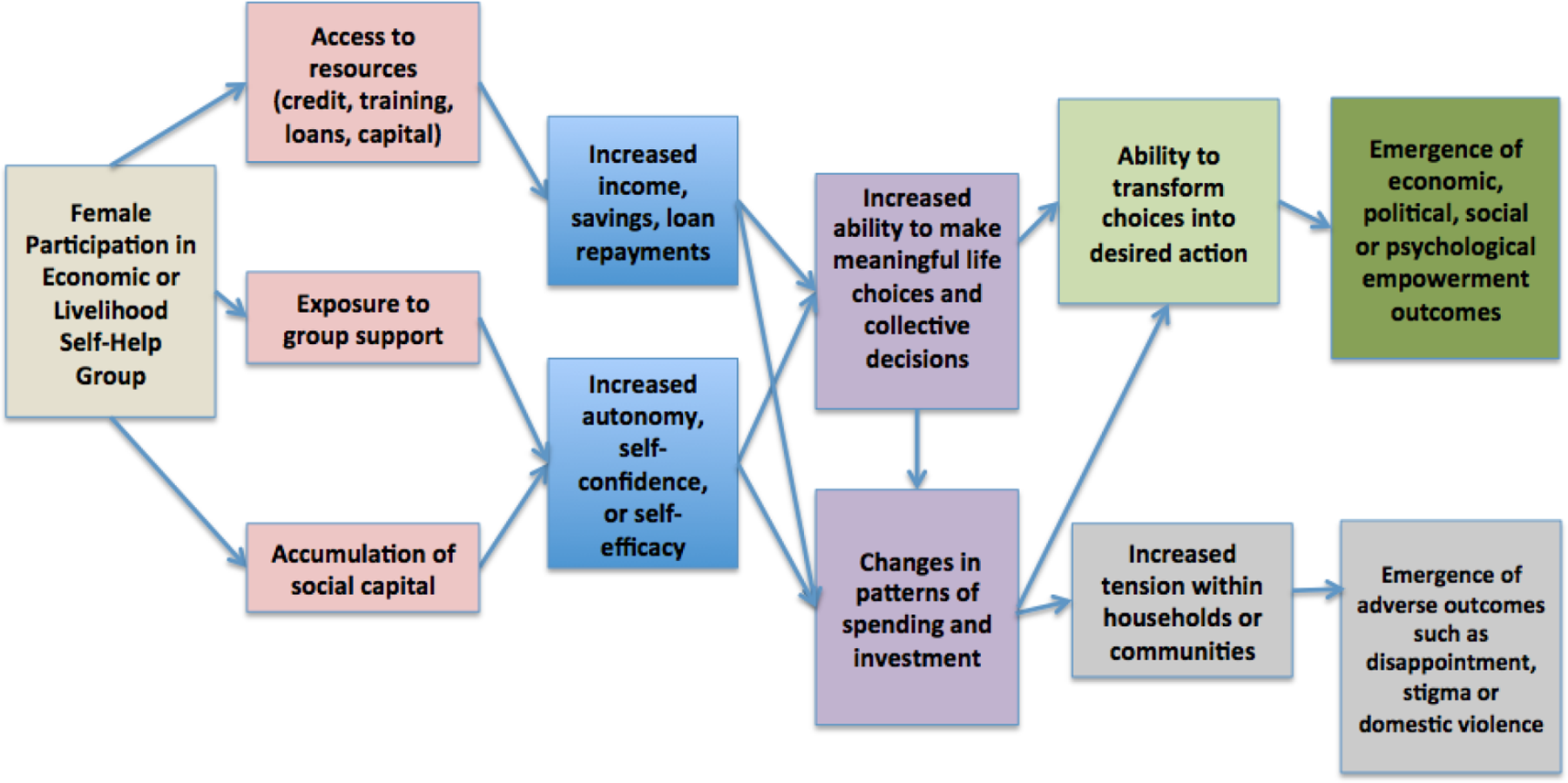
Economic Self-help Groups and Empowerment Casual Pathway
Based on the literature, we hypothesise that women's participation in economic and livelihoods SHGs will enable women to gain access to resources in the form of credit, training, loans or capital. Consequently, these women will experience an increase in income, savings, and/or loan repayments. In addition, participants will be exposed to group support and will accumulate social capital. As a result of group support and social capital, women will experience increased feelings of autonomy, self-confidence and self-efficacy. With both an increase in financial stability and an increase in feeling of self-confidence, participants will be able to make meaningful life choices and their patterns of spending and savings will change. As a result of these changes, women may experience an increased ability to transform their choices into desired actions, which would lead to the emergence of economic political, social, and psychological empowerment outcomes (Eyben, Kabeer & Cornwall, 2008). However, it is also possible that these changes will increase tensions within households and communities, which will lead to disappointment, stigma and domestic violence.
Numerous factors can modify the pathways described above. For example, we know from the literature that empowerment can occur at the individual and collective levels (Eyben, Kabeer & Cornwall 2008). Individual empowerment indicates changes that have occurred within an individual. Collective empowerment indicates that structural changes in power relations have occurred. While self-help group participation may lead to improved self–efficacy of an individual (individual empowerment), the systematic marginalisation of that group may remain unchanged (collective empowerment). In addition, the economic climate, departures from program fidelity, the role of the facilitator and underlying class/caste issues can affect how program benefits are realised. While we have not mapped all of these potential modifiers in the above causal pathway diagram, these factors will be captured during the review process and reported in the limitations section.
Empowerment studies have lent credence to the concept that women can and should be central actors in social and economic development. But it is important to note that empowerment of an individual or a small group alone may invoke negative reactions when familial, community and structural factors have not yet adjusted to women's changing roles. Intimate partner violence, for example, has been shown to remain, if not increase, in prevalence when women's economic empowerment is not coupled with additional family and community interventions that address women's empowerment within the context of these relations (Dala 2011; Ahmed 2005).
Studies have also shown that increasing women's monetary contributions to the family without also taking into account the upheaval this may cause with respect to expected gender and domestic responsibilities can lead to increased household tensions and decreased emotional well-being for women (Ahmed 2005; Ahmed & Chowdhury 2001). Short and long term backlash tendencies are therefore important to consider when examining the impacts of self help groups on empowerment.
1.4 WHY IT IS IMPORTANT TO DO THIS REVIEW
In reviewing the impact of self-help group programs on women's empowerment, we base our review on the understanding that a great deal of evidence has been generated from quantitative and qualitative research, much of which can be useful in informing policy and practice. Several systematic reviews addressing related topics have been identified in the literature:
The reviews above are restricted to microcredit interventions and do not comprehensively review and synthesise the evidence on the impact of self-help group interventions that include collective finance, enterprise and/or livelihoods components. In addition, the reviews have a limited focus on empowerment outcomes and do not comprehensively cover a range of key empowerment outcomes such as decision-making within households, feelings of self-confidence or autonomy, or the ability to work outside the home. Vaessen's review is the only review with an explicit focus on women's empowerment. However, the review does not focus on self-help groups, covers microcredit interventions only and does not synthesise empowerment outcomes other than women's control over household resources.
We plan to look at quantitative studies evaluating the impact of self-help group programs with a broader range of collective finance, enterprise and livelihoods components on political, economic, social and psychological empowerment and qualitative studies of women's perceptions of the barriers and facilitators to women's empowerment through these interventions. We intend to conduct an integrated mixed-methods review in order to benefit from data generated through both types of research methods and to enhance the review's utility and impact for policymakers. As Harden describes, “mixed-methods systematic reviews can be defined as combining the findings of ‘qualitative’ and ‘quantitative’ studies within a single systematic review to address the same overlapping or complementary review questions.” This approach allows us to capture a broader range of evidence than a traditional review of quantitative studies so that we can more comprehensively answer the policy question.
2 Objective of the review
The primary objective of this review is to answer the following two research questions:
What is the impact of women's economic self-help groups on women's individual empowerment in low and middle-income countries? What are the perspectives of female participants on factors determining their participation in, and benefits from, economic self-help groups in low and middle-income countries?
A secondary objective of this review is to revise the theory of change that describes how women's economically-oriented self-help groups lead to women's empowerment using evidence drawn from both rigorous quantitative impact evaluation studies and qualitative studies of perspectives of female self-help group participants.
3 Methods
3.1 CRITERIA FOR INCLUDING STUDIES IN THE REVIEW
3.1.1 Participants
Women of all ages in low- and middle-income countries, as defined by the World Bank categorisation of low and middle-income countries based on GDP, at the time the data were collected. Exclude studies of interventions in high-income countries. For the purposes of this review, we will include women's self-help groups and self-help groups where participation is not limited exclusively to women but where impacts on women are assessed separately from men. Studies where impacts are not disaggregated by gender and self-help groups composed exclusively of men will be excluded.
3.1.2 Interventions
We will include studies on self-help group programs where female participants physically come together and receive a collective finance and enterprise and/or livelihoods group intervention.
We define self-help groups, also known as mutual aid or support groups, as those groups that involve people who provide support for each other and/or are created with the underlying assumption that when individuals join together to take action towards overcoming obstacles and attaining social change, individual, and/or collective empowerment can result. We plan to examine those groups that have been initiated by an external agency (that is, a development organisation or research group) as well as those that have come to existence without any direct external involvement. To be included, the self-help groups need to receive an economic intervention that includes or contains the following components: collective finance and enterprise
1
(such as savings and loans, group credit, collective income-generation, micro-insurance) and/or livelihoods interventions (such as life skills, capacity-building, business training, financial education, labour and trade group organising).
2
We will exclude studies evaluating individual self-help or group programs that are not explicitly designed as self-help programs or that do not have a collective finance, enterprise or livelihoods intervention component. In addition, a forthcoming Campbell review (Vaessen et al. 2012) analyses quantitative studies that examine women's control over household resources as a result of microcredit programs. We plan to look at both qualitative and quantitative studies evaluating microcredit self help group programs but will exclude outcomes included in their study (micro-credit self help groups evaluated quantitatively using “women's control over household resources” as an outcome) from our analyses so as not to overlap with this review.
3.1.3 Outcomes
3.1.3.1 Primary Outcomes
To be included in the review, studies must measure at least one of the following empowerment outcomes, as defined below 3 :
economic empowerment Political empowerment social empowerment psychological empowerment
The studies must use at least one relevant outcome indicator. There is a broad range of outcome indicators that have been used to measure economic, political, soci0-cultural and psychological empowerment outcomes in the empirical literature. We will include all outcome indicators that meet the definitions of our outcomes. The included outcome measures will be organised and analysed along the causal chain in the review. Conceptually similar indicators will be combined.
These indicators can be measured through household surveys, validated scales, structured closed-ended questionnaires, in-depth interviews, focus groups, and personal narratives.
Aggregate level empowerment outcomes such as women's right to vote, legislation against domestic violence, inheritance law, female literacy, female child survival and so on, will be excluded from this review.
3.1.3.2 Secondary Outcomes
Spillover effects from women's self-help group participants to non-participating women in the same communities.
Adverse outcomes (for example):
Intimate partner violence Stigma Disappointment
3.1.4 Study Types
To answer our review question, we will include component studies that have the following study designs:
Objective 1: We will include the following study designs: 1) experimental designs using random assignment to the intervention and 2) quasi-experimental designs with non-random assignment (such as regression discontinuity designs, ‘natural experiments’ and studies where participants are self-selected into the programme). To be included, the studies need to: 1) collect data at baseline and endline (longitudinal) and/or cross-sectional (endline) data from treatment and comparison groups and 2) use statistical matching, difference-in differences estimation, instrumental variables regression or other forms of multivariate analysis (such as Heckman's selection models) that correct for selection bias. We will include data collected at individual and group level. For interrupted time series, at least three data points need to be collected before and after the intervention for the study to be included. Comparison conditions eligible are no comparison, pipeline or ‘business as usual’. Objective 2: We will include qualitative studies that explore empowerment from the perspectives of women participants in self-help group programs using such methodologies as in-depth interviews, participant observation and focus groups that draw on such techniques as phenomenological analysis, grounded theory, or ethnography. These studies must report individual narratives from women and must include discussion of factors that determine women's participation in, and benefits from, economic self-help groups.
We will exclude studies that have the following design:
Objective 1 and 2: studies that do not contain one of the empowerment outcomes. Objective 1: quantitative studies without any type of observable comparator (for example, time or control group) and credible methods of correcting for selection bias as outlined above. Single group pre-post studies will be excluded. Objective 2: qualitative studies that do not employ the defined methodologies listed above or that do not draw from direct observation or direct reports from female self-help group program participants.
3.2 SEARCH METHODS FOR IDENTIFICATION OF STUDIES
3.2.1 Electronic searches
The literature search will occur in two phases.
Phase 1: The first phase will involve searching the following databases:
PubMed (http://www.pubmed.gov)
IndMed (http://medind.nic.in/)
POPLINE (http://www.popline.org/)
PsycINFO (http://www.apa.org/psycinfo/)
Index Medicus for the WHO (http://www.globalhealthlibrary.net)
Social Sciences Citation Index
International Bibliography of the Social Sciences
(www.lse.ac.uk/collections/IBSS/about/keyFacts.htm)
British Library of Development Studies (BLDS),
Joint libraries of WB and IMF (JOLIS)
3ie database of impact evaluations
Econlit
Global Health (CABI)
Africabib
Phase 2: Phase two will consist of reviewing reference lists of included studies and searching through studies that have cited the included studies for additional resources, conducting supplemental keyword searches using identified program names and locations, and contacting key experts for additional information.
In the second phase of the search, we will conduct a supplemental keyword search in google.com based on leads generated by the search described above. For example, if a search identifies an article mentioning (but not evaluating) a self-help group program through an MFI institution in the Philippines called Tulay sa Pag-unlad, Inc. (TSPI) which reported a dramatic increase in women's role as funds managers in their households, a search of google.com and google.scholar will use a search of “Tulay sa Pag-unlad Inc” and several keywords to determine whether there is additional information on the program that may include evaluation information relevant to the analysis.
We will also search the grey literature for dissertations, theses, government reports, non-governmental organisation reports, and funder reports including:
Search Engines (limited to the first 100 hits ordered by relevance): IDEAS/RePEc
Google/Scholar
Africa-Wide
Dissertations and Theses:
ProQuest
http://www.umi.com/enUS/catalogs/databases/detail/pqdt.shtml
3.2.2 Other Searches
Hand search relevant shelves:
UC Berkeley Library
Touro University
University of California, San Francisco
Key Journals (Past 2 years in case they have not been indexed in databases):
Journal of Development Effectiveness, Health Policy, Global Public Health, Health Policy and Planning, International Journal of Health Planning and Management, Health Care for Women International, Development, Journal of Development Economics, International Journal of Sustainable Development, Indian Growth and Development Review, Journal of International Development, Economic Development and Cultural Change, Feminist Economics and World Development, Current Anthropology, International Journal of Social Research Methodology, Qualitative Research in Psychology, Indian Journal of Gender Studies, Third World Quarterly, Development Change.
Multi-lateral Organisations:
United Nations Fund for Population, United Nations Development Fund for Women, United Nations Development Programme, United Nations Children's Fund, African Development Bank, Asian Development Bank, United Kingdom's Department for International Development, United States Agency for International Development, World Bank, International Fund for Agricultural Development, World Health Organization, Inter-American Development Bank
We will also contact key personnel at the following organisations and foundation to elicit additional grey or unpublished information:
GROOTS International, African Women's Development and Communication Network (FEMNET), Asian Women's Network on Gender and Development, Women Deliver, The Latin American Women and Habitat Network, International Committee for Research on Women, Population Council, AED Center for Gender Equality, The Global Fund for Women, UCGHI Center of Expertise on Women's Health and Empowerment, The Hewlett Foundation, The Packard Foundation, The Guttmacher Institute, the Center for the Evaluation of Global Action and Ford Foundation, SEWA.
Another search component in phase two is to review the citations of all included studies and contact the lead authors or corresponding authors from the included studies with the request that they review the list of studies and make further suggestions for consideration, particularly for unpublished studies.
A record will be maintained describing the databases searched, the keywords used, and search results.
3.2.3 Search terms
3.2.4 Time period
Include studies conducted from 1980 – present, since the emergence of self-help group programs began in the early 1980s. Exclude studies that were not conducted within this time frame.
3.3 DATA COLLECTION AND ANALYSIS
3.3.1 Selection of studies
In the first stage, two team members will independently review titles and abstracts or executive summaries (where available) and exclude all references that are clearly irrelevant. Duplicate references will also be excluded. Disagreements about inclusion will be resolved through discussion. If no agreement can be reached, a third independent member of the team will be used to resolve the disagreement.
In the second stage, two team members working independently will apply the specified inclusion/exclusion criteria to the remaining abstracts and determine whether the study should be included for analysis. In the case of a discrepancy between the two reviewers' assessments, the case will be discussed with a third team member for a decision. Where necessary, the full text of an article may be retrieved to determine eligibility of studies for inclusion.
3.3.2 Data extraction and management
Two team members working independently will extract information from each study included in the review. Both team members will use a pre-piloted data extraction form and summarise data in a table. Disagreements in coding will be resolved through discussion. If no agreement can be reached, a third independent member of the team will be used to resolve the disagreement. Study, group, outcome and effect level data extraction and coding forms will guide the data extraction (Appendix 8.1).
3.3.3 Assessment of risk of bias in included studies
Two independent reviewers will assess quantitative study rigor using a published list of criteria, developed by 3ie, to assess risk of bias in social experiments and quasi-experiments (Hombrados and Waddington 2012). The critical appraisal tool will assess the likely risk of the following biases:
Selection bias and confounding, based on quality of attribution methods (mechanisms of assignment/ identification), and assessment of group equivalence Performance bias, based on the extent of spillovers to women in comparison groups; Outcome and analysis reporting biases Other biases, including: unit of analysis errors detection bias and placebo effects motivation and courtesy biases (Hawthorn effect; John Henri effect) coherence of results, retrospective baseline data collection other biases.
We will judge whether a study is subject to high/medium/low risk of bias for each of these risk of bias categories using the following decision rules:
For review question 1:
Studies will be critically appraised according to the likely risk of bias based on: 1) the quality of attribution methods (addressing confounding and sample selection bias); 2) the extent of spillovers to women in comparison groups; 3) outcome and analysis reporting bias; and 4) other sources of bias. We will assess risk of bias among these domains using the decision rules in the IDCG risk of bias tool. In addition, the following classifications will be made according to their respective definitions:
We will report risk of bias assessment for each included study, conducting sensitivity analyses by overall risk of bias classification and, where sufficient studies are available, for each risk of bias domain.
For review question 2:
We will assess the quality of included studies using the Critical Appraisal Skills Programme Qualitative Research Checklist (CASP, 2013), making judgments on the adequacy of stated aims, the data collection methods, the analysis and the conclusions drawn. The checklist can be found here: http://www.casp-uk.net/wp-content/uploads/2011/11/CASP-Qualitative-Research-Checklist-31.05.13.pdf.
The results of the quality appraisal will be reported in the review and we will conduct a sensitivity analysis to assess how sensitive our findings are to the removal or addition of studies of varying quality (Noyes et al., 2011).
3.3.4 Measures of treatment effect
Where possible, we will calculate standardised mean differences (SMDs) for continuous outcome variables, and risk ratios (RRs) for dichotomous outcome variables. Treatment effects will be calculated as the ratio of, or difference between, treated and control observations in a consistent way, such that outcome measures are comparable across studies. Where it is not possible to calculate SMDs, we will calculate response ratios, which measure the proportional change in an outcome in the intervention group relative to that in the comparison group.
3.3.5 Methods for handing dependent effect sizes
We will include only one effect estimate per study in a single meta-analysis. Where studies report multiple effect sizes by sub-group, we will report data in separate analyses or compile estimates prior to meta-analysis by calculating a single sample-weighted average effect size for each study, using appropriate formulae to recalculate variances and standard errors and making covariance assumptions as necessary (as per Borenstein et al., 2009 and the Cochrane Handbook Chapter 16).
3.3.6 Unit of analysis issues
Where the unit of analysis is different from the unit of treatment allocation (that is, where the unit of allocation is by group but the unit of analysis is at the individual level), we will assess whether the primary study authors have taken clustering into account in the analysis and use the adjusted standard deviations. For studies with a risk of unit of analysis error, we will apply corrections to the standard errors and confidence intervals using the variance inflation factor as follows: SEcorrected = SEuncorrected × √(1 + (m – 1) × ICC) where m is the is the number of observations per cluster and ICC is the intra-cluster correlation coefficient. If information about cluster size is not reported, we will estimate cluster size by dividing the total number of participants in each analysis (or the total number of participants if former not available) by the number of clusters. If the data for estimating the ICC are not available, we will estimate the ICC values for the corresponding outcomes using published ICCs from other studies reporting the same or a similar outcome measures (Waddington et al. 2012).
3.3.7 Dealing with missing data
If the necessary data to calculate effect sizes are not available in the included studies, we will attempt to contact the authors of the studies. If missing data cannot be retrieved from authors, we will extract or impute effect sized based on commonly reported statistics such as the t or F statistic or p or z- values using David Wilson's
3.4 DATA SYNTHESIS
We intend to conduct an integrated mixed-methods review in order to benefit from data generated through both types of research methods and to enhance the review's utility and impact for policymakers. An integrated review has three stages: 1) a summary of quantitative effects, 2) a summary of relevant qualitative pieces, and 3) a synthesis of both summaries that ‘goes beyond’ the primary studies and generates new interpretations or hypotheses (Harden 2010, Thomas 2004). We plan to conduct a meta-analysis with the data extracted from quantitative studies, and use meta-synthesis methods to synthesise the textual data extracted from the qualitative studies. We will then integrate the findings from the qualitative synthesis with those from the quantitative studies in order to develop a framework for assessing how economic self-help groups can impact women's empowerment.
The extracted data from the quantitative and qualitative studies will be analysed separately.
3.4.1 Quantitative Synthesis
We will investigate the possibility of statistically combining results from two or more quantitative studies of comparable self-help group programs with the same evaluation design and the same outcome variable through a random effects meta-analysis of effect size estimates. We will judge studies to be sufficiently similar to be combined in a single meta-analysis if there are two or more studies available where:
the interventions are judged to be sufficiently similar the effect sizes can be computed the outcome measures are judged to be sufficiently similar in terms of construct validity (that is, measuring the same outcome construct, though potentially measured in different ways)
Where possible, we will report and synthesise effect sizes separately for women's self-help group participants and neighbouring women who might indirectly benefit from the intervention, to assess the extent of spillovers.
Different effect size measures (that is, standardised mean differences and risk ratio effect sizes) will be analysed separately. Different study designs will be analysed in the same meta-analysis initially but a sensitivity analysis will be carried out to assess whether the type of study design moderates the effect size findings. We will present the meta-analysis results using forest plots.
Where meta-analysis is not possible, we will synthesise the studies using narrative synthesis. Using this method, we will report and take into account sample size and magnitude of effect when interpreting findings and present the direction, magnitude and statistical significance of findings, using effect sizes where calculable as well as the sample size and risk of bias.
3.4.1.1 Assessment of heterogeneity
When meta-analysis is possible, we will explore heterogeneity across studies using the I-squared statistic and tau-squared (τ2).
When meta-analysis is not possible, we will explore heterogeneity narratively.
3.4.1.2 Investigation of heterogeneity
We will use sub-group analysis to explore factors explaining heterogeneity using the following moderating variables:
type and number of intervention components type of group initiation (by external agency vs. no direct external involvement) geographic location.
We will use inverse-variance weighted ANOVA to examine each listed moderator in turn.
When meta-analysis and subgroup analysis is not possible, we will discuss reasons that might explain heterogeneity of results narratively.
3.4.1.3 Sensitivity Analysis
We will perform a sensitivity analysis using an inverse-variance weighted ANOVA approach according to the following effect size moderators:
Overall risk of bias classification Risk of bias status for each risk of bias category (where sufficient studies available) study design (RCTs vs. quasi-experimental studies)
If meta-analysis and weighted ANOVA sensitivity analysis are not possible, we will separately analyse findings from RCTs and quasi-experimental studies and describe methodological factors that might moderate the effect size narratively. We will separately analyse findings with high risk of bias and studies with low and medium risk of bias.
3.4.1.4 Assessment of publication bias
We will assess the possibility of publication bias using funnel plots if sufficient data is available. If this is not possible, we will conduct sub-group analysis of published versus unpublished studies (using inverse-variance weighted ANOVA if possible).
3.4.2 Qualitative Synthesis
Qualitative analysis will consist of a thematic analysis, which is an iterative process where researchers will discuss the emergent themes from studies and determine how they are related, or dissonant, through a compare and contrast exercise. Key concepts will be translated within and across studies, and will result in a new interpretation of those themes. This process will result in a nuanced level of understanding and iterative conceptual development focused on the empowerment process.
The meta-synthesis of qualitative studies will follow the Walsh and Downe (2005) framework. Thematic analysis techniques will be used to synthesise qualitative study results. The studies will be read repeatedly to extract the concepts, categories, metaphors and themes used to describe or interpret the accounts provided by the women interviewed. The emergent themes will be discussed extensively among the research team and the studies will be reread to consider any evidence that could be refuted (Noblit and Hare, 1988). Discussions between team members will help to build consensus on the themes.
3.4.3 Integrating findings from quantitative synthesis of effectiveness with qualitative synthesis
To integrate the findings from quantitative and qualitative synthesis, we will conduct the synthesis of effects along the causal chain and use the findings of the qualitative synthesis to “interrogate” and/or complement the quantitative synthesis. The information from participants gathered through qualitative investigations will be used to understand whether and where any causal chain links break down in our theory of change. In other words, findings from the qualitative synthesis will describe, explore and help interpret both the nature of the empowerment and the extent to which women experienced empowerment. For example, while a quantitative assessment of a micro-finance self-help group program may find that women participants reported an increase in decision-making power within their households, qualitative findings may describe what types of decisions women had more power to make and how that affected their perception of their lives or self-images. Or the qualitative findings may indicate that although women reported more decision-making power, they perceived a backlash from their community and felt more isolated than before. The mixed methods review allows information gathered using different methodologies to inform, enhance and supplement each other. The findings from the integrated synthesis will be used to revise and improve our theory of change using information extracted from the included studies and provide insights about the nature and utility of the measures used to capture empowerment, with the aim to synthesise the evidence produced by both bodies of research in order to capture the state of the evidence for the impact of self-help groups on women's empowerment.
4 Timeline
Title: 15/06/12
Draft Protocol: 30/06/13
Draft Report: 30/01/13
Final Report: 01/06/14
Policy brief and short summary: 01/06/14
5 Acknowledgements
We would like to thank 3ie for funding this study. We would also like to acknowledge our advisory group and research assistants.
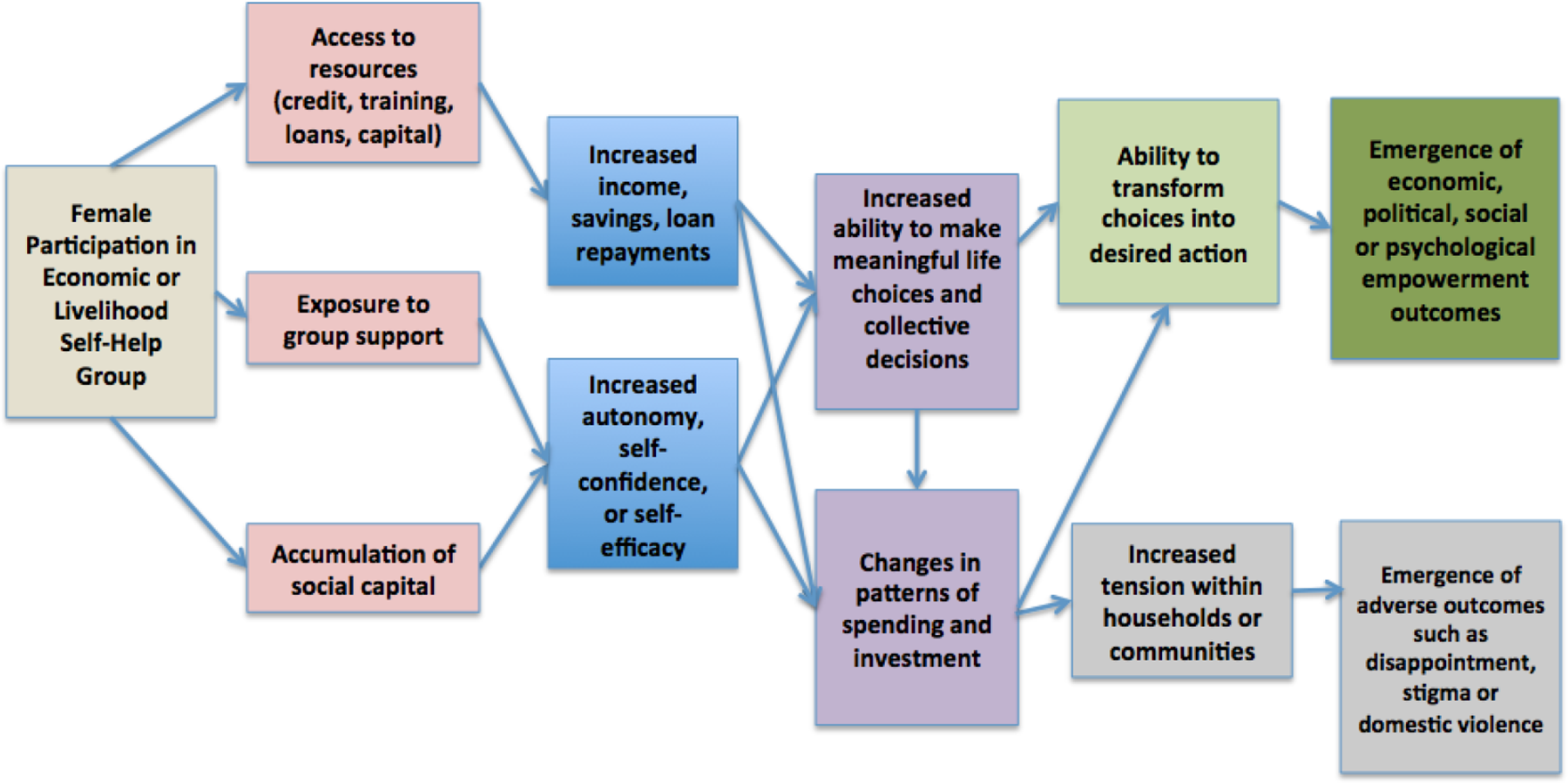
Economic Self-help Groups and Empowerment Casual Pathway
Footnotes
8 Appendices
9 Sources of support
1
An example of a collective finance intervention is SaveAct in South Africa which allows members of the community to voluntarily form a group and save money in the form of share purchases. The group also contributes monthly to a Social Fund to assist members in times of emergency or family crisis, such as a death in a member's family ( , 2013).
2
An example of an individual livelihoods intervention is the Neang Kongrey Stoves project in Cambodia, which offered training program to three groups of local potter women on how to produce improved cook stoves. (World Bank, 2009).
3
Sources: Malhotra 2002, Mayoux 1998, Eyben, Kabeer & Cornwall 2008, Advisory Group