






Abstract
Linked article:
BACKGROUND
Access to agricultural inputs
With 12.5 per cent of the world's population currently undernourished (FAO, 2013) there is an urgent need to improve food security. Increased agricultural productivity has been identified as a potential means for improving the food supply aspect of food insecurity, and agricultural inputs can help to increase productivity greatly (Gordon, 2000). Adequate inputs are important to achieving agricultural productivity in developing countries (Buringh & Dudal, 1987; Hazell et al., 2007, Ajah & Nmadu, 2012). There is a strong concern that in developing countries, the inputs and technologies needed to achieve increased productivity are financially unaffordable or unattractive to many poor farmers (e.g. Wiggins & Brooks, 2010). Agricultural input subsidies are a potential way of incentivising farmers to purchase inputs that they are unable or unwilling to obtain at market rates; for example, because they lack access to credit or find or expect the inputs to be unprofitable at market prices given existing knowledge about their benefits, and so on. Input subsidies could thus provide a means for achieving higher agricultural productivity, improved food security and, through lower food prices, pro-poor economic growth.
There is, however, considerable contention among policy makers and analysts regarding the effectiveness and efficiency of investments in agricultural input subsidies and the conditions under which they may or may not work (Wiggins & Brooks, 2010; Kilic et al., 2013; Pauw & Thurlow, 2014).
Agricultural input subsidy interventions
Agricultural input subsidies were common in poor rural economies in the 1960s and 70s, but conventional wisdom deemed them ineffective by the 1980s and 90s (Dorward, 2009). However, in recent years, there has been a resurgence of interest and investment, mainly in Africa, in so-called ‘smart subsidies’, which seek to maximise the multiple benefits of subsidies to different stakeholders while minimising their distortionary effects on inter alia efficient commercial market operation and development (Morris et al., 2007). This resurgence was the result of a need to boost food security in the short-term while also implementing longer-term investments to raise productivity. Such programmes use vouchers for targeting, rationing and private-sector delivery.
How subsidies might work
Impacts on agricultural production and productivity are the direct impacts that are expected from input subsidy programmes. Historically, the economic justification for agricultural input subsidies involved reducing temporary knowledge and risk constraints to farmers' adoption of improved technologies and practices, and increasing productivity with farmer benefits and/or consumer gains, from produce and labour market and price effects.
However, wider potential subsidy impacts associated with the introduction of new and innovative agricultural input subsidy programmes are increasingly recognised and investigated, including private market development, soil fertility replenishment, social protection, national and household food security, and growth (Dorward, 2009). These indirect (or dynamic) environmental, income and consumer welfare effects are only expected when there are direct (or static) production effects.
These wider impacts, still critically dependent on links from productivity impacts, are affected by a variety of factors, including:
Subsidy design and implementation: inputs subsidised, targeting and access, beneficiary household characteristics, complementary inputs and investments including credit, subsidy scale and rationing (for example, value per beneficiary), market effects and technical fit (for example, marginal productivity);
Institutional and policy context: complementary services (research, extension, transport, inputs, markets and finance), institutions, policies and infrastructure;
Output market characteristics: tradable/non-tradable, staple/non-staple foods and cash crops, input and product demand elasticities (allowing for close substitutes);
Farmer characteristics: e.g. knowledge, attitude to risk, credit constraints, profitability and household livelihood sources;
Technology characteristics: e.g. scale-neutral/biased; labour, land or capital bias; fertiliser, seeds and demand elasticity;
Livelihood and economy characteristics: wealth, economic activity and activities such as different farm and non-farm activities, diversity within and between livelihoods, production systems, asset holdings and attributes (e.g. land, machinery and education);
Infrastructure: roads (for example all weather or seasonal roads), information communications technology (ICT), access to international markets, irrigation;
Institutions and policies: input and output market structure and conduct, market standards, land tenure and other property rights, gender relations, formal and informal social protection, produce pricing policies, labour relations and markets and farmer credit access;
Agro-ecological, climate and weather conditions: spatial and temporal rainfall distribution, droughts, soils, temperatures, pests and diseases;
Politics: stability, conflict, formal and informal rules of behaviour, corruption, transparency, accountability, elections and governance systems;
Development context: for example, general ‘stages of growth’ of agricultural development (Ruttan, 2012), market/economy ‘thickness’ (the number of participants in a market), macroeconomic conditions (including for example foreign exchange rules and situation), ‘low productivity traps’ (vicious circles of low investment, income and productivity), and political systems.
This is illustrated in the impact pathway attached (Figure 1). This figure has been developed from reviews of theory and literature (e.g. Dorward, 2009 and intensive evaluation by Dorward and Chirwa of the Malawi Agricultural Input Subsidy from 2006/7). It shows the main outcomes and impacts flowing from input subsidies and the causal links between them. On the right hand side are the main contextual influences that affect impacts and the links between them.
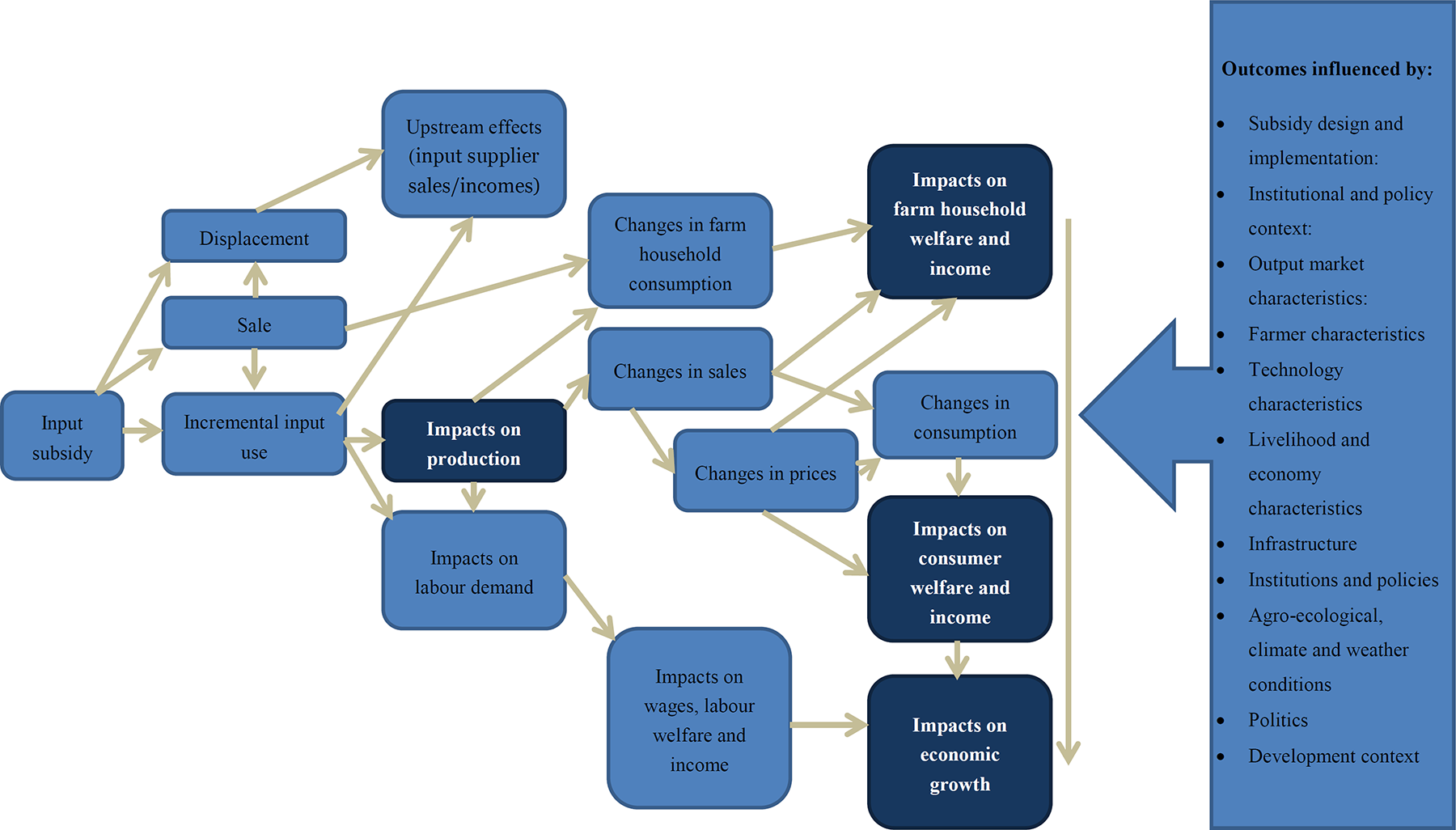
Impact Pathway of Agricultural Input Subsidies
A policy-relevant systematic review of agricultural input subsidy impacts therefore requires: examination of direct (static) effects such as impacts on beneficiary farmers' incomes; examination of broader impacts including indirect (dynamic) effects such as productivity impacts on consumer welfare and wider growth; and analysis that distinguishes between different contexts, issues and impact chains.
Why it is important to do the review
While subsidies sometimes played a key but time-limited development role (e.g. Timmer, 2004), empirical studies generally revealed negative impacts and difficulties in cost control, diversion (inputs being stolen or used by others other than the intended recipients), overuse of inputs and capital (discouraging more labour-intensive methods), regressive benefits, and market distortions inhibiting private investment in agricultural services (e.g. Ellis, 1992; Morris et al., 2007; Timmer et al., 2009). Dominant analyst and donor thinking therefore considered agricultural subsidies to be generally ineffective and inefficient.
This viewpoint has been challenged by re-examination of successes and failures of both state- and market-led agricultural development (e.g. Fan et al., 2004; Djurfeldt et al., 2005; Dorward, 2009), and by calls from African governments, NGOs and some donors for input subsidies to address agricultural stagnation in Africa. Furthermore, wider potential subsidy impacts associated with different delivery mechanisms are, in turn, generating new impact studies (e.g. Ricker-Gilbert et al., 2009; Liverpool-Tasie et al., 2010; Ricker-Gilbert et al., 2010; Ward & Santos, 2010; Chirwa et al., 2011; Pan & Christiaensen, 2011; Liverpool-Tasie, 2012).
While the literature has been reviewed (e.g. Chirwa & Dorward, 2013), no systematic review of agricultural input subsidies has, to our knowledge, been published in the past, using systematic data collection, critical appraisal and statistical synthesis using meta-analysis, and neither have more general reviews been sufficiently theoretically rigorous in addressing the range of possible programmes, outcomes and impacts discussed above.
This systematic review will therefore not only provide the first systematic review of this topic, it will also address a major gap existing in general literature reviews by taking a more holistic approach in addressing direct and indirect effects.
OBJECTIVES
The primary research question is: what are the effects of agricultural input subsidies on productivity, farm incomes, consumer welfare and wider growth in low- and middle-income countries?
1
This will be treated as a set of linked research questions (see also Figure 1), examining: what are the direct (static) effects of agricultural input subsidies on agricultural productivity? what are the indirect (dynamic) effects of agricultural input subsidies on farm incomes, consumer welfare and wider growth?
We will examine the linkages between direct and indirect effects as indicated by prices and other mediating effects (Figure 1), as well as contextual factors moderating the effects of subsidies.
We intend the review to become a key resource in ensuring that all stakeholders concerned with the potential development and/or implementation of agricultural input subsidies: are aware of the range of advantages and limitations of different approaches to agricultural input subsidies for achieving different policy goals in different contexts; and are able to draw on a technical audit of the existing evidence together with accessible information on implications for improved policy selection, design and implementation if and where this is appropriate.
We aim to contribute to the achievement of these objectives and to influence the policy discourse away from more ideological arguments for or against subsidies to more empirically based (and theoretically grounded) arguments that consider their particular short- and long-term strengths and weaknesses for particular purposes in particular situations. The study dissemination plan is presented in Annex 1.
METHODOLOGY
The systematic review will be conducted in two main parts: firstly, searching and identifying relevant studies; and secondly, data extraction and synthesis of findings.
Study inclusion criteria
The literature will be assessed against whether the article assesses the effects of one or more subsidies of agricultural inputs in a low- or middle-income country. The inclusion criteria follow the conventional population, intervention, comparator, outcome, study design (PICOS) structure (Table 1).
Components of the systematic review research questions (RQ)
Population
Eligible populations are people for whom data are collected at all levels (e.g. country, region, community, household or individual) living in a low- or lower-middle-income country (as defined by the World Bank) at the time the intervention was carried out. ‘Low- and lower-middle-income countries’ as defined in March 2012 by the World Bank are divided according to 2008 GNI per capita, calculated using the World Bank Atlas method 2 . The group of countries included consists of the 36 low-income economies ($1,025 or less); and 48 lower-middle-income economies ($1,026 to $4,035) at the time of the search. Studies that relate to countries that were developing countries by such definition during the experimental study period but are no longer on the World Bank list at the time the search is conducted, will not be explicitly sought, but will be included where identified. The populations considered include direct beneficiaries of the intervention (farmers and farm households) and those who may be indirectly affected (wage labourers and food consumers).
Intervention
Interventions studied will be limited to direct agricultural producer subsidies for inputs. ‘Agriculture’ is defined as animal or crop production (i.e. excluding forestry and fisheries). ‘Agricultural input subsidies’ are defined as grants (or loans, if repaid at below the market price) given to a farmer as a means of reducing the market price of a specific input used in agricultural production (Harman, in prep). We will distinguish between full (100%) and partial subsidies as appropriate. Credit and loans for unspecified purposes or inputs are not included in this study as they have distinct economic effects, as covered in a much broader literature. We will also exclude early-stage agricultural research station field trials and humanitarian relief programmes, as the adoption of these trial inputs and such emergency interventions are unrepresentative of impacts of input subsidies in normal agricultural practice.
Comparator
Eligible comparisons include no active agricultural input subsidy intervention, wait-list, alternate input subsidy intervention, or other interventions providing access to inputs. We will collect data on comparison conditions and test for systematic differences in effects accordingly in moderator analysis.
Outcomes
Primary outcomes
Primary outcomes include direct static outcomes including agricultural production and productivity and farm income. ‘Agricultural productivity’ is measured in broad terms by production per resource unit such as yields per unit land, net revenue (profits per unit of land) and production per unit of labour. ‘Agricultural production’ includes total production per farm. ‘Farm income’ is measured by the value of production at market prices, net of cost of purchased inputs; it may or may not also be considered net of imputed costs (e.g. of own land or family labour).
Primary outcomes also include indirect dynamic outcomes such as consumer welfare and wider growth, which result from changes in agricultural production and productivity and farm income. ‘Consumer welfare’ is measured by changes in real income that are commonly used as proxy measures of welfare in benefit cost analysis, and generally provide similar answers (Sadoulet & de Janvry, 1995; Alston et al., 2000). Real incomes are often measured by consumption or expenditure and poverty aggregates. 3 Poverty may be measured in terms of the relative number of individuals/households below a given poverty line, as well as other aggregates such as depth of poverty (average distance below the line) and severity of poverty (degree of inequality below the line). ‘Wider growth’ refers to growth in, and outside of, the agricultural sector and may be measured by GDP growth in the wider economy or in sectors and subsectors outside those directly affected by (benefiting from) a subsidy. These effects are only expected when there are direct production effects.
Secondary outcomes
Secondary outcomes are all intermediate outcomes, including effects on input use (including displacement, sales and upstream effects 4 ), impacts on labour demand, wages and labour welfare (including incomes), farm household sales and consumption, and prices (see Figure 1). Secondary outcomes will only be collected from papers that report primary outcomes.
Study Designs
The different elements of the review question pose different challenges in empirical determination of subsidies' impacts. This can be seen with reference to the impact pathway in Figure 1: some impacts affect subsidy beneficiaries directly (for example, changes in beneficiaries‘ productivity and incomes) while others affect beneficiaries and non-beneficiaries indirectly (farm incomes, wages rates, consumer welfare and wider growth). While direct impacts are normally amenable to experimental and quasi-experimental investigation comparing beneficiaries and non-beneficiaries, indirect impacts are not amenable to such investigation unless the subsidies are administered in restricted areas within which market impacts are also restricted, using clustered designs at appropriate levels. This situation is not common and does not usually apply to large-scale subsidies, which are of major policy interest.
In view of these differences between potential methods for investigating direct and indirect subsidy impacts, we define different types of study design that will be included to answer questions on direct and indirect effects (Table 1). We will only include studies that involve some counterfactual comparison of results with and without subsidy treatments.
Direct subsidy beneficiary impacts: methods include randomised control trials and studies that use some formal methods for removing likely biases from non-random assignment of subsidy receipt. Such methods include regression studies using difference in differences (or fixed effects models), instrumental variables regression, regression discontinuity, and propensity score matching methods, as appropriate for analysing panel or cross-sectional household data with randomised or quasi-randomised beneficiary selection or beneficiary selection by programme planners.
Indirect subsidy impacts: methods include studies with appropriate cluster-level assignment (e.g. randomisation at the level of the market), quasi-experimental methods such as interrupted time series and fixed effects regression analysis across different regions or states (e.g. Fan et al., 2004), as well as simulation models that allow comparison of with and without subsidy situations (for example, partial equilibrium models (PEM), CGE, and other statistical simulation models that link direct subsidy impacts into wider labour and produce markets).
It is recognised that studies vary in their methodological rigour, in the quality of data, and in their contextualisation. Clear recording criteria will be utilised for coding each study on these parameters.
Searching
We have devised a search string to capture the studies relevant to these concepts (Annex 2). This search string will be used in the series of databases, selected for their known strength in covering the agricultural economics literature. The search string is based on CAB Thesaurus terms for CAB Abstracts, plus relevant non-Thesaurus identifier terms for free-text searching. In addition, the economics CABIcodes EE140 and EE145 will be used in CAB Direct to ensure that papers are relevant.
We will search the following databases: 3ie Systematic Review Database Ageconsearch (http://ageconsearch.umn.edu/) Agricola AGRIS British Library for Development Studies CAB Direct Dissertations Express (http://disexpress.umi.com/dxweb) Ebsco: Econlit and Africa Wide ELDIS IDEAS (Economic and Finance Research), including the RePec database http://ideas.repec.org/
IFPRI library JOLIS Networked Digital Library of Theses and Dissertations (NDLTD) (www.theses.org) Social Sciences Citation Index (ISI Web of Knowledge) USAID library USDA's Economic Research Service site.
Other information sources including grey literature: Google (Advanced Search) Google Scholar OECD/DAC Evaluation database Open-Grey
We will also hand search the following journals: Agricultural Economics American Economic Review American Economic Journal – Applied Economics American Journal of Agricultural Economics Economic Development and Cultural Change European Review of Agricultural Economics Journal of Agricultural Economics Journal of Development Economics World Development
Finally, bibliographic back-referencing will be conducted from existing reviews on the topic (Chirwa & Dorward, 2013; Jayne & Rashid, 2013; Ricker-Gilbert et al., 2013). Citation searches in Web of Science and Google Scholar for included studies will be conducted, and the names of key identified authors searched to ensure recent papers have not been missed. We will also contact key authors to request relevant papers.
Searches will not be refined by year of publication to ensure that all publications of an acceptable standard will be included in the review. This will include (in addition to the peer-reviewed journal and book material) non-peer reviewed material, conference papers, organization reports, working papers and other similar publications. The standard of papers will be dealt with through the quality assessment tool detailed below. The bibliographic data, abstracts and full text (where available) will be saved into separate EndNote libraries for each database search. These libraries will then be combined into a single set, and duplicate records removed using an auto deduplication procedure, and then by comparison of bibliographic information when sorted by title or by author. These results will form the start of the QUOROM flow diagram (Figure 2) for how the literature was screened for inclusion within the review. This will be constructed from a log of search results.
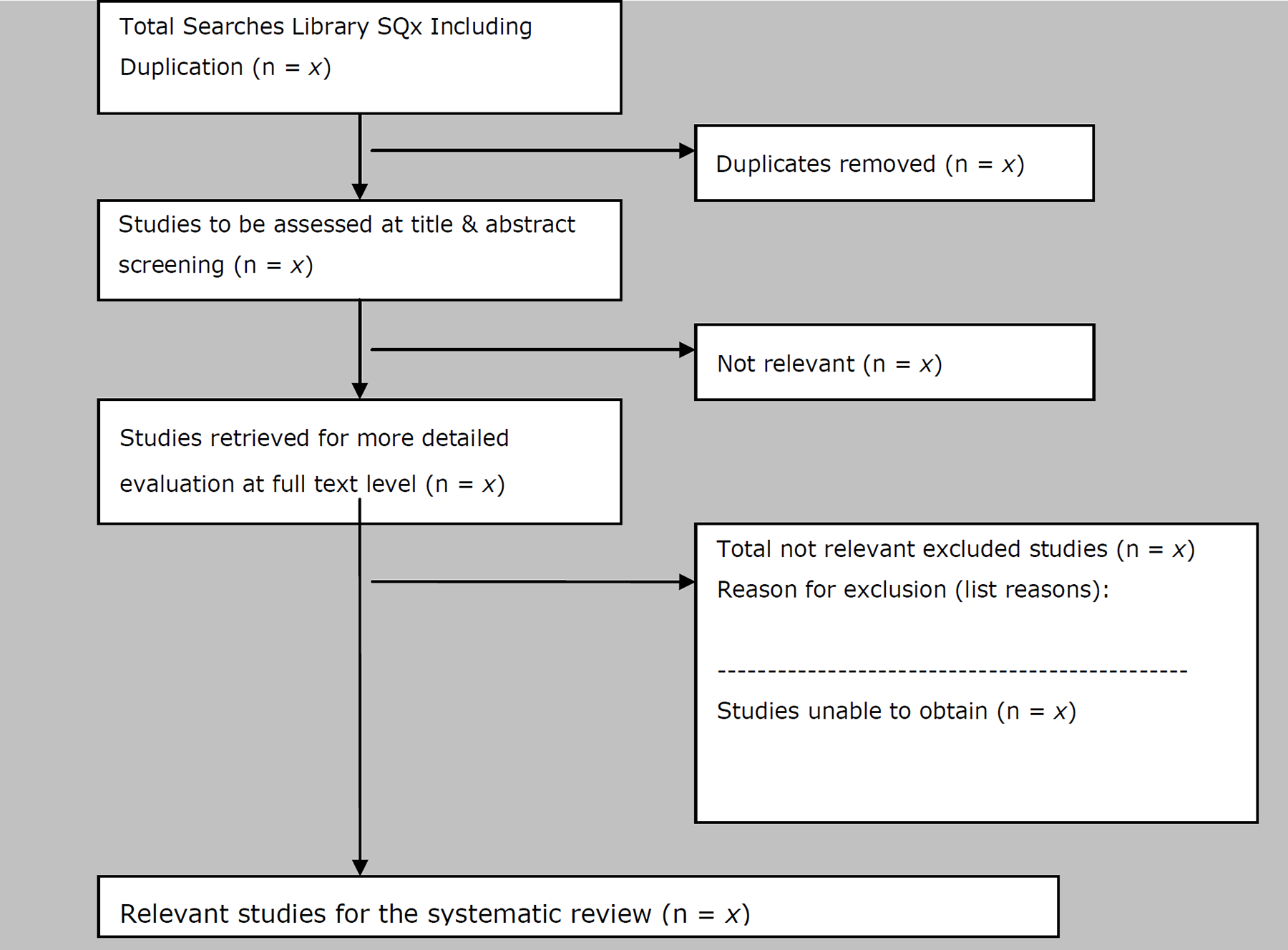
Literature assessment flow through the search and screening process
Any record where it is clear that there is no relevance to the review subject will be placed in a discard set, but if there is apparent relevance or if it is not clear, they will be added to a set for screening at full-text level.
Any records where full text is not readily available online will be followed up by library searching or requests, or requests to the authors to facilitate the full text screening. We will also request authors suggest any other relevant papers. The full-text screening will again generate a discard set, and a set for further analysis. The rejected and selected records will be checked by a second reviewer and confirmed with level of agreements reported in the final report, via Kappa analysis (Cohen, 1960). Disagreement regarding inclusion/exclusion of studies will be resolved by consensus, or following assessment by a third reviewer. If the Kappa value is low, the reference list will be reassessed against adjusted inclusion and exclusion criteria. The same subset of references will be reassessed by a second reviewer with Kappa analysis. Reviewers will then consider articles viewed at the full text level for relevance, either excluding them from, or admitting them to, the review.
Description of methods used in research on agricultural subsidy impacts
A recent search of CAB Abstracts examining the impacts of agricultural input subsidies (Luke Harman, in prep.) suggests that there is significant variation in methodological quality (particularly analysis of counterfactuals and attribution). Consideration of contextual issues and impact chains (as discussed above and indicated in Figure 1) are also highly variable. CGE and other models addressing counterfactual and attribution questions are often weak at describing contextual issues. These may be better covered by farmer surveys and commodity/sectoral studies – but such studies are weaker in addressing attribution. Separation of subsidy impacts from other complementary policies and identification of determinants of positive and negative impacts are particularly problematic.
Examples of studies which are eligible for inclusion in the review are provided in Table 2, together with some counterfactual comparisons. Examples of studies which would be excluded as lacking any counterfactual comparisons are presented in Table 3.
Studies eligible for inclusion
Studies not eligible for inclusion
Data collection
Alongside the relevant bibliographic data, information to be extracted from each study will include: the country/region focus, whether the study collects outcomes data using quantitative or qualitative methods, the methodology used, whether the study was conducted ex ante or ex post, the data period covered, the product sector covered, whether subsidies were the main focus of the study, what impact metric was used, any data source quoted, sample size and control variables employed in the analysis, and effect sizes and standard error of the effect size. In recording the evidence, the stated objective of the study will be noted, along with key insights, what the effect on the impact metric was, any comments on the mechanism and other observations. Annex 3 provides detailed study codes.
Critical appraisal
In assessing the studies, the clarity of aims, clarity and appropriateness of methodology, isolation of an appropriate output metric, commentary on potential mechanisms, use of controls or counterfactuals, and clarity of findings, will be considered and reported in the descriptive analysis. Potential sources of bias will be scored using a traffic-lights system (indicating high risk, medium risk and low risk of bias, as appropriate). The following categories of bias will be assessed for experiments and quasi-experimental studies (Waddington et al., 2012): confounding and sample selection bias; performance bias; motivation bias; reporting biases; and other sources of bias (see Annex 3). Sources of bias for statistical modelling studies will include factors relating to model specification (e.g. source of model coefficients) and methods of inference (e.g. use of systematic sensitivity analysis 5 ).
These scorings will not be used as weights in the analysis. We will firstly report direct and indirect outcomes separately along the causal chain, and secondly explore sensitivity using risk of bias categories.
Where information regarding the reasons for heterogeneity is presented in the studies, it will be recorded, distinguishing whether this information is based on empirical evidence or author's hypotheses.
Moderator variables
This review will assess findings from a wide range of studies conducted under widely differing circumstances. Data on relevant contextual factors (as indicated in Figure 1) will be collected and taken into account as ‘effect modifiers’ in analysis and interpretation of the results of the systematic review. Any effect modifiers identified a posteriori will be indicated clearly as such in the report. The following moderators have been identified (Annex 3).
Subsidy design and implementation: inputs subsidised, targeting and access, beneficiary household characteristics, complementary inputs and investments including credit, subsidy scale and rationing (for example, value per beneficiary) and technical fit (for example, marginal productivity).
Output market characteristics: tradable/non-tradable, staple/non staple foods and cash crops, input and product demand elasticities (allowing for close substitutes).
Livelihood and economy characteristics: wealth, economic activity and activities such as different farm and non-farm activities, diversity within and between livelihoods, production systems, asset holdings and attributes (e.g. land, machinery and education).
Infrastructure: roads (for example, all weather or seasonal roads), information communications technology (ICT), access to international markets and irrigation.
Other interventions, institutions and policies: land tenure and property rights, access to social protection, produce pricing, farmer credit access, other forms of subsidy and taxes affecting agriculture.
Agro-ecological, climate and weather conditions: spatial and temporal rainfall distribution, droughts, soils, temperatures, pests and diseases.
Data synthesis and presentation
We will synthesise the study results as far as is justified– using conventional meta-analysis if data permits, and narrative synthesis of all studies that meet the quality requirements described above, with a focus on magnitude of effects and sample size. For data synthesis purposes, the four broad categories of impacts on productivity, farm incomes, consumer welfare and wider growth impacts will be treated separately. Studies will be divided into further sub-groups as necessary – for example, empirical and modelling studies will be treated separately, as would studies assessing the impacts of introducing and removing subsidies.
Measures of the treatment effect
The statistical evidence in the papers will be extracted with the intention of comparing effects of input subsidies on outcomes. A sample of data extraction will be done by two team members to ensure consistency. We will examine changes in comparable criteria at fixed periods after subsidies have been introduced, or have been withdrawn. We will collect data at multiple follow-up periods and synthesise these appropriately across studies.
We will extract data to compute standardised mean difference effect sizes for continuous outcomes, and odds ratios for dichotomous outcomes, using methods outlined in Lipsey and Wilson (2001). Methods for computing effect sizes for treatment effects estimated using regression adjustment are presented in Annex 4. We will ensure all effect sizes are calculated consistently, so that the direction of change reflects a uniform increase or decrease in the outcome variable across studies (e.g. where studies estimate effects of introducing or removing subsidies).
Criteria for determining independent findings
We will only include independent effect sizes in any single meta-analysis. This means that if we are pooling across studies, we will only take a single effect estimate for that study. It also means that when we have multiple studies on the same programme, we will seek an appropriate method of generating a single study effect. We will use the following decision criteria to determine independent findings: 1) where multiple specifications are presented for a single study, we will choose the method with the lowest risk of bias (usually the least parsimonious in terms of covariates for quasi-experiments); 2) as used in Baird et al. (2013), where we have multiple independent estimates for sub-populations we will calculate a ‘summary effect size’ using inverse-variance weighted random effects meta-analysis; 3) where we have multiple dependent estimates we will calculate a ‘synthetic effect size’ using the approach given in Borenstein et al. (2009; Chapter 24).
Unit of analysis errors
We will use the appropriate unit of analysis for clustered studies when calculating standard errors of the effect. For clustered studies, if the authors do not state they have done so, we will adjust the standard error upwards using the standard formula in the Cochrane Handbook (Higgins & Green, 2011).
Dealing with missing data
To calculate standardised mean differences data on the standard deviation of the outcome variable are needed. Where this is not reported, we will contact primary study authors to obtain this, where possible, or use an effect size measure which does not require outcome standard deviation such as the response ratio (see Annex 4). Where data are not reported on confidence intervals in simulation studies (e.g. due to lack of sensitivity analysis), we will report effect sizes only.
Treatment of qualitative research
We do not plan to include qualitative data in this review.
Methods of synthesis
We will present effect sizes and 95 per cent confidence intervals using forest plots. Where constructs are considered sufficiently similar, we will also estimate pooled effect sizes across studies using inverse-variance weighted random effects meta-analysis using Stata software (Stata Corp, TX, USA). We will present results from studies measuring direct and indirect outcomes, and studies using experimental, quasi-experimental and simulation models separately. We will examine sensitivity of findings to study design and risk of bias assessment, and other factors such as length of follow-up period. We will conduct moderator analysis according to the moderators defined above, and if sufficient studies permit we will conduct analysis of publication bias using conventional methods such as funnel graphs. If sufficient studies are available, we also plan to use meta-regression to examine sensitivity to study design parameters, moderator effects and other effects such as small sample sources of publication bias (Egger's test (Egger et al., 1997)).
SOURCES OF SUPPORT
We are grateful to 3ie for funding the study, the International Development Coordinating Group (IDCG) for technical support, and to our advisory group: David Rohrback (World bank), Maria Wanzala (NEPAD), Porfirio Fuentes (IFDC) and Valerie Kelly (ASFC).
DECLARATIONS OF INTEREST
Chirwa and Dorward are engaged in ongoing evaluations of the Malawi Farm Input Subsidy Programme and have and are publishing on this and more widely on input subsidy impacts. Any work of theirs will be independently assessed by other members of the team.
There are no other conflicts of interest to declare of which we are aware.
REVIEW AUTHORS
ROLES AND RESPONSIBILITIES
Dorward, Chirwa, Harman: To further develop understanding of the causal pathway, with consideration to contextual factors that will affect impacts etc. (have conducted research and literature reviews in this field, written on subsidy impact chains). Osborn, Lamontagne-Godwin, Wright: Contribute to developing project outline (substantial knowledge of academic publications in this field).
Dorward, Chirwa, Harman: Help define relevant issues for protocol (have good understanding for identification of relevant studies involving appropriate experimental approach. Dorward and Harman have worked on a closely related review). Roberts: Devising protocol, advising team on methods (substantial experience of applying systematic review methods). Osborn: Contribution to developing protocols (understanding of importance of impact chain – has developed previous systematic review protocols). Hemming, Wright: Ensuring all elements of systematic review methods are applied appropriately (experience on previous systematic review and relevant training).
Dorward, Chirwa, Harman: Define key variables and hypothesised relationships between them, interpret findings. Subject expertise for fuzzy set calibration (experience in analysing relevant studies and their significance). Roberts: Developing appropriate statistical approach. Substantial experience of using statistical methods in meta-analysis in systematic reviews (Roberts, Lamontagne-Godwin: Applying appropriate statistical methods (has conducted relevant statistical analysis).
Dorward, Chirwa, Harman: Suggest relevant databases and other sources, input into designing framework for data extraction (experience in finding relevant subject material). Roberts, Finegold: Advice on general approach to information retrieval and data extraction (experience in ensuring full range of inputs used, and appropriate approach taken). Lamontagne-Godwin: Guidance on assessing quality and relevance of material (has combined quantitative and qualitative assessment in previous work). Osborn: Devising data searches and interpreting them, provide guidance and support for research assistant (substantial experience in running database searches and using appropriate terminology and strategies, developed and ran searches for previous systematic review). Hemming: Supporting information retrieval and identification of relevant material, overall supervision of the process (long experience of database searching and assessing documents against key criteria, and managing research assistant conducting such tasks). Wright: searching, maintenance of End Note database, data extraction (substantial experience of previous systematic review). Hill: searching, maintenance of End Note database, data extraction (with advice from team).
Dorward, Chirwa, Harman: Writing and revising the narrative of draft report (Dorward and Chirwa have authored many papers on the subject). Roberts, Finegold: Meta-analysis methodology and conclusions (Roberts has conducted meta-analysis and written systematic review reports). Osborn: Comment on final review (substantial editing experience in socioeconomics field). Hemming, Wright: (Experience of writing and editing reports). Hill: reporting writing (with advice from team)
PRELIMINARY TIMEFRAME
Funding has been secured for this review and work has commenced with completion date of January 2015. The following timeframe has been proposed to and accepted by the commissioners.
PLANS FOR UPDATING THE REVIEW
References libraries of all stages will be kept in clearly documented and transparent Endnote libraries so that if additional funding is sourced the review can be easily updated.
AUTHORS' RESPONSIBILITIES
By completing this form, you accept responsibility for preparing, maintaining and updating the review in accordance with Campbell Collaboration policy. The Campbell Collaboration will provide as much support as possible to assist with the preparation of the review.
A draft review must be submitted to the relevant Coordinating Group within two years of protocol publication. If drafts are not submitted before the agreed deadlines, or if we are unable to contact you for an extended period, the relevant Coordinating Group has the right to de-register the title or transfer the title to alternative authors. The Coordinating Group also has the right to de-register or transfer the title if it does not meet the standards of the Coordinating Group and/or the Campbell Collaboration.
You accept responsibility for maintaining the review in light of new evidence, comments and criticisms, and other developments, and updating the review at least once every five years, or, if requested, transferring responsibility for maintaining the review to others as agreed with the Coordinating Group.
PUBLICATION IN THE CAMPBELL LIBRARY
The support of the Campbell Collaboration and the relevant Coordinating Group in preparing your review is conditional upon your agreement to publish the protocol, finished review and subsequent updates in the Campbell Library. Concurrent publication in other journals is encouraged. However, a Campbell systematic review should be published either before, or at the same time as, its publication in other journals. Authors should not publish Campbell reviews in journals before they are ready for publication in the Campbell Library. Authors should remember to include a statement mentioning the published Campbell review in any non-Campbell publications of the review.
I understand the commitment required to undertake a Campbell review, and agree to publish in the Campbell Library. Signed on behalf of the authors:
Form completed by: David Hemming
Date: 08/08/2014
Footnotes
ANNEX 1
ANNEX 2
ANNEX 3
ANNEX 4
1
A systematic review question on this subject was proposed by 3ie regarding the impact of agricultural inputs subsidies on productivity and farmer incomes and welfare. The authors suggested broadening the scope in terms of the outcomes assessed, on the basis of theory and experience in developing countries, anticipating that the original question would miss key impacts relevant to considering the usefulness or otherwise of subsidies.

3
Consumer welfare, particularly for poorer consumers, may be affected by changes in food prices, and hence food prices can be used as an indicator of real incomes.
4
‘Upstream effects’ include effects on input suppliers, and may be measured in terms of income or sales for suppliers and number of suppliers.
6
This annex is taken from IDCG (2012).