






Abstract
Linked article:
BACKGROUND
The Problem
There is evidence of gang violence in low- and middle-income countries in Africa and Asia, and the prevalence of gangs is particularly well documented throughout Central and South America (Decker & Pyrooz, 2010; Gatti et al., 2011). Official estimates of gang membership in Central America estimate approximately 69,000 members, while academic estimates believe this figure to be closer to 200,000 (UNODC, 2007). Some estimates are as high as 500,000 gang members in the region including South America and the Caribbean, and gangs have been identified as “the primary threat to regional stability and security” (Muggah & Aguirre, 2013). While reporting and recording issues make it difficult to estimate rates of gang violence, the homicide rate in Colombia, Brazil, El Salvador and Guatemala are substantially higher than those of European and North American countries (Decker & Pyrooz, 2010; UNODC, 2007). Gangs are also active in South Africa, with an estimate of 100,000 members in Western Cape alone (Reckson & Becker, cited in Decker & Pyrooz, 2010); however, to date, there is limited research examining gangs in Africa and Asia.
Youth gangs are internationally identified with increased rates of delinquency and violent crime (Howell, 1997; Klein, 2002; White, 2002), including trafficking in arms, drugs and (increasingly) humans (Organisation of American States [OAS], 2007). The victims of gang crime are not only non-gang-affiliated individuals and rival gang members, but also include members of the same gang. Gang members are disproportionately involved with serious and violent offences compared to non-gang delinquent youth (Howell, 1998). This suggests that there is something about gang membership which encourages violence, over and above the correlation between having delinquent friends and a previous delinquent history (Battin et al., 1998; Haviland et al.,2008).
Researchers often contest a uniform definition of a youth gang, as it varies by time and place (Howell, Egley, & O'Donnell, n.d.). Notwithstanding these debates, the literature typically describes a gang as comprising between 15 to 100 members, generally aged 12 to 24; members share an identity linked to name, symbols, colours or physical or economic territory; members and outsiders view the group as a gang; there is some permanence and degree of organisation; and there is involvement in an elevated level of criminal activity (Decker & Curry, 2003; see also Esbensen et al., 2001; Howell et al., n.d.; Huff, 1993; Miller, 1992; Rodgers, 1999; Spergel, 1995; Theriot & Parker, 2008). There have been significant efforts amongst academics and policy makers to reach agreement on the definition of a youth gang. The “Eurogang Working Group” (see The Eurogang Project, 2012) consensus definition is as follows: “A street gang (or troublesome youth group corresponding to a street gang elsewhere) is any durable, street-oriented youth group whose involvement in illegal activity is part of its group identity” (Weerman et. al., 2009, p.20). A youth gang is differentiated from an adult gang if the majority of the gang members are aged between 12 and 25 (Weerman et. al., 2009).
Although associated with criminal activity, gangs can offer a sense of belonging and purpose to disenfranchised youth (Howell, 2012; Tobin, 2008). Self-reported reasons for gang membership can include social reasons, protection, and instrumental or financial reasons (Howell & Egley, 2005). For young men living in environments of deprivation, exclusion and violence, having family members in gangs may lead to them learning to ‘do masculinity’ in a context of “exposure and socialisation into armed groups”, particularly where pro-social opportunities are limited (Baird, 2012, p.186). Humiliating levels of deprivation may lead to the search for an extreme public masculinity that provides the gang member with power or ‘respect’ (Adams, 2012). Gang membership can be viewed as a means to overcome “extreme poverty, exclusion, and a lack of opportunities” (Organization of American States (OAS), 2007, p.5).
“Youth gangs represent a spontaneous effort by children and young people to create, where it does not exist, an urban space in society that is adapted to their needs, where they can exercise the rights that their families, government, and communities do not offer them. Arising out of extreme poverty, exclusion, and a lack of opportunities, gangs try to gain their rights and meet their needs by organizing themselves without supervision and developing their own rules, and by securing for themselves a territory and a set of symbols that gives meaning to their membership in the group. This endeavour to exercise their citizenship is, in many cases, a violation of their own and others' rights, and frequently generates violence and crime in a vicious circle that perpetuates their original exclusion. This is why they cannot reverse the situation that they were born into. Since it is primarily a male phenomenon, female gang members suffer more intensively from gender discrimination and the inequalities inherent in the dominant culture.” (OAS, 2007, p.5)
In low- and middle-income countries in particular, gang membership has been identified as offering a unique social framework for excluded youth to meet particular social and cultural needs (OAS, 2007); a process that has been described as “filling a social vacuum” (Adams, 2012, p.31).
The Predictors
Extensive research (primarily conducted in high-income countries) has focused on identifying risk and protective factors 1 which may alter the likelihood of youth becoming involved in violent activity. These have been categorised into individual, peer group, family, school, school, and community factors (Decker et al., 2013; Hawkins et al., 2000; Howell, 2012; Howell & Egley, 2005; Katz & Fox, 2010; Klein & Maxson, 2006; O'Brien et al., 2013; Tobin, 2008). These five domains are drawn from developmental psychology, where they are identified as the key domains of influence affecting a young person's behaviour (Howell & Egley, 2005). We recognise that in some instances, a factor may be either a predictor of gang membership or a consequence of having joined a gang. In this review we will distinguish between predictors and correlates of gang membership according to the methodology used in the primary research (for more detail see the ‘Study design’ subsection of the ‘Criteria for inclusion and exclusion of studies’).
Individual factors include biological and psychological characteristics identifiable in children from young ages which may increase vulnerability to negative social and environmental influences (Herrenkohl et al., 2000). Peer group factors that may influence youth gang involvement include peer attitudes, delinquency and gang involvement (Dahlberg, 1998; Katz & Fox, 2010; Moser & Holland, 1997; Olate et al., 2012). Family factors refer to both the structural characteristics of families, such as poverty, single-headed households, as well as the way in which children are socialised within families (Blum et al., 2003; Howell & Egley, 2005; Moser & Holland, 1997; Thale & Falkenburger, 2006). School factors include such aspects as children's academic achievement and experiences at school, including exposure to violence (Herrenkohl et al., 2000; Howell & Egley, 2005; Olate et al., 2012). Community factors are the structural and social characteristics of the local environment, including neighbourhood levels of crime, firearms and drugs in a neighbourhood (Katz & Fox, 2010; Moser & Holland, 1997; Sanders et al., 2009; Thale & Falkenburger, 2006; Tobin, 2008) as well as factors such as community social disorganisation (Howell, 2012; Howell & Egley, 2005). A summary of predictors of gang membership is shown in Table 1.
Predictors of gang membership
Previous research conducted within high-income countries provides evidence of the importance of individual, peer and family domains as predictors of youth gang involvement, whilst relatively weaker evidence exists for the predictive value of school and community factors (O'Brien et al., 2013). The present review seeks to examine whether the relative weight of influence across these domains also applies to youth gang involvement in low- and middle-income countries.
How the Predictors may Impact Gang Membership
Research indicates that each of the five domains of predictors of youth gang involvement (individual, peer, family, school and community) are most influential at particular times in a child or young person's life, and that a developmental model is useful to identify the key steps towards offending behaviour (Howell & Egley, 2005). Research in high-income countries demonstrates that the predictors of gang involvement cut across all five domains, that youth with multiple risk factors have a proportionately higher risk of gang involvement, and that those youth with risk factors in multiple domains have further increased likelihood of gang involvement (Decker et al, 2013; Howell & Egley, 2005).
Building on Thornberry and colleagues' developmental framework of gang membership (Thornberry et al., 2003), Howell and Egley (2005) propose a developmental perspective that incorporates predictors from early childhood through to adolescence. The model is illustrated in Figure 1.
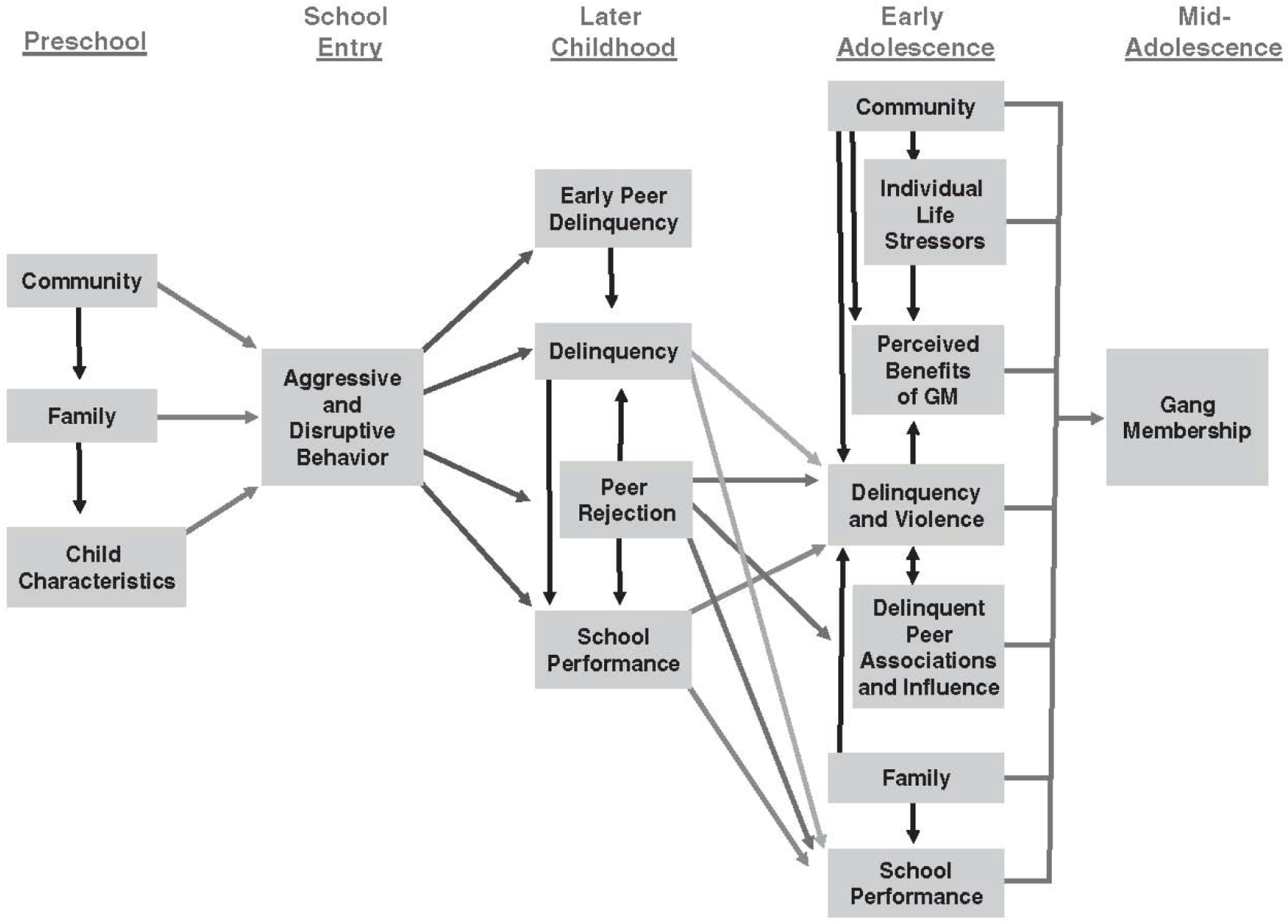
Logic model of predictors of gang membership (Source: Howell & Egley, 2005)
Howell and Egley (2005) argue that the pathway to gang membership for youth at the highest risk begins as early as three or four years of age with conduct problems, school failure in elementary school, followed by delinquency at twelve years of age, gang membership in early adolescence and more serious delinquency from mid-adolescence. We describe Howell and Egley's (2005) developmental model in the remainder of this section.
Howell and Egley's logic model of gang membership (2005) begins with preschool factors, where structural disadvantage and lack of social capital at the community level, combined with family factors such as low human capital, family conflict and poor parenting, and child level risk factors such as aggressive and impulsive temperament, are theorised to lead to conduct disorders at the pre-school stage. These aggressive and disruptive behaviours may lead to rejection by pro-social peers, which may increase the likelihood of early delinquent behaviour and decreased school performance. In later childhood, it is suggested that peer factors become even more important. Early rejection by pro-social peers may increase the likelihood of association with aggressive or delinquent peers, and therefore the likelihood of further delinquent behaviour and the weakening of social bonds. School level factors such as poor grades, low-quality schooling or school policies such as suspension or expulsion, may also increase the likelihood of gang membership due to the weakening of school-student bonds and the potential for increased time without adult supervision.
In early adolescence it is argued that the influence of community level predictors increases. Community factors such as high crime rates, drug use, and concentrated disadvantage may lead to decreased informal social control and decreased community attachment. This may lead to negative life stressors, delinquency, and the perception that gang membership offers benefits to the young person. Negative family characteristics (both structural and social process factors) are theorised to continue to affect young people by decreasing family bonds, increasing delinquency and reducing school performance. School risk factors such as poor academic performance, low aspirations, negative labelling by teachers and feeling unsafe at school may reduce attachment and increase the risk of gang membership. The model suggests that delinquent beliefs and delinquent peers in early adolescence, and individual predictors including substance use, delinquency and life stressors such as violent victimisation further increase the likelihood of delinquency and violence, a key precursor of youth gang membership.
Gang membership is seen as a culmination of interrelated structural and process factors. It is argued that individual, community and structural family characteristics influence early pro-social behaviours and pro-social bonds. In an interactive feedback relationship, antisocial behaviours may decrease pro-social friendships and in turn increase the impact of negative peer attachments and the risk of delinquent behaviours. These social and structural factors, in combination with negative life events, negative school experiences and a lack of school attachment, may increase the attractiveness of gang membership.
Why it is important to do this review
Understanding the predictive factors associated with youth gang membership is essential to designing empirically-based prevention strategies to reduce the levels of youth gang membership and the incidence of youth gang violence. The proposed systematic review aims to synthesise the research evidence that identifies the pathways to youth gang membership in low- and middle-income countries.
The Campbell Collaboration has previously published two systematic reviews which examine the involvement of young people in gangs (Fisher et al., 2008a, 2008b). The focus of these reviews is preventing youth gang involvement through cognitive-behavioural and opportunities provision interventions, and these two systematic reviews found no studies that met their inclusion criteria. Another review of interventions designed to reduce gang-related crime was conducted by the Evidence for Policy and Practice Information and Coordinating Centre (EPPI-Centre, 2009). These three reviews have not considered the predictive factors of gang membership, and have focused on interventions implemented in high-income countries. Klein and Maxson (2006) conducted a systematic review of the published evidence on risk factors for youth gang membership; however this review again focused on surveys conducted in the United States, Canada and Europe.
We suggest that there are differences in the motivations for participation in gangs between youth in high-income countries and those in low- and middle-income countries. This is evidenced in Olate et al.,'s (2011) cross-cultural study, which identifies significant differences in the predictive factors of youth gang membership between San Salvador and Boston, particularly with regards to early delinquency and violence. Many low- and middle-income countries have experienced in recent decades or are experiencing some form of war or conflict, creating societies that foster youth gang membership. Issues such as a culture of violence, low sense of citizen security, distrust of authorities, poor economic outlook, high accessibility to firearms and drugs, and migration enable the creation and maintenance of gangs in such countries (Cruz, 2007; Davies & MacPherson, 2011; Thale & Falkenburger, 2006). We therefore focus our review on the predictive factors for youth gang membership in low- and middle-income countries, as defined by the World Bank (World Bank, 2013).
This review aims to inform not only the academic literature on the predictive factors associated with youth gang membership, but will also provide a valuable resource for both policy makers and practitioners to assist in designing appropriate preventive interventions for implementation. Preventive gang interventions in low- and middle-income countries are funded and implemented by NGOs, government agencies, international aid agencies, and community organisations. This systematic review has been funded by the United States Agency for International Development (USAID), with the aim of informing best practice in youth gang interventions. USAID supports a variety of preventive anti-gang programs in Latin America and the Caribbean, including both primary and secondary prevention programs, and argues that evaluation is important to improve programs and build support for crime prevention programs (USAID, 2010b).
By identifying the most important predictive factors of youth gang involvement and disseminating that information to those working in the field, we aim to ensure that policy makers and implementing agencies have access to high quality research when designing their interventions. There is a general lack of evidence on the impact of interventions to prevent youth gang involvement in low- and middle-income countries, therefore it is important to synthesise the available evidence on predictive factors to inform the development of preventive interventions. Essentially, we hope to ensure future prevention efforts are focused on targeting the identified predictors of youth gang membership.
Objectives
The proposed review focuses on the factors associated with membership in youth gangs in low- and middle-income countries. We anticipate that this review will identify multiple predictors of interest.
This review has two key objectives: (1) to synthesise the published and unpublished empirical evidence on the predictive factors associated with membership of youth gangs in low- and middle-income countries; (2) to assess the relative strength of the different predictive factors across the domains of individual, family, school, peer group and community.
METHODOLOGY CRITERIA FOR INCLUSION AND EXCLUSION OF STUDIES
Characteristics of the studies relevant to the objectives of the review
This systematic review aims to determine the association between a characteristic of a young person or their environment and their gang membership status. This review will focus on observational studies rather than experimental or quasi-experimental studies, as gang membership is not a characteristic that can be experimentally manipulated. In order to describe the relationship as a predictive relationship, the “predictor” must occur prior to the onset of gang membership or be a time-invariant characteristic. Ideally studies that examine predictors would be longitudinal; however there are few longitudinal studies examining gang membership and most studies in this field are cross-sectional (Thornberry, 1999). We will utilise cross-sectional studies, but we will classify time-variant factors as “correlates” in this instance, as it can be difficult to determine if a time-variant predictor is a true antecedent of the outcome if the study is not longitudinal (Murray et al. 2009). The review is conducted alongside a broader project on conduct problems and crime in low- and middle-income countries (Murray et al., 2013).
Types of participants
There is a general agreement amongst researchers that most members of youth gangs are aged between 12 and 24 years of age (Howell et al., n.d.; Huff, 1993; Rodgers, 1999; Seelke, 2013). However, we extend the age range to include studies where the participants are aged between 10 and 29, in part because formal definitions of youth vary across countries, and in part to ensure that the age range is broad enough to ensure that studies that retrospectively examine gang membership within a short timeframe are not excluded.
We will adopt a broad definition of youth gang membership. We acknowledge that there is no clear international consensus definition of youth gangs. As such, we will accept youth gangs as defined by the Eurogang definition, as it offers a more descriptive definition: “a street gang (or troublesome youth group corresponding to a street gang elsewhere) is any durable, street-oriented youth group whose involvement in illegal activity is part of its group identity” (Weerman et. al., 2009, p.20). Likewise we will accept author definitions of youth gangs. We exclude groups described as organised crime gangs, terrorist gangs and piracy gangs.
This review is focused on the predictive factors for youth gang membership in low- and middle-income countries; therefore, we will only include studies that take countries that have been classified by the World Bank as low- and middle-income countries for at least 50% of the time since 1987, when recordings start (World Bank, 2013).
Types of predictors
To be considered a true predictor, a risk factor needs to be present prior to the outcome occurring, making longitudinal designs the optimal study method for identifying predictive factors (Farrington & Loeber, 2000). However, many studies of gang-involved youth use a cross-sectional study design, in which some factors are retrospectively reported or are clearly in existence prior to gang involvement (for example, sex, ethnicity), whilst some factors are only measured once the young person is already in a gang (for example, family conflict, expulsion from school). We recognise that measuring the predictor at the same time as measuring the outcome has the potential to conflate the causes of gang membership with the results of gang membership (Klein & Maxson, 2006).
We will classify predictors as those factors that are either: estimated from prospective longitudinal studies at a time prior to the onset of gang membership, or estimated from cross-sectional studies and the factor is time-invariant (eg. sex), or estimated from longitudinal or cross-sectional studies and the factor has been reported retrospectively to a time prior to onset of gang membership (e.g. number of family members who were gang members when the respondent was aged 10, parent's marital status when the respondent was aged 5). estimated from a case-control study where predictive factors are assessed retrospectively for samples of gang members (cases) and non-gang members (controls).
We will classify correlates as those factors that are either: estimated from longitudinal studies at a time after the onset of gang membership, or estimated from cross-sectional studies without retrospective reporting to a time prior to the onset of gang membership.
We follow Klein and Maxson (2006) in including these cross-sectional studies in order to retain more sources of evidence in our review; however, we will synthesise the effect sizes for predictors and correlates separately.
We will exclude predictors that are conglomerations of multiple constructs, such as Raine et al. 's (1996) measure of biosocial risk, which combines measures of marital conflict, maternal rejection, family instability, parental crime, neurological problems, and slow motor development.
The review focuses on the factors associated with membership in youth gangs in low- and middle-income countries. We anticipate that this review will identify multiple predictors of interest and each will be analysed separately.
Types of outcome measures
The outcome of interest is membership in youth gangs. We will code outcomes related to individual youth participation in gangs, including self-reported, peer-reported, family-reported, practitioner-reported, or police-reported measures of youth gang membership. We will perform moderator analysis to identify heterogeneity due to different methods of recording gang membership.
Study design
For inclusion in the review, studies must use a sample where there is variability in the levels of gang membership, including youth who are not gang-affiliated. For example, the sample may include young people who are gang members, young people who are not gang members, and young people who are ex- gang members. We will include observational longitudinal studies, cross-sectional studies, case-control studies, and epidemiological studies, as long as they include a subsample of young people who are not gang members. Studies must provide a bivariate or multivariate assessment of the relationship between a predictor and gang membership.
We will not include studies that report only on the characteristics of a youth gang sample with no reference to a comparison group. In such studies there is no way to demonstrate that gang-involved and non-gang-involved youth differ on these measures. While single case studies and ethnographies capture details of the lived experience and individual pathways, they are not appropriate for inclusion in this review as there is no comparison group to determine what is unique about gang members when compared to non-gang members.
All participants must have been recruited through random, stratified probability or total sampling. A study is eligible if it includes participants recruited in an institutionalized or specialized setting (e.g. detention centre) if there is also a comparison group recruited from the community through random, stratified probability, or total sampling within both groups.
To be eligible for inclusion in a meta-analysis, the study must report an effect size, or provide sufficient detail such that an effect size can be calculated.
Exclusion Criteria
We will exclude studies from countries that have not been categorised as low- or middle-income by the World Bank for at least 50% of the time since 1987.
Example of studies that might be eligible for inclusion in the review
We anticipate that many of the research designs will be retrospective comparisons of the histories of gang youth compared to non-gang youth, or prospective studies of youth where gang membership is identified as an outcome state. The analyses in these studies are likely to be either comparisons of the level of selected predictors or correlates across levels of gang membership, or multiple regression designs with level of gang membership as the dependent variable.
Our preliminary investigations have identified several examples of eligible studies conducted in low- and middle-income countries. Katz and Fox (2010) examined the risk and protective factors associated with gang-involved youth in Trinidad and Tobago. Surveying a cross section of 2, 206 school students, the authors examined thirty risk factors and thirteen protective factors between non-gang, current and former gang-involved youth through a multinomial logistic regression. Predictive factors were grouped into community (e.g. mobility, neighbourhood attachment and perceived availability of drugs and hand guns), school (e.g. commitment, academic achievement), family (e.g. conflict, parental attitudes) and peer-individual factors (e.g. perceptions of drug and alcohol use, depression, antisocial peers). A second example study considers gang involvement in China, through a cross sectional survey of 2,245 high school students (Pyrooz & Decker, 2013). The authors utilise independent sample t tests and Chi 2 tests to compare non-gang and gang youth across a number of factors, including age, gender, minority status, parents education, household strain, self-control, school attachment and performance, parental attachment and monitoring and peer associations. A study by Olate and colleagues (2012) used a similar methodology, conducting a cross-sectional survey of 174 young people in San Salvador. The authors used independent sample t tests and Chi2 tests to compare high-risk non-gang-involved youth to gang-involved youth on a number of demographic variables and risk factors, categorised into individual, family, school, peer and community domains.
SEARCH METHODS FOR IDENTIFICATION OF RELEVANT STUDIES
The search for eligible studies is conducted as part of a broader project systematically reviewing literature on conduct problems and crime in low- and middle-income countries (Murray et al., 2013). The search strategy will include published and unpublished literature with no date constraints. We will also not place any language restrictions on the eligibility of documents; however our search will be conducted in English, French, Chinese, Arabic, Russian, Spanish and Portuguese. The geographic location of studies will be limited to countries located in a LMIC, defined according to the World Bank 2 as low- or middle-income at least 50% of the time since 1987, when the recordings start 3 . The countries and regions included as low- and middle-income are shown in Table 1.
Countries classified as “low- and middle-income” and their corresponding region
Search terms
This systematic review is conducted as part of a larger project focusing on conduct problems and crime in low- and middle-income countries (Murray et al., 2013) and alongside a systematic review on preventive interventions targeting youth gang violence in low- and middle-income countries (Higginson et al., 2013). The search terms are broad enough to capture both the corpus of intervention studies and the corpus of predictive studies, with further refinement occurring at the abstract and title screening stage for each review.
The search strategy was developed using the Cochrane Collaboration's Effective Practice and Organisation of Care Group search strategy for low- and middle-income countries, combined with selected MeSH/DeCS terms and free text terms relating to conduct problems, crime and violence. To maximise sensitivity, no methodological filters were used. The full search strategy is listed in Appendix A.
Search locations
We searched a wide range of electronic academic databases, international organisation databases, the websites of NGOs and other organisations. All locations were searched electronically. The search locations are listed in Table 3.
Search locations used in the English language systematic search (hosting platforms in parentheses)
Table 3 shows the locations searched in languages other than English. Due to the nature of database interfaces, the searches in these databases were less systematic. The outcome search terms were used and, where possible, the search terms for child and youth age groups.
Predictors of gang membership
The non-English language searches were conducted by a team of six researchers (four native speakers and two speaking the search language fluently).
If dissertations are located that are potentially eligible for inclusion we will contact the author or their institution for a copy of the document. We will conduct citation searches of eligible tracking and citation harvesting from the references of included studies. We will contact members of the Advisory Group as well as other prominent scholars in the field to locate further studies that may not yet be published or located in our search. Any new literature of interest will be obtained and assessed for eligibility.
DATA COLLECTION AND ANALYSIS
Selection of Studies
Title and abstract screening
The results of each search will be imported into EndNote reference management software where the initial title and abstract screening will take place.
A team of six trained research assistants will use a set of preliminary eligibility criteria to assess, on the basis of titles and abstracts, whether the studies returned from the systematic search are potentially eligible for inclusion in the systematic review. Due to the large number of studies identified in the wider English language search, and the specialised language skills required to screen the studies in the non-English language search, each title and abstract will be screened by only one reviewer. One research assistant with native (or near- native) language fluency will screen all of the studies from their allocated language in collaboration with one of the review authors, who will screen all of the English language studies.
The title and abstract screening inclusion criteria are: all participants are 10-29 years old located in a LMIC, defined according to the World Bank as lower or middle income at least 50% of the time since 1987, when the recordings start all participants recruited through random, stratified probability, or total sampling included a community comparison group if the sample was selected from within prison or juvenile detention centres assessed the association at the level of an individual between at least one specific predictor and gang membership predictor is a single characteristic and does not include conglomerations of multiple constructs longitudinal study, cross-sectional study, or case-control study: comparison of a group with the outcome (gang membership) and those without the outcome
Documents will be excluded if the answer to any one of the criteria is unambiguously “No”, and will be classified as potentially eligible otherwise. We will err on the side of inclusivity and only exclude studies where it is clear that these criteria are not met.
Full text eligibility screening
Once the title and abstract screening has taken place in EndNote, the group of studies that are potentially eligible will be imported into SysReview, a Microsoft Access database designed for screening and coding of documents for systematic reviews. The full text document will be located for all studies screened as potentially eligible at the title and abstract stage, and attached to SysReview.
In order to narrow down the results of the initial search to the subset of studies that specifically focus on the predictors of involvement in youth gangs, different criteria are included at the full text eligibility screening stage.
A team of trained research assistants will use a set of inclusion criteria to assess, on the basis of titles and abstracts, whether the studies returned from the systematic search are potentially eligible for inclusion in the systematic review. After training to ensure that each reviewer is adopting the same approach to screening, each document will be screened by only one reviewer. The training will include a comprehensive briefing by the review manager, including reading and discussion of the protocol, followed by each reviewer independently screening a set of 20 studies. The results of the initial screening of the training corpus will then be mediated by the review manager, in consultation with the full review team. Further blocks of 20 studies will be reviewed independently by each member of the review team, and mediated by the review manager. Once the review team reaches an agreement rate of above 95 per cent, the subsequent screening of each document will be conducted by only one reviewer. Any issues or questions that arise during coding will be discussed amongst the review team and the review manager, and the review manager will randomly check screening decisions to ensure consistency.
The full text eligibility screening criteria are: reports on youth gangs all participants are 10-29 years old located in a LMIC, defined according to the World Bank as lower or middle income at least 50% of the time since 1987, when the recordings start assessed the association at the level of an individual between at least one specific predictor and gang membership predictor is a single characteristic and does not conglomerations of multiple constructs all participants recruited through random, stratified probability, or total sampling included a community comparison group if the sample was selected from within prison or juvenile detention centres uses a longitudinal study, cross-sectional study, or case-control study design, comparing gang members and non-gang members
Documents will be eligible for detailed coding and inclusion in the meta-analysis if they are coded as “Yes” across all criteria, and are not considered eligible if they are coded as “No” for any criterion.
Data Extraction
Trained research assistants will use the SysReview database, along with a detailed coding companion document, to code in detail the documents that are eligible for inclusion in the meta-analysis. The coding fields are shown in Appendix B, including information on study information, sample characteristics, study quality, outcomes reported, and effect size data.
The team of research assistants will be trained on coding and will each code a corpus of 10 eligible studies independently. All coding conducted during training will be double checked by the review manager to ensure accuracy and consistency of information capture. For the final coding, all coding and effect size data will be checked by a second reviewer who is not blinded to the initial coding. Coding discrepancies will be resolved by discussion between reviewers, in consultation with the review manager if required. For data from between-groups studies, relevant data will be input into Comprehensive Meta-Analysis software (Borenstein, Hedges, Higgins & Rothstein, 2005) to calculate standardized effect sizes and their standard errors.
We will code all predictors identified in the primary studies, and categorise them according to the framework of individual, peer group, family, school, and community factors, following the conceptualisation shown in Table 1. We will consult with members of the Advisory Group if predictors are identified that do not clearly fall into one of the five domains.
Following Lipsey & Derzon (1999) and in line with the developmental framework of Howell and Egley (2005) and Thornberry and colleagues (2003) we will also categorise predictors according to the age of the respondent at the time of measurement, as different factors may have stronger influence during particular developmental periods; for example, if the absence of a male role model is a predictor of interest, it may have a stronger impact if measured at the age of 12 than it does at the age of 3. If there is sufficient data we will conduct moderator analyses to assess whether the effects of the predictor differ during different developmental stages.
Assessment of methodological quality and risk of bias
We will assess risk of bias using a series of questions listed in the coding fields shown in Appendix B under Risk of Bias. The quality of each study will be assessed by two reviewers, and the results of the two assessments will be mediated by the review manager, who will not be blind to the original quality assessment. Coding discrepancies will be resolved by discussion between reviewers, in consultation with the review manager. These items will assess the quality of the sampling, the measurement of items, and the timing of the measurements to ensure that the predictor did indeed occur before gang membership. When assessing risk of bias we will not allocate a score or index, as extreme failure in one area can be more serious than minor breaches of quality across multiple arenas. We will not exclude studies on the basis of risk of bias assessment, but will conduct moderator analysis to determine whether inclusion of studies with higher risk of bias impacts on the summary effect size. We will present the results of the assessments in a “traffic light” format (see de Vibe et al., 2012).
STATISTICAL PROCEDURES AND CONVENTIONS
Effect size metric and calculations
For studies that measure the difference on a predictor between a gang-involved and a non-gang-involved youth (i.e., case-control designs), we will calculate Hedges' g or the log odds ratio. For continuous predictors we will use Hedges' g as the measure of effect size, as it includes an adjustment for estimator bias in smaller samples (Borenstein et al., 2009). If binary predictors are found we will calculate a log odds ratio as the measure of effect size. For studies that report the raw unadjusted correlation between a predictor and gang membership, we will convert Pearson's r to Fisher's z to perform calculations (Borenstein et al., 2009). Final results will be transformed back into r for ease of interpretation.
Ideally, when synthesising the results of multiple regression studies, we are interested in the partial effects of the predictors, after controlling for an appropriate set of covariates. However, we expect that different regression studies may use different sets of covariates and therefore estimating the partial effects of a predictor variable under different conditions. For studies that report predictors using a multiple regression model, we will select the most appropriate effect size depending on the literature. We anticipate that for studies using multiple regression models that we will calculate either the semi-partial correlation coefficient (Aloe & Thompson, 2013) or Cohen's d. We will also code the covariates in the multiple regression model and, if there is sufficient data, we will perform a moderator analysis to determine the extent to which the effect size is affected by the use of particular covariates. Alternately, if the zero-order correlations are reported for each study we will synthesise the results of bivariate correlations, r and conduct sensitivity analysis to compare the effect on the overall effect size using partial regression coefficients or using bivariate correlations.
We will input the effect size data into Comprehensive Meta-Analysis software (Borenstein et al., 2005) to allow the calculation of standardized effect sizes and their standard errors, and the conversion between effect size types, to ensure that a common metric is used. Following Hawkins and colleagues (2000) we will convert all effect sizes to the log odds ratio as a common effect size for synthesis and present results as the odds ratio, as it represents the amount of increased or decreased risk in an intuitive metric. Although converting different effect sizes to a common metric is imperfect, it is preferable to conducting multiple separate meta-analyses (Borenstein et al., 2009).
Criteria for determination of independent findings
There are two issues of independence that will need to be addressed in this review. The first is that documents may report on multiple studies, which may in turn report multiple predictors or outcomes. Documents will be allowed to contribute multiple effect sizes, but only one effect size for each predictor/outcome relationship. If a study reports multiple effect sizes for the one predictor or outcome, the mean effect size for will be calculated using Comprehensive Meta-Analysis 2.0 (Borenstein et al., 2005).
The second issue of independence is that multiple documents may report on the same data. In these instances, we will seek to identify which documents are related, and we will assess all sources in order to select an effect size. This assessment will be based on the completeness of the data and the risk of bias assessment of the studies, and all decisions will be reported in the final review.
Missing data
We will use reported statistics such as t, F, p or z-values to convert to effect sizes if effect size data is not reported in the between-groups studies. If data required to compute effect sizes is missing, we will attempt to contact the authors of the studies.
Method of synthesis
If the systematic search results in at least two studies that provide effect sizes for a conceptually equivalent predictor we will conduct a random-effects meta-analysis with inverse variance weighting to calculate an overall weighted mean effect estimate for each predictor-outcome association. We will present the results of the meta-analyses in forest-plots with 95 per cent confidence intervals.
If statistical meta-analysis is not possible due to small numbers of effect sizes in each category, we will present the effect sizes and 95 per cent confidence intervals from each study in a forest plot without providing an overall summary of effect sizes.
Where a factor has been measured as both a correlate and a predictor, we will synthesise the effect sizes separately.
We also aim to categorise each predictor into the domains of individual, peer, family, school and community, and perform a meta-analysis for each of these domains, using the summary effect sizes from each individual predictor. We will use forest plots with 95 per cent confidence intervals to present the results.
Assessment and investigation of heterogeneity
We will test for heterogeneity in the meta-analyses using I2, τ2 and Q statistics, following Borenstein et al (2009).
We will code a range of study-level moderators that we expect would have an impact on the effect size. We will test the effect of key variables on the heterogeneity of the predictor impact. For the meta-analysis we will assess heterogeneity using moderator analysis for categorical predictors and meta-regression for continuous predictors. We anticipate that we will perform moderator analysis using population (e.g. school based samples, gender specific, age specific), geographic region (e.g. Latin America, Sub-Saharan Africa, South-East Asia etc), measure of gang involvement (e.g. gang membership, gang affiliation, involvement in gang-related crime, ex-gang member), the use of covariates in regression models, the age at which the predictor is measured, the method of recording gang membership (e.g. self-report, peer-report etc), and the risk of bias. We will distinguish in the final review between a priori planned analyses (those listed in the protocol) and post hoc analyses identified only during the analytic stage.
Sensitivity analysis
We will conduct subgroup analyses in order to assess the impact of study quality and study design. Using moderator analysis for categorical variables, and meta-regression for continuous variables, we will perform sensitivity analysis on the effect of risk of bias, publication status, publication year, the use of partial regression coefficients versus bivariate correlation coefficients, and geographic level of analysis.
Assessment of publication bias
For the between-groups meta-analyses we will test and adjust for publication bias using funnel plots and trim-and-fill analysis as suggested in Rothstein et al., (2005). We will seek advice on methods for assessing publication bias in model-based meta-analysis.
Treatment of qualitative research
We will not use qualitative research to evaluate the predictors of youth gang membership.
SOURCES OF SUPPORT
Internal funding
Support for this study will be provided by the Institute for Social Sciences Research, the University of Queensland, and the ARC Centre of Excellence in Policing and Security.
External funding
This review is externally funded by USAID through 3ie (International Initiative for Impact Evaluation, Inc.) (SR/1117). The views expressed in this article are not necessarily those of USAID or 3ie or its members.
Funding for the broader database searching (Murray et al., 2013) was provided by the Wellcome Trust [089963/Z/09/Z]
DECLARATIONS OF INTEREST
None of the authors have any known conflict of interest.
REVIEW AUTHORS
ROLES AND RESPONSIBLIITIES
Content: Angela Higginson, Joseph Murray, Lorraine Mazerolle, Laura Bedford, Kathryn Benier Systematic review methods: Angela Higginson, Joseph Murray, Yulia Shenderovich Statistical analysis: Angela Higginson Information retrieval: Yulia Shenderovich, Kathryn Benier, Laura Bedford
PRELIMINARY TIMEFRAME
PLANS FOR UPDATING THE REVIEW
The authors plan to update the review every five years.
AUTHORS' RESPONSIBILITIES
By completing this form, you accept responsibility for preparing, maintaining and updating the review in accordance with Campbell Collaboration policy. The Campbell Collaboration will provide as much support as possible to assist with the preparation of the review.
A draft review must be submitted to the relevant Coordinating Group within two years of protocol publication. If drafts are not submitted before the agreed deadlines, or if we are unable to contact you for an extended period, the relevant Coordinating Group has the right to de-register the title or transfer the title to alternative authors. The Coordinating Group also has the right to de-register or transfer the title if it does not meet the standards of the Coordinating Group and/or the Campbell Collaboration.
You accept responsibility for maintaining the review in light of new evidence, comments and criticisms, and other developments, and updating the review at least once every five years, or, if requested, transferring responsibility for maintaining the review to others as agreed with the Coordinating Group.
PUBLICATION IN THE CAMPBELL LIBRARY
The support of the Campbell Collaboration and the relevant Coordinating Group in preparing your review is conditional upon your agreement to publish the protocol, finished review and subsequent updates in the Campbell Library. Concurrent publication in other journals is encouraged. However, a Campbell systematic review should be published either before, or at the same time as, its publication in other journals. Authors should not publish Campbell reviews in journals before they are ready for publication in the Campbell Library. Authors should remember to include a statement mentioning the published Campbell review in any non-Campbell publications of the review.
I understand the commitment required to undertake a Campbell review, and agree to publish in the Campbell Library. Signed on behalf of the authors:
Form completed by: Angela Higginson
Date: 15 July 2014
Footnotes
Appendix A
Appendix B
1
Hereafter, for brevity, we will refer to the set of risk and/or protective factors as “predictive factors”

3
This approach ensures that we include countries which have consistently been ranked as LMIC. For the vast majority of countries there has been very little change in status over the last few decades, therefore rather than cross-referencing countries against categorisations in the year the study was conducted, it is more efficient to establish the list of countries that meet 50% criteria. All excluded countries had either been consistently ranked as high-income or had moved from upper-middle-income to high-income during this period.