






Abstract
Linked article:
BACKGROUND
The Problem, Condition, or Issue
For a majority of the world's children, despite substantial increases in access to primary school, academic learning is neither occurring at expected rates nor supplying the basic foundational skills necessary to succeed in the 21st century. As of 2010, approximately 61 million primary school-age children worldwide were not attending school. Among those attending school, academic learning is far from assured. For example, only 46 percent of children in Nicaragua achieve Grade 4 learning standards, a figure that drops to less than 5 percent in Malawi. In Ghana, as of 2008, four out of five young women who had completed Grade 6 were still illiterate or only partially literate (UNESCO, 2012). The significant lag in academic achievement tells us that schools alone do not fully meet children's needs for literacy development. Many reasons exist for these challenges in providing adequate literacy instruction within the school context. For example, a World Bank study found an average 19 percent teacher absence rate across Bangladesh, Ecuador, India, Indonesia, Peru, and Uganda; and many teachers who were physically present were not spending their time teaching in the classroom (Chaudhury, Hammer, Kremer, Muralidharan, & Rogers, 2006). Even when both children and teachers are in the classroom, student learning can be significantly hampered by unfamiliarity with the language of instruction (Altinok, 2013), large class sizes because of an insufficient number of teachers, and teacher assignment practices that disproportionally allocate the lowest-performing teachers to the communities with the highest needs (UNESCO, 2014). Despite efforts and innovations in many countries, these problems will not be solved quickly, and alternative approaches are needed to support children's literacy development.
The most proximal contexts (i.e., a child's home and community) have a direct influence on literacy development. Numerous initiatives are underway globally to try to improve children's literacy development, including interventions that work through parents, families, and communities. These initiatives are intended to supplement children's school-based learning or provide alternatives for children who do not have access to pre-primary or primary education. Examples of such interventions include tutoring and peer-assisted learning, mobile libraries, programs to build parental knowledge on how to support children's literacy, literacy instruction outside regular schools (e.g., in the context of religious education), and the provision of educational media for use outside regular classroom instruction.
There are numerous such interventions in low- and middle-income countries (LMICs), but there is little information regarding which interventions have evidence for (or against) their effectiveness, and what that evidence reveals. Therefore, this review is focused on evidence of what works to improve children's literacy development in LMICs, with interventions that are focused on children between 3 and 12 years old and work through parents, families, and communities.
The Intervention
We will draw on two dimensions of learning: (1) contexts that support literacy learning and (2) learning outcomes in the areas of preliteracy and literacy. Ecological models have demonstrated that the most proximal contexts—particularly school, home, and community— are among the strongest influences on learning (Christenson & Reschly, 2010; Dickinson & Neuman, 2006). Within these contexts, influences can be categorized as human (e.g., families) and nonhuman (e.g., print). There have been studies of human influences, such as parent and child shared book reading, peer-to-peer learning, and community volunteers (Britto, Brooks-Gunn, & Griffin, 2006; Britto, Oketch, & Weisner, 2012). Nonhuman influences include access to print through environmental print, learning resources, and mobile libraries; interpersonal support from parents, tutors, and other community members; and access to print and learning support through digital means, such as educational radio or television and other technologies (Doiron, 2011). Some of these influences operate through naturally occurring interactions of daily life, whereas others operate through programs and services. Human and nonhuman influences can intersect to support children's learning. For example, reading interventions may rely on community and parental engagement to support implementation (Lancy, Bock, & Gaskins, 2010), often with support from international organizations, national nongovernmental organizations (NGOs), and community based-organizations (Hoppers, 2006).
How the Intervention Might Work
Because literacy skills are acquired progressively, this study will use a developmental lens from emergent preliteracy skills to reading and writing. Therefore, this review includes interventions that are intended to improve children's literacy development at any point from the pre-primary period through middle childhood (i.e., 3 to 12 years old). The conceptual framework for this study draws on the contextual pathways that are linked with literacy from a developmental perspective.
Five features characterize this model (see Figure 1):
Proximal contextual supports for literacy include the family and the community. The model differentiates family-level supports from community-level supports. These supports may supplement, complement, or compensate for more formal preschool-and school-based contextual influences. Pathways between these supports and child literacy outcomes can be mediated by three dimensions: (1) the attitudes, beliefs, and expectations of families and communities regarding children's literacy learning; (2) the availability of resources, such as knowledge and print materials; and (3) the actual interactions or practices that families and communities engage in to promote literacy. Models of learning (including literacy) have demonstrated that development is a result of person-by-context interactions. The child is both an active participant in and a recipient of family and community interactions that promote learning. Therefore, the conceptual model considers not only the role of the child but also his or her characteristics. Community members or organizations can affect child literacy outcomes by either engaging with children directly or acting on families (who in turn engage with children). Finally, given the evidence that early learning is one of the strongest predictors of later literacy skills, from a developmental perspective, the model considers outcomes for children between 3 and 12 years old.
In some family or community contexts, one or more of the pathways shown in Figure 1 may be weak or nonexistent, reducing the likelihood that a child will reach his or her full potential with regard to literacy development. The interventions that will be considered in the current review are expected to act on one or more weak or missing pathways, leading to improvements in children's literacy development. Each intervention we review will act on one or more pathways and include one or more preliteracy or literacy outcomes for children.
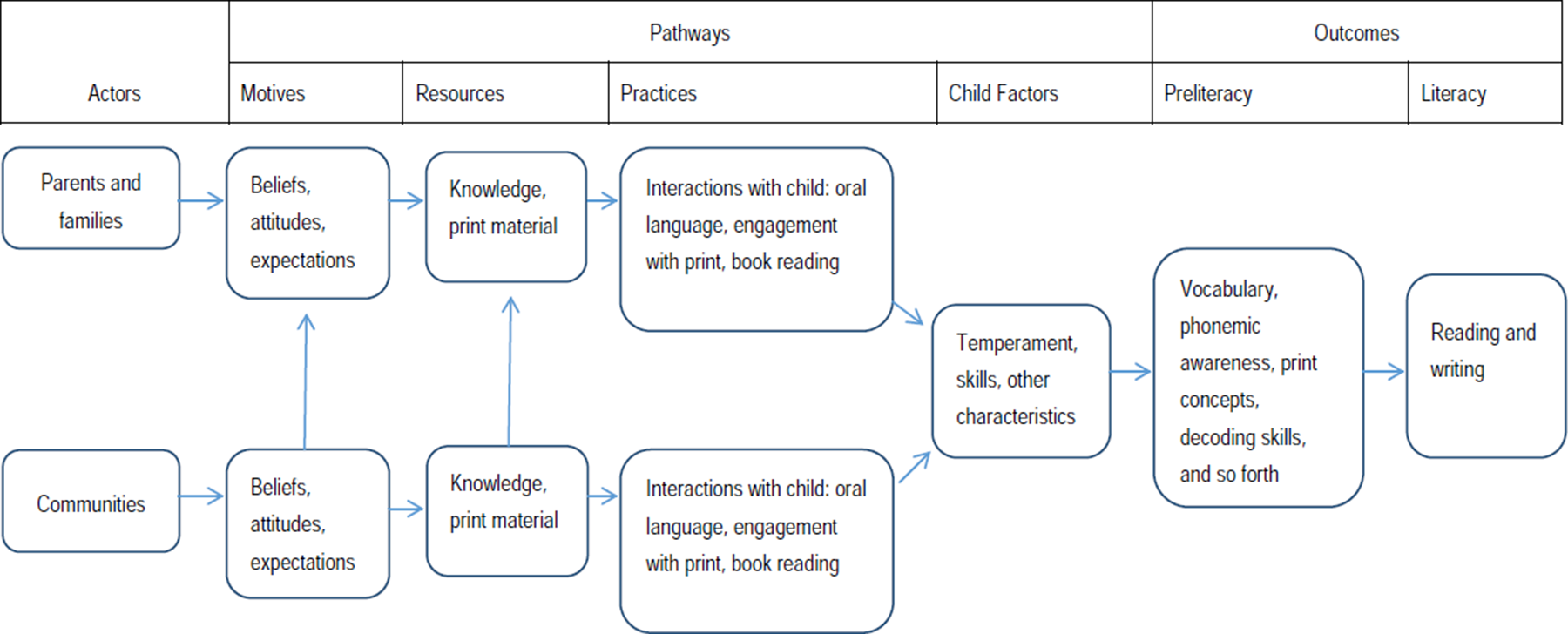
Nonschool Contextual Pathways to Literacy Learning
Why It Is Important to Do the Review
Policymakers and practitioners at both the individual country level and in multinational organizations increasingly want to select interventions that have documented and reliable evidence of their effectiveness. As discussed previously, poor literacy development is of persistent and significant concern in many countries. However, the available published research literature outside industrialized nations is quite limited, albeit growing, and there is a dearth of high-quality, quantitative studies. There also is a lack of balance in the quality and the quantity of evidence for intervention effectiveness across different contexts (e.g., more literature is expected to be available from middle-income countries than from low-income countries, despite the high level of investment in interventions for low-income countries). The field will benefit from knowing the types of interventions that have been subject to rigorous evaluation, as well as the evidence produced by those evaluations. There is already a high level of interest in the results of this review among large international development organizations (such as the U.S. Agency for International Development [USAID] and UNICEF), as well as smaller NGOs and academics across developing countries.
This review also is expected to provide comprehensive information about those models or approaches that have evidence supporting or refuting their effectiveness and models that are being used in the absence of evidence. Our objective for this work is to provide the evidence needed for NGOs, governments, and others to make informed decisions about interventions to improve children's literacy outcomes in LMICs. It will also include information to help end users understand the extent to which evidence is grounded in studies carried out in similar contexts (e.g., the level of parental literacy where family reading initiatives have been successful). Our advisory panel has indicated that this contextual information is vital for effective decision making.
We expect to find significant gaps in the availability of evidence for what works to improve children's literacy development in LMICs outside the formal education system. By highlighting the availability of evidence, we expect that our review will provide information that will help funders learn where they should invest evaluation resources.
Work products, such as the full literature review and shorter briefs, will be made available on each partner organization's website and through relevant information clearinghouses (such as USAID's Development Experience Clearinghouse and the Clearinghouse on International Developments in Child, Youth, and Family Policies at Columbia University). We will build on the Search Institute's extensive network of international and country-specific NGOs, such as Save the Children, World Vision International, YMCA International, and the International Youth Foundation. We will contact numerous other professional networks that are focused on global child and youth development, including UNICEF, the Alliance for International Youth Development, the Communication Initiative Network, the International Society for Child Indicators, and the UN's Committee on the Rights of the Child.
OBJECTIVES
The objective of this systematic review is to examine the availability of evidence and what that evidence says about the effectiveness of interventions to improve parental, familial, and community support for children's literacy development in developing countries. This review will provide information about the contextual influences of parental, family, and community support on children's literacy development skills by using interventions that target those influences.
We will explore the following questions:
What literacy interventions for children between 3 and 12 years old have recently been implemented outside formal education settings with parents, family, and communities in LMICs? Which literacy interventions have been studied in a rigorous enough manner to provide information regarding their effectiveness? Which interventions are most effective at building literacy skills? What are the essential features of effective models? What are the identified moderators and mediators of intervention effectiveness? To what extent are the nature and the effectiveness of interventions influenced by contextual factors, such as cultural tradition, poverty, conflict situations, the availability of learning resources, or parental literacy?
The overarching goal of this review is to increase the availability of information for evidence-based decision making for international agencies, NGOs, and government policymakers.
Whether an intervention leads to improved child literacy outcomes is affected by the larger context, even if that intervention is effective at strengthening one specific aspect of the model. Human and material resources are required for interventions to be implemented with fidelity. For example, an intervention that shows parents how to engage in shared book reading will have little or no impact on children's literacy development if no printed materials are available. Likewise, an intervention that engages parents in shared book reading with their children and improves children's literacy may work well because it was introduced in a place where parents have the time and literacy skills to engage in reading with their children, plus print materials are available.
In addition to home and community contexts, the replicability and the scalability of an intervention depend on the availability of resources required to introduce and implement that intervention. For example, a successful mobile library initiative may require the acquisition and the maintenance of one or more vehicles, staff with basic training in managing a library, and so on. Therefore, to the extent that information is available, we will frame the results in terms of contextual variables that may affect the replicability and the scalability of the intervention or approach, as well as the resources necessary to introduce and deliver the intervention. This information can be essential for stakeholders who are considering which intervention(s) may be right, given the local context and the resources available.
METHODOLOGY
This section addresses the criteria for study inclusion/exclusion, our search strategy, methods used in primary research, criteria for the determination of independent findings, study coding categories, statistical procedures, and the treatment of qualitative research.
I. Criteria for Inclusion and Exclusion of Studies in the Review
In this section, we address eligible designs and types of participants, interventions, and outcome measures that will define the criteria for including and excluding studies in this review.
Population, Intervention, Comparison, and Outcomes Model
The Population, Intervention, Comparison, and Outcomes model (Petticrew & Roberts, 2006) will be used to categorize the inclusion criteria of the literature by population, intervention, comparison, and outcome. Each criterion must be met for inclusion. A fifth and supplemental category—context—also may be considered.
II. Search Strategy
Relevant literature will be included if it was published in 2003 or later. Studies from more than 10 years ago have a high likelihood of assessing interventions that are no longer in use or are no longer being implemented in the same context (e.g., children's access to primary education, parental literacy, and the use of first-language instruction have all increased in many LMICs during the last decade).
Unpublished studies of eligible interventions, such as dissertations or research reports from government agencies and NGOs, will be included. Documents such as PowerPoint presentations, internal agency memos, editorials and notes, student term papers, advertisements or promotional materials, editorials, letters, case series, and personal communication notes will be eligible for the review if sufficient information is included. We will screen literature with abstracts published in English, Spanish, and French. If a study passes title and abstract screening but the main text is in another language, we will identify qualified reviewers literate in that language to review that study.
2a. Resources Searched
Studies included in this systematic review will be obtained from electronic academic literature, grey literature (i.e., unpublished reports), and key informant solicitation. We will search online databases across diverse disciplines (see Table 1), work with our advisors and their networks to identify relevant literature, and examine reference sections for any other relevant work.
Online Databases to Be Searched
Agency websites to be searched for grey literature include the United Nations, international development banks, and aid groups; NGOs and foundations; and international research institutes and centers of expertise. The project advisory panel also will be asked to use their professional networks to assist in the search for grey literature.
2b. Search Terms and Key Words
A list of search terms will be used to search electronic databases and agency websites and during informant solicitation (see Table 2). The search terms necessarily must be adapted for each database, although the concepts of the phases of human development (early and middle childhood), and home and community-based learning remain constant. We also will use a core set of search terms that were common to all databases, such as read* and lit*.
Search Strings
To obtain grey literature, publications, reports, documents, and archives of agency websites will be searched using the electronic database search terms. The vocabulary for each agency will vary based on its disciplinary affiliation and agency-specific language. Therefore, although some terms from the academic search will be relevant, new vocabulary may need to be inserted for the agency search. When searching publications, agency websites may or may not include the following search fields: title, keyword, ISBN, subjects, series, departments, publishing agencies, languages, year/release date, publication lists, region/country, and so forth. For agencies where reports are not accessed through an online search, the agency librarian or contact will be sent a request to assist in searching through agency publications.
2c. Screening
The initial screening will use titles and abstracts to determine whether the study meets the defined inclusion criteria; then we will obtain the full-texts of all articles that pass initial screening. Given that multiple sources will be searched, the possibility of obtaining duplicate articles is very high. All duplicates will be removed, and all articles identified for review will be double coded to address possible selection issues. The completed coding forms will be reconciled; when there are cases of disagreement between the two reviewers, a third reviewer will be consulted to render a decision. Copies of the code books are available in the appendix.
The literature will be screened and selected based on the PRISMA (Preferred Reporting Items for Systematic Reviews and Meta-Analyses) guidelines, as illustrated in Figure 2 (Moher, Liberati, Tetzlaff, & Altman, 2009).
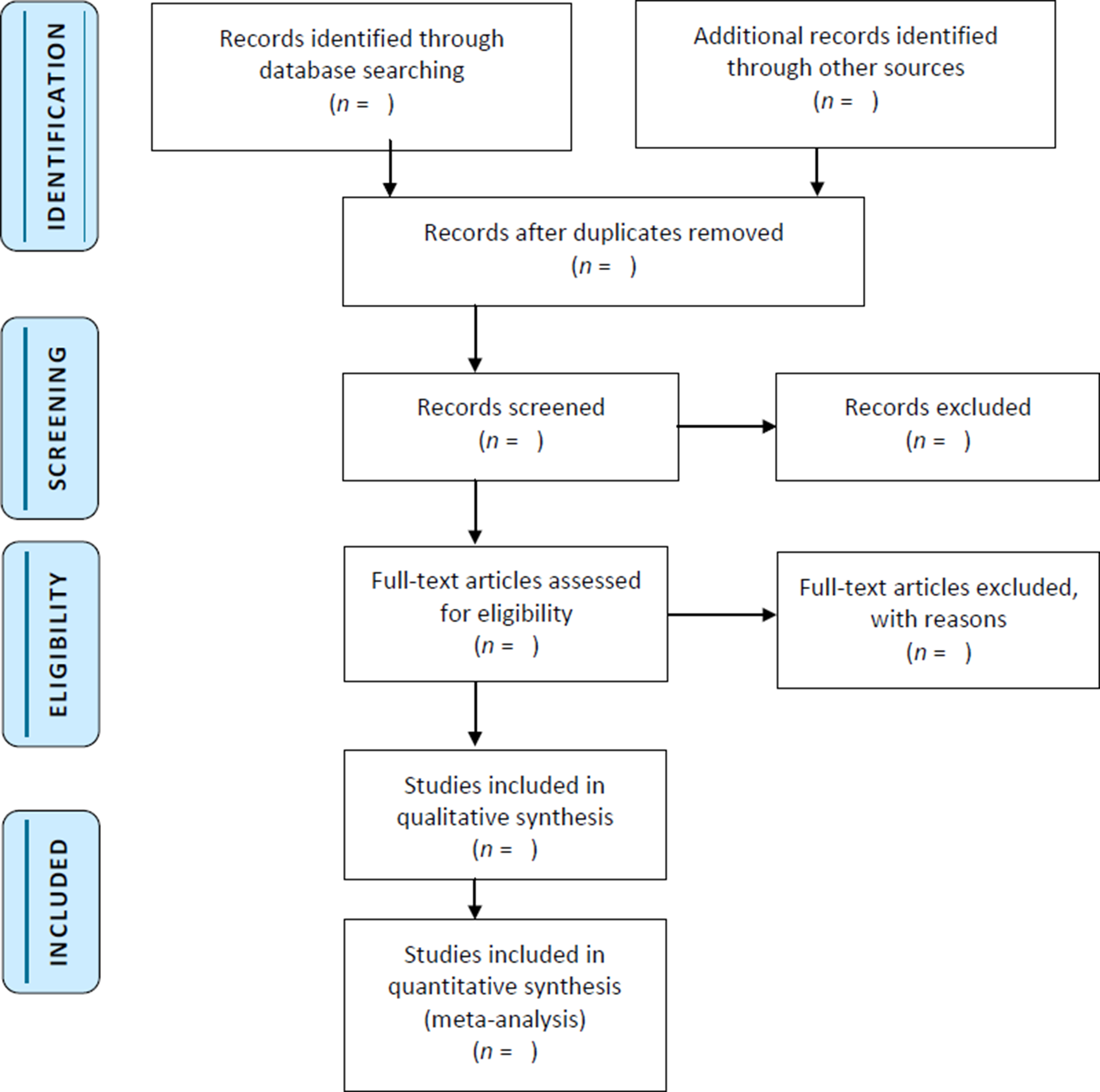
PRISMA Guidelines
2d. Information Management
Mendeley software will be used to manage the title and abstract library and store full-text documents. Coding will be completed using Microsoft Excel.
III. Methods Used in Primary Research
There is at least some rigorous research in LMICs that addresses the effects of interventions intended to improve children's preliteracy and literacy development through parents, families, or communities. The research conducted in this area falls into two general types. The first are studies of community-level interventions, primarily carried out under the auspices of large organizations (such as UNICEF). These studies cover LMICs. The second are smaller-scale studies of interventions delivered to individual children or families. The literature search is expected to yield more information about populations, interventions, and outcomes that have been studied in LMICs.
The following is information about two studies that are eligible for inclusion in this review. One study reported on a UNICEF initiative that facilitated the transition of young children into primary school (UNICEF, 2010). The evaluation consisted of multiple, country-level RCTs and is of interest because of its common evaluation framework and tools across diverse countries, and the fact that school-age children (community members) served as informal teachers to groups of preschool children to deliver the intervention. The aim of the intervention was to increase the school readiness of preschool children, including in the area of preliteracy. Although several countries are included in the study, not all countries implemented the trial with sufficient controls. Thus, only those countries where there is evidence of the use of randomization, and with information about group equivalence at the pretest, will be included.
Another study (Banerjee, Cole, Duflo, & Linden, 2007) measured the impacts of two remedial education interventions and compared their cost-effectiveness in the short and medium term and across the initial abilities of the students. The intervention of interest in this review hired young women in the community to teach basic literacy skills to children lagging behind in government schools. It included an intervention outside the formal school setting based in the community. Although the study itself examined a relevant intervention, the analysis strategy included the use of instrumental variables to adjust the differences among the treatment and control groups. This study may be included if the authors can provide the unadjusted treatment and control group means to calculate an effect size.
IV. Criteria for Determination of Independent Findings
If there are several reports of the same study, we will examine all but will treat the study as the unit of analysis. Because we anticipate that studies will report on a number of outcomes, we will conduct a meta-analysis on each outcome separately, with each study contributing only one effect size in each analysis. We may consider using robust standard errors (Hedges, Tipton, & Johnson, 2010) for synthesizing the results of studies that include the same outcomes, but we do not anticipate obtaining enough studies to be able to use this technique.
V. Details of Study Coding Categories
We will code the studies based on the characteristics of the participants, the interventions, and the study design. Participant characteristics include country, age, and gender of the intended beneficiaries; native language schooling experience; and school level. Intervention characteristics include the focus of the intervention (e.g., language skills, print awareness), the characteristics of the intervention providers, the duration and the intensity of the intervention, the materials used, and setting. The research design will be coded, along with any potential sources of bias such as attrition, randomization problems, and preexisting differences between the experimental and control groups. We will not employ a research quality scale but will instead separately analyze RCTs and quasi-experimental studies. The major statistical analyses used in the study will be coded, as will measures of effect size from all relevant outcomes that are reported. These codes will be used, if possible, in an examination of moderators of effect size heterogeneity. The coding form is provided in the appendix.
VI. Statistical Procedures and Conventions
This review will include study designs ranging from RCTs to various types of quasi-experiments (excluding one-group pre-post studies). For most studies, we will use either a standardized mean difference or the log-odds ratio as the effect size, comparing outcomes between two independent groups. We will analyze the different types of effect sizes separately but not transform the effect sizes to the same metric. Some studies may employ more complex quasi-experimental designs, such as regression discontinuity or propensity score matching. We will not combine effect sizes from different study designs because they are not necessarily comparable. For example, we will not combine a standardized mean effect size computed from a study using covariate-adjusted means with a standardized mean effect size computed from unadjusted means. Effect sizes from clustered, randomized trials will be adjusted using approaches suggested by Hedges (2007) and Pigott (2011).
Where possible, we will combine the study results using meta-analysis. We will conduct analyses by outcome and intervention type, using separate analyses for such outcomes as direct measures of literacy versus successful grade progression. For example, we anticipate that several studies using a peer teaching model to increase school readiness skills will be included in the review. We will begin the analysis by examining similar outcomes from similar interventions. We will examine the heterogeneity of the effect sizes for each outcome within intervention types across studies using the I2 index and the test of the variance component for a random effects model, and we will provide the 95 percent confidence interval for each effect. We will use sensitivity analyses to examine the impact of effect size outliers, reporting results when the outlier is included and when it is excluded. Because we anticipate a wide range of interventions implemented in a number of LMIC contexts, we will use a random effects model, which more accurately reflects the heterogeneity we expect in our sample of studies.
We will use moderator analysis to explore heterogeneity if we have sufficient numbers of studies as indicated in the power guidelines by Hedges and Pigott (2004). If we are able to conduct moderator analyses, we will use our conceptual model as a guide, examining whether effect size heterogeneity is related to, for example, the characteristics of the participants, such as the age of children, income level of the community, and child disability status. If we are able to conduct moderator analyses, we will use a common measure of the random variance component because we anticipate finding small numbers of studies. All meta-analysis procedures will be weighted by the inverse of the variance of the effect size. We will use STATA or R software to conduct the meta-analysis and use the most recent techniques for computing effect sizes and synthesizing results.
Publication bias will be examined by using both funnel plots and Egger's test. We also will produce Forest plots for relevant analyses of effect sizes. Where appropriate, we will attempt to contact the authors to obtain missing data within studies. If we are not successful in obtaining important information after at least two contact attempts, we may need to drop the study from a particular analysis.
VII. Treatment of Qualitative Research
We are not explicitly searching the literature for any purely qualitative assessments of interventions. However, if eligible studies include qualitative evidence, we will examine these studies for insight into how interventions with quantitative outcomes have worked in a given setting.