






Abstract
Linked article:
BACKGROUND
The Problem
Small and medium enterprises (SMEs), defined in this review as businesses with up to 250 employees, are believed to be both an important tool in the fight against poverty and an important contributor to economic growth in developing countries. SMEs are responsible for the majority of employment generation in developed as well as in developing countries (Ayyagari et al., 2007). Given that SMEs play an important role in the formal labour force, the health of the sector has implications for employment generation policies and growth. Ayyagari et al. (2007) show that formal SMEs are responsible for most of the private sector employment in developed countries - for example, SMEs are responsible for around 60-70 per cent of employment generation in Germany, Finland, Belgium and Canada. However, in African countries SMEs are responsible for a smaller share of formal employment generation, providing only about 20 per cent of employment in Nigeria, Cote d'Ivoire and Cameroon. Ayyagari et al. also note that the SME sector's contribution to employment shows a strong positive correlation with GDP per capita. Thus, the evidence suggests that increasing this sector's contribution to employment might generate growth (Ayyagari et al., 2007; Beck et al., 2005), and therefore that effective business support services may positively affect GDP per capita. African economies have a lower percentage of formal workers in SMEs due to the fact that these economies have a larger (not computed) and less productive informal sector. Thus, in the path towards a more formalised labour market, employment generation by the SME sector plays a very important role.
SMEs can further be linked to economic growth through their ability to link knowledge, product commercialisation and total factor productivity (Acs et al., 2009; Solow, 2007). A seminal study using a cross-section of countries to analyse SMEs and growth was provided by Beck et al. (2005), who found a positive but not causal relationship between SMEs and growth. An exploration of other available empirical evidence however, shows that while studies that focus on developed nations suggest a positive impact of SMEs and entrepreneurship on economic growth, studies examining developing countries suggest a negative impact (for example, Audretsch and Keilbach, 2004; Mueller, 2007; Cravo 2010; Cravo et al., 2012; Cravo et al., 2014). 1 Acs et al. (2008) have attributed these differences in empirical results to different entrepreneurship responses to institutional arrangements. Moreover, heterogeneity in institutional arrangements is likely to provide different incentives to rent-seeking activities (Baumol, 1990). Thus, the role of SMEs in a given economy can be expected to vary depending on the institutional settings and level of development.
Development agencies provide a considerable amount of targeted assistance to SMEs in low-and middle-income country economies (Beck et al., 2006). For instance, the World Bank devoted US$9.8 billion to SME projects during the period 2006–12 (IEG, 2013). For the same period, the support of the International Finance Corporation (IFC) of the World Bank Group directed to SMEs amounted to US $25 billion.
However, there is limited evidence on the impact of SME support in the literature, due either to an insufficient number of studies employing convincing identification strategies to isolate the causal impact of the intervention under consideration, or to limited information regarding the mechanism underlying such interventions. This systematic review will draw on economic theory and qualitative studies to uncover the channels through which a particular intervention can affect the outcomes of interest. This research will therefore separate the outcomes into two categories, intermediate and final, wherever possible in order to uncover the theory of change of each intervention.
The Intervention
In developing countries, programmes that support SMEs are based on the view that there are institutional constraints that impede SMEs from reaching their full potential to generate jobs and profits. Thus, the large amount of financial resources allocated to the development of the SME sector by governments and development organisations is designed to address institutional failures, and allow SMEs to operate more efficiently, thus leading to productivity growth (Beck et al., 2005). 2
Various approaches are used to provide support services to SMEs. These mainly aim to improve the institutional setting and to remove those institutional constraints that prevent these firms from reaching their full potential and thus contributing effectively to economic growth and poverty alleviation.
Based on a preliminary review of the literature, we have identified the main approaches to SME support as programs related to formalisation and the business environment, access to external markets, value chains and clusters, training and technical assistance, SME financing and innovation policy.
This literature can be divided into two distinct themes. The first considers indirect support that addresses the constraints that prevent SMEs from getting access to credit, whereas the second addresses the impact of direct business support to SMEs. In the first strand, many studies look at the impact of an indirect type of public support aimed at SMEs, such as tax simplification, which intend to provide incentives for informal SMEs to formalise. The underlying assumption is that formal firms are less credit-constrained than their informal counterparts and therefore formalisation would be an effective way of helping entrepreneurs. Formalised firms are expected to have higher economies of scale and consequently be more productive, demand a more skilled labour force, and have higher profits. If informal firms are prevented from growing due to credit constraints, reducing the cost of formalisation should, indirectly, give firms the opportunity to escape from the low-scale-low-productivity trap. This intervention is an indirect form of public support because it is targeted to all firms with annual revenues below some threshold. All informal firms are incentivised to formalise through tax simplification. Those that decide to formalise are not directly offered any other type of public support.
The second group of studies addresses the impact of direct business support to SMEs. They generally estimate the impact of a support programme to SMEs within a specific sector in a specific country, with the intervention based on the assumption that SMEs face constraints such as a limited pool of skilled labour, limited innovation capability and coordination failures. In this view, SMEs need public support to break the vicious circle of low investment and low productivity. A successful intervention might even generate (spillover) effects on firms that do not belong to the target group of the programme – firms from other sectors and/or informal firms in the same sector. This kind of support comes in the form of training programs, support for innovation or value chain and association strategies (for example, clusters) to address coordination failures. Notice that, unlike the indirect public support programmes, the unit of intervention is the firm itself. Firms are directly targeted with programmes that aim to help them shift from a low equilibrium (small size and scale) to a high equilibrium (bigger scale and dynamism). Workers are offered training, and transportation costs, spillover effects and coordination failures are directly affected by the creation of productive agglomerates.
How the Intervention Might Work
Since this review will investigate the impact of a diverse array of interventions, it is challenging to come up with a general theory of change. Although we provide a general theory of change based on our preliminary search of the literature in this section, it is with the caveat that each type of intervention identified in the initial search of the literature is based on an institution's belief in a particular causal chain. Therefore our approach to building out this theory of change will involve taking a case-by-case perspective on the assumptions regarding the causal chain of each of the programs analysed.
As mentioned in Section 1.2, in general, support to SMEs is related to productivity growth and employment generation. Overall, the theory of change behind SME support services is linked to the improvement or creation of institutions that allow SMEs to reach their full potential. Figure 1 below provides a more general illustration of the theory of change for the intervention models we aim to survey in this review, as detailed in Table 1.
Types of intervention and related search terms
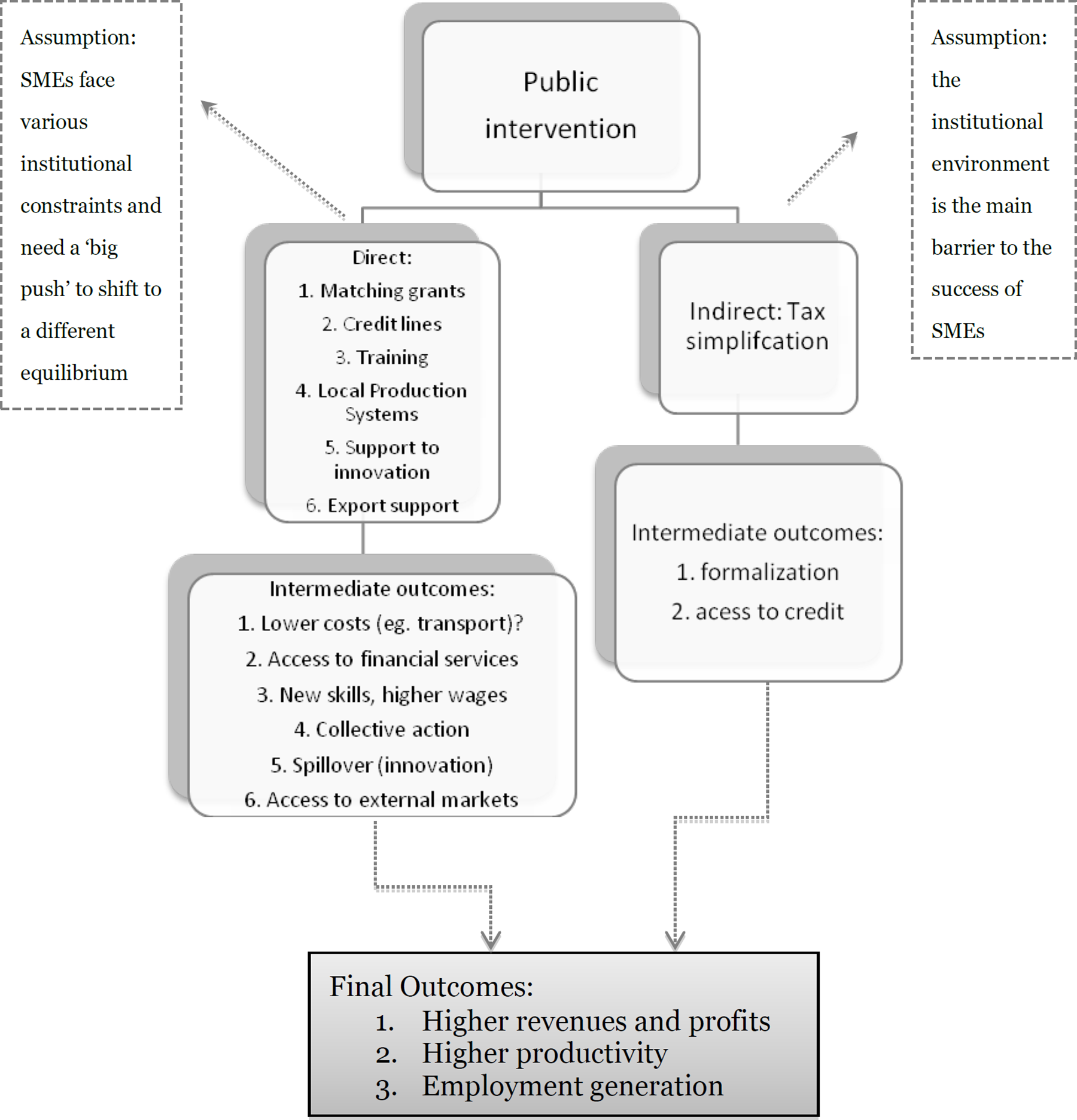
Theory of change
Within this general theory of change are contained those which are specific to the particular interventions shown:
Matching grants. According to McKenzie (2011) this is the most widespread intervention in African countries. These programmes consist of a government subsidy with the government reimbursing 50 per cent of the costs firms incur with training, marketing, and/or attending a trade fair. This programme is justified on the grounds that these investments have positive externalities and firms therefore invest less than the optimal level (McKenzie, 2011).
Credit lines. SME financing programs are popular and tackle adverse selection and moral hazard in credit markets that generate financial constraints and limit SME activities. The establishment of specific projects circumvents adverse selection of credit provision to SMEs. The availability of credit allows firms to invest and hire new employees and productive assets. These investments are likely to lead to productivity growth.
Training and management programs. These programmes, provided in the context of the limited skills of the workforce in low- and middle-income countries, are based on the idea that the market failure preventing the firms from taking off is related to lack of skills or information within the workforce. Thus, skills acquired in specific training programmes should contribute to workers' employability and wages, but also to firms' productivity through adoption of more efficient management practices.
Interventions that support local production systems (LPS) are based on the idea that individual firms can benefit from agglomeration externalities and coordination (for example, Schmitz, 1995) (see figure 2 below). Consider a project, in a region specialised in a given sector, that provides solutions that allow firms to act collectively (such as training, joint purchases, joint certifications). The economic theory suggests that formal firms might act together to capture collective externalities, grow and impact the local economic performance. A successful project that allows firms to benefit from positive externalities generated by collective actions would affect outcomes such as employment and regional growth through: 1) the establishment of collective agreements, and 2) specific outputs from collective action (that is, certification efforts, training, joint purchase). The causal chain is that firms will organise around a common goal that will allow them to capture positive externalities from collective actions. Collective actions are expected to generate intermediate outputs, allowing firms to move to another level of productivity and employment that would affect regional economic performance.
Support for innovation policies might include funding for improving processes (Lagace and Bourgault, 2003), and intend to capture externalities stemming from an innovation. Innovation programs aimed at SMEs might support innovation transfer, R&D programs, certifications related to innovation in order to lead to process innovation and product differentiation. The rationale is that innovation will impact on productivity growth of the firm that thus will contribute to aggregate regional and country growth.
Public intervention supporting access to external markets might also spur employment generation. Such interventions tackle information asymmetries that prevent firms from accessing the external market through provision of training, courses and counselling. The identification and adaptation to external markets generate exports that may lead to increases in production, impacting on firm profit and employment creation.
Tax simplification initiatives can be seen as a type of indirect business support to SMEs. These interventions aim at improving firm performance through the channel of formalisation. Economic theory suggests that formal firms will be able to grow with access to credit markets and by taking advantage of economies of scale. A tax simplification program could affect outcomes such as employment and profit through two intermediate outcomes: 1) formalisation rate, and 2) access to credit. The causal chain could be simplified as following: The necessary conditions for a tax simplification program shifts the informal entrepreneurs trapped in one equilibrium, characterised by low productivity and profits, to another where they face less constraints to growth after formalisation. There are plenty of studies that concentrate only on final outcomes, however, and shed no light on the mechanisms. Consequently, policy makers interested in knowing how such an intervention worked are given no guidance.
We note that sub-components within the business support interventions that this review analyses may overlap. We will develop a conceptual model of intervention types to ensure appropriate categorisation of interventions for the analysis.
Why it is Important to do the Review
A review such as this has the potential for significant policy relevance, given the amount of attention governments, development agencies and organisations around the world have dedicated to sponsoring a range of assistance programs targeted to SMEs and aimed at spurring firms' performance regarding innovation, productivity, exports and employment generation. Broader impacts on the economy such as higher wages and poverty reduction are also seen as by-products of such interventions (Beck et al., 2006). However, in spite of their prevalence worldwide, too little is known about the impact of SME support interventions. In a recent survey on SME policies in African countries, McKenzie (2011) shows that African firms are in general small, with up to 10 employees, but very heterogeneous in terms of employment, sales and access to external market. He also shows that although SMEs have been supported in several ways in African countries, rigorous evaluation of such policies is scant. This is surprising given that the SME sector is one of the main targets of international and national aid agencies (Cravo et al., 2014). This research intends to fill part of this gap by summarising systematically the rigorous evaluations done in the field so far, and feeding back the results to policymakers working on this problem worldwide.
The policy relevance of this review is increased by the fact that it aims to distill the evidence on what works in Africa, and should therefore be particularly useful to policymakers and donor organisations interested in supporting SMEs in Africa. Among the Africa-specific issues we aim to address with this review, are the question of SMEs' potentially limited contribution to employment in African countries relative to other regions, and, in contrast, the potentially greater contribution to poverty reduction these enterprises may make in the African region in comparison to larger ones.
The initial literature search for impact evaluations of indirect business support services suggests the existence of a considerable number of studies for Asian and Latin American low- and middle-income economies. Fajnzylber et al. (2011) and Monteiro and Assunção (2012) use quasi-experimental techniques to analyse the effect of a tax simplification program in Brazil on formalisation and firms' performance. McKenzie and Sakho (2010) use instrumental variable (IV) estimations and provide evidence on how tax registration affects profitability in Bolivia. Mel et al. (2012) study the effect of formalisation on profit, sales, new workers and other outcomes in Sri Lanka using IV estimations and Rand and Torm (2012) use matching and difference-in-difference techniques to assess how formalisation affects profit, access to credit and investment in Vietnam. For the African context, the available evidence is likely to be more limited. However, a detailed, comprehensive search and synthesis of the literature is necessary, with a particular focus on its applicability to the African context.
As with the indirect interventions, the initial search of the literature for impact evaluations of direct support services indicates that there is limited evidence for Africa. In one of the few studies available, Mano et al. (2012) conduct a randomised experiment in Ghana to analyse the effect of SME training programs on sales, added value and profit. In the context of low-and-middle income countries as a whole, a considerable amount of evidence is available for Latin America. Benavente and Crespi (2003) analyse the effect of an association strategy on productivity in Chile, using difference-in-difference and matching methods. In another study of the Chilean case, Arraiz et al. (2012) analyse the effect of value chain support on sales, employment and exports using propensity score matching and difference-in-difference estimators.
The literature also presents evidence on support for innovation in low- and middle-income countries. Castillo et al. (2011) provide evidence of the impact of process and innovation support on exporting, employment, wages and survival in Argentina, by combining propensity score matching and a difference-in-difference approach. Other studies analyse different types of support. Tan (2009) provides evidence for Chile for different SME programs of technical assistance, cluster programs, technology programs and credit programs on sales, output, employment, wage, productivity and exports. In addition, Ibarraran et al. (2009) study how training programs, access to credit, product innovation and ISO certification affect productivity using instrumental variables and matching methods in Latin American countries.
Though most of the papers cited above indicate a positive effect of SME support programs on selected outcomes, there is a need to systematically review and synthesise the evidence to provide an unbiased account of the impact of these programs on firm performance. As the evidence appears to be predominantly from Latin America, its applicability to African countries, or any other context, is not straightforward due to lack of external validity that mark these studies. A comprehensive understanding of the mechanisms underlying the causal chain of an SME intervention is therefore crucial if one is interested in designing SME interventions in different contexts. Therefore, one of the aims of this review is to shed light on the impact of various programs, as well as on the mechanisms that could help us understand why similar programs succeed in some countries or contexts but fail in others.
This review has some similarities with another Campbell-registered review, by Grimm and Paffhausen (2013). This other review, however, focuses on employment creation and business creation and will not systematically review evidence on firm performance such as productivity, revenues, profits, innovation, formalisation and access to credit – all of which are the main outcomes of interest of this review.
OBJECTIVES
The review aims at providing evidence on whether the provision of various SME support services impact firm performance and result in employment generation and regional growth. The analysis will be based on the search of the literature related to the impact of business support services for SMEs and will seek to provide answers to the following questions: What are the effects of business support services for SMEs on firm-level outcomes in LMICs? How do these effects differ for different types of SME business support interventions (e.g. tax simplification, access to finance, training, and so on)? What is the comparative effectiveness of SME business support interventions for achieving different outcomes? Is the interventions' effectiveness context-specific? If so, what are the contexts and mechanisms (or ‘rules of game’) which facilitate or attenuate the effectiveness of an intervention?
3
How does the available evidence apply to African countries?
To answer these questions, the research will cover both intermediate outcomes, such as access to credit, training, and formalisation, and final outcomes, such as higher profits, employment generation, productivity and access to external market, and will look for context-specific variables that can help us understand the causal chain of the intervention. We recognise that this is a very challenging exercise to be fully addressed by this systematic review. In fact, the main objective is to shed some light on the potential moderator variables linked to the institutional setting and level of development of each country. Assessing applicability of the results to specific local African context is not an easy task and goes beyond the scope of the systematic review, however, in order to allow the reader to relate the review findings to a specific context, the document will present relevant contextual and implementation information.
METHODOLOGY
I. Criteria for including studies in the review [PICOS]
Participants
This review will focus only on studies that evaluate policies aimed at supporting SMEs in low-and middle-income countries (as defined by the World Bank's classification), with an emphasis on African countries wherever possible. The focus on LMICs is justified firstly because private firms in these countries tend to be more labour intensive and less innovative, and consequently are the main employer of a large proportion of the labour force. Secondly, restricting the scope to LMICs helps to identify the binding constraints that SMEs might face in similar institutional contexts, such as in some African countries. The term SME covers a wide range of definitions and measures, varying from country to country and between the sources reporting SME statistics. Some of the commonly used criteria are the number of employees, total net assets, sales and investment level (Ayyagari et al., 2007). The most common criterion used to classify SMEs is based on employment information, due to data availability, and the cut-off used to define SMEs is usually 250 employees4. This review will use this cut-off of 250 employees. Consequently, other types of interventions aimed only at supporting entrepreneurship and the creation of microenterprises, such as microfinance 5 , will not be part of this research. This is because self-employed and micro-entrepreneurs have a different nature in comparison to SMEs 6 . The former, especially in LMICs, are comprised of less productive or informal enterprises of few employees in the fringe of the markets. Furthermore, these enterprises are not eligible to most of the public interventions to be covered in this review. Thus, the definition of SME based on number of employees fits well our purpose of covering a broad set of interventions and of considering relevance for African countries 7 . Since our prior assumption is that there will be only a few studies examining public interventions in African countries, a proper contextualisation of the interventions, a comprehensive understanding of the designs, the target groups, and the moderator variables ranging from those related to firms themselves (size, sector, number of years in operation) to those related to the country where the intervention take place will be crucial to this review. This will allow us to be able to shed some light on whether the intervention has some external validity and consequently whether it could potentially work in an African context. 8
In order to address the likely problem of limited evidence, particularly of relevance to Africa, the scope of the review will include all studies identifying final and intermediate outcomes. This will also better inform the causal chain analysis which will help inform our tentative findings about generalisability to African countries.
In the studies selected, we will then search for any information on how and why interventions worked or did not work. The literature recommends that synthesis is informed by the theory of change embedded in the design of an intervention (see Waddington et al., 2012b). However, our focus is not only on the impacts directly anticipated by the intervention but also included unanticipated impacts.
Interventions
We will include the following interventions:
Formalisation/ Business Environment (Institutional Improvement): such as tax simplification, intended to provide incentives for informal SMEs to formalise. Underlying assumption: that formal firms are less credit-constrained than their informal counterparts and therefore formalisation would be an effective way to help entrepreneurs. Indirect support to SMEs may include policies regarding business registration, property registration and regulatory frameworks (Fajnzylber et al., 2011; Monteiro and Assunção, 2012; McKenzie, 2013).
Exports/Access to External Markets: defined as interventions that correct market failures such as information externalities and help SMEs overcome obstacles to exporting (Volpe and Carballo, 2010; Volpe et al., 2010; World Bank, 2010).
Support for innovation policies is based on the idea that social returns to innovation exceed private returns (Lundvall and Borras, 2005; Acs and Audretsch, 1988). Interventions designed to support innovation vary. This review will consider different types of innovation support such as matching grants, subsidies and tax incentives, as identified in the preliminary search. For instance, Chudnovsky et al. (2006) evaluate the case of matching grants provided after an open call for proposals. Alvarenga et al. (2012) analyse the impact of innovation-oriented matching grants and subsidised credit for innovation, and Czarnitzki et al. (2011) evaluate the effect of tax credits on innovation. Other forms of innovation support may also be identified during the search process.
Value Chain, Networks and Cluster interventions: defined as interventions that help individual firms benefit from agglomeration externalities and overcome the coordination failures that prevent SMEs from capturing these externalities (Schmitz 1995; Schmitz and Nadvi 1999; Giuliani et al., 2005).
Training and technical assistance: defined as interventions that provide support for employee training and technical assistance, based on the idea that skills improve employability and wages of workers and contribute to firm productivity (Attanasio et al., 2011; Rosholm et al., 2007). This type of intervention also includes consulting services and management practices such as those considered by the World Bank (2010), Bruhn et al. (2013) and Bloom et al. (2013).
SME Financing/Credit Guarantee: adverse selection and moral hazard in credit markets generate financial constraints, which in turn restrain SME activities (Beck and Demirguc-Kunt, 2006; Michelacci and Silva, 2007; Canton et al., 2012). The review will consider in this line of support, interventions that provide loans or insurance services to SMEs, such as those noted in World Bank (2010) for credit and in Oh et al. (2009) for credit guarantee schemes.
We note that sub-components within the business support interventions this review analyses may overlap. In this case, it will be important to categorise them as accurately as possible. If there is sufficient data, a sensitivity analysis will be conducted using detailed information on intervention sub-components, however, this may not always be possible if only a small number of examples are present.
Comparisons
To the best of our knowledge, most of the papers investigating the impact of a public policy targeted to SMEs compare a treated (or eligible) group with a control group (or comparison group in the case of quasi-experimental design). However, we will be distinguishing studies that compare treatment and control (or comparison) groups from studies that have more than two treatment arms. Besides, we will also separate the evidence according to the intervention design. In the case of RCTs, for instance, an intervention can use a phase-in design, an encouragement design, cluster (or block) randomisation, or pure randomisation (see Duflo et al., 2008). Different designs have two implications: (1) they almost always identify different parameters (ITT, ATT, LATE and so on); and (2) they almost always differ in terms of data collected (different take-up rates, different attrition rate, different risk of contamination bias and so on).
Outcomes of interest
The selected studies must report on at least one impact to do with firm-related outcomes, either intermediary or final. For the purposes of this review, we will define firm performance impacts to refer to objective indicators such as revenues, profits, job creation, innovation, formalisation, number of workers trained, and access to credit. Only factual/objective measures of firm performance impacts will be included: subjective measures on beliefs and perceptions will be excluded.
Primary outcomes
Primary outcomes of SME support revolve around better firm performance and growth and therefore can be categorised as: revenues, profits, employment, productivity, innovation, exports, and survival rates. The following are examples of studies that we would expect to include in the review looking at these outcomes: Mano et al.'s (2012) experiment in Ghana to analyse the effect of SMEs training programme on sales, value added and profit; Benavente and Crespi's (2003) study of the effects of an association strategy on productivity in Chile; Arraiz et al.'s (2012) assessment of the effect of value chain support on sales, employment and exports in Chile; Tan's (2009) evaluation of different Chilean SMEs programs for technical assistance, cluster programs, technology programs and credit programs on sales, output, employment, wage, productivity and exports; and Castillo et al.'s (2011) study of the effects of process and innovation support on exporting, employment, wages and survival in Argentina.
Secondary outcomes
Secondary outcomes vary according to the type of program, but can be broadly defined as: access to credit, job training, tax simplification aimed at firms' formalisation, formalisation rate, policies aimed at improving the value chain, and regional growth.
These are all examples of direct intervention through secondary outcomes. Programmes that provide access to credit ultimately aim to allow firms to endure an economic recession and/or invest. As the firms successfully continue in the market and invest, the primary intended outcomes are survival and increases in productivity. Similarly, with SME support related to innovation, training and the value chain the underlying assumption is that innovative practices, more skilled workers and a better coordinated value chain will result in higher productivity, employment generation, access to foreign markets and others. For instance, Ibarraran et al. (2009) focus on how interventions such as training programs, access to credit, product innovation and certification affect productivity of SMEs in Latin American countries.
Study types: designs of interest to this review
The review will draw on a broad search to identify studies that relate to the interventions aimed at SMEs in LMICs.
To address questions i) to iii), the review will focus on quantitative analysis and include only studies that use experimental (randomised controlled trials) and quasi-experimental methods, such as regression discontinuity design (RDD), instrumental variables, difference-in-differences, matching on covariates, propensity score matching and any other methods that purport to control for selection bias (for example, Heckman two-step estimator) 9 . Studies selected must have controls for the endogeneity of program placement or self-selection into the program. Experimental and quasi-experimental methods are widely seen as the best tools when the main objective is to estimate the causal impact of an intervention or policy (see for example Duflo et al., 2008). When an intervention is carefully designed or the identification strategy of an observational study convincing enough, the findings on the impact of the program or intervention are said to have internal validity, that is, one can claim that the difference in the outcomes between treatment and control groups was caused by the intervention 10 .
This review will thus consider only studies that assess the impact of an intervention comparing the treatment (or eligible) and the control (or comparison) groups at one or more points in time. In cases where more than two treatment phases are considered, the estimates can also involve comparison of the two treatments 11 . The studies considered will therefore be drawn from cross-sectional and panel data datasets. Quasi-experimental studies that rely on observation data must show balance tests or use a matching method to control for imbalances in observed characteristics. Studies using matching methods, for instance, should clearly state the intervention rule of the program to be able to make the case that the problem of selection bias is (mostly) due to observed characteristics. Most importantly, the studies included will document the impact of any business support service on SMEs compared to practice as usual. In addition, the review will compare the impact of different types of business support service on firm performance.
As discussed in Waddington et al. (2012b), focusing exclusively on studies that use experimental and quasi-experimental methods may significantly restrict the studies that can be included in the review. Although this might be a legitimate concern, particularly if one is interested in comparing different interventions, we choose this trade-off because findings of studies that do not control for their selection biases are of little relevance, and possibly misleading, for decision makers.
To address questions iv) and v), we will draw on background program documentation or ‘sibling studies’ (Snilstveit, 2012) on the interventions in question. Such studies are deemed relevant if they meet the following criteria: They relate to the interventions included in the effectiveness review. They report on primary data collected from beneficiaries, program staff, local authorities and experts. They contain analysis of the context and mechanisms which facilitate or negate firm performance impacts. They describe their methodology adequately for the purposes of this review as set out here: that is, they provide information regarding their sampling strategy, data collection procedures, type of data analysis, methodology and methods or research techniques.
II. Search methods for identifying studies
The generalised search strategy aims to cover as comprehensive a set of published and unpublished sources as feasible within the period allocated, prioritising electronic searches because in the case of the interventions of interest, it is most likely that these have been reported in the formal literature on SMEs or in the grey literature on the part of national and international organisations.
The first stage of the review is a search of all published and unpublished studies likely to be relevant to our objectives. They must meet all of the following criteria in order to be included: They report on SME support interventions of the kind detailed in the section on Interventions The interventions are located in low-and middle-income countries, as defined by the World Bank's classification. The interventions occurred since the year 2000, since the review will cover studies that use impact evaluation techniques which have mainly been developed since this time.
Given the variety of interventions to be covered in this research, it might be inefficient to begin with an online search. Reference ‘snowballing’ might be more suitable in our case (Hammerstrøm et al. 2009; cited in Waddington et al., 2012). Reference snowballing consists of using existing reviews, papers and reports to identify the set of studies to be reviewed. Our search strategy will therefore draw on the first set of important studies already identified (see References, section 10). We will then proceed to conduct the electronic search as laid out in the next section in order to find studies missed during the snowballing phase, including sibling studies and background information.
Electronic searches
Databases for search:
3ie database of impact evaluations: http://www.3ieimpact.org
EconLit
ABI/INFORM Global (ProQuest)
International Bibliography of the Social Sciences (EBSCO)
EconPapers
Informaworld Taylor & Francis Journals Complete
Ingentaconnect.com (Ingenta)
JSTOR (All Collections)
NBER Working Papers
IDEAS/RePEc
PAIS International (http://www.csa.com/factsheets/pais-set-c.php)
Periodicals Archive Online (ProQuest)
Royal Society Journals
SAGE Journals Online
ScienceDirect
SpringerLink (MetaPress)
Wiley InterScience
Social Science Citation Index
International bibliography of social sciences
Networked digital library of Theses and Dissertations
DAC (OECD)
BLDS: http://blds.ids.ac.uk
Google Scholar: http://scholar.google.nl
JOLIS: http://jolis.worldbankimflib.org/e-nljolis.htm
Youth Employment Network database
Portals:
World Bank: http://www.worldbank.org/html/extdr/thematic.htm
IDB: www.iadb.org
AFDB: www.afdb.org
ADB: www.adb.org
UNDP: http://www.undp-povertycentre.org/
DFID: http://r4d.dfid.gov.uk/
Search terms
Table 2 provides the list of basic search terms used to identify studies in the systematic review. Based on these terms, a detailed search strategy was set up to account for US and British English spelling, to seek for the most relevant studies and to restrict the search to low- and middle-income countries. The details of the search terms are provided in Appendix 1. The search strategy was developed using the Social Science Citation Index (ISI) and Econlit databases, two of the most important databases in economics. These codes will be adapted for other databases that allow the users to construct detailed codes for search terms. Nevertheless, unfortunately not all databases listed above allow the users to generate such a specific chain of commands to identify studies related to SMEs. When a database does not make it possible to construct complex search codes, an iterative search strategy using the search terms provided in the appendix and Table 2 will be used. All searches performed will be provided in the appendices of the systematic review.
Data extraction
Other searches
Along with database searches, the research assistants will carry out manual back searches in bibliographies of studies and journals identified as relevant to the topic 12 . Given that the search focuses on low- and middle-income countries, we will also contact authors of studies and experts in the field for further recommendations on studies dealing with under-researched aspect of the interventions of interest. In addition, we will contact authors of selected studies to obtain fuller information on the interventions of interest. The review will cover studies published in English, Spanish and Portuguese. We will also include sibling studies (Snilstveit, 2012): qualitative studies including project documents, process evaluations and monitoring and evaluation documents associated with the projects evaluated in the impact evaluations included in the review. This will help to understand how a particular intervention works and achieves the results shown and help inform how applicable the effectiveness findings are to African contexts.
III. Data collection and analysis
Selection of studies
The selection of studies will be done in two stages. First, two independent reviewers will select the studies that meet the inclusion criteria described previously. Abstracts and full texts will be used to decide whether a study is relevant by the inclusion criteria. Conflicts over whether or not a study qualifies for inclusion will be resolved through discussion within the team.
Data extraction and management
For all studies included in the two stages of the review, the researchers will extract information on different stages of the research process as well as of the program intervention. This will be done through an independent and consecutive process of reading studies, and will thus involve double-coding.
For each included study we will extract the following information:
Assessment of risk of bias in included studies
The Cochrane Collaboration tool will be used to assess the ‘risk of bias’ in RCTs and the IDCG risk of bias tool (Hombrados et al., 2012) will be applied to assess bias in quasi-experimental studies. Since some interventions that will be covered in this research are likely to have general equilibrium effects, estimates of spillover effects are critical.
Assessment of statistical power of included studies
The impact estimates will be assessed on two grounds: (1) effect size, and (2) statistical significance. Statistical significance is directly affected by study design and sample size. Study design can affect the precision (or efficiency) of the estimates if, for instance, the randomisation (or intervention) occurs at cluster level and the unit of analysis are firms or workers. If that is the case, the standard errors should be computed correcting for intra-cluster correlation. This correction might imply a loss of precision if units within the same cluster are relatively similar in terms of the outcomes of interest.
For a similar reason, small sample size results in higher sampling variance and therefore lower precision. In this case, an intervention that is based on a small sample size will have to have a big effect size to be statistically significant. When studies report effect sizes but are mute with regard to power analysis, we will perform an ex-post power calculation or simulate the sample size that would be required so that the estimated effect size had a power of at least 80 per cent 14 .
Measures of treatment effect
The comparison of the effectiveness of different interventions requires standardised effect sizes. Whenever pooled standard deviation is provided, we will calculate standardised mean differences (SMDs) for continuous variables and Odds Ratios (ORs) for binary outcomes 15 . In the absence of an effect, SMD equals 0 and the OR equals 1. Whatever is the case, standardised effect sizes as well as their 95 per cent confidence interval (CI) will be provided. The computation of the CI is important to inform how precise (and therefore reliable) the effect size is and consequently the results of a study. Standard effect sizes are also important if one is considering implementing a meta-analysis or a meta-regression (Duvendack et al., 2012). To deal with outliers we will apply the Winsorising technique that consists of censoring the distribution of the effect sizes by replacing, say, the top and bottom two percentiles with the highest and lowest values of the censored distribution. 16
Methods for handling dependent effect sizes
In cases where impact is estimated for subgroups (for example, small, medium, and large firms), it is recommended that only one effect size per outcome per study is used in the meta-analysis to avoid over-representation and misleading average effect size computation (Borenstein et al., 2009: 226). In these cases, the effect sizes will be weighted averaged and variances recalculated accordingly prior to the meta-analysis. However, if the study investigates the impact of an intervention on several outcome variables, an effect size will be computed for each outcome and, in such cases, more than one effect size extracted from the same study will be considered in the meta-analysis.
Unit of analysis issues
Based on our preliminary review and background, most of the studies that assess the impact of the interventions that will be investigated in this review use data either at firm or worker level. However, the experimental or quasi-experimental unit may differ. For instance, an intervention may target firms in a specific region. In this case, the intervention would happen at cluster level and the analysis would be performed at firm or worker level. Since firms of the same region (cluster) are more likely to be similar than firms from different regions, the computation of the standard errors should correct for intra-cluster correlation (ICC - correlation between units within the same cluster) otherwise the standard errors would be underestimated and therefore the null hypothesis of no impact would be more likely to be wrongly rejected (a higher risk of Type 1 error). Whenever this is the case, we will contact the authors to request the estimate of the ICC. When the estimate is not made available, we will run power calculation with different values for the ICC to examine how sensitive the estimates and the study conclusions are to the presence of ICC 1 ?.
Dealing with missing data
Since it is quite unusual to see studies in applied social sciences reporting the pooled standard deviation, we will first try to contact the authors when it is the case and eventually use alternative measures to compute the effect size, such as response ratios and standardised regression (beta) coefficients
18
. The response ratio is given by the following ratio (see Borenstein et al., 2009):
where YT is the mean value of the outcome in the treatment (or eligible) group and YC is the mean value of the outcome in the control (or comparison) group. In this case, R corresponds to the effect of the programme on the level of the outcome variable. For difference-indifferences estimates, R will be given by the ratio between the variation in the mean outcome in the treatment group and the mean outcome in the control group. In this case, R provides the effect of the intervention on the growth rate of the outcome of interest.
Inter-rater reliability
To check code consistency across studies, what is called inter-rater reliability, different versions of Cohen's (1960) kappa will be used. The original version of Cohen's kappa is more suitable when there are two coders as it consists of a computation of a standardised index across studies based on cross-tabulated ratings. The index is given by difference between the observed percentage of agreement in ratings across studies, P(a), and the probability of expected agreement due to chance, P(e), divided by 1-P(e). The kappa index varies from -1 (total disagreement) to 1 (total agreement), with 0 representing completely random agreement.
According to Hallgren (2012), the original Cohen's kappa is subject to two main sources of problems. One problem arises from the nature of the coding system and it is called prevalence problem. This happens when one category of rating is over-represented compared to the others. This biases the kappa estimates downwards. The second source of problem is called bias problem and arises when the ratings differ considerably across coders. Although different versions of Cohen's kappa have been developed to deal with these problems, there is not a unique estimator that takes care of both problems simultaneously. Hallgren (2012) recommends Siegel and Castellan's (1988) kappa in the presence of bias and Byrt et al.'s (1993) kappa to correct for the prevalence problem.
IV. Synthesis
Quantitative synthesis
Since this review will be covering a broad set of interventions, it may be difficult to find studies that satisfy the minimum requirements for direct comparability. However, whenever possible, this review will apply meta-analysis techniques to synthesise the effect sizes of an intervention. Borenstein et al. (2009) define meta-analysis as a rigorous way of synthesising the effect of an intervention investigated by several different studies. Although the interventions tested in different studies may be seen as equivalent by the researcher, the context in which they take place may be considerably different and by no means irrelevant for their success or failure. To be suitable for meta-analysis, the studies have to investigate the same intervention, and have similar outcome variables and effect sizes (Becker et al., undated; Waddington et al., 2012b). 19 In order to account for such idiosyncratic characteristics of each intervention, the meta-analysis will use random effects to compute the ‘average of the averages’, as it might be implausible to assume that there would be a unique effect size regardless of the differences between the studies. We will assess heterogeneity across contexts using moderator analysis (discussed below), as necessary.
Our criteria for studies to form part of the meta-analysis will be as follows: The interventions are judged to be similar enough for comparison. The effect sizes can be computed. The studies use the same effect size measures. The outcome measures are judged to be sufficiently similar in terms of construct validity (i.e., measuring the same outcome construct, though potentially measured in different ways).
Forest-plots will be used to summarise the results for each study and the overall effect size will be estimated with inverse weighted variance. This is done to account for studies sample size. In addition to this, where we are able to control for external factors that might contribute to the success (or failure) of an intervention, the so-called moderator factors, such as the level of bureaucracy to deal with the paperwork and tax codes, and the labour legislation, we may be able to run a meta-regression controlling for such factors. The systematic review will use Stata 12 and 13 to perform the statistical analysis required.
Although quasi-experimental methods, such as difference-in-difference and regression discontinuity design, are usually seen as second best strategies to deal with the selection problems that characterise most of the studies that rely on observational data, there are many controversies regarding whether they should be included or excluded from a meta-analysis. In fact, different quasi-experimental methods have different identification strategies and in most of the cases identify different parameters, such as intention-to-treat, average treatment effect on the treated, local average treatment effects, marginal treatment effects, and so on. 20
We will distinguish between direct and indirect comparisons in the analysis of comparative effectiveness of interventions. Comparative effectiveness will be assessed directly using factorial studies (i.e. studies with multiple treatment arms corresponding to different interventions). Comparative effectiveness will be assessed indirectly across studies using standard meta-analysis and mega-regression. We do not envisage using network meta-analysis due to the anticipated small number of studies reporting direct comparisons.
When meta-analysis is not feasible, for example because there are insufficient (less than two) effect sizes per outcome, forest-plots will still be used but without calculating the pooled effect size and we will discuss the heterogeneity within and across studies narratively. Whenever possible, the analysis will be complemented with reference to potential mediator factors and context variables such as those mentioned in Table 3 under Context and Causal Mechanisms.
Furthermore, given the number of rigorous studies we are aware of, at least for some interventions the review may end up with an insufficient number of studies to allow solid conclusions and therefore policy recommendations. In those cases, we will make clear that policy conclusions cannot be drawn from such a small sample of studies, and that more rigorous evaluations are needed in order for governments, multilateral organisations and donors to draw conclusions about the effectiveness of those interventions.
Heterogeneity Assessment
This review will use meta-analysis and, where possible, meta-regression to synthesise the effect sizes of different studies that looked at the same type of intervention. As stated above, whenever the use of meta-analysis is feasible, we will use random effects to account for the studies' idiosyncrasies.
Another advantage of using a random effects model is that it accounts for two sources of variance: between-study variance, and within-study variance. The former depends on the number of studies included in the review and the latter has to do with the sample size used in that study. To capture such heterogeneity stemming from these two sources of variability, we will compute the I 2 statistic 21 . In fact, this statistic is considered a descriptive one that informs the inconsistency across the results of different studies (Borenstein et al., 2009). Where a forest plot is used to synthesise findings across the studies, we will also report the estimate for the variance of the ‘true effect size’, as an alternative measure for between-study variance 22 , τ 2.
The effectiveness (or failure) of an intervention, particularly if small and very well targeted to firms of certain region or sector, is context-specific and consequently potentially heterogeneous. This review will collect information on contexts, treatment intensity (time exposed to the treatment), constraints and time span in order to scrutinise what underpins the success (or failure) of an intervention.
To shed light on the mechanisms underlying the variability, if any, of the results associated with the same type of intervention, we will conduct a meta-regression (or an AN OVA analysis) since it would be able to disentangle how much of the total variability observed in the results is explained by variables such as context (country), sector, firms size, or time span of the intervention^.
Sensitivity Analysis
We will report separate analyses for RCTs and quasi-experimental studies, as well as examining sensitivity of analyses to studies which report adjusted and unadjusted effect sizes (Becker et al., undated). We will follow Waddington et al. (2012a) and perform sensitivity analysis for different treatment effects (intent-to-treat, average treatment effect, average treatment effect on the treated, local average treatment effect). To test for publication bias, we will use funnel plots as suggested by Egger et al. (1997). To minimize the risk of such bias, the search methods will consider gray papers (unpublished studies), we will use Egger's meta-regression test for publication bias and, where there is evidence for publication bias for particular outcomes, we will re-estimate pooled effects using a ‘trim and fill’ procedure. We will assess whether there is indication of underreporting of negative or negligible effects of interventions under consideration, a practice named ‘file drawer effects’, as part of the risk of bias assessment (see Appendix 3).
External validity
The review will discuss the ways in which the sibling studies and background program documentation informs the potential generalisability of the findings, particularly with regard to Africa, since this is one key focus of this project. We will use the knowledge gained from these studies, in combination with the theory of change and program theory, to understand what factors may influence both the overall conclusions about the effectiveness of the interventions in question, and their generalisability. We will give particular attention to findings which may guide the application and adoption of particular types of intervention in Africa: the questions of how particular interventions may work in an overall low-income context; with regard to educational levels; or with regard to gender, for instance, all have place-specific aspects, and evidence on program design will help to guide the review's conclusions in this respect. To assess possible channels leading to external validity, we also aim to provide insights on potential causes of heterogeneous contexts in Africa by assessing the contextual factors (that is, population characteristics, implementation modalities, study characteristics using moderator analysis and by providing descriptive information about the characteristics of the studies).
We will discuss the extent to which the cause-effect relationships found in the studies evaluated have external validity and therefore may be expected to hold true across different geographic areas, or, as importantly, across income levels. For example, we expect to find more relevant studies in Latin America and Asia than in Africa, and probably more relating to higher-income countries within the group of interest. Since this review is being commissioned to determine the potential applicability of findings to Africa, transferability is also an important question, and we will pay specific attention to the conditions under which study conclusions may also hold true in African countries. This will involve considerations such as the geographic conditions of the study (urban, peri-urban, or rural), the types of SME involved in the study, the scale of the programme (if local, regional or national), and other country conditions such as economic policy, political stability and technological capacity. However, it is important to distinguish between African regions, and countries, in terms of the findings' transferability, given that very different conditions prevail in different regions across the continent. A consideration of these differences is also important when thinking about the related question of applicability: that is, whether a specific type of intervention, rather than the cause-effect relationship found in an evaluation, will play out in the same way in different countries 24 . Although the review will discuss the possible channels that might lead to external validity, as noted in the objectives, assessing applicability of the results to specific local African context is not easy and is beyond the scope of the systematic review.
SOURCES OF SUPPORT
We are grateful to CIDA and 3ie for financial support, and to Martina Vojtkova of 3ie for coordinating the peer review.
DECLARATIONS OF INTEREST
We are not aware of any conflicts of interest arising from either researcher interest or financial sources.
REVIEW AUTHORS
The lead author is the person who develops and co-ordinates the review team, discusses and assigns roles for individual members of the review team, liaises with the editorial base and takes responsibility for the on-going updates of the review.
ROLES AND RESPONSIBLIITIES
Lauro Gonzalez and Caio Piza are joint lead reviewers. The literature search and data extraction will be carried out by Caio Piza, Tulio Cravo, Samer Abdelnour and Linnet Taylor, and the final analysis will be carried out jointly by the team. Advice will be provided by Andy McKay and Julie Litchfield of the University of Sussex, and two experts to be contacted by CIDA.
PRELIMINARY TIMEFRAME
We aim to submit the first draft of the review by October 2014 and the final draft of the review by February 2015.
AUTHORS' RESPONSIBILITIES
By completing this form, you accept responsibility for preparing, maintaining and updating the review in accordance with Campbell Collaboration policy. The Campbell Collaboration will provide as much support as possible to assist with the preparation of the review.
A draft review must be submitted to the relevant Coordinating Group within two years of protocol publication. If drafts are not submitted before the agreed deadlines, or if we are unable to contact you for an extended period, the relevant Coordinating Group has the right to de-register the title or transfer the title to alternative authors. The Coordinating Group also has the right to de-register or transfer the title if it does not meet the standards of the Coordinating Group and/or the Campbell Collaboration.
You accept responsibility for maintaining the review in light of new evidence, comments and criticisms, and other developments, and updating the review at least once every five years, or, if requested, transferring responsibility for maintaining the review to others as agreed with the Coordinating Group.
PUBLICATION IN THE CAMPBELL LIBRARY
The support of the Campbell Collaboration and the relevant Coordinating Group in preparing your review is conditional upon your agreement to publish the protocol, finished review and subsequent updates in the Campbell Library. Concurrent publication in other journals is encouraged. However, a Campbell systematic review should be published either before, or at the same time as, its publication in other journals. Authors should not publish Campbell reviews in journals before they are ready for publication in the Campbell Library. Authors should remember to include a statement mentioning the published Campbell review in any non-Campbell publications of the review.
I understand the commitment required to undertake a Campbell review, and agree to publish in the Campbell Library. Signed on behalf of the authors:
Form completed by: Caio Piza
Date: 15/04/2014
Footnotes
APPENDIX 1
APPENDIX 2
APPENDIX 3
1
For instance, innovation support might be more effective in more developed countries as the nature of the SME sector differs from developing countries due to institutional factors. An innovation policy might be successful in a developing country if it supports the correct segment of SMEs that has the institutional capacity required to innovate.
2
3
The funders of this review have asked that special attention be paid to Africa, both in terms of study search and analysis and in terms of extrapolating the implications of the results.
4
For instance, the European Union and the World Bank use such definition. See, for instance, the Enterprise Survey website www.enterprisesurveys.org. Empirical papers, such as Beck et al. (2005), Ayyagari et al (2007), Cravo et al (2012),  adopt 250 employees as a cut-off to classify SMEs.
5
As in the standard literature and as in Ayyagari et al (2011), we consider as microenterprise firms with less than 5 employees (and usually those microenterprises are informal in developing countries).
6
Some interventions might target SMEs and microenterprises together. We will identify these cases and conduct sensitivity or sub-group analysis to check the effects in case of the inclusion of microenterprises in the study.
7
8
Since this is a very ambitious exercise, our approach will be very conservative to avoid misleading conclusions and policy recommendations.
9
As will be discussed below in the critical appraisal section, the method/design is not a sufficient condition for the inclusion of the study in the review.
10
On the other hand, RCTs are often criticised because their findings do not have external validity, that is, the findings cannot be generalised to different contexts. Systematic reviews are conceived, at least partially, with the purpose to shedding some light on this issue as it synthesises the results of the same type of intervention taking place in different circumstances.
11
For instance, one study could be interested in comparing which package of intervention (treatment arm) is more effective in boosting firms' productivity: training, or training plus subsidies. The impact of each treatment type could be estimated by comparing each treatment group with the control group. However, under some assumptions, one could also compare the two treatment groups to identify the effect of the subsidy component.
12
This review will not conduct hand-searches of journals in library shelves.
13
We acknowledge an anonymous referee for this suggestion.
14
We will use the sampsi command in Stata to perform power analysis when needed. If meta-analysis is feasible and the objective is to compute the average effect size, case-by-case power calculation might not be necessary as the variance of the average effect sizes is weighted to account for different sample sizes (precision) of each study.
15
For small sample sizes, the SMD will be computed using the Hedges g small sample formula. See , p. 372). For binary outcomes, we will extract Risk Ratio (RR) and Odds Ratio whenever possible. In cases where the number of studies is sufficient to perform meta-analysis but we are unable to obtain OR from RR, sensitive analysis will be performed to check whether the main conclusions are sensitive with the way the effect size is computed. We acknowledge an anonymous referee for raising this issue.
16
Note that this procedure does not truncate the distribution by excluding outliers.
17
18
In this case we would have to assume that the covariance of the means of the two groups is zero. Waddington et al. (2012b) provide a good summary on how to compute effect sizes and SE for what they call ‘regression analysis’. To compute SMD and RR from studies drawing from matching methods and regressions studies, we will use .
19
Campbell expectations and guidelines for protocols are available at Campbell Collaboration (undated).
20
21
22
23
Other moderator variables may also be considered. The feasibility will depend on the number of similar studies (similar outcome definition and measurement, similar intervention and similar context) for a given intervention.
24
Depending on the number of studies covering a similar type of intervention, meta-regression might be considered as an alternative way of investigating the influence of these variables on the impact of the programme.
26
Even in the context of RCTs, when randomisation is successful and carried out over sufficiently large assignment units, it is possible that small differences between groups remain for some covariates. In these cases, study authors should use appropriate multivariate methods to correcting for these differences.
27
Even in the context of RCTs, when randomisation is successful and carried out over sufficiently large assignment units, it is possible that small differences between groups remain for some covariates. In these cases, study authors should use appropriate multivariate methods to correcting for these differences.
28
If the research has serious concerns with the validity of the randomisation process or the group equivalence completely fails, we recommend to assess the risk of bias of the study using the relevant questions for the appropriate methods of analysis (cross-sectional regressions, difference-in-difference, etc.) rather than the RCTs questions.
29
If the research has serious concerns with the validity of the assignment process or the group equivalence completely fails, we recommend to assess the risk of bias of the study using the relevant questions for the appropriate methods of analysis (cross-sectional regressions, difference-in-difference, etc) rather than the RDDs questions.
30
An instrument is exogenous when it only affects the outcome of interest through affecting participation in the programme. Although when more than one instrument is available, statistical tests provide guidance on exogeneity (see background document), the assessment of exogeneity should be in any case done qualitatively. Indeed, complete exogeneity of the instrument is only feasible using randomised assignment in the context of an RCT with imperfect compliance, or an instrument identified in the context of a natural experiment.
31
Accounting for and matching on all relevant characteristics is usually only feasible when the programme allocation rule is known and there are no errors of targeting. It is unlikely that studies not based on randomisation or regression discontinuity can score “YES” on this criterion.
32
There are different ways in which covariates can be taken into account. Differences across groups in observable characteristics can be taken into account as covariates in the framework of a regression analysis or can be assessed by testing equality of means between groups. Differences in unobservable characteristics can be taken into account through the use of instrumental variables (see also question 1.d) or proxy variables in the framework of a regression analysis, or using a fixed effects or difference-in-differences model if the only characteristics which are unobserved are time-invariant.
33
Knowing allocation rules for the programme – or even whether the non-participants were individuals that refused to participate in the programme, as opposed to individuals that were not given the opportunity to participate in the programme – can help in the assessment of whether the covariates accounted for in the regression capture all the relevant characteristics that explain differences between treatment and comparison.
34
Matching strategies are sometimes complemented with difference-in-difference regression estimation methods. This combination approach is superior since it only uses in the estimation the common support region of the sample size, reducing the likelihood of existence of time-variant unobservables differences across groups affecting outcome of interest and removing biases arising from time-invariant unobservable characteristics.
35
The Hausman test explores endogeneity in the framework of regression by comparing whether the OLS and the IV approaches yield significantly different estimations. However, it plays a different role in the different methods of analysis. While in the OLS regression framework the Hausman test mainly explores endogeneity and therefore is related with the validity of the method, in IV approaches it explores whether the author has chosen the best available strategy for addressing causal attribution (since in the absence of endogeneity OLS yields more precise estimators) and therefore is more related with analysis reporting bias.
36
Contamination, that is differential receipt of other interventions affecting outcome of interest in the control or comparison group, is potentially an important threat to the correct interpretation of study results and should be addressed via PICO and study coding.
37
‘Common methods’ refers to the use of the most credible method of analysis to address attribution given the data available.
38
A comprehensive assessment of the existence of ‘data mining’ is not feasible particularly in quasi-experimental designs where most studies do not have protocols and replication seems the only possible mechanism to examine rigorously the existence of data mining.
39
For PSM and covariate matching, score “YES” if: where over 10% of participants fail to be matched, sensitivity analysis is used to re-estimate results using different matching methods (Kernel Matching techniques). For matching with replacement, no single observation in the control group is matched with a large number of observations in the treatment group. Where not reported, score “UNCLEAR”. Otherwise, score “NO”.
40
All interventions may create expectations (placebo effects), which might confound causal mechanisms. In social interventions, which usually require behaviour change from participants, expectations may form an important component of the intervention, so that isolating expectation effects from other mechanisms may be less relevant.