






Abstract
BACKGROUND
Illegal drug use is a global public health problem with consequences for social and economic development. The United Nations Office on Drugs and Crime (UNODC) recently estimated the global prevalence of illegal drug use at between 149 million and 272 million people, or 3.3 to 6.1 percent of the world's population, and rising (United Nations Office on Drugs and Crime [UNODC], 2011). Illegal drug use results directly in almost 200,000 deaths per year (UNODC, 2011), and the indirect social and economic costs of the illegal drug trade are much greater. The economic cost of illegal drug use is enormous with billions of dollars invested in the attempt to suppress the industry (Paoli, Greenfield & Reuter, 2009). In 2011, the U.S. National Drug Intelligence Center estimated that the economic cost to the U.S. of illicit drug use was more than $193 billion during the 2007 calendar year. This estimate includes $61.4 billion in crime related issues, $11.4 billion in health related issues and $120.2 billion in loss of productivity (United States Department of Justice, National Drug Intelligence Centre, 2011). At a country level, the violence associated with the use of illegal drugs is of primary concern (Finklea, Krouse, & Rosenblum, 2011). In some countries such as the U.S, policymakers rely on crop targeting strategies as a way to resolve military conflict (Felbab-Brown, 2010). Research consistently shows a direct link between emerging violence and the illicit drug trade (International Centre for Science in Drug Policy, 2010). International implications of the drug trade include the establishment of international organized crime networks (Schneider, 2010), an escalation in violence along trafficking routes (UNODC & Latin America and the Caribbean Region of the World Bank, 2007), and increased corruption in federal law enforcement agencies (Bronitt, 2004; UNODC, 2007). In 2010 in Mexico alone, the estimated number of deaths related to drug trafficking was 11,600, with an estimated 30,000 deaths occurring from December 2006 onwards (Trans-Border Institute, Justice in Mexico Project, 2010), highlighting the urgency for assessing the relative effectiveness of various drug-control strategies.
Efforts to control supply to global, wholesale drug markets began in 1909 and continue today as an important system of control (UNODC, 2008). Countries throughout the world spend enormous amounts of money reducing the supply, demand and harms associated with illicit drugs. Whilst acknowledging the difficult task of estimating government drug policy expenditures (see Reuter, 2006), research consistently shows that the big ticket item in drug control expenditures is law enforcement supply-reduction strategies (Caulkins & Reuter, 2010). In 2010, for example, over 50 percent of the total federal expenditure on the control of illegal drugs in the U.S. was spent on domestic law enforcement and interdiction, and almost two-thirds (64.5%) of the total expenditure was spent on supply-reduction efforts (Office of National Drug Control Policy, 2010). In Australia, the law enforcement slice of the drug policy expenditure pie is approximately $740.4 million per annum (Moore, 2005). The dominance of supply-side approaches to drug control policy suggests the timeliness of “taking stock” of what works in drug supply-reduction interventions.
Our systematic review will examine the effectiveness of crop targeting as a wholesale drug-control strategy. Our review is timely, given the rationalizations in supply-side interventions accompanying the recent shift in U.S. drug policy. Indeed, on February 28, 2011, U.S. Drug Policy Director Gil Kerlikowske – an appointee of President Obama – described a repositioning of U.S. drug control policy to promote a more balanced approach than that of previous drug policies, combining prevention, education, and promotion of “smarter use of law enforcement resources” (Kerlikowske, 2011). This shift in U.S. drug policy marks the first major move away from the law-enforcement-dominated “War on Drugs” in decades. The “smarter use of law enforcement resources” comment by Kerlikowske serves as a reminder that supply-side, law-enforcement approaches to drug control should be evaluated for their effectiveness before being included in future portfolios of drug control interventions not just in the U.S., but also elsewhere in the world.
Drug law-enforcement strategies target all parts of the supply chain, from actions aimed at preventing importation across national borders (Wood et al., 2003) to those that target the point of supply to consumers (Ministerial Council on Drug Strategy, 2011). Yet despite the obvious interconnections between supply, demand and harm reduction strategies, many countries throughout the world treat demand, supply and harm reduction approaches as independent efforts, or “silo-ed pillars,” for preventing and controlling illicit drugs (Caulkins, 2002; Pentz, Bonnie, & Shopland, 1996; Ritter, Bammer, Hamilton, Mazerolle, & DPMP Team, 2007; but see Hughes, Lodge, & Ritter, 2010). Supply reduction is generally defined as strategies and actions which “prevent, stop, disrupt or otherwise reduce the production of supply of illegal drugs as well as efforts to control, manage and/or regulate the availability of legal drugs” (Collins & Lapsley, 2008; see also Fisher, 2009b; McSweeney & Turnbull, 2011). In contrast, demand reduction is defined as “strategies and actions which prevent the uptake and/or delay the onset of use of drugs; reduce the misuse of drugs in the community; and support people to recover from dependence and reintegrate with the community” (Ministerial Council on Drug Strategy, 2011; see also Clark & Fisher, 2009; McSweeney & Turnbull, 2011). Harm reduction, by contrast, seeks to reduce the adverse health, social and economic consequences of the use of alcohol, tobacco and other drugs (Caulkins & Reuter, 1997; Fisher, 2009a; McSweeney & Turnbull, 2011; Ministerial Council on Drug Strategy, 2011).
The Obama Administration U.S. Drug Control Policy is now more consistent with drug policies elsewhere in the world. In Australia, for example, the Federal Government's illicit drug control policy has, for many years, taken a more balanced approach (Ministerial Council on Drug Strategy, 2011). In Europe, harm reduction policies are central to drug policy agendas, and have been for many years (Hallam & Nougier, 2011). These drug policies, however, still consider law enforcement initiatives to be central and essential to the overall mix of strategies.
Illicit crop targeting (including eradication, alternative development and awareness campaigns) is one of the key law enforcement wholesale supply reduction strategies. It is generally considered to be the centrepiece of the supply-side campaign in the “war on drugs,” yet also a highly contested and controversial issue (James, 2005). Techniques of crop targeting vary according to the crop involved, yet typically include three broad categories: eradication, alternative development, and awareness campaigns. We discuss each of these crop targeting techniques below.
Crop Eradication
The United Nations (UN) is the prime proponent of crop eradication and is responsible for providing the current legislative measures for the eradication of illicit crops. In Afghanistan in 2009, for example, methods of opium poppy eradication included tractors (59%), manual tools (38%) and animal plough (3%) (UNODC, 2009). Methods utilized for coca eradication in Colombia include mechanic and manual destruction (plant by plant), aerial or manual spraying, burning, and the use of biological means (UNODC, 2006). Coca is hardier than most other crops and can grow on poor quality or depleted soil and is resistant to climate variations and pests (Dion & Russler, 2008). The most commonly used method has been aerial fumigation and supply reduction programs under Plan Colombia (Dion & Russler, 2008).
Alternative Development
In contrast to crop eradication are drug control programs that provide agricultural and developmental assistance (see xxxx). These types of programs rely less on direct eradication of crops and more on addressing the economic and development issues that encourage the farming of illicit crops. Assistance can be in the form of medicine, education, construction activities, electricity, drinking water and agricultural inputs (UNODC, 2007a). In Afghanistan in 2007, for example, 83 percent of villages reported receiving external assistance, the majority of which was from the government (64%), the United Nations (21%), and non-government organizations (14%) (UNODC, 2007b). However, in 2009, the number of villages receiving agricultural assistance had reduced to 33 percent (UNODC, 2009)
Awareness Campaigns
Anti-opium awareness campaigns are another form of crop targeting that have taken place in many Afghan provinces over recent years. Public awareness campaigns in Afghanistan highlight the harms of opium whilst promoting alternative livelihoods. According to Lipetz (2007), many Afghanis view opium in a positive light due to its economic usefulness, demonstrating a need to educate the population regarding the negative impact of opium. To be successful, awareness campaigns need to tap into the Afghan psyche by emphasizing that opium is illegal, injurious, and most importantly, un-Islamic, and for all parties involved with delivering the anti-opium message to the public to be transparently at arm's length from all illegal drug activity (Lipetz 2007).
Our review will include evaluations from states, provinces, regions, or countries that engage in a crop targeting intervention to reduce the wholesale supply of drugs, and we will not apply geographic limitations to the location of the interventions. We are specifically interested in evaluating the effect of crop targeting interventions on the wholesale sector of the illicit drug market as opposed to the impact of the crop targeting interventions on the retail sector of drug markets. As such, we will apply a sectorial limitation to the review and focus exclusively on the impact of crop targeting on wholesale drug markets..
Our review will not examine crop targeting interventions aimed at the retail level (or what is known as the “street level”) of drug market activity. For example, interventions such as eradication by police of personal, backyard plants will not be included in the review. We note that an earlier systematic review has examined law enforcement interventions “at the street level” (see Mazerolle, Soole, & Rombouts, 2006, 2007) and concluded that proactive, problem-oriented interventions involving partnerships between the police and third parties and/or community entities are more effective at reducing drug problems in drug problem places than reactive/directed approaches. Unlike this earlier review of street level drug law enforcement, our review will focus on the wholesale level.
In our proposed review, we recognize the different market levels in which the problems of illicit drug activities take place, from activity at the wholesale end of the supply chain through to the street level (or retail level) of the supply chain (see Bright & Ritter, 2010, 2011). Street-level, “users,” and individual retail drug market activity will be excluded from this review. A wholesale, or commercial activity, involves any method of generating the supply of the illegal substance itself (production and manufacture) and distributing it amongst the lower levels of the pyramid. This wholesale level is where our notion of “crop targeting” is introduced and where importation/exportation of illegal substances occurs.
Logic Model
Figure 1 (below) provides a Logic Model to help guide the review. The logic model presents a simplified, graphical interpretation of the logic of intervention effectiveness. The boxes and arrows represent interventions, outcomes and relationships that exist in the overall logic of crop targeting as a drug control strategy. As this logic model shows, the primary goal of the interventions is to reduce the supply of illegal drugs. By implementing crop targeting initiatives such as eradication and substitution, various direct (proximate) outcomes are produced. For the purpose of this review we choose to code a range of direct and indirect outcomes. Direct outcomes could include: seizure rates, production rates, cultivation, yield, net farm income, and the number of eradicated hectares. As demonstrated in the far right box, indirect outcomes could include: violence, economic, harm, or unintended outcomes such as displacement of drug cultivation.
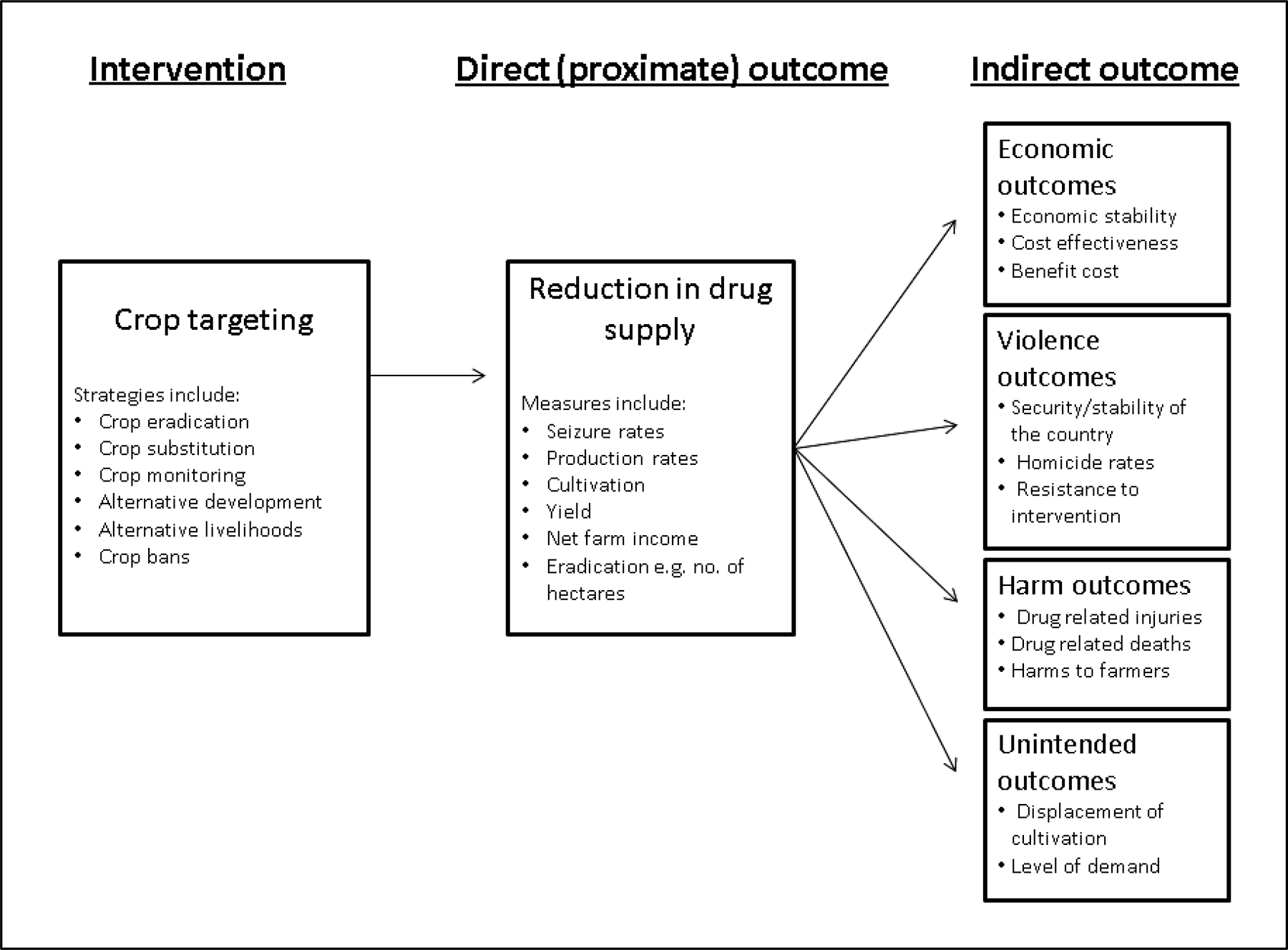
Logic model of interventions involving crop targeting as a strategy for drug control
Displacement and Diffusion of Crime Control Benefits
Our review will also record information, where possible, on displacement, spill-over or unintended consequences of any crop targeting intervention that seeks to control the supply of illegal drugs. In this review, unintended consequences are defined as consequences/outcomes that were not planned for in a plan of action (Chouvy, 2012). Unintended consequences for eradication could include an increase in poverty and cultivation, or environmental pollution. A recent systematic review of interventions that measured macro-level displacement of crime examined international displacement of important drug and precursor laboratories (see Weisburd, Telep, Teichman, Gill, & Vitter, 2011). This research showed that the U.S. national drug control policy may have been responsible for pushing drug laboratories such as methamphetamine labs across country borders (Weisburd et al., 2011). They found, for example, that “improved controls in Canada and further tightening of controls in the U.S. have led to a shift of production across the border to Mexico” (Weisburd et al., 2011). This finding demonstrates the importance of examining the potential side-effects of crop targeting initiatives as means of dealing with the control of illegal substances.
In summary, our review will focus on crop targeting efforts to control illegal drug supply at the wholesale level of the illicit drug supply chain. Even with the re-positioning of the U.S. drug policy toward a combination of prevention, education, and smarter use of law-enforcement resources (Kerlikowske, 2011), drug policies throughout the world continue to include, and rely upon, law enforcement and supply-side reduction strategies. Our systematic review seeks to provide policy makers with the research evidence to help guide a smarter use of scarce law enforcement resources aimed at the wholesale level of efforts to control the supply of illegal drugs.
OBJECTIVES
The main objective of this review is to systematically assess and synthesize all available research pertaining to the effectiveness of crop targeting as a drug control strategy to reduce the wholesale supply of illicit plant-based drugs. We seek to answer the following research questions: How effective is crop targeting as a drug control strategy to reduce the wholesale supply of illicit plant-based drugs? What is the strength of the association between crop targeting interventions and the reported outcomes? What strategy characteristics differentiate effective crop targeting strategies from those that are ineffective? How do the effects of crop targeting strategies vary according to the geographic location in which they are applied? In which regions and under which political conditions are crop targeting strategies most effective?
METHODOLOGY
CRITERIA FOR INCLUDING STUDIES IN THE REVIEW (PICOS)
Types of participants
The units of analysis will be any geographic place (e.g. farm, village, province, state, region, country or countries) that is the subject of crop targeting interventions. In order to obtain an accurate global overview of the effectiveness of crop targeting as a strategy for drug control, there will be no geographic limitations for inclusion.
Types of interventions
To be eligible for inclusion in the review, studies must have examined the impact and/or effectiveness of a crop targeting strategy aimed at controlling the wholesale supply of illicit, plant-based drugs. For the purpose of our systematic review, crop targeting interventions are defined as interventions aimed at reducing the supply of drugs through destroying or suppressing the cultivation of illegal drug crops. We will include interventions that involve crop targeting and explicitly state that the initiative, program, policy, or legislation are aimed at managing, reducing, removing, curtailing, stopping or eradicating illicit plant based drug crops.
The drugs that will be considered in crop targeting interventions are all drugs that are illegally grown and cultivated according to international agreements and local (national) laws. As outlined in the World Drug Report 2011, such illegal drugs include cannabis, coca (base or paste), opiate and poppy straw (United Nations Office on Drugs and Crime, 2011). The drugs must be plant-based, thus any illicit drugs that are chemical based will be excluded from the review e.g. amphetamine, methamphetamine. We will not include interventions that seek to eradicate precursor chemicals (non-plant based) used to create illicit drugs unless the strategy relates to crop targeting as a drug-control strategy.
We will only include crop targeting activities that focus on reducing cultivation at the wholesale level of drug activity by suppressing or reducing the farming of illicit drug crops, and will exclude activities targeting the cultivation of illicit drug plants purely for personal use. Wholesale level crop targeting interventions that seek to reduce the wholesale supply of illegal drugs and disrupt the supply chain might include, for example, eradication of crops (Andersson, 2010), substitution of illicit crops (Carpenter, 2005), alternative livelihoods, alternative development (Berg, 2002), and crop monitoring (Tian et al., 2011).
An example of a well-known crop targeting initiative is the Cannabis Crop Eradication Programme, a New Zealand crop targeting initiative, involving a series of police operations designed to reduce the cultivation of cannabis by destroying the supply at the source using fixed wing aircraft and helicopters (Wilkins, Bhatta, & Casswell, 2002). A second example of a wholesale level crop targeting initiative is Plan Colombia, a Colombian and U.S. effort to reduce the supply of illegal drugs entering the U.S. market (Veillette, 2005). With United States support through the State Department's Office of Interregional Aviation, the initiative involved aerial eradication through the spraying of coca and poppy crops with a glyphosate herbicide mixture (Veillette, 2005).
Alternative development interventions include crop targeting activities that assume that “drug problems are closely linked to development problems and that effective development policy measures can bring about a sustainable reduction in drug cultivation” (Berg, 2002, p. 1). Berg argues that alternative development policies aim to create economic and social conditions in which households can achieve an acceptable standard of living without having to resort to drug cultivation. In Thailand, for example, alternative development projects have been used to target opium production (see Berg, 2002).
Types of outcome measures
Interventions which deal with some outcome measure of drug production, prevalence and availability of the drug on the illicit market will be included in the review, including: production, cultivation, yield, net farm income, market availability and number of eradicated hectares. We will differentiate between effects measured at the local level (such as farm gate prices) and at the global level (such as worldwide estimates of drug consumption) in our analyses.
As figure 1 shows, we will include a number of indirect outcome measures in our review, for example, crime rates, measures of improvement in democracy or the security of the country, economic outcomes, violence outcomes and harm outcomes. Moreover, we will include any unintended outcomes in our review. All six types of displacement and diffusion (spatial, target, temporal, tactical, perpetrator, and type of crime) will be coded (Windle & Farrell, 2012).
Outcome measures relating to harm reduction or demand reduction will be included in our review. We will include any study that reports a harm outcome (as an indirect outcome) resulting from a crop targeting intervention.
We recognise that as the review has no geographic restriction, the mechanisms of measurement for the outcomes may vary considerably. For example, we have identified studies that measure cultivation in two distinctly different fashions. In one set of studies, conducted in Colombia, coca cultivation is measured as a continuous variable: the number of square kilometres under coca cultivation in an area (see for example, Dion & Russler, 2008). In another set of studies, conducted in Afghanistan, opium poppy cultivation is measured as a dichotomous variable: whether a village expected to plant opium poppies that year (see for example, UNODC, 2012). Both of these studies rely on data collected by UNODC; the data on number of square kilometres cultivated is gathered through aerial surveys, whilst the data on village cultivation relies on the responses of key informants, which we would argue are intrinsically less reliable. We suggest that there may be a perceived incentive for village chiefs who have received alternative development assistance to report that their village will not subsequently cultivate illicit drug crops, if doing so is seen as increasing the likelihood of continued assistance. We will code each study for the possibility of introduced bias and conduct sensitivity analysis with study quality as a moderator variable. We anticipate that other outcomes such as consumption, harm, and farm income will likewise be measured in a variety of ways, and pose similar challenges.
Types of study designs
Because we anticipate a limited pool of relevant studies in our global search, we will include in our review both studies that measure the causal impact of crop targeting on outcomes and studies that measure the association between crop targeting and outcomes. We will, however, synthesize the effect sizes from the different sets of studies separately. We describe the range of studies included in our review below.
First, experimental designs and certain quasi-experimental designs can be used to evaluate the causal impact of introducing an intervention. We will include randomised control trials (RCT) where crop targeting interventions are assessed against a control group with random assignment to the intervention and control conditions. We will also include a subset of quasi-experimental designs which we refer to as “strong” quasi-experiments. Strong quasi-experiments can be used to provide causal inference, albeit weaker inference than that which is provided by RCTs, as they provide a counterfactual by attempting to control for selection bias. This can be done in a number of different ways, such as: controlling the assignment of cases to treatment and control groups (regression discontinuity), matching the characteristics of the treatment and control groups (matched control), statistically accounting for differences between the treatment and control groups (multiple regression design), or providing a difference-in-difference analysis (parallel cohorts with pre-test and post-test). We will include the following quasi-experimental designs in our synthesis of the causal impact of crop targeting interventions: regression discontinuity designs, multiple regression designs, matched control group designs, control group designs with pre-intervention measures (pre- and post-test designs), and short interrupted time-series designs with control group (less than 25 pre and 25 post observations (Glass, 1997))
1
.
For those quasi-experimental designs that use matched control groups, we will accept both propensity score matched controls and statistically matched controls. We will also accept non-matched control groups, provided that a pre-intervention measure is recorded.
A second set of study designs that can provide good evidence for causal impact, but which will be synthesised separately, are long interrupted time-series designs without control groups (at least 25 pre and 25 post observations (Glass, 1997)). We will not synthesise the results from time-series designs together with other causal study designs, as the effect size from a time-series design has a different meaning than a numerically equivalent effect size from other quasi-experimental studies. We will synthesise the effect sizes from time-series designs separately.
The third set of study designs include correlational studies. Unlike the study designs listed above, correlational and “weak” quasi-experimental designs cannot be used to demonstrate causality, and can only be used to demonstrate the magnitude of the relationship between crop targeting and the outcome. In this group of designs we will include both raw unadjusted correlational designs, as well as the subset of quasi-experimental designs that we refer to as “weak” quasi-experiments. Weak quasi-experiments include unmatched control group designs without pre-intervention measures. The reason for the lack of evidence for causal inference from these types of studies depends on the study design. In raw unadjusted correlational designs where the variation in the level of the intervention is compared to the variation in the level of the outcome, there is no comparison group which can demonstrate that the observed relationship is not due to extraneous factors. For example, we have identified studies that examine the impact of crop targeting over time within one country, reporting correlation between the annual number of hectares under illicit drug cultivation and the prior-year number of hectares eradicated. These studies show the association between levels of intervention and outcomes, but this association cannot be considered causal, as it may be due to unmeasured factors. Similarly, unmatched control group designs cannot demonstrate the counterfactual without a baseline pre-intervention measurement to control for selection bias. These designs can demonstrate an association between the presence of an intervention and an outcome, but they cannot measure the causal impact of introducing the intervention. An example of a weak quasi-experimental design that occurs commonly within the crop targeting literature is a post-test only design with an unmatched control group. The results from this type of design are commonly represented as a two by two contingency table, where villages are divided into those that received the intervention in the previous year and those that did not (without statistically matching the groups on other variables), and the outcome is measured as the number of villages that cultivated illicit drug crops in the current year. We note that this design is the most likely to demonstrate selection bias, and will therefore conduct sensitivity analyses of the meta-analysis using study design as a moderator variable.
Finally, in addition to correlational and weak quasi-experiments, studies that address questions of causality are often used to address questions of association (Cooper, 2009). We therefore group the following types of research designs as those that can be used to address the magnitude of association between crop targeting and outcomes: randomised control trials regression discontinuity designs, multiple regression designs, matched control group designs, control group designs with pre-intervention measures (pre- and post-test designs), short interrupted time-series designs with control group, raw unadjusted correlational designs, and unmatched control group designs without pre-intervention measures.
Exclusion criteria
Since we are focusing primarily on the reduction of wholesale drug supply through crop targeting, any evaluation of interventions that are not directed at plant-based drugs and targeted toward activities to reduce/eliminate crops will not be included in the review.
We will also exclude all of the street-level drug law-enforcement interventions included in Mazerolle and colleagues' earlier review of “street-level drug law enforcement” (Mazerolle et al., 2007). Interventions such as community-wide policing, problem-oriented policing and hotspots policing will all be excluded unless the evaluation explicitly states that the intervention approach is aimed at the wholesale level of the market and used to target crop cultivation activities.
Settings and timeframe
We will include documents produced after 1 January 1980. We will not limit the country or region where the intervention was staged.
SEARCH METHOD FOR IDENTIFYING STUDIES
Search terms
A list of preliminary search terms was developed to cover four key categories: primary intervention; intervention; outcome; and substance. The primary intervention terms ensure that the intervention of interest is applied to crops. The intervention terms capture the variety of crop interventions that take place, and narrow the focus of the search onto interventions designed to destroy or target crops, or capture a law enforcement aspect of the document. The outcome intervention terms ensure that the intervention is measured by its effect on the market. The substance terms ensure that the document is focused specifically on illicit plant-based drugs. The search strategy combines the sets of search terms with a Boolean AND. Primary intervention CROP or CROPS Intervention “ALTERNATIVE DEVELOPMENT” or “ALTERNATIVE CULTIVATION” or ERADICATION or SUBSTITUT* or TARGET* or “LAW ENFORCEMENT” or CONTROL or POLICY Outcome CONSUMPTION or SEIZURE* or MARKET* or PRODUCTION or CULTIVAT* Substance “ILLICIT DRUG*” or CANNABIS or MARIJUANA or COCA or COCAINE or OPIUM or POPPY
The search term list was generated using Leximancer software (available from https://www.leximancer.com). Using a list of search terms derived from reading background literature, we ran a search on the Web of Knowledge and Scopus databases. We sorted the results according to relevance and selected the first 100 from each database (with abstracts, if available). These articles were fed into Leximancer, which generated a list of themes and concepts pertinent to the body of texts. From Leximancer, we took the top ten themes and concepts, as well as other concepts that we thought relevant, to arrive at a list of initial search terms. Certain broad concepts, such as “plant” and “drug”, were removed in order to make the search more topic focused. A comparison of the results from our initial keyword search in Web of Knowledge with the keywords formulated from the Leximancer keywords found that a small number of texts were missed by the Leximancer keyword search. Examination of these texts resulted in the addition of “alternative cultivation” to the list of keywords, and the use of wild card notation to “substitution” (substitut*). For a more detailed treatment of this technique, see Thompson and colleagues (2013). Through feedback from reviewers and the project advisory group, these keywords will be revised and modified accordingly.
Whilst we will not exclude documents based on language, we will only search using English terms due to budgetary constraints.
Search locations
The list below provides a starting list of databases and websites to be searched for the review: Abdul Latif Jameel Poverty Action Lab (J-PAL) (www.povertyactionlab.org) American Physical Society Australian Criminology Database (CINCH) Beckley Foundation (http://www.beckleyfoundation.org/search) British Library for Development Studies (BLDS) (www.bldscat.ids.ac.uk) Directory of Open Access Journals (DOAJ) DrugData EconLit GPO (U.S. Government Publications) IDEAS Informit International Initiative for Impact Evaluation (3ie) (www.3ieimpact.org) International Society for Study of Drug Policy website (ISSDP) JSTOR MIT OpenCourseWare National Bureau of Economic Research (NBER) (www.nber.org) NCJRS NDLTD ProQuest ProQuest Digital Dissertations index RAND Corporation (http://www.rand.org) SAGE Publications ScienceDirect Scitation Scopus Sociological Abstracts (via ProQuest) United National Office on Drugs and Crime website (UNODC) Web of Knowledge (including Medline) Wiley Online Library World Bank website Worldwide Political Science Abstract (via ProQuest)
As with the preliminary list of search terms, the modification of this list of databases will occur in accordance with the feedback from the project advisory group. In order to maintain an accurate list of search terms, a pilot search will be conducted so that any modifications to the list can be made prior to commencing the systematic search. The exact search term combinations used to search the different locations are listed in Appendix E.
After the initial list of eligible documents is identified, we will search the reference lists of all eligible documents. Newly identified documents will go through the title and abstract screen, document retrieval and document coding stages. This iterative process will continue until no further new documents are identified.
Once we have completed the list of eligible studies it will be sent to the project Advisory Group to determine whether or not we missed any important sources. Furthermore, the authors of the included studies will be sent the list and asked for recommendations for further sources.
Once the search is completed, duplicate records will be removed, and the bibliographic details of each potentially eligible document will be exported to a Microsoft Access database at the University of Queensland.
Search language
Although we will conduct our search in English, we still anticipate that this search will yield studies written in languages other than English. Since this review is targeted at any state, province, region, country or countries that engage in a crop targeting intervention to reduce the supply of drugs, it is difficult to account for the array of languages which may or may not be encountered within the found studies. We assume that some of the evidence base for this review will be published in languages other than English. Therefore, we have budgeted for translation services to translate located documents into English from up to five predetermined languages. These languages will include Spanish, because of a large literature around crop targeting drug interventions in Latin American countries (see for example Dion & Russler, 2008; Tabares & Rosales, 2005; Reyes-Hernandez, 2010), and may include up to four other languages selected for optimum geographic coverage. The areas where the interventions have occurred will play a large role in determining these other languages. Such languages may include Chinese (Mandarin), Arabic, French, and Russian, as these are official languages of the United Nations and cover a wide geographic and social range.
DESCRIPTION OF METHODS USED IN PRIMARY RESEARCH.
At the stage of the review, we have not yet identified the full body of primary research which will contribute to the review; however, preliminary searching has identified studies that used multiple regression designs and studies that used a randomly sampled control group design without pre-intervention measures. Because crop targeting interventions are business-as-usual in many drug cultivating countries, we do not expect to find primary studies that randomly allocated subjects to conditions (eg. a randomised controlled trial).
An example of a study that would meet our inclusion criteria is the Afghanistan Opium Survey (UNODC, 2012). As part of the annual Opium Risk Assessment, this study assessed the impact of both an alternative development assistance program and an awareness campaign on the expected cultivation of opium poppies in Afghanistan. The study used a systematic random sampling of villages stratified according to cultivation risk; however, because the allocation of the intervention was not necessarily random, this study is an example of a post-test only design with an unmatched control group. Fifty-seven trained surveyors interviewed the headmen of 458 villages and assessed (amongst other measures) the relationship between receiving agricultural assistance or awareness campaigns in 2011 and the expectation of opium poppy cultivation in 2012. The findings were reported as a two-by-two contingency table where receipt of intervention and intention to cultivate were both measured dichotomously.
CRITERIA FOR DETERMINATION OF INDEPENDENT FINDINGS
There are two issues of independence that will need to be addressed in this review. The first is that documents may report on multiple studies, which may in turn report multiple outcomes. Documents will be allowed to contribute multiple effect sizes, but only one effect size for each outcome. If a study reports multiple effect sizes for the one outcome, the mean effect size for that outcome will be calculated using Comprehensive Meta-Analysis (Biostat, 2005).
The second issue of independence is that multiple documents may report on the same data. We consider that this is a likely scenario because data sourced from government agencies are reported in multiple documents, and many government agencies report on crop eradication initiatives on an annual basis using a time-series design. In these instances, we will identify which documents are related, and use all sources for coding but treat them as a single study.
DATA COLLECTION AND ANALYSIS
Selection of studies
Title and abstract screening
The aim of the title and abstract screening stage of the review process is to assess document titles and abstracts for eligibility, and to screen out documents which have been captured in the keyword search but are not relevant to the review. At this stage, the screeners will be presented with the bibliographic details of each document, which may also include an abstract if the indexing database allowed abstract export. If the document is in a non-English language, we will use Google Translate to provide a translation of the title and abstract.
To be eligible for inclusion at the title and abstract screen stage, the study must exhibit the following two characteristics: The document must relate to some kind of illicit, plant-based drug. Studies relating to any form of chemical-based drug will be immediately excluded. The document must relate to some form of “crop targeting” activity. At this stage the precise details of the activity are not necessarily available, so we will include any form of crop activity that aims to reduce/control the supply of the illicit substance.
A team of trained research assistants will conduct the title and abstract screening process, using the “Crop targeting review title and abstract screen coding companion” document (Appendix A). Ten percent of all titles will be re-screened by a second research assistant who will be blind to the results of the first screening. Inter-coder agreement will be checked regularly throughout the screening process. Inter-coder agreement will be calculated as the percentage agreement between coders that a study is eligible. We will accept an overall inter-coder agreement of 95 percent or more; if there is less than 95 percent agreement between coders at any stage we will conduct further training, and rescreen the set of studies where agreement fell below the 95 percent threshold.
Document retrieval
Once the documents have been screened and a list of potentially eligible documents has been obtained, the next stage is to retrieve the documents. Electronic copies of documents will be attached to the document record in the database, and hard-copy versions of documents will be retrieved through the University of Queensland library. An information specialist will be hired to aid in document recovery for particularly difficult items if required. If the document is in a non-English language, we will have the document professionally translated by the Institute of Modern Languages at the University of Queensland.
Study coding
A team of trained research assistants will code the documents using the “Crop targeting review coding sheet companion” (Appendix A). Each coder will first code a selection of 15 documents for eligibility and inter-coder agreement will again be assessed. Disagreements in the coding of the training corpus will be discussed between the coders and the review manager, as part of training to ensure coding consistency.
Documents will be read in detail and coded according to document eligibility, study information, intervention information, implementation success, quality, authors' conclusions, and outcomes. Each document may contain multiple studies which may in turn report on multiple outcomes. The coding database captures this nested data arrangement. Details of coding fields are contained in Appendix A.
As a further quality control measure, all documents which are coded as eligible will have their coding double-checked by the review manager.
Assessment of study quality
We will assess study quality using an adapted version of the Campbell Collaboration International Development Coordinating Group (IDCG) Risk of Bias tool (see Appendix D). We will not allocate a score or index, as extreme failure in one area of study quality can be more serious than minor breaches of quality across multiple arenas. Rather we will make a critical qualitative decision for each study as to whether there is a clear risk of bias such that the study quality is sufficiently low to warrant exclusion from the review. Any evaluations that are excluded on the basis of quality will be listed in the final review. We will present the results of the assessment of study quality in a “traffic light” format (see de Vibe et al., 2012).
STATISTICAL PROCEDURES AND CONVENTIONS
Method of synthesis
If the search results in the identification of suitable data for meta-analysis, we will use meta-analysis to synthesize the results of the included evaluations. We will conduct a meta-analysis if we have at least two independent effect sizes that measure a conceptually equivalent outcome, measured at an equivalent unit of analysis. As discussed in “Study designs”, we will synthesize the effect sizes separately for experiments and strong quasi-experiments, long time series designs, and correlational and weak quasi-experimental designs, and we will conduct separate meta-analyses for conceptually different outcome measures, and for effects measured at different units of analysis. If a study reports multiple effect sizes for the one outcome, we will use the mean effect size for that outcome. We will use a random-effects model with inverse variance weighting to combine study results.
Our method of synthesis for results from regression models will depend upon how many studies we identify that use multiple regression analysis. Ideally, when interpreting regression studies, we are interested in the partial effect of the intervention, after controlling for a number of covariates. However, we recognize that there may be differences in the covariates used in regression analyses across studies. We will synthesise the results from the regression models separately to the results from experiments and quasi-experiments; however, if our search identifies a large number of regression studies, we will consider conducting a model-based meta-analysis. In this circumstance, we will contact the study authors to request the zero-order correlation matrices, and will then follow Becker (2009) in estimating the mean correlation matrix,
We expect that a number of factors will introduce heterogeneity into the analysis, specifically the type of intervention strategy, crop type, and geographic location. We anticipate that, for example, forced eradication will be less successful in reducing crop cultivation than alternative development strategies, as the latter provide additional pathways for income support for farmers, whilst the former remove what may in many instances be the farmers' most successful cash crop. We also expect that there will be different impacts of a similar strategy in different geographic locations, due to the varying socio-political and economic environments. We will examine these variables as sources of heterogeneity in the intervention impact, using subgroup analysis (analogue to the ANOVA) for categorical outcomes and meta-regression for continuous variables. If the analysis shows significant heterogeneity of effects across locations, we will display this effect graphically in a series of maps to inform interpretability of the results.
We will present the results of the meta-analysis in forest plots, including 95 percent confidence intervals for individual studies and for the overall weighted mean effect estimate. We will test and adjust for publication bias using a range of approaches suggested in Rothstein, Sutton, and Borenstein (2005); depending on the data collected, this may include funnel plots and trim-and-fill analysis. We will conduct sensitivity analysis to test the effect of study design and evaluation quality on the results of the analyses. We expect that we would see a smaller effect for experimental study designs and more rigorous evaluations, as these are less likely to introduce bias to the effect size estimate. We will use Comprehensive Meta-Analysis software (Biostat, 2005) for calculations and production of figures.
Effect size metric and calculations
We will calculate a range of effect sizes, depending on the data available from each study, and then aim to convert these to a common metric where possible. For continuous outcomes we will calculate the standardized mean difference using Hedges' g as the measure of effect size, as it includes an adjustment for estimator bias in smaller samples (Borenstein, 2009). If binary outcomes are found we will calculate a log odds ratio as the measure of effect size. If we locate studies that report regression coefficients we will calculate the standardized mean difference from the regression coefficients if there are only a small number of such studies, but if a larger body of studies is identified, we will consider conducting a model-based meta-analysis as discussed above. For raw unadjusted correlations we will extract r as the effect size of choice. As a quality control measure, all effect size calculations will be double-checked by a second reviewer.
Some studies may use an interrupted time-series design with observations at multiple time points before and after the implementation of an intervention in an area and some may use comparison groups in addition to multiple time points. For studies that collect data at multiple time points, we assume an underlying uniform distribution for violent crime, and a step function for the effect of the intervention on the outcome. We will therefore calculate an average effect size for the time points before the intervention, and an average effect size for the time points after the intervention, and compare the two. We recognize that there are many other ways to deal with this type of time series data; however, given the research questions and the likely nature of the intervention effect, we believe that this method is the most defensible and parsimonious. We will synthesise the results of time-series studies separately from other experimental and quasi-experimental designs, as time series designs standardize for variability over time rather than variability over units, resulting in a different scaling (D. Wilson, personal communication, September 20, 2013).
We will use reported statistics such as t, F, p or z-values to convert to effect sizes if effect size data is not reported. If data required to compute effect sizes is missing, we will attempt to contact the authors of the studies to obtain the required data.
We will input all effect size data into Comprehensive Meta-Analysis software (BioStat, 2005) to allow the calculation of standardized effect sizes and their standard errors, and the conversion between effect size types, to ensure that a common metric is used. Should an outcome be measured across different studies using binary data in some studies and continuous data in others, we will convert all effect sizes and their variances for this outcome to a common metric. For example, correlation coefficients and log odds ratios will be converted first to Cohen's d and then to Hedges' g, and the meta-analysis will be conducted on all outcomes using Hedges' g as the effect size of choice. Following Borenstein (2009), we argue that this approach whilst imperfect is preferable to conducting two separate meta-analyses. If this approach is required, we will conduct a sensitivity analysis to compare the results with those obtained by conducting separate meta-analyses.
Treatment of qualitative research
This review will not use qualitative research.
PRELIMINARY TIMEFRAME
PLANS FOR UPDATING THE REVIEW
The authors will update the review every three years.
STATEMENT CONCERNING CONFLICT OF INTEREST
None of the authors have any known conflicts of interest.
Footnotes
APPENDIX A: CROP TARGETING REVIEW OVERVIEW
APPENDIX B: CROP TARGETING REVIEW TITLE AND ABSTRACT SCREENING COMPANION
APPENDIX C: CROP TARGETING REVIEW CODING COMPANION
APPENDIX D: ADAPTED IDCG RISK OF BIAS TOOL
APPENDIX E: DETAILS OF SEARCH STRATEGY BY LOCATION
ACKNOWLEDGEMENTS
The authors wish to acknowledge the contributions of Adele Somerville, Kathryn Ham, Michelle Sydes and Madonna Devaney.
1
In distinguishing between and pre- and post-test designs with control groups and short interrupted time-series designs with control groups, the key factor is whether the study reports on data from a group of subjects (eg farmers, villages) or a single subject (eg municipality, region). In pre- and post-test control group designs, the outcome is typically reported as a mean value for each of two groups of subjects (treatment and control), calculated at two time points (before and after the intervention). For example, the study might compare the mean number of hectares cultivated by farmers in the treatment group and in the control group. On the other hand, a short interrupted time-series design with a control group typically reports on data from two subjects, where each subject is a group or area. Each subject is observed repeatedly over time, and one subject receives an intervention during the period of observation. In these studies the outcome is reported as a single measure, rather than as a mean. For example, a study may measure total hectares under illicit drug crop cultivation every year over a ten year period for two similar municipalities, where one municipality begins to receive agricultural assistance during the period of observation (eg during year 4), and the control area never receives the intervention.
2
The tool has been adapted from an instrument developed by Jorge Hombrados and Hugh Waddington, drawing on existing tools, in particular EPOC (n.d.), Higgins and Green (2011) and Coalition for Evidence-Based Policy (2010). Thanks to Richard Palmer-Jones, Maren Duvendack and Phil Davies for comments on previous drafts.
3
If a quasi-randomized assignment approach is used (e.g. alphabetical order), you must be sure that the process truly generates groupings equivalent to random assignment, to score “Yes” on this criteria. In order to assess the validity of the quasi-randomization process, the most important aspect is whether the assignment process might generate a correlation between participation status and other factors (e.g. gender, socio-economic status) determining outcomes; you may consider covariate balance in determining this (see question 2).
4
If there are serious concerns about the randomisation process or the group equivalence completely, assess the risk of bias of the study using the relevant questions for the appropriate methods of analysis (cross-sectional regressions, difference-in-difference, etc) rather than the RCTs questions.
5
If there are serious concerns with the assignment process or the group equivalence, assess the risk of bias of the study using the relevant questions for the appropriate methods of analysis (cross-sectional regressions, difference-in-difference, etc) rather than the RDDs questions.
6
Accounting for and matching on all relevant characteristics is usually only feasible when the programme allocation rule is known and there are no errors of targeting. It is unlikely that studies not based on randomisation or regression discontinuity can score “YES” on this criterion.
7
There are different ways in which covariates can be taken into account. Differences across groups in observable characteristics can be taken into account as covariates in the framework of a regression analysis or can be assessed by testing equality of means between groups. Differences in unobservable characteristics can be taken into account through the use of instrumental variables (see also question 1.d) or proxy variables in the framework of a regression analysis, or using a fixed effects or difference-in-differences model if the only characteristics which are unobserved are time-invariant.
8
Please note that when a), b) or f) score no or large differences in baseline characteristics, we suggest assessing risk of bias considering other study design (Diff-in-Diff, cross-sectional regression, instrumental variables)
9
Even in the context of RCTs, when randomisation is successful and carried out over sufficiently large assignment units, it is possible that small differences between groups remain for some covariates. In these cases, study authors should use appropriate multivariate methods to correcting for these differences.
10
Knowing allocation rules for the programme – or even whether the non-participants were individuals that refused to participate in the programme, as opposed to individuals that were not given the opportunity to participate in the programme – can help in the assessment of whether the covariates accounted for in the regression capture all the relevant characteristics that explain differences between treatment and comparison.
11
Matching strategies are sometimes complemented with difference-in-difference regression estimation methods. This combination approach is superior since it only uses in the estimation the common support region of the sample size, reducing the likelihood of existence of time-variant unobservables differences across groups affecting outcome of interest and removing biases arising from time-invariant unobservable characteristics.
12
The Hausman test explores endogeneity in the framework of regression by comparing whether the OLS and the IV approaches yield significantly different estimations. However, it plays a different role in the different methods of analysis. While in the OLS regression framework the Hausman test mainly explores endogeneity and therefore is related with the validity of the method, in IV approaches it explores whether the author has chosen the best available strategy for addressing causal attribution (since in the absence of endogeneity OLS yields more precise estimators) and therefore is more related with analysis reporting bias.
13
If the instrument is the random assignment of the treatment, the reviewer should also assess the quality and success of the randomisation procedure in part a).
14
An instrument is exogenous when it only affects the outcome of interest through affecting participation in the programme. Although when more than one instrument is available, statistical tests provide guidance on exogeneity (see background document), the assessment of exogeneity should be in any case done qualitatively. Indeed, complete exogeneity of the instrument is only feasible using randomised assignment in the context of an RCT with imperfect compliance, or an instrument identified in the context of a natural experiment.
15
Contamination, that is differential receipt of other interventions affecting outcome of interest in the control or comparison group, is potentially an important threat to the correct interpretation of study results and should be addressed via PICO and study coding.
16
‘Common methods’ refers to the use of the most credible method of analysis to address attribution given the data available.
17
A comprehensive assessment of the existence of ‘data mining’ is not feasible particularly in quasi-experimental designs where most studies do not have protocols and replication seems the only possible mechanism to examine rigorously the existence of data mining.
18
All interventions may create expectations (placebo effects), which might confound causal mechanisms. In social interventions, which usually require behaviour change from participants, expectations may form an important component of the intervention, so that isolating expectation effects from other mechanisms may be less relevant.
19
Standard errors may be inflated in parametric approaches if the intervention does not have a homogeneous effect across the whole sample population, and the authors fail to conduct appropriate sub-group analyses.