






Abstract
BACKGROUND
The Problem, Condition or Issue
The International Energy Agency (IEA) estimates that more than 1.3 billion people (or about one-sixth of the world's population) are still without access to electricity, while another 1 billion have unreliable access (International Energy Agency [IEA], 2013). The global population without access to electricity is concentrated in Sub-Saharan Africa, South Asia, and to a lesser extent in East Asia and the Pacific (IEA, 2013). Combined, the Sub-Saharan Africa and South Asia regions account for more than 80 per cent of all people worldwide lacking electricity access (IEA, 2013). Electrification rates vary widely between rural and urban areas. The massive gains in global access to electricity over the last two decades have primarily been in urban areas. Over 80 per cent of the global population without access to electricity are concentrated in rural areas; for example, in Sub-Saharan Africa the rural electrification rate is just 14 per cent, compared with 60 per cent in urban areas (IEA, 2013). Expansion of coverage through grid extension in rural areas is challenging. Large numbers of people remain unconnected because of the high costs of grid extension. Grid expansion costs are generally high in rural areas because rural areas are characterised by low population density. This implies that electricity distribution costs must be spread over fewer numbers of households, thus resulting in high unit costs per household. Off-grid options are now available in many countries as transitional alternatives to grid-based electricity -- often at a lower cost than conventional technologies. For low-demand users in geographically remote areas, these options could potentially serve as long-term solutions as well. Costs for off-grid technologies have come down significantly over recent years, stimulating a growing market for small rural energy service companies. Hundreds of companies and other organisations now produce and distribute these systems, which have been introduced in practically all countries of the world.
Even where electricity is within reach, inability to pay is a significant barrier for many households. High grid-connection costs (which can be as much as $250 even when subsidised) and electricity prices (for on-going consumption) constrain energy use among households that cannot afford them. Bernard (2012) reviewed a number of studies and found that within grid-electrified villages, connection rates were 12 per cent in Botswana, 39 per cent in Ethiopia, and 30 per cent in Senegal. Low connection rates are particularly prevalent among poorer households. Heltberg (2003) found that less than five per cent of the households in the lowest income quintile in Ghana and South Africa have access to electricity, while it is 50 per cent for the highest quintile. The high initial investment cost of technologies such as solar systems is also a major barrier for rapid deployment of off-grid solutions in rural electrification. A recent study of off-grid technologies in Kenya found that only five per cent of households with access to solar kits purchased one (Jacobson, 2007).
In addition to the population that does not have access to electricity, up to a billion people, especially in developing countries, are subject to unreliable and low quality grid supplies, resulting in short- or long-term power outages in an area. In many developing countries, grid-connected electricity provided by utility companies suffers from frequent breakdowns (resulting in irregular power supply), and problems of quality (resulting in low or fluctuating voltage; that is, brownout). An irregular power supply may mean momentary loss of power or blackouts (that is, total loss of power) that may last from a few minutes to several weeks. Both interruptions in service and irregular voltage in an electrical power supply can cause poor performance of equipment or even incorrect operation. In addition, power is often supplied only at odd hours (such as midnight or midday), when the need for electricity is minimal.
Problems with the reliability of decentralised systems also threatens the viability of many off-grid projects to provide electricity. A literature review by Nieuwenhout et al. (2001) showed how inadequate service infrastructure and organisational and technical problems raised doubts about the effectiveness and suitability of off-grid solutions for rural development. It highlighted the problem of poorly designed systems and insufficient after-sales support and technical assistance, suggesting that neglect of maintenance and service requirements (for example, only low quality replacement components that are often not fully compatible with the system) may lead to frequent failures and user dissatisfaction that, in turn reduce motivation to continue repayment of fees to comply with rental or purchase agreements.
Electrification provides power for domestic uses (lighting, cooking, TV, radio, communication) productive uses (for example, water pumping, fencing, cooling, mills, sewing machines, and so forth) and public uses (for example, schools, health facilities, police stations). Those who lack access to electricity rely on traditional biomass sources, such as firewood, charcoal, manure and crop residues. The largest populations that rely on traditional biomass for energy are in the developing regions of Asia, with 836 million in India alone (IEA, 2013). Such sources of energy are often time-consuming to collect and, as they emit harmful indoor air pollutants when burned, can be detrimental to health. Other sources of energy used in the absence of electrification, such as candles, kerosene and batteries, are often expensive to purchase. Studies have shown that poor households end up paying a higher share of their income for energy consumption. For example, the Energy Sector Management Assistance Program [ESMAP] (2003) study in the Philippines reported that poor households appear willing to pay large amounts for the energy sources they use in the absence of electrification. Bernard (2012) reports that energy expenditure is about four per cent of total expenditure of the poorest rural households in Ghana, seven per cent in South Africa, 10 per cent in Ethiopia and 15 per cent in Uganda. Illegal and secondary connections, which serve a significant proportion of the population in many countries, also pose a major safety hazard, as well as lost revenues to utility companies.
The Intervention
The focus of this review is the expansion of access to electricity in developing countries. As there is no universally accepted definition of “access”, developing an appropriate definition was a challenge. Doing so is important, however, as the definition will influence the types of interventions that we are interested in.
The aim in this review is to capture the multi-faceted, multi-tier nature of “electricity access”. Therefore our definition: Goes beyond a household focus (that equates access to electricity with the availability of an electricity connection at home or the use of electricity for lighting) to include productive and community access to electricity. Includes access to off-grid and mini-grid solutions as well as access to grid-based electricity. Recognises that access is not only about having an electricity connection, but also about electricity supply problems, including irregular services, breakdowns, and problems of quality, as well as affordability issues and legality of supply.
This definition of “access to electricity” will be reflected in the types of interventions that meet the criteria for the review. We envisage three broad types of interventions: Interventions which increase electricity coverage through provision of the physical means of accessing electricity Interventions which enhance electricity quality or reliability Interventions which incentivise and support consumer access
The main categories of intervention are detailed in Table 1 (see methods section for further information on eligible interventions).
Intervention categories (types of intervention/intervention components)
How the Intervention Might Work
A review seeking studies investigating relationships between energy, welfare and gender captured predominantly observational studies with population samples sufficiently large to support multivariate regression for controlling potential confounders (Kohlin, Sills, Pattanayak, & Wilfong, 2011). The authors summarised desired outcomes from electrification as longer working days, better access to information, better and safer lighting, greater efficiency in domestic and caring responsibilities and expanded opportunities for income generation. Their putative pathway between household electrification were drawn from the literature but supported by few robust studies of impact: In general, light and TV are the first common uses of electricity, accounting for at least 80% of rural electricity consumption… Electricity displaces more expensive candles and kerosene lamps, thereby reducing indoor air pollution and fire and burn risk, and providing higher quality light. Lighting and television help improve access to information, the ability to study, and extend the effective working day. Lightly also improves the productivity of many household activities.
Kohlin et al. (2011) also found observational studies addressing electrification of communities. These indicated potential positive effects through better schools (where teachers are less absent and spend more time planning lesson), better health care (through refrigerated storage), better security (for example, with street lighting), greater social capital (through lighting for evening gatherings), employment opportunities associated with the generation and transmission of electricity and other economic opportunities (for example through improved communication with the market and processing or storage facilities). Lastly, wider environmental impacts may result from reduced deforestation and more or less pollution, depending on how the electricity is generated.
This literature also suggested differential gender impact:
Providing electricity to communities and homes and motor power for tasks that are typically considered women's work can promote gender equality, women's empowerment, and women's and girl's access to education, health care and employment, although sustainability and scaling up face additional difficulties. Kohlin et al. (2011) identified household studies that associated electrification with: reduced time spent by women collecting firewood and water; disproportionate increases in female employment, possibly by freeing women from time consuming domestic tasks such as cooking; and even greater impacts when accompanied by social marketing, finance schemes for appliances, or enterprise schemes for women to access electricity services. The review authors were convinced by studies of rural electrification demonstrating increased women's work outside the home, especially for younger women. Evidence of education and health benefits from electrification appear less differentiated by gender, although fertility rates are lower in rural areas with consequent benefits for women. Studies also implicate television as a route to women's empowerment possibly through exposure to role models of emancipated women in fictional TV dramas.
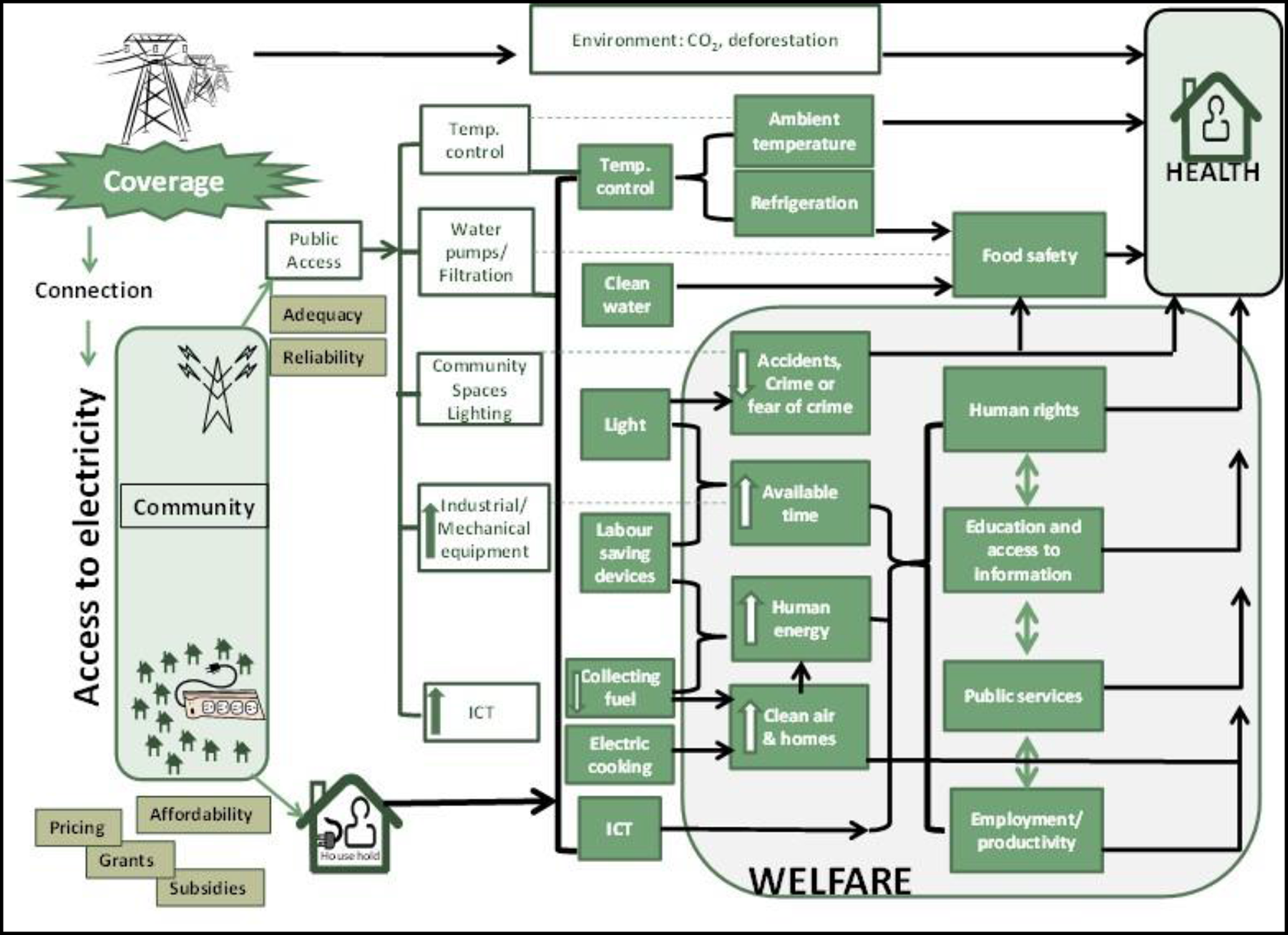
This gendered analysis Kohlin et al. (2011) and an earlier investigation of the welfare gains associated with electricity access (Independent Evaluation Group [IEG], 2008) informed an initial logic model. Figure 1 illustrates the final model employed to frame the current review.
Causal Chain for Access to Electricity and Potential Outcomes
In this model (read from left to right in figure 1), increased coverage of electricity generation and transmission provides opportunities for communities to access electricity. Community access to electricity improves temperature control (ambient temperature and refrigeration for safer food), water supplies and lighting in public spaces and the use of mechanical and information/communication technology (ICT). Within these communities, household access to electricity depends on affordability, which is determined by pricing, grants and subsidies. Household access allows similar opportunities for temperature control, clean water, lighting, labour saving devises and ICT. Electricity for cooking reduces the need for collecting fuel, simultaneously saving time and human energy and reducing indoor air pollution. Better lighting within communities and households reduces accidents and (fear of) crime. More time, energy, lighting and ICT leads to better information access and education, public services, employment opportunities and productivity. Taken together these improve human rights. The overall result is better health and welfare. On a scale larger than households and communities, increasing electrification has broader environmental impacts, changing forestation, atmospheric carbon and climate change.
Why it is Important to do the Review
It is generally recognised that energy issues must be dealt with in order to alleviate poverty in the developing world (Department for International Development [DFID], 2002; Sachs, 2005). Although energy is not one of the Millennium Development Goals (MDGs), the MDG Summit considers it essential for achieving most of the goals. A growing number of governments, Non-governmental Organisations (NGOs), international agencies, and businesses are working to overcome energy poverty. Since 2002, the International Energy Agency (IEA) has been focusing on the topic through the improvement of energy demand and supply situations in developing countries, devoting a chapter to explain the roles of energy for the development in its World Energy Outlook 2002 (IEA, 2002). In 2012, the Sustainable Energy for All (SE4ALL) global initiative was launched by the Secretary-General of the United Nations in partnership with the World Bank and the IEA to reach universal energy access, improve energy efficiency, and increase the use of renewable energy by 2030. The initiative was launched to coincide with the designation of 2012 as the International Year of Sustainable Energy for All by the UN General Assembly. In the 1990s the World Bank Group expanded the scope of its projects and adopted a new wave of rural electrification projects that were carried through the following decade, with renewable energy as the choice among off-grid options. This evolution was supported by a greater involvement of the private sector, and the advent of the low carbon agenda at the global level. Moreover, power sector privatisation and energy sector reform more broadly became the main focus of World Bank Group projects, which then shifted from supporting state owned enterprises to unbundling and power market development. The policy paper on power sector (World Bank, 1993) governed the World Bank Group's support during the 1990s. More recently, in 2012, the World Bank Group became partner of the Sustainable Energy for All (SE4ALL) global initiative launched with the Secretary-General of the United Nations and the IEA to reach universal energy access, improve energy efficiency, and increase the use of renewable energy by 2030. In July 2013, the World Bank Group outlined its future sector directions in the document “Toward a Sustainable Energy Future for All”, containing a number of actions and initiatives to improve electricity access (World Bank, 2013). To date, 68 developing country governments have adopted formal targets for improving access to electricity. According to the IEA, between 2010 and 2030 an average of $14 billion will be spent annually in extending access to modern energy services (IEA, 2013).
The case for electricity as a promising way of improving socio-economic outcomes for people in low- and middle-income countries (LMICs) is well documented in the available literature (Khandker, Barnes, & Samad, 2012). Having access to electricity for domestic, productive and public uses is considered important for a range of social development impacts, including productivity, income, health, education, potable water and communication services (Barnes, 1988; Bose, 1993; Domdom, Abiad, & Pasimio, 2000; Fitzgerald, Barnes, & McGranaan, 1990; United Nations Development Programme [UNDP], 2005; World Bank, 2002). Whilst there have been efforts to draw together this literature, there are no existing systematic reviews which aim to systematically collect and statistically synthesise students on effects of electrification in LMICs on health, education and welfare outcomes. Existing reviews are more limited in scope, and/or methodological rigour. In recent years, the World Bank has initiated both impact studies and monitoring and evaluation of its own projects in this area. A mid-1990s review of Bank experiences of rural electrification in Asia provided ‘generally pessimistic’ findings (IEG, 1994). A more recent review sets out to examine whether progress has been made since then (IEG, 2008). This study used some components of systematic review in its portfolio assessment: it aimed to include all World Bank project documents, and extracted data and reported results systematically. Moving beyond studies of electrification projects funded by the World Bank, several traditional literature reviews based on non-systematic searches exist (Bernard, 2012; Kohlin et al., 2011; Nieuwenhout et al., 2001). In addition, several systematic reviews in this area have been conducted. A recent review conducted for the Collaboration for Environmental Evidence (CEE) examined the impact of investments in electricity on agricultural productivity; narrative synthesis was used to combine studies (Knox, Daccache, & Hess, 2013). Although statistical meta-analysis was used in the systematic review by Thillairajan, Mahalingam, & Deep (2013), the outcome of interest was limited to ‘access to electricity’. Finally, a further study conducted for CEE which systematically reviewed the literature on major barriers to increased use of modern energy services and interventions to overcome these also used a narrative approach to synthesis (Watson et al., 2012). These are problems that this systematic review aims to remedy, thereby adding value to the existing body of research on this topic.
A related systematic review is also currently underway (Bensch, Munyehirwe, Peters, & Sievert, 2014). This review is interested in the most effective mechanisms for achieving universal access to electricity, with the primary outcome being increased access to electricity measured by regional or national electrification rates. Ultimate welfare outcomes (poverty reduction, economic growth, and so forth) are not the subject of this review.
None of these systematic reviews aim to systematically collect and statistically synthesise studies on effects of electrification in LMICs on health, education and welfare outcomes. Taking into account both these specific gaps in the evidence base and policymaker priorities this review will build on the World Bank Group's main energy evaluation study (IEG, 2008) which focused on the fifteen year period spanning FY1999-2013, by updating and enhancing the knowledge on the topic through a systematic review of relevant studies.
OBJECTIVES
The primary objective of this review is to critically analyse and synthesise the existing evidence along the causal chain framework, linking interventions with intermediate outcomes and final impacts. It will achieve this by answering the following questions: Review question no. 1: What is the impact of electricity access on health, education and welfare in low- and middle-income countries? Review question no. 2: What characteristics of participants (for example, gender) and context (for example, rural or urban communities) appear to moderate effects?
METHODOLOGY
Criteria for including studies in the review
Types of study participants
The unit of observation/analysis may be individuals, households, community-based organisations (for example, schools, health clinics, community centres) or commercial enterprises (except those that build their own power transmission systems to access electricity for their own use alone).
The study sample will be based in low- and middle-income countries, where low and middle income is defined in accordance with the current World Bank classification. 1 Studies focusing on people living in rural, peri-urban and/or urban areas will be eligible. Participants may be any age, and there will be no restrictions by any other demographic characteristics.
Types of interventions
The focus of the review is on access to off-grid and mini-grid solutions as well as access to grid-based electricity. Off-grid power may be supplied through two basic distribution options: village mini-grids (serving tens or hundreds of users) and isolated systems (serving just one or two users). It may be generated from a variety of resources: diesel, biomass, solar (photovoltaic technologies), wind, small hydro-generators, or hybrid combinations of these. Both private and public suppliers of electricity are eligible (for example, government-related agencies, international/bilateral-donor support, banks, private companies, commercial dealers, or NGOs). Delivery may be at a national, regional or local level.
We anticipate identifying the following broad types of intervention.
(i) Expanding coverage of the national (or regional) power transmission system to new areas and communities, through: construction of new transmission lines; network densification measures.
(ii) Expansion of off-grid, decentralised power provision (understood as power generation in the village using locally available energy resources) to new areas and communities, in the form of central grid, mini-grid, and stand-alone solutions, through: financial incentives (for private enterprises); donation of equipment (for example, by NGOs).
Technical support designed to improve: Supply-side management of on-grid system efficiency (for example, use of energy efficient equipment to increase generation and improve efficiency, and measures to reduce transmission and distribution losses at the point before the consumer meter). Such measures have the potential to: lower the cost of delivered energy to customers; reduce service interruptions; and improve the quality of supply in terms of voltage and frequency variations. Supply-side advance notification about on-grid service interruptions and service restoration times; Supply-side post-installation maintenance and services (both on-grid and off-grid systems); Supply-side improvement to quality of systems, installation and after-sales services (off-grid systems). Legal and regulatory frameworks and policies: Standards reform (for example, relating to design of micro-grid systems) Improved standards for off-grid components and system designs (for example, subject to their being eligible for inclusion in subsidised programmes).
Financial resources that improve affordability: Tariff rationalisation (for example, introduction of time-use tariffs); Introduction/expansion of consumer credit schemes/loans/subsidies; Rental (fee-for-service) schemes; Technical resources aimed at training and supporting consumers to maintain/repair and manage/construct off-grid systems. Awareness raising campaigns and products that advertise and promote the (sustained) use of new energy sources.
Interventions that are solely solar-powered appliances (for example, solar lamps, radios, and calculators) as opposed to ‘solar energy generating systems’ that have the capacity to produce electricity to power a number of different appliances (for example, solar-powered photovoltaic (PV) panels) because solar-powered appliances do not represent access to electricity.
Interventions providing/improving access to biofuels, although interventions which improve access to electricity including electricity generated from biofuels are eligible.
Types of outcome measures
Studies will be eligible for review if they address outcomes for individuals, households, community-based organisations (for example, schools, health clinics, community centres) or micro, small or medium sized enterprises (MSMEs) in one or more of the domains of primary outcomes detailed in Table 2. Some examples of measurable indicators for the outcome constructs are indicated here, with a fuller list of expected outcome measures provided in sections F, G and H of the coding tool detailed in Appendix 4.
Examples of intermediate and primary outcomes
Studies will be excluded if they only report intermediate outcomes. We will collect data on all relevant outcomes identified in the included studies, including any indicators not specified in the protocol. We will indicate in the report those outcomes that were identified post hoc. Secondary (intermediate) outcomes data will only be collected from studies also reporting primary outcomes.
Types of study designs
Eligible research designs include the following:
A) Studies in which the authors use a control or comparison group, and in which: Participants were randomly assigned (using a process of random allocation, such as a random number generation); A quasi-random method of assignment was used and pre-treatment equivalence information is available regarding the nature of the group differences; Participants were non-randomly assigned but matched on pre-treatment outcomes and/or time-invariant variables such as relevant demographic characteristics (using observables, or propensity scores) and/or according to a cut-off on an ordinal or continuous variable (regression discontinuity design); Participants were non-randomly assigned but statistical procedures were used to control for differences between groups (for example, multiple regression analysis, difference-in-differences methods, or instrumental variables regression).
B) Studies using an interrupted time-series design with a minimum of three periods of data collection before and after the intervention are eligible.
Studies will be excluded where they are based on non-randomly allocated or matched data and do not employ an appropriate method of statistical analysis for causal identification. Ineligible study designs therefore include: Single group, post-test only design. Single group, pre-test/post-test design (that is, where participants act as their own controls). Non-equivalent comparison group design, with no additional controls (that is, design involves use of non-random treatment and comparison groups, either concurrent or historical, but does not employ an appropriate method of statistical analysis for causal identification). Inappropriate methods include measurement of statistical association between participation and outcomes, such as ANOVA or bivariate regression-based studies without incorporation of additional control variables. Interrupted time-series with less than three periods of data collection both before and after the intervention. Studies that attempt to predict the impact of an intervention using data simulation techniques. Such ‘hypothetical’ studies are attempting to predict how something will behave without actually testing it in the real world (that is, they are estimating parameters that have not been measured from field data).
Date, Language, and Form of Publication
For this review, the date of publication or reporting of the study must be 1994 or later, which allows the accumulation of two decades of evidence. A search of 3ie's Impact Evaluation database, which includes regular systematic searches for studies, indicates the earliest published impact evaluation study on electrification (in the context of schools) is from 1994, and the vast majority published since 2000. Eligibility is restricted to studies published in English due to time and resource constraint. Studies will be included regardless of their medium of publication type (that is, we will not exclude specific forms of publication, such as working papers, theses or dissertations).
Search strategy
A comprehensive search strategy will be used to search the international research literature for qualifying studies. To reduce the omission of relevant studies and ensure our search is as unbiased as possible, a wide range of sources will be used to capture both academic and ‘grey’ literature. Manual searching techniques will be used to supplement the electronic searching of bibliographic databases and library catalogues. The search strategy includes many sources with a specific focus on low- and middle-income countries.
Electronic searches of bibliographic databases and library catalogues
We will develop a comprehensive search strategy consisting of relevant search terms and search electronic databases, including general social science databases and subject specific data bases covering energy sector. Due to time constraints we will restrict ourselves to English language databases.
The following major commercial electronic bibliographic databases will be searched: ASSIA (Applied Social Sciences Index and Abstracts) (ProQuest) ERIC (Education Resources Information Centre) (ProQuest) IBSS (International Bibliography of the Social Sciences) (ProQuest) Medline (ProQuest) Sociological Abstracts (ProQuest) Business Source Premier (EBSCO) Econlit (EBSCO) PsycINFO (EBSCO) Web of Science
5
Specialist bibliographic databases and library catalogues will also be searched (see Appendix 1). For each bibliographic database, a tailored search query will be developed using controlled vocabulary and/or free-text terms. A comprehensive list of terms related to the main concept of this review (electrification) will be used in the search. Database thesauri, where available, will be consulted to ensure that all relevant synonyms have been included, and wildcards will be applied as appropriate. A publication year filter to identify studies published since 1 January 1994 will be used.
The search query will be developed using a pilot test based on keywords identified from the literature survey for the main energy report. A pilot test ensured that the search terms captured relevant studies. Based on the pilot we modified the search string to fine tune the search query. A search query for the ERIC database is presented in Appendix 2.
Other searches
Websites: The websites of relevant bilateral and multilateral organizations, including the Inter-American Development Bank and Asian Development Bank, will be searched (see Appendix 3 for full list).
Backward citation tracking: The bibliographic information contained within the reference lists of included studies and relevant reviews will be scanned to identify studies that meet the eligibility criteria. The following reviews will be searched in this way (Bernard, 2012; Farrington & Welsh, 2002; Knox et al., 2013; Nieuwenhout et al., 2001; Thillairajan et al., 2013; Watson et al., 2012). Any others identified during the course of the review will also be searched.
Forward citation tracking: Studies that have cited the included studies since their publication will be checked for relevance. Citation tracking will be performed through Web of Knowledge and Google Scholar. All the hits from each citation search will be screened.
Personal contacts: Key researchers and organizations working in the field of energy access and welfare (including authors of included studies and relevant ongoing research) will be identified and contacted with a request for information about any potentially relevant studies. These will include: Mike Toman, Research Manager, World Bank Shahidur R. Khandker, Lead Economist, World Bank Dominique Van De Walle, Lead Economist, World Bank
In the event that we identify relevant studies published in languages other than English, authors and funding sources will be contacted regarding the availability of translated versions. Where no English-language version is available, the study will be excluded from the review. Details of any such studies will be provided in the final report.
Networks: Requests for relevant literature will be made by posting a bulletin board/listserv message to members of the following networks: SPARK (The World Bank Group Community) SE4ALL Practitioner Network
Search engines: To ensure maximal coverage of unpublished literature, search engines will be used as part of the search. Google will be used to follow up on potentially relevant named programmes that come to light during the course of the review. As noted above, Google Scholar will be used to track citations of included studies.
Conference proceedings, dissertations and theses: One specialist source for dissertations and theses will be searched (ProQuest Dissertations & Theses: UK & Ireland). Most of the major bibliographic databases also index this type of publication (ERIC, for example, includes over 14,000 dissertations/theses published since 1990). As part of the Web of Science search (see above) a search for conference proceedings will be undertaken.
Selection of studies
Review management software, EPPI-Reviewer 4, will be used to manage the entire review process (Thomas, Brunton, & Graziosi, 2010). Potentially relevant items identified through the electronic search of bibliographic databases will be imported into EPPI-Reviewer (and will later be screened against the eligibility criteria). Details of eligible studies identified through the non-electronic searches will be entered into the reviewing software manually.
Selection of primary studies will be based on the pre-developed selection criteria described above. The criteria will be piloted by two researchers who will screen (on titles and abstracts) a 10 per cent sample of reports independently and compare their results. Discrepancies will be resolved by further review of the respective titles and abstracts and agreement reached by discussion. This process will be repeated until consistency in application of the selection criteria is achieved. Screeners will be required to err on the side of caution; in case of any uncertainty full text copies will be ascertained.
Full texts will be retrieved for all studies that appear to meet the inclusion criteria on the basis of the information in their titles and abstracts, and each of these papers will be closely examined by a minimum of two reviewers to determine eligibility.
All study selection and information retrieval activities in the review will be documented and described in sufficient detail in the final report so that the processes can be replicated by other researchers. Summary flowcharts will be used to convey relevant information.
Description of methods used in primary research
The following four studies exemplify the methods likely to meet the eligibility criteria for the proposed review.
Khandker, S. R., Barnes, D. F., Samad, H. A., & Minh, N. H. (2009). Welfare impacts of rural electrification: Evidence from Vietnam. (Policy Research Working Paper 5057). Washington, DC: World Bank.
This paper investigates impacts of the World Bank financed Rural Electrification project (REI) in Vietnam on households' cash income, expenditure, and educational outcomes. Panel surveys fielded in 2002 and 2005 were used. The survey data covered communes already having electricity, those that would receive electricity under the project, and areas which were not scheduled to receive electricity within a five-year time frame (the control group). In a few survey areas electricity has been provided by non-World Bank entities; therefore, besides estimating the impacts of rural electrification, this study also investigates if impacts are different for project (World Bank-implemented) and non-project electrification. Rigorous estimation techniques are used to estimates the benefits of both commune and household electrification. For example, the authors implement a household-level fixed effects (FE) regression technique that controls for both the observed and unobserved characteristics that possibly influence the outcomes.
Asaduzzaman, M., Yunus, M., Haque, A., Azad, A., Neelormi, S., & Hossain, A. (2013). Power from the Sun: An Evaluation of Institutional Effectiveness and Impact of Solar Home Systems in Bangladesh. Bangladesh Institute of Development Studies.
This study investigated solar home systems (SHS) installed by the Infrastructure Development Company Limited (IDCOL) in Bangladesh. The World Bank were among the partners supporting the programme. The study used several sources of data including a large household survey among SHS adopters and non-adopters. A total of 4000 households were surveyed in 128 villages (64 ‘treatment’ or supplied with SHS, 64 ‘control’ without such supply). The population for the sample of households was the records of IDCOL. The villages and households were chosen at random, and propensity score matching techniques were used to create a match between the treatment and control groups. The study assessed various socio-economic impacts, direct and indirect, on households and its members, including those on women.
Peters, J. (2013). Impacts of pico-photovoltaic systems usage on the energy poor - A randomized controlled trial in rural Rwanda. RWI.
This study evaluates take-up behaviour and impacts of a Lighting Africa-certificated Pico-PV kit marketed by the British company ToughStuff International. ToughStuff received a start-up support from the Dutch Daey Ouwens fund to launch its activities in Rwanda. The Pico-PV kits comprise a small 1W panel, a 40 lumen lamp, a mobile phone charger and a radio charger. A randomised controlled trial (RCT) was conducted in 15 remote communities in which households do not have access to electricity and rely on candles and kerosene for lighting and dry-cell batteries for radio usage. Pico-PV kits were randomly distributed among 300 households in 15 villages after a baseline survey in late 2011. These 300 households were revisited in June 2012 for a follow-up survey. Indicators examined are energy expenditures, lighting usage, mobile phone usage, and radio usage as well as knowledge about contraceptive usage, family planning, and malaria prevention.
Dinkelman T (2011). The effects of rural electrification on employment: New evidence from South Africa. American Economic Review. 101(7): 3078-3108.
This study estimates the impact of South Africa's mass roll-out of electricity to rural households. It uses several data sources and two different identification strategies (an instrumental variables strategy and a fixed effects approach). The author's main approach is to estimate community-level employment growth rates in communities that do and do not receive an electricity project between 1996 and 2001, instrumenting for project placement. This involves collecting and matching administrative data on roll-out in rural KwaZulu-Natal with geographical data and two census surveys. As a complement to the main analysis, a fixed effects strategy is used to estimate the impact of electrification on a richer set of labour market outcomes: employment, hours of work, wages and earnings. For this analysis, the author constructs a four-period panel of magisterial districts (agglomerations of communities) from cross-sectional household survey data in 1995, 1997, 1999, and 2001 and addresses non-random project placement and confounding economic trends by directly controlling for magisterial district fixed effects and trends.
Data extraction and critical appraisal
Two reviewers will independently evaluate each study using a tool developed specifically for this review (see Appendix 4 for a draft version). A coding manual will also be available to reviewers to guide the process.
Eligible studies will be coded to capture both substantive and methodological characteristics. The coding will focus on the following features of the studies: general study characteristics, such as source of study funding; variables related to the characteristics of the study samples, the nature of the intervention and its implementation; study methods; and outcome measurements. The study results and conclusions will also be extracted, and effect sizes calculated where the data allows. The reviewers will attempt to contact the authors of studies that are missing data that are essential for the review.
Information about the quality of the reporting will be extracted and a risk of bias assessment undertaken. We intend to use a previously used tool appropriate for experimental and quasi-experimental studies using complex statistical procedures (Waddington et al., 2012). Studies will be critically appraised according to the likely risk of bias based on the quality of methods used for addressing confounding and sample selection bias; the extent of contamination (spillovers and crossovers to comparison groups); outcome and analysis reporting bias; and other sources of bias. Examples of additional sources of bias include: concerns about blinding of beneficiaries, personnel delivering the intervention, outcome assessors and/or data analysts (detection bias or placebo effects); courtesy bias from outcomes collected through self-reporting; attrition or other forms of missing data; whether data on the baseline was not collected, or collected retrospectively; reliability of outcome measures; whether groups were treated equally (in all respects other than receipts of the intervention); and whether any ancillary/subsidiary/adjusted analyses that were presented were pre-specified or exploratory.
Again drawing on Waddington et al. (2012) and Baird et al. (2013) the summary assessment of risk of bias will proceed as follows: Low risk of bias: studies in which clear measurement of and control for confounding was made, including selection bias, where intervention and comparison groups were described adequately (in respect of the nature of the interventions being received) and risks of spillovers or contamination were small, and where reporting biases and other sources of bias were unlikely. Medium risk of bias: studies where there were threats to validity of the attribution methodology, or there were likely risks of spillovers or contamination, arising from inadequate description of intervention or comparison groups or possibilities for interaction between groups such as when they are from the same community, or reporting biases suspected. High risk of bias: all other studies. The detailed description of the risk of bias tool is included in Appendix 5.
Piloting of the coding tool will be undertaken by members of the review team who will work independently on a purposive sample of eligible studies (selected to test the tool on the full range of included study designs) before meeting to compare their decisions. Reviewers will be retrained on any coding items that show discrepancies during this process and the coding manual will be adapted accordingly. This process will be repeated until a very high level of consistency in reviewers' application of the codes is achieved (at which point the tool will be finalised). The remaining studies will be coded by different combinations of two reviewers who will independently extract information from each study report and then come together to compare their decisions. Any uncertainties and discrepancies will be resolved by discussion, further review of the respective study reports and, where necessary, consultations with a third reviewer.
Data analysis
Approach
We plan to use meta-analysis to combine the results from included studies. It may not be possible to do so if, for example, there is insufficient statistical information reported to calculate effect sizes (and following up with authors is unsuccessful), and/or participants, interventions or outcomes are not conceptually similar. Where possible, however, the review will combine statistical meta-analysis with theory of change analysis. This will involve drawing on the theory of change (Figure 1) to present outcomes along the causal chain, and refining the theory based on the review findings. The meta-analysis will be performed using the software Comprehensive Meta-Analysis (CMA).
In the event that statistically combining the findings is not possible/appropriate, we will write a narrative synthesis for the results. Textual narrative synthesis is an approach that arranges studies into relatively homogenous groups according to a standard format, with similarities and differences compared across studies (Barnett-Page & Thomas, 2009).
Whichever approach is taken for data synthesis, key features of the participants, interventions and outcomes will be described in summary tables in the final report, along with effect size estimates (where relevant) and methodological quality characteristics.
Criteria for determination of independent findings
Efforts will be made to identify all affiliations between studies/reports before coding commences. Information on study sample sizes, intervention details, grant numbers, and so on will be used to identify multiple reports from single studies and multiple studies in single reports. The authors of the reports will be contacted if it is unclear whether reports and studies provide independent findings.
In cases where several different reports relating to a single study exist, reviewers will classify one (for example, the publication containing the most complete data set) as the main report. When extracting data, the full set of relevant reports will be used. In cases where a single report describes more than one study, each study will be coded separately (that is, as if they had been published separately).
In the event that most studies use several measures for a particular outcome construct, we will combine these into one overall measure of effect per study (for that outcome construct). Alternatively, if most studies have only used one measure per outcome construct, those using several measures will be assessed and only the ‘most relevant’ measure will be used. This will involve selecting the outcome measure that is most similar to those used by other studies and retaining only that particular effect size in the analysis. Appropriate methods to estimate the within study variance will be used (see Chapter 24, Borenstein, Hedges, Higgins, & Rothstein, 2009).
Where a study presents results for several periods of follow-up for the same outcome, we will undertake separate meta-analyses for each of the various time-points (for example, outcomes at six months, two years, and so forth). In the event that synthesising effect sizes separately at different points of duration is not feasible (for example, not all studies may use common follow-up durations), we will form reasonable ranges of follow-up duration (for example, short term 1-6 months, medium term 7-12 months, and so forth) rather than discrete follow-up duration time points. Where a study presents data from a different time point to the other studies, we will present these data separately. If a sufficient number of such studies are available, we will also analyse outcomes by investigating the change in effect size over time.
Statistical procedures and conventions
Calculating effect sizes
Where data allows, effects sizes will be computed for all relevant outcomes within each study. The CMA software has built-in functionality for calculating effect sizes from a range of statistics that are presented in study reports. If required, other web-based resources (for example, the Campbell Collaboration's effect size
For each outcome measure, we will calculate effect sizes using a range of metrics: standardised mean difference (SMD), risk ratio, and/or response ratio. SMDs and response ratios are applicable to continuous outcome variables, and risk ratios and ORs are applicable to discrete outcome variables. Which ones are calculable will depend on a number of factors, including availability of suitable data; how the change is estimated; type of comparison; and, applicability for specific methods, such as adjusted analyses based on multivariate regression. We will calculate response ratios for continuous variables where data on outcome standard deviations are not available to calculate SMD. For guidance, we will consult relevant sources of information, including the effect size appendix in Lipsey and Wilson, 2001). By computing different effect sizes for each outcome measure, we hope to be able to explore the sensitivity of the results to the selection of the effect size metric and cope with any possible loss of information arising from being unable to compute a particular effect size for a study. Reviewers will document the computations used for the effect size estimates derived from each study. All effect sizes will be coded such that positive effect sizes represent positive outcomes (for example, less unemployment, higher wages).
To correct for small sample size, all SMD effect sizes will be converted to Hedges' g, a standardised mean difference with a small sample size bias correction factor (Hedges & Olkin, 1985). The unit of assignment to treatment and comparison groups will be coded for all studies, and if cluster designs arise, we will correct for variation associated with cluster-level assignment by making appropriate adjustments to the effect sizes (Hedges, 2007).
For some outcomes it is possible that we will encounter the use of a continuous outcome by some authors, and a dichotomous outcome by others. Therefore, for each outcome category, we will determine the number of coded effect sizes in each of the different metrics. Where more than one type occurs in a given outcome category, we will transform the effect size metric with the smaller proportion into the metric with the larger proportion using the Cox transform as shown by Sánchez-Meca, Marin-Martinez, and Chácon-Moscoso (2003). This will allow all the effect sizes for that outcome category to be analysed together. In the event that we do not have consistency across our data (that is, effect sizes based on either all raw data or all log-transformed data), Higgins, White, and Anzures-Cabrera (2008) will be consulted for guidance on data transformation. We will conduct sensitivity analysis for any transformations made.
Synthesising effect sizes
Effect sizes are considered conceptually similar, and therefore suitable to be pooled, where they are of similar intervention type, outcome measurement and effect size metric. All analyses will be stratified according to these criteria. We will assess sensitivity of pooled findings to counterfactual condition, research design and methods of analysis, using stratified analysis and meta-regression where sufficient observations exist. RCTs and other studies will be separated from the outset and only synthesised together where evidence strongly suggests there are no significant differences.
Data synthesis of primary outcomes will be carried out using random effects statistical models. 6 To account for differences in sample sizes for individual studies, effect sizes will be averaged across studies by using an inverse variance weighting of the individual effect size. This weighting will result in the individual effect sizes of larger n studies being given more weight in the combined effect size.
Forest plots will be used to display the estimated effect sizes from each study along with their 95 per cent confidence intervals. Heterogeneity tests (Q and I2) will be used to examine whether variation (or consistency) in effect-size estimates were attributable to true systematic variation rather than sampling error (Deeks, Altman, & Bradburn, 2001). In the event that there is insufficient similarity to statistically combine the study results, forest plots will be presented showing only the point estimate and error measurements for each study.
Sensitivity analysis
Where possible, included studies will be plotted onto a funnel plot and examined for possible publication bias. The ‘trim and fill’ method (Duval & Tweedie, 2000) and/or regression test (Egger, Davey Smith, Schneider, & Minder, 1997) will be used to assess the impact of missing studies on the results of the meta-analysis. Further sensitivity analyses will be conducted to test the robustness of the results of the data synthesis and offer possible explanations for the differences between studies when interpreting the results. Where possible, we will examine whether the pooled estimates of effect are sensitive to the study design and methodological quality of studies; outliers; the specific statistical procedures and methods for computing each effect size; our method of analysis (in particular, decisions relating to transformation between effect size metrics, the way outlier effect sizes and sample sizes were handled, and missing data imputations); the degree of missing/incomplete data; and, the way outcomes were measured in the primary studies and the timing at which measured. Tau-squared (τ2) will also be estimated and presented as a measure of effect size heterogeneity.
Missing data
If we have studies that are missing data that are considered essential for the review, thorough attempts will be made to contact the original investigators and funding sources. Our approach may also involve imputing the missing data with replacement values. In this event, we will make explicit the methods used to impute missing data (Higgins & Green, 2011). The potential impact of missing data on the findings of the review will be analysed through sensitivity analysis.
Moderator analysis
If there are sufficient data, we will conduct moderator analyses in an attempt to explain variation in effect sizes. It is unlikely that we will have the minimum requirement of ten studies of sufficient quality for each moderator variable that would allow the use of meta-regression models (Borenstein et al., 2009). In this event, we will use an analogue to the ANOVA analysis (univariate) approach, as described in Lipsey and Wilson (2001). Power calculations will be conducted for these analyses (Hedges & Pigott, 2004).
We have drawn on relevant primary literature to identify potential effect size moderators. These include: Gender (males; females) Age (children; adults; older adults) Geographical location (low-income country; lower-middle income country; upper-middle income country) Area population density (urban; peri-urban; rural) Residency (immigrant; established resident populations) Employment status (paid employment; unpaid employment) Poverty status (income quartiles compared) Size of private/community enterprise (comparison of large, medium, small and micro-sized commercial enterprises (MSMEs) using authors' definitions of MSMEs, a universal definition of MSMEs as those with fewer than 250 employees, and country-specific indicators of MSMEs7; see Kushnir, Mirmulstein, & Ramalho, 2010). Type of intervention (interventions providing means of accessing electricity; interventions improving system reliability; interventions incentivising/supporting consumer access)
SOURCES OF SUPPORT
This study is funded by the Independent Evaluation Group, World Bank.
Declarations of interest
Please declare any potential conflicts of interest.
None known.
REVIEW AUTHORS
ROLES AND RESPONSIBLIITIES
Please give brief description of content and methodological expertise within the review team. The recommended optimal review team composition includes at least one person on the review team who has content expertise, at least one person who has methodological expertise and at least one person who has statistical expertise. It is also recommended to have one person with information retrieval expertise.
Who is responsible for the below areas? Please list their names: Content: Kavita Mathur. Kavita Mathur is an experienced evaluation researcher. She has performed portfolio review and analysis for large infrastructure evaluations in the World Bank. She has attended Campbell systematic review training. Systematic review methods: Sandy Oliver and Janice Tripney. Both are experts in systematic reviews. Sandy Oliver has published a book on introduction to systematic reviews (Gough, Oliver, & Thomas, 2012). Janice Tripney is an experienced reviewer who has led a number of systematic reviews, including one recently published by the Campbell Collaboration ( Statistical analysis: Janice Tripney. Jan has considerable experience gained from previous systematic reviews. Information retrieval: Kavita Mathur will be guided by Sandy Oliver and Jan Tripney in designing and carrying out the search strategy and coding the studies.
Advisory Group members: Varadarajan Atur and Marie Gaarder (World Bank Group)
PRELIMINARY TIMEFRAME
Approximate date for submission of the systematic review (please note this should be no longer than 2 years after protocol approval. If the review is not submitted by then, the review area may be opened up for other authors).
January 2015
PLANS FOR UPDATING THE REVIEW
Reviews should include in the protocol specifications for how the review, once completed, will be updated. This should include, at a minimum, information on who will be responsible and the frequency with which updates can be expected.
AUTHORS' RESPONSIBILITIES
By completing this form, you accept responsibility for preparing, maintaining and updating the review in accordance with Campbell Collaboration policy. The Campbell Collaboration will provide as much support as possible to assist with the preparation of the review.
A draft review must be submitted to the relevant Coordinating Group within two years of protocol publication. If drafts are not submitted before the agreed deadlines, or if we are unable to contact you for an extended period, the relevant Coordinating Group has the right to de-register the title or transfer the title to alternative authors. The Coordinating Group also has the right to de-register or transfer the title if it does not meet the standards of the Coordinating Group and/or the Campbell Collaboration.
You accept responsibility for maintaining the review in light of new evidence, comments and criticisms, and other developments, and updating the review at least once every five years, or, if requested, transferring responsibility for maintaining the review to others as agreed with the Coordinating Group.
PUBLICATION IN THE CAMPBELL LIBRARY
The support of the Campbell Collaboration and the relevant Coordinating Group in preparing your review is conditional upon your agreement to publish the protocol, finished review and subsequent updates in the Campbell Library. Concurrent publication in other journals is encouraged. However, a Campbell systematic review should be published either before, or at the same time as, its publication in other journals. Authors should not publish Campbell reviews in journals before they are ready for publication in the Campbell Library. Authors should remember to include a statement mentioning the published Campbell review in any non-Campbell publications of the review.
I understand the commitment required to undertake a Campbell review, and agree to publish in the Campbell Library. Signed on behalf of the authors:
Form completed by: Kavita Mathur, Sandy Oliver, and Janice Tripney.
Date: July 14, 2014.
Footnotes
APPENDIX 1
APPENDIX 2
APPENDIX 3
APPENDIX 4
APPENDIX 5
Fiscal year 2013-2014, ending on June 30 2014; see
A historical control is chosen from a different group of individuals who were observed at some time in the past or for whom data are available through records.
Prospective evaluations begin during the design phase of the intervention, with groups allocated before the intervention occurs and followed up over time. Retrospective evaluations are usually conducted after the implementation phase and exploit existing data (with treatment and comparison groups generated ex-post -- i.e., after the intervention has occurred).
However, we will collect and report on whether the effect size estimate is adjusted or not, and code data on broad types of covariates included (for example education, income, gender).
Core collection: Science Citation Index Expanded; Social Sciences Citation Index; Arts and Humanities Citation Index; Conference Proceedings Citation Index (Science); Conference Proceedings Citation Index (Social Science and Humanities)
Note that random effects model is not necessarily superior to fixed effects model when the sample of study-observations is small as it is likely to be the case in this review.
Please note that when a) b) or f) score no or large differences in baseline characteristics, we assess risk of bias considering other study designs (Diff-in-Diff, cross-sectional regression, Instrumental variables). If the study presents high rate of non-compliance and combines an effective random design with IV, the report is assessed using the IV checklist and assuming a perfect instrument.
Please note that when a) or b) scores “No” or there are large differences in baseline characteristics across groups, we assess risk of bias considering non-experimental assignment of the treatment (Diff-in-Diff, cross-sectional regression, Instrumental variables).