






Abstract
Background
The Problem, Condition or Issue
Criminological research universally shows that crime and disorder problems are largely driven by a small percentage of people, clustered in specific places, and committed at particular times of the day, week, month and year. Years of research shows that a substantial proportion of crime is generated by just 3–15% of offenders (Allard, Chrzanowski, & Stewart, 2012; Thornberry, Huizinga, & Loeber, 1995; Wolfgang, 1973), who have very well understood types of antecedents and pathways to offending (see Jennings & Reingle, 2012; Moffit, 1993, 2003; Piquero, 2008; Piquero, Jennings, & Barnes, 2012). Placed-based research reveals that a substantial proportion of crime clusters at 3-10% of city street segments (see Sherman, Gartin, & Buerger, 1989; Weisburd et al., 2004, 2012), a trend that holds for street-level drug crime (Weisburd & Green, 1995; Weisburd & Mazerolle, 2000) and violent crime (Braga, Papachristos, & Hureau, 2010; Eck, Gersh, & Taylor, 2000), with even more concentrated clusters for juvenile crime (Weisburd, Morris, & Groff, 2009). In addition to clustering by place and offender, there is also a predictable temporal pattern to crime, whereby crime and disorder tend to cluster in the evening (Felson & Poulsen, 2003; Townsley, 2008), over the weekend (Uittenbogaard & Ceccato, 2012), during winter for robberies (van Koppen & Jansen, 1999) and during summer for violent crime (Farrell & Pease, 1994). These various forms of crime clustering suggest that crime and disorder problems are somewhat predictable, providing police with a wide range of opportunities to focus their crime control and prevention strategies.
Third Party Policing (TPP) is identified as one of eight key policing innovations of the 21st century (Weisburd & Braga, 2006) that enables police to target the places, people and/or times that disproportionately contribute to crime and disorder problems. TPP expands the capacity of police to target crime and disorder clusters in two distinct ways: (1) by creating a partnership between police and non-police third parties that (2) harnesses the third party's resources and legal powers to control or prevent a crime or disorder problem. In TPP, police partner with external entities (‘third parties’) – such as government regulators and inspectors, housing authorities, licensing authorities, and business owners – to harness the partner's legal powers and responsibilities to regulate or alter the underlying social, physical, temporal and/or situational conditions that generate crime and disorder problems (Buerger & Mazerolle, 1998; Green-Mazerolle & Roehl, 1998; Mazerolle & Ransley, 2005). In TPP, the police indirectly address crime and disorder problems by working through (and with) their third party partners and those partners’ range of legal levers.
The trend towards partnership approaches in policing, such as TPP, emerged from global transformations in governance and regulation during the 1990s (see Mazerolle & Ransley, 2005 for review). These transformations generated a proliferation of regulatory agencies and laws (Braithwaite, 1999, 2000), blurring the boundaries between traditional categories of law (Cheh, 1998; Mazerolle & Ransley, 2005). For policing, these blurred boundaries and broad regulatory networks created opportunities for partnerships with external crime control ‘nodes’ or entities (Crawford, 2006, 2009; Crawford et al., 2005; Ericson, 2007; Jones & Newburn, 2006; Loader, 2000; Shearing, 2007) . As a result, in many police jurisdictions throughout the world, the presumption is now that police will use partnerships to control crime and disorder problems. In Scotland, for example, Section 32 of the Police and Fire Reform (Scotland) Act 2012 embodies the notion of collaboration and partnership in legislation. Similarly, the UK Crime and Disorder Act 1998 mandates that the police forge partnerships to control crime and disorder problems (see also Independent Police Commission, 2013).
Legal reforms that shift the notion of partnerships in policing from being encouraged to being mandated is one driver of partnerships in policing. Other drivers for partnerships in policing are the proliferation of crime control programs in police departments (e.g., see Weisburd & Eck, 2004), ad-hoc or episodic initiatives developed at the grassroots of policing (e.g., see Scott, 2013), and political directives for partnerships (e.g., in counterterrorism, see Bayley & Weisburd, 2009; Brewer, 2013) . TPP is a form of policing that is differentiated from other partnership approaches (e.g., grassroots initiatives, political directives and crime control programs such as Pulling Levers, Plural Policing, Problem-Oriented Policing) which analyse problems and then activate mechanisms of change in a range of ways that may or may not include partnerships with entities who possess legal levers. For example, Pulling Levers is a focused deterrence approach that entails identifying a crime problem; forming an interagency working group; researching the characteristics of the identified problem; devising a response that includes a range of sanctions (e.g., police crackdowns); mobilising community resources and social services to complement police responses; and consistent communication directly with offenders so that they understand the action being taken by police and other agencies (see Braga & Weisburd, 2012). By contrast, the TPP mechanism of change requires a partnership between police and an enitity with one or more legal levers (i.e., a third party) such that the form of the intervention is defined by the explicit activation or escalation of the legal processes delineated by the third party's legal lever(s).
The partnerships, in TPP, are grounded by existing legal processes: they are formed because of the legal provisions available to third party partners and sustained because the legal provisions offer mutual benefit to both police and their third party partners. TPP is a policing approach that remains part of the “new crime control establishment” (Garland, 2001, p. 17) that is relevant to policing in times of fiscal restraint (e.g., see Ayling, Grabosky, & Shearing, 2009) and consistent with the trend towards proactive focusing of police resources on clusters of criminogenic places, people and situations (e.g., see Lum, Koper, & Telep, 2011; Sherman, 2013; Telep & Weisburd, 2012; Weisburd & Eck, 2004). In a preliminary review of the extant evaluation literature, Mazerolle and Ransley (2005) concluded that TPP may be effective for reducing a wide range of crime and disorder problems. In this current review, we will update, refine and expand Mazerolle and Ransley's (2005) previous work to systematically assess the effectiveness of TPP for reducing crime and disorder problems.
The Intervention
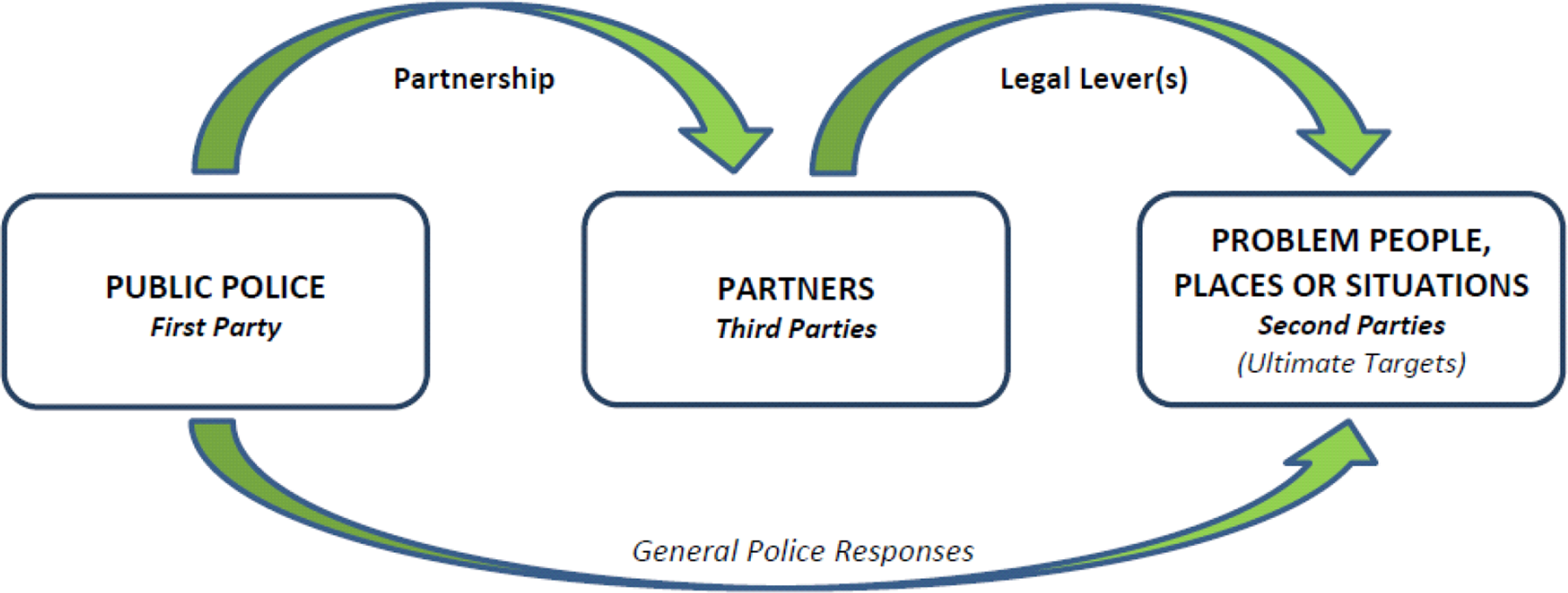
TPP is a policing approach that requires a partnership between police and a third party. The third party is valuable to police because they have access to legal provisions (i.e., legal levers) that are (or could be) applied to control or prevent a crime or disorder problem. Figure 1 illustrates the components of a TPP intervention. As seen Figure 1, TPP involves three key players: (1) the police (‘first party’), (2) a crime or disorder problem (‘second party’), which could be a problem place, problem people, or a situation where criminogenic places, times and people converge, and (3) an external entity (‘third party’) that police partner with to control or prevent the crime or disorder problem. We describe each of these component parts below.
Third Party Policing Model
In TPP, the ‘first party’ is defined as the public police. As Figure 1 illustrates, public police work in partnership with a third party for the purposes of controlling or preventing a crime and/or disorder problem. Partnerships may be forged in an ad-hoc episodic manner (see Mazerolle & Ransley, 2005), through a program of crime control activities (e.g., Pulling Levers Policing, see Braga & Weisburd, 2012; Problem-Oriented Policing, see Weisburd et al., 2010), and/or because the partnership is mandated by law (e.g., the UK Crime and Disorder Act, 1998; the Scottish Police and Fire Reform Act of 2012).
The ‘second party’ in TPP is defined as the ultimate crime control or prevention target (see Buerger & Mazerolle, 1998; Mazerolle & Ransley, 2005). Consistent with Routine Activity Theory, the ultimate target of a TPP intervention can be a problem person (a motivated offender), a problem place (an amenable place), or a problem situation (a suitable target, absence of suitable controllers) (see Cohen & Felson, 1979; Eck, 1994; Felson, 1995) . In essence, TPP interventions aim to focus police resources on one or more criminogenic factors that either allow crime problems to flourish, or prevent crime problems from emerging or escalating.
The ‘third party’ lies at the centre of the TPP intervention approach. A third party is an entity – a person, an agency, organisation, or business – operating within a legal framework and with legal powers and responsibilities not directly available to police. The third party is thus the partner and agent of crime control within TPP. A third party can be an individual (e.g., a bar staff member, property owner), an organisation (e.g., Pharmacy Guild), a business (e.g., a bar), a regulatory authority (e.g., liquor licensing authority, local council, school), a government department (e.g., education department), or a network of collaborating agencies (e.g., see Green, 1996), all of which have statutory responsibilities that are unavailable to police.
How the Intervention Might Work
The key defining feature of TPP is that police indirectly, rather than directly, target crime and disorder problems, and they do so through a partnership with a third party with access to a legal lever. We hypothesise that TPP controls and/or prevents crime through police–third party partnership formation which, in turn, activates, escalates or re-directs the use of existing legal levers to address crime problems Figure 1 (above) illustrates the two critical mechanisms of TPP (represented by the two upper green arrows in Figure 1) as being (a) the character of the crime control partnership between police and the third party, and (b) the process of activating, escalating or re-directing the use of legal levers. These two intrinsically tied mechanisms distinguish TPP from other types of policing and define the underlying mechanisms of TPP interventions.
We hypothesise that it is the combination of the partnership and legal lever components that underlies TPP's potential for preventing and controlling crime and/or disorder problems. Specifically, we hypothesise that the TPP mechanism that impacts crime control outcomes is the process of police forming legitimate partnerships with third parties, which then enables the activation (escalation or re-direction) of legal levers. In the subsections that follow, we first describe the partnership and legal lever components. Second, we discuss how the partnership and legal lever components, in combination, are hypothesised to explain the effectiveness of TPP interventions in controlling crime and/or disorder.
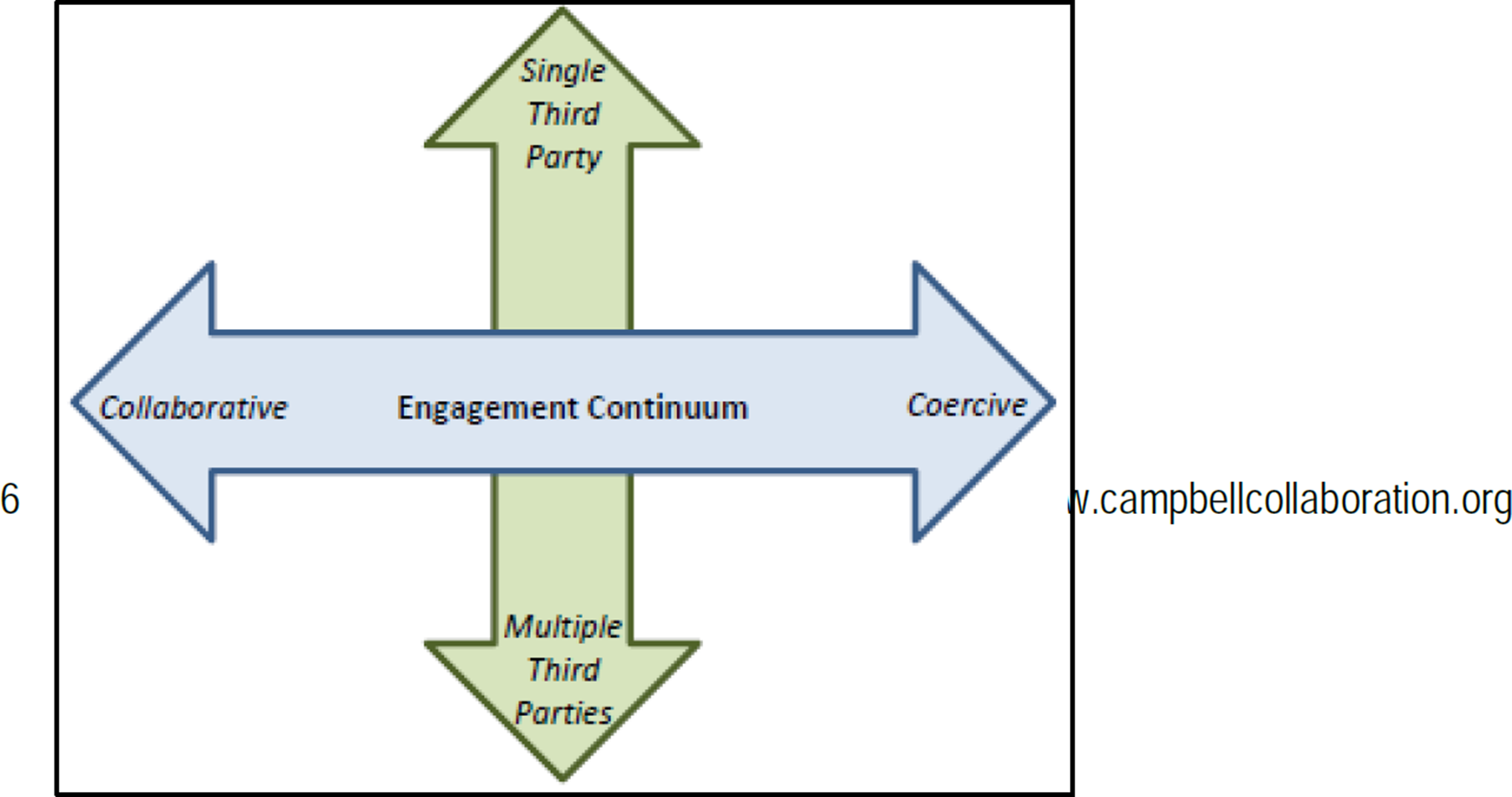
The first necessary mechanism underlying TPP interventions is the dynamic character of the TPP partnership. TPP partnerships exist when police and one or more third parties work together to control or prevent a crime/disorder problem through the initiation and/or escalation of third parties’ legal levers. The TPP Partnership Matrix in Figure 2 below captures the different types of TPP partnerships. The matrix categorises TPP partnerships along two continuums: the engagement continuum and the number of third parties within the TPP intervention. The engagement continuum reflects the range of engagement strategies – from collaborative to coercive – that are used to forge and maintain police–third party partnerships in the effort to control or prevent crime and disorder problems.
Third Party Policing Partnership Matrix
The way police engage with third parties will depend on the willingness and capacity of third parties to partner with police to address crime and disorder problems. In some instances, police may need to induce a recalcitrant or less-than-willing third party's cooperation to address a crime and disorder problem. In other instances, third parties may be willing and enthusiastic to cooperate and work with police to address a crime and disorder problem. Mazerolle and Ransley (2005) describe coercive engagement as a ‘sledge-hammer’ approach that is characterised by forceful engagement techniques. By contrast, the ‘carrot,’ or collaborative end of the continuum, uses persuasive techniques of engagement. We extend this description and define coercive techniques as tactics or strategies that police use to forge or maintain TPP partnerships where the police either threaten or actually impose negative consequences or remove benefits in order to compel a third party to cooperate (see Raven, 2008). In contrast, we define collaborative techniques as tactics or strategies that are characterised by more consultative or amicable processes that aim to engender willing cooperation from a third party. Scott (2013) provides several examples of the range of partnership engagement techniques that have been implemented by police in past interventions (see also Cherney, 2008; Goldstein & Scott, 2005). For example, on the coercive end of the continuum, police may compel third parties to cooperate and take responsibility for a crime and disorder problem by withdrawing services, publicly shaming the third party, or initiating civil actions against the third party for failure to meet their statutory responsibilities (e.g., bar owners that serve alcohol to minors). Alternatively, police may take a collaborative approach with their partners by making informal requests or appeals for cooperation, educating third parties to increase awareness of their responsibilities, providing incentives or rewards for cooperation (see Grabosky, 1995; Farrell & Roman, 2006), or brokering formal partnerships that are based on cooperative problem-solving, joint decision-making and sharing of resources (see Bond & Gittell, 2010; Claiborne & Lawson, 2005).
The first quadrant in Figure 2 is where police and single third parties forge partnerships characterised by collaborative engagement strategies (top, left quadrant). An example of a TPP intervention in this single third party, collaborative quadrant is the DART (Drug Abatement Response Team) intervention, which aimed to address drug-related crime and disorder at residential properties in San Diego (Eck & Wartell, 1998). The police partnered with the City's Code Compliance Department (single third party) who, through the enforcement of nuisance abatement legislation (legal lever), could close properties for up to one year, or fine property owners if persistent drug activity was found at the property. Before resorting to these outcomes, the police and DART advised property owners/managers of the crime problem at their property and the consequences if they did not take steps to alleviate the problem, and met with property owners/managers to devise a plan of action. In other words, police collaboratively partnered with the City Code Compliance Department (third party) to utilise their legal powers, including property closure to remove the ‘place’ enabling the crime or activating a place manager to deter drug-related crime and disorder, to modify the conditions underlying the crime problem.
The second quadrant is where the police focus on a single third party and use coercive engagement techniques (top, right quadrant) where there is non-compliance. Ransley and colleagues (2011) describe the relationship between police and rogue pharmacists as being a single third party coercive TPP partnership. In Queensland (Australia), police can use a real-time recording database (Project STOP) to identify anomalies in the way pharmacies record (or fail to record) purchase information about products containing pseudoephedrine (e.g., customer identification details). In Queensland, under several statutory and regulatory provisions, it is compulsory for pharmacists (third party) to record information about purchasers of controlled substances and share information with both police and health authorities. Failure to fulfil the mandatory reporting obligations can result in criminal charges and civil penalties (e.g., loss of licence to sell controlled substances). These legal provisions can be used by police to coerce rogue pharmacies to cooperate with police initiatives.
The third quadrant is where the TPP partnership involves multiple third parties and the engagement techniques used to forge and maintain the partnership are collaborative (bottom, left quadrant). An example of a TPP intervention involving multiple third parties working in a collaborative manner is the Specialised Multi-Agency Response Team (SMART) intervention (Green, 1995, 1996). In this study, addresses with high numbers of calls-for-service or drug-related arrests received a TPP intervention where police encouraged property managers to initiate legal levers by discussing the drug crime and disorder problem at their property, reminding them of the legal levers they were responsible for implementing (e.g., evicting problem tenants under Drug Nuisance Abatement laws and abiding by housing, safety, health and fire legislation), and offering a free course on property management. Police also partnered with SMART, which comprised city inspectors from various regulatory agencies (e.g., Housing, Public Works) responsible for enforcing legal levers in their respective areas. After being provided information by police regarding problem properties, the SMART inspectors escalated, where there was non-compliance, the regulatory legislation by issuing code violations that could result in fines or property closure.
The fourth quadrant is where the TPP partnership involves multiple third parties and the engagement techniques used to forge and maintain the partnership fall at the coercive end of the Engagement Continuum (bottom, right quadrant). In this context, police may need to compel one or more recalcitrant third parties who are unwilling or unable to work with them to prevent or control a crime and disorder problem. For example, in an effort to reduce alcohol-related crime and disorder problems in Wisconsin, police used the media to publicly shame licensees and public officials (third parties) who were lax in their implementation and enforcement of liquor licensing legal levers (cited in Scott, 2013; see also Green Bay Police Department, 1999). As a result, third parties became stricter in their implementation and enforcement of liquor licensing legal levers, which then assisted police with the regulation of conditions underlying alcohol-related crime and disorder (e.g., public intoxication).
Evidence supporting the effectiveness of partnership approaches for addressing crime and disorder is growing (see Berry et al., 2011 for review). Rosenbaum (2002) provides a comprehensive list of reasons that may explain why a partnership approach is particularly effective for addressing complex crime and disorder problems. Among these reasons is the increased capacity for partnerships to target criminogenic risk factors in a multifaceted way while at the same time pooling and executing resources efficiently (see also Cherney, 2008; Rosenbaum & Schuck, 2012). Gittell (2006) provides a relational perspective by suggesting that multiagency partnerships are conducive to the development of ‘relational coordination’ which is characterised by “frequent high-quality communication supported by relationships of shared goals, shared knowledge, and mutual respect” (Bond & Gittell, 2010, p. 119). Gittell has empirically demonstrated that the level of relational coordination between multiagency partners impacts partnership efficiency and attainment of desired outcomes (Gittell, 2011; Gittell, Fairfield et al., 2000; Gittell, Seidner, & Wimbush,2010; Gittell, Weinberg et al., 2010). The parallel between these explanations for the effectiveness of partnerships and TPP is clear. TPP partnerships provide a forum for pooling resources, for targeting criminogenic risk factors in a multifaceted way through different legal levers, and for generating relational coordination through communication and relationships characterised by shared goals and knowledge. However, as will be explored below, the partnership component is insufficient, in isolation, for understanding how TPP interventions may work to prevent crime and disorder.
The second necessary mechanism of TPP interventions is the activation, escalation or re-direction of a third party's legal levers. Legal levers are broadly defined as the legal powers possessed by third parties that create a crime control or crime prevention capacity that is otherwise unavailable to police. Police use TPP partnerships to access, influence, activate, escalate or re-direct these legal levers in TPP interventions. Examples of legal levers include conduct licensing (e.g., alcohol, firearms), mandatory reporting (e.g., chemical sales, child abuse), orders to control behaviour (e.g., gang or domestic violence injunctions, truancy regulations), orders under regulatory codes (e.g., building, fire, health and safety, noise codes), and property controls (e.g., drug nuisance abatement). Legal levers define and shape TPP interventions. First, by specifying third parties available for police partnership. Second, the procedural aspects of a TPP intervention is based on the legally mandated processes, possible legal outcomes, or consequences of the legal levers available to police through third parties.
Legal levers are positioned within an overarching legal framework that aims to regulate social, economic or functional activities in a given jurisdiction (e.g., health and safety, licensing, banking, transport). Third parties have the legal power to regulate these activities within their jurisdiction through the implementation or enforcement of legal levers. For example, a bar owner implements legal levers around responsible service of alcohol in order to regulate the behaviour of patrons (e.g., staff training, alcohol serving times, age restrictions). In contrast, a liquor licensing authority enforces compliance with licensing conditions, also aimed at regulating behaviour of patrons and licensed establishments (e.g., fines for serving underage patrons). In TPP, police assume that conditions that allow a crime problem to flourish can be controlled when (or if) a third party uses their legal lever to regulate behaviour, whether that be individuals, groups of individuals, or characteristics of places or geographic areas. For example, if a school-age person is committing crimes during the day time, police might encourage schools to activate and/or escalate their truancy laws to pressure the young person to attend school. Thus, police partner with third parties to modify the criminogenic conditions underlying a crime problem, thereby indirectly controlling or preventing the problem through implementation, or enforcement, of available legal levers (see Mazerolle, 2014).
Legal levers can be categorised by (a) their source of legal authority, (b) extent of their application, and (c) type of legal outcomes or consequences they may produce. Sources of legal authority include statutes, regulation/subordinate legislation, contract or tort, and the extent of application is either general or targeted (e.g., specific population, area, parties to contract, those with duty of care). Depending on the legal framework and the third party, the types of legal consequences can be criminal, civil, or administrative in nature including fines, licence revocation, incarceration, eviction, property forfeiture, orders for compensation or damages, infringement notices, injunctions, and refusal of entry into or ejection from licensed premises.
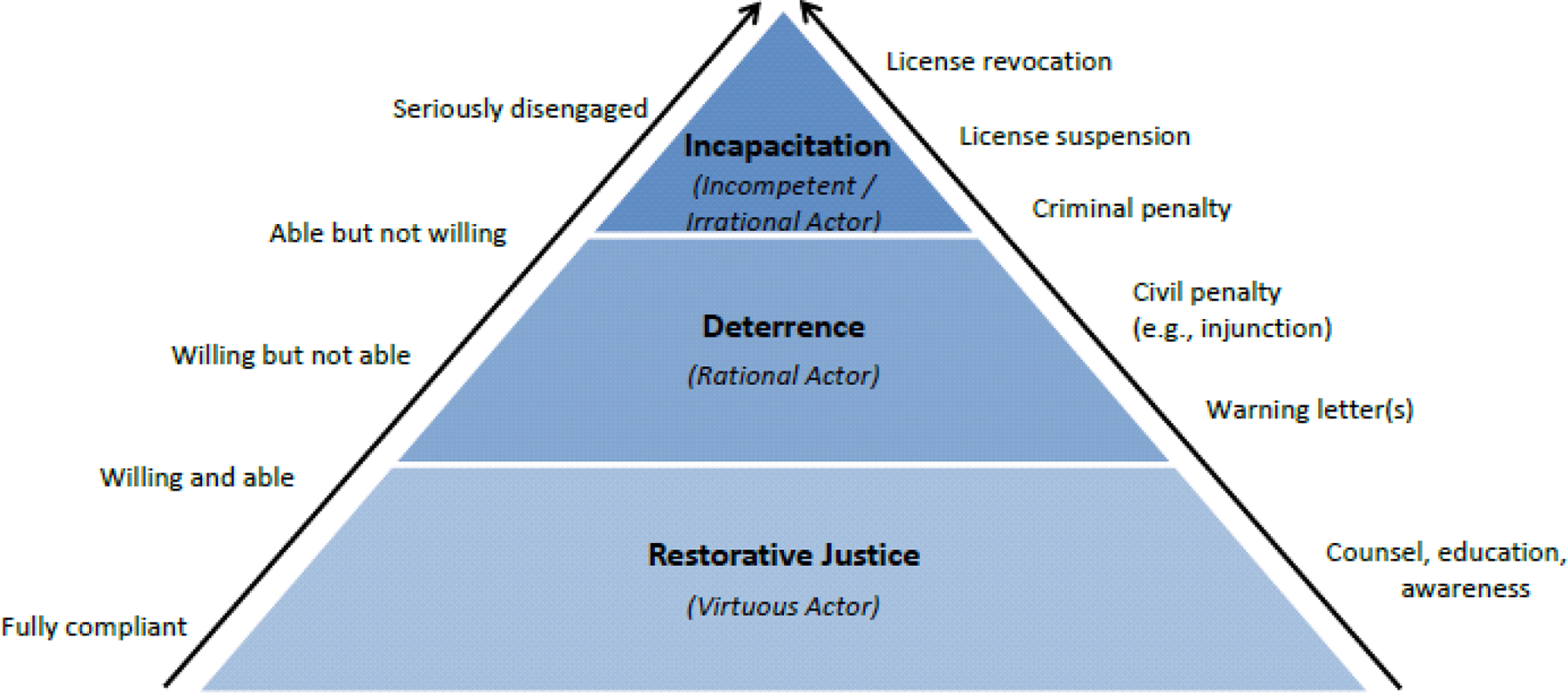
The legal frameworks from which legal levers are drawn dictate the process of TPP interventions 1 . Legal levers are drawn largely from the increasingly complex web of regulatory laws in the ‘new regulatory state’ (Braithwaite, 2002) where the emphasis is not so much on post-event use of formal legal sanctions, but rather on articulated and graduated actions that ultimately seek voluntary cooperation (see Mazerolle & Ransley, 2005 for a review). In explicating the theory of responsive regulation, Ayres and Braithwaite (1992) and Braithwaite (2006, 2011) describe this system of graduated sanctions as a regulatory pyramid (see Figure 3). The pyramid captures how regulators respond to each successive act of non-compliance by progressing through a hierarchical range of sanctions in a systematic and increasingly punitive way. As Ransley (2014) suggests, the range of legal levers that could be used in TPP interventions is extensive. Our preliminary review of TPP literature (see Mazerolle & Ransley, 2005) indicates that most legal levers utilised in TPP interventions align closely with Braithwaite's (2006, 2011) concept of the regulatory pyramid. That is, legal levers are activated by initiation of more benign consequences to encourage compliance (e.g., education, warning letter) and then sequentially escalate to more punitive consequences to coerce compliance (e.g., infringement notices, to fines, to license revocation), with the ultimate sanctions at the tip of the pyramid. It is this codified and stipulated process for regulating conduct that differentiates TPP from other policing processes 2 .
Regulatory Pyramid (adapted from Ayres & Braithwaite, 1992; Braithwaite, 2006, 2011).
Braithwaite (2006, 2011) suggests that regulation of social, economic or functional activities through the pyramid structure is both efficient and effective, provided regulators are willing and able to consistently initiate and escalate sanctions in response to non-compliance. The idea is that the possible range of sanctions aligns with the array of capabilities and motivations that underlie non-compliance (see Figure 3). For example, if an ‘offender’ is responsive to persuasive, normative requests to comply with rules, he or she is likely to alter their behaviour. In contrast, for a rational actor who is only responsive to the threat of punishment, then the use of persuasion or education at the bottom of the pyramid may not be effective for obtaining compliance. In the responsive regulatory model, this type of offender would be coaxed into compliance with more deterrent-based sanctions further up the pyramid (e.g., warning letters or civil actions). Provided that citizens believe “in the inexorability of escalation if problems are not fixed” (Braithwaite, 2011, p. 489), most escalations should not proceed far beyond the lower levels of the pyramid. Moreover, Braithwaite (2011) suggests that escalations are unlikely to compromise perceptions of legitimacy pertaining to the law or the regulator if the regulatory process begins with approaches that align with the principles of procedural and restorative justice. As a result, the use of responsive regulation is likely to foster voluntary compliance through perceptions of legitimacy. Therefore, responsive regulation is an effective strategy for regulating a range of factors that may underlie crime problems by fostering voluntary compliance and also responding to non-compliance in a way that addresses the full range of motivations underlying offending.
In the previous subsections, we described how partnerships and legal levers can help control or prevent crime and disorder problems. We argue, however, that it is the combination of these two necessary factors that explains how TPP interventions may work to control or prevent crime and disorder problems. We suggest that the formation of police–third party partnerships fosters the activation (escalation or re-direction) of legal levers, which then enables the control or prevention of crime and disorder problems.
Why is a partnership alone not enough? We suggest that a partnership between police and another entity on its own is less likely to generate the capacity to control crime without the third party having access to a pre-existing legal lever. In TPP, the addition of a legal lever structures, legitimises and prioritises the partnership between police and third parties. A range of research demonstrates how cross-agency partnerships are more likely to be effective when there is a clear structure to the partnership, including the articulation of roles, responsibilities and processes (e.g., see Berry et al., 2011; Foster-Fishman et al., 2001; Meyer & Mazerolle, 2013; Rosenbaum & Schuck, 2012; Roussos & Fawcett, 2000; Zakocs & Edwards, 2006). We propose that legal levers provide a framework for structuring partnerships because they pre-establish roles and responsibilities and procedural aspects of an intervention. Moreover, because legal levers mandate the legal responsibilities of third parties, a partnership with police to control or prevent a crime problem through the activation, escalation or redirection of legal levers is legitimised and more likely to be prioritised by third parties.
Why are legal levers alone not enough? If legal levers are already positioned within regulatory pyramids, they should already be controlling or preventing crime and disorder problems by promoting voluntary compliance in the way hypothesised by responsive regulation theory. However, we suggest that legal levers are not consistently activated (escalated or re-directed) by third parties in a way that makes them effective for controlling or preventing crime and disorder problems. Indeed, legal levers are more often than not created without reference to their potential as a tool for crime prevention or control. Street-level bureaucrat literature highlights how those on the ‘front-line’ of policy, regulatory and legislative implementation (i.e., third parties) can lack knowledge of legal provisions available to them, and even if they are aware of the provisions, a variety of factors influence how street-level bureaucrats use their discretion to implement legal provisions (Gofen, 2013; Lipsky, 2010; Tummers, 2011) . Third parties may know little about the activation procedures delineated by legal levers, inconsistently activate legal levers, or lack the capacity to do so (e.g., see Baldwin & Black, 2008; Weber, 2013) . As a result, the patchwork of individual attitudes, levels of knowledge and beliefs amongst third parties influences the way they activate legal levers in day-to-day practice and, in turn, the potential for legal levers to regulate factors that underlie crime and disorder problems. In TPP, we hypothesise that the formation of a partnership between police and third parties impacts the way third parties perceive legal levers and their capacity to consistently activate legal levers.
Figure 4 explicates the hypothesised process by which TPP partnerships and legal levers may work to impact crime and disorder problems. First, the presence of a legal lever prioritises, legitimises and structures the partnership between police and third parties. Second, the formation of TPP partnerships augments the ability of legal levers to reduce crime and disorder by (a) impacting third parties’ capacity to consistently and reliably activate their legal levers, and (b) altering third parties’ perceptions of their legal levers. That is, the TPP partnership increases the potential for third parties to activate the full range of their legal levers in the way envisioned by Braithwaite's regulatory pyramid (from education and persuasion through to prosecution). Third, the consistent and reliable activation of legal levers increases the likelihood that the wide range of complex motivations underlying compliance, and the criminogenic factors underlying crime problems, are effectively regulated, thereby ultimately impacting levels of crime and disorder.
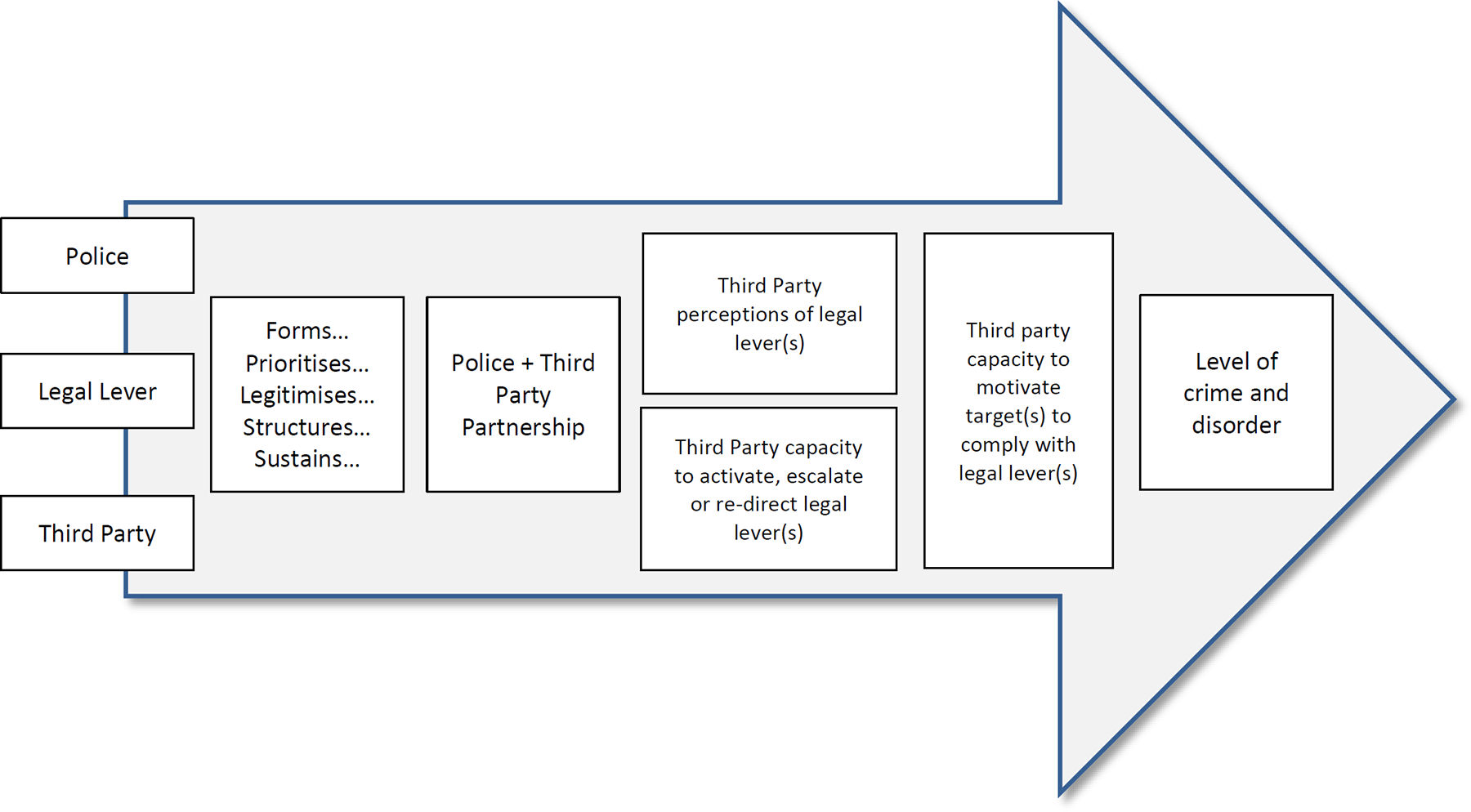
Logic model depicting how TPP impacts crime and disorder.
Why it is Important to do the Review
In a non-Campbell Collaboration review, Mazerolle and Ransley (2005) used systematic review techniques to locate, assess and describe the extant TPP evaluation literature. The authors identified a large pool of studies that varied in terms of methodological rigour, type of third party, type of legal lever and type of crime problem targeted by the intervention. On the basis of mostly positive effect sizes across individual studies, Mazerolle and Ransley concluded that TPP appeared to be an effective policing strategy for reducing a wide range of crime and disorder problems.
Almost ten years have passed since Mazerolle and Ransley's (2005) review. At the time of their review, TPP terminology was only just beginning to emerge in the literature and was not yet part of the general policing lexicon. Although TPP has since been identified as one of eight key policing innovations of the 21st century, the approach is not without critique (e.g., see Desmond & Valdez, 2013; Meares, 2006) . Therefore, we argue that an updated and broader systematic review of TPP's effectiveness for reducing crime and disorder is required. The review we propose will enhance Mazerolle and Ransley's previous work by including a more expansive search of published and unpublished literature and, provided sufficient data is available, will include a meta-analysis to determine the effectiveness of TPP for reducing crime and disorder. As we note above, the TPP approach aligns closely with the trend toward partnerships in policing and the focusing of police tactics on people, places and situations. The results of our review will assist policy makers and practitioners to make informed decisions about how TPP can be used to focus their resources, use their existing legal levers, and build partnerships to address crime and disorder.
Objectives
The primary objective of this review is to systematically evaluate the impact of TPP interventions on crime and/or disorder. We will achieve this by synthesising the results of published and unpublished empirical research on TPP interventions and by addressing the following research questions: What impact does TPP have on crime and/or disorder? Does the impact of TPP vary by the type of TPP partnership? Does the impact of TPP vary by the type of legal lever or third party utilised? Does the impact of TPP vary by the type of crime or disorder targeted? Does the impact of TPP vary by the target of the TPP intervention (e.g., offenders versus crime places)?
Methodology
CRITERIA FOR INCLUDING STUDIES IN THE REVIEW
Types of study designs
Our review will consider quantitative research that uses randomised experimental (e.g., RCTs) or ‘strong’ quasi-experimental evaluation designs with a valid comparison group that does not receive the intervention. In most instances, we expect that the control group or comparison condition will be ‘business-as-usual’. For example, police districts operating in their usual fashion are compared to experimental police districts that implemented a specific TPP intervention. However, we will also accept designs where the comparison group receives no intervention or an alternative intervention (treatment-treatment designs).
Although not as robust as randomised experimental designs, strong quasi-experiments can be used to provide causal inference when the nature of the design attempts to minimise threats to internal validity. This can be achieved in a number of ways, such as: controlling the assignment of cases to treatment and control groups (regression discontinuity), matching the characteristics of the treatment and control groups (matched control), statistically accounting for differences between the treatment and control groups (designs using multiple regression analysis), or providing a difference-in-difference analysis (parallel cohorts with pre-test and post-test measures).
We will include the following quasi-experimental designs in our synthesis of the effectiveness of TPP: Regression discontinuity designs Designs using multivariate controls (e.g., multivariate models that control for confounding factors whilst also examining the effects of group membership) Matched control group designs with or without pre-intervention baseline measures (propensity or statistically matched) Unmatched control group designs with pre-intervention measures (difference-in-difference analysis) Short interrupted time-series designs with control group (less than 25 pre- and 25 post-intervention observations (Glass, 1997))
3
Long interrupted time-series designs with or without a control group (≥25 pre- and post-intervention observations (Glass, 1997))
To address potential bias due to research design, we will perform a subgroup analysis using research design as a predictor variable. In addition, time-series designs will be synthesised separately because the effect size has a different meaning than numerically equivalent effects sizes for other quasi-experimental designs.
To be included in the meta-analysis, evaluations must have also reported an effect-size, or sufficient detail to allow an effect size to be calculated. Where there is not sufficient detail to calculate the effect size and standard error in an otherwise eligible study, we will attempt to contact the corresponding author for the required information.
Types of interventions
To be eligible for inclusion in the review, each piece of research must satisfy the criteria that define a TPP intervention (see Background section above): The presence of at least one third party with a legal lever; AND The presence of a police partnership with a third party that addresses a crime problem through the use of legal lever(s) accessible to the third party.
A third party is defined as an entity external to the police and can be an individual (e.g., a bar staff member, property owner), an organisation (e.g., Pharmacy Guild), a business (e.g., a bar), a regulatory authority (e.g., liquor licensing authority, local council, school), a government department (e.g., education department), or a network of collaborating agencies (e.g., see Green, 1996). To qualify as a third party for this review, the entity
Types of outcome measures
Crime and disorder is the primary outcome of interest for this review. To be included in the review, each TPP evaluation must report at least one crime and/or disorder outcome. Due to variation in the way outcomes are measured across the literature (e.g., see Addington, 2009), the scope of outcomes considered for the review will be relatively wide. We plan to conduct meta-analyses separately for conceptually different outcomes (e.g. we will separately analyse the effects of the intervention on violent crime and property crime) and will conduct moderator analyses to determine if different measurement methods (e.g. survey data vs official data vs observations) result in a different estimate of the effect. We will code and analyse all types of crime (e.g., property, violent, drug offences) and/or disorder that use the following measurement methods: Official measures of crime (e.g., arrest data, crime rates, calls-for-service data) Unofficial measures of crime (e.g., citizen reported crime via interview or survey) All types of crime and/or disorder displacement (see Guerette & Bowers, 2009) Diffusion of crime control benefits Systematic observations of social disorder (e.g., public intoxication, loitering, solicitation, excess noise, drug dealing) Systematic observations of physical disorder (e.g., dilapidated or abandoned properties, rubbish, graffiti) Citizen- or practitioner-reported observations of social or physical disorder
Types of participants
As we are interested in the impact of TPP on crime and/or disorder in general, we will include, code and analyse research with any type of participant or unit of analysis. For example, individual or place levels of analysis will be eligible for inclusion. However, we will synthesise studies with different levels of analysis separately.
Settings, timeframes and language
We will consider interventions executed in any country or region and will apply no restrictions on language. Our search will be conducted using the English language; however we will not exclude research written in a non-English language. Because the emergence of TPP is intrinsically linked with the transformation of governance towards the end of the twentieth century (see Mazerolle & Ransley, 2005) our review will focus on TPP interventions conducted from 1980 onwards.
Exclusion Criteria
Qualitative research designs and any study that does not fit the inclusion criteria outlined above will be excluded from the review.
SEARCH STRATEGY FOR IDENTIFYING STUDIES
The corpus of literature for this review will be drawn from a large-scale policing intervention database – Global Policing Database (GPD, www.gpd.uq.edu.au). The GPD has been created outside of this review and is a collaboration between Australian researchers at The University of Queensland, Queensland University of Technology, the London Mayor's Office for Policing and Crime (MOPAC), and the College of Policing in the United Kingdom. The database is designed to capture all published and unpublished experimental and quasi-experimental evaluations of policing interventions since 1950 without any restrictions on outcome measures, language of the research, or type of policing intervention.
The GPD is being compiled using systematic search and screening techniques, including an extensive systematic search of published and unpublished literature sources. All unique records are screened for relevance to policing based on the title and abstract and, if relevant, proceed to a staged full-text eligibility screening process to verify the presence of a quantitative impact evaluation of a policing intervention. The full protocol can be found on the GPD website, however, Appendix A summarises the GPD compilation process and the point at which TPP studies will be extracted, and Appendix B provides the GPD systematic search and screening methodology. We will use the GPD as the primary search location for the TPP search, as by definition the literature evaluating TPP interventions is a subset of the GPD corpus. This approach will also improve the timeliness and cost-effectiveness of the systematic review.
We will also hand search the most recent issues of specific journals not yet indexed (see Table 1). In addition, we will conduct cited reference searches using all eligible studies and seminal TPP publications (see Table 1).
Sources for hand searches and cited reference searches
DESCRIPTION OF METHODS USED IN PRIMARY RESEARCH
At this stage of the review, we have not identified the full corpus of research that will be eligible for inclusion. However, our preliminary examination of the TPP evaluation literature found a mixture of experimental and quasi-experimental research methodologies (e.g., Baker & Wolfer, 2003; Higgins & Coldren, 2000; Mazerolle, Kadleck, & Roehl, 1998; Mazerolle, Price, & Roehl, 2000; Weisburd & Green, 1995). For example, Eck and Wartell (1998) evaluated the DART intervention using a randomised controlled trial design where residential properties were randomly assigned to a control group (n = 42) or to one of two treatment groups (n = 42 and n =37). The main outcome measure used was 30 months of post-intervention official crime data which was aggregated into five six-month intervals for each site.
Other authors have evaluated TPP strategies using quasi-experimental techniques. For instance, Green (1995, 1996) used a pre–post unmatched control group design to examine the impact of the Specialised Multi-Agency Response Team (SMART) intervention on a number of crime and disorder outcomes in Oakland, California. Green used a number of outcome measures, including calls-for-service, narcotics arrests, field contact data and systematic observation of physical disorder, and compared outcomes for the intervention sites (n = 321) with the overall city before, during and after the SMART intervention.
DETAILS OF CODING CATEGORIES AND DATA EXTRACTION
Full-text eligibility screening
As noted in previous sections, the corpus of research for this review will be drawn from a large-scale policing intervention database called The Global Policing Database (GPD). The GPD will contain documents that report on experimental and quasi-experimental impact evaluations of policing interventions, with no limits on the type of outcome measures (see Appendix A for GPD screening process). This means that for the purposes of the TPP review, we will only need to screen documents for eligibility on the TPP intervention and outcome measure inclusion criteria (see Appendix C for eligibility screening companion), as all documents in the GPD will have already met the study design criteria.
The full-text of all eligible documents in the GPD will be imported into our Microsoft Access systematic review database – SysReview. The SysReview database is customisable to individual review requirements and creates a unique record for each document (see Appendix D for screen shots). Using the ‘Eligibility Screening’ form (see Figure D.2 in Appendix D), the full-text of each document will be screened, using the screening companion in Appendix C, to identify studies that satisfy the following criteria: Research conducted from 1980 onwards; AND The presence of at least one third party; AND The presence of at least one legal lever; AND The presence of a police partnership with a third party with the intention of addressing a crime problem through the initiation or escalation of legal lever(s) accessible to the third party Uses a crime and/or disorder outcome measure
Documents that are not excluded during this phase will progress to the in-depth coding phase (see below). To ensure consistency in screening decisions, each document coder will screen 30 documents for eligibility and inter-coder agreement will be calculated (percentage agreement between coders that document is eligible). We will accept an inter-coder agreement of ≥95 per cent. If there is less than 95 per cent agreement, we will implement further training and rescreen the group of documents where agreement fell below the 95 per cent threshold. Disagreements regarding the eligibility of training and non-training documents will be resolved by a discussion between the coders and the review manager.
After the eligibility screening phase has been completed, a list of eligible documents and the inclusion criteria will be distributed to the TPP Advisory Group for perusal to ensure that eligible studies have not been omitted from the review. Although we will have previously contacted policing experts and other study authors for the GPD, the TPP Advisory Group is comprised of practitioners and scholars who may not have been contacted for the GPD (see Appendix E). Any additional studies provided by the Advisory Group will be assessed for eligibility in the same manner as studies retrieved from the systematic search.
Full-text coding and data extraction
A team of trained research assistants will code the documents using the ‘TPP Review Full-Text Coding Companion’ which details all coding fields (see Appendix F). We will assess coders’ understanding of the coding structure and consistency of coding decisions by implementing the same quality control process used for the eligibility screening phase (see above). Given the anticipated large size of this review, complete double-coding will not be feasible. However, a random 10 per cent sample of each coders’ work will be double-coded to verify coding reliability and check for coder drift. In addition, we will use two independent coders to conduct duplicate data extraction for effect size coding fields.
Documents will be read in detail and coded according to fields recommended by research synthesists (e.g., Littel et al., 2008). Specifically, data will be extracted for (a) general characteristics of the study (e.g., intervention location); (b) research methodology (e.g., type of comparison group); (c) study quality (see section below); (d) outcome characteristics (e.g., data source); and (e) effect size data. In addition, a range of data will be extracted on the characteristics of the TPP interventions which will serve a dual purpose of informing qualitative descriptions of included studies and proposed subgroup analyses.
Each document may (a) report multiple outcomes for the one intervention or (b) contain multiple studies with multiple outcomes. SysReview allows for this nested data situation by enabling coders to add multiple outcomes for each unique study, and manually add multiple studies within the one document record (see Appendix D, Figure D.3). The results of the eligibility screening and coding phases will be presented in the final review in the form of a PRISMA flowchart (Moher et al., 2009).
If there is missing data for key coding fields (e.g., intervention components, data required for effect size calculation), we will attempt to correspond with the document's author(s) to obtain the required information.
Criteria for determination of independent findings
We anticipate two issues relating to the determination of independent findings that will need to be addressed in this review. First, documents may report on multiple studies and/or multiple outcomes. Our protocol for this situation will be to allow documents to contribute multiple effect sizes, but only contribute one effect size for each outcome. If a document provides multiple effect sizes for one outcome, the mean effect size for that outcome will be calculated using Comprehensive Meta-Analysis 2.0 (Borenstein et al., 2005). The second issue of independence is where multiple documents report data from the same evaluation. We will treat dependent studies as a single study and use all sources to calculate effect sizes for each outcome.
Assessment of methodological quality and risk of bias
We will use a modified version of the Campbell Collaboration International Development Coordinating Group (IDCG) Risk of Bias tool to assess the quality of each eligible study (see Appendix G). Rather than allocate a score or index, we will make a qualitative decision regarding the risk of bias for each eligible study. We have chosen this approach because extreme failure in one area of study quality may be more serious than minor breaches across several areas of study quality. We will present the results of study quality assessment using a ‘traffic light’ format (see de Vibe et al., 2012). We will not exclude studies on the basis of methodological quality or risk of bias; however, we will conduct sensitivity analysis to determine the impact of study quality on the overall findings.
STATISTICAL PROCEDURES AND CONVENTIONS
Methods of synthesis
We will synthesise the effect sizes for each outcome using a random-effects meta-analysis with inverse variance weighting to account for likely heterogeneity in interventions. We will conduct all analyses using Comprehensive Meta-Analysis software (Borenstein et al., 2005). If a study reports multiple effect sizes for the one outcome, we will use the mean effect size for that outcome. We will synthesise the results of time-series studies separately from other experimental and quasi-experimental designs, as time-series designs standardise for variability over time rather than variability over units, resulting in a different scaling (D. Wilson, personal communication, September 20, 2013).
We will only combine results of evaluations if the outcomes are conceptually equivalent. For example, if studies report violent crime and property crime as separate outcomes, we will conduct two separate meta-analyses – one for violent crime outcomes and one for property crime outcomes – as we do not consider that these two outcomes are conceptually equivalent. We will conduct separate meta-analyses for outcomes measured at different levels of analysis (e.g., individual, police district, country). We will present the results of the meta-analysis in forest plots, including 95 per cent confidence intervals for individual studies and the overall effect.
Measures of treatment effect
We will calculate standardised effect sizes and their standard errors in SysReview for the most commonly reported data, as the database has inbuilt calculations with formulae drawn from Lipsey and Wilson (2001). For less commonly reported data we will calculate standardised effect sizes and their standard errors using the web-based effect size calculator “Practical Meta-Analysis Effect Size Calculator” 4 .
For continuous outcomes we will use Hedges’ g as the measure of effect size, as it includes an adjustment for estimator bias in smaller samples (Borenstein, 2009). If binary outcomes are found we will calculate a log odds ratio as the measure of effect size. Should an outcome be measured across different studies using binary data in some studies and continuous data in others, we will convert all effect sizes and their variances for that outcome to a common metric once the data are entered into Comprehensive Meta-Analysis software (Borenstein et al., 2005). For example, log odds ratios may be converted to Hedges’ g, and the meta-analysis conducted on all outcomes using Hedges’ g as the effect size of choice. Following Borenstein and colleagues (2009), we argue that this approach, whilst imperfect, is preferable to conducting two separate meta-analyses with different effect size measures.
Some studies may use an interrupted time-series design with observations at multiple time points before and after the implementation of an intervention in an area and some may use comparison groups in addition to multiple time points. For studies that collect data at multiple time points, we will assume an underlying uniform distribution for violent crime, and a step function for the effect of the intervention on the outcome. We will therefore calculate an average effect size for the time points before the intervention, and an average effect size for the time points after the intervention, and compare the two. We recognise that there are many other ways to deal with this type of time-series data; however, given the research questions and the likely nature of the intervention effect, we believe that this method is the most defensible and parsimonious.
Unit of analysis
The standardised coding sheet contains fields to code both the unit of treatment and the unit of analysis. We will also assess each study for unit of analysis error, as part of the IDCG risk of bias tool. If a study is assessed as suffering from unit of analysis error, we will correct for the standard error and confidence intervals of the studies, using the formula 
Missing data
We will use reported statistics such as t, F, p, or z-values to convert to effect sizes if effect size data are not reported. If data required to compute effect sizes are missing, we will attempt to contact the authors of the studies to obtain the data required.
Assessment and investigation of heterogeneity
We will test for heterogeneity using I2, and Q statistics, following Borenstein et al. (2009), and will calculate and report the between studies variance (Τ2). We will code a range of study-level moderators that we expect would have an impact on the effect size. If there is sufficient information available, we will test the effect of key variables on the heterogeneity of the intervention impact, using moderator analysis for categorical predictors and meta-regression for continuous predictors. We will use a random effects model with inverse variance weighting for all moderator analyses. As indicated by the review objectives, we plan to perform moderator analysis on the following variables: type of crime and/or disorder targeted by the TPP intervention (e.g., violent versus property crime); type of TPP partnership; whether the intervention was exclusively TPP or a selected response as part of another type of intervention (e.g. Problem-Oriented Policing); type of legal lever utilised in the TPP intervention; type of third party police have partnered with; and the type of TPP target (e.g., offenders versus crime places). We will distinguish in the final review between a priori planned analyses (those listed in the protocol) and post hoc analyses identified only during the analytic stage.
Sensitivity analysis
We will conduct subgroup analyses in order to assess the impact of study quality and study design. We will use a random effects model with inverse variance weighting for all sensitivity analyses. Using moderator analysis for categorical variables, and meta-regression for continuous variables, we will perform sensitivity analysis on the effect of study quality, publication status, publication year, and geographic level of analysis. We will distinguish in the final review between a priori planned analyses (those listed in the protocol) and post hoc analyses identified only during the analytic stage.
Assessment of publication bias
We will test and adjust for publication bias using a range of approaches suggested in Rothstein, Sutton, and Borenstein (2005); depending on the data collected, this may include funnel plots and trim-and-fill analysis.
Treatment of qualitative research
We will not use qualitative research to evaluate the impact of TPP interventions on crime and/or disorder.
Footnotes
Sources of Support
The Global Policing Database is co-funded by a grant awarded to the Mayor's Office for Policing and Crime (MOPAC) by the UK Home Office College of Policing Innovation and Capacity Building Fund.
Declarations of Interest
Professor Mazerolle is one of the founding TPP scholars, has evaluated a number of policing interventions with TPP components, and has published widely on TPP and related topics. Nevertheless, Professor Mazerolle is neither advocate nor critic of TPP; for example, chapter seven of her TPP book clearly articulates equity issues and potentially negative side effects of TPP. Professor Mazerolle is committed to generating a neutral and accurate review of the impact of TPP in order to make a meaningful contribution to crime control/prevention policy and practice, irrespective of whether the review's findings contradict her previous research endeavours.
Review Authors
| Name: | Lorraine Mazerolle |
| Title: | Professor |
| Affiliation: | The University of Queensland (UQ), School of Social Science |
| Address: | Room 440, Michie Building (9), UQ |
| City, State, Province or County: | St Lucia, Queensland |
| Postal Code: | 4067 |
| Country: | Australia |
| Phone: | +617 3346 7877 |
| Email: |
|
|
|
Angela Higginson |
| Title: | Dr |
| Affiliation: | Queensland University of Technology, School of Justice |
| Address: | Gardens Point Campus, 2 George Street |
| City, State, Province or County: | Brisbane, Queensland |
| Postal Code: | 4000 |
| Country: | Australia |
| Phone: | +61 7 3138 7130 |
| Email: |
|
|
|
Elizabeth Eggins |
| Title: | Ms |
| Affiliation: | The University of Queensland (UQ), School of Social Science |
| Address: | Room 423, Michie Building (9), UQ |
| City, State, Province or County: | St Lucia, Queensland |
| Postal Code: | 4067 |
| Country: | Australia |
| Phone: | +617 3365 6307 |
| Email: |
|
Roles and Responsibliities
Content: Mazerolle, Higginson, Eggins Systematic review methods: Higginson, Eggins Information Retrieval: Eggins (with additional research assistants) Statistical analysis: Higginson
Preliminary Timeframe
| • Searches for published and unpublished studies | July 2014 |
| • Staff training and piloting of eligibility and coding protocols | August 2014 |
| • Relevance assessments for GPD | September 2014 |
| • Relevance assessments for TPP review | November 2014 |
| • Full-text coding and data extraction from eligible literature | December 2014 |
| • Statistical analysis | January 2015 |
| • Preparation of final report | February 2015 |
Plans for Updating the Review
We plan to update the review every three years.
Authors’ Responsibilities
By completing this form, you accept responsibility for preparing, maintaining and updating the review in accordance with Campbell Collaboration policy. The Campbell Collaboration will provide as much support as possible to assist with the preparation of the review.
A draft review must be submitted to the relevant Coordinating Group within two years of protocol publication. If drafts are not submitted before the agreed deadlines, or if we are unable to contact you for an extended period, the relevant Coordinating Group has the right to de-register the title or transfer the title to alternative authors. The Coordinating Group also has the right to de-register or transfer the title if it does not meet the standards of the Coordinating Group and/or the Campbell Collaboration.
You accept responsibility for maintaining the review in light of new evidence, comments and criticisms, and other developments, and updating the review at least once every five years, or, if requested, transferring responsibility for maintaining the review to others as agreed with the Coordinating Group.
Publication in the Campbell Library
The support of the Campbell Collaboration and the relevant Coordinating Group in preparing your review is conditional upon your agreement to publish the protocol, finished review and subsequent updates in the Campbell Library. Concurrent publication in other journals is encouraged. However, a Campbell systematic review should be published either before, or at the same time as, its publication in other journals. Authors should not publish Campbell reviews in journals before they are ready for publication in the Campbell Library. Authors should remember to include a statement mentioning the published Campbell review in any non-Campbell publications of the review.
I understand the commitment required to undertake a Campbell review, and agree to publish in the Campbell Library. Signed on behalf of the authors:
Form completed by: Angela Higginson
Date: 07 July 2014
Appendix A: GPD Flowchart
Appendix B: GPD Search and Screening Methodology
Appendix C: Full-Text Eligibility Screening Companion for TPP Review
Appendix D: SysReview Screen Shots
Appendix E: TPP Advisory Group Members
Appendix F: Full-Text Coding Companion for TPP Review
Appendix G: Adapted IDCG Risk of Bias Tool
1
Unlike problem-oriented policing, where the process of intervention is driven by analysis of a problem and then selection of a suitable response(s) based on the specific characteristics of the problem (Goldstein, 1979, 1990; Spelman & Eck, 1987).
2
In addition, unlike other partnership-type policing approaches (e.g., community-oriented, networked, plural or pulling levers policing), it is a necessary condition for TPP that partners possess a legal lever that is otherwise unavailable to police.
3
In distinguishing between and pre- and post-test designs with control groups and short interrupted time-series designs with control groups, the key factor is whether the study reports on data from a group of subjects (e.g., offenders) or a single subject (e.g., police district, region). In pre- and post-test control group designs, the outcome is typically reported as a mean value for each of two groups of subjects (treatment and control), calculated at two time points (before and after the intervention). For example, in a pre- and post-test control group design, the study might compare the mean time to reoffending by offenders in the treatment group and compare that to the control group. On the other hand, a short interrupted time-series design with a control group typically reports on data from two subjects, where each subject is a group or area. Each subject is observed repeatedly over time, and one subject receives an intervention during the period of observation. In these studies the outcome is reported as a single measure, rather than as a mean. For example, a study may measure total offences every year over a ten year period for two similar police districts, where one district begins to focus on the use of TPP interventions during the period of observation (e.g., during year 4), and the control area where the intervention never occurs.

5
We will exclude the following categories from our search: Corrections, Human Rights, Law and the Courts.
6
Whilst we acknowledge this design can be methodologically robust (e.g., units of analysis are randomly assigned to treatments), this type of design generally provides indications of the comparative effectiveness of different interventions rather than providing indications of causality.
7
The tool has been adapted from an instrument developed by Jorge Hombrados and Hugh Waddington, drawing on existing tools, in particular EPOC (n.d.), Higgins and Green (2011) and Coalition for Evidence-Based Policy (2010). Thanks to Richard Palmer-Jones, Maren Duvendack and Phil Davies for comments on previous drafts.
8
If a quasi-randomized assignment approach is used (e.g. alphabetical order), you must be sure that the process truly generates groupings equivalent to random assignment, to score “Yes” on this criteria. In order to assess the validity of the quasi-randomization process, the most important aspect is whether the assignment process might generate a correlation between participation status and other factors (e.g., gender, socioeconomic status) determining outcomes; you may consider covariate balance in determining this (see question 2).
9
If there are serious concerns about the randomisation process or the group equivalence, assess the risk of bias of the study using the relevant questions for the appropriate methods of analysis (cross-sectional regressions, difference-in-difference, etc) rather than the RCTs questions.
10
If there are serious concerns with the assignment process or the group equivalence, to assess the risk of bias of the study using the relevant questions for the appropriate methods of analysis (cross-sectional regressions, difference-in-difference, etc) rather than the RDDs questions.
11
Accounting for and matching on all relevant characteristics is usually only feasible when the programme allocation rule is known and there are no errors of targeting. It is unlikely that studies not based on randomisation or regression discontinuity can score “YES” on this criterion.
12
There are different ways in which covariates can be taken into account. Differences across groups in observable characteristics can be taken into account as covariates in the framework of a regression analysis or can be assessed by testing equality of means between groups. Differences in unobservable characteristics can be taken into account through the use of instrumental variables (see also question 1.d) or proxy variables in the framework of a regression analysis, or using a fixed effects or difference-in-differences model if the only characteristics which are unobserved are time-invariant.
13
Please note that when a), b), or f) score no or large differences in baseline characteristics, we suggest assessing risk of bias considering other study design (Diff-in-Diff, cross-sectional regression, instrumental variables)
14
Even in the context of RCTs, when randomisation is successful and carried out over sufficiently large assignment units, it is possible that small differences between groups remain for some covariates. In these cases, study authors should use appropriate multivariate methods to correcting for these differences.
15
Knowing allocation rules for the programme – or even whether the non-participants were individuals that refused to participate in the programme, as opposed to individuals that were not given the opportunity to participate in the programme – can help in the assessment of whether the covariates accounted for in the regression capture all the relevant characteristics that explain differences between treatment and comparison.
16
The Hausman test explores endogeneity in the framework of regression by comparing whether the OLS and the IV approaches yield significantly different estimations. However, it plays a different role in the different methods of analysis. While in the OLS regression framework the Hausman test mainly explores endogeneity and therefore is related with the validity of the method, in IV approaches it explores whether the author has chosen the best available strategy for addressing causal attribution (since in the absence of endogeneity OLS yields more precise estimators) and therefore is more related with analysis reporting bias.
17
If the instrument is the random assignment of the treatment, the reviewer should also assess the quality and success of the randomisation procedure in part a).
18
An instrument is exogenous when it only affects the outcome of interest through affecting participation in the programme. Although when more than one instrument is available, statistical tests provide guidance on exogeneity (see background document), the assessment of exogeneity should be in any case done qualitatively. Indeed, complete exogeneity of the instrument is only feasible using randomised assignment in the context of an RCT with imperfect compliance, or an instrument identified in the context of a natural experiment.
19
Contamination, that is differential receipt of other interventions affecting outcome of interest in the control or comparison group, is potentially an important threat to the correct interpretation of study results and should be addressed via PICO and study coding.
20
‘Common methods’ refers to the use of the most credible method of analysis to address attribution given the data available.
21
A comprehensive assessment of the existence of ‘data mining’ is not feasible particularly in quasi-experimental designs where most studies do not have protocols and replication seems the only possible mechanism to examine rigorously the existence of data mining.
22
All interventions may create expectations (placebo effects), which might confound causal mechanisms. In social interventions, which usually require behaviour change from participants, expectations may form an important component of the intervention, so that isolating expectation effects from other mechanisms may be less relevant.
23
Standard errors may be inflated in parametric approaches if the intervention does not have a homogeneous effect across the whole sample population, and the authors fail to conduct appropriate sub-group analyses.