






Abstract
Linked Article
1) BACKGROUND
1.1. The Problem, Condition or Issue
Corruption is a pervasive phenomenon and significant in both developed and developing countries. As a complex social phenomenon, corruption deploys its characteristics under various and extensive forms which make the definition of corruption particularly complex and vast.
Literature on the definition of corruption is broad. The following paragraphs will provide the readers with some commonly used definitions of corruption. However, this overview of definitions is not intended to be comprehensive. As far as this systematic review will focus on the
Corruption is commonly defined as the abuse or misuse of public office (by elected politician or appointed civil servant) for private gain (Organization for Economic Cooperation and Development OECD 2008: 22; The World Bank 1997: 8; United Nations Office on Drugs and Crime UNODC 1999). The main offences constituting corrupt behaviour are bribery 1 , patronage and nepotism, theft of state assets or diversion of state revenues 2 , extortion (World Bank, 1997). Corrupt behaviours are also identified as acts of bribery of domestic or foreign public officials, trading in influence, embezzlement, misappropriation or other diversion of property by a public official (OECD 2008: 23; OECD 2015: 28). To widen the notion of corruption to individuals or private parties, we could also state that corruption is the misuse of entrusted power for private gain.
Besides the specific types of offences characterizing corrupt behaviours, there is also the distinction between “petty” and “grand” corruption. This distinction is focused on the seriousness of the offence, on the amount of money involved and on the hierarchical level of the public officials concerned. Indeed, “grand” corruption usually involves substantial amounts of money and high-level public officials and politicians, while “petty” corruption usually concerns smaller sums of money and typically more junior officials, civil servants (UNODC 1999; The World Bank 1997; The World Bank 2003).
Another distinction commonly mentioned in the literature is the one between public and private corruption. As its name indicates, public corruption concerns the misuse of public office for private gain while private corruption happens between individuals operating in the private sector (World Bank 2003: 3).
A third distinction is often made between administrative and political corruption (Khan 2004; Pope 2000; Riccardi & Sarno 2013). This distinction is more related to the types of operations/processes influenced by the corrupt behaviour and to the types of public officials involved. Administrative corruption refers to the state administration at central and local level (OECD 2015: 19) and involves civil servants. It mainly alters the implementation of policies (rather than their formulation) and service delivery (Gould 1991; Huberts 1998: 211; OECD 2015: 29; Riccardi & Sarno 2013). Political corruption refers to act at the political level, often with high-level civil servants involved. It influences the formulation of laws, regulations and policies and concerns elected public officials (Kramer 1997; OECD 2015: 28; The World Bank 2003: 6).
The categories mentioned above are not mutual exclusive and their meaning often overlaps. For example, the difference between “grand” and “petty” corruption is often related to the difference between “political” and “administrative” corruption (Blundo & al. 2006).
Administrative corruption: the problem of this review
The problem this review will address is
This systematic review will refer to the administrative corruption in the public sector as the abuse of public office or public role for private gain at the implementation end of public policies or procedures. By public office, we refer to people belonging to any kind of public institutions (e.g. schools, hospitals) in addition to governmental ones, with the exclusion of politicians.
This review will consider the following main corrupt acts: bribery of public officials; embezzlement; misappropriation or other diversion of property by a public official (theft of state assets or diversion of state revenues), nepotism, as well as a range of corrupt behaviors such as trading in influence, abuse of function, illicit enrichment. Some corruption-related concepts will also be included in the review such as fraud and extortion. Fraud is a broader legal and popular term that covers both bribery and embezzlement. Extortion is a form of corruption often seen in cases when state officials return preferential business opportunities and freedom from taxation. According to OECD (2011), asking for a bribe becomes extortion “when this demand is accompanied by threats that endanger the personal integrity or the life of the private actors involved.”
Furthermore, absenteeism as a serious form of corruption in specific sectors, such as education and health (Transparency International 2013) will also be included in this review. Indeed, “stealing time” (e.g. not show up to work) while performing a public office is considered a serious form of diversion or theft of state assets (time in this case) (Hanna 2011: 8).
Although administrative corruption is often defined and studied together and as opposed to political corruption, this systematic review will exclude political corruption. We deliberately separate politics from administration. Political corruption affects the formulation of policies, it involves political decision-makers and happens when politicians who are entitled to make the laws (the rulers) are themselves corrupt. In political corruption, laws and regulations are abused and even tailored to fit the interest of the rulers. Political corruption takes place at the high levels of the political system and it has political repercussions (Amundsen, 1999). Administrative corruption occurs at any level of authority in the public administration and affects the implementation of policies. The review will not examine the acts of political corruption mainly because we believe that the mechanisms and the functioning of political corruption (i.e. manipulations of rules of voting systems) are significantly different and more complex that those related to administrative corruption. We thus believe that political corruption would need an ad-hoc separate review.
Anti-corruption interventions/reforms implemented at the administrative level: the scope of this review
The aim of this systematic review is to identify the impact of the existing
The majority of administrative interventions and reforms in the public sector have been developed to curb public corruption at the state administration level (World Bank 1997, USAID 2009: 4, European Commission 2014b). Several anti-corruption programs have been, indeed, developed both at the domestic and international level. In the words of Gounev (2012) “significant funds are being allocated by the EU cohesion policy to the strengthening of administrative capacity at all levels, including regionally, especially in less developed regions and newer EU Member States. The added administrative efficiency that should result will reduce actual levels of corruption and consequently the pressure on personnel to become corrupt. Once administrative efficiency has been improved, additional specific anti-corruption measures can be added.”
The issue so far has been that, in spite of the large amount of anti-corruption programs implemented (cfr. European Commission 2014b), the literature bringing them into line is most of the times an overview and compilations of general findings, leading to conclusions which might be too general and vague to inspire policy-makers. In addition, evaluations are more easily available on outcomes of higher sanctions and intensified controls, than on administrative reforms which try to reduce the “market” for corruption by making public bureaucracies more efficient and “user-friendly”. Though there has been a noticeable trend of developing significant anti-corruption programs helping to understand the causes and capture the indicators of corruption, there has been little systematic research into the impact of these anti-corruption efforts in reducing corruption. As a consequence, there has been a serious lack of comprehensive assessment of the implementation and the efficiency of anti-corruption measures in different settings.
Given the need for such evaluation, we propose a systematic review of all studies that have examined administrative anti-corruption reforms as well as their effects on the level of corruption. As formulated by Johnsøn & Søreide (2013: 1), “producing evidence that anti-corruption interventions have an impact in reducing corruption is a relatively new area for research and evaluation”. This is the contribution this systematic review is aiming at.
Why the focus on administrative corruption and why it is a target for administrative anti-corruption interventions/reforms?
In order to keep the systematic review manageable, it only covers administrative corruption. Along with this primary reason, the focus on administrative corruption and the administrative anti-corruption reforms is explained as follows:
The importance of the parties involved in administrative corruption
The reason we focus on the public sector corruption is that the state plays a decisive role and it is reflected in most definitions of corruption. Nevertheless, administrative corruption also exists within and between private businesses, within non-governmental organizations, and between individuals in their personal dealings. However, for this review, when the act of corruption does not imply or emphasize a state-relationship, it will be excluded from the review. The term “public sector” used for the review does not exclude the private sector or private companies which might be equally corruptible with serious public flow-on effect. For this review, we take into consideration the counterparts/protagonists to the corrupt officials who can be any non-governmental, nonpublic individual, or the general public. In sum, acts of corruption with no state components or public office involvements will be excluded from the review. This leads us to another significant reason to focus on administration corruption. As a matter of fact, whenever administrative corruption happens, it does involve numerous protagonists of the society, namely bureaucratic elites, public officials and interested individuals or parties. Administrative corruption involves appointed bureaucrats and public administration staff at the central or subnational levels. As advanced by Johnston (2011), administrative corruption implies that within public bureaucracies, abuse of roles, powers or resources have been found and it has been initiated by staff officials, their superiors or the agency clients. Although anchored in large and centralized governments, protagonists of administrative corruption might also be individuals or institutions from elsewhere in the public sector (Johnston, 2011).
The diversity of types of acts/offences of administrative corruption
The second reason of this focus is mostly related to the vast selection of malfeasant acts and behaviors emanated from administrative corruption. The most common act of administrative corruption is, according to Taslim (1994), pecuniary bribes. However, bribes are not the only forms of administrative corruption. In a study of Gounev (2012), administrative corruption consists of acts of manipulation of public tenders, kickbacks from providers, nepotism-based recruitment and promotions. In the interaction with private agents, administrative corrupt acts can be seen in the requests of extra payment or speed money for providing government services or to expedite some bureaucratic procedures. Bribes violating rules and regulations, bribes or kickbacks in order to obtain positions or to secure promotions, or mutual exchanges of favors within the public bureaucracy can also be part of administrative corrupt behaviors (Fjeldstad & Isaksen, 2008: pp. 5-6). When small payments are involved, administrative corrupt acts can be assimilated to petty corruption although in some specific cases and in aggregate the sums may become significant (Blundo & al. 2006). It also happens that, in order to provide advantages to either state or non-state actors, an intentional imposition of distortions in the prescribed implementation of existing laws, rules and regulations has been deployed. For instance an administrative corrupt act includes bribes to an official inspector to overlook minor (or possibly major) offences of existing regulations, or bribes to gain licenses, to smooth customs procedures, or to win public procurement contracts (World Bank, 2000). Administrative corrupt acts also include the actions of “offering”, “promising” and a bribe and not only the act of “giving” a bribe. However, our review will consider only the act of “giving of a bribe”, which occurs when the briber actually transfers the undue advantage and implies an agreement between the briber and the official. As offering and promising bribes have not been established as complete offences (OECD 2008, p. 26), we have decided to exclude these acts from this review.
1.2. Why it is Important to do the Review
Considering that “the absence of rules facilitates the process of corruption as much as the presence of cumbersome or excessive rules does” (Bank's General Counsel, Ibrahim Shihata), an evaluation of what works and what does not is of extreme importance to identify the most parsimonious and effective “model” to curb corruption issues.
Despite a large amount of literature on anti-corruption, there are few systematic reviews focusing on anti-corruption reforms and even fewer assessing the issues of effectiveness and impact. There is thus a need for more comprehensive assessments of the implementation and the efficiency of anti-corruption measures in different settings.
Therefore, the main objective of this review is to systematically identify any evidence and evaluation of the effectiveness of different anti-corruption reforms at the administrative level. Anti-corruption policies or interventions cannot operate successfully without a concrete assessment of their impact on the level of corruption. Determining the effects of anti-corruption interventions is integral to the success of the eradication of corruption. It is necessary to know exactly what has worked, what has been useful so far, what has not worked and how to do better in the fight against corruption. Consequently, there are not many ways to acquire such knowledge except from conducting a systematic review of anti-corruption measures and their effectiveness.
Our systematic review will allow identifying studies presenting anti-corruption reforms and interventions and comprehensive assessing the outcomes of these interventions.
The proposed research has a main impact for the criminological and criminal law field, but furthermore, as the subject of corruption and anti-corruption policies and reforms crosses many other disciplinary boundaries, it also constitutes an opportunity to consider all studies belonging to different disciplines such as political sciences, economic, business management, etc. In addition, our review will allow learning where empirical studies are concentrated (for instance what kinds of interventions and outcomes). Finally, given the lack of assessments of this sort at the international level, such review will be of high relevance to the international literature on the theme of administrative anti-corruption strategies.
One major contribution to the subject is the systematic review of Hanna & al. (2011) on “The effectiveness of anti-corruption policy”. This review demonstrates that the major shortcoming of existing research on the effectiveness of anti-corruption measures is related to the fact that they mainly focus on the incentives and advantages of not engaging in corrupt practices, but there remains a dearth of knowledge in relation to the assessment of administrative reforms adopted to reduce the “need” (or the “market”) for corrupt behavior.
The review of Hanna focuses on developing countries, on two main types of interventions (i.e. monitoring and incentives mechanism, and changing the rules of the system) and it uses a textual narrative synthesis approach. Hanna stated that there would have been the need to better understand the long-term effects of anti-corruption strategies focused on the changes of the rules and on those more oriented to monitoring and incentives interventions (Hanna 2011: 1).
Our review will differentiate from the Hanna's one by (1) considering both developing and developed countries (classified in low, middle and high income countries according to the World Bank and OECD definitions), (2) including a wider range of interventions and not only “monitoring and incentives programs” or “interventions changing the underlying rules of the system”, (3) focusing on both micro and macro level studies and (4) by using meta-analysis instead of textual narrative review. Moreover, this review aims at raising the attention on the importance of conducting cost-benefit analysis to evaluate interventions (Hanna 2011: 6). This method has long provided useful policy guidance in many sectors but it is still rarely applied to the evaluation of anti-corruption interventions (Johnson 2014: 1). Through the identification and analysis of studies based on this method, this review can help to promoting its appropriate and informed use.
As far as the features and mechanism for corruption change quickly, as well as the measures for countering this issue, this systematic review will also serve as an update to the results of the previous studies.
To conclude, this proposal seeks to answer to the key question:
1.3. The Intervention
This systematic review focuses on interventions which represent different types of administrative reforms mainly focused on curbing corruption.
Existing classifications of potential administrative anti-corruption reforms are usually focused on the schools of thought underneath them, on the types of system used to implement them, on the process/area they are addressed to.
For example, McCusker (2006) emphasizes three key schools of thought on corruption prevention and strategies: Interventionism -- the relevant authorities wait for the corrupt action to take place and then intervene to capture and punish the wrongdoer. This school of thought embodies principles of retribution, rehabilitation and deterrence. However, it overlooks several problems: the harm has already occurred and cannot be undone; the majority of corruption cases are unreported; and no attention is paid to improving supervision to deter corrupt actions in the first place. Managerialism -- the individuals or agencies seeking to engage in corrupt behavior can be prevented from doing so by establishing appropriate systems, procedures and protocols. Managerialism advocates the reduction or suppression of opportunities benefiting the individuals engaging in corruption. However, the limitation of this school resides in the fact that individuals do not necessarily operate according to the predetermined principles of managerialism. This often leads to inflation of rules and elimination of discretion that prevents practical, common-sense solutions. Organizational integrity – a norm of ethical behavior related to corruption control strategies and ethical standards needs to be created within an organization's operational system. This school supposes that the mechanism of corrupt behavior and deviance stems from the organization rather than the individuals. Therefore, in order to reach a successful level of reducing corruption, targeting the organizational context in which individuals operate is necessary.
Caiden (1969) categorizes the administrative reforms into four types (1) reforms imposed through political changes, (2) reforms to remedy organizational rigidity, (3) reforms through the legal system and (4) reforms through changes in attitude.
Even though there is a degree of disparity between the desire to eliminate corruption and the delivery of anti-corruption strategies, there are a number of important pragmatic and innovative mechanisms in anti-corruption efforts. Anti-corruption strategies should be developed in a way that incorporates policies in relation to the areas and sectors vulnerable to corruption.
With this regards, Huberts (1998) has distinguished six main anti-corruption strategies: economic – focused on the reduction of financial and economic stimuli for corruption (e.g. paying higher salaries to civil servants to reduce vulnerability or temptation to bribes); educational – focused on the change of attitudes and values of the population and civil servants (e.g. through training and educational campaigns; increasing public exposure; changing family attitudes population; influencing attitude of public servants; etc.); cultural – focused on the improvement of the ethical standards and examples given by management and on the development of ethical code of conduct for civil servants, as well as on the enhancement of protection for whistle blowers; organizational or bureaucratic – focused on the improvement of internal control systems and supervision (e.g. auditing systems), decentralization, selection of personnel and rotation of personnel; but also technological improvement helping the organizational system (e.g. conditional cash transfer (CCT) programs), which can help reducing the possibility for corruption to happen. political – focused on the improvement of the example given by politicians (e.g. more commitment by politicians to combat corruption), on an increased transparency in the monitoring of party finances and on a more rigorous separation of public powers (these last two examples are not included in this review); judicial or repressive measures – focused on the implementation of harsher penalties for corrupt practices but also on the creation of independent anti-corruption agencies.
Huberts' (1998) classification is more focused on the specific content and characteristics of different anti-corruption reforms rather than on the school of thought underneath them (such as McCusker's classification) or on the system used to develop them (such as Caiden's classification). Moreover, Huberts' classification is based on the views of 257 experts from 49 countries with very different political, economic and societal conditions. Due to its international orientation and to its more practical implications, Huberts' classification of anti-corruption reforms better serves the purpose of this review.
Six main types of anti-corruption reforms will, therefore, be considered for the purposes of this review: (1) economic; (2) educational; (3) cultural; (4) organization or bureaucratic; (5) political; (6) judicial or repressive measures.
Some examples are provided in the following chapter.
Examples of the types of possible interventions
Many important organizations and actors are behind the administrative anti-corruption reforms. Interventions seeking to reduce the discretionary power and monopoly of the power by the government officials, improvement of law enforcement, civil service reform, increase of transparency and improvement of citizen participation (UNDP, 1997). A genuine reform of bureaucracy by reducing the incentives and opportunities of corruption is one of the anti-corruption interventions proposed by UNDP.
Efforts and reforms of anti-corruption are deployed in all sectors of education, environment, energy, health, information technology and transport (USAID, 2011). In 2007, for instance, a program called “program of collective action” comprising the directions and principles to counter corruption was developed by OECD.
One of the anti-corruption reforms suggested by Schleifer and Vishny (1993; 610) is to produce competition between bureaucrats in the provision of government goods, which will drive bribes down to zero. This arrangement has been introduced in many agencies of the US government, in particular the passport office. It seems that creating competition in the provision of government goods might increase theft from the government but at the same time reduces bribes.
Decentralization is another example of anti-corruption reforms. When applying a decentralization policy, the responsibility for the implementation of a given policy passes from a higher level of government to a lower one (Hanna 2011: 9).
The use of technology and electronic payments can help to bypass various lengthy bureaucratic procedures and to avoid direct contact with civil servants. This can reduce the opportunity for bribes (Hanna 2011).
In the case of Italy, the new anticorruption law ratified in November 2012 was specifically addressed to the reduction of administrative corruption through the increase of transparency and dissemination of information by public administration. Within the three-year national anti-corruption and integrity action plan addressed to all administration bodies, the following main areas of administrative anti-corruption reforms have been considered for intervention: Reduce the likelihood of corruption Increase the detection of corruption cases Create a corruption-proofed environment
The following are some examples of practical interventions which have been developed within each of these areas: Public e-Procurement to manage public bid processes online and increase transparency (e.g. Acquistiinretepa.it) and shifts of management staff. Whistleblowers' protection through the development of informatics systems within public administration for reporting any suspected operation online. This provision is applicable to government employees who report misbehaviors under the condition that they do not commit libel of defamation or infringe on anybody's privacy (European Commission 2014a, p. 4). The identity of whistleblowers cannot be disclosed without their consent. Code of ethics for the public administration (European Commission 2014a, p. 9).
The types of interventions vary also on the basis of the country where they are developed. For example, Public Expenditure Tracking Surveys (PETS) are considered among the few methods having a positive impact on corruption in service delivery in developing countries with a weak system of governance (Sundet 2007, p. 2). The application of PETS in Uganda, for example, shows that the flow of funds improved dramatically, from 13 percent on average reaching schools in 1991-95 to around 80 percent in early 2001 (Reinikka and Svensson 2003). However, this method was not successful in other countries with similar characteristics (e.g. in Tanzania) (Sundet 2007).
1.4. How the Intervention Might Work
According to Johnsøn and Søreide (2013: 1-2), even if in the last two decades a substantial amount of empirical work has been done in order to understand the effects of anti-corruption interventions in different countries, “producing evidence that these interventions had any impact in reducing corruption is still a relatively new area for research and evaluation”. Anti-corruption practitioners are, indeed, still trying to understand how to best translate principles such as sanctions, control, transparency, and accountability into reforms and programs against corruption (Ibidem).
In this sense, our study offers a review as a bridge between theory and literature of anti-corruption strategies/reforms on the one hand and their empirical effectiveness on the other.
The universe of anti-corruption interventions and reforms is vast (see section 1.3. of this protocol) and, depending on the types of strategy and approach and on the type of actors involved and the environment where they have been developed, these interventions might work in different ways.
As mentioned above, as far as a standardized approach in this regard is still missing, the identification and description of how the different anti-corruption interventions might work, is among the main aims of our study and will be carefully analyzed during the development of this review.
However, a preliminary and general approach, based on the anti-corruption interventions' classification used in our study (see Huberts 1998 and McCusker 2006), can be described as follows (see Fig.1 below).
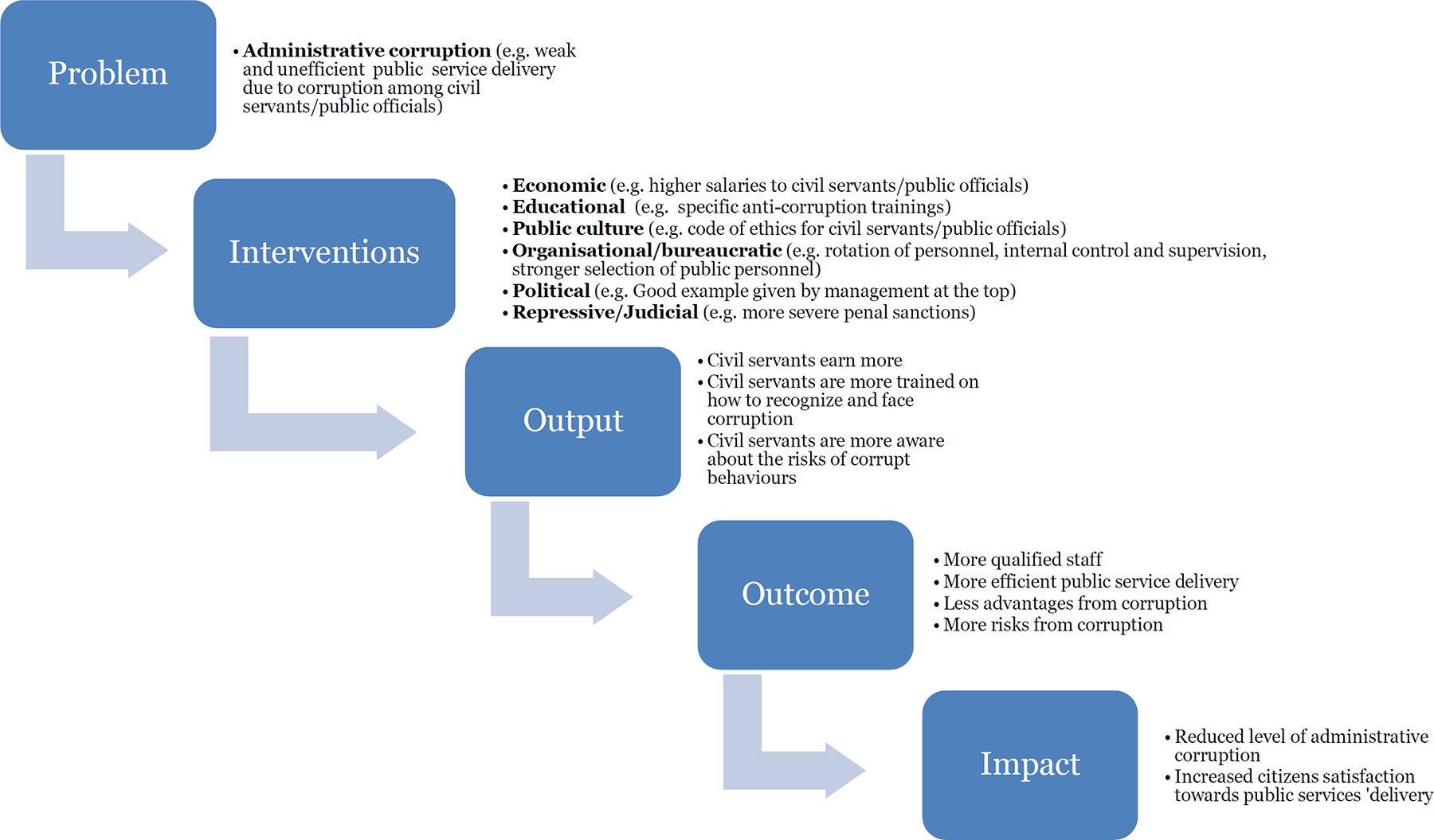
– Example of the practical functioning of anti-corruption interventions in the administrative field.
A more detailed and illustrative example of how a specific anti-corruption reform might work is provided by Johnsøn and Søreide (2013: 6) (see Figure 2 below).
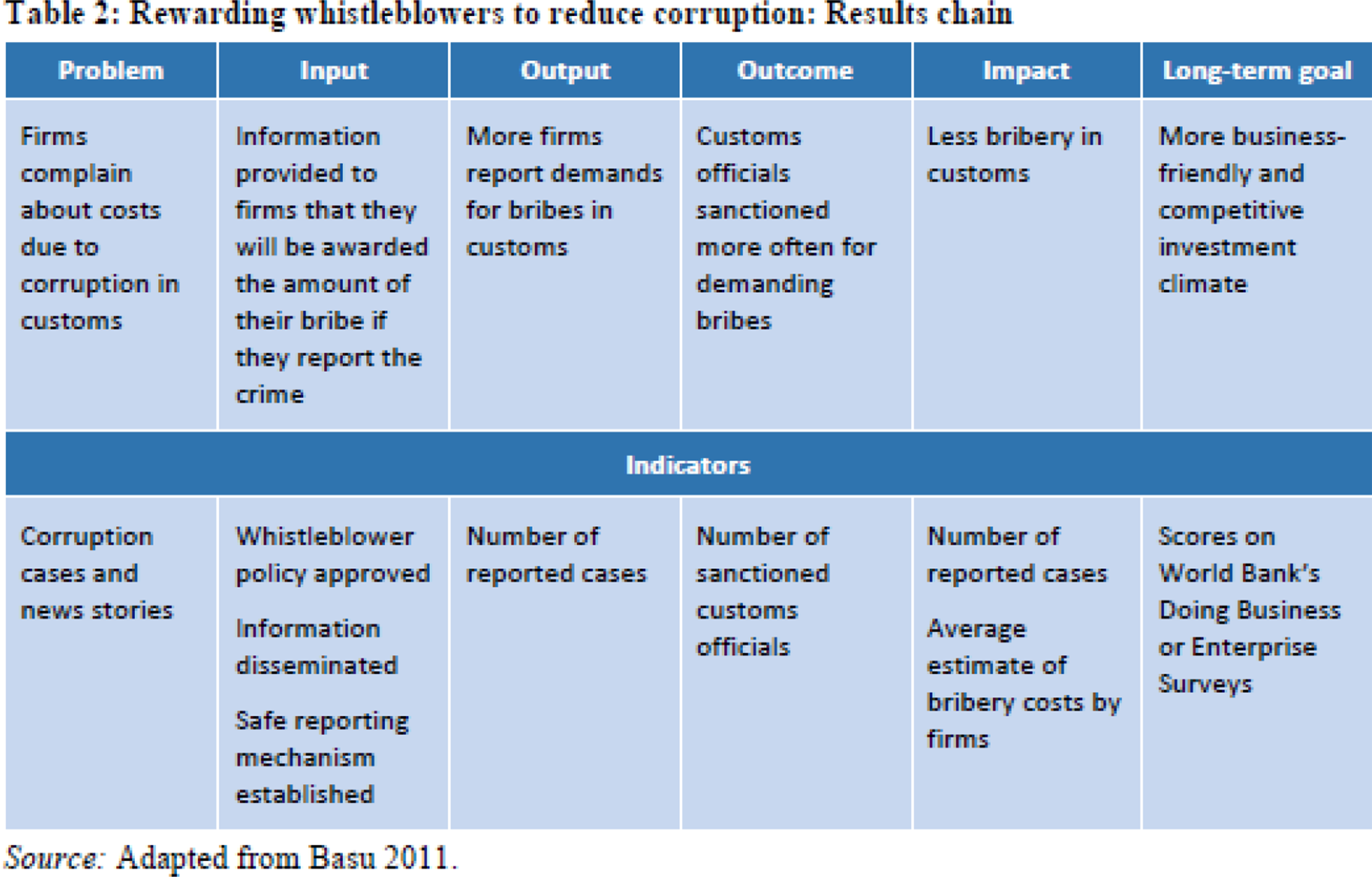
– Example of the practical functioning of anti-corruption interventions.
The authors focus on the process of a program aimed at reducing corruption in customs by offering a reward to businesses who report they have paid a bribe. For each step of the process, specific measurable indicators are also provided to show how the impact of this intervention might be empirically measured. However, Johnsøn and Søreide (2013) also highlight that it is not always easy to identify and evaluate the working process of a specific intervention, as it might be difficult to recognize preconditions and intervening variables. The idea is, therefore, to go beyond the log-frame approach and to also consider the socioeconomic and political context for the intervention in order to understand how it worked, and thus properly assess its effects. This is how our study is going to proceed.
(2) OBJECTIVES
This systematic review aims to identify and synthetize published and unpublished studies providing empirical evidence on the effects of administrative reforms, developed in the public sector, to counter administrative corruption.
The main objectives of this systematic review are the following: To identify which types of reforms (or interventions) have a deterrent effect on the level of administrative corruption across developing and developed countries and to measure the effectiveness of these reforms. To examine whether different types of interventions have different effects on the level of corruption, and how these effects vary across the types of interventions. To assess whether and how the effects of the interventions vary across developed and developing countries. To determine whether and how the effects of the interventions vary by unit of analysis (e.g. government agencies vs civil servants) and by type of offence (e.g. bribery vs misappropriation of public assets; nepotism vs extortion).
From the formulated objectives specific research questions emerge accordingly: Which types of interventions (among the six identified by this review) significantly reduce the risk of administrative corruption in the public sector? Do different types of interventions have different effects on corruption? Do the effect of a specific intervention change across developed and developing countries? And if yes, to which extent does it change? Do the effect of the interventions change by unit of analysis? And by type of offence? How does it change? And if yes, to which extent does it change?
While pursuing the above-mentioned objectives, this project will also contribute in better understanding the characteristics of administrative corruption and in shaping its peculiarities across different contexts (developed and developing countries).
(3) METHODOLOGY
This systematic review aims at providing quantitative evidence on the effectiveness of administrative anti-corruption strategies in the public sector.
In order to do so, it will synthetize evidence from quantitative studies, following Campbell and Cochrane Collaboration approaches to systematic reviewing (Higgins & Green, 2011; Petticrew & Roberst, 2006; Clarke & Oxman, 2000). Studies must be primary studies published or unpublished.
Studies written in or translated into English, German, French, Italian, Spanish and Vietnamese will be included in the review, as far as the project's team include persons who are fluent in these languages.
3.1. Criteria for including studies in the review
3.1.1. Type of study designs
Studies eligible for inclusion in this review must quantitatively assess the effects of the administrative reforms on the level of corruption in a given context. The included studies have to quantitatively measure the intervention either as a dichotomous, ordinal or scaled variable.
To be included in this review, studies should ideally use randomised controlled trials (RCT's), or any quasi-experimental method as study design. Therefore, we will include in this review RCTs, cluster RCTs, quasi-RCTs, pretest-posttest two groups studies (with a non-equivalent control group) and interrupted time series studies. The latter must have a clearly identifiable time point at which the intervention occurred and must include information for at least three time points before and after the intervention. Given the limited number of studies in this field of research using any control groups, we will include also studies in which neither a control group nor a random assignment is present, such as pretest-posttest one group studies and cross-sectional studies like surveys (suchas the study of Yongqiang, 2011).
Both the definition of corruption and the criteria of inclusion are deliberately broad because we are concerned about the limited number of possibly eligible studies. If a reasonable number of studies (more than twenty) can be identified and located we shall consider restricting the review to those studies meeting the highest methodological standards. At the documentary stage, however, it seems safer to include as many studies as possible.
Anyway, we will include only those studies which clearly describe their research design and clearly report the change in the level of administrative corruption due to a specific intervention.
3.1.2. Types of participants
The review will include studies developed in low, middle and high income countries (defined according to the World Bank classification method). For studies to be included they will need to collect and report on data at an individual or aggregated level.
If the outcomes of interest are measured at an aggregate level, the units of analysis will be any geographic place (e.g. community, city, province, state, region, or country) and/or governmental agencies, public and private companies within a developed or developing country. If the outcomes of interest are measured at an individual level, the unit of analysis will be the individual (e.g. civil servants, representatives of governmental agencies, public and private companies).
In particular, the review will include studies focusing on the following units of analysis: Geographical areas (countries, regions, provinces, local municipalities), Government agencies, Public companies, Private companies (e.g. surveys asking whether they have ever been requested to pay a bribe to public officials), Civil servants.
The type of unit of analysis depends on the different studies' sources of data. For example, studies considering the level of corruption as measured by administrative statistics, which have specific geographical areas as unit of analysis, will consider as population a number of provinces, local municipalities, or countries. On the other side, studies analyzing corruption as measured by population surveys or self-report studies, will consider a population of individuals or companies, which are the unit of analysis of such investigations.
The above-mentioned units of analysis will be analyzed separately, in order to highlight how the impact of administrative measures on corruption differs across them.
3.1.3. Types of interventions
The types of interventions of this review, or the independent variables, are the
As mentioned in Chapter “Background”, Section 1.1, “Administrative corruption: the problem of the review”, administrative corruption in this review is intended as “the abuse or misuse of public office for private gain” and includes acts of bribery, fraud, extortion, embezzlement, misappropriation or other diversion of property by a public official, theft of state assets or diversion of state revenues, absenteeism, extortion, nepotism. Therefore, anti-corruption interventions or reforms which are not specifically meant to curb or prevent these administrative corrupt acts will be excluded from this review.
This systematic review will include administrative anti-corruption reforms without any geographic and temporal limitations. The study of Hanna (2011: p. 17) demonstrated that temporal exclusion criteria do not have much impact on the review's findings because the study of anti-corruption strategies has only taken off in recent years.
Furthermore, the administrative anti-corruption reforms considered for the review need to concern reforms belonging to at least one of the following six main categories (see definitions under section 1.3): Economic Educational Cultural Organisational or bureaucratic Political Judicial or repressive measures
Studies included in this review should clearly distinguish the types and characteristics of the interventions (administrative reforms) according to the above-mentioned criteria.
The intervention has to be quantitatively measured. In particular, it could be measured either as a dichotomous variable (e.g. presence / absence of a specific legislative reforms), ordinal variable (e.g. long-term implementation of a specific legislative reform / medium-term implementation / short-term implementation), or as a scaled variable (e.g. increased amount of civil servants' salaries).
3.1.4. Types of outcome measures
This review will include
Furthermore, we understand that the outcome of specific anti-corruption reforms might have a wider positive displacement than simply reduce the level of corruption. However, the purpose of our review is to mainly focus on interventions with
criminal justice statistics, i.e. number of cases of corruption reported to the police and recorded by the police in a given context, the number of cases of corruption prosecuted.
surveys' data of the general population or of particularly knowledgeable groups (such as civil servants) that have assessed experience with corruption, and/or any other quantitative indicator on the experience and perception of corruption (e.g. direct observations, self-report studies, etc.).
Studies including at least one of the above-mentioned measures of corruption will be included in the systematic review.
3.1.5. Exclusion criteria
As articulated in Section 1.1., studies focused on political corruption are excluded from the review.
Furthermore, as mentioned in Section 1.1 and in Section 3.1.2., studies which do not examine administrative corruption offences and reforms with the involvement of at least one party as the state or public office are excluded from the review (private on private corruption).
Studies not using a quantitative method of assessment of the outcome will be excluded (see below for further details).
Qualitative and purely descriptive studies on anti-corruption strategies, as well as those aiming at testing the causes and consequences of corruption are excluded from this review. Indeed, even if these investigations may be interesting to understand the origins of corruption and their interrelation with the social and economic environment of a given country, they will not be included in this review because they do not measure the effects of anti-corruption reforms.
3.1.6. Examples of studies eligible for inclusion
On the basis of the abovementioned criteria, this section provides some examples of studies eligible for inclusion in this review.
1. Treisman, D. (2000). Decentralization and the quality of government.
This study statistically demonstrates how the degree of political decentralization in a country can affect the quality of its government and the level of perceived corruption. The analyses of the data on up to 154 countries suggest that states which have more tiers of government tend to have higher perceived corruption.
2. Steves, F. and Rousso, A. (2003). Anti-corruption programmes in post-communist transition countries and changes in the business environment, 1999-2002. European Bank for Reconstruction and Development Working Paper No. 85.
Using the results of a large survey of firms across 24 post-communist transition countries, this paper shows that omnibus anti-corruption programmes and membership in international anti-corruption conventions have not led to reductions in the level of either administrative corruption or state capture, between 1999 and 2002. Moreover, it finds out that the implementation of anti-corruption programmes is positively correlated with the perception of corruption.
3. Olken, B., A. (2005). Monitoring corruption: evidence from a field experiment in Indonesia. Working paper 11753. National Bureau of Economic Research. Cambridge, MA.
This study provides an example of ex-post cost-benefit analysis. The study quantifies in monetary terms both the costs and the benefits of an anti-corruption intervention, after its implementation. In particular, the author of this paper uses a randomized filed experiment to examine different approaches to reducing corruption across 600 Indonesian village road projects. He demonstrates that traditional top-down monitor can reduce corruption. In particular, he finds out that “announcing an increased probability of government audit, from a baseline of 4% to 100% reduced the missing expenditures (measured as discrepancies between official project costs and an independent engineer's estimate of costs) by about 8 percentage points”. On the other side he discovers that “increasing ‘grass-roots’ participation in the monitoring process only reduced missing wages, with no effects on missing material expenditure”. Overall, the net social benefits of this type of intervention were US$250 per village, 150% more than the costs of the intervention (Johnson 2014: 6).
4. Yongqiang, N. (2011). Government Intervention, Perceived Benefit, and Bribery of Firms in Transitional China. Journal of Business Ethics (2011) 104:175-184. Springer.
This study interview 600 business graduates (EMBA and MBA), working in different Chinese companies, in order to understand if there are any relationship between government intervention (in the forms of licenses, quotas, permits, approvals, authorizations, franchise assignments, etc.) and bribery/corruption, and if this relationship was somehow mediated by the firm's perceived benefit it can get from the corrupt practice. The results show that the government intervention causes bribery/corruption indeed, but a firm's perceived benefit fully mediates this relationship.
3.2. Search Strategy
In order to minimize publication bias, both published and unpublished studies, from a broad range of international and national sources, will be included in this review.
The team members will perform a literature search to obtain papers and studies written in English, German, French, Italian, Spanish and Vietnamese, including a quantitative assessment of the effect of administrative anti-corruption reforms.
The literature search will be conducted within electronic databases, journals and websites.
In particular, among academic databases the review will focus on: Social Science Citation Indexes JSTOR, International Bibliography of Social Science Social Science Research Network Wiley Interscience EBSCO Business Source Premier EconLit Google Scholar Academic Search Premier (Ebsco) ProQuest (Political Science, CSA Illumina, Public Affairs Information Service (PAIS Inernational)) OVID (International Political Science Abstracts (IPSA))
With regards to academic journals, the search will be particularly focused on those presenting an Economic and Development orientation, as well as a Sociological and Criminological focus.
Databases including unpublished studies (grey literature), such as: Campbell Crime and Justice Group IDEAS (Internet Documents in Economics Access Service) NBER (National Bureau of Economic Research) Networked Digital Library of Theses Dissertation Index to Theses, DocTA (Doctoral Theses Archive) Proquest's Digital Dissertation Rutgers Grey Literature Database
will also be investigated.
Online databases of key institutions, with more practitioner publications (rather than academic), such as those of: the Global Policing Database the World Bank the European Bank for Reconstruction and Development (EBRD) the Inter-American Development Bank Regional development banks (African, Asian, etc.) Innovations for Poverty Actions Transparency International U4 Anti-Corruption Resource Centre Ernst and Young PricewaterhouseCoopers KPMG
will also be explored in order to collect relevant policy evaluations from a broad array of public, private and no-profit institutions.
Online databases belonging to International and European organization such as: the United Nations the European Union (e.g. Group of States against Corruption (GRECO) Transcrime
will also be searched, as well as national anti-corruption authorities' website, such as: Swiss State Secretary for Economic Affairs (SECO) Italian National Anticorruption Authority (ANAC)
In addition, a screening of the references of the identified studies will be performed, in order to run a citation search using the abovementioned databases. Conference programs of key institutions mentioned above will also be investigated.
In case some key information is missing in included studies, the authors will be contacted. Authors of particularly relevant studies may also be contacted in order to obtain further materials or sister articles and documents.
The literature search will be mainly based on the groups of keywords presented in Table 1 below. These keywords will be also combined using the Boolean operators OR and AND and they will be translated in German, French, Italian, Spanish, Russian, Ukrainian and Vietnamese.
Groups of keywords used for the systematic review
All searches will be stored into EPPI-Reviewer, bibliographic tracking software dedicated to systematic review, to ensure replicability.
3.3. Data extraction and study coding procedures
3.3.1. Selection of studies
All potential studies identified through the searches will be stored into reference management software and duplicates removed.
Two independent review authors will start from reading the titles and abstracts of identified studies in order to determine their eligibility against the inclusion/exclusion criteria. When a title or abstract cannot be rejected with certainty, the full text of the article will be reviewed. In case of disagreement between the two review authors at any stage, this will be resolved by discussion, and if necessary, consultation with a third review author.
The included studies will be then organised into categories based on their methodological approach, type of interventions, types of administrative corruption acts, geographical region and other factors.
Studies that appear to be relevant but do not meet the inclusion criteria will be listed in the table of excluded studies with reasons given for exclusion.
3.3.2. Data extraction and management
Data on the identified studies will be extracted independently by two review authors on the basis of the template provided by the Cochrane Public Health Group.
In particular, the following information will be stored: year of publication; country of origin; study design; sample size; recruitment details; sample description; theoretical basis for intervention; intervention type; delivery of intervention; direct resource/cost requirements of the intervention; duration of intervention and follow-up; intensity of intervention; outcomes (including scales/measures used, time points and results, effect sizes); whether or not adverse outcomes were measured and reported; potential moderators/confounders of study outcomes and any adjustment processes used; population characteristics; process evaluation
5
measures; programme evaluation measures (if available)
6
; presence and extent of any bias in attrition
In case of disagreement about whether or not a study should be included, the lead author (Professor Martin Killias) will act as arbitrator.
Data will be entered into Review Manager (RevMan 5) software and checked for accuracy.
A coding sheet with a description of the data collected is included in the appendixes.
3.3.3. Missing data
In case the selected studies do not report sufficient data to calculate effect sizes, we plan to contact the authors of the studies and ask for them. In case the authors will or could not provide the data, we will calculate response ratios effect size. The response ratio provides a measure of the relative change in an outcome caused by an intervention. Besides some limitations (see Borenstein et al. 2011), the response ratio offers good possibilities for estimation.
3.3.4. Description of methods used in the component studies
Studies eligible for inclusion in this review must quantitatively assess the effects of the administrative reforms on the level of corruption in a given context.
The method used by the studies covered by this review should ideally be based on randomised control trials (RCT's), such as the study of Olken (2005) (see summary on page 24).
Randomization and field experiments can be considered the most reliable methods to evaluate anti-corruption initiatives, because they control well for bias, but they are not the most used. Indeed, it is often difficult to randomly establish a control group and to obtain support by decision makers or donor organizations (Johnsøn & Søreide 2013: 18). Therefore, quasi-experimental methods will also be included in the review. According to Johnsøn & Søreide (2013: 20) they are most applicable for evaluating large interventions targeting a large number of people or units. Eligible study designs include randomized controlled trials, natural experiments, interrupted time-series designs, and any other quasi-experimental design with or without control group (e.g. pretest-posttest two groups studies and pretest-posttest one group studies), as well as cross-sectional studies like surveys (e.g. Yongqiang, 2011).
So far our review shows a prevalence of studies based on cross-sectional studies using ordinary least square multiple regression analyses, such as the one of Yongqiang (2011) estimating the effect of a government intervention on Chinese firms' bribery, the one of Treisman (2000) studying the impact of political decentralization on perceived corruption, and the study of Steves and Rousso (2003) focusing on the relationship between anti-corruption programmes and the level of administrative corruption.
3.3.5. Criteria for determination of independent findings
There may be different sources of non-independence of findings, the most important regards the following issues:
Multiple indicators of the level of corruption reported in a single study (e.g. police recorded cases, prosecuted cases). Only one will be selected for the analysis, taking into consideration the most updated data and the comparability with the results of the other studies included in the review.
Multiple outcomes or time-points within a single study on the same participants. In case of different outcomes measured at multiple points in time (e.g. in time-series studies where the level of corruption is measured 6 months after the implementation of the reform, 12 months after and 3 years after) we will synthetize (average) multiple effect size related to the same outcome from the same sample, prior to meta-analysis. In particular, assuming an underlying uniform distribution for corruption we will calculate an average effect size for the time points before the intervention, and an average effect size for the time points after the intervention, and compare the two of them We recognize that there are many other ways to deal with this type of time series data (see Borenstein et al. 2009); however, given the research questions and the likely nature of the intervention effect, we believe that this method is the most reliable and parsimonious. In addition, even if we are aware that the effects of administrative reforms usually take a while before producing tangible outcomes, we think it is important to consider all the measurements of the same outcome at different points in time. Any relevant difference in the same outcome at different points in time will be reported within the results. It could, indeed, provide key information on the functioning of a specific intervention as well as on the confounding effects of other variables. In case of other study designs reporting multiple effect sizes for the same outcome on the same participants, we will compute the mean of these effect sizes and their variance (see Borenstein et al. 2009 for further details).
The same data being reported across multiple documents. The most complete and detailed manuscript in terms of data availability and the most reliable according to the risk of bias assessment will be designated as the primary coding source. We will make sure that the effect sizes we calculate come from independent samples. In order to do so, we will enter the information about each article/document into a data file (Excel) and we will note down those cases where a sample may have overlapped with another study. For each study, we will differentiate the unique outcomes derived from the same sample, and then will combine multiple effect sizes describing the same outcome from the same sample. We will then go again through the sample characteristics of our studies to check that any effect sizes from different studies utilizing the same sample will be combined together for our final analysis.
3.3.6. Details of study coding categories
Preliminary coding sheets have been produced for this protocol and included in its appendixes. They illustrate the systematic method of extracting information regarding each study's characteristics, research design, participants, type of intervention, type of outcome, risk of bias, etc.
Further table will be used to summarize the results of the critical appraisal for each study.
3.4. Assessment of risk of bias in included studies
When developing a systematic review, the most difficult source of bias to control for is the low methodological quality of the selected studies (Jarde et al. 2012).
In order to ensure the selection of studies methodologically sound, the researchers will assess the overall quality of each of them on the basis of the STROBE statement (Strengthening the reporting of observational studies in epidemiology) 7 checklist.
In addition, the potential specific risks of bias (selection bias, performance bias, detection bias, attrition bias, reporting bias, and other potential risks) of included studies will be also assessed using the relevant Cochrane EPOC (Effective Practice and Organisation of Care) “Risk of Bias” tool 8 .
In particular, for studies with a separate control group (RCTs; NRCTs and CBA studies), the overall risk of bias will be estimated as low, high or unclear, on the basis of the nine standard criteria identified in the EPOC classification (1. Sequence generation, 2. Allocation concealment, 3. Blinding of participants and personnel, 4. Blinding of outcome assessment, 5. Incomplete outcome data, 6. Selective outcome reporting, 7. Other potential risks of bias). For interrupted time series (ITS) studies, the overall risk of bias will be assessed on the basis of the six standard criteria identified by EPOC (1. Independence of the intervention of secular changes; 2. Pre-specification of the shape of the intervention effect; 3. Likelihood of the intervention to affect data collection; 4. Blinding of outcome assessment; 5. Selective outcome reporting; 6. Other potential risks of bias) (see also Petticrew & Roberts 2006: 138).
It has to be mentioned that, on the basis of the preliminary literature review we have conducted, there are few true experimental or quasi-experimental studies providing data on the effects of anti-corruption reforms, and, thus, several non-experimental studies will have to be appraised before including them into the review.
Sanderson et al. (2007) highlighted that there is not a single and unanimously recognised tool for assessing the quality of non-experimental studies. Discussion on this issue was developed by Jarde et al. (2012 and 2013) in two different articles, leading to the creation of the tool Q-Coh.
Following the checklists provided by the STROBE statement, the Q-Coh tool, and the framework provided by Petti crew and Roberts (2006: 142) this review will assess the risk of bias for non-experimental studies looking at four specific items which can affect the methodological quality of a research:
On the basis of these evaluations we will provide each study with an assessment of the study quality “weight”, the overall weight of evidence which the study provides. During this phase, we will also provide technical details on analytical 9 and statistical methods used to test the effectiveness of the anti-corruption reforms.
To obtain a preliminary and visual assessment of the risk of bias, forest plots ordered by judgements on each ‘Risk of bias’ entry will be analysed (through RevMan5). Forest plots on the risk of bias are useful to provide a visual overview both of the relative contributions of the studies at low, unclear and high risk of bias, and also of the extent of differences in intervention effect estimates between studies at low, unclear and high risk of bias.
Effect sizes belonging to studies presenting different risk of bias will not be combined together. In particular, studies with a ‘high’ or ‘unclear’ risk of bias will be kept separated from the main analysis and treated as a separated category. Ideally, studies at high or unclear risk of bias should be given reduced weight in meta-analyses, compared with studies at low risk of bias. However, formal statistical methods to combine the results of studies at high and low risk of bias are not sufficiently well developed. Therefore, the major approach is still to restrict meta analyses to studies at low (or lower) risk of bias, or to stratify studies according to risk of bias (Spiegelhalter 2003).
3.4.1. Assessment of reporting bias
In order to assess whether there is a systematic difference between reported and unreported findings, the following questions will be answered: 1. Were some outcomes, but not others, selectively reported in the study depending on the nature and direction of the results? (Yes/No). 2. Were the research findings published or non-published depending on the nature and direction of the results? (Yes/No); 3. Were the publication of the research delayed depending on the nature and direction of the results? (Yes/No); 5. Were the research findings published in journals with different ease of access or levels of indexing in standard databases, depending on the nature and direction of the results? (Yes/No).
In order to further check for publication bias, we will assess whether there are significant differences between the results of published and unpublished studies, by using funnel plots to assess the relationship between effect size and study precision and by running a sensitivity analysis to identify the level of impact caused by different effect estimates in small studies. Considering that the statistical significance of the results is often considered a requirement for publication (Gerber & Malhotra 2008a, 2008b), a large number of published studies with a p-values just below the standard 0.05 threshold can be considered a first sign of the presence of publication bias (Molina 2013: 32).
3.5. Statistical procedures and conventions
Ideally, this project would comply with the standards of meta-analysis (as specified by Lipsey and Wilson, 2001, or by Petticrew and Roberts, 2006) to synthetize the results of the considered evaluations. The a-priori rule for conducting meta-analysis requires two or more studies, each with a computable effect size of a common outcome construct, and similar comparison conditions (Wilson et al., 2011).
3.5.1. Effect size extraction and transformation
According to the nature of the data being collected, the comparable effect size estimates will be extracted from existing studies together with 95 percent confidence intervals. This effect size data or data that can be used to calculate a standardized effect size will be recorded in free-text format as part of the standardized coding sheet. A second reviewer will double-check the coding and data extraction for every study that contains effect size data. All relevant data will be input into Rev Man or Comprehensive Meta-Analysis software to calculate standardized effect sizes and their standard errors and the conversion between effect size types, to ensure that a common metric is used.
The different effect sizes will be then treated and calculated as following: In case both the dependent and independent variables are dichotomous, the Odds-Ratio (OR) effect size will be calculated. In case both the dependent and independent variables are continuous, the correlation coefficient (Pearson product moment correlation) effect size will be calculated. In case of analyses comparing two groups' performance on a continuous outcome (continuous outcome variables), the standardised mean-difference (SMD) effect size will be calculated. Hedges' g will be used for estimating standardized mean differences. Ordinal outcomes and measurement scales will be treated as dichotomous variables. In case of regression-based studies, as far as exposure is often measured using different methods and metrics across the studies, the standardized beta coefficient effect size will be used for scaled independent variable. For dichotomous independent variables the semi-partial correlation coefficients effect size will be calculated.
Odds-Ratio, Correlation Coefficients and Standardized Mean Effect Sizes Effect sizes will be calculated both by hand using Microsoft Excel as well as by using the David Wilson's Practical Meta-Analysis Effect Size Calculator 10 , or other similar programmes (Rev Man or Comprehensive Meta-Analysis software).
Effect sizes will be reported using forest plots.
3.5.2. Effect size combination
Following the Cochrane Handbook, the combination of intervention effect estimates across studies will be computed using the inverse variance weight method (IV). Assuming that the different studies differ for a number of reasons (e.g. study design, type of intervention, type of country covered, etc.), a
The meta-analysis will combine only those studies focused on the same outcome, the same unit of analysis, the same type of intervention, the same type of study design, and the same type of effect size. For example, an Odds Ratio effect size in a cross-sectional study will not be included in the same analysis as a standardized mean-difference effect size in a longitudinal study. Only one effect estimate per study will be included in a single meta-analysis.
Therefore, we will calculate separate effect sizes, and report them by using forest plots, for each different group indicated in Table 2 below.
Potential groups for which different effect sizes will be calculated
The review will also provide technical details on analytical 11 and statistical methods used to test the effectiveness of the anti-corruption reforms.
3.5.3. Assessment of heterogeneity
In order to test whether the different effect sizes that are averaged into a mean value all estimate the same population effect size, we will report tests for between-studies variability 12 of effects (Hedo-Medina et al. 2006). In particular, we will compute a Q test of homogeneity between groups and calculate the I2 index to complement the results of the Q test (Higgins and Green 2011, Huedo-Medina et al. 2006).
We assume the presence of between-studies variability in our review as far as the included studies differ on a number of characteristics (e.g. geographical region, characteristics of the samples, variations in the treatment, in the design quality, in the unit of analysis, etc.) and as such assume and implement a random-effects model for meta-analysis.
Depending on the number of available studies, we will explore potential causes of heterogeneity, based on the subgroups listed in Table 2. Caution will be taken in the interpretation of results with a high level of unexplained heterogeneity.
3.5.4. Moderator analysis
In order to test whether and how variation among studies in effect size is associated with differences in key contextual factors (e.g. geographical region, country income level and types of corruption) we will run a moderator analysis.
If our moderators are categorical (e.g. low, medium and high income countries; corruption intended as bribery, diversion of public assets, etc.), we will estimate models analogous to one-way ANOVA.
Considering that we might have to deal with small sample sizes within each sub-group, if the number of cases in the sub-groups is lower than 5 we would need to use a pooled estimate of the variance component otherwise we will use separate estimates of the variance component (τ2) within sub-groups.
Even if we assume that the moderators included in our review will be mainly categorical, in case of continuous moderators and if we want to test more than one moderator (either continuous or categorical) we will use meta-regression.
3.5.5. Sensitivity analysis
In order to check for the certainty 13 of our findings we will perform several sensitivity analyses in our review, including: type of counterfactual, experimental vs. non-experimental studies, randomized vs non-randomised studies; relevant differences in impact measure, traditional versus meta-analyses including the risk of bias and the uncertainty about the risk of bias, etc. It is likely that other issues suitable for sensitivity analysis will be identified during the review process when the individual peculiarities of the studies under investigation are better defined. We will specify and report all of them in the last version of our review.
In case sensitivity analyses will show specific decisions or missing information strongly influencing the findings of the review, we will try to obtain extra information on the concerned studies.
3.6. Treatment of qualitative research
This review is not meant to cover qualitative studies.
Footnotes
(5) PRELIMINARY TIMEFRAME
This review will be completed in approximately two years from the data of the approval of the protocol.
The following table describes the main methodological steps and related activities of the project by number of months.
(6) APPENDICES
(7) SOURCES OF SUPPORT
Support for this study will be provided by the University of St. Gallen and Killias Research & Consulting (KRC).
The Swiss National Scientific Foundation will be approached for funding.
(8) DECLARATIONS OF INTEREST
None of the authors has any conflicts of interest in the outcome of the review.
(9) REVIEW AUTHORS
|
|
Martin Killias |
| Title: | Professor of Criminology and Criminal Law, Director of Killias Research & Consulting (KRC) |
| Affiliation: |
University of St. Gallen, Killias Research & Consulting |
| Address: |
Tigerbergstrasse 21, CH-9000 St. Gallen, Switzerland Rathausgasse 30, P.O.2094, 5600 Lenzburg 2, Switzerland |
| Country: | Switzerland |
| Phone: | +41 62 891 02 54 |
| Mobile: | +41 79 621 36 56 |
| Email: |
|
|
|
Giang Ly Isenring |
| Title: | PhD |
| Affiliation: |
University of St. Gallen Killias Research & Consulting |
| Address: |
Tigerbergstrasse 21, CH-9000 St. Gallen, Switzerland Rathausgasse 30, P.O. 2094, 5600 Lenzburg 2. Switzerland |
| Phone: | +41 62 891 02 54 |
| Mobile: | +41 79 707 70 19 |
| Email: |
|
|
|
Giulia Mugellini |
| Title: | PhD |
| Affiliation: |
University of St. Gallen Killias Research & Consulting |
| Address: |
Tigerbergstrasse 21, CH-9000 St. Gallen, Switzerland Rathausgasse 30, P.O. 2094, 5600 Lenzburg 2, Switzerland |
| Phone: | +41 62 891 02 54 |
| Mobile: | +39 3471588056 |
| Email: |
|
|
|
Patrice Villettaz |
| Title: | PhD |
| Affiliation: | University of Lausanne |
| Address: | Quartier UNIL-Sorge Batiment Batochime CH-1015 Lausanne |
| Phone: | 021 692 46 40 |
| Email: |
|
(10) ROLES AND RESPONSIBILITIES
Content: Martin Killias, Giulia Mugellini, Giang Ly Isenring Systematic review methods: Giulia Mugellini, Giang Ly Isenring, Patrice Villettaz Statistical analysis: Giulia Mugellini, Patrice Villettaz Information retrieval: Giulia Mugellini, Giang Ly Isenring,
(11) PLANS FOR UPDATING THE REVIEW
This review will be updated every three years to include new anti-corruption reforms. The primary authors will take the lead in future updates.
(12) PUBLICATION IN THE CAMPBELL LIBRARY
The support of the Campbell Collaboration and the relevant Coordinating Group in preparing your review is conditional upon your agreement to publish the protocol, finished review and subsequent updates in the Campbell Library. Concurrent publication in other journals is encouraged. However, a Campbell systematic review should be published either before, or at the same time as, its publication in other journals. Authors should not publish Campbell reviews in journals before they are ready for publication in the Campbell Library. Authors should remember to include a statement mentioning the published Campbell review in any non-Campbell publications of the review.
I understand the commitment required to undertake a Campbell review, and agree to publish in the Campbell Library. Signed on behalf of the authors:
Form completed by: Giulia Mugellini, Giang Ly Isenring, Martin Killias, Patrice Villettaz
Date: 4 November 2015
1
“Public office is abused for private gain when an official accepts, solicits, or extorts a bribe. It is also abused when private agents actively offer bribes to circumvent public policies and processes for competitive advantage and profit” (The World Bank 1997: 8)
2
“Public office can also be abused for personal benefit even if no bribery occurs, through patronage and nepotism, the theft of state assets, or the diversion of state revenues.” (The World Bank 1997: 8-9)
3
This review will consider the following main corrupt acts: bribery of public officials; embezzlement; misappropriation or other diversion of property by a public official (theft of state assets or diversion of state revenues), nepotism, as well as a range of corrupt behaviors such as trading in influence, abuse of function, illicit enrichment. Some corruption-related concepts will also be included in the review such as fraud and extortion. Fraud is a broader legal and popular term that covers both bribery and embezzlement. Extortion is a form of corruption often seen in cases when state officials return preferential business opportunities and freedom from taxation.
4
Ibidem.
5
Process evaluation or output evaluation relates to the assessment of ongoing activities and of the outputs they produce. It focuses on whether activities are implemented according to plan and outputs are achieved on time (Johnsøn & Søreide 2013: 13).
6
Programme evaluation or outcome evaluation aim to produce evidence of whether the programme has achieved its stated objectives (Johnsøn & Søreide 2013: 12)

11
For analytical method is intended here all the methodological steps followed to determine the answer to a posed research question, e.g. from the variables' identification to their measurement, etc.
12
In a homogeneous distribution, effect sizes differ from population mean only by sampling error (within-study variability) (Huedo-Medina et al. 2006).
13
The results of the review are not affected by the different decisions made during the review process.