






Abstract
Background
Scope of the evidence and gap map (EGM)
This evidence and gap map (EGM) will identify, collect, map, and describe available high-quality evidence on the impacts of agroforestry on agricultural productivity, ecosystem services, and human well-being in the low-and middle-income countries (L&MICs) of Africa, Asia, and Latin America. It will show areas of high, low, or non-existent occurrences of evidence on agroforestry impacts as well as present varying levels of robustness relative to study design.
Agroforestry—defined simply as “agriculture with trees” or more comprehensively as “the practice and science of the interface and interactions between agriculture and forestry, involving farmers, livestock, trees and forests at multiple scales” (ICRAF, 2017)—has often been supported by external actors, such as donor agencies and non-governmental organizations (NGOs). Evidence on the effect of any intervention involving “agriculture with trees” in L&MICs will be relevant to this EGM. To be included, the study in question must assess the causal effects of the deliberate promotion and/or actual integration of woody perennials (trees, shrubs, palms, bamboos, etc.) on the same land management unit (ranging in scale from a single plot to the entire farm) as agricultural crops and/or animals. Agroforestry practices need not rely on external interventions, however. This EGM will therefore also include, for example, evidence on farmer managed natural regeneration (FMNR) and the cultivation of forest gardens, which often are not externally promoted.
There is no standardized way in which agroforestry is promoted. Agroforestry policies and programs can be shaped by a variety of factors, including the social-ecological context in which they are implemented, the specific objectives, knowledge, and interests of the external organization and farmers involved, and the financial, technical, and material (including tree/shrub germplasm) resources available (Garrity et al., 2010). Nevertheless, we identify at least six different classes of interventions—elaborated in greater detail in Table 2 below—through which agroforestry is generally promoted and encouraged:
Although there is wide variation in the practices promoted, agroforestry interventions typically encourage farmers to take up several complementary practices (e.g., planting of longer-term tree species together with short-term shrubs along field contours) to meet multiple social-ecological objectives (Waldron et al., 2017). The establishment of fruit orchards, woodlots, fodder banks, wind breaks, and boundary planting are other common examples of promoted practices, which may include the provision of training and material support in the setting up of tree nurseries and grafting stock. Strengthening the integration of smallholders into tree-product value chains through, for example, addressing production constraints or promoting more favorable contractual arrangements with buyers, is also becoming increasingly popular (Degrande et al. 2014).
Figure 1 presents a simplified and generic theory of change which may underlie an agroforestry intervention (either explicitly or implicitly). There are two initial preconditions: (1) successful mobilization and engagement of farmers; and (2) provision of relevant capacity development (broadly defined) and/or facilitating their access to appropriate tree germplasm. At least the first and, in many cases, both are required for significant and appropriate adoption of the promoted agroforestry practices and/or tree germplasm. Following such adoption, a number of intermediary outcomes are then expected. For example, farmers may see improved soil health and other ecosystem services, such as water infiltration, that then increase crop productivity or at least reduce production costs and, therefore, increase returns. Some participants in the intervention may find that increased use and availability of tree/shrub fodder leads to increases in milk production and returns. Selling other agroforestry products such as timber, firewood, and fruit, is also expected to increase and diversify income and food sources. These changes may have differential effects depending on gender. Together, these intermediate outcomes are expected to interact together to bolster household resilience to shocks, as well as overall household income food and nutritional security. These positive benefits—and the broader context in which this stylized theory of change is embedded—will then affect further household investment in agroforestry.
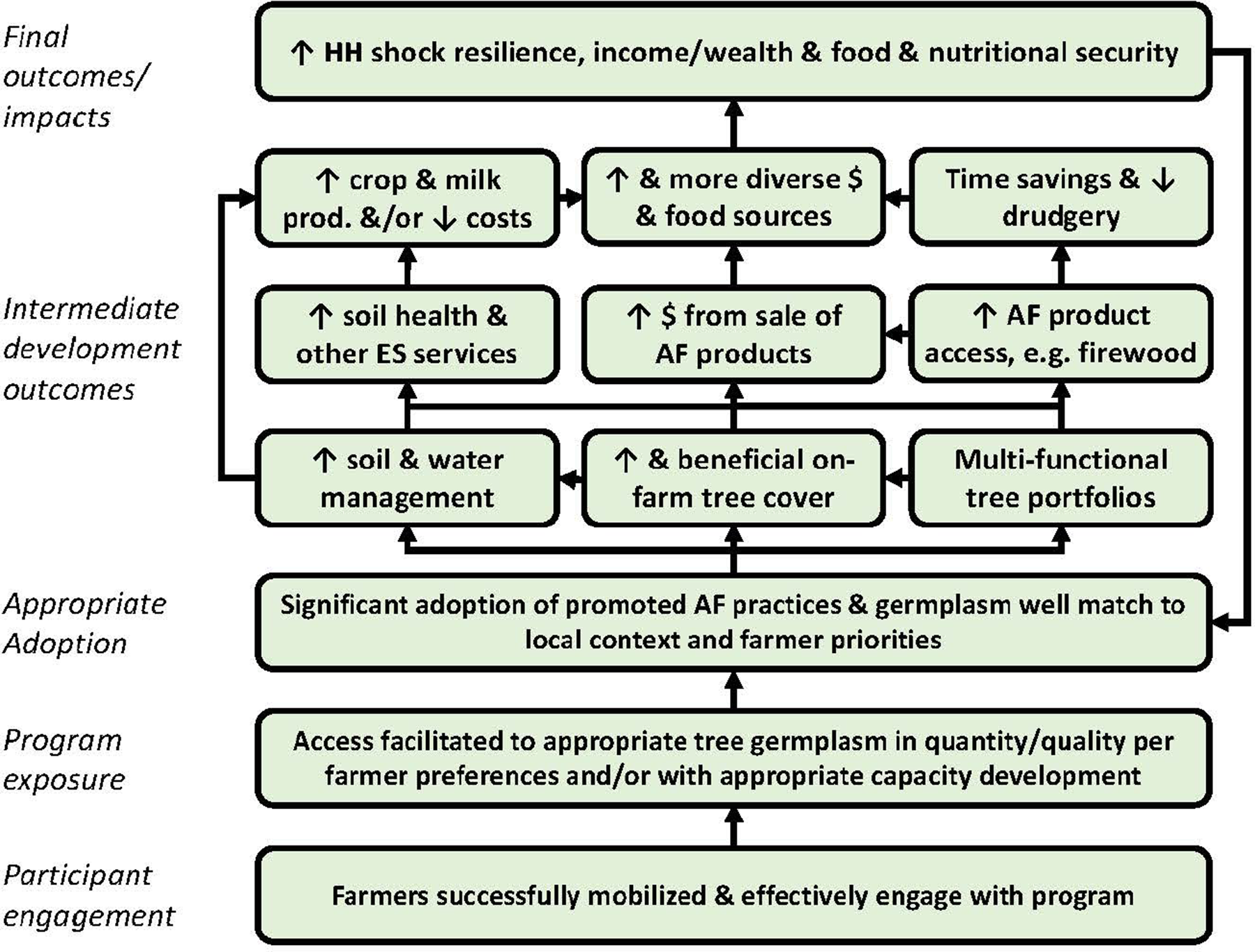
Illustrative theory of change for an agroforestry (AF) intervention.
Why it is important to do this EGM
The integration of trees into agriculture is widespread across the low-and middle-income countries (L&MICs) of Africa, Asia, and Latin America. Agroforestry practices, ranging from FMNR through to the intercropping of trees within annual crop fields and cultivation of forest gardens, are estimated to take place on nearly 50 per cent of agricultural land in developing country regions (Zomer et al., 2014). Proponents argue that agroforestry can provide basic subsistence, natural insurance, and a means to generate income and build assets for many rural households in L&MICs (Garrity et al., 2010; Miller, Muñoz-Mora, & Christiaensen). Agroforestry can also generate environmental benefits, including carbon storage, biodiversity conservation, clean water, erosion control, soil fertility while enhancing resilience of agricultural lands in the face of climate-related stresses (Buttoud, 2013; Garrity et al., 2010; Jose, 2009; Kalaba, Chirwa, Syampungani, & Ajayi, 2010; Mbow, Smith, Skole, Duguma, & Bustamante, 2014). Agroforestry, perhaps surprisingly given the usual emphasis on its environmental benefits, has also been shown to substantially increase productivity in a variety of different contexts (Garrity et al., 2010; Pretty & Bharucha, 2014; Sileshi, Akinnifesi, Ajayi, & Place, 2008; Waldron, Justicia, & Smith, 2015).
For the above reasons, agroforestry has increasingly been seen as a solution for addressing environmental degradation, boosting food security, and contributing to a range of other development policy objectives (Garrity et al., 2010; Waldron et al., In review). Since the 1992 UN Earth Summit in Rio, international aid donors have invested more than US$10 billion in agroforestry projects (activity code: 31220.07) in L&MICs (Aid Data, 2017). The largest donor, the World Bank, continues to emphasize agroforestry in its policy documents, including major commitments to ensure its agricultural investments are “climate smart” by 2020 (World Bank, 2016). High-level policy documents in many L&MICs now explicitly call for the integration of trees into farming systems (e.g. Government of India, 2014; Government of Malawi, 2011; Republic of Kenya, 2014) and there is growing interest in promoting agroforestry as part of sustainable intensification initiatives that reconcile agricultural production with the provision of other important ecosystem services (Buttoud, 2013). Agroforestry is widely viewed as a critical element in realizing a number of the UN Sustainable Development Goals (SDGs) (UN, 2015; Waldron et al., In review; ICRAF, 2017).
Despite increasing recognition that agroforestry can provide a high-yielding system that delivers multiple social-ecological benefits, financing and implementation of agroforestry and other non-mainstream agricultural approaches remains very limited in many contexts (DeLonge, Miles, & Carlisle, 2016; Horlings & Marsden, 2011; IPES-Food, 2016). Instead, high-input, mechanized approaches to agriculture predominate. Over the past half century, these approaches have become conventional, leading to major increases in yields and helping to feed much of the world's population (IAASTD, 2009; Pretty & Bharucha, 2014; The Government Office for Science, 2011). However, these benefits have brought with them sometimes steep social and environmental costs, including biodiversity loss, climate change, land degradation, water pollution, and negative effects on human health (Brawn, 2017; Edenhofen et al., 2015; Horrigan, Lawrence, & Walker, 2002; IAASTD, 2009; Maxwell, Fuller, Brooks, & Watson, 2016; Pretty & Bharucha, 2014). Farmers, consumers, and policymakers increasingly recognize these costs and seek viable alternatives that can simultaneously address food security concerns while delivering other social and environmental benefits. Agroforestry represents one such alternative, but there is an important need to systematically identify what kinds of interventions and practices have worked to deliver these benefits and understand potential trade-offs involved. Evidence on the effectiveness of agroforestry is therefore needed to inform broader debates and investment decisions relating to sustainable agricultural intensification.
A large body of experience with agroforestry in L&MICs has now accumulated. Though agroforestry practices have a long history, agroforestry as a science and specific policy domain emerged in the 1960s and 1970s. National governments, NGOs, research organizations, and aid agencies alike began to embrace the idea and to develop, test, and support a wide range of interventions (Nair, 1993a). As the field has matured, a substantial literature on the adoption and impacts of agroforestry practices in L&MICs has developed. However, syntheses of evidence of what agroforestry practices have been effective, under what circumstances, and why remains lacking. This lack of systematic understanding, in turn, constrains the ability of policymakers, practitioners, and researchers to make effective decisions relating to agroforestry interventions.
Recent systematic maps (SMs) and reviews (SRs) have begun to shed light on the effects of agroforestry practices on specific outcomes, such as agricultural productivity and ecosystem service provision (Reed et al., 2017; Rosenstock et al., 2016; Thorn et al., 2015). Cheng et al. (Forthcoming) examines the impacts of forestry and agroforestry interventions on poverty. The recently published SR by Reed et al. (2017) synthesizes existing evidence on the indirect effects that forest- and tree-related ecosystem services have had on food production in the tropics. Two recent EGMs related to forests (Snilstveit et al., 2016; Puri, Nath, Bhatia, & Glew, 2016) include agroforestry as a relevant intervention or practice, with some attention to existing evidence on effects on environmental and social outcomes in low and middle-income countries. These reviews will provide valuable information for the EGM proposed here, which is broader in scope geographically and in outcomes considered. As detailed below, the current EGM will include all L&MICs, not just tropical ones, and direct and indirect effects of agroforestry interventions on a range of outcomes, including multidimensional human well-being. We are aware of no EGM, SM, or SR that summarizes empirical studies on the causal effects of agroforestry interventions in L&MICs, particularly outside the context of tightly controlled, research station-based experimental trials.
There are two primary audiences for this EGM. First, we expect that researchers on agroforestry and broader sustainability issues will use the results to inform further investigations on these topics, including new empirical research, as well as systematic reviews of specific linkages and further evidence synthesis. Results should be of wide interest to researchers in a range of institutions, from CGIAR centers to universities. The second main anticipated audience is decision-makers for whom agroforestry is already or potentially of interest. This includes relevant ministries and programs in governments and donor agencies, as well as NGO and other advocacy and implementing organization staff.
Objectives
The overall aim of this evidence gap map is to identify, map and describe existing evidence on the effects of agroforestry interventions on agricultural productivity, ecosystem services and human well-being in L&MICs. The results of the EGM will inform the scope of a planned systematic review on this topic.
In doing so, it addresses the following research questions: What is the extent and characteristics of empirical evidence on the effects of agroforestry interventions on agricultural productivity, ecosystem services and human well-being in L&MICs? What are the major gaps in the primary evidence base? What are the intervention/outcome areas with potential for evidence synthesis?
Methodology
Criteria for including and excluding studies
Types of studies to be included
Given that we seek to provide a resource for decision-makers, as well as identify gaps in the current evidence base, we will include both primary studies and systematic reviews. Primary studies that measure the effect of agroforestry interventions on the different outcomes of interest will be included, as will systematic reviews of the literature that synthesize and analyze these same relationships.
Generally, included studies must explicitly examine the outcomes of specific agroforestry interventions. Further, they must use a comparator, whether temporal, spatial, between group, or some combination of these (see below). We understand the term “agroforestry interventions” to comprise a range of actions and practices taken to improve a situation, which may or may not be promoted or supported externally (see detail below). We will exclude theoretical or modeling studies (unless they include a relevant empirical example with design that meets inclusion criteria), and editorials and commentaries.
We will include four kinds of studies: 1) Quantitative impact evaluations, 2) systematic reviews, 3) field trials that test specific agroforestry techniques and approaches, and 4) observational studies on the effect of agroforestry practices.
The main EGM, focusing on the impacts of agroforestry interventions, will include studies of the first two types. A second, related EGM will focus on studies evaluating the impacts of agroforestry practices and include studies of the second two types.
Studies where participants are randomly assigned to treatment and comparison group (experimental study designs); Studies where assignment to treatment and comparison groups is based on other known allocation rules, including a threshold on a continuous variable (regression discontinuity designs) or exogenous geographical variation in the treatment allocation (natural experiments); Studies with non-random assignment to treatment and comparison group that include pre-and post-test measures of the outcome variables of interest to ensure equity between groups on the baseline measure, and that use appropriate methods to control for selection bias and confounding. Such methods include statistical matching (for example, propensity score matching, or covariate matching), regression adjustment (for example, difference-in-differences, fixed effects regression, single difference regression analysis, instrumental variables, and ‘Heckman’ selection models). Studies with non-random assignment to treatment and comparison group that include post-test measures of the outcome variables of interest only, and use appropriate methods to control for selection bias and confounding, as above.
Ideally, studies would include baseline and post-intervention data, but given the likely small number of studies meeting this criterion, we will include studies with post-intervention outcome data only as long as they use some method to control for selection bias and confounding. To account for the differences in the quality of study designs and analysis methods, we will appraise the risk of bias in all included studies and do sub-group analysis by risk of bias status.
Systematic reviews examine the effects of different interventions using transparent and systematic methods to identify, appraise and synthesize findings from studies addressing a specific issue (Waddington et al., 2012). We will include systematic reviews and reviews (e.g. systematic maps, evidence gap maps) that describe methods used for search, data collection and synthesis as per the standardized checklist highlighted in Snilstveit et al. (2017) for appraising systematic reviews. Literature reviews that do not describe methods used for search, data collection and synthesis will not be included.
Field trials in agroforestry are designed to test the effects of experimental treatments or other variables on crop yield or other outcomes of interest in conditions similar to the actual growing conditions experienced by farmers who may adopt the treatment (Lovell et al., 2017; Nair, 1993b). As for agronomy more generally, field trials can be divided into three types: 1) Researcher managed and researcher implemented; 2) researcher managed and farmer implemented, and 3) farmer managed and farmer implemented (FAO 1995). We will include such studies as long as they pertain directly to some aspect of agroforestry, include an experimental research design, and describe the effects of an intervention, technique, or practice on an outcome category relevant to the current study.
Finally, we will include observational studies on the effect of agroforestry practices provided they are quantitative and include at least one comparison as described below (e.g. before/after; study group/non-study group). We include such studies given that we anticipate a number of potentially interesting studies will not examine the impacts of an agroforestry intervention per se, but a specific practice or set of practices.
EGM framework
Our framework will follow standard practice for EGMs (Snilstveit, Vojtkova, Bhavsar, & Gaarder, 2013), with rows in a matrix representing interventions and columns outcomes. Below we detail these two dimensions of the matrix as well as describe each Population, Intervention, Comparator, and Outcome (PICO) component to be examined.
Interventions:
In the field of agroforestry, there are multiple strands of literature, including studies of the impacts of specific agroforestry practices and systems and studies of the impacts of specific interventions designed to spur the adoption of agroforestry to yield more distal social-ecological impacts. A further strand of literature describes the impacts of field trials as controlled interventions. The “intervention” axis in the EGM will include all three of these categories. As noted above, we will split the EGM into two parts based on the type of studies included (e.g. field trials and observational studies will be included in a separate map on the impacts of specific agroforestry practices).
The overall intervention category for our EGM is “agroforestry” defined as “a collective name for land-use systems and technologies where woody perennials (trees, shrubs, palms, bamboos, etc.) are deliberately used on the same land-management units as agricultural crops and/or animals, in some form of spatial arrangement or temporal sequence.” (FAO 2015). We aim to capture any practice that might fall under this broad definition. However, agroforestry comprises many different kinds of practices. To capture this diversity and present it in a coherent way that allows for distinctions among different practices and identification of evidence gaps, we will subdivide agroforestry into the practice types listed in Table 1.
Agroforestry systems can be classified in many ways using a variety of different criteria, such as the structural composition and arrangement of the different components in the system, their temporal sequencing, and their function, especially based on that of woody perennials within it (Nair, 1985). We adapt the classification system proposed by Nair (1985, 1993) and updated by Sinclair (1999), Torquebiau (2000), and Atanga et al. (2014).
From a policy perspective, it is especially useful to know what kinds of interventions might most effectively promote agroforestry practices to yield desired social-ecological outcomes. The EGM will therefore also include studies that examine specific types of interventions designed to promote agroforestry. The intervention types are summarized in Table 2.
Classification of interventions to promote agroforestry.
We expect to present the main matrices of interventions and practices in two ways: 1) a simplified typology of interventions and practices using the broad agroforestry system listed in Table 1 and 2) a more detailed version with the specific interventions and practices listed. The map will note whether a given study describes an intervention with multiple components.
Comparator:
Farm or household that does not adopt a given practice identified in Table 1, or is not exposed to a specific agroforestry intervention,
OR
Farm or household before adopting a given agroforestry practice, or being exposed to a specific agroforestry intervention,
OR
Farm or household that adopts a different agroforestry practice, and/or that is exposed to a different specific agroforestry intervention,
OR
A combination of two or more of the above.
Outcomes
The columns of the EGM matrix will be comprised of three broad outcome categories: 1) agricultural productivity, 2) ecosystem services, and 3) human well-being.
Studies that focus exclusively on the adoption of a particular agroforestry technique or species without reference to impact will be excluded. We will, however, note the number of adoption-related studies (and their geographic location) excluded due to lack of evidence on outcomes. The primary outcomes are the three stated above (agricultural productivity, ecosystem services, and human well-being), and secondary outcomes are adoption and behavior change, which will only be reported if the study also reports primary outcomes.
Specific outcome categories under
For
Domains and definitions of human well-being outcomes (adapted from McKinnon et al. 2016).
As for intervention types, we will present the three outcomes in the EGM main matrix in two ways: 1) a simplified typology of broad outcome categories and 2) a more detailed version with the specific outcome categories.
Types of settings
We expect that the agroforestry interventions and outcomes will take place in a range of settings in L&MICs. These settings will cover a range of ecoregions and are likely to be primarily rural, but potentially also urban areas (e.g. city gardens). We also expect much of the evidence to pertain to smallholders, but some may describe agroforestry practices among larger landholders.
Population:
The population of interest will be farms and those that live and farm on them (likely especially, though not only smallholder farmers) in L&MICs using a system that falls within the definition of agroforestry.
Status of studies
The EGM will include both completed and ongoing studies we are able to identify, and the latter will be coded as such.
Search strategy
We will undertake a comprehensive search using multiple sources of knowledge to best capture an unbiased representation of existing literature. Studies from 1990 to June 30, 2017 will be included in the search. We begin the study period in 1990 as this is roughly the time (in the lead up to and immediate wake of the UN Earth Summit in Rio) that the international community increased support for agroforestry and other approaches designed to further environmental goals. The search will be done through use of search engines, based on key words within the identified databases. When such a strategy is not possible (e.g. for some topical databases), hand searches will be performed to extract all potentially relevant studies. Due to resource constraints, the focus will be on studies published in English. However, where the search (done using English terms) turns up studies in French or Spanish these will be reviewed for inclusion as the team has the requisite language skills and studies in those languages may turn up additional cases in Africa and Latin America.
The databases that will be searched for publications are: SCOPUS EBSCO: Agricola, Econlit Web of Science: Core Collection CAB Abstracts and Global Health AGRIS
The search terms to be used in each database can be found in Table 5 (constructed using the terms from CAB thesaurus and also the EGM framework described above). Each search string will include each of the agroforestry practices from Table 1. These terms and search strings have been modified through a scoping exercise in Web of Science, SCOPUS and EBSCO, where the search terms were used and the results were evaluated against a set of 40 relevant studies assembled by the team (Annex 2). We note that the intervention types are more generic, including topics well beyond agroforestry, so our search will focus on practices. We will continue to test the search iteratively on a set of known studies.
Search terms by intervention and outcomes
Additionally, in order to identify the existing grey literature, the websites of various organizations that are likely to produce published and unpublished research will be searched, using the search terms from Table 5. The list of relevant research organizations (Table 6) has been constructed from cross-validation of websites listed in the systematic mapping protocols of agro-forestry related studies (e.g. Bottrill et al., 2014; Leisher et al., 2016; Nguyen et al., 2011). This list will be validated with the external EGM advisory group. To optimize the scope of the search while ensuring transparency in our methods, we will follow the approach developed by Haddaway et al. (2017), which will allow us to search multiple websites simultaneously and to extract the relevant information from each website into a single database. Finally, we will also contact key informants within 3ie, ICRAF, and other relevant organizations for identification of additional relevant literature for screening and inclusion.
List of websites from relevant organizations
A search of literature through search engines will also be performed. A search in Google Scholar, using the search terms from Table 3 will be performed and the first 300 results sorted by relevance will be reviewed, following the findings from N. R. Haddaway et al. (2015). The online literature review and reference management software, EPPI-Reviewer 4, will be used to upload relevant titles and abstracts for candidate studies identified through the search strategy. We will create a project workspace to assist in organizing and managing the sources of evidence (i.e., where possible studies were located) and the screening process.
Screening
We will first review search results at the level of title, and then abstract to determine inclusion or exclusion. Depending on the volume of search results, we may use double screening for a small subset of studies at the title and abstract stage and then use the approach in Shemilt et al. (2016) for securing agreement among coders. Consistency checking will be conducted using a two-step, double-blind method employed within EPPI-Reviewer 4 and inconsistencies will be discussed and reconciled among the review team. Based on a training set of studies screened by all reviewers, inter-rater reliability will be calculated using a Kappa statistic for all studies double screened at title and abstract levels. When a rater is uncertain about study inclusion, the relevant study will be marked for a second opinion and screening by a second rater will be conducted. We will keep a full list of excluded studies and record reasons for exclusion for each. Studies that meet the inclusion criteria at both the title and abstract stages will be reviewed at the full text stage. Those excluded at this stage will also be recorded along with reasons for the exclusion.
In addition to the above approach to screening, we also plan to test new software, Colandr, developed by Data Kind in collaboration with Conservation International (https://colandrapp.com), that uses machine learning and artificial intelligence elements to improve efficiency of systematic mapping methods. Colandr, currently in Beta form, allows users to set up systematic mapping/review projects and use the computer-assisted screening and extraction modules to help find relevant citations. The algorithm “learns” every 10 citations screened, pushing more and more relevant articles to the top of the list. We will explore comparing this computer- assisted screening approach to the traditional methods described above to derive insights about potential cost-savings for future reviews and updating of the EGM.
Data coding strategy
We will use a standardized data extraction form to extract descriptive data from all studies meeting our inclusion criteria (Annex 1). We will create a codebook describing the scope of each question in the data extraction form. We will conduct a pilot with a small subset of studies by everyone in the research team to ensure consistency and to resolve any issues or ambiguities. Given the likely volume of studies (based on previous SR and EGM experience such as in McKinnon et al. 2016), we do not plan to carry out extensive side-by-side double extraction of data at the full text stage. Instead, we will conduct random spot checks of a small percentage of included articles to ensure consistency between raters. We will measure consistency using percent disagreement of spot-checking with the primary rater.
We will follow the guidance provided in Masset and Snilstveit (2016) on creating equity-sensitive EGMs. In particular, we will use the PROGRESS framework (O'Neil et al., 2014) to consider potentially disadvantaged groups in the included studies. Key dimensions of equity likely to be considered include place of residence, race, ethnicity, culture, and language (including status as indigenous), gender, sex, religion, education, socio-economic status, and age. For those studies that look at differential effects of the intervention on different subgroups, we will record whether they conduct a risk-of bias assessment.
A detailed coding form is attached as Annex 1.
Dimensions
Intervention: Agroforestry interventions and practices as described above (Tables 1 and 2). Outcomes: agricultural productivity, ecosystem service provision, and human well-being (Tables 3and 4).
Additional dimension: Type of study (experimental, quasi-experimental, experimental field studies, observational studies, SRs and systematic and evidence gap maps). We will include country and region where each empirical study was carried out. For SRs, we will categorize them according to level of confidence based on guidance in Snilstveit et al. (2017). Finally, we will assess the extent to which each study addresses equity, by describing any intervention focus on specific social groups, examining equity as an outcome, or reporting on differential impacts across sub-populations.
Analysis and presentation
We expect to perform several analyses based on the data collected and to summarize results visually and in various written forms so as to effectively communicate with intended audiences. A final report will present descriptive statistics on the number of studies by intervention and outcome at general and more specific levels as described above. We will also provide descriptive statistics on geographical distribution of study location by country and world region, the type of studies, and quality of the SRs. We will also analyse how and the extent to which studies address equity, whether they look at multiple dimensions of ecosystem services and/or human well-being, and if they consider social and ecological outcomes at the same time or focus on one. We will visually present the included studies in two matrice, available separately on-line and as part of a report. The first will focus on impact evaluation and SRs on the impacts of agroforestry interventions whereas the second will focus on field trials and observational studies of specific agroforestry practices. Based on these maps, we will perform gap analysis to identify areas for systematic review or primary research. We will also comment specifically on the extent to which the literature examines interventions vs. specific practices or both simultaneously.
Stakeholder engagement
We have assembled an Advisory group comprised of 3ie members, donor agency staff, IDCG members and other evidence synthesis experts, ICRAF scientists and other agroforestry subject experts. The Advisory group will provide oversight and advice to strengthen the EGM and related work. Our team includes university researchers from the College of Agricultural, Consumer, and Environmental Sciences at the University of Illinois and the Head of the Impact Evaluation unit at ICRAF. In preparing this protocol, we have coordinated with these actors as well as colleagues involved in two related evidence maps (McKinnon et al 2016 and Cheng et al. forthcoming). We have also publicized the draft protocol at two recent events, the International Food Security at Illinois Symposium and Illinois Big Data Summit in Food, Energy and Water, both in April 2017. We expect to engage with other subject experts and stakeholders to finalize this protocol (especially the EGM framework) and the EGM itself through presentation and discussion of drafts at the ICRAF Science Week in September 2017 and the FLARE conference in Stockholm in October 2017, among other events. Throughout, we will consult with 3ie/IDCG. Finally, we expect to engage with additional reviewers through our efforts to publish this protocol and the resultant EGM in peer-reviewed journals.
Footnotes
EGM authors
| Name: Daniel C. Miller |
| Title: Assistant Professor |
| Affiliation: Natural Resources & Environmental Sciences, University of Illinois |
| Address: S-406 Turner Hall |
| 1102 S. Goodwin Ave. |
| City, State, Province or County: Urbana, IL |
| Postal Code: 61801 |
| Country: United States |
| Phone: +1 (217) 244-8293 |
| Email: |
|
|
| Name: Pablo J. Ordonez |
| Title: Ph.D. student |
| Affiliation: University of Illinois |
| Address: 302b Mumford Hall |
| 1301 W. Gregory |
| City, State, Province or County: Urbana, IL |
| Postal Code: 61801 |
| Country: United States |
| Phone: +1 (217) 419-4787 |
| Email: |
| Name: Kathy Baylis |
| Title: Associate Professor |
| Affiliation: Department of Agricultural and Consumer Economics, University of Illinois |
| Address: 302b Mumford Hall |
| 1301 W. Gregory |
| City, State, Province or County: Urbana, IL |
| Postal Code: 61801 |
| Country: United States |
| Phone: +1 (217) 244-6653 |
| Email: |
| Name: Karl Hughes |
| Title: Head, Monitoring, Evaluation & Impact Assessment |
| Affiliation: World Agroforestry Center (ICRAF) |
| United Nations Avenue, Gigiri, P.O. Box 30677 |
| City, State, Province or County: Nairobi |
| Postal Code: 00100 |
| Country: Kenya |
| Phone: +254 20 722 4393 |
| Email: |
| Name: Pushpendra Rana |
| Title: Postdoctoral Research Scholar |
| Affiliation: Natural Resources & Environmental Sciences, University of Illinois |
| Address: S-406 Turner Hall |
| 1102 S. Goodwin Ave. |
| Urbana, IL 61801 |
| City, State, Province or County: Urbana, IL |
| Postal Code: 61801 |
| Country: United States |
| Phone: +1 (217) 333-1880 |
| Email: |
Roles and responsibilities
Content:
All team members have strong knowledge of the content focus for this review, agroforestry and impact evaluation: Miller (research focus includes agroforestry impacts in Africa and US contexts; policy work on forestry/agroforestry at World Bank); Baylis (expertise in impact evaluation in the context of agricultural and natural resource management interventions in developing countries); Hughes (wide knowledge of agroforestry policy, practice, and research as Monitoring, Evaluation & Impact Assessment Head for ICRAF); Ordonez (research on effect of forest and agro-ecological management practices in Mexico and Sub-Saharan Africa and research experience for Corpoica, the Colombian government agency responsible for developing technologies for the agricultural sector); Rana (has carried out impact evaluations of forestry/agroforestry interventions in Brazil, Gabon, India, Indonesia, and Zambia; more than a decade of work on related issues for Indian Forest Service).
Systematic review methods:
Miller (has led or been part of several systematic review teams, including an evidence gap map on conservation-human well-being linkages, the environmental impacts of different property rights regimes as part of CIFOR's evidence-based forestry initiative, and impacts of forestry and agroforestry interventions on poverty, in coordination with the World Bank's Program on Forests); Rana (team member for PROFOR systematic map related to forestry-poverty linkages); Baylis and Hughes (familiarity with systematic review methods).
Information retrieval:
Rana has expertise on information retrieval and will lead on this aspect. Miller, Baylis, and Ordonez also have relevant expertise. The team will work closely with information specialists with expertise specifically on information retrieval at the University of Illinois library, one of the largest public university libraries in the world.
Acknowledgements and sources of support
We thank members of the advisory group to this EGM, Kahlil Baker, Samantha Cheng, Steve Franzel, Irina Klytchnikova, and Frank Place, and Birte Snilstveit and five anonymous reviewers for their input and comments on earlier iterations of this protocol. The funding to carry out this work has been provided by 3ie.
Declarations of interest
It is possible that searches for the EGM will turn up studies in which members of the review team have been involved, but it is difficult to know with precision which studies, if any, these may be. For example, Miller has recently published a study on the socio-economic contribution of trees on farms in five African countries that may eventually be included. Hughes works for ICRAF, which seeks to advance agroforestry research and practice generally.
Preliminary timeframe
Approximate date for submission of the EGM: December 31, 2017.
Plans for updating the EGM
We do not currently have funding to regularly update the EGM past the funding period for this project. However, we expect that the tools we test and use (e.g. machine learning software like Colandr) to identify relevant studies can be employed regularly in the future to update the map. The team will explore further ways to update the EGM, including through engagement and resources at ICRAF and the University of Illinois.