






Abstract
Background
The problem, condition or issue
The University of Kansas, in partnership with the University of Montana, operates a Rehabilitation Research and Training Center on Promoting Interventions for Community Living (RRTC/PICL). The purpose of the Center is to examine the effectiveness of interventions to support greater community participation for individuals with physical and co-occurring multiple disabilities and to promote the dissemination and utilization of effective interventions. Currently, in its first year of operation, the RRTC/PICL is charged with developing and promoting interventions that support individuals with disabilities and positively impact community participation outcomes for such individuals. One of the goals of RRTC/PICL is to conduct a systematic review of the literature to identify the outcomes of effective evidence-based, multifaceted interventions (see page 2 for key definitions) that support individuals with disabilities to participate in their community through.
Numerous U.S. laws have been passed to increase protections and opportunities for people with disabilities to live more independently in the community. Section 504 of the Rehabilitation Act of 1973 was created to increase opportunity for physical and programmatic access in institutions (e.g., universities) that received federal monies. Title VII of the Rehabilitation Act established Centers for Independent Living (CILs), and mandated four core services: information and referral, advocacy, peer counselling, and independent living skills training; a fifth core service, transition, was added in the latest version of the Workforce Innovation and Opportunity Act of 2014 (Administration for Community Living [ACL], 2016). The Fair Housing Amendments Act of 1988 allowed tenants to make reasonable modifications to their apartments at their own expense; the Americans with Disabilities Act of 1990 was designed to protect the civil rights of citizens with disabilities; the Olmstead v. L.C. Supreme Court decision (1999) allowed people to live in least restrictive environments; and the currently proposed Disability Integration Act (DIA), S. 2427 would create a civil right to home and community-based services and supports as an alternative to institutions. Despite these enacted laws, many people with disabilities lack personal knowledge, skills, resources and/or enabling environments that would allow them to take advantage of these rights and resources and live more independently in the community.
The intervention
For this review, we rely heavily on research conducted by our research team member Bryce Ward, Ph.D., the Associate Director at the Bureau of Business and Economic Research and Director of the Bureau's Health Care Research Program at the University of Montana. Dr. Ward has published work on community participation of disabled persons in peer-reviewed journals.
The systematic review is proposed for multifaceted interventions that promote community participation among people with disabilities. A
Direct access to or participation in the community
Integrated competitive employment (i.e., employment in the community with non-disabled peers for minimum wage or higher) Continued learning (e.g., engaging in college or technical training – classes or diploma or certificate completion) Housing (e.g., independent living in a home of choice, usability of the home) Civic involvement (e.g., voting, volunteer work, advocacy, committees/leadership) Recreation (e.g., sports, art, music, community events) Navigating the community/accessing community (e.g., accessing public transportation)
Dimension of community participation
Increased self-determination (e.g., autonomy, decision-making, self-advocacy) Improved physical or mental health Improved general quality of life Increased family support/activities in the home (e.g., caregiving, supporting children/parenting, household chores/care) Social networking (e.g., friendships, relationships – boy/girlfriend or spouse, church)
We recognize that the nature of the community participation outcomes defined is broad.
Our goal in conducting a systematic review of multifaceted interventions is to identify the current status of multifaceted intervention research for community participation outcomes, point to gaps in the literature on such interventions and features that are effective in enhancing community participation.
Examples of multifaceted interventions resulting in community participation outcomes include the following: A vocational services agency decides to implement customized employment services and social skills training in an effort to affect rates of obtaining and maintaining integrated competitive employment. An independent living center implements an adaptive recreation program at the local community center along with transportation training in the community in an effort to affect the rate at which individuals with physical disabilities are accessing and navigating their community and engaging in recreational activities.
How the intervention might work
The concept of person-environment fit is the theoretical framework that will guide our work on the systematic review of literature related to community participation interventions. The Person-Environment diagram (see Figure 1), adapted from Tang et al. (2011), depicts the interaction of personal and environmental factors which adapts existing evidence-based interventions related to community participation.
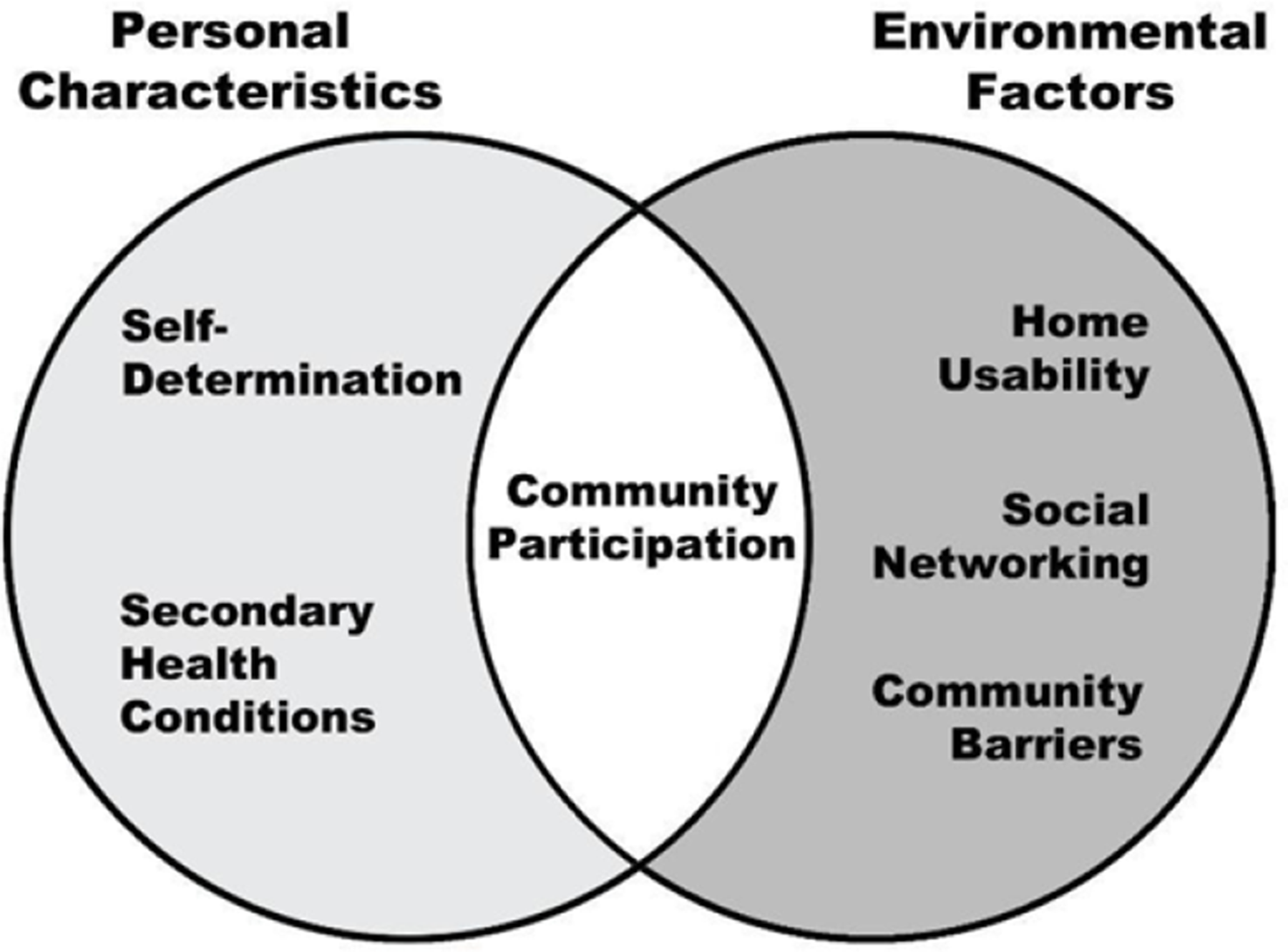
Adapted person-environment fit model with examples of personal characteristics and environmental factors
The social-ecological framework meshes with the Institute of Medicine's model of disability as a dynamic process that results from characteristics and interactions of the individual with his/her environment (Brandt Jr & Pope, 1997; Field &Jette, 2007; McDermott & Turk, 2011; Nagi, 1991). “Disability” itself “depends on an interaction between the individual and the physical and social environment” (Rehabilitation Act (Sec. 2(a)(3)). Person-environment fit theory has been applied in numerous areas, including employee attitudes and behaviors (Duffy, Autin, &Bott, 2015), functioning among older adults in long-term care settings (Rantakokko, Törmäkangas, Rantanen, Haak, &Iwarsson, 2013), and transition of youth with disabilities to adulthood (Stewart et al., 2014).
In addition to our theoretical orientation, we subscribe to the basic values of Independent Living Philosophy (DeJong, 1978; Pfeiffer, 2002; White, Lloyd Simpson, Gonda, Ravesloot, & Coble, 2010). These values are consistent with the basic guidelines for quality Home and Community-Based Services (HCBS) related to the provision of Medicaid services to people with disabilities in the community (National Quality Forum, 2015), and provide the ethical and social guidelines for intervention research that go beyond empirically derived best practices. They include, among others, services provided to maximize integration and inclusion in the community; enabling self-direction, choice, and control; adherence to human and legal rights to personal freedom, privacy, and risk balanced with safety and support; and delivering and managing services that are coordinated, dependable, and comprehensive (National Quality Forum, 2015).
Considering this theoretical and value-based orientation, we will review studies that take into account various personal characteristics as well as environmental factors. Personal characteristics are often the target of interventions seeking to change something about the person (how they think, what they know, how they act). Environmental factors may be the target of interventions seeking to increase access and opportunity for people with disabilities. We will review studies of interventions that address two or more of these characteristics and factors across different domains and examine the impacts of the intervention on community participation outcomes for a diverse group of people with disabilities.
Why it is important to do the review
Studies of the impact of single-faceted interventions on community participation of adults with disabilities are numerous. An example of a systematic review of a single intervention is a study of the efficacy of using service dogs for people with physical disabilities (Winkle, Crowe, & Hendrix, 2012). Other reports examining the impact of a single intervention on community participation for adults with disabilities include a study of transportation vouchers (Samuel, Lacey, Giertz, Hobden, & LeRoy, 2013), an exercise intervention (Dean et al., 2012), and a cognitive intervention to reduce fear of falling and associated avoidance of activity among older adults with disabilities (Haastregt et al., 2007). However, our theoretical orientation is on reviewing the effectiveness of multifaceted interventions, which are defined as interventions that address two or more barriers to change (Eldh&Wallin, 2015). The hypothesis is that multifaceted interventions will be more effective, especially when confronted with multiple, complex, and interacting factors affecting outcomes of a complex phenomenon such as community participation by people with a wide range of disabilities.
There are very few systematic reviews of multifaceted interventions related to disability issues. Most reviews on the topic of disability and community relate to descriptive factors serving as barriers or facilitators to participation (e.g., White et al., 2011). In searching The Cochrane Collaborative, The Campbell Collaboration, and NARIC databases, we found no systematic reviews related to multifaceted interventions to enhance community participation by adults with disabilities of any type. There were a few systematic reviews of multifaceted interventions focused on other topics. For example, Williams et al. (2007) conducted a systematic review of multifaceted interventions to improve depression care and found strong evidence for the effectiveness of care management for depression.
The research question guiding our meta-analysis is as follows: What are the reported community participation outcomes of multifaceted interventions targeting adults with disabilities?
Our findings will be used to enhance the planned intervention research in years 2-5 of our NIDILRR grant award. The figure below demonstrates the role the systematic review will play in our future grant activities.
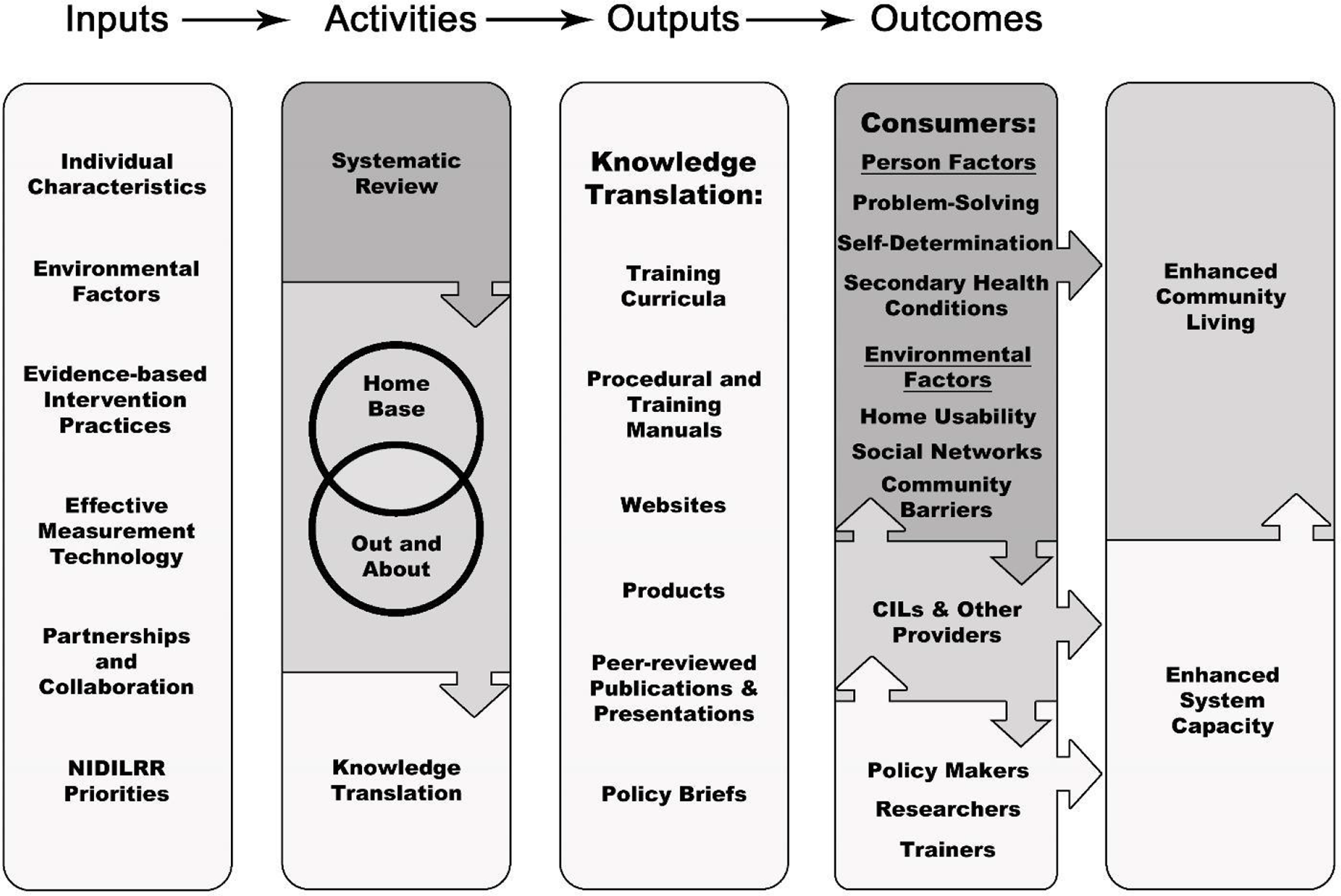
RRTC/PICL Logic Model
Objectives
The purpose of this systematic literature review is to synthesize the research on the effects of multifaceted interventions provided in community settings for the purpose of promoting community participation outcomes of adults (18+ years old, no longer receiving secondary education services) with disabilities in studies using quantitative – randomized-controlled trials and quasi-experimentalresearch design methods.
We seek to identify the outcomes of effective multifaceted interventions that facilitate community participation for adults with disabilities, particularly those with severe limitations (e.g., cognition, mobility) that impede their participation in the community. The results of the literature review will inform policy makers in their practical decisions about social and behavioural interventions and public policy regarding funding and services to provide such interventions. In addition, the literature review results have the potential to help health and social services practitioners in the field who work directly with people with disabilities to understand and apply the information regarding multifaceted interventions in their daily work.
The findings will also inform modifications of our planned interventions to be addressed in the subsequent years of the Center and will be the basis for at least one peer-reviewed publication. In addition to filling a critical gap in the research literature, we expect the results of the systematic literature review to provide us with information to modify and finalize our multifaceted intervention research.
Methodology
Criteria for including and excluding studies
Types of study designs
Types of intervention studies that will be reviewed include: quantitative – randomized-controlled trials quasi-experimental mixed methods (quantitative component will be included when it meets quality expectations for the methodology)
The team will ensure that the research of selected studies is high-quality using adapted versions of the National Technical Assistance Center on Transition (NTACT) Quality Indicator Checklists for Group Experimental studies (see http://www.transitionta.org/effectivepractices). The quality indicator checklist for group experimental studies distinguishes between rigorous and weak study designs and identifies a number of quality indicators related to participants, intervention and comparison conditions, outcome measures, and data analysis. Among the 19 indicators, the checklist identifies that studies of high quality meet all but one indicator (#19), and acceptable quality studies meet 10 specific indicators out of the 19. Studies not meeting those 10 specific indicators are considered to be of unacceptable, or weak, methodological quality and will be excluded from the sample. We will include all studies meeting “acceptable” and “high quality” standards as indicated by the application of the checklist. Adaptations to the checklist include removing any requirement that study content be specific to the field of transition to adulthood.
Types of intervention studies that will not be included in the review: case studies single subject research design single group – pre/post
Inclusionary and exclusionary criteria
Inclusionary criteria: Published 2000-present Peer reviewed – including published work and dissertations/theses This meta-analysis was undertaken as a component of a research agenda for the federally funded Research and Training Center on Promoting Interventions for Community Living (RRTC/PICL). In the funded grant proposal, one research activity to be completed for the purposes of informing future research at the RRTC/PICL was the completion of a systematic review of peer-reviewed literature on multifaceted interventions promoting community participation. In addition, since the topic is expansive, covering multiple types of interventions with a wide array of possible outcomes, we expect there to be quite a large number of search results that will need reviewed for inclusion. Original research involving testing an intervention Intervention has a clearly defined disability sample It is the entire sample or a subsection of the entire sample that is receiving the intervention with outcomes identified specific to that sample. Participants are 18+ years of age and have left secondary education Intervention is applied in a community-based setting Applied intervention is multifaceted Measures of community participation outcomes for the disability sample English only We specifically are working with English only studies because the concepts and terminology we are using varies from culture to culture. We have struggled to clearly define terms within English for our work as things like “community-based” and “community participation” may be different from culture to culture and even terms in English that define disability vary from culture to culture. While our research group has broad and varied skillsets, it is difficult to come to agreement among people who lack the same disability background and historical knowledge of disability in the culture of study. We also are trying to define “multifaceted interventions” and identify a base of intervention studies that reflect that definition. Considering these challenges, we feel that limiting our studies to English language only will help to ensure reliability in the application of the inclusionary criteria.
Exclusionary criteria: Articles that are a literature review or compilation of studies (may use these for bibliographic searches for primary research articles) Intervention studies applied in segregated environmentsin which the only people without disabilities are those in a service or leadership capacity serving/supporting the adults with disabilities
Types of participants
The intervention must target persons with a disability/ies for at least a portion of the target sample, with outcomes identified specific to the disability sample. This means that the intervention must be provided to individuals with disabilities, whether they represent the entire sample in the study or a subsection of the sample. The outcomes for the individuals with disabilities must be analysed separate from individuals in the sample without a disability.
Samples in selected articles will include adults: Who are 18+ years old Whom have left the secondary education/high school setting Whom have one or more disabilities
Study samples will
Types of interventions
The intervention in the study must meet the following criteria: Intervention measures one or more community participation outcomes targeted for change Intervention targets persons with a disability/ies for at least a portion of the sample – with an identifiable impact on the disability sample Intervention seeks to change/impact two or more personal characteristics or environmental factors that are in different domains (e.g., transportation skills and employability skills)
See examples of multifaceted interventions are provided on page 4.
Types of outcome measures
Community participation outcomes are chosen by/desired by the individual with a disability, occur in the community (i.e., integrated with people without disabilities), and are reflective of (a) direct access to or participation in the community or (b) dimensions of community participation (i.e., outcomes for which there is a research base linking them to community participation). Below we have provided examples of what might be included in each broad outcome category. However, we do not want to limit our community participation outcomes by strictly defining each term below.
These are to include the following outcomes and examples below:
Integrated competitive employment Continued learning Education Training Housing Place Housemates Usability Civic involvement Voting Advocacy Committees/leadership Volunteer work Recreation Sports Arts Music Community events (e.g., art in the park, parades, block parties) Navigating the community/accessing community
Increased self-determination Autonomy Self-advocacy Improved health Physical Mental Improved quality of life Increased family support/activities in the home Caregiving Supporting children/parenting Household chores/care Social networking Friendships Relationships (e.g., boy/girlfriend, spouse) Church/religious activities
Descriptive studies that do not include outcome measures will be excluded. Outcome measures that may be included in the meta-analysis are outcomes of the individual with a disability only. These may be performance measures, self-reported, observed and recorded, or caregiver (e.g., family or staff member) reported outcomes measures. We will not include data on outcomes for individuals other than the person with a disability in the meta-analysis.
Duration of follow-up
All studies meeting the inclusionary criteria and reporting follow-up data will be analysed for treatment effects for the key outcome variables of interest. The follow-up conditions will use the same criteria and statistical procedures as the primary intervention data and be reported separately from the primary intervention data.
Types of settings
The intervention must be applied in a community-based setting. Interventions conducted inin-patient institutions or hospitals will be excluded.
Search strategy
Our team has the support of a University of Kansas Associate Faculty Librarian with experience on conducting systematic and scoping reviews (Peterson-Besse et al., 2014; White et al., 2013). Database selection is important because of the need to have the most comprehensive, but least duplicative results as possible. Therefore, the first step is to utilize relevant articles and journals in which the researchers and advisory team predict the most relevant studies would appear, and then identify which electronic databases index the journals by searching Ulrich's Periodical database. The previously identified articles will also inform the initial development of the database search strategy. We will search the databases with most number of journals indexed, while also ensuring that all identified journals are captured. After reviewing fifteen databases and one publisher journal package, we selected three databases for initial peer-reviewed literature electronic searching: PubMed, Web of Science, and PsycInfo.
The databases were selected based guidelines in the Cochrane Handbook about database selection, including the necessity of searching of PubMed, and the inclusion of both a general bibliographic and a subject-specific database (Higgins & Green, 2011). The search strategies are informed by previous systematic reviews (Peterson-Besse et al., 2014; White et al., 2013). The goal is to ensure that all types of disabilities are included in the search results, but also exclude irrelevant results. In addition, we will consider that each database has a specific search strategy because of the different controlled vocabulary and search mechanisms.
Two additional databases, Dissertations & and Theses Abstracts and PolicyFile, will be searched to find potentially relevant grey literature. These two databases were selected because of the variety literature offered, as well as the controlled searching environment. PolicyFile's sources includes think tanks, universities, publishers, and non-profits, both domestic and international. Dissertation and Theses Abstracts also provides potentially more current and comprehensive research than the peer-reviewed literature.
Mesh terms will be used in PubMed, however, the “exploding” command except for “disabled persons” and “mentally disabled person,” will not be utilized. In test searches, the “explode” command retrieves excessive numbers of irrelevant and redundant searches; therefore, using the “exact” command establishes a more effective strategy. In the PyscInfo search, “mentally ill” is not included because the preferred term is “mental disorder.” Unlike PubMed and PsycInfo, Web of Science does not have a controlled vocabulary; therefore, searching operators search “near” must be utilized to establish an accurate, but complete search. Web of Science also requires extensive use of “Web of Science Categories” and “Research Areas” as limiters because of the lack of controlled vocabulary. Two members of the research team based on the search results will manually select these. However, similar subject limiters in PubMed and PsycInfo will also be utilized, even though this is not standard protocol. This review search is very broad, specifically the intervention portion of the search, and the number of results will be too large without the use of database provided subject and/or classification limiters. The results from all three searches will be combined, exported, and reduplicated using the reference management software EndNote.
We will also develop a spreadsheet with terms related to persons with disabilities that are likely to appear in applicable studies (e.g., sensory disorders, hearing loss, dependent amputation mobility limitation, vision disorders).
Community Participation Living Access Community-based Intervention Training Multifaceted Supports and services Intervention outcomes (see list in definitions for outcomes key words)
In addition, we identified fields of research where we might find literature and journals associated with each topic as follows. Employment & Rehabilitation Disability and Rehabilitation Journal of Vocational Rehabilitation Journal of Applied Rehabilitation Counseling Rehabilitation Research, Policy, and Education Journal of Occupational Rehabilitation Journal of Labor Policy Journal of Rehabilitation Rehabilitation Counseling Bulletin Community psychology Journal of Counseling Psychology Medicine/public health American Journal of Public Health Aging The Gerontologist Disability Disability and Society Research in Developmental Disabilities Intellectual and Developmental Disabilities Disability and Health Journal Journal of Intellectual and Developmental Disability Journal of Intellectual Disabilities Journal of Applied Research in Intellectual Disabilities Autism Journal of Intellectual Disability Research Journal of Disability Policy Studies Research and Practice for Persons with Severe Disabilities Focus on Autism and Developmental Disabilities Education and Training in Developmental Disabilities
Description of methods used in primary research
Anticipated methods that studies are likely to employ include random assignment to treatment and control/comparison conditions or pre-test/post-test designs. We expect that the treatment conditions will be compared to either a no-treatment control group or a comparison group receiving a different intervention. Studies will be subjected to two levels of analysis to generate an overall study effect size controlling for such variables as design (e.g., random vs quasi-experimental), outcome (e.g., competitive employment), participant (e.g., Physical vs Intellectual Disability), or treatment (e.g., individual vs environmental) characteristics.
Criteria for determination of independent findings
The independence of study findings will be accounted for by insuring that all outcome aggregation will be conducted only for those outcomes of the same conceptual construct, that studies generating outcome data using the same participants will be restricted to a single data set for any sample of participants, and multiple sets of the same data from a participant sample will not be included in any analysis. All meta-analyses will aggregate outcome results according to common outcome construct and assessment time point to account for the independence of the individual study effect size calculations.
Details of study coding categories
Coders will engage in preliminary practice using the inclusionary/exclusionary criteria. Coders will each read, review, and discuss articles to test the clarity of the inclusionary criteria. During this process, criteria, definitions, and examples will be clarified. Coders will then apply these criteria to a set of practice articles, reviewing them independently and then discussing and reviewing the application of the criteria – clarifying criteria as needed. Practice sets will be continued until coders reach 80% reliability with regard to screening of practice sets for all inclusionary criteria – editing and enhancing definitions as needed. Once 80% or better is achieved in practice articles, we will conduct the first stage of review.
The first stage of applying inclusionary criteria will include a review of the title and abstract of all searched articles to determine if they can be excluded based on the inclusionary and exclusionary criteria. This first stage of review will be conducted by three members of the research team. Any articles where it is unclear whether or not they would be included will be set aside for a more detailed review of the PDF to determine appropriateness for inclusion in the review.
The second stage of applying the inclusionary criteria involves a review of the PDF. Coding for all included studies will be accomplished by at least two independent reviewers completing a coding sheet in Excel. We will develop a coding sheet to track the decisions for each criteria as well as final decisions for determination of inclusion in the next phase of review. Prior to independently reviewing articles, we will achieve 80% interrater reliability. The application of the criteria and decisions will be discussed whenever there are disagreements regarding the inclusion of the article. We will come to consensus on each decision regarding inclusion.
The third and final stage of review will be conducted regarding the quality of the studies. We will use an adapted versions of the National Technical Assistance Center on Transition (NTACT) Quality Indicator Checklists for Group Experimental studies (see http://www.transitionta.org/effectivepractices). We will insert the criteria into an excel sheet and to track the decisions for each criterion as well as final decisions for determination of inclusion in the review. The application of the criteria and decisions for each article in this stage will be discussed among the 2-3 reviewers that we expect to be involved in this stage. Whenever there are disagreements regarding the inclusion of the article, we will discuss the issues and come to consensus on each decision regarding inclusion.
Statistical procedures and conventions
Each included study will be assessed for methodological quality using as the risk of bias for such characteristics as reporting, internal validity bias, selection bias, and external validity bias attrition bias using the National Technical Assistance Center on Transition. (see Appendix A). The quality assessment will follow the same review approach used for determining study inclusion using two independent reviewers as described earlier.
All calculations will be conducted using Comprehensive Meta-Analysis (CMA) software to synthesize, compute, compare, and determine variation in effect sizes and treatment effects across studies that are reviewed. The calculation of effect sizes will take into account the variety of measures used to assess intervention effects by calculating and analysing all data using the standardized mean difference (SMD) converted to Hedges’ g to account for small n sample sizes. All effect sizes will be calculated using the 95% confidence interval (CI). It is anticipated that most of the studies will present with continuous data resulting in the reporting of means and standard deviations. For those studies reporting F-test, t-test, or p-values rather than means and standard deviations effect sizes will be calculated using appropriate conversion conventions provided by CMA. Should a study present report outcomes using dichotomous data, we will calculate the appropriate odds ratio (OR) or risk ratio (RR) and convert the values to Hedges’ g.
In order to provide a substantive interpretation of the intervention effects and retain effect size dependence, the effect sizes from the individual studies will be aggregated within and across studies using only same or conceptually similar outcomes. For example, those studies reporting data for hours worked, salary, job tenure, these will be classified as employment outcomes with the combined treatment effect on employment aggregated across other studies reporting employment outcomes. We anticipate categories of outcomes to include employment, mental health, housing, independent/adult daily living, social, learning, and quality of life. Different categories of outcomes will not be aggregated.
Heterogeneity analysis will be conducted for participant, intervention, and outcome characteristics. In light of the fact that multiple effect sizes may be attributable to sampling error, a random effects model and the associated inverse variance weight at the 95% confidence level will be used for all analysis. The random effects model provides for an assumption of population variation from which the sample is drawn and calculates the impact of the effect size by estimating the parameters of that population. Additionally, the random effects model provides the opportunity to account for studies not included in the current data set thus allowing for generalization beyond the present study.
A sensitivity analysis will be conducted using the funnel plot function with the trim and fill analysis to assess the strength of conclusions generated from the analysis for variables such as publication bias, publication source, attrition, or missing data. In addition, we will conduct a sensitivity to assess the impact of outlier data (1) the cumulative treatment effect based on the chronological order of the study's publication, (2) study design on the overall effect size, and (3) any single on the overall effect size. Additionally, a sensitivity analysis will be conducted to assess the impact of any outliers by comparing the average weighted effect size with the outliers present and removed. These results will determine the decision to retain or exclude specific data points or implement a Winzorizing procedure to account for their impact.
Subgroup analysis will be conducted if the number of studies is sufficient, on moderators such as (1) types of direct access to community participation, (2) dimension of community participation, (3) length of intervention, (4) place of intervention, (5) type of outcome measure, and (6) disability. Subgroup analysis will be conducted using CMA.
Attrition will be calculated for each study and a sensitivity analysis conducted to assess effect size impact.
Treatment of qualitative research
Qualitative studies will be excluded from analysis.