






Abstract
BACKGROUND
The problem, condition or issue
The role of mathematics has become even more important an ever before (Xing, 2013) as everyday life requires some form of mathematical understanding and decision-making. Yet low achievement in mathematics affects a large proportion of the general population. Dowker (2009) estimated 15-20% of the general population have some form of mathematical learning difficulty. In fact, it is estimated within the UK, 15-17 million adults have poor numeracy skills (Every Child a Chance Trust, 2009; Skills for life, 2012). Research has focused on interventions for those with a suspected (i.e. low achievement) or diagnosed mathematics learning disabilities (e.g. Dyscalculia). Yet, there are no consistent standards by which to judge the presence of a math learning disability nor is there agreement concerning the precise definition, criteria, or prevalence (Karagiannakis, Baccaglini-Frank &Papadatos, 2014). A recent report suggests that approximately 5% of the UK population meet the diagnostic criteria for Dyscalculia (Department of Work & Pensions, 2017)but this only accounts for a small percentage of the total population (Dowker&Sigley, 2010; Mazzocco, 2015).
A greater number of students struggle with low math performance without a disability diagnosis (Nelson & Powell, 2017). Many children struggle to meet expected levels in mathematics by the end of primary school (DE, 2015). Gross (2007) reported that 21% of 11-year-olds leave primary school without reaching the mathematical level expected, and 5% do not attain the mathematical level expected of a 7-year-old. Most alarming are the negative outcomes associated with low numeracy, such as significantly higher risk of unemployment, lower wages, mental health problems, physical illness, arrest and incarceration (Gross, Hudson, and Price, 2009). Moreover, the societal cost of low numeracy is considered to include billions of pounds worth of lost revenue in taxes and welfare provision (Every Child a Chance Trust, 2009; OECD 2010). Focusing mathematical research on such larger homogenous samples affected by low numeracy is therefore necessary to provide greater understanding of how to increase mathematical learning across a wider population.
Increased investment into mathematical research has led to a plethora of studies identifying a wide breadth of domains involved in mathematical difficulty as well as countless interventions. Deficits include attitudes, motivation, language ability and IQ, in addition to social and educational factors. Studies have identified executive functioning skills such as holding and manipulating information in mind, the ability to suppress distracting information and unwanted responses and shifting, and the ability to flexibly switch attention between different tasks as also implicated in mathematics achievement (Cragg& Gilmore, 2014; Cragg, Keeble, Richardson, Roome& Gilmore, 2017). Additional factors that could cause low achievement in mathematics include anxiety, stress and low self-esteem (Chinn & Ashcroft, 2007). To the same extent that not all students learn in the sameway, not all children fail to learn mathematics in the same way (Wardrop, 2014). Math learning draws on several cognitive mechanisms and memory systems highlightinga highly complex learning process. Difficultiescan arise from a wide-range of areas emphasising why establishing a reliable diagnosis of dyscalculia or math difficultly can be challenging (Kormos, 2012).
Learning mathematics in the early years (e.g. primary education) determines how much success children have later in math and as well as other areas such as reading (Sarama and Clements, 2009). The traditional approach to mathematics involves the explicit teaching of procedures and algorithms followed by fluency through repeated practice, known as ‘direct instruction’. However, Sweller, Clark and Kirschner (2010) argue, “instructional guidance in mathematics leads to minimal learning” (p.1304). Research on math instruction approaches have found that more creative forms of instruction can be more effective than traditional methods. Another approach involves consolidating math learning using rich real-life situations known as ‘problem-based’ or ‘inquiry-based’ instruction (Hattie et al., 2016) which can increase metacognitive skills that are critical to future success in mathematics (Marschark et al., 2002).
Recent research has been dedicated to developing effective interventions to improve mathematical learning (DE, 2012). However, this has not resulted in a clearer understanding what does and does not improve mathematical learning for children with poor numeracy skills. Recent reports have called for an increase in systematic investigations of education interventions to provide an evidence-base to inform decisions about educational changes (DE, 2013). Therefore, a broad review of effective interventions to improve mathematical learning for children is timely due to the rapid development of new interventions. An evidence base that includes a broad, rather than narrow, review of intervention literature may benefit every teacher and all children in the classroom.
Intervention
Systematically reviewing evidence on the effectiveness of a range of mainstream student-directed classroom based interventions will allow teachers and policy makers to access reliable and validated research to make informed choices about appropriate teaching practices and interventions. The included trials will be classroom-based mathematics interventions directed at primary school-aged pupils, such as those applied at the whole-class level and one-to-one support, delivered by trained teaching professionals as well as through other mediums such as peer tutoring. The term ‘intervention’ is defined as a deviation from standard teaching practice. Trials aimed at parents or requiring parental involvement will not be included as this is beyond the scope of the review. Unlike previous reviews, we will focus on interventions that did not select participants based on suspected or diagnosed mathematical difficulties, i.e. mathematics achievement below the 25th percentile on standardised mathematical tests. Therefore, addressing the need to identify practices that may have the most benefit for large groups of children in the classroom across the achievement spectrum (e.g. those with low or average mathematical achievement). Eligible study designs in this study will focus on randomised controlled designs (RCT). It is important to note that RCTs are not necessarily the most effective educational research method however; they do provide the strongest evidence of effectiveness (Akobeng, 2005).
How the intervention might work
Several general cognitive and mathematics-specific skills have been identified as being predictive of mathematical achievement in primary school aged children such as working memory (Raghubar, Barnes & Hecht, 2010), inhibitory control (Cragg& Gilmore, 2014), counting skills (Cowan, Donlan, Shepard et al., 2011) and flexible strategy use (Geary & Brown, 1991). Attitudes and anxious thoughts directed towards mathematics have also been linked to mathematical performance (Maloney, Schaffer &Beilock, 2013). The identification of these skills has directly informed the development of experimental interventions that range from one-to-one computerised training to whole-class pedagogy approaches. Individually administered training has been developed to improve specific mathematical skills for all students such as number sense (Wilson, Dehaene, Dubois & Fayol, 2009) and basic addition skills (Siegler&Ramani, 2008). It has also been proposed that computerised training of working memory may lead to gains in mathematical learning, although evidence for this is mixed (Melby-Lervag& Hulme, 2013). Classroom-based educational interventions such as explicit delivery of heuristics, encouraging children to reflect and verbalise their strategy use and explicit instruction have been established to be effective in improving mathematical outcomes (Gersten et al., 2009). Tentatively, the use of concrete manipulatives, such as cuisenaire rods or NumiconTM, have been associated with improvements in mathematical learning (Dowker, 2009). Expressive writing interventions that aim to reframe anxious thoughts about mathematics have been observed to improve mathematical performance on a classroom level (Ramirez &Beilock, 2011). In addition, peer tutoring, in which children guide one-another's learning and provide feedback, has also been observed to assist in mathematical outcomes (Thurston, Tymms, Merrell &Conlin, 2014).
Why it is important to do the review
Existing research has been unable tobetter identify the key features of effective interventions within randomised controlled designs, due to the inherent contradictions within educational research. This includes:
i. A lack of randomised controlled studies
To the authors’ knowledge, there are no systematic reviews specifically exploring the outcomes of interventions focused on improving mathematical learning assessed via randomised controlled trials. Generally, randomised controlled trials within education are less common compared to other experimental designs due to the time and costs involved as well as the ethical concerns regarding the random allocation of, possibly, beneficial interventions (Sykes, Schneider, Plank & Ford, 2012). However, there has been a gradual movement over time towards the inclusion of randomised controlled trials to gain high quality evidence to help inform decision-making within education (Tranfield, Denyer& Smart, 2003). Randomised controlled trials provide the most rigorous method of determining cause-effect (Sibbald, 1998). Systematically reviewing such studies would provide greater validity and reliability regarding the outcomes of these interventions.
ii. Largely dyscalculic samples
Within the literature there is a focus on mathematical interventions with specialist populations of children, for example children with Dyscalculia (Gersten et al., 2009; Kroesbergen& Van Luit, 2003; Xin &Jintendra, 1999). Currently, there is an ongoing registered Cochrane review focusing on mathematical interventions to improve mathematical learning in children with Dyscalculia (Furlong et al., 2016), the protocol of which has been recently published. Current theories suggest that children with Dyscalculia struggle with mathematics due to specific cognitive deficits (Geary, 2011) not shared by individuals with general low achievement in mathematics. Consequently, children with Dyscalculia benefit from different types of intervention compared with children in the rest of the achievement spectrum. Accordingly, this highlights the need to systematically review interventions targeted improving mathematical learning across the achievement spectrum.
iii. Mixed age groups
Wide age-ranges of populations (i.e. both primary and secondary levels) are included in published systematic reviews (Cheung &Slavin, 2013; Carbonneau, Marley & Selig, 2012) of mathematical interventions (e.g. children and adolescents). However, it has been suggested that early interventions are the most cost effective and efficient approach to improving children's educational outcomes (Easton & Gee, 2012). Therefore, discrepancies between studies concerning the impact of interventions on learning may be attributed to comparing studies that intervene on young children to those that focus on adolescents. This further emphasises the need for a systematic review that provides a clearly focused criterion (i.e. on primary school sample; implemented in school settings) to allow interpretation and application by the relevant practitioners and policy makers.
iv. Narrow reviews of intervention methods
Existing systematic reviews that do include children across the ability spectrum also tend to focus on a specific type of interventions, such as educational technology applications (Cheung and Slavin, 2013) or the use of concrete manipulatives (Carbonneau, Marley and Selig, 2012). In addition, such reviews contain varied methodologies by including a wide range of experimental designs, duration of interventions, sample characteristics and year of publication. This increases the likelihood of several methodological biases and ultimately reduces the quality of findings. In addition, identifying similar contexts and sample characteristics becomes difficult. Ultimately, such narrow reviews may not assist general educational practitioners informed decision making. Therefore, a systematic investigation that allows comparison between intervention types within relevant contextual features (e.g. primary school children in mainstream school) will provide a cohesive evidence-base, benefiting teachers.
Products of this systematic review
By addressing these issues, this review will be to provide practitioners and policy makers with reliable and valid contextual information about interventions that improve children's mathematical outcomes. More specifically, this review will enable teaching professionals to make informed, evidence-based decisions that is substantiated through studies carried out in similar contexts and with similar sample characteristics to their own pupils. The proposed systematic review will focus on primary school aged children, identifying content of interventions and assessing the efficacy of these interventions. If possible, meta-analysis of effect sizes across studies will provide a clear scientific evidence-base to inform and support decision-making by teachers, head-teachers and policy makers. A key additional tool for dissemination will also be a website and handbook for teachers and policy makers. The “What Works Clearinghouse” (WWC)is a like-mindedresource that evaluates classroom curricula, programs and materials within educational research. However, unlike the WWC, the product of this review (e.g. website) will involve significant discussion and inputfrom the teaching community. The website will provide a summary of numeracy interventions suitable for primary school children, which will be searchable by key words, cost, implementation process and materials to enable teachers and policy makers to better identify relevant interventions. By providing a dedicated study website and additional tools such as a handbook and training events, this review will address a current gap in available information for educational professionals.
OBJECTIVES
This systematic review will aim to answer the following questions: What types of classroom-based interventions or programmes are used with primary school-aged children who do not meet the criteria for math disability? What are the most effective classroom based interventions for improving mathematical learning in primary school-aged children who do not meet the criteria for math disability? What are the key characteristics of the most effective interventions for improving mathematical learning primary-school aged childrenwho do not meet the criteria for math disability (e.g. equipment involved, any associated costs)?
METHODOLOGY
Criteria for including and excluding studies
Types of study designs
Included: Randomised controlled trials (including cluster randomised controlled trials) Must include comparison control condition (e.g. no intervention, practice-as-usual, waiting list, or active control group)
Excluded: Quasi-randomised designs Matched subject or group designs Cross-over designs Single-subject designs Correlational designs
Time and language
All eligible studies will be published from January 2000, this will ensure that the materials included are relevant in terms of curriculum context, to the time of literature search conclusion (approximately August, 2017). Full texts must be available in English.
Types of participants
Included: Participants are children aged 4-11 years’ old Attending mainstream primary/elementary-level schools
Note: If a study only mentions Grade level, rather than age, the following criteria will be applied. Students between Kindergarten up to Grade 6 will be included only if students are situated within a primary/elementary school environment (e.g. middle school Grade 6 will be excluded despite including 11-12 year olds).
Excluded: Samples selected due to suspected or diagnosed mathematical difficulties (e.g. mathematics achievement below the 25th percentile or less on standardized mathematical tests) Samples attending special education establishment Samples with other diagnosed learning difficulties or developmental disorders
Types of interventions
Included: Interventions (specific deviations from standard practice)aimed at improving mathematicskills (e.g. speeded recall of arithmetic facts, flexible strategy use) Interventions carried out in school settings, not laboratory based studies Administrated individually, within small groups or whole-class based Delivery method may include those delivered by teachers, teaching/classroom assistants or other trained professionals At least one follow-up at post-test is necessary (within one month)
Excluded: Interventions aimed at children screened or suspected of Dyscalculia Interventions aimed at parents and requiring parent participation
Types of outcome measures
The primary outcome is mathematics ability, as measured by: Curriculum-based outcome measures (e.g. Key Stage assessments) Standardised tests (e.g. Wechsler Individual Achievement Test Numerical Operations or Mathematical Reasoning) Cognitive experimental measures of specific mathematics skills (e.g. speeded recall of arithmetic facts, flexible strategy use)
Secondary outcomes will include attitudinal or affective constructs, e.g. attitude towards mathematics; mathematical anxiety levels; mathematical self-efficacy; confidence in mathematics skills or enjoyment of the subject. In addition, if possible identifiable costs (e.g. unit costs or costs per student, technology costs) will be extracted and summarised.
Duration of follow-up
Immediate post-test results (up to 30 days post intervention) If longer term follow-up periods vary greatly (e.g. after 6 months, after 12 months) then similar follow-up periods may be grouped
Note: The primary analysis will be based on immediate post-test data. If sufficient data are available, separate meta analyses will be conducted for outcomes measured at longer follow up periods (e.g. up to 6 months post-intervention and up to 12 months post-intervention).
Types of settings
Interventions (specific deviations from standard practice) directed towards students in mainstream classroom settings
Search strategy
Electronic search
Eligible studies will have been published since January 2000, in English. To identify all eligible studies, an extensive search will be conducted using the following databases: British Educational Index Education Abstracts Academic Search Complete MEDLINE ERIC PsycINFO Social Sciences Citation Index International Bibliography of the Social Sciences Applied Social Sciences Index and Abstracts Cochrane Central Register of Controlled Trials Evidence for Policy Practice Information and Coordinating Centre (EPPI-Centre)
Unpublished and grey literature: ProQuest Dissertations and Thesis Dissertation Abstracts International Conference Proceedings Citation Index Websites of charitable and funding organisations (Nuffield Foundation, National
Numeracy Trust, the Education Endowment Foundation and National Science Foundation (USA)) Government departments (e.g. Department of Education) World Health Organisation trials website and clinicaltrials.gov) Google and Google Scholar (e.g. first 150 hits recorded, exact URL and date of access recorded) OpenGrey
As suggested in the C2 Literature Search guide (Hammerstrøm, Wade, &Jørgensen, 2010), journal hand searches will be conducted where many included studies have been found (e.g. British Journal of Educational Psychology). Reference lists of all identified articles or review articles will be checked. Prominent authors in the field will also be contacted.
Search terms
Search terms
One trained research assistant (CM) will conduct the initial search following the search strategies above. Training has involved information retrieval workshops and specialist mentorship with Cochrane Ireland and the Campbell Collaboration. Titles and abstracts will be screened independently by two of the review team and coded (on the basis of inclusion/exclusion criteria) in EPPI-Reviewer. One author (CM) will undertake coding of all identified studies, with second coding of each study divided equally between the other three reviewers (VS, CG and SS). Disagreements between the review team (e.g. CM and VS) will be resolved by a different review team member (e.g. either CG or SS) and consensus will be achieved. Full texts of potentially eligible studies will be located and again screened independently by two of the review team. Again, disagreements will be resolved through discussion and consensus as a team. Reasons for excluding studies will be clearly documented and reported.
Description of methods used in primary research
Studies in the systematic review will consist of randomised controlled trials (RCT). This review will use include both pre-test and post-test measurements. Comparison group conditions will involve treatment as usual, other appropriate interventions, or no interventions. All identified eligible studies will be summarised in a ‘Summary of Findings Table’ in the completed review.
The following two studies provides example eligibility criteria for the proposed review:
Criteria for determination of independent findings
Non-independence of findings can occur when multiple measures of the same outcome are reported in a single study. Mathematics ability is usually directly assessed, meaning the issue of multiple informants of the same outcome is unlikely to be a major issue for our primary outcome, however where this is identified, we will calculate an average weighted effect size within each study for each outcome. Where the same outcome is measured at multiple time-points (e.g. immediate post-test, 6 month follow up, 12 month follow up), analysis will focus on the time-point closest to the end of the intervention period. Where multiple reports of the same study are identified through scrutinising author names, sample description and study time frame, data will only be extracted once from the most complete and detailed report.
Details of study coding categories
Included studies will be coded in Excel by CM. The type of information that will be coded includes: study design (including unit of allocation and description of trial arms), geographic location, relevant sample information (e.g. age, sex, ethnicity, socio-economic status), initial sample size and attrition, intervention type, delivery mode (e.g. teacher, trained classroom assistant, etc) and personnel, frequency (e.g. daily, weekly, bi-monthly, etc) and duration (e.g. one off session, one year, etc) implementation fidelity, outcomes and measures used, intervention effects, and any reported data on intervention costs. In addition, any available contextual information (e.g. school population) relating to study setting/sample characteristics will be extracted from the included articles. A coding sheet is attached as an appendix.
Included studies will be assessed for risk of bias by two reviewers, using the Cochrane Collaboration's Risk of Bias tool (Higgins & Green, 2011). Studies will be categorised as having ‘low’, ‘high’ or ‘unclear’ risk of bias based on the following features:
Random sequence generation: Studies will be categorised as low risk if the method used to generate the allocation sequence is described in sufficient detail and able to produce comparable groups.
Allocation concealment: Studies will be categorised as low risk if the allocation sequence was adequately concealed from study personnel or participants, such that it would not be possible to predict which group participants would be allocated to.
Blinding of participants and personnel: Lack of blinding can lead to different expectations for individual's performance, thus biasing trial results. Studies will be coded as low risk if participants (teachers and pupils) and trial personnel are blind to allocation status.
Blinding of outcomes assessors: Studies will be coded for outcome assessors and whether assessors are blind to allocation status. Studies will be coded as low risk of bias if outcomes are assessed by independent fieldworkers or invigilators who have no knowledge of group allocation.
Incomplete outcome data: The extent of missing outcome data by group allocation will be extracted to assess for systematic differences between intervention and control groups in terms of measurement attrition and the reasons for missing data. Studies with no attrition, low attrition (<20%), or no evidence of differential attrition will be coded as having low risk of bias. Use of intention to treat (ITT) analysis and methods of account for missing data (e.g. using multiple imputation), will be recorded.
Selective outcome reporting: Reporting biases will be assessed, that is whether there is discord between the outcomes measured and those reported (which may be detailed in the methods section of trial reports, or in separate trial protocols). Studies at low risk of bias will either have published a protocol detailing pre-specified outcomes of interest or clearly show through the methods and results sections of publications that all pre-specified outcomes are reported.
Statistical procedures and conventions
Included studies will be synthesised via narrative and statistical methods. Meta-analysis will be conducted if there are sufficient (i.e. over 10) included studies that can be meaningfully grouped together. It is essential that a logical approach is taken when making decisions on combining studies in meta-analyses. Studies will only be combined if there are a) a reasonable number of studies with shared characteristics and b) those studies share characteristics in terms of the type of intervention and the outcome that the intervention targeted. These characteristics are important as it would not be logical to combine effects of widely different types of interventions or studies that focus on improving very different facets of mathematics.
Meta analysis will be conducted in Comprehensive Meta Analysis (CMA, Borenstein et al., 2005) using random-effects models. Separate analyses will be conducted for the primary outcome (mathematics ability) and secondary outcomes (attitudinal and affective outcomes). The experimental versus control comparisons will focus on adjusted post-test means which control for imbalance at pre-test. If this detail is not available, we will subtract the pre-test mean effect size from the post-test mean effect size. The unadjusted pooled standard deviation will be used. For continuous data, we will use mean differences for similar outcome measures (e.g. standardised achievement tests) with a 95% confidence interval. However, it is likely that outcome measures will differ between studies, and where this is the case, we will use the standardised mean difference as the effect size metric based on Hedges’ g which adjusts for bias associated with small samples, which is calculated using the following formula:
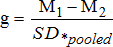
Note: M1 – M2 represents the difference on an outcome between the control and intervention group that is divided by the pooled weighted standard deviation of the outcome.
Dichotomous outcome data will be analysed by calculating the risk ratio (and its 95% confidence interval) for the occurrence of an event. Risk ratios will be converted to the standardised mean difference (using David Wilson's practical effect size calculator) for the purpose of meta-analysis.
Meta-regression will be used to examine the influence of moderating variables on intervention effect size. Moderator analysis will be carried out when a) there are a reasonable number of publications identified that can be meaningfully analysed and b) when the required data is available in the publication. Any subgroup analysis will be clearly labelled as such in the final review.
Studies with multiple groups
If a study is identified with two (or more) intervention groups versus one control group, and all interventions are deemed relevant, there are two options as to how these groups should be treated: a) If the intervention groups are similar the two groups should be treated as single group or b) If the intervention groups are not similar the control group sample size will be divided in half and will then be compared to the intervention groups. Thus this study would provide two effect size estimates. This process is carried out to ensure that participants in the control group are not “double counted” (Higgins & Green, 2011). A similar strategy, but in reverse, will be carried out if there is a study with one intervention group and two control groups. In addition, if a paper is identified that contains one relevant and one irrelevant intervention group the data from the relevant group will be analysed, but irrelevant data associated with an irrelevant intervention will be ignored.
Unit of analysis issues
It is likely that cluster-randomised trials will be identified, i.e. studies where participants are allocated as a group rather than individually. If such studies have not been appropriately adjusted for clustering (using, for example, robust standard errors or multi-level modelling), we will apply standard conversion criteria as outlined in the Cochrane Handbook (Higgins & Green, 2011). We will use ICC estimates pertaining to each individual study, and if these are unavailable, we will identify appropriate external ICCs based on comparable study size and context. The What Works Clearinghouse (US) has recommended an ICC of 0.20 for achievement outcomes, and 0.10 for all other outcomes (WWC, 2017), and the Education Endowment Foundation (2015) estimates ICCs of 0.103 – 0.126 for maths attainment in primary school (EEF, 2015). If it is unclear whether a cluster-randomised controlled trial has used appropriate controls for clustering, we will contact the study authors for further information.
Investigation of heterogeneity
We will assess heterogeneity by comparing the distribution of important factors such as participant demographics, type of intervention and control comparators and outcomes measured across studies. If appropriate, we will synthesise results in meta-analyses, specifically meta-regression using the CMA program. Meta-analyses will use random effects models. If there are sufficient data, we will carry out subgroup analysis to explore the effect of key study attributes, such as a how the intervention was administrated (e.g. by a teacher or educational psychologist, on an individual or group basis), intervention intensity and duration and the impact of pupil characteristics. Intervention intensity will be defined as low (one off session to one month of sessions), medium (> one month of sessions to one year of session) or high (> one year of sessions). High intensity interventions have generally been shown to provide higher gains than low intensity interventions. Early interventions are suggested to be more effective than interventions applied to older children, this again can be assessed in the meta-analysis. Heterogeneity will be measured and reported through the Q, l2 and Tau2 statistics in conjunction with visual inspection of forest plots.. Significant heterogeneity will be defined as an l2 above 75% (Higgin & Green, 2011). High heterogeneity is expected due to the broad criteria for population inclusion in this systematic review.
Sensitivity analysis
Sensitivity analysis will be conducted to determine whether the overall findings of the analysis are impacted by removal of: studies with outlier effect sizes; unpublished studies; studies with missing information (e.g. standard deviations or ICCs) which had to be imputed; studies with high risk of bias.
Missing data and author queries
If further information is required regarding study data to conduct appropriate analyses or to establish baseline equivalence, the first author of the study will be contacted via email. One reminder email will be sent within one month of first request of information. Should requested data be unavailable, the study will still be reported, but not included in the final meta-analysis.
Treatment of qualitative research
We do not plan to include qualitative research.