Abstract
Linked article:
Linked article:
1 Background for the Review 4
Correctional boot camps, frequently called shock or intensive incarceration, were first opened in adult correctional systems in Georgia and Oklahoma in 1983. Since that time they have rapidly grown, first within adult systems and later in juvenile corrections. Today, correctional boot camps exist in federal, state and local juvenile and adult jurisdictions in the United States.
In the typical boot camp, participants are required to follow a rigorous daily schedule of activities including drill and ceremony and physical training. They arise early each morning and are kept busy most of the day. Correctional officers are given military titles and participants are required to use these titles when addressing staff. Staff and inmates are required to wear uniforms. Punishment for misbehavior is immediate and swift and usually involves some type of physical activity like push-ups. Frequently, groups of inmates enter the boot camps as squads or platoons. There is often an elaborate in-take ceremony where inmates are immediately required to follow the rules, respond to staff in an appropriate way, stand at attention and have their heads shaved. Many programs have graduation ceremonies for those who successfully complete the program. Frequently, family members and others from the outside public attend the graduation ceremonies.
The camps for adjudicated juveniles differ somewhat from the adult camps. Less emphasis is placed on hard labor and, as required by law, the camps provide juveniles with academic education. Juvenile camps are also apt to provide more therapeutic components. However, in many other aspects the juvenile camps are similar to adult camps with rigorous in-take procedures, shaved heads, drill and ceremony, physical training, immediate physical punishment for misbehavior (e.g., push-ups), and graduation ceremonies.
While there are some basic similarities among the correctional boot camps, the programs differ greatly in other aspects (MacKenzie and Hebert 1996). For example, the camps differ in the amount of focus given to the physical training and hard labor aspects of the program versus therapeutic programming such as academic education, drug treatment or cognitive skills. Some camps emphasize the therapeutic programming, others focus on discipline and rigorous physical training. Programs also differ in whether they are designed to be an alternative to probation or to prison. In some jurisdictions judges sentence participants to the camps, in others, participants are identified by department of corrections personnel from those serving terms of incarceration. Another difference among programs is whether the residential phase is followed by an aftercare or re-entry program designed to assist the participants with adjustment to the community.
Despite their continuing popularity, correctional boot camps remain controversial. Primarily, the debate involves questions about the impact of the camps on the adjustment and behavior of participants while they are in residence and after they are released. According to the advocates, the atmosphere of the camps is conducive to positive growth and change (Clark and Aziz 1996, MacKenzie and Hebert 1996). In contrast, critics argue that many of the components of the camps are in direct opposition to the type of relationships and supportive conditions that are needed for quality therapeutic programming (Andrews, Zinger, Hoge, Bonta, Gendreau, and Cullen 1990, Gendreau, Little and Groggin 1996, Morash and Rucker 1990, Sechrest 1989).
Research examining the effectiveness of the correctional boot camps has focused on various potential impacts of the camps. Some have examined whether the camps change participant's attitudes, attachments to the community or impulsivity (MacKenzie, Styve, Gover, and Wilson, 2001, MacKenzie and Shaw 1990, MacKenzie and Souryal 1995). Others have examined the impact of the camps on the need for prison bed space (MacKenzie and Piquero 1994, MacKenzie and Parent 1991). However, the research receiving the most interest appears to be that examining the impact of the camps on recidivism. Past reviews of this research, such as MacKenzie (1997), have concluded that boot camps are ineffective in reducing recidivism with the caveat that those boot camps that emphasize therapeutic activities and aftercare may be successful.
2 Objectives of the Review
The objective of this systematic review is to synthesize the extant empirical evidence (published or otherwise) on the effects of boot camps and boot camp like programs on the criminal behavior of convicted adult and juvenile offenders. The focus of this review is on the effectiveness of these programs with respect to recidivism. According to a survey of state correctional officials by Gowdy (1996), reduced correctional costs and recidivism were the primary goals of boot camps. The review does not examine research on the cost effects of these programs, nor does it review the potential secondary effects on outcomes such as antisocial attitudes.
3 Methods
3.1 Criteria for inclusion and exclusion of studies in the review
The scope of this review is experimental and quasi-experimental evaluations of boot camp and boot camp like programs for juvenile and adult offenders that utilize a comparison group. The preliminary eligibility criteria are (a) that the study evaluated a correctional boot camp, shock incarceration, or intensive incarceration program (i.e., a residential program for convicted offenders that incorporates a militaristic environment and/or structured strenuous physical activity other than work); (b) that the study included a comparison group that received either probation or incarceration in an alternative facility, such as jail or prison (study design may be experimental or quasi-experimental; one-group research designs will not be eligible); (c) that the study participants were exclusively under the supervision of the criminal or juvenile justice system (i.e., convicted of or adjudicated for an offense); and (d) that the study reported a post-program measure of criminal behavior, such as arrest or conviction (the measure may be based on official records or self-report and may be reported on a dichotomous or continuous scale). These criteria will be modified if necessary after we interact with the literature. A form for evaluating the eligibility of studies is in Appendix A.
3.2 Search strategy for identification of relevant studies
Several strategies will be used to identify all studies, published or otherwise, that meet these criteria, including a keyword search of computerized databases, contact with authors working in this area, and examination of study registries. We have already completed a preliminary search of the following databases: Criminal Justice Periodical Index, Dissertation Abstracts Online, Government Publications Office Monthly Catalog, Government Publications Reference File, NCJRS, PsychINFO, Sociological Abstracts, Social SciSearch, and U.S. Political Science Documents. The keywords used were: boot camp(s), intensive incarceration, and shock incarceration. Several of the searched databases index nonpublished works. We will also search the Campbell Collaboration Social, Psychological, Educational and Criminological Trials Register. These searches will be updated and we will identify and contact non U.S. researchers working in this area to help us locate international evaluations. We anticipate few such studies (with the exception of a couple of evaluations from Great Britain of which we are aware), for boot camps have been a predominately a U.S. phenomenon, although that may change in the coming decade.
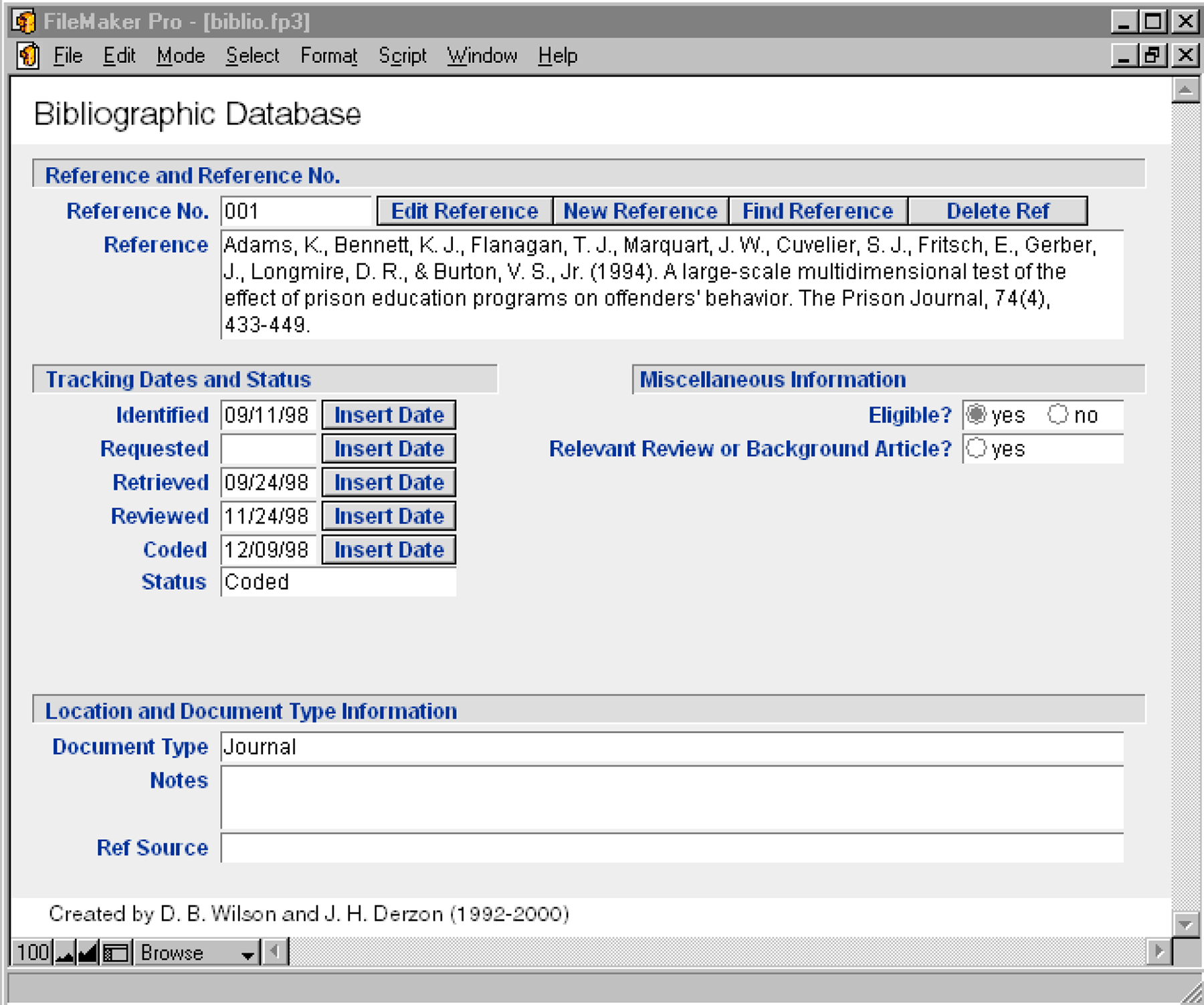
All references identified as potentially eligible for this review will be entered into a bibliographic database program created in FileMaker Pro(TM) by D. B. Wilson and J. H. Derzon specifically for use in managing bibliographies for meta-analysis (a sample of the main status screen from this program is presented in Appendix B). Identified documents will be retrieved and two coders will assess eligibility through an examination of the full report.
3.3 Description of methods used in the component studies
The methods used by the studies included in this review are variations on a treatment versus comparison group research design with a post-test and possible follow-up measurement points. In all cases the participant samples will be adjudicated juvenile delinquents or convicted adult offenders, a sample of whom will participate in a boot camp program and a sample of whom will participate in some other traditional correctional program, such as probation or short-term incarceration and parole.
The studies will vary with respect to the method of constructing the comparison group. A small number of studies will rely on random assignment of participants to the boot camp and comparison conditions. The remaining studies will be observational, relying on groups constructed by natural means. The common variations will be historical controls, adjacent jurisdictions, offenders eligible for boot camp who chose not to participate, and eligible offenders who did not participate due to limited space in the boot camp program. The studies will also vary with respect to the degree to which they employ statistical controls (matching, covariate analysis, etc.) to reduce the threat of selection bias.
All studies included in this review will include a post-program measure of criminal recidivism, that is, criminal behavior. These may include dichotomous indicators of arrest, conviction, or reincarceration or more differentiated indicates that specify specific types of offenses or the frequency of offenses. A few studies may also include self-report measures of criminal involvement.
A subset of studies will report on other outcomes, such as school performance, employment status, changes in antisocial attitudes, etc. We will not be coding these other outcomes. However, we will document all reported outcomes (see coding protocol).
3.4 Criteria for determination of independent findings
A complication in conducting a systematic review of studies in this area is that most studies will report multiple indicators of recidivism, and some will report those indicators at multiple time points (e.g., 12 months post-program, 24 months post-program). The statistical methods outlined below require that the findings (effect sizes) be independent, that is, come from unique samples. Several strategies will be used to address this problem.
First, all findings will be coded and entered into the data file. Second, criteria will be developed to select the more general indicators of recidivism and those with the longest follow-up that are based on the full sample (i.e., not affected by attrition). Third, any multiple effect sizes remaining within a study will be averaged and the average will serve as the effect size for the primary analyses. Fourth, a secondary set of analyses will be conducted that will analyze all measures of arrest, conviction, and reinstitutionalization separately, averaging multiple indicators of each within a study. These analyses will provide a sensitivity check on the primary set of analyses.
3.5 Details of study coding categories
A preliminary coding protocol has been developed for this project (see Appendix C) and is a modification of the coding protocol for two previously completed meta-analyses and two ongoing meta-analyses. This protocol recognizes the nested nature of effects within studies and as such is hierarchical in nature. Any number of effects can be coded for any number of dependent variables for each program-comparison contrast contained within a study. That is, a study may report multiple independent evaluations or boot-camp versus comparison group contrasts. Furthermore, a study may have multiple indicators of criminal involvement, such as arrest, conviction, and technical violation, measured at multiple time points following release from the program. The coding protocol and corresponding database are designed to accommodate this complexity.
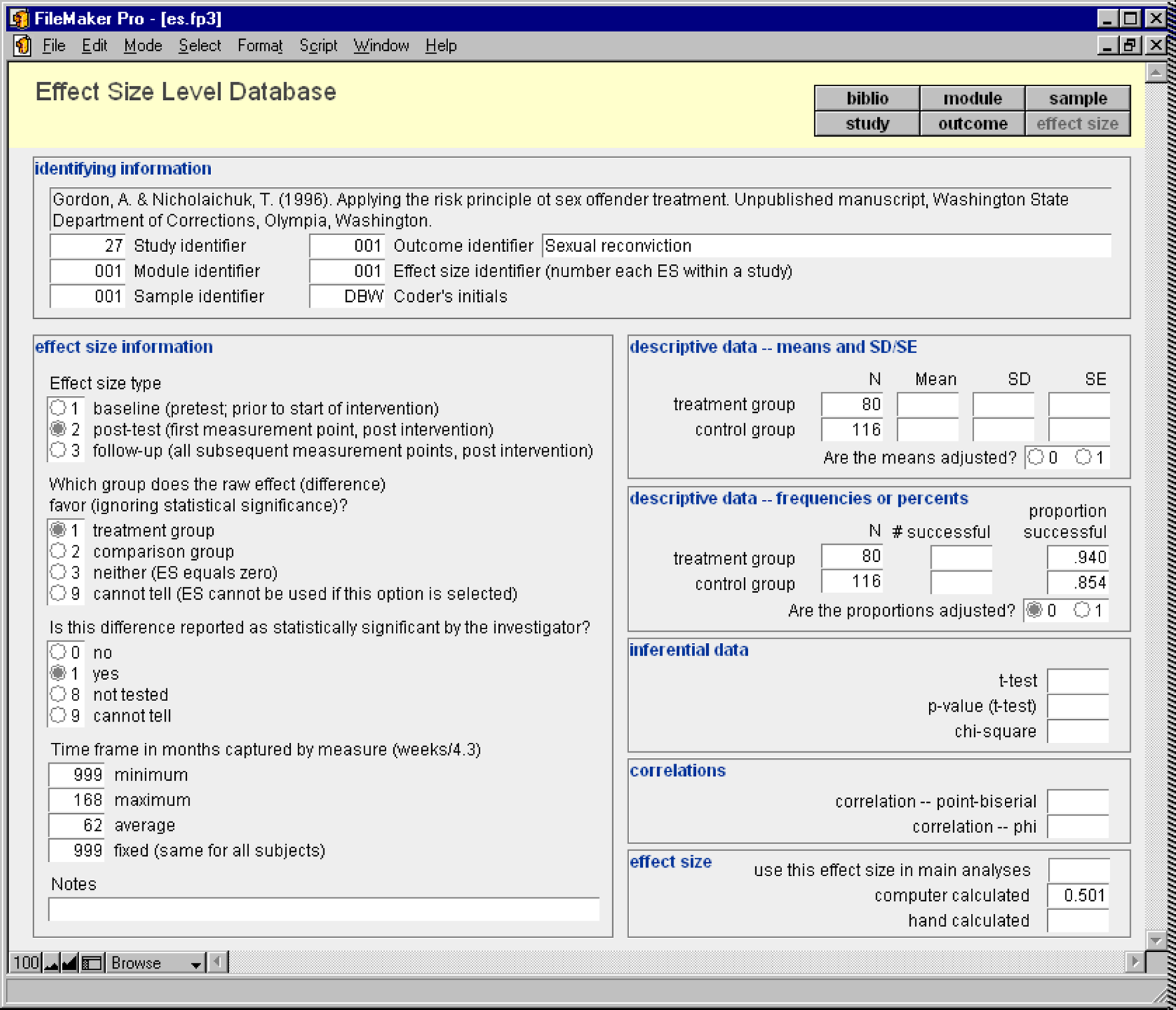
The coding protocol captures aspects of the research design, including methodological quality, the boot camp program, the comparison group condition, the participant offenders, the outcome measures and the direction and magnitude of the observed effects. All studies will be coded by two independent coders and all coding differences will be resolved by either Dr. MacKenzie or Wilson. The uncorrected double coding will be used to assess interrater reliability. Only items with acceptable reliability (e.g., agreement over 70%) will be used in the analyses. The data will be maintained in a FileMaker Pro(TM) database. Coding can be performed either on the paper coding forms (Appendix C) or can be performed directly into the computer using database screens that match the paper coding form (see Appendix D for an example).
3.6 Statistical procedures and conventions
The primary effect of interest is recidivism or a return to criminal activity on the part of the offender after leaving the program. Recidivism data are most typically reported dichotomously. As such, the natural index of effectiveness is the odds-ratio (see Fleiss, 1994) and is the index of effect that will be used in this review. If a study reports recidivism on a continuous scale, then a standardized mean difference effect size will be computed and transformed into an equivalent odds-ratio (see Lipsey and Wilson, 2001, page 198).
The mean odds-ratio and homogeneity of effects across studies will be computed using the inverse variance weight method. A random effects model will be assumed and the random effects variance component will be estimated using the methods outlined by DerSimonian and Laird (1986). The computations will be performed using macros written by D. B. Wilson and available for use with SAS, SPSS, and Stata (Lipsey and Wilson, 2001). These macros use the same methods of computation as those used by the Cochrane Collaborative MetaView program (Deeks, 1999). Sample output from these macros is presented in Appendix E. In addition to an examination of overall effects, the relationship of study features, both substantive and methodological, to observed effects will be explored, both through categorical models and regression models.
3.7 Treatment of qualitative research
At this time we have no plans to include qualitative research in this systematic review. We would welcome any collaborator with expertise in the area of qualitative research to contribute a review of qualitative evaluations to this synthesis.
4 Timeframe
Most of the proposed work has already been completed and has been published (MacKenzie, Wilson, and Kider, 2001). Tasks to be completed are searching for more recent studies and a more comprehensive search for international studies. We will need to code any new studies identified and run new analyses. Finally, we need to produce a written product conforming to Campbell Collaborative guidelines. Given the extensive work already completed (29 coded studies representing 44 independent boot camp versus comparison contrasts), we anticipate completion of the Campbell review by the end of August, 2003.
5 Plans for Updating the Review
We plan to update this review every two-to-three years in accordance with Campbell Collaborative guidelines.
6 Acknowledgments
We would like to thank the Jerry Lee Foundation for partial support of this project.
7 Statement Concerning Conflict of Interest
Drs. MacKenzie and Wilson, and Ms. Kider have no financial interest in any existing or planned boot camp program. Dr. MacKenzie has argued in prior publications that boot camps are ineffective, at least in the absence of therapeutic elements and aftercare components. Thus, the only potential conflict of interest is consistency with prior scholarly publications. The research team will strive to avoid any potential conflict.
Footnotes

9 Tables
None.
A Eligibility Checklist (version 9/26/00)
| First Author's Last Name | _______________ | |
| Document Identification Number | ____ | |
| Coder's Initials | ___ | |
| Date Eligibility Determined | _____ | |
| Document Status | ||
| ___ | Eligible | |
| ___ | Not Eligible | |
| ___ | Relevant Review | |
| To be eligible, a study must meet the following criteria. Answer each question with a “yes” or “no.” | ||
|
|
|
|
| __ | __ | The study evaluated a correctional boot camp, shock incarceration, or intensive incarceration program (i.e., a residential program for convicted offenders that incorporates a militaristic environment and/or structured strenuous physical activity other than work). |
| __ | __ | The study included a comparison group that received either probation or incarceration in an alternative facility, such as jail or prison. Study design may be experimental or quasi-experimental. One-group research designs are not eligible. |
| __ | __ | The study participants were exclusively under the supervision of the criminal or juvenile justice system (i.e., convicted of an offense). There is no age or gender restriction for this review. |
| __ | __ | The study reported a post-program measure of criminal behavior, such as arrest or conviction. The measure may be based on official records or self-report and may be reported on a dichotomous or continuous scale. |
| For documents that do not meet the above criteria, answer the following questions: | ||
| __ | __ | The document is not a quantitative evaluation study (i.e., this document does not report any data regarding the effects of a boot camp). |
| __ | __ | The document is a review article relevant to this project (i.e., may have references to additional eligible studies or background information useful for preparing written manuscripts for this synthesis). |
| Notes: | ||
B Sample Status Screen from the Bibliographic Database Program
C Coding Protocol
D Sample Screen from the Coding Protocol Database