Abstract
Linked article:
Background
Turning Point Alcohol and Drug Centre (Australia) is currently the recipient of a large grant titled “Responding to illicit drugs in Australia: Determining optional strategic mixes.” The project aims to develop tools for policy makers, police and other practitioners who develop and implement illicit drug policy. It will use a range of conceptual and analytical methods, including economic, systemic and complexity approaches to develop new models to describe dynamic relationships between law enforcement, treatment and prevention in order to assess the optimal mix of these responses in particular situations.
In Stage One of the project, a sub-grant to Associate Professor Mazerolle of Griffith University has been provided. Mazerolle will undertake a systematic review of drug law enforcement evaluations in order to (a) identify the strategic law enforcement interventions that are most effective (b) identify and provide parameter estimates that will be useful for project colleagues who are building economic, systemic and complexity models and (c) use what we learn about drug law enforcement to guide the development of activities (notably a randomized controlled trial) in Stage Two that aims to examine the optimal mix of law enforcement, treatment and prevention approaches to dealing with drug problems. I note that reviews of treatment and prevention interventions are being conducted by other investigators on the larger project during Stage One of funding,
Our drug law enforcement systematic review begins from the premise that the police can indeed be effective in dealing with drug problems. Prior to the 1990s the general view of policing was predominately negative, with the major contention being that police were ineffective in preventing or controlling criminal activity (see Bayley, 1994; Gottfredson & Hirschi, 1990). The 1990s, in contrast, have been described as an innovative decade for policing (Weisburd and Eck, 2004). Indeed, the 1990s is associated with the establishment of many innovative policing strategies, including hots-spots policing, broken windows policing, evidence-based policing, civil remedies, intelligence-led policing, third party policing, community policing, problem-oriented policing and crackdowns. Many of these strategies have been specifically used to target drug problems.
Drug law enforcement strategies can be generally classified by their aim. Some approaches are intended to reduce the supply of drugs (for instance, a crackdown aimed at disrupting a local distribution network); others are intended to reduce demand for drugs (for instance, a police-led drug education program intended to prevent young people from experimenting with drugs and thus reducing the risk of future chronic involvement). In practice this distinction between supply and demand-reduction strategies are often blurred, yet continue to serve as an important defining characteristic of drug law enforcement approaches. These days, traditional-style drug law enforcement tactics (e.g., crackdowns, raids, buy-busts) have been used in conjunction with harm minimisation strategies as well as newer, partnership based policing approaches to crime control such as community, problem-oriented, and third party policing.
Research shows that drug problems targeted by the police vary across a range of characteristics (Eck, 1994; Mazerolle, Kadleck and Roehl, 2004; Weisburd and Green, 1995; Weisburd and Mazerolle, 2000). Indeed we know that environmental characteristics of small places largely influence opportunities for drug use and dealing and also influence the type of interventions and relative effectiveness of police activity (Mazerolle et al, 2004). For example, drug-dealing places vary by geographic size (some are addresses, others are street corners), by types of drugs sold (crack markets, heroin markets), by types of selling locations (inside bars, open-air sales on main throughways), and by levels of formal control (some receive extensive police attention, others do not). Recent research also suggests that drug sellers assess place attributes (see Eck, 1994) and, at some level, make rational decisions about whether or not to sell drugs (Reuter, MacCoun, and Murphy, 1990; see Cornish and Clarke, 1986 generally). For example, drug dealers typically locate their operations close to arterial roads (Eck, 1994 1 ; Green, 1996; Weisburd and Green, 1994), they choose places that maximize communication with customers and minimize the risk of apprehension (Eck, 1994, Rengert and Wasilchick, 1990), and they prefer places with weak place management to minimize the risk of interference (Eck, 1994; Green, 1996)
While the effectiveness of generic law enforcement interventions has been studied and reviewed (Braga, 2001; Poyner, 1993; Sherman, et al., 1997; Weisburd & Eck, 2004), far less is known regarding the relative effectiveness of a variety of law enforcement interventions specifically aimed at reducing drug supply and/or demand. Previous reviews of drug law enforcement interventions are rare and have tended to be far from comprehensive (e.g. Effective Interventions Unit, 2004), wholly descriptive (e.g. Weisel, 1996), or predominately concerned with drug policy and legislation (e.g. Beecher, 1986). Perhaps the most comprehensive of drug law enforcement reviews to date (see Mason & Bucke, 2002) is not without its limitations either. Specifically, the review assesses interventions aimed at local drug markets only, ignoring international/global approaches (such as interdiction and seizures) and individualised approaches (such as arrest referral and diversion), and included English language studies only. Still, valuable information regarding intervention effectiveness can be deduced from this review. Specifically, Mason and Bucke (2002) found that third party policing interventions involving drug nuisance abatement and civil remedies were the most effective strategies for attempting to disrupt drug dealing from residential or commercial properties, with raids and community based policing interventions being partially effective. Conversely, when attempting to address drug dealing in open street-level markets, it was noted that interventions generally emphasised traditional enforcement tactics and an absence of partnership between police and external agencies. Undercover operations involving stings were deemed to be most effective and crackdowns and buy-bust operations partially effective, in dealing with open-air markets.
Obviously, it is imperative that policy decisions regarding drug law enforcement, and indeed policy decisions of any kind, be based on empirical evidence. Thus, the need for a comprehensive systematic review of the effectiveness of drug law enforcement strategies is essential in order to provide a framework from which policy makers can formulate evidence-based decisions regarding the most appropriate strategies to be employed in varying situations. Essentially, the aim of this report is to conduct such a review, assessing the effectiveness of a variety of drug law enforcement interventions in reducing drug and associated criminal activity. The findings spawned from this review will be disseminated to policy makers in a number of ways. First, the aims and scope of the review, and findings to date, were presented at the Australian and New Zealand Society of Criminology conference recently held in Wellington, New Zealand. An academic paper will be prepared and submitted for review to the Journal of Experimental Criminology, and a report of the findings will be presented to Turning Point Alcohol and Drug Centre, as part of the wider Drug Policy Modelling Project.
Objectives
Our project seeks to conduct a systematic review of police-led or involved drug law enforcement strategies. The objective of this review will be to assess the effectiveness of drug law enforcement interventions, implemented at the local, regional, state, national and global levels to reduce or prevent drug problems (including drug use, drug dealing, supply of drugs, demand for drugs and the associated problems with drug dealing places). This objective will be achieved in three parts. First, a narrative review will assess a wide variety of interventions classified as either, (a) international/national interventions (such as interdiction and drug seizure), (b) reactive/aggressive interventions (including crackdowns, raids, buy-busts, saturation patrol, etc), (c) proactive/partnership interventions (including third-party policing, problem-oriented policing, community policing, drug nuisance abatement, etc), and (d) individualised interventions (such as arrest referral and diversion). Second, a meta-analysis will be conducted statistically analysing the impact of reactive/aggressive and proactive/partnership interventions
2
on reducing drug and associated crime and disorder outcomes. Finally, the findings from the narrative review and meta-analysis will be integrated to create an overall assessment of the effectiveness of the evaluated interventions. The review will address such research questions as: Which drug law enforcement interventions most effectively reduce drug related problems (such as use, dealing, manufacturing, trafficking, and drug offences)? Which drug law enforcement interventions most effectively reduce problems associated with drugs (such as property crime, violent crime, and disorder)? Are there variations by type of drug targeted? How effective are international/national interventions? Reactive/aggressive interventions? Proactive/partnership interventions? Individualised interventions? What strategies are most effective at addressing drug problems at residential and/or commercial sites (eg. use & dealing in public housing)? What strategies are most effective at addressing street-level drug problems (eg. open-air dealing)? What strategies are most effective at addressing national/international level drug problems (eg. trafficking)? What strategies are most effective at addressing individual drug problems (eg. use)? What strategies are most effective at addressing drug demand? Drug supply? What are the displacement or diffusion of benefit effects associated with different drug law enforcement strategies? What associated benefits (or disadvantages) might accrue to drug law enforcement interventions (e.g. fear of crime, increased harms, satisfaction with police)?
The first nine research questions are to be addressed drawing from the findings of both the narrative review and meta-analysis, whereas the last two questions will draw from the findings of the narrative review only.
Methodology
Criteria for Inclusion of Studies
Search Strategy
In order to ensure the review is comprehensive, several search strategies will be used:
Computerised databases
These databases cover published and unpublished material in criminology, police studies, social science, education, psychology and behavioural science, health, and the law. The years covered by the various databases are indicated in brackets. Australian Criminology Database (CINCH) (from 1968) Australian Federal Police Digest (AFPD) (from 1991) Australian Public Affairs Information Service (APAIS) Bibliography of Nordic Criminology (from 1945 for Denmark, 1999 for other nations) CrimDoc (European) Criminal Justice Abstracts (from 1968) Dissertation Abstracts (from 1980) Drug Database (from Australian Alcohol and other Drugs Council of Australia) (from 1974) Drugscope Educational Resources Information Center (ERIC) (from 1960s) Expanded Academic ASAP (from 1992) Francis (French) Health and Society Database (from 1980) HM Inspector of Constabulary Kinetica (Australian National Bibliographic Database) Kluwer online e-journals (from 1997) Medline (from 1960s) National Criminal Justice Reference Service (NCJRS) Abstracts (from late 1960s) Proquest – Multiple Databases (from 1985) Psychinfo (from 1983) Psycharticles (from 1988) Public Affairs Information Service International (PAIS) (from 1972) SAGE Fulltext (from 1980s) Science Direct Social Policy & Practice (UK) Sociological Abstracts (from 1963) Swetswise (from 1993) Web of Science (from 1997) Wiley e-journals (Multidisciplinary) (from 1997)
In addition to these databases available through Griffith University, Phyllis Schultze, librarian at Rutgers University will search online US databases (e.g., Catalog of U. S. Government Publications (CGP); International Bibliography of the Social Sciences; PolicyFile) and obtain studies that are not accessible in Australia. A number of databases, including Applied Social Science Index and Abstracts (ASSIA), Acompline (Greater London Authority), Planex (IDOX plc), SOLIS (German), and Inside Web (UK), will not be accessed given financial constraints of the project.
Websites on drug law enforcement
Searches will be conducted on a number of Australian and international websites covering the fields of police, law enforcement, criminal justice, drug services, education and health. Furthermore, to improve the international scope of the search, popular internet search engines will be searched to attempt to reveal other relevant sites. Australian Clearinghouse for Youth Studies <www.ucys.utas.edu.au> Australian Institute of Criminology <www.aic.gov.au> Australasian Centre for Policing Research <www.acpr.gov.au> Bureau of Justice Assistance <www.ojp.usdoj.gov/BJA> Campbell Collaboration's Social, Psychological, Educational, and Criminological Trials Register (C2-SPECTR) <http://geb9101.gse.upenn.edu> Center for Problem-Oriented Policing <www.popcenter.org> Cochrane library <www.cochrane.org> Curtin's National Drug Research Institute <db.ndri.curtin.edu.au> Drug Enforcement Administration <www.usdoj.gov/dea> National Institute of Justice <www.ojp.usdoj.gov/nij> NSW Bureau of Crime Statistics and Research <www.lawlink.nsw.gov.au/bocsar> Office of Community Oriented Policing Services (COPS) <www.communitypolicing.org> Police Executive Research Forum <www.policeforum.org> Rand Corporation Research Services <www.rand.org> UK Home Office <www.homeoffice.gov.uk> and <www.drugs.gov.uk>
Previous reviews and bibliographies
Previous reviews and bibliographies will also be consulted as a source of potential eligible studies. These include: Beckman et al. (2003) review of policing literature Beecher (1986) Braga's (2001) review of hot spots policing Crime Prevention Studies series, esp. Natarajan & Hough (2000) Loxley et al. (2002), chapters 11–12
Mason & Bucke (2002) systematic review of actions against local drug markets Petrosino's (2000) review of “crime, drug and alcohol” Poyner (1993) Sherman et al. (1997), What works review Sherman et al. (2002) evidence-based crime prevention, esp. chapter by Eck, Preventing crime at places
Sutton & James (1996) evaluation of Australian anti-trafficking laws and follow up study (2000) Weatherburn et al. (2000) drug crime prevention literature review Weisel's (1996) police anti-drug tactics
In addition to these reviews, the reference list of all articles collected will be scanned and citations that seem relevant to the review will be followed up. Finally, leading police and drug control scholars throughout the world will be contacted to help us to locate up-to-date as well as unpublished material relevant to the review.
Keywords used in searches
Drug Police/policing Law enforcement Drug law enforcement Drug control Hot-spots Problem-oriented policing Community policing Third-party policing Intelligence-led policing Civil remedies Drug nuisance abatement Situational crime prevention Crime prevention through environmental design Undercover drug buy Undercover operation Sting Crackdown Raid Buy and bust Drug sweep Closedown Interdiction Directed patrols Drug use/misuse/abuse Substance use/misuse/abuse Drug free zones Prevention Zero tolerance Dealing Street-level market Open-air market Drug market Hotline Trafficking Neighbourhood renewal Neighbourhood revitalisation Neighbourhood enhancement Expiation notice Crop eradication Crop substitution Arrest referral Diversion Cautioning Supply reduction Demand reduction Harm reduction Rave party Party drug
Truncations (polic∗ to search for police and policing; neighbo?hood to search for both neighbourhood and neighbourhood) will be used to aid the search process. When narrowing of the searches is required, keywords will be used in combination (e.g., combining the words police or drug with other keywords). Conversely, if minimal hits are obtained from keyword searches containing multiple terms, terms will be searched independently where logical (eg. drug nuisance abatement ? drug nuisance & abatement in separate searches). The search process will be iterative, beginning with broad search terms such as “police & drug” before moving onto more complex search terms. While this process returned a large number of hits in the early stages of the searches (with many articles being irrelevant), it was deemed to be the most comprehensive approach. Where applicable, database thesauri will be employed to indicate additional relevant search terms.
Eligibility Assessment and Retrieval of Studies
Two research assistants will conduct the searches and retrieve relevant studies. The eligibility assessment will be based initially on the careful examination of abstracts but when the abstract does not provide enough information to determine eligibility of the study, the full text will be retrieved. When in doubt regarding inclusion the researchers will consult with each other and with the team leader to resolve any discrepancies. The full text or the relevant sections of all studies included in the review will be printed for later reference. A reasonable effort will be made to retrieve the full text of all studies deemed eligible and failure to retrieve a potentially eligible study will be documented. The citations for studies included in the review as well as studies that are excluded (along with the reasons for exclusion) will be recorded in a bibliographic database.
As stated previously a number of steps will be taken to retrieve grey and unpublished literature, including consultation with a US librarian, contact with key drug law enforcement researchers, and contact with postgraduate students.
Coding of studies
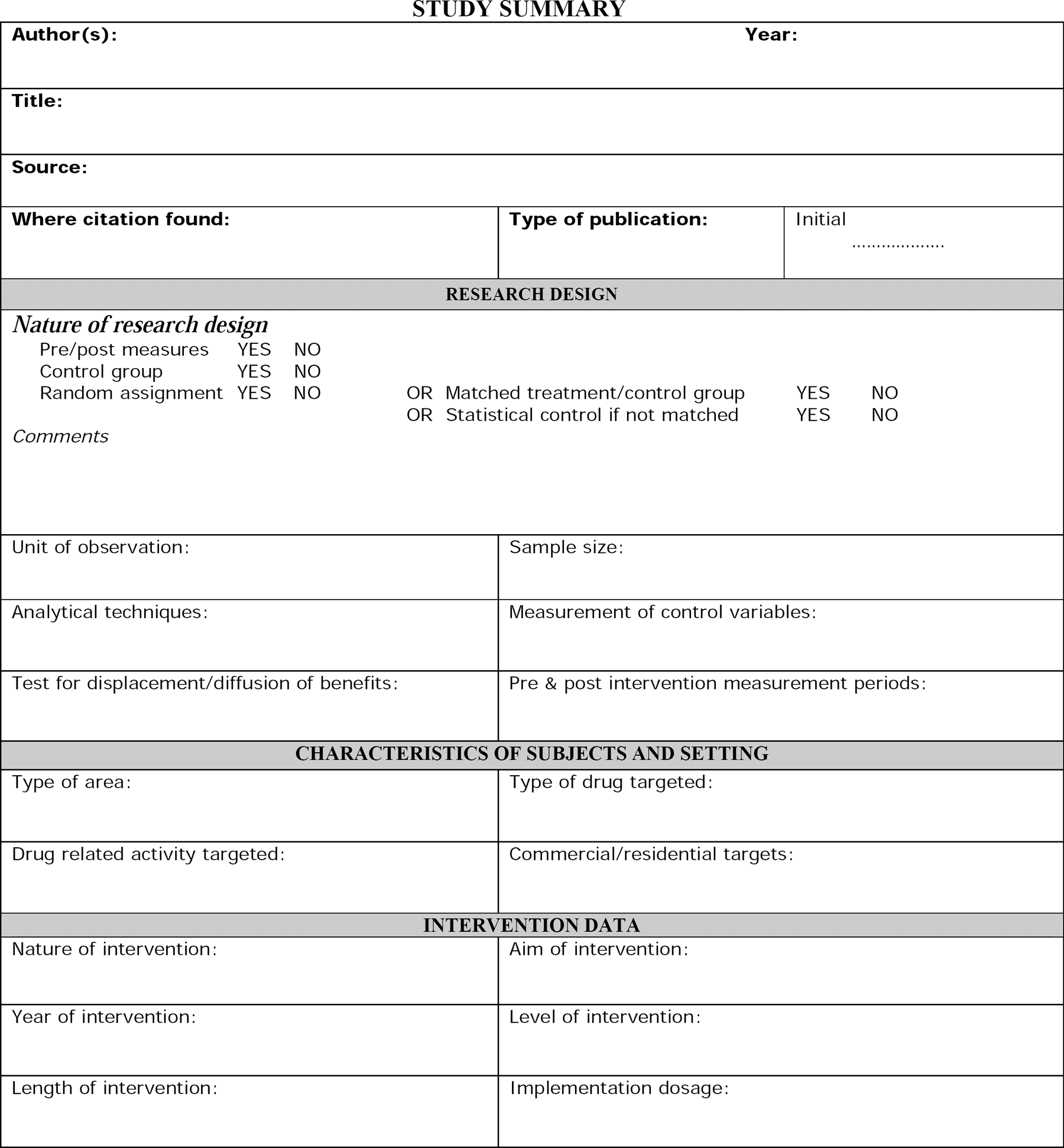
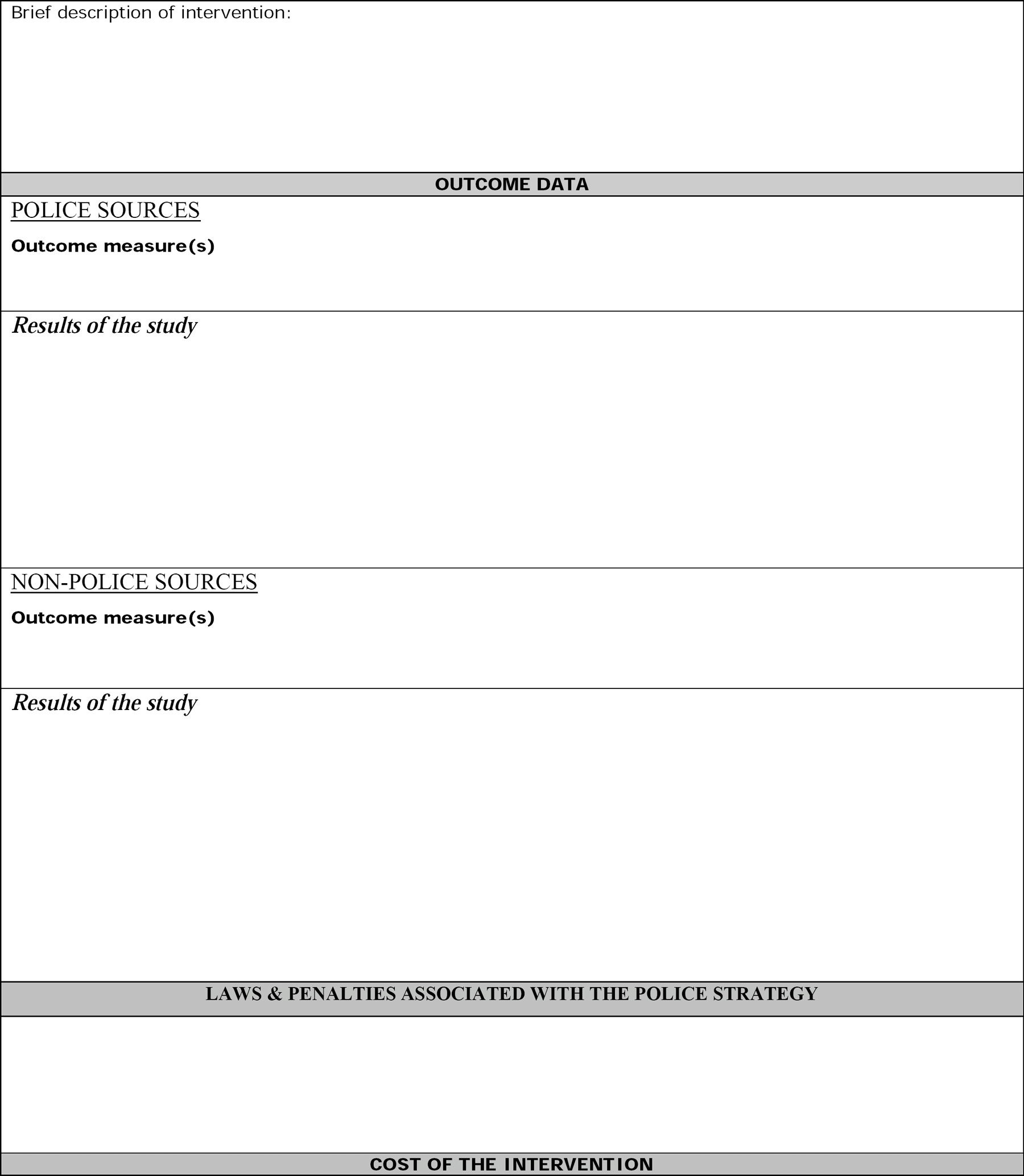
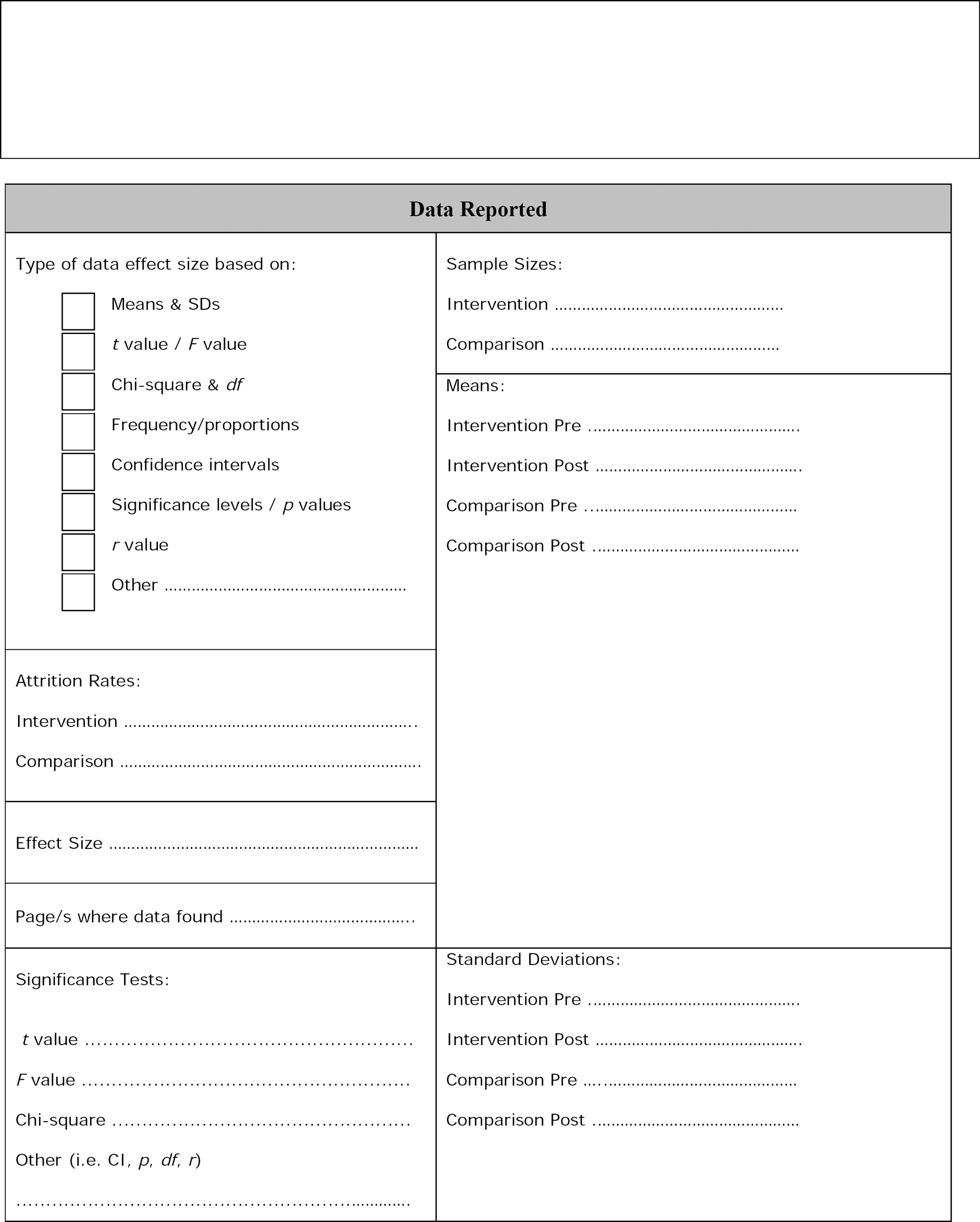
All studies will be systematically coded to record particulars related to study level characteristics, sample level characteristics, and outcome level characteristics. Seven categories will be considered: Study descriptors: year and type of publication Research design: design type, unit of observation, analytical techniques used, test for displacement/diffusion of benefits, sample size, measurement of control variables, pre and post intervention measurement periods Characteristics of subject and setting: country of intervention, type of area, socio-demographics and relevant characteristics of target/setting Intervention data: nature (What type of intervention is it?), aim (supply/demand reduction, type of drug targeted, type of drug related activity targeted), intervention implementation date, level of intervention (local, regional, state, national, international), length of intervention, and the implementation dosage (What specifically did the experimental group/area receive in the way of intervention? What about the control group/area?). Laws and penalties associated with the intervention Cost of the intervention: cost of police time, cost of setting up intervention, fund obtained from external sources (where the sources governmental/private/other?) Outcomes: measures from both police (eg. arrest or CFS data) and non-police sources (eg. survey/interview data, observational data) that aid in an assessment of intervention effectiveness; all data relevant to the calculation of effect sizes
The coding sheet used to assess studies can be found at Attachment B.
Assessment of Methodological Quality
In addition studies included in the meta-analysis will be coded regarding their methodological rigour. The scale used (see Attachment A) was adapted from Health Canada's (2004) review of treatment and rehabilitation interventions for driving while impaired offenders. The scale ranks studies from zero to five (0 representing a methodologically poor study and 5 a methodologically sound study) on the basis of the study control for internal validity (randomisation, matching, experimental/comparison group equivalence at pre-intervention). In addition to the scale, a further three common methodological faults were identified and ½ a ranking was deducted from scale scores for each fault reported. Thus, the range of methodological quality scores is −1.5 to 5.
Outcome measures and effect size
As stated previously studies included in either the narrative review or the meta-analysis are required to have at least one outcome measure assessing the impact of the intervention on drug-related problems (i.e. a drug/crime/disorder outcome). So far, a wide range of outcomes have been reported by studies included in the narrative review including the number of drug-related arrests, amount of drug seized, number of drug-related calls for service, incident reports, rates of offending for various crime categories, rates of use, among others. Outcome variables reported by studies included in the meta-analysis will be organised into the following main three categories (a) arrest data, (b) offence data, or (c) calls for service data. These categories are likely to be further divided into (a) drug related, (b) disorder related, (c) related to offences against the person (included both violent and sexual crime), and (d) property crime related. Other outcomes for which effect sizes will be calculated include observed drug selling, use, and drug related field contacts 6 .
Statistical Analysis/Data Synthesis
The results of all evaluations providing sufficient data for the calculation of an effect size will be synthesised using meta-analytic techniques. Meta-analysis is a range of systematic, quantitative methods used to synthesise research findings from multiple studies on a similar topic or issue. The key to meta-analysis is the calculation of an effect size. The effect size is the magnitude of a specific intervention's effect independent of the study's sample size. Calculating an effect size enables one to compare individual research findings using a common metric.
There is a tendency for law enforcement evaluation studies to report incident data for two groups (intervention and comparison), at pre-post intervention. Consequently, the odds-ratio effect size, which allows for a comparison between the intervention and comparison groups in terms of the change in the relative odds of an outcome (i.e., arrest, incident, call for service) occurring as a result of the implementation of an intervention, will be employed as the effect size of choice for the meta-analysis. Advantages of using the odds-ratio statistic are that it is easy to interpret and accounts for non-equivalence of groups. The standardised mean difference, another popular effect size statistic, will not be used given the limited number of studies reporting a standardised value (such as a standard deviation or standard error), which is necessary for calculation of such an effect size measure.
As stated, qualitative studies and studies not included in the meta-analysis due to insufficient data reportage, will be examined in a narrative analysis in order to complement the results of the meta-analysis. Analysis of findings from studies in the narrative review will include assessment of the effectiveness of individual strategies, effectiveness of different interventions in addressing different drug problems (i.e. supply vs. demand reduction, use/dealing at residential/commercial addresses vs. street-level dealing, etc). Furthermore, an analysis of potential displacement or diffusion of benefits effects, as well as associated outcomes such as citizen's fear of crime and unintended health consequences for users or the public, will also be conducted.
A separate meta-analysis will be conducted for each of the outcome categories detailed earlier 7 . Presentation of results for each analysis will include odds-ratios, 95% confidence intervals, p-values, and forest plots for both each individual study and all studies combined. All analyses will be run using a random effects model given the substantial between-study variation observed. Heterogeneity will be addressed by providing Q-statistics and their associated p-values for each analysis. At this stage we expect that the extent of between-study heterogeneity, and the small number of studies to be included in each meta-analysis will preclude us from conducting a sensitivity analysis. We propose to pay attention to interpretations of the forest plots rather than focus on the combined effect size calculations given the extent of heterogeneity in our data. Despite this, we expect that the results of the meta-analysis will still provide useful information.
It should be noted that our review so far suggests a general lack of quality studies in the area of drug law enforcement evaluation. The meta-analysis is limited by the degree of variation in interventions assessed, designs employed, study characteristics, and outcome measures assessed. Nevertheless, the narrative review and analysis of the forest plots will provide important information.
Timetable
The review will be conducted over a 14 month period, starting March 2004
Plans for Update to the Review
Contingent on future funding, the investigator plans to update this review in two years as part of larger Drug Policing Modelling project.
Acknowledgments
The primary source of funding for this review is a grant from the Turning Point Alcohol and Drug Centre, Melbourne, Victoria, Australia
Conflict of Interest
None
Footnotes
1
Methamphetamine dealers, however, seem to exhibit different place selection criteria to cocaine, crack and heroin dealers (see Eck, 1994).
2
So far, we have identified no studies evaluating international/national interventions, and only a single study evaluating individualised interventions, provided sufficient data to calculate effect sizes. Thus, the meta-analysis will likely to be restricted to those interventions classified as reactive/aggressive or proactive/partnership.
3
Given the use of the odds-ratio effect size in the meta-analysis, studies must report raw frequency data or data from which raw frequencies can be calculated. The odds-ratio effect size was chosen given the tendency for law enforcement evaluations to report raw frequency data for intervention and comparison groups, pre- and post-intervention (see methodology section for more detail).
4
Attrition was not a problem in any of the studies included in the meta-analysis, thus was not included as a criteria from which to assess methodological quality.
5
For each of these outcome measures only one study reported data from which an effect size could be calculated. Thus, a meta-analysis of these findings will not be possible.
6
For each of these outcome measures only one study reported data from which an effect size could be calculated. Thus, a meta-analysis of these findings was not possible.
7
Where a sufficient number of studies assessing the same outcome exist. For some outcome measures a meta-analysis will not be possible given the small number of studies. In these cases, effect sizes will be calculated and presented in a table with forest plots also provided.
ATTACHMENT A METHODOLOGICAL RIGOUR SCALE (adapted from Health Canada,2004)
| Ranking | Characteristics |
|---|---|
| 5 | Randomised experimental design (groups comparable at pre-intervention) |
| 4 | Randomised experimental design (noticeable differences between groups at pre-intervention) |
| 3 | Matched comparison quasi-experimental design (groups comparable at pre-intervention) |
| 2 | Matched comparison quasi-experimental design (noticeable differences between groups at pre-intervention) |
| 1 | Non-equivalent comparison, quasi-experimental design (groups comparable at pre-intervention) |
| 0 | Non-equivalent comparison, quasi-experimental design (noticeable differences between groups at pre-intervention) |
In addition, if the study contains any of the following methodological faults, remove ½ rank from scale score for each fault: Post-intervention measurement occurs while the intervention is still being implemented in the targeted area/s measurement contamination) Post-intervention period is longer than pre-intervention period (leading to an underestimate of the impact of the intervention) Comparison group received lower level of the intervention or some other form of intervention (complicating any interpretation of the observed effect)
ATTACHMENT B