






Abstract
2. Background for the Review
The request for a systematic review of the research on interviewing and interrogation methods is extremely timely and germane to current social events. Specifically, bright lights have been shone on both military and police investigation methods. The effectiveness of military interviewing, or human intelligence (HUMINT), has come under intense scrutiny because of the situations in Iraq and Afghanistan, and the heated debate over the use and efficacy of torture for educing intelligence (see Evans, Meissner, Brandon, Russano, & Kleinman, in press; Redlich, 2007). Just recently, information was released about the “enhanced interrogation” tactics used by the CIA with prisoners of war. At the same time, in the criminal justice arena, police interview and interrogation methods are being called into question because of the increased identification of false confessions and wrongful convictions.
False confessions are an international problem that has been documented in almost every continent (see Kassin, Drizin, Grisso, Gudjonsson, Leo, & Redlich, 2010). In response, several countries, including the United Kingdom, Norway, New Zealand, and Australia, have changed interrogation practices from those that are guilt-presumptive to information-gathering in nature. The United States, Canada, and many Asian nations continue to utilize a guilt presumptive, accusatorial framework (Costanzo & Redlich, 2009; Leo, 2008; Ma, 2007; Smith, Stinson, & Patry, in press). The purpose of this systematic review is to evaluate information-gathering and interrogative (guilt-presumptive or accusatory) methods for persons suspected of committing crimes. 1 One potential measure of effectiveness is diagnosticity. Interviewing methods can be considered “diagnostic” when they produce a higher ratio of true to false confessions and/or ability to detect accurate from inaccurate information. When assessing the effectiveness of questioning techniques on investigative outcomes, it is important to consider the accuracy of the outcome as well as the outcome itself. It is equally important to assess efficacy when suspects are both guilty and innocent (when known), as these two contexts may produce different levels of effectiveness.
The
In part, the PEACE model is based on components of the Cognitive Interview (CI; Fisher & Geiselman, 1992). The CI was derived from basic memory research and involves a series of strategies and techniques. One of the principal techniques is context reinstatement (attempts to reinstate emotions, perceptions, and sequences of the event to-be-remembered). Another technique is to vary the order in which events are recounted. Often, the research that has been conducted on interviewing styles concentrates on the individual techniques/strategies and the theories underlying them. For example, Vrij, Mann, Fisher, Leal, Milne, and Bull (2008) recently tested whether recalling an event in reverse order (which, in theory, should be more difficult for liars than truth-tellers) influenced others' abilities to accurately detect deception. Although the effectiveness of the CI has been researched extensively, the majority of the research (but importantly, not all) and subsequent reviews of the research (e.g., Kohnken, Milnes, Memon, & Bull, 1999) have focused on witnesses and victims' reports of events, not suspects.
The
The scientific study of investigative interviewing has proliferated in the past two decades or so. Both the PACE and PEACE models and some of their individual components (e.g., strategic disclosure of evidence, use of open-ended questions) have been studied in the field and in the laboratory (Bull & Soukara, 2009; Meissner, Russano, & Narchet, 2010; see also Clarke & Milne, 2001 for an evaluation). Similarly, numerous experiments have been conducted on general (e.g., minimization and maximization; Russano, Meissner, Narchet, & Kassin, 2005) and more specific accusatorial methods (e.g., presenting false evidence; Redlich & Goodman, 2003). However, to our knowledge, a synthesized review such as the one proposed here has not been undertaken. That is, a review focusing on the effectiveness of information-gathering and accusatorial methods of questioning suspects has yet to be done, but one that will surely be instructive to academics and policymakers alike.
In the U.S., police and military interrogation and intelligence gathering methods, which are accusatorial and guilt-presumptive in nature, are under fire. Some 20 years ago, Great Britain underwent similar controversies and in response, made sweeping policy changes that arguably preceded the scientific research. Via this systematic review of the experimental literature and its subsequent results, we are in a unique position to inform public policy before it may be altered. As detailed below, our main methodology of review will be meta-analysis and study space analysis, which are appropriate when aiming to translate research into policy recommendations.
3. Objectives of the Review
The objective of this review is to systematically and comprehensively review published and non-published, experimental and quasi-experimental studies on the effectiveness of interviewing and interrogation methods. We plan to focus on suspects as our population, interview style (information-gathering, accusatorial, control) as the intervention, and the diagnosticity of the methods as the primary measure of efficacy. Our guiding question is whether information-gathering or accusatorial methods are more diagnostic in the accuracy of the information that is produced when employed on guilty and innocent suspects. When relevant and available, completeness and consistency of information will also be examined as indicators of effectiveness. Finally, important knowledge has been gained from field, quasi-experimental studies. Thus, although accuracy of outcomes (e.g., confessions) cannot be discerned, we conduct a separate systematic review of field studies.
With interrogation and intelligence gathering methods under intense scrutiny, jurisdictions, states, and countries may have to revisit their questioning procedures and policies, if they have not done so already. As mentioned above, numerous nations in the recent past have changed their interrogation practices. Armed with a review such as the one proposed here, policy makers and law enforcement decision-makers will have the best information available. Interview methods that increase the amount of true information gained from actual perpetrators while at the same time do not increase false information from innocent individuals are important to identify via a systematic, comprehensive, and scientific approach.
4. Methodology
We will conduct two separate meta-analyses and a study space analysis. As we describe more fully below, a study space analysis is one that highlights the topics—and intersection of topics—that have and have not yet been (but need to be) studied.
4a. Criteria for inclusion and exclusion of studies:
The primary products of this systematic review will be two meta-analyses (MA) and subsequent forest plots that graph the magnitude and direction of calculated effect sizes. The first MA (i.e., MA 1) will only include experimental studies in which the “ground truth” (i.e., whether the person is innocent or guilty) is known. The second MA (i.e., MA 2) will include quasi-experimental, field studies in which the ground truth is unknown.
MA 1
To be eligible for the first meta-analysis, published and unpublished studies must meet these requirements:
Intervention: The intervention of interest is interviewing style (information-gathering, accusatorial, and/or “control” methods). To be included, the study must include
Outcomes: Outcome variables include true and false confessions when the suspects are guilty and innocent, as well as potentially measures of completeness and accuracy. Eligible studies must report outcomes for “guilty” participants, “innocent” participants, either, or both (for example, several studies only include situations in which all participants are innocent). Further, at least one outcome measure (with sufficient quantitative data to calculate an effect size), such as a confession rate, completeness or accuracy of reported information, or accuracy in discriminating the credibility of the statement/denial, (see below list of Dependent Variables) must be present.
Population/Samples: The population of interest is suspects (of any age, nationality, or status) who are accused of committing mock crimes/transgressions or withholding important information. Interviewing effectiveness of victims and witnesses will not be included as the motivations and information to-be-gained (and thus the potential effectiveness of methods) differ. Thus, to be eligible, studies must include “suspected perpetrators” or “suspected transgressors.”
MA 2
To be eligible for the second meta-analysis, published and unpublished studies must meet these requirements:
Intervention: Systematic studies that examined interview and interrogation techniques used in actual law enforcement/military settings (i.e., the “field”) are included here. These can include studies of observed interviews/interrogations (live or on video) or archival analysis studies (e.g., police reports, transcribed interviews). The study must quantify at least one interview or interrogation technique. When possible, these techniques will be categorized (by reliable consensus) into information-gathering or accusatorial, though we acknowledge that this may not be possible.
Outcomes: Eligible studies must report at least one outcome, such as confession (partial, full), or Miranda or rights waiver. Of importance, the authors must link interview/interrogation techniques with outcomes, and provide sufficient quantitative data to calculate effect sizes.
Population/Samples: The population of interest is identical to MA 1. That is, to be eligible, studies must include suspects or those with knowledge.
A study that may be eligible for MA 1 and the SSA would be one conducted by Vrij and colleagues (2007; see below for more details). A study that would not be eligible would be one by Colwell, Hiscock-Anisman, Memon, Rachel, and Colwell (2007) because it focuses on witnesses rather than suspects.
In searching the below references and databases, we will determine relevance by reading titles and abstracts. For example, titles that clearly refer to victim/witness accounts will not be included. When more information is needed, we will access and review full reports. Graduate students will be responsible for determinations of initial relevance, with Professors Meissner and Redlich making final decisions.
4b. Search strategy for identification of relevant studies:
We will search for published and unpublished, experimental and quasi-experimental studies on information-gathering-accusatory interviewing. Although we will not set an a priori limit on the publication dates of searched studies, we anticipate that the majority of studies that would be potentially eligible (pass the first round of review) will have been published from 1980 to the present.
We have several comprehensive resources to initiate the search. Below are examples: Justice, B. P., Bhatt, S., Brandon, S. E., & Kleinman, S. M. (2009). Army field manual 2-22.3 interrogation methods: A science-based review [Lists approximately 250 references] Kassin, S. M., Drizin, S., Grisso, T., Gudjonsson, G., Leo, R. A., & Redlich, A. D. (2010). APLS-Approved White Paper, Police-induced confessions: Risk factors and recommendations. Law and Human Behavior. DOI 10.1007/s10979-009-9188-6. [Lists approximately 300 references] Schollum, M. (2005). Investigative interviewing: The literature. New Zealand Police Department. Retrieved January 15, 2006, http://www.police.govt.nz/resources/2005/investigative-interviewing/investigative-interviewing.pdf [Lists approximately 240 references] Williamson, T. (2006). Investigative interviewing: Rights, research, and regulation. Devon, England: Willan Publishing. [this book was the result of the 1st International Conference on Investigative Interviewing] Educing information. Interrogation: Science and Art. Intelligence Science Board, Phase 1 Report (December 2006). Washington, DC: National Defense Intelligence College.
We will also search the following databases: Criminal Justice Periodical Index Criminal Justice Abstracts National Criminal Justice Reference Services (NCJRS) Abstracts PsychInfo [which includes PsychARTICLES] MEDLINE Sociological Abstracts Social Science Abstracts (SocialSciAbs) Social Science Citation Index Dissertation & Theses Abstracts Google Scholar—Advanced Australian Criminology Database (CINCH) Centrex (Central Police Training and Development Authority)—UK National Police Library Scopus Web of Knowledge Publisher databases, such as Springer and Wiley California POST Library
We will use the following keywords to initiate the search. We expect more keywords to be generated as the search progresses. In addition, we will combine keywords to produce more targeted searches, such as “interview and suspect,” and “confession and interrogation.”
Interrogation(ory) Information (gathering) Inquisitorial(ive) Interview(ing) Suspects Confession Cognitive Interview Conversation Management Ethical interviewing Disclosure Strategic evidence Accusatory(ion) Deception detection Statement Validity Analysis (SVA) Criterion Based Content Analysis (CBCA) Reality Monitoring (RM) PEACE model of interviewing PACE (Police Crime and Evidence Act) Adversary(ial) Miranda Coercion (psychological coercion) Entrapment
Finally, the reviewers have many well-established contacts with researchers studying interviewing and interrogation here in the U.S. and abroad. In Appendix A, we have started a list of possible researchers to contact. We will reach out to known and unknown contacts for unpublished or ‘in press’ studies to possibly include. We have obtained the programs of the 2nd and 3rd (June 2008) International Conferences on Investigative Interviewing. Included in these programs are more than 100 presentations that we can follow up on to determine if the studies have been written up.
4c. Description of methods used in primary research.
First, we describe an experimental laboratory study that may be eligible for inclusion in MA 1. Then, we describe an example of a quasi-experimental field study that may be appropriate for MA 2.
We use a recent study by Vrij and colleagues (2007) to illustrate. The title of the study was, Cues to deception and ability to detect lies as a function of police interview styles, and published in a leading journal, Law and Human Behavior.
In Experiment 1, 120 college students participated; half of them participated in a staged event (playing the game Connect 4 with a confederate) in which money was taken from the wallet of another confederate. This was the “truth tellers” condition. In the other condition, the “liars” did not partake in this staged event, but instead were given scripted information about the event. The “liars” also were instructed to take the money out of the wallet, hide it on themselves, and pretend to have participated in the staged event.
Next, both liars and truth tellers were told they would be interviewed and to convince the interviewer that they did not take the money. There were three interview conditions; 60 truth tellers and 60 liars were randomly assigned across them. In the “information-gathering” condition, participants were instructed to tell everything they could about the Connect 4 game, providing as much detail as possible, and follow-up questions were open-ended (as opposed to leading). In the “accusation” condition, participants were asked 11 questions with an accusatory tone, such as “Are you sure you're telling me the truth?” and “Your reactions make me think you're hiding something from me.” In the “behavior analysis interview” condition, participants were asked for free recall and then asked 15 BAI questions, such as “Do you think that someone else did purposefully take the money?”
The interviews were then coded and scored using Criterion Based Content Analysis (CBCA) and Reality Monitoring (RM). These scores were used as the dependent measures. In brief, they found that accusatory interviews resulted in no discernible differences between truth tellers and liars when either CBCA or RM scores were examined, whereas the other two interviewing styles did (though not across the board).
In Experiment 2, Vrij et al. (2007) showed the videotaped stimuli (the three interview conditions) to 68 British police officers. The officers were told that they would see clips of interviews of students who were lying or telling the truth. Officers made dichotomous judgments of accuracy, which were used to calculate hits and false positives. In brief, they found that accuracy was unaffected by interview style and that a truth bias was found in that truth telling was more accurately assessed than lying. Effect sizes were reported.
Additional studies have followed similar experimental methods, such as Hartwig et al. (2005) and Vrij et al. (2008 and 2009).
As stated by the authors, “this Study 2 did not find a simple relationship between degree of tactic usage and extent of shift to confessing” (p. 149). However, Study 2 did find that the two tactics of positive confrontation and leading questions (both interrogatory tactics) were more frequent in the interviews producing confessions. These results help to highlight the techniques that produce outcomes (although the accuracy of outcomes are unknown) with actual crime suspects.
4d. Criteria for determination of independent findings
If eligible studies have multiple outcomes, we will compute an effect size (odds ratio) for each outcome measure separately. If studies employ multiple conditions that represent a single construct (accusatorial or information-gathering methods), a weighted mean effect size will be calculated across these conditions, or a single condition will be selected for inclusion in the data. At this point (i.e., prior to our comprehensive search), our understanding of the literature is that most, if not all, studies have not repeatedly interviewed participants over time. Thus, we do not anticipate outcomes from multiple time points to be problematic. However, if we do encounter this, we will use the final outcome to compute effect sizes.
4e. Details of study coding categories
After conducting the searches as described above, a study eligibility code sheet will be developed. This sheet will include basic information about the study (such as author names, journal name and volume, and title) and a checklist for each eligibility criterion described above.
After the subset of eligible studies is finalized, they will be logged and assigned a unique study id number. Again basic information about the type of publication (conference paper, government report) and the study itself (date range of research, subject pool, country) will be documented. Of importance, we will also assess the methodological rigor of the studies. For example, we could use the Scientific Methods Scale designed by Lawrence Sherman, and utilized recently by Cynthia Lum and colleagues (see http://gemini.gmu.edu/cebcp/Matrix/SMSScoreKey.html). This scale categorizes studies into five categories of methodological rigor.
At a broad level, we will code independent, method/procedural, and dependent variables for each study. Here are some possibilities of each. Final variables to be coded will partially depend on the number of studies that examine and report on them.
Interview style: information-gathering (e.g., PEACE), accusatorial, BAI, control (e.g., no instruction group) Guilt/Innocence, Truth-Telling/Lying Demographic characteristics of the suspect: age group, gender Type of crime Number of techniques used
Random assignment Laboratory vs. field Country in which study took place Active participation vs. non-active participation (e.g., watch video) in event Students vs. offenders as suspects Students vs. law enforcement as interrogators/deception detectors
Confession Accuracy in detection deception: hits, false positives, truth or deception biases Diagnosticity: ratio of true to false confessions/information Memory-measure scores: CBCA, SVA, SUE, RM Coded verbal and non-verbal behaviors Completeness of information provided Consistency of information provided (with the ‘ground truth’) Degree of change from denial to confession Miranda or rights waiver
4f. Statistical procedures and conventions
We will generate two meta-analyses and a study space analysis.
For both meta-analyses, we will code our outcome variables and assess the distribution of effect sizes for each outcome using a random effects model, including a report of the mean weighted effect sizes, any outliers, and the 95% confidence interval. A weighted analysis (least squares regression) of moderator effects will also be pursued if a sufficient number of studies is present (with sufficient variance among a given set of predictors). A forest plot graphing the calculated effect sizes will be produced.
We will also aim to conduct a study space analysis, which is an analysis that provides a frequency and graphic representation (a matrix) of the current literature identifying the relationship between key independent, classification, methodological, procedural, dependent and measured variables. Of importance, these variables are intersected, and when the study space analysis is completed, the areas which have been ignored or are in need of study become apparent. Thus, whereas traditional literature reviews tend to focus on the findings of scientific studies, study space reviews can highlight what is needed to be studied, which can be quite important for policy-laden issues. An example of a generic study space matrix (from Malpass et al., 2008; Table 1) is below.
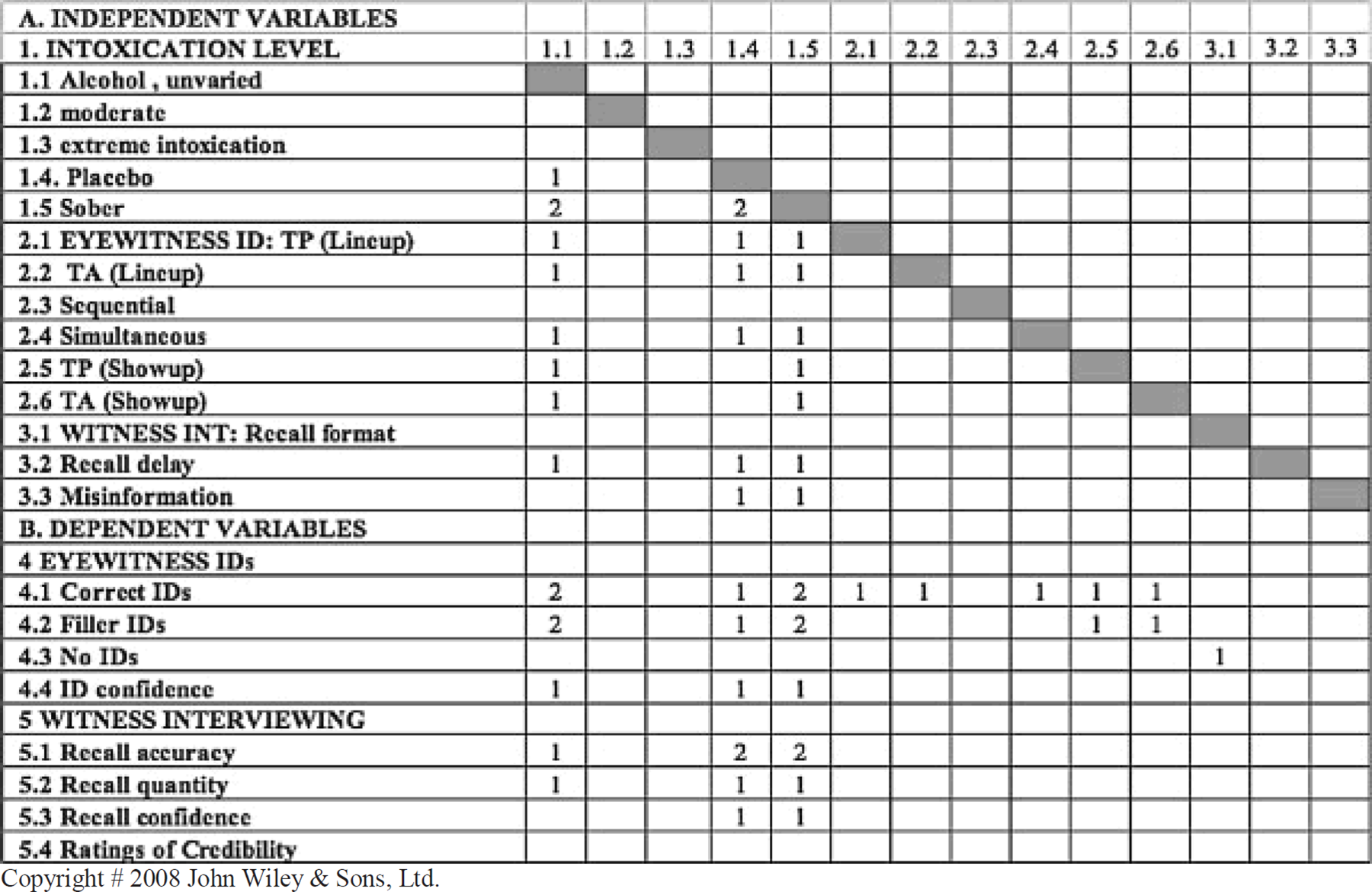
As specified by Malpass and colleagues (2008), there are five steps in constructing a study space matrix: 1) identify the studies (which is also part of the meta-analysis); 2) construct for each study a matrix which shows the independent, method, procedural, and dependent variables; 3) identify and incorporate into the matrix constant variables; 4) enter a ‘1’ in the matrix cells corresponding to an intersection of study attributes for each study; and 5) merge the individual study matrices into one matrix. Malpass et al. (2008) conducted a study space analysis for eyewitness identification line-up procedures, and for the effects of alcohol on witness memory. The latter matrix is attached below as an example of a completed matrix.
4g. Treatment of qualitative research.
Qualitative studies will not be eligible for the study space and meta-analyses because they do not meet the experimental or quasi-experimental criteria. However, when such studies are located in our extensive search, we will make determinations about their possible relevance in identifying additional outcome measures, in developing future research questions, and in the interpretation of results. These determinations will be made by logging and coding the studies for content, authors' conclusions, etc. A discussion of any qualitative studies identified in our search will be included in the final report.
5. Timeframe
The below timeline of approximate dates will be adhered to as closely as possible:
6. Plans for Updating the Review
The review will be updated every three to five years. The lead reviewers and their students will be responsible for updating. Pending effectiveness, the same search and data coding methods will be employed.
Footnotes
7. Acknowledgements
Not applicable.
8. Statement concerning Conflict of Interest
None of the reviewers have financial conflicts of interest.
Professor Meissner has evaluated the deception detection and interviewing/interrogation literatures, including conducting several meta-analyses in this and other areas (Meissner & Brigham, 2001a, 2001b; Meissner & Kassin, 2002; Meissner, Sporer, & Susa, 2008; Mitchell, Haw, Pfeifer, & Meissner, 2005). He has also co-organized a conference sponsored by the American Psychological Association on investigative interviewing. This conference developed into a co-edited volume entitled, Interrogations and confessions: Current research, practice, and policy recommendations, which was published by the American Psychological Association (Lassiter & Meissner, 2010).
Professor Redlich has reviewed the literature on U.S. police and military interrogations, most notably as part of the American Psychology-Law Society's scientific review committee to write a “white paper” on police interrogations and false confessions (see Kassin et al., 2010). This review (as well as others; Redlich, 2007; Redlich & Meissner, 2009) provide the basis for her interest in proposing to conduct this systematic review.
Dr. Susan Brandon (Acting Director for the Behavioral Science Program, Defense CI & HUMINT Center, U.S. Defense Intelligence Agency) and Dr. Sujeeta Bhatt (Research Scientist, Defense CI & HUMINT Center, U.S. Defense Intelligence Agency) will also collaborate on the project as reviewers. Both were instrumental in a recent review of the U.S. Army's FM 2-22.3 (Justice, Bhatt, Brandon, & Kleinman, 2009). Drs. Brandon and Bhatt have knowledge and access to reports of projects funded by the U.S. Government (as well as the United Kingdom) relevant to this proposed topic. They will also participate in the reviewers meeting to be held in February 2010 at the University of Texas at El Paso.
10. Tables and Figures
Table 1 from Malpass et al., 2008
Generic study space structure
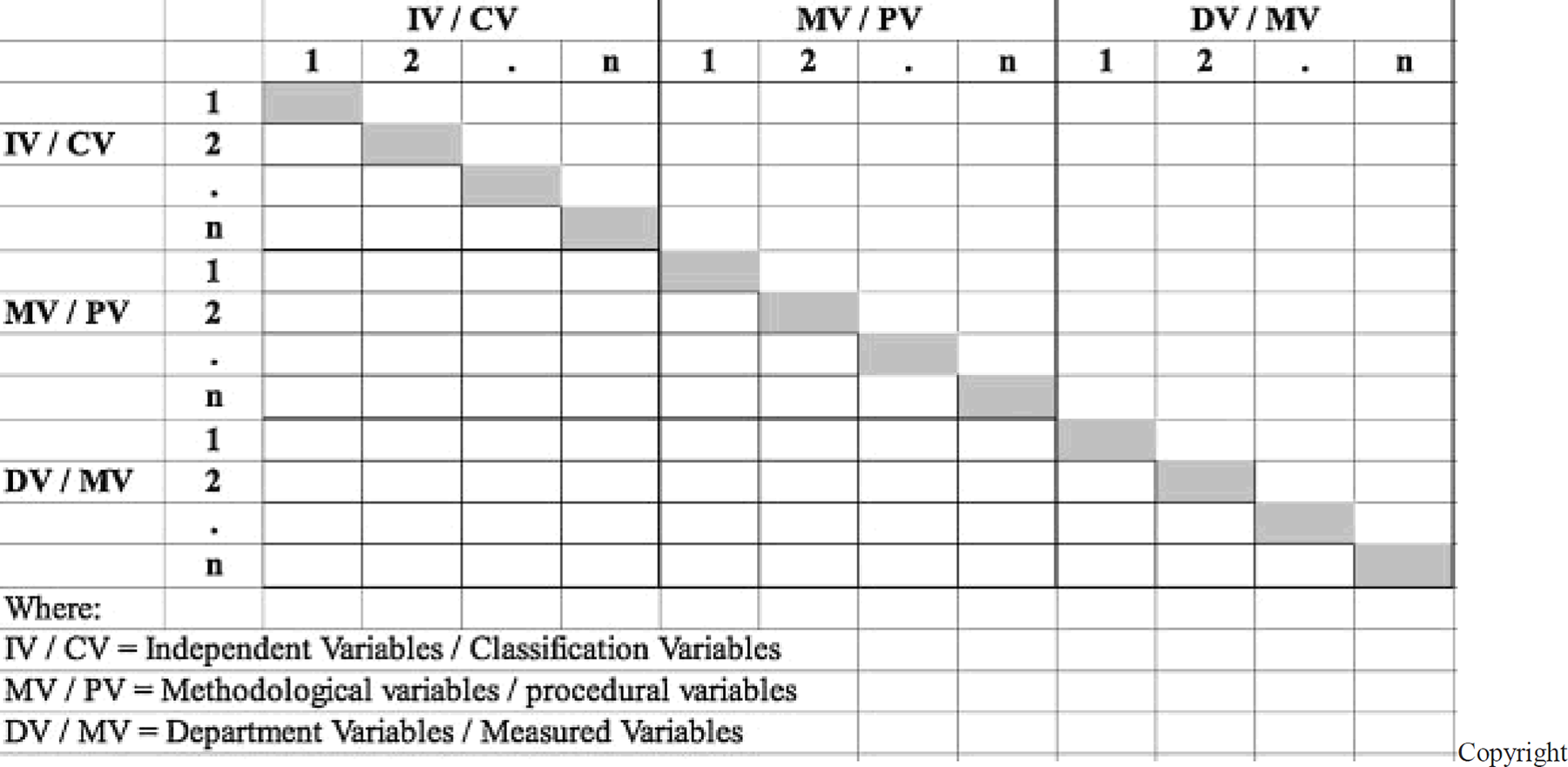
Table 3 from Malpass et al., 2008
Completed study space for alcohol and eyewitness testimony
Appendix A
1
We believe that a review of interviewing styles on the effectiveness of eliciting accurate and complete information from victim/witnesses of crime combined with a review of suspects is inappropriate. The motivations of the individual being questioned and the resultant efficacy of interviewing styles are distinct for these groups. Further, we believe the more pressing policy issues relates to persons suspected of crimes.
2
PEACE stands for