







Abstract
Indiana University–Purdue University Indianapolis has joined campuses across the nation in identifying and assessing student learning outcomes. With its twenty schools, diverse populations, and multiple goals, how this urban institution managed to organize much of its work around six learning principles is a tale of both caution and triumph.
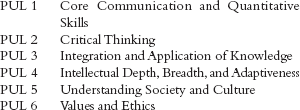
IT'S THE FIRST DAY of fall 2005 classes at Indiana University–Purdue University Indianapolis (IUPUI). As Sherri Jones makes her way up the stairs to her learning community class, she sees, painted on the wall in large red letters, the following phrases: Core Communication Skills and Quantitative Skills; Critical Thinking; Integration and Application of Knowledge; Intellectual Breadth, Depth, and Adaptiveness; Understanding Society and Culture; Values and Ethics.“Where have I seen that before?” she muses. In class, as she pulls her books from her backpack, she comes across the laminated bookmark she received at orientation.“Oh yeah, it's those principles we heard about.” As class begins, Professor Sabol hands out the syllabus for the course, and right at the top, Sherri sees the principles listed again, cross-indexed with the goals of the course. “These principles must be important,” she thinks. Then she notices the classroom walls, where again the principles are painted in bold red letters. The voice of Professor Sabol brings her back to the work of the class:“For your first assignment, as you write your academic goals for your education at IUPUI, you will be enacting several of the Principles of Undergraduate Learning—most notably Core Communication Skills, but also Critical Thinking, Integration and Application of Knowledge, and, quite possibly, Values and Ethics. Can anyone tell me how these principles might relate to writing about your academic goals?”
Leaving class, Sherri notices a poster on the door, reiterating the Principles of Undergraduate Learning (PULs). “Is this what I am going to be learning at IUPUI?” she asks herself on her way to a student group meeting to plan Unity Day. As Sherri turns her attention toward Unity Day, she recalls from her syllabus that participating in this event, which involves a variety of multicultural activities and celebrations, enacts PUL 5, Understanding Society and Culture.
While Sherri's experience compresses considerable exposure to the Principles of Undergraduate Learning into one class and one day, it represents a very likely possibility in this particular professor's class and in those of several other IUPUI faculty members. Sherri's experience is at one end of a continuum. At the other end are classes and cocurricular experiences where mention of the PULs is notably absent. Even so, each year, more classes and other student experiences do begin in a manner similar to this one—and not just in students' first year. While integration of the PULs is definitely uneven, they are becoming increasingly ingrained in the curricular and cocurricular culture of IUPUI. We are still learning to enact our intention that the PULs will encourage students to become more intentional and reflective about how courses and cocurricular experiences work together to contribute to intellectual development and learning. This article tells the story of how the PULs came to be a central feature of undergraduate education at IUPUI.
Deciding to Take a Road Less Traveled
THE TASK of designing and implementing a coherent institution-wide program of general education seems one of the most formidable challenges we face in higher education. In fact, faculty and staff members on many campuses elect not to confront this issue at all. They recognize how divisive it can be for scholars from various disciplines to try to reach agreement in defining the knowledge and skills all students should develop as a foundation for the major and for lifelong learning. So they simply provide a list of introductory courses in the humanities, sciences, and social sciences and require students to take two or three courses from each category. Typical cocurricular experiences are equally atomized. A primary justification for this approach is that students will be exposed to a variety of ways of knowing and will make their own meaning of the collective experience.
IUPUI confronted the challenge directly by creating collaborative opportunities among colleagues from more than twenty schools representing fields as disparate as medicine, music, and mechanical engineering, engaging them in discussions about the meaning of undergraduate education. Between 1990 and 1997, committees were appointed, reports were written, exceptions were taken to one or more aspects of the content, and the sequence had to be repeated with a new set of committees. In the midst of this process, in 1992, a team representing the North Central Association of Colleges and Schools (NCA)—our regional accrediting body—suggested that this approach to decision making about general education was not promising: it would take too long to complete, and indeed, agreement might never be achieved. The assertion of the team that completing the process would take time proved correct, but finally, in 1998, the Faculty Council approved the six Principles of Undergraduate Learning (PULs).
IUPUI faculty members took another road less traveled in deciding to integrate the PULs with learning outcomes for each major, thereby enabling students to practice and strengthen these general skills throughout their years at IUPUI. This integration might have taken another decade, but conversation about the principles was so widespread and had been under way for so long that nearly everyone on campus had heard of them by the time they were approved. Some schools with disciplinary accreditors to satisfy, notably Nursing and Allied Health Sciences, had already begun to integrate the PULs with their own curricula by 1998, and most others were considering ways to do so by the time the principles were formally adopted.
Though we are still some distance from our goal of establishing a robust scholarship of teaching, learning, and assessment at IUPUI, we are making progress. We can point to a healthy measure of faculty and staff activity related to providing students with a strong foundation of knowledge, skills, and values, and we can point to work on continuing to improve our practice through assessment and reflection. We turn now to how these PULs were developed and implemented and how they are being woven into the fabric of faculty work and student learning.
Creating Principles to Guide Our Unique Approach to General Education
PRIOR TO 1991, general education curriculum had been the responsibility of each school. In 1990–91, campus leaders established the Commission on General Education to oversee development of a centrally coordinated approach to general education for IUPUI. In its earliest deliberations, the commission identified three possible approaches to general education:
The distributive approach, defining required areas and specific requirements within those areas
The core curriculum approach, involving the development of a set of courses required in all majors
The process approach, focusing on student learning experiences and coordinating those experiences across disciplines to provide all students with knowledge and skills considered appropriate by the faculty
Within the distributive approach that the campus had been employing, there was no guarantee of commonality of general education experience. The School of Liberal Arts and the School of Science had already explored and then rejected a core curriculum because they could not agree on which courses needed to be included; every department wanted to protect its enrollment-based tuition income. The commission therefore chose the process approach, not because it seemed most likely to succeed but because it seemed least likely to fail on a campus as diverse as IUPUI.
A process approach to general education necessitates widespread and ongoing involvement of faculty. Consequently, within the first two years of its formation, the commission involved more than two hundred IUPUI faculty in the following events:
First Annual Symposium on General Education (April 1992): More than 150 faculty attended and developed a list of core values that most participants agreed should be included in any general education program.
Commission Report to the Faculty (September 1992): This report synthesized the core values identified by the faculty and set up a faculty study group for each core value, involving almost two hundred participants.
Faculty study groups on general education (1992–1993): These study groups explored the pedagogical and curricular implications of their respective core values and developed a considerable body of teaching and evaluation strategies and suggestions.
Second Annual Symposium on General Education (April 1993): More than two hundred faculty members attended in order to hear presentations from each of the study groups and provide feedback on their work.
During the summer of 1993, the commission synthesized the two years of deliberations by faculty and administrators and, based on the conclusions of the faculty study groups, developed a general education approach that supported IUPUI's mission and a plan for reconciling the process approach with NCA's recom-mendations. An initial set of eight Principles of Undergraduate Learning (Core Communication and Quantitative Skills; Critical Thinking; Intellectual Adaptability; Self-Awareness; Collaborative Learning; Engagement in Cocurricular Activities and Learning; Understanding Culturally and Ethnically Diverse Societies; and Service Beyond the Self) resulted from these deliberations. Although a few schools and academic units began to integrate these principles into their curricula, most schools did not accept them in this first iteration.
In 1994, the Council on Liberal Arts and Sciences (CLAS) was formed, initially to explore the possibility of a merger between the School of Liberal Arts and the School of Science. When CLAS realized a merger was not possible, it turned its attention to curricular commonalities and, in 1995–96, began work on a common core curriculum. During these conversations, the deans of the two schools, focusing primarily on academic content, condensed the eight principles into five: they moved Collaborative Learning into introductory comments about implementing the principles; they removed Service Beyond the Self (service learning) as a separate principle, given that the campus was conceptualizing civic engagement as a major campus initiative that would involve several of the principles, but they included the requirement “to further the goals of society” in Integration and Application of Knowledge; similarly, they assumed that a major campus focus on cocurricular learning would embrace all of the principles and so eliminated Engagement in Cocurricular Activities and Learning as a separate principle. While not everyone was comfortable with these changes, CLAS members eventually agreed on this modified set of five principles as the foundation for its core curriculum and began to call its proposed curricular structure “The Principled Curriculum.” This proposed curriculum, based on five principles of undergraduate learning, was approved by the respective faculty assemblies of the School of Science and the School of Liberal Arts in 1998.
Students learn about the Principles of Undergraduate Learning during their first interactions on campus.
Concurrently, many campus committees and academic units were discussing the principles. The General Education Advisory Committee was formed in 1994 to replace the Commission on General Education, and it began work on having the principles approved by the whole campus. In the course of these conversations, many faculty proclaimed the need for Values and Ethics (which had been embedded in Understanding Society and Culture) to be an explicit, separate principle. In early 1998, the five PULs became six;“Understanding Society and Culture” and “Values and Ethics” became discrete principles. These six principles—the current PULs—were approved by the IUPUI Faculty Council in 1998:
Exploring Ways to Integrate the Principles into the Curriculum
WHEN THE PULs and the Principled Curriculum for Liberal Arts and Science were approved in 1998, faculty leaders knew that the next step was to make explicit the integration and role of the PULs in undergraduate education across the campus and that the assessment of student learning would provide an excellent mechanism for ensuring that this integration was taking place. Thus, the Program Review and Assessment Committee (PRAC), which had been formed in 1994 with two faculty members from each school to initiate and strengthen assessment of student learning in the major, became the campus body for shepherding the PULs. PRAC encouraged schools to document the integration of the PULs in each academic major and asked for evidence of student mastery of the PULs in the annual report submitted to PRAC by each school (see http://www.planning.iupui.edu/prac/prac.html).
The next step was to gather specific information on how the PULs were being taught, learned, and assessed in each school. In spring 2000, three faculty associate positions were created to collect and collate this information campuswide. These faculty associates met with every school and academic unit serving undergraduates to determine how their curricula advanced student understanding of the PULs through specific course and program requirements. Their work resulted in the document Phase I of a Study on Student Learning: A Working Document for the Campus (http://www.iport.iupui.edu/teach/_matrix.asp).
Also during 2000, three summer institute teams— the Diversity Inquiry Group, the Asheville Institute Team, and the American Association for Higher Education (AAHE) Summer Academy team—met to explore three different aspects of the undergraduate learning experience at IUPUI. The Diversity Inquiry Group began work to produce an annotated bibliography on pedagogical strategies, course and curriculum approaches, and classroom behaviors that seem most effective in creating a welcoming climate for students. In essence, they were finding ways to integrate two of the six PULs into their work:“Understanding Society and Culture” and “Values and Ethics.” The Asheville Institute Team identified a set of courses that is now being called “the empirical core”—the courses, such as writing and oral communication, that are required by most schools and academic programs. What they discovered, not surprisingly, is that this empirical core could be very easily mapped to the PULs. The AAHE Summer Academy team identified twenty-five “gateway courses” (those most commonly taken by students during their first two semesters at IUPUI, a list very similar to the “empirical core,” but derived from student choices rather than from stated curricular requirements), focusing on ways to improve the learning experiences in these courses. One suggestion was to make the coherence of the general education structure more apparent to students by focusing on the PULs as the foundation for learning. That idea led to another general education initiative—implementation of the PULs—as well as to documentation of student learning in relation to the PULs—the IUPUI Student ePortfolio.
The preceding historical overview presents a seemingly logical, focused, and intentional picture of what was, in essence, a concurrent series of initiatives involving sincerely committed faculty, but evolving almost independently of one another, with very few faculty or administrators aware of the complete picture. It was also evident at this stage that the intended cam-puswide integration of the PULs with our civic engagement initiative and a campus cocurricular learning initiative was not happening. Implementation involved not just putting ideas and decisions about the PULs into action but also bringing the disparate initiatives, each with a distinct vision of undergraduate learning, together into a unified program. That was, indeed, a challenge.
Implementing, Unifying, and Evaluating the Principles
ALTHOUGH 1998 heralded the approval of the Principles of Undergraduate Learning, there was no language in the approved document stipulating how they would be implemented, who would ensure that the PULs were explicitly integrated into the curriculum or cocurriculum, or how such efforts would be evaluated. And yet, with a 2002 accreditation visit looming, we knew that we had to find ways to demonstrate that these PULs were being explicitly integrated and evaluated throughout the undergraduate learning experiences of our students. This section focuses on the diverse strategies we used to implement the approved principles throughout the campus.
After the faculty associates had interviewed faculty and administrators in every school on campus and had reviewed sample syllabi and course materials, they developed a matrix showing how each PUL was defined in each school, what forms it took in coursework, and which courses had responsibility for providing opportunities to learn about the PUL and for demonstrating that learning in relation to the discipline. The matrix also displayed how proficiency in each PUL was evaluated and how the results of the evaluation were used to improve curriculum and instruction. Professional schools with external accrediting bodies, such as the School of Nursing and the School of Engineering and Technology, provided rich information about the integration of the PULs into the curriculum, and their resulting matrix forms were full and complete. On the other hand, schools that did not have external accrediting bodies, such as the School of Liberal Arts and the School of Science, displayed a disconcerting number of blank spaces in the matrix. The problem was not so much that the schools were negligent but rather that they were not explicitly documenting how, when, and where in the curriculum the PULs were being taught, learned, and assessed.
Concurrently, IUPUI was developing an electronic institutional portfolio (iPort) as part of the Urban Universities Portfolio Program and was grappling with how to make optimal use of the electronic medium to provide evidence of learning. The project director for iPort conceived the notion of creating an interactive matrix on iPort, using the information about the PULs provided by the different schools. Using the interactive matrix, anyone visiting iPort could enter a particular school and a particular PUL and learn exactly what the school was doing in relation to that PUL. It took only a couple of demonstrations to deans and administrators—in which the deans called out which schools and PULs they wanted to see—for the matrix to show vividly which schools were successfully integrating the PULs and which were not. Within a few weeks, the impetus to integrate the PULs into the curriculum suddenly became a priority. Within a few months, schools with little data or with vague information about the PULs were developing plans to more explicitly integrate the PULs into the curriculum in ways that could be documented and assessed.
As previously noted, the NCA team that visited IUPUI in 1992 did not find promise in the approach to general education then under way at IUPUI. A very different conclusion was reached by the 2002 NCA team. In recommending reaccreditation for another decade, this team added a section titled “Recognition of Significant Accomplishments, Significant Progress, and/or Exemplary and Innovative Practice” and included this comment:
As a further example of IUPUI's dedication to the connections between Teaching and Learning, the six PULs seem to have served as an excellent focal point to redirect perspectives regarding the role and purpose of general education in the curriculum, and provide a profile of what the institution expects of its graduates … These “principles-based” learning outcomes reach toward a broadly-based education intended to serve students beyond their first or second jobs and throughout their lives. Furthermore, despite the difficulty of implementing the PULs and measuring student achievement of them, the institution has demonstrated an interest in assessing them. Although much remains to be done, the team was impressed by the dedication and seriousness with which IUPUI has approached a daunting task.
Weaving the Principles into Cultures Throughout Campus
WHILE THE COMMENTS of the NCA team acknowledged our efforts and praised our plans for using the PULs as our basis for general education, they also acknowledged that all of our plans and strategies were still in their earliest stages and were not uniformly implemented throughout the campus. Our task was clear: we had to weave the PULs into the fabric of faculty and staff work and student learning in order to achieve our goals for general education and undergraduate learning. This work is still in progress, with diverse initiatives coalescing incrementally. In this section, we describe our major initiatives.
University College plays a key role in introducing our students to the PULs. As our opening vignette showed, students learn about the principles during their first interactions on campus. Orientation leaders introduce all entering students and their family members to the PULs. Orientation is centered in the University College Building, which is also the home of the Student Activity Center. Classrooms and stairwells have the principles painted as a frieze high on the walls. Students, from orientation through their first-year seminars (the key courses in the learning communities, which serve most entering students), thus encounter the principles many times. Faculty had some initial conversations about whether it made sense to have the PULs on the wall. They concluded that it is just as appropriate to highlight the PULs in this way as it is to have “Go! Fight! Win!” on the walls of locker rooms or corridors leading to athletic fields.
The first-year seminars, organized by students' majors or intended majors or designed for exploratory students who have not yet declared their major, follow a common template (http://www.slashtmp.iu.edu/pub-lic/download.php?FILE=keeckert/619148mdyQs) rather than a common syllabus. The targeted student learning outcomes for the seminars include Core Communication Skills and Quantitative Skills and Critical Thinking. The instructional teams that teach the seminars use varying approaches in introducing the PULs. Many use a scavenger hunt, which has students work in collaborative groups to seek out examples of the PULs in their course readings and assignments and in cocur-ricular activities. One faculty member provides single-use cameras with which students can photograph examples, such as groups of ethnically diverse students involved in an activity (http://www.slashtmp.iu.edu/public/download.php?FILE=keeckert/84416KeOUhi). Others require group projects that center on the PULs (http://www.slashtmp.iu.edu/public/download.php?FILE=keeckert/35838azGh4H).
Cohorts of students co-enroll in the first-year seminars and other courses and, in more than twenty cases, are included in interdisciplinary, theme-based sets of courses called “thematic learning communities.” Faculty members in each course collaborate to introduce students to the PULs across the disciplines.
Through both curricular and cocurricular activities in these introductory semesters, we set the stage for students to become intentional and reflective about what they are learning throughout their undergraduate experience, moving from recognition of the words of the PULs and what at first is often rote repetition, without depth of understanding or interpretation, to deeper, more sophisticated understanding and application of the concepts.
In order to track this progress, the Center on Integrating Learning (COIL) was established to develop and implement a student electronic portfolio (ePort). ePort was heralded in the NCA Higher Learning Commission report as a major resource for documenting and evaluating student learning of the PULs in relation to the major. While ePort has many features, the PUL learning matrix has been developed to provide optimal opportunity to assess student progress in the PULs.
The learning matrix provides access, in one screen, to the entire undergraduate experience of each student in relation to the PULs. The PULs form the left column of the matrix, and student progress forms the top row. As students complete work in their major, they upload graded assignments that demonstrate knowledge in the major and proficiency in one or more of the PULs. Faculty committees have developed learning expectations for each cell (see the description of communities of practice later in this section), and a process for writing and reviewing reflections has been established. Students are also provided opportunities to document cocurricular learning beyond the classroom that applies, enhances, or integrates their curricular learning.
A completed matrix will provide students, faculty, departments, and the campus with a rich source of information about growth and achievement of the PULs in relation to academic and professional programs. That's the theory. That's the goal. The reality is that at IUPUI, as at most institutions, academic success is defined in terms of courses completed and grades on a transcript. Looking at broad and enduring goals for learning, such as critical thinking, values and ethics, or understanding society and culture, across a range of courses does not come naturally to most students or even to most faculty members. While faculty and students both appreciate the importance of broad goals for learning, their first reaction is that documenting growth and achievement in the PULs is additional work without space in established courses for that additional work to take place. A considerable reorientation, as well as additional time, resources, and collective commitment, is required in order to find ways that both course or program goals and broader goals for learning can be explicitly taught, learned, and assessed.
Consequently, COIL is moving slowly, working collaboratively with the Center for Teaching and Learning (CTL) and with faculty who are willing early adopters because they understand the importance of integrating enduring goals for learning with discipline-specific content and because they see the value of ePort in supporting this integration. The two centers are also tying internal faculty development grants to integration of the PULs into courses being developed or transformed with faculty development support, and they are providing mini-grants to faculty willing to work with the ePort PUL learning matrix.
COIL also oversees the development and support of a community of practice for each PUL. The collective goal of these communities is to explore intellectually and practically what the PULs mean for teaching, research, and service within IUPUI and the community at large. Each community is composed of faculty and staff from several disciplines and schools across the campus. During the 2004–05 year, each community worked to develop a set of expectations for learning at introductory and intermediate levels for their respective principle. In addition, several of the communities developed model assignments that explicitly integrate the expectations for learning with discipline-specific course concepts. These may be reviewed on the COIL Web site (http://www.opd.iupui.edu/COIL).
In addition, COIL oversees the Scholarship of Teaching and Learning (SoTL) program and supports SoTL projects exploring the integration of the PULs
into disciplinary curricula. Some projects investigate the impacts on student engagement, performance in the major, and retention; others look at syllabi and course assignments to analyze how faculty explicitly carry out the integration; still others look at student perspectives on this integration and its influence on their attitudes about learning at IUPUI. PRAC supports this SoTL initiative by providing funding in order for faculty to assess the impact of their approaches to integration.
The Center for Research and Learning (CRL), which not only oversees but also is a catalyst for undergraduate research across the campus, has also articulated specific requirements for integrating the PULs throughout all of their undergraduate research programs. A recent analysis of undergraduate research projects conducted by the CRL director indicates that every project integrates at least one—and often more than one—of the PULs. Plans are being developed by COIL and CRL for students engaged in undergraduate research to demonstrate their improvement in the PULs on ePort.
The Center for Service and Learning (CSL) is also collaborating with COIL to integrate the PULs across the curriculum in relation to our civic engagement initiative, as the deans intended when they removed Service Learning as an individual principle. As stated in its mission statement, CSL collaborates with other campus units; develops community partnerships; coordinates and evaluates programs; and promotes service, service learning, and civic engagement to further the academic and public purposes of the university. In keeping with this mission, CSL seeks to link its service, service learning, and civic engagement programs to the PULs. At one level, this linkage can be seen in the programmatic values of CSL, which state that CSL values programs that
Are innovative, cohesive, and educationally meaningful (PULs 3 and 4)
Change lives through a commitment to the ethic of service (PUL 6)
Improve social conditions in the community (PUL 5)
Involve reflective practice that informs participants (PULs 1 and 2)
Build on campus and community assets (PUL 5)
More specifically, CSL has promoted the PULs through its internal grantmaking activities, by requiring that recipients intentionally link their civically engaged teaching and learning strategies to the PULs. CSL staff members have also participated in several of the communities of practice and have contributed to faculty learning communities. For example, as a result of his work with the Faculty Learning Community on Civic Participation, the coordinator of the Office of Service Learning is developing a rubric that links civic engagement outcomes, learning activities, and assessment strategies to the PULs. CSL has recently appointed a senior scholar to deepen and extend reflective practices as an assessment strategy that can be used at classroom, program, and institutional levels of analysis. This project has been expanded to include the use of reflection products as artifacts for ePort.
Finally, the Office of Campus and Community Life has developed a wide range of activities that explicitly refer to the PULs and that intentionally address each of them. Examples of cocurricular programs that support the PULs include the following:
Cultural heritage months (Hispanic Heritage Month, GLBT Awareness Month, Native American Heritage Month, Black History Month, Women's History Month, Asian Heritage Month) support Understanding Society and Culture. Cultural programs and diversity training workshops challenge students to analyze information and ideas from multiple perspectives, explicitly supporting Critical Thinking (http://www.life.iupui.edu/culture/index.Asp).
Leadership development programs include workshops and community service activities to develop Values and Ethics in civically minded students (http://life.iupui.edu/volunteer/index.Asp). Leadership workshops provide opportunities for students to apply new knowledge to specific issues and real-world problems, reinforcing Integration and Application of Knowledge (http://life.iupui.edu/leadership/index.Asp).
Campus and Community Life houses more than 160 undergraduate student organizations, engaging students in Core Communication Skills and Quantitative Skills as they develop and refine their leadership skills as well as increase their opportunities to understand diverse societies and cultures (http://life.iupui.edu/groups/index.Asp).
Identifying Challenges and Next Steps
THERE ARE MANY CHALLENGES to our PUL-based approach to undergraduate education. Too often, the course of least resistance is a set of distribution requirements. That was the most frequent road taken for most of us who populate the academy today, and there is always some energy for moving backward to such an approach. Particularly in an era when students transfer and assemble credits from multiple institutions, we believe campuses would better serve students by stressing students' learning and by encouraging students to become more intentional and reflective about how their courses as well as their work and cocurricular experiences are contributing to their intellectual development and learning.
We believe that involvement of students, faculty, and staff with the PULs, particularly as we expand the use of ePort and the communities of practice, will continue to grow. Students will come to understand how being able to demonstrate what they know and can do in terms of the specific learning outcomes will help them both in their undergraduate years and as they apply for jobs or for graduate study. Their increasingly sophisticated ability to describe their learning gives them a strategic advantage, and students understand that. Too often, undergraduate education, particularly the typical “gen ed” courses, is a matter of memorize, pass the test, sell the book, and do a memory dump. Instead, the PULs help students put their learning in context and help them make it their learning.
Faculty committees are currently reviewing the 1998 articulation of the principles. These discussions have gained further credibility and engagement among the faculty as the result of the PULs being awarded both the 2006 Hesburgh Certificate of Excellence and the 2006 CHEA Award for Student Learning Outcomes. In an era of increasing globalization, we have some sense that we might appropriately bring more attention to the international aspects of education. A very early iteration of the PULs included physical development of students. While we do not foresee implementation of mandatory physical education courses, it may be that continuing dialogue, particularly on a campus where we stress the life sciences, will someday result in an articulation of the importance of health and wellness. It is not our place to decide what the next iteration of the PULs might be, but we are certain that the continuing changes in our students, in society, and in our understanding will result in some revisions of the PULs. If that happens, we can repaint the walls.