







Abstract
The difference between caring for and caring about students
“OUR STUDENTS are very content here; they're very happy,” a student support educator at a prominent private institution once said to me in a matter-of-fact tone. He continued, “But because of our hands-on approach, our students leave here without the competencies they need to be successful in life and work. We take good care of them, but I'm not sure that's the same as caring about them. If we did, we'd have a completely different set of expectations.”
Underlying these comments was an assumption that higher education is—or should be—a caring, helping profession but that education practitioners and decision makers sometimes confuse caring about students with caring for students. Colleges and universities often take good care of students but consequently do not require or allow students to become competent, productive contributors to their communities, workplaces, and families. The research of Todd Davis and Patricia Murrell in the 1990s indicated that student responsibility is the key to all learning; learning is only possible when students become accountable for their own learning and behavior. In effect, educators do students a disservice when caring for students precludes students from taking responsibility. Caring about students without becoming their caretakers centers on the difference between generation and emanation.
In the medieval fantasy Baudolino, Italian novelist Umberto Eco's characters distinguish between emanation and generation:“You see that bird? Sooner or later it will generate another bird through an egg…. But once generated, [the bird] lives on its own, survives even if its mother dies. Now think, on the contrary, of fire. Fire does not generate heat; it emanates it. Heat is the same thing as fire; if you were to put out the fire, the heat would also cease” (p. 428).
Generation is production: bringing something new into existence. To generate is to create. A parent generates a child, but the child at some point will continue without the parent. An acorn that falls from an oak tree generates a new tree that is independent from its source and lives on long after the original tree has fallen and the acorn has disintegrated. A teacher generates learning through instruction, but the student at some point must apply the learning independent of the teacher. Generation is an act of influence.
Emanation, on the other hand, is sending forth from a source: flowing out. To emanate is to radiate. A fire emanates heat, but the heat disappears when the fire goes out. A river emanates from a spring or a glacier, but the river dries up if the source is extinguished. A charismatic leader exudes charm and magnetism but fails to develop the leadership capacity of his or her followers. Emanation is an act of effluence.
One way to distinguish between generation and emanation in higher education is to compare the characteristics of each, as shown in the following table. It becomes apparent that the focus of generation is on the recipient of the programs and services (students), while the focus of emanation is on the provider of the programs and services (practitioner).
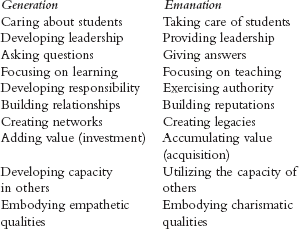
Should higher education focus on generation or emanation—or both? Are the outcomes that matter in higher education—things like learning, student development, citizenship, and character—created or radiated? Are our students affected most by our influence or our effluence?
There are times when emanation may be necessary. An incapacitated student may need someone better able to make a decision in a crisis. Prior to the development of leadership competency, a group or an individual student may turn to a student development educator for help, information, or insights. Unless a department head accumulates certain resources, it may be difficult for a group to add educational or developmental value for students. By nature and, to some extent, by design, the higher education field draws a good number of outgoing, charismatic people. Hence, some emanation is inherent in the learning enterprise. Still, overreliance on emanation will not result in the independence and interdependence in students that society desires.
Although emanation has its place, the ultimate goal of higher education should be generation. Generation requires a transformation from being a student-centered organization to becoming a learning-centered organization, if we are truly in the learning business. The difference may be subtle yet critical. A student-centered organization can all too easily focus on taking care of students, which results in reliance rather than self-reliance. A learning-centered organization involves all constituents in the generation of programs and services designed to produce learning and personal development. In such a scenario, everyone learns. The student is still the object of intervention, but learning is the objective.
Educated, enlightened citizens are the products of generation. After an individual leaves the institution, the results of his or her educational experience continue to survive and thrive. If the institution has done its work well, the individual will continue to learn throughout a productive and meaningful lifetime. In “The Student as Customer Versus the Student as Learner,” educator James Groccia indicates that a consumer mind-set in higher education is misguided because learning cannot be consumed; it can only be produced. Education requires the learner to invest both time and effort in the learning enterprise, and this notion reinforces the concept of generation. Faculty and staff members can generate the learning process, but the student must carry the process forward to its (hopefully) logical conclusion.
To help students reach their educational goals, faculty and staff should take steps to transform programs and services to make them more generative.
First, educational programs and services should be based on desired outcomes. Don Creamer, professor of educational leadership and policy studies at Virginia Polytechnic Institute, reports that too many goals and objectives in higher education organizations are written as activities for staff rather than as outcomes for students. Changing the focus from departmental efforts to student outcomes helps practitioners concentrate on them (student learning and development) rather than us (faculty or staff interests). Student capability, rather than staff productivity, becomes the gauge of organizational success.
Second, educational outcomes should lead to higher levels of learning. Knowledge for the sake of knowledge is valued by many scholars, but the construction and transmission of knowledge is not the highest purpose of higher education. The product of our generative efforts should be the capacity of our students to use their acquired knowledge to effect change, contribute productively to their communities, and, ultimately, to generate new knowledge. In the process, students assume responsibility for their learning, their behavior, and their lives. Our programs and services must convert intelligence into competence; contributing to what students know will never be as powerful and consequential as discovering what students can do with what they know.
Third, generation requires innovation. Experimentation and risk are necessary components in bringing new things to life. To generate is to create, and to create is to take chances. Higher education pays excellent lip service to the value of risk taking, but we have to really mean it for our students to believe it. We must increase our tolerance for failure, model appropriate risk management practices for our students, and develop in them the capacity to try, fail, and try again.
If we truly care about students, we will employ outcomes, competency, and innovation to generate programs and services that are learning-centered and that facilitate student responsibility. The things we generate in higher education—those that are meant to last—don't require our continued presence. They require our eventual withdrawal. Otherwise, they are merely emanations.