






Abstract

OVER THE PAST FIFTY YEARS, a great deal of attention has been paid to what is known as the massification of higher education in the United States. As Roger Geiger has pointed out, a confluence of factors, including proliferation of student financial aid options, growth of the college-age population, and increased demands from the corporate world for a more highly educated workforce have resulted in an increase in the number and diversity of institutions serving the needs of a larger, more diverse group of students. During those fifty years, colleges and universities have faced challenges as varied as increasing the physical space of a campus to accommodate growing student enrollments, controlling costs to students while still meeting students' demands for services, and learning how to effectively serve a growing population of students who are members of underrepresented groups defined by race, economic status, gender, or sexual orientation. The majority of research on this final challenge has focused on racial/ethnic and gender minorities and economically disadvantaged students, while a smaller, though not insignificant body of work has focused on sexual minorities.
Massification has also presented compelling issues for students as they begin to think about college. Whereas in the past, college attendance was reserved mostly for the children of upper-class, well-educated families, increases in the number and variety of institutions and the availability of aid programs, among other factors, now make the option to attend college available to an increasing number of different types of students. These students are faced with the daunting task of considering which college to attend. Having many options to choose from is not necessarily a bad thing, but navigating the process of selecting a college can be overwhelming to even the most prepared student.
The College Choice Process
STUDENTS approach the process of selecting a college from various backgrounds and levels of experience. Confronted with a list of more than 3,000 colleges and universities, they must pare that list down to a select few institutions to which they intend to apply and eventually choose just one of the schools to attend. The final decision carries potential implications for the student's success in college and beyond. As John Braxton, Nick Vesper, and Donald Hossler pointed out in 1995, for students from at-risk backgrounds (including GLBTQ students) the decision can also make the difference between persisting and dropping out, or as Anthony D Augelli noted, it can mean the difference between living and dying.
Considering the gravity of the college choice decision, especially for at-risk students, it is important to understand the process they go through to choose a college. In 1987, Donald Hossler and Karen Symms Gallagher identified three stages of college choice: predisposition, search, and choice. Predisposition refers to students' preconceived notions of college attendance. Having family members that previously attended college and one's belief that one is academically capable of being successful in college are examples of factors that affect predisposition. The search stage is defined as the period of time during which students research institutions and narrow their list to only those to which they intend to apply. Students' choices during this time can be affected by various factors, including peer influence, university rankings, or cost of attendance. The final decision of which institution to attend is made during the choice stage. At this point, the student has received and processed enough information to make the choice of one college over the other available options. These stages clearly define a linear process that students complete when selecting a college—a process that those of us who have attended college are likely quite familiar with. Our colleagues working in high school counseling offices and college admissions offices encounter students every day who are working their way through this process. The students they work with come from myriad backgrounds, bringing many unique perspectives to the process. Understanding what matters most to students can lead to improved services and higher levels of student retention and success in college.
Factors Affecting College Choice
PATRICIA McDONOUGH considers multiple factors in explaining what students think about when they decide where they will go to college. She concludes that numerous factors, such as geographic location, parental education level, family structure, race or ethnicity, socioeconomic status (SES), and cost of attendance (possibly the most important factor for low-SES students), are all important in students' decision making. To add to the knowledge about what factors affect students' college choice, I developed a research project to determine whether sexual orientation is an additional factor to consider when characterizing the college choice process. Other researchers, including Sylvia Hurtado, Byung-Shik Inkelas, Charlotte Briggs, and Karen Rhee have undertaken similar projects that focus on different demographic characteristics of students, such as race. Their findings all suggest that demographic differences do matter in regard to college choice. One finding from Erin McNamara Hor-vat—that African American students are most likely to attend colleges that have large African American enrollments—motivated my interest in the college choice process of GLBTQ students. Does the same hold true for this population? Though GLBTQ students may not always be easily identifiable, campuses do give signals to potential students about the level of support that GLBTQ students can expect. These signals may take the form of student organizations, GLBTQ resource centers, or special-interest housing, among other options. Furthermore, many pre-college preparatory programs serve the needs of low-income, underrepresented students, some of whom may be GLBTQ. Results of my survey did reveal the importance of attending a GLBTQ-friendly campus for these students.
Research on college choice, like research on general college experiences, has focused mainly on the process for all students as well as on racial or ethnic minorities and economically disadvantaged students. Less is known about the potential concerns for gay, lesbian, bisexual, transgender, or queer college students. In this article, I offer the results of an anonymous Web-based survey of current high school and college GLBTQ students. The survey was designed to elicit information about their college choice processes and how those choices related to both their coming-out and their high school experiences. Though demographic information was collected, I did not ask for any personal identifying information because I hoped to reach students who might not be totally out and to obtain responses about personal, intimate topics such as sexuality. A total of 119 students completed the survey—6 high school students, 95 college undergraduates, and 18 graduate students.
Results of my study have implications for how educators serve GLBTQ students in high school and college and for researchers who desire to make additional contributions to understanding this important population.
My goal is to provoke discussion among educators about the specific needs of GLBTQ students in relation to the process of college choice. Admittedly, I work from the assumption that all colleges and universities enroll GLBTQ students, whether they acknowledge this fact or not, and that all colleges and universities should be interested in finding ways to effectively serve this group of students. Questions I considered when conducting my survey included the following:
How are we currently addressing the needs of GLBTQ students in regard to helping them select the best college or university?
What specific programming do we currently offer or could we envision offering to assist GLBTQ students?
How can we involve faculty, staff from various departments, and current students in reaching out to GLBTQ students?
Personal and Social Factors
Coming Out
Though many of the respondents related both positive and negative stories about their coming-out process, the majority of respondents (68 percent) indicated that most of their coming-out experiences had been positive. Considering this result, one might expect that the respondents would also report feeling that their high school provided a supportive environment for GLBTQ students; however, this was not the case.
High School Experiences
Respondents' positive experiences with coming out in general do not carry over to their feelings of support in high school. Of the 75 participants who rated their high school experiences, 41 felt that their high school was only somewhat or not at all supportive of GLBTQ students. Only 16 felt their high school was at least fairly supportive. However, the quality of an individual's high school experience was not significantly related to any demographic variables or to any particular factor affecting college selection, including the desire to attend a gay-friendly school. Logic would suggest that someone who had endured a mostly unsupportive four years of high school might seek out a college that would provide a more open and welcoming experience. The fact that the respondents in this sample do not explicitly seek out such an experience does not mean that it is unimportant but rather that there are other factors that are of greater importance. This result also indicates that while GLBTQ students may find those close to them supportive, they do not experience similar support from their educational institution at the system level.
Outness
The term outness in this article refers to the extent to which respondents are out to different people in their lives. Respondents were asked to indicate how out they were to their parents, siblings, extended family, friends, classmates, and teachers. The highest percentage of respondents indicated that they were totally out to all of the groups except for extended family. Outness is an important consideration because students at different stages of the coming-out process may experience the college choice process differently. For example, a student who is totally out to his or her family may be more interested in knowing whether a campus offers special-interest housing for GLBTQ students or how to join GLBTQ student organizations. In contrast, a student who is not out to his or her family may shy away from special-interest housing and student organizations. The challenge for institutions is finding a way to connect with both types of students.
College Essay
Respondents were also asked if they intended to or if they had come out in their college admissions personal statement and were given a chance to offer the reasons for their decision. The respondents overwhelmingly indicated that they had no intention of coming out in their essay or on their application. When asked why, the respondents offered two main reasons. First, many felt that their sexuality was not relevant to going to college. One person stated, “I just don't think that is important. Why would they need to know that?” Second, some were concerned that their application might be treated differently. “I would be worried about who was reading my essay,” wrote another person. However, those who planned to or did come out felt that their sexuality was an important part of who they were and that their high school involvement reflected that. One respondent noted, “I decided to come out in my essay because I felt it was important. Plus, I was in my high school GSA [Gay Straight Alliance], so that would've given it away anyway.”
Institutional Factors
THE SELECTION of a college is never based only on one factor or even on just a few factors. Characteristics of the institution, the student's self-evaluation, parental influence, and numerous other factors affect the decision of where to go to college. For the purposes of this study, I chose to focus on institutional factors. Respondents were asked to indicate how important a group of nine institutional factors were in their decision to attend a particular college. Table 1 shows the rank order of relative importance for each factor. The rank order of these factors is quite unique. The most important factors related to the quality and prestige of an institution. These respondents were most interested in attending a well-respected institution, regardless of the cost, availability of housing, or diversity of the student body. The low rank of financial aid is peculiar at first glance. Previous research, such as that published by McDonough in 1997, shows that financial aid is often the most important factor for students; however, income levels for this sample were skewed toward the upper end of the scale, so financial concerns were less of an issue for many of the respondents.
Factors Affecting College Decisions ON A5-POINT SCALE
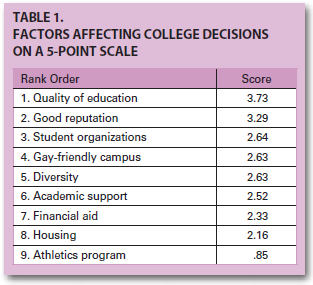
Perhaps the most important finding, though it is not surprising, is that attending a gay-friendly school is rated fairly highly by the respondents. Sixty-seven percent of respondents rated attending a gay-friendly campus as fairly or very important. GLBTQ students may not consider a gay-friendly campus the most important factor in deciding where to go to college, but many students do at least consider the campus climate when selecting a school. This finding is similar to that of Horvat's 1996 study of African American students. Like those students, respondents in this study indicate that they generally desire to attend an institution where there is a visible and accepted population of students like themselves.
Implications for Practice
THE FINDINGS related to students' experiences with coming out reveal some interesting contrasts. Though students indicate mostly positive experiences with coming out, fewer than one in five report that their high school provided a supportive environment for GLBTQ students. Also, the majority of students surveyed are out to everyone in their immediate family and to their friends, yet most of them did not or plan not to refer to their sexual orientation in their college admission essay. These contrasts present interesting challenges for higher education practitioners. This section discusses some methods that practitioners can employ to reach out to GLBTQ students who are potential attendees of their institution.
One way that many institutions address the challenge of reaching out to specific populations is through special breakout sessions during campus visits or orientation programs. However, breakout sessions for GLBTQ students, especially in the age of the helicopter parent, are likely to attract only those students who are out. How, then, can a campus reach out to an invisible population—closeted students—without these students having to out themselves? One method is to ensure that services related to GLBTQ students are well documented and highlighted in all print and Web-based recruitment materials.
Another intriguing possibility is using technology to reach out to GLBTQ students. Many universities now use Web-based chat rooms as a tool for recruiting students throughout the admissions process. Chat rooms allow semi-anonymous conversations between potential students and university staff members. Students today are generally well versed in the use of technology and often feel more comfortable interacting virtually. Incorporating a chat room for GLBTQ students in this service, as some universities now do, could have a positive impact on both out and closeted GLBTQ students. Closeted students, especially, can use the chat room to ask any questions they may have about services for GLBTQ students on the campus in a relatively stress-free environment in which they are only required to share as much personal information as they desire.
Directions for Future Research
IN ORDER TO ANSWER the question “Do gay and lesbian students consider the gay-friendliness of a college campus in relation to their college choice process?” I assumed that sexual orientation is a salient characteristic for those who identify as GLBTQ and that being GLBTQ leads one to have experiences that are different from those who identify as heterosexual. However, the question should not be seen as assuming that all GLBTQ students are the same. GLBTQ students come from all races, religions, social classes, genders, and other demographic categories. I was not able to address concerns specific to subpopulations of GLBTQ students within the scope of this study; however, future research should attempt to determine the role that some of these other differentiating characteristics may play. Questions that need to be addressed include these:
Does socioeconomic status influence the likelihood that students will consider the gay-friendliness of prospective colleges?
Does a student's particular sexual identity (for example, gay male, lesbian, or queer) affect the likelihood that he or she will consider the gay-friendliness of prospective colleges?
Does a student's racial identity have any impact on his or her consideration of gay-friendliness?
The extant literature has shown time and again that GLBTQ students have a markedly different experience of college than other students. In 1998, Craig Waldo found that GLBTQ students were more likely to perceive their campus negatively and to experience it as such. Another study by Robert Hill, JoEllen Childers, Adrian Childs, Gail Cowie, Annette Hatton, Jamie Lewis, Nancy MacNair, Sara Oswalt, Ruperto Perez, and Thomas Valentine noted that over half of GLBTQ students reported feeling unsafe on their campus and that three out of every four GLBTQ students know someone who was verbally harassed because of their sexual orientation. Finally, in 1989, D'Augelli found that 26 percent of gay and lesbian students had been threatened with violence in relation to their sexual orientation. Such findings justify the need for continued research on the experiences of this population. One way to address issues related to campus climate is to focus on the pre-college population and employ means that make it evident to all students, regardless of sexual orientation, that a campus supports the GLBTQ community.
GLBTQ students may not consider a gay-friendly campus the most important factor in deciding where to go to college, but many students do consider the campus climate when selecting a school.
How can a campus reach out to an invisible population—closeted students—without these students having to out themselves?
My study began with one central question: Do GLBTQ students who are applying to college consider the gay-friendliness of the campuses to which they apply? The data seem to support this hypothesis to a certain extent. It cannot be said that the desire to find a gay-friendly campus is relevant to all GLBTQ students, nor can it be said that other factors related to sexual orientation, like coming-out experiences and experiences in high school, influence the college choice process. However, the data do show that GLBTQ students at least consider the desire to attend a gay-friendly institution to be relevant to their choice process.