






Abstract

Like higher education itself, student affairs is a dynamic enterprise grounded in paradigms that have shifted over its history. the purpose of this article is to frame the role of higher education at large, with a look at the role of student affairs in particular, to advance integrative learning. portfolio pedagogy is described as one strategy for advancing integration. this pedagogy is grounded in reflective practice, a vital, under-utilized skill to prepare students for their journey as life-long learners and contributors.
Defining Integrative Learning
The construct of integrative learning has many meanings. in the vernacular, educators have defined the term in a variety of ways, referring to interdisciplinary study across knowledge domains or creative commingling of the curricular and cocurricular to enliven learning. in the research domain, the construct of inte-grative learning is a bridge being built as it is being walked upon, with yet limited findings available to demonstrate evidence for how integration is achieved. this article relies on Mary Taylor Huber and Pat Hutchings's rather comprehensive definition of inte-grative learning:
One of the great challenges in higher education is to foster students’ abilities to integrate their learning across contexts and over time …. the capacity to connect is central … whether focused on discovery and creativity, integrating and interpreting knowledge from disciplines, applying knowledge through real-world engagements … [integrative learning] builds intentional learners … and the habits of mind that prepare students to make informed judgments in the conduct of personal, professional, and civic life … [leading to] personal liberation and social empowerment” (p. 1).
The emphasis on multiple learning environments (“across contexts”), life-long learning (“over time,” “habits of mind”), and preparing students for contributing to the betterment of the world (“real-world engagements,” “civic life,” “social empowerment”) creates a direct sight line between integrative learning and the aims of student affairs.
Relationship of Learning Outcomes to Integrative Learning
Integrative Learning is, at its core, a process for synthesizing learning across multiple experiences, coalescing meaning, and also creating new learning and meaning. but to what ends? the literature is increasingly populated with reports from national associations and government agencies regarding student learning, outcomes, “purposeful pathways,” and institutional accountability. thus, intentionality, at minimum, speaks to interventions grounded in theory and research, designed with defined learning outcomes in mind.
Defining learning outcomes within academe—espe-cially in nonprofessional education domains—is controversial. at the same time, legislators and the public call for “accountability” through oftentimes ungrounded and highly pragmatic metrics that do not necessarily align with the aims or values of higher education. essential learning outcomes provide a foundation upon which to ground the processes of integrative learning. these may align with the many learning outcomes already defined by professional accrediting agencies, and may be in concert with students’ self-defined learning outcomes.
The association of American Colleges and universities (AAC&U) defined four rubrics in 2011 comprising the essential learning outcomes to prepare students for the challenges of the twenty-first century: knowledge of human cultures and the physical and natural world; intellectual and practical skills; personal and social responsibility; and integrative and applied learning (these outcomes are also discussed by kevin Hovland and Carol Geary Schneider in “Deepening the Connections: Liberal education and global Learning in College” in this issue). Most of these cut across the many learning environments found within and beyond the classroom. of special note is the rubric of integrative and applied learning. it is not surprising that with the increasing call for adaptive life-long learners, the capacity to synthesize and translate learning into new situations would be identified as essential. outcomes, however defined, form the content against which the process of integrative learning may be applied.
Integrative Learning as an Essential Role for Higher Education
While the language associated with the aims of higher education at large—and student affairs in particular— might shift over time, the fundamental purpose that guides educators has remained steady. expressed as early as the student personnel point of view of 1937, and continued through Ernest Boyer's foundational work, development of the whole student—not just intellectual capacity—maximizes students’ growth so that they may be fully contributing members to society and achieve maximum personal fulfillment. Content knowledge, skill development, and learning how to learn for a lifetime are the basics. in the end, it is higher education's hope that students graduate with a more sophisticated way of knowing and interacting with the world.
Robust research over the decades in psycho-social development, cognitive psychology, learning theory, and social identity development provides a theoretical framework for how students understand themselves, the intersections of a multiplicity of identities, and how they engage in their worlds. it informs us about how students make meaning and how learning experiences are approached, constructed, and mediated by each student's own personal history. from Arthur Chickering and Linda Reisser's seven vectors of development to Howard Gardner's theory of multiple intelligences, this literature asserts that these transitional years for students are the richest for cultivating students’ cognitive and affective development. Ernest Pascarella and Patrick terenzini's meta-analyses of decades of research in the impact of college on students provide ample evidence that an intentional total college experience and environment that is designed to encourage involvement and engagement can have a profound effect on students’ active learning and development and on the integration of their learning. these learning constructs have deep roots affirming John Dewey's profound assertion in his 1897 pedagogic creed that “education is a process of living and not preparation for future living” (p. 78).
Clearly, student growth and development along a variety of parameters is the work of higher education at large. yet learning across multiple arenas is not automatically integrated. there is nothing necessarily intrinsic about the higher education experience—perhaps especially at large, research multiversities—that requires an “integrative” approach to teaching or learning. surely, most educators believe in the principle of integrative learning. however, there exist surprisingly few formal, sustainable ways in which to accomplish this comprehensively. higher education researchers have identified current organizational practices reinforcing segmented acquisition of knowledge and skills. these include increasingly specialized discipline-specific learning and the structural barriers between learning within and outside the classroom. this results in educational delivery that can be experienced as highly distributed and unfocused to many students. taken together, reports and research make the case for an intentional, seamless, and integrated educational experience across curricular and cocurricular domains linked to measurable learning outcomes. further, many reports assert that fostering cross-institutional partner-ships to promote student engagement, learning, and development can result in a more cohesive educational experience for students.
Professional and research literature alike sounds a consistent and resounding call for educators throughout the institution to unite toward the shared goal of inte-grative student learning. While academe has valued the concept and even made inroads to address integration, these efforts have privileged structural interventions over pedagogical processes. It is a start but it is insufficient.
Interdisciplinarity: A Good First Start toward Integrative Learning
THERE IS NO SINGLE WAY TO ACHIEVE INTEGRATION. In a 1994 report, George Kuh, Katie Branch Douglas, Jon P. Lund, and Jackie Ramin-Gyurnek encouraged the “transcending [of] artificial boundaries” to facilitate comprehensive learning. examples of educational interventions for structural integration are plentiful, including creative co-teaching across seemingly disparate disciplines (recent examples from the university of Michigan include physics and music faculty co-teaching and the botanical gardens sponsoring a multiyear project to bring together undergraduate and graduate students from engineering, near eastern studies, and museum studies as partners in the presentation of a fourth-century funerary monument in the botanical gardens). as exciting as creative co-teaching may be, bringing together seemingly unrelated disciplines to develop exciting new ways of knowing, limitations exist. it is difficult to sustain such efforts, and the relatively small number of students accessing these unique experiences makes this a more rarified than routineex-perience. as such, it represents one compelling strategy toward integrative learning, although exposure to diverse learning alone does not, de facto, create the conditions for making connections across experiences. these approaches must be complemented by other strategies with greater reach, sustainability, and intentionality for all students.
Frequently, at large, decentralized, research institutions, where teaching shares priority (but not necessarily equal status) with basic research and service, learning opportunities occur within a distributed environment. students often have access to an extraordinary array of subject areas and cocurricular opportunities; this results in tremendous exposure yet potentially disjointed experiences for students.
In more recent work for the AAC&U, George Kuh identified ten high-impact educational practices for affecting and effecting meaningful learning that also have implications for integrative learning. these include:
first-year seminars and experiences,
common intellectual experiences,
learning communities,
writing-intensive courses,
collaborative assignments and projects,
“science as science is done”/undergraduate research,
diversity/global learning,
service learning/community-based learning,
internships, and
capstone courses and projects.
While many of these practices cut across curricular and cocurricular boundaries, many of these practices still represent efforts at structural integration. While no single strategy will satisfy the need for integration, higher education must get beyond these structural solutions. they do not directly address the pedagogical processes required for students to derive meaning from what they learn. for this, we require an integrative paradigm that looks beyond interdisciplinarity to one that embraces teaching students the tools of refection.
Integrating Diverse Learning through Reflective Practice
TODAY'S COLEGES ARE FILLED by the millennial generation. traveling through a life stage coined by Jeffrey Arnett as “emerging adulthood,” these students are self-focused on exploration and transition. today's students want to create their own meaning through self-expression. at the 2008 national Conference on Law & higher education, Thomas Workman referred to today's students as “digital thinkers” and encouraged us to recognize the unique characteristics and capacities associated with this type of thinking: “for millennials, the growing sophistication and capacity of the internet has been entwined in their own maturation process to the point where it is difficult to determine the degree of influence one has had on the other” (p. 2). it would seem as if these “emerging adults” are predisposed to take an active role in their own learning.
A key question is “What might effectively prompt this active role in one's own learning?” and, more to the point, “What affects integration across diverse learning experiences?” While these questions offer fertile ground for future research, current understanding suggests that deliberate refection and action appear to be at least some components that prompt integrative learning. integration speaks to the capacity to draw on the knowledge and skills gained from individual in-class and out-of-class experiences to create a new, more complex, and synergized understanding and application of knowledge. however, learning scientists tell us because learning is context-bound, translating concepts from one situation to another is extremely diff-cult. “scafolding”—using prompts that encourage the translation of old information into unique contexts—is one cognitive strategy for generating learning. according to the work of the national research Council reported in How People Learn, for today's students, meaning making results in both weaving together disparate knowledge and creating new, more sophisticated ways of knowing and acting in the world. facilitating such deliberate refection beyond the individual classroom experience appears to be largely absent in our institutional practices. few if any formal, systemic mechanisms exist to facilitate such cohesive and syner-gistic learning.
Interestingly, Donald schön in The Reflective Practitioner indicates that one can only “practice” refection—it cannot be taught. educators can create situations and stand back to coach. students must learn for themselves by synthesizing existing and generating new knowledge through a series of actions and refections or praxis. one question is how might the enterprise of higher education prompt the kind and magnitude of deliberate practice to ensure that students gain the competency of reflective practice?
To be sure, institutions have experimented with an array of models to more fully integrate student learning, as pointed to in kuh's high-impact educational practices. Clearly, there is no single strategy that will satisfy the need for integration, though all require intentionality. Consider, for example, a community service opportunity in a large, diverse, urban setting. such a program may not, in and of itself, contribute to the AAC&U learning outcome of ethical reasoning and action (within the personal and social responsibility rubric). yet combined with (1) an academic course on critical urban issues, (2) active student leadership to construct their own learning focus, (3) mentoring as part of symbiotic community engagement, and (4) opportunities for reflection including planned conversations designed to stimulate connections between concepts and practice, an integrated experience can be created that strengthens student understanding of social responsibility and a sense of personal agency. yet, absent a pedagogy for integrating learning from these opportunities, the risk is a highly segmented, disjointed experience for students.
From Aristotle and Rousseau to Dewey and Freire, we know that it is a long-tested principle that students learn best that which they discover for themselves. When learning occurs cognitively, affectively, experientially, and with reflection, it is more likely to become truly integrated. in the end, integrating learning is about helping students get the most out of their experiences. this may be achieved by expressing intentional learning outcomes, creating deliberately structured learning opportunities, and providing self-conscious, scaffolded processes in order to actively refect on and make connections across experiences. ultimately, students will have developed the fundamental skills of translating knowledge, and of learning how to learn so they will progress throughout life as intentional learners. a question remaining, then, is do we have the capacity to coach students to integrate their diverse learning? and what tools are needed to facilitate this process?
Portfolio Practices as One Tool to Promote Integrative Learning
ONE COMPELLING STRATEGY to promote integration uses portfolio processes (as distinguished from a traditional cocurricular transcript or professional portfolio models primarily designed to document achievement and accomplishments). electronic in mode, this process is also distinguished from popular social networking tools such as Facebook. the “integrative knowledge portfolio” approach is grounded in learning theory, student development research, and the principles of active student learning and reflective practice. it is in this spirit of promoting active student learning from formal and informal learning ecosystems that this portfolio model is based.
The integrative knowledge portfolio currently being instituted at the university of Michigan is designed for students to make unique meaning of their own learning by both documenting it and creating new knowledge in the process. the goal of the model is to provide a learning process to support students identifying, connecting, and demonstrating evidence of their learning (see Figure 1). students do so by surfacing and articulating the value of formal and tacit knowledge; connecting their values, goals, and learning experiences; and applying their knowledge and skills across different contexts and over time. structured around learning outcomes, the electronic portfolio is a tool that encourages students to describe and refect upon an array of cognitive, affective, and experiential learning experiences.
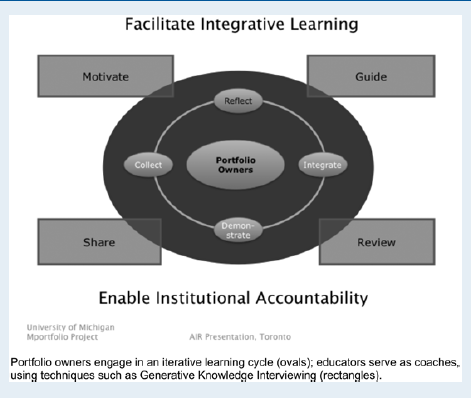
Integrative Learning Cycle
Different from matrices that can perpetuate silos of knowledge, “prompts” serve as the intellectual scaffolding for deliberate refection. Melissa Peet, first as part of dissertation research and later as research lead for the university of Michigan MPortfolio effort, has developed and studied generative knowledge interviewing (GKI), a pedagogical technique designed to surface tacit knowledge and prompt meaning making. prompts also frame the portfolio templates that guide students to consider what they know and how they know it. examples of prompts include:
What did i learn and why was it important?
What knowledge, skills, or capacities did i gain or demonstrate?
How does it relate to other contexts and experiences?
How does it relate to my own interests, passion, or goals?
How might i use this knowledge in the future?
This meaning making is then translated into a highly visual presentation of a student's “persona” that is sub-stantiated by artifacts of evidence, such as papers and documented experiences. portfolios include a philosophy statement and multiple reflective and meta-reflective narratives that capture learning themes across diverse educational experiences. the portfolio evolves and may be utilized for planning, sharing, and archiving. this approach to integrative learning allows students to better know what they know and then translate this knowledge into something useful in the “flat world” of today—a world, as Thomas Friedman reports, in The World Is Flat, that no longer values the generalist nor needs the specialist but requires the adaptability of the versatilist.
Approached as action research, the e-portfolio effort at the university of Michigan began as an inquiry in the efficacy of a tool and pedagogy that facilitates reflection and demonstration of learning. it was an organic, pilot-based experiment to determine if and how such a tool and surrounding practices could be effective in assisting students in making meaning of their diverse learning. to that end, a mixed-method research inquiry accompanied the implementation. Quantitative measures are captured through a self-rated pre-/post-test of defined learning outcomes. portfolio content analysis and focus groups capture qualitative data.
Findings to date are compelling, as reported by Melissa Peet, Steve Lonn, Patricia Gurin, Page Boyer, Malinda Matney, Tiffany Marra, Andrea Daley, and myself in the recent inaugural issue of the International Journal of ePortfolio. Gains in demonstrating knowledge, transferring knowledge to new situations, and working collaboratively with others were significant, regardless of level of participation. students gained more when they created more components of their portfolio. students who participated in more than one experience using portfolios demonstrated the greatest gains.
The integrative knowledge portfolio is just one strategy for effecting integrative learning. however, unlike other strategies that are more reliant on systemic institutional change, this one may have the advantage of sustainability because it is student-centered. it potentially allows students to create their own interdisciplinary learning. Disciplines, faculty, and staff may choose to join together to create specific curri-cula/cocurricula; however, integrated learning is not dependent on this. through guided reflection, students will learn to integrate learning across a multiplicity of unique experiences. in the spirit of Donald schön's views on reflective practice, educators of all backgrounds will serve as coaches—reflective aids—to students’ own learning.
Portfolio learning has the potential to address other issues of interest to higher education, as well:
Educators may utilize such a tool to evaluate evidence of learning by individual student and by educational experience.
Programs, units, and schools/colleges may aggregate student outcomes data for purposes of accountability and accreditation.
The institution may aggregate select quantitative outcomes data to demonstrate institutional effect while complementing these data with tangible, substantive student narratives of their growth.
The institution may define its own relevant measures of impact rather than have these measures defined externally.
In short, encouraging reflective thinking to integrate learning has the capacity to benefit the individual student, inform academic and institutional planning, and demonstrate the public good of education to a wide constituency.
Integrative Learning as an Essential Role for Student Affairs
STUDENT AFFAIRS CONDUCTS ITS WORK within the intersectional and interstitial spaces of learning. it works in intersectional spaces when it works with students to leverage learning and perspectives across disciplines and experiences, applying and adapting existing knowledge to new, dynamic situations. it works in interstitial spaces when it engages students to make meaning across their diverse learning experiences through reflective practice. the role of the student affairs educator, whether facilitating career planning, intergroup relations, or service learning, is to coach students in the processes of self-conscious refection about themselves, others, and their role in greater society.
In all this, an emphasis on integrative learning asserts first and foremost that educators place students at the center of their own learning. it also implies, to paraphrase John Dewey, that the educational environment is where students “live” and don't just “prepare to live.” these are foundational principles for student affairs educators. As such, there is great congruence between the education goal of integration and the work of student affairs. the essential role for student affairs in promoting integrative learning is grounded on several key assertions:
that advancing learning outcomes, broadly defined, are the shared responsibility of all who claim a role as educator;
that educators reveal themselves in various ways: teaching political science, guiding a chemistry lab, conducting an intergroup dialogue, and providing academic and career counseling;
that the potential for learning occurs wherever students are, when they are fully engaged, and particularly when intentional interventions are present;
that through employing integrative pedagogy, educators may guide students to weave together holistic, integrative learning derived from multiple sources to create new knowledge;
that active reflection is the process lynchpin to integrative learning, and tools of refection, such as the portfolio, facilitate surfacing new knowledge; and
that the new knowledge students create will inform them about who they are and want to be, who they are in relation to others, and what they aspire to as global citizens for the betterment of society. they become increasingly self-authored.
Each of these assertions is anchored directly to the theory, research, and best practice informing the work of student affairs. in an increasingly student-driven learning agenda, a student-centered functional area such as student affairs plays a critical role. it must increasingly apply itself to facilitating integrative learning while helping students navigate across the fluid and diverse learning environments.
Students navigate, refection facilitates, and educators guide, motivate, and critique.
Conclusion
The importance of integrative learning for preparing today's students for tomorrow's world suggests that higher education examines:
how institutions can create paths for learning that extend beyond what is gained from an individual classroom, cocurricular, or community experience;
how we can get beyond the structures and strictures of where unique learning experiences occur and who guides the learning to focus more fully on ensuring that learning and development actually occur and can be demonstrated; and
how students can graduate not only with an understanding of the “what” of their unique experiences but also with the “so what” of integrating and leveraging their experiences toward larger goals.
Promoting integrative learning is offered here as an essential paradigm for framing the work of higher education at large and student affairs in particular. bringing together definitions of integrative learning with the theoretical underpinnings guiding the work of student affairs, it becomes increasingly apparent that student affairs is uniquely situated to be an essential partner to advance integrative learning. Looking back, this work resonates with the foundations of student affairs expressed over 80 years ago. Looking forward, it concurrently presses student affairs into a uniquely twenty-first-century agenda preparing students to develop “habits of mind” to complement “habits of the heart” required to be life-long, intentional, adaptive learners prepared to succeed in quickly changing environments and to improve society globally.