






Abstract
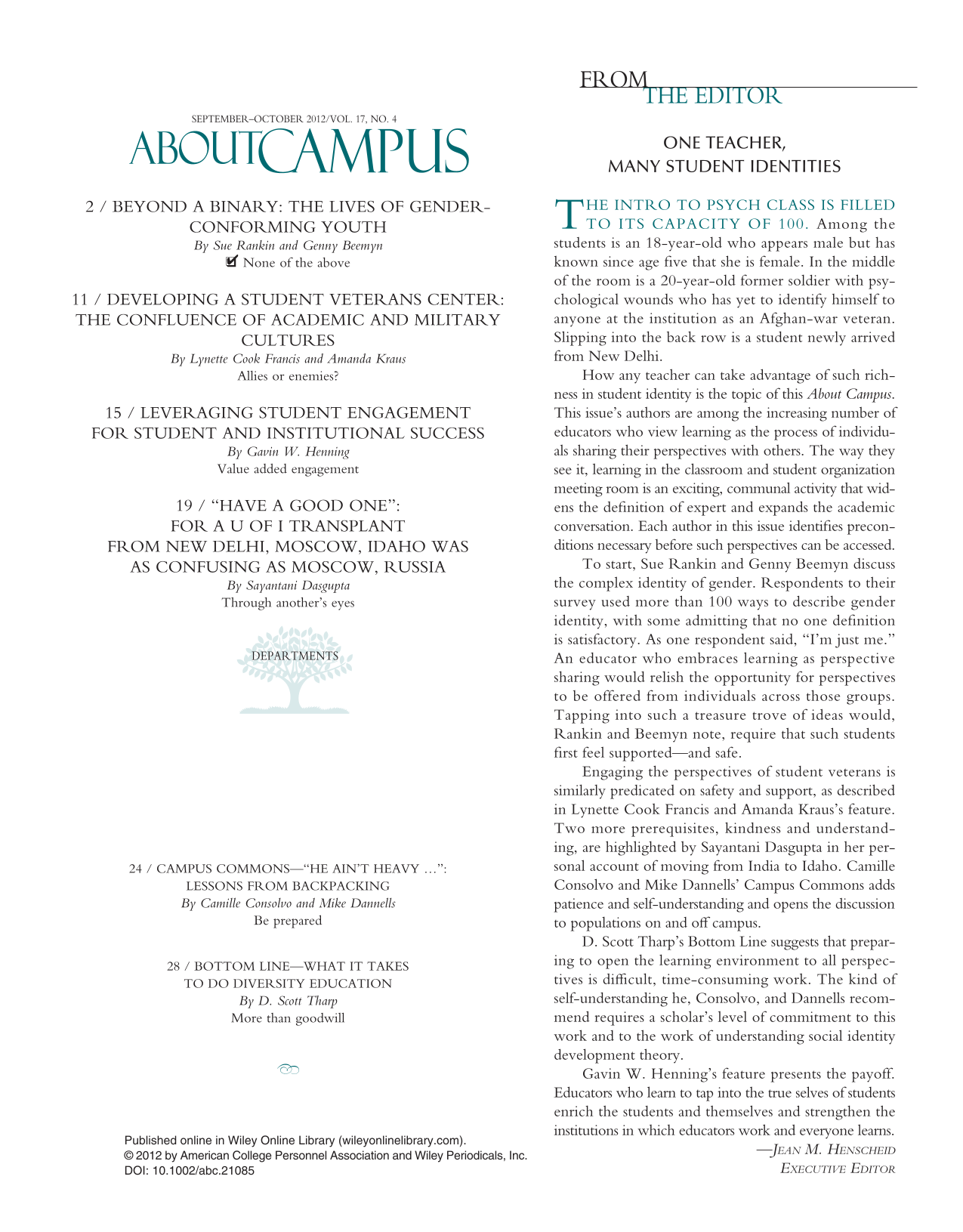
How any teacher can take advantage of such richness in student identity is the topic of this About Campus. This issue's authors are among the increasing number of educators who view learning as the process of individuals sharing their perspectives with others. The way they see it, learning in the classroom and student organization meeting room is an exciting, communal activity that widens the definition of expert and expands the academic conversation. Each author in this issue identifies preconditions necessary before such perspectives can be accessed.
To start, Sue Rankin and Genny Beemyn discuss the complex identity of gender. Respondents to their survey used more than 100 ways to describe gender identity, with some admitting that no one definition is satisfactory. As one respondent said, “I'm just me.” An educator who embraces learning as perspective sharing would relish the opportunity for perspectives to be offered from individuals across those groups. Tapping into such a treasure trove of ideas would, Rankin and Beemyn note, require that such students first feel supported—and safe.
Engaging the perspectives of student veterans is similarly predicated on safety and support, as described in Lynette Cook Francis and Amanda Kraus's feature. Two more prerequisites, kindness and understanding, are highlighted by Sayantani Dasgupta in her personal account of moving from India to Idaho. Camille Consolvo and Mike Dannells’ Campus Commons adds patience and self-understanding and opens the discussion to populations on and off campus.
D. Scott Tharp's Bottom Line suggests that preparing to open the learning environment to all perspectives is difficult, time-consuming work. The kind of self-understanding he, Consolvo, and Dannells recommend requires a scholar's level of commitment to this work and to the work of understanding social identity development theory.
Gavin W. Henning's feature presents the payoff Educators who learn to tap into the true selves of students enrich the students and themselves and strengthen the institutions in which educators work and everyone learns.