







Abstract

Lee Burdette Williams provides insight into the behaviors and thought processes of her baffling, but often inspiring, students on the autism spectrum. Her perspective helps us understand their experience of a world they often find stressful and confusing.
For the first time in almost 30 years, I am not formally attached to a college campus. My pay stubs do not bear the name of an institution of higher education. My car is without a campus–issued sticker. When my technology presents problems, there is no help desk to call. After spending a career in higher education, most recently as the senior student affairs officer at a small college, I now find myself in the company of a very small group of students, working for what is something of a start–up.
Instead of managing a division of student affairs, I have the responsibility for a group of students who live in a house I supervise. They are college students, yes, but at four different local institutions. They have two things in common: they are residents of our program, Mansfield Hall, and they all have disabilities significant enough that living a traditional college student's life is not an option for them. Most are on the Autism Spectrum, diagnosed with what is sometimes called “Asperger syndrome,” or have other challenges that put a typical college experience just beyond their reach.
I thought I had left the profession I had called home for nearly three decades, only to find it in a renovated former fraternity house on the edge of a campus with which I have no formal connection. This is the story I have been writing every day in my head, surrounded by students who have made me think differently about everything I do and everything I have ever done.
Despair, up Close, and Personal
It was about 10 years ago, when I was the Dean of Students at the University of Connecticut, that I started to see in front of me, students whose behavior, whose needs, were beyond the limits of the services we offered in the Dean's office. I was fortunate to work closely with the office responsible for students with disabilities and began to learn from those colleagues the ins and outs of students “on the spectrum.” I learned the term “Asperger syndrome” and saw up close the effort required to help those students navigate a large university. They came to my attention most often because they were disruptive in either a residence hall or a classroom or both, and through the diligent efforts of my co–workers across the hall and a group of student–centered professionals within and beyond our Division of Student Affairs, we did our own careful navigating, finding the constantly shifting line between ADA requirements and “otherwise–qualified,” between can't and won't, between rights, responsibilities, and downright irritation.
MANSFIELD HALL IS HOUSED IN A FORMER FRATERNITY HOUSE ACROSS THE STREET FROM THE CAMPUS OF THE UNIVERSITY OF VERMONT.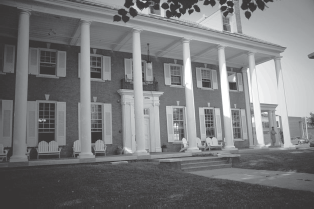
I remember one meeting early in my time at UConn involving our Director of Disabilities, our conduct officer, a student, his father, and myself. The student's behavior in a class was so disruptive that the faculty member sought some sort of redress to manage what was becoming an untenable classroom environment. Disruptions had begun to show up elsewhere as well, including in the very office charged with supporting him and overseeing his accommodations. I remember two things about that meeting: the student was utterly and unequivocally unlikeable. And his father was thoroughly defeated. I remember feeling a shift in perspective within myself during that meeting, from the dean who was expected to maneuver a complex set of obligations on behalf of a student who acted at every turn like a total jerk to an ally of a father who had dealt with this son his whole life. The despair on this father's face—this clear sense from him that he had been in meetings like this too many times—made my heart ache. What was it like, I wondered, to have a child like this, to know he was permanently yoked to his difficult son? All I had to do was figure out what we could work out for a semester. His father had decades of dealing with his son ahead of him.
Asperger syndrome. That was what my colleagues talked about after the meeting. Students with such inept social skills that everyday interactions seemed impossible. Yes, there were students on the Autism Spectrum succeeding everyday at UConn, but there was this subgroup of square pegs who seemingly refused, with great gusto, to fit into the round holes of our university.
The students I work with now are sometimes difficult in the way this student was, although for the most part, they are compliant and not terribly disruptive. They can, however, be difficult to like if one's criteria for liking people are that they are socially appropriate, interested in others, willing to be flexible, and able to read social cues. Those used to be my criteria—at least some of them—for liking people. The students I work with now have changed that. I understand in a very different way now why “reading social cues” is an ability I take for granted in myself and others and just what it means when this is not one's default setting in the world. The students now in my care are those for whom this is not the default setting. In fact, for some of them, every interaction with other people is a source of anxiety exactly for this reason. When I think about how anxious I get at those moments when I can't use this skill—when I don't understand what's happening socially—and then imagine what it would be like to feel that way everyday, my respect for my students grows. This is a hard world to navigate for most of us. What is it like for someone whose brain is wired in a way that makes it even more difficult?
Things I Didn't Know (A Large Category)
The term “Asperger syndrome” has entered and exited the official psychiatric lexicon with blazing speed. First coined in 1981 by British scientist Lorna Wing, the name paid homage to Austrian psychiatrist Hans Asperger. Asperger, along with Baltimore–based psychiatrist Leo Kanner, had been studying similar populations on either side of the Atlantic throughout the 1940s. Asperger originally called it “Autistic Psychopathy.” Kanner saw it as a category, but Asperger viewed it more as a spectrum of related behaviors that differed in severity. “Asperger syndrome” became an official diagnosis in the American Psychiatric Association's (APA) fourth Diagnostic and Statistical Manual (DSM–IV) in 1994. Anyone who has followed the politics of the APA and the manual that is their battlefield knows that no diagnosis is ever safe from revision based on research, on politics, on the interpersonal warfare of a group of people supposedly committed to helping people. And so with some fanfare, “Asperger syndrome” was removed from the DSM–V in 2012, subsumed under a broader category known as “Autism Spectrum Disorder.” Also swept up in this change were several other diagnoses whose distinctions had created a swamp of uncertain labels being used to grant or deny children certain services.
Meanwhile, driven by the Individuals with Disabilities Education Act (IDEA), federal legislation that required students with disabilities be provided access to public education, documents known as Individualized Educational Plans (IEPs) were being created across the K–12 landscape, outlining to parents and school systems exactly what services schools and teachers could reasonably be expected to provide. One of the necessary components of an IEP is a diagnosis. The problem with diagnosing problematic behavior in children is that most behavioral maladies cannot be viewed under a microscope. They are observed in multiple settings by multiple people, which in itself would be difficult if a child acted the same way everyday. However, children are wildly unpredictable, their motives mysterious as the night sky. For two decades, IEPs have done the work of officially labeling children, if not forever, for a very long time. Maybe that wouldn't be an issue if the labels were clear–cut diagnoses. However, children with autism are as unique as snowflakes. There are patterns and occasional predictability to be sure, but to convincingly label a nine–year–old who in some ways acts like this particular group of kids but in other ways acts completely unlike them? As fluid and as sticky as syrup.
The thing about Asperger's, however, was that it was a kind of sticky diagnosis, at least for those of us working with college students. It brought into focus a group of students we found ourselves often struggling with, students with legitimate smarts, quirks, laser–like focus on certain, oft–times bizarre topics, and complete cluelessness in other ways. “He's kind of Aspie,” we learned to say about a student who was facing charges of stalking or had burned through three roommates in two month, or who caused a faculty member to beg the disability services staff to mitigate an impossible classroom dynamic.
For many of us in student affairs, “Asperger's” became a shorthand way to describe or explain a level of social awkwardness combined with reasonable academic ability. The APA's vernacular battles were of little interest to us. We were just happy to know there was a starting place for our work with these students who were sometimes weird, sometimes baffling, sometimes unlikeable, and occasionally delightful.
Big Universities Have Big Challenges. Small Colleges Have Big Challenges
I left UConn for a much smaller institution—Wheaton College in Massachusetts—having figured out that I was a small college dean at heart, and I took with me the admittedly elementary learning I had gleaned from my disabilities colleagues.
I downsized from 16,000 to 1,600 students and felt like I had slipped into a comfortable groove. In short order, of course, I found myself dealing with students quite similar to those who had proven so vexing at UConn. However, at UConn, these students with Asperger's were mere dots of paint on a large mural, most of the time blending in or being absorbed by the many people and activities of a large campus. At Wheaton, these dots of paint stood out, in part because we were not a large mural; we were a small portrait of a campus community. Anyone who has ever attended or worked at a small college knows this phenomenon: everyone knows the weird kids; everyone knows the students who cause headaches. However, on a small campus, there are fewer of us to negotiate with students and their parents to find a peaceful coexistence. The challenges were similar: students disrupting classroom discussions, alienating roommates, being reported to my office as “difficult,” but we lacked the staff to respond. At times, I longed for the resources, not to mention the sheer number of colleagues available to assist, that exist at a large university.
A complicating piece of being responsible for these students on a small campus came in the form of parental expectations. I don't think parents sending their children to a large university have high hopes that their child is going to know every professor, connect with key administrators, have a safety net to protect them from all forms of disaster. However, parents of small college students? They do. And we have no one to blame but ourselves. It's how we sell ourselves to justify our higher cost. “At our college, your student will be known. Your student will be an individual, not a number. Their professors will know them. We will provide individualized, personalized attention.” I've said these words many times.
To the parent of a student on the Autism Spectrum, who has spent years living with IEPs and one–on–one attention, they hear this and think, “Perfect! It's exactly what my child needs to be successful in college.” However, they are hearing something we are not actually saying. We say, “We will know your student,” and they hear “… and understand the quirks and challenges they will bring with them.” We say, “We will provide personal attention,” and they hear “We will make sure they are doing what they need to do to be successful here.” We are speaking college–ese. They are hearing K–12–ese. It is this disconnect that would lead a parent to call me, usually mid–semester, to report that their child hadn't been to class in weeks because he kept sleeping through it. “Someone needs to make sure he's up in the morning.” I would respond, “Um…we don't do that for our students.”
I couldn't blame them for misinterpreting what we had said. Unless they had sent a previous child to college, they could not know that we didn't wake our students up, manage their medication, check to make sure they had completed their assignments.
So I started changing what I was saying to parents during the admissions cycle, and that helped a bit. However, we were still in the business of selling a small college experience, and they were still hopeful that their student on the Spectrum could succeed in college. Isn't that where the K–12 path leads? Smart kids go to college, even the weird ones. And being generically weird is not always a problem. Weird, however, in an Asperger's way? That often is a problem.
Each year brought more students on the Autism Spectrum to our campus, and based on conversations I had with other small college deans, they were seeing the same. The success of behavioral therapies for autism meant that a growing wave of students on the Spectrum was in the pipeline.
The Harvard Review of Psychiatry, in a 2014 special issue on Autism, published a comprehensive look at college students on the Autism Spectrum, noting the expected surge in the number of students with this diagnosis that will be attending college. The number of students with this diagnosis has increased from 1 in 150 in 2000 to 1 in 88 in 2008. Assuming that most diagnoses come between the ages of three and five years old, we can anticipate a steady increase arriving on our campus doorsteps over the next 10 years. And as author Stephanie Pinder–Amaker points out, it is a population that has been surging throughout the past decade. “The factors contributing to the increased prevalence of ASD include heightened public awareness, improved public screening, changes in the diagnostic specification, and, notably, improved ability to recognize and diagnose higher–functioning individuals who may have been overlooked in the past.”
The message is clear: they're here, and more are coming. The response is less clear.
The Solo Act
I needed help figuring out how to best serve these students. Most campuses employ someone responsible for overseeing the experience of students with disabilities. At a small college, this might be one person managing a large caseload of students with disabilities ranging from mobility impairments to hearing impairments, from significant mental health diagnoses like clinical depression or eating disorders to learning disabilities. This person reviews a student's documentation and determines the appropriate accommodations, educates staff and faculty about these accommodations, and responds when those individuals fall short of providing them. This person meets with families and students and must explain why certain expectations are not reasonable and lobbies the administration to provide funding for those accommodations that the law requires. So to ask this person to be the sole navigator on campus for students on the Autism Spectrum? I felt bad even imagining the request.
I decided that I needed to find ways to better educate and structure my staff. I thought about recent history and saw the parallels of how our campuses had responded to students of color when their numbers increased, to gay and lesbian students when they were claiming their identities in larger number. When it came to these students, we went from having single offices or departments or centers responsible for these students (which in the early days we assumed would be enough but came to learn were not) to recruiting “allies” all over campus, training, and educating anyone who would listen, creating peer mentor programs and faculty development workshops.
These were, of course, everyone's students. Their presence on our campuses was not new, but the recognition and appreciation of it was, and in the process of our institutional shift, our culture changed. Everyone's students: it seems so obvious now that to balkanize our LGBT students or our students of color, and assigning responsibility to one individual or one office or one center is to cheat both students and the institution. Everyone's students. Our students on the Spectrum belonged to us all. I needed to start with myself and then my staff and so found myself researching programs, reading articles, and surfing websites.
How Hard Could this be? Very
I found, for example, the 2009 book Students With Asperger Syndrome: A Guide for College Personnel and pored over it, trying to figure out how to incorporate its practical lessons into staff training and regular meetings. I watched YouTube videos by experts on Autism and Asperger's. I picked the brains of my UConn colleagues who had established an on–campus program for students with Asperger's, having become good enough at what they did that they found themselves with a population growing too rapidly to support without passing the costs on to parents (foretelling a lesson I have come to understand in new ways: this is not necessarily something schools want to get good at).
One day, I read that a new program had opened in Burlington, VT, providing residential and academic support to students “with learning differences.” They mentioned Autism and Asperger syndrome in their material. Intrigued, I contacted their executive director to learn more. What I learned was that they were still figuring things out, that most of the staff had backgrounds in special education or residential treatment programs, not higher education, and, most intriguingly, they had a staff position available. I wasn't sure I was what they were looking for, but I applied. Although I loved much of the work I was doing and the people I did it with, I was ready to leave the very stressful life of a vice president and dean. They—the management of Mansfield Hall—were willing to give me a shot at learning how to work with students with Autism as well as a number of other disabilities.
Programs like this one are rare. What has become more common are special programs, created by colleges and universities, with enhanced services for students with Autism. Some institutions have absorbed the cost, but others, recognizing the ambivalent value of becoming known as a “good school for kids on the Spectrum” and not wanting to find themselves with endless (and unfunded) needs, pass the cost along to families. Costs range from a thousand dollars each semester (on top of room, board, and tuition) to $30,000 for a year in addition to tuition, with residential, academic, and social support services provided in a designated residential program.
The program at Mansfield Hall costs about $56,000 per year, and for that, students get room and board in one of our two buildings in Burlington, substantial academic support, social communication groups, activities, and constant efforts to help them develop the kinds of skills needed to succeed as an independent college student. They take classes part–time or full–time at one of the local institutions. Our goal for most of them is to move into a residence hall or nearby apartment after two years with us, be successful academically and socially (which is broadly defined for these students), graduate, and become independent adults.
It all sounds great. And it is all very, very hard to do. Hard, maybe, because while I have almost 30 years of higher education experience, I have never done this, and it tests me everyday. Hard, maybe, because, well, it's just really difficult to figure out how to help students like ours succeed in college. Our institutions and these students are not, in most ways, made for each other.
I feel like I have spent a year standing in the shallow but forceful surf of the ocean, having walked into the water from my comfortable beach chair. And now I am ankle deep in increasingly rough waters. As I look to the horizon, I see larger waves approaching, ones that will topple our chairs and drench our towels. However, just as I was doing only moments before, most beach–goers sit blithely under their umbrellas enjoying the day. I could warn them, but I'm not entirely sure what to say. One phrase does come to mind.
Badgers Eat Bunnies
Like any culture or organization, the field of special education has its own creative descriptors and shorthand terms that allow its professionals to quickly assess and communicate with one another about the students in their care. That this lexicon exists didn't surprise me as much as how utterly unaware of it I was, despite working with college students for decades. If there is one thing that regularly reminds me of the straddling I do between two worlds, it's my awareness of how often a term is used among my colleagues that I have never heard before.
“Bunny” is the shorthand term for a student who, while struggling with learning differences or other disabilities, is mild–mannered, compliant, and gentle, if sometimes a little odd. Bunnies are, not surprisingly, easy to manage in a residential setting like ours. Their greatest sins might be sleeping through an alarm or isolating themselves to play video games or saying inappropriate but generally harmless things. Bunnies go with the flow if pressed, although can be twitchy and nervous, much like their namesake, if put into an unfamiliar place or situation.
“Badgers,” on the other hand, are disruptive, destructive, sometimes threatening, with impulse control issues that make the lives of those around them hell. Badgers generally require a more restrictive environment than we offer and so are not accepted for enrollment with us. They are usually found in locked and supervised residential, wilderness, or other therapeutic programs where the damage they can do is limited.
I learned early in my new career that badgers eat bunnies and that much of the success of our program depends on us very carefully screening prospective students to rule out badgers. It only takes one badger to eat a houseful of bunnies. Bunnies are ill–equipped to protect themselves and vulnerable to the manipulations of badgers (like “borrowing” money, blaming others for their actions, and generally intimidating those around them).
When I think back to many of the most heinous student–on–student harm I've witnessed on campuses, I see how often this dynamic—badgers eating bunnies—was fully at play in residence halls occupied by neurotypical students. I wish now I had seen it as more a matter of how in nature, there are predators and prey and that my work—the work of student affairs—is figuring out how to help them live peaceably together or, failing that (which, if one thinks about it through a Discovery Channel kind of lens, is likely), separating them so there is not the constant threat of bloodshed. So many hours in weekly meetings that brought staff together to figure out how to respond to students in crisis could have been reduced to a quick recitation—“bunny, badger, badger, bunny.” Roommate conflicts? Yes, they can be resolved, unless one student is a bunny and one's a badger, in which case a quick separation may prevent a gory disaster.
Flexibility, Rigidity, and Questions that Are Not Really Questions
One of the things I love about my students is their honesty. This is not to say that my students are always honest. Sometimes they lie. However, I'll come back to that. My students are honest because artifice requires wiring that is often missing, or differently connected, in the brains of people with autism. We know, as neurotypicals, that telling someone they're fat is rude, or at the very least unkind, even if they ask you “am I fat?” We know that white lies allow us to live in sometimes–peaceable proximity to others, including others we don't particularly like. A coworker you don't really like asks if he can join you at the lunch table. Sure. A neighbor asks if you like her ugly lawn art. Absolutely.
We lie because in our brains, we can do the multiple calculations, the cost–benefit analysis, that tell us it is easier to lie and suffer a short–term moral sting than to be honest and find oneself engaged in a lengthier and more awkward conversation. We take that ability to calculate for granted, and we move on with our day. We also know, for the most part, when someone “asks” us to do something but is clearly not leaving it up to us, such as one's supervisor asking, “Would you mind re–doing this report with the most current data?” Would I mind? Of course. Will I do it? Yes.
My students? Most can't do that kind of truth/lie question/not question calculation. Some may be able to multiply two large numbers in their heads or tell you the team batting average of every National League club, but that's only handy occasionally. So when they are asked a question, they just answer it. They may even answer a question that hasn't actually been asked, but they believe should be. “The team batting average for the Phillies is 8 points higher on the road than at home” they might volunteer, apropos of nothing you've said. “Those pants are too small for you,” perhaps answering a question you asked yourself that morning. This is what I love: they often save me the trouble of asking a question and just answer it.
They are literal to an amazing degree. At a recent group study session, Dave approached another student, Leo, who was, it appeared, actually studying. Dave asked Leo a question about his fantasy football team. The staff member overseeing the session asked Dave, “Could you wait till after the session is over to talk about that?” Dave said yes, then continued to discuss fantasy football with Leo. The staff member quickly adjusted her request. “Please stop talking about fantasy football during this session.” Dave immediately did so. He was not being difficult. He just answered the question that was asked (“could you wait?”) rather than respond to the request that was implied in the question (“stop bothering Leo”). I wonder how many times I have assumed about students on the Spectrum that they were being willfully noncompliant when in reality, they were simply answering the (literal) question I had asked.
Imagine a world without subtext, a world where we all just ask each other what we want to know and answer it with the same emotional intent that was present in the asking—which is to say: none. At Mansfield Hall, if one of my students tells me to stop bothering him, it doesn't mean he doesn't like me (usually). It means he wants to be left alone. There is no judgment in the request, no insult intended. It has, as one might imagine, taken me months to figure this out. When I first started working here, I went home most nights with a bruised ego, wondering why I was on the receiving end of apparent insults. Now I know that generally, I'm just part of a simple calculation (“If I ask her to leave me alone, she will”).
I don't mean to portray my students as unfeeling. They are not at all that. They just feel differently and show those feelings differently. When I sat with Arielle, whose parents, over speakerphone, informed her that they had just had her beloved cat, Mr. P., put to sleep, her tears fell so quickly I barely had time to grab the Kleenex. She sobbed and then, with her parents still on the line, let me ask her about Mr. P., her “best friend” for 16 years. I learned, for example, that “P” stood for Penelope, the result of gender confusion when he was a kitten. At the end of the call, Arielle's parents asked if she would like them to call her later that evening. She looked baffled. “Why?” she asked, still sniffling.
“To check in with you,” her mother replied. I saw the bewilderment on Arielle's face.
“We talk on Sundays,” she reminded them. They agreed they would call her on Sunday.
While they are generally willing to answer a question honestly, it doesn't mean my students don't lie. This has given me cause to ponder honesty and dishonesty and what's required of the autistic brain to lie since the usual reasons we might have for lying, like not wanting to hurt someone's feelings, are less relevant to my students.
At the root of most lying is a desire to avoid an unpleasant circumstance. “Did you do your homework?” “Yes” (no, I didn't do it, but I don't want to do it now, and if I answer honestly, you'll make me do it). “Did you go to class?” “Yes” (no, I played my video game in the campus coffee shop, but if I answer honestly, you may escort me to class tomorrow, and I won't like that).
I find myself thinking of lies I have told or plan to tell, and the same thing is at the root of them: a desire to avoid something unpleasant. Because I'm fairly neurotypical, however, I can make connections between a lie today and a bigger problem tomorrow and then will probably make the choice to be honest, take my lumps, and move on. This is a complicated set of calculations that I, that all of us, make everyday—again, the cost–benefit analysis of daily life. What I have learned from my students is that when they lie to me, I need to shift to a different set of calculations and figure out what unpleasant consequence they may be trying to avoid by lying. If I can reframe the consequence, I stand a chance at an honest dialogue.
This habit has, in many ways, changed how I hear myself and others in conversation. Working every day with students on the Autism Spectrum has taught me to quickly sort through the niceties, misrepresentations, and strategic deletions of communication that often sound like lies and just figure out what the person wants from our exchange. Information? Absolution? Avoidance of something unpleasant? Once I figure that out, I can set the lie aside as though it's unimportant and get to the heart of issue. When a student lies about having finished a class assignment, it is likely because the assignment is overwhelming, and I need to sit with the student to figure out a plan for getting it done. Maybe I'll address the lie then or wait till later. However, what the student needs to know in that moment is that I still am on their side. Which I am.
Stress (Theirs, Mine, and Ours)
We have this hand signal we use around Mansfield Hall—one's thumb tucked inside one's other four fingers. We then wave the four fingers in the air. This hand signal is often accompanied by a strained look and a “waaaah.” We all know what it means: a student's prefrontal cortex has disengaged and left their poor, sweet amygdala (the thumb) unprotected by reason and sensibility. This is, quite literally, our shorthand for “Quit trying to reason with him/her. It ain't gonna happen.”
People with autism spend an unreasonable portion of their day stressed out. What exactly is “unreasonable?” Take your typical day, slice it into, say, 10–minute increments, and guess what percentage of those slices you spend in a stressed–out state. Maybe a slice or two if you have to get your kids off to school. Clean up a mess your dog just made. Drive in heavy traffic. Meet with an unhappy boss. In between those stressful slices are others that, while not necessarily pleasant, are not acutely stressful. And “acutely” is the key word here. Stress itself can be a good thing. It produces adrenaline, which can increase confidence. It keeps us hyper–alert when we might need to be (e.g., driving in bad weather). The hormones released when we're stressed do their thing and then make their way to our bladder, exiting as soon as possible.
The slices of stress in the daily life of a person with autism make up a big portion of the pie. Autism changes the wiring in the brain to interpret many, many situations and sensations as stressful: loud (or constant) noises, crowds, unexpected situations (an unannounced guest speaker in a class, a missing ingredient in the lunch line). All around them, neurotypicals are experiencing some of those same stressors, but our brains are processing them differently. People with autism know only that their brains are entering fight–or–flight mode. That warm and cozy quilt of a prefrontal cortex has been pulled away from that amygdala, and all this person can do is react—exit the room, yell at someone, flap their hands, whatever it takes to self–soothe. The helpful bystander tries to reason with the agitated student, but that brain is not available for a reasonable conversation.
This “brain in the palm of the hand” demo is not exclusive to people with Autism. It happens for all of us. When I think of the times I tried to reason with a very distraught student to no avail, it was probably a daily occurrence for me. What I needed to do at those times was give the student some space, take a walk together, just change the subject for a few moments—things we do at Mansfield Hall everyday. However, I lived by a calendar, and my window of opportunity to settle a student and impart wisdom or reason was limited. I don't even want to think about the time I wasted trying to connect with a student's reasoning ability when it was all that student could do to just sit still and listen to me blather on about community, caring, personal responsibility. I sometimes imagine hitting a rewind button on conversations that might have gone very differently if I had, when I looked in their eyes, just seen their amygdala, right there at the base of their brain, naked and afraid.
I Think about Henry Now and Then
Several years ago, a student passed through Wheaton's summer orientation program who gave some of us pause. Henry was clearly not like most of our other students. Doughy, disheveled, not much into eye contact, Henry arrived with his mother who smiled nervously when any of us tried to interact with Henry. “I really think this will be a great college for him!” she said to me. Henry seemed less sure. He did not look at me and barely responded to questions.
One day, I saw him standing on our quad playing an accordion. I stopped and talked with him for a few moments, interrupting what looked to be a very contented, withdrawn reverie with a soundtrack of not–very–good music. He answered my questions politely and immediately went back to his accordion.
Henry didn't make it to many classes, isolated himself in his room, and eventually was taken home by his parents within the window of time that allowed us to refund a portion of our hefty tuition, room, and board. Clearly on the Autism Spectrum, Henry was a long shot for us, and we were a long shot for him. He needed so much more than we could offer. He needed a place like Mansfield Hall, with residential, daily patient support.
When I think about Henry and others like him, who have shown up on our campus doorsteps only to fail and return home, I ponder the seeming impossibility of our current system of higher education to address the enormously complex and often overwhelming needs of a growing population. In my new world, I've learned another term: the “service cliff.” My colleagues use it to describe what happens when these students graduate from high school and all of its federally mandated supports: they step to the edge of a cliff, look over into a vast chasm, and at the bottom of it see a tiny dot: college. They can jump, and maybe someone will be there at precisely the right moment to catch them. It's more likely they will land with a thud. Their parents will collect them and carry them home. And the college—the target at the bottom of that chasm—will go on about its business of educating students who do not have an autistic brain.
One of the many moments I had this past year that illuminated for me the distance I have traveled in my own thinking about students with significant disabilities came when I was talking with the founders of our organization. We had been discussing starting a nonresidential program that would offer assistance to students who wanted (and were able) to live on campus but needed more support than the campus disabilities offices were able to offer. We discussed pricing—what would it cost us to do this versus what could families pay?
At our residential prices, obviously, we tend to skew toward a particular demographic—those few for whom a $50 k+ price tag is, if not inconsequential, at least manageable. However, now we were talking about families that might be truly stretched just paying tuition, room, and board, and we were talking about tacking on an additional $8,000 per semester for our services. My colleagues would tell you that it's a fair price, as is our residential fee (and trust me—no one is getting rich here; we operate at a very thin margin). Their perspective, I realized, was one that came from the special education/therapeutic program world, where a $100,000 price tag for a year of highly structured schooling is not unusual. Those costs, however, are often borne by the student's town, which is federally required to provide an appropriate educational setting for all of its children.
Colleges are not. Yes, they are required to provide a level of service to those students they have enrolled, at a steep price. However, ultimately, attending college is a privilege afforded to those who are academically and financially able to do the work and pay the price.
Academically and financially able. I find myself thinking about those words a lot. My students are both, and neither. They may have the intellectual ability needed, but they are often lacking the many “soft” skills that are necessary for college success. And the financial ability? They may or may not—it's hard to know what families are sacrificing to pay that fee. What I know for sure is this: we—those of us in higher education—do not have the ability to absorb the costs that come with these students. Just as those with mental health diagnoses, as defined by the ADA, must be accommodated by colleges and universities, so will this growing population of college–bound people with Autism.
Our imperative to meet their needs is threefold. We have, quite clearly, an economic imperative. This is a population that without appropriate services will likely wind up back home, playing video games in a parent's basement. They are unlikely to find gainful employment or enter the workforce, pay taxes, and contribute to our economy. Their sometimes–remarkable gifts will be wasted. Numerous technology companies have created new hiring programs for people on the Autism Spectrum because someone recognized the value that such hyper–focus and outside–the–box thinking can bring to a business, but we have to get them to that employable status first.
There is a legal imperative as policy–makers and legislators respond to the heightened advocacy efforts of parents and groups like Autism Speaks. Those of us who have been on the receiving end of new and amended federal legislation know that it is much better to anticipate these demands ahead of their arrival, courtesy of the departments of Justice or Education.
And there is the moral imperative. These are everyone's students. Throughout the history of integrating groups of students into our institutions, student affairs has led the way. Our earliest deans supported the emergence of women as student leaders, equal to male students on our campuses. We pushed for support and services for students of color that went beyond a “multicultural center” on the edge of campus. We stood up for, and strategized with, our LGBT students when they needed support to be recognized. And now it is time for us to lead our campuses to understand and serve a population that, when we're honest, we must admit is challenging to serve. That's the dilemma I most often struggle with myself: some of my students are not easy to love. I didn't love them before, and some days, I don't love them now. However, I respect how they have overcome so many challenges to even be in a position to attend college—challenges that so far exceed anything I've ever had to meet. And in respecting them, I better understand them. And in understanding them, well—here you go. I'm fond of them and protective of them and want their institutions to do right by them.
Handwringing is Not an Option
I'm not a revolutionary. I used to be, but years of administrative work have smoothed out my rebellious nature. I just want us to do two things—two small, relatively simple, inexpensive things that could make a significant difference in the prospects of students on the Autism Spectrum who want to go to college.
First, I want us as a profession—senior, junior, residential, community college, urban, and rural student affairs professionals—to become more educated about these students. This is not to recruit them to our campuses. They're already here. It's to give them a fighting chance. You do not need to return to school and get a certificate in special education. Train yourself by reading, talking, watching some of the million videos you can find if you Google “Autism Spectrum Disorder” or “Asperger's,” then train your staff. Train your resident advisors, your orientation leaders, your peer tutors, your dining services staff, your chief financial officer. Learn enough about these students that your own perspective begins to change, and instead of seeing them as sources of great consternation, see them as worthy of your admiration.
Second, our graduate preparation programs need to incorporate required coursework in disabilities services, including this particular disability. I'd like them to work with these students in assistantships and internships and understand them and appreciate the challenges they face on our campuses. I want to imagine directors of residence life and student activities looking across a table at a candidate for an entry–level position on their campus and have that candidate say, “Yes, I know about students on the Spectrum. I can make a difference in their lives here.” I want our new professionals to appreciate just what it's like when you are the square peg being chiseled, everyday, to fit into a round hole. And maybe as they move up through the ranks, they actually become part of a movement to change the shape of the holes so that fitting into them isn't so painful.
In this effort, I've become something of an evangelist, recruiting students in the local student affairs master's program to join us as interns, presenting on campuses interested in learning more about this work, and, obviously, writing about it whenever I am given the column inches.
If Anyone's Looking for Me, I'll be across the Street
So here I am, able to look out my window and see the lush lawn at the center of a campus that is not mine and watch its students make their way to classes. My students walk out the front door and enter the flow of students like cars coming down an entrance ramp onto a highway. I watch them go, hopeful that someone will find in them the determination and intellect I've come to see, that someone on that campus will look past the quirkiness, the awkward conversations, the occasionally questionable hygiene, and see instead the college student, just trying to fit into a round hole that rarely flexes to accommodate them.
I think back to myself as one of those college employees and find myself both wistful that it took me this long to figure out how to do what originally brought me into the field—helping students—and grateful that I've learned what I have in this past year so I can keep doing it, albeit very differently.
Among the many things my students have introduced me to this year is Discworld, a series of fantasy novels, one of which, A Hat Full of Sky, is about an 11–year–old aspiring witch. It was in this book that I came across this passage, one that I keep taped above my desk to remind myself of all I have learned and will continue to learn in the company of these students:
“Why do you go away? So that you can come back. So that you can see the place you came from with new eyes and extra colors. And the people there see you differently, too. Coming back to where you started is not the same as never leaving” (p. 34).
Sometimes, in fact, it's better.