






Abstract

Adrianna Kezar and Marissiko M. Wheaton note the disconnect between women's ways of leading in increasingly top–down, hierarchical university systems and suggest a hybrid approach to leadership that calls on the strengths of both collaborative and authoritative models.
Kennedy is the director of the Alternative Breaks (AB) program at her university. Part of her role requires her to work closely with faculty to coordinate the required civic–engagement course and site–selection process. This year, the student site leaders requested to be a part of this process because they have concerns about the ethical practices of multiple site locations that the program has collaborated with in the past. Kennedy is known for her collaborative approach with student leaders; her open communication relationships with students have shaped the popularity and success of the AB program. Therefore, she sees the students’ request as a learning and developmental opportunity for them to engage with faculty. Upon reaching out to the chair, however, she is informed that the faculty committee is not open to making changes to site locations. Many of them have established relationships and have built their curriculum based on particular sites. They are not open to compromise. Kennedy now wrestles with the need to keep the faculty happy, given their instrumental role, while also allowing students to have a voice in the program. She is also struggling with how to lead collaboratively—her natural and preferred style of leadership—and manage student expectations within the more hierarchical power dynamics of the institution.
Kennedy's story illustrates the dramatic changes and resulting tensions in leadership approaches over the past 20 years—in both the general public and on college campuses. Unlike traditional approaches to leadership, with individual charismatic heroes who work in authority–based and top–down ways, today's leaders emphasize collaboration and acting collectively in concert with others. These leaders emphasize mutual power and influence processes, attend to relationships and tasks, and encourage democratic and participatory forms of decision–making. In addition, leadership is now focused more on ethics and values than in past eras. All of these changes have been shaped by research on women's leadership. While many have called this collective set of characteristics women's ways of leading, we see it as women's contribution to the practice of leadership. One of the major contributions of women leaders and their practice is a fundamental rethinking of what leadership is as a phenomenon and how effective leadership can be enacted. Yet, as Kennedy's situation demonstrates, women's leadership practices often run into roadblocks in university systems that rely on or call for top–down, power–based decision–making. Additionally, not all situations can be best approached through collaboration, relationships and, mutuality; leaders need to be adept at understanding when different approaches work best.
Women's Leadership
Increasingly, researchers are identifying women's approaches to leadership as more effective than traditional approaches. For example, in an article in the Journal of Strategic Leadership, Diane Chandler notes that transformational leadership, which has been identified as one of the most successful forms of leadership, is practiced more frequently by women leaders. Many of the other characteristics associated with women's leadership—the development of followers, strong interpersonal relationships, participative decision–making—have also been associated with more effective leadership.
It is important to note, however, that we do not mean to imply that all women leaders act in the same ways. Clearly, there are many women who utilize and enact traditional hierarchical conceptualizations of leadership and some that blend the two approaches. Still others act in ways that defy any of the commonly described forms of leadership. Thus, when we refer to women, we are speaking of a particular genre of studies and are not trying to apply this to all women leaders. In addition, we recognize that not all men utilize the practices of traditional forms of leadership, and many practice forms of leadership described as the new contributions (e.g. collaboration or nonhierarchical) provided by women leaders. Our goal is not to stereotype how various forms of leaders act but to demonstrate new directions that have come into our current thinking about, and proven practices for, successful leadership.
In fact, stereotyping of qualities associated with men and women only limits the approaches they can use in leadership and has typically negatively impacted women. Specifically, as Diane Chandler points out in her article, when women do not act in gender–defined ways, they may be looked at negatively by coworkers. Lastly, we understand that using a single axis framework of gender is limiting—leaders are made up of multiple identities, including race, socioeconomic status, sexual orientation, and other aspects. Interestingly, however, articles by Kristen Renn and Brent Bilodeau in the NASPA Journal and Adrianna Kezar and Deb Moriarty in the Journal of College Student Development demonstrate that identities that have been traditionally disempowered (gender, race, sexual orientation) tend to have similar views or approaches to leadership.
What We Can Learn from Women Leaders
Studies find that as leaders, women tend not only to reach out for input but also to listen more as part of the leadership process. In fact, researchers cite consultation and democratic decision–making as one of the most significant differences between the way men and women lead. Many studies of women leaders also note how women tend to lead groups or teams using a shared approach rather than being a single leader. In these studies, women speak about the importance of building a team, seeking consensus, and drawing on all points of view as important to a successful leadership process.
Because women leaders typically see leadership as a shared process comprising a team or group, they are more likely to focus on collaboration, networks, and partnering as important dimensions of leadership. Through studies of women leaders, leadership skills associated with successful collaboration have included frequent interaction with coworkers, inclusion of individuals in decision–making, fostering healthy relationships, encouraging networking and partnerships, and actively creating alliances. As seen above in Kennedy's work with students, she was collaborative, relationship–oriented and inclusive in decision–making.
Much of women's contribution to leadership has been to demonstrate what a relationship–based form of leadership looks like and to draw on relationships to create even more successful approaches to leadership. Women's attention to relationships results in greater inclusiveness among members of the leadership team and groups as well as members of the organization in general. Women leaders typically engage in many important practices that build inclusiveness, such as inviting participation, listening, and encouraging feedback. While women are consultative and seek out perspectives, they also seek to ensure that multiple perspectives are obtained. As Estela Bensimon and Anna Neumann explain in their book, Redesigning College Leadership, women leaders also help identify interpersonal conflicts in groups as well as mend them.
Various studies of women leaders have demonstrated that they encourage empowerment among those who they work with. Empowerment is typically defined as the practice of sharing power and enabling other organizational members to act on issues they feel are important and relevant. Organizationally, empowerment is typically achieved by breaking down hierarchical structures that contain power within only certain groups that hold positional authority through the creation of teams and the delegation of authority.
In addition to empowerment, women leaders also tend to emphasize and support learning among the individuals they work with as a central part of the leadership process. David Day documents how women leaders provided the knowledge, skills, and ability for others within the organization to lead in his article on leadership development in Leadership Quarterly. Women see leadership as a responsibility to teach, be a mentor, and to allow others they are working with test out their emerging knowledge by being a part of leadership situations. In the opening example, Kennedy wanted the students to learn about decision–making and how to consider multiple perspectives and the negotiation and listening involved in complex decision–making processes.
More recent conceptualizations influenced by women leaders suggest that leadership is inherently tied to ethics and that change outcomes that are not ethical (e.g. that decisions that marginalize or disempower a group are suspect) would not be considered leadership. Ethical leadership is defined as an attempt to act from the principles, beliefs, and values embedded in the leader's espoused system of ethics. Many earlier conceptualizations of leadership focused on accomplishing goals with little examination of the process, including whether it utilized ethical means and outcomes.
Women engage in processes of self–reflection and awareness more often than men and are therefore able to identify lapses in integrity and remedy them more quickly. Studies of women leaders also suggest that not only do they value integrity but that they consider ways to ensure that they embody integrity. For example, Kennedy wanted the students she was working with to be able to raise their ethical concerns, but she also wanted them to hear about what concerns the faculty might have.
A New Generation of Leaders
The good news is that studies of the next generation of leaders demonstrate that they think about leadership differently from the past, with both men and women claiming that collaboration, relationship building, partnering, ethics, communication, inclusion, and innovation are the most important qualities of leadership. A 2013 international study that John Gerzema and Michael D'Antonio discuss in their book, The Athena Doctrine, documented that the millennial generation tends to view women's approaches to leadership as being preferable in the workplace. Yet, like the students in the AB program, they noted that these practices are typically not represented within the organizations they are entering.
Similarly, Sherry Penney and Patricia Nielson explain in Next Generation Leadership that millennials in the United States see a disconnect between the way they want to practice leadership and the actual practices of leaders and the organizations they work in. In fact, they describe their organizations as lacking integrity, a focus on the common good, inclusion, and social responsibility. Millenials also state that their organizations offer minimal coaching and development and lack shared leadership and collaboration.
These up–and–coming leaders say that organizational structures do not support a humane, collaborative, and inclusive form of leadership. They express concern about the driving goal of profit making and the ways that organizations emphasize goals over people. New millennial leaders coming into higher education are likely to reflect this approach to leadership and feel a significant disconnect between their beliefs and organizational environments, but as the opening vignette suggests, multiple forms of leadership are present within campus contexts.
The Problem and Paradox
While new leaders often feel disconnected from more traditional styles of leadership, it's important to note that sometimes, leaders need to use multiple styles to be effective. For example, as the new director of her university's LGBTQ center, Mei–Ling has been told that her collaborative leadership approach tends to slow down administrative productivity. Prior to her arrival, the university experienced demands from students regarding the need for more diversity initiatives. Over the past six months, Mei–Ling has developed a good rapport and reputation with the campus community. By welcoming honest feedback from students and colleagues, she has been able to build trusting relationships.
In an effort to be collaborative, she ensures that all LGBTQ center programs are organized with student leaders. She also approved the student–run funding board, which oversees the office programming budget. Mei–Ling believes that her leadership approach has helped to restore the trust between students and the administration. Additionally, the office structure is conducive to leadership development among students. However, on multiple occasions, her supervisor has asked her to renege on student approvals and decisions due to political consequences. Mei–Ling feels torn between the commitment she has for shared governance among student leaders and her relationships with colleagues, which she often leverages for support.
As Mei–Ling's story suggests, while women's leadership is heralded as more effective and beneficial to organizations, daily life on campuses typically reflects the more traditional approaches to leadership, which are more directive and hierarchical. Studies by both Marlena Fine and Eduardo Melero found that women leaders cannot enact their preferred mode of leadership because of organizational and environmental biases against their style that they naturally would chose to bring. Woman leaders in their studies were viewed as ineffective in resolving situations and not being politically astute. Not only did others view them as ineffective, but also, they were typically unable to achieve their goals. In order to be effective, they needed to alter their style at times. Women therefore have to navigate their own leadership preferences (e.g. being collaborative) within a world of hierarchical and top–down organizations and structures.
Furthermore, pressures that are facing today's colleges are making them more hierarchical, top–down, and unconsultative. In the last decade, college leadership has become more corporate and market–driven in orientation. In their book, Academic Capitalism, Sheila Slaughter and Gary Rhoads identify a variety of changes on college campuses that they label academic capitalism. In other words, the pressure to compete that comes from the global economy contributes to a more capitalistic orientation that is seen as essential for success in the coming decades. University leaders prioritize revenue generation activities at the expense of other activities. An example of this more market–driven culture on campuses is the need for leaders to focus on entrepreneurial activities in order to maximize profits from research ventures through patents and licensing by creating partnerships with industry. Another example is developing curriculum for businesses in an effort to seek revenue. Campuses are increasingly focused on pursuing profits through technology transfer and lucrative partnerships and are de–emphasizing the liberal arts and public service that were once important for the common or public good.
In addition to the profit–seeking motivation, Slaughter and Rhoads argue that university leaders have embraced a more corporate or market approach to management and leadership. Within this corporate approach, leaders are encouraged to centralize power; develop top–down authority structures; cut costs; use corporate management practices such as outsourcing, benchmarking and metrics, marketing, and public relations; and exercise business–oriented forms of accountability focused on the bottom line. Over the last 20 years, various studies have found that as campuses have begun to emphasize these business management practices, they have moved away from the shared governance that has historically characterized US higher education. Several trends in higher education also demonstrate these corporate or marketization strategies, including the move to a largely contingent or nontenure–track faculty with semester–to–semester appointments, with over 75 percent of the faculty now off the tenure track. These trends seem particularly problematic given the fact that new professionals want to engage in shared and collaborative ways but are being constrained by the traditional approaches to leadership that are favored on their campuses.
Solutions in a Time of Change: Connective Leadership Approach
Although women's approaches to leadership are needed more than ever to help campuses address complex challenges, we suggest that, to be successful in this corporate and increasingly top–down environment, new professionals on today's campuses may need to implement a hybrid form of leadership that integrates the best of what women have brought to leadership with strategies that have also been associated with men's leadership. This approach reflects earlier work on androgynous leadership by authors such as Karen Korabik or Daewoo Park, who note that that the most successful leaders are often those who combine stereotypical male and female approaches to leadership.
They studied assessments of leadership effectiveness among college students who used different approaches to leadership, finding that those who used both stereotypically male and female approaches were consistently considered the most effective. The new generation of leaders, who were studied by Penney and Nielson in Next Generation Leadership, identified these disconnects between leaders’ personal beliefs and the organizations into which they were entering as employees but noted they had no way to navigate the struggle. We need to do more to help future leaders think about this emerging struggle.
In her book Connective Leadership, Jean Lipman–Blumen argues that leadership needs to embrace a more complex and multifaceted approach in the 21st century, which she labels “connective” leadership. The connective era is characterized by the global economy and greater cross–cultural interaction, with contradictory tensions pulling us toward greater global interdependence but also fragmentation based on our diversity. At a time when polarization and dissonance about values could lead to paralysis or operating suboptimally, successful leaders can reconcile differences and work across values systems and seemingly irreconcilable complex domains. The connective leadership model requires a blending of the various skills and approaches (e.g. collaboration as well as hierarchy) that could be seen across the leadership literature—including the most recent studies of women leaders but also in earlier studies of more traditional and political forms of leadership.
According to Lipman–Blumen, connective leadership is focused on three main areas (see in Table 1): relational, direct, and instrumental. Together, these areas support contributing to others’ tasks (relational), mastering one's own task (direct), and maximizing interactions (instrumental). Lipman–Blumen emphasizes that although the model includes many politically oriented behaviors, they are ethically oriented toward community benefits. She also advocates a “politics of commonality” as an alternative to the politics of difference favored by traditional, divisive leaders.
Areas of Connective Leadership
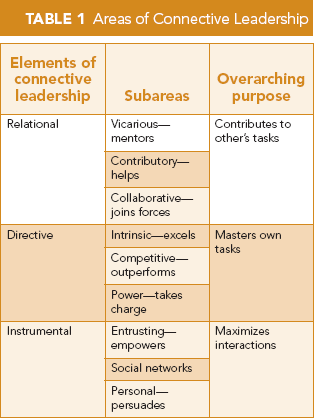
Within the relational facet, the leader uses collaboration and a contributory style by helping others to learn and succeed. They also employ vicarious leadership, encouraging and guiding others, often through mentoring. Leaders who use the direct approach are intrinsically driven to excel and complete work. They are also driven by competition, using external standards of excellence and seeing each activity as a contest or forum for achievement. In addition, they understand how to use power wisely to get things done. The intrinsic, competitive, and power styles are more commonly associated with male or traditional patterns of leadership.
Lastly, instrumental leaders use a personal approach: they are charismatic and are able to motivate others. This approach uses a social style to harness networks and partnerships to get things done and build strong relationships that can be utilized for support by entrusting and empowering others. Interestingly, within the instrumental facet, the personal and social approaches are typically associated with male leadership, while the empowering or entrusting approach is more often associated with women. However, it's important to note that while elements of all three approaches (i.e. relational, direct, and instrumental) may be more often associated with men or women, these associations are not intended to generalize men and women as every individual has their own unique style.
Connective leaders try to build community among diverse groups in order to create a sense of belonging. In recognizing differences in the approach to leadership, they help translate the different styles and approaches, so different change agents better communicate and can act together. Mei–Ling can maximize the leaders she is working with by harnessing different approaches and helping the students to understand her supervisor's concerns while also helping her supervisor to understand concerns the students articulated by being a bridge builder. Lipman–Blumen regards connected leaders as authentic and accountable. The approach itself encourages the widest possible set of individuals to join the leadership process. The model is also contingent, suggesting that different leadership situations will require different forms or balances between these three areas. In working with her supervisor, she may need a more directive style, but when working with the students, a collaborative and contributory style might be best suited.
Lipman–Blumen also notes how connective leadership blends in the qualities of other meta–models, such as transactional/transformational leadership, but moves away from the focus on the individual leader, characteristic of transformational leadership to leadership teams. Connective leaders can be anyone, not just those in positions of authority, and can involve groups, not just individuals. A leader might recognize that he or she is not good at instrumental and decide to bring in other leaders to help contribute this skillset. Lipman–Blumen notes that the instrumental path tends to be used the least by leaders because, traditionally, leadership has been seen as individualistic rather than collective but is critical for success in this new era.
Although Connective Leadership offers much greater detail than can be provided in this article, the main point is that leaders might be best guided into the future with a model that helps them blend multiple approaches to address the complex environment in which they exist. Using connective leadership, women are better able to determine when they might need to use traditional approaches but also how to counteract and circumvent them with this knowledge. Connective leadership does not necessarily suggest operating in traditional ways (using a directive style, for example) but instead recognizing that various styles exist and knowing how to communicate with leaders using different styles.
Therefore, for example, if Mei–Ling is familiar with her supervisor's directive style, she might help her supervisor understand how collaborating with the students can achieve the goals her supervisor is attempting to accomplish with her directive style. This knowledge and skill would help leaders to address the politics and unanticipated reactions that have sometimes led to their failure to identify and appreciate market and corporate approaches. Connective leadership is also about navigating the tensions of diversity, which women can do better if they are harnessing multiple approaches and even, when necessary, those with which they may be less comfortable. Moreover, it is important for all constituents on campus, faculty, staff, and students. It is important for staff working with students to help educate them about the value of different approaches to leadership and how they may face conflicts in their future workplaces in terms of approaches to leadership.
Let's take Mei–Ling situation again—she is trying to figure out when to be relational, directive, and instrumental. She is attempting to be collaborative with students by allowing them to engage in the decision–making processes of the program. Given the demands of her colleagues, she realizes she needs to employ more directive leadership tactics in order to meet goals and maintain high productivity for her office. She also wants to build skills in this area. She sits down with the dean of student affairs, who has strong directive skills, and asks if she can receive mentoring. Mei–Ling really wants guidance on knowing when to be more directive as she has a strong preference for collaboration. She also wants to remain loyal to the commitment she has for student learning and development. She asks to get feedback from the dean as she feels she is not being directive enough. She is having difficulty balancing relational with directive and instrumental leadership. Through conversations with the dean, she has been able to gain a better grasp of the institutional power structure, which has informed her judgment and approach to leadership.
The Promise of Connective Leadership
Leadership is a social construction that has changed over time—at times, it has been coercive, others charismatic, and yet others political or managerial. In the most recent times, women have been pivotal in reshaping the views we now hold about leadership, which now include collaboration, collective action, nonpositional actors, participatory decision–making, cognitive complexity, empowerment, inclusiveness, integrity, ethics, common purpose, and vision. This change is truly revolutionary in the history of the phenomenon of leadership. As we move forward in changing times, more alterations are likely to emerge. As Lipman–Blumen predicts in Connective Leadership, we are living in an era when leadership requires a complex integration of the best qualities of many different approaches to leading.
For women (and emerging millennials) who fought so hard to have new views of leadership embraced, blending in these other styles can feel threatening, problematic, or like selling out. Yet, we believe the future is best served by a leadership approach that embraces women's perspective but combines it with the best of other approaches that have emerged and that aligns with current pressures in our environment. New professionals are seeking out differing leadership perspectives, and learning how to navigate among various approaches will be pivotal to the success of future leaders in higher education.