







Abstract

Recognizing the mismatch between a philosophy of holistic development and evaluation focused on external, quantitative criteria led Miami University's Honors and Scholars Program to revise its curriculum in accordance with student development theory.
However, as we further prepared for our visit to the graduate course, we realized that we would provide a greater opportunity for students to share their expertise if we laid out our struggles rather than our successes. After all, while we felt we had made significant strides in the past few years, we remained intent on finding more effective ways to foster transformative teaching and learning. What better venue could we find in which to explore these issues than a class of graduate students who were familiar with our context and had studied these issues extensively? Thus, we decided to use the class visit as an opportunity not to share best practices but to solicit feedback on our program's deeply entrenched problems as well as some newly developed ideas for solving them. Little did we realize that the discussion that ensued in that classroom would propel the transformation of every aspect of our program.
We realized that we would provide a greater opportunity for students to share their expertise if we laid out our struggles rather than our successes.
We started the class session with an overview of our most pressing challenges. Like many high-ability students, Miami's honors students enter the university with impressive high school records of achievement inside and outside the classroom. Although they enter with credit for the majority of their introductory college courses, our program nevertheless requires them to complete at least seven honors courses, most of which meet introductory general education requirements and which they can take in any order. One concern is that despite the fact that our exit interviews show that students find many of their out-of-class and nontraditional learning experiences more transformational than traditional coursework, we give little to no credit for these types of opportunities. And although the percentage of our students who complete a thesis is slightly above the national norm, it is still lower than expected, given the high profile of our entering students. Thus, we have found ourselves in the unenviable predicament of encouraging students to meet course requirements that they really do not need, unintention-ally devaluing the out-of-class learning experiences that we know are key to their development, and recognizing that the coursework that we are providing does not seem to prepare or motivate students for substantive research or creative work. In short, our curriculum and program requirements are in critical need of reform.
To address some of these challenges, Haynes had drafted a curriculum composed of three increasingly challenging and complex tiers. She distributed handouts detailing this new curriculum to the graduate students serving as our consultants and then opened the floor for feedback. As our consultants leafed through the handouts, they began to ask questions and provide perspectives that pushed us to consider more deeply our beliefs and values in regard to the learning and development process.
“The learning outcomes appear weighted toward cognitive development,” observed one student.
“Good point,” Haynes responded. “My perspective as a faculty member makes me biased in that direction. We will need to work with our partners in student affairs to make sure the learning outcomes also address affective development.”
Others began to think about the implementation process. “In what ways will you ensure that students complete experiences in an appropriate sequence rather than in a random or unstructured manner?”
We explained, “We have not quite gotten to that level of detail yet. Any ideas?”
With each subsequent question and comment that our consultants offered, we discovered areas in which to improve and expand the draft for the new curriculum. Immersed in vibrant discussion, we hit the core of the issue when Baxter Magolda observed, “It strikes me that the current program requirements do not measure learning.” Her observation drew the class's collective attention to the milestones we in the UHSP use to gauge successful progress toward completing the program: five experiences completed with a cumulative grade point average of 3.2 or higher by the end of second year; eight experiences completed with a cumulative grade point average of 3.3 or higher by the end of third year; ten experiences completed with a cumulative grade point average of 3.5 or higher by graduation. Suddenly, we realized that the main hurdle to implementation of the new curriculum would be figuring out how to reframe what counts as successful progress. Although the thought of downplaying or perhaps even eliminating the grade point average requirement for an honors program seemed radical to us at first, this idea became increasingly attractive and spurred a turning point in our shift toward a learning-centered paradigm. With the graduate students' help, we came to see that our current program requirements served as external formulas for success that undercut the mission and vision of our program. In essence, while we espoused holistic development and intentional learning, we measured success with indicators that did not reliably tell us how students had grown intellectually, personally, and socially; even worse, the quantitative requirements provided no incentive or expectation that students decide for themselves the significance or sequence of learning experiences. We had been reinventing the means to the end—the curriculum and cocurriculum of our program—without acknowledging that the end in and of itself would need to change to better reflect and project our program's values. As we studied the mismatch between the means and the end, we recognized that, as Elliot Eisner states in The Enlightened Eye, “More than what educators say, more than what they write in curriculum guides, evaluation practices tell both students and teachers what count. How these practices are employed, what they address and what they neglect, and the form in which they occur speak forcefully to students about what [educators] believe is important” (p. 81).
Having identified the root cause of our deeply entrenched problems, we decided to use the rest of our time with our consultants to gain multiple perspectives and cutting-edge ideas on the following questions:
How can the UHSP requirements reflect that out-of-class learning opportunities are as important as in-class learning opportunities?
How can we shift our focus from assessing students' progress in terms of the number of experiences and toward assessing students' progress in terms of measurable learning outcomes?
How can we sequence learning experiences in a developmentally appropriate way, to help students move progressively toward effective scholarship and leadership within their fields?
Bringing energy, passion, creativity, and intelligence to the discussion, our consultants provided us with theoretically grounded solutions. Moreover, they reinvigo-rated our hope for effecting positive change within our program in particular and Miami University in general. Inspired, we rushed back to our offices to revise the draft of the new curriculum. The tangible end product of our discussion with the graduate students and the revelations we experienced in regard to learning-centered practices is a framework that shifts away from a focus on teaching and course delivery to a focus on student learning and development. Rather than ask students to complete a particular number of honors experiences and maintain a certain grade point average, we will ask them to demonstrate evidence that they have achieved a sequenced set of outcomes through an annual learning map (a less bureaucratic and legalistic term for learning contract) and e-portfolio. While we will continue to pay attention to students' grade point averages, we will review each student's GPA within the context of his or her individualized academic goals rather than have a set cut-off for what counts as acceptable. The outcomes students will work to meet are advanced by a tiered curriculum and cocurriculum that steadily lead students toward the capacity to engage in sophisticated intellectual and creative activities, build mature relationships, and make decisions based on an internal belief system.
Finding Common Ground on Which to Establish Our Framework
While we espoused holistic development and intentional learning, we measured success with indicators that did not reliably tell us how students had grown intellectually, personally, and socially.
The outcomes are advanced by a tiered curriculum and cocurriculum that steadily lead students toward the capacity to engage in sophisticated intellectual and creative activities, build mature relationships, and make decisions based on an internal belief system.
The national dialogue about what and how students should learn echoes the local dialogue that Miami University's president, David Hodge, has begun during the past two years. From dinners focused on topics such as undergraduate research and the learning mission of the university to conference presentations, Hodge has engaged educators in rethinking the structure and function of higher education. In “It Takes a Curriculum: Preparing Students for Research and Creative Work,” Hodge and his coauthors—Paul LePore, Kira Pasquesi, and Marissa Hirsh—propose a model for combining research-based learning with student development theory. In this model, which they label Student as Scholar, they envision a curriculum that helps students develop attributes such as accepting responsibility for their own learning, using answers as opportunities to ask more questions, understanding how to work collaboratively, being confident in their ability to author new knowledge, and looking to peers in order to share viewpoints and contribute to the quality of critical dialogue. During his 2007 annual address to the Miami University community, Hodge highlighted Kate Waller, who has resurrected a student organization designed to encourage environmentally sustainable choices and worked with companies such as Phillips and Kroger to help the campus reduce its carbon footprint, as a student who embodies these attributes. Amid the multiple perspectives on the ultimate outcomes of a high-quality liberal arts education and vivid examples of students who demonstrate advanced degrees of personal, relational, and intellectual maturity, we found common ground, where educators both nationally and locally seek to develop graduates who have the capacity for what Robert Kegan and Baxter Magolda have termed self-authorship. In Learning Partnerships (which she edited with Patricia King), Baxter Magolda notes that Kegan defines self-authorship as “internally coordinating beliefs, values, and interpersonal loyalties rather than depending on external values, beliefs, and interpersonal loyalties” (p. xviii). Joining our fellow educators on this common ground, we turned next to research associated with how to help students achieve self-authorship.
First, we revisited King and Baxter Magolda's chapter in Learning Partnerships: Theory and Models of Practice to Educate for Self-Authorship, which provides step-by-step guidelines for designing a developmental “curriculum” or, in other words, a plan that breaks developmental goals into a sequence of steps and then “organizes these steps into a series of activities and accomplishments that culminate in the achievement of the learning goals” (p. 320). We also reviewed in “Beyond Seat Time and Student Satisfaction: A Curricular Approach to Residential Education” in which Kathleen Kerr and James Tweedy discuss how the University of Delaware's Office of Residence Life shifted toward a learning-centered paradigm. As part of this shift, the office developed a residential education curriculum that focuses on citizenship education and addresses the question, “‘What should every individual student learn as a result of living in a residence hall?’” (p. 11). Kerr and Tweedy explain, “The citizenship outcome has been divided into twenty-eight stated competencies that each student must achieve to meet this outcome. The competencies are time-specific (for example, first year, sophomore year)…. These competencies are further divided into lesson plans sequenced for use at various points throughout the student's experience in the residence halls” (p. 12). From these sources, we derived a basic structure and set of components for our framework.
Considering that the UHSP context allows us to work with students from the time they enter Miami until the time they graduate, we specified that Tier 1 in our framework is designed to target students in early levels of young adult development, Tier 2 targets students in intermediate levels, and Tier 3 targets students in advanced levels. Ultimately, these three tiers provide a sequence of steps that help students move gradually and intentionally toward personal, relational, and intellectual maturity. The first tier focuses on assisting students in gaining foundational competencies in scholarship, leadership, and service; the second tier features students beginning to engage in authentic research, service, and leadership endeav- ors with support and guidance from educators; and the third tier offers students the opportunity to plan, design, and implement their own scholarly, leadership, and service projects with continual feedback and self-reflection. Based on our experiences as well as our understanding of student development theory, we anticipate that most first-year students begin at Tier 1. However, given Jane Pizzolato's findings that some at-risk students demonstrate self-authorship prior to entering college, we leave open the possibility that some may be ready for Tier 2 when they enter, depending on their social and cultural histories. In contrast to our current requirements, in which only a few students reach the Tier 3 level of development, the new framework sets forth the expectation that all students will reach Tier 3 by the time they graduate.
Fitting Together Components of the Learning and Development Process
TABLE 1 summarizes some of the key features of the tiered framework for student learning. The table includes five interrelated components that are integral to our framework:
Framework for Student Development
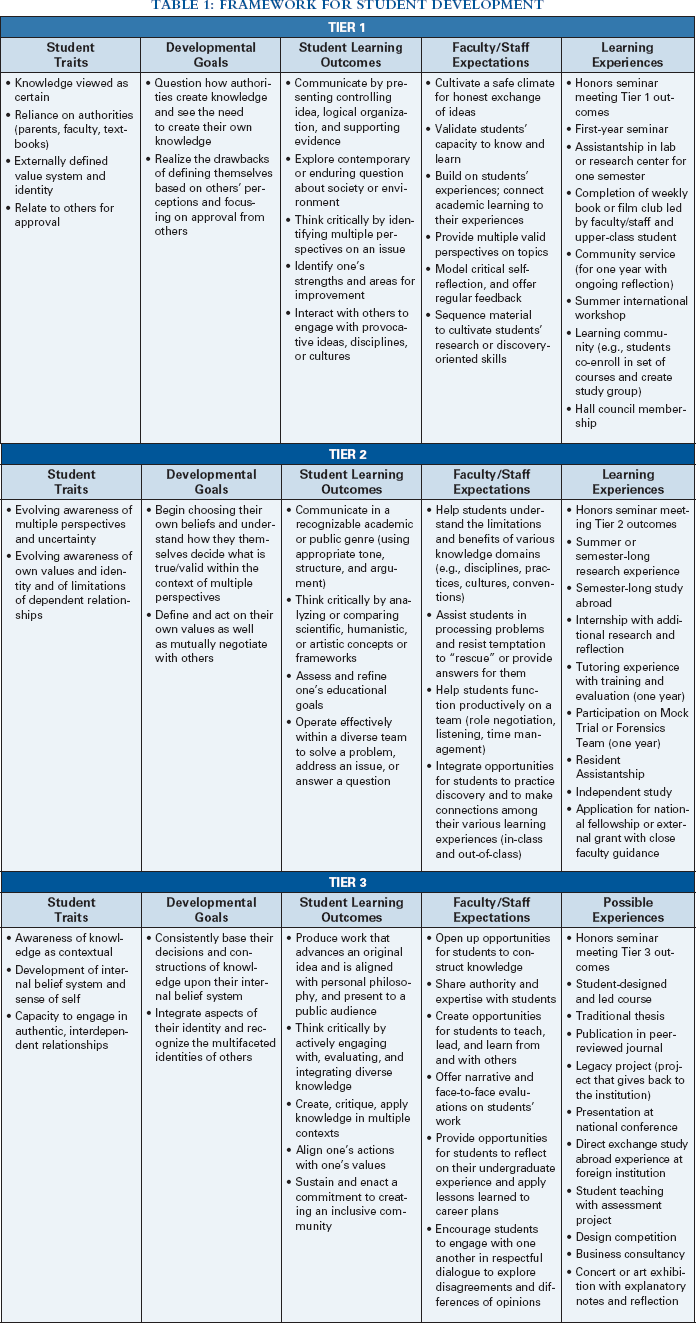
A brief description of student traits, which are based on Baxter Magolda's twenty-year longitudinal study of young adult development
A list of key developmental goals, which span the three dimensions of personal, relational, and intellectual development
A list of specific and measurable student learning outcomes
A set of expectations for faculty and staff facilitating the learning
A list of possible sites for student learning to occur both inside and outside the classroom
Each tier contains all five components, but the nature of the components changes in each tier as students move along in their journey toward self-authorship.
To develop each tier, we began with a description of students' traits in terms of development. We considered questions such as “How do our students at this level of development think about themselves?” “How do they relate with others?” “How do they make decisions?” In essence, we considered where students would likely begin when they approach the activities associated with each tier. Next, we determined the developmental point to which students could realistically progress as a result of engaging in a certain tier's activities. That is, we established a sequenced set of developmental goals that lead students toward self-authorship as they move from Tier 1 to Tier 3. These developmental goals serve as the foundation for the student learning outcomes, which represent the specific capacities we expect students to demonstrate.
As we began developing the student learning outcomes for the UHSP framework, we initially reviewed the seven liberal arts outcomes of the Wabash National Study of Liberal Arts Education (WNSLAE). In their About Campus article on these outcomes, “Liberal Arts Student Learning Outcomes: An Integrated Approach,” Patricia King, Marie Kendall Brown, Nathan Lindsay, and JoNes VanHecke explain, “Our goal was to produce a list of liberal arts outcomes that connected the qualities of the mind commonly associated with developing wisdom with the responsibilities of citizenship, meaning the educated person's commitment to community” (p. 3). Their list of liberal arts outcomes includes integration of learning, inclination to inquire and lifelong learning, effective reasoning and problem solving, moral character, intercultural effectiveness, leadership, and well-being. The authors note that two distinguishing features of this list are the interdependence and multiple dimensions of the outcomes. By portraying the outcomes as interdependent, the researchers acknowledge that the outcomes mutually shape one another and fit within a larger developmental process. By having the outcomes span multiple dimensions, the researchers fuse aspects of learning that have traditionally been separated and thus achieve an integrated, holistic portrait of liberal arts education.
The distinguishing features of the seven WNSLAE liberal arts outcomes reflect our own assumptions that learning and development are intricately intertwined and involve growth in cognitive as well as affective dimensions. Thus, we began to revise our student learning outcomes to ensure that they aligned with the developmental goals we had established for the framework and that they addressed all three dimensions of development (personal, relational, and intellectual). For example, one of our current student learning outcomes is to demonstrate a critical understanding of diverse perspectives and cultures. While this outcome most directly connects with the relational aspect of development, in which students gain the capacity to recognize and appreciate the multifaceted identities of others, it also involves intellectual growth in order to identify the assumptions that shape a given perspective and culture as well as personal growth in order to see difference as valuable rather than threatening. Confident that this student learning outcome linked learning with development and spanned multiple dimensions, we then broke it down into steps. For Tier 1, we expect students to demonstrate a willingness to interact with others in order to engage with new and provocative (that is, dissonance-inducing) ideas, disciplines, or cultures. This ability lays the groundwork for Tier 2, in which we ask students to work to incorporate new and provocative ideas, disciplines, or cultures into their own personal and professional philosophy. Finally, as students complete Tier 3, we expect them to be able to recognize the unique value of their own and other cultures and to sustain a commitment to creating inclusive communities. Ultimately, we intertwined the developmental goals and learning outcomes in each tier so that as students learn, they also develop greater degrees of personal, relational, and intellectual maturity.
We established a sequenced set of developmental goals that lead students toward self-authorship.
We intertwined the developmental goals and learning outcomes in each tier so that as students learn, they also develop greater degrees of personal, relational, and intellectual maturity.
The final two components of our framework address how educators will interact with students in order to achieve the developmental goals and learning outcomes. In essence, these components discuss specific ways to implement the framework and support students during their journey toward self-authorship. The faculty and staff expectations come from the three key principles that promote self-authorship from Baxter Magol-da's long-term study. These key principles, which form part of the Learning Partnerships Model, are as follows: “Validate learners' capacity to know, situate learning in learners' experience, and define learning as mutually constructing meaning” (p. 41). Similar to the way in which we linked learning outcomes and developmental goals, we aligned the faculty and staff expectations with students' level of development for each tier. Thus, how educators define learning as mutually constructing meaning looks different when they are working with students in the first tier than when they are working with students in the third tier. For example, students in Tier 1 likely need a model of how to engage in critical self-reflection because they may be unfamiliar with this activity, while students in Tier 3 need opportunities to routinely apply the insights they gain from self-reflection. These faculty and staff expectations also help communicate how educators can reformulate their roles away from that of an expert and toward that of a guide who facilitates students' developmental journeys. For the final component in our framework, we sought to identify experiences throughout our university in which educators can effectively engage with students to promote the student learning outcomes. Such a list should be tailored to the institutional context. For example, our institution provides several unique internship and intensive leadership programs that are open to students from a wide range of majors. We have begun developing intentional partnerships with the coordinators of such programs to ensure the experiences fully align with the student learning outcomes. Although the list could be endless, the sites named in our list are those that our institution can readily provide and span a range of in-class and out-of-class environments.
Assessing Our Framework
Once admitted into the program, students will participate in a sequenced series of advising sessions throughout their collegiate experience that will encourage them to identify goals for their educational journey and connect these goals with the outcomes for the appropriate tier; explore various curricular and cocur-ricular opportunities that they believe will help them meet our program's outcomes, their major requirements, and their individual educational goals; and reflect on the highlights and challenges of their college journey. These sessions also will help illustrate how students can partner with educators to take an active role in their own learning experience. Each year, students will use the learning map to reflect on their progress in terms of the relevant tier's outcomes and to plan for meeting the outcomes in subsequent tiers. Using an electronic portfolio system, they will attach copies of work that they believe demonstrates how they met (or aimed to meet) one or more of the tier's outcomes in their contract. For example, let's take the hypothetical case of Lauren, a student who identifies scientific research as her primary educational goal. During her first year, Lauren elects to enroll in a rigorous slate of lower-division science and math courses and volunteers to be a lab assistant; in her e-portfolio, she includes a lab report that provides an insightful summary of the main topic that the research team in her lab is investigating as well as explores possible sources of bias and error within the data. The component of her lab report that explores sources of bias helps educators who are reviewing her e-portfolio see that she has begun to question knowledge claims; when they meet individually with her, they encourage her to move on to Tier 2 opportunities. In Tier 2, Lauren completes courses that focus on research methods, which allow her to compare and contrast different frameworks for her discipline. From her e-portfolio, faculty and staff see that her development in inquiry and critical thinking is on target with Tier 2 outcomes but that her development in collaboration remains in the Tier 1 range. An advisor provides this feedback to Lauren and discusses how to connect with a diverse interdisciplinary research team. The next year, Lauren includes a journal entry about working with the research team in her e-portfolio. She vividly describes a heated argument that took place in the lab one day; elaborating on the stance she took in this situation, Lauren states, “Each person had a valid point, but some people were reluctant to abandon the initial research design because they themselves had put a lot of work into developing it. I decided to jump into the conversation and say that I appreciated the time and effort they had spent because it helped us investigate one key variable. I tried to help them see that not gaining the desired results was an important discovery in and of itself.” Lauren's demonstrated ability to listen to her teammates and relate with them in a productive fashion gives her confidence to bring her own perspective to her scholarly activities. As a result, she, in consultation with one of her advisors, decides to participate in a graduate-level seminar during her senior year. Through this experience, she and her research team coauthor an article for a peer-reviewed science journal. To document this achievement, Lauren includes the response that she and her coauthors have crafted to the peer reviewers' comments and notes, “I now realize that feedback, even if critical, is a sign that the reviewer is interested enough in the work to raise questions about it. Rather than dread feedback, I now yearn for it because it allows me to further participate in scholarly dialogue.” Before Lauren graduates, she meets for one final time with an advisor in the Honors and Scholars Program to assess her progress toward the learning outcomes. Even though she may not have reached the top level in each area, she marvels at how far she has come since she wrote her admission essays. Like Lauren, each student in the UHSP will be able to gradually imagine a unique pathway to success that promotes key liberal education outcomes and is aligned with his or her own personal educational goals.
Moving Forward with Our Framework
Each year, students will use the learning map to reflect on their progress in terms of the relevant tier's outcomes and to plan for meeting the outcomes in subsequent tiers.
While the framework offers many solutions to our deeply entrenched problems, it does not eliminate challenges. Most significantly, implementation of the framework requires cultural change among faculty and staff as well as students. Student learning can only be advanced if educators are also encouraged to develop as learners and teachers through ongoing and required orientations, reflection sessions, and consultations. Moreover, as those who work on the front lines know well, the journey toward self-authorship is rarely, if ever, smooth. Because promoting development involves inciting dissonance and coaxing students to step beyond their comfort zone, crises and conflicts—which take time and patience to resolve—are likely to arise. Educators and students must work together to stay focused on learning, even though one or both parties may be tempted to run from the transformational process at times.