







Abstract

The authors describe a pilot project in which formative feedback from industry professionals creates a genuine learning experience for students.
Raising standards by employing standardized measures and cross-institutional comparisons, however, may not provide the practices and measures that meet the needs of employers or society. Jonathan Kozol, lamenting the failure of the long history of standardized measures to lead to improved learning on a CounterSpin radio broadcast, suggests why: “Weighing the lamb doesn't fatten the lamb.”
The persistent disconnect between cross-institutional comparisons, standardized measures, and student learning has been further explicated in Hart Research Associates survey of employers commissioned by the Association of American Colleges and Universities in 2008 that reports employers’ general disinterest in these comparisons and measures. Underscoring Kozol's wry caveat, the Association of American Colleges and Universities survey reports that a majority of 301 employers say they have little confidence in transcripts, tests, or cross-institutional comparisons as helpful predictors of career success. Those measures don't provide evidence for what graduates can do. The common weights of institutional and student success like “enrollment persistence, and degree attainment” are no longer adequate documentation (p. 1). Employers report a pointed frustration with recent graduates’ lack of “broader skills,” including communication, collaboration, and problem solving. Those “360 degree skills” are what employers deem “necessary to promise greater success for both the individual and their employer” (p. 1). Further, employers recognize that traditional assessments are unlikely to promote development of such skills. More useful, they suggest, are “internships, community-based projects, and senior projects” (p. 1).
Employers are not waiting for educators to establish useful outcomes assessment. According to Paul-Baskin's article in The Chronicle of Higher Education, Boeing has implemented an internal ranking system that tracks employees back to their colleges. It is not a coincidence that Boeing's senior vice president, Richard D. Stephens, was a member of Margaret Spellings's Commission on the Future of Higher Education, a panel formed by Spellings, the U.S. Secretary of Education, in 2005. Baskin quotes Stephens, who explains that his experience sitting through many meetings of the commission “listening to long discourses by education professionals” helped him realize that Boeing “would have to take action on its own.” Boeing's effort, Stephens says, is “really about improving the dialogue on curriculum, performance, and how we can build a stronger relationship between the colleges, universities, and us, because, ultimately, their students become our employees.”
Accreditors are also questioning the value of standardized tests and cross-institutional comparisons. In September 2008, HEA Update from the Council for Higher Education Accreditation noted that for the first time, accreditation “may include different standards for different institutions or programs, as established by the institution.” The recognition of institutional diversity is a recognition of the need to individualize, deepen the conversation among stakeholders, and do more to promote activities like internships, community-based projects, and senior projects—activities that faculty, students, and employers value but that elude traditional measurements.
Assessment that will meet needs of the twenty-first century requires a broad new approach to collaboration. As Peter Ewell of the National Center for Higher Education Management Systems argues, the vision for assessment has always “demanded” three “intertwined and inseparable” things: “collective and detailed vision of attributes and abilities,” “coherence and connectedness” and “defensible evidence” (p. 1, italics added). Implementation of the vision, it is clear, will not be possible without engaging stakeholders—employers, faculty, and students. To that end, communication technologies are indispensable.
The work cannot rely on the traditional and exclusive labor of educators (and their assistants) alone. Accreditors repeatedly remind classroom faculty that accountability expectations are changing and that grades, if they ever were, are not now sufficient for meeting accountability requirements. It is a caution that is in part recognition that the isolated perceptions of any single group—even a group of expert educators—will not satisfy the many stakeholders who are invested in higher education. In classroom terms, grades (faculty judgment) are not sufficiently grounded or validated. Including professionals from the field in assessment practice, however, is valuable for more than simply validating an assessment; the opportunities to build robust community have additional explicit and implicit value. Professional participation in assessment activities can be mediated to introduce students—and educators—to the discourse of the community of professional practitioners, even when the field of study is not directly vocational or professional. And the reciprocal benefits that professionals gain from working with the academic community—the opportunity to reflect upon their own professional development while guiding and shaping the future leaders of the profession—are also a mul-tifaceted opportunity to add value to the educational enterprise. Further, as John Dewey called for more than a century ago, collaborating with professionals provides a vital way to reclaim education's shaping function in society.
Finally, students themselves are key stakeholders in building a broader community around issues of assessment. As Grant Wiggins argues in his 1993 book, Assessing Student Performance: Exploring the Purpose and Limits of Testing, learners gain substantially just from the demystification of academic expectations as well as from engaging in guided self-assessment.
The Challenge of Educative Assessment
In Donald Finkel and Stephen Monk's classic 1983 essay “Teachers and Learning Groups: Dissolution of the Atlas Complex,” the authors identified the Atlas complex of the title as the belief of many educators that they are solely responsible for teaching students. Such a perspective is not sustainable, according to Finkel and Monk, and it is not effective. They elaborate on the wealth of teaching resources students live among—most notably, their peers. As Grant Wiggins argues on the New Horizons for Learning Web site, “Our challenge as educators is to think of assessment as first and foremost educative,” adding, “Our aim must therefore be to create assessments that provide better feedback by design, and not think of improvements in terms of more accurate evaluation.” Suggesting that feedback needs to be understood more broadly, Wiggins quotes Peter Senge, who defines it in learning organizations as “a reciprocal flow of influence.”
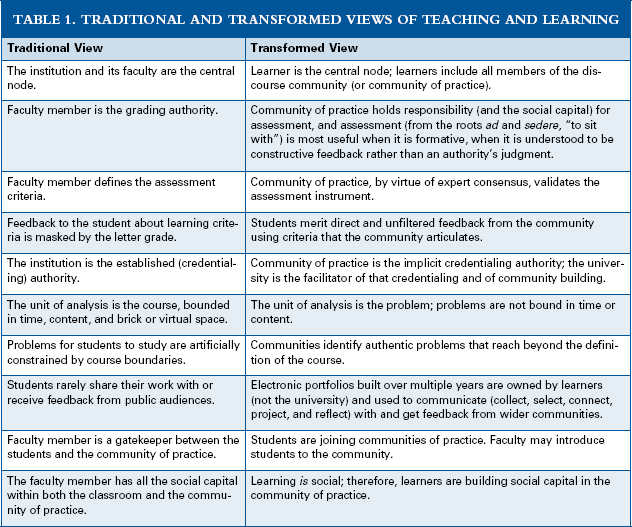
From this discussion of accountability, assessment, and feedback, we have formulated Table 1 as a way to outline the distinctions that define and guide our approach to the challenge of improving feedback, assessment, and accountability.
Traditional and Transformed Views of Teaching and Learning
The Cross-Stakeholder Approach
At Washington State University (WSU), a field experiment and pilot project explored the proposition that a community of students, educators, and industry professionals providing feedback based on explicit criteria will improve learning outcomes in ways that meet accreditation guidelines and align with professional employability. Further, the project examined how such a community of practice collects and shares data to inform their conversation and help to demystify expectations and criteria for all stakeholders. Working with a design team from Washington State University's Center for Teaching, Learning, and Technology, a faculty member from the university's Apparel, Merchandising, Design and Textiles Department interested in promoting authentic learning opportunities enlisted her professional colleagues in industry to join in the project and the study. Findings from this work have implications for educators and learners in and outside formal classroom settings and for a broad range of constituents in and outside the academy. These findings have much to say to those educating for, working in, or preparing to work in settings far beyond apparel, merchandising, design, and textiles.
The Project
Widely Divergent Views across Stakeholders
Ratings of student projects were statistically significantly different across all groups. Rather than being disheartened by these divergent findings, we see in those differences a rich and potentially productive opportunity for conversations about them across stakeholder groups. We believe that working to encourage consensus about direct measures of learning is critical in building bridges between stakeholder communities and provides the context in which this study was conducted.
The agreement within groups is also interesting. There were marginally acceptable levels of agreement among industry professionals at 65 percent, with half of the projects receiving ratings that had better than 70 percent agreement (the conventional minimum). The marginal level of reliability among employers may result from the novelty of the procedure and the lack of calibration or formal norming of the rating of student work using the rubric. In contrast, students were remarkably aligned at 80 percent agreement. The level of agreement among students is notable and merits follow-up in the future. Faculty ratings were, unfortunately, underrepre-sented because there were too few projects with multiple ratings to provide measures for analysis.
Shaping Learning of Students and of their Potential Employers
Differences in Student Evaluations across Groups
We examined the differences in the quantity of words used to guide or respond to student performance that were provided by the three groups—faculty, industry professionals, and students. The frequencies suggest interesting distinctions between stakeholders, distinctions that suggests different qualities of engagement. Employers provided the greatest quantity of words of all stakeholders, which suggests that they are a potentially rich and valuable collaborative resource that might contribute to the scalability of this approach to engaging distributed stakeholder and harvesting feedback, a way to counter the Atlas complex. We also extended the exploration of the quantity of participation by calculating the number of words per comment. A high percentage of faculty members responded to student work with fewer than twenty words per comment. It appears that faculty in this study were not only more parsimonious in their feedback but also less likely to respond to student work at all (perhaps an indication that they may not suffer from the Atlas complex after all?). Peers and employers were much more likely to respond more often, and when they did, they were more likely to provide a greater quantity of feedback.
Of course, there is no evidence to suggest that quantity associates with the quality or utility of a response. There is no reason to suspect that saying nothing is not appropriate in many instances, especially considering that the faculty lead's project goal was to promote engagement among employers and students. In fact, counter to the Atlas complex, Wiggins suggests that feedback need not be labor-intensive in his 2004 entry on the New Horizons for Learning Web site. He says, “A common misconception about feedback in schools is that it is impossible to provide enough of it because good feedback seemingly requires intensive one-on-one tutorials. But much important feedback is derived from situational information in response to trying to accomplish a task. The challenge of designing learning, in fact, is to make it possible for students to self-assess and self-adjust effectively, with minimal intervention by the teacher. Put another way, instructional design is the art of maximizing self-directed learning and useful information from the situation.”
To get at the issue of quality, we conducted a tag cloud analysis on the text of the feedback in order to provide some preliminary insight that would help sharpen this complex issue. Tag clouds count word frequencies, and the more frequently words are used, the larger they are rendered in the cloud. Figure 1 makes apparent the different character of the language used by each group.
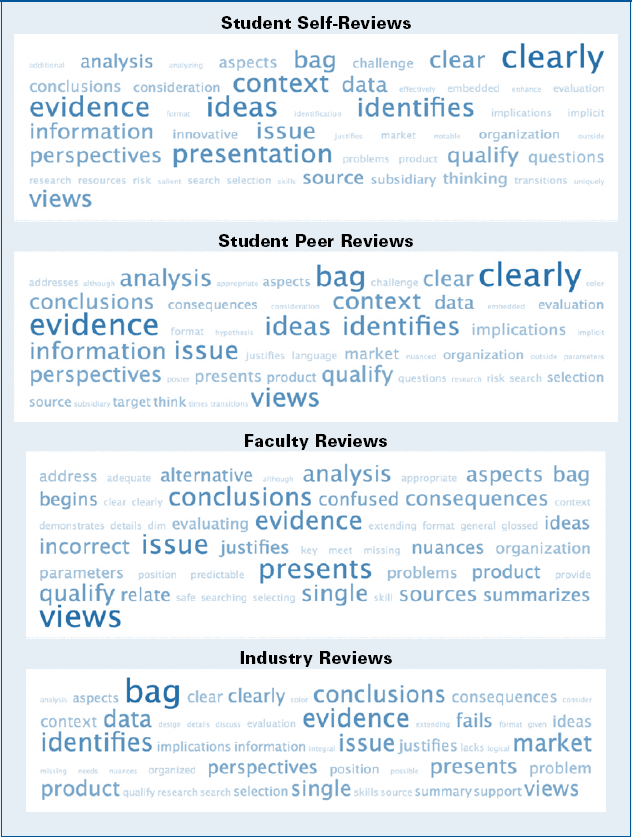
TAG CLOUDS FOR STUDENT EVALUATIONS BY VARIOUS STAKEHOLDERS, INDICATING FREQUENCY OF WORD USAGE
The tag clouds are revealing. At first blush, the tag clouds demonstrate some degree of adoption of the language of the rubric across groups. Industry experts, faculty members, and students frequently use the word evidence, for instance. Scrutiny of the tag clouds, however, reveals some subtle but distinct differences between groups. Note the faculty use of problems, while the employers’ focus is on problem. We point to this distinction as emblematic of a potentially key difference and one that may illuminate the challenge of cross-stakeholder assessment. The faculty references to problems are pointers to the many aspects of students’ projects that are incorrect (also signaled in the cloud of faculty discourse). The feedback that faculty members give to students is, we suggest, more atomized, more focused on errors, focused on, metaphorically, the trees. The attention to corrections is often, as Rich Haswell noted, “analogous to that of the teaching of grammar in composition courses—hundreds of thousands of hours spent, and being spent right now, on a task of little proven benefit.” Alternatively, employers tend to look at the forest, the larger problem that students have addressed in their projects. Both industry experts and students use the words market and perspectives. Faculty don't. (In fact, the only faculty comment related to “other perspectives” was concern that students’ consideration of other views might be “irrelevant.”) Like students (and unlike faculty), industry professionals frequently discuss context and data. Like the implicit pedagogies that promote what employers value—communication, collaboration, problem solving—the big picture focus of employer feedback generally aligns with what research by John Bean; Grant Wiggins, in Assessing Student Performance: Exploring the Purpose and Limits of Testing; John Bransford, Ann Brown, and Rodney Cocking; and Ernest Pascarella and Patrick Terenzini; and others has identified as good teaching practice.
The faculty stress on correctness, however qualified by the fact that this is a small study, hints at the deeper problem of the Atlas complex. It reflects a habit of providing feedback to students that, as Haswell notes, is difficult to scale upward. Fatigue may very well be one reason that faculty comments are under-represented in this study. The “too busy” lament may mask a “too tired” reality. More important, Atlas-related fatigue also delimits faculty's ability to engage themselves and their students with the larger problems facing the profession. To what extent does that disengagement feed the ubiquitous perception among students and others outside the academy that the world of higher education is not the real world? Combing through student work in order to highlight errors is, for most, a tedious and exhausting practice. Focusing on ideas is more invigorating, as indicated by the positive response from employers in this study. In addition, focusing on correcting student work, however much it may be deemed necessary, also promotes what Jerry Farber identified back in 1969 as “authority addiction.” It is not incidental that in spite of the gains that students demonstrated in this study, student evaluations of the experience were distinctly bi-modal Students praised the course experience or panned it, with little in between. Student resistance to innovation is well documented by Sahana Murthy and Maria Ruibal. That authority addiction, we argue, lies at the heart of the difficulties many students identify with innovative teaching practices like those in the project reported on in this article. Such innovations press students to assume greater responsibility for learning. In other words, in spite of the reported purpose for getting an education as a way to prepare for careers and the seemingly obvious contributions such activities might hold to that end, students are addicted to the authority of the instructor, a symbiotic dependency that contributes to the status quo.
Building Consensus among Diverse Participants
Other implications are worth noting. As Wiggins has pointed out, there is a danger when we conflate high standards with standardization. This process illustrates how students can be held to high and authentic standards while working on diverse teams doing diverse projects in diverse ways. As they would be in the real world, students in this project were responsible for constructing their own understanding of professional success and, with input from peers, faculty, and industry professionals, realizing that success. At the same time, industry participants reported gains in their own understanding of the criteria associated with that success.
Implications for Accountability
What is less clear, yet no less exciting, is how the process used for this project begins to assuage Dewey's fear that education might fall to only a reflecting role and forfeit its function of shaping society. Though this process challenges traditional faculty, student, and even employer roles in promoting relevant learning, it begins to break the fall.