






Abstract
Background
In recent years, crime scholars and practitioners have pointed to the potential benefits of focusing crime prevention efforts on crime places. A number of studies suggest that there is significant clustering of crime in small places, or “hot spots,” that generate half of all criminal events. Researchers have argued that many crime problems can be reduced more efficiently if police officers focused their attention to these deviant places. The appeal of focusing limited resources on a small number of high-activity crime places is straightforward. If crime can be prevented at these hot spots, then citywide crime totals could be reduced.
Objectives
To assess the effects of focused police crime prevention interventions at crime hot spots. The review also examined whether focused police actions at specific locations result in crime displacement (i.e., crime moving around the corner) or diffusion (i.e., crime reduction in surrounding areas) of crime control benefits.
Search Methods
A keyword search was performed on 15 abstract databases. Bibliographies of past narrative and empirical reviews of literature that examined the effectiveness of police crime control programs were reviewed and forward searches for works that cited seminal hot spots policing studies were performed. Bibliographies of past completed Campbell systematic reviews of police crime prevention efforts were reviewed and hand searches of leading journals in the field were completed. Experts in the field were consulted and relevant citations were obtained.
Selection Criteria
To be eligible for this review, interventions used to control crime hot spots were limited to police-led prevention efforts. Suitable police-led crime prevention efforts included traditional tactics such as directed patrol and heightened levels of traffic enforcement as well as alternative strategies such as aggressive disorder enforcement and problem-oriented policing. Studies that used randomized controlled experimental or quasiexperimental designs were selected. The units of analysis were limited to crime hot spots or high-activity crime “places” rather than larger areas such as neighborhoods. The control group in each study received routine levels of traditional police crime prevention tactics.
Data Collection and Analysis
Sixty-five studies containing 78 tests of hot spots policing interventions were identified and full narratives of these studies were reported. Twenty-seven of the selected studies used randomized experimental designs and 38 used quasiexperimental designs. A formal meta-analysis was conducted to determine the crime prevention effects in the eligible studies. Random effects models were used to calculate mean effect sizes.
Results
Sixty-two of 78 tests of hot spots policing interventions reported noteworthy crime and disorder reductions. The meta-analysis of key reported outcome measures revealed a small statistically significant mean effect size favoring the effects of hot spots policing in reducing crime outcomes at treatment places relative to control places. The effect was smaller for randomized designs but still statistically significant and positive. When displacement and diffusion effects were measured, a diffusion of crime prevention benefits was associated with hot spots policing.
Authors' Conclusions
The extant evaluation research suggests that hot spots policing is an effective crime prevention strategy. The research also suggests that focusing police efforts on high-activity crime places does not inevitably lead to crime displacement; rather, crime control benefits may diffuse into the areas immediately surrounding the targeted locations.
PLAIN LANGUAGE SUMMARY
Hot spots policing is associated with reductions in crime
Hot spots policing is associated with small but meaningful reductions in crime at locations where criminal activities are most concentrated. Focusing police efforts at high activity crime places is more likely to produce a diffusion of crime prevention benefits into areas adjacent to targeted hot spots than crime displacement.
What is this review about?
Crime is concentrated in small places, or “hot spots,” that generate half of all criminal events. Hot spots policing focuses police resources and attention on these high crime places. For the purpose of this review, hot spots programs must have consisted of police-led crime prevention efforts that targeted high-activity crime “places” rather than larger areas such as neighborhoods.
This review considers both randomized controlled experimental and quasiexperimental evaluations of the effects of hot spots policing interventions on crime where the control group in each study received routine levels of traditional police enforcement tactics.
This Campbell systematic review assesses the preventive effects of focusing police-led crime prevention efforts on crime “hot spots” as compared to traditional police crime control strategies. The review summarizes evidence from 65 studies containing 78 tests of hot spots policing interventions, including 27 randomized controlled trials and 38 quasiexperimental evaluations.
What studies are included?
A total of 65 studies containing 78 tests of hot spots policing interventions were identified. However, standardized effects sizes were only calculated for 73 main effects tests due to reporting deficiencies in three included studies.
All studies were published from 1989 to 2017: 51 studies were conducted in the United States, four in the United Kingdom, four in Sweden, and six in other countries.
What are the main findings of this review?
Does focusing crime prevention efforts on crime hot spots reduce crime?
Yes. Hot spots policing generates statistically significant small reductions in overall crime and disorder in areas where the strategy is implemented. These crime control gains were evident across specific categories of crime outcomes including drug offenses, disorder offenses, property crimes, and violent crimes.
Does policing crime hot spots inevitably produce crime displacement effects?
No. Overall, it is more likely that hot spots policing generates crime control benefits that diffuse into the areas immediately surrounding the targeted locations than displacing crime into nearby locations.
What do the findings of this review mean?
Findings from this review support hot spots policing as a proactive crime reduction strategy. Police departments should incorporate focusing resources at high-activity crime places as part of their broader approach to crime prevention.
The majority of studies included in the updated review have been published since the previous iteration of the review and utilized rigorous research designs.
Despite the drastic increase in eligible studies, only one study conducted a formal cost-benefit assessment of the hot spot policing intervention. The growth of hot spots policing warrants further empirical attention on the efficiency of hot spots policing for reducing crime.
How up-to-date is this review?
The review authors searched for studies up to February 2017.
BACKGROUND
The issue
Over the past 30 years, crime scholars and practitioners have pointed to the potential benefits of focusing crime prevention efforts on crime places. A number of studies suggest that crime is not spread evenly across city landscapes. Rather, there is significant clustering of crime in small places, or “hot spots,” that generate half of all criminal events (Pierce, Spaar, & Briggs, 1988; Sherman, Gartin, & Buerger, 1989). Even within the most crime-ridden neighborhoods, crime clusters at a few discrete locations and other areas are relatively crime free (Weisburd, Groff, & Yang, 2012). More recent research has reinforced this idea of crime concentrations (Braga, Andresen, & Lawton, 2017) and led Weisburd (2015) to argue that there is a “law of crime concentration” at places showing not just that crime is concentrated but that it is concentrated at similar levels across cities and across time. A number of researchers have argued that many crime problems can be reduced more efficiently if police officers focused their attention to these persistent high-activity crime places (Braga & Weisburd, 2010; Sherman & Weisburd, 1995; Weisburd, 1997). The appeal of focusing limited resources on a small number of high-activity crime places is straightforward. If we can prevent crime at these hot spots, then we might be able to control citywide crime levels (Weisburd, Braga, Groff, & Wooditch, 2017).
Police officers have long recognized the importance of place in crime problems. Police officers know the locations within their beats that tend to be trouble spots and are often very sensitive to signs of potential crimes across the places that comprise their beats. As Bittner (1970, p. 90) suggests in his classic study of police work, some officers know “the shops, stores, warehouses, restaurants, hotels, schools, playgrounds, and other public places in such a way that they can recognize at a glance whether what is going on within them is within the range of normalcy.” The traditional response to such trouble spots typically included heightened levels of patrol and increased opportunistic arrests and investigations. Putting police officers in high crime locations may be an old and well-established idea; however, in the long history of policing, police crime prevention strategies did not focus systematically on crime hot spots until only very recently (Braga & Schnell, 2018). The availability of powerful crime mapping software packages has allowed police departments to identify and address problem places more easily than was previously possible in the days when pin maps were necessary to examine crime concentrations (Weisburd & Lum, 2005).
Hot spots policing
Hot spots policing has become a very popular way for police departments to prevent crime. Many police departments report having the capability to manage and analyze crime data in sophisticated ways and, through management innovations such as Compstat, hold officers accountable for implementing problem-solving strategies to control hot spot locations (Weisburd, Mastrofski, McNally, Greenspan, & Willis, 2003). In the words of then-New York Police Department Deputy Commissioner Jack Maple, “the main principle of deployment can be expressed in one sentence: ‘map the crime and put the cops where the dots are.’ Or, more succinctly: ‘Put cops on dots.’” (Maple, 1999, p. 128). The 2007 Law Enforcement Management and Administrative Statistics survey reported that nearly all police agencies in large metropolitan centers use computers for hot spots identification (Reaves, 2010). The Police Executive Research Forum (2008) surveyed 176 U.S. police departments and found that nearly 9 out of 10 agencies used hot spots policing strategies to deal with violent crime in their jurisdictions and that problem-solving techniques were often deployed to address violent crime hot spots. In a more recent study of a representative sample of police agencies, the National Police Research Platform reported that 75% of the agencies surveyed used the hot spots policing approach (Mastrofski & Fridell, n.d.; reported in Weisburd & Majmundar 2018).
A growing body of research evidence suggests that focused police interventions, such as directed patrols, proactive arrests, and problem-oriented policing (POP), can produce significant crime prevention gains at high-crime “hot spots” (see, e.g., Braga, 2008; Eck, 1997, 2002; Weisburd & Eck, 2004). Indeed, the National Research Council's Committee to Review Research on Police Policy and Practices found that “...studies that focused police resources on crime hot spots provided the strongest collective evidence of police effectiveness that is now available” (Skogan & Frydl, 2004, p. 250). More recently, the National Research Council's Committee on Proactive Policing concluded that the available research evidence suggests that hot spots policing strategies generate statistically significant crime reduction effects (Weisburd & Majmundar, 2018). Critics of place-based interventions, however, charge that such policing strategies result in displacement—that is, criminals move to places not protected by police intervention (e.g., Blattman, Green, Ortega, & Tobón, 2017; Reppetto, 1976). The available evidence suggests that hot spots policing interventions are more likely to be associated with the diffusion of crime control benefits into surrounding areas rather than crime displacement (e.g., Braga & Weisburd, 2010; Weisburd & Majmundar, 2018; Weisburd et al., 2006).
Theoretical underpinnings
The crime prevention potency of hot spots policing is supported by two key theoretical mechanisms: deterrence and crime opportunity reduction (Braga & Schnell, 2018). Deterrence theory suggests that crime can be prevented when the costs of committing the crime are perceived by the offender to outweigh the benefits (Gibbs, 1975; Zimring & Hawkins, 1973). Much of the literature evaluating deterrence focuses on the effect of changing certainty, swiftness, and severity of punishment associated with certain acts on the prevalence of those crimes (Apel & Nagin, 2011; Nagin, 2013; Paternoster, 1987). Reflecting on the theoretical and policy lessons learned from hot spots policing evaluations, Nagin et al. (2015) argued that increasing police visibility in crime hot spots will generate substantial marginal deterrent effects by heightening potential offenders' perceived risk of apprehension and discouraging them from taking advantage of concentrated crime opportunities in these small places. Indeed, in the well-known Minneapolis hot spots patrol experiment, Sherman and Weisburd (1995) claimed evidence of place-specific “micro-deterrence” associated with increased police presence in hot spot areas (p. 646).
Hot spots policing is also highly influenced by three complementary crime opportunity theories: rational choice, routine activities, and environmental criminology (Braga & Clarke, 2014; Eck & Weisburd, 1995). The rational choice perspective assumes that “offenders seek to benefit themselves by their criminal behavior; that this involves the making of decisions and choices, however rudimentary on occasion these choices may be; and that these processes, constrained as they are by time, the offender's cognitive abilities, and by the availability of relevant information, exhibited limited rather than normative rationality” (Cornish & Clarke, 1987, p. 933). This perspective is often combined with routine activity theory to explain criminal behavior during the crime event (Clarke & Felson, 1993). Routine activities theory posits that a criminal act occurs when a likely offender converges in space and time with a suitable target (e.g., victim or property) in the absence of a capable guardian (Cohen & Felson, 1979). Rational offenders come across criminal opportunities as they go about their daily routines and make decisions whether to commit offenses. The assumption is that, if victims and offenders are prevented from converging in space and time through the effective manipulation of the situations and settings that give rise to criminal opportunities, police can reduce crime.
Environmental criminology explores the distribution and interaction of targets, offenders, and opportunities across time and space; understanding the characteristics of places, such as the presence of crime attractors or crime generators, is important as these attributes give rise to the opportunities that rational offenders will encounter during their routine activities (Brantingham & Brantingham, 1991). Although this perspective is primarily concerned with applied crime prevention, Weisburd et al. (1992, p. 48) suggest “environmental criminology's basic contribution lay in its call for a change in the unit of analysis from persons to places.” The attributes of a place are viewed as key in explaining clusters of criminal events. For example, a poorly lit street corner with an abandoned building, located near a major thoroughfare, provides an ideal location for a drug market. The lack of proper lighting, an abundance of “stash” locations around the derelict property, a steady flow of potential customers on the thoroughfare, and a lack of informal social control (termed defensive ownership) at the place generates an attractive opportunity for drug sellers. In many such cases, the police spend considerable time and effort arresting sellers without noticeably impacting the drug trade. The compelling criminal opportunities at the place attract sellers and buyers, and thus sustain the market. If the police want to be more efficient at disrupting the market, this suggests they should focus on the features of the place which cause the drug dealing to cluster at that particular location (see, e.g., Green, 1996).
Why it is important to do the review
The widespread use of hot spots policing to prevent crime warrants ongoing careful reviews of the available empirical evidence on the crime control benefits of the approach. If hot spots policing program are effective in controlling crime, the societal benefits may be considerable. For instance, in an influential article, Durlauf and Nagin (2011) suggested that crime and incarceration in the United States would both be reduced if resources were shifted from imprisonment to policing. Among other focused police interventions, they specifically point to evaluations of hot spots policing deployment strategies as evidence that the police, when properly oriented, can prevent crime.
As new program evaluations are completed, however, conclusions on the crime control efficacy of hot spots policing could change in response to the growing scientific evidence base. For instance, several recent hot spots policing studies have reported null effects (Gerell, 2016), crime increases (Phillips, Wheeler, & Kim, 2016), and modest crime displacement (Blattman et al., 2017). This document provides an updated version of a previously completed Campbell Collaboration systematic review of the effects of hot spots policing on crime (Braga, 2001, 2005, 2007; Braga, Papachristos, & Hureau, 2012, 2014).
OBJECTIVES
This review will synthesize the existing published and nonpublished empirical evidence on the effects of focused police crime prevention interventions at high-activity crime places and will provide a systematic assessment of the preventive value of focused police crime prevention efforts at crime hot spots. The review also examined whether focused police actions at specific locations result in crime displacement or a diffusion of crime control benefits.
METHODS
This review synthesizes existing published and nonpublished empirical evidence on the effects of focused police crime prevention interventions at crime hot spots and provides a systematic assessment of the preventive value of these programs. In keeping with the conventions established by the systematic reviews methods literature, the stages of this review and the criteria used to select eligible studies are described below.
Criteria for considering studies for this review
Types of studies
In eligible studies, crime places that received the hot spots policing intervention were compared to places that experienced routine levels of traditional police service (i.e., regular levels of patrol, ad-hoc investigations, etc.). The comparison group in each study had to be either experimental or quasiexperimental (nonrandomized) (Campbell & Stanley, 1966; Cook & Campbell, 1979; Shadish, Cook, & Campbell, 2002).
Types of areas
The units of analysis were crime hot spots or high-activity crime “places.” As Eck (1997, p. 7-1) suggests, “a place is a very small area reserved for a narrow range of functions, often controlled by a single owner, and separated from the surrounding area… examples of places include stores, homes, apartment buildings, street corners, subway stations, and airports.” All studies using units of analysis smaller than a neighborhood or community were considered. This constraint was placed on the review process to ensure that identified studies were evaluating police strategies focused on the small number of locations that generate a disproportionate amount of crime in urban areas.
As described earlier, hot spots policing was a natural outgrowth of theoretical perspectives that suggested specific places where crime concentrates were an important focus for strategic crime prevention efforts. Police interventions implemented at the community or neighborhood level would not be specifically focused on small places, often encompassing only one or a few city blocks, that would be considered hot spots of crime. However, this review does include quasiexperimental designs that compare changes at larger areal units, such as policing districts or census tracts, if the implemented hot spots policing program was clearly focused at specific places within the larger areal unit. For instance, The Kansas City Gun Project quasiexperiment evaluated the effects of increased gun seizures focused at gun hot spots within an 8 by 10 block police beat on gun crime relative to traditional policing services in comparison police beats (Sherman & Rogan, 1995a).
Types of interventions
To be eligible for this review, interventions used to control crime hot spots were limited to police-led crime control efforts. Eligible police interventions included traditional tactics such as directed patrol and heightened levels of traffic enforcement as well as alternative strategies such as aggressive disorder enforcement and POP (Goldstein, 1990). Studies of police crackdown programs were also considered (see, e.g., Sherman, 1990). However, to be included in the review, crackdown programs had to be focused on very specific places. Some ongoing attention to crime hot spots must be a characteristic of the program whether it was a series of subsequent crackdowns or simple maintenance of the targeted area through other means (e.g., additional follow-up directed patrol). This inclusion criterion ensured that only crackdown programs that were similar to more formal hot spots policing programs were considered.
Types of outcome measures
Eligible studies had to measure the effects of police intervention on officially recorded levels of crime at places such as crime incident reports, citizen emergency calls for service, and arrest data. Other outcomes measures such as survey, interview, systematic observations of social disorder (such as loitering, public drinking, and the solicitation of prostitution), systematic observations of physical disorder (such as trash, broken windows, graffiti, abandoned homes, and vacant lots), and victimization measures used by eligible studies to measure program effectiveness were also coded and analyzed. We closely examined any eligible studies that reported outcome data on community reactions to implemented hot spots policing programs.
Particular attention was paid to studies that measured crime displacement effects and diffusion of crime control benefit effects. As mentioned earlier, policing strategies focused on specific locations have been criticized as resulting in displacement (see Reppetto, 1976). More recently, academics have observed that crime prevention programs may result in the complete opposite of displacement—that crime control benefits were greater than expected and “spill over” into places beyond the target areas (Clarke & Weisburd, 1994; Weisburd et al., 2006). The quality of the methodologies used to measure displacement and diffusion effects, as well as the types of displacement (spatial, temporal, target, modus operandi) examined, was assessed. Based on our a priori knowledge of several hot spots policing experiments (e.g., Braga & Bond, 2008; Weisburd & Green, 1995a), we expected most analyses of displacement and diffusion effects to compare pre- and posttest counts of official crime data in catchment areas surrounding treatment and control hot spots.
Search strategies for identification of studies
Several strategies were used to perform an exhaustive search for literature fitting the eligibility criteria. First, a keyword search was performed on an array of online abstract databases (see lists of keywords and databases below). Second, the bibliographies of past narrative and empirical reviews of literature that examined the effectiveness of police crime control programs were reviewed (Braga, 2008, 2016; Higginson & Mazerolle, 2014; Johnson, Guerette, & Bowers, 2014; Lum, Koper, & Telep, 2011; Telep & Weisburd, 2012; Telep, Weisburd, Gill, Vitter, & Teichman, 2014; Weisburd & Telep, 2014; Weisburd, Farrington, & Gill, 2017; Weisburd, Telep, & Braga, 2015;). Third, forward searches for works that cited seminal hot spots policing studies were performed (Braga & Bond, 2008; Braga et al., 1999, 2014; Sherman & Rogan, 1995a; Sherman & Weisburd, 1995; Sherman, Buerger, & Gartin, 1989; Weisburd & Green, 1995a; Weisburd et al., 2006). Fourth, bibliographies of past completed Campbell systematic reviews of police crime prevention efforts were searched (Bowers, Johnson, Guerette, Summers, & Poynton, 2011; Braga & Weisburd, 2012; Braga, Welsh, & Schnell, 2015; Koper & Mayo-Wilson, 2012; Mazerolle, Bennett, Davis, Sargeant, & Manning, 2013). Fifth, hand searches of leading journals in the field were performed. 1
The searches were all completed between January 2017 and February 2017. Thus, the review only covers studies published in 2017 and earlier. Sixth, after finishing the above searches and reviewing the studies as described later, the list of studies meeting our eligibility criteria was emailed in June 2017 to leading criminology and criminal justice scholars knowledgeable in the area of hot spots policing strategies. These 146 scholars were defined as those who authored at least one study which appeared on our inclusion list, anyone involved with the National Academy of Sciences review of police research and other leading scholars (see Appendix A). This helped to identify studies the above searches left out as these experts were able to make referrals to studies that were missed, particularly unpublished studies. Finally, an information specialist was engaged at the outset of our review and at points along the way in order to ensure that appropriate search strategies were used to identify the studies meeting the criteria of this review. 2
The following 15 databases were searched: Criminal Justice Abstracts Sociological Abstracts National Criminal Justice Reference Service Abstracts Educational Resources Information Clearinghouse Google Scholar Proquest Dissertation and Theses A&I Westlaw Next Government Publications Office, Monthly Catalog (GPO Monthly) Informit Web of Science Core Collection Academic Search Premier HeinOnline Social Sciences Premium Collection Rutgers University Gottfredson Library gray literature database C2 SPECTR (Campbell Collaboration Social, Psychological, Educational and Criminological Trials Register)
3
The following terms were used to search the 15 databases listed above: Hot spot AND police Crime place AND police Crime clusters AND police Crime displacement Place-oriented interventions High crime areas AND police High crime locations AND police Targeted policing Directed patrol Crackdowns Enforcement swamping
Details of study coding categories
All eligible studies were coded (see coding protocol attached in Appendix B) on a variety of criteria including: Reference information (title, authors, publication etc.) Nature of description of selection of site, problems and so forth. Nature and description of selection of comparison group or period The unit of analysis The sample size Methodological type (randomized experiment or quasiexperiment) A description of the hot spots policing intervention Dosage intensity and type Implementation difficulties The statistical test(s) used Reports of statistical significance (if any) Effect size/power (if any) The conclusions drawn by the authors
The four authors independently coded each eligible study. Where there were discrepancies, the authors jointly reviewed the study and determined the final coding decision.
Analysis of outcome measures across studies were carried out in a uniform manner and, when appropriate and possible, involved quantitative analytical methods. We used meta-analyses of program effects to determine the size and direction of the effects and to weight effect sizes based on the variance of the effect size and the study sample size (Lipsey & Wilson, 2001). In this systematic review, the standardized mean difference effect size (also known as Cohen's d; see Rosenthal, 1994) was used. Computation of effect sizes in the studies was not always direct. The goal was to convert all observed effects into a standardized mean difference effect size metric. Indeed, it was sometimes difficult to develop precise effect size metrics from published materials. This reflects a more general problem in crime and justice with “reporting validity” (Farrington, 2006; Lösel & Köferl, 1989) and has been documented in reviews of reporting validity in crime and justice studies (see Perry & Johnson, 2008; Perry, Weisburd, & Hewitt, 2010).
The Effect Size Calculator, developed by David B. Wilson and available on the Campbell Collaboration's web site, was used to calculate standardized mean difference effect sizes for reported outcomes in each study.
4
Biostat's Comprehensive Meta Analysis Version 2.2 was then used to conduct the meta-analysis of effect sizes. For many of the included studies, treatment and control group crime counts were used to calculate effect sizes. From these raw counts, Odds ratios (ORs) were first calculated. To obtain Cohen's d, the log of this OR was then multiplied by √3/π (Hasselblad & Hedges, 1995). The variance of log OR was calculated as the sum of the reciprocal terms in the cells immediately below. The computational formulae are presented here:
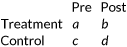

An adjustment for over-dispersion was then made using the method in Farrington, Gill, Waples, and Argomaniz (2007): the adjusted V(LOR) is computed as the product of V(LOR) and D, with D = 0.0008 × N + 1.2. N is indexed as the mean number of incidents per case and is calculated as the total number of incidents (a + b + c + d) divided by the total number of treatment plus control cases. This adjusted V(LOR) is then multiplied by (3/π2) to give the final variance of the effect size [V(d)] (Hasselblad & Hedges, 1995).
In certain included studies, counts were not provided or could not be reconstructed from information in the study report. We then attempted to contact study authors to gain access to the original data and/or request further output that would allow us to calculate Cohen's d. When this was not possible, we attempted to use other methods. For example, many recent papers reported incidence rate ratios (IRRs) in order to estimate treatment effects conditional on the use of covariates. In such cases, ORs were obtained by taking the product of the IRR and a ratio of the pretest means in the control and treatment group [OR = IRR × (mean_pre_C/ mean pre_T)]. This allows d to be calculated from log OR using standard methods. The standard error of this IRR is squared to obtain the variance. In other included studies, Cohen's d could not be estimated in either way described above, and other methods were pursued. For instance, in Weisburd and Green (1995b), the p levels from a mixed-model analysis of variance were used to compute the effect sizes. The p level for each contrast was first converted to a Z score which was then used to calculate a correlational effect size (r). Using conventional formulae, this effect size was then converted to Cohen's d.
Determination of independent findings
One problem in conducting meta-analyses in crime and justice is that investigators often do not prioritize outcomes examined. This is common in studies in the social sciences in which authors consider it good practice to report all relevant outcomes. For example, the Jersey City Drug Market Analysis Program experiment presents an array of outcome measures including violence, property, disorder, and narcotics calls for service (Weisburd & Green, 1995a). However, the lack of prioritization of outcomes in a study raises the question of how to derive an overall effect of treatment. Specifically, the reporting of one significant result may reflect a type of “creaming” in which the authors focus on one significant finding while ignoring the less positive results of other outcomes. But authors commonly view the presentation of multiple findings as a method for identifying the specific contexts in which the treatment is effective. When the number of such comparisons is small and therefore unlikely to affect the error rates for specific comparisons, such an approach is often valid.
All studies for which a standardized effect size could be obtained were analyzed using three approaches. The first approach is conservative; we calculated an overall mean effect size for each study that combined all reported outcomes. The second represents the largest effect reported in the studies and offers an upper bound to the review findings. It is important to note that in some of the studies with more than one outcome reported, the largest outcome reflected what authors thought would be the most direct program effect. This was true for the Jersey City Drug Market Analysis Program experiment, which examined a wider range of crime outcome measures, but suggested that the largest program effects would be found in the case of disorder calls of service given the program's focus on street-level drug markets (Weisburd & Green, 1995a). Finally, the smallest effect size for each study was analyzed. This approach is the most conservative and likely underestimates the effect of hot spots policing programs on crime. It was used here primarily to provide a lower bound to the review findings.
Treatment of qualitative research
Qualitative research on crime and disorder outcomes was not included in this systematic review. The authors hope that a qualitative researcher will assist in future updates to this review with a synthesis of qualitative evaluation measures.
RESULTS
Selection of studies
Results of the search
Search strategies in the systematic review process generate a large number of citations and abstracts for potentially relevant studies that must be closely screened to determine whether the studies meet the eligibility criteria (Farrington & Petrosino, 2001). The screening process yields a much smaller pool of eligible studies for inclusion in the review. Search strategies used for this review yielded a total of 26,038 titles, citations, and abstracts. Naturally, due to the number of databases, key terms, and tactics used, there was an inevitable overlap in search results. 5 Each result was reviewed for any suggestion of an experimental or quasiexperimental evaluation of hot spots policing interventions. Two hundred and seventy-four distinct abstracts were selected for closer review and the full-text reports, journal articles, and books for these abstracts were acquired and carefully assessed to determine whether the interventions and evaluations met the eligibility criteria.
The original Campbell systematic review of the effects of hot spots policing on crime identified nine studies (Braga, 2001) and first update of the review included 19 studies (Braga, Papachristos, and Hureau, 2014). In this iteration, we identified 65 eligible studies to be included in the updated systematic review and meta-analysis. Figure 1 presents the yearly counts of included hot spots policing evaluations and highlights the strong growth in hot spots policing studies since the completion of the previous review. Indeed, we identified 46 new studies representing a 242% increase in eligible studies since the prior review. The 65 eligible studies included: Minneapolis Repeat Call Address Policing (RECAP) Program (Sherman et al., 1989) New York Tactical Narcotics Teams (Sviridoff, Sadd, Curtis, & Grinc, 1992) St. Louis Problem-Oriented Policing in three Drug Market Locations Study (Hope, 1994) Minneapolis Hot Spots Patrol Program (Sherman & Weisburd, 1995) Jersey City Drug Markets Analysis Program (DMAP) (Weisburd & Green, 1995a) Kansas City Gun Project (Sherman & Rogan, 1995a) Kansas City Crack House Police Raids Program (Sherman & Rogan, 1995b) Beenleigh Calls for Service Project (Criminal Justice Commission, 1998) Jersey City Problem-Oriented Policing at Violent Places Project (Braga et al., 1999) Houston Targeted Beat Program (Caeti, 1999) Oakland Beat Health Program (Mazerolle, Price, & Roehl, 2000) Pittsburgh Police Raids at Nuisance Bars Program (Cohen, Gorr, & Singh, 2003) Buenos Aires Police Presence after Terror Attack Study (DiTella & Schargrodsky 2004) Philadelphia Drug Corners Crackdowns Program (Lawton, Taylor, & Luongo, 2005) Jersey City Displacement and Diffusion Study (Weisburd et al., 2006) Lowell Policing Crime and Disorder Hot Spots Project (Braga & Bond, 2008) Jacksonville Policing Violent Crime Hot Spots Project (Taylor, Koper, & Woods, 2011) Philadelphia Foot Patrol Program (Ratcliffe, Taniguchi, Groff, & Wood, 2011) Boston Safe Streets Teams Program (Braga, Hureau, & Papachristos, 2011) DDACTS Program in Washoe County (Beck, 2010) Safer Cities Initiative in Los Angeles (Berk & MacDonald, 2010) License Plate Reader Patrols in Crime Hot Spots in two Adjacent Jurisdictions (Lum, Hibdon, Cave, Koper, & Merola, 2011) Camden 28-Day Crime Suppression Initiative (Ratcliffe & Breen, 2011) Predictive Risk Mapping and Policing in Trafford, Greater Manchester (Fielding & Jones, 2012) Broken Windows Style Crackdowns in three California Cities (Weisburd, Hinkle, Famega, & Ready, 2012) Operation LASER in Los Angeles (Uchida & Swatt, 2013) Palos Verdes Team Policing Project (Martinez, 2013) License Plate Readers at Crime Hot Spots Experiment in Mesa, Arizona (Koper, Taylor, & Woods, 2013) Lowell Smart Policing Initiative (Bond, Hajjar, Ryan, & White, 2014) DDACTS Program in Shawnee, Kansas (Bryant, Collins, & Villa, 2014) Summer Crime Initiative in Washington, DC (Mazeika, 2014) Operation Impact in Newark, New Jersey (Piza & O'Hara, 2014) St. Louis Metropolitan PD's Firearms Violence Hot Spots Policing Experiment (Rosenfeld, Deckard, & Blackburn, 2014) Hot Spots Randomized Field Trial in Sacramento, California (Telep, Mitchell, & Weisburd, 2014) Trinidad & Tobago Police Services Hotspot Experiment (Sherman et al., 2014) Policing Crime Hot Spots in Stockholm, Sweden (Marklund & Merenius, 2014) Policing Crime Hot Spots in Eskilstuna, Sweden (Marklund & Merenius, 2014) Anti-Drunk Driving Program in Rajasthan, India (Banerjee, Duflo, Keniston, & Singh, 2014) Philadelphia Policing Tactics Experiment (Groff et al., 2015) Colorado Springs PD's Risk-Based Intervention (Kennedy, Caplan, & Piza, 2015) Newark PD's Risk-Based Intervention (Kennedy et al., 2015) Kansas City PD's Risk-Based Intervention (Kennedy et al., 2015) Glendale PD's Risk-Based Intervention (Kennedy et al., 2015) St. Louis County Hot Spots in Residential Areas Study (Kochel, Burruss, & Weisburd, 2015) Mobile Computing Technology at Crime Hot Spots in a Suburban County (Koper, Lum, & Hibdon, 2015) Proactive CCTV Monitoring with Directed Police Patrol in Newark, New Jersey (Piza, Caplan, Kennedy, & Gilchrist, 2015) Tactical Police Response at Micro-Time Hot Spots (Santos & Santos 2015a, 2015b) Philadelphia GunStat Model (Sorg, 2015) Dallas Patrol Management Experiment (Weisburd et al., 2015) West Midlands Police's Randomized Control Trial of Policing Hot Spots (Williams, 2015) Actively Monitored CCTVs in Stockholm, Sweden (Marklund & Holmberg, 2015) Operation Style in Peterborough, England (Ariel, Weinborn, & Sherman, 2016) Glendale Smart Policing Initiative (Dario, 2016) Policing Violent Crime Hot Spots in Malmö, Sweden (Gerell 2016) Operation Impact in New York City (MacDonald, Fagan, & Geller, 2016) Kansas City Foot Patrol Project (Novak, Fox, Carr, & Spade, 2016) Police Paramilitary Raids in Buffalo, New York (Phillips et al., 2016) Offender-Focused Police Intervention at Hot Spots (Santos & Santos, 2016) New Haven Smart Policing Initiative (Sedelmaier & Hipple, 2016) Operation Menas in London, England (Ariel and Partridge 2016) Investigating Hot Spots Policing in Copenhagen, Denmark (Attermann, 2017) Hot Spots Policing in Bogotá, Colombia (Blattman et al., 2017) Philadelphia Predictive Policing Experiment (Ratcliffe et al., 2017) Flint DDACTS Program (Rydberg, McGarrell, Norris, & Circo, 2017) Operation Strikeforce in Buffalo, New York (Wheeler & Phillips, 2018)
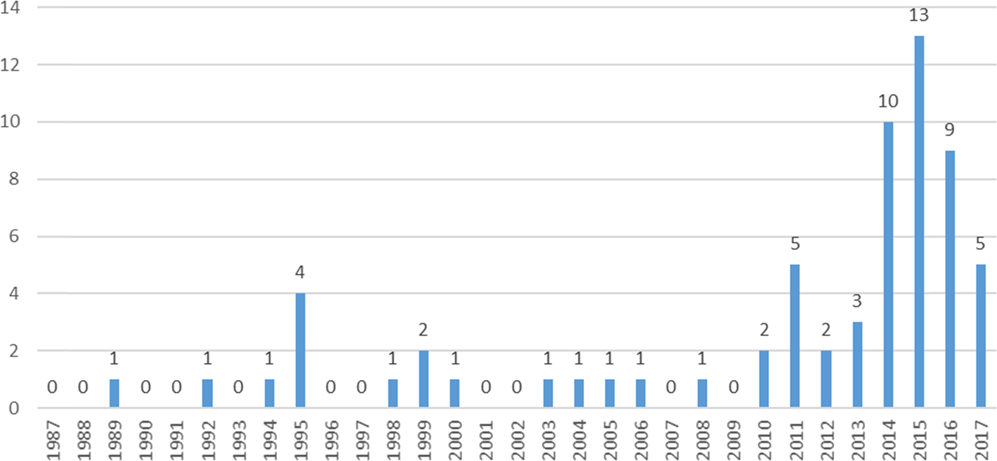
Number of eligible hot spots policing studies by year (N = 65) [Color figure can be viewed at wileyonlinelibrary.com]
There were a number of studies identified during the abstract search that were worthy of further consideration but ultimately determined not to meet the inclusion criteria. These studies are noted in Appendix C.
Table 1 presents the basic characteristics of the 65 eligible hot spots policing studies. Fifty-one of the 65 (78.5%) identified studies were conducted in the United States. Four hot spots policing evaluations were conducted in the United Kingdom and four eligible studies were completed in Sweden. One hot spots policing evaluation was conducted in each of the following countries: Argentina, Australia, Colombia, Denmark, India, and Trinidad and Tobago. Twenty-seven studies (41.5%) were completed in medium-sized cities with between 200,000 and 500,000 residents, 25 studies (38.5%) were completed in large cities with more than 500,000 residents, and 12 studies were completed in smaller cities with <200,000 residents (18.5%). One study included both a large and small city in the designated study area (1.5%): Lum et al. (2011) evaluated the impact of license plate reader technology in crime hot spots in two adjacent jurisdictions located in Alexandria City and the eastern portion of Fairfax County (VA). Eleven cities were the research sites for multiple hot spots policing evaluations. These cities were Philadelphia (five studies), Kansas City (four studies), Jersey City (three studies), Newark (three studies), St. Louis (three studies), Los Angeles (two studies), Lowell (two studies), Minneapolis (two studies), New York City (two studies), Port St. Lucie (two studies), and Stockholm (two studies). Thirty-six of the eligible hot spots policing studies were published in peer-reviewed journals (55.4%), 16 were available as published reports (24.6%), seven were available as unpublished theses/dissertations (10.8%), and six were available as unpublished reports or working papers (9.2%).
Characterisics of eligible hot spots policing evaluations
Characterisics of eligible hot spots policing evaluations
Argentina, Australia, Colombia, Denmark, India, and Trinidad and Tobago.
Twenty-seven eligible studies used randomized controlled trials (41.5%) and 38 eligible studies used quasiexperimental research designs (58.5%) to evaluate the effects of hot spots policing on crime. Eleven of the 65 eligible studies (16.9%) evaluated more than one hot spots policing intervention. Nine studies examined two separate hot spots policing interventions and two studies examined three hot spots policing interventions. For instance, the seminal Minneapolis RECAP experiment separately evaluated POP interventions at residential and commercial addresses (Sherman et al., 1989). More recently, Blattman et al. (2017) evaluated the impacts of increased police patrol and, separately, increased police patrol plus municipal services on high-crime street segments in Bogotá, Colombia. In total, the 65 studies included in this review yielded 78 experimental and quasiexperimental tests of hot spots policing on crime.
Across the 78 tests of hot spots policing, the specific types of hot spots policing interventions fit broadly into two categories: POP and increased traditional policing. More than one-third of hot spots policing programs focused primarily on reducing crime opportunities at places by engaging strategies consistent with POP (N = 27, 34.6%). In these initiatives, the POP strategies generally attempted to change the underlying conditions and situational dynamics that caused problems to recur in high-activity crime places (Braga, 2008; Goldstein, 1990). Increased traditional policing was used in two-thirds of the eligible hot spots policing (N = 51, 65.4%). These programs were generally designed to deter offenders from committing crimes in hot spot areas by increasing police presence and enforcement activities. This was most commonly attempted through increased foot or vehicle patrol (N = 31), drug enforcement operations (N = 6), offender-focused apprehension programs (N = 4), actively monitored CCTV with directed patrol (N = 3), and other kinds of increased enforcement activities (N = 7). 6 Crime displacement and diffusion of crime control benefits effects were assessed for 46 of the 78 tests of hot spots policing (58.9%).
A noteworthy majority of the hot spots policing evaluations concluded that hot spots policing programs generated significant crime control benefits in the treatment areas relative to the control areas. Only 16 of the 78 tests (20.5%) of hot spots policing interventions did not report noteworthy crime control gains associated with the approach. Table 2 summarizes the treatments, hot spot definitions, and research designs. Table 3 summarizes the main effects of the intervention on crime and disorder measures, treatment effects as measured by other nonofficial data sources, and, if measured, the immediate spatial displacement and diffusion of crime control benefits effects. A more detailed narrative review of the 65 hot spots policing studies and the 78 tests contained in the eligible studies is provided in Appendix D.
Hot spots policing experiments and quasiexperiments
Results of hot spots policing experiments and quasiexperiments
Only seven of the 65 eligible studies (10.8%) considered the effects of hot spots policing strategies on police–community relations. For the Kansas City Gun Project, community members exposed to treatment indicated that they welcomed concentrated police efforts at problem places (Shaw, 1995). Residents in treated areas of the Lowell Policing Crime and Disorder Hot Spots experiment reported that they recognized the intervention and its positive impacts on local disorder problems (Braga & Bond, 2009). Results from the Jersey City Problem-Oriented Policing in Violent Places experiment suggested that community members' improved perceptions of disorder were attributed to the focused intervention and their attitudes toward police were not negatively affected (Braga, 1997).
A “broken windows” style hot spots experiment in three California cities found the disorder-oriented intervention did not produce a “backfire effect” as it pertains to residents' fear of crime, police legitimacy, collective efficacy, or perceptions of crime or social disorder (Weisburd, Hinkle, Famega, & Ready, 2011). However, a companion analysis to the Weisburd et al. (2006) Jersey City Displacement and Diffusion study suggested that the increased police activity associated with the intervention may have made residents feel less safe (Hinkle & Weisburd, 2008). The Data-Driven Approach to Crime and Traffic Safety program in Shawnee (KS) found local businesses and community members both reported seeing an increase in high visibility police presence during the intervention and the majority of those who were familiar with initiative believed that it improved the quality of life in the area (Bryant et al., 2014). Evidence from the St. Louis County Hot Spots in Residential Areas experiment suggested the directed patrol treatment was associated with short-term detriments to police–community relations, but no negative short-term effects were linked to the problem-solving treatment (Kochel & Weisburd, 2017). In the long term, for both treatment conditions, residents' willingness to cooperate with police was higher after the intervention ended (Kochel & Weisburd, 2017).
Study implementation
The majority of the eligible hot spots policing studies seemed to implement the desired treatment successfully. Twenty-one studies (32.3% of 65), however, did report potential threats to the integrity of the treatment spanning various degrees of severity. The Minneapolis RECAP experiment showed no statistically significant differences in the prevalence of citizen calls for service at commercial addresses that received the POP treatment as compared to control commercial addresses (Sherman et al., 1989). Buerger (1993) speculated that these results were probably due to the assignment of too many cases to the RECAP unit, thus outstripping the amount of resources and attention the police officers provided to each address. Moreover, the simple randomization procedure led to the placing of some of the highest event addresses into the treatment group; this led to high variability between the treatment and control groups and low statistical power. Although the overall findings suggest that the RECAP program was not effective in preventing crime, a case study analysis revealed that several treated addresses experienced dramatic reductions in total calls for service (Buerger, 1992).
The Vera Institute of Justice evaluation of the Tactical Narcotics Teams noted that the intervention was not implemented as planned in one of the two treatment precincts (Sviridoff et al., 1992). In the 67th precinct, 20% of the staffing of the Tactical Narcotics Team was reassigned to another department initiative. As a result, the treatment in the 67th precinct yielded fewer arrests and the maintenance period for targeted drug hot spots by uniform patrol was shortened when compared to the treatment in the 70th precinct.
The patrol treatment in the Minneapolis Hot Spots experiment (Sherman & Weisburd, 1995, pp. 638–639) was disrupted during summer months due to a peak in the overall calls for service received by the Minneapolis Police Department and a shortage of officers due to vacations; this situation was further complicated by changes in the computerized calls for service system implemented in the fall. The changes in the calls for service system and the disappearance of differences in patrol dosage between treatment and control hot spots during summer months were addressed by conducting separate outcome analyses using different intervention time periods; there were no substantive differences in the outcomes of the experiment across the different time periods.
The Jersey City DMAP experiment (Weisburd and Green 1995a, p. 721) and Jersey City POP at Violent Places experiment (Braga, 1997, pp. 107–142) reported instances where the treatments were threatened by subversion by the participants. The officers charged with preventing crime at the treatment hot spots were resistant to participating in the programs and this resulted in low levels of treatment during the early months of both experiments. In the Jersey City DMAP experiment, this situation was remedied by providing a detailed crackdown schedule to the Narcotics Squad commander and extending the experiment from 12 to 15 months. This problem was remedied in the Jersey City POP experiment by changing the leadership of the POP unit, developing an implementation accountability system, and providing additional training in the POP approach, in addition to other smaller adjustments.
The Philadelphia Policing Tactics randomized experiment noted deficiencies in both the foot patrol and POP treatment conditions (Groff et al., 2015, pp. 44–45). For the foot patrol treatment, there was not a significant increase in police activity in the targeted areas. The POP treatment suffered due to a lack of commitment to the problem-solving process and POP officers being pulled from the treatment hot spots to deal with issues elsewhere in the city. Similarly, varying levels of POP activities were also reported across treatment stores in the Glendale (AZ) Smart Policing Initiative quasiexperiment (Dario, 2016).
The Houston Beat Patrol Program reported that the three “high visibility” patrol beats managed by one substation experienced police resistance to the program (Caeti, 1999). However, the evaluation suggested that the treatment was applied with enough integrity to measure possible impacts on reported crime outcomes. In the Jersey City Displacement and Diffusion Study, focused police attention was originally applied to three crime hot spots; unfortunately, the Police Foundation research team detected that the intervention was not being applied with an adequate dosage in the burglary hot spot and, as such, the location was dropped from the evaluation (Weisburd et al., 2006). In the Peterborough “soft” hot spots policing experiment, Ariel et al. (2016: 310) reported a mild threat to the integrity of treatment as it was difficult for the officers to stay within the hot spot boundaries to ensure the consistent delivery of 15-min patrols, three times per shift, over the entire duration of the study period. Similarly, Kennedy et al. (2015, p. 14) reported officers participating in the Glendale (AZ) quasiexperimental risk-based intervention did not strictly adhere to the target area boundaries; in response, the quasiexperimental evaluation expanded its definition of treated areas as street segments that experienced at least one intervention activity.
As described in Table 3 and Appendix D, several studies tested new technological innovations designed to increased police presence and enforcement activities in treatment hot spots relative to control hot spots. In four studies, technological failures were noted as possible threats to treatment integrity. Marklund and Holmberg (2015) reported that low-quality video footage from CCTVs placed in hot spots hampered police investigations of offenders frequenting targeted areas. In the Philadelphia Predictive Policing randomized experiment, Ratcliffe et al. (2017) reported that officers experienced challenges when attempting to access the software. In the Trinidad and Tobago directed patrol randomized experiment, Sherman et al. (2014) documented problems with the GPS technology used to monitor treatment dosage. Finally, in the West Midlands hot spots experiment, the treatment was originally planned to be a 150-day intervention but a breakdown in “geofencing” over the last 50 days limited the analysis to the first 100 days of intervention.
The treatment delivered in the Philadelphia Police Department's GunStat program suffered from a number of serious implementation issues; Sorg (2015) noted a lack of collaboration across policing districts (p. 175), the withholding of intelligence on repeat offenders frequenting hot spots locations (p. 176), unstable program leadership during the study period (p. 177), and a lack of support from partnering criminal justice agencies (pp. 182–183). Most of the other hot spots policing experiments reporting threats to the integrity of treatment raised questions on dosage such as no differences in police stop rates between treatment and control locations in the Washoe County Data-Driven Approaches to Crime and Traffic Safety quasiexperiment (Beck, 2010), negligible physical improvements noted in the municipal services hot spots in the Bogotá Hot Spots Policing experiment (Blattman et al., 2017), lower levels of police presence in treatment areas than anticipated in the Dallas (Weisburd et al., 2015) and mobile computing in suburban hot spots (Koper et al., 2015) randomized experiments, and fewer contacts with offenders in targeted hot spots in the Stockholm quasiexperiment (Marklund & Merenius, 2014). Finally, in the St. Louis Gun Violence Hot Spots experiment, Rosenfeld et al. (2014) noted that although the directed patrol with self-initiated activity treatment was implemented with strong fidelity, the fidelity for directed patrol without self-initiated activity was limited.
Of course, these implementation problems are not unique to these hot spots policing experiments and quasiexperiments; many well-known criminal justice field experiments have experienced and successfully dealt with methodological difficulties. 7 It is also important to note here that none of the eligible studies noted problems with attrition. Since the units-of-analysis were places, this may have diminished common attrition issues commonly found in evaluations involving people as the units-of-analysis.
Risk of bias in included studies
Table 4 presents our assessment of risk of bias in the N = 65 included hot spots policing studies. We assessed the level of risk of bias along six sources of potential bias for each study (“Low” or “High”), or if a study was not clear on whether the bias was present or not (“Unclear”). The dimensions of bias assessed were: (a) to what extent was the random allocation sequence adequately generated? (b) How well was the randomization sequence followed? (c) What was the level of similarity between treatment and control units at the baseline? (d) How much protection against contamination was present in the study? (e) How free was the study from selective reporting? (f) How free was the study from other reported risks of bias?
Assessment of risk of bias in eligible hot spots policing studies
Assessment of risk of bias in eligible hot spots policing studies
To what extent was the random allocation sequence adequately generated?
How well was the randomization sequence followed?
What was the level of similarity between treatment and control units at the baseline?
How much protection against contamination was present in the study?
How free was the study from selective reporting?
How free was the study from other reported risks of bias?
All 27 randomized controlled trials included in this review used credible methods for randomization and did not report any issue in the implementation of the randomization scheme implemented. However, there were some limitations to the internal validity of the included studies. More than half of all eligible studies (N = 37, 56.9%) provided direct evidence (usually in the form of a table that presented balanced outcomes and descriptive variables) that the treatment and control units were similar at the baseline measurement period. Another 11 studies (16.9%) provided descriptions of methods, such as block randomization (e.g., Braga et al., 1999) and propensity score matching (e.g., Kennedy et al., 2015), that create balanced treatment and control groups but did not provide clear evidence that the described techniques actually achieved balance. Seventeen studies (26.2%) used treatment and control units that were not the same. For instance, the Jersey City Displacement and Diffusion Study compared crime outcomes in the targeted areas relative to crime outcomes in the rest of the city. The simple randomization procedure used in the Minneapolis RECAP experiment led to the placement of some of the highest event addresses into the treatment group; this led to high variability between the treatment and control groups and low statistical power (Sherman et al., 1989).
Sixty-one studies (93.8%) did not report any evidence of contamination of control conditions during the intervention period. Four studies either explicitly noted possible contamination or presented indirect evidence that contamination was very likely. For instance, the adjacency of included experimental segments in a map presenting hot spot locations in the Bogota hot spots policing experiment was highly suggestive of contamination effects (Blattman et al., 2017, p. 8). None of the included studies reported evidence suggestive that the evaluators were only selecting those crime types that showed an effect. Finally, only three studies (4.6%) presented any other evidence of possible bias. For example, the Bogota hot spots policing study reported crime outcome measures that confounded violent crime (home robbery; person robbery) with property crime (no burglary, breaking/entering, or theft from person measures included) and did not include larcenies from a person (Blattman et al., 2017, p. 12).
The internal validity of the included studies was generally high. There were variations in the overall strength of the research designs used by included studies: 27 studies used randomized controlled trials and 38 studies used quasiexperimental designs. Among the 38 studies that utilized a quasiexperimental approach, the strength of the research design varied. Therefore, we conducted sensitivity analyses that tested the moderating effects of research design on the relationship between hot spots policing programs and crime outcomes.
Our meta-analyses of the effects of hot spots policing programs on crime were limited to 62 of the 65 eligible studies. Two studies, the St. Louis Problem-Oriented Policing in Three Drug Market Locations Study (Hope, 1994) and the Beenleigh (Australia) Calls for Service Project (Criminal Justice Commission, 1998), did not report the necessary information to calculate program effect sizes. As described in Appendix D, the Houston (TX) Targeted Beat Program (Caeti, 1999) did not use appropriate statistical methods to estimate program effects and, unfortunately, accurate effect sizes could not be calculated. We were able to calculate effect sizes for 73 main effects tests and 40 displacement and diffusion tests in these 65 eligible studies. As such, the unit of analysis in the meta-analyses presented here represent these independent tests rather than individual studies.
Using the overall mean effect size from each study for 73 main effects tests, the forest plot in Figure 2 show the standardized difference in means between the treatment and control or comparison conditions (effect size) with a 95% confidence interval (CI) plotted around them for all tests. Points plotted to the right of 0 indicate a treatment effect; in this case, the test showed a reduction in crime or disorder. Points to the left of 0 indicate a backfire effect where control conditions improved relative to treatment conditions. A random-effects model was used to estimate the overall mean effect size based on an a priori assumption of a heterogeneous distribution of effect sizes. 8 The meta-analysis of effect sizes suggests an effect in favor of hot spots policing strategies. Notably, the overall effect size for these studies is 0.132 (p < .001); this would be considered a small mean effect size (see Cohen, 1988).
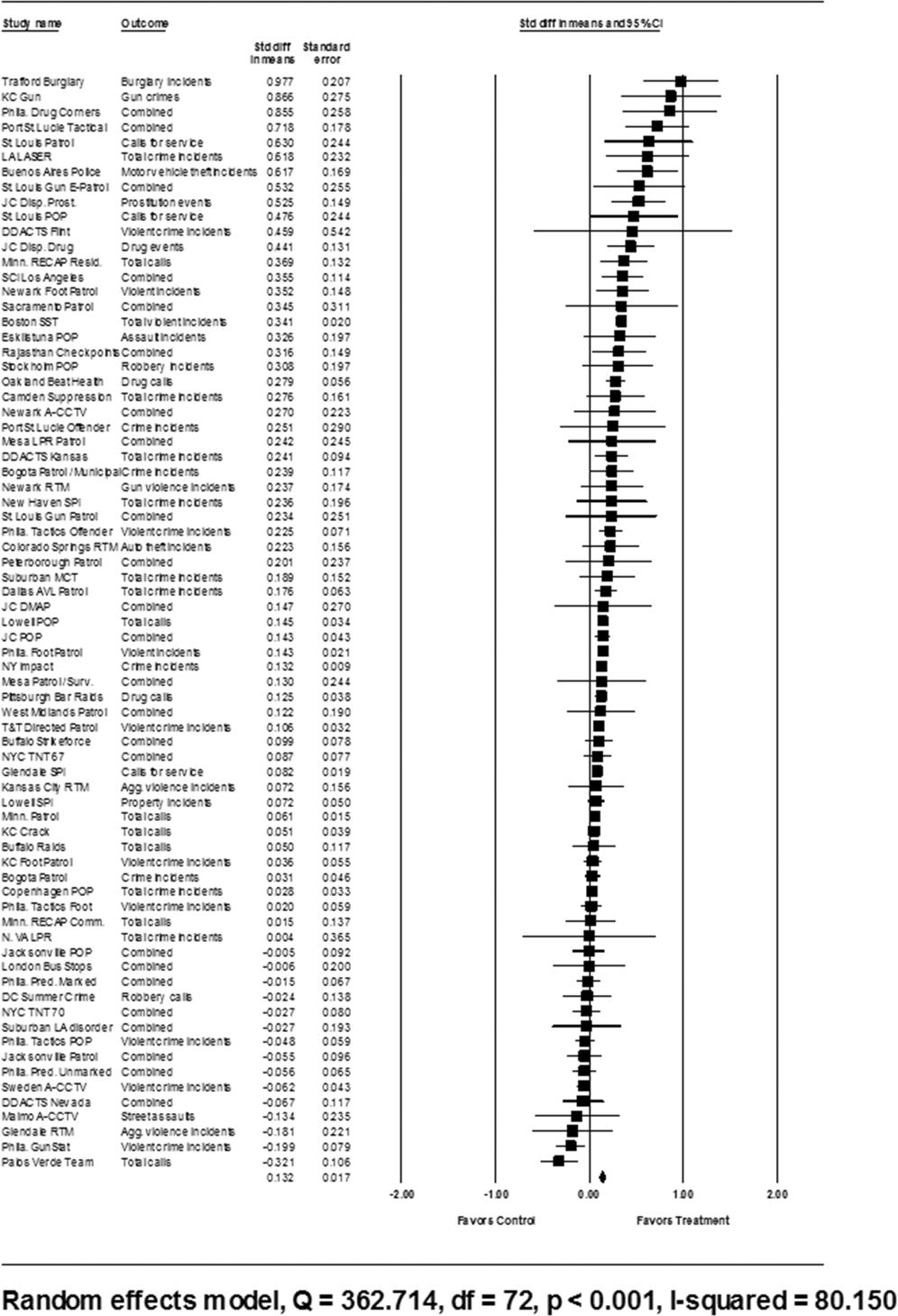
Combined effect sizes for study outcomes
Fifty-seven tests reported effect sizes that favored treatment conditions over control conditions (78.1% of 73 total tests). The Trafford (UK) Predictive Risk Mapping and Policing quasiexperiment (0.977), Kansas City Gun quasiexperiment (0.866), and Philadelphia Drug Corners Crackdown quasiexperiment (0.855) tests reported the largest statistically significant effect sizes while the Minneapolis Hot Spots Patrol experiment (0.061) reported the smallest statistically significant effect size. The forest plots in Figures 3 and 4 present the meta-analyses of the largest and smallest effect sizes for each study, respectively. 9 For the largest effect size meta-analysis, the overall standardized mean difference effect size was 0.197 and statistically significant at the p < .05 level. For the smallest effect size meta-analysis, the overall standardized mean difference effect size was 0.104 and statistically significant at the p < .05 level. Table 5 presents mean effect sizes for the effects of hot spots policing programs disaggregated by crime type. Hot spots policing programs produced statistically significant (p < .05) positive mean effect sizes for violent crime outcomes (0.102), property crime outcomes (0.124), disorder outcomes (0.161), and drug crime outcomes (0.244).
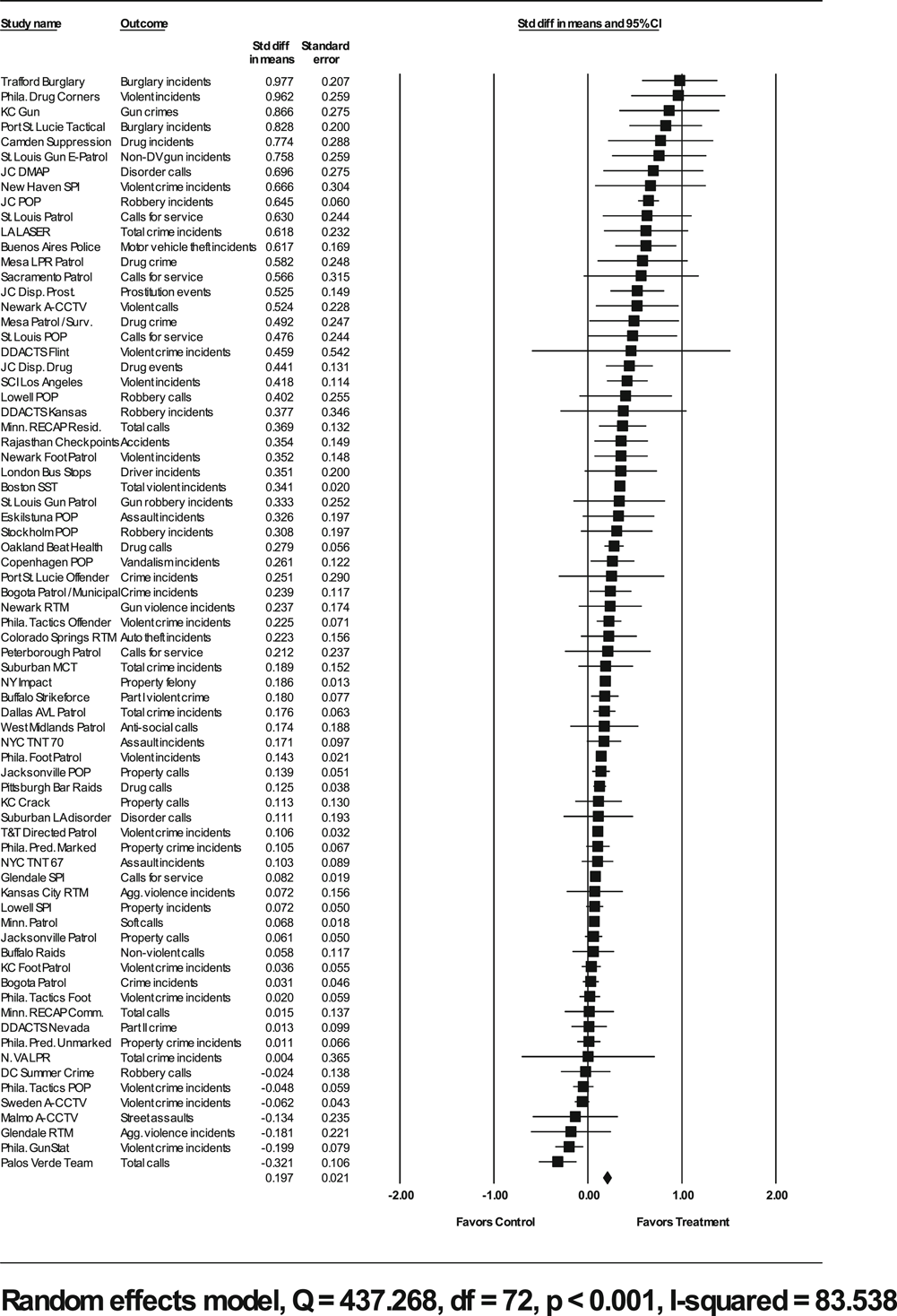
Largest effect sizes for study outcomes
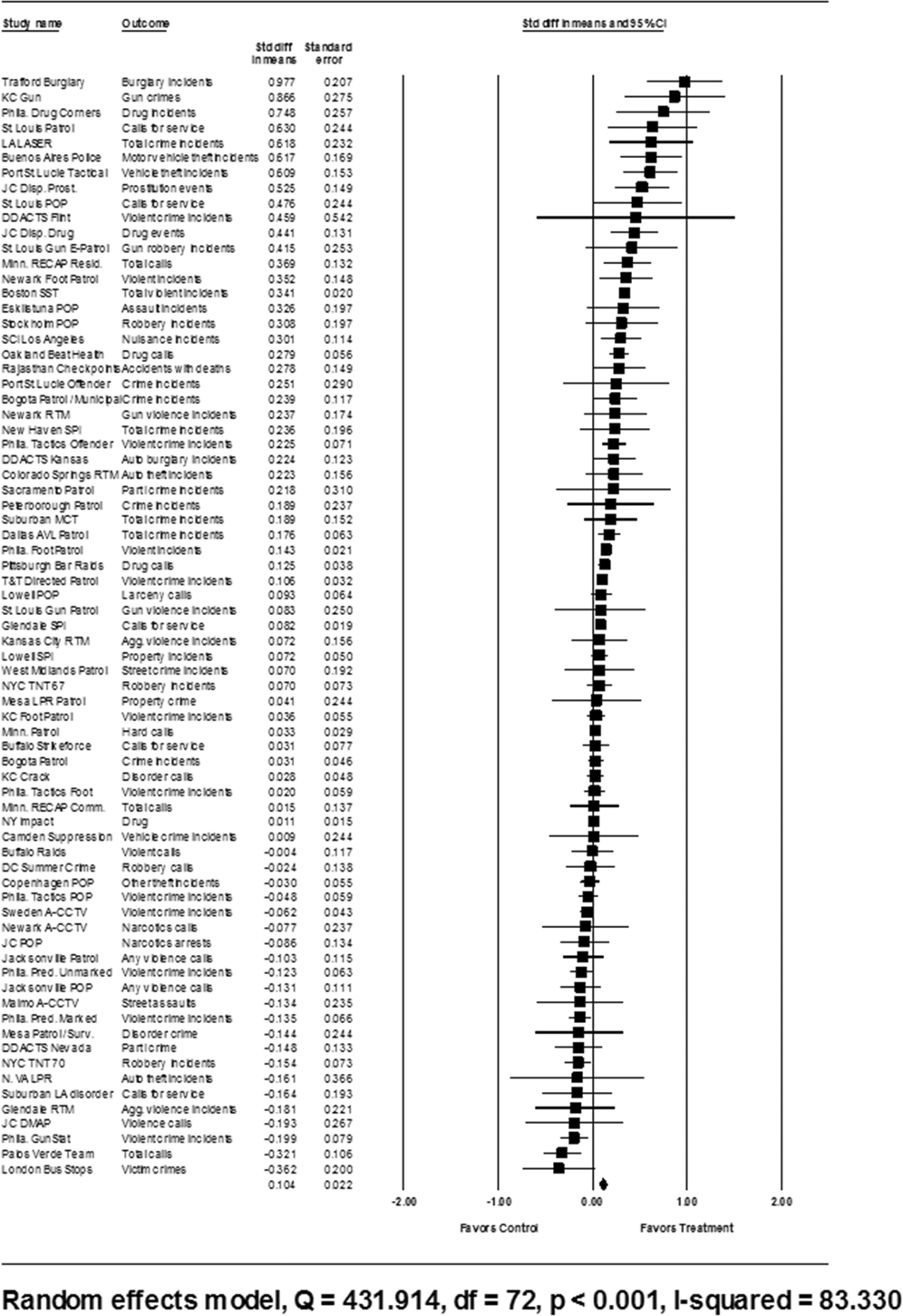
Smallest effect sizes for study outcomes
The effects of hot spots policing on specific crime types
Note: Random effects meta-analysis models used in all reported effect sizes.
p < .05.
Given the important distinction in methodological quality between the randomized controlled trials and quasiexperimental evaluation studies, we also explored research design as a moderator variable. It is well known among social scientists that program evaluations with more rigorous research designs tend to report null effects compared to evaluations with weaker research designs. As Rossi's (1987) Iron Law of Evaluation states, “The expected value of any net impact assessment of any large scale social program is zero” (p. 3). And as his Stainless Steel Law of Evaluation posits, “The better designed the impact assessment of a social program, the more likely is the resulting estimate of net impact to be zero” (Rossi 1987, p. 3). Figure 5 presents a random-effects model that considers the two different classes of evaluation designs included in this review. The quasiexperimental designs were associated with a modestly larger within-group effect size (0.171, p < .001) relative to the randomized controlled trial designs (0.109, p < .001). 10 We also conducted an exploratory moderator analysis that suggested stronger quasiexperimental designs produced a slightly more conservative effect size estimate (0.158, p < .001) relative to weaker quasiexperimental designs (0.188, p < .001) but these differences were not statistically significant (between group Q = 0.194, df = 1, p = .660). 11
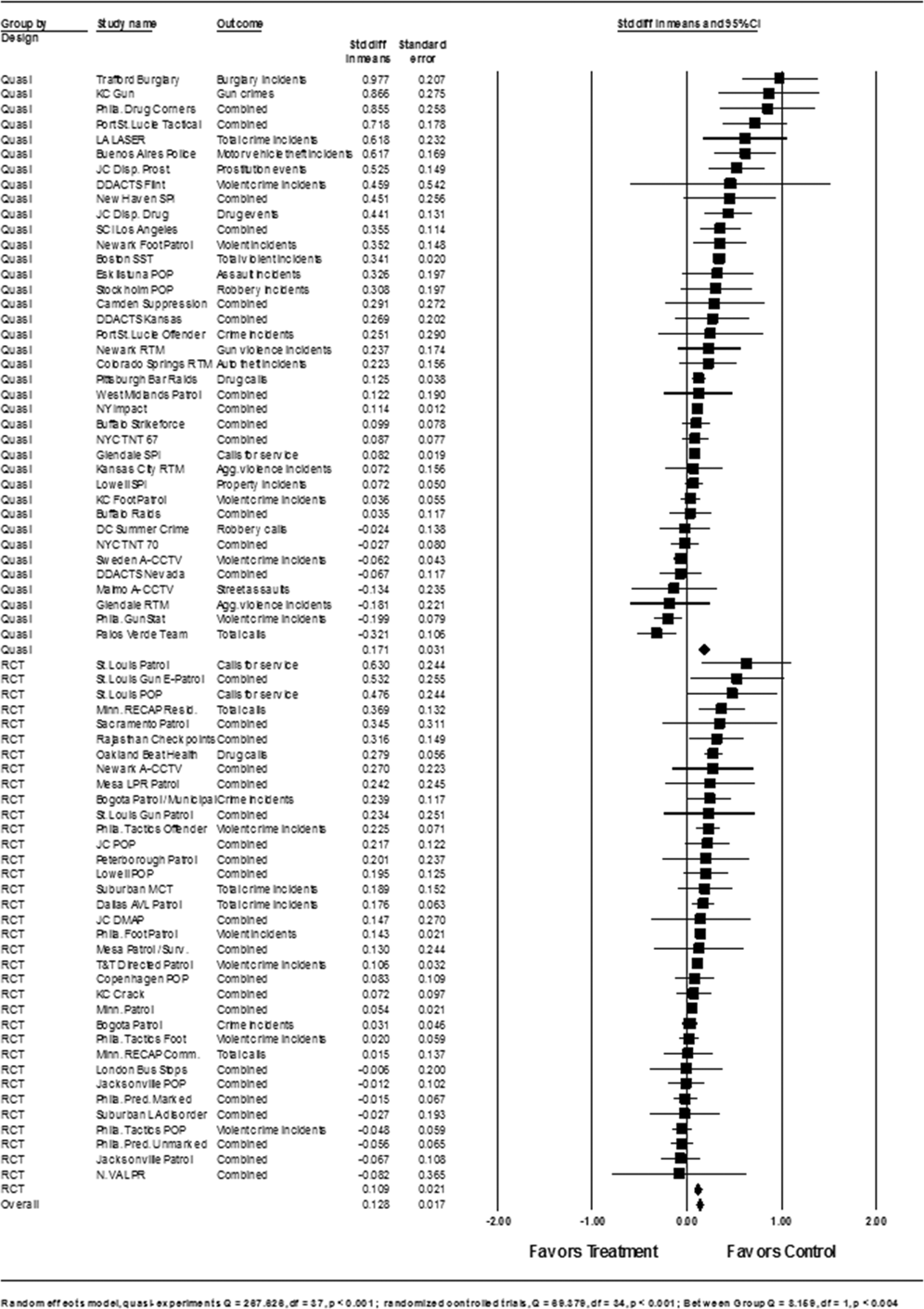
Research design type as moderator for study outcomes
Prior to a discussion of the research findings, it must be noted that it is very difficult to detect displacement effects because the potential manifestations of displacement are quite diverse. As Barr and Pease (1990) suggest, “if, in truth, displacement is complete, some displaced crime will fall outside the areas and types of crime being studied or be so dispersed as to be masked by background variation…no research study, however massive, is likely to resolve the issue” (p. 293). The same difficulties are encountered when testing for diffusion effects. Most tests were limited to examining immediate spatial displacement and diffusion effects; that is, whether focused police efforts in targeted areas resulted in crime “moving around the corner” or whether these proximate areas experienced unintended crime control benefits.
In this analysis, we analyzed immediate crime displacement and diffusion effects jointly as two sides of a single distribution that ranged from harmful to beneficial effects in areas adjacent to the treatment and control hot spots. Using the overall mean effect size from each study for 40 displacement and diffusion tests, the forest plots in Figure 6 show the standardized difference in means between the treatment and control or comparison conditions (effect size) with a 95% CI plotted around them for all tests. Points plotted to the right of 0 indicate a diffusion of crime control benefits effect; in this case, the test showed a reduction in crime or disorder in the areas surrounding the targeted hot spots. Points to the left of 0 indicate a crime displacement effect. We used a random-effects model to estimate the overall mean effect size. 12 The meta-analysis suggests a small but statistically significant overall diffusion of crime control benefits effect (0.086) generated by the hot spots policing strategies (p < .001).
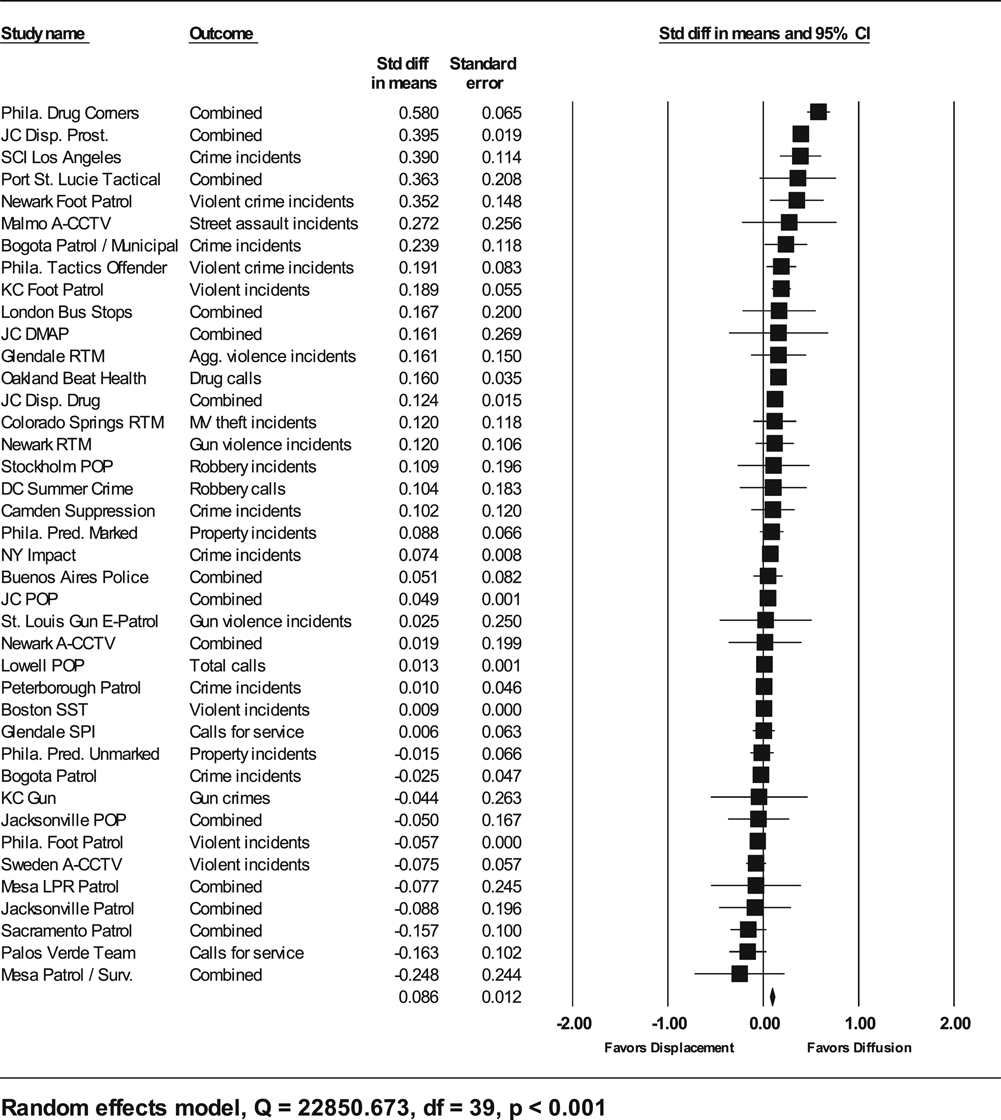
Combined effect sizes for displacement and diffusion outcomes
Twenty-nine tests (72.5% of 40 total tests) reported effect sizes that favored diffusion effects over displacement effects. The largest statistically significant diffusion effects were reported by the Philadelphia Drug Corners Crackdown quasiexperiment (0.580), Jersey City Displacement and Diffusion Study quasiexperiments (buffers around prostitution site = 0.395, buffers around drug crime site = 0.124), 13 and the Los Angeles Safer Cities Initiative quasiexperiment (0.390). Eleven tests (27.5% of 40 total tests) reported effect sizes that favored displacement effects over diffusion effects. The Philadelphia Foot Patrol experiment was the only study that reported a statistically significant displacement effect (−0.057). The forest plots in Figures 7 and 8 present the meta-analyses of the largest and smallest effect sizes for each study, respectively. 14 Both meta-analyses estimated overall effect sizes that favored diffusion effects over displacement effects. For the largest effect size meta-analysis, the overall standardized mean difference effect size was small (0.110) and statistically significant at the p < .05 level. For the smallest effect size meta-analysis, the overall standardized mean difference effect size was also small (0.062) but still statistically significant at the p < .05 level.
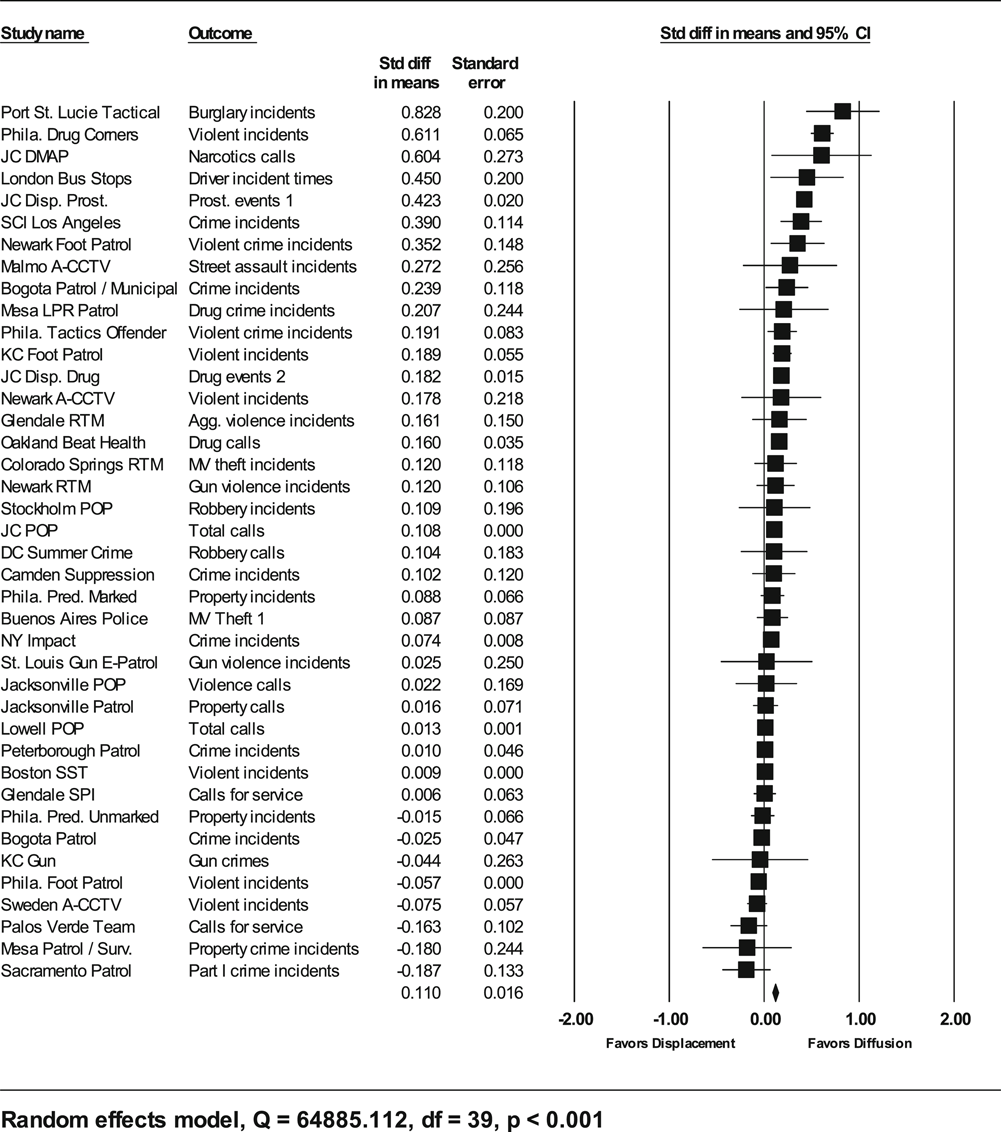
Largest effect sizes for displacement and diffusion outcomes
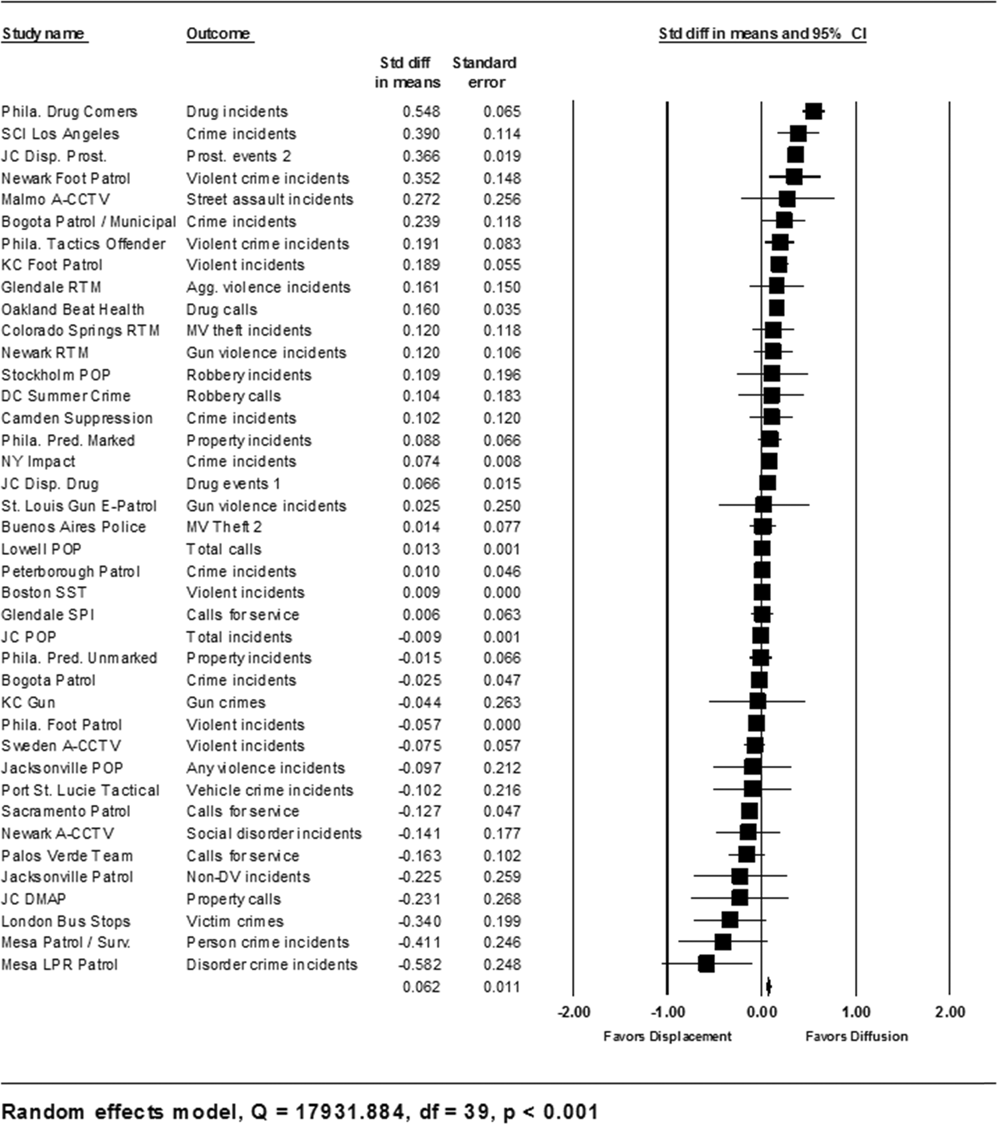
Smallest effect sizes for displacement and diffusion outcomes
Our narrative review documented that hot spots policing programs have adopted POP, focused drug enforcement, increased patrol, increased gun searches and seizures, and zero-tolerance policing to control high-activity crime places. POP programs attempt to change the underlying conditions at hot spots that cause them to generate recurring crime problems (Braga & Weisburd, 2010; Goldstein, 1990). The other hot spots policing interventions represent increased traditional policing activities concentrated at specific places to prevent crime through general deterrence and increased risk of apprehension (Nagin et al., 2015). There is, of course, some overlap between the enforcement interventions employed by the POP hot spots programs and the actions taken by the increased policing hot spots programs. However, these two general types of programs represent fundamentally different orientations in dealing with the problems of high-activity crime places.
Moderator variables help to explain and understand differences across studies in the outcomes observed. Program type could be an influential moderator of the observed effect sizes in our overall meta-analysis. Figure 9 presents a random-effects model examining the two different hot spots policing program types: POP and increased policing. 15 Our meta-analysis revealed that POP programs produced a modestly larger overall mean effect size (0.164, p < .001) relative to the size of the overall mean effect size generated by increased traditional policing programs (0.108, p < .001).
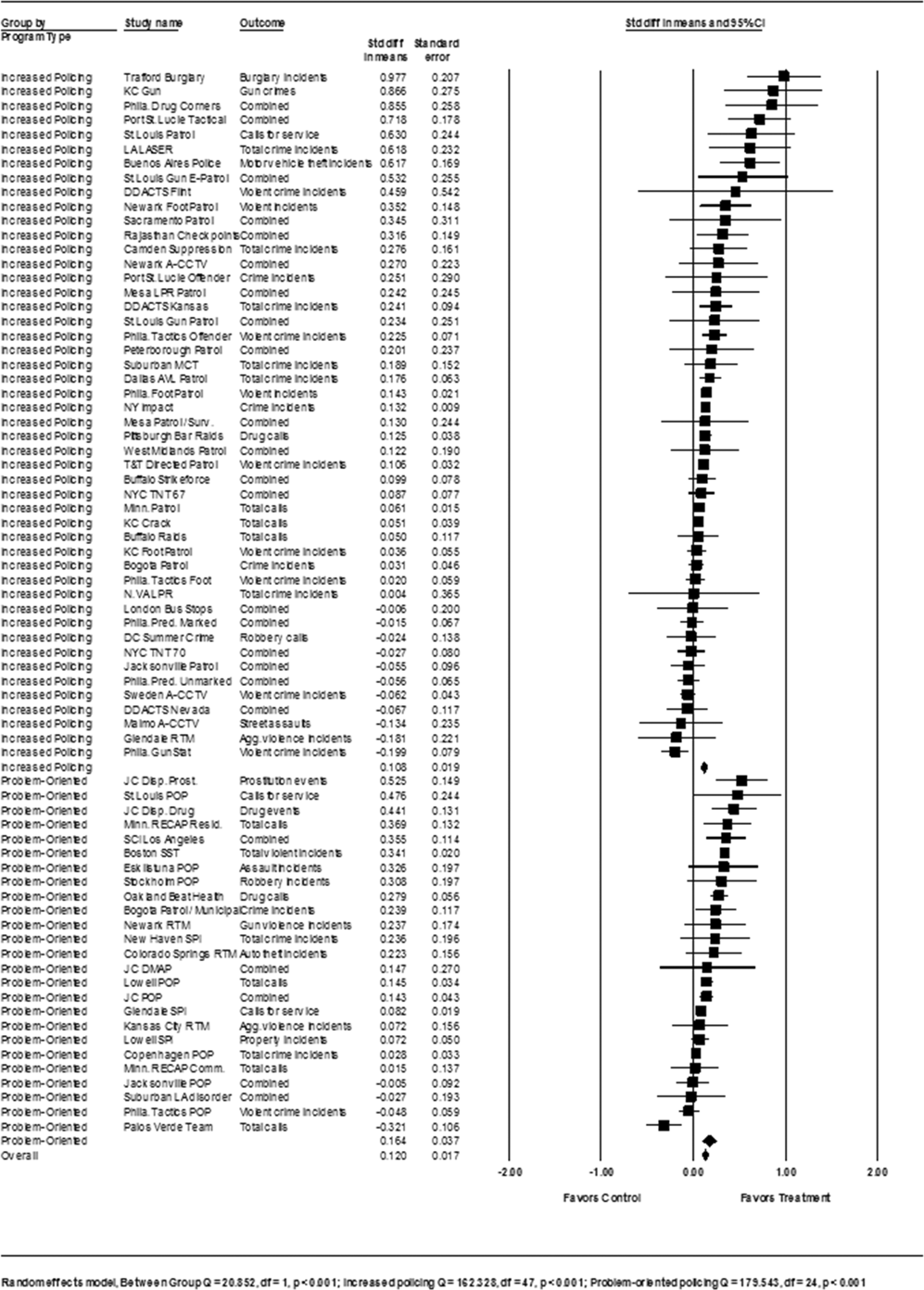
Hot spots policing program type as moderator for study outcomes
Publication bias, generally defined as the concern that the collection of studies easily available to a reviewer represents those studies most likely to have statistically significant results, presents a strong challenge to any review of evaluation studies (Rothstein, 2008). The credibility of a review arguably depends more heavily on the collection of studies reviewed than on which statistical methods of synthesis are used (Wilson, 2009). Similar to the problem of a biased study sample leading to biased results in an individual study, a biased collection of studies will potentially lead to biased conclusions in a systematic review (Rothstein & Hopewell, 2009). As reported earlier, our search strategies were designed to mitigate the potential effects of publication bias on our analyses. Indeed, it is encouraging that nearly half of the eligible studies (29 of 65, 44.6%) were acquired through gray literature sources such as published reports, theses, dissertations, unpublished reports, and unpublished working papers. The studies identified through gray literature sources reported a much smaller overall mean effect size (0.060, p < .001) when compared with the overall mean effect size (0.200, p < .001) reported by studies in published journal articles, suggesting that our search strategies were successful in identifying a range of hot spots policing studies with varying effects on crime outcomes. 16
Like many systematic reviews, our meta-analyses used the trim-and-fill procedure to explore whether publication bias might be affecting the results and to estimate how the reported effects would change if the bias were to be removed (Duval & Tweedie, 2000; Duval, 2005). The diagnostic funnel plot is based on the idea that, in the absence of bias, the plot of study effect sizes should be symmetric about the mean effect size. If there is asymmetry, the trim-and-fill procedure imputes the missing studies, adds them to the analysis, and then recomputes the mean effect size. Trim-and-fill procedures do suffer from some well-known limitations that could result in the underestimation or overestimation of publication bias (Rothstein, 2008; Simonsohn, Nelson, & Simmons, 2014). 17 Nonetheless, this approach does provide reviewers with a well-understood measure of the possible influence of bias on their meta-analytic results.
A visual inspection of the resulting funnel plot indicated some asymmetry with more studies with a large effect and a large standard error to the right of the mean than the left of the mean. The trim-and-fill procedure determined that 11 studies should be added to create symmetry. The funnel plot with imputed studies is presented in Figure 10. Using a random-effects model, the mean random effect decreased from 0.132 (95% CI = 0.097, 0.165) to 0.103 (95% CI = 0.067, 0.138). Indeed, the 95% CIs substantially overlap, suggesting that the underlying parameters may not be different. Nevertheless, the trim-and-fill result suggests mild publication selection bias. However, the adjusted mean effect size remained a similar statistically significant small size and, as such, the observed publication bias does not appear to be sufficient to nullify the results (as suggested by the funnel plot in Figure 10).
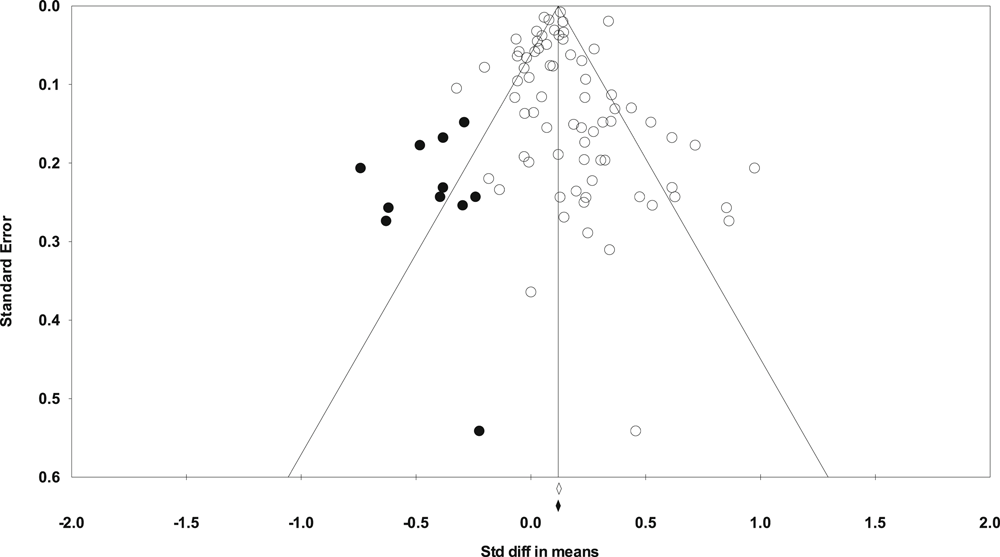
Funnel plot of standard error by standardized difference in means. Empty circles are the original studies. Filled-in circles indicate 11 imputed studies from the trim-and-fill analysis. These additional studies only slightly changed the mean effect size estimate. Using a random effects model, decreased from 0.132 (95% CI = 0.097, 0.165) to 0.103 (95% CI = 0.067, 0.138). CI, confidence interval
Summary of main results
Overall, results from this review suggest that hot spots policing is associated with small but meaningful crime control gains. The preventive impact of hot spots policing was statistically significant for crime overall and when crime outcomes were disaggregated by offense type. Programs that focused police resources and attention on high-activity small crime places concentrated generated reductions in drug offenses, disorder offenses, property crimes, and violent crimes.
Slightly more than half of the 78 tests of hot spots policing examined potential crime displacement and diffusion effects. Narrative reviews of these studies indicated little evidence of crime displacement; indeed, the studies suggested hot spots policing was more likely to produce unintended crime prevention benefits in areas immediately adjacent to targeted hot spots. Additionally, a meta-analysis of key reported outcome measures suggest hot spots policing has a small but statistically significant overall mean effect size in favor of a diffusion of crime control benefits over crime displacement effects.
There was some evidence that the research design used in the included studies moderated the magnitude of the impact of hot spots policing on crime. The within-group effect size for quasiexperimental designs was somewhat larger when compared with randomized controlled trial designs. Nevertheless, the effects of hot spots policing on crime remained statistically significant regardless of the research design. Among studies that used quasiexperimental designs, studies that utilized more rigorous designs showed slightly more conservative effect size estimates compared with studies with weaker designs. However, the within-group effect size differences between stronger and weaker quasiexperiments were not statistically significant.
The magnitude of the impact of hot spots policing also varied by program type. Hot spots policing initiatives that used POP interventions generated a modestly larger overall mean effect size relative to the overall mean effect size generated by increased traditional policing programs.
Overall completeness and applicability of evidence
Positive findings produced in this review have widespread applicability to the field of policing and crime prevention. The previous iteration of this review contained 19 studies dating back to 1989. This updated review identified 46 eligible studies published between 2010 and February 2017 for a new total of 65 eligible studies. With the addition of a large number of hot spots policing studies, the essential finding of this review was reaffirmed: hot spots policing generates small reductions in crime. Most eligible hot spots policing interventions occurred in the United States (51 studies); however, 12 studies were implemented in other countries thereby suggesting a general applicability of hot spots policing across varying contexts. Only one study included in the review conducted a formal cost-benefit analysis. Therefore, further research is warranted on the cost-effectiveness of hot spots policing to traditional policing strategies.
Quality of the evidence
The overall quality of evidence present in this review is robust. Randomized controlled trial designs were used in almost half of eligible studies and among the quasiexperimental studies, many used rigorous evaluation methods. Positive crime control findings were observed for both experimental and quasiexperimental research designs. More than half of eligible studies demonstrated that treatment and control units were similar at the baseline measurement period. There was no evidence that authors of eligible studies engaged in selective reporting of crime outcomes. Furthermore, evidence of contamination of treatment was absent in nearly all of the eligible studies.
Limitations and potential biases in the review process
Outcome measured by studies included in this review relied exclusively on official records and did not include measures of self-report victimization. This review was also unable to calculate standardized effect sizes for three studies containing five tests of hot spots policing due to the insufficient or inadequate information being presented.
Agreements and disagreements with other studies or reviews
The results of this systematic review support the assertion that focusing police efforts at high activity crime places can be effective in preventing crime (Skogan & Frydl, 2004; Weisburd & Majmundar, 2018). This review reaffirms and strengthens results on the effectiveness of hot spots policing at reducing crime from previous iterations of systematic review and meta-analysis of hot spots policing (Braga et al., 2012, 2014; Braga, 2001, 2005, 2007). Our findings on hot spots policing rarely generating crime displacement and more likely producing a diffusion of crime control benefits into adjacent areas is consistent with findings from prior reviews (Bowers et al., 2011; Weisburd & Majmundar, 2018), but are contrary to arguments made in other works (Blattman et al., 2017; Reppetto, 1976).
AUTHORS' CONCLUSIONS
Implications for practice and policy
Evidence from this review suggests hot spots policing is an effective approach to crime prevention. However, police executives and policymakers should note certain practices may generate stronger impacts at high-crime places. In our review, we found that POP interventions generated larger overall effect sizes when compared with the increased policing interventions. While increasing presence and concentrating traditional enforcement activities constitute an effective police response to crime hot spots, it seems likely that altering place characteristics and dynamics will produce larger crime prevention benefits (Braga & Weisburd, 2010). We believe that the POP approach holds great promise in developing tailored responses to very specific recurring problems at crime hot spots. While it is difficult for police agencies to implement the “ideal” version of POP (Braga & Weisburd, 2006; Cordner & Biebel, 2005; Eck, 2006), the available evidence suggests that even “shallow” problem solving better focuses police crime prevention efforts at crime hot spots.
Proactive policing strategies, such as hot spots policing programs, have been suggested to lead to abusive and unlawful policing practices in disadvantaged minority neighborhoods (Tso, 2016). Indeed, Rosenbaum (2006) cautions that hot spots policing can easily become zero-tolerance and indiscriminate aggressive tactics can drive a wedge between the police and communities. An evaluation of the adverse system side effects of Operation Sunrise, described here as the Philadelphia Drug Corners Crackdown, found that initiative strained the local judicial system by generated a high volume of arrests that resulted in a significant increase in fugitive defendants (Goldkamp & Vilcica, 2008). Short-term crime gains produced by particular types of hot spots policing initiatives could undermine the long-term stability of specific neighborhoods through the increased involvement of mostly low-income minority men in the criminal justice system.
Only seven studies included in this review examined the impacts of hot spots policing on community residents. These studies found little evidence that hot spots policing programs result have negative impacts on police-relations. A recent report by the U.S. National Academies Committee on Proactive Policing supports this position, noting that proactive policing strategies such as hot spots policing show “consistent evidence of [crime reduction] effectiveness without evidence of negative community outcomes” (Weisburd & Majmundar 2018, p. 13). However, the committee also recognized the scant evidence on this issue and acknowledged that the potential impacts of hot spots policing on legitimacy may depend in good part on the types of strategies used and the context of the hot spots affected. Implementing problem-oriented and situational prevention strategies that reduce police reliance on aggressive enforcement strategies in crime hot spots may not only generate stronger crime control gains but could also yield positive benefits for police–community relations. Whatever the impact, we clearly need to know more about the effects of hot spots policing approaches on the communities that the police serve.
Finally, in closing, we were surprised that only one of the 65 hot spots policing evaluations reviewed here conducted formal cost-benefit assessments. Operation Style in Peterborough, England found that 21 more minutes of uniformed and unarmed patrol by Police Community Support Officers (PCSO) was linked to 85 to 360 fewer potential days of imprisonment in each targeted hot spot relative to control areas. This imprisonment reduction was associated with 5.6–23 Euros saved for every 1 Euro spent on PCSO patrol, or $6.68–$27.45 USD per $1.19 USD spent on PCSO patrol (Ariel et al., 2016). It is unfortunately rare for crime and justice program evaluations to include analyses of monetary costs of running the program relative to the benefits accrued by preventing crimes (Welsh & Farrington, 2000). When monetary costs were explicitly mentioned in the hot spots policing evaluations, it was usually to acknowledge that additional patrols in hot spot areas were supported by the police department's own overtime budget (e.g., Taylor et al., 2011) or through external grant funds (e.g., Sherman & Rogan, 1995a). Many of the evaluations implied that the hot spots interventions were supported via reallocating existing resources into the treatment areas without incurring any additional costs. Nevertheless, the policy impact of this body of research would be considerably strengthened if evaluation demonstrated that hot spots policing programs generated both crime control gains and monetary savings relative to traditional policing methods.
Implications for research
Our systematic review identified 78 tests of hot spots policing in 65 eligible studies. Sixty-two of the 78 tests reported noteworthy crime control gains associated with the hot spots policing interventions when treatment conditions were compared to control conditions. A meta-analysis of key reported outcome measures revealed a small but statistically significant mean effect size favoring the effects of hot spots policing in reducing crime in treatment places relative to control places. When crime displacement was measured, it was very limited and unintended crime prevention benefits were more likely to be associated with the hot spots policing programs (see also Bowers et al., 2011). A meta-analysis of key reported outcome measures in 40 tests revealed a small but statistically significant mean effect size favoring a diffusion of crime control benefits rather than a crime displacement effect.
Twenty-seven of the 65 eligible studies in this review used randomized controlled trials to evaluate the effects of hot spots policing on crime. When research design was considered as an effect size moderator, our meta-analysis reported that the quasiexperimental evaluation generated larger overall effect sizes when compared with the randomized controlled trials. While the biases in quasiexperimental research are not clear (e.g., Campbell & Boruch, 1975; Wilkinson & Task Force on Statistical Inference, 1999), two recent reviews in crime and justice suggest that weaker research designs might lead to more positive outcomes (e.g., see Weisburd, Lum, & Petrosino, 2001; Welsh, Peel, Farrington, Elffers, & Braga, 2011). This does not mean that nonexperimental studies cannot be of high quality, but only that there is evidence that nonexperimental designs in hot spots policing evaluations seem likely to overstate outcomes as contrasted with randomized experiments. However, the purported relationship between quasiexperimental designs and larger effect sizes has not been universally found (e.g., see Lipsey & Wilson, 2001; Shadish & Ragsdale, 1996).
SOURCES OF SUPPORT
Earlier iterations of this systematic review were supported in part by funds from the Smith Richardson Foundation and the U.S. National Academy of Sciences.
DECLARATIONS OF INTEREST
With colleagues, Braga has conducted two randomized controlled experiments and one quasiexperimental evaluation that found hot spots policing to be effective in controlling crime and disorder problems. Moreover, his colleagues (e.g., David Weisburd and Lorraine Mazerolle) have conducted other experimental evaluations of the effects of hot spots policing on crime. Although Braga does not have an ideological bias toward the effectiveness of place-focused interventions, it may be uncomfortable for him to report findings in this review that contradict the findings of his experiment or experiments conducted by his colleagues. Papachristos and Hureau have collaborated with Braga on an evaluation of the effects of hot spots policing program in Boston. Beyond that single study, neither Papachristos nor Hureau has been involved in evaluating hot spots policing interventions. Turchan has not been involved in any hot spots policing evaluations.
ROLES AND RESPONSIBILITIES
A. A. B. designed the original systematic review following established Campbell Collaboration conventions and protocols; A. A. B., D. M. H., and A. V. P. designed the second iteration while A. A. B., B. T., D. M. H., and A. V. P. designed the third iteration. With the assistance of Phyllis Schultze, B. T., and A. A. B. executed the varied search strategies to identify eligible studies. A. A. B., B. T., D. M. H., and A. V. P. selected eligible studies that fit the established criteria and coded the characteristics of the eligible studies. A. A. B., B. T., D. M. H., and A. V. P. calculated standardized mean effect sizes and executed the formal meta-analyses. B. T. and A. A. B. wrote the narrative reviews for each eligible study. A. A. B., B. T., D. M. H., and A. V. P. collaborated closely on the writing of the literature review, methodology and analysis sections, results, and conclusion. Content: A. A. B., B. T., A. V. P., and D. M. H. Systematic review methods: A. A. B., B. T., A. V. P., and D. M. H. Statistical analysis: A. A. B., B. T., A. V. P., and D. M. H. Information retrieval: A. A. B., and B. T.
SOURCES OF SUPPORT
Earlier iterations of this systematic review were supported in part by funds from the Smith Richardson Foundation and the U.S. National Academy of Sciences.
David B. Wilson deserves special thanks for his analytic support (and patience) in the completing the meta-analysis. We would also like to thank Phyllis Schultze of Rutgers University's Criminal Justice Library, Rosalyn Bocker, and Deborah Braga for their assistance in searching for and locating eligible studies. David Weisburd, Larry Sherman, Mark Lipsey, Anthony Petrosino, Brandon Welsh, Charlotte Gill, Cynthia Lum, and David Farrington also deserve thanks for making helpful comments on earlier iterations of this review. Finally, we would like to thank David Weisburd, Josh Hinkle, and Cody Telep for sharing data from their POP systematic review and Bruce Taylor, Christopher Koper, and Daniel Woods for sharing data from their hot spots policing randomized controlled trial.
PLANS FOR UPDATING THE REVIEW
Anthony Braga will coordinate the next update to this review, with contributions from Brandon Turchan, Andrew Papachristos, and David Hureau. We plan to update this review every 5 years in accordance with Campbell Collaboration guidelines.
Footnotes
LIST OF 146 EXPERTS CONTACTED
CODING SHEETS
EXCLUDED STUDIES
DETAILED NARRATIVE REVIEW OF ELIGIBLE HOT SPOTS POLICING EVALUATIONS
These journals were: Criminology, Criminology and Public Policy, Justice Quarterly, Journal of Research in Crime and Delinquency, Journal of Criminal Justice, Police Quarterly, Policing, Police Practice and Research, British Journal of Criminology, Journal of Quantitative Criminology, Crime and Delinquency, Journal of Criminal Law and Criminology, and Policing and Society. Hand searches covered 1979–2017.
Ms. Phyllis Schultze of the Gottfredson Library at the Rutgers University School of Criminal Justice executed the initial abstract search and was consulted throughout on our search strategies. Ms. Schultze also helped identify comparable substitutes for abstract databases and indexes used in previous iterations of the review but were no longer maintained.
C2 SPECTR was searched in previous iterations of this review. However, this register has not been updated consistently by C2 and, as such, was not searched in this update of the hot spots policing review.
Overlapping search results is an issue that is frequently encountered when conducting a comprehensive exploration of research literature.
These activities included roadblocks, patrol with license plate reader technology, zero-tolerance policing, and increased gun searches and seizures.
The landmark Kansas City Preventive Patrol Experiment had to be stopped and restarted three times before it was implemented properly; the patrol officers did not respect the boundaries of the treatment and control areas (Kelling, Pate, Dickman, & Brown, 1974). Likewise, the design of the Minneapolis Spouse Abuse Experiment was modified to a quasiexperiment when randomization could not be achieved because officers chose to arrest certain offenders on a nonrandom basis (Berk, Smyth, & Sherman,  ).
).
For the overall main effects meta-analysis, Q = 362.714, df = 72, p < .001 and I 2 = 80.150.
Random effects models were used to estimate the overall standardized mean effect sizes. For the largest effect size meta-analysis, Q = 437.268, df = 72, p < .001, I 2 = 83.534. For the smallest effect size meta-analysis, Q = 431.914, df = 72, p < .001, I 2 = 83.330.
We used a random-effects model for this comparison. For the quasiexperiments, Q = 267.626, df = 37, p < .001, I 2 = 86.175. For the randomized controlled trials, Q = 69.379, df = 34, p < .001, I 2 = 50.994. For the overall analysis, the between group Q = 8.159, df = 1, p < .004, suggesting that the type of evaluation produced statistically significant differences in observed crime outcomes. The moderated overall effect size was 0.128 (standard error = 0.017, p < .001, 95% CI = 0.094, 0.162).
In this exploratory analysis, we first used the Maryland Scientific Methods Scale (Sherman et al., 1997) to distinguish between “Level 3” and “Level 4” (in a five-level scale) quasiexperimental evaluations. Level 3 designs rule out many threats to internal validity such as history, maturation/trends, instrumentation, testing, and mortality. However, as Farrington et al. (2002) observe, the main problems of Level 3 evaluations center on selection effects and regression to the mean due to the nonequivalence of treatment and control conditions. Level 4 evaluations measure outcomes before and after the program in multiple treatment and control condition units. These types of designs have better statistical control of extraneous influences on the outcome and, relative to lower-level evaluations, deal with selection and regression threats more adequately. We then further distinguished “strong” quasiexperimental evaluations by their use of small hot spot locations (e.g., street segments, clusters of addresses, etc.) as units of analysis rather than larger areal units (e.g., census block groups, precincts, etc.). When hot spot treatment effects are measured at larger areal units rather than at the actual treated hot spot locations (see, e.g., Sviridoff et al., ), the evaluations may not be well-positioned to detect program effects if these impacts in fact exist.
Random effects models were used to estimate the overall displacement and diffusion standardized mean effect sizes: Q = 22850.673, df = 39, p < .001, I 2 =99.829.
The Jersey City Displacement and Diffusion Study quasiexperiment measured separate displacement and diffusion effects for one- and two-block buffer zones surrounding the targeted prostitution and drug crime hot spots. The Buenos Aires Police Presence after Terror Attack quasiexperiment measured treatment effects on blocks immediately surrounding the block with the protected Jewish center and blocks one removed from the block with the protected Jewish center. For both studies, distinct effect sizes were calculated for each of the two sets of buffer areas.
Random effects models were used to estimate the standardized mean effect sizes for the largest and smallest displacement and diffusion effect size analyses. For the largest effect size meta-analysis, Q = 64885.112, df = 39, p < .001, I 2 = 99.940. For the smallest effect size meta-analysis, Q = 17931.884, df = 39, p < .001, I 2 = 99.783.
For POP programs, Q = 179.543, df = 24, p < .001, I 2 = 86.632. For increased policing programs, Q = 162.328, df = 47, p < .001, I 2 = 71.046. The between Q = 20.852, df = 1, p < .001, suggesting that the hot spots policing program type produced statistically significant differences in observed crime outcomes. The moderated overall effect size was 0.120 (standard error = 0.017, p < .001, 95% CI = 0.086, 0.153).
The 29 gray literature studies included 32 independent tests of hot spots policing programs and the 36 journal article studies included 41 independent tests of hot spots policing programs. For gray literature studies, Q = 73.908, df = 31, p < .001, I 2 = 58.056. For journal article studies, Q = 228.913, df = 40, p < .001, I 2 = 82.526. The between Q = 42.342, df = 1, p < .001, suggesting that the publication type produced statistically significant differences in observed crime outcomes. The moderated overall effect size was 0.125 (standard error = 0.018, p < .001, 95% CI = 0.089, 0.161).
As discussed by Rothstein (, p. 69), the trim-and-fill procedure is based on the notion that, in the absence of bias, a funnel plot of study effect sizes will be symmetric about the mean effect. If there are more small studies on one side than on the other side of the bottom of the funnel plot, there is concern that some studies may have been censored from the meta-analysis. The trim-and-fill approach imputes the missing studies, adds them to the analysis, and then recomputes the mean effect size. The most notable limitation is that this approach assumes the observed asymmetry is a result of publication bias rather than of true differences in the results of the small studies compared with the larger ones.
Part I Index crimes are eight serious crimes used by the U.S. Federal Bureau of Investigation in the Uniform Crime Reports and include murder, forcible rape, robbery, aggravated assault, larceny, burglary, motor vehicle theft, and arson.
Mitchell, R.J. (2017). The usefulness of a crime harm index: Analyzing the Sacramento hot spot experiment using the California Crime Harm Index (CA-CHI). Journal of Experimental Criminology, 1–11 [available online].
Piza, E., Caplan, J., & Kennedy, L. (2017). CCTV as a tool for early police intervention: Preliminary lessons from nine case studies. Security Journal, 30(1): 247-265.
White, M.D. & Balkcom, F. (2012). Glendale, Arizona Smart Policing Initiative: Reducing convenience store theft. Washington, DC: U.S. Department of Justice, Bureau of Justice Assistance.
The “awareness only” condition was not treated in this systematic review as a test of hot spots policing because police resources were not explicitly directed at the identified hot spots.