






Abstract
BACKGROUND: THE STATE OF CHILD WELL-BEING IN LOW- AND MIDDLE-INCOME COUNTRIES
Child well-being is a multidimensional and a holistic concept which provides a contextual understanding of a child in different domains such as health, material well-being, education, conditions of housing and environment, and interpersonal relations (UNICEF, 2014). A decent level of child well-being is underpinned by the Declaration of the Rights of the Child which states that “The child, by reason of his physical and mental immaturity, needs special safeguards and care, including appropriate legal protection, before as well as after birth” (Cohen, 1989). But many children around the world still suffer deficiencies in many dimensions of well-being.
Aspects of shortfalls in child well-being
One in three children (200 million globally) fails to reach their full physical, cognitive, psychological and/or socioemotional potential due to poverty, poor health and nutrition, insufficient care, stimulation and other risk factors to early childhood development (Grantham-McGregor et al., 2007). It is estimated that globally, almost 385 million children are living in extreme poverty. Poverty, malnutrition, poor health, unstimulating home environments and violence against children are major risk factors, which detrimentally affect the cognitive, motor and social-emotional development of children (Tran, Luchters & Fisher, 2017). Preterm birth complications, acute respiratory infections, intrapartum-related complications, congenital anomalies and diarrhoea are the main factors continuing causes of high numbers of under-five deaths (WHO, 2019).
Further adding to the plight of children in developing countries, young girls and adolescent women are invariably subjected to various forms of harmful practices including child marriage and female genital mutilation. Close to 300 million (3 in 4) children aged 2 to 4 worldwide experience violent discipline by their caregivers on a regular basis and approximately 250 million (around 6 in 10) are punished by physical means. Recent estimates of ILO show that Asia and the Pacific still has the largest numbers of child labour (almost 78 million or 9.3% of child population), but sub-Saharan Africa continues to be the region with the highest incidence of child labour (59 million children which is over 21% of all children; ILO, 2013). In 2017, four African nations (Mali, Benin, Chad and Guinea-Bissau) witnessed over 50% of children aged 5–14 working (UNICEF, 2017). The worst form of child labour lead to severe exploitation of children including impact on physical, mental and moral and social development of children (ILO, 2013).
Education offers children a path to a promising future but about 264 million children and adolescents around the world fail to enter or complete school. They are thwarted by poverty, discrimination, armed conflict, emergencies and the effects of climate change (UNICEF, 1998) Often the family and environmental risk factors a child experiences are beyond the control. Though the effects of these factors can be moderated and this is where opportunities to promote children's positive mental health and wellbeing lie.
Consequences of shortfalls in child well-being
Childhood deprivation cannot just take childhood from children, but also have long-run consequences. Child undernutrition is associated with shorter adult height, less schooling, reduced economic productivity and lower offspring birthweight for women (Victora et al., 2008). Lack of education is a major factor in households remaining poor (Baulch, 2011). Early marriage is bad for the health of the mother – with greater risk of dying during childbirth – and her offspring who are at greater risk of having low birth weight and of dying prematurely (Nour, 2006).
Addressing shortfalls in child well-being
The provision of services on health, education and safety to all children in the world irrespective of cast, creed, colour and ethnicity is a fundamental right enshrined in the UN Convention on the Rights of the Child.
In recognition to the 2030 Agenda for Sustainable Development, children's rights and well-being are acknowledged as important for long-term sustainable development of children. Some sustainable development goals (SDGs) are important reference points for the design of national development strategies for child well-being such as: end poverty (SDG1), end hunger, achieve food security and improved nutrition and promote sustainable agriculture (SDG2), health (SDG 3), quality education (SDG4), reduce inequality between and within countries (SDG10).
Despite this apparent focus on child well-being and various international organisations working toward a common goal, striking gaps remains in achieving SDG indicators – as outlined above. Research can play a crucial role in helping to close the remaining gaps in global evidence base for effective interventions. SDG 17 targets 17.16 and 17.18 emphasises increased need for investment in generating sound evidence to improve child well-being interventions strategies. Though child well-being interventions have been in use for decades; however, evidence for the effectiveness of these interventions are often scattered, their value is possibly underestimated and their inclusion in national strategies and programmes is rare.
Failure to effectively implement evidence informed interventions represents a key obstacle in the progress of child well-being system in many low and middle income countries (LMICs) toward achieving the United Nations SDGs. This is partly due to a weak and under-utilised evidence base that does not give policy makers and programme managers the information needed to make decisions. Both international and national organisations should work together to fill the gaps in evidence and to gain a better understanding of what works and what doesn't in child well-being.
Why it is important to develop the Megamap
Evidence-based research and multi-country experiences make a strong rationale for investing in child well-being programmes. While evidence-based policy making is of increasing importance, many agencies commission systematic reviews to inform policy, but due to lack of a central repository, systematic reviews are often duplicated and may give misleading findings if not undertaken to proper standards. Also, the existing evidence base around child well-being has major gaps. Even the existing research is rarely accessed or used for policy or funding decisions as studies are often scattered across different databases and website.
Evidence maps are an approach to providing an overview of the available evidence, with various approaches adopted to evidence mapping by different agencies over the years (Saran & White, 2018). There has been a rapid growth in evidence and gap maps (EGMs) in recent years, notably in international development (Phillips et al., 2017). A typical EGM provides an overview of primary studies and systematic reviews in a particular policy domain. Since this map has such a broad scope – all of child well-being – we label it as a Megamap and map only systematic reviews and EGMs.
Based on a systematic search, the proposed Megamap will provide an overview of the evidence of the effectiveness of interventions aimed at improving child well-being in LMICs using an intervention-outcome framework. It will identify areas in which there are good bodies of synthesised knowledge to inform policy, and those areas in which there is little or no evidence synthesis. The map will contain effectiveness studies. It does not include other research on child well-being, including qualitative studies.
The map will inform the identification of priority areas where evidence is currently lacking, such as rigorous systematic reviews of the effectiveness of early marriage interventions, child labour or those in conflict-affected situations. This will help create a central repository of all the available resource on the effectiveness of child well-being.
UNICEF Innocenti centre with Campbell Collaboration has published a set of five research briefs highlighting main findings of a preliminary version of the Megamap. As a next step, the two organisations are now working on an evidence and gap on child violence in LMICs – identified in the draft Megamap as an area deficient in evidence synthesis.
Scope of the Megamap
The Megamap will include existing EGMs and systematic reviews which synthesise evidence of the effectiveness of child well-being interventions in improving child well-being. The map will be presented in two dimensions: the rows list interventions and sub-categories, and the columns the outcome domains. Each cell shows systematic reviews and EGMs which contain evidence on that combination of intervention and outcome. Included systematic reviews and EGMs are coded for additional characteristics which can be used in filters, such as country, region and child categories.
We started developing draft the framework by reviewing UNICEF strategy documents, key documents by major funders as WHO, UNDP, DFID, Save the Children and World Bank to name a few. In particular we referred to UNICEF strategic plan 2018–2021: Executive summary (UNICEF Research Brief, 2018) and Global Strategy for Women's and Children's health (Ki-Moon, 2010). Various stakeholder consultations were carried out to refine the framework.
The final framework aimed to provide an overview of existing systematic reviews for child welfare interventions as Early childhood interventions that addressed the period from pregnancy, child birth and children up to 3 years of age. Health and nutrition that addressed maternal health interventions, timing and spacing of birth, child birth, nutrition, prevention and treatment of childhood diseases. Educational intervention that aimed to address improve learning and achievement and skill development of children from 4 to 18 years of age. Social work and welfare that aimed to protect the child from violence and other risk factors. Social protections interventions that aimed to provide financial support to mother, children and families to access the basic amenities for survival and living. Environmental WASH to ensure every child lives in clean environment. Governance and advocacy to ensure sustainable intervention strategies.
Figure 1 below illustrates how child welfare interventions may help contribute to achieving UNICEF strategic goals outcomes.
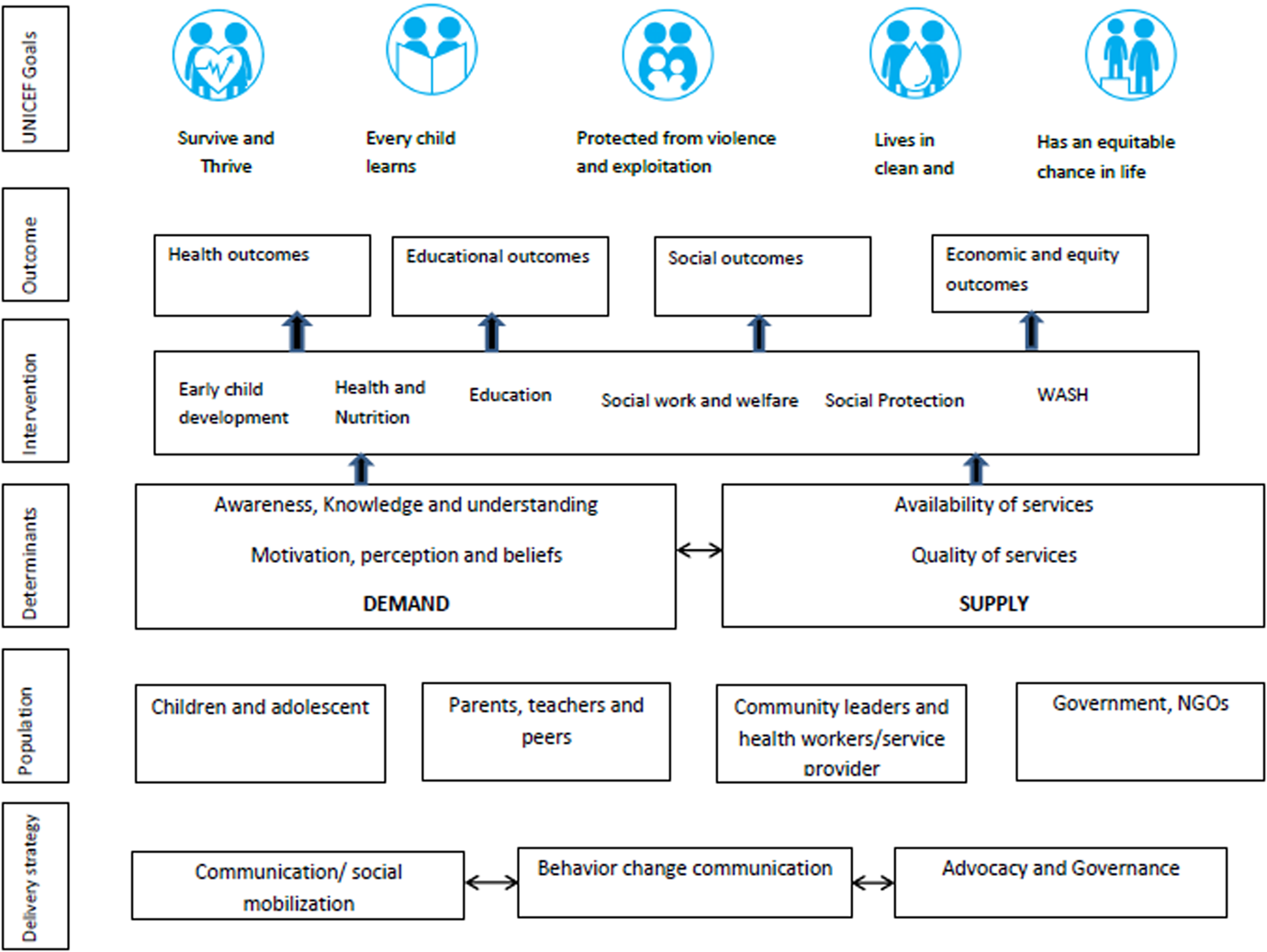
Conceptual framework for the child well-being Megamap
Since this a Megamap and has a very broad scope, it will be first of its kind in this area. But there are related EGMs that will be included in the Megamap. Examples include EGM on social, behaviour and community engagement intervention produced by World Health Organisation and International Initiative of Impact Evaluation (3ie) presents the evidence available on social, behavioural and community engagement interventions related to reproductive, maternal, newborn and child health programmes in LMICs. EGM on primary and secondary education by 3ie that presents evidence on interventions designed to improve access to education and learning outcomes for primary and secondary school children in LMICs. EGM on Intimate partner Violence highlights important gaps in the rigorous evidence base of intimate partner violence prevention programmes in LMICs.
There are number of focussed reviews related to specific child well-being interventions such as Systematic review by Bangpan, Dickson, Felix and Chiumento (2017) assess the impact of psychosocial interventions on mental health of children and adults in humanitarian emergencies. Systematic review by Miller, Maguire and Macdonald (2011) assesses home-based child development interventions for preschool children from socially disadvantaged families. Another systematic review by Bright, Felix, Kuper and Polack (2017) measures effectiveness of interventions aimed at increasing access to health services for children aged 5 years and below in LMIC.
The specific objectives are Develop a clear taxonomy of interventions and outcomes related to the effectiveness of child well-being interventions aimed at improving child well-being in LMICs. Map available systematic reviews and EGMs of the effectiveness of interventions aimed at improving child well-being in LMICs with an overview provided in a summary report. Provide database entries of included systematic reviews and EGMs which summarise the intervention, context, study design and main findings.
Defining EGMs
This EGM is an effectiveness map in which the primary dimensions are the rows and columns of the map which are, respectively, intervention categories (and sub-categories) and indicator domains (and sub-domains). Secondary dimensions, such as country and target group will be included as filters.
Population
The primary population of interest for this Megamap is children under the age of 18 years as per the definition by United Nation Convention and includes children from LMICs. LMICs are defined by World Bank as low-income economies - those with a Gross National Income (GNI) less than $995; lower middle-income economies – those with a GNI per capita between $996 and $3,895; and upper middle-income economies – those with a GNI per capita between $3,896 and $12,055 (World Bank, 2018). Different child age ranges (0–1 month, 1 month–2 years, 2–6 years, 6–12 years and 12–18 years).
Population sub-groups of interest include: orphans, children with disabilities, children belonging to ethnic minorities, child sex workers, malnourished children, child brides, isolated children/street child, children with HIV/AIDS and children in conflict and humanitarian settings.
Interventions
The included interventions cover all main strategies whose primary purpose is to improve child well-being outcomes. So we do not include more general policies (e.g., macroeconomic policies) which will affect child well-being, or more general social programmes (such as health or unemployment insurance). Many of the included interventions are directly targeted at children, for example, immunisation or education interventions. But that is not necessarily the case. For example, parenting programmes intended to modify parenting practice and a community-based campaign against early marriage attempts to modify social norms – but in both cases with the end goal of improving child well-being.
The seven intervention categories are Early child development Health and nutrition Education Social work and welfare Social protection Environment health including WASH Governance
Table 1 lists the intervention sub-categories under each of these headings. Intervention domains of the Megamap will be linked to UNICEF's five key goals proposed under the new Strategic Plan (2018–2021) and subsequent research briefs on findings from Megamap will be published for each of these UNICEF goals. Goal One: Every child survives and thrives Goal Two: Every child learns Goal Three: Every child is protected from violence and exploitation Goal Four: Every child lives in a safe and clean environment Goal Five: Every child has an equitable chance in life
Intervention categories and sub-categories
The seven outcome categories are Health Healthy development Learning and development Risk factor reduction Safety Equity Economic impact
Table 2 lists the outcome categories and sub-categories. These are broad sub-categories, and the recorded outcomes may be even positive or negative effects.
Outcome categories and sub-categories
Types of study designs
The Megamap will include only systematic reviews and EGMs of effects of interventions. The key characteristics for a review to be included as a ‘systematic review’ A clearly stated set of objectives with pre-defined eligibility criteria for studies. An explicit, reproducible methodology. A systematic search that attempts to identify studies that would meet the eligibility criteria. A systematic presentation, and synthesis, of the characteristics and findings of the included studies.
Studies were not excluded based on the results of our critical appraisal of the included studies.
The map will not include qualitative research.
Types of settings
Systematic reviews will be from LMICs. Systematic reviews that have a global focus will be excluded if their focus is predominantly on high-income countries. Those which contain information on high-, middle- or low-income countries, but where the findings are clearly disaggregated by region or country and where the findings for low- or middle-income regions or countries are presented separately will also be included.
EGMs that included studies from LMICs were included even if they had global focus.
Status of studies
On-going systematic reviews and EGMs will be included. Status of systematic reviews and EGMs will be a filter.
Search strategy and status of studies
The Megamap will be developed in three stages The first Stage 1 was a piloting stage for the framework which included search of relevant systematic reviews and EGM from 3ie databases. This search yielded 99 systematic reviews and 16 EGMs. Stage 2 based on a database search for a draft version of the map, which identified 302 systematic reviews and 16 EGMs Stage 3 for the Campbell map will include (a) search additional websites for grey literature, (b) consult experts and (c) screen submissions received in response to dissemination of the Stage 2 map.
The search will be as comprehensive as possible, using (but not limited to) relevant bibliographic databases and EGM databases, web-based search engines, websites of specialist organisations, bibliographies of relevant reviews and targeted calls for evidence using professional networks or public calls for submission of articles. Additionally, reference lists of the included reviews will be reviewed and the authors contacted for information on other relevant sources.
Databases
International organisations - UNICEF - DFID (including Research for Development (R4D) - UNFPA Evaluation Database - WHO EGM database - 3ie EGM repository - Swedish Agency For Health Technology Assessment and Assessment of Social Services - Collaboration for Environmental Evidence - Global Evidence Mapping Initiative - Evidence based Synthesis Programme (Department of Veteran affairs) - Cochrane - Evidence based policing matrix - EPPI Centre Evaluation Database of Education Research Systematic review database - Cochrane - Campbell - 3ie Systematic Review Database - Research for Development Academic databases - World Bank eLibrary (Ebsco). - The National Bureau of Economic Research (NBER) - Social Science Research Network (SSRN) - International Bibliography of Social Sciences (IBSS) - Applied Social Sciences Index and Abstracts (ASSIA) - Embase - PsycINFO - MEDLINE - ERIC Grey literature search/websites - World Health Organisation - World Bank - UNICEF - UNICEF Innocenti Research Centre - UN Women - UNESCO - United Nations Population Fund - UN Economic and Social Council - CARE - Save the Children - African development bank - Young Lives - Association for the Development of Africa - Médians Sans Frontières - Action against Hunger - World for World Organisation - Project Concern - One International - World Vision - Department for International Development - World Food Programme - Valid International - Concern Worldwide - Action Aid http - CIFF - International Red Cross - WHO ICTRP - Working Group on Early Childhood Development, Division for - Social Policy & Development, Child Fund International - GreyNet Internationa l - Proquest Dissertations & Theses - Opengrey - Gates Foundation - Clinton Foundation - Abdul Latif Jameel Poverty Action Lab (J-PAL - Urban Youth Evidence Synthesis - Innovations for Poverty Action (IPA) Database - Child and Youth Finance International
Sample search is added as an Annexure A.
All titles and abstracts, and then full text, will be double screened, with a third party arbitrator in the event of disagreement.
Data extraction, coding and management
Coding will be done independently by two coders, with a third party arbitrator in the event of disagreement. The coding form is given in Annexure B. The coding form is very straightforward so coding is conducted in Excel.
Quality appraisal of systematic reviews
The quality of the included systematic reviews will be assessed using AMSTAR 2.
Critical appraisal will not be carried out for included EGMs.
Analysis and presentation
Unit of analyses
Each entry in the map will either be a systematic review or and EGM. The accompanying EGM report will identify the number of systematic reviews and EGMs covered by the map in each sector.
Presentation
The map will be generated using the EPPI Centre's Mapping Software.
In addition to intervention and outcomes, the following filters will be coded systematic reviews and Megamap: Population sub-groups of interest include: orphans, children with disabilities, children belonging to ethnic minorities, child sex workers, malnourished children, child brides, isolated children/street child, children with HIV/AIDS and children in conflict and humanitarian settings, and different child age ranges. A study is coded by one of these filters if the sub group is the focus of the review. Region: East Asia & Pacific, Europe & Central Asia, Latin America & Caribbean, Middle East & North Africa, North America, South Asia, Sub-Saharan Africa and conflict affected regions Systematic review quality: Based on AMSTAR 2 as high, medium and low Country classification by income level: low-income <1,005, lower-middle income 1,006–3,955 and upper-middle income 3,956–12,235.
Filters 2 and 4 are applied if the included review or map's own inclusion criteria meant such studies were eligible. As mentioned above, the population sub-group filters were applied when that was the focus of the review.
The EGM report shall provide tabulations or graphs of the number of systematic reviews and EGMs, with accompanying narrative description, by Intervention category and sub-category Outcome domain and sub-domain Table of ‘aggregate map’ of interventions and outcomes Region Year Study type and study quality
The map itself will show the number of studies in each cell which corresponds to an intervention sub- category and outcome sub-domain. See Annexure C for snapshots of the draft map (the map itself may be found at https://cedilprogramme.org/wp-content/uploads/2018/09/megamap_june252018.html).
Stakeholder engagement
The framework was developed through a consultative process. An advisory board was formed comprising of key experts in the area from UNICEF Innocenti, Ministry of Health and family welfare in India, African Child Forum etc. Initial framework was developed based on various standard guidelines document of child well-being by key organisations such as UNICEF, WHO, Save the Children. The proposed framework was revised based on feedback by the advisory board and piloting of the framework was done using 3ie database search an screening. The framework was then further revised in a mapping workshop in London where key stakeholders and experts in the area were invited. They reviewed the categories in an interactive exercise to fit the identified papers into the categories
The map will be discussed at various mapping workshop and advisory group meetings organised by UNICEF Innocenti and Campbell Collaboration.
ROLES AND RESPONSIBILITIES
Content expertise: K. A. who has experience regarding use of evidence across all of UNICEF's policy areas. H. W. who has published papers, including reviews and impact evaluations, on various aspects of child well-being.
EGM methods expertise: A. S. and H. W. have previous experience in systematic review methodology, including search, data collection, theory-based synthesis, which mean they are proficient in carrying out the various processes in an EGM, such as search, eligibility screening, quality assessment and coding. They have undertaken an overview of approaches to mapping in a range of organisations. J. A. is experienced screener and has previously worked on Campbell Collaboration research projects.
Information retrieval expertise: A. S. has training in designing and implementing search strategies.
FUNDING
This EGM is partially supported by the UNICEF Innocenti Centre.
CONFLICT OF INTERESTS
The authors declare that there are no conflict of interests.
PRELIMINARY TIMEFRAME
Phase 1: Systematic reviews from 3ie database: completed
Phase 2: Full systematic review search: completed
Phase 3: Grey literature search: Completed
Protocol drafted: December 2018
Coding: October 2018
Draft report writing: June 2019
PLANS FOR UPDATING THE EGM
Megamap will be updated annually and hence will again be updated in 2019. The EGM team are in discussions with the EPPI Centre, who are responsible for the mapping software, about possible real time updating through (a) automated searches with machine-learning powered screening and (b) moderated submissions of suggested papers.