







Abstract
This article is about teaching the first university credit course devoted to Mad People's History. The focus is on situating the course within the academy and community, curriculum development and pedagogical controversies.
Establishing Mad People's History as a university credit course is one way of getting our past on the public educational agenda to counter prejudices which have been ubiquitous down through the ages continuing to the present day. is a form of “intellectual empowerment,” fostering understanding of societal issues (Tosh, 2008, p. ix). In this respect, promoting Mad People's History helps people who have personal connections to madness place their experiences into a wider historical context to reduce the sense of isolation that comes with belonging to a marginalized group. Mad People's History fosters understanding of the community whose history is long and rich, even though hidden in the shadows. Mad People's History is one way of bringing light to some of these shadows.
Before proceeding to the details of the how and why of this course, I want to start this article with one experience with adult education that is linked to its development. As a nineteen year old psychiatric out–patient in the summer of 1981, I attended high school equivalent upgrading courses at a community college in my hometown of Windsor, Ontario (I never graduated from this community college, but that is another story). Before then, I had dropped out of high school in Grade 9 at the age of 14, lived at home with my immensely supportive parents, had been a psychiatric in–patient twice for a total of six months and worked at a sheltered workshop for people with physical and mental disabilities for just over a year. My social worker in 1981, Ron Rousette, the best mental health support worker I had in the seven years I saw social workers, psychiatrists and psychologists between 1976 to 1983 – told me that I should get my high school diploma so that I could go to university. His suggestion that I should go to university seemed extraordinary to me at the time. “Are you serious, Ron?!” In any case, I duly went to upgrading adult education courses at St. Clair Community College beginning in June 1981. Like any other educational institution, some of the instructors were very good, even first–rate in a couple of cases, others were not so good, and some were somewhere in between. One of the professors was a man I admired. In class he expressed interest in matters that interested me – global affairs, opposition to United States President Ronald Reagan's policies – and he also seemed to be a down to earth, approachable sort of person.
Then, one day, he started to talk about a student he had had in his class at some point in years gone by. This student, he said, was “squirrelly”. At the time, this was a common derogatory term for someone who had mental health disabilities. He said the young woman in question had been in a mental hospital which was well known locally at that time, in St. Thomas, Ontario, about a two–hour drive away. She was “really sweet”, the professor said. She was also shy and timid. He said it was his job to know of “squirrelly” students who had been in St. Thomas to keep an eye on them. Then he said some other students knew of this young woman's background. One particular male student intimidated – “teased” in the professor's words – this student so much that she hid under a desk in the classroom. The professor said he then had to spend time trying to get the young woman out from under the desk. He told this story in a tone that he intended to sound humorous: grinning, interchanging the word “squirrelly” with a sort of nudge–wink manner that made it sound as if the male student who tormented the female student was just having some mischievous fun. He even expressed a sort of “poor child” tone about the young woman. I do not recall now if he said anything about whatever happened to the young woman after this episode. Perhaps it was because my mind was cascading with a multitude of thoughts while also feeling frozen in my chair. The professor enjoyed telling the class this story. From what I saw and heard from the back of the class that day, most of the students enjoyed it too. They laughed along with him. I cannot recall today what was the point, if any, the professor had in telling us this story. I only remember feeling very alone in the back of that classroom, thinking about the young woman hiding under the desk from her tormentor and listening to a professor I had admired, up until then, describing his former student, a fellow human being, as being “squirrelly”, with laughter erupting all around. All of it in an adult education setting.
I wondered, did this professor know that I too was “squirrelly”? That I was then an out–patient who had once been in St. Thomas Psychiatric Hospital like the young woman he had just talked about? Was this a message to me to watch out, that this professor had his eye on me too? Was I the only “squirrelly” student in class that day who wasn't laughing? It sure felt like it. Of course, I will never know if some other students present felt as I did and had themselves been in psychiatric facilities. It was not exactly an atmosphere that encouraged anyone to share stories about our vulnerabilities, let alone our psychiatric history. I kept my thoughts to myself, that day and for years afterwards in similar situations. In the years to come as I worked my way up from being a high school drop out to a returned adult student pursuing higher education, I would hear plenty of other disparaging remarks from professors and fellow students about people considered mentally disabled. This episode, however, from summer 1981 is the one which stays with me the most. In some ways it was emblematic of them all. The extreme bad taste and offensiveness of the comments. The emotional cruelty towards vulnerable people. The disillusionment with someone who was nowhere near as understanding as they first appeared to be. The contempt for other human beings past and present – including contempt for students sitting right in front of the professor who uttered such words. The apparent agreement and laughter of others in the class with the prejudiced statements being made was met with my silence and other classmates. No one gave voice to how wrong such comments were. It would not be until I was a graduate student that I began to express public opposition to such prejudices. By then I felt that those leading as educators should counter these ideas in person and in print.
These experiences, and others I have heard from people over the years, underline the importance of a course like Mad People's History. Educators should care about this topic as mad students are in classes everywhere and always have been, even if not publicly, for very good reasons. Teachers who have experienced madness are also in the classroom and have been in the past too with their own reasons for not being public. As a tenured professor told me in a hushed tone after I gave a public talk on our history in 1999: “I have had to keep it quiet.” We need to make our presence known so that the sort of episode where public harassment and after the fact mocking of a mad student, like that described above, becomes a part of the past. In doing so, talking about our incredibly rich history is essential to making positive change happen inside and outside the classroom so that both students and professors do not feel the need to be quiet about our experiences.
Origins: What is Mad People's History and why is it important?
At its most basic, Mad People's History is the study of the experiences of people deemed mad and treated as such by their contemporaries. This course privileges the views and experiences of mad people as being of central importance in our interpretations of histories of madness. Privileging the views of mad people is done to get a fuller understanding of the humanity of mad people, to link past practices and prejudices with ongoing struggles of people with mental health disabilities, to examine human rights issues, and to provide a voice to this often maligned group of people. Teaching this course is one way to get these historical and contemporary rights issues on the educational agenda for all to take seriously and to make our concerns public.
Clarification on the beginnings of this course is necessary since, in some of the secondary sources that refer to it, there are factual inaccuracies on this point. An article published by Burstow (2016) cites the course Iintroduced as “the world's very first” course on Mad People's History (para. 6), while an earlier article credits this course as the first of its kind in Canada (Gillis, 2015). Both authors mistakenlythe establishment of the course at Ryerson University as being the locale where it wastaught. Yet another source describes instructors who taught this course at Ryerson University after I had introduced it and left for another teaching job as “the people behind the first course in Mad history to make it into a university setting” (Russo & Sweeney, 2016, p. 4). To clarify:originallyfor, developed and taught Mad People's History as an undergraduatecourse with funding from adoctoral fellowship at the Institute for the History and Philosophy of Science and Technology (IHPST) at the University of Toronto in 2000 (Reaume, 2006a). Due to funding issues –I was told by academic administrators – it was not made into a permanent part of the curriculum at the University of Toronto but was a one–time only half year course that ended when my post–doctoral funding ended in August 2000. Not having any luck afterwards with advocating for the re–mounting of this course as part of the undergraduate curriculum at the city's oldest university, I approached Melanie Panitch, then Director of the School of Disability Studiesat Toronto'sRyerson University, who invited me to teach the course there as contract faculty which I did three times between 2002 and 2003. After beingatUniversity's Critical Disability Studies program in 2004 in a tenure track position I introduced this course to a third university in Toronto, this time at the graduate level.
Now, I do not claim to be the first academic to have promoted Mad People's History as an academic topic worthy of serious investigation. Peterson (1982) in the United States and Porter (1987) in the United Kingdom deserve credit for this with their publications on this topic. Unless evidence can be shown to the contrary, however, it is safe to claim that the course I originally introduced beginning in 2000 is the first university credit course devoted to Mad People's History, as Burstow (2016) has noted, even if she located its start at the wrong place.
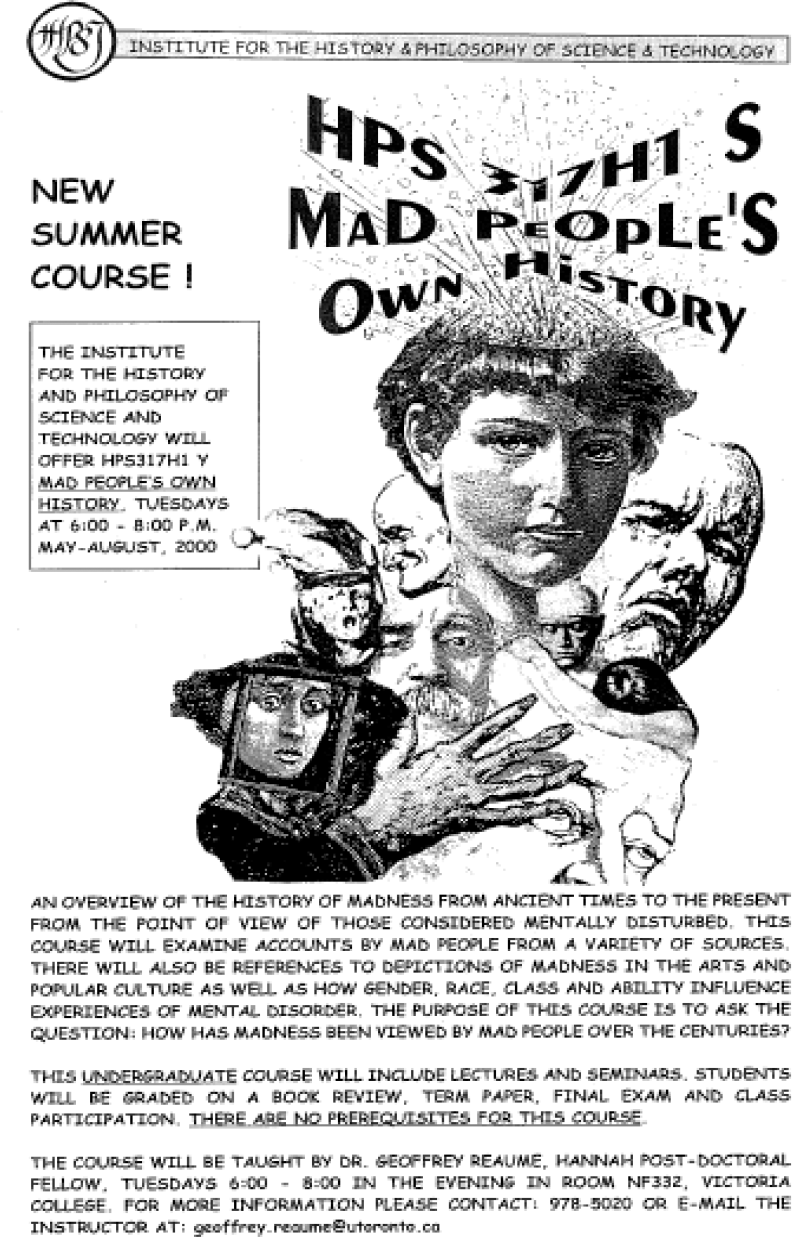
Poster advertising the first university credit course in Mad People's History; University of Toronto, 2000. Poster design: Bill Zaget; text: Geoffrey Reaume.
Locating Mad People's History in the Academy
Why does it matter when this course started? Origins matter. Given my own psychiatric history dating to 1976 and experiences thereafter, I wanted to ensure that the course was based on historical accounts by and about mad people first and foremost. The timing was crucial to how the course was defined and developed from within the community of people upon whom it focuses. This was an approach which most historians of psychiatry up to the end of the 20th century did not take (Reaume, 1994, 2000a, 2000b). The course I developed is focused on history because that is my research field and where my passion belongs – in the past – and ensuring connections are made between past struggles against injustice and contemporary developments.
Beginning in 1990, during the second year of my doctoral studies, I became involved in the psychiatric consumer/survivor/ex–patient community in Toronto. The term ‘psychiatric survivor’ refers to people who were or are patients of the mental health system at some point in their lives and who are critical of their experiences, including critical of the domination of the medical model (Reaume, 2002).
At its most basic the medical model claims that mental disturbance is biologically based and hence individualized to a specific person (Bentall, 2004; Ussher, 1991). Originally viewed as an advancement over ancient supernatural explanations which claimed that madness was due to being good or bad in one's life, or previous life; the medical model by the early twentieth century dominated the emerging field of psychiatry. The medical model excluded wider social, economic, racial, class, gender and sexuality based influences for why someone either (a) went mad or (b) was labelled with a mental illness (Burstow, 2015; Porter, 2002; White, 2018). Critics of biological psychiatry have pointed out how definitions of mental illness have been based on the mental health professionals’ privileged position to determine diagnostic categories and to whom such categories apply. There have also been criticisms of the biological orientation of the medical model from a social model perspective that originated within Disability Studies but has more recently been taken up within Mad Studies (Menzies, LeFrançois, & Reaume, 2013). Basically, this model posits that social structures, attitudes and practices that impede the ability of wider society to integrate people with physical and mental differences is not inherent to an individual's physical or biological make–up but rather due to wider societal barriers that fail to accommodate differences from what is perceived as the physical and mental norm (Beresford, 2005; Nabbali, 2009; Oliver, 1990).
One of the benefits of researching and teaching Mad People's History is to show that social construction critiques did not simply develop with scholars like Szasz (1974) and Foucault (1988). Mad people have long objected to labelling based on personal experiences. Historian Porter (1987) pointed this out when recording the words of playwright Nathaniel Lee [1653–1692] who said in reference to his confinement in Bedlam asylum: “They called me mad, and I called them mad, and damn them, they outvoted me” (p. 3). This rich history of dissent and critique of conventional ways of determining both the existence and causes of madness provided the foundation for the course on Mad People's History. By stressing the extent, depth, and longevity of mad people's past, we can place our current situation in proper historical context, give proper credit to activists, writers, and individual mad people whose efforts deserve our respect and also raise the issue of the need for humility when reflecting on the struggles of people in centuries past.
The point here is to situate the development of ideas for this course in both my own work as an academic historian and among the wider community past and present. The course grew out of research, activism and teaching. I wanted to ensure my work was not just about the community but a part of it. Many of the critiques I incorporated in the course were based not only on my own experiences but also based on years of discussions and activist participation in the community also called the Mad Movement (Shimrat, 1997). Mad People's History therefore is inextricably linked to the history of activism and taking pride in our abilities as current or former psychiatric patients, inmates, survivors, or mad people.
The development of this course is therefore located within the emergence of disabled and mad people's activism during the late 20th century. IHPST was a particularly supportive atmosphere for my work, thanksthe mentorship of Pauline Mazumdar, a medical historian at the Institute. After years of dealing with less than enthusiastic support from the History Department at this same university where I did my doctorate, I knew proposing a coursethis could be challenging. As it turned out, colleagues at IHPST were entirelythough it was made clear this would be a one–time only course, supported as it was by external funding of $5,000 for an undergraduate half year course. This course was proposed within the field of the History of Psychiatry, not Disability Studies nor Disability History (which I was only just beginning to be aware of) and before the existence of Mad Studies. Money for what has become one of the foundational courses in Mad Studies came from an agency which specialized in medical, Associated Medical Services, Hannah Institute for the History of Medicine. underlines the point that while the ideas for such a course were based onbackgrounds of, in this case, myself as the course instructor and the, the actual resources to pay for mounting this course for the first time came from a medical model oriented research organization. The reason is not hard to figure out: during this period Medical History was a much more established field with plenty of money compared to Disability Studies. It would be a mistake to view medical historians as belonging only to a medical model view of this sort of history as there have long been scholars in this field who are supportive of, and themselves engage in, critically interpreting the medical model (Linker, 2013). So while it may appear odd that a course critical of the medical model of madness would emerge from an academic area and funding agency focused on bio–medicine, it actually fits well within the corpus of a field where critically engaging such topics was well under way by the 1990s.
The first course in Mad People's History was established outside of the field of Disability Studies and from within the environment of mad activism. ts eventual inclusion in the field ofandStudies shows how the field has grown and benefited from cross–disciplinary. Framing it as new and innovative within an existing field was just as important as situating the course within the well–established field of social history. As Tosh (2008) has argued, study ofis essential for providing people with the analytical tools to understand contemporary developments. Though he has reservations about what he refers to as “identity history”, Tosh (2008) nevertheless points out its potential for wider positive impact:“Since history is integral to social visibility, reconstructing the past may also contribute to the recognition of one's own group by others” (p.). This in turn can help to foster greater inclusivity and rights protection for people with mental health disabilities creating the potential for more allies.
When it was first taught at the University of Toronto in 2000 this third–year course required nofor enrolling and was open to all undergraduate students. It was important that it be open to all students to reach as wide an audience as. From its inception, Mad People'swasopen to auditors, many of whom were not students but were members of the madcommunity who wanted to learn more about their history in a formal course setting. My dream at that timeto make it a permanent course of study, either at the University of Toronto, or somewhere else. But first, it had to be established as a serious course whose success would demonstratethat it should betaught in the future.
An essential motivation for the course was how mad people were viewed by academics in class and in published work. Throughout the course the definition of madness has been placed within the context of socio–economic dimensions of madness, rather than the medical model of mental illness (Reaume, 2006a). Therefore, the choice to use the word ‘mad’ in the course title was intended to ensure the medical model of mental illness, with its uncritical assumptions about a biological cause of mental anguish, was de–emphasized to highlight the much older term “mad” which pre–dates biologically deterministic labels (Porter, 1987, 2002). I had been concerned throughout my years as a PhD student studying the history of medicine and psychiatry when reading the often disparaging comments of historians about people deemed mad. It was not a coincidence that at the same time as I was advocating for a course on Mad People's History, I criticized the way mad people were caricatured in publications. For example, American historians Gerald Grob and Ellen Dwyer made excuses for asylum staff members who abused patients while making no allowances for vulnerable inmates confined in locked wards (Reaume, 2000a). These patients were described as “violent” and “disruptive” while abusive staff members benefited from positive interpretations of their violent behaviour (Dwyer, 1987; Grob, 1994).
In 1999 I gave a public talk at a Canadian medical history conference which was published the following year (Reaume, 2000b), criticizing the unfair, insulting and prejudiced assumptions used to describe mad people in publications. This included a critique of Canadian historian S.E.D. Shortt's description of asylum inmates as having written “‘rambling, semiliterate accounts,’ briefly quoting one such document written by an inmate that was dismissed by [London, Ontario Asylum Superintendent] Bucke as containing ‘fantasies’”(Shortt, 1986, p. 59). No context was provided by Shortt about the pressures and class differences between an asylum inmate in a crowded public ward writing a letter about the situation, and an educated doctor sitting in a quiet, private office (Reaume, 2000b). It was a matter of academic integrity to treat such writings of asylum patients with the utmost respect and to treat their recorded thoughts in clinical notes with care. This historiographical article (Reaume, 2000b), encapsulated one of the main motivating factors which impelled me to advocate for this course, by questioning:
“Why is there an indifference, even outright contempt among some academic historians towardspeoplewithmental?simply a matter of differences over interpretations of historical events, or contrasting methodological approaches to history, or even diverging personal interests…. Instead, as in several of the sources[in this article], there is a disregard for the humanity of an entire group of people, solely because these individuals have real or presumed mental disorders” (Reaume, 2000b, p. 112).
In addition to providing a critique of unfair and derogatory terminology used in describing mad people, I also wanted to do something positive about it. This desire to emphasize the humanity of mad people, that we have a history that deserves to be taken seriously, and how this past affects people today which formed the basis of this course. The course remains based in my experiences and those of other people whose views and experiences had been dismissed as unreliable or nonsensical, something which Mad People's History directly challenges.
Curriculum Development
A basic pedagogical approach to ensuring accessibility continues to be important. Higher education has so often placed inaccessible physical, economic and intellectual barriers ahead of marginalized people, impeding opportunities to participate in university (Fuller, Healey, Bradley, & Hall, 2004; Hibbs & Pothier, 2006). To address the economic barrier, the course has been open to the community who audit the course for free. Another basic form of accessibility is using clear language such as avoiding the use of academic jargon in the classroom and in print. Terms like ‘social construction’ – or ‘whiggish’ – used to refer to a school of liberal, capitalist thought among some historians – as well as more obscure terms are avoided as much as possible. If used, they are used sparingly and explained in plain language. People with and without disabilities who are not academics have expressed frustration over the years at hearing or reading terms that are commonly used among select groups of academics but nowhere else. Terms like “rhizomatic” (Deleuze & Guattari, 1987, p. 11) or “incorporeally” (Massumi, 1993, p. 129) only serve to obfuscate, rather than explain. Whether or not people agree with the use of a term like “mad” in a university course about mental health, everyone knows what it means (Poole & Grant, 2018).
Over twenty years ago, when attending a film screening at a Toronto mental health facility, a friend in the psychiatric survivor community asked me what the word “cogitate” meant after one of the post–film panelists used this word. When I told her it meant “to think” my friend, who never had the opportunity to go to university and was a longtime activist in the community, said “Well why doesn't he say so?!” She was and is absolutely right. Why do not we academics talk and write in accessible language, especially those of us who are researching communities that have been historically marginalized in society and within the academy? Teaching and writing accessibly is therefore a basic premise of Mad People's History.
Sources
Throughout my teaching this course I have been concerned with imparting the longevity of this history and how mad people's perspectives and activism is by no means a recentdevelopment. Mad people have been speaking out for several hundred years at least, long before contemporary activists came along. Ito move away from thethat there was little meaningfulfor and by mad people until the post–1960s era, for instance the anti–psychiatry movement (Everett, 2000). Interestingly, early writersas–psychiatry did not themselves self–identify as mad (nor, in some cases, as anti–psychiatry) such as Szasz (1974), Foucault (1988) and Laing (1960). Another aim of this course was to move from an either or perspective; that is, if you were not pro–psychiatry (medical model in outlook) you were anti–psychiatry (rejecting the psychiatric system entirely). This binary simplicity is an inaccurate way of portraying people's perspectives about madness, and mental health concepts. There are activists who describe themselves as anti–psychiatry, just as there are activists who do not identity in this way who are critical of the medical model. Also, the perspectives of mad people who accepted conventional views on madness from whatever period in which they lived should be included.
I remember hearing from a participant (an auditor) in the firstcourse taught, the spring/summer term of 2000 at theof Toronto, that she had not realizeda long history there was which documented mad people's lives. While she knew madness existed for as long as there were people, thewas surprised at how far back one could find perspectives and words of those deemed mad. In contrast, theoretical writings by modern academics have not been prioritized as essential. Foucault's (1988, 2006) book on the history of madness was included in some of the early courses for his discussion of the power/knowledge relationship between mad people and an emerging medical profession. His work, however, is not concerned with the agency and voices of mad people, has been criticized for historical inaccuracies (Scull, 1990), and therefore was not included as essential. A few years ago, a York University graduate student told me the most “striking thing” about my course syllabus was that I did not have Foucault on the reading list. While the post–modernist thinker was on the reading list the first time I taught this course in 2000, and in some of the earlier courses taught at York University, he has not been included on a regular basis. This is due to a desire to move away from ‘great’ people, including ‘great’ theoreticians, and focus on the far less known words, writings, and experiences of mad people. Theoretical tomes cannot equal the lived experience in immediacy or historical relevance. If the course is remembered for anything “striking,” it should be the words and experiences of mad people down through the centuries. Foucault does not lack an audience. Most of the mad people on my course outline do lack wider recognition. If someone decides to not take a course, as this student did, because one academic theorist is not included, while people who have lived this history over the centuries are prioritized instead, one can only wonder at how seriously the student is interested in history based on long ignored perspectives found in primary sources.
The richness of Mad People's History has exploded with increased sources available from a variety of perspectives. Since this course was first taught in 2000, the scope of written material has grown and it is now possible to teach extensively topics difficult to support with written material twenty years ago. While historical evidence of mad people's writings has been available since before this course was first taught, historical analysis, particularly critical interpretations, were more difficult to locate. For example, topics such as asylum inmates’ labor, and race, imperialism and madness have seen significant amounts of historical research published over the past eighteen years. While there was some material available when the course was first taught in each of these areas, today there is a regular stream of research available to support the teaching of this course with increasing critical historical interpretations and first–person accounts. The internet has enabled important primary and secondary sources to reach a wider audience than before, in part through open access (Survivors History (http://www.studymore.org.uk); Psychiatric Survivor Archives of Toronto (http://www.psychiatricsurvivorarchives.com); History of Madness in Canada (http://historyofmadness.ca)).
The course begins with a historiographical introduction to the field, which has changed over the years. When I began teaching this course in the early 2000s, I spent the first class talking about what was not available because historians had not done a great deal of research on this or that topic, such as labor history or race and madness. In contrast, while a significant amount of research and writing still needs to be done, more time can now be spent on giving an overview of what has been written in this field, indicating how dynamic this topic has become (Bacopoulos–Viau & Fauvel, 2016; Huertas, 2013; Reaume, 2017a, 2017b).
To stress the longevity of our past, a discussion of madness in ancient and medieval Europe is essential (Craig, 2014; Porter, 2002; Screech, 1985). Also, the histories of mad people outside of Christianity such as in the medieval Islamic world where mad poets and early welfare initiatives for majnun were well known need to be discussed (Dols, 1992). The religious underpinnings of this history and how, in our secular 21st century world, consider how long–ago expressions of spiritual visions, even when seen as mad were not always viewed as bad. In fact, such visions were sometimes viewed as having positive connotations within religious contexts.
Today, social media allows for the dissemination of personal stories in ways that were unheard of just a generation ago. Given this context, it helps to point out that the equivalent of 21st century social media were pamphleteering centuries ago, at least among the pre–industrial upper classes. Thus, mad people using the media of the day to get their views heard is not new, and self–advocacy and denunciation of brutal treatment goes back hundreds of years (Allen, 1997; Belcher, 1997; Cruden, 1982; Kempe, 1982). Some of the earliest writings in English by mad people, such as the transcribed comments of Margery Kempe from 1436 and Hannah Allen's first person account from 1683 contain sentence structure, cultural, and historical references, and a writing style that come across almost like another language to 21st century readers, as one Ryerson student told our class in 2003. Such challenges in reading are themselves teaching moments as to why mad people spoke and wrote in particular styles at certain times. For example, before the advent of mass literacy writing could take on a specialized form embedded in religious ways of thinking, ideas that seem particularly odd to many secular students today. Such readings teach students to be humble about how we view people from past centuries and how we use words today. Pointing out that some terms used in the early 2000s will appear odd, indecipherable, or offensive to future generations reminds students that language evolves as do concepts around madness.
A class on the rise of state–supported asylums, which eventually replaced older private madhouses, stressed the influence that places of confinement had on inmates’ writings from the mid–19th to mid–20th centuries. These writings significantly increased advocacy for mad people's rights, efforts which continue to this day (Anonymous, 1982; Geller & Harris, 1994; Pengilly, 1885). This in turn led to a class devoted to the early organized activist efforts of mad people beginning in mid–19th century Europe and North America emphasizing the respect we need to show to those whose advocacy efforts predated the modern mad movement (Goldberg 2003; Hervey, 1986; Sapinsley, 1991). Two sources have been mainstays in classes on activist history: Hervey's (1986) study of the Alleged Lunatics’ Friends Society, an advocacy group in Britain that lasted from 1845–63 and a selection from Shimrat's (1997) book on the mad movement in Canada which features interviews with a number of activists. In both cases, students have found these readings revelatory for how long mad people have been organizing internationally and, the extent of organizing within Canada. Some Canadian activists have attended class to bring to life their own experiences and, in one instance, a guest speaker presented a paper on his own medical records from confinement during the early 1950s in the United States which he later published as an article (Weitz, 2004). The combination of course readings and experiences recounted by guest speakers has helped to bring home the extent to which mad people have been engaged as advocates in North America.
Gender, race, class and ability are areas discussed throughout the course with specific classes devoted to each of these topics. The history of women's experiences of madness is perhaps one of the most well researched areas in Mad People's History which, along with a wealth of first–person accounts, provides an in–depth basis upon which to teach this topic (Geller & Harris, 1994; St–Amand & LeBlanc, 2013). In the early years of this course, there were few historical studies on race and madness, now more research has been published on racism and psychiatry and on mad people's history outside of North America and Europe with an increasing number on madness and colonialism (Burch & Joyner, 2007; Gambino, 2008; Rajpal, 2015; Segrest, 2014; Summers, 2010). Studies on how concepts of madness were imposed upon and experienced by Aboriginal peoples in North America and the British empire have expanded awareness of this topic which previously had been primarily about the historical experiences of white mad people (Burch, 2014; Harper, 1988; Menzies & Palys, 2006; Yellow Bird ca., 2004).
Class and ability are also emphasized given the location of poor and disabled people (categories which are often mutually reinforcing) in our history. In this regard, asylum inmates’ labor has been central with a separate class. Students are surprised at the extent of work asylum inmates were expected to do as unpaid laborers and their central role in building and maintaining institutions (Reaume, 2000a). Labor history, which in the early classes was primarily based on my own research into this topic in Ontario, has expanded with international contributions showing the worldwide scope of the exploitation of disabled people's labor (Brumlik, 2014; Ernst, 2016; Reaume, 2006b; Monk, 2010).
In addition to print sources, there are also sources on the street. An essential part of the course is to reference local physical examples of where this history occurred. As part of teaching Mad People's History for the first time, I led the first of 142 tours (as of this writing) of a nineteenth century asylum boundary wall surrounding three sides of what was the grounds of the Toronto Asylum for the Insane (now the Centre for Addiction and Mental Health, CAMH). Discussing brick walls which were built and re–built by unpaid asylum inmates in 1860 and 1888–89 provides tangible examples to make this history ‘real’ in a physical sense. The labor class addressed stereotypes of mad people as incapable of work, while having their labor exploited, juxtaposing the history with the contemporary unemployment of disabled people (Reaume, 2010). In other words, psychiatric patients’ labor history has direct connections with contemporary issues around poverty and continuing challenges facing disabled people in the labor market (Galer, 2018). While taking a class on a wall tour has not been done every time, in each course students were told about the wall's history and its implications. From there, we discussed searching our own communities for histories that mad and disabled people have imprinted on the local environment (Church, Panitch, Frazee, & Livingstone, 2018; Park & Hamilton, 2010).
Art and madness is another topic covered in most of my courses. The one time I left it out students expressed their disappointment. This topic always generates a good deal of debate on the exploitation of “outsider art” and whether or not there is such a thing as mad art or, instead, art that happens to be created by mad people (Artaud, 1965; Gilman, 1996; Huddleston& Russell, 2015).
Histories of eugenics and cross–disability oppression are the focus of one class. This is to ensure students learn about the parallels in discrimination experienced by people labeled with varying degrees of intellectual disability and people deemed mad under eugenic policies. This class also raised the issue of prejudices some mad people have expressed towards people considered ‘feeble–minded’ and how support for other disabled people has too often been absent in Mad People's History (Chadha, 2008; Friedlander, 2001; Menzies, 2002; Seeman, 2015; Spagnuolo, 2016; Woodson, 1994). For instance, we discussed Woodson (1994) who had been confined in an institution in Oklahoma during the early 1930s for what was then called alcoholic insanity. After reading about his sexist attitudes towards woman and support for eugenical sterilization of people labelled feeble minded, a student once asked “So why are we reading him?” To which I responded: “Because this is part of our history;” going on to discuss the importance of dealing with prejudices mad people might have about race, gender, class, ability, religion, cultural background, or sexuality. There is a need to ensure that this course does not descend into a celebratory sort of history, all pride and no prejudice from mad people, for if it did, it would be hero–worship, lacking serious historical integrity. Only by teaching this less proud part of our past can it be challenged and changed, by mad people ourselves.
Media madness, popular culture, and discrimination towards disabled people was originally the focus of a class but with the growth of historical scholarship in other areas, this topic has been subsumed under classes dealing with more recent periods. Media stereotypes (madness equated with badness for a host of publicly known offences) is an area with available resources for independent study (Harper, 2009; Wahl, 1995). On the other hand, educators who have limited access to sources, could include this class given the easy availability of on–line sources from daily media which portray mad people in stereotypical ways. Unfortunately, there is plenty of media material from the past and present for a class on this topic.
A class on first–person accounts of madness in Canada, intended to highlight the richness of writings in this area, was a regular feature of early courses. This included accounts by authors who discussed their experiences of living in boarding homes in the 1970s and 1980s. These regular sources included a short story by Gibson (1994) on being in a general hospital psychiatric ward and a map of “Our World” by Errett (1983) detailing Toronto's downtown west end social service agencies, homeless shelters, group homes and psychiatric facilities. Each author refers to places in Toronto which usually resonate with students who often know the places being discussed. Recently first person accounts were replaced by a class on the modern influence of the pharmaceutical industry and deinstitutionalization. The topic includes the wider national and international developments surrounding deinstitutionalization and chemical treatments locally during the late 20th century. First–person accounts from people who have experienced this process in different countries have been included moving the topic from a strictly Canadian themed class (Davies et al., 2016; Medawar & Hardon, 2004; Whitaker, 2010).
A way to address recent history is to invite people to class who have lived some of the topics on the agenda. Guest speakers have ranged from institutional survivors of abuse dating back to the 1950s and 1960s, activists, advocates and artists, including theatrical performers. In one instance, a graphic arts student at York University presented a cartoon film she made for her Master's program about growing up as a mad girl which she showed in class to enthusiastic applause. As will be evident in the next section, not all guest speakers were applauded.
Classroom Controversies
“I hate the name but like what you are doing with this course.” So, said a graduate student when we were discussing Mad People's History in fall 2004. Since the course's introduction, various people have expressed their like or dislike of the course's name. Those who have criticized it view the course name as perpetuating a negative image of people with mental health disabilities – madness as badness. I chose the name to highlight the longevity of our collective history, the need to ‘re–own’ a term too often deemed negative, and the essential humanity of the people who make up this past and present (see Screech, 1985).
The term ‘mad’, was deliberately chosen to get away from an idea that this course would be a history ofbased on medical model interpretations. While the development of diagnostic classifications arecertainly part of this history it is subsumed under the crucial emphasis that this history is about ‘people’ – mad people. As a result, calling this course “Mad People's History” encapsulated my primary aims in creating this course in each word with these priorities: the historical validity and longevity of the term ‘Mad’ as it applies to human beings; theessential point that we are discussing ‘People’, not diagnostic categories, nor stereotyped images caricatured in art, media, literature and history; and ‘History’ to underline that mad people do indeed have a history, one which is ancient.
Given the emotional and intellectual investment people have in this topic strong differences of opinion occurred during the teaching of Mad People's History. Differences were usually expressed in a civil way. Participants knew that despite disagreements a common desire existed to make this a place to discuss Mad People's History without replicating the harm experienced by those deemed mad, or whose loved ones have experienced madness. Controversies, however, do occur. A contentious issue has been when different students clashed over the use of the term ‘mental illness’. Some students felt comfortable describing themselves and others in this way while other students did not. This lead to differences of terminological opinion that were sometimes stated in discussions. At other times the differences were implied indirectly. Students showed their position on this issue when responding to the readings by referring to a person as either ‘mad’ or ‘mentally ill’. Sometimes, students met me outside of class to discuss language and their concerns. At times, differences intensified to the point that some students said it was prejudicial to use a term like ‘mental illness’. While classroom discussion was sometimes strained around these issues, only once did it get to the point that some students wanted an end to medical model terminology by other people taking the course. As the instructor, it was important to acknowledge differences of interpretations whilst also expressing the importance of respecting differences. Some students could understand various perspectives while not wanting to get embroiled in debates over terminology that might overshadow the history everyone was there to learn. The controversy surrounding the name, is, in itself, a microcosm of the course's history and is a teaching moment to explain the ‘why’ and ‘what for’ about the course.
Another controversy was caused by a guest speaker who used the term “disabling” in a pejorative way, as in “certain treatments are mind–disabling” or could lead to a disability. These comments were related to the development of neurological side–effects from psychiatric treatments (Burstow, 2015). The objection was to the speaker's entirely negative use of the term in that to have a disability was a bad experience and assumed everyone would agree. To state this in a Critical Disability Studies course was not the wisest way of introducing a topic on the abuses experienced by people in the mental health system. The speaker was critiqued for these comments and admitted afterwards not considering the issue before but understood the point. In this case, the class taught the speaker as much as the speaker taught the class.
During one of the three times that I taught Mad People's History at the School of Disability Studies at Ryerson University in 2002 and 2003 (Reaume, 2003), two guest speakers came in to discuss community–based representations of madness in the arts community. One of the guest speakers decided to denounce deaf parents who wanted deaf children, a topic which had been in the news when a lesbian couple went to court so one of them could be implanted with sperm from a deaf male sperm donor in the hope of having a deaf baby. Though this issue was not directly related to the topic of the guest speaking engagement, one guest speaker vociferously attacked the parenting choices of this couple as “cruel” for wanting a deaf child. The guest speaker then proceeded to respond with strong language to the attempts of myself and several students to point out that having a deaf baby was not cruel and that we need to re–think the cross–disability nature of discrimination experienced by people who are deaf/Deaf, mad or otherwise categorized as disabled (acknowledging that not all people who are deaf/Deaf consider themselves as disabled). There was no meeting of minds on this issue. The guest speaker and everyone else who spoke up in class that evening remained on different sides of this debate, including the other guest speaker who was also upset and embarrassed at the comments. Rather than make a bad situation worse as tempers started to flare, we ended up agreeing to disagree. I steered the class back on to the original topic. The next class began with a discussion about what happened and apologizing for the distress caused in what was probably the most difficult class in all the years of teaching Mad People's History.
Overall, student responses at the University of Toronto and Ryerson University were positive with most criticisms focusing on too much reading material (particularly in the first course) and difficulty in incorporating so much new historical information covering a vast time frame. One student even claimed to have been “historically challenged” before taking the undergraduate course, enjoyed it and recommended it to others. At the graduate level at York University some students preferred either less reading in certain areas (such as mad people's negative treatments) and more on other areas (such as on arts and madness). Interestingly, I have seldom received much critical feedback about the need to include more theoretical works.
Conclusion
For educators who are thinking of setting up a course on Mad People's History there are a number of implications and recommendations to share. The title of the course should be considered to have wide appeal, to be meaningful to administrators and oversight bodies at the institution. The internal politics need to be assessed to determine long–term support. When developing curriculum lists of secondary sources and primary sources that reflect local histories of madness, source material, guest speakers, and field trips are equally important.
Guest speakers could provide a class on a local history of mad people, especially when local secondary and primary sources are lacking. Secondary sources from another geographical area could be used to highlight a topic – such as activist history – while a guest speaker could address this topic locally. Or, if there is a research project underway locally on an aspect of this history, inviting a researcher working on an as yet unpublished local history related to mad people, could also be a way to address an issue. These points lead into questions about where there are gaps in the literature, what is missing from the course, and recommendations for future research.
In regard to mad people's labor histories and experiences of racialized groups, gaps in the literature in these areas are starting to be addressed as more work is published yet further research is needed on the experiences of racialized people, such as in regard to asylum labor and experiences of sexual minorities in mad people's histories. Other topics needing exploration include the views and experiences of mad people prior to the late 19th century (when more people began recording experiences due to the rise in mass literacy), the experience of mad migrants and immigrants, activist histories before the 1960s (a largely unknown area of history with a few exceptions) (Hervey, 1986; Goldberg, 2003), and histories of madness outside of the western world in relation to imperialist influences and independent of them (see Yoo, 2016), even if from a medical model point of view. Histories of madness among students would also be a welcome addition to the topic. One area mentioned in the course without a class on its own is the experiences of mad people in the criminal justice system (Jeffreys, 2018; Procknow, 2017). Much of our past has not been preserved or written at all, partly because the vast majority of mad people, especially before the 20th century, were poor and illiterate or semi–literate who did not have either the resources or formal education to leave first person accounts. As Scull (2015) notes when referring to written accounts frominmates, “And of course, patients were literate, as many of their poorer counterparts were not. Of the great mass of mad folk locked up in warehouses with thousands of their fellow lunatics we know much less” (pp. 234–235). In other cases, no one in authority cared enough to record much or anything about the vast majority of the poorest mad people, a sin of omission more than commission, insofar as historical preservation is concerned. Even where sources do exist, there is also the issue of documents being difficult to access due to privacy laws, as well as having been destroyed before work could be done on them (Jackson, 2017; Warshauer & Sturges, 2013). Thus, the creation, preservation, and accessibility of historical primary source records has its own complexities and ethical debates which need analyzing when discussing Mad People's History (Reaume, 2018).
Only by practically digging into archival repositories that record lives from well before our own lived experiences, will Mad People's History grow significantly beyond contemporary focuses. The most important implication for teaching this course, whether in the ideally longer historical version proceeding from ancient times, or in one which focuses instead on more recent history due to available resources, is to ensure that no one is ridiculed for being mad, mentally ill, or whatever term people use. Mad People's History has always been with us, long before the academy approved of it. Developments in recent decades show that Mad People's History is here to stay as a growing field in the university and beyond.