







Abstract
Competing theories have viewed relationship formation as a gradual process or as an instant development, with little attention to differences in individual perceptions of the same relationship. In the present study, conceptual metaphors concerning relationship formation were identified and coded from interviews with each friend in 59 same–sex, white, college–age, US dyads (57% female). Friends were extreme and either very similar or different from one other with regard to extraversion–introversion. An actor–partner analysis found that friends paired with an extravert used more Force–Impact metaphors that conveyed an explosive ‘friends–at–first–sight’ experience, whereas friends paired with an introvert used more Journey–Organism metaphors that reflected a gradual transition into friendship. Regardless of their partner's personality, extraverts and female friends used more Joint–Proximity metaphors that emphasised the development of intimacy. Results are interpreted using the Social Relations Model and the PERSOC approach to show how personality can serve both as an environment (partner) and as a cognitive schema (actor) to distinctly shape impressions of how a friendship develops. Copyright © 2012 John Wiley & Sons, Ltd.
My roommate went to high school with Irene and so like I saw Irene a lot, but I didn't really like—but then Christmas break I went on a ski trip with Irene and two other girls. That's when….it kinda bloomed. We met at a friend's party, like her birthday party.
We just kinda hit it off right away. We're talking for a while. … It was really kinda funny cuz um, Ella when she like, meets someone that she's like decided she'd be a friend of hers, it's like, ‘And this person is really great and I want to see them! All the time! I want to see them more!’
As is apparent in the aforementioned excerpts, people offer varied metaphors to describe the development of friendships. The metaphor in the first excerpt characterises the friendship as blooming slowly, whereas the metaphor in the second excerpt depicts the friendship as developing suddenly and with force when the friends hit it off. These differing views of how relationships develop reflect competing theories of relationship development, one of which posits a gradual trajectory (social penetration theory; Altman & Taylor, 1973), and the other an immediate impact (predicted value outcome theory; Sunnafrank, 1986). Neither theory, however, accounts for why some relationships are experienced as developing slowly and other relationships more quickly, or whether each partner harbours similar impressions of their relationship trajectory. Such questions are pertinent to personality theories and social relationship theories and are also informed by a field of linguistics known as conceptual metaphor theory (Lakoff & Johnson, 1980). The present study lies at the confluence of these theories. We examined how personality similarities and differences shaped the experience of becoming friends by analysing metaphors in stories of friends who were either both introverted, extraverted or opposite on this personality dimension.
Personality and Social Relationships
In the past 35 years, the dynamics of personality in the context of social relationships have been conceptualised with increasing sophistication, moving from Interactionism (Endler & Magnusson, 1976), to the Social Relations Model (Malloy & Kenny, 1986), and most recently, the Personality and Social Relationships, or PERSOC, approach (Back et al., 2011). The latter framework synthesises prior models by highlighting actor, situational (or partner) and dyadic processes at the behavioural and perceptual levels. This increasing sophistication is apparent in the kinds of research questions that have dominated personality research in social contexts. An early emphasis was on showing that particular personalities exerted a distinctive behavioural press or force (e.g. Block, 1971; Murray, 1938). These unidirectional studies of personality were then broadened to incorporate the reciprocal force of dispositions in dynamic interactions, with dispositional behaviours sometimes yielding and sometimes pushing back (e.g. Sadler & Woody, 2003; Thorne, 1987). In addition to studying how similar and different personalities behave with each other, researchers also have examined whether people are sensitive to each other's personality in close relationships. For example, people tend to choose friends whose extraversion–introversion (E–I) is similar or perceived to be similar to their own (Klohnen & Luo, 2003; Lee et al., 2009; Selfhout, Denissen, Branje, & Meeus, 2009). These assortative findings, however, have small to moderate effect sizes, suggesting that friends with dissimilar personalities are not uncommon. People in close relationships who are markedly different on E–I have been found to report increased levels of conflict (Bono, Boles, Judge, & Lauver, 2002), and distinctive forms of accommodation to each other's preferences (Nelson, Thorne, & Shapiro, 2011).
While less interested in the role of dispositions in relationship formation, two social psychological theories have posited relationship dynamics that arguably might implicate personality. Social penetration theory (Altman & Taylor, 1973) posits that dyadic relationships develop slowly over time as partners gradually open up to each other through self–disclosure. Likening the development of a relationship to peeling back layers of an onion, Altman and Taylor (1973) proposed that acquaintances cultivate increasingly rich and detailed impressions of each other that eventually inform the decision either to become friends or to abandon the relationship. On the other hand, predicted outcome value theory (Sunnafrank, 1986) proposes that first encounters are important venues in which people make quick judgments about the value and rewards of potential relationships (see also Berg & Clark, 1986). For example, when initial assessments of the friendship indicate high rewards, potential friends reciprocally reinforce mutual disclosure and other intimate relationship activities.
Empirical evidence for these ‘slow’ versus ‘fast’ views of relationship formation is mixed (e.g. Berg, 1984; VanLear, 1987, 1991). For example, although self–disclosure behaviours have been found to generally increase over the course of a friendship (e.g. Altman & Taylor, 1973; Berg, 1984), a longitudinal study of college roommates found that perceptions of each other's level of disclosure were only mildly correlated, that initial liking and satisfaction were multiply determined, and that the best predictor of long–term liking and satisfaction was not disclosure but rather perceptions of how rewarding each partner was across time (Berg, 1984).
An implicit bias in these relationship theories is that dyadic relationships develop similarly for both individuals. Little is known as to whether each partner in a relationship tends to agree about how the relationship developed. Disagreements are conceivably not rare and might even be common when the individuals involved are significantly different in personality. For example, potential friends do not necessarily establish mutuality of relationship expectations and perceptions early on (Braiker & Kelley, 1979). Indeed, Sunnafrank and Ramirez (2004) found that individuals’ initial impressions were only mildly consensual with regard to how rewarding their friendship would be in the future.
Because the personality trait of E–I is strongly associated with sensitivity to social attention rewards (Ashton, Lee, & Paunonen, 2002), friends’ differences on this personality trait might help to account for how they seek out and respond to each others’ attention in their experience of becoming friends. A large body of research has examined the effects of extraversion on social behaviour and impressions of friendship quality. With regard to social behaviour, extraversion has been found to predict self–reported social activity (e.g. Paunonen, 2003) and expressive and sociable behaviour (e.g. Back, Schmukle, & Egloff, 2009; Eaton & Funder, 2003; Levesque & Kenny, 1993; Levesque, Steciuk, & Ledley, 2002; Mehl, Gosling, & Pennebaker, 2006; Patterson, Kosson, & Newman, 1987; Stone, 1986). With regard to friendship, extraversion has been found to predict self–reports of number of friends (Asendorpf & Wilpers, 1998) and perceptions of the relationship as close (Neyer & Asendorpf, 2001).
Although none of these studies examined perceptions of how friendships between extraverts and introverts developed, the gist is that extraverts and introverts are very different social forces, with extraverts expressive and engaging, and introverts as retiring and reticent. These differences are palpable to observers, who have been found to quickly and accurately assess the E–I of others when forming interpersonal impressions (Albright, Kenny, & Malloy, 1988; Borkenau, Brecke, Mottig, & Paelecke, 2009). We next move to the question of whether, in a dyadic friendship, the extraversion of the actor or the partner drives metaphoric impressions of how the relationship formed.
Personality and Relationship Metaphors
Impressions of how a friendship formed are obviously complicated (e.g. Berg, 1984), and complicated experiences can be rendered meaningful and concrete through the use of conceptual metaphors. Although metaphors have traditionally been seen as nothing more than decorative language (see Gibbs, 1994, for review), according to conceptual metaphor theory (Lakoff & Johnson, 1980) people use metaphors to cognitively structure experiences that are otherwise difficult to conceptualise. This view of metaphors has often privileged the environment's influence on the body. Many metaphors function in this embodied fashion (Gibbs, Lima, & Francozo, 2004). For example, Lawrence and Bargh (2008) had confederates ask participants to briefly hold either a cup of hot coffee or of cold water. Participants who held the hot coffee rated the confederate as having a warmer disposition than people who held the cold water. These results support the role of the environment (the cup) in driving one's perception of an experience (the personality of the confederate).
With regard to metaphors of relationship formation, expressions such as ‘we hit it off’ concretise the complex experience of being in a relationship by reducing the experience to a more basic embodied sensation. According to conceptual metaphor theory, the metaphor ‘we hit it off’ facilitates or even generates understanding of friendship formation in terms of the more concrete sensation of being hit. Similarly, the metaphor ‘the friendship blossomed’ reduces the complex process of friendship formation to the subjective sensation of something gradually growing or unfurling.
Although we know of no studies that have linked personality and metaphors about relationship formation, metaphors that depict a relationship as a sudden force and as a gradual development emerged in one of the few systematic studies of relationship metaphor use. Baxter (1992) conducted a factor analysis of metaphors in interviews about romantic relationship histories. Baxter identified several root metaphors that participants used to differentially make sense of their relationships, and suggested that people use these metaphors to describe different stages of the relationship or to uniquely organise how relationships are globally understood. Notably, two of the root metaphors, Journey–Organism metaphors and Force–Danger metaphors, respectively, correspond to the two relationship theories that we discussed previously, social penetration theory (Altman & Taylor, 1973) and predictive outcome value theory (Sunnafrank, 1986). Journey–Organism metaphors, such as ‘the relationship grew’ conceptualise the relationship as a gradual process of discovery that must be travelled along a path or that grows toward maturity in stages. This slow emergent process is akin to the kind of process that is described by social penetration theory. Force–Danger metaphors, on the other hand, portray a relationship as powerful, uncontrollable and risky, as in ‘I was engulfed by her presence’. The subjective sensation of being engulfed is explosive and immediate in its energy and is more akin to the immediate assessment of a relationship that is posited by predictive outcome value theory.
Although metaphors such as ‘we hit it off’ or ‘the relationship just grew’ might be driven by aspects of the environment, including partner personality, studies of personality and metaphor use have more often viewed metaphors as linguistic expressions of individual differences in cognitive schemas (Goetzmann et al., 2007; Moser, 2007). This view of metaphor use as being driven by internal cognitive schemas reflects a common premise that actor personality drives linguistic differences in narratives and life stories (Thorne, 2004).
Although a substantial body of research supports the view that inner dispositions drive narrative content and style (e.g. Fast & Funder, 2008; Mehl et al., 2006), most of this research has examined monologues that have no particular environmental context; the data are akin to diaries that are written in a dark closet because the physical or social context described by the narratives is not apparent to the researcher and/or audience. For example, in describing the experience of taking a test, optimistic and pessimistic individuals were found to respectively use more optimistic or pessimistic metaphors (e.g. ‘preparing for an exam is like a squirrel who gathers nuts to eat for the winter’ versus ‘preparing for an exam is like going on a walk to the gas chamber’; McConnell, Christine, Dember, & Grasha, 1993). These findings illustrate how deeply a cognitive schema or expectation can penetrate to the imagery that one implants upon an outward experience. However, in the absence of independent information about the nature of the environment (did the test have a particular ‘personality’?), we cannot conclude that the outward experience had no bearing on the subjective impression.
Present Study
A notable gap between theories of personality and language use, on the one hand, and theories of relationship formation, on the other, is that the former tend to neglect the role of the environment and the latter to neglect the role of personality. In an effort to bridge this gap, the present study examined metaphors about friendship formation in a context in which the personality of each friend was known. Furthermore, to maximise the possibility that personality would be a salient feature of the friendships, we selected pairs of friends who scored in the extreme on a very socially potent trait, E–I. In examining the role of actor and partner personality in spontaneous descriptions of how they became friends, we crafted three hypotheses.
Our first hypothesis was that the partner's personality, rather than the actor's personality, would account for the actor's metaphoric experience of how the friendship developed. This hypothesis reflects the emphasis that relationship theories place on impressions of the other person (Altman & Taylor, 1973; Sunnafrank, 1986). Furthermore, findings that the trait of E–I is readily apparent in first impressions suggest that people are quite sensitive to this trait, beginning with their earliest moments of meeting (Albright et al., 1988; Borkenau et al., 2009).
H1:The partner's personality will be more strongly associated with metaphor use to explain friendship formation than the actor's personality.
The second and third hypotheses specifically addressed the kinds of metaphors that would surface in descriptions of how friendships with introverts and extraverts formed. We expected that friendships with introverts would be described with Journey–Organism metaphors. This hypothesis was based on findings that introverts tend to be slow to warm up, are hesitant and are enigmatic in social interactions. For example, introversion has been found to be associated with conversational hedging (Thorne, 1987), privacy (Stone, 1986) and detail–oriented contemplation (Patterson et al., 1987). In line with social penetration theory (Altman & Taylor, 1973), we expected that it would take longer to get to know an introverted than extraverted partner, and that friendships with introverts would therefore be conceptualised as gradually developing with Journey–Organism metaphors.
H2: Friends paired with an introverted partner will conceptualise a gradual and progressive friendship formation by using Journey–Organism metaphors more than friends paired with an extraverted partner.
The third hypothesis was that friendships with extraverts would be conceptualised with Force–Danger metaphors. We expected that extraverted partners would make a strong impression of friendliness in the opening moments of first contact because extraversion has been associated with smiling (Borkenau et al., 2009), agreement in conversations (Thorne, 1987) and intimate disclosure (Levesque et al., 2002). In line with predicted outcome value theory (Sunnafrank, 1986), we expected that actors would experience becoming friends quickly with extraverted partners and would therefore use more Force–Danger metaphors to describe how such friendships formed.
H3: Friends paired with an extroverted partner will conceptualise becoming friends very quickly by using Force–Danger metaphors more than friends paired with an introverted partner.
Method
Participants
Participants were 59 pairs of same–sex friends consisting of 18 matched introvert pairs (39% female), 19 matched extravert pairs (53% female) and 22 mixed introvert–extravert pairs (68% female). Participants averaged 19.6 years of age (SD = 0.9) and attended a public university in Northern California. They had been friends for at least 6 months (62% of the pairs either currently or had formerly lived together; 38% had never lived together). All participants were required to be native English speakers, and 90% self–identified as white or European American. One member of each dyad was recruited on the basis of pretesting in a large psychology course, for which participation in the study fulfilled a course requirement. The recruit subsequently brought along a friend who was compensated $20.
Procedure
Recruitment and participant selection
We studied a college–age sample because the vast majority of such youth develop new close friendships during the first few years of college (Hays, 1985; Shaver, Furman, & Buhrmester, 1985). One member of each dyad was part of a pretest group, averaging 250 students per academic quarter, recruited between Fall, 1999, and Spring, 2002. Students were administered a survey in large psychology courses; the survey included 10 E–I items and additional demographic questions. To determine cut–offs for recruiting extraverts and introverts, scale scores in the Fall, 1999, pretest sample were compiled into a distribution (M = 15.2; SD = 2.9, range = 10–20), and students scoring in the upper and lower quartiles were identified as candidates. The scores for extraverted candidates ranged from 18–20, and introverted candidates ranged from 10 to 12. These cut–offs were maintained for subsequent pretest samples, which showed very similar distributions. Approximately nine candidates were randomly recruited each academic quarter, representing a small portion of the approximately 125 potential participants available. This small percentage reflected the difficulty of scheduling a 2–hour session in which the candidate was available to bring a friend along to the study; we also had limited research staff.
A few days after taking the survey, candidates were telephoned and invited to bring a same–sex friend whom they had known for at least 6 months to participate in a 2–hour ‘friendship study’. The personality of the friend was identified at the end of the study when the E–I scale was readministered. Cut–offs for the friend were relaxed one scale point (10–13 for introverts, 17–20 for extraverts) to obtain viable sample sizes. Friendship pairs consisting of two high scoring extraverts, two high scoring introverts, or a partner who scored high on extraversion and a partner who scored high on introversion were selected to form the three groups in the present study. A total of 79 dyads were run in the study, 66 of whom met the selection criteria; the remaining 13 dyads consisted of a high scoring introvert who brought along a mid–scoring friend (n = 8 dyads) and a high scoring extravert who brought along a mid–scoring friend (n = 5 dyads). 1 These 13 dyads were not included in the present study. As well, seven dyads in the remaining sample (one matched introvert dyad, three matched extravert dyads and three mixed personality dyads) contained at least one friend who failed to provide a recorded friendship formation story because of technical failures, resulting in the final sample size of 59 participating dyads.
Catch–up conversation
Upon arriving for the study, an undergraduate research assistant who was the same sex as the dyad greeted the friends. The research assistant was blind to the personality scores of the friends. The dyad was directed to a comfortable room decorated with children's art and seated on couches arranged in an L–shape. The dyad was informed that we were interested in understanding friendship dynamics. Friends were asked to first engage in a brief 10–minute conversation in order to catch up or talk about whatever came to mind. The research assistant promised anonymity, acquired consent for audio–recording the conversation, prepared the recording equipment, and then left the room. Conversations were ended when the research assistant knocked on the door. These conversations have been analysed in prior studies (Thorne, Korobov, & Morgan, 2007; Thorne, Shapiro, Cardilla, Korobov, & Nelson, 2009) and are ancillary to the present study, which focused on interviews with each friend.
Friendship formation story
At the end of the conversation, the research assistant interviewed one of the friends in an adjacent private room, whereas the other friend was instructed to complete several questionnaires; the friends then switched rooms and activities. The same research assistant separately interviewed each friend in the dyad. The interview was audio–recorded and typically lasted 30 to 40 minutes. The first part focused on how the participants met and became friends; it was designed to be casual, reflecting real–world interactions, such as when students return home and curious parents ask about new friends. The interview protocol began with the following introduction: ‘OK, I'd like to start out by asking you some general questions about your friendship. Could you tell me how you got to know each other? When and how did you meet?’ During the participant's response, the interviewer could ask clarifying questions, such as ‘So you didn't know each other before becoming roommates?’ The present study focused on coding metaphors in the participants’ responses to these questions.
Next, the interviewer asked what the friends did together, what kinds of contact they had on a weekly basis, what they did together before coming to the study and what stood out in this friendship compared with their other relationships. The interviewer then described to the participant how the audiotape of the conversation would be played back for both of them to hear. The interviewer or the participant could stop the tape at any time to discuss what was happening. For example, if the friends started to laugh in the conversation, the interviewer might pause the tape and ask the participant to explain the laughter. This procedure allowed participants to elaborate on the meaning of specific communications. The interviewer would also ask whether conduct referenced in the conversation was common for the friendship or unique to this particular conversation. This section of the interviews has been analysed in prior research to explore how the friends negotiated personality differences or similarities in how and what they talked about, where and what they did together, and how the relationship was energised and stabilised (Nelson et al., 2011).
Questionnaires
While each friend was being interviewed, the other friend was administered surveys about the quality of the friendship, the typicality of the 10–minute conversation, demographics and their personality [i.e. Myers–Briggs Type Indicator: Briggs & Myers, 1998; and Thematic Apperception Test (TAT): Atkinson, 1958]. Personality was assessed to determine the E–I score of the friend who had been brought along. The TAT and conversation typicality ratings were not analysed in the present study.
Debriefing
At no point were the participants told the study concerned extraversion or, in general, personality. This was done to avoid priming the participants to think about each other in terms of personality types (see Thorne, 1987). With regard to the intent of the study, participants were only informed that the research centred on friendship dynamics.
Measures
Extraversion–introversion scale
Because potential participants were initially recruited during class time, 10 items from the E–I scale of the Myers–Briggs Type Indicator (MBTI), Form M (Briggs & Myers, 1998), were used to quickly assess their personalities. The scale contains forced–choice items (1 = introverted direction; 2 = extraverted direction) that mainly refer to preferences for either sociability or reserve in general social settings. Scale scores ranged from 10 to 20, with higher scores indicating extraversion. The internal consistency of the 10–item scale was acceptable (α = 0.83), and the subset of items correlated highly with the full 21–item MBTI E–I scale, r(158) = .93, p < .001. The MBTI E–I scale has been found to correlate strongly with other commonly used extraversion scales (see McCrae & Costa, 1989; Thorne & Gough, 1991). We also administered both the Big Five Inventory (Benet–Martínez & John, 1998) extraversion items and the 10 MBTI extraversion items to college students (74% female, 57% European American); the two scales were found to correlate robustly, r(87) = .79, p < .001.
Friendship ratings
Participants completed a survey that asked them to rate the closeness of this friendship compared to their closest same–sex friendship from 1 (not at all) to 5 (extremely) and the length of the friendship in months.
Coding metaphors in friendship formation stories
Friendship formation stories were gathered during an interview from the open–ended questions, ‘Could you tell me how you got to know each other? When and how did you meet?’ Metaphors used in the stories were then systematically identified and coded. By drawing on conceptual metaphor theory (Lakoff & Johnson, 1980), a metaphor was understood to describe one domain of experience (target) in the terms of another, often embodied, domain of experience (source). For the purpose of the present study, we were only interested in the target domain of meeting and becoming friends, therefore, metaphors pertaining to other experiences were not included in the analysis. In studying the transcripts, coders paid special attention to the surrounding context of potential metaphors to distinguish the use of language that was figurative (metaphorical) from language that was literal. For example, the utterance ‘I am very close to Suzy’ could literally mean that the participant lived next door to the friend or it could figuratively mean that the participants were very good friends. In addition, if the interviewer used a metaphor to ask the participant a follow–up question, such as, ‘So you two were close from the beginning?’ and the participant responded in kind, as in, ‘Yes, we started off really close’, the participant's figurative use of close was not coded. In other words, participants’ metaphor use had to be spontaneous rather than prompted in order to be counted. Prompting of a metaphor occurred quite infrequently (f = 6).
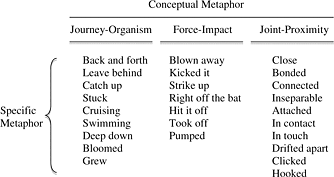
One of the authors and a research assistant, who were blind to the participants’ personality scores and separate from the interviewers, first located all of the friendship formation metaphors in the transcripts, achieving 94% agreement. Because metaphors are often used and interpreted automatically (Moser, 2000), disagreement was typically due to missing the nonliteral use of language. The few disagreements were therefore easily resolved through consensus. Next, all of the metaphors were read through in multiple passes to look for commonalities in how friendship formation was figuratively conceived through the language of embodied experience. Multiple specific metaphors (e.g. bonded and inseparable) could be instances of a common embodied source domain used to conceptualise friendship formation (e.g. the experience of physical closeness). We used Baxter's (1992) factor analysis to guide grouping the participants’ specific metaphors into more general conceptual metaphors, while also looking for other types of groupings that arose more inductively from the data set. The analysis yielded evidence of three commonly occurring conceptual metaphors, including two from Baxter (1992)—Journey–Organism and Force–Impact—as well as a third metaphor group that figured friendship in terms of Joint–Proximity (i.e. closeness). Both researchers independently coded all specific metaphors as an instance of one of these three conceptual metaphors, with the few remaining metaphors coded as ‘other’. Inter–rater agreement was acceptable (kappa = .89). Rare disagreements (∼5%) were discussed and resolved by consensus. The specific metaphors that friends used and their groupings into the three conceptual metaphors are shown in Table 1.
Friendship formation metaphors grouped by conceptual metaphor category
Journey–Organism
We followed Baxter's (1992) precedent to combine Journey and Organism metaphors because they both conceptualise friendship development as intentional movement over time towards an end point or goal. Use of Journey metaphors portrayed the relationship as having a beginning with gradual steps towards (e.g. cruising), away from (e.g. leave behind) or stops along (e.g. stuck) the path of a successful friendship. Similarly, Organism metaphors conceived relationship development as a progressive movement or growth, as in ‘our friendship goes deep down’ or ‘our friendship really blossomed.’
Force–Impact
Metaphors figuring friendship formation as an energetic collision, often of an explosive quality, were coded as Force–Impact. Although Baxter (1992) identified this group of metaphors to be a combination of Force and Danger motifs, there was little evidence of danger conveyed in friendship formation stories. Instead, Force appeared to be conceptually linked to Impact in order to convey the intense and exciting experience of first meeting the new friend, for example, ‘I went up to ask her for a light, for a cigarette. And we just started talking, and we totally hit it off.’
Joint–Proximity
Metaphors that figured friendship formation in terms of increasing physical closeness and connection were coded as Joint–Proximity (Quinn, 1987). Because Baxter (1992) did not find or catalogue such metaphors in romance stories, we did not expect to find a high percentage of friends using them. Nonetheless, many participants did use Joint–Proximity metaphors to conceptualise the development of their friendship in terms of distance, where closeness indicated more intimacy, for example, ‘We found that we had more similarities to each other, so we got closer as time went on.’ Friendship development was similarly conceptualised as being joined together, such as, ‘Now we are inseparable.’
Other metaphors
Two other conceptual metaphors were identified and coded as Other because of their low base rate. First, foundation and building were instances of Work metaphors that conceptualised friendship development as constructing a finished product (Baxter, 1992). Second, the Visibility metaphors of ‘we are up front with each other’ and ‘we are really open’ conceptualised a friend as someone who could been seen and known and did not stay hidden or keep secrets.
Automatic text analysis
The metaphor identification and coding process was a time–consuming endeavour that might be simplified by automatic text analysis, such as Linguistic Inquiry and Word Count (LIWC; Pennebaker, Booth, & Francis, 2007). Unfortunately, automatic text analysis struggles to use context correctly to identify metaphors (Graesser, McNamara, & Kulikowich, 2011). LIWC works by searching a document for any words or phrases that literally correspond to a predefined dictionary. LIWC does not come with a metaphor dictionary, so we created our own dictionary of metaphor words and phrases conceptually grouped according to the human coding (see Table 1). LIWC predictably captured all of what the coders found, as well as any metaphors that were prompted by the interviewer's use of the same metaphor. LIWC also identified all nonmetaphoric or literal instances of the language; ‘close’ was the most frequently identified word that was used literally instead of metaphorically. Using our custom dictionary, LIWC misidentified approximately 10% of words or phrases as metaphors compared with the human coding. For a large corpus of text, the speedy use of such software with the metaphors catalogued in this study might be worthwhile, even with some misidentification. It should, however, also be noted that the specific metaphors identified in this study do not exhaust the ways that people can figure their relationships, likely resulting in under–identification, as well. The relatively small size of the present sample permitted human coding. Therefore, we chose to privilege the more accurate human–coded data set (versus the LIWC–generated data) in the subsequent analyses.
Results
Background statistical analyses
Comparison of personality scores
According to an independent–samples t–test, introverts paired with an extravert were not significantly different in their introversion scores (M = 11.36, SD = 1.00) than introverts paired with another introvert (M = 11.25, SD = 1.08), t(56) = −.40, p = .691, d = .11. Similarly, extraverts paired with an introvert were not significantly different in their extraversion scores (M = 18.64, SD = 1.05) than extraverts paired with another extravert (M = 18.74, SD = 1.03), t(58) = .36, p = .719, d = .10.
Gender
The distribution of gender at the level of the dyad was analysed with a 2 (gender) × 3 (dyad personality) chi–square analysis. Although mixed dyads contained more women (68%) than did matched extraverted dyads (53%) and matched introverted dyads (39%), the gender differences did not reach significance, Likelihood Ratio (LR) χ2(2, N = 59) = 3.50, p = .174, Cramer's V = .24.
Friendship closeness
Ratings of friendship closeness across dyads averaged four on a five–point scale, indicating that most of the friends regarded themselves as very close. Two dyads in the matched introvert group and three dyads in the mixed group contained at least one friend who did not report closeness ratings. For the remaining 54 dyads, intraclass correlations were used with a p–value less than .20 to classify interdependence in the friends’ closeness ratings (Kenny, 1995). A p–value less than .20 conservatively protects against the potential bias when nonindependent data is used with tests that do not account for interdependence (Myers, 1979). Using this criterion, we found that closeness ratings were significantly correlated between friends in the matched extraverted dyads (r = .55, p < .001), the matched introverted dyads (r = .93, p < .001), and the mixed dyads (r = .32, p = .082). We therefore averaged the friend's ratings to create a single closeness rating for each dyad. No significant differences in dyad closeness were found among matched introverts (M = 3.89, SD = 0.92), matched extraverts (M = 3.83, SD = 0.94) and mixed dyads (M = 4.14, SD = 0.63), F(2,48) = .93, p = .402, η2 = .04. Using an independent–samples t–test, female dyads, however, were found to report significantly closer friendships (M = 4.45, SD = 0.62) than male dyads (M = 3.45, SD = 0.82), t(49) = 4.46, p < .001, d = 1.26.
Friendship story length
Stories about how the partners became friends averaged 150 words in length (SD = 99 words). Again, intraclass correlations with a p–value less than .20 were used as the cut–off to assess interdependence in the length of friends’ stories (Kenny, 1995; Myers, 1979). Story length was significantly correlated between friends in the matched extraverted dyads (r = .32, p = .183), the matched introverted dyads (r = .36, p = .148) and the mixed dyads (r = .44, p = .041). We therefore averaged the story length of friends to create a single story length for each dyad. According to an independent–samples t–test, there was no significant difference in word count between the stories of friendship reported by women (M = 151 words, SD = 86) and men (M = 147 words, SD = 73), t(57) = −.16, p = .877, d = .05. As well, no significant differences in word count were found among the stories of matched extraverts (M = 165, SD = 84), matched introverts (M = 161, SD = 123) and mixed dyads (M = 126, SD = 105), F(2, 56) = 1.48, p = .236, η2 = .05.
Overall metaphor use
Table 2 presents means and standard deviations of the conceptual metaphors used, and the frequency of friends who used these metaphors, parsed by personality and gender. We used a metric of metaphor use per 150 words (i.e. the sample's mean story length) to control for the wide individual variation in story length. Approximately 44% (f = 52/118) of the friends spontaneously used a metaphor to describe how they became friends. Friends averaged 0.75 metaphors (SD = 1.07) for every 150 words spoken in their story. The most commonly occurring conceptual metaphors were identified as Journey–Organism (f = 17 friends, M = 0.16, SD = 0.48), Force–Impact (f = 15 friends, M = 0.15, SD = 0.44) and, unexpectedly, Joint–Proximity (f = 26 friends, M = 0.35, SD = 0.75).
Descriptive statistics of metaphor use parsed by personality and gender
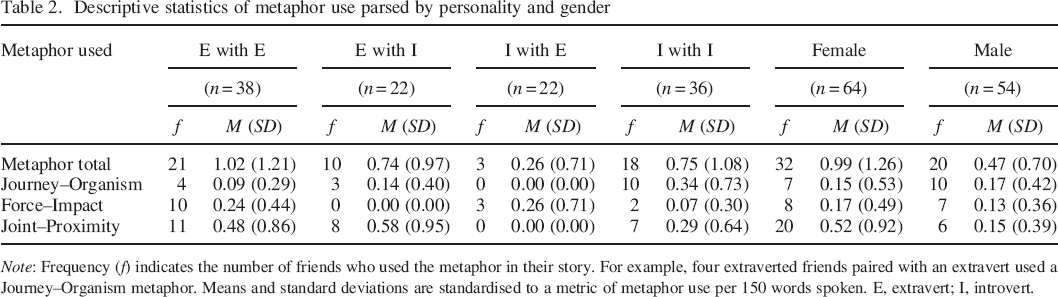
Note: Frequency (f) indicates the number of friends who used the metaphor in their story. For example, four extraverted friends paired with an extravert used a Journey–Organism metaphor. Means and standard deviations are standardised to a metric of metaphor use per 150 words spoken. E, extravert; I, introvert.
Mixed metaphors
Friends typically used only one of the three common metaphors, but a few friends combined two or three of the metaphors in their story: Joint–Proximity/Journey–Organism (f = 3 friends), Joint–Proximity/Force–Impact (f = 2 friends) or all three conceptual metaphors (f = 2 friends).
Metaphor agreement
Paired friends infrequently used the same conceptual metaphor in their stories: Journey–Organism (f = 3 matched introvert dyads), Force–Impact (f = 1 matched extravert dyad) and Joint–Proximity (f = 2 matched introvert and 1 matched extravert dyads). This low base rate of agreement may have happened in part because spontaneous metaphor use occurred in approximately half the sample, meaning that only one person in a dyad typically used a metaphor in their story. Furthermore, paired friends who used the same conceptual metaphor all came from the matched personality dyads, which foreshadows the personality analysis.
Personality and gender effects of metaphor use
Statistical analysis
We used SAS GLIMMIX (SAS Institute, Cary, NC, USA) with a Poisson distribution to analyse the friends’ metaphor counts nested together in a dyad (Spain, Jackson, & Edmonds, 2011). Dichotomizing extreme groups during analysis can mask important variation (Preacher, Rucker, MacCallum, & Nicewander, 2005); therefore, we used participants’ raw E–I scores. We structured the analysis according to the Actor–Partner Interdependence Model (Cook & Kenny, 2005). With this model, one's own personality (the actor) and the personality of one's friend (the partner) were used as predictors of metaphor use in the regression analysis. In addition, we included the actor's friendship closeness rating and the gender of the same–sex dyad as independent variables. Female participants were dummy coded 0 and male participants were dummy coded 1. All models achieved convergence. Given the base rate of metaphor use and overall sample size, the power to detect interactions was low and therefore interactions were not included in the model. Results of the SAS GLIMMIX analyses for actor/partner personality, gender and friendship closeness for all metaphors used can be found in Table 3 and are elaborated in the following sections. 2 After each set of quantitative findings, we present narrative examples to flesh out the meaning of the statistical findings.
SAS GLIMMIX coefficients and test statistics for metaphor use predicted from personality, gender, and friendship closeness
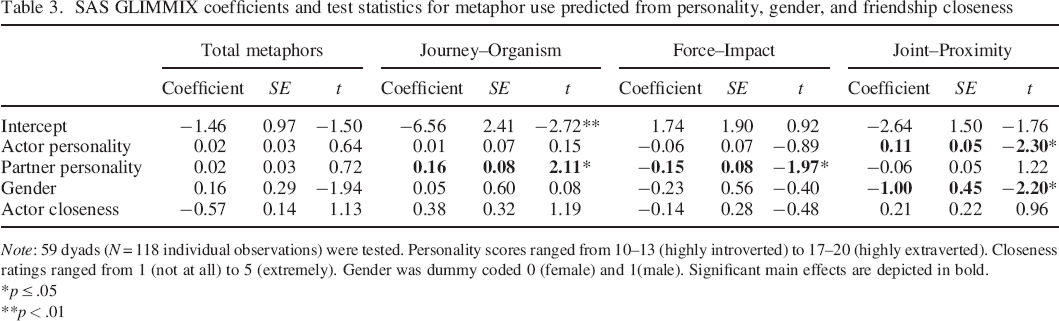
Note: 59 dyads (N = 118 individual observations) were tested. Personality scores ranged from 10–13 (highly introverted) to 17–20 (highly extraverted). Closeness ratings ranged from 1 (not at all) to 5 (extremely). Gender was dummy coded 0 (female) and 1(male). Significant main effects are depicted in bold.
p ≤ .05
p < .0.
Journey–Organism and Force–Impact
Because the conceptual metaphors of Journey–Organism and Force–Impact shared similar and related patterns of findings, we cover them in tandem. Figure 1 presents the percentages of friends who used the metaphors parsed by the personality of the friends. Partner personality significantly predicted the use of Journey–Organism metaphors (see Table 3). In support of Hypotheses 1 and 2, being paired with an introverted friend was associated with more friends (f = 13/58) using Journey–Organism metaphors in comparison to being paired with an extraverted friend (f = 4/60). Partner personality also significantly predicted the use of Force–Impact metaphors (see Table 3). Supporting Hypotheses 1 and 3, having an extraverted friend was associated with more friends (f = 13/60) using Force–Impact metaphors than having an introverted friend (f = 2/58). Actor personality and the gender of the dyad did not significantly predict the use of either metaphor. Therefore, being an extravert, an introvert, female or male was not connected to the use of Journey–Organism or Force–Impact metaphors. These findings indicate that the E–I of a person's friend plays a significant role in the person's experience of becoming friends.
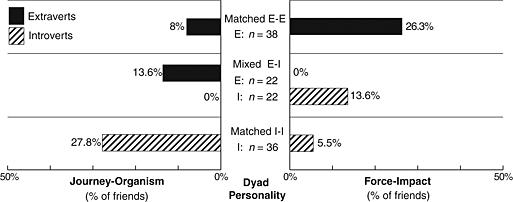
Percentage of friends who used Journey–Organism and Force–Impact metaphors parsed by dyad personality and individual personality. For example, 13.6% of extraverted friends in the mixed personality dyads (i.e. paired with an introverted friend) used Journey–Organism metaphors. E, extravert; I, introvert.
The influence of a partner's E–I on friendship formation was conveyed by the use of metaphor with respect to first impressions and the speed of becoming friends. In the following narrative, the extraverted friend Tom uses a Force–Impact metaphor to describe how he met another extravert, Erny:
I guess Theater was probably how we connected. The first time I saw him was… [laughs to himself] in our Intro to Acting class. I remember just being totally blown away by him because we were doing Shakespearean sonnets. And we had to get up and do them in front of the whole class. And when he did his, he was a private piano teacher, giving it to a student. And he—and all the girls were like, ‘[gasp] Oohh, Jim!’ And I was like, ‘WHOA! Whoa. This is—that's—I [quick sigh] won't be able to do that!’
Through the use of metaphor (blown away), Tom conveyed the explosive impression of his soon to be friend, Erny. The conceptual metaphor of Force–Impact characterised extraverts as the centre of a powerful, potentially uncontrollable, energy. Consistent with this characterisation of extraverted partners, Force–Impact metaphors were also used to convey the immense speed with which people became friends with an extravert. Both extraverted actors (‘When I got here we just, just hit it off and became friends, really quickly’) and introverted actors (‘We lived together so we spent a lot of time together; we just hit it off as friends’) reported befriending an extraverted partner in a sudden and immediate manner with the use of Force–Impact metaphors. The powerful social energy experienced by others in the vicinity of highly extraverted individuals appeared to promote this ‘friends–at–first–sight’ phenomenon.
Making friends with introverted partners, in contrast, was associated with the use of Journey–Organism metaphors; these metaphors conveyed a much slower process of friendship formation. In the next example, an extraverted friend, Scott, describes the many steps he took on his way to friendship with his introverted friend Ivan.
I started hanging out with Ivan a little bit more, talking to Ivan a little more, and hanging out with Ivan just a little bit more. And then Ivan and I started making films of our own—and uh, that's really what did it. And then we just ended up spending hours and hours and hours with each other. Just editing our films. Yeah! Yeah! We've decided to always like do almost everything together. Like we're not gonna leave either one of us behind.
The long(er) Journey on the way to friendship with an introverted partner such as Ivan may be the result of a number of differences in the approach to friendship by extraverts and introverts. In particular, the stories in our sample suggested introverted partners gave the impression of being reserved and careful during the friendship process, as exemplified in the following narrative of Bob meeting Iner, both introverts:
I didn't know anybody else in the class, but I recognised him [Iner], and so you know, kinda like started sitting next to each other and then, you know, I didn't know his name for the longest time. But you know it's kinda like we'd sit and start talking and stuff, and I don't know. And then it was like we started hanging out on, uh, instant messenger, and started talking to each other and stuff. I'd say like our friendship's really grown in the past, um, since like in the Fall, like after coming back from Summer break.
Bob reported being unable to discover his potential friend's name ‘for the longest time’. Although Bob might have acted on his own to jumpstart the friendship, what is noteworthy is that he apparently needed to ask for Iner's name at all. It is hard to imagine that Tom would have needed to inquire about his potential friend's name, Erny, the theatrical extravert. Although it may take longer, or at least be experienced as taking longer, to achieve friendship with an introverted partner, the Journey could also provide opportunities to develop skills and emotional commitment pertinent to the relationship's maintenance. After reporting the many steps towards friendship with his introverted partner, Scott claimed, ‘We're not gonna leave either one of us behind.’
Joint–Proximity
Figure 2 presents the percentage of friends who used a Joint–Proximity metaphor, parsed by personality and gender. In contrast to the previous metaphors, partner personality was not significantly associated with the use of Joint–Proximity metaphors (see Table 3). Unexpectedly though, the personality of the actor and the gender of the dyad were significantly associated with Joint–Proximity (see Table 3). Failing to support Hypothesis 1, more extraverted friends (f = 18/60), regardless of their partner's personality, used Proximity metaphors than introverted friends (f = 7/58). Similarly, more female friends (f = 20/64) than male friends (f = 6/54) used Proximity metaphors.
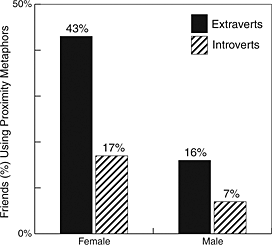
Percentage of friends who used a Joint–Proximity metaphor parsed by gender and actor personality. For example, 43% of extraverted female friends used a Joint–Proximity metaphor.
Extraverts and women typically used Joint–Proximity metaphors alongside reports of intimate activities such as disclosure. For example, Erin described ‘bonding’ with her friend Elaine (another extravert) and counseling each other. (Note that the first use of ‘bonded’ is literal, whereas the second use of ‘bonded’ is a figurative or conceptual metaphor.)
We met cuz we both applied to live at the same apartment. I felt like we just sort of bonded because our rooms were right next to each other and we were each looking for something different than the house had to offer, so we sort of bonded over that. And then, we did a lot of counseling with each other.
The following excerpt from an extravert in a mixed (E–I) dyad also referenced ‘bonding’ in terms of intimate talk, in this case, talking about ‘guy stuff’:
I was really good friends with Carol who lived in her building. So they knew each other from that but, um, we didn't really start talking or bonding until like the next quarter. I think it was like late one night I went to her room because I had just been at that house and, I think we bonded over like, I dunno, guy stuff.
However, the introverted partner attributed their friendship to being in the same locale: ‘We just met through a friend—Carol was her name. We both lived at the same college last year, so we're kinda neighbors too. That sorta deal.’ This dyad exemplified the finding that extraverts used Joint–Proximity metaphors more so than introverts.
Discussion
Previous narrative and metaphor research has focused on associations between actor personality and language use (Fast & Funder, 2008; Mehl et al., 2006; McConnell et al., 1993). Whereas Joint–Proximity metaphors (e.g. ‘we bonded’) confirmed this actor effect, the other two relationship metaphors showed partner effects. The latter findings suggest that partner personality serves as an environmental influence on how people make linguistic sense of their relationships. Because narratives often concern other persons in addition to oneself, partner personality effects might be woven into the fabric of storytelling more deeply than is typically operationalised. These findings highlight the need for a PERSOC approach that embeds narrative and linguistic studies of personality more deeply in social contexts (Back et al., 2011).
Each of the metaphors found in the present study appeared to conceptualise distinct phases of successful friendship development. Force–Impact described salient initial encounters (e.g. ‘We hit it off’), Journey–Organism emphasised the continued process of becoming friends (e.g. ‘We went back and forth’) and Joint–Proximity expressed the current nature of the friendship (e.g. ‘We are very close’ now; ‘We've bonded’). Consistent with the Social Relations Model (Malloy & Kenny, 1986), attending to the personality of both friends (actor and partner) helped to account for why relationship development stages were differentially prioritised across the friendship stories.
Specifically, the partner effects reflected the vital role of the personality of the friend in conceptualising how the friendship formed. The exuberant talkative force of an extraverted partner (Borkenau et al., 2009; Eaton & Funder, 2003; Levesque et al., 2002) rendered the initial encounter of the relationship salient (e.g. ‘we hit it off right away’). In contrast, the reflective style and verbal reticence of introverted partners (Eaton & Funder, 2003; Patterson et al., 1987; Thorne, 1987) was experienced as more difficult to track down and therefore made the progression of the relationship more salient (e.g. ‘the relationship bloomed over time’). The experience of becoming friends with an extravert felt like a sudden, high–impact event, and the experience of becoming friends with an introvert felt like a slow–going journey. Analogously, if friendship formation were like entering a swimming pool, entry with an extraverted partner would feel like jumping in, whereas entry with an introverted partner would feel like dipping one's toes into the water and slowly becoming immersed.
These partner effects suggest that two divergent theories of relationship development might be differentially applicable depending on the situation. Social penetration theory (Altman & Taylor, 1973) posits that relationships develop gradually as people carefully feel each other out to determine the fit of the friendship, a theory that is appropriate to capture what it felt like to befriend an introvert. On the other hand, predicted value outcome theory (Sunnafrank, 1986) posits that first impressions powerfully influence the course of relationships, a theory that is a better fit with the sudden impact of extraverts on friendship formation. While both theories stress the importance of interpersonal impressions in the development of relationships, this is the first study to show how personality impressions differentially map onto these theories. The differential relevance of these theories to friendships with an extraverted or introverted partner suggests that the theories should not be seen as competing but rather as alternative templates that emphasise different aspects of the relationship trajectory.
It is interesting to speculate about the consequences of experiencing a slowly versus quickly developing friendship. A gradual process of increasing commitment to intimacy might offer the opportunity to weed out potential friends who are not an especially good fit (Altman & Taylor, 1973). This careful slowness of social penetration may help to explain prior findings that introversion is associated with having slightly fewer friends (Selfhout et al., 2010). On the other hand, the exciting and engaging encounter with a smiling extraverted partner can be experienced as immediately valuable (Sunnafrank, 1986). In this regard, it is important to note that unlike romantic relationships (Baxter, 1992), references to high–force friendships did not frame such sudden developments as being difficult to control. Such metaphors perhaps contained no reports of danger because stories of how the friendship began do not tell the tale of later conflict. Although it is possible that friendships with extraverted partners might have a greater tendency to explode when things go wrong compared with friendships with introverted partners, danger in high–force relationships might be more relevant to sexual than platonic relationships.
Notably, however, metaphor use was not restricted to partner personality but was also associated with actor personality and with gender. Specifically, regardless of the personality of the partner, extraverts and women more often used Joint–Proximity metaphors (e.g. ‘we bonded’) to characterise the friendship as close and intimate. In the domain of friendship stories, these actor effects suggest that Joint–Proximity metaphors are best understood as cognitive schemas that derive from one's own personality and gender. Possibly, these particular actor effects may reflect the greater tendency of extraverts and women, compared with introverts and men, to engage in self–disclosure (Levesque et al., 2002; Parker & de Vries, 1993). Although our sample used same–gender dyads, we would also expect that in describing the development of cross–sex friendships, women and especially extraverted women, would be more likely than men to use Joint–Proximity metaphors.
That both actor and partner personalities significantly predicted the use of metaphors suggests that metaphors are influenced both by cognitive schemas (actor) and environmental (partner) impressions. This reciprocal influence between dispositions and social environments is at the core of a PERSOC approach, where individuals are understood to negotiate their similarities and differences in the construction of relationships (Back et al., 2011; Nelson et al., 2011). While the debate concerning the role of metaphor as fundamental versus ornamental in cognition remains active, the field of metaphor studies is also moving to integrate previously disparate theories of metaphor (e.g. Landau, Meier, & Keefer, 2010; Tendahl & Gibbs, 2008). The combined actor–partner findings in the present study encourage these more dialectical ‘this and that’ approaches to understanding how people diversely use metaphor to communicate and understand cherished experiences, including how they develop close relationships.
Three important limitations concerning the present methodology are worth noting. First, attending to spontaneous metaphor use in open–ended interviews strengthened face validity but also resulted in a relatively low base rate of metaphor use. About 25% of the participants spontaneously used Joint–Proximity, a little less than 15% used Journey–Organism and a little more than 10% used Force–Impact. Significant results with such a low base rate indicate a very strong pattern of findings, but the low base rate also warrants caution when generalising the results without large sample size replications. The low base rate also hindered the testing of statistical interactions. For example, a similarly extraverted partner might yield more Force–Impact metaphors than an extraverted partner paired with an introverted partner, and likewise for paired introverted friends and Journey–Organism metaphors. Second, as emphasised throughout the paper, retrospective accounts reflect the overall phenomenology or experience of becoming friends and are distal from the actual experience. Gathering concurrent reports of friendship quality as the relationship develops could reveal whether friendships with an extraverted partner developed more quickly, in the moment, than friendships with an introverted partner. Third, because metaphors are particularly challenging for second–language users (Charteris–Black, 2002), we limited the sample to native English speakers. Although humans have similar bodies, cultures distinctly instruct how the body is used literally (e.g. how we walk and hug) and metaphorically (e.g. holding the head up increases honour endorsements for Latinos but not for European Americans; Cohen & Leung, 2009). In addition, friendship practices are somewhat culture specific and may shape the metaphoric conceptualisation of relationship development. For example, self–disclosure tends to be valued in American society but reflects poor friendship intimacy in traditional Chinese societies (Schneider, Smith, Poisson, & Kwan, 1997). A potential implication is that Chinese extraverted friends may use Joint–Proximity metaphors less often than their American counterparts.
Overall, the present study contributes to moving the study of personality and language use beyond the more literal and unconditional approaches that have long occupied a revered place since Allport and Odbert (1936) discovered 18 000 personality descriptors in the Oxford English Dictionary. A focus on one specific aspect of language, metaphors, situates language use and personality in the mundane but richly informative experience of our bodies and our relationships, and suggests that personality both embodies a social environment and uniquely shapes relationship development.
Footnotes
Acknowledgements
Special thanks to Halley Farwood for helping to code the metaphors, Raymond W. Gibbs, Jr., and Lauren A. Shapiro for consulting on early drafts, the Narrative and Identity Research Group, and the helpful comments from reviewers.