







Abstract
There is now reliable evidence that heightened positive affectivity is associated with a distinctive pattern of attentional selectivity, favouring emotionally positive information. While this has invited speculation that differential attentional responding to positive information may directly contribute to the determination of this emotional temperament, the causal basis of their association as yet remains unknown. We addressed this issue by experimentally manipulating selective attentional response to positive information, using a cognitive bias modification variant of the attentional probe task, and examining the impact of this attentional manipulation on positive emotional reactivity to a subsequent success experience. The findings support the hypothesis that individual differences in selective attentional response to positive information can make a causal contribution to variation in positive affectivity. Copyright © 2012 John Wiley & Sons, Ltd.
It is now widely accepted that two personality dimensions, negative affectivity and positive affectivity, represent distinct aspects of emotional temperament (Watson, Wiese, Vaidya, & Tellegen, 1999). Negative affectivity reflects the disposition to experience negative emotion, while positive affectivity instead reflects the disposition to experience positive emotion (Watson & Naragon–Gainey, 2009; Watson & Tellegen, 1985). Factor analysis has shown that these two facets of emotional disposition are orthogonal dimensions of personality (Watson & Tellegen, 1999; Watson, Clark, & Tellegen, 1988), consistent with biological evidence indicating that they are associated with differing neurological substrates (Davidson, Jackson, & Kalin, 2000; Shankman & Klein, 2003).
Considerable research effort has sought to determine the attentional basis of individual differences in these two dimensions of emotional disposition. The early focus of this work was squarely placed on revealing the attentional underpinnings of variation in negative affectivity, but more recently, this focus has been broadened, reflecting developing interest in also determining the attentional substrate of variation in positive affectivity. Both lines of research have been motivated by the hypothesis that heightened attentional bias towards a particular emotional valence of information causally contributes to an elevated disposition to experience a corresponding emotional state (Wadlinger & Isaacowitz, 2010). Thus, according to this theoretical position, it should not only be the case that heightened attentional bias towards emotionally negative information, relative to neutral information, causally contributes to elevated negative affectivity (Beck, Emery, & Greenberg, 1985; Williams, Watts, MacLeod, & Mathews, 1997; Williams, Watts, MacLeod, & Mathews, 1988) but also that heightened attentional bias towards emotionally positive information, relative to neutral information, causally contributes to elevated positive affectivity (Tamir & Robinson, 2007). While the former position, concerning the contribution of attentional selectivity to individual differences in negative affectivity, has received strong empirical support, the latter position, concerning the contribution of attentional selectivity to individual differences in positive affectivity, has not yet been adequately tested. This was the purpose of the present study.
There is robust evidence that an attentional bias operating to favour the processing of negative information is a reliable characteristic of elevated negative affectivity (cf. Cisler, Bacon, & Williams, 2009; Mathews & MacLeod, 2005; Bar–Haim, Lamy, Pergamin, Bakermans–Kranenburg, & van Ijzendoorn, 2007). Elevated negative affectivity can be inferred from heightened levels of anxiety vulnerability (Lee, Watson, & Mineka, 1994). The two most common experimental paradigms employed to determine the pattern of attentional selectivity that characterises elevated negative affectivity have been the emotional Stroop task (Cisler & Koster, 2010; Williams, Mathews, & MacLeod, 1996) and the attentional probe task (MacLeod, Mathews, & Tata, 1986; MacLeod, Soong, Rutherford, & Campbell, 2004). In the emotional Stroop task, participants are presented with emotionally toned words, displayed in different colours, and are required to rapidly name the colour of words while not attending to their semantic content. The repeated finding that participants high in negative affectivity reliably display disproportionate slowing to colour name emotionally negative, relative to neutral words, provides evidence that such individuals have particular difficulty inhibiting attention to negative semantic content (Rutherford, MacLeod, & Campbell, 2004; Amir, Freshman, & Foa, 2002). In the attentional probe task, participants are briefly exposed to word pairs that each contain an emotionally negative and an emotionally neutral item. They then must quickly discriminate the identity of a small visual probe, which subsequently appears in the locus where either of these words was just displayed. The consistent finding that participants high in negative affectivity are disproportionately speeded to discriminate probes presented in the locus of the emotionally negative words indicates that they preferentially assign attention towards negative information (e.g. Frewen, Dozois, Joanisse, & Neufeld, 2008; MacLeod et al., 1986; Mathews, Ridgeway & Williamson, 1996).
While these studies confirm that there is an association between elevated negative affectivity and an attentional bias towards negative information (Bar–Haim et al., 2007), the demonstration of this association cannot suffice to verify the hypothesis that this negative attentional bias causally contributes to negative affectivity. To test this causal hypothesis, it is necessary to determine whether directly modifying attentional response to negative information serves to alter negative affectivity. MacLeod, Rutherford, Campbell, Ebsworthy, and Holker (2002) introduced a methodology for inducing transient change in attentional response to negative stimuli to reveal whether this temporarily alters negative emotional reactivity to an unpleasant event. They developed a training variant of the attentional probe task, in which a systematic contingency between the position of the negative words and the position of probes was designed to modify attentional response to such stimuli. For some participants, this training contingency was that probes always appeared in the same locus as the negative words, to induce an attentional bias towards negative information (‘attend negative’ training). For other participants, the training contingency was that probes always appeared in the opposite locus to the negative words, to induce at attentional bias away from negative information (‘avoid negative’ training). The observed change in the pattern of probe discrimination latencies confirmed that these alternative training conditions differentially altered attentional response to the negative information, as required. Specifically, exposure to the ‘avoid negative’ training condition served to reduce attentional bias towards the negative stimuli, whereas exposure to the ‘attend negative’ training condition produced the opposite change in attentional selectivity, tending instead to increase attentional bias towards the negative stimuli.
Having succeeded in differentially altering attentional response to negative information using this training procedure, MacLeod et al. examined the degree to which participants then displayed negative emotional reactions to an aversive event. For this purpose, they exposed participants to an anagram task, contrived in a manner that ensured they would perform poorly, and assessed the emotional impact of this failure experience by recording negative mood state immediately before and after the anagram task using an analogue scale. Consistent with the causal hypothesis, participants initially exposed to the ‘attend negative’ training condition came to show disproportionately large elevations of negative mood state in response to this later failure experience, compared with participants initially exposed to the ‘avoid negative’ training condition. Subsequent research has replicated the finding that manipulation of negative attention bias using this attentional probe training approach impacts on negative affectivity, as revealed by the intensity of the elevation in negative mood state induced by a laboratory stressor (cf. Hakamata et al., 2010). This represents clear evidence that variability in attentional bias towards negative information does make a causal contribution to variability in negative affectivity.
As yet, however, it remains unknown whether biased attentional responding to positive information causally contributes to positive affectivity. It is perhaps surprising that this issue has not yet been empirically addressed, given the burgeoning interest in the psychological mechanisms underpinning positive affectivity that has accompanied the rise of positive psychology in recent years (cf. Linley, Joseph, Harrington, & Wood, 2006; Seligman & Csikzentmihalyi, 2000). Determining the cognitive basis of positive affectivity is of more than purely theoretical interest, as there is evidence that elevated positive affectivity is associated with many beneficial outcomes, including improved mental and physical health and better social functioning (cf. Lyubomirsky, King, & Diener, 2005). In keeping with the methodological approaches used to investigate the attentional characteristics of negative affectivity, Tamir and Robinson (2007) employed an attentional probe task in which the members of word pairs were emotionally positive (rather than negative) and neutral, to examine the attentional concomitants of variation in positive affectivity. Consistent with the hypothesis that positive affectivity is characterised by a positive attentional bias, the results showed that elevations in reported experience of daily positive affect were associated with heightened attentional preference for positive information. Using the Emotional Stroop paradigm, the studies of Mauer and Borkenau (2007) and Segerstrom (2001) provided converging support for this conclusion. Across these two studies, attentional preference for positive information was found to be associated with increased approach temperament, a personality factor on which positive affectivity loads heavily, and with heightened optimism, respectively. Thus, there does appear to be a reliable association between positive attentional bias and elevated positive affectivity.
However, while these studies demonstrate the existence of this association, they do not permit conclusions concerning the causal contribution of such attentional selectivity to variation in positive affective disposition. Addressing this issue would require a methodological framework paralleling that employed to investigate the functional contribution of negative attentional bias to negative affectivity (Eldar, Ricon, & Bar–Haim, 2008; MacLeod et al., 2002). This was the approach we adopted in the present study. Participants reporting mid range positive affectivity performed an attentional training task, designed to differentially modify attentional response to positive emotional information. The efficacy of this training procedure was determined by examining probe discrimination latencies obtained from attentional assessment trials presented before and after the attentional training, in which the training contingencies were eliminated. In keeping with previous research, evidence that the training procedure was effective in differentially modifying positive attentional bias will be revealed by an interaction between training condition and attentional assessment point. Specifically, participants trained to avoid positive information should display a relative reduction in attentional preference for positive information, while participants trained to attend to positive information should display the reverse pattern of change, reflecting a relative increase in attentional preference for positive information. Following this attentional training procedure, participants were exposed to an anagram success task, designed to elicit positive emotional reactivity. In this task, participants were provided with false feedback indicating that they performed particularly well. Assuming that the attentional training task is capable of modifying attentional response to positive information, the mood data obtained from the success task can be examined to determine the validity of the hypothesis that positive attentional bias causally contributes to variation in positive affectivity. If this hypothesis is correct, then following exposure to the attentional training procedure, but not before, participants trained to attend towards positive information will display significantly greater positive affective responses to the success task than will participants trained to avoid positive information.
Method
Participants
Thirty–six introductory psychology students at The University of Western Australia accepted an invitation to participate in the study. We sought participants who were mid range with respect to dispositional positive affectivity. Thus, recruitment was guided by a mass screening of approximately 800 introductory psychology students on the trait version of the Positive Affectivity Schedule (PAS; Watson et al., 1988). Only students who scored within the middle 50% of the trait PAS scores (i.e. 30–36) were invited to participate in the study.
Participants were randomly allocated to one of the two groups, with the constraint that an equivalent gender ratio (10 female and 8 male) was maintained across both groups. One group of participants was exposed to the training contingency designed to induce a relative increase in attention to positive information, and was designated the ‘attend positive’ group. The remaining participants were instead exposed to the training contingency designed to induce a relative decrease in attention to positive information, and were designated the ‘avoid positive’ group. This gave rise to a between–group factor of Training Condition (attend positive training vs avoid positive training). Participant characteristics are shown in Table 1. The two groups did not differ in terms of trait PAS scores, t (34) = 1.57, ns, or age, t (34) = .27, ns.
Characteristics of participants
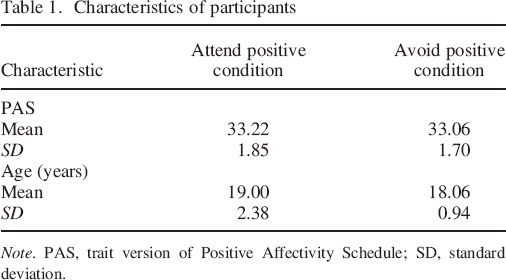
Note. PAS, trait version of Positive Affectivity Schedule; SD, standard deviation.
Materials
Experimental stimuli
Emotional word pairs
We required word pairs in which one member of each pair had a positive emotional valence, while the other member instead had a neutral valence. A final set of 96 word pairs was selected from a larger initial pool of 200 candidate word pairs, on the basis of emotional valence ratings provided by six clinical psychologist judges. Each of these candidate 200 word pairs comprised members that were thought to differ in emotional valence but that were matched in terms of both word length (in terms of letters) and word frequency (according to Kucera & Francis, 1967). All 400 candidate words were presented in random order to the judges, who were asked to rate the emotional valence of each word by using a 7–point scale, ranging from −3 (extremely negative) to +3 (extremely positive). In the final set of 96 word pairs selected for use in the study, the mean emotional rating of the positive word member was 1.98 (SD = 0.60), and the mean emotional rating of the neutral word member was 0.07 (SD = 0.20). A t–test confirmed that across this final set of word pairs, the valence of the two word pair members significantly differed in terms of emotionality, t (95) = 29.96, p < .001, as required. This set of 96 word pairs was then divided into two word pair subsets, each containing 48 word pairs. The two subsets of word pairs did not differ significantly in terms of their emotional characteristics, word lengths or frequencies. The full set of experimental word pairs is provided in the Appendix.
Anagram task letter strings
The anagram success task was delivered twice, once prior to and once following completion of the attentional training task. A set of 120 letter strings was generated for use in this anagram success task. Each letter string was a soluble anagram, in that the letters could be rearranged to form a legitimate English word. To ensure that participants were able to solve these anagrams with a high degree of ease, the letter strings were only three or four letters in length, and their solutions all were common words. This set of 120 letter strings was divided into two subsets, each containing 60 letter strings. Each subset comprised 35 three–letter stings and 25 four–letter strings.
Emotional assessment instruments
Positive Affectivity Schedule
The PAS of the Positive and Negative Affect Schedule (Watson et al., 1988) is a 10–item mood scale, designed to assess positive affectivity. The study employed the trait version of the scale, in which participants are instructed to rate ‘to what extent you generally feel this way; that is, how you feel on average’. This instrument has been found to have both good reliability and validity (Crawford & Henry, 2004).
Visual analogue positive mood scale
To measure positive mood state before and after completion of the anagram success task, an analogue mood scale assessing happiness was programmed for computer delivery. This scale consisted of a 15–cm horizontal line, divided into 60 equal partitions, with the terminal labels happy and sad. Using the mouse, participants moved a cursor along the line to a point that corresponded with their current level of happiness, and pressed the left mouse button to register their response. This resulted in a score between 1 and 60, with a higher score indicating a greater level of happiness. Using the mood score data obtained from these scales, we were able to compute an index of positive affectivity, which expressed the degree to which exposure to the success experience served to elevate positive mood, using the following equation:
Index of Positive Affectivity=post–anagram positive mood score−pre–anagram positive mood score.
Experimental hardware
A Hewlett–Packard Compaq dc7800 with a 22–inch colour monitor (Hewlett–Packard Company, Palo Alto, CA, USA) and a standard two button mouse was used to present both the attentional probe task and the anagram success task.
Experimental tasks
Attentional probe task
The attentional probe task used to assess and manipulate attentional responding to positive information was closely based on the task previously employed by MacLeod et al. (2002) to manipulate attentional responding to negative information. Each trial commenced with the presentation of the signal ‘Next Trial’ in the centre of the screen for 500 ms, which served as a fixation cue. The screen was then cleared, and a word pair was presented for 500 ms, with one member appearing just above and the other member appearing just below the fixation cue. The position of the positive word was random, such that it appeared with equal frequency in the upper or lower screen location. Immediately upon termination of the word pair display, a small probe stimulus appeared in the position previously occupied by one of the word pair members. With equal probability, this probe stimulus was either a single red dot or a pair of adjacent red dots. Participants were required to indicate the identity of the probe as quickly as possible, using the left or right mouse button to indicate that the probe was either a single dot or a double dot, respectively. The probe remained on the screen until the participant's response was detected, and probe discrimination latency was recorded. The screen was then cleared, and the next trial commenced after a 500 ms inter–trial interval. In total, 864 trials were presented across the attentional probe task. The first 96 and final 96 were attentional assessment trials, whereas the intervening 672 were attentional training trials, and the distinction between these blocks of trials was as follows:
Attentional training trials
In the attentional training trials, the screen position in which the probes appeared depended upon training group assignment. For participants in the attend positive group, every probe appeared in the locus of the previously presented positive word, while for participants in the avoid positive group, every probe appeared in the locus of the previously presented neutral word. For each participant, only one of the two word pair subsets was employed in the attentional training trials, though across participants, each word pair subset was used an equal number of times in the attentional training trials. During the attentional training trials, each of these 48 word pairs was exposed a total of 12 times. Presentation order was random, with the constraint that each of these 48 word pairs was exposed once before any were presented for a second time and was only exposed for a third time, after all had been presented twice, and so forth. We adopted procedure by Koster, Baert, Bockstaele, and De Raedt (2010) to encourage affective processing of the stimulus words. 1 Specifically, for this purpose, we included 96 trials in which no probe appeared, but instead participants were told to judge the emotional tone of the stimuli in a word pair. These trials always contained either two positive words or two neutral words, and were distributed evenly across the attentional training block.
Attentional assessment trials
In the attentional assessment trials, probes appeared in locus of a previously presented positive word and in the locus of a previously presented neutral word, with equal frequency, for all participants. To ensure that the attentional assessment trials only used words not previously encountered in the attentional training trials, the post–training attentional assessment always used the word subset not employed in the attentional training trials. The pre–training attentional assessment used the other word pair subset, as subsequently employed in attentional training. Across each block of attentional assessment trials, each of the 48 word pairs was presented twice, in random order, with the constraint that each of these 48 word pairs was exposed once before any was presented for a second time. For each word pair, the probe appeared once in the screen locus previously occupied by the positive word, and once in the screen locus previously occupied by the neutral word. 2 Using the probe discrimination latency data obtained from these attentional assessment trials, we calculated an index reflecting attentional bias for positive information. This index expressed the speeding for probes in the locus of positive words relative to probes in the locus of neutral words and was computed using the following equation:
Attentional Bias to Positive Information Index = RT for probes opposite positive word locus–RT for probes in positive word locus.
Anagram success task
We modified the anagram stress task developed by MacLeod et al. (2002), originally designed to provide a failure experience to elevate negative mood state, to instead create an anagram task that ensured a success experience to elevate positive mood state. Participants were informed that the task was part of ongoing research investigating the association between academic achievement and performance on cognitive tasks, and that it was designed to measure individual differences in the capacity to solve anagrams. They were advised that individual anagrams would appear in the centre of the computer screen, and were told that they had 3 min to complete as many as possible. On presentation of each anagram, the participant responded by first pressing the spacebar, enabling them to input the correct answer. The participant then pressed the enter key to register their response and proceed to the next anagram. If the participant was unable to solve an anagram, they were instructed to press the mouse button to skip to the next anagram.
To render the task capable of elevating positive mood state, not only were the anagrams easy to solve but also false feedback was provided online to the participant, indicating that they were performing much better than average. To achieve this, a graph was presented in the bottom, left–hand corner of the screen during the task. Participants were informed that the red bar on this graph corresponded to their own performance at that point in time, while the yellow bar on the graph corresponded to the average performance at that point in time of the other participants who had previously completed the task. A percentile rank, indicating the participant's supposed rank among these previous participants, was also displayed on the graph. Performance feedback was such that each participant began the task with both bars at zero and with a percentile rank reading ‘Average’. As the participant progressed, their performance bar elevated each time they made a correct response. The programme ensured that the bar supposedly displaying the average performance of previous participants did not keep up with the bar showing the participant's own performance. As the discrepancy between both bars widened, the percentile label changed accordingly, indicating a progressively higher percentile rank for the participant. All participants finished with a percentile rank that read ‘Upper 10%’. The anagram success task was administered both before and after the attentional training task, with mood state being assessed on the analogue scale immediately before and immediately after each delivery of the anagram task. A different anagram letter string subset was used on each occasion the success task was delivered, with these letter strings being presented in random order.
Procedure
Each participant was tested individually. The test session commenced with the participant being seated approximately 60 cm from the computer screen and provided with instructions concerning completion of analogue mood scale and the anagram task. The participant then completed the analogue mood scale, followed by the anagram success task, and then the second administration of the analogue mood scale. Next, the participant was briefed about the requirements of the attentional probe task. They were instructed to discriminate probe identity as quickly as possible, while minimising errors, and no mention was made of any contingency that predicted the position of the probes. Following completion of the attentional probe task, the session continued with delivery of the analogue mood scale, the anagram success task, and the repeated administration of the analogue mood scale. At the end of the session, the participant was debriefed about the purpose of the study and thanked for taking part.
Results
Two issues were sequentially addressed in the analysis of the data. First, attentional probe discrimination latencies were analysed to determine whether the attentional training procedure was effective in differentially modifying attentional responding to positive information, as intended. Second, analogue mood scale data were analysed to establish whether the differential modification of positive attentional bias resulted in differential positive affectivity following the attentional training procedure, as revealed by the intensity of positive emotional reaction to the post–training anagram success experience. Analyses pertinent to each of these two issues will be reported in turn.
Impact of attentional training on attentional response to positive information
One participant reported being unable to complete the task proficiently because of ill health, while two further participants were found to be outliers in terms of their low probe discrimination accuracy, which fell more than two standard deviations below the mean. These three participants were removed from further analysis. The remaining participants displayed reassuringly high levels of accuracy, averaging less than 7% errors across attentional assessment trials. Accuracy rates did not differ for participants in the two attentional training conditions (F < 1).
To determine the efficacy of the attentional training procedure, we examined the probe discrimination latencies from the two attentional assessment blocks. Consistent with previous research using the attentional probe task, latencies less than 200 ms and greater than 2000 ms first were eliminated, as were those that fell further than 1.96 SD from the participant's mean probe discrimination latency, obtained under each of the eight unique experimental conditions that arose from the nested combination of the three two–level experimental factors (Koster, Crombez, Verschuere, & De Houwer, 2004). This led to the exclusion of 6.7% of the latencies. The mean probe discrimination latencies observed in each condition next were calculated, and are shown in Table 2.
Mean and standard deviation of probe discrimination latencies, in ms, under each experimental condition
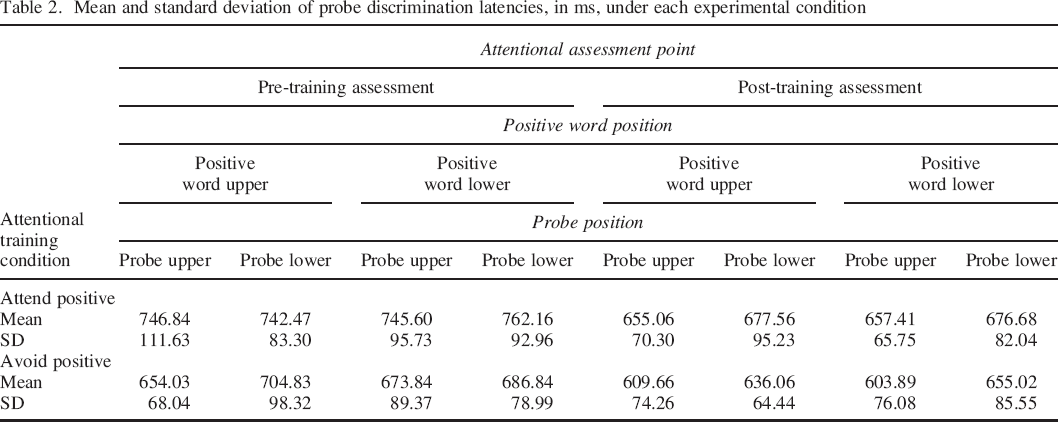
These data were subjected to a mixed–design 2 × 2 × 2 × 2 ANOVA that considered the between–group factor Training Condition (attend positive vs avoid positive) and the within–group factors Attentional Assessment Point (pre–training assessment vs post–training assessment), Positive Word Position (positive word upper vs positive word lower) and Probe Position (probe upper vs probe lower). The analysis revealed a significant main effect of Training Condition, F (1, 31) = 5.31, p < .05, η2 = 0.15, reflecting the fact that participants in the avoid positive training condition displayed faster probe discrimination latencies (M = 653.02, SD = 84.82) than did participants in the attend positive condition (M = 707.97, SD = 95.70). Also emerging from the analysis was a significant main effect of Attentional Assessment Point, F (1, 31) = 31.92, p < .001, η2 = 0.51, reflecting generally shorter probe discrimination latencies in the post–training, relative to pre–training, attentional assessment (M = 645.80, SD = 79.62 vs M = 713.53, SD = 95.72), and a significant main effect of Probe Position, F (1, 31) = 10.17, p < .01, η2 = 0.25, reflecting faster discrimination latencies to probes appearing in the upper screen location (M = 667.29, SD = 94.82) rather than the lower screen location (M = 692.04, SD = 92.26). Of more importance, these main effects all were subsumed within the predicted four–way interaction of Training Condition × Attentional Assessment Point × Positive Word Position × Probe Position, F (1, 31) = 6.26, p < .05, η2 = 0.17, which was the only other significant effect to emerge from the analysis.
To communicate the nature of this effect, we computed attentional bias to positive information index scores, expressing the degree to which probes presented in the locus of positive words were discriminated more rapidly than probes presented in the locus of neutral words (by subtracting the mean discrimination latency for the former probes from the latter). A higher score on this index reflects a greater attentional bias towards positive, relative to neutral, stimuli. Examination of the attentional bias index scores revealed that participants in the avoid positive training condition came to display reduced scores on the index of attentional bias to positive information at the post–training assessment (M = −24.73, SD = 60.49), relative to the pre–training assessment (M = 37.79, SD = 64.37), and this change was statistically significant, F (1, 16) = 4.83, p < .05, η2 = 0.23. In contrast, participants in the attend positive training condition tended to show the opposite pattern of change in their attentional bias index scores, coming to display higher scores on the index of attentional bias towards positive information at the post–training assessment (M = 3.23, SD = 49.43), relative to the pre–training assessment (M = −20.93, SD = 78.51), though this change fell short of statistical significance, F (1, 15) = 1.62, ns, η2 = 0.10. We conducted post–hoc analyses to determine whether there was a between–group effect of Training Condition on the index of attentional bias to positive information, at the pre–training and post–training assessments. This post–hoc analysis revealed an unexpected significant simple main effect of Training Condition at the pre–training assessment, F (1, 31) = 5.55, p < .05, η2 = 0.15, reflecting higher initial positive attentional bias index scores in the participants assigned to the avoid positive training condition. Given the random allocation of participants to training condition, and the fact that this group difference was observed before training had commenced, the effect must represent a Type I error. Following exposure to attentional training, participants in the attend positive training condition increased their positive attentional bias index scores, while those exposed to the avoid positive training condition decreased their positive attentional bias index scores, such that at post training, the former participants (M = 3.23, SD = 49.43) had nominally higher attentional bias index scores than did the latter (M = −24.73, SD = 60.49). This simple main effect of Training Condition did not reach statistical significance at the post–training assessment F (1, 31) = 2.10, ns, η2 = 0.04. Nevertheless, the interaction confirms that the two attentional training conditions exerted a differential impact on attentional response to positive information, and despite the unexpected group difference in attentional bias prior to the delivery of attentional training, the direction of the observed attentional training effects was consistent with our expectations.
Impact of attentional training on positive affectivity
The positive mood scores obtained from the analogue mood scale for each of the participant groups are shown in Table 3. These data were subjected to a mixed–design ANOVA that considered the between–group factor Training Condition (attend positive training vs avoid positive training) and the within–group factors Anagram Test Phase (pre–training anagram success vs post–training anagram success), and Mood Assessment Point (pre–anagram assessment vs post–anagram assessment). This analysis revealed a significant main effect of Mood Assessment Point, F (1, 31) = 13.13, p < .01, η2 = 0.30, reflecting the fact that the level of positive mood indicated by analogue mood scale–rating scores at the post–anagram success assessment was significantly higher than the level of positive mood indicated by the analogue mood scale scores at the pre–anagram success assessment (M = 42.56, SD = 10.44 vs M = 39.76, SD = 10.14). This confirms that the anagram success experience did serve to elevate positive mood state, as intended. Of greater theoretical importance, this main effect was subsumed within a higher–order interaction of Training Condition × Anagram Test Phase × Mood Assessment Point, F (1, 31) = 4.90, p < .05, η2 = 0.14, which was the only other significant effect to emerge from the analysis.
Mean and standard deviation of analogue mood scores obtained from anagram success task delivered pre–attentional and post–attentional training
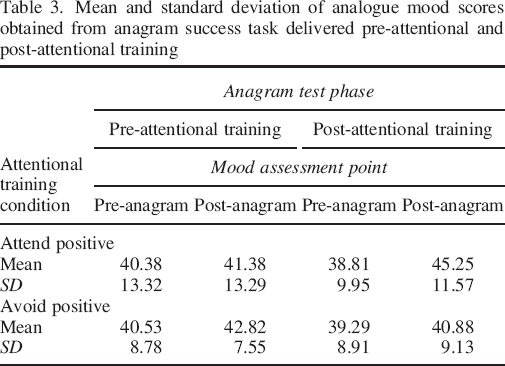
This three–way interaction, which is displayed in Figure 1, resulted from the emergence of a simple two–way interaction of Training Condition × Mood Assessment Point post–training, F (1, 31) = 8.03, p < .01, η2 = 0.21, which did not approach significance pre–attentional training, F (1, 31) = 0.29, ns. As can be seen from panel (b) of Figure 1, following attentional training, but before the subsequent anagram success experience, participants who had completed the alternative attentional training conditions did not differ in their levels of positive mood, F (1, 31) = 0.02, ns. However, in response to the anagram success experience, those participants who had undergone the attend positive attentional training displayed a significantly greater elevation of positive mood state than did the participants who had experienced the avoid positive attentional training condition. For the former participants, the anagram success experience significantly elevated positive mood state, F (1, 15) = 21.72, p < .001, η2 = 0.59, while this was not the case for the latter participants, F (1, 16) = 2.37, ns, η2 = 0.13. Thus, those participants who had been exposed to the training contingency designed to increase attentional bias to positive information subsequently came to display disproportionately pronounced elevations of positive mood state in response to the anagram success experience, relative to participants who had been exposed to the training condition designed to decrease attentional bias to positive information.
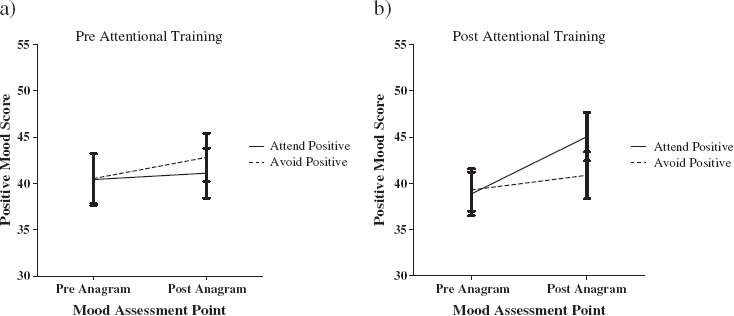
Impact of anagram success task on positive mood, before and after attentional training.
We computed an index of positive affectivity, as foreshadowed in the Method section, by subtracting positive mood scores immediately prior to delivery of the anagram task (pre–anagram), from those obtained immediately after delivery of the anagram task (post–anagram), and the resulting positive affectivity scores are shown in Figure 2. Higher scores on this positive affectivity index reflect the heightened tendency to respond to the success experience with greater elevation of positive mood state. The hypothesis that attentional bias to positive information causally contributes to positive affectivity predicts a significant simple main effect of Training Condition on this positive affectivity index after, but not before, exposure to the attentional training manipulation. The pattern of results displayed in Figure 2 is fully consistent with this expectation. While the simple main effect of Training Condition on positive affectivity index score did not approach significance pre–attentional training F (1, 31) = 0.29, ns, this same simple main effect was statistically significant post–attentional training, F (1, 31) = 8.03, p < .01, η2 = 0.21.
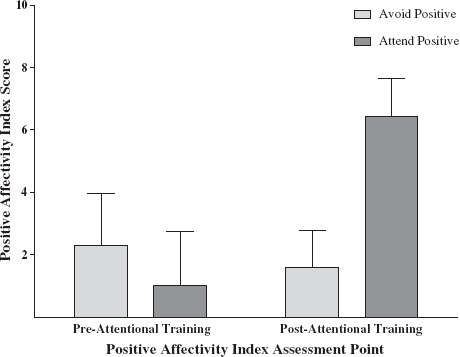
Mean and standard error of positive affectivity index scores obtained from anagram success task delivered pre–attentional and post–attentional training.
Discussion
The reported study demonstrates that an attentional training manipulation, which differentially modified attentional response to positive information, differentially modified the degree to which a subsequent pleasant experience then elevated positive mood state. This finding suggests that variability in selective attentional response to positive information can make a causal contribution to variability in positive affectivity. Thus, it supports the hypothesis that individual differences in attentional bias towards positive information can causally contribute to positive affectivity.
We recognise that the degree to which people experience feelings of subjective well–being will also be influenced by situational variables. In the present study, positive mood state was elevated by exposure to a success experience, and there is much evidence that heightened subjective well–being is related to demographic factors that plausibly are associated with increased access to success experiences (Diener & Lucas, 1999). However, investigators such as Diener, Suh, Lucas, and Smith (1999) have noted that situational factors of this type account for only a modest proportion of the variance in subjective well–being, which also depend crucially on individual differences in temperament. This observation has led them to call for increased research into the cognitive factors that underpin positive affective disposition. The current work responds to this call, and provides evidence that the preferential allocation of attention to positive information may represent one of the cognitive mechanisms that causally underpins the disposition to experience positive affect. This is consistent with the claims of emotional regulation theorists who posit that people shape their emotional experience through selective attentional deployment (John & Gross, 2004). In particular, our findings support the recent proposal of Wadlinger and Isaacowitz (2010) that an attentional bias favouring positive information plays a crucial role in determining the likely intensity of positive affect experienced in response to emotional situations, with an attentional bias to positive information leading to stronger positive affective responses to such situations.
In addition to advancing theoretical understanding of positive affectivity, by lending empirical weight to the hypothesis that attentional selectivity causally contributes to this disposition, our findings also suggest possible applied benefits of a cognitive bias modification approach, capable of inducing increased attention to positive information. Our study revealed that such attentional change influenced the degree to which positive mood was elevated by a positive experience within the laboratory setting. However, we recognise that individual differences in affective response to one particular success experience, within a contrived laboratory context, may not provide an optimal index of positive affectivity as a personality dimension. Thus, we suggest that future researchers should seek to determine whether inducing an attentional preference for positive information more generally increases the intensity of positive mood states evoked by a wider array of naturalistic situations, as will be the case if such attentional selectivity contributes to trait positive affectivity.
Our own attentional training study sought only to transiently modify attentional response to positive information. It remains to be seen whether extended delivery of this training procedure across multiple sessions can bring about an enduring increase in selective attention to positive information and, if so, whether this serves to elevate scores on conventional positive affectivity questionnaires assessing real–world emotional experience, such as the Positive and Negative Affect Schedule positive affectivity subscale (Watson et al., 1988). There are good grounds for optimism that this may prove possible, given the findings of recent studies in which extended versions of this training task, designed to modify selective attentional response to negative information, have been employed. Such extended delivery has been shown to exert a lasting influence on attentional response to negative information, and to influence real–world negative affect, months beyond the cessation of training (See, MacLeod, & Bridle, 2009; Amir, Beard, Burns, & Bomyea, 2009; Schmidt, Richey, Buckner, & Timpano, 2009). For example, when clinically anxious participants were exposed over 3 weeks to six sessions of this training, designed to reduce attentional bias to negative information, Amir et al. (2009) and Schmidt et al. (2009) observed a resulting reduction in their anxiety symptoms that remained evident at follow–up three months later.
We suggest that future researchers should now seek to establish whether a similarly extended programme of attentional training, designed instead to increase attentional bias towards positive information, can serve to induce a stable elevation in positive affectivity. Not only would such a finding further support the hypothesis that biased attentional response to positive information causally contributes to this personality dimension, but also it could also have important real–world applications. The benefits of elevated positive affectivity are well documented, and there is clear evidence that this emotional disposition is associated with enhanced functioning in many settings (cf. Lyubomirsky et al., 2005). For example, elevated positive affectivity is associated with superior job performance and productivity (Wright & Cropanzano, 2000), and with reduced levels of absenteeism, job turnover and burnout (George, 1989; Shaw, 1999; Thoresen, Kaplan, Barsky, Warren, & De Chermont, 2003). One of the key objectives that motivated the development of positive psychology was to identify ways of enabling more people to achieve the benefits that accompany positive emotional experience (Seligman, Steen, Park, & Peterson, 2005). Although we recognise that the use of cognitive bias modification methodologies to induce heightened levels of positive affectivity may raise some ethical issues, we nevertheless believe that there may be appropriate applications.
In particular, we would suggest that such an approach could be warranted when individuals suffer the adverse symptoms associated with unusually low levels of positive affectivity. It is now well recognised that deficient positive affectivity is a hallmark of clinical depression. Clinical anxiety and depression are both characterised by elevated levels of negative affectivity, but clinical depression alone also is marked by the distinctive lack of positive affectivity (Lee et al., 1994). In their recent meta–analysis, Hallion and Ruscio (in press) found good evidence that anxiety is therapeutically responsive to cognitive bias modification procedures that reduce the selective processing of negative information but concluded that this is not reliably the case for depression. Plausibly, this may reflect the fact that effective therapeutic alleviation of depression requires not only the attenuation of negative affectivity, but also the amplification of positive affectivity. Given our present evidence that attentional bias to positive information contributes to positive affectivity, this suggests that attentional bias modification approaches to the remediation of depression may require the inclusion of a training component that serves to increase selective attention to positive information, before this attentional training will be fully effective in attenuating depressive symptomatology.
In the current study, we employed the same approach that MacLeod et al. (2002) used to address the hypothesis that attentional bias to negative information causally influences negative affectivity (as assessed by negative emotional reactivity to an unpleasant event), and amended it to instead address the hypothesis that attentional bias to positive information causally influences positive affectivity (as assessed by positive emotional reactivity to a pleasant event). Although the results support our hypothesis, they do not exclude the possibility that biased attentional response to positive information might also make a contribution to negative affectivity. It is not implausible that attention to positive aspects of a negative situation may attenuate the degree to which it induces negative affect (Segerstrom, 2001), and there is some preliminary evidence that variability in attentional bias towards positive information may be inversely related to variability in negative emotional reactivity to a stressor (Taylor, Bomyea, & Amir, 2011). It also is possible that attentional bias towards negative information may contribute to positive affectivity, serving to attenuate the intensity of positive emotional reactions to pleasant events. Hence, we suggest that future investigators should contrast the impact of training procedures that discretely manipulate attentional response to either positive or negative information, on both positive and negative emotional reactivity to pleasant and unpleasant events. The results of such future work will determine whether biased attentional responding to negative and to positive information each uniquely contributes to positive and negative affectivity, respectively, or whether both forms of attentional selectivity contribute in combination to each emotional disposition.
Although we have found support for the hypothesis that individual differences in positive attentional bias can causally contribute to positive affectivity, this does not exclude the possibility that there may be a bidirectional causal relationship between these two variables, whereby positive affectivity also causally influences attentional preference for positive information. Although there is some evidence to suggest that the induction of positive mood state can influence the breadth of attentional focus (Gable & Harmon–Jones, 2010; Rowe, Hirsh, & Anderson, 2006), we are not aware of any research that has sought to determine whether the induction of positive mood serves to increase selective attention to positive information. Nor are we aware of work investigating whether an increase in the disposition to experience positive mood states can elevate such positive attentional bias. Research addressing this issue could make a valuable future contribution to the literature. However, whether or not such a bidirectional causal relationship exists, the present findings indicate that attentional bias to positive information makes a causal contribution to positive affectivity.
There are, of course, limitations associated with the present study. For one thing, although the alternative training conditions differentially influenced attentional response to positive information in the intended directions, an unexpected difference in attentional preference for positive information was observed between the two training groups prior to attentional training. Thus, in principle, one could propose that the discrepant effects of the differing attentional training conditions might be accounted for by regression to mean. However, if this were the case, then there would be no basis for anticipating that these training manipulations also would differentially influence positive affective responses to the anagram success task. In light of the differing elevation in positive mood state observed between participants in the two training conditions, the most parsimonious account is that there was a genuine training–induced change in attentional response to positive information, which served to influence positive emotional reactions to the success experience. Of course, confidence in this conclusion will be further increased by replication of these findings in participants who do not initially differ in terms of attentional bias.
Another limitation is that, although we are able to conclude that the training procedure did appear to influence selective attentional responding to positive information, we cannot exclude the possibility that it might have modified selective attentional responding to negative information too. Specifically, it is not impossible that the training conditions, respectively designed to reduce and to increase selective attentional bias to positive information may also have respectively increased and reduced selective attentional bias to negative information. If this were the case, then it could be the change in attentional response to negative information that impacted on positive affectivity. Thus, we suggest that future researchers should include both positive and negative emotional stimulus materials when assessing the attentional impact of this training manipulation. Such an approach would permit determination of whether the present training procedure modifies only attentional bias to positive information, as we have assumed positive and negative attention biases are independently related.
The third limitation reflects the fact that, because we assigned participants only to active training conditions, we cannot conclusively determine whether each of the two training contingencies served to exert a significant impact on positive attention bias. Inspection of the data invites speculation that the training condition designed to reduce attentional preference for positive information may have served to attenuate positive attentional bias more than the training condition designed to increase attentional preference for positive information served to elevate this bias. However, such a conclusion cannot confidently be drawn in the absence of a control condition that exposed participants to the same probe task but without including a training contingency. To determine the relative contribution of the two training contingencies to changes in positive attentional bias, we suggest that future studies should seek to include such a no contingency control condition.
A further limitation concerns our mood–rating scale. This was intended to assess the impact of the success experience on positive mood state. However, because this scale ranged from a positive terminal (happy) to a negative terminal (sad), what we interpret here as increases in positive mood state following the success experience could alternatively be construed to reflect decreases in negative mood state following the success experience. To fully dissociate the impact of the success experience on positive and negative mood, we recommend that future researchers should employ two mood–rating scales. One could assess positive affect alone, using terminal labels that describe high and low levels of positive affect (e.g. elated and dull). The other could assess negative affect alone, using terminal labels that describe high and low levels of negative affect (e.g. distressed and calm).
Finally, because of the relatively small sample size, we are unable to conduct a formal mediation analysis to confirm that impact of the training manipulation on positive affectivity was mediated by its impact on attentional response to positive information. As noted by MacLeod, Koster, and Fox (2009), it is possible that an attentional training procedure may independently influence selective attentional bias and affective reactivity. Thus, the change in positive affective reactivity that we currently observed to accompany the training–induced modification of attentional preference for positive information may not have been mediated by this attentional change. To directly address this issue, future researchers should employ larger samples to allow for formal mediation analysis to be performed, thereby enabling them to more rigorously address the hypothesis that positive attentional bias causally contributes to positive affectivity.
Although it will require further research to address these various limitations, for the moment, our results are fully consistent with this hypothesis that biased attentional responding to positive information makes a causal contribution to positive affectivity. Our findings show that it is possible to differentially modify attentional response to positive information by using an attentional probe training procedure, and that this serves to influence the intensity of positive emotional reactivity to a pleasant experience. We hope this work may stimulate further interest into the attentional basis of positive affectivity, and we are optimistic that the attentional bias modification approach could prove useful to other personality researchers investigating the functional relationship between attentional selectivity and emotional temperament.
Footnotes
Acknowledgements
We would like to thank Andrew Mathews for his helpful comments on an initial draft of the manuscript. This work was partly supported by Australian Research Council Grant DP0879589.
1
In keeping with Koster et al. (2010), we adopted this procedure to ensure participants encoded the emotional tone of stimuli, which is a prerequisite for successfully modifying attentional response to positive information. We do not have the capacity to determine whether its inclusion influenced our ability to train attentional preference to positive information, as this would require a comparison condition from which this procedure was omitted.
2
In the current study, we presented word pair stimuli twice within each attentional assessment block, though we took care to ensure that word pairs were not repeated in the same condition. Thus, when a word pair initially was presented with the probe appearing in the locus of its positive member, then the probe appeared in the locus of its neutral member when this pair was repeated (and vice versa). Nevertheless, this approach does introduce the logical possibility that participants could, in principle, have been able to anticipate the locus in which the probe will appear, during the latter half of the assessment, which would have reduced the sensitivity of the assessment procedure. Therefore, we suggest that future studies should employ larger stimulus sets to avoid the need for repetition of word pairs within assessment blocks.