







Abstract
In our set of studies, we extended research on approach and avoidance motivations by investigating (i) motives in a work setting, (ii) interactions among approach and avoidance motives, and (iii) motives at implicit levels. Results of Studies 1 through 3 provided support for the construct validity of our work motives measure by demonstrating that approach and avoidance work motives are markers of more general approach and avoidance temperaments, they are distinct from other individual difference variables commonly studied by organisational psychologists (e.g. conscientiousness, regulatory focus and cognitive ability) and they are stable over time. In Studies 4 through 7, we confirmed our predictions that approach and avoidance motives predict employees’ goal orientations, job appraisals and attitudes (e.g. job satisfaction and perceived support) and supervisor–rated job behaviours (e.g. task performance and citizenship behaviour). Importantly, we provide the first empirical evidence that approach and avoidance motives interact to predict task performance and that the motives operate at implicit levels. Copyright © 2012 European Association of Personality Psychology
Keywords
The distinction between approach and avoidance phenomena is fundamental, emerging in disciplines ranging from physiology and neurology to psychology and organisational behaviour (Elliot & Thrash, 2002, 2010). Within psychology alone, approach–avoidance themes are evident in research on personality, affect, attitudes, self–regulation and neuropsychology, among other topics (Brockner & Higgins, 2001; Cacioppo & Berntson, 1994; Carver & Scheier, 1998; Chang, Ferris, Johnson, Rosen, & Tan, 2012; Eysenck, 1967; Ferris et al., 2011; Harmon–Jones & Allen, 1997; Lanaj, Chang, & Johnson, 2012; McCrae & Costa, 1999). As a way of synthesising these perspectives, Elliot and et al. (Elliot & Thrash, 2002, 2010; Gable, Reis, & Elliot, 2000, 2003) demonstrated that various approach (e.g. extraversion and positive emotionality) and avoidance (e.g. neuroticism and negative emotionality) phenomena load on higher–order approach and avoidance temperaments. According to the hierarchical approach–avoidance model (Elliot, 2006), these enduring temperaments influence downstream goals, attitudes and behaviours.
Research on approach and avoidance motivations has proven fruitful because they play important roles in achievement and affiliation domains, the two central domains in which daily life is experienced. In academic contexts, approach and avoidance motives and goals impact study strategies and course grades (e.g. Elliot & Thrash, 2010; Harackiewicz, Barron, Tauer, & Elliot, 2002). In interpersonal contexts, approach and avoidance motives and goals influence the love, jealousy and conflict that exist between partners (e.g. Gable & Berkman, 2008; Gable & Reis, 2001; Strachman & Gable, 2006). There is, however, a need for research examining these motivations in contexts besides academics and interpersonal relationships.
One achievement–based context deserving of further attention is the workplace. Although much research has examined the effects of goals on employee behaviour (e.g. Locke & Latham, 1990; Lord, Diefendorff, Schmidt, & Hall, 2010), including those of approach and avoidance goals (e.g. Payne, Youngcourt, & Beaubien, 2007; Seijts, Latham, Tasa, & Latham, 2004), the effects of approach and avoidance temperaments have been largely overlooked. This oversight is unfortunate because temperaments have direct effects on behaviour in addition to their indirect effects via goals (Baard, Deci, & Ryan, 2004). Another reason to consider temperaments owes to their greater breadth relative to goals. Because goals are mental representations of specific states or objects (Austin & Vancouver, 1996), their effects are limited to processes and behaviours that are directly tied to those states or objects. Temperaments transcend specific states and objects and are therefore capable of influencing a variety of attitudes and behaviours, as they represent ‘core dispositions on which other dispositions rest’ (Elliot & Thrash, 2010, p. 894).
The aim of the present work was to examine employee approach and avoidance motives 1 and their implications for job performance. To date, research on this topic in organisational settings is limited and inconclusive. Diefendorff and Mehta (2007) found mixed support for their predictions that approach and avoidance motives are related to counterproductive work behaviours (e.g. cursing at coworkers, stealing company property), and their sample consisted of part–time workers who were young (average age of 21 years) and inexperienced (average job tenure was less than two years). Their data were also collected from a single source at one point in time, which raises concerns of common method and source biases (Podsakoff, MacKenzie, Lee, & Podsakoff, 2003). More recently, Izadikhah, Jackson, and Loxton (2010) found that approach motives were positively related to supervisor–rated task performance. The authors, however, neglected to examine avoidance motives, which have effects that are unique from approach motives.
Our work builds upon this initial research in four important ways. First, we used a direct measure of approach and avoidance work motives, which circumvents the problems identified by Elliot and Thrash (2010) when motives are operationalised in terms of the shared variance among marker constructs. Previous research measured marker constructs rather than the motives directly, which confounds shared and unique variance. Second, in one study, we measured work motives using an indirect measure that assesses motives at implicit levels. Although it has been proposed that basic approach and avoidance motives may operate at implicit levels (Elliot & Thrash, 2010), we provide the first empirical test of this assumption. Another limitation of previous research is its singular focus on independent effects, despite suggestions (e.g. Gable et al., 2003) that approach and avoidance motives may interact. For example, task performance may be higher when people are simultaneously motivated by achieving success and avoiding failure (Carver & Scheier, 1998). A third contribution, then, is our test of approach by avoidance interactions. Finally, to mitigate criticisms of common method bias and questions regarding the causal direction of effects, we collected predictor and criterion data at different times and from different sources.
Our examination of work motives spans seven studies. In Studies 1 through 3, we tested the construct validity of our work motives scale. We did so by assessing the relations of work motives with related approach and avoidance variables and other common personality–based predictors of performance (e.g. conscientiousness). We also assessed the stability of approach and avoidance work motives. In Studies 4 through 7, we used our work motives measures to test causal models. We did so by using approach and avoidance motives to predict work–based goal orientations, attitudes and performance. In the sections that follow, we first review approach and avoidance motivation theory and then describe each study.
Approach and Avoidance Motivation
Approach and avoidance motivations are biologically based temperaments that give rise to individual differences in sensitivity towards positive and negative stimuli (Elliot & Thrash, 2002). Approach motivation is instigated by and guides behaviour towards positive objects and possibilities. In contrast, avoidance motivation is instigated by and guides behaviour away from negative objects and possibilities. Approach and avoidance temperaments not only coordinate affective, cognitive and behavioural responses to stimuli but also orient people in a consistent fashion across domains and situations. It is therefore not surprising that researchers from different disciplines have similarly conceptualised two distinct behavioural systems, such as behavioural activation and behavioural inhibition systems (Gray, 1990) and discrepancy reducing and discrepancy enlarging regulation (Carver & Scheier, 1998).
Although different conceptualisations of approach and avoidance phenomena exist, they share two core assumptions (Elliot & Thrash, 2010). First, they are distinguishable according to valence: one dimension responds to positive information, whereas its counterpart responds to negative information. These dimensions are orthogonal because they respond to different environmental cues and have unique effects on cognition and behaviour (Gable et al., 2000). Second, approach and avoidance phenomena are biologically based and emerge early during human development. For example, there are dedicated brain structures for detecting and processing positive and negative information (Cacioppo & Berntson, 1994; Gray, 1990), and these sensitivities are relatively stable over time (Elliot & Thrash, 2010).
Approach and avoidance temperaments integrate three separate, but fundamental, types of personality dimensions: traits, affective dispositions and motivational systems (Elliot & Thrash, 2002). Trait models of personality posit many core traits but common to most are extraversion and neuroticism (Eysenck, 1967; McCrae & Costa, 1999). Extraversion is associated with being sociable, optimistic and reward sensitivity, whereas neuroticism is associated with emotional instability and a sensitivity to negative stimuli. Affective disposition models generally posit positive and negative emotionalities (Watson, Clark, & Tellegen, 1988). Positive emotionality is conceptualised as a broad predisposition to experience positive emotions and negative emotionality as a broad predisposition to experience negative emotions. 2 Lastly, motivational systems posit an approach–avoidance distinction (Gray, 1990). The behavioural activation system (BAS) is activated by cues signalling reward, whereas the behavioural inhibition system (BIS) is activated by cues signalling punishment.
Elliot and Thrash (2002) were the first to conceptualise and test higher–order approach and avoidance constructs that encompass the abovementioned constructs. In a series of studies, they supported a higher–order two–factor structure where extraversion, positive emotionality and BAS sensitivity loaded on approach temperament, and neuroticism, negative emotionality and BIS sensitivity loaded on avoidance temperament. The hierarchical model of approach–avoidance motivation (Elliot & Church, 1997; Elliot & McGregor, 1999; Elliot & Thrash, 2002) conceptualises approach and avoidance motivations as general, higher–order tendencies that give rise to achievement goals, which are concrete cognitive representations that guide behaviour (Dweck, 1986; Elliot & McGregor, 1999). This hierarchical structure has been supported, such that approach motivation relates to mastery and performance–approach goals, and avoidance motivation relates to performance–avoidance and performance–approach goals (Elliot & Thrash, 2002, 2010). These goals, in turn, predict behaviour in academic (e.g. Elliot & Thrash, 2010; Harackiewicz et al., 2002) and interpersonal contexts (e.g. Elliot, Gable, & Mapes, 2006; Gable & Reis, 2001). In the present series of studies, we examine the effects of approach and avoidance motives on employee goals, attitudes and behaviours. We also provide the first empirical tests of approach by avoidance interactions and of implicit motives.
Study 1
In Study 1, we developed items to assess approach and avoidance motives at work. Our goal was to create a direct measure that is efficient to administer in applied settings, circumventing the need to measure one or more markers of approach and avoidance motives. We initially generated 26 items based on a review of the literature (e.g. Elliot & Thrash, 2002; Gable et al., 2003) and existing measures of related constructs (e.g. Carver & White, 1994; Watson et al., 1988). We reduced this number to six items for each motive based on an assessment of content validity (as judged by five subject matter experts) and psychometric quality (e.g. internal consistency). The construct validity of our measure was evaluated by administering it to a sample of employed participants, along with measures of related approach and avoidance constructs.
Method
Participants and procedure
Surveys were completed by 233 employed students at a university in the Midwest US in exchange for extra credit. Participant demographics were as follows: 60% were female; average age was 23.1 years (SD = 3.5); average tenure in their current job was 13.9 months (SD = 14.0); average hours worked per week was 21.8 (SD = 6.9); and they were employed predominantly in retail/service (e.g. car salesperson; 58%), professional (e.g. accountant; 25%) and manufacturing (e.g. automobile plant worker; 9%) positions.
Measures
Work motives
The 12 items we developed were used to measure approach and avoidance motives (Table 1). Participants responded to these and all other items using a 5–point Likert scale (from 1 = ‘Strongly Disagree’ to 5 = ‘Strongly Agree’).
Exploratory factor analysis of the items on the Work Motives Scale
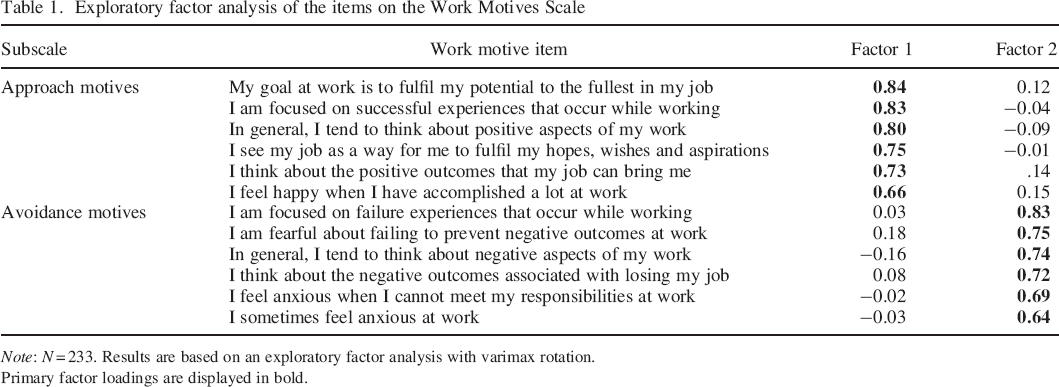
Note: N = 233. Results are based on an exploratory factor analysis with varimax rotation.
Primary factor loadings are displayed in bold.
Personality traits
Extraversion (α = .88; ‘I am skilled in handling social situations’) and neuroticism (α = .86; ‘I get irritated easily’) were measured using eight items each from Goldberg's (1999) International Personality Item Pool (IPIP). BAS and BIS sensitivity were measured using Carver and White's (1994) scales. Thirteen items assess the three dimensions of BAS sensitivity: reward responsiveness (five items; α = .87; ‘When I get something I want, I feel excited and energised’), drive (four items; α = .87; ‘I go out of my way to get things I want’) and fun–seeking (four items; α = .82; ‘I crave excitement and new sensations’). Consistent with the previous research (e.g. Harmon–Jones & Allen, 1997), we created a composite BAS score (α = .89). Seven items assess BIS sensitivity (α = .73; ‘I worry about making mistakes’). The trait version of Watson et al. (1988) Positive and Negative Affectivity Schedule was used to assess positive and negative emotionality. Ten items each measure positive emotion (α = .88; ‘happy’) and negative emotion (α = .89; ‘fearful’).
Results and Discussion
The 12 items on our Work Motives Scale (WMS) were first submitted to an exploratory factor analysis using maximum likelihood estimation and an orthogonal rotation. Results revealed that a two–factor solution fits the data best based on commonly used criteria (e.g. eigenanalysis and parallel analysis; Fabrigar, Wegener, MacCallum, & Strahan, 1999). The first factor, comprised of the approach motive items, accounted for 35.5% of the variance. The second factor, comprised of the avoidance motive items, accounted for an additional 26.4% of the variance. The factor loadings are listed in Table 1. The internal consistencies for approach (α = .80) and avoidance (α = .78) motives were good, and the correlation between them was small (r = −.19, p < .05).
We next examined relations of the motives with other markers of approach and avoidance motivation. Approach motive was positively correlated with extraversion (r = .46, p < .05), positive emotionality (r = .54, p < .05) and BAS sensitivity (r = .47, p < .05), whereas avoidance motive was positively correlated with neuroticism (r = .48, p < .05), negative emotionality (r = .50, p < .05) and BIS sensitivity (r = .54, p < .05). Cross–valence correlations (e.g. avoidance motive and extraversion) were weak and ranged from .05 to −.18.
Lastly, we examined a measurement model where all approach–oriented variables loaded on one higher–order factor and all avoidance–oriented variables loaded on a second factor. Each variable was modelled as a latent factor with three–item parcels as indicators (parcels were created using the isolated uniqueness strategy; Hall, Snell, & Foust, 1999). The fit of this model, which is illustrated in Figure 1 was acceptable based on commonly used fit indices (see Hu & Bentler, 1999; Kline, 2004): χ2(200) = 485.42; comparative fit index (CFI) = 0.96; root mean square error of approximation (RMSEA) = 0.06; and standardised root mean square residual (SRMR) = 0.06. Taken together, these results provide supportive evidence for the validity of our work motives scales.
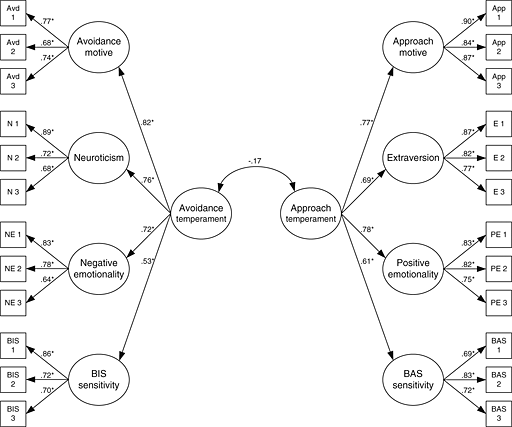
Measurement model of higher–order approach and avoidance temperaments from Study 1. BAS, behavioural activation system; BIS, behavioural inhibition system.
Study 2
Having demonstrated that scores on our work motives scale covary in expected ways with other markers of approach and avoidance temperaments, we next examined their uniqueness in relation to other personality variables. Doing so is important for two reasons. First, there has been no research to date examining relations of approach and avoidance variables with personality traits besides extraversion and neuroticism, despite calls for doing so (e.g. Elliot & Thrash, 2010). Second, many personality traits (e.g. conscientiousness) are established predictors of work criteria (e.g. Barrick & Mount, 1991). Thus, if substantial overlap exists between work motives and these other traits, then there is little value added in measuring motives. However, if the motives are unique, then it may prove fruitful to consider them in work settings. The personality variables we examined were agreeableness, conscientiousness, openness to experience, self–esteem, self–efficacy and locus of control. The work motives were not expected to overlap substantially with these personality variables.
We also examined relations of work motives with regulatory focus. Regulatory focus theory (Higgins, 1998) proposes that people differ in their sensitivities to gains and non–gains (labelled promotion focus) and their sensitivities to losses and non–losses (labelled prevention focus). Thus, parallels exist between approach/avoidance motives and promotion/prevention regulatory foci (Elliot & Thrash, 2010). Specifically, approach and avoidance motives exist at the system or person level, whereas promotion and prevention foci reflect preferences for eagerness and vigilance approaches, respectively, that operate at lower strategic and tactical levels during goal pursuit (Lanaj et al., 2012; Scholer & Higgins, 2008). Although it is possible that approach and avoidance motives at the system level constrain regulatory foci at lower levels, promotion and prevention foci can both aid in the pursuit of approach goals or avoidance goals. Given the increasing attention being paid to regulatory focus in work settings (see Lanaj et al., 2012, for a review), it is useful to examine work motives vis–à–vis regulatory focus.
Method
Participants and procedure
Surveys were completed by 476 employed students at a university in the Southern US in exchange for extra credit. Participant demographics were as follows: 55% were female; average age was 30.9 years (SD = 11.8); average tenure in their current job was 36.3 months (SD = 45.9); average hours worked per week was 37.4 (SD = 12.9); and they were employed predominantly in retail/service (43%) and professional (35%) positions.
Measures
Work motives
The WMS was used to measure approach (α = .86) and avoidance (α = .83) motives. Participants responded to these and all other items using a 5–point Likert scale (from 1 = ‘Strongly Disagree’ to 5 = ‘Strongly Agree’).
Personality traits
Neuroticism (α = .79), extraversion (α = .85), openness to experience (α = .75; ‘I enjoy hearing new ideas’), agreeableness (α = .82; ‘I sympathize with others’ feelings’) and conscientiousness (α = .86; ‘I am always prepared’) were measured using 10 items each from Goldberg's (1999) IPIP. Self–esteem was measured using Rosenberg's (1965) 10–item scale (α = .89; ‘I feel that I have a number of good qualities’). Self–efficacy was measured using Schwarzer and Jerusalem's (1995) nine–item Generalised Self–Efficacy Scale (α = .87; ‘I can always manage to solve difficult problems if I try hard enough’). Locus of control was measured using 10 items from Goldberg's (1999) IPIP (α = .83; e.g. ‘I like to take responsibility for making decisions’). Responses were coded such that high values reflect an internal locus of control. Lastly, promotion focus (α = .76; ‘I focus on how many job tasks I can complete’) and prevention focus (α = .80; ‘I focus on doing my duty at work’) were each measured using six items developed by Wallace, Johnson, and Frazier (2009).
Results and Discussion
Consistent with Study 1, the correlation between approach and avoidance motives was small (r = −.16, p < .05), and approach motive was positively related to extraversion (r = .41, p < .05), whereas avoidance motive was positively related to neuroticism (r = .44, p < .05). Of most interest, though, are relations of motives with the other personality variables. Approach motive tended to have weak relationships with agreeableness (r = .08, ns), conscientiousness (r = .20, p < .05), openness (r = .28, p < .05), self–esteem (r = .13, p < .05), self–efficacy (r = .19, p < .05), and locus of control (r = .05, ns). Similarly, avoidance motive was weakly related to agreeableness (r = −.17, p < .05), conscientiousness (r = .09, ns), openness (r = −.06, ns), self–esteem (r = −.17, p < .05), self–efficacy (r = −.07, ns) and locus of control (r = −.10, ns). With respect to regulatory focus, approach motive was positively related to promotion focus (r = .15, p < .05) and prevention focus (r = .13, p < .05), whereas avoidance motive was unrelated to promotion focus (r = −.09, ns) and negatively related to prevention focus (r = −.18, p < .05).
To supplement these correlation results, we also examined a measurement model that included separate latent factors for all 10 variables. Same as in Study 1, each latent factor was modelled via three–item parcels. The fit of the measurement model was acceptable: χ2(360) = 739.50; CFI = 0.95; RMSEA = 0.04; and SRMR = 0.05, and all factor loadings were significant. Approach and avoidance motives were weakly related to each other (γ = −0.12, p < .05), approach motive was positively related to extraversion (γ = 0.38, p < .05), avoidance motive was positively related to neuroticism (γ = 0.43, p < .05) and both motives had weak relations with the remaining latent personality variables (γs ranged between −0.16 and 0.19). Taken together, these findings provide additional support for the validity of our work motives scale, and they verified that work motives are not redundant with other common personality variables.
Study 3
Approach and avoidance motives are believed to reflect relatively stable sensitivities and response tendencies towards domain–specific positive and negative information (Elliot, 2006). We therefore examined the stability of the motives by measuring them at three points in time. If the motives are stable, then moderate to high intercorrelations should be observed.
Method
Seventy employed students at a large university in the Southeast US were administered the motives measure three times (separated by five–week intervals) in exchange for extra credit. Participant demographics were as follows: 58% were female; average age was 26.7 years (SD = 10.5); average tenure in their current job was 27.5 months (SD = 18.4); average hours worked per week was 36.4 (SD = 12.9); and they were employed predominantly in retail/service (43%), professional (28%) and manufacturing (13%) positions.
Measures
Work motives
The WMS was used to measure approach (αs ranged from .78 to .86) and avoidance (αs ranged from .80 to .87) motives. Participants responded to these items using a 5–point Likert scale (from 1 = ‘Strongly Disagree’ to 5 = ‘Strongly Agree’).
Results and Discussion
Relations among the approach motives ranged from .73 (Time 1–Time 3) to .82 (Time 2–Time 3), relations among the avoidance motives ranged from .74 (Time 1–Time 3) to .85 (Time 2–Time 3) and relations among approach and avoidance motives measured at the same time ranged from −.10 (Time 1) to −.17 (Time 3). Thus, the work motives appeared stable across time.
Study 4
The results of Studies 1–3 support the construct validity of the work motive scale. In the remaining studies, we used this scale to test causal models that included work–based goals, attitudes and performance. The aim of Study 4 was twofold. First, we examined relations of work motives with employees’ predispositions to set approach and avoidance achievement goals (DeShon & Gillespie, 2005). Consistent with Elliot and Thrash's (2002, 2010) hierarchical model, we expected approach motive would predict mastery–approach goal orientation (i.e. achieving task–based expertise) and performance–approach goal orientation (i.e. achieving expertise relative to others). In contrast, avoidance motive should predict performance–avoidance goal orientation (i.e. avoiding incompetence relative to others) and performance–approach goal orientation. The latter cross–valence relationship is expected because approach behaviour can serve underlying avoidance motivations (i.e. ‘approach in order to avoid’; see Elliot & Church, 1997). The second aim of Study 4 was to verify that work motives are distinct from general cognitive ability, another established predictor of job performance (Schmidt & Hunter, 1998).
Method
Participants and procedure
The measures were administered to 166 employed students at a university in the Southeast US in exchange for extra credit. Participant demographics were as follows: 52% were female; average age was 28.2 years (SD = 10.1); average tenure in their job was 28.2 months (SD = 21.7); average hours worked per week was 37.1 (SD = 14.2); and they were employed primarily in retail/service (42%), professional (25%) and government (14%) positions.
Measures
Work motives
The WMS was used to measure approach (α = .84) and avoidance (α = .82) motives. Participants responded to these and all other survey items using a 5–point Likert scale (from 1 = ‘Strongly Disagree’ to 5 = ‘Strongly Agree’).
Achievement goal orientations
We used VandeWalle's (1997) 13–item scale to measure work–specific achievement orientations. Five items assess mastery–approach goal orientation (α = .79; ‘I often look for opportunities to develop new skills and knowledge at work’), and four items each assess performance–approach (α = .74; ‘I'm concerned with showing that I can perform better than my coworkers’) and performance–avoidance (α = .75; ‘I prefer to avoid situations at work where I might perform poorly’) goal orientations.
Cognitive ability
Participants were administered the Wesman Personnel Classification Test (Wesman, 1965), which measures the ability to think and reason through verbal problems and to see interrelationships and conceptual themes. It is a timed test during which participants complete verbal ability (40 items) and numerical ability (20 items) subtests. Scores on these subtests were combined into an overall score.
Results and Discussion
Consistent with expectations, approach motive correlated with mastery–approach (r = .48, p < .05) and performance–approach (r = .38, p < .05) orientations, whereas avoidance motive correlated with performance–avoidance (r = .47, p < .05) and performance–approach (r = .21, p < .05) orientations. Approach and avoidance motives were unrelated (r = −.09, ns). We tested a structural equation model with the hypothesised paths from motives to achievement orientations. As before, latent constructs were modelled via item parcels. The fit of the measurement model was acceptable: χ2(44) = 122.02; CFI = 0.96; RMSEA = 0.04; and SRMR = 0.05, and all factor loadings were significant. The structural model, which is illustrated in Figure 2, had acceptable fit: χ2(46) = 135.21; CFI = 0.94; RMSEA = 0.05; and SRMR = 0.06. Results supported predictions that approach motive relates to mastery–approach and performance–approach goal orientations, whereas avoidance motive relates to performance–avoidance and performance–approach goal orientations. Finally, with respect to our second aim, results revealed that cognitive ability is unrelated to both approach motive (r = .14, ns) and avoidance motive (r = .04, ns).
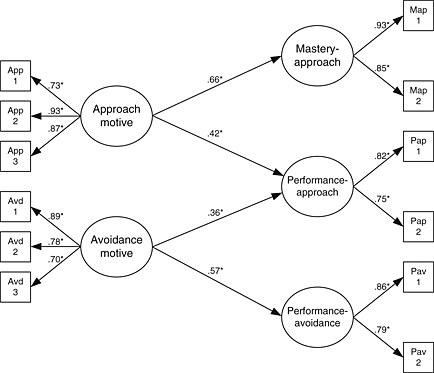
Structural model of work motives predicting work–based achievement goals from Study 4.
Study 5
In this study, we investigated seven criteria that are influenced by employees’ appraisals of positive and negative stimuli in their work environment: job satisfaction; perceived support from the organisation and one's supervisor; affective, normative and continuance commitment; and work strain. Job satisfaction refers to a pleasurable emotional state that is elicited by appraisals of one's job and job–related experiences (Locke, 1976). Perceived organisational support and supervisor support refer to employees’ perceptions of the extent to which their organisation and supervisor, respectively, value their contributions and care about their well–being (Eisenberger, Stinglhamber, Vandenberghe, Sucharski, & Rhoades, 2002). Satisfaction and perceived support are heavily influenced by employees’ appraisals of their environment, such as the extent to which rewards and procedures are fair and role ambiguity and overload are low (Cohen–Charash & Spector, 2001; Rhoades & Eisenberger, 2002). As discussed earlier, approach and avoidance motives sensitise people to the presence and absence of positive and negative stimuli in their environment, which biases how they construe their experiences. For example, avoidance–oriented employees may interpret critical feedback from their supervisors as an act of incivility rather than constructive criticism. Such employees also experience negative emotions more intensely, thereby causing larger declines in satisfaction and perceived support. Alternatively, approach–oriented employees are predisposed to experiencing positive emotions and encoding positive information, which increase satisfaction and support. We therefore expected that approach and avoidance motives would relate positively and negatively, respectively, to satisfaction and perceived support.
Organisational commitment refers to the attachment that employees feel towards their employer, which takes on different forms depending on employees’ underlying motivations (Johnson, Chang, & Yang, 2010; Meyer, Becker, & Vandenberghe, 2004). Affective commitment entails an acceptance of organisational goals and values and a strong emotional attachment to the organisation (Meyer & Allen, 1997). The psychological mechanisms underlying affective commitment are based on desire—the desire to affiliate with the organisation and to adopt its values and goals. Attachment based on desire reflects approach motivation (Johnson et al., 2010). Normative commitment derives from a sense of indebtedness and perceived obligation to stay with one's employer (Meyer & Allen, 1997). Employees with this type of commitment stay with their company in order to avoid the anxiety that being disloyal would cause them. Given that normative commitment exists to avoid disappointing oneself and others, it should relate to avoidance motive (Strachman & Gable, 2006). Lastly, continuance commitment derives from personal investments tied to one's current employment (Meyer & Allen, 1997). Employees with this type of commitment remain with their employer in the hopes of obtaining further rewards and to avoid losing investments that have been accrued (Taing, Groff, Granger, Jackson, & Johnson, 2011). Because continuance commitment involves both economic gains and losses, it should relate positively to both approach and avoidance motives (Johnson et al., 2010).
Work strain refers to the experience of tension and fear resulting from excessive work demands (Chang, Johnson, & Yang, 2007). Strain occurs when employees perceive their work environment as threatening or challenging and lack adequate resources to cope effectively with these demands (Lazarus & Folkman, 1984). As Elliot (2006, p. 115) noted, ‘avoidance motivation is experienced as stressful, and even when effective, can take a toll on enjoyment and, eventually, well–being.’ Given that work strain is intertwined with the experience of anxiety and sensitivity to threats, we expect it is uniquely predicted by avoidance motive.
An ancillary aim of Study 5 was to replicate the findings of Study 1 with a sample of full–time workers. A potential limitation of our prior studies was the use of employed participants who attended university. It is possible that work–based motivations, affect and attitudes operate differently across employed students whose employment is a means to an end (e.g. paying for tuition) versus full–time employees in the midst of their career. We therefore recruited samples of employees with more extensive work experience for this study and the two remaining ones.
Method
Participants and procedure
We administered two surveys to 212 full–time employees. Surveys were distributed several ways, including via business and human resource contacts and university alumni networks. Participants completed measures of motives and personality as part of the first survey and then completed measures of the outcomes as part of a follow–up survey two weeks later. Separating the predictor and criterion measures in time is effective for reducing common method bias (Johnson, Rosen, & Djurdjevic, 2011). Participant demographics were as follows: 58% were male; average age was 34.6 years (SD = 9.1); average job tenure was 46.3 months (SD = 18.9); average hours worked per week was 44.2 (SD = 10.6); and they were employed predominantly in professional (40%), retail/service (26%), and manufacturing (22%) positions.
Measures
Work motives
The WMS was used to measure approach (α = .86) and avoidance (α = .83) motives. Participants responded to these and all other survey items using a 5–point Likert scale (from 1 = ‘Strongly Disagree’ to 5 = ‘Strongly Agree’).
Personality traits
Extraversion (α = .83) and neuroticism (α = .83) were measured using eight items each from Goldberg's (1999) IPIP. BAS (α = .86) and BIS sensitivity (α = .80) were measured using Carver and White's (1994) scales. The Positive and Negative Affectivity Schedule of Watson et al. (1988) was used to assess positive (α = .78) and negative emotionality (α = .79).
Work criteria
Job satisfaction (α = .89) was measured using three items developed by Seashore, Lawler, Mirvis, and Cammann (1982). An example item is ‘All in all, I like my job.’ Organisational support was measured using Eisenberger, Huntington, Hutchinson, and Sowa's (1986) 16–item measure (α = .92; e.g. ‘Help is available from my organization when I have a problem’). Supervisor support was measured via Graen, Novak, and Sommerkamp's (1982) measure of leader–member exchange (α = .91; e.g. ‘I feel that my immediate supervisor understands my problems and needs’). Affective (α = .87; e.g. ‘I would be happy to spend the rest of my career with my organization’), normative (α = .78; e.g. ‘One of the major reasons I continue to work for this organization is that I believe that loyalty is important and therefore feel a sense of obligation to remain’), and continuance commitment (α = .83; e.g. ‘It would be too costly for me to leave my organization now’) were each measured using Meyer and Allen's (1997) six–item subscales. Work strain was measured using House and Rizzo's (1972) seven–item Work Tension Scale (α = .88; e.g. ‘If I had a different job, my health would probably improve’).
Results and Discussion
Correlations and descriptive statistics are listed in Table 2. As in Study 1, we examined the construct validity of the work motives scale by specifying a measurement model where all approach–oriented variables loaded on one factor and all avoidance–oriented variables on another factor. Three–item parcels were used to model each latent variable. The fit of this model, which is shown in Figure 3, was acceptable: χ2(243) = 418.05; CFI = 0.95; RMSEA = 0.05; and SRMR = 0.04.
Correlations and descriptive statistics for the focal variables in Study 5
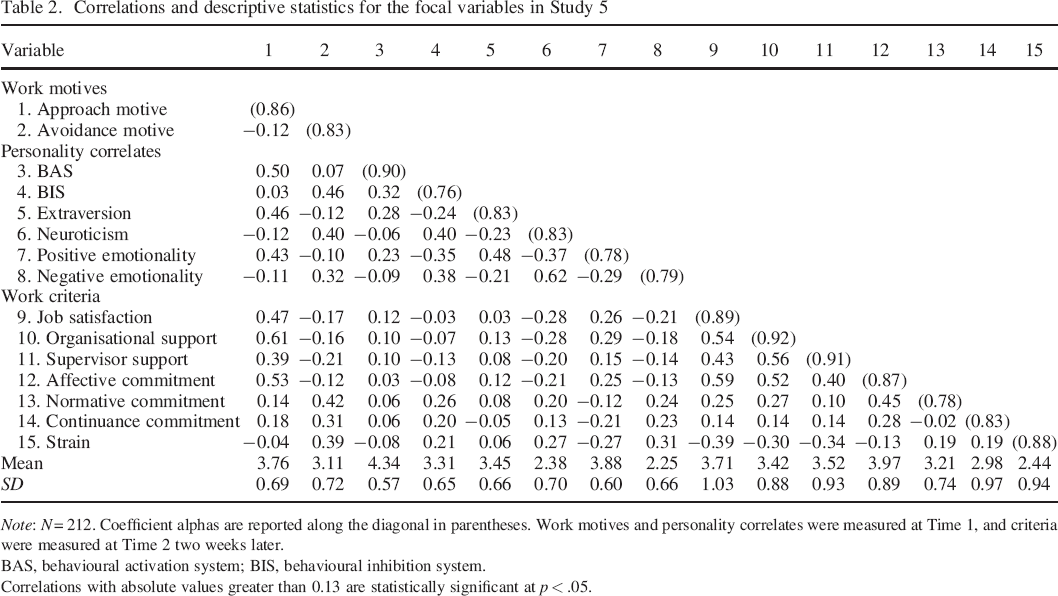
Note: N = 212. Coefficient alphas are reported along the diagonal in parentheses. Work motives and personality correlates were measured at Time 1, and criteria were measured at Time 2 two weeks later.
BAS, behavioural activation system; BIS, behavioural inhibition system.
Correlations with absolute values greater than 0.13 are statistically significant at p < .05.
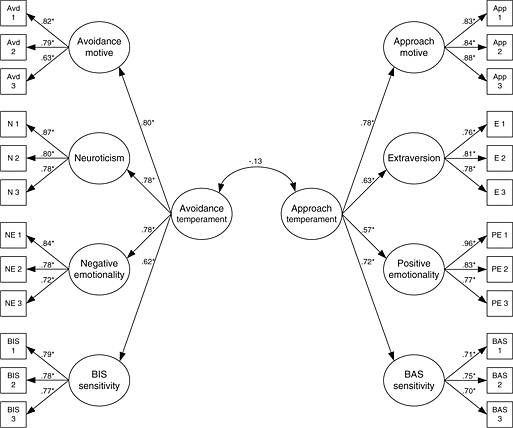
Measurement model of higher–order approach and avoidance temperaments from Study 5. BAS, behavioural activation system; BIS, behavioural inhibition system.
To test the causal models, we conducted a series of hierarchical multiple regressions where each criterion was regressed on a set of covariates in Step 1 followed by the motives in Step 2. We controlled for employee gender, tenure and hours worked per week in Step 1 because many attitudes and perceptions covary with these variables (e.g. longer tenure is positively related to continuance commitment). Results of these analyses are reported in Table 3. In line with expectations, approach motive was positively related to job satisfaction and perceived support, whereas avoidance motive was negatively related to both criteria. Effects were asymmetrical in that approach motive exhibited stronger relationships than avoidance motive. Also paralleling expectations was the finding that approach motive predicted affective and continuance commitment, whereas avoidance motive predicted normative and continuance commitment. Finally, as hypothesised, avoidance motive was the sole predictor of strain. On average, work motives accounted for 19% of the variance in criteria, which is an impressive amount given that a time lag existed between the predictors and criteria.
Predicting job attitudes and perceptions with work motives in Study 5
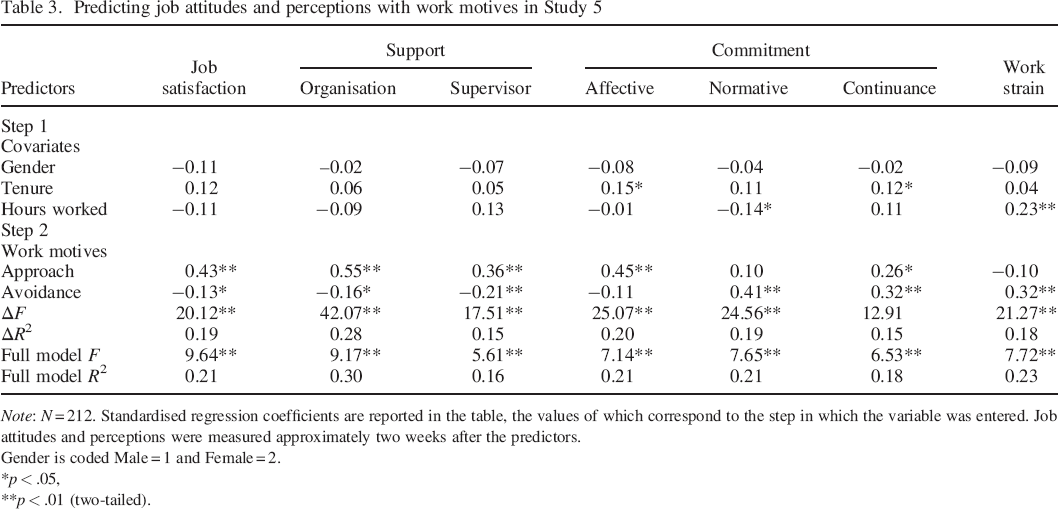
Note: N = 212. Standardised regression coefficients are reported in the table, the values of which correspond to the step in which the variable was entered. Job attitudes and perceptions were measured approximately two weeks after the predictors.
Gender is coded Male = 1 and Female = 2.
p < .05,
p < .01 (two–tailed).
In addition to the regression results reported in Table 3, we also examined whether or not work motives predicted criteria incremental to the more general personality traits. We did so by first regressing the criteria on the covariates and personality traits (extraversion, neuroticism, BAS and BIS sensitivity and positive and negative emotionality), followed by the motives in Step 2. Results indicated that work motives explained significant variance in every outcome: job satisfaction, ΔR2 = 0.08, F(2, 195) = 11.54, p < .05; organisational support, ΔR2 = 0.19, F(2, 195) = 28.25, p < .05; supervisor support, ΔR2 = 0.08, F(2, 194) = 9.98, p < .05; affective commitment, ΔR2 = 0.12, F(2, 196) = 19.88, p < .05; normative commitment, ΔR2 = 0.15, F(2, 195) = 22.28, p < .05; continuance commitment, ΔR2 = 0.10, F(2, 196) = 12.55, p < .05; and work strain, ΔR2 = 0.06, F(2, 196) = 6.28, p < .05. Taken together, these findings verify that work motives are significant predictors of work attitudes and perceptions, when considered alone and in conjunction with more general personality traits.
Exploratory analyses
According to Gable et al. (2003), it is possible that approach and avoidance motives interact to predict outcomes. Take, for example, employees with high levels of approach motive paired with low levels of avoidance motive. Their high sensitivity to positive work events may have stronger effects on job satisfaction given that they are also insensitive to negative events, which normally reduce satisfaction. Approach and avoidance motives may also interact because, given a strong approach motive, high levels of avoidance motive heighten evaluation anxiety, which is expressed in terms of obsessive approach (so long as approach motive is greater than avoidance motive). 3 We therefore tested for possible interactions in this study by adding approach × avoidance product terms in Step 3 of the regression models (main effect terms were first centred, and we used the centred values to compute interaction terms; Cohen, Cohen, West, & Aiken, 2003). The interaction term was a significant predictor of job satisfaction, β = −.18 (ΔR2 = 0.03), t(204) = −2.12, p < .05; organisational support, β = −.13 (ΔR2 = 0.02), t(204) = −2.05, p < .05; and continuance commitment, β = .24 (ΔR2 = 0.03), t(204) = 3.76, p < .01. In the case of satisfaction and support, the positive relation of approach motive was stronger when avoidance motive was low versus high. The opposite was true for continuance commitment—approach motive had a stronger positive relation when avoidance motive was high versus low. Given the exploratory nature of these findings, though, follow–up research is needed.
Study 6
In this study, we examined relations of work motives with three dimensions of job performance: task behaviour, citizenship behaviour and counterproductive behaviour (Rotundo & Sackett, 2002). Task behaviour refers to the completion of essential job tasks and duties, usually contributing to the manufacturing of a product or provision of a service (Borman & Motowidlo, 1993). We suspect that approach motive is positively related to task behaviour because many of the phenomena that coincide with a strong approach motive (e.g. setting mastery goals, persistence) are ones that contribute to effective performance. Approach goals specify desired states, which aid performance because they encapsulate the conditions for success that people move towards via the operation of negative–feedback processes (Carver & Scheier, 1998). Compared with approach motivation, avoidance motivation is much more limited because it is associated with setting goals that specify undesirable states (e.g. minimising mistakes). These to–be–avoided goals do not, alone, facilitate high performance because they merely specify what not to do. The fear of committing errors and the anxiety associated with the pursuit of avoidance goals may also reduce available cognitive resources that would otherwise be devoted to on–task activities (Elliot, 2006). In fact, the goal to avoid errors can actually stifle performance because committing errors aids learning (Johnson, Chang, & Lord, 2006; Keith & Frese, 2005). Without approach goals signalling what needs to be done, regulatory behaviour is disorganised when driven solely by avoidance goals (Carver & Scheier, 1998).
Although we did not expect a direct effect of avoidance motive on–task behaviour, we tested for an approach × avoidance motive interaction such that task behaviour is most effective when approach and avoidance motives are both high. When pursuing desired task goals, which is aided by strong approach motives, performance is further enhanced when strong avoidance motives are also in play because such motives help employees recognise potential obstacles and make corrective adjustments in response to negative feedback (Lanaj et al., 2012). As noted by both Carver and Scheier (1998) and Elliot (2006), approach and avoidance motivations can exert complementary forces on behaviour that simultaneously pull people towards desired states while pushing them away from undesired states. In line with these ideas, we expect approach motive will have stronger relations with task performance when avoidance motive is high (versus low).
Organisational citizenship behaviour (OCB) refers to behaviours that contribute to the social and psychological aspects of the work environment (e.g. helping a coworker, committee service; Organ, 1997). Although these tend to be discretionary behaviours that fall outside formal job duties, they are exemplary forms of performance that benefit companies (Podsakoff, Whiting, Podsakoff, & Blume, 2009) and employees (Allen & Rush, 1998). One reason why employees perform OCB is to manage their work impressions in order to procure rewards and better their career prospects (Bolino, 1999). The prospect of desirable economic and socio–emotional rewards is consistent with approach motives, which should relate positively to OCB.
Counterproductive work behaviour (CWB) refers to intentional acts that harm the organisation or its members (e.g. theft, damaging company property; Spector & Fox, 2002). Theoretical and empirical evidence (e.g. Hershcovis et al., 2007) suggest that CWB is primarily a consequence of negative emotions elicited by job stressors like unfair procedures and interpersonal treatment. Because avoidance motive involves a heightened sensitivity to negative information and a proclivity for experiencing negative emotions (Elliot & Thrash, 2002), a strong avoidance motive may increase the likelihood that employees engage in CWB (Ferris et al., 2011; Johnson, Tolentino, Rodopman, & Cho, 2010). However, engaging in CWB also comes at the risk of being punished and facing organisational sanctions, possibly culminating in the loss of one's job. Given that avoidance motive is concerned with escaping punishment and personal loss, it is also possible that a strong avoidance motive reduces the likelihood of performing CWB (e.g. Brebels, De Cremer, & Sedikides, 2008; Neubert, Kacmar, Carlson, Chonko, & Roberts, 2008). Given these incompatible predictions and findings, our results will help clarify the exact nature of avoidance motive–CWB relations.
Lastly, we also examined relationships of motives with turnover cognitions, or employees’ thoughts about quitting. Employee turnover is a costly affair for companies—it requires them to continually recruit and train new employees and can tarnish a company's reputation. Low turnover, then, serves as a marker of organisational performance. The greater sensitivities to negative information and negative emotions that underlie avoidance motive, and the greater dissatisfaction that they elicit, may increase the likelihood that employees step back and reconsider their employment circumstances. Although voluntarily leaving one's job also entails some degree of risk (e.g. forfeiting job security), which may be off–putting for avoidance–oriented employees, this does not preclude them from thinking or fantasising about quitting. Thus, we expect avoidance motive is positively related to turnover cognitions.
Method
Participants and procedure
We administered surveys to 179 matched employee–supervisor dyads. Surveys were distributed using similar methods as in Study 5, except this time we also collected \contact information for participants’ immediate work supervisor. Focal participants were administered measures of motives, CWB and turnover cognitions. Two weeks after participants returned the survey, we collected measures of task behaviour and OCB from their supervisor. Demographics of the focal participants were as follows: 58% were male; average age was 29.4 years (SD = 5.9); average job tenure was 37.5 months (SD = 30.9); average hours worked per week was 43.6 (SD = 10.5); and they were employed predominantly in professional (49%), retail/service (33%) and government (10%) positions. Supervisor demographics were as follows: 66% were male; they ranged in age from 20 to 29 years (24%), 30–39 years (28%), 40–49 years (29%) and 50 and above (19%); and average hours worked per week was 47.9 (SD = 9.9). The average tenure of employees’ working relationship with their supervisor was 38.0 months (SD = 14.8).
Measures
Work motives
The WMS was used to measure approach (α = .84) and avoidance (α = .80) motives. Participants responded to these and all other survey items using a 5–point Likert scale (from 1 = ‘Strongly Disagree’ to 5 = ‘Strongly Agree’).
Work criteria
Supervisors rated subordinate task performance and OCB using Williams and Anderson's (1991) measure. Seven items assess task behaviour (α = .85; ‘Adequately completes assigned duties’), and 14 items assess OCB (α = .88; e.g. ‘Helps others who have heavy workloads’). Subordinates rated their own CWB using Robinson and O'Leary–Kelly's (1998) nine–item scale (α = .87; e.g. ‘I have damaged property that belonged to my employer’). CWBs are typically performed covertly, and therefore, collecting self–reports is recommended (Spector et al., 2006). Although the items assess sensitive information, we are optimistic that participants responded honestly because participants were assured confidentiality and because the variance in CWB scores (s2CWB = 0.78) was comparable with the variance of other scores (s2 ranged from 0.59 to 0.98). Turnover cognition was measured using a hybrid six–item scale (α = .81; ‘I constantly think about quitting’) consisting of items developed by Mobley, Horner, and Hollingsworth (1978) and Mowday, Koberg, and McArthur (1984).
Results and Discussion
Correlations and descriptive statistics are listed in Table 4. Each criterion was regressed on the set of covariates in Step 1 followed by the motives in Step 2. Results are reported in Table 5. Paralleling predictions, approach motive was positively related to task behaviour and OCB. The approach × avoidance interaction was also a significant predictor of task behaviour, β = .26 (ΔR2 = 0.05), t(166) = 2.87, p < .05 (as in the previous study, we computed the interaction using centred values and entered it in the final step of the regression model). The interaction, which is illustrated in Figure 4, was such that approach motive had a stronger positive relationship with task behaviour when avoidance motive was high (versus low). Although not expected, approach motive was negatively related to CWB, possibly because engaging in such behaviour lessens the likelihood of receiving desirable economic and socio–emotional rewards, which are salient when approach motive is strong. In contrast, avoidance motive was positively related to CWB and turnover cognition, which may indicate that greater sensitivities to perceiving negative events and experiencing negative emotions translate into counterproductive actions and thoughts at work. Interestingly, it does not appear that the risks of punishment and company sanctions deter avoidance–oriented employees from engaging in CWB.
Correlations and descriptive statistics for the focal variables in Study 6
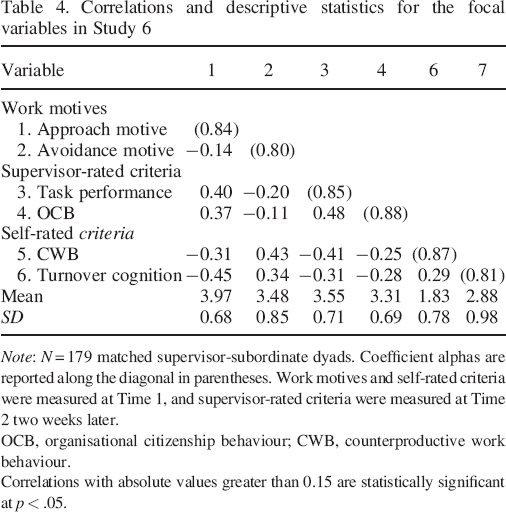
Note: N = 179 matched supervisor–subordinate dyads. Coefficient alphas are reported along the diagonal in parentheses. Work motives and self–rated criteria were measured at Time 1, and supervisor–rated criteria were measured at Time 2 two weeks later.
OCB, organisational citizenship behaviour; CWB, counterproductive work behaviour.
Correlations with absolute values greater than 0.15 are statistically significant at p < .05.
Predicting Job Behaviours with work motives in Study 6
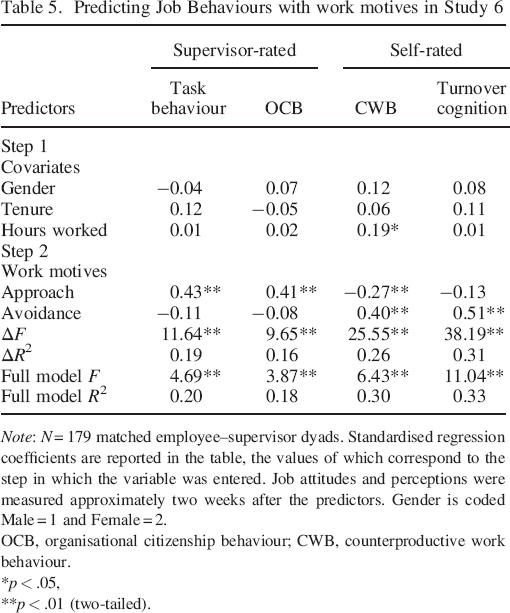
Note: N = 179 matched employee–supervisor dyads. Standardised regression coefficients are reported in the table, the values of which correspond to the step in which the variable was entered. Job attitudes and perceptions were measured approximately two weeks after the predictors. Gender is coded Male = 1 and Female = 2.
OCB, organisational citizenship behaviour; CWB, counterproductive work behaviour.
p < .05,
p < .01 (two–tailed).
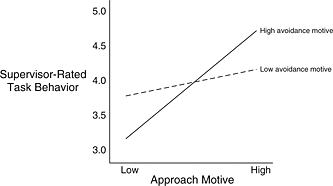
Approach × avoidance motive interaction predicting task behaviour in Study 6.
Exploratory analyses
In response to Gable et al. (2003), we tested whether the approach × avoidance interaction predicted other dimensions of performance besides task behaviour. It did in the case of CWB, β = −.20 (ΔR2 = 0.03), t(166) = −3.39, p < .05. The nature of the effect was such that avoidance motive had a stronger positive relationship with CWB when approach motive was low versus high. The combination of strong avoidance motive paired with weak approach motive appears to be a potent recipe for deviant behaviour. Given the exploratory nature of this interaction finding though, it ought to be replicated before interpreting it as a substantive finding.
Study 7
Much motivation–based processing operates at implicit levels (Bargh & Chartrand, 1999), meaning it occurs outside people's awareness, intention and control (De Houwer & Moors, 2007). Although this is a well–established fact backed by extensive empirical support, only recently have organisational scholars begun to consider implicit processes and their effects in work settings (e.g. Johnson & Saboe, 2011; Johnson et al., 2010; Shantz & Latham, 2009). There are compelling reasons to expect that approach and avoidance motives operate at implicit levels. For example, motives are fundamental phenomena—the valence of environmental stimuli is automatically evaluated, and approach and avoidance behavioural responses are automatically elicited by these evaluations (Elliot, 2006; Strack & Deutsch, 2004). Also, the features of a typical workplace are ones that increase the likelihood of processing at implicit levels (e.g. routinised tasks and high cognitive load; Johnson & Steinman, 2009). We therefore used an indirect measure of approach and avoidance motives to better capture them at implicit levels and to minimise possible response distortion. Doing so addresses recent calls (e.g. Uhlmann et al., 2012) to develop indirect measures for predicting job attitudes and behaviour.
Method
Participants and procedure
We administered surveys to 124 matched pairs of employees and their supervisors, who were recruited using identical procedure as those in Studies 5 and 6. Demographics of the focal participants were as follows: 61% were male; average age was 34.5 years (SD = 6.2); average job tenure was 38.7 months (SD = 19.6); average hours worked per week was 40.2 (SD = 13.1); and they were employed predominantly in professional (40%), retail/service (38%) or manufacturing (19%) positions. Supervisor demographics were as follows: 68% were male; they ranged in age from 20 to 29 years (13%), 30–39 years (31%), 40–49 years (35%) and 50 and above (21%); and average hours worked per week was 45.2 (SD = 8.1). The average tenure of employees’ working relationship with their supervisor was 41.3 months (SD = 18.5).
Measures
Work motives
The WMS served as the direct measure of explicit approach (α = .86) and avoidance (α = .83) motives. Participants responded to these and all other survey items using a 5–point Likert scale (from 1 = ‘Strongly Disagree’ to 5 = ‘Strongly Agree’). Explicit approach and avoidance motives were weakly related (r = −.13, ns).
A word fragment completion task based on ones developed by Johnson et al. (Johnson & Lord, 2010; Johnson & Saboe, 2011) served as the indirect measure of motives. We chose this particular method because it circumvents the technological constraints of response latency methods, it is easily adapted to survey formats for use in applied settings, and it is a reliable method that has been used previously (Koopman, Howe, Johnson, Tan, & Chang, 2012). The measure is composed of 22 word fragments (e.g. ‘A _ _ _ D’) that can be completed to form approach words (AWARD), avoidance words (AVOID), or neutral words (ASKED). The majority of word fragments formed either an approach word or an avoidance word but not both. Responses were coded by two independent raters, and discrepancies were resolved by discussions with the first author (initial inter–rater agreement was 94% and Cohen's (1960) κ = 0.90). The proportion of target words that respondents generate is used to infer the automatic activation of focal constructs (Gilbert & Hixon, 1991). We therefore operationalised implicit approach and avoidance scores by summing the number of approach and avoidance words, respectively, that participants generated, and dividing these sums by the total number of words generated. The correlation between implicit approach and avoidance motives was weak (r = −.21, p < .05), and correlations between direct and indirect scores for the same motive ranged from r = .29 to .36 (p < .05 for all). Although moderate in size, these relationships are similar to ones reported in a meta–analysis by Hofmann, Gawronski, Gschwendner, Le, and Schmitt (2005).
In line with recommended practices for word fragment measures (see Koopman et al., 2012), participants received two sets of instructions prior to being administered the indirect measure. First, they were asked to think about themselves as employees in their work roles, the tasks they complete in those roles and why they perform them. These instructions were meant to prime the workplace and motives associated with that setting. Second, participants were asked to complete the word fragments as quickly as possible and to skip any items for which they were unable to immediately think of a word. The purpose of this instruction was to ensure that participants generated words that reflected the most accessible content at implicit levels.
Two pilot studies were conducted to assess the validity of the indirect measure. First, 77 university students were exposed to an approach–avoidance manipulation. The prime involved instructing students to think about a time when they successfully earned a desirable outcome (approach condition; n = 33) or experienced a negative outcome (avoidance condition; n = 34). Following the prime, participants were administered the indirect measure. Participants in the approach condition generated a larger proportion of approach words (0.30 vs 0.17), t(76) = 7.05, p < .01, whereas those in the avoidance condition generated a larger proportion of avoidance words (0.25 vs 0.12), t(76) = 7.12, p < .01. Second, we calculated the test–retest reliability of the indirect measure to verify that it assesses chronic motives. Ninety–four university students completed the measure at two times separated by six weeks. The coefficients of stability (i.e. correlations between the time 1 and 2 scores) were significant for implicit approach (r = .71, p < .05) and implicit avoidance (r = .74, p < .05) motives. These results are favourable with respect to the reliability and validity of the indirect measure.
Work criteria
We used the same scales as in Study 6 to measure supervisor–rated task performance (α = .89) and OCB (α = .89), and subordinate–rated CWB (α = .84) and turnover cognition (α = .85).
Results and Discussion
We conducted a series of hierarchical multiple regressions in which each outcome was regressed on the covariates in Step 1, the explicit motives in Step 2 and the implicit motives in Step 3 (Table 6). Consistent with prior results, approach motive predicted task behaviour and OCB, whereas avoidance motive predicted CWB and turnover cognition. Furthermore, the implicit motives accounted for significant unique variance in all four criteria incremental to the explicit motives. We also tested whether the hypothesised approach × avoidance interaction observed in Study 6 predicted task behaviour by regressing the criterion on the covariates, main effects and interaction term. The approach × avoidance motive interaction was again a significant predictor of task behaviour, β = .27 (ΔR2 = 0.05), t(115) = 3.12, p < .05. As illustrated in Figure 5, implicit approach motive had a stronger positive relationship with task behaviour when implicit avoidance motive was high (versus low). Taken together, these results suggest that the indirect measures are particularly useful tools for assessing approach and avoidance work motives.
Predicting job behaviours with explicit and implicit work motives in Study 7
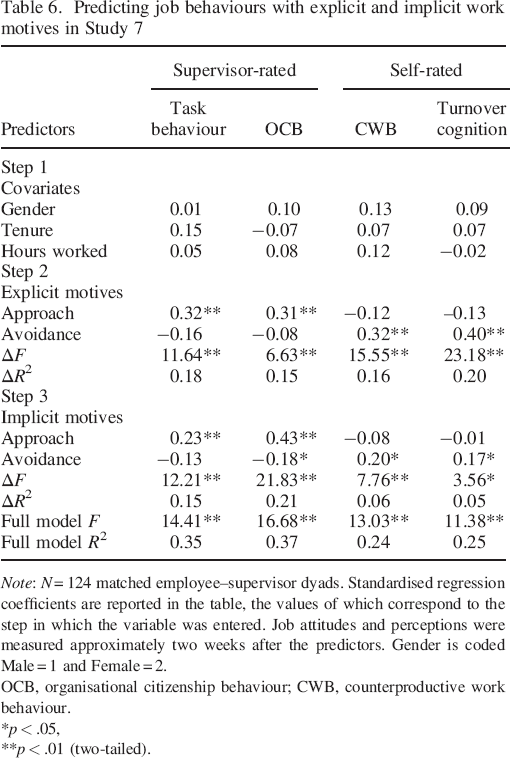
Note: N = 124 matched employee–supervisor dyads. Standardised regression coefficients are reported in the table, the values of which correspond to the step in which the variable was entered. Job attitudes and perceptions were measured approximately two weeks after the predictors. Gender is coded Male = 1 and Female = 2.
OCB, organisational citizenship behaviour; CWB, counterproductive work behaviour.
p < .05,
p < .01 (two–tailed).
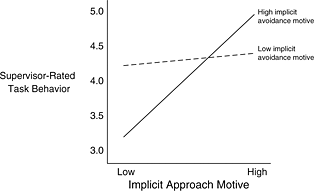
Implicit approach × avoidance motive interaction predicting task behaviour in Study 7.
General Discussion
In the present research, we conducted a series of studies that extended theory and research on the approach–avoidance motivation hierarchy. Findings from the first three studies established the construct validity of our work motives measure. In particular, we verified that work motives converged with other markers of approach–avoidance motivation (e.g. emotionality and motivation systems). Answering calls by Elliot and Thrash (2010), we also demonstrated that approach and avoidance motives are not redundant with other individual difference variables, such as conscientiousness, self–esteem, regulatory focus and cognitive ability. It can be assumed, then, that motives have relations with work criteria that are unique from these other variables.
In the next four studies, we tested causal models in which work motives predicted employee goals, attitudes, and behaviours. In Study 4, we confirmed expectations that approach motive predicted mastery–approach and performance–approach goal orientations, whereas avoidance motive predicted performance–avoidance and performance–approach goal orientations. These findings are consistent with Elliot and Thrash's (2002) findings regarding goals in academic domains. In Study 5, we supported hypotheses that motives relate to work–related appraisals and attitudes. Specifically, approach motive positively related to job satisfaction and perceptions of support, whereas avoidance motive exhibited negative associations with these variables as well as work strain. Paralleling research on approach–avoidance attachment in relationships, approach and avoidance motives also affected the nature of employees’ attachment to their organisation. In line with theory (Johnson et al., 2010), approach motive was associated with organisational commitment based on desire and the accruement of favoured rewards, whereas avoidance motive was associated with commitment based on duty and the fear of losses associated with unemployment. Although not formally predicted, exploratory analyses revealed significant approach by avoidance motive interactions. Specifically, approach motive had stronger, positive relations with job satisfaction and perceived organisational support when avoidance motive was low (versus high). In contrast, approach motive had stronger, positive relations with continuance commitment when avoidance motive was high (versus low). Although these findings provide initial evidence for interactive effects among approach and avoidance motives and suggest that previous research may have underestimated the effects of motives by focusing exclusively on main effects, more research is needed to corroborate these interactions.
In Studies 6 and 7, we demonstrated that work motives predict job performance. Approach motive has positive relations with task performance and OCB, whereas avoidance motive has negative relations with task performance and positive relations with CWB. We also observed a significant interaction among the motives, such that approach motive has stronger relations with task performance when avoidance motive is high (versus low). This finding supports the idea that approach and avoidance motivations are capable of exerting complementary forces on behaviour that pull people towards desired states while at the same time pushing them away from undesired states (Carver & Scheier, 1998; Elliot, 2006). The unique variance explained by this interaction was quite large (ΔR2 = 0.05) considering it was observed in a field study in which motives and criteria were measured from different sources and at different times.
In Study 7, we replicated the aforementioned findings using an indirect measure that assesses implicit approach and avoidance motives. To date, ours is the first study to examine these motives at implicit levels. We expected the motives would have implicit effects because fundamental motives and affect often operate outside people's awareness and control (Johnson et al., 2010; Strack & Deutsch, 2004). Although the direction of effects was similar across explicit and implicit motives, the latter accounted for larger proportions of variance in supervisor–rated work criteria. Moreover, we also observed an implicit approach by avoidance interaction predicting task performance. As before, implicit approach motive had stronger relations with task performance when implicit avoidance motive was high (versus low). In order to capture the full gamut of effects that work motives have, the motives ought to be assessed at both implicit and explicit levels.
Directions for extending the present research
Although the present set of studies provides converging evidence for the effects of approach and avoidance motives on important outcomes, a number of avenues for future research would be fruitful. First, our findings consistently demonstrated that approach and avoidance motives predict job behaviours. Although we examined multiple performance behaviours (task, OCB, and CWB), these findings could be extended to other dimensions like safety and innovative behaviours. Safety behaviours represent actions that benefit workplace safety like wearing protective gear and encouraging coworkers to follow safety regulations (Griffin & Neal, 2000). Employees high in avoidance motivation may be especially sensitive to adhering to rules and upholding organisational standards and thus be more likely to perform safety behaviours. They may also be more likely to engage in safety behaviours in order to avoid negative consequences like reprimands and poor performance evaluations. Because safety behaviour is often not rewarded, such behaviour may not relate to approach motive. Innovative behaviours consist of creative ideas and solutions that contribute to company performance (Amabile, Conti, Coon, Lazenby, & Herron, 1996). Employees with strong approach motive are driven by aspirations for advancement and accomplishments and are prone to experiencing positive emotions. We suspect that approach motive relates to innovation because positive emotions are established antecedents of innovation and creativity (Baas, De Dreu, & Nijstad, 2008).
Future research might also verify the mediating role of goals in the relationship between approach and avoidance motives and the outcomes examined in this study. A meta–analysis by Payne et al. (2007) indicated that mastery and performance goals mediated relations between temperaments and performance behaviours. More recently, Elliot and Thrash (2010) found that mastery and performance goals mediated relationships of approach and avoidance temperaments with academic performance. Similar effects are expected in work contexts. Unfortunately, we were unable to investigate these effects because of restrictions on the length of the survey and time constraints imposed by the organisations involved. Future research examining goals as mediators would enrich our understanding of the underlying mechanisms that link approach and avoidance work motives to work outcomes. An important contribution of such research would be establishing the relative importance of work motives and goals for predicting employee behaviour and verifying whether motives have unique direct effects.
Further insight might be attained by moving from a focus on achievement motives to affiliation motives at work. Gable et al. (Elliot et al., 2006; Gable, 2006; Gable & Berkman, 2008) have suggested that approach and avoidance temperaments give rise to social motives aimed at satisfying needs for affiliation, companionship and intimacy. Approach social motives are associated with rewarding social interactions that provide companionship and fun, whereas avoidance social motives are associated with social interactions that lack anxiety and conflict (Gable, 2006). These motives likely influence the nature and quality of relationships that employees have with their supervisors, coworkers and customers. For example, perhaps subordinates and supervisors who have matching high levels of approach motives develop more satisfying leader–member exchanges than dyads with mismatched levels or matching low levels. It is likely that individuals with strong approach motives who seek out positive social connections and try to build meaningful relationships at work may struggle when interacting with individuals with avoidance motives who are more preoccupied with avoiding unpleasant and insecure relationships versus proactively building new ones (Gable & Berkman, 2008). The degree of person–person fit with respect to work motives may influence relationship quality and other important affective, cognitive and interpersonal outcomes. Initial findings regarding approach and avoidance motives within mentor–protégé dyads lend some support to this idea (Hirschfeld, Thomas, & Lankau, 2006).
There are also ways in which future research can build upon our initial finding that approach and avoidance motives operate at implicit levels. Our results indicate that implicit motives contribute to the prediction of job behaviours, and they do so incremental to explicit motives. Although findings at implicit levels mostly paralleled those at explicit levels, the relatively small correlations between implicit and explicit scores for the same motive (rs ranged from .29 to .36) hints at the possibility of asymmetrical effects. One direction for future research is to identify variables that moderate the importance of explicit versus implicit motives (see Friese, Hofmann, & Schmitt, 2009, for a review). For example, explicit motives may show greater predictive validity for employees who have a tendency to engage in more systematic and effortful information processing (e.g. those with high need for cognition; Johnson & Steinman, 2009). Implicit motives, in contrast, are likely more predictive when employees rely on intuitive or heuristic processing, because of personal predispositions (e.g. high impulsivity, low self–control) or to environment demands (e.g. working under high cognitive load). Friese et al. (2009) taxonomy of dispositional and situational variables that moderate implicit and explicit effects on behaviour would be helpful for identifying candidate moderator variables. Another possibility is to prime state–based approach and avoidance motives that are not necessarily consistent with people's chronic motives. Perhaps the extent of congruence between state and chronic motives has implications for employees’ appraisals of their environment and their job behaviours. For example, employees with strong avoidance motives may perform especially well on work tasks than prime preventative states (e.g. tasks involving safety or quality control). This idea is similar to Higgins’ (2000) notion of regulatory fit (i.e. effort is optimal when fit exists between goal pursuit strategies and people's regulatory orientations), which has received preliminary support in work settings (e.g. Lanaj et al., 2012). This research has important practical implications because work environments are capable of priming different motives and goal pursuit strategies (Shantz & Latham, 2009).
Conclusion
Although there is much to be learned about approach and avoidance motives, the current findings provide evidence that these motives have significant effects in work settings. Although our research has limitations (e.g. not examining achievement goals as mediators of motive–outcome relations), we are confident in our findings owing to the theoretical consistency of results, utilisation of multisource data, separation in time of predictors and criteria and parallel findings across explicit and implicit motives. In response to recent calls (Elliot & Thrash, 2010; Gable et al., 2003), our work contributes to existing approach–avoidance theory and research by providing initial empirical evidence of approach by avoidance interactions and of motive–based effects at implicit levels. Although it is clear that further research is needed to delve deeper into the processes through which the effects of approach and avoidance motives are realised, our findings demonstrate the value added of investigating work motives in organisational settings.