







Abstract
The current research investigated a phenomenon that has received little attention so far: the labelling of students who are characterised by a strong academic orientation. We analysed whether personality predicts being labelled a ‘Streber’ (literally a person who strives for success; German origin, similar to the English word ‘nerd’) and labelling others as Strebers. Besides individual characteristics, we examined the impact of the classroom context. In Study 1 (N = 317), eighth–grade students nominated classmates who were considered to be Strebers and provided self–ratings on how often they had labelled others as Strebers. In Study 2 (N = 358), using a round robin design, we had students rate each of their classmates on the extent to which the students perceived their classmates to be Strebers. Results showed that being labelled was associated with introversion and conscientiousness. Labelling others was related to extraversion, low conscientiousness and low agreeableness. Furthermore, the labelling and the expected relation between individual characteristics and labelling were stronger in high–achieving than in low–achieving classes. Results are discussed with respect to personality traits as potential risk factors in peer stigmatisation and the impact of the classroom context. Copyright © 2012 European Association of Personality Psychology
At the end of Grade 5, Marius’ achievements decrease. His parents don't know that the other children in class punish him when he receives an A. At the beginning of Grade 6, he complains about stomach aches or headaches on Monday mornings. He stops doing his homework and doesn't talk about school at home. Every morning when he boards the school bus, the mental war starts over again. (Schoener, 2010, p. 2, transl. by authors)
In most societies, academic striving is positively valued, as demonstrated by international comparisons or efforts to improve individual performances (e.g. Program for International Student Assessment PISA; OECD, 2009; No Child Left Behind Act; U.S. Department of Education, 2002). But academic striving seems to have another side of the coin as illustrated by the initial story. Ironically, there are contexts in which high achievement is rather unpopular. Very little attention has been paid to this phenomenon, although it has been observed at the workplace (Kim & Glomb, 2010) or among students in college (Darnon, Dompnier, Delmas, Pulfrey, & Butera, 2009; Exline & Lobel, 1999). Likewise, it seems that academic orientation has a bad reputation among adolescents too.
The Labelling of Academically Oriented Students as ‘Strebers’ 1
In contrast to general societal demands, peers tend to stigmatise academically oriented classmates as ‘Strebers’ (Boehnke, Pelkner, & Kurman, 2004; Breidenstein & Meier, 2004; Rentzsch, Schütz, & Schröder–Abé, 2011). Etymologically, Streber is a German word describing a person who strives for something (cf. German verb ‘streben’; Dutch verb ‘streven’). From a cross–cultural perspective, labels that are very similar to the German ‘Streber’ are found across different countries and societies, for example, in the USA (‘nerd’; e.g. Bishop et al., 2004; Brown, Mory, & Kinney, 1994) or Israel (‘Hnun’; e.g. Boehnke, 2008). Similar English concepts are ‘dork,’ ‘brain’ (e.g. Prinstein & La Greca, 2002), ‘geek’ (e.g. Tyson, Darity, & Castellino, 2005) and ‘teacher's pet’ (e.g. Tal & Babad, 1990). All labels have in common that they are used to refer to academically oriented students. Still, there are some differences; for example, a Streber typically is a student who is associated with ambitious studying and academic striving, whereas those who spend much time at the computer are often called nerds (Duden, 2007; Hornby, 2005).
Being labelled a Streber is not a trifle. The term Streber is one of the most frequently used and most feared labels among adolescents at school (Pelkner & Boehnke, 2003). It is a well–known fact that students like Marius, who obviously put much effort into schoolwork, are at risk of being punished by their classmates. Ambitious students who are labelled Strebers are perceived as unpopular (Rentzsch et al., 2011) and report feelings of negative affect (Breidenstein & Meier, 2004). Similarly, activating the stereotype of Strebers is related to negative affect and distracting thoughts in students who have been labelled Strebers (Rentzsch & Schütz, 2012b). Another potential consequence of being labelled a Streber is that the respective student might reduce future efforts at school. Landsheer, Maassen, Bisschop, and Adema (1998) comment: ‘If high achievement in the sciences results in unpopularity, it could lead to lesser effort by better students’ (p. 188). Similarly, Pelkner, Günther, and Boehnke (2002) found that the fear of being called a Streber predicted lower achievement in mathematics. Several discussion forums on the Internet in which parents or students describe their concerns about being labelled a Streber provide information about the social relevance of that label (see http://www.labbe.de/mellvil, http://www.schueler–gegen–mobbing.de).
We thus conceptualise calling somebody a Streber as a soft form of aversive interpersonal behaviour that resembles antisocial teasing (Kowalski, 2004; see also Breidenstein & Meier, 2004) and verbal bullying (Olweus, 1990; see also Gaida, 2010). Teasing can be defined as ‘identity confrontation couched in humor’ (Kowalski, Howerton, & McKenzie, 2001, p. 178). Applied to the Streber phenomenon, those who are labelled often feel that their identities are threatened, and those who label others often think that it is just fun (Breidenstein & Meier, 2004).
Given the importance of the topic and the potential effects on the targets, it is surprising that the stigmatisation of studious students has not yet received much attention. Most of the research has been conducted in sociology or educational psychology and has focused on crowds or youth cultures (e.g. Bishop et al., 2004; Brown & Klute, 2003). The few existing studies on students called Strebers have addressed the link between being labelled and school achievement only. For example, it has been shown that being called a Streber is significantly, albeit only moderately, correlated with school grades (Pelkner & Boehnke, 2003). As achievement does not explain the whole story about so–called Strebers, we expected factors other than achievement to be relevant to this labelling. The current article extends previous research as follows:
We investigated whether basic personality traits are associated with the labelling of students as Strebers. As there is no previous research on the connection between personality and the labelling of students as Strebers, we began with a broad approach and analysed global dimensions of personality (i.e. the Big Five; Asendorpf & van Aken, 2003; Borkenau & Ostendorf, 1990; Costa & McCrae, 1992). We focused not only on the perspective of the targets who are labelled Strebers but also on the perspective of the students who label others as Strebers. Given that most attention has been paid to the targets of the labelling so far, we aimed to close this research gap and analysed the personality traits of both groups. We also considered the context in which the labelling took place and therefore investigated the role of the academic environment.
Because of the lack of previous research, we based our hypotheses on stereotypical characteristics of so–called Strebers, anecdotal evidence and also on related literature on personality and interpersonal behaviour or classroom relations.
Personality and Being Labelled
Why should the labelling of students as Strebers be related to certain personality traits? It is evident that self–ascribed personality traits are related to behavioural tendencies (e.g. Mehl, Gosling, & Pennebaker, 2006; Vazire, 2010). Because personality traits are connected to even ‘thin slices’ of observable behaviour (Borkenau, Mauer, Riemann, Spinath, & Angleitner, 2004), they are also related to interpersonal perceptions (Back, Baumert, et al., 2011; Funder, 1999); for example, extraverted people tend to be socially active (Mehl et al., 2006), wear fashionable clothing and are perceived as popular (Back, Schmukle, & Egloff, 2011). Strebers usually are regarded not only as having few friends, as being shy, unfashionable and unathletic but also as ambitious and diligent (Pelkner & Boehnke, 2003; Rentzsch & Schütz, 2012a). If these associations have a kernel of truth and are at least in part caused by the behaviour of the students who are perceived as Strebers, those students should also exhibit characteristic scores on corresponding personality traits.
One of the most important factors in social interaction is extraversion. Extraverted people like to have an impact on the things going on in their peer groups, they enjoy social interactions and they are sociable, dominant and popular (Costa & McCrae, 1992; Jensen–Campbell et al., 2002; Selfhout et al., 2010). Introverts are described as quiet, shy, reserved and withdrawn (John & Srivastava, 1999). As a so–called Streber is usually described as someone who is shy and withdrawn, sitting next to the teacher and having no friends in class (Rentzsch & Schütz, 2012a), we expected students labelled as Strebers to reveal low levels of extraversion.
The situation is less straightforward when it comes to agreeableness as another important predictor of peer relationships in adolescents (e.g. Jensen–Campbell et al., 2002). Agreeable persons are described as warm, soft–hearted, sympathetic or friendly, whereas disagreeable people are described as cold, unfriendly or hard–hearted (John & Srivastava, 1999). However, neither agreeableness nor disagreeableness is particularly characteristic of descriptions of so–called Strebers. Furthermore, past research has yielded contradictory findings on the connection between agreeableness and being the target of teasing. Georgesen, Harris, Milich, and Young (1999) did not find significant relations, but a study by Jensen–Campbell et al. (2002) suggested that low levels of agreeableness predict becoming the target of victimisation. Because of these inconsistent findings, we tested the relation between agreeableness and being labelled a Streber in an explorative way.
Considering openness and conscientiousness, both traits are associated with high academic confidence in school (Graziano, Jensen–Campbell, & Finch, 1997; Graziano & Ward, 1992). Because academic confidence fits very well with the description of Strebers (Pelkner & Boehnke, 2003; Rentzsch & Schütz, 2012a), it can be assumed that openness and conscientiousness are positively related to being called a Streber. However, openness is a trait that is particularly associated with academic abilities (Costa & McCrae, 1992), whereas conscientiousness is related to academic effort (Trautwein, Lüdtke, Roberts, Schnyder, & Niggli, 2009). When it comes to peer perceptions, evaluations of bright students seem to differ from those of hard–working students. Several studies have shown that students whose academic success is due to effort are regarded less positively than students whose academic success is due to high ability (Juvonen & Murdock, 1993, 1995; Tannenbaum, 1962). In a similar vein, Pelkner et al. (2002) showed that it is the studiousness of students in particular that is evaluated negatively by peers (see also Rentzsch et al., 2011; van der Linden, Scholte, Cillessen, Nijenhuis, & Segers, 2010). Because conscientiousness is characterised by academic orientation and academic effort, whereas openness is characterised by academic orientation and academic abilities, we assumed that being labelled a Streber would be related to high conscientiousness but not to openness.
Neuroticism is characterised by anxiety, emotional instability, nervousness and worrying (John & Srivastava, 1999). However, students who are perceived as Strebers are usually not described in such terms. Moreover, findings regarding the relation between neuroticism and victimisation seem to be inconsistent: On the one hand, it has been found that neuroticism is related to being the target of teasing or bullying (Georgesen et al., 1999; Tani, Greenman, Schneider, & Fregoso, 2003). On the other hand, there are studies showing no connection between neuroticism and being the target of victimisation (Jensen–Campbell et al., 2002; Slee & Rigby, 1993). We therefore decided to test the relation between neuroticism and being labelled a Streber in an explorative manner.
Personality and Labelling Others
When investigating the relation between the Big Five and the tendency to label other students as Strebers, we consulted research demonstrating the link between personality and certain social behaviours (e.g. Funder & Colvin, 1991; Nezlek, Schütz, Schröder–Abé, & Smith, 2011; Ozer & Benet–Martínez, 2006; see also the special issue on personality and social relations in European Journal of Personality, 2004, volume 18). For example, it has been shown that the Big Five are related to classroom behaviour and adjustment in the long run (Graziano et al., 1997). More specifically, certain personality traits predispose people to antisocial behaviour (Bollmer, Harris, & Milich, 2006).
For example, extraversion is related to antisocial interactions such as bullying and teasing (Georgesen et al., 1999; Tani et al., 2003). It has been shown that extraverted students show more social dominance and influence in class than introverted students (van der Linden et al., 2010). As we refer to the labelling of others as Strebers as a form of antisocial teasing, we assumed that students who label others as Strebers would exhibit high extraversion.
In addition, we argue that disagreeableness should also play a role in the labelling of students as Strebers. Disagreeable individuals are described as demanding, cold, not forgiving, stubborn and not compassionate (Costa & McCrae, 1992). In a similar vein, a study by Jensen–Campbell and Graziano (2001) revealed that disagreeable adolescents are less likely to use constructive tactics such as compromise to cope with interpersonal conflict than agreeable adolescents. In accordance with that, Georgesen et al. (1999) showed that disagreeableness was related to teasing. We therefore assumed that students who tease others for being Strebers would have lower scores on agreeableness than other students.
For a long time, conscientiousness has been studied as a trait that is associated with intrapersonal aspects such as achievement and effort at school (see Jensen–Campbell & Malcolm, 2007). But recently, interpersonal aspects of conscientiousness have been emphasised (Jensen–Campbell & Malcolm, 2007; Nezlek et al., 2011), and it has been demonstrated that underlying factors such as honesty, self–control, social responsibility, or rule orientation have social implications (Roberts, Chernyshenko, Stark, & Goldberg, 2005). For example, Jensen–Campbell and Malcolm (2007) found that low levels of conscientiousness were linked to attention difficulties and externalising problem behaviours that can be seen as indicators of poor self–regulatory skills and lack of emotional control. In accordance with that, research has shown that low levels of conscientiousness are related to antisocial behaviour and teasing (Bollmer et al., 2006; Georgesen et al., 1999). We therefore expected students who label others as Strebers to be less conscientious than other students.
The Current Studies
In the current article, we investigated two questions. First, we examined whether being labelled a Streber and labelling others as Strebers are connected to personality traits. We expected students who are labelled Strebers to exhibit lower extraversion and higher conscientiousness than other classmates and hypothesised that students who label others as Strebers would be more extraverted, less agreeable and less conscientious than other classmates. Second, we investigated whether the labelling of students as Strebers and the relation between personality and labelling are affected by the classroom context. Building on research that has shown that the average classroom performance has an effect on individual perceptions of students (Huguet et al., 2009; Marsh & Parker, 1984), we assumed that the performance level of a class would be an important factor influencing the perception of students as Strebers. We therefore assumed that high–performance contexts would create a competitive atmosphere and thus a climate where students are easily at risk of falling behind. Thus, in such contexts, the striving of the others would not be welcome. We hypothesised that in high–performance contexts, students might tend to devalue those who excel and fit the characteristics of a stereotype (Bishop et al., 2004; Tesser, 1988).
In addition, our research aimed to establish and compare different methods for identifying Strebers and students who label others because there has been no established method up to now. In Study 1, a nomination task was used to identify so–called Strebers, and self–ratings were used to identify those who label others (whom we call teasers). In Study 2, we identified Strebers and teasers in a more sophisticated way using peer ratings in a round robin design and social relations analysis in order to investigate whether the findings with respect to personality traits from the first study could be conceptually replicated.
Study 1
In extending previous research, we examined the effects of personality traits in predicting the labelling of students as Strebers. In contrast to previous studies, we considered the targets of the labelling as well as those who label others.
Method
Participants
Three hundred seventy–two students from 17 eighth–grade classes at six German schools were contacted to participate in the study. In the end, 317 students (174 girls, 143 boys) participated. This dropout was primarily due to parents not giving consent and to students being ill on the day when the study was conducted. Participants’ ages ranged from 13 to 17 years (M = 14.1, SD = 0.5). Class size varied from 16 to 28 students. It is important to mention that in the German school system, students share the same lectures with their classmates and therefore stay together in class most of the time at school. Thus, they get to know each other very well, which allows them to provide precise ratings of each other.
Measures
Personality
The Big Five personality traits were assessed with the Big Five Inventory (BFI; John, Donahue, & Kentle, 1991; German adaptation by Lang, Lüdtke, & Asendorpf, 2001). Responses were made on 5–point Likert scales ranging from 1 (strongly disagree) to 5 (strongly agree). Three items had to be excluded from the analyses (one item each from the agreeableness, conscientiousness and openness scales) because of low corrected item–total correlations and internal consistencies (cf. Roth, 2002, for similar results with adolescents). Internal consistencies (Cronbach's alphas) of the final scales were .77 (neuroticism), .83 (extraversion), .78 (openness), .62 (agreeableness) and .76 (conscientiousness). 2
Strebers
To identify students who were labelled Strebers by their peers, we used a nomination procedure. All students received a list with the names of their classmates, and each name was linked to a numeric code. Participants were asked to write down the codes of two of their classmates who were most likely to be considered Strebers. 3 As the frequencies of nominations were not normally distributed, we classified students who had been nominated into the category ‘Streber’ and students who had not been nominated into the category ‘not a Streber.’
Teasers
To identify students who labelled others as Strebers, we used a one–item self–rating (‘How often have you called a classmate “Streber”?’, Pelkner et al., 2002). Responses were made on a 4–point Likert–type scale (1 = never, 2 = rarely, 3 = sometimes, 4 = often).
Procedure
Data were collected during regular school days at the end of the school year. After having received permission from school authorities, principals, teachers and parents, the questionnaires were administered to participants during regular class hours in 45–minutes sessions. A research assistant informed the participants about the purpose of the study, emphasised that responses were anonymous and explained how to use the numeric codes. Participants first completed the peer nominations. After handing each student a list of classmates’ names with codes, the research assistant assured the students that the lists would be destroyed after the study. Finally, participants completed teaser self–ratings and then personality measures.
Strategy for data analysis
The data set was structured hierarchically in that 317 students were nested in 17 classes, and classes were nested in six schools. To address this nested data structure, we conducted multilevel analyses (multilevel random coefficient modelling; Raudenbush & Bryk, 2002) with the software HLM 7.0 (Raudenbush, Bryk, & Congdon, 2011) to predict Streber nominations and teaser self–ratings, respectively. In this study, we considered two levels: students on Level 1 and classes on Level 2. 4 The Big Five personality traits were treated as Level–1 predictors. Predictors at Level 1 were group–mean centred. For all analyses, we considered random slopes models; when a random effect revealed no meaningful variance, we treated the variable as fixed in that model. Because Streber nomination was a dichotomous dependent variable, logistic multilevel analyses were conducted (HLM Bernoulli option; Raudenbush & Bryk, 2002). Regarding the prediction of teaser self–ratings, we ran multilevel analyses for ordinal outcomes (HLM Ordinal option). Regression coefficients in both types of analyses correspond to log–odds ratios. As the regression coefficients in multilevel analyses for ordinal outcomes refer to the log–odds of a response to the first category of a variable (e.g. the response ‘1’ in teaser self–ratings) relative to responses to the other categories, the first category should be coded towards the positive end of the variable (e.g. ‘I often called someone a “Streber”’) to facilitate the interpretation of coefficients. Therefore, scores for teaser self–ratings were inverted prior to multilevel analyses.
Results
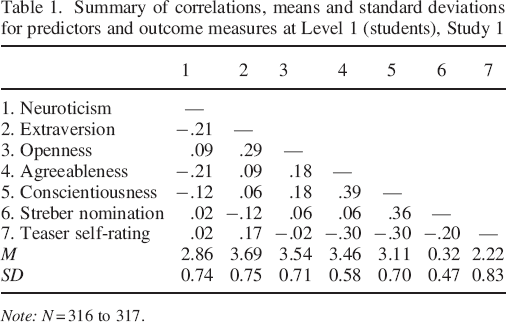
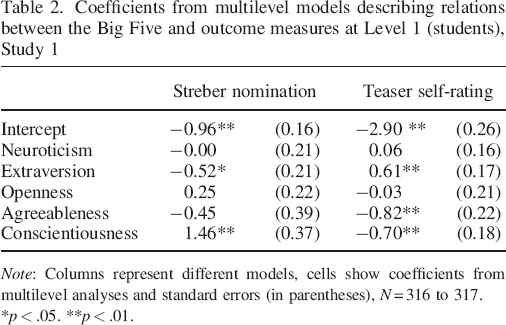
Descriptive statistics and correlations between all variables are listed in Table 1. Level–1 regression coefficients for multilevel models predicting Streber nominations and teaser self–ratings are shown in Table 2.
Summary of correlations, means and standard deviations for predictors and outcome measures at Level 1 (students), Study 1
Note: N = 316 to 317.
Coefficients from multilevel models describing relations between the Big Five and outcome measures at Level 1 (students), Study 1
Note: Columns represent different models, cells show coefficients from multilevel analyses and standard errors (in parentheses), N = 316 to 317.
p < .05.
p < .01.
Focusing on Streber nominations, as expected, conscientiousness was significantly positively related to being nominated a Streber in class (t = 3.94, p = .001), whereas openness did not reveal a significant effect (t = 1.11, p = .27). Furthermore, the likelihood of being nominated a Streber in class significantly increased with decreasing scores on extraversion (t = −2.50, p = .01). Thus, introverted and conscientious classmates were nominated as Strebers. Neuroticism and agreeableness did not reveal significant effects (ps > .26).
With respect to the teaser self–ratings, conscientiousness yielded a significant negative effect (t = −3.91, p < .001). In line with our hypotheses, students with higher extraversion (t = 3.66, p < .001) and lower scores on agreeableness (t = −3.75, p < .001) reported labelling others as Strebers more often than other students. Neuroticism and openness did not show significant effects (ps > .70). 5
Study 2
In Study 2, we aimed to replicate the findings from the first study using different operationalisations of so–called Strebers and teasers. The conceptualization of the Streber phenomenon was extended in that we considered the perception of students as Strebers as a two–sided process and took into account that the perception of another student depends not only on the characteristics of the target but also on the characteristics of the perceiver. For further illustration, Bill's rating of Anna as a typical Streber depends not only on Anna's characteristics but also on Bill's tendency to stigmatise his fellow students.
The Social Relations Model (SRM; Kenny, 1994) provides a conceptual and statistical framework for such dyadic processes. The SRM proposes that the rating of another person can be decomposed into three components (i.e. perceiver effect, target effect and relationship effect). For example, the perception of another student as a Streber consists of the average tendency of the rater to label others as Strebers (i.e. perceiver effect, ‘teaser’), the average effect of the target person to be perceived as a Streber by his or her classmates (i.e. target effect, ‘Streber’) and the specific tendency of a specific rater to perceive a specific target as a Streber (i.e. relationship effect). Target effects are similar to the mean of the ratings a student receives from all other classmates controlling for the average tendency of each of the classmates to rate others in a certain way. A perceiver effect reflects the mean of the ratings a student gives to his or her classmates controlling for how each classmate is seen by the other students in class (the formulas can be found in detail in Kenny, 1994, p. 236). Therefore, the rating of a student as a Streber can be seen as a kind of conglomerate of the target's reputation in class, the rater's teasing tendencies and the specific relationship between them. In contrast to Study 1, the design of Study 2 enabled us to separate the tendency of the rater to label others as Strebers from the effect of the target person to be perceived as a Streber in class and vice versa.
In Study 2, we extracted target and perceiver effects of Streber ratings via social relations analysis and used them as new indicators of Strebers and teasers, respectively. Apart from that, we examined whether the findings from Study 1 would also hold when students’ academic achievement was included as a control variable in the multilevel models. Furthermore, we tested whether the average classroom achievement would contribute to the relations mentioned earlier.
Method
Participants
Four hundred forty–two students from 20 eighth–grade classes at eight German schools were contacted to participate in the study. In total, 358 students participated in the study at the end of the school year. This dropout was primarily due to parents not giving consent and to students being ill on the day when the study was conducted in class. Participants who had problems understanding the instructions or who skipped full pages of the questionnaire (3%, 12 students) and participants who did not provide ratings on any target (4%, 16 students) were excluded from the analyses (Kenny, 2007). The final sample consisted of 330 students (163 girls, 157 boys) 6 from 20 classes. Participants’ ages ranged from 13 to 17 years (M = 14.3, SD = 0.6).
Measures
Personality
As in Study 1, the Big Five personality traits were assessed with the BFI (John et al., 1991; German adaptation by Lang et al., 2001). One item had to be excluded from the analyses (openness) because of a low corrected item–total correlation (cf. Roth, 2002, for similar results). Internal consistencies of the final scales were .74 (neuroticism), .82 (extraversion), .79 (openness), .61 (agreeableness) and 0.76 (conscientiousness). 7
Strebers and teasers
Using a round robin design, students had to rate each of their classmates and indicate the extent to which they think the other student is a Streber (one indicator; ‘I think X is a Streber’). Responses were made on 7–point Likert scales ranging from 1 (strongly disagree) to 7 (strongly agree). To guarantee anonymity, we used numeric codes on the answer sheets. All students received a list with the names of their classmates, and each name was linked to a numeric code. The numeric codes were presented in a random order.
Academic achievement
Individual grade averages were computed by calculating the mean of the students’ self–reported grades in math, physics, German and English. Class grade averages were computed by calculating the mean of all individual grade averages within one class. In the German grading system, low scores correspond with high achievements. For ease of interpretation, scores were inverted prior to analyses, such that high scores represent high achievement.
Procedure
The procedure closely resembled that of Study 1. Participants first completed personality measures and then the round robin design. In accordance with ethical considerations and parental as well as school consent, we used numeric codes in order to guarantee anonymity. A research assistant assured the students that the lists with students’ names would be destroyed after the study. Participants provided information on demographics and individual grades at the end of the questionnaire.
Strategy for data analysis
In the current study, social relations effects of Streber peer ratings were computed via social relations analysis using the R package Triple R (Schmukle, Schönbrodt, & Back, 2010). 8 Group size varied from 8 to 27 participants. Target and perceiver effects were uncentered as classes varied with regard to class size and class grade average. Thereafter, we ran multilevel analyses with the software HLM 7.0 (Raudenbush et al., 2011) to predict target and perceiver effects on Streber perceptions. As in Study 1, students were modelled at Level 1 nested in classes at Level 2. Predictors at Level 1 were group–mean centred and entered into the models simultaneously to control for their intercorrelations. In the first model, the SRM target and perceiver effects were predicted by Big Five personality traits. In the second model, target and perceiver effects were predicted by the Big Five controlling for individual grade average. 9 In the third model, class grade average was entered as a predictor at Level 2. Prior to analyses, class grade average scores were z–standardised across all classes. This procedure is similar to the grand–mean centering of the Level–2 predictor.
Results
Social relations analysis
The analysis revealed that perceiver, target and relationship variances were significantly different from zero (ps < .001), indicating that Streber ratings did not depend on only one of the components. Twenty–five per cent of the variance represented target variance, reflecting consensus within classes in rating students as Strebers. Perceiver variance was about 21%. Relationship variance was particularly large (54%). This is a typical finding as measurement error could not be separated from relationship variance because there were no multiple indicators of Streber ratings. Furthermore, Streber ratings did not show reciprocity effects: Generalised reciprocity, the correlation between perceiver and target effects (r = −.08, p = .41) and dyadic reciprocity, the correlation between relationship effects (r = −.002, p = .93), were almost zero. This finding indicates that perceiving others as Strebers is not answered by being perceived as a Streber in return.
Multilevel analyses
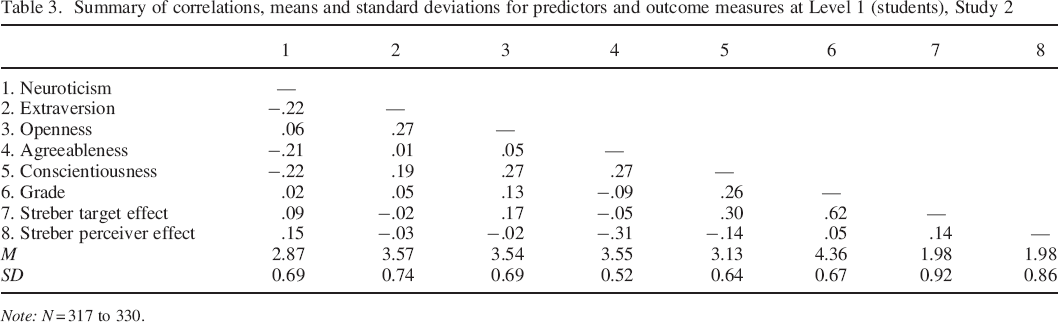
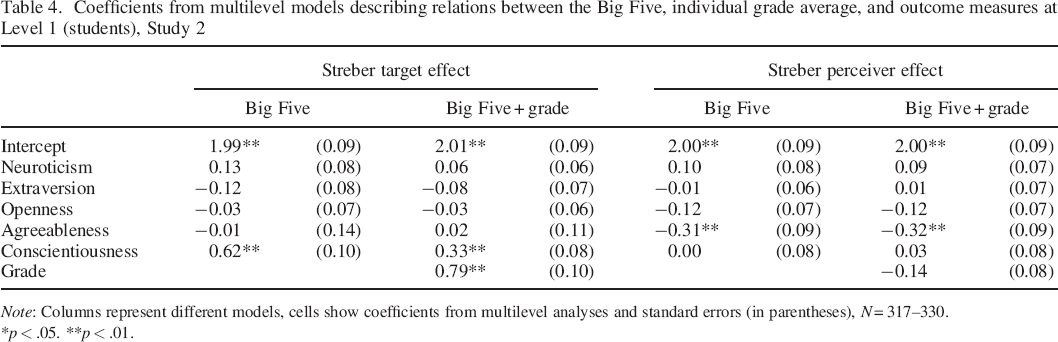
Descriptive statistics and correlations of all variables are listed in Table 3. Multilevel models were used to predict Streber target effects and Streber perceiver effects (Table 4).
Summary of correlations, means and standard deviations for predictors and outcome measures at Level 1 (students), Study 2
Note: N = 317 to 330.
Coefficients from multilevel models describing relations between the Big Five, individual grade average, and outcome measures at Level 1 (students), Study 2
Note: Columns represent different models, cells show coefficients from multilevel analyses and standard errors (in parentheses), N = 317–330.
p < .05.
p < .01.
Predicting Streber target effects
Matching the results from Study 1, we found a significant positive effect of conscientiousness on being perceived as a Streber in class (t = 6.10, p < .001) in the first model. Again, in line with our hypothesis, openness did not have a significant effect (t = −0.49, p = .62). Extraversion was negatively but not significantly related to the Streber target effect (t = −1.40, p = .18). Thus, in contrast to Study 1, the risk of being perceived as a Streber was not higher for more introverted students in class. All other Big Five factors did not reveal significant effects (ps > .14).
In the second model, we used the Big Five as predictors and controlled for individual grade average. If the relation between conscientiousness and being perceived as a Streber in class could be fully explained by academic achievement, then the regression coefficient between conscientiousness and the target effect would no longer be significant when controlling for individual grade average. This was not the case (Table 4). Instead, conscientiousness still significantly predicted the Streber target effect (t = 4.14, p = .001). In line with the results of the first model (without controlling for grade average), all other Big Five factors did not reveal significant effects (ps > .25).
Additionally, a further analysis including main effects and interaction effects between personality predictors and individual grade average indicated a significant interaction between conscientiousness and individual grade average (b = 0.61, t = 5.33, p < .001; with main effects remaining significant). For examining the direction of the effect, Level 1 equations for this interaction effect were estimated for students at 1 SD above the mean and 1 SD below the mean of individual grade average: In students with higher individual grades, the relation between conscientiousness and being perceived as a Streber was stronger (b = 0.78) as compared with students with lower individual grade averages in class (b = 0.08). Thus, the positive relation between conscientiousness and being perceived as a Streber in class was especially pronounced in students with high individual grade averages. The simple slopes for values on conscientiousness 1 SD above and 1 SD below the mean are displayed in Figure 1. 10
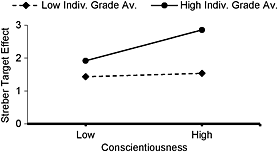
Simple slopes of Streber target effects on conscientiousness at high and low levels of individual grade average.
In the third model, we ran intercepts–and–slopes–as–outcomes analyses (Burstein, Linn, & Capell, 1978; Raudenbush & Bryk, 2002) to examine whether the relations between individual variables such as personality traits and the target effect were moderated by classroom context and whether the classroom context had an impact on the Streber target effect per se. Although our first two models had not yielded a significant main effect of extraversion on being rated a Streber in class, the analysis revealed that the negative relation between extraversion and the Streber target effect was moderated by class grade average (γ = −0.17, t = −2.70, p = .01). For examining the direction of the effect, within–class equations for this cross–level interaction effect (consisting of an intercept and the slope for extraversion) were estimated for classes at 1 SD above the mean and 1 SD below the mean of class grade average (see Huguet et al., 2009; Nezlek & Plesko, 2003). The negative effect of extraversion on the target effect could be found only in high–achieving classes (b = −0.23) but not in low–achieving classes (b = 0.11). Only in high–achieving classes were introverted students at a higher risk of being perceived as a Streber than extraverted students. The simple slopes for values on extraversion 1 SD above and 1 SD below the mean are displayed in Figure 2. We also explored cross–level interactions for the other Big Five variables. None of them was significant (ps > .11).
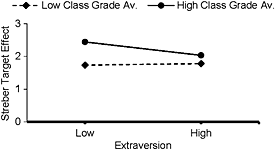
Simple slopes of Streber target effects on extraversion at high and low levels of class grade average.
Furthermore, we found that the relation between individual grade and the target effect at Level 1 was moderated by class grade average (γ = 0.27, t = 2.81, p = .01). Again, within–class equations for this cross–level interaction effect were estimated for classes 1 SD above the mean and 1 SD below the mean of class grade average. The positive effect of individual grade average on the Streber target effect was much stronger in high–achieving classes (b = 1.06) as compared with low–achieving classes (b = 0.53). Especially in high–performance classes, students with good grades were at higher risk of being the target of the Streber label than students with lower academic achievements (Figure 3).
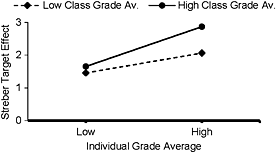
Simple slopes of Streber target effects on individual grade average at high and low levels of class grade average.
With respect to the relevance of a high–performance context, we also tested whether the outcome measure (Streber target effect) alone was determined by class grade average. Results showed that being rated a Streber (as indicated by the intercept of the Streber target effect) also varied across classes with respect to the class’ grade average: γ = 0.25, t = 3.14, p = .01, indicating that the phenomenon of being perceived as a Streber was stronger in high–achieving classes as compared with low–achieving classes. In high–performance contexts, students were at higher risk of being rated as Strebers than in low–performance contexts.
Predicting Streber perceiver effects
With respect to the question of who labels others as Strebers, agreeableness significantly predicted Streber perceiver ratings (t = −3.34, p = .001) in the first model. Students low in agreeableness in particular tended to rate others as Strebers. This finding supported our expectations and the results from Study 1. The effect for openness (t = −1.65, p = .10) was not significant, although there was a moderate trend indicating that students with lower scores on openness had a stronger tendency to rate others as Strebers. All other main effects were not significant (ps > .23). Results remained the same when controlling for individual grade average in the second model (Table 4). 11
Although we had not provided hypotheses about the relation between individual grade average and rating others as Strebers, individual grade average (t = −1.70, p = .09) revealed a moderate trend indicating that students with lower grades had a stronger tendency to rate others as Strebers. Furthermore, results from an intercepts–and–slopes–as–outcomes analysis (third model) revealed that the negative relation between individual grade average and Streber perceiver effect was significantly moderated by class grade average (γ = −0.20, t = −2.01, p = .04). Within–class equations indicated that the negative effect of individual grade average was true for high–achieving classes (b = −0.36) but not for low–achieving classes (b = 0.04). The simple slopes for values on individual grade average 1 SD above and 1 SD below the mean are displayed in Figure 4. As can be seen in Figure 4, only in high–achieving classes were students with lower grades more prone to rate others as Strebers than students with higher grades. All other cross–level interactions were not significant (ps > .26). 12
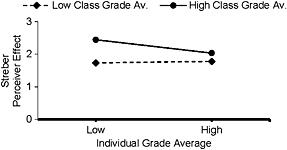
Simple slopes of Streber perceiver effects on individual grade average at high and low levels of class grade average.
With regard to the impact of classroom achievement on rating others as Strebers, results indicated that the ratings varied significantly across classes with respect to their grade average (γ = 0.24, t = 2.90, p = .01). Perceiving others as Strebers occurred in high–achieving classes in particular but less so in low–achieving classes, supporting our assumption that a high level of achievement in class fosters the devaluation of students as Strebers.
General Discussion
By taking personality into account, the current study was the first to investigate factors above and beyond academic achievement in predicting the labelling of students as Strebers. In doing so, we analysed both targets and actors of the labelling.
Predictors of being labelled and of labelling others
Extending previous research, our results show that personality traits significantly contribute to the labelling of students as Strebers even when controlling for academic achievement. We found that conscientious students were more likely than less conscientious students to be perceived as Strebers in class. In contrast to conscientiousness, there was no significant relation with openness. This is an interesting finding because both conscientiousness and openness have been found to be related to academic orientation. However, conscientiousness, in particular, is associated with effort and studiousness, whereas openness is associated with ability (Costa & McCrae, 1992; Trautwein et al., 2009). Our results that indicated that students who are labelled as Strebers are more conscientious than others in their class support findings that emphasise the negative perception of effort by peers (Juvonen & Murdock, 1993; Landsheer et al., 1998; Rentzsch et al., 2011). However, as we did not assess intelligence or effort per se, it would be relevant to include other objective measures of ability or effort aside from academic achievement in future research and to investigate their predictive values in the process of the labelling. Aside from the main effect of conscientiousness, our results revealed that the relation between conscientiousness and being perceived as a Streber was particularly pronounced in high–achieving students as compared with low–achieving students. Thus, even though previous research has primarily emphasised individual grades in predicting being labelled as a Streber (e.g. Pelkner & Boehnke, 2003), our research points to the importance of conscientiousness because conscientiousness reinforced the effect of grades on being labelled.
In addition, we found that students who were viewed as Strebers were more introverted than their classmates (particularly in high–achieving classes). This finding is in accordance with studies on interpersonal conflict (e.g. Scholte, Engels, Overbeek, de Kemp, & Haselager, 2007), and it dovetails with the description of so–called Strebers as being shy or withdrawn (Rentzsch & Schütz, 2012a). Building a bridge between introversion and being labelled, such behavioural tendencies might have fostered the perception of being a Streber (see also Back, Baumert, et al., 2011). Considering agreeableness and neuroticism in being labelled as a Streber, we did not find significant effects across both studies. The effects for neuroticism and agreeableness were consistently very low suggesting that students labelled as Strebers are not particularly high or low in emotional stability as well as agreeableness.
With respect to the students who label others, our studies consistently demonstrated that students who tend to label others as Strebers were less agreeable than other students in class. Interestingly, this finding fits with previous research on teasing and interpersonal conflict, suggesting that the actors of the teasing are those who show little compassion to others (Bollmer et al., 2006; Jensen–Campbell & Graziano, 2001; Tani et al., 2003). In Study 1, we found that those who label others were more extraverted and less conscientious than their classmates. Our results are in line with findings by Georgesen et al. (1999) who showed that teasers are particularly low in agreeableness and conscientiousness and high in extraversion. Furthermore, our result on conscientiousness in those who label others underline recent findings that conscientiousness comprises interpersonal aspects (e.g. students low in conscientiousness exhibit low self–regulatory skills, which in turn is related to interpersonal problem behaviour; Jensen–Campbell & Malcolm, 2007).
In sum, we found that the effects of conscientiousness on being the target of the labelling and disagreeableness on labelling others, as well as extraversion on being the target of labelling in high–achieving classes were consistent across both studies. In accordance with previous studies that have shown that personality traits influence classroom behaviour and adjustment (Graziano et al., 1997), our findings on peer perceptions point to the relevance of personality characteristics in labelled students. For example, because introversion is negatively related to social competency (Graziano & Ward, 1992) and to adjustment in peer relationships (Graziano et al., 1997) but positively related to general peer victimisation (Mynard & Joseph, 1997), introverted students who are perceived as Strebers are potentially at risk of becoming the targets of ongoing stigmatisation.
However, the significant effects of extraversion and conscientiousness on labelling others as Strebers could not be replicated in Study 2. That result may be due to the different operationalisations of students who label others: self–ratings in Study 1 and perceiver effects in Study 2. First, the difference may be due to the fact that the teaser self–rating in Study 1 referred to self–reported frequencies of behaviour (‘How often have you called a classmate “Streber”?’), whereas the other–ratings from Study 2 were about perceptions (‘I think X is a Streber’) with regard to indicating the extent to which one perceives others as Strebers. In fact, the method in Study 2 may be regarded as more indirect because it was less transparent to participants that the study was on labelling or stigmatisation. Second, the ratings in the two studies differed in that Study 1 was about frequencies, and Study 2 was about intensities. Third, Study 2 corrected for target effects, whereas Study 1 did not. Fourth, shared method variance might be an issue: In Study 1, the teaser self–rating was regressed on personality self–ratings, whereas in Study 2, other–ratings (the perceiver effect) were regressed on personality self–ratings. As there might have been more common variance among the self–rating measures in Study 1 as compared with the other–rating and self–rating measures in Study 2, this might have fostered stronger effects on labelling others as Strebers in Study 1 than in Study 2. As the perceiver effects reflect rater tendencies that are not confounded by the tendencies of the targets and less affected by socially desirable responding, this approach seems to be the more solid one and ought to be the procedure of choice in future studies even if the procedure is very time–consuming.
The importance of class performance
Aside from individual characteristics, our research points out that the average performance in a class—a context factor that has not yet been examined in interpersonal perception—plays a critical role in labelling. Our results showed a consistent pattern: Being perceived as a Streber, perceiving others as Strebers and their relations with extraversion and individual grade average were found in high–achieving classes in particular.
Drawing on the literature about the Big–Fish–Little–Pond effect, it has been suggested that the comparison level of classes has a strong influence on individual perceptions (Huguet et al., 2009). It therefore seems plausible that in high–performance contexts in particular, the striving of peers is taken seriously and is not easily forgiven. Maybe it is the competitive atmosphere within high–achieving classes that leads students to compare themselves with others and—if that comparison reveals an unfavourable outcome—to devalue those who excel and fit the characteristics of a stereotype (Bishop et al., 2004).
Strengths, limitations and directions for future research
The current research benefits from several methodological advantages. Multilevel random coefficient modelling was used to take the hierarchical data structure into account and to simultaneously examine the effects of Level–2 (e.g. class grade average) and Level–1 variables (e.g. extraversion). Only with such analyses can the impact of classroom achievement on individual level relations be analysed properly (Raudenbush & Bryk, 2002). In addition, it should be emphasised that our data go beyond self–reports because being labelled was primarily assessed via peer ratings. More specifically, we used peer nominations in Study 1 and peer perceptions from a round robin design in Study 2. We extended the one–sided perceptions from Study 1 by using two–sided perceptions in Study 2: By partitioning peer perceptions into perceiver, target and relationship effects, we took the dyadic nature of interpersonal perceptions into account (Kenny, 1994).
Despite those methodological advantages, there are also methodological limitations. As outlined before, because of the operationalisation of being labelled a Streber by interpersonal perceptions in Study 2, we did not assess interpersonal behaviour such as teasing or bullying. It is therefore not clear whether somebody who strongly tends to rate others as Strebers also tends to publicly use the term for derogation in the classroom or engages in other active bullying. Although our results are similar to those from studies on teasing or interpersonal conflict, they still cannot be generalised to interpersonal behaviour in the classroom. Additionally, our hypotheses on personality traits and being labelled were based on research showing that personality is reflected in observable behaviour (Borkenau et al., 2004; Vazire, 2010), which causes interpersonal perceptions (Back, Baumert, et al., 2011; Funder, 1999). According to the PERSOC (personality and social relationships) model (Back, Baumert, et al., 2011), certain cues of the observed person, which correspond with the personality traits of the observed person, are supposed to be connected to interpersonal perceptions in the observer. Still, the question remains regarding which observable cues have the potential to foster perceptions of a student as a Streber depending on his or her personality. For example, introverted students might have been perceived as Strebers because they wore glasses, unfashionable clothes or sat alone in class (see Back, Schmukle, et al., 2011, for the cue correlates of extraversion). Here, glasses, clothes or seating distance could have served as cues that mediated the relation between personality and interpersonal perceptions. Future research should therefore try to replicate the current findings and include observations of behaviour (see the special issue on Personality Psychology as a truly behavioural science, Furr, 2009) and relevant cues. Moreover, our results point to the Big Five personality traits and academic achievement as meaningful predictors of the labelling. However, there was still variance in the outcome measures that remained unexplained. Considering the negative connotation of the label Streber, future research is clearly warranted to examine further predictors of the labelling of students as Strebers.
An important limitation is the correlational and cross–sectional design of our study, which makes it impossible to draw conclusions about the causal direction of the effects that have been found. For example, introversion could be a risk factor of being labelled a Streber, but the reverse pattern could also be true: Maybe students become more introverted and withdrawn because of the labelling. Future research should use longitudinal or experimental designs to provide insight into the causes of the labelling as well as the long–term consequences.
Future studies also should investigate whether our results can be generalised to other societies. The representativeness of our studies is limited in that both samples were drawn from German schools. However, there are some indications that the phenomenon is not restricted to Germany or Europe and that similar labels are used in countries like the USA or Israel (Bishop et al., 2004; Boehnke et al., 2004; Brown et al., 1994; Rentzsch et al., 2011; Tal & Babad, 1990). Clearly, cross–cultural research is needed to understand the correlates of this phenomenon in different societies.
Footnotes
Acknowledgement
We are grateful to the German National Academic Foundation for the financial support of this research.