







Abstract
Applying regulatory focus theory to the context of social dilemma situations, the present research demonstrates that individual differences in vigilant, prevention–focused self–regulation predict the tendency to invest private resources to punish uncooperative interaction partners (costly punishment), a behaviour that typically has strong positive effects on the collective level of cooperation. Analyses further support the distinctiveness of the vigilance system proposed in regulatory focus theory (prevention focus) in comparison with general defensive inhibitory tendencies (measured with Carver and White's Behavioral Inhibition System scale). Results document that individual differences in prevention–focused self–regulation but not differences in general defensive inhibitory tendencies are positively related to costly punishment. In sum, the findings indicate that vigilant, prevention–focused self–regulation plays a crucial role in the context of sanctions that enforce cooperation. Copyright © 2013 John Wiley & Sons, Ltd.
Keywords
Introduction
Whenever humans face the antagonism of benefiting oneself to the disadvantage of the collective, free riding is a potential tragedy (Hardin, 1968). This applies to public goods like (the conservation of) fresh air, (the formation of) civil defence corps and a (clean) kitchen in an apartment–sharing community. In these situations, every member of a group can benefit from the public good, although free riders who do not contribute to its provision (and thus save costs) benefit the most. This problem of free riding results in the question of how the potential tragedy of the collective can be avoided, that is, how cooperation can be established and free riding reduced.
One prominent solution is to establish a system of costly punishment, that is, the option to invest private resources to punish uncooperative interaction partners (McCullough, 2008; Rockenbach & Milinski, 2006; Shinada & Yamagishi, 2008). However, the main problem of establishing a sanction system is that these systems are themselves public goods (second–order public goods) because the question arises who actually pays for the costly punishment of uncooperative interaction partners. This problem is even more stressed in one–shot interactions when there is no opportunity of obtaining benefits from a potentially cooperative behaviour of a punished interaction partner in the future. To put it another way, there are no direct economic reasons (serving one's material self–interest) to engage in costly punishment in one–shot situations; it is just costly. Nevertheless, individuals actually engage in costly punishment, even in one–shot situations where there are no monetary reasons to punish directly applicable (Kollock, 1998). Remarkably, the engagement in costly punishment has strong and positive effects on the collective level of cooperative behaviour (Balliet, Mulder, & Van Lange, 2011; Fehr & Gächter, 2002).
It is the central feature of the present work to relate costly punishment in one–shot situations to a prominent motivational approach: regulatory focus theory (RFT; Higgins, 1997, 1998). This specific focus is particularly promising because approaches addressing behaviour in social dilemmas, particularly regarding costly punishment, have largely ignored the role of self–regulatory orientations, although these orientations have been found to be of critical relevance with respect to a wide spectrum of cognitive, affective and behavioural phenomena (for a review, see Molden, Lee, & Higgins, 2008). Moreover, Perugini and De Raad (2001) emphasized the high potential of chronic orientations regarding the analysis of behaviour in social dilemma situations. Similarly, Ferguson, Heckman, and Corr (2011) referred to the fact that there is a growing awareness regarding the importance of individual differences (i.e. personality characteristics) in the study of economic behaviour. Hilbig, Zettler, and Heydasch (2012), for instance, used the HEXACO model to predict cooperative behaviour in a public goods game. Findings indicate that those relatively low in Honesty–Humility adjust their behaviour and act more cooperatively when a punishment option (vs. no such option) was present. Gollwitzer, Rothmund, Pfeiffer, and Ensenbach (2009) as well as Skatova and Ferguson (2011) predicted cooperative behaviour from the perspective of individual differences in justice sensitivity and the Behavioral Inhibition System (BIS)/Behavioral Activation System (BAS) approach. However, to the best of our knowledge, costly punishment of non–cooperative interaction partners involved in a public goods dilemma has not been addressed from a personality psychology perspective to date. In this sense, our approach to examine the association between chronic orientations (specifically, prevention–focused self–regulatory orientation) and costly punishment reflects a step in a new direction and constitutes a contribution to research on social dilemmas that closes a gap in this field of study.
Specifically, in the present work, the assumption was put to the test that individuals are more likely to punish uncooperative group members in a typical costly punishment paradigm the more they are vigilantly prevention–focused in their orientation. Dealing with individual differences in self–regulatory orientations regarding the engagement in costly punishment, we address the (differential) relation between costly punishment and (a) prevention–focused self–regulation and (b) general defensive inhibitory tendencies. As we will point out, individual differences in behavioural inhibition (BI) tendencies and prevention–focused self–regulation share several aspects. However, the distinctions between the two vigilant orientations are crucial for our argumentation according to which only prevention–focused self–regulation is positively related to costly punishment. The theoretical notions underlying this assumption are discussed in the next sections.
Core Assumptions Of Regulatory Focus Theory
Regulatory focus theory holds that it is necessary to differentiate among distinct types of pleasures and distinct types of pain, and to assess the specific strategic orientations and types of goal pursuit that reflect self–regulation guided by two distinct motivational systems—promotion focus and prevention focus (Higgins, 1997). Self–regulation with a promotion focus is characterized as the motivation to attain growth and nurturance, to bring one's actual self into alignment with one's ideal self, and to reach gains (and avoid non–gains). In contrast, self–regulation with a prevention focus entails the motivation to attain security, to bring one's actual self into alignment with one's ought self (i.e. fulfilling one's duties and obligations), and to avoid losses (and attain non–losses).
Research on RFT (cf. Higgins & Spiegel, 2004) shows that both types of regulatory orientations are related to specific consequences. The psychological consequences of promotion–focused self–regulation are (a) a special sensitivity to the presence or absence of positive outcomes (Higgins, 1997, 2009), (b) an application of eager approach strategic means (Crowe & Higgins, 1997), (c) a risky orientation in the pursuit of maximal goals with positive valence (Higgins, 2009), (d) cheerfulness–dejection emotions in response to positive and negative events (Idson, Liberman, & Higgins, 2000) and (e) an independent self–construal emphasizing the uniqueness of the self (Aaker & Lee, 2001; Lee, Aaker, & Gardner, 2000; Lockwood, Marshall, & Sadler, 2005).
Most important, in the present context, the psychological consequences of prevention–focused self–regulation are (a) a special sensitivity to the presence or absence of negative outcomes (Higgins, 1997, 2009), (b) an application of vigilant avoidance strategic means (Crowe & Higgins, 1997), (c) a risk–averse and defensive orientation in the pursuit of minimal goals with positive valence and a risky bias in a state of a loss (Higgins, 2009; Scholer, Zou, Fujita, Stroessner, & Higgins, 2010), (d) quiescence–agitation emotions (i.e. relaxation vs. fear and anxiety) in response to positive and negative events (Idson et al., 2000) and (e) an interdependent self–construal emphasizing the social connectedness of the self (Aaker & Lee, 2001; Lee et al., 2000; Lockwood et al., 2005).
According to RFT, individuals differ in their predominant chronic self–regulatory orientations, largely as a function of parenting styles (cf. Keller, 2008). Several measures to assess chronic regulatory focus have been developed (e.g. regulatory focus questionnaires, cf. Higgins et al., 2001; Keller & Bless, 2008; Lockwood, Jordan, & Kunda, 2002; regulatory strength measures, cf. Shah, Higgins, & Friedman, 1998). The two self–regulatory systems can also be manipulated, that is, situationally induced or primed (Freitas, Liberman, & Higgins, 2002; Friedman & Förster, 2001; Pham & Avnet, 2009; Roney, Higgins, & Shah, 1995; Shah et al., 1998). It is important to note that the two modes of self–regulation have been conceptualized as distinct constructs. Thus, prevention–focused self–regulation does not represent the opposite pole of promotion–focused self–regulation. This implies that it is possible that one of the two modes is associated with a certain phenomenon or construct, whereas the other mode is not.
On Regulatory Focus And Costly Punishment
In the present work, we argue that one specific mode of self–regulatory orientation, that is, prevention–focused self–regulation, fosters costly punishment in public goods situations. Several lines of reasoning suggest this positive link. First, it has been shown that the relevant standards of prevention–focused individuals‘ represent duties, responsibilities and oughts reflecting normative standards (Higgins, 1997). Moreover, the prevention focus is linked to a special concern with interdependence and social connectedness (Aaker & Lee, 2001; Lee et al., 2000; Lockwood et al., 2005), indicating a tendency to act in accordance with the subjectively imposed expectations of significant others (representing social norms) rather than in accordance with own personal ideals (Markus & Kitayama, 1991). In this sense, Keller, Hurst, and Uskul (2008) showed that individuals hold a stronger negative reciprocity norm the more they are prevention–focused. Given that uncooperative behaviour of others can be conceptualized as a fairness norm violation that damages interpersonal connectedness (Cubitt, Drouvelis, Gächter, & Kabalind, 2011; Fehr & Fischbacher, 2004; Knoch, Gianotti, Baumgartner, & Fehr, 2010), those individuals with a special concern with normative standards, that is, prevention–focused individuals, are most likely to reciprocate and punish those who violate relevant normative standards in the attempt to maintain the normative status quo.
Second, the differential sensitivity assumption of RFT holds that prevention–focused individuals are particularly sensitive to the presence or absence of negative outcomes (Higgins, 1997; Higgins, 2009). Neural correlates support this assumption indicating a greater activity in the amygdala, anterior cingulate and extrastriate cortex for prevention–focused individuals when negative (vs. positive) information is presented (Cunningham, Raye, & Johnson, 2005). In the context of public goods, one can state that public goods involve the possibility that unfair free riders cause a negative outcome of the common group project (public good) because they violate the fairness norm. Because of the sensitivity to negative outcomes involving norm violations, it seems reasonable to assume that prevention–focused individuals react particularly strongly to such a negative outcome and are prone to punish those identified as the cause for the negative outcome.
Third, it has been shown that prevention–focused individuals apply vigilant avoidance strategies in goal striving (Crowe & Higgins, 1997; Scholer & Higgins, 2011). In this sense, a vigilant strategy reflects a tendency to cautiously avoid situations in which unfair treatment may occur (Oyserman, Uskul, Yoder, Nesse, & Williams, 2007). However, if prevention–focused individuals are actually confronted with negative outcomes, prevention–focused individuals are more likely to interpret this situation as unfair because of a sensitivity to unfair treatment (a negative outcome). Empirically, Oyserman et al. (2007, Study 3) demonstrated that participants in a prevention–primed (vs. promotion–primed) condition perceived an ambiguous event with a negative outcome as significantly more unfair. Applying this argumentation and finding to the context of uncooperative behaviour in public goods, we argue that prevention–focused individuals are vigilant regarding unfair behaviour of others and more likely to interpret ambiguous behaviour as unfair given their special concern with normative standards. Consequently, following the notion that costly punishment reflects a response to a fairness norm violation (Cubitt et al., 2011; Fehr & Fischbacher, 2004; Knoch et al., 2010), it seems reasonable to argue that prevention–focused individuals are particularly vigilant regarding potentially unfair behaviour and therefore most likely to punish unfair others.
Taken together, there are good reasons to expect a significant positive relation between prevention–focused self–regulation and costly punishment. However, we do not expect an association of the promotion focus and costly punishment because none of the factors characterizing this mode of self–regulation (eagerness, ideal self, independence, need for personal development and growth) appears conceptually closely related to factors determining individuals‘ tendency to punish others. This proposed differential relation is well in line with the conceptual distinction of the two modes of self–regulation. Accordingly, one can expect to find a positive relation between prevention–focused self–regulation and costly punishment, whereas from a theoretical perspective, there is no good reason to expect a relation between promotion focus and costly punishment.
Regulatory Focus In Distinction To General Defensive Inhibitory Tendencies
In the present work, we address the distinction between vigilant self–regulation as conceptualized in RFT (prevention–focused self–regulation) and general defensive and inhibitory tendencies (BI) as conceptualized in theoretical approaches building on the basic hedonic principle according to which individuals approach pleasure and avoid pain (for a systematic discussion of these theoretical approaches, see Higgins, 1998; chapters in Elliot, 2008, or in Vohs & Baumeister, 2011). That is, when we refer to general defensive inhibitory tendencies, we allude to individual differences in orientations that reflect the inhibition of behaviour and movements towards goals (Carver & White, 1994). In line with Rothbart, Ellis, and Posner (2011), our approach builds on the analogy of BI as the ‘brakes’ on behaviour. According to Carver and White (1994), the BI system reflects such general defensive inhibitory tendencies, and the BIS scale was designed to assess individual differences in such general defensive inhibitory tendencies. Accordingly, we included Carver and White's (1994) BIS scale in our analysis to distinguish prevention–focused self–regulation from general defensive inhibitory tendencies (BI). 1 Referring to the current work, it was expected that only individual differences in prevention–focused self–regulation but not differences in general defensive inhibitory tendencies are related to costly punishment.
This proposed differential relation may appear counterintuitive, because BI and prevention–focused self–regulation share several aspects, such as the special sensitivity to negative outcomes, the agitation–related emotions (fear and anxiety) that result from the experience (or anticipation) of negative events, strategic vigilance in goal striving (Corr, 2009; Scholer & Higgins, 2008) and a positive association with neuroticism due to a common overlap with anxiety (Jorm et al., 1999; Keiser & Ross, 2011; Smits & Boeck, 2006; Keller et al., 2008; Winterheld & Simpson, 2011). Consequently, significant positive correlations between chronic prevention focus and BI are typically found (McGregor, Gailliot, Vasquez, & Nash, 2007; Summerville & Roese 2008; Winterheld & Simpson, 2011). However, irrespective of the obvious similarity of the two systems, we expected that only prevention–focused self–regulation but not BI is related to costly punishment.
Specifically, the prevention focus is explicitly proposed to be linked to duties, obligations and responsibilities as relevant standards. Accordingly, RFT predicts that vigilant self–regulation is linked to paying special attention to social norms, as these are conceptually closely related to duties, obligations and responsibilities. In contrast, BI is not specifically related to a special attention to social norms. Furthermore, it has been shown that prevention–focused self–regulation is specifically associated with a special concern with interdependence and social connectedness (Aaker & Lee, 2001; Lee et al., 2000; Lockwood et al., 2005), whereas BI is not. Hence, only RFT predicts that vigilant self–regulation is linked to a concern with social connectedness. Note that both of these aspects (i.e. a concern with normative standards and social connectedness) are particularly important regarding behaviour in a social dilemma situation such as addressed in the study reported herein.
Finally, BI reflects general defensive and inhibitory tendencies, whereas prevention–focused self–regulation involves important other components that are related to activation mechanisms (Higgins, 1997; Higgins & Spiegel, 2004; Keller & Pfattheicher, 2011). Applied to the present context, one may reasonably argue that the punishment of uncooperative individuals represents a type of behaviour that requires the active initiation of a response rather than the inhibition of a behavioural tendency.
In combination, there are reasonable arguments supporting the conclusion that BI is unlikely to predict costly punishment of uncooperative individuals, whereas a prevention–focused mode of self–regulation is likely to predict this behavioural tendency. Such a differential relation between costly punishment and BI versus prevention focus would provide evidence supporting and justifying the differentiation of the self–regulatory tendencies. First empirical evidence supporting such a differentiation of the two tendencies was reported by Winterheld and Simpson (2011, Study 1) who showed distinctive effects of prevention and promotion focus on the discussion of conflict details (positive association with prevention focus) and creative problem solving (positive association with promotion focus) in romantic relationships. Specifically, prevention and promotion focus, measured with the regulatory focus scale (RFS) of Lockwood et al. (2002), remained significant after controlling for the BIS/BAS scales.
In sum, we hypothesize that a vigilant, prevention–focused self–regulatory orientation predicts individuals‘ willingness to costly punish uncooperative individuals in public goods situations. Additionally, we assume that the association of prevention–focused self–regulation and costly punishment remains robust after controlling for BI, indicating the uniqueness of prevention–focused self–regulation in distinction to general defensive inhibitory tendencies. In the study reported herein, we put these assumptions to an empirical test.
Study
Method
Participants
The study involved students at the University of Ulm (N = 144; Mage = 22.6; 45 females, two did not indicate their sex). Participants completed measures assessing chronic levels of regulatory focus before they read the explanation of the public goods game with a time gap (approx. 15 minutes) between the assessment of the RFS and the behaviour in the public goods game. The BIS/BAS scales were measured afterwards to minimize waiting time due to different time duration when answering the questionnaire items (all participants had to start the public goods game at the same time).
Regulatory focus
Chronic self–regulatory orientations were assessed with a German version (Keller & Bless, 2006) of the RFS developed by Lockwood et al. (2002). 2 Alpha reliabilities, means, standard deviations and zero–order correlations among the applied scales are displayed in Table 1.
Zero–order correlations among scales and behaviour
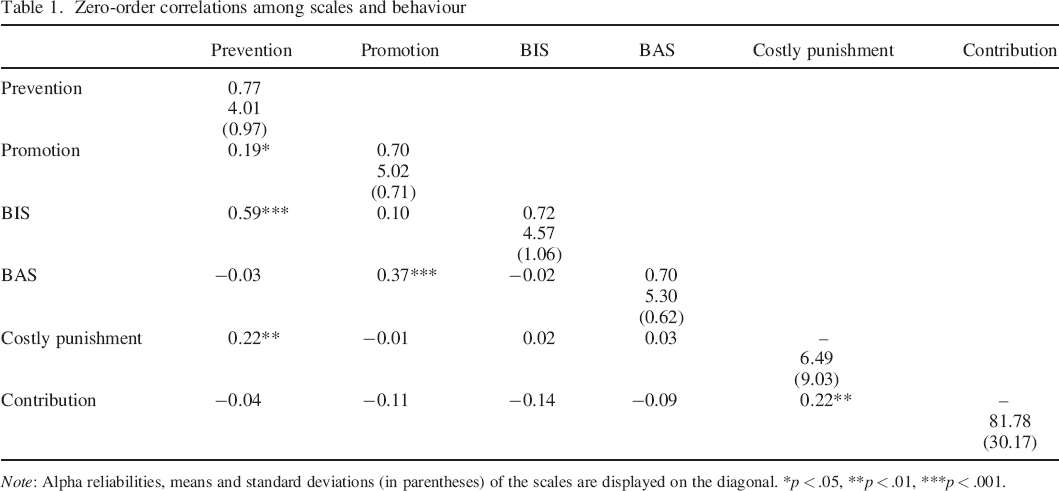
Note: Alpha reliabilities, means and standard deviations (in parentheses) of the scales are displayed on the diagonal.
p < .05.
p < .01.
p < .001.
Behavioral Inhibition System/Behavioral Activation System
Behavioural inhibition and behavioural activation were assessed using Carver and White's (1994) BIS/BAS scales.
Costly punishment
We used a standard public goods game with the option to punish costly (cf. Fehr & Gächter, 2002) and replicated the punishment condition of the study by Fehr and Gächter (2002), that is, we used their instructions, and participants played six periods of the public goods game with the option to costly punish under anonymous conditions. In the public goods game, four players constituted one group. Each player was endowed with 20 money units (MUs; 1 MU was equal to €0.05) and free to choose how many of them to keep and how many to contribute to the public good. Each MU contributed was multiplied by 1.6. Next, each player received one fourth of the public good, independently of his or her contribution. Accordingly, it was always in the material self–interest of every individual to keep all MUs privately irrespective of how much the other three subjects contributed. If all group members kept all MUs privately, each subject earned only 20 MUs, whereas if all of them invested their 20 MUs, each subject would earn 0.4 × 80 = 32 MUs. If one group member free rides (e.g. one contributes 0 MU) and the other three group members invested their 20 MUs, the free rider earns 44 MUs and each of the other three group members earns 24 MUs.
Afterwards, each player was given information on the contributions of the other three players and the option to costly punish them by investing own MUs (between 0 and 10 for each player) that reduced the selected other players‘ payoff by the factor of three (e.g. the investment of 2 MUs decreased the payoff of another by 6 MUs). Participants were told that the group composition randomly changed from period to period to reduce direct reciprocity accounts (Trivers, 1971). All interactions were computer–mediated via z–tree (Fischbacher, 2007), and all decisions were made simultaneously. As in the study by Fehr and Gächter (2002), 24 participants fit into our laboratory. Participants were privately paid their earnings (M = €6.45) at the end of the session.
As a critical measure of costly punishment, we computed the sum of MUs across the six periods of the public goods game the participant used for punishment of group members who contributed less than the participant him/herself (cf. Herrmann, Thöni, & Gächter, 2008).
Results
Preliminary results
In order to give the reader an impression of the contributions to the public good and investments in costly punishment, the descriptive statistics are reported first. The sum of MUs invested in the contribution to the public good across the six periods (maximum 6 × 20 MUs = 120 MUs) was 81.78 MUs (SD = 30.17). The sum of MUs invested in costly punishment across the six periods was 6.49 MUs (SD = 9.03). 25.7% of participants did not invest any MU in costly punishment. The contributions and investments in costly punishment were significantly correlated, r = .22, p < .01 (as in the study by Fehr & Gächter, 2002). Overall, the observed values are similar to those reported by Fehr and Gächter (2002). Neither prevention focus nor promotion focus nor BIS nor BAS significantly predicted the contribution to the public good.
Prevention focus and costly punishment
We found that prevention focus (β = 2.14, t = 2.78, p < .01) but not promotion focus (β = −0.30, t = −0.29, p = .78) was positively related to costly punishment (see Tables 1 and 2, Model 2). 3
Linear regression analyses testing the association between regulatory focus and costly punishment
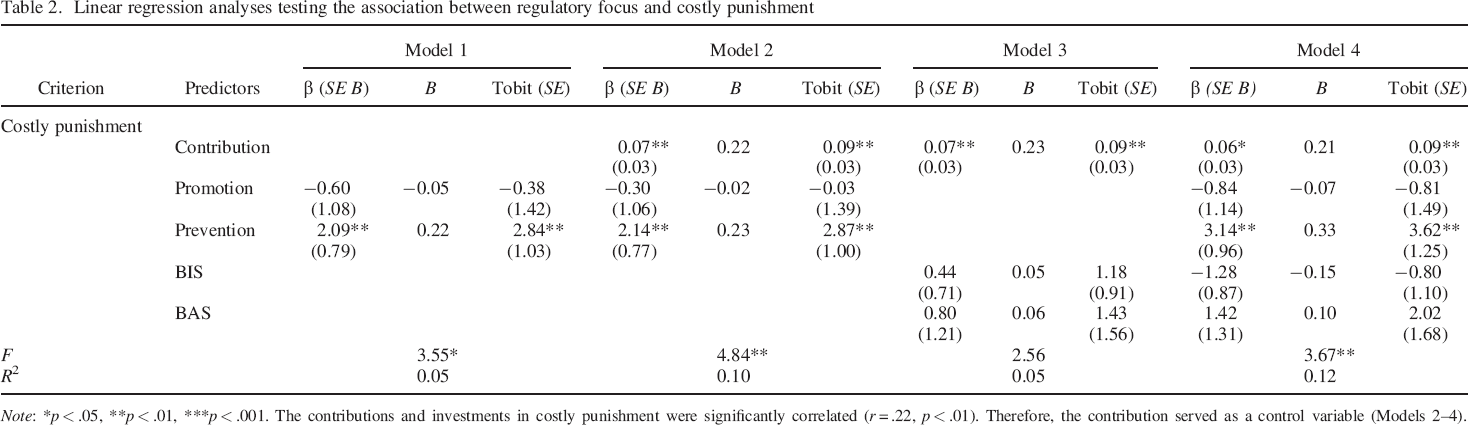
Note:
p < .05.
p < .01.
p < .001. The contributions and investments in costly punishment were significantly correlated (r = .22, p < .01). Therefore, the contribution served as a control variable (Models 2–4).
Behavioral Inhibition System/Behavioral Activation System included
Individual differences in prevention–focused self–regulation predict costly punishment, but the BIS scale does not predict costly punishment (see Table 2, Model 4). Entering only BIS/BAS scales as predictors into regression models revealed no significant coefficients for either BIS or BAS (ps > .51; see Table 2, Model 3). Additionally, none of the subscales of the BAS (Reward Responsiveness, Drive, Fun Seeking) as well as the revised BIS scale (Heym, Ferguson, & Lawrence, 2008; Keiser & Ross, 2011) that splits the original scale into BIS–anxiety and FFFS–fear reached the level of significance when entered without the RFS or after Model 2.
Further analyses
Given the proportion of participants who never engaged in costly punishment (25.7%), Tobit regression analysis seems to be the most appropriate way to analyze the data (cf. McDonald & Moffitt, 1980). We want to emphasize the fact that results using Tobit regressions are essentially equivalent to all reported linear regression results (see Table 2). Additionally, in order to test for robustness, we bootstrapped all analyses reported in the present work (based on 1000 resamples) and found identical results, that is, all reported p–values below .05 corresponded to the 95% confidence interval that excludes zero.
In order to exclude the notion that prevention–focused participants behaved in a hostile manner and punished indiscriminately, all analyses reported in Table 1 were reanalyzed by substituting costly punishment with antisocial punishment (i.e. the punishment of cooperative individuals; see Herrmann et al., 2008). Neither prevention, promotion, BIS or BAS emerged as a significant predictor of antisocial punishment (all ps > .36). The contribution was negatively correlated to antisocial punishment (r = −.38, p < .001).
In combination, the findings support the assumption that a prevention–focused self–regulatory orientation but not the BIS scale predicts individuals‘ tendency to punish uncooperative group members in public goods situations.
Discussion
In 2009, the Nobel Prize in economic sciences was awarded to political economist Elinor Ostrom. In her seminal work (Ostrom, 1990), she asked the highly relevant question of how to govern the commons and offered several solutions how to solve the free rider problem. One structural solution is to implement an option to punish the uncooperative free rider. However, when punishment is costly, the question arises who actually pays for the punishment of uncooperative free riders. This problem is particularly critical in one–shot interactions when there is no opportunity of obtaining benefits from a potentially cooperative behaviour of a punished free rider in the future. Whereas research (mainly in politics and economics) dealing with costly punishment of free riders produced a large amount of articles in recent years, individual differences in chronic orientations have been almost completely neglected in this research. In this sense, the current work contributes to a better understanding of costly punishment that is quite important given that this kind of behaviour is known to foster cooperative behaviour in such a remarkably strong way (Balliet et al., 2011; Fehr & Gächter, 2002).
To summarize the present research relating costly punishment in public goods situations to RFT (Higgins, 1998), it was proposed that a prevention–focused mode of self–regulation shows a positive relation to the tendency to punish uncooperative group members. The obtained findings support this hypothesis. In contrast, the promotion focus did not play a significant role in the reported study. This supports our assumptions that the factors characterizing this mode of self–regulation (eagerness, ideal self, independence and need for personal development and growth) are not closely related to costly punishment in public goods situations. Finally, our findings support the uniqueness of prevention–focused self–regulation in distinction to general defensive inhibitory tendencies. Prevention–focused self–regulation was positively related to costly punishment, whereas general defensive inhibitory tendencies, measured with the BIS scale, were not significantly related.
As outlined earlier, prevention–focused self–regulation and BI share several facets such as the special sensitivity to negative outcomes, the association with agitation–related emotions (fear and anxiety) that result from the experience (or anticipation) of negative events, the strategic vigilance in goal striving and a positive correlation with neuroticism. However, we emphasized the fact that BI and prevention–focused self–regulation can be distinguished with respect to the special concern with normative standards, interdependence and social connectedness, and the essentially inhibitory character of BI. These distinctions are highly relevant regarding our argumentation that is supported by the results documenting a positive association between costly punishment and individual differences in prevention–focused self–regulation (but not the BIS scale).
In critically reflecting the current work, we want to acknowledge the fact that the BIS/BAS scales were assessed after the public goods game, whereas the RFS was assessed before participants read the explanation of the game. A counterbalanced positioning (before vs. after the game) to control for order effects would have been a more appropriate approach. We acknowledge that spill–over effects could be possible, and we cannot fully rule out this possibility. Moreover, we want to note that the BIS/BAS scales were critically discussed in some contributions focusing on the fact that the instrument does not appropriately address the revised version of the reinforcement sensitivity theory (e.g. Smillie, 2008). However, we think that the application of the Carver and White BIS scale is well justified for studying individual differences in a general manifestation of defensive inhibitory tendencies. The main purpose of the present work was to distinguish the prevention focus from general defensive inhibitory tendencies. The focus was not on the BIS as outlined in the (revised) reinforcement sensitivity theory. 4
The reported research findings are innovative in several respects. First, in relating RFT to costly punishment in public goods, we document the crucial impact of a distinct self–regulatory orientation with regard to an important social interactive phenomenon. Given that we found a reliable positive association between vigilant, prevention–focused self–regulation and the tendency to punish uncooperative individuals, one implication of our work is that this distinct mode of self–regulation seems to play an important role in social situations involving normative elements. So far, the role of self–regulatory orientations has been largely neglected in the analysis of individuals‘ behaviour in social dilemmas, particularly regarding costly punishment.
Second, given the differential relations with costly punishment observed for individual differences in prevention–focused self–regulation and BI, the present study provides evidence supporting the differentiation of the two approaches differentiating distinct self–regulatory tendencies. This appears particularly important, as the two models share various features that may lead to the misleading conclusion that the prevention focus was redundant with BI (Haws, Dholakia, & Bearden, 2010).
Third, the current work reveals a functional aspect of prevention–focused self–regulation given its positive relation to costly punishment that has strong and positive effects on the collective level of cooperative behaviour (Balliet et al., 2011; Fehr & Gächter, 2002). Reviewing the literature on RFT (e.g. Molden et al., 2008), one can easily get the impression that the promotion focus was functionally superior to the prevention focus. Therefore, by highlighting the functional aspects of prevention–focused self–regulation, the present work contributes to the understanding that there are obvious positive aspects of the prevention focus (further positive aspects are mentioned in Scholer & Higgins, 2011).
In sum, the present work represents a new and promising approach to the study of costly punishment in public goods situations and its underlying forces. Our work takes into account that social interactive processes are significantly influenced by the self–regulatory orientations guiding individuals‘ behaviour. The presented findings demonstrate that self–regulatory orientations can play a crucial role in social dilemma situations, specifically regarding costly punishment. As such, the current work opens a new avenue of research for studying costly punishment (and social dilemma situations in general) that incorporates the crucial impact of individual differences in self–regulatory orientations.
Footnotes
Acknowledgements
The reported research has been supported by a grant from the German Research Foundation to Johannes Keller. We are particularly grateful to Silvia Rajec for her help with data collection.