







Abstract
Studies comparing personality across cultures have found inconsistencies between self–reports and measures of national character or behaviour, especially on evaluative traits such as Conscientiousness. We demonstrate that self–perceptions and other–perceptions of personality vary with cultural mindset, thereby accounting for some of this inconsistency. Three studies used multiple methods to examine perceptions of Conscientiousness and especially its facet Competence that most characterizes performance evaluations. In Study 1, Mainland Chinese reported lower levels of self–efficacy than did Canadians, with the country effect partially mediated by Canadian participants’ higher level of independent self–construal. In Study 2, language as a cultural prime induced similar effects on Hong Kong bilinguals, who rated themselves as more competent and conscientious when responding in English than in Chinese. Study 3 demonstrated these same effects on ratings of both self–perceived and observer–perceived competence and conscientiousness, with participants changing both their competence–communicating behaviours and self–evaluations in response to the cultural primes of spoken language and ethnicity of an interviewer. These results converge to show that self–perceptions and self–presentations change to fit the social contexts shaped by language and culture. Copyright © 2013 European Association of Personality Psychology
How valid are cross–cultural comparisons of personality ratings? Recent studies have yielded counterintuitive findings: Although some studies suggest that cross–cultural comparisons of personality fit with our intuitions about cultural differences—such as sensible correlations between personality and cultural characteristics (e.g. McCrae, Terracciano and 78 members of the Personality Profiles of Cultures Project, 2005), or individual perceptions of organizational cultures that reflect similar personality factors (Hofstede, Bond & Luk, 1993)—self–reports and peer reports of personality traits are not correlated with reporters’ perceptions of their own countries’ national character (McCrae & Terracciano, 2006, Terracciano et al., 2005). For instance, Hispanic cultures are characterized by a cultural script, Simpatía, which denotes agreeable, friendly, sympathetic and polite traits, but Hispanics’ self–ratings on Simpatía/Agreeableness are significantly lower than those of non–Hispanics (Ramírez–Esparza, Gosling & Pennebaker, 2008). As another example, sociability is considered to be a core characteristic of Mexicans, but they rate themselves significantly lower on Extraversion than do Americans (Ramírez–Esparza, Mehl, Alvarez–Bermudez & Pennebaker, 2009).
Cross–cultural comparisons of self–perceptions of Conscientiousness and its facets appear particularly paradoxical, repeatedly diverging from more objective measures. Heine, Buchtel, and Norenzayan (2008) found that behavioural and demographic predictors of Conscientiousness were correlated strongly with perceptions of national character, but not with self–reports and peer reports across cultures. Oishi and Roth (2009) also revealed a lack of validity in self–reports of Conscientiousness across cultures, although other personality measures showed predicted relations with criterion variables.
Similarly, Chinese students are perceived as more academically conscientious than American students (Bond, 1991), and most comparative studies of academic achievement have indeed shown superior performance and higher motivation among Chinese students (Stevenson & Lee, 1996). However, comparisons of mean scores on the NEO Personality Inventory (NEO–PI–R; Costa & McCrae, 1992) between North American and Chinese college students showed that Chinese described themselves as only average on the facets of Conscientiousness, that is, Order, Dutifulness, Achievement Striving, Self–discipline and Deliberation, and were especially low relative to American norms on the facet of Competence (McCrae, Costa & Yik, 1996).
A popular explanation for these inconsistent results is the reference group effect (Heine, Lehman, Peng & Greenholtz, 2002), which points to the problem of using Likert–type, subjective scales that allow individuals to evaluate themselves against implicit standards from their own culture rather than against objective reference points. Nevertheless, some recent attempts found that the impact of the reference group effect on counterintuitive personality ratings was modest (Ramírez–Esparza et al., 2008; Mõttus, Allik, Realo, Pullmann, Rossier, Zecca, et al., 2012).
Another plausible explanation is response style, with East Asians more likely to choose the midpoint of a scale in their responses than do European Americans (Chen, Lee & Stevenson, 1995; Zax & Takahashi, 1967). East Asians also tend to exhibit a greater moderacy response bias when completing the instruments in their native language than in English (Kuroda, Hayashi & Suzuki, 1986). However, a direct test of extreme versus neutral (midpoint) responding in self–reports of Conscientiousness across 22 cultural groups shows mixed findings (Mõttus et al., 2012). The Chinese sample from Changchun scored the lowest in the index of neutral responding among all the samples including those from Western cultures, whereas the Beijing sample scored higher and the Hong Kong sample highest among all the cultural groups.
In the present studies, we turn to the possibility of a more general mechanism that potentially underlies the paradox: cultural mindset. Whereas Mõttus, Allik, and Realo (2010) found that the counterintuitive correlations between national means of Conscientiousness and criterion variables differed across the facets of Conscientiousness with different correlates, we focused on the case of competency judgments in this research. In particular, we investigated how individualistic versus collectivistic cultural mindsets could explain the inconsistent findings that Chinese students rate themselves as less competent than do Western students (McCrae et al., 1996). Although past work addressing the mixed patterns of Conscientiousness has almost exclusively focused on comparing Conscientiousness ratings across cultures, an approach that treats them as stable individual differences, we address this controversial issue by adopting a within–person perspective that views personality as contextualized and situation–specific behavioural patterns (e.g. Mischel, Shoda & Mendoza–Denton, 2002). We attempt to demonstrate that self–perceptions and other–perceptions of personality traits such as Conscientiousness and especially of its Competence facet are malleable, subject to the influence of cultural mindsets as elicited by situational cues. This within–individual variability on evaluative traits may give rise to inconsistent findings across cultures and in part explain why Conscientiousness ratings are problematic in cross–cultural comparisons.
Cultural mindset as an explanatory mechanism
Cultural mindsets refer to mental representations or cognitive schemas of content, procedures and goals embedded in cultural contexts, such as with the scripting of individualism and collectivism (Oyserman, 2011; Oyserman, Sorensen, Reber & Chen, 2009). For example, multiple studies have shown that separating and connecting procedures are features of individualistic and collectivistic mindsets, respectively, which people use to process information in a culturally congruent way. An individualistic mindset is characterized by separation, autonomy and independence; a collectivistic mindset, by connection, relatedness and interdependence. An individualistic mindset activates personal goals, striving for personal achievement and being positive about oneself, whereas a collectivistic mindset activates group goals, striving for interpersonal harmony and being modest about oneself. The framework of cultural mindsets integrates previous findings testing how cultural knowledge is primed and provides a new perspective on how cultural ways of thinking operate to achieve individual and collective goals.
These individualistic and collectivistic mindsets can be cued by cultural priming, such as circling singular or plural pronouns or changing the language of the instrument used for the ratings (see Oyserman & Lee, 2008, for a review). For example, using English to prime an individualistic mindset, Hong Kong Chinese bilinguals became more self–enhancing (Lee, Oyserman & Bond, 2010), whereas Chinese Canadians exhibited lower self–esteem when primed by the Chinese language (Ross, Xun & Wilson, 2002). In this light, cultural differences in aspects of person perception are not static, but activated by cultural mindsets operative at the moment of rating.
The process of shifting one's response patterns in the face of cultural cues can also be understood as cultural frame switching (Hong, Morris, Chiu & Benet–Martínez, 2000), which activates bicultural individuals’ different cultural meaning systems (Pouliasi & Verkuyten, 2007). Cultural primes serve as situational cues to elicit not only cognitive content and process (Oyserman & Lee, 2008) but also personality traits that are congruent with the primed cultural contexts (Chen & Bond, 2010).
Cultural mindsets may therefore shape how individuals both self–perceive and self–present their conscientiousness, leading to differences in ratings that reflect situationally salient cultural mindsets rather than stable individual differences. These self–perceptions and self–presentations reflect not only changes in the salience of cultural knowledge systems but also in the way individuals make meaning of the current situation and interact to achieve culturally scripted goals.
For example, living in a society where collective cues abound, the chronic activation of a collectivistic mindset could predispose Chinese to perceive the self as less competent and efficacious, as modesty is an important goal strongly reinforced in daily interactions (Chen, Bond, Chan, Tang & Buchtel, 2009) and becomes salient with a collectivistic mindset. Conversely, priming an individualistic mindset would elevate individuals’ striving for self–enhancement, resulting in more positive judgments and presentations of one's competence. As shown in Lee et al. (2010), using the English language activated an individualistic mindset and primed a self–enhancing bias—a characteristic of those socialized into a Western culture—such that Chinese students rated themselves as better than others and distanced themselves from outperforming others in social comparison situations. Thus, we hypothesized that Chinese students would rate themselves as more conscientious and perceive themselves as more competent when using English than when using the Chinese language.
The present study
To test this prediction, we conducted three studies using multiple methods to measure the effects of cultural mindsets on perceptions of Conscientiousness. In this research, we focused on the facet of Competence, the trait most characteristic of performance evaluation among the various facets of Conscientiousness, along with the broader dimension of Conscientiousness. Using a cross–cultural design, Study 1 investigated differences in a self–report measure of competence between Canadians and Mainland Chinese, and unpacked these differences using independent self–construal. In an experimental design, Study 2 used language as a cultural prime influencing the self–reported competence of Hong Kong Chinese bilinguals. Finally, Study 3 assessed how cultural mindsets influenced self–perceived and other–perceived competence among Hong Kong Chinese on both written measures and during conversations.
Study 1
We first examined cultural differences in self–perceived competence, operationalized as judgments of self–efficacy (Bandura, 1986), a cognitive appraisal of one's competence and capabilities. Cultural groups vary in both general and domain–specific self–efficacy (Kwan, Hui & McGee, 2010). Comparative studies have shown that Chinese and Chinese immigrants tend to report lower levels of self–efficacy than do Westerners (e.g. Chen, Chan, Bond & Stewart, 2006; Leung, 2001; Moore & Leung, 2001; Nesdale, 2002). However, their performance on various cognitive tasks is comparable with, and often exceeds, that of individuals from Western and other cultural groups.
Although cultural orientations have been implicated in prior research, they have not yet been directly measured and shown to be an explanatory factor underlying cross–cultural differences in self–perceptions of efficacy. Demonstrating the mediating role of the underlying cultural factor is a difficult but important task for establishing sources of cultural differences (Bond & van de Vijver, 2011; Brockner, 2003; Heine & Norenzayan, 2006).
We hypothesized that cross–cultural differences in self–efficacy could be explained by independent self–construal (Markus & Kitayama, 1991), a self–view that reflects the individualistic mindset (Gardner, Gabriel & Lee, 1999). We tested this hypothesis by sampling Mainland Chinese and Canadians, using independent self–construal as a mediator to unpack between–country differences in self–efficacy.
Method
Participants and procedure
University students (n = 402) participated in this study on a voluntary basis. We recruited 199 Chinese students (106 men and 93 women) from the Beijing Normal University, all of whom were born in China (age M = 20.52 years, SD = 2.16); and 203 Canadian students (52 men and 151 women) from the University of British Columbia, all of whom were born in Canada (age M = 20.42 years, SD = 3.57; 51.23% Caucasian, 41.38% Asian, 5.91% multi–racial and 1.48% other).
Measures
Mainland Chinese and Canadian participants completed the following instruments in Chinese and English, respectively.
Self–efficacy
A 10–item, Generalized Self–Efficacy Scale (Schwarzer & Jerusalem, 1995) was used to tap one's perceived competence, for example, ‘I can always manage to solve difficult problems if I try hard enough’. Responses were anchored on 4–point Likert scales ranging from 1 (strongly disagree) to 4 (strongly agree).
Independent self–construal
Fourteen items from the Self–Construal Scale developed by Gudykunst et al. (1996) were used to measure an independent view of the self, for example, ‘I try not to depend on others’. Responses were anchored on 7–point Likert scales ranging from 1 (strongly disagree) to 7 (strongly agree).
Results and Discussion
Examining cultural differences
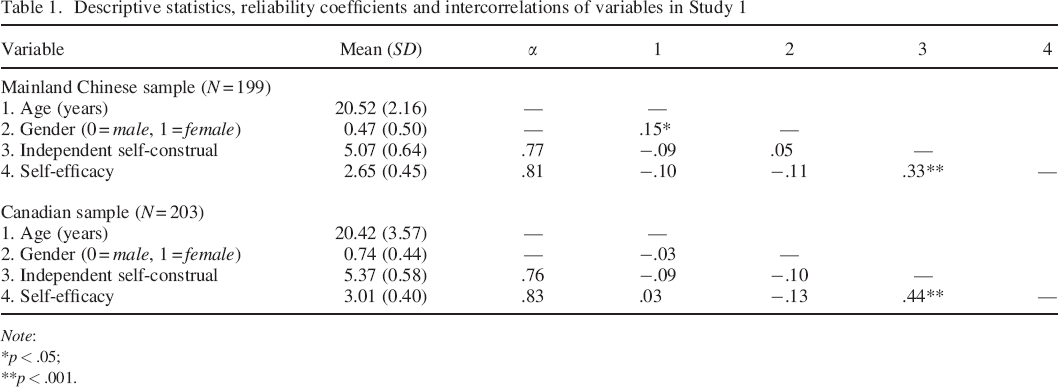
Descriptive statistics including means and standard deviations, alphas and intercorrelations of the variables for Study 1 are summarized in Table 1. We first tested metric equivalence of the constructs needed for cross–cultural comparisons. Using multiple–group analysis with item parcelling (three parcels being formed for each construct), partial scalar invariance, by relaxing the constraint on one parcel intercept, was established for both self–efficacy and independent self–construal, χ2(3, N = 402) = 5.89, p = .12, comparative fit index = 0.99, and χ2(3, N = 402) = 5.97, p = .11, comparative fit index = 0.99, respectively. Chi–square difference tests indicated no significant reduction of model fit after constraining all factor loadings and the two intercepts of the parcels across groups.
Descriptive statistics, reliability coefficients and intercorrelations of variables in Study 1
Note:
p < .05;
p < .001.
Then we examined cultural differences between Chinese and Canadians in the target variables, namely independent self–construal and self–efficacy, and correlations between them, before proceeding to mediation analysis. As expected, independent samples t–tests revealed that Chinese scored significantly lower (M = 5.07, SD = 0.64) on independent self–construal than did Canadians (M = 5.37, SD = 0.58), t(399) = 4.99, p < .001, d = 0.50, and Chinese reported lower levels of self–efficacy (M = 2.65, SD = 0.45) than did Canadians (M = 3.01, SD = 0.40), t(399) = 8.56, p < .001, d = 0.86. Moreover, independent self–construal was positively correlated with self–efficacy in both cultural groups, r(196) = .33, p < .001, for Chinese and, r(200) = .44, p < .001, for Canadians.
Unpacking cultural differences
A mediation model was constructed to test whether independent self–construal could unpack the effect of culture on self–efficacy, controlling for age and gender. We employed a bootstrapping procedure (Preacher & Hayes, 2004) to test the indirect effect. An indirect effect is typically tested with the Sobel test (Sobel, 1982); however, it requires the effect to be normally distributed, an assumption which is often violated, for instance, because of small samples or the use of categorical variables (Preacher & Hayes, 2008). Bootstrapping involves repeatedly sampling the indirect effect from the dataset with replacement and estimation of confidence intervals (CIs) from the resampled data distribution. The bootstrapping method is therefore considered to be more accurate than the traditional approach and was applied in the present study.
Our hypothesized mediation model with 1000 bootstrapping replications was conducted with Mplus 5.0 (Muthén & Muthén, 2007). The indirect effect of independent self–construal as a mediator of cultural differences (dummy–coded, 0 = Canadians) was statistically significant, standardized coefficient = −0.09, SE = 0.02, p < .001, 95% CIs [−0.13, −0.05]. However, the direct effect of culture on self–efficacy was also significant, indicating partial mediation of the cultural difference; standardized coefficient = −0.34, SE = 0.04, p < .001, 95% CIs [−0.42, −0.25]. The mediation effect of independent self–construal accounted for 21% of the total effect, which is comparable with other studies using cultural variables to unpack cultural differences (e.g. using dialecticism to unpack emotional complexity in Spencer–Rodgers, Peng & Wang, 2010). Hence, independent self–construal is a non–negligible, mediating variable in explaining the observed cultural differences.
These results confirm previous findings from mean–score comparisons of self–reports showing that Chinese perceive themselves as lower in competence than do Westerners, but additionally show that these differences can be partially attributed to independent self–views, the focal psychological dimension of an individualistic cultural mindset. Viewing oneself as unique and distinct contributes towards believing in one's own capabilities to perform tasks and attain goals.
Study 2
Although the results of Study 1 identified independent self–construal as an underlying mechanism that explains between–country differences in competence perception, the research design operationalized cultural mindsets as an individual difference variable. An alternative method of operationalization is via manipulation, a social–cognitive approach that can reflect the contribution of both individual differences and situational factors (Bond, 2013; Brockner, 2003). As the accessibility of psychological constructs influences an individual's thoughts, feelings and behaviours (Higgins, 1998), the impact of cultural mindsets depends upon their accessibility to the individual at the moment of judgement and their applicability to the task at hand (Oyserman, 2011). Thus, Study 2 tested the effects of cultural mindsets via experimental manipulation of language.
As a marker of culture, language can activate the shared knowledge and meanings encoded when the language is acquired and used. Thus, among bilinguals, it can prime cultural mindsets to evoke culturally congruent responses (Chiu, Leung & Kwan, 2007; Oyserman & Lee, 2008; Ramírez–Esparza, Gosling, Benet–Martínez, Potter & Pennebaker, 2006). Among Hong Kong Chinese bilinguals, an individualistic mindset can be primed by the use of English, a collectivistic mindset by the use of Chinese (Lee et al., 2010).
We thus sampled Chinese–English bilinguals in Hong Kong, using a between–subjects design and randomly assigning them to complete the measures in English or in Chinese. We hypothesized that the results produced by this written language manipulation (Chinese vs. English) would mirror those found from the between–country comparison (Chinese vs. Canadians), with those who responded in English reporting higher levels of self–efficacy (i.e. perceived competence) than those in Chinese. Thus, the mediator of independent self–views in Study 1 was manipulated instead of measured in Study 2 (individualistic mindset primed by English) to confirm its causal effect on competence perceptions. We also included a broad measure of Conscientiousness in the current study to complement our findings on the competence facet.
Method
Participants and procedure
The sample consisted of 198 (94 men and 104 women) university students (age M = 20.57 years, SD = 1.54). All participants were Chinese–English bilinguals recruited from the Chinese University of Hong Kong. They were randomly assigned to two language conditions, completing the following instruments in either English (n = 96; 46 men and 50 women) or Chinese (n = 102; 48 men and 54 women).
Participants were also asked to report on their first and second languages regarding their ability, past and present usage, and media exposure (Benet–Martínez & Haritatos, 2005). The two scales (first and second language proficiency and usage) consist of 14 items on 6–point Likert scales, with the items tapping language ability (e.g. ‘Rate your overall English language ability’) ranging from 1 (very little ability) to 6 (very high ability) and the rest (e.g. ‘How much have you used English in general as an adult?’) ranging from 1 (almost never) to 6 (very often) (αs = .73 for both Chinese and English conditions).
Measures
The original English versions of the instruments were translated into Chinese by bilinguals using back–translation and verified by another bilingual. The equivalence of meaning on all items was ensured through consultations with native Chinese and English speakers.
Self–efficacy
As in Study 1, the 10–item Generalized Self–Efficacy Scale (Schwarzer & Jerusalem, 1995) was used, αs = .86 and .92 for the English and Chinese language conditions, respectively.
Conscientiousness subscale of the Big Five Inventory
As a well–established measure of personality, the Big Five Inventory uses short phrases to assess the most prototypical traits associated with the Big Five factors (see John, 1990; John & Srivastava, 1999), namely Extraversion, Agreeableness, Conscientiousness, Neuroticism and Openness to Experience. Responses to each target were anchored on 5–point Likert scales ranging from 1 (strongly disagree) to 5 (strongly agree). In the present study, nine items of the Big Five Inventory were employed to measure the factor of Conscientiousness, with αs = .68 and .79 for the English and Chinese language versions, respectively.
Results and Discussion
We first examined the equivalence of the two experimental groups on language proficiency and usage. Independent samples t–tests found no significant differences in participants’ reported Chinese proficiency, t(196) = 0.58, Chinese usage, t(196) = −0.52, English proficiency, t(196) = −0.93, or English usage, t(196) = −1.60, all ps > .05. Differential language ability is therefore an unlikely cause of differences in responses as a function of questionnaire language. Across the two conditions, participants rated their Chinese proficiency and usage as significantly higher than their English proficiency and usage, t(197) = 15.55, p < .001. Language dominance has been observed in bilinguals, such that they have greater proficiency in one language than the other (Grosjean, 2008). As Chinese was the native language of the current sample, their Chinese proficiency was higher than English proficiency. This does not seem to confound the results, as we predicted that participants would rate themselves as more competent when responding in their second rather than their first language.
We tested whether questionnaire language influenced self–efficacy scores. An independent samples t–test found a significant difference in self–efficacy ratings between the two groups, t(196) = 2.14, p < .05, d = 0.30. As hypothesized, Chinese–English bilinguals who responded in English reported significantly higher levels of self–efficacy (M = 2.77, SD = 0.43) than did those responding in Chinese (M = 2.62, SD = 0.55).
Likewise, independent samples t–test showed that bilinguals scored higher on Conscientiousness in the English condition (M = 3.22, SD = 0.52) than in the Chinese condition (M = 3.07, SD = 0.66) with marginal significance, t(196) = 1.72, p = .087, d = 0.25.
The results indicate that self–ratings of competence varied as a function of the test language and that these differences were also observed at the factor level of Conscientiousness although relatively more weakly because multiple facets were tapped. As Lee and colleagues (2010) used language manipulation as an operationalization of cultural mindsets and found self–enhancement effects on Chinese–English bilinguals while English was in use, our results add evidence to the claim that competence perception varies as a consequence of activating different cultural meaning systems. Put together, the English language appears to activate an individualistic mindset and prompt participants to view themselves more positively in terms of self–perceived competence and ability, whereas the Chinese language appears to activate a collectivistic mindset and make a modest self–perception more prominent.
Study 3
Studies 1 and 2 suggest that competence effects can be a result of activating cultural mindsets, but it leaves open an important question: Are these self–perceptions in self–report measures manifested in social situations? Faced with collectivistic cultural primes, will bilinguals adjust their behaviourally communicated competence as well as their self–perceptions to fit cultural expectations? McCrae, Yik, Trapnell, Bond, and Paulhus (1998) compared self–ratings of personality traits between Chinese in Hong Kong and Chinese immigrants in Canada and revealed that exposure to Canadian culture changed Chinese immigrants’ self–rated personality, which had assimilated to North American cultural norms.
To go beyond self–reports of personality traits, however, we adopted a within–person design using both self–ratings and observer ratings in the present study. Adding observer judgments of competence gives insight into the degree to which a cultural mindset leaks into observable, self–presentational behaviour as well as self–ratings. In addition to the language prime, we used the ethnicity of interlocutor as a cultural prime, as had been carried out before in interpersonal exchanges (Chen & Bond, 2010; Pierson & Bond, 1982).
Method
Participants
The sample consisted of 76 Chinese–English female bilinguals from the Chinese University of Hong Kong (age M = 20.34 years, SD = 1.49). We adopted stringent criteria to recruit fluent bilinguals, because lack of fluency in their second language of English would contribute to perceptions of low competence and confound the effects of cultural mindset. Thus, only those scoring C or above on both the Hong Kong Certificate of Education Examination and the Advanced Level Examination tests of Chinese and English subjects were selected. To control for possible gender effects, all interviewers were male and all interviewees were female.
Interviewers
Four male interviewers (two Caucasians and two Chinese) were recruited, all fluent in both English and Cantonese (the spoken language of Chinese in Hong Kong). All were between 20 and 30 years and comparable in height and physical attractiveness. They were trained to standardize their non–verbal behaviours (paralinguistics, kinesics and gazing) during the interviews and instructed to minimize their verbal and non–verbal reactions, so as to minimize experimenter effects across interviewers. All interviewers and research assistants were blind to the hypotheses.
Measures and procedure
Self–efficacy before interviews
Participants were randomly assigned to two language conditions, as in Study 2. At Time 1, half completed the written measures in English, including the Generalized Self–Efficacy Scale (Schwarzer & Jerusalem, 1995); half, in Chinese. After 2–3 weeks at Time 2, the two groups completed the other language version of the same measure.
Competence during interviews
After another 3 weeks at Time 3, participants were interviewed by one Caucasian interviewer and one Chinese interviewer in both English and Cantonese for about 10 minutes, separately. That is, each participant took part in four conditions, that is, talking with a Caucasian interviewer in English, with a Caucasian interviewer in Cantonese, with a Chinese interviewer in English and with a Chinese interviewer in Cantonese. The order of language and interviewer was counter–balanced across interviewees.
To standardize interview content across conditions, four sets of questions were designed in parallel forms and in both languages, such that each interviewee answered comparable but not identical questions across the four interviews. Their content was general information about themselves, their hobbies and social activities. For example, after a brief introduction to the procedure, participants were asked to talk about sports/movies/songs/paintings, respectively, for each condition (with four sets of scripts), and to describe their favourite sport/movie/song/painting and why they liked it, as well as their favourite sport star/movie star/singer/painter. We used easy and informal topics, so that they resembled social conversations rather than formal, serious interviews. The conversations were recorded by camcorders.
Both self–perceptions and observer perceptions of competence were collected as follows. After all interviews were completed, participants answered questions tapping their self–perceptions of competence under each condition, using seven items on 4–point Likert scales, namely fluent, confident, strong, important, respectable, competent and superior, extracted from Pierson and Bond (1982). All ratings were completed in Chinese to counter the possibility that previous findings had been due to subtle linguistic differences in the Chinese versus English scales measuring self–efficacy. To collect observer reports of competence, two Chinese–English bilingual observers were recruited to separately review all interviews, rating participants’ competence using the same set of items. The observers were blind to the hypotheses.
Additionally, the observers were also asked to judge the participant's traits from the video segment (e.g. ‘Did the participant seem assertive?’) and to circle their answers on a 6–point scale, ranging from 1 (strongly disagree) to 6 (strongly agree). The questions included a representative item or keyword for each of the eight personality dimensions, as measured by the Sino–American Person Perception Scale (SAPPS; Yik & Bond, 1993). The SAPPS assesses eight dimensions of personality: Emotional Stability, Extraversion, Application, Openness, Assertiveness, Restraint, Helpfulness and Intellect.
In addition to identifying the personality dimensions similar to those of the five–factor model, the SAPPS dimension of application, for example, refers to being hard–working, diligent and practical, and that of restraint denotes being cautious, dignified and thorough. Application, Restraint, Intellect and Assertiveness were found to be loaded on the Conscientiousness factor as measured by the NEO–PI–R in a Chinese sample (Yik & Tang, 1996). Thus, these four factors were averaged to form a composite of observer–rated Conscientiousness.
Results and Discussion
Differences in general self–efficacy before the interviews
A dependent samples t–test examined differences in the written measure of generalized self–efficacy in Chinese and English taken at Time 1 and Time 2, t(70) = 5.97, p < .05, d = 0.61. As anticipated, bilinguals reported significantly higher levels of general self–efficacy (M = 2.76, SD = 0.36) when responding in English than in Chinese (M = 2.50, SD = 0.48). This finding from a within–subjects design replicated that of the between–subjects in Study 2, indicating that with written language priming, bilinguals’ perception of their competence was higher when using English than when using Chinese.
Self–ratings of competence after the interviews
In the following, we examined the effects of cultural mindset primes on more situation–specific measures of competence in social interactions. We expected to see higher competence ratings when participants used English (as compared with Cantonese) and when the interviewer was a Caucasian (as compared with a Chinese) interviewer.
First, the seven items measuring self–perceived competence were factor–analysed for each condition, with all scree tests indicating a one–factor solution of general competence in all four interview conditions (all αs > .80).
A 2 × 2 repeated–measures analysis of variance (ANOVA) tested the effects of interview language (English vs. Cantonese) and interviewer ethnicity (Caucasian vs. Chinese) on the composite score of self–rated competence. The results revealed a significant main effect of language, F(1, 70) = 112.98, p < .001,
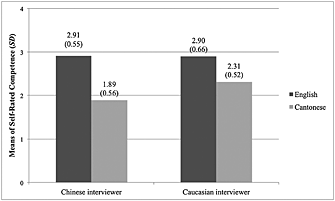
Cultural mindset effects on self–ratings of competence in Study 3. Note. Analyses were based on 76 Chinese–English bilinguals with repeated measures of self–rated competence across four conditions.
Observer ratings of competence
Were these self–perceptions reflected in social behaviour, as observed by raters of the videotapes? As before, the seven items measuring observer–perceived competence were factor–analysed for each condition, with all scree tests indicating a one–factor solution tapping general competence (all αs > .80).
A 2 × 2 repeated–measures ANOVA tested the effects of interview language (English vs. Cantonese) and interviewer ethnicity (Caucasian vs. Chinese) on the composite score of observer–rated competence. The overall pattern of observer reports followed that of self–perceptions, indicating that self–perceptions were consistent with communicated behaviour. Replicating the effects for self–perceptions of competence, the main effect of language was significant, with participants being perceived by others as more competent when communicating in English than Cantonese, F(1, 71) = 20.83, p < .001,
Again, a significant interaction was observed, F(1, 71) = 17.22, p < .001,
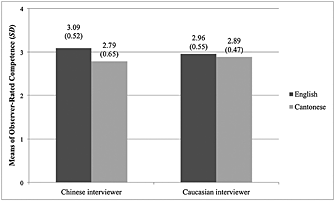
Cultural mindset effects on observer ratings of competence in Study 3. Note. Analyses were based on 76 Chinese–English bilinguals with repeated measures of observer–rated competence across four conditions.
Observer ratings of conscientiousness
We conducted 2 × 2 repeated–measures ANOVAs to evaluate the effects of language (English vs. Cantonese) and ethnicity (Caucasian vs. Chinese interviewers) on observer ratings of participants’ traits, the composite of Conscientiousness.
As before, the Language main effect was significant, F(1, 71) = 63.41, p < .001,
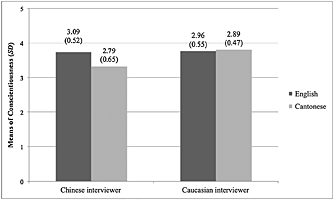
Cultural mindset effects on observer–rated conscientiousness in Study 3. Note. Analyses were based on 76 Chinese–English bilinguals with repeated measures of observer–rated conscientiousness across four conditions.
In summary, ratings by both participants and observers converged to show that speaking English consistently evoked higher levels of both self–perceived and behaviourally communicated competence and conscientiousness in general, although the strength of language effects was lessened when presented with the prime of a Caucasian interviewer. These findings suggest that priming mindsets has a powerful and immediate effect on self–perceptions of competence. Combined with the language effects on self–efficacy ratings found before the interviews, our results emphasize the flexibility of self–perceptions under the effect of mindsets. More surprisingly, these self–perceptions are communicated through behaviour, being reliably observable by more objective others.
General Discussion
The present research demonstrates that individualistic versus collectivistic cultural mindsets could be one of the mechanisms to account for between–country and within–individual differences in competence perceptions. Study 1 found that Mainland Chinese reported lower levels of self–efficacy than Canadians and partially unpacked this country effect with independent self–construal, a cultural self–view reflecting an individualistic mindset. Following experimental manipulations in Studies 2 and 3, Hong Kong Chinese–English bilinguals perceived themselves as more competent and more conscientious in general when responding to primes of individualistic rather than collectivistic mindsets, whether in written measures or conversations, using between–subjects or within–subjects designs, or as tapped by self–ratings or other–ratings.
Cross–cultural studies have shown that despite East Asian students’ high motivation and superior academic performance, they tend to perceive themselves as lower in Conscientiousness than their North American counterparts (e.g. McCrae et al., 1996). Our results suggest that personality perceptions vary with cultural mindsets, potentially explaining why traits such as Conscientiousness, and particularly Competence, exhibit confusing patterns in cross–cultural comparisons. As these comparisons mostly used self–report measures, which derive from evaluations and perceptions of one's own traits, they are based on perceived competence rather than actual competence. We demonstrate that self–perceptions and even other–perceptions varied with cultural mindsets across different measures of conscientiousness and competence: generalized self–efficacy in the form of perceived competence and mastery, communicated competence in social interactions, or the composite of Conscientiousness measured by the SAPPS dimensions. These convergent patterns from multiple criterion variables suggest that a general self–perception process operates within a cultural frame of mind and shifts self–perceptions, accounting for part of the Conscientiousness paradox.
Cultural mindsets, and their differing standards of appropriate self–views (e.g. self–enhancing vs. modesty biases, and reference group standards), may affect participants from some cultures to underestimate their positive characteristics, whereas participants from other cultures may overestimate the same characteristics. As seen in the case of competence studied here, average cultural differences may be due to differences in mindsets rather than objectively differing levels of valued traits. It is especially interesting that we find that self–perceptions are not simply inaccurate or overly modest self–ratings but also reflect changes in how individuals act in a social situation—how much competence they appear to express from an observer's perspective.
Although observers may also be influenced by cultural mindsets, with their ratings subject to individualistic or collectivistic primes, we took steps to reduce this possibility. Observers rated all the video files using their native language Chinese, which predisposed them to their default collectivistic mindset. In addition, the camera only focused on the participant, and observers were blind to the ethnicity of the interviewer in each video file. These procedures could minimize the influences of cultural mindsets on observers. Nonetheless, it would have been more compelling to use monolingual observers’ ratings such that the effect of language used in coding is being controlled for. As English is a mandatory subject at kindergarten in Hong Kong and at primary school in Mainland China, further studies may sample monolingual English speakers to rule out this plausible explanation.
Another limitation is that the present research used language to operationalize cultural mindsets, that is, language of the instrument in Studies 2–3 and language of the interview in Study 3. Conceivably, between–language differences in self–ratings could arise from discrepancies in the two language versions, even though standard translation and back–translation were conducted. Small nuances in wording and meaning might affect endorsement levels of competence evaluation. Nevertheless, the ethnicity of interviewer served as a cultural prime in Study 3 has provided evidence for types of cultural mindset beyond language use. Future research may employ other manipulations to operationalize cultural mindsets, such as pronoun circling, to extend the present findings.
Most important, the aforementioned evidence for how malleable self–perceptions are under different cultural mindsets suggests that trait measures may not represent stable individual differences. When behaving in another cultural context, the same individuals shift their own behaviours and self–perceptions to match cultural expectations. Self–perceptions of personality are subject to cultural norms, stored by individuals as mental representations and induced by the context as situational demands. It is the interaction of person (the self) by situation (cultural context) that produces dynamic expressions of personality (see also Bond, Lun, Chan, Chan & Wong, 2012).
This study also suggests that previously found ethnic differences between Chinese and Westerners may be a culturally induced response, not merely an effect of immigrant status. Past studies that compared self–efficacy between Chinese and Westerners mostly sampled Chinese sojourners or immigrants in Western, English–speaking cultural contexts (Leung, 2001; Moore & Leung, 2001; Nesdale, 2002). It is plausible that their lower self–efficacy ratings reflected their acculturation process and minority status, as residing in a host country as a member of a minority group entails adjustment difficulties and discrimination for sojourners and immigrants. The present studies enable us to tease apart the effects of cultural patterns versus acculturation status, as our participants are members of majority groups in their societies and had not physically relocated from one culture to another. Variations in their expressed self–efficacy under manipulated primes indicate that self–perceptions are culturally contextualized.
Cultural mindsets: Implications for causal mechanisms
In these studies, we manipulated cultural mindsets through primes of language or interviewer ethnicity, changing both self–perceptions and self–presentations. A cultural mindset makes accessible an interwoven collection of cultural norms, such as values, beliefs, goals, self–concepts or judgement procedures (e.g. Oyserman, 2011). Yet an interesting question remains: What specific aspects of individualistic or collectivistic cultural mindsets are influencing participants in these studies? A strong possibility is that, as suggested by previous studies (Lee et al., 2010), Chinese language and ethnicity primed a modesty mindset, causing participants to not only privately rate themselves lower on positive characteristics (Studies 1–3) but also to behave modestly in social situations (Study 3), thus appearing less competent than they did under the influence of Western primes. However, another possibility is that Chinese language and ethnicity primed a sense of inferiority compared with Chinese standards for competence (a reference group effect), causing lowered self–ratings for competence (Studies 1–3) and also causing the expression of that sense of inferiority through social behaviour (Study 3). A third possibility is that both reference group and modesty norms acted in tandem, with differing reference group standards for competence mostly affecting private, anonymous self–ratings (Studies 1–3) and norms for modesty versus self–enhancement mostly affecting public social behaviour (Study 3). Finally, there is also the possibility that complex communication norms within multicultural Hong Kong culture influenced self–expression when speaking with Chinese or Caucasian interviewers, causing more dramatic language effects with Chinese interviewers than with Western interviewers. Although our results cannot distinguish between these specific mechanisms, it draws our attention to the powerful ways cultural mindsets can affect comparisons of cultural groups.
This research only tested the effects of individualistic versus collectivistic mindsets by contrasting Asian versus Western cultures. It cannot explicate the full range of mixed findings on Conscientiousness within and across different cultures and regions. For instance, although regional personality differences exist in the USA and are geographically clustered (Rentfrow, 2010), there are discrepancies between regional stereotypes and regional averages of self–reported traits across states, especially Conscientiousness (Rogers & Wood, 2010). Wood and Rogers (2011) showed that perceived regional levels of Conscientiousness are negatively correlated with regional differences in self–ratings of Conscientiousness. Moreover, US state averages of self–rated Conscientiousness are contrary to predicted criteria, such as being positively related to criminal behaviour but not related to long–term benefits of health–promoting behaviour (Rentfrow, Gosling & Potter, 2008).
Other than individualistic versus collectivistic mindsets, there exits cross–national and cross–regional differences in other cultural dimensions (e.g. dialecticism, tightness vs. looseness) and personality–related characteristics (e.g. attitudes, values, beliefs and behaviours). Whether discrepancies between national/regional stereotypes and self–rating averages can be attributable to other cultural dimensions and psychological attributes awaits further studies.
Future research needs to determine which aspect of cultural mindsets are the most active in different situations, from public behaviour to private self–ratings. For example, cultural mindsets may explain differences in response styles across cultures. A self–enhancing mindset may lead to inflated self–ratings, and a modest mindset may lead to modest responding. These mindsets can be embedded in cultural or regional norms or evoked by situational or contextual cues.
Dynamic selves: Implications for personality
For years, Hofstede's (1980) differentiation of nations by individualism/collectivism and Markus and Kitayama's (1991) differentiation of individuals by independent/interdependent self–construals have stimulated cross–cultural studies demonstrating between–country differences in cognition, emotion and behaviour. An assumption underlying this dichotomous view is that cultural orientations are stable individual differences and cultural differences are static positionings along this continuum—countries are classified as either individualistic or collectivistic; individuals are categorized as possessing either independent or interdependent self–views.
Yet Triandis (1995) contended that people within a cultural group can endorse both individualistic and collectivistic orientations. The dynamic constructivist approach to culture proposed by Hong and colleagues (Hong & Chiu, 2001; Hong et al., 2000) conceptualizes culture as a loose network of domain–specific, cognitive structures rather than a generalized single entity and maintains that people can hold more than one cultural meaning systems.
By and large, individuals regard themselves as both interdependent and independent (Niedenthal & Beike, 1997). The same individuals can possess differing views of the self, with the expression of specific self–views dependent on the context for behaviour and the psychological domain accessed (Matsumoto, 1999). Therefore, rather than between–country differences being the result of stable individual differences, cultural influences on cognition, emotion and behaviour may be better construed as arising from the salience of mindsets that can be either chronically accessed in the society or temporarily activated by situational cues. The present research extends this dynamic view of cultural influences to conceptualizing personality as malleable and its behavioural manifestations as contingent upon cultural contexts for their expression.
Conclusion
Our findings offer another perspective on the long–debated issue of why Conscientiousness seems problematic in cross–cultural comparisons and proposes a mechanism to account for the inconsistent ratings of such evaluative traits. By using Chinese–English bilinguals to demonstrate the variability of competence perceptions in response to language use and interlocutor ethnicity, these results have implications for cross–cultural comparisons of personality traits, which mostly use self–reports in the participants’ native language and with native–speaker co–culturalists as experimenters. These situational factors surrounding respondents’ performance are important considerations for future personality research.
Footnotes
Acknowledgement
This project was partially supported by the General Research Fund (PolyU 5412/08H) from the Research Grants Council of the Hong Kong Special Administrative Region, China.