







Abstract
The present work analyses the predictive validity of measures provided by several available self–report and indirect measurement instruments to assess risk propensity (RP) and proposes a measurement instrument using the Implicit Association Test: the IAT of Risk Propensity Self–Concept (IAT–RPSC), an adaptation of the prior IAT–RP of Dislich et al. Study 1 analysed the relationship between IAT–RPSC scores and several RP self–report measures. Participants’ risk–taking behaviour in a natural setting was also assessed, analyzing the predictive validity of the IAT–RPSC scores on risk–taking behaviour compared with the self–report measures. Study 2 analysed the predictive validity of the IAT–RPSC scores in comparison with other indirect measures. Results of these studies showed that the IAT–RPSC scores exhibited good reliability and were positively correlated to several self–report and indirect measures, providing evidence for convergent validity. Most importantly, the IAT–RPSC scores predicted risk–taking behaviour in a natural setting with real consequences above and beyond all other self–report and indirect measures analysed. Copyright © 2013 European Association of Personality Psychology
Introduction
It is widely assumed that individuals differ in their risk–taking behaviour (Kogan & Wallach, 1964; Rubio, Hernández, Zaldívar, Márquez, & Santacreu, 2010). Whether these differences are attributed to a specific personality trait, influenced by attitudes towards risk or driven by situational factors remains controversial (Appelt, Milch, Handgraaf, & Weber, 2011). At the basis of this controversy lies the fact that risk–taking behaviour is a complex phenomenon that is likely multidetermined. Risk–taking behaviour should be understood as a function of the characteristics of the decision maker [e.g. risk propensity (RP)] and the decision domain (e.g. eliciting deliberate or automatic behaviours), as well as the interaction between both (Figner & Weber, 2011).
Regardless of the theoretical assumptions, the different perspectives have stimulated the development of several measurement procedures to assess RP and risk attitude. 1 Traditionally, RP has been assessed by self–report instruments (Harrison, Young, Butow, Salkeld, & Solomon, 2005). These measurement instruments generally assess how often people engage or how likely people would engage in various risky behaviours [e.g. the Nicholson, Soane, Fenton–O'Creevy, & Willman's, 2005, Risk Propensity Scale (RPS) and the Weber, Blais, and Betz's, 2002, Domain Specific Risk Attitude Scale (DOSPERT)] or, alternatively, the preference of a specific course of action among several alternatives, each having different probabilities and pay–offs (e.g. the Kogan & Wallach's, 1964, Choice Dilemmas Questionnaire, CDQ).
Although most of these self–report measures have an acceptable level of reliability and validity, many authors have highlighted the limitations these instruments present (e.g. Robie, Born, & Schmit, 2001; Rubio, Hernández, Revuelta, & Santacreu, 2011; Schwarz, 1999). First, authors highlighted the susceptibility of self–reports to response distortions due to voluntary biases, such as social desirability. For instance, several studies have demonstrated the effects of social desirability on the reliability and validity of self–reported risk–taking behaviours, such as sexual (Catania, Gibson, Chitwood, & Coates, 1990) or reckless behaviours (Brown, 1999). On the other hand, research in psychology has shown the existence of implicit processes leading many psychologists to propose that significant parts of individuals’ knowledge might be inaccessible to introspection and awareness (Nisbett & Wilson, 1977; Seger, 1994). Thus, several authors have recently suggested dual–process models to acknowledge that people can process information about themselves and their environment not only explicitly, controllably or reflectively but also implicitly, automatically or impulsively (Smith & DeCoster, 2000; Strack & Deutsch, 2004; Wilson, Lindsley, & Schooler, 2000).
For the reasons noted earlier, interest in indirect measurement has increased considerably in recent years to complement the information provided by self–report measurements (see Gawronski & Payne, 2010). Thus, researchers have developed a multitude of indirect measurement procedures for different constructs, such as attitudes, stereotypes, self–esteem or self–concept (see Petty, Fazio, & Briñol, 2009), as well as for RP (e.g. the Dislich, Zinkernagel, Ortner, & Schmitt's, 2010, Implicit Association Test (IAT) for assessing RP, IAT–RP). At the same time, other instruments that are not based on individuals’ self–report have also been developed to overcome the limitations of self–report measures, such as the objective performance tests (OPTs) [e.g. the Balloon Analogue Risk Task (BART), Lejuez et al., 2002; the Choice Task, Mishra & Lalumière, 2011; the Game of Dice Task, GDT, Brand et al., 2005; the Risk Propensity Task, Aguado, Rubio, & Lucia, 2011; and the Roulette Test, Rubio et al., 2010]. Nevertheless, the problems of predicting risk–taking behaviour in natural settings (Weber et al., 2002) and the lack of consistency found among different types of measurement instrument (e.g. Lejuez, Aklin, Zvolensky, & Pedulla, 2003) deserve further research and the development of new measurement procedures. The present work analyses the predictive validity of measures provided by several available self–report and indirect measurement instruments to assess RP and proposes an adaptation of the IAT–RP of Dislich et al.: the IAT of Risk Propensity Self–Concept (IAT–RPSC).
Iat Measures and Risk Propensity Research
The IAT was proposed to assess strengths of associations between concepts by observing response latencies in computer–administered categorization tasks (Greenwald, McGhee, & Schwartz, 1998). Although IAT measures have received several criticisms (e.g. Fiedler, Messner, & Bluemke, 2006; see De Houwer, Teige–Mocigemba, Spruyt, & Moors, 2009, for a review), research has provided substantial evidence concerning their good psychometric properties (see Greenwald, Poehlman, Uhlmann, & Banaji 2009; Lane, Banaji, Nosek, & Greenwald, 2007; for reviews). Thus, IAT measures have typically shown good internal consistency and an acceptable temporal stability (Hofmann, Gawronski, Gschwendner, Le, & Schmitt, 2005; Lane et al., 2007).
Regarding the predictive validity of IAT measures, Greenwald et al. (2009) have recently found an average r = .27 for prediction of behavioural, judgment and physiological measures by IAT scores, although predictive validity can vary largely as a function of many different variables (Perugini, Richetin, & Zogmaister, 2010). Furthermore, Perugini et al. (2010) have proposed that there are different patterns of predictive validity, and different theoretical models have been used to explain those different predictive patterns, such as unitary (e.g. Fazio, 2007) or dual construct models (e.g. Strack & Deutsch, 2004; Wilson et al., 2000). Specifically, the latter models propose dual (implicit and explicit) representations for the same concept (e.g. risk).
A very relevant property of the IAT is its supposed reliance on associative processes that can operate automatically (Ranganath, Smith, & Nosek, 2008). At the same time, prior research has shown that IAT measures are less susceptible to faking than self–report measures (Greenwald et al., 2009). These findings are of particular interest for RP assessment in which the perceived consequences of reporting risk–taking behaviour can be susceptible to social desirability concerns and would affect the veracity of self–report measures (Aklin, Lejuez, Zvolensky, Kahler, & Gwadz, 2005). Moreover, even when individuals want to reveal his or her RP or risk attitude, they can be unaware of and thus, unable to report it explicitly. Assuming that no one consciously seeks for negative results of his or her actions, individual differences in risk–taking behaviour should be based either on risk takers believing that the situation faced involves lower potential losses or lower probability of such losses than it actually involves, or they being worse accurate in loss identification of their actions (Yates & Stone, 1992). It is important to note that such individual variability is plausibly based not only simply on reflective (or deliberate) but also on impulsive (or automatic) processes involved in risk–taking behaviours (Weber & Johnson, 2009). As IAT measures are posited to reveal automatic responses that are more resistant to self–presentation artifacts and independent of introspective access to the association strengths being measured (Greenwald et al., 2002; Greenwald, Nosek, & Banaji, 2003), they can be very useful for RP research.
Previous Attempts for a Measurement of Risk Propensity Using Iat
Although most indirect measurement research in the last decade relates to the study of IAT and many authors have suggested the need to develop measurement procedures of RP that are not based on self–report to overcome their limitations (Hunt, Hopko, Bare, Lejuez, & Robinson, 2005; Rubio et al., 2010), to our knowledge, very little research has been developed using IAT to assess RP or risk attitude. Specifically, on the one hand, Ronay and Kim (2006) proposed two different versions of the Implicit Risk Task (IRT, Global and Unique), which provide indirect measures of respondents’ appraisals of risk by assessing the strength of automatic associations of the attributes ‘Gain’ versus ‘Loss’ with the category ‘Risk’. Both IRTs were designed as a Single Category IAT (SC–IAT, Karpinski & Steinman, 2006), in which the category ‘Risk’ did not have a contrast category, thus defining the measure as an evaluation of risk alone and not as a comparative or relative measure of risk, as opposed to ‘Security’ or another such antithetical representation. The two versions of the IRT (i.e. Global and Unique) are different only because the IRT–Unique was personalized, replacing the words to represent a global construct of risk with self–selected words representing risk behaviours unique to each participant. Results showed a significant correlation between the IRT–Unique and a parallel semantic differential scale (SDS). However, it did not correlate with either the Sensation Seeking Scale Form V (SSS–V, Zuckerman, Eysenck, & Eysenck, 1978) or the behavioural criterion used (i.e. the BART, Lejuez et al., 2002). In contrast, the IAT–Global did not correlate with either a parallel SDS or the SSS–V but did correlate with the BART, showing that the IRT–Global scores had a slight but significant incremental validity above and beyond the variance of the behavioural criterion explained by the self–report measures (i.e. the SSS–V and the parallel SDS).
On the other hand, in a more recent study, Dislich et al. (2010) analysed the convergence between several direct, indirect and objective risk–taking measures in gambling. These authors developed a SC–IAT similar to Ronay and Kim's IRTs (2006), which assessed associations of the attributes ‘Gain’ versus ‘Loss’ with the category ‘Gambling’. Most relevant to the present work, Dislich et al. (2010) also developed an IAT to indirectly assess the self–concept of being a risk–prone person. In their IAT–RP, they used the categories ‘Me’ versus ‘Other’, and ‘Risky’ versus ‘Secure’. Interestingly, Dislich et al. (2010) found their SC–IAT correlated with what was considered an impulsive OPT (i.e. the BART, Lejuez et al., 2002), whereas direct measures (e.g. DOSPERT) correlated with a reflective OPT (i.e. the GDT, Brand et al., 2005). Thus, these authors proposed that their results be interpreted as evidence that controlled behaviour depends to a larger extent on explicit traits, whereas automatic behaviour is influenced more strongly by implicit dispositions, consistent with several dual–construct theories (e.g. Wilson et al., 2000; see also Smith & DeCoster, 2000, for a review).
Nevertheless, even though several available indirect measures have shown significant predictive validity with respect to an objective performance–based test assessing RP (i.e. the BART), neither Ronay and Kim (2006) nor Dislich et al. (2010) explored whether those IAT measures can predict risk–taking behaviour in a natural setting with real consequences. More specifically, prior research did not use any behavioural criteria in which people would gain or lose real money according to their risk–taking behaviour; only the BART was used to simulate those risk–taking situations. Hence, the main aim of the present work is to analyse the unexplored validity of several available self–report and indirect measures to predict a specific behaviour: A spontaneous risk–taking behaviour in a natural setting with real consequences.
Overview of the Present Studies and Hypotheses
The present work proposes an adaptation of the previous Dislich et al. IAT–RP measurement instrument for an indirect assessment of RP from a personality self–concept perspective: the IAT–RPSC. With prior research (e.g. Dislich et al., 2010), the IAT was adapted to measure RP by assessing associations of the Self (‘Me’ vs. ‘Not–Me’) with ‘Risk’ versus ‘Security’ categories. We propose that IAT–RPSC has differences and advantages over existing measurement instruments on the basis of IATs for several reasons. First, the IAT–RPSC differs from Ronay and Kim's IRTs (2006) and Dislich et al. SC–IAT (2010) because the IAT–RPSC is not a risk attitude measurement instrument. The IRTs and the SC–IAT arguably provide more attitudinal measures because they include ‘Gain’ versus ‘Loss’ as attribute categories, and these categories may be interpreted as evaluative categories with a clear valence (positive vs. negative). In contrast, and according to what Schnabel, Asendorpf, and Greenwald (2008) pointed out the IAT–RPSC categories (‘Me’ vs. ‘Not–Me’) relate to associative representations of self–concept. Thus, the IAT–RPSC should be considered as a personality self–concept measurement instrument (see also Greenwald et al., 2002; Schnabel & Asendorpf, 2010). Moreover, the IAT–RPSC also differs from Ronay and Kim's IRTs (2006) because the IAT–RPSC includes a comparative or relative measure of ‘risk’ in relation to ‘security’ (instead of a global evaluation of ‘Risk’ concept alone), in line with most prior IAT research and with the very tradition of the study of the meaning of language (Osgood, Succi, & Tannenbaum, 1957).
Furthermore, the IAT–RPSC also differs from the IAT–RP of Dislich et al. (2010) in the use of Me versus Not–Me categories instead of Me versus Other. Regarding this issue, there is certain controversy related to the attributed valence, neutral or negative, either of Others or Not–Me categories (see, for different positions, Karpinski, 2004; Pinter & Greenwald, 2005; Rudman, 2011). We considered the category Not–Me as more suitable for assessing self–esteem or any self–related associations, as Karpinski (2004) posited, and preferred for a personality self–concept measure. Moreover, we think the use of Not–Me instead of Other might decrement the influence of normative information (i.e. extrapersonal associations culturally shared about risk–taking behaviours but not necessarily reflecting an individual RP) related to risk–taking behaviours (see Olson & Fazio, 2004). Prior studies have used Me versus Not–Me obtaining good results (e.g. Díaz, Horcajo, & Blanco, 2009; Jordan, Spencer, Zanna, Hoshino–Browne, & Correl, 2003 and so was used for the IAT–RPSC.
Therefore, the present work aimed, first and most importantly, to analyse the validity of prior available self–report and IAT measures in predicting a risky behaviour in a natural setting with real consequences, extending previous literature on the predictive validity of RP measures. Second, the present work aimed to improve procedural aspects of previous RP IAT developments, specifically proposing a RP measurement instrument by using IAT: the IAT–RPSC based on the IAT–RP of Dislich et al. (2010). Thus, two studies were carried out. Study 1 analysed the relationships between the IAT–RPSC scores and several RP self–report measures, examining the predictive validity of the IAT–RPSC scores compared with self–report measures. In Study 2, we analysed the predictive validity of the IAT–RPSC scores in comparison with measures provided by other available indirect measurement instruments. Three hypotheses are tested:
As prior research has shown, IAT measures have predicted automatic or spontaneous behaviours better than self–report measures in several domains (e.g. shy behaviour in realistic social situations; Asendorpf, Banse, & Mücke, 2002). Thus, we expect the IAT–RPSC scores will predict spontaneous risk–taking behaviour above and beyond self–report measures in a natural setting with real consequences in which individuals have to choose quickly and in a less controlled or deliberate way. We expect that the IAT–RPSC scores will predict spontaneous risk–taking behaviour above and beyond other indirect measures provided by an available risk attitude IAT (i.e. SC–IAT of Dislich et al.) because this attitudinal IAT has been developed using categories more external to individuals, such as ‘Gain’ or ‘Loss’ in relation with ‘Gambling’, and including likely more normative information about this concept (Olson & Fazio, 2004), instead of categories relating to associative representations of self–concept, such as ‘Me’ or ‘Not–Me’ and its associations with ‘Risk’. As prior works have highlighted, self–concept is a higher–order–organizing schema that fundamentally determines the specific attitudes and behaviours that individuals show in a given situation (see Leary & Tangney, 2003, for a review). In fact, even though self–concept can also show changes in response to subtle influences, the salient information related to self–concept will be brought to bear in any specific context (e.g. Cantor, Markus, Niedenthal, & Nurius, 1986; Markus & Kunda, 1986) and will influence how individuals interpret situations, the choices they make, whether and how they initiate actions and their pursuit of specific goals (Kawakami et al., 2012, p. 562). We expect that the IAT–RPSC scores will predict the spontaneous risk–taking behaviour above and beyond the existing RP self–concept IAT (i.e. IAT–RP of Dislich et al.) because the IAT–RPSC has been designed in relation to associative representations of self–concept by using ‘Me’ versus ‘Not–me’ categories (instead of including the ‘Other/s’ category), and as noted previously, it should decrease the potential negative valence of the non–specific ‘Other/s’ category (Karpinski, 2004) and furthermore the influence of normative information related to risk–taking behaviours (Olson & Fazio, 2004).
Study 1: Relationship between Iat–Rpsc Scores, Self–Report Measures and Risk–Taking Behaviour
The main aim of Study 1 was to assess the convergent validity of the IAT–RPSC scores with other self–report measures and most importantly the validity in predicting risk–taking behaviour in a natural setting with real consequences.
Method
Participants
Sixty–nine psychology students at the Universidad Autónoma de Madrid (Spain) voluntarily participated in partial fulfillment of course requirements (57 women and 12 men). Participants’ mean age was 21.9 years (SD = 1.99), with ages ranging between 20 and 30 years. Participants were offered a €16 voucher exchangeable at the university bookshop.
Measurement instruments and procedure
Iat–Rpsc
By using the same procedure recommended for the development of previous IATs (Greenwald et al., 1998), the IAT–RPSC was developed using words as stimuli. The IAT–RPSC included two categories with respect to self (‘Me’ and ‘Not–Me’) and two other categories with respect to attributes (‘Risk’ and ‘Security’). Although our main target categories were ‘Risk’ versus ‘Security’, as noted before and following Greenwald et al. (2002, p. 9), it would make more sense to understand our IAT assessing RP as a self–attribute association in which the attribute is not typically evaluative (‘Risk’ vs. ‘Security’) and can be interpreted as an aspect of self–concept (see also, e.g., Schnabel et al., 2008).
The selected words and categories were used with the standard IAT available from Inquisit (version 3.0) and recommended by Greenwald and colleagues (2003), which consisted of seven blocks or sets of stimuli. 2 In the first combined block, participants had to classify with the same key the words related to ‘Me’ or ‘Risk’ categories. In the second combined block, participants had to classify with the same key the words related to ‘Me’ or ‘Security’ categories. Each combined block included 40 trials. The order of block assignment was kept constant for each participant. The IAT was scored according to the revised scoring algorithm described by Greenwald et al. (2003), which produces a D score including error latencies in analyses without penalty. In all cases, the IAT–RPSC scores were computed such that a larger D score indicated a relative stronger association between ‘Risk’ and ‘Me’ (or ‘Security’ and ‘Not–Me’) compared with ‘Risk’ and ‘Not–Me’ (or ‘Security’ and ‘Me’). In this first study, participants’ mean D score was −.13 (SD = .76), ranging between −1.14 and 1.27.
Previously, we explored the reliability of the IAT–RPSC scores by using a sample of 270 participants (174 women and 96 men, mean age = 21.13 years, SD = 3.28, with ages ranging between 17 to 45) by (i) analyzing split–half reliability of the participants’ scores and (ii) analyzing test–retest reliability across a 3–week period. To assess the internal consistency of the IAT–RPSC scores, we created a split–half reliability index by correlating the D scores derived from Blocks 3 and 6 with the D scores from Blocks 4 and 7. This index was based on a Spearman–Brown–corrected split–half correlation. The correlation was r = .74 (n = 270) at Time 1 and r = .73 (n = 270) at Time 2 (3 weeks later). Moreover, we analysed test–retest reliability across this 3–week period by correlating the D scores from the Time 1 assessment with those of the Time 2 assessment. This correlation was r = .55 (n = 270, p < .001). Results showed that the IAT–RPSC scores exhibited good internal consistency on the split–half method and acceptable test–retest reliability. Thus, in Study 1, the IAT–RPSC scores are analysed in the prediction of risk–taking behaviour, compared with self–report measures.
The DOSPERT (Weber et al., 2002)
The DOSPERT consists of a 30–item scale that evaluates (i) behavioural intentions to engage in risk–taking behaviours in five different risk domains (social –S–, recreational –R–, financial –F–, health/safety –H/S– and ethical –E–) by using a 7–point rating scale ranging from 1 (‘extremely unlikely’) to 7 (‘extremely likely’) and (ii) the respondents’ gut level appraisal of how risky each behaviour is on a 7–point scale, ranging from 1 (‘not at all’) to 7 (‘extremely risky’). The DOSPERT was adapted to Spanish by using the back–translation method (in the present study, the scores of this Spanish version showed good reliability with a Cronbach's α of S = .79, R = .83, F = .79, H/S = .66, E = .62 and Total scale = .79 for behavioural intentions and S = .74, R = .82, F = .87, H/S = .78, E = .70 and Total scale = .88 for risk perception).
The RPS (Nicholson et al., 2005)
The RPS is a 12–item scale, asking respondents the following: ‘We are interested in everyday risk–taking. Please could you tell us if any of the following have ever applied to you, now or in your adult past?’ For each of the six items, there were two response scales, one for ‘now’ and one for ‘past’. Each was scaled 1–5: ‘never’, ‘rarely’, ‘often’, ‘quite often’ and ‘very often’. A Spanish translation of the scale was used for this research (Spanish version scores showed a Cronbach's α of .56 for the ‘Present’ scale, .55 for ‘Past’ scale and .74 for the Total scale).
The SSS–V (Zuckerman et al., 1978; Spanish adaptation: Pérez & Torrubia, 1986)
The SSS–V consists of a ‘yes’/‘no’ 40–item scale including Thrill and Adventure Seeking (TAS), Experience Seeking (ES), Disinhibition (DIS) and Boredom Susceptibility (BS) sub–scales. The SSS–V provides a score for each sub–scale as well as a total score (current research Cronbach's α = .85, .57, .63, .60 and .79 for TAS, ES, DIS, BS and Total scale, respectively).
The RP–SDS
The RP–SDS was designed ad hoc for the present study and included a 7–point SDS using the Risk terms included in the IAT–RPSC and their antonyms. Each participant was asked to respond on the SDS about himself or herself (‘Me’). Participants’ responses were scored and averaged to create a composite index so that higher values represented higher RP (Cronbach’ α = .92).
The risk–taking behaviour
We designed this behavioural measurement specifically for this study. We decided to use this particular risk–taking behaviour measurement because our interest was to assess the predictive validity of the IAT–RPSC measures in as natural a setting as possible, that is, with real consequences. Thus, the behavioural measurement consisted of choosing between collecting the €16 voucher for participating or betting on double or quits, or different subsequent bets. If the participant accepted the double or quits bet, he or she chose heads or tails and the experimenter tossed a coin. According to the result, the participant would receive €32 or nothing. If the participant instead declined to play, a new proposal was made. This time he or she could bet to receive €28 should they win and €4 should they lose. If he or she accepted the bet, the coin was tossed. Otherwise, a new offer was given: €24 in the event of winning/€8 on losing. If he or she refused to bet, a last offer was presented: €20 on winning/€12 on losing. The values range from 0 (no bet accepted) to 4 (the first, riskiest bet is accepted). Eight participants declined to participate in the risk–taking behaviour task and were not included in analyses. Frequencies showed 33 participants on value 0, 11 participants on value 1, 0 participants on value 2, 6 participants on value 3 and 11 participants on value 4.
All participants were tested in a computer laboratory. Participants were informed that all data would be confidential and anonymous, and all agreed to participate in the experiment providing their signed informed consent. After assigning them a personal identification number, they performed the IAT–RPSC and, afterwards, the self–report measurement instruments, without any time limit, in the following order: DOSPERT, RPS, SSS–V and RP–SDS. Once they completed this phase, they were individually conducted to a different room in which one experimenter completed the voucher with the participant's name and offered him or her the opportunity to play double or quits and so on. If he or she refused all the alternatives, he or she collected the €16 voucher and was thanked for their participation. Otherwise, the coin was tossed and a new voucher completed according to the result.
Results
The IAT–RPSC scores’ internal consistency (split–half reliability index computed as described previously) was r = .93. Likewise, convergent validity was demonstrated by positive significant correlations between the IAT–RPSC scores and behavioural intentions to engage in risky behaviours in the DOSPERT's health/safety domain (r = .25, p = .03), the SSS–V's DIS sub–scale (r = .25, p = .03) and the RP–SDS (r = .33, p = .01) scores (Table 1).
Correlations between IAT–RPSC, self–report and risk–taking behaviour measures
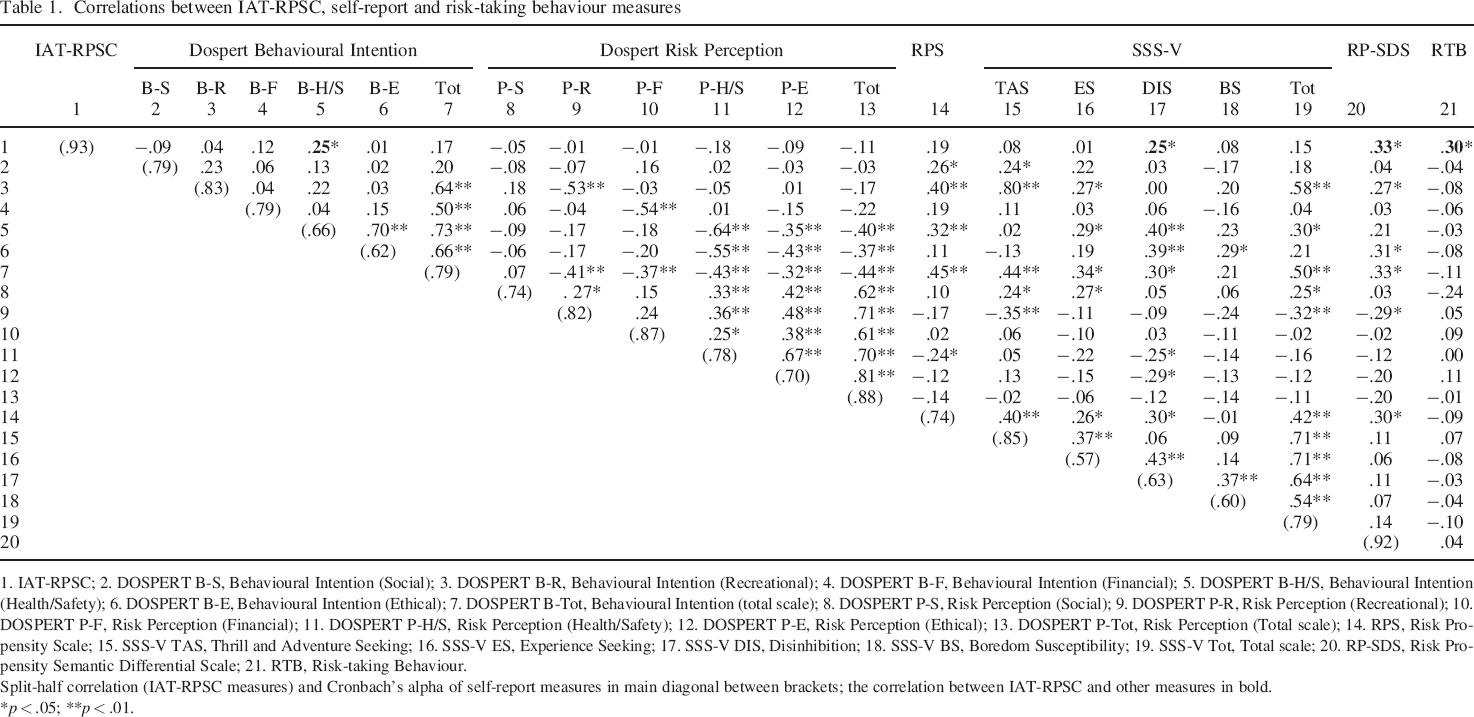
1. IAT–RPSC; 2. DOSPERT B–S, Behavioural Intention (Social); 3. DOSPERT B–R, Behavioural Intention (Recreational); 4. DOSPERT B–F, Behavioural Intention (Financial); 5. DOSPERT B–H/S, Behavioural Intention (Health/Safety); 6. DOSPERT B–E, Behavioural Intention (Ethical); 7. DOSPERT B–Tot, Behavioural Intention (total scale); 8. DOSPERT P–S, Risk Perception (Social); 9. DOSPERT P–R, Risk Perception (Recreational); 10. DOSPERT P–F, Risk Perception (Financial); 11. DOSPERT P–H/S, Risk Perception (Health/Safety); 12. DOSPERT P–E, Risk Perception (Ethical); 13. DOSPERT P–Tot, Risk Perception (Total scale); 14. RPS, Risk Propensity Scale; 15. SSS–V TAS, Thrill and Adventure Seeking; 16. SSS–V ES, Experience Seeking; 17. SSS–V DIS, Disinhibition; 18. SSS–V BS, Boredom Susceptibility; 19. SSS–V Tot, Total scale; 20. RP–SDS, Risk Propensity Semantic Differential Scale; 21. RTB, Risk–taking Behaviour.
Split–half correlation (IAT–RPSC measures) and Cronbach's alpha of self–report measures in main diagonal between brackets; the correlation between IAT–RPSC and other measures in bold.
p < .05;
p < .01.
Most importantly, participants’ IAT–RPSC scores were related to risky behaviour showing a positive and significant correlation with the risk–taking behaviour ratings (r = .30, p = .02). In fact, the IAT–RPSC scores were the unique measures that significantly correlated with the behavioural criterion (Table 1). Moreover, a multiple regression analysis was conducted to test the predictive validity of the IAT–RPSC scores compared with self–report measures. In this analysis, the risk–taking behaviour ratings were regressed on the self–report (specifically, total indexes from DOSPERT behavioural intentions and risk perception, RPS, SSS–V and RP–SDS) and IAT–RPSC scores (stepwise method). Results showed only a significant effect of the IAT–RPSC scores on risk–taking behaviour ratings, β = .295, F(1, 45) = 4.274, p = .044, which accounted for 8.7% of variance for the behavioural criterion. No other self–report measure had a significant effect on the risk–taking behaviour when included in the regression model (Table 3). Finally, the two–way interactions between the IAT–RPSC scores and the self–report measures were non–significant predicting behavioural ratings when included in the regression analysis.
Discussion
The results from Study 1 showed very good internal consistency of the IAT–RPSC scores, especially considering that the internal consistency of measures based on response latency is generally somewhat lower than for those based on self–reports (see Lane et al., 2007). 3 Furthermore, the correlations between the IAT–RPSC scores and some RP self–report measures allow us to propose the IAT–RPSC as a valid measurement instrument. In contrast with these correlational results, prior research conducted by Dislich et al. (2010) did not find a significant relation between their IATs scores and the self–report measures (e.g. DOSPERT) included in their study (rs ranged from .01 to .09). Similarly, the IRTs measures from Ronay and Kim (2006) were not significantly related to SSS–V (r = .07 for IRT–Global and r = –.05 for IRT–Unique) or SDS (r = .11 for IRT–Global), except for the IRT–Unique scores that were related to a parallel SDS (r = 28, p < .01). Therefore, the IAT–RPSC scores showed better convergent validity than has been found in prior research on RP using IAT. In sum, the moderate positive correlations obtained between the IAT–RPSC scores and some self–report measures, even outperforming the results from Dislich et al. (2010) or Ronay and Kim (2006), were in line with results from most previous IAT research showing evidence for convergent validity, although it was also consistent with the hypothesis that indirect and direct measures could refer to related but distinct constructs (Nosek & Smyth, 2007).
Finally, the most relevant result was that the IAT–RPSC scores predicted spontaneous risk–taking behaviour in a natural setting with real consequences. In our first study, the IAT–RPSC scores showed a correlation of .30 with the risk–taking behaviour ratings, consistent with prior findings in IAT research averaging r of .27 for prediction of behavioural, judgment and physiological measures (Greenwald et al., 2009). Most importantly, a multiple regression analysis showed that the IAT–RPSC scores predicted risky behaviour above and beyond all other self–report measures included in this study.
In sum, the IAT–RPSC seems to be a suitable measurement instrument of RP appraising relatively stable individual differences in automatic associations between self and risk, and these individual differences, furthermore and most importantly, contribute significantly to the prediction of risk–taking behaviour in a natural setting. One question to resolve is whether the IAT–RPSC scores will predict relevant behaviour above and beyond other available indirect measurement instruments.
Study 2: Relationship between the Iat–Rpsc Scores, Other Indirect Measures and Risk–Taking Behaviour
The main aim of Study 2 was to assess the predictive validity of the IAT–RPSC scores in comparison with other indirect measures assessing RP to test whether or not our measurement instrument outperforms those currently existing. Thus, in addition to the IAT–RPSC, other indirect measurement instruments and a behavioural risk–taking criterion were included in this study. Paying attention to the fact that Ronay and Kim's (2006) IRTs are very similar to the SC–IAT from Dislich et al. (2010), we selected the IAT–RP and the SC–IAT proposed by the latter authors.
Method
Participants
Forty psychology students at the Universidad Autónoma de Madrid (Spain) voluntarily participated in partial fulfillment of course requirements. Participants were offered a €16 voucher exchangeable at the university bookshop. One participant with an IAT error rate greater than 20% was excluded from analyses. Therefore, 39 participants were finally included in analyses (34 women and 5 men). Participants’ mean age was 21.6 years (SD = 1.58), with ages ranging between 20 and 27 years.
Measurement instruments and procedure
Iat–Rpsc
We used the IAT–RPSC as included in the first study, and D scores were computed in the same way. In this second study, participants’ mean D score was −.57 (SD = .31), ranging between −1.44 and .05.
Iat–Rp (Dislich Et Al., 2010)
The IAT to assess RP developed by Dislich et al. (2010) included two target categories (‘Me’ and ‘Other’) and two (attribute) non–evaluative categories (‘Risky’ and ‘Secure’). The words used for each category were adapted to Spanish from original words used by Dislich and colleagues. 4 Participants had to respond with the same key to ‘Me’ or ‘Secure’ categories in the first combined block. In the second combined block, participants had to respond with the same key to ‘Me’ or ‘Risky’ categories. The order of block assignment was kept constant for each participant. In this case, consistent with Dislich et al. (2010), the IAT–RP scores were computed such that a larger D score indicated a relative stronger association between ‘Secure’ and ‘Me’ (or ‘Risk’ and ‘Other’) compared with ‘Secure’ and ‘Other’ (or ‘Risk’ and ‘Me’). Thus, a negative correlation between the IAT–RPSC and IAT–RP scores was expected. In the IAT–RP, participants’ mean D score was .68 (SD = .27), ranging between .05 and 1.23.
Sc–Iat (Dislich Et Al., 2010)
As indicated by Dislich et al. (2010, p. 22), the SC–IAT included only the single target category ‘Gambling’, and the attribute categories were ‘Loss’ versus ‘Gain’. All procedural aspects of this SC–IAT followed Karpinski and Steinman's (2006) recommendations. A larger D score indicated a stronger association between ‘Gambling’ and ‘Gain’ rather than ‘Gambling’ and ‘Loss’ (see Dislich et al., 2010). Participants’ mean D score was .08 (SD = .34), ranging between −.59 and .80.
Risk–taking behaviour
We used the same behavioural criterion developed for Study 1, which consisted of choosing between collecting the €16 voucher for participating or betting on double or quits, or subsequent bets. All participants agreed to participate in the risk–taking behaviour task, and score frequencies showed 13 participants on value 0, 12 participants on value 1, 6 participants on value 2, 4 participants on value 3 and 4 participants on value 4.
The procedure was similar to the first study. In this case, the order of presentation of these three indirect measurement instruments was counterbalanced between participants. Once they completed this phase, as in Study 1, they were individually conducted to a different room in which the behavioural assessment was carried out.
Results
The IAT–RPSC scores’ internal consistency (split–half reliability index computed as described in Study 1) was r = .69. The IAT–RP scores’ split–half correlation was r = .50. Finally, the split–half correlation of the SC–IAT was r = .58.
Regarding convergent and predictive validity, all indices were computed such that the higher the score, the higher the RP, with the exception of the IAT–RP scores, as noted before. The order of presentation of IAT measurement instruments produced no significant differences on scores. For this reason, that variable was not included in the correlation and regression analyses. As expected, the IAT–RPSC scores showed a significant and negative correlation with the scores of the most similar IAT (the IAT–RP, r = –.57, p < .001). Most importantly, the IAT–RPSC scores were correlated with the behavioural ratings (r = .39, p = .01). Likewise, the IAT–RP scores were correlated with the behavioural ratings (r = –.31, p = .05), but we do not find this to be the case for the SC–IAT (Table 2).
Correlations between IAT–RPSC, IAT–RP, SC–IAT and the risk–taking behaviour measures
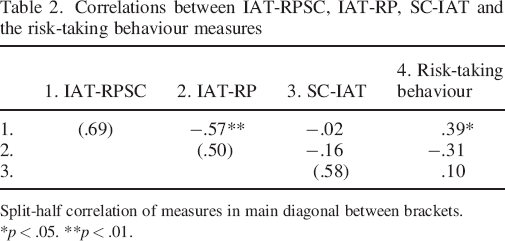
Split–half correlation of measures in main diagonal between brackets.
p < .05.
p < .01.
A multiple regression analysis was also conducted to test the predictive validity of the IAT–RPSC scores on the behavioural criterion in comparison with the other indirect measures. In this analysis, the risk–taking behaviour ratings were regressed on all indirect measures (stepwise method). Results showed only a significant effect of the IAT–RPSC scores on the behavioural ratings, β = .387, F(1, 36) = 6.333, p = .016, which accounted for the 15% of the variance for the behavioural criterion. No other indirect measures had a significant effect on the risk–taking behaviour ratings when included in the regression model (Table 3). Nevertheless, as both IAT–RPSC and IAT–RP measures were correlated with risk–taking behaviour ratings, to examine the IAT–RPSC scores’ incremental predictive power above and beyond that provided by the IAT–RP scores, a hierarchical regression analysis was also performed. Step 1 of the hierarchical regression included the IAT–RP scores, which accounted for 5.9% of the variance in the behavioural measures, F(1, 36) = 2.24, p = .14. Inclusion of the IAT–RPSC scores on Step 2 resulted in an R2 change of .091, accounting for 15% of the variance, F(2, 35) = 3.09, p = .05, indicating that the validity of the IAT–RPSC scores was incremental to that explained by the IAT–RP scores.
Regression weights and p values for measures in Studies 1 and 2
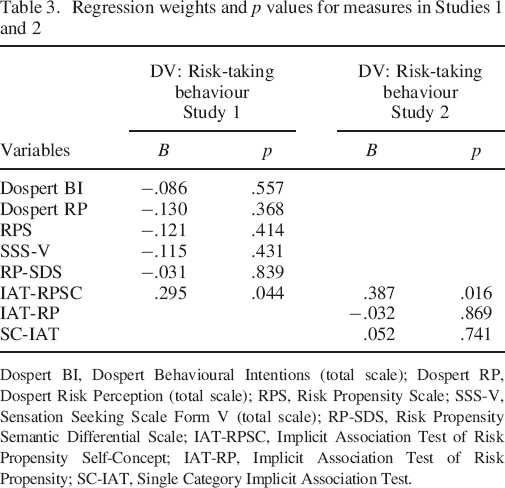
Dospert BI, Dospert Behavioural Intentions (total scale); Dospert RP, Dospert Risk Perception (total scale); RPS, Risk Propensity Scale; SSS–V, Sensation Seeking Scale Form V (total scale); RP–SDS, Risk Propensity Semantic Differential Scale; IAT–RPSC, Implicit Association Test of Risk Propensity Self–Concept; IAT–RP, Implicit Association Test of Risk Propensity; SC–IAT, Single Category Implicit Association Test.
Discussion
The results indicate that the IAT–RPSC scores show an internal consistency higher than the other indirect measures included in this study. Furthermore, the correlations between the IAT–RPSC and the IAT–RP scores allow us to present the IAT–RPSC as a valid measurement instrument showing convergent validity not only with the self–report measures but also with other indirect instrument such as the IAT–RP developed by Dislich et al. (2010). Most importantly, although the IAT–RPSC and IAT–RP measures were related to risk–taking behaviour ratings, a multiple regression analysis showed the superiority of IAT–RPSC scores predicting risk–taking behaviour above and beyond all other indirect measures (although slightly over the IAT–RP scores).
General Discussion
The present work analysed the predictive validity of several self–report and indirect measures for RP assessment and proposed a measurement instrument using the IAT: the IAT–RPSC. Across two studies, the IAT–RPSC scores showed good internal consistency, as well as significant moderate relationships with other direct (Study 1) and indirect (Study 2) measures of RP. These results are in line with earlier IAT research showing the relationship between indirect and self–report measures of attitude, stereotype and self–esteem being consistent and weakly positive, although also quite variable in magnitude between studies (e.g. Bosson, Swann, & Pennebaker, 2000). More recent research has shown similar findings, although IAT and self–report measures can be strongly related in some cases (Greenwald et al., 2003; Hofmann et al., 2005; Nosek, 2005). In a meta–analysis of IAT and self–report measure correlations, Hofmann et al. (2005) reported an average r of .24 in a total of 126 studies from 53 different content domains. Likewise, Nosek (2005) analysed 57 different content domains reporting an average correlation of .37. Therefore, prior evidence suggests that direct and indirect measures are positively related. Consistent with this prior evidence, the IAT–RPSC scores were significantly positively correlated with several self–report measures included in Study 1 (rs ranged from .25 to .33).
In accordance with our first hypothesis, the IAT–RPSC scores predicted spontaneous risk–taking behaviour in a natural setting with real consequences above and beyond self–report measures. Previous literature has shown evidence for the predictive validity of IAT measures in a wide variety of research domains, and in some cases, IAT measures predicted variation in behaviour that was not accounted for by direct self–reports (see Friese, Hofmann, & Schmitt, 2009; Greenwald et al., 2009; Perugini et al., 2010; for reviews). For example, Greenwald et al. (2009) compared the predictive validity of IAT measures with that of parallel self–report measures. As noted before, this review found an average r of .27 for prediction of behavioural, judgment and physiological measures by IAT measures, although predictive validity can largely vary as a function of many different variables (see, e.g., Perugini et al., 2010). Likewise, parallel self–report measures were also effectively predictive, averaging an r of .36, but with much greater effect size variability. Furthermore, IAT measures showed predictive validity that was independent of corresponding self–report measures (Greenwald et al., 2009). Related to this, in the present work, the IAT–RPSC scores significantly predicted risk–taking behaviour ratings included in Studies 1 and 2 (βs ranged from .29 to .38), whereas self–report measures did not.
The predictive validity issue when direct and indirect measures are involved deserves a more detailed discussion. As Perugini et al. (2010) have proposed, there are different patterns of predictive validity in such cases. Although we do not intend to be exhaustive, there are several predictive patterns that have received important support from prior research (see Perugini et al., 2010 for a complete description). For example, according to a simple association pattern, a single indirect measure predicts a single behaviour. In addition, a moderation pattern occurs when the simple association pattern is qualified by conditions under which predictive validity is enhanced or reduced. In contrast, according to an additive pattern, an indirect measure explains a unique portion of variance of a behavioural criterion in addition to what is predicted by a self–report measure. Moreover, an interactive or multiplicative pattern can also be proposed. That is, indirect and self–report measures can interact synergistically to predict a particular behavioural criterion. Furthermore, a double dissociation pattern consists of indirect measures predicting spontaneous behaviour and self–report measures predicting deliberate behaviour and not vice versa. Finally, different theoretical models have been proposed to explain those different predictive patterns. They can be classified into unitary (e.g. Fazio, 2007) or dual (e.g. Strack & Deutsch, 2004; Wilson et al., 2000) construct models.
Thus, in line with the different patterns of predictive validity suggested by prior theoretical and empirical works, our results could support a simple association pattern in which only the IAT–RPSC scores predicted a single risk–taking behaviour. However, these results could also be interpreted as evidence of a moderation pattern in which only the IAT–RPSC scores predicted risky behaviour because we included a single risk–taking behaviour in a specific condition (i.e. spontaneous behaviour in a natural setting with real consequences), but they could not predict risky behaviour in different conditions. In the same regard, an explanation is also possible on the basis of a double dissociation pattern in which the IAT–RPSC scores predict more spontaneous behaviour, whereas self–report measures predict more deliberate behaviour (not assessed in the present work) and not vice versa, according to the findings of Dislich et al. (2010). In contrast, an additive pattern in which the IAT–RPSC scores explain a unique portion of variance of our behavioural criterion in addition to what is predicted by a self–report measure is harder to assume on the basis of the results provided by Study 1, given that the self–report measures did not significantly predict risk–taking behaviour. Finally, an explanation in terms of an interactive or multiplicative pattern can be ruled out given the results found in Study 1 because the IAT–RPSC did not interact with self–report measures in the prediction of risk–taking behaviour.
Therefore, the next question to clarify must be under what conditions the IAT–RPSC scores predict risk–taking behaviour; that is to say, what type of behaviour or when those indirect measures would predict it. According to prior literature, indirect measures could predict different types of behaviour compared with self–report measures. For example, Asendorpf et al. (2002) found that an indirectly measured self–concept of personality (shyness) significantly predicted spontaneous shy behaviour in realistic social situations. Moreover, indirect measures uniquely predicted spontaneous (but not controlled) shy behaviour, whereas self–report measures uniquely predicted controlled (but not spontaneous) shy behaviour. Most relevant to the present research, Dislich et al. (2010) found that indirect measures of RP were better predictors of OPT scores assessing impulsive behaviour, compared with direct measures of RP. In contrast, when the OPT assessed reflective behaviour, direct measures of RP were better predictors compared with indirect measures.
The present study assessed a more spontaneous risk–taking behaviour producing real consequences in a natural setting. As any other behaviour in a natural setting, such risk–taking behaviour would probably be multidetermined. Nevertheless, the main elements of this situation individuals had to face were (i) choosing quickly between doubles or quits (and so on) and (ii) not being told about this beforehand. Thus, we could speculatively hypothesize that it mainly shows more impulsive or automatic aspects of RP in accordance with proposals from dual models of risk–taking behaviour (Weber & Johnson, 2009) and prior research analyzing the prediction of IAT measures over spontaneous behaviour (e.g. Asendorpf et al., 2002).
Furthermore, according to De Houwer and colleagues (De Houwer, 2006; De Houwer et al., 2009; Moors & De Houwer, 2006), ‘a process can be called automatic in the sense that it can operate even when participants do not have particular goals, a substantial amount of cognitive resources, a substantial amount of time, or awareness (of the instigating stimulus, the process itself, or the outcome of the process)’ (De Houwer et al., 2009, p. 350). Thus, the risk–taking behaviour assessed in the present work can be assumed to be automatic in the sense that participants did not have a substantial amount of time to think carefully about the consequences of his or her decision making. Likewise, the IAT–RPSC measures can be assumed to be automatic in the same sense of automaticity. Therefore, in the present work, we assumed the automaticity of these measures as consistent with most previous IAT research that also has shown that IAT measures are often more difficult to control and fake than are traditional self–report measures (Greenwald et al., 2009). In conclusion, at least in this sense, IAT measures, and particularly the IAT–RPSC scores, can be described as less controllable and thus more automatic than many RP self–report measures (De Houwer et al., 2009).
Alternatively, we think that the RP self–report measures analysed in the present work could relate to a more reflective dimension. That is, through their biographical experiences, individuals consolidate a reflective and conscious representation of themselves, and the way people describe themselves can rest on the basis of the coherence of one's own reflective and conscious statements (Cervone & Shoda, 1999). In this sense, when someone is directly asked about his or her preferences or dispositions, we hypothesize that a person describes himself or herself on the basis of that coherence, and his or her responses would coherently show one's own deliberate cognitions and behaviours. Thus, when facing a situation in which reflective cognitive and motivational resources are available, as is the case when completing a self–report assessment (without time pressure) or making deliberate risk–taking behaviour decisions, the individual can use such reflective representations to guide his or her information processing and behaviour. However, in this case, biases produced by response factors such as self–presentation concerns, or limitations associated with an inaccurate self–awareness, as well as additional implicit processes operating, might affect self–report measures. In contrast, when facing a situation in which time is limited and controlled processing is not allowed, such as in an IAT assessment or making spontaneous risk–taking decisions, the individual behaves in a more automatic way, and thus, he or she should show less self–presentation biases in his or her responses and behaviours, as well as less dependency on accurate self–awareness. Whether the difference is only in the respective degrees of controllability of the processes on which direct and indirect measures are based (e.g. Fazio, 2007) or whether the difference is produced by a dual–representation of constructs such as RP or risk attitude (e.g. Wilson et al., 2000) remain under discussion. In accordance with Perugini et al. (2010, p. 261), both theoretical models (i.e. unitary or dual) are able to accommodate empirical results from the different predictive patterns noted previously. The most critical result would have been evidence for double dissociation, but it is always possible to reinterpret the evidence for dissociation as indicative of different processes underlying the measures themselves rather than reflecting different forms of knowledge representation per se (see Greenwald & Nosek, 2009; Olson & Fazio, 2009).
In sum, as noted by Perugini et al. (2010), the critical question relates to the meaning attributed to the differences between self–report (or direct) and IAT (or indirect) measures. More specifically, this relates to whether these differences provide information about the same underlying constructs, whereas the underlying processes of these constructs are expressed differently in response to self–report versus indirect measures, as suggested by Fazio's MODE model (e.g. Fazio, 2007; Olson & Fazio, 2009) or whether people hold different forms of knowledge for the same concept (e.g. RP self–concept), either as separate representations (e.g. Strack & Deutsch, 2004; Wilson et al., 2000) or as a result of separate processes (e.g. Gawronski & Bodenhausen, 2006). Analyzing this controversy exceeds the aims of the present work and, as noted by Perugini et al. (2010), probably requires empirical research on construct formation and functioning.
In accordance with the second hypothesis of the present research, our results showed an IAT assessing self–concept predicted the behavioural criterion above and beyond a presumably more attitudinal IAT (SC–IAT of Dislich et al.). These results are consistent with those works which establish self–concept as a higher–order–organizing schema that fundamentally determines the specific attitudes and behaviours that individuals show in a given situation (see Leary & Tangney, 2003, for a review), the IAT–RPSC being a better instrument to assess and provide self–concept measures to predict spontaneous risk–taking behaviour in a natural setting. Moreover, as noted previously, the use of IAT categories such as ‘Gain’ versus ‘Loss’ may include more normative information about the ‘Risk’ (or ‘Gambling’) concept (Olson & Fazio, 2004), calling into question even the interpretation of its scores as individual attitudinal measures. This is of particular interest when referring to risk preference assessment and the prediction of risk–taking behaviour. In fact, there is controversy regarding whether risk–taking behaviour is the result of a consistent and stable way of behaving when faced with a choice involving risk elements or driven by situational factors and influenced by momentary attitudes towards risk (Appelt et al., 2011), although there is robust evidence for the consistency of risk preferences (Levin, Hart, Weller, & Harshman, 2007). Regardless of theoretical assumptions, several procedural aspects of existing risk attitude IATs could also explain the superiority of the IAT–RPSC scores found in the present work. Future research should analyse and improve risk attitude IATs developed to date, for example, using more typical attitudinal IAT categories, such as ‘Positive’ (or ‘I like’) versus ‘Negative’ (or ‘I don't like’) as attribute categories and ‘Risk’ versus ‘Security’ as target categories (see Greenwald et al., 2002; Olson & Fazio, 2004).
Concerning the third hypothesis of the present work, our results showed that, even though scores from both indirect RP self–concept instruments (IAT–RP and IAT–RPSC) significantly correlated with the behavioural criterion, only the IAT–RPSC scores significantly predicted risk–taking behaviour in the stepwise regression analysis. Moreover, when a hierarchical regression analysis was carried out, the predictive validity of the IAT–RPSC scores was incremental to that explained by the IAT–RP scores on risk–taking behaviour by Dislich et al. (2010). Thus, it seems that the categories ‘Me’ versus ‘Not–Me’ work better than ‘Me’ versus ‘Other/s’. We can hypothesize that Me versus Not–Me categories may reduce the influence of normative information related to risk–taking behaviours (Olson & Fazio, 2004) and decrease the potential negative valence of the non–specific ‘Other/s’, as Karpinski (2004) posed, although further research is necessary. In line with this hypothesis, a lower convergent validity with self–report measures should be expected for the IAT–RP measures in comparison with IAT–RPSC scores, such as we found in the Study 1 compared with Dislich and colleagues’ findings. Thus, even though these specific issues require further research, as well as future studies analyzing the variability found on the internal consistency of the RP IAT measures, the results obtained allow the consideration of the IAT–RPSC as an improved indirect measurement instrument for assessing RP self–concept compared with prior available IATs.
In conclusion, we propose that the assessment of RP should take into account both self–report and indirect measures to gain a better understanding of individual differences in RP, as well as to improve the prediction of individuals’ risk–taking behaviour. In accordance with this, our results correspond to those from Asendorpf et al. (2002) and Dislich et al. (2010) and are consistent with several predictive patterns noted in prior literature, but they do not provide conclusive support for either a dual–process model or a dual–representation model that account for the distinctions between implicit and explicit constructs (see, e.g., Greenwald & Nosek, 2009; Nosek & Smyth, 2007; Olson & Fazio, 2009; Perugini et al., 2010; for a discussion). In the present work, the IAT–RPSC scores showed an improvement in predicting an assumedly more (but not exclusively) automatic risk–taking behaviour with real consequences, compared with self–report and other available indirect measures. Future research should analyse and distinguish the multiple (automatic or controlled) aspects that the IAT–RPSC taps into and its relations with different (automatic or controlled) risk–taking behaviours. Furthermore, future research should explore these questions in a relevant way for personality research, for example, analyzing individual difference variables as potential moderators for the relationship between indirect (versus direct) measures of RP and risk–taking behaviour (see, e.g., Conner, Perugini, O'Gorman, Ayres, & Prestwich, 2007; Dislich et al., 2010; Friese et al., 2009).
Footnotes
Acknowledgements
This research has been funded by the Spanish Ministry of Science and Innovation, research grants PSI2008–02916 and PSI2011–27000.