







Abstract
The majority of research on self–monitoring has focused on the positive aspects of this personality trait. The goal of the present research was to shed some light on the potential negative side of self–monitoring and resulting consequences in two independent studies. Study 1 demonstrated that, in addition to being higher on Extraversion, high self–monitors are also more likely to be low on Honesty–Humility, which is characterized by a tendency to be dishonest and driven by self–gain. Study 2 was designed to investigate the consequences of this dishonest side of self–monitoring using two previously unexamined outcomes: moral disengagement and unethical business decision making. Results showed that high self–monitors are more likely to engage in unethical business decision making and that this relationship is mediated by the propensity to engage in moral disengagement. In addition, these negative effects of self–monitoring were found to be due to its low Honesty–Humility aspect, rather than its high Extraversion side. Further investigation showed similar effects for the Other–Directedness and Acting (but not Extraversion) self–monitoring subscales. These findings provide valuable insight into previously unexamined negative consequences of self–monitoring and suggest important directions for future research on self–monitoring. Copyright © 2013 European Association of Personality Psychology
Keywords
Since its initial proposition (Snyder, 1974), the self–monitoring construct has been a topic of enthusiastic investigation in many research domains. Self–monitoring refers to the extent to which an individual monitors the public appearance of the self in social settings and interpersonal relationships (Snyder, 1987). High self–monitors 1 are attuned to their social environment and adjust their behaviours in order to control images that they present to others. Low self–monitors, on the other hand, are more consistent in their behaviours across contexts and are also consistent with their attitudes, emotions and dispositions (Snyder & Gangestad, 1986).
A review of the literature shows strong evidence in support of the positive effects of high self–monitoring, including higher emotional intelligence (Tett, Fox, & Wang, 2005), greater non–verbal decoding skills (ability to recognize emotional displays in others) and behavioural sensitivity to the expectations of others (see Gangestad & Snyder, 2000, for a review). Within the workplace context, high self–monitoring has been positively linked to promotions over a 5–year period (Kilduff & Day, 1994), positive leadership behaviours, perceptions of leader effectiveness (Day, Schleicher, Unckless, & Hiller, 2002), leadership emergence (Cronshaw & Ellis, 1991; Ellis, 1988), greater job involvement (Day et al., 2002) and higher evaluations on interpersonal aspects of job performance (Barrick, Parks, & Mount, 2005; Blakely, Andrews, & Fuller, 2003).
Despite these positive effects, however, there appears to be a somewhat more negative side to self–monitoring. In their seminal review, Gangestad and Snyder (2000) noted that although constructs such as self–monitoring may be good natured and functional in terms of social interaction, there “… may also be an essential component in illicit social activities as well, such as lying, concealing one's true intentions, or presenting an inauthentic self” (p. 530). Indeed, researchers have found that high self–monitors tend to condone lies when there is opportunity for self–gain and engage in deception in romantic relationships (Gangestad & Snyder, 2000; McLeod & Genereux, 2008). Thus, there is a growing body of evidence indicating that there may be a more negative side to self–monitoring. The goal of the present research was to investigate the personality basis of this negative side and potential consequences in two independent studies. In the succeeding discussions, we provide an overview of the extant theoretical and empirical work on self–monitoring and how the present research fits within this literature. Next, we present two empirical studies designed to extend the literature. In Study 1, we examined the personality correlates of self–monitoring in order to show the dual aspects of this construct—that is, its ‘positive’ (high Extraversion) and ‘negative’ (low Honesty–Humility) sides. In Study 2, we examined the consequences of the proposed negative side of self–monitoring with respect to the propensity to engage in moral disengagement and to make unethical business decisions.
Theoretical Background
Although Snyder (1974, 1987) initially conceptualized self–monitoring as uni–dimensional, the past few decades have witnessed extensive debate about its dimensionality. The majority of this debate stems from evaluations of the psychometric properties of Snyder's Self–Monitoring Scale (Snyder, 1974; Snyder & Gangestad, 1986). According to this body of research, the Self–Monitoring Scale can be broken down into three subscales, namely Acting, Extraversion and Other–Directedness (Lennox & Wolfe, 1984; Snyder & Gangestad, 1986). Acting describes the extent to which the high self–monitor is capable of playing or assuming the role of a different persona or character (e.g. ‘I would probably make a good actor’ or ‘I find it hard to imitate the behaviour of other people’—Reversed). Other–Directedness is concerned with the extent to which the individual portrays multiple façades to different persons and in different contexts (e.g. ‘In different situations and with different people, I often act like very different persons’ and ‘I'm not always the person I appear to be’). Last, the Extraversion subscale is composed of sociable and outgoing behaviours (e.g. ‘At a party, I let others keep the jokes and stories going’—Reversed). On the basis of a comprehensive quantitative review of this literature, Gangestad and Snyder (2000) reported evidence in support of a two–factor structure, which they termed Public Performing and Other–Directedness (see also Briggs & Cheek, 1988; Gangestad & Snyder, 1985). All three subscales were found to load on the Public Performing factor, which captures the majority of the variance of the scale. This factor, named the Self–Monitoring axis, was found to be very strongly closely associated with the Acting subscale (Gangestad & Snyder, 2000). Last, the Other–Directedness and Extraversion subscales loaded on the second dimension (Gangestad & Snyder, 2000).
The prominence of Extraversion in Snyder's (1974) self–monitoring measure led to extensive investigations into the extent to which self–monitoring and its effects could be primarily accounted for by trait Extraversion and other related ‘social’ traits (e.g. Briggs & Cheek, 1988; John, Cheek, & Klohnen, 1996). Across a number of studies, Extraversion has emerged as an important correlate of self–monitoring, typically possessing positive relationships in the .30s and .40s (Barrick et al., 2005; Bono & Vey, 2007; Briggs & Cheek, 1988). Gangestad and Snyder (2000) acknowledged that Extraversion enjoys a dominant presence in the Self–Monitoring Scale and is a nontrivial covariate of the self–monitoring axis. Moreover, the link between self–monitoring and trait Extraversion may also be explained by the Acting subscale, which to some extent requires social skills in order to be successful (i.e. to ‘be an actor’ or to imitate the social behaviours of others). Research evidence, however, indicates that self–monitoring and its effects cannot be solely explained by Extraversion or any other personality trait within the dominant Big Five factor structure (Barrick et al., 2005; Gangestad & Snyder, 2000). Thus, there appears to be a distinct aspect to self–monitoring that, according to Gangestad and Snyder, is informed by phenomena that pertain to “variation in predispositions to engage in certain forms of impression management…categories that can best be characterized as concerning the active construction of public selves designed to achieve social ends” (Gangestad & Snyder, 2000, p. 546).
A review of the emerging literature on broad personality dimensions suggests that this other aspect of Self–Monitoring may be better captured under an alternative personality framework known as the HEXACO Personality Model (Ashton & Lee, 2007; Lee & Ashton, 2005). The HEXACO model proposes that there are six, not five, broad dimensions of personality, namely: Honesty–Humility, Emotionality, eXtraversion, Agreeableness, Conscientiousness and Openness to Experience (Ashton & Lee, 2007). Although there are a few notable differences between the HEXACO model and the prominent Big Five Model, the inclusion of Honesty–Humility, the sixth personality dimension, represents a key departure and significant advantage of this model (Ashton & Lee, 2007; Lee, Ogunfowora, & Ashton, 2005). Honesty–Humility is described by adjectives such as honest, fair, sincere or loyal versus greedy, conceited, pretentious and sly (Ashton & Lee, 2007). The negative pole of Honesty–Humility highlights the tendency to be dishonest and driven by self–gain, the acquisition of material goods and willingness to condone fraudulent acts, including presenting a façade to gain something from others (Ashton & Lee, 2007). These descriptors, particularly the latter, share theoretical similarities with high self–monitoring. As noted earlier, Gangestad and Snyder (2000) argued that the Self–Monitoring axis reflects a predisposition to engage in impression management and image management behaviours. Similarly, individuals who are low on Honesty–Humility have been shown to engage in impression management and impression–management–motivated behaviours (Bourdage, Lee, & Ogunfowora, 2009; Bourdage, Lee, Lee, & Shin, 2012). This suggests a negative link between self–monitoring and Honesty–Humility. In particular, low Honesty–Humility should be associated with the Other–Directedness subscale. This is because they both share a tendency to be disingenuous in interpersonal relations, specifically, with respect to presenting an inconsistent self to others in order to gain something from them (Ashton & Lee, 2007; Gangestad & Snyder, 2000). Moreover, low Honesty–Humility may also be positively related to the Acting subscale, which to some degree likely relies on an ability to ‘deceive’—that is, to the extent that Acting entails assuming and convincingly portraying the persona of someone else to observers (Gangestad & Snyder, 2000). Indeed, the previously described associations of high self–monitoring to the tendency to lie and deceive others (Gangestad & Snyder, 2000; Mcleod & Genereux, 2008) are consistent with low levels of Honesty–Humility (Ashton & Lee, 2007). Not surprising, therefore, researchers have found a negative link (r = −.42) between Honesty–Humility and self–monitoring— measured using Snyder's (1974) Self–Monitoring Scale (Ashton & Lee, 2005). More recently, Grieve (2011) found partial support for this relationship by using a different measure of self–monitoring (Lennox & Wolfe, 1984). Grieve found that Honesty–Humility was negatively related to the ‘ability to monitor self–presentation’ subscale of self–monitoring but not the ‘sensitivity to expressive behaviour of others’ subscale. Thus, in addition to Extraversion, low Honesty–Humility appears to be an important personality basis of self–monitoring.
The proposed dual nature of self–monitoring may also be understood within the context of a prominent theoretical model in the self–monitoring literature—Arkin's (1981) theory of acquisitive and protective self–presentation styles. According to this theory, the way people present themselves to the world can be captured by two motivational processes. Acquisitive self–monitoring is concerned with self–presentation driven by a desire for social gain and approval (Arkin, 1981; Wolfe, Lennox, & Cutler, 1986). This corresponds to the desire of high self–monitors to ‘get ahead’ by actively managing how they are perceived by others in an effort to garner social success and rewards (Rauthmann, 2011). This is also conceptually similar to low Honesty–Humility, which is driven by the acquisition of material goods and willingness to condone fraudulent acts for self–gain (Ashton & Lee, 2007). Honesty–Humility also appears to share some conceptual links with protective self–monitoring. Ashton and Lee (2007) suggested that Honesty–Humility can be theoretically interpreted as altruism–driven—a motive that pushes one who is high on Honesty–Humility to deal genuinely with others ‘even when one might exploit them without suffering retaliation’ (p. 156). In contrast, the individual who is low on Honesty–Humility is driven by selfish motives. Protective self–monitoring also appears to have an underlying self–serving motive; that is, to the extent that the high protective self–monitor is motivated to get along with others only to ‘protect’ the self from social rejection (Arkin, 1981; Wolfe et al., 1986).
In support of these postulations, Rauthmann (2011) recently demonstrated that the protective and acquisitive aspects of self–monitoring are both related to the so–called Dark Triad—narcissism, psychopathy and Machiavellianism (Paulhus & Williams, 2002)—a group of traits that have in common a tendency to manipulate and exploit others for the pursuit of selfish gains. Interestingly, Lee and Ashton (2005) found that Honesty–Humility relates substantially with each of the Dark Triad traits, with correlations ranging from −.53 (Machiavellianism) to −.72 (psychopathy). More recently, Lee, Ashton, Wiltshire, Bourdage, Visser, and Gallucci (2012) demonstrated that the core variance of the Dark Triad variables can be accounted for by low Honesty–Humility.
The positive association of self–monitoring with Extraversion may also be understood in terms of the protective and acquisitive self–presentation styles. High protective self–monitors attempt to minimize the negative repercussions of social rejection by putting up façades in social situations in order to facilitate acceptance. They are likely to be successful at this to the extent that they possess extraverted qualities (i.e. outgoing, talkative, energetic, and enthusiastic; Costa & McCrae, 1991) that enable them to acutely manoeuvre social situations in order to stand out and incur social approval (rather than rejection). Moreover, Rauthmann (2011) has proposed that the link with Extraversion can also be understood from an acquisitive perspective to the extent that Extraversion results in feelings of social reward and success when the high self–monitor effectively presents a favourable image of himself or herself in social situations.
In sum, extant theoretical and empirical research to date strongly indicates that Extraversion and low Honesty–Humility are important personality bases of self–monitoring. A deeper understanding of this dual nature of self–monitoring is important for a number of practical reasons. Although self–monitoring is positively related to many indicators of success in life, the preliminary evidence showing a negative co–variation with Honesty–Humility is a significant cause for concern. This is because research indicates that low levels of Honesty–Humility are associated with delinquency and antisocial behaviours (Dunlop, Morrison, Koenig, & Silcox, 2012; Lee, Ashton, & Shin, 2005), sexual promiscuity and sexual harassment (Ashton & Lee, 2008; Bourdage, Lee, Ashton, & Perry, 2007; Lee, Gizzarone, & Ashton, 2003), counterproductive work behaviours (Lee, Ashton, & De Vries, 2005; Marcus, Lee, & Ashton, 2007) and unethical business decision making (Lee, Ashton, Morrison, Cordery, & Dunlop, 2008). This suggests that high self–monitoring may also be associated with these negative outcomes. To date, however, there have been no further investigations into the low Honesty–Humility aspect of self–monitoring following Ashton and Lee's (2005) initial research. The issue of the dual nature of self–monitoring was not the focus of past research (Ashton & Lee, 2005; Grieve, 2011) and, as such, has received minimal attention to date.
The present research
The present multi–study research sought to shed further light on the proposed dual aspect of self–monitoring. Study 1 was designed to test the proposition that Extraversion and Honesty–Humility are the two most important broad personality factors associated with self–monitoring. This investigation was conducted in two separate samples and contexts. Study 2 was designed to investigate the consequences of the proposed dual nature of self–monitoring using two previously unexamined outcomes: moral disengagement and ethical business decision making.
Study 1
We began our investigation by exploring the most important broad personality correlates of self–monitoring in an attempt to corroborate and extend Lee and Ashton's (2005) initial findings. These relationships were tested using multiple sources (self–reports and peer reports) of self–monitoring and HEXACO personality traits in an undergraduate student sample. At a general level, demonstrating that the findings converge across multiple methods of measurement of the same traits is pertinent for illustrating the robustness of the proposed dual nature of self–monitoring (Campbell & Fiske, 1959; Oh, Wang, & Mount, 2011). This is in line with Hofstee's (1994) recommendation that researchers provide evidence beyond self–reports when attempting to establish relationships among personality constructs. Moreover, sole reliance on self–reports may limit the robustness of conclusions, as observer reports of personality may also capture important unique variance in understanding the relationship among constructs (Oh, Lee, Ashton, & De Vries, 2011). Thus, we employed both self–ratings and observer ratings in the first sample. In line with past research, we expect that Honesty–Humility and Extraversion will demonstrate the strongest and most consistent associations with self–monitoring across rating sources.
Hypothesis
Among the major personality dimensions, Extraversion and Honesty–Humility will emerge as the strongest and most consistent correlates of self–monitoring.
We further tested the proposed relationships between self–monitoring, Extraversion and Honesty–Humility in an employment context. This allowed for a test of the generalizability of the proposed relationships in a sample of adults in an employment setting. Although only self–reports were available, this is important because a substantive body of research on self–monitoring has been conducted in the work domain (e.g. Barrick et al., 2005; Blakely et al., 2003; Bono & Vey, 2007; Day et al., 2002; Kilduff & Day, 1994).
Method
Participants and procedure
Sample 1
The first sample consisted of a total of 258 undergraduate students from a mid–sized Canadian university. Of these, 65% were female, and the average age was 20.63 years (SD = 3.96). Participants arrived in dyads, with close friends attending together. Each person completed a self–report questionnaire and a peer–report questionnaire. In order to help participants feel comfortable answering honestly, we ensured that participants sat at separate tables, and if this was not possible, they were separated by a large divider. The participants were awarded research credits or paid $20 for participating in the study.
The peers consisted of 63% female participants, with an average age of 20.69 years (SD = 4.25). Participants reported knowing their peers an average of 4.75 years (SD = 4.31), and this corresponded with the estimates provided by the peers. We also obtained subjective ratings of how well participants reported knowing each other using a 10–point rating scale and found an average rating of 7.75 (SD = 1.59).
Sample 2
Participants from the second sample were employees in the Services department of a not–for–profit human services organization in Canada. The total organization size was 358 employees, 226 of whom worked in the Services department. One hundred and ten Services employees participated in the study, indicating a response rate of about 49%. The average age of respondents was 41.52 years (SD = 11.19). Approximately 78% were women, and the average tenure with the organization of 38.26 months (SD = 60.35 months). The present data were collected as part of a larger validation study at the organization. The authors attended team meetings during which employees were asked to complete a number of questionnaires that included personality scales.
Measures
Personality
In both samples, personality was measured using the HEXACO Personality Inventory Revised (HEXACO PI–R; Lee & Ashton, 2004). This scale assesses six personality factors: Honesty–Humility, Emotionality, Extraversion, Agreeableness, Conscientiousness and Openness to Experience. The items are scored on a 5–point scale (1 = strongly disagree to 5 = strongly agree).
In Sample 1, the 100–item HEXACO PI–R was administered, and self–reports and peer reports were obtained. The internal consistency reliabilities for the self–report scales were acceptable: Honesty–Humility (α = .80), Emotionality (α = .83), Extraversion (α = .85), Agreeableness (α = .85), Conscientiousness (α = .82) and Openness to Experience (α = .82). The reliability estimates for the peer–report scales were also acceptable: Honesty–Humility (α = .85), Emotionality (α = .88), Extraversion (α = .87), Agreeableness (α = .89), Conscientiousness (α = .86) and Openness to Experience (α = .84). In Sample 2, because of pressures from management to keep the survey short, a limited number of items were selected to measure each personality trait. Honesty–Humility was assessed using 12 items (α = .74) from the HEXACO Fairness, Sincerity and Modesty subscales, whereas Extraversion was assessed using eight items (α = .66) obtained from the HEXACO Liveliness and Social Boldness subscales.
Self–monitoring
In Sample 1, self–monitoring was assessed using self–reports and peer reports on the 18–item Self–Monitoring Scale (Snyder & Gangestad, 1986). Responses were assessed on a 5–point Likert scale (1 = strongly disagree to 5 = strongly agree). The internal consistency reliabilities for the self–reports and peer–report measures were .73 and .72, respectively. We also calculated scores for the three subscales of Acting, Extraversion and Other–Directedness. The reliability estimates (self–reports and peer reports, respectively) were as follows: Acting (α = .74; .67), Extraversion (α = .63; .65) and Other–directedness (α = .45; .54) subscales. These somewhat lower values are quite similar to those reported in past research. For instance, Hoyle and Lennox's (1991) comprehensive study found reliability estimates of .70 for the total 18–item self–report scale, and .64, .64 and .46 for the Acting, Extraversion and Other–Directedness subscales, respectively.
In Sample 2, self–monitoring was assessed using self–reports on the 10–item Self–Monitoring Scale from the International Personality Item Pool (IPIP; Goldberg et al., 2006). Responses were assessed on a 5–point Likert scale (1 = strongly disagree to 5 = strongly agree). The obtained reliability of this measure was .79. This IPIP scale (Goldberg et al., 2006) was developed to closely reflect self–monitoring as measured by Snyder (1974), but was not designed to measure the three subscales.
Results
The means, standard deviations and correlations among study variables can be found in Table 1. In examining the correlations among self–ratings and peer ratings of personality and self–monitoring, we used a multi–trait–multi–method approach (Campbell & Fiske, 1959), looking at the correlations between the following: (i) self–rated HEXACO traits and self–rated self–monitoring; (ii) self–rated HEXACO traits and peer–rated self–monitoring; (iii) peer–rated HEXACO traits and self–rated self–monitoring; and (iv) peer–rated HEXACO traits and peer–rated self–monitoring. 2 In terms of overall self–monitoring, across all four sets of correlations, the links between self–monitoring, Extraversion and Honesty–Humility were replicated. Consistent with past research, Extraversion was strongly and significantly correlated with self–monitoring across sources (range = .34 to .47; average r = .40). 3 Moreover, as expected, Honesty–Humility emerged as a statistically significant correlate of self–monitoring across sources (range = −.15 to −.42; average r = −.30). In comparison, openness to experience—the next trait most consistently related to self–monitoring—demonstrated relatively modest associations (range = .15 to .27; average r = .19). All other traits demonstrated weak and/or inconsistent associations with self–monitoring across source (the next strongest average correlation was Agreeableness, r = −.15). Taken together, the results obtained from both samples provide strong support for hypothesis 1. Last, we found a moderate correlation of .42 between self–ratings and peer–ratings of self–monitoring, indicating that students can judge the self–monitoring of their peers to some extent.
Means, standard deviations and correlations among the variables in Study 1 (student sample and adult working sample)
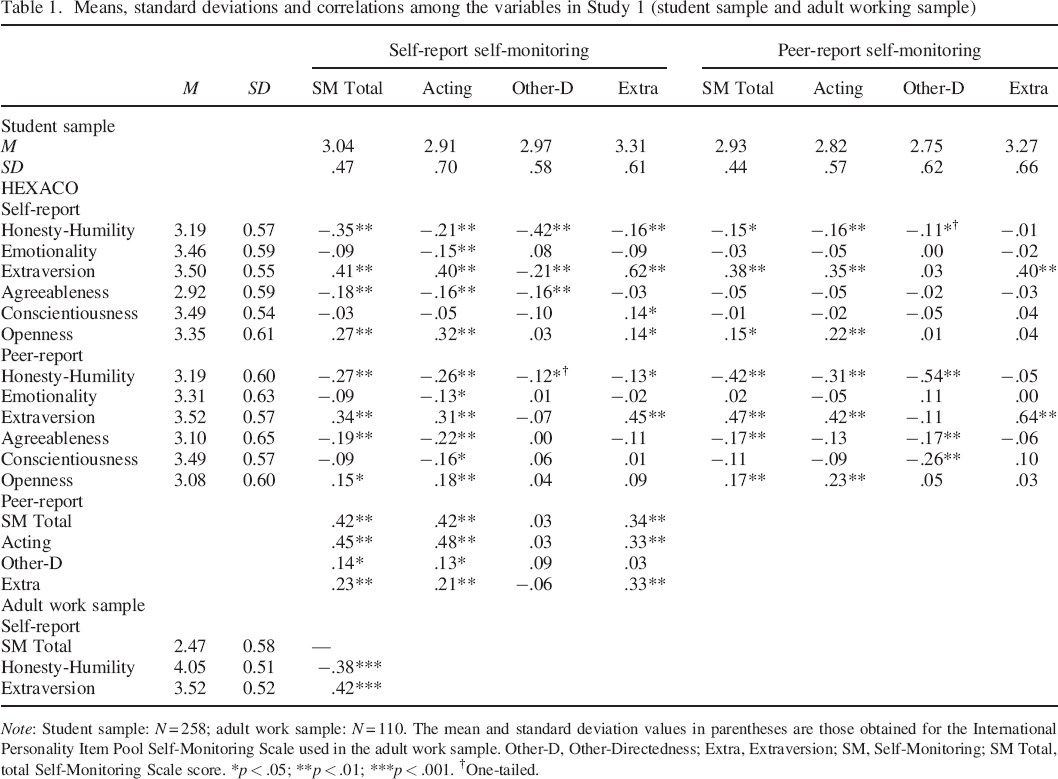
Note: Student sample: N = 258; adult work sample: N = 110. The mean and standard deviation values in parentheses are those obtained for the International Personality Item Pool Self–Monitoring Scale used in the adult work sample. Other–D, Other–Directedness; Extra, Extraversion; SM, Self–Monitoring; SM Total, total Self–Monitoring Scale score.
p < .05;
p < .01;
p < .001.
One–tailed.
Table 1 also shows the correlations with the self–monitoring subscales. Across sources, Honesty–Humility was moderately correlated with Other–directedness (range = −.11 to −.54, average r = −.31) and Acting (range = −.16 to −.31, average r = −.24) but relatively weaker with the Extraversion subscale (range = −.01 to −.16, average r = −.09). In contrast, Extraversion was most strongly associated with the Extraversion subscale (range = .40 to .64, average r = .54), moderately with Acting (range = .31 to .42, average r = .37) and weakly with Other–Directedness (range = −.21 to .03, average r = −.09).
The means, standard deviations and inter–correlations among the study variables for the adult work sample are presented at the bottom of Table 1. The results show that overall self–monitoring is significantly correlated with Extraversion (r = .42, p < .001) and Honesty–Humility (r = −.38, p < .001). These results replicate the pattern of correlations obtained in the student sample in an employment context.
Brief discussion
The results of Study 1 provide support for the dual nature of self–monitoring. Our results corroborated past findings that have found the primary personality correlate of self–monitoring to be Extraversion. The magnitude of this correlation across different sources was similar to that reported in previous studies (Barrick et al., 2005; Bono & Vey, 2007; Briggs & Cheek, 1988). Study 1 also demonstrated that, across different sources, high self–monitoring is also associated with low Honesty–Humility. Moreover, we demonstrate that these findings generalized to an employed adult sample. Past research has shown that high self–monitors may be more prone towards engaging in deceit, manipulation and status–driven motivation (e.g. Gangestad & Snyder, 2000). Similarly, low Honesty–Humility has at its core the tendency to be duplicitous and status–oriented, and correlates highly with the Dark Triad personality traits (Lee & Ashton, 2005; Lee et al., 2012). The fact that the negative association between these two traits generalized across both self–reports and peer–reports indicates that these correlations are not solely due to same source effects. As such, these features strengthen our confidence in the conclusions drawn. However, we do note that a possible limitation of our study design is that participants were allowed to choose which of their friends to bring along to the study. This may have introduced some degree of selection bias as participants may have invited only good friends that are more likely to endorse a view of the individual that is similar to the participant's self–views. 4
At the facet level, Honesty–Humility appears to be moderately associated with Other–Directedness and, to a slightly lesser degree, the Acting subscale of the Self–Monitoring Scale. The stronger association with the Other–Directedness subscale is in line with Grieve's (2011) finding that Honesty–Humility was most strongly associated with the component of Lennox and Wolfe's (1984) self–monitoring measure that pertains to one's ability to modify behaviour in response to social cues (rather than a sensitivity or ability to detect these cues). The association with the Extraversion subscale was much smaller in comparison. In contrast, HEXACO Extraversion was most strongly associated with the Extraversion subscale, followed by the Acting subscale. The observed pattern of correlations therefore suggests that Honesty–Humility is most closely associated with Other–Directedness; HEXACO Extraversion is most aligned with the Extraversion subscale; and both Honesty–Humility and Extraversion are implicated in the Acting subscale. These differential patterns of relationships indicate that it may useful to explore the consequences of the dual nature of the self–monitoring construct by using the subscales of the Self–Monitoring Scale, in addition to analyses using the overall scale.
Study 2
Study 1 established that self–monitoring can be understood in terms of high Extraversion and low Honesty–Humility, at least among broad personality dimensions. Building on this research, an important line of inquiry that warrants further attention pertains to the potential implications of the low Honesty–Humility correlate of self–monitoring. To this end, Study 2 was designed to test the effects of self–monitoring on outcomes that are likely to be the result of this dishonest side. Specifically, we examined the extent to which self–monitoring relates to unethical business decision making, as well as the potential mediating effect of moral disengagement (Bandura, 1986) in understanding this association. Last, we tested the proposition that these relationships can be explained primarily by low Honesty–Humility but not high Extraversion.
Self–monitoring and unethical decision making
A potential negative consequence of the low Honesty–Humility aspect of self–monitoring is the propensity to make unethical business decisions. Gangestad & Snyder (2000) have suggested that high self–monitoring is driven in part by the motivation for self–gain and the need to acquire social status and success. This is also in line with the theoretical interpretation of acquisitive self–monitoring, which highlights a desire for social gain that is driven by a ‘get ahead’ mentality (Wolfe et al., 1986). We propose that such a motive may increase the probability that a high self–monitor will make unethical business decisions, particularly those judged to benefit the self and which allows the high self–monitor to get ahead in life. A similar drive for self–gain and social status is also inherent in low Honesty–Humility. Not surprisingly, research studies have found a positive association between low Honesty–Humility and unethical business decision making (e.g. Lee et al., 2008; Perugini & Leone, 2009; Van Gelder & De Vries, 2012). A high self–monitor may further reason that an unethical decision that brings about financial success may help to elevate his or her social status and ultimately foster social acceptance rather than rejection by others (i.e. protective self–monitoring). These arguments indirectly suggest that high self–monitors may be likely to make unethical business decisions. Moreover, self–monitoring has also been linked to discrete forms of unethical intentions, such as willingness to condoning lies and a tendency to deceive and manipulate others (Grieve, 2011; Mcleod & Genereux, 2008; Gangestad & Snyder, 2000). Hence, we propose that self–monitoring will be associated with unethical business decision making.
Hypothesis
Self–monitoring will be positively related to unethical decision making.
The mediating effects of moral disengagement
One potential explanation for the proposed link between self–monitoring and unethical decision making may be the propensity to morally disengage (Bandura, 1986). Bandura (1986) developed the concept of moral disengagement to explain how people come to engage in detrimental conducts that are otherwise incongruent with their moral standards. Social cognitive theory proposes that self–management of detrimental conducts occur through cognitive, self–regulatory mechanisms (Bandura, 1999). According to Bandura and colleagues, people evade self–imposed sanctions for engaging in negative conducts by using a number of ‘sociocognitive manoeuvres’ that deactivate normal self–regulatory processes, thereby disengaging their moral standards from detrimental conduct (Bandura, Caprara, Barbaranelli, Pastorelli, & Regalia, 2001). Bandura (1999) has described eight such mechanisms of moral disengagement that ultimately enable a person to engage in detrimental conduct with little guilt and self–censure. They include moral justification (cognitively misconstruing harm to others so as to seem morally justifiable), euphemistic labelling (using morally neutral diction to make unethical conduct seem less threatening), advantageous comparison (making an unethical conduct seem less harmful by comparing it with more injurious unethical actions), displacement of responsibility (passing culpability for one's unethical conduct to the directives of authority figures), diffusion of responsibility (abating personal liability for unethical conduct when such actions are taken as part of a larger group or collective), disregarding or distorting the consequences (minimizing, forgetting or even actively discrediting evidence of harm caused to others), dehumanization (sanctioning immoral acts by casting victims as subhuman or lacking human qualities) and attribution of blame (blaming the recipients of harmful behaviours for instigating such actions) (Bandura, Barbaranelli, Caprara, & Pastorelli, 1996; Detert, Treviño, & Sweitzer, 2008).
Detert et al. (2008) recently argued that moral disengagement mechanisms also disassociate contemplated actions from the guilt or self–censure that would otherwise prevent it (p. 378). In particular, moral disengagement mechanisms may operate to minimize guilt feelings associated with thinking about engaging in unethical behaviours. In support of this, Detert et al. found that moral disengagement was positively related to unethical decision making. We propose that moral disengagement can help to explain the relationship between self–monitoring and unethical decision making. The high self–monitor who contemplates an unethical course of action in order to gain social success may eliminate any guilt or self–censure through moral disengagement mechanisms. For instance, the high self–monitor may justify the need to make an unethical business decision by reasoning that the resulting financial success will help to achieve a favourable public image, which is necessary in order to get ahead in an otherwise difficult and harsh world (i.e. serving the acquisitive self–monitoring motive). The high self–monitor may also reason that the resulting financial success and social status will bring about acceptance from others who may otherwise reject him or her from their social circles (i.e. serving the protective self–monitoring motive). These are examples of the moral justification mechanism (for instance, a sample moral justification item is as follows: ‘Playing dirty is sometimes necessary in order to achieve noble ends’; Moore, Detert, Treviño, Baker, & Mayer, 2012). As another example, the high self–monitor may engage in euphemistic language strategies to make their unethical intentions sound less threatening. For instance, making unethical decisions that result in social or financial gain may be construed as ‘being politically savvy’ or ‘playing the game’ rather than unethical per se.
Hypothesis
The relationship between self–monitoring and unethical decision making will be mediated by moral disengagement.
Last, in light of the preceding arguments, we posit that the negative relations of self–monitoring to unethical decision making, and the potential mediating effects of moral disengagement, will be explained by its low Honesty–Humility side but not the extraverted side.
Hypothesis
The link between self–monitoring and unethical decision making, and through moral disengagement, will be explained by Honesty–Humility but not Extraversion.
Method
Participants and procedure
A total of 215 undergraduate Canadian students enrolled in multiple sections of an introductory business course in organizational behaviour were recruited as part of a larger project on individual and team characteristics. About 48% of respondents were female, and the average age was 21.8 years old (SD = 3.95). Students were randomly assigned into teams of four to six members and worked on a major class project that accounted for 40% of their final class grade. At the start of the semester, students were invited to voluntarily participate in a multi–wave research study (at approximately 1–month intervals) in exchange for partial course credits. Personality questionnaires were administered at the start of the semester (time 1), followed by the moral disengagement measure at time 2. At time 3, participants completed the ethical business decision–making scale.
Measures
Personality
As in Study 1, Honesty–Humility and Extraversion were measured using the 100–item version of the HEXACO PI (Lee & Ashton, 2004). The observed internal consistency reliabilities were .82 and .79 for Honesty–Humility and Extraversion, respectively.
Self–monitoring
Self–monitoring was assessed again using the 18–item Self–Monitoring Scale (Snyder & Gangestad, 1986)—see the Method section in Study 1. The reliability of the total Self–Monitoring Scale was .74; and for the Acting, Extraversion and Other–Directedness subscales, the reliabilities were .69, .49 and .61, respectively.
Moral disengagement
Moral disengagement was measured using the modified version by Detert et al. (2008) of the 32–item scale originally developed by Bandura et al. (1996) for use with children and adolescents. This scale was modified for use with an older population. The resulting 24–item scale assesses the eight subcomponents of moral disengagement and was shown to possess acceptable overall scale reliability (α = .87) and strong initial construct and predictive validity evidence (Detert et al., 2008). Responses to the questions were made on a 5–point Likert scale ranging from 1 (strongly disagree) to 5 (strongly agree). Interested readers may refer to Detert et al. for a complete list of items in this scale.
Ethical decision making
Participants completed a revised version of the Business Ethical Decision Making Dilemma scale (Lee et al., 2008). This scale contains 10 questions that require participants to estimate how likely (1 = very unlikely to 4 = very likely) they are to choose a course of action that would yield personal or organizational profits, even though it may potentially cause harm to other individuals or to society at large (Lee et al., 2008). The scale was scored such that high scores indicated a higher likelihood to make unethical decisions. The reliability of this measure was .79.
Analyses
The hypotheses were tested using the PROCESS procedure in SPSS (Hayes, 2013). PROCESS incorporates traditional regression analysis tests (Hypotheses 1–2), as well as bootstrapping methodologies for testing indirect effects (Hypotheses 3–4). In contrast to traditional significance testing, mediation is supported to the extent that the confidence interval (CI) around the estimated mediated effect does not contain zero (Preacher, Rucker, & Hayes, 2007). In the present study, 95% bias–corrected CIs were calculated on the basis of 10 000 bootstrapped samples. Hypothesis 4 was tested using two models. In the first model, Extraversion was entered as a control variable in the model testing the indirect effects of self–monitoring on unethical decision making through moral disengagement. A second model was then specified with Honesty–Humility as the control. This allowed us to determine which of the two personality traits was responsible for the observed effects.
Results
Table 2 shows the means, standard deviations and inter–correlations among the study variables. The bivariate correlations among the hypothesized variables were generally in the predicted direction and were statistically significant. Consistent with the results from Study 1, the two strongest correlates of overall self–monitoring were Extraversion, r = .42, p < .01, and Honesty–Humility, r = −.38, p < .01. In addition, similar to Study 1, we found that Honesty–Humility was moderately negatively related to the Other–Directedness subscale, r = −.32, p < .001, but weakly to the Extraversion subscale, r = −.15, p < .05, whereas HEXACO Extraversion was strongly and positively related to the Extraversion self–monitoring subscale, r = .62, p < .001, but weakly to the Other–Directedness subscale, r = −.11, p > .05. Both Extraversion, r = .39, p < .001, and Honesty–Humility, r = −.31, p < .001, were related to the Acting subscale. These trends clearly replicate the findings from Study 1. In support of our hypothesized relationships, self–monitoring positively correlated with moral disengagement, r = .19, p < .01, and unethical decision making, r = .26, p < .01, providing initial support for Hypotheses 1 and 2. The relationship between moral disengagement and unethical decision making was moderate and significant, r = .47, p < .01.
Means, standard deviations and correlations among the study variables (Study 2)
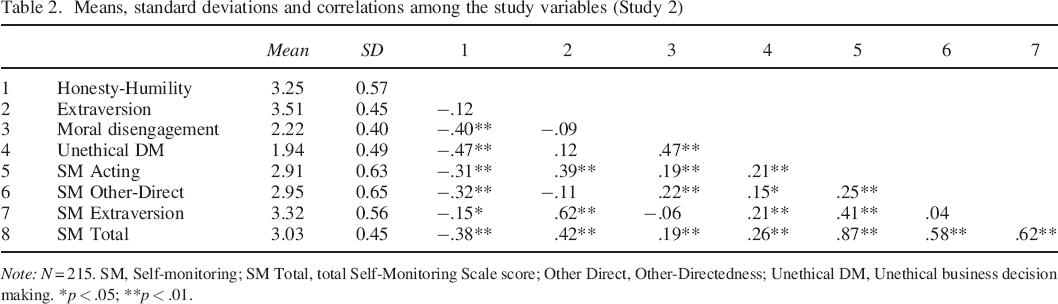
Note: N = 215. SM, Self–monitoring; SM Total, total Self–Monitoring Scale score; Other Direct, Other–Directedness; Unethical DM, Unethical business decision making.
p < .05;
p < .01.
Table 3 provides the results obtained from the regression and bootstrapping analyses. The regression results showed that overall self–monitoring was positively related to moral disengagement, β = .15, p < .05, providing support for Hypothesis 1. In addition, overall self–monitoring had both a direct positive effect on unethical business decision making, β = .21, p < .01, and an indirect effect through moral disengagement, ρ = 0.08 (CI = 0.002 to 0.16). Hence, Hypothesis 2 and 3 were supported. In order to test Hypothesis 4, the proposed mediation was tested controlling for HEXACO Extraversion. The results showed that self–monitoring retained a significant direct effect on unethical decision making, β = .17, p < .05, as well as an indirect effect through moral disengagement, ρ = 0.13, CI = 0.05 to 0.23. This indicates that the direct and indirect effects of self–monitoring on unethical business decision making cannot be explained by HEXACO Extraversion. These analyses were repeated with Honesty–Humility as the control variable. The results showed that self–monitoring no longer demonstrated a direct effect on unethical decision making, β = .11, p > .05, nor did it have an indirect effect through moral disengagement, ρ = 0.01, CI = −0.07 to 0.08. These results suggest that the direct and indirect effects of self–monitoring on unethical business decision making can be explained by the low Honesty–Humility aspect of self–monitoring.
Direct and indirect effects of self–monitoring on unethical business decision making (Study 2)
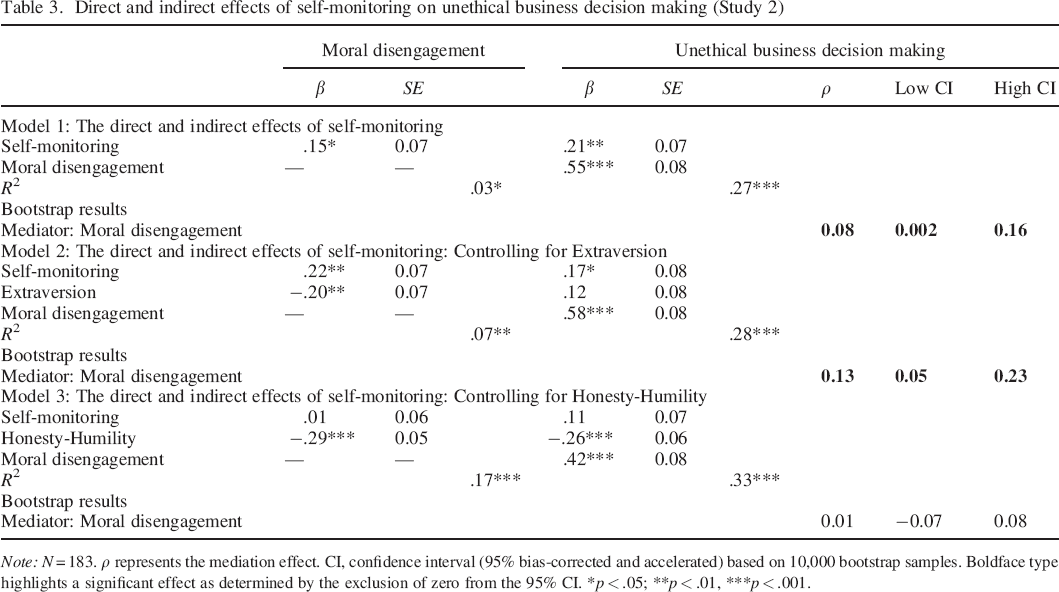
Note: N = 183. ρ represents the mediation effect. CI, confidence interval (95% bias–corrected and accelerated) based on 10,000 bootstrap samples. Boldface type highlights a significant effect as determined by the exclusion of zero from the 95% CI.
p < .05;
p < .01.
p < .001.
The aforementioned analyses were repeated for each of the self–monitoring subscales. The Acting, Other–Directedness and Extraversion aspects of self–monitoring were all positively correlated with unethical business decision making, rs = .21, .15 and .21, ps < .05, respectively. However, Acting, r = .19, p < .01, and Other–Directedness, r = .22, p < .01, were related to moral disengagement but not Extraversion, r = −.06, p > .05. The direct and indirect effects of these subscales on unethical decision making were also tested. The results showed that moral disengagement mediated the effects of Other–Directedness, ρ = 0.07, CI = 0.02 to 0.13, and Acting, ρ = 0.06, CI = 0.01 to 0.11, on unethical business decision making; this mediation effect was, however, not supported for the Extraversion subscale, ρ = −0.07, CI = −0.26 to 0.09. In these analyses, Acting, β = .11, p < .05, and Extraversion, β = .20, p < .01, also demonstrated direct effects on unethical decision making, but not Other–Directedness, β = .05, p > .05. This suggests that the effect of Other–Directedness (but not the other subscales) on unethical decision making occurs primarily through moral disengagement.
Similar to the results obtained for the overall Self–Monitoring Scale, the direct and indirect effects of Other–Directedness and Acting on unethical business decision making through moral disengagement remained unchanged after controlling for HEXACO Extraversion. However, these effects were no longer supported after controlling for Honesty–Humility. In contrast, the Extraversion subscale retained a direct positive effect (β = .16, p < .01) on unethical business decision making, after controlling for Honesty–Humility (even though there was no support for an indirect effect through moral disengagement). This suggests that the Extraversion subscale shares a portion of its variance with unethical business decision making that cannot be explained by low Honesty–Humility.
Brief discussion
Research studies have found that self–monitoring relates to a number of positive outcomes (e.g. Day et al., 2002; Gangestad & Snyder, 2000). In comparison, fewer studies have examined the potential detrimental aspects of this construct. In light of the evidence from Study 1 indicating that self–monitoring has a low Honesty–Humility side, Study 2 was carried out to investigate the potential repercussions of this association. The results demonstrated that high self–monitors are more likely to make unethical business decisions. We also found that the tendency to use moral disengagement mechanisms as a way of minimizing feelings of guilt associated with unethical decisions is one explanation for the link between self–monitoring and unethical decision making. To date, no research has linked self–monitoring to these important ethics–related consequences. Last, the results supported our thesis that these negative, ethics–related outcomes can be explained by the low Honesty–Humility correlate of self–monitoring, rather than its Extraversion correlate. In other words, low Honesty–Humility is pertinent to understanding the extent to which high self–monitors engage in morally questionable cognitive processes and decisions. 5
Further investigations into the self–monitoring subscales provided additional support for our propositions. The results revealed similar mediatory effects of moral disengagement on the links between Acting and Other–Directedness and unethical business decision making. This was, however, not the case for the Extraversion subscale. Although the Extraversion subscale was related to unethical decision making, most likely because of its shared variance with the other components of self–monitoring, the use of moral disengagement tactics may be more readily attributable to those behaviours that fall within the Acting and Other–Directedness domain. Specifically, compared with the Extraversion subscale, the Acting and Other–Directedness behaviours may be more closely associated with a tendency towards deception through image control (particularly Other–Directedness) and, as such, may be more likely serviced by moral disengagement tactics. It is therefore not surprising that low Honesty–Humility was again implicated in explaining the links between these self–monitoring subscales and unethical business decision making through moral disengagement. In sum, analyses of the self–monitoring subscales revealed differential patterns of relationships and support the notion that these subscales should be investigated independently. However, we encourage readers to exercise caution in the interpretation of these findings given the lower levels of reliability associated with these subscales. This issue is not unique to the present study, however, as past studies have found similarly low reliabilities for these subscales (e.g. Hoyle & Lennox, 1991).
General Discussion
The present multi–study research was designed to shed light on the dual nature of the self–monitoring construct. On the basis of past research, we proposed that self–monitoring relates primarily and most consistently to two important major personality dimensions: Extraversion and (low) Honesty–Humility. 6 In light of the extensive research that has been conducted on Extraversion as a correlate of self–monitoring, this paper sought to establish the consequences of the low Honesty–Humility side of self–monitoring. A number of important findings emerged from this investigation. First, across multiple samples, we found consistent evidence that Extraversion was the strongest correlate of self–monitoring (as measured by the 18–item Self–Monitoring Scale; Snyder & Gangestad, 1986), followed closely by low Honesty–Humility. This association generalized across different rating sources and different samples, including an adult work sample. These findings replicate Ashton and Lee's (2005) initial observation of a negative association between Honesty–Humility and self–monitoring and provide strong evidence of the dual nature of self–monitoring. Second, Study 2 showed that self–monitoring and its three subscales were positively related to unethical business decision making. In addition, overall self–monitoring—as well as the Acting and Other–Directedness components—also demonstrated an indirect effect on unethical business decision making through moral disengagement. Additionally, we showed that these negative outcomes of self–monitoring were primarily due to the low Honesty–Humility side of self–monitoring but not the extraverted side. As noted earlier, past research has found that high self–monitors are more likely to engage in impression management, to condone deceit in order to gain favours, as well as engage in deception in romantic relationships (Gangestad & Snyder, 2000; Mcleod & Genereux, 2008; Turnley & Bolino, 2001). More recently, Grieves (2011) found that high self–monitoring was positively associated with self–reported tendencies to engage in emotional manipulation. Not surprisingly, these same impression management and emotional manipulation tactics have been associated with low Honesty–Humility (e.g. Bourdage et al., 2012, 2009; Grieves, 2011). Taken together, the results of the present research more clearly and directly demonstrate the role of low Honesty–Humility in understanding the negative effects of self–monitoring on two previously unexamined ethics–related outcomes.
Implications and future research
High self–monitoring has been associated with success in different domains of social life and, as such, is often treated as an adaptive construct. The present research, however, shows that high self–monitors are also likely to entertain unethical cognitions and decisions. This may be problematic in the workplace, for instance, where high self–monitors are likely to be viewed positively by others and promoted to positions of authority (Day et al., 2002). Moreover, there are likely to be other unfavourable outcomes that may result from high self–monitors‘ propensities to morally disengage. Bandura et al. (1996) have also shown that children and adolescents who engage in moral disengagement are less likely to engage in prosocial behaviours and more likely to be prone to aggression. A recent multi–study investigation (Moore et al., 2012) found that individuals who have a higher propensity to morally disengage are more likely to engage in a number of unethical behaviours, including stealing, lying and cheating. These individuals showed a greater tendency to engage in fraudulent activity and made more self–serving decisions that place others at jeopardy.
Moreover, self–monitoring also demonstrated a direct effect on ethical business decision making. This suggests that there may be other explanatory mechanisms for understanding why high self–monitors make unethical decisions that should be explored in the future. In addition, future studies should also be devoted to investigating other implications of the low Honesty–Humility nature of self–monitoring. For instance, Honesty–Humility is a strong predictor of delinquency, antisocial behaviours, sexual harassment proclivity and cheating behaviours (Hershfield, Cohen, & Thompson, 2012; Lee, Ashton, & De Vries, 2005; Lee et al., 2003; O'Neill, Lewis, & Carswell, 2011). As such, future studies should examine the potential links between self–monitoring and similar negative outcomes.
Similar to past research (Cheek, 1982; Wymer & Penner, 1985), we observed a moderate relationship between self–ratings and peer ratings of self–monitoring in Study 1. Past research has further shown that the magnitude of this self–peer agreement is roughly the same for high self–monitors as it is for low self–monitors (Gangestad & Snyder, 2000). As noted by a reviewer, this observation is somewhat disconcerting because if those who rate themselves as high self–monitors are readily judged by their peers as high self–monitors, then the objective of self–monitoring (convincingly presenting differing ‘favourable’ images to others) would have failed. This raises the question of whether there are individual differences in the ability to be an effective high self–monitor. For instance, past research has shown that the effective use of impression management tactics—a set of behaviours related to self–monitoring—depends on the political skills of the impression manager (e.g. Harris, Kacmar, Zivnuska, & Shaw, 2007). A review of the self–monitoring subscales, however, showed moderate correlations between self–ratings and peer ratings of Extraversion (r = .33) and Acting (r = .48), but not Other–Directedness (r = .09). This suggests that, unlike the other sub–facets, participants are unable to judge the Other–Directedness of their peers. This is worth noting because Other–Directedness embodies the fundamental, chameleon–like attribute of the high self–monitor—that is, it describes the extent to which the individual puts on different favourable facades to different people. The results indicate that perhaps peers are not capable of judging this pertinent aspect of high self–monitors after all. Future research is, however, necessary to replicate these findings before substantive conclusions are drawn, particularly given the lower reliabilities of the self–monitoring subscales in the present study.
Limitations
The present research has some limitations that warrant consideration. First, we generally observed low internal consistency reliability estimates for the subscales of the Self–Monitoring Scale. Although these reliability estimates are similar to those that have been reported in past research (e.g. Hoyle & Lennox, 1991), the low reliability of these subscales may have had negative effects on the observed relationships reported in this study. Another limitation is that the findings in Study 2 were based on same source data, which may limit the inferences made from this study. To minimize the effects of same source biases, Study 2 incorporated a lagged design that separated measures of the independent, mediator and outcome variables by time (i.e. across three periods). This does not, however, alleviate concerns regarding the external validity of the findings obtained in Study 2. In particular, this study found a link between self–monitoring and unethical business decision making by using a sample of undergraduate business students. The generalizability of this association to decision making in the workplace, however, needs to be established. Last, we should note that although we focused on two major personality factors that appear to underlie self–monitoring (Extraversion and low Honesty–Humility), the self–monitoring construct is likely more than just a combination of these two personality variables. For instance, we conducted post hoc regression analyses relating the HEXACO personality variables as a set to the overall Self–Monitoring Scale. The results indicate that, as a whole, the HEXACO model of personality does not fully account for the variance in self–monitoring (for Study 1, the average R between the six HEXACO factors and self–monitoring is .52). Thus, although self–monitoring cannot be completely understood within the HEXACO framework, the HEXACO model does provide an avenue for understanding the dishonest side of this important construct.
Conclusion
In sum, the present research illustrates that the self–monitoring construct has both high Extraversion and low Honesty–Humility aspects. An exploration of the low Honesty–Humility side provided valuable insight into previously unexamined, negative consequences of self–monitoring. It is our hope that this research will encourage future work on the implications of the dishonest side of self–monitoring across different domains of social life.