







Abstract
Understanding the individual factors that predispose persons to criminal behaviour is vital to reducing offending and rehabilitating those who have been sentenced to prison. This study examined the roles of narcissism (at both clinical and subclinical trait levels) and empathy, by comparing levels in young adult males currently serving a prison sentence to those with no history of criminal convictions. Prison participants had significantly higher levels of narcissism—in particular entitlement—than control participants, and this link was sequentially mediated by lower perspective–taking and subsequently lack of empathic concern. Trait narcissism showed stronger effects than narcissistic personality disorder symptoms. Narcissistic young men's feelings of entitlement and ensuing lack of empathy for others may account for their greater likelihood of criminal behaviour. Copyright © 2013 John Wiley & Sons, Ltd.
The world's prisons are overcrowded. Occupancy rates are over 100% of official capacity in Australia, Britain, the USA and many other countries (International Centre for Prison Studies, 2012). Evidently, this level of criminal behaviour impacts negatively on society. Moreover, approximately half of those released from prison reoffend within a year, according to British justice sources (Ministry of Justice, 2012). The ability to recognise at–risk individuals before they commit offences would enable authorities to target and tailor interventions. Thus, it is useful to identify key individual difference variables that predict offending. Next to sociodemographic factors and mental capacity, personality variables are especially relevant. In this article, we examine the personality trait of narcissism. We test whether dimensional trait narcissism or narcissistic personality disorder (NPD) symptoms best distinguish offenders from non–offenders, and we explore the mediating role of empathy in this link. In so doing, we hope to improve understanding of personality risk factors as well as inform the design and targeted delivery of offender programs.
Scholars have long speculated about the personality factors that predispose certain individuals to criminal behaviour. Wulach (1988), for example, proposed a ‘criminal personality’, which meets the criteria for four personality disorders (PDs). Indeed, studies of offenders have identified higher rates of PD symptoms compared to the general population (Blackburn and Coid, 1999; Johnson et al., 2000). However, not every person who commits a criminal offence suffers from a mental disorder. Thus, it is crucial to identify subclinical personality traits that characterise offenders. Research on basic personality traits has suggested that antisocial behaviour is predicted by a profile of several traits (e.g. low agreeableness and conscientiousness; Mõttus, Guljajev, Allik, Laidra, and Pullmann, 2012). Can this approach be simplified by focusing on fewer key personality variables?
A promising candidate is narcissism. NPD has been mooted as one of the disorders characterising offenders (Wulach, 1988), but prevalence rates are very low (∼3%; Johnson et al., 2000). In contrast, narcissistic personality traits are prevalent in the general population (hereafter, we refer to this dimension as ‘trait narcissism,’ although it is often called ‘subclinical narcissism’ or ‘normal narcissism;’ Sedikides, Rudich, Gregg, Kumashiro, and Rusbult, 2004). Trait narcissism entails a grandiose, inflated self–image and desire for power, coupled with a sense of entitlement and lack of regard for others (Campbell and Foster, 2007; Campbell, Rudich and Sedikides, 2002; Raskin and Terry, 1988). That is, although narcissistic individuals depend on other people's praise and respect to feed their ego, they lack communal motivation and fail to consider the effect they have on others (Morf, Horvath and Torchetti, 2011; Sedikides, Campbell, Reeder, Elliot and Gregg, 2002). Accordingly, narcissism is associated with antisocial characteristics such as low empathy (Watson and Morris, 1991), exploitativeness (Campbell, Bush, Brunell, and Shelton, 2005) and aggressive reactions to threat (Bushman and Baumeister, 1998). Together, these characteristics may predispose narcissistic individuals to a range of criminal behaviours by increasing motivation to gain resources or power and by decreasing regard for conventional social consequences. Entitlement and exploitativeness are the most socially toxic or ‘maladaptive’ ingredients of narcissism (Campbell and Foster, 2007) and so should relate most closely to criminality. Although the relation between NPD and trait narcissism remains unclear, research indicates that both constructs share antagonistic characteristics, but trait (vs clinical) narcissists are more extraverted, emotionally stable and psychologically healthy (Miller and Campbell, 2008).
Thus far, most studies examining narcissism and criminal behaviour have used clinical measures. Blickle, Schlegel, Fassbender and Klein (2006) found that ex–managers incarcerated for ‘white–collar’ crimes endorsed more NPD symptoms than current managers with no criminal history. Blackburn and Coid (1999) reported that violent male offenders diagnosed with ‘antisocial–narcissistic’ PD clusters had more extensive criminal careers. Vaughn, Litschge, DeLisi, Beaver and McMillen (2008) showed that narcissistic–type items in a short–form of the psychopathic personality inventory (Lilienfeld and Andrews, 1996) correlated with arrests and assaults with a weapon in the past two years. Finally, Johnson et al. (2000) found that NPD symptoms in early adolescence predicted violent criminal behaviour in mid–adolescence and early adulthood. Trait narcissism has primarily been examined in community samples; for example, Barry, Frick, Adler and Grafeman (2007) established that adolescents higher (vs lower) on maladaptive narcissistic traits reported engaging in more delinquent acts and having more contact with police over the following three years. In the only study to our knowledge, to assess trait narcissism in convicted offenders, Bushman and Baumeister (2002) compared 63 violent offenders to baseline scores in published literature. Violent offenders had higher narcissism but not higher self–esteem than baseline. However, this study only included violent criminals, and the baseline samples had unknown criminal histories. Thus, the association between trait narcissism and criminal behaviour is not fully understood. This is a timely question, because evidence indicates that levels of trait narcissism are increasing in Western society, with a 30% rise in the past 30 years (Twenge, Konrath, Foster, Campbell, and Bushman, 2008), and patterns also suggesting an increase in Eastern culture (Cai, Kwan, and Sedikides, 2012). Thus, whereas NPD is a relatively rare disorder, trait narcissism is highly prevalent. If trait narcissism leads to criminal behaviour, its increase in society should cause concern.
By what mechanism might narcissism lead to criminal behaviour? Above and beyond their motivation to aggress or exploit, it is arguably narcissists’ lack of empathy that allows them to enact their urges or devious plans. Without regard for others’ feelings, narcissists have no reason to curtail their behaviour. Low empathy is a recognised feature of NPD (American Psychiatric Association, 2000; Decety and Moriguchi, 2007; Ritter et al., 2011). Moreover, studies consistently show negative associations between trait narcissism and empathy (Gurtman, 1992; Hepper, Hart and Sedikides, 2013; Wai and Tiliopoulos, 2012; Watson and Morris, 1991). In turn, empathy relates inversely to aggressive and antisocial behaviour (Miller and Eisenberg, 1988) and to offending (Day, Casey and Gerace, 2010; Jolliffe and Farrington, 2004, 2007). Robinson, Roberts, Strayer, and Koopman (2007) documented that empathy distinguished incarcerated young offenders from non–offenders better than self–reported aggressive behaviour and attitudes. Thus, empathy is a core concern in understanding criminality and may play a role in explaining narcissists’ antisocial actions.
Empathy is defined as both the cognitive ability to understand others’ perspectives and the affective tendency to respond to others by sharing their emotions or feeling compassion (Davis, 1983). It is this latter compassionate response that theoretically drives prosocial (vs antisocial) behaviour (Vreeke and van der Mark, 2003). However, theoretical accounts of empathy hold that perspective–taking may be a prerequisite for experiencing compassion or affective empathy (Batson and Ahmad, 2009; Marshall, Hudson, Jones and Fernandez, 1995; Vreeke and van der Mark, 2003). Thus, social behaviour is affected sequentially by individual differences in both perspective–taking (distally) and compassionate tendencies (proximally). Research has linked narcissism either to deficits in both cognitive empathy and affective empathy (Gurtman, 1992; Watson and Morris, 1991) or to a deficit in affective empathy only (Ritter et al., 2011; Wai and Tiliopoulos, 2012). Similarly, offending has been linked variously both to cognitive empathy (Jolliffe and Farrington, 2004) and affective empathy (Jolliffe and Farrington, 2007). Thus, the specific nature of the narcissism—empathy—offending link remains to be established.
The Present Study
We examined the roles of narcissism and empathy in distinguishing offenders from non–offenders. First, we compared levels of narcissism in young men currently serving prison sentences to those with no history of criminal convictions. We hypothesised that narcissism levels would be higher among offenders. We further examined whether clinical (i.e. NPD) or trait narcissism statistically predicted offender status and which components of narcissism (e.g. entitlement, exploitativeness) played the strongest role. In so doing, we aimed to increase theoretical understanding of the nature of narcissism and identify a personality variable that can be used in screening procedures to target individuals likely to engage in offending behaviour.
Second, we focused on the role of empathy. We hypothesised that low empathy would mediate the link between narcissism and offending. We specifically examined whether this pattern was driven by (a) cognitive empathy; (b) affective empathy or (c) a sequential pattern leading from cognitive empathy to affective empathy (Marshall et al., 1995; Vreeke and van der Mark, 2003). Our goal was to pinpoint a focal mechanism for narcissist–tailored interventions.
Method
Participants
Participants (N = 146) included 77 convicted and sentenced men, recruited at a Young Offenders’ Institute in the UK (aged 18–22 years, M = 20.04, SD = 0.81), and a control sample of 69 men of similar age who had no history of criminal convictions, recruited from the UK community via youth hostels, sports clubs, local shops and word of mouth (aged 18–23 years, M = 19.45, SD = 1.35). 1 For brevity, we hereafter refer to the samples as prison and community samples, respectively. Broadly mirroring the offence profiles of the national population of incarcerated young adult males, most prison participants had been convicted of violence against the person (40%), robbery (40%), drug offences (18%), burglary (13%), theft/stolen goods (5%) or motoring offences (4%) (some had multiple convictions). Most community participants were in employment (59%), unemployed (19%) or students (17%) (5% undeclared).
The prison sample was relatively more ethnically diverse (51% Caucasian, 29% Black, 17% mixed and 4% Asian) than the community sample (90% Caucasian, 3% Black, 4% mixed and 3% Asian), χ2(3) = 27.11, p < .001, φ = 0.43. The prison sample was also slightly less well–educated (59% compulsory schooling only or less, 35% college [e.g. further/continuing education], 3% university degree, 4% other professional qualification) than the community sample (26% compulsory schooling only or less, 62% college, 6% university degree, 6% other professional qualification), χ2(5) = 21.13, p < .001, φ = 0.38. More clearly, on an ordinal scale from 1 (no schooling) to 5 (degree/professional qualification), the difference between the prison sample (M = 3.14, SD = 1.03) and the community sample (M = 3.81, SD = 0.70) was significant, t(140) = 4.54, p < .001, d = 0.77. We used this variable (i.e. education level) in data analyses.
Procedure
Prison participants were invited to take part in the study by the third author, a psychologist known to them through the delivery of existing programs. They completed a paper–and–pencil questionnaire booklet in a quiet room at the institution with the opportunity to ask questions or receive support with reading/writing if needed. The option was offered to complete the questionnaire by dictating responses, but none chose to do so. Community participants were given an identical questionnaire booklet to complete in their own time, and returned it in person or by post for £5 GBP. All participants provided informed consent and received written debriefing.
Materials
Trait narcissism
The narcissistic personality inventory (NPI; Raskin and Terry, 1988) contains 40 forced–choice items. Each item requires the participant to choose between a pair of statements, one indicating high narcissism (e.g. ‘I have a natural talent for influencing people’) and the other low narcissism (e.g. ‘I am not good at influencing people’). The number of narcissistic choices is summed (α = .86). Based on Raskin and Terry's (1988) factor analyses, the NPI is often analysed in terms of seven subscales: authority (8 items, α = .73), self–sufficiency (6 items, α = .34), superiority (5 items, α = .48), exhibitionism (7 items, α = .61), vanity (3 items, α = .67), exploitativeness (5 items, α = .51) and entitlement (6 items, α = .52). The subscales’ low internal consistencies are congruent with past research, but they show good construct validity and test–retest reliability (Raskin and Terry, 1988; del Rosario and White, 2005). The subscales intercorrelated weakly to moderately in the present study, rs(144) = 0.17–0.50, ps = 0.0001–0.042, Mr = 0.37.
Clinical narcissism
The NPD subscale of the Personality Diagnostic Questionnaire (Hyler, 1994) contains nine true/false items based on the diagnostic symptoms of NPD (e.g. ‘I have accomplished far more than others give me credit for’; α = .61). This alpha is similar to past non–clinical samples (Chabrol, Rousseau, Callahan and Hyler, 2007; Miller and Campbell, 2008). In clinical settings, an individual who gives four or more ‘true’ responses would be interviewed for possible diagnosis of NPD. The Personality Diagnostic Questionnaire is one of the most commonly–used self–report PD measures (Widiger and Coker, 2001) and has also been used as a continuous measure in non–clinical samples (Miller and Campbell, 2008). In the present study, NPD symptoms correlated weakly to moderately with NPI subscales, rs(144) = 0.14–0.47, ps = 0.0001–0.095, Mr = 0.33 and moderately with the total NPI score, r(144) = 0.48, p < .001. This NPI–NPD correlation is similar to past non–clinical samples (Miller and Campbell, 2008: r = .43, p < .01).
Empathy
The Interpersonal Reactivity Index (Davis, 1983) contains four 7–item subscales. We used the two subscales that assess other–oriented empathy (1 = not at all, 6 = extremely). Perspective–taking assesses cognitive tendency to take another's viewpoint (e.g. ‘Before criticising somebody, I try to imagine how I would feel if I were in their place’; α = .64), whereas empathic concern assesses emotional compassionate responses to another's distress (e.g. ‘I often have tender, concerned feelings for people less fortunate than me’; α = .66). Fifteen prison participants did not complete the Interpersonal Reactivity Index because of time constraints, and one community participant omitted this page of the booklet. Perspective–taking and empathic concern correlated moderately, r(128) = 0.50, p < .001.
Results
Are offenders more narcissistic than non–offenders?
We first tested the hypothesis that offenders would be more narcissistic than non–offenders. We conducted a Prison versus Community multivariate Analysis of Variance to compare levels of the seven trait narcissism (NPI) subscales (Table 1). Prison participants were significantly more narcissistic than community participants overall, and this difference was significant or marginal for five of the seven subscales. As hypothesised, entitlement showed the largest difference. Surprisingly, exploitativeness (along with exhibitionism) did not differ between groups.
Descriptive statistics and differences between prison and community participants on narcissism
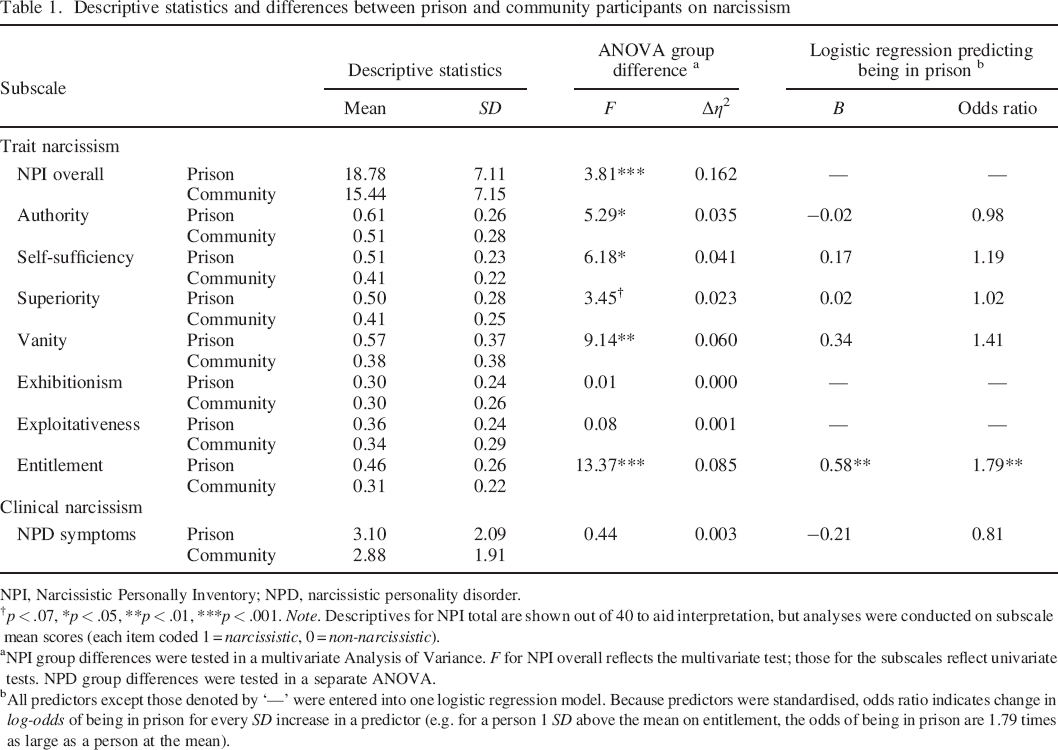
NPI, Narcissistic Personally Inventory; NPD, narcissistic personality disorder.
p < .07,
p < .05,
p < .01,
p < .001. Note. Descriptives for NPI total are shown out of 40 to aid interpretation, but analyses were conducted on subscale mean scores (each item coded 1 = narcissistic, 0 = non–narcissistic).
NPI group differences were tested in a multivariate Analysis of Variance. F for NPI overall reflects the multivariate test; those for the subscales reflect univariate tests. NPD group differences were tested in a separate
All predictors except those denoted by ‘—’ were entered into one logistic regression model. Because predictors were standardised, odds ratio indicates change in log–odds of being in prison for every SD increase in a predictor (e.g. for a person 1 SD above the mean on entitlement, the odds of being in prison are 1.79 times as large as a person at the mean).
Contrary to hypotheses, the two samples did not differ significantly on clinical narcissism symptoms (
To examine which components of narcissism were uniquely related to being in prison, we conducted a logistic regression predicting group (1 = prison, 0 = community) from the five NPI subscales that differed between groups as well as NPD symptoms, standardising all predictors (Table 1). Only entitlement significantly predicted being in prison. The model correctly classified 65.8% of participants, χ2(6) = 18.93, p = .004, Nagelkerke R2 = 0.16.
Because the two samples differed somewhat in terms of education and ethnicity, we next ascertained whether the link between narcissism and offender status remained robust when controlling for these differences. We added education level (scored on the 1–5 scale) and ethnic background (1 = Caucasian, −1 = Other) to the model just described. Model fit was improved, Δχ2(2) = 39.00, p < .001, Nagelkerke R2 = .45, correctly classifying 78.2% of participants. Less–educated participants were more likely to be in prison, B = −1.04, odds ratio = 0.35, p < .001, as were non–Caucasian participants, B = −1.12, odds ratio = 0.33, p < .001. However, entitlement remained significant, B = 0.59, odds ratio = 1.81, p = .043, and no other predictors were altered. Thus, higher levels of narcissistic entitlement uniquely contribute to the likelihood of being in prison over and above the demographic differences between samples.
Do offenders lack empathy compared to non–offenders?
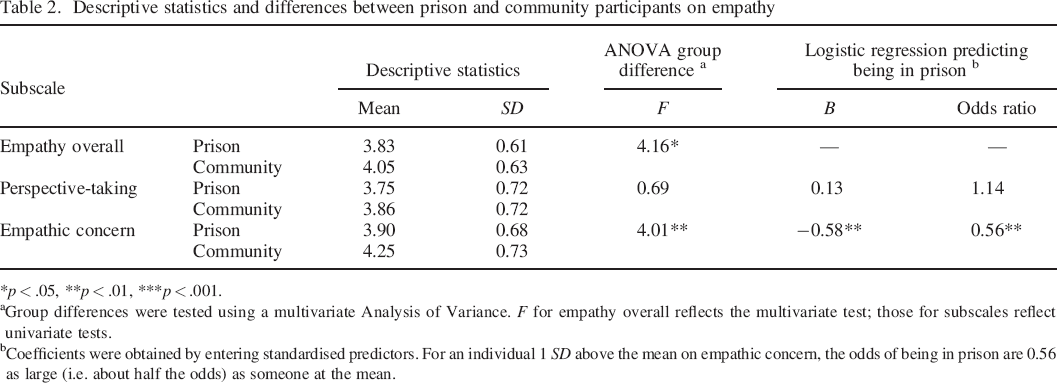
We next tested group differences in empathy (Table 2). Consistent with some past results (Jolliffe and Farrington, 2007; Robinson et al., 2007), prison participants reported significantly lower empathic concern, but not perspective–taking, than community participants. This implies that incarcerated young men are as capable of understanding another's viewpoint as non–offenders, but show relatively less affective concern for others. However, the absence of a significant total effect does not preclude the presence of an indirect effect (especially in modest sample sizes; Preacher and Hayes, 2008). Thus, it is possible that deficits in perspective–taking are associated with offending indirectly via lower empathic concern.
Descriptive statistics and differences between prison and community participants on empathy
p < .05,
p < .01,
p < .001.
Group differences were tested using a multivariate Analysis of Variance. F for empathy overall reflects the multivariate test; those for subscales reflect univariate tests.
Coefficients were obtained by entering standardised predictors. For an individual 1 SD above the mean on empathic concern, the odds of being in prison are 0.56 as large (i.e. about half the odds) as someone at the mean.
Does low empathy mediate the link between narcissism and offending?
We next tested the hypothesis that narcissists’ low empathy explains their greater likelihood of being in prison. We did so using three indices of narcissism: (a) overall NPI score; (b) NPI entitlement (given that this subscale uniquely relates to offender status) and (c) NPD symptoms. Although NPD was not significantly associated with being in prison, note again that this does not preclude the presence of indirect effects (Preacher and Hayes, 2008). Consistent with most past research (Gurtman, 1992; Watson and Morris, 1991), overall NPI score correlated negatively with both perspective–taking, r(128) = −0.17, p = .049 and empathic concern, r(128) = −0.19, p = .027. Similarly, NPI entitlement correlated marginally with perspective–taking, r(128) = −0.16, p = .063 and significantly with empathic concern, r(128) = −0.23, p = .007. Consistent with some past studies (Decety and Moriguchi, 2007) but not others (Ritter et al., 2011), NPD symptoms correlated negatively with perspective–taking, r(128) = −0.22, p = .012, but not empathic concern, r(128) = −0.05, p = .608.
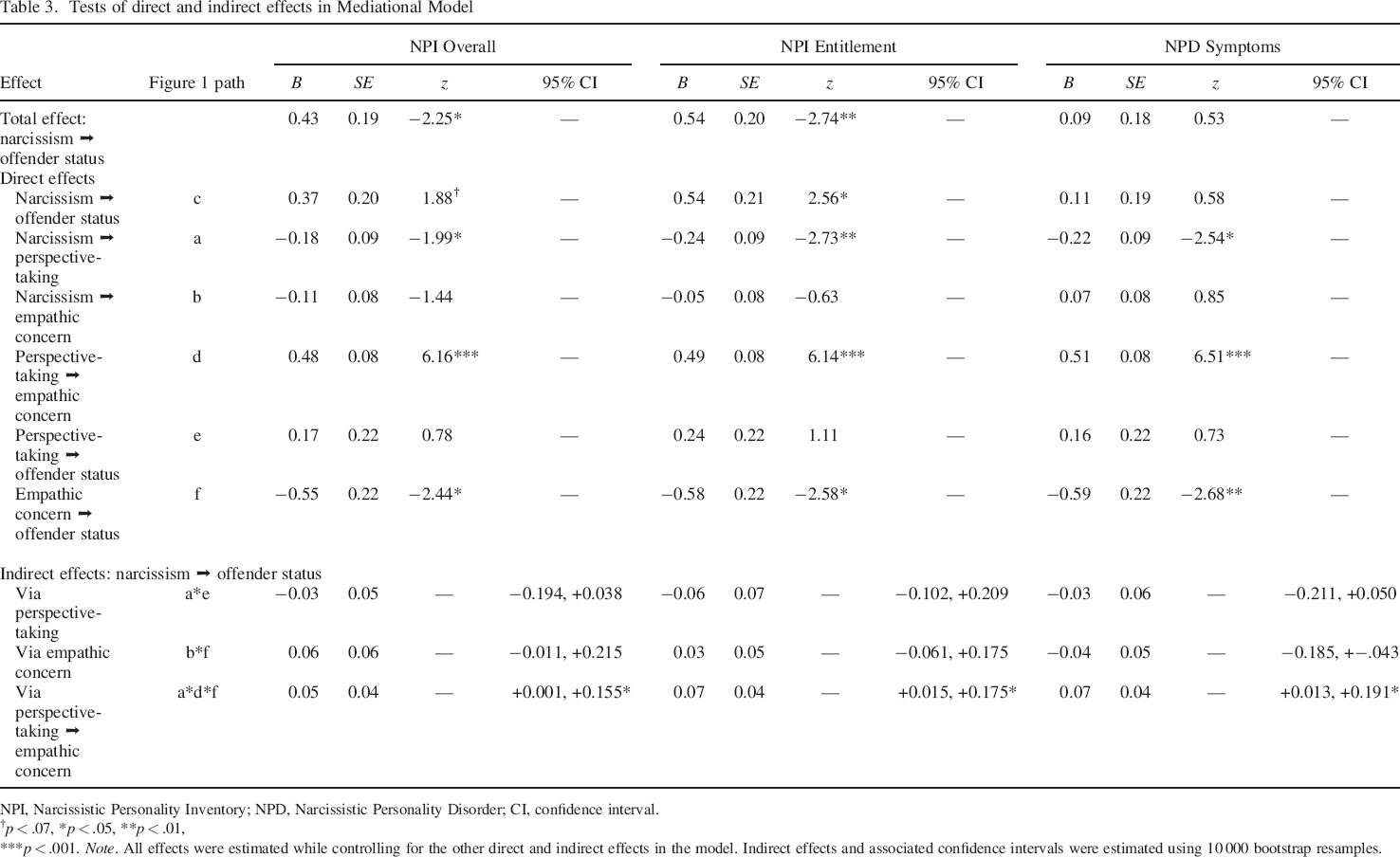
We tested indirect effects of narcissism on offender status via perspective–taking and empathic concern using Hayes’ (2012) PROCESS procedure. This computational tool is appropriate for binary outcomes and tests unique and sequential indirect effects via multiple mediating variables using 10 000 bootstrap resamples (Figure 1 for conceptual model). Bootstrapping is robust to the nonparametric distribution of indirect effects and is appropriate for smaller samples (Preacher and Hayes, 2008). Thus, we tested four possible paths from narcissism to offender status: a direct effect (path c in Figure 1), an indirect effect via perspective–taking (path a*e), an indirect effect via empathic concern (path b*f) and a sequential indirect effect via perspective–taking and then empathic concern (path a*d*f). The latter indirect effect corresponds to the theoretical proposal that deficits in perspective–taking lead to deficits in empathic concern, which in turn impact social behaviour (Batson and Ahmad, 2009; Marshall et al., 1995; Vreeke and van der Mark, 2003). The procedure generated 95% confidence intervals for each indirect effect controlling for all other paths in the model (Table 3).
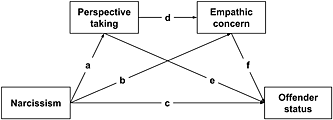
Mediational model including sequential indirect effects.
Tests of direct and indirect effects in Mediational Model
NPI, Narcissistic Personality Inventory; NPD, Narcissistic Personality Disorder; CI, confidence interval.
p < .07,
p < .05,
p < .01,
p < .001.
Note. All effects were estimated while controlling for the other direct and indirect effects in the model. Indirect effects and associated confidence intervals were estimated using 10 000 bootstrap resamples.
For overall NPI score, the total effect on offender status was significant, model χ2(3) = 11.89, p = .008, Nagelkerke R2 = .12. The direct effect was marginal, but the sequential indirect effect from NPI➝perspective–taking➝empathic concern➝being in prison was significant. The single indirect effects via either perspective–taking or empathic concern alone were not significant. This pattern of results implies that trait narcissism is related to criminal behaviour via lack of perspective–taking and resulting lack of empathic concern. Importantly, it also implies that both components of empathy are necessary to fully explain the narcissism—offending association (i.e. neither mediated the effect individually).
NPI entitlement also demonstrated a significant total effect, model χ2(3) = 15.36, p = .002, Nagelkerke R2 = .15. The sequential indirect effect was again the only significant indirect effect, but the direct effect of entitlement on offender status was also significant. Thus, the unique link between narcissistic entitlement and offender status is partly mediated by low perspective–taking and thereby low empathic concern. However, lack of empathy cannot account completely for the criminal behaviour of those high in entitlement.
For NPD symptoms, the total effect and direct effect on offender status were not significant. However, the sequential indirect effect was again significant, model χ2(3) = 8.58, p = .035, Nagelkerke R2 = .09. Thus, some of the variance that clinical narcissism shares with low perspective–taking may carry through into low empathic concern and thus risk of offending.
Finally, because all three narcissism indices showed the same sequential indirect effect, we examined whether this path was driven by clinical versus trait narcissism by entering NPD symptoms and NPI entitlement simultaneously. The sequential indirect effect was significant from entitlement, B = 0.05, SE = 0.04, 95% CI = (+0.003, +0.158), but not from NPD, B = 0.04, SE = 0.04, 95% CI = (−0.001, +0.165). The direct effect of entitlement was also significant, B = 0.60, z = 2.75, p = .006, but the direct effect of NPD was not, B = −0.13, z = −0.65, p = .52. Thus, trait narcissistic entitlement uniquely relates to being in prison, partly via deficits in cognitive and (subsequently) affective empathy, whereas clinical narcissism does not. 2
Discussion
The present results reveal that trait narcissism is more relevant than clinical NPD symptoms for distinguishing between young adult male offenders and young adult males with no history of criminal convictions. Thus, the antisocial consequences of trait narcissism extend to criminal acts. In particular, offender status was best predicted by narcissistic entitlement—the belief that one deserves more than others (Raskin and Terry, 1988). This finding is consistent with views of entitlement as a ‘maladaptive’ component of trait narcissism (Barry et al., 2007; Campbell and Foster, 2007). Further, it seems that entitlement is more maladaptive in terms of antisocial behaviour than is NPD symptomatology. However, the other component of trait narcissism often labelled maladaptive—exploitativeness—did not relate to offender status. Perhaps, although manipulative behaviour is socially undesirable, it is the sense of entitlement that makes an individual willing to break the law to get ahead. The present findings also pertain to the blurred boundary between clinical and subclinical narcissism (Miller and Campbell, 2008). In particular, the findings imply that clinical narcissism, instead of being a qualitatively distinct construct, may simply reflect the extreme end of a single dimension, with entitlement being the most antisocial component.
We further demonstrated that narcissism predicts offending via a sequential pathway of empathy deficits: high narcissism leads to low cognitive empathy, which leads to low affective empathy, which proximally leads to offender status. This pattern was again most robust for narcissistic entitlement. These findings document a highly–antisocial consequence of trait narcissists’ lack of empathy (Gurtman, 1992; Hepper, Hart, et al., 2013; Wai and Tiliopoulos, 2012; Watson and Morris, 1991). They also identify a key personality variable that may precede low empathy as a risk factor for criminal behaviour (Jolliffe and Farrington, 2004, 2007; Robinson et al., 2007). Moreover, the present findings clarify inconsistencies in the literature concerning the relative roles of cognitive and affective empathy, that is, in line with Batson and Ahmad's (2009) and Vreeke and van der Mark's (2003) theorising, lack of cognitive perspective–taking accounts for narcissists’ lack of empathic concern for others—and thereby their risk of being in prison. Narcissistic entitlement was also directly associated with being in prison. Although lack of empathy gives a narcissist the ‘green light’ to commit a criminal act, the initial feeling of deserving the best may also be a necessary ingredient for narcissistic crimes. Future studies might clarify the contribution of narcissistic entitlement and empathy over and above more basic personality traits (e.g. agreeableness) and identify additional mediators. For example, narcissists’ over–positive expectations (Hepper, Hart, Gregg and Sedikides, 2011) may lead them to underestimate chances of being caught. Alternatively, narcissists’ impulsivity (Vazire and Funder, 2006) may render them less able to resist opportunities for delinquent and criminal behaviour. Nevertheless, Miller et al. (2009) found that the link between trait narcissism and a range of self–defeating (albeit not directly criminal) behaviours was mediated by low agreeableness and not impulsivity, which is consistent with our findings and implies that empathy might play a more important role than impulsivity.
The present findings have implications for practice. Whereas PDs are rare, and are difficult and labour–intensive to assess, trait narcissism is common and easily measured using the NPI. By screening for narcissism, social workers, educators, prison and probation staff, as well as psychologists, can target interventions to individuals who are at risk of offending or reoffending. Different individuals may benefit from different preventative and rehabilitative programs. Our findings suggest that narcissists require interventions to increase empathy. Empathy–focused interventions are common in forensic settings, but their effectiveness is variable (Day et al., 2010). Tailoring the content of interventions to individuals based on personality traits may increase success rates. Of course, this proposal rests on the assumption that narcissists are capable of perspective–taking and empathy. Recent evidence suggests that narcissists do well at recognising others’ emotions (Wai and Tiliopoulos, 2012) and are able to respond empathically to a distressed target person when forced to take their perspective (Hepper, Hart, et al., 2013). Thus, narcissists are simply less inclined to perspective–take, especially when doing so might prevent them from readily pursuing their self–serving goals. Interventions should focus on motivating narcissists to view situations (and antisocial acts) from others’ perspectives before focusing on their feelings of concern for others.
The link between trait narcissism and criminal behaviour is concerning, given evidence for increasing narcissism levels (Cai et al., 2012; Twenge et al., 2008). It is noteworthy that narcissism correlates positively with intrapersonal functioning, such as self–esteem and satisfaction with life (Sedikides et al., 2004). This, coupled with the extensive self–regulatory strategies that narcissists use to maintain illusions of superiority (Hepper, Gramzow and Sedikides, 2010; Hepper, Sedikides and Cai, 2013; Morf et al., 2011), makes narcissism self–sustaining and resistant to change. Without targeted interventions, narcissists are unlikely to respond to circumstances (e.g. incarceration) by changing their behaviour.
These findings are preliminary and call for further examination of trait narcissism in the context of offending. First, the data are cross–sectional; priorities should include identifying causal links. Prospective research in adolescent samples indicates that maladaptive narcissistic traits predict subsequent delinquency (Barry et al., 2007) and NPD symptoms predict subsequent criminal behaviour (Johnson et al., 2000), implying that trait narcissism causes offending. However, it is also plausible that incarceration might increase some narcissistic traits, yielding a bidirectional pattern and creating a vicious circle for narcissistic individuals. This possibility requires empirical scrutiny. Second, despite its validity, the NPI has psychometric limitations that are only partly addressed by recent higher–order models (Ackerman et al., 2011; Barry et al., 2007; Corry et al., 2008). Now that we have pinpointed entitlement as the core element of narcissism relating to offending, future investigations could include robust measures such as the Psychological Entitlement Scale (Campbell, Bonacci, Shelton, Exline and Bushman, 2004) to examine this link further.
Third, further studies might incorporate additional risk factors for offending, such as conduct disorder, substance abuse or socioeconomic status (Vaughn et al., 2008). It would be especially useful to examine the unique contribution of narcissism beyond other ‘dark’ personality traits such as psychopathy and Machiavellianism, given that these traits are also linked to low empathy (although they do not necessarily entail entitlement; Jones and Paulhus, 2011). Finally, the present research focused only on men and sampled community members to match the age range of the available prison sample. Levels of both clinical and trait narcissism are typically higher in men than women (Miller and Campbell, 2008), but with the ongoing rise in narcissism, women are fast catching up (Twenge et al., 2008). In addition, evidence indicates that narcissism levels decrease with age (Cramer, 2011). Future work, then, should extend the present findings to female offenders and those in mid–adulthood or later–adulthood.
Taken together, we found that, among young men, narcissistic entitlement and ensuing lack of empathy accounts for higher likelihood of criminal behaviour. Our research improves understanding of both narcissism and personality predictors of offending and has the potential to inform practice.
Footnotes
Acknowledgements
The authors would like to thank Elizabeth Lowe, Chloe Lavington, Beverly Lau, Stacey Rodd, Sonja Edwards and Chloe Snowdon for the assistance with data collection.