







Abstract
Personality traits are important predictors of relationship satisfaction. However, the majority of previous study findings are based on self–perceptions of personality. Thus, by means of the self–, partner–, and meta–perceptions of personality, the present study focused on three different perspectives on the Big Five personality traits to examine dyadic associations with relationship satisfaction of intimate couples. The study was based on the first measurement occasion of the Swiss longitudinal study ‘Co–Development in Personality: Longitudinal Approaches to Personality Development in Dyads across the Life Span’ and included data of 216 couples. The main analyses were based on Actor–Partner Interdependence Model. Three general findings emerged. First, the three personality perspectives represented related, albeit distinct, constructs, and showed incremental validity with respect to relationship satisfaction. Second, neuroticism was negatively related to relationship satisfaction, whereas agreeableness and conscientiousness were positively related to relationship satisfaction across all perspectives. Third, substantial associations between
Introduction
Relationship satisfaction is an important resource in adulthood. Satisfied individuals in long–term romantic relationships have happier, healthier, and longer lives (Diamond, Fagundes, & Butterworth, 2010). One important factor that may contribute to relationship satisfaction is personality. Indeed, a large body of cross–sectional and longitudinal research has consistently demonstrated that personality traits are associated with relationship satisfaction and marital success (Dyrenforth, Kashy, Donnellan, & Lucas, 2010; Malouff, Thorsteinsson, Schutte, Bhullar, & Rooke, 2010; Roberts, Kuncel, Shiner, Caspi, & Goldberg, 2007). However, most existing research is largely based on personality self–perception, and little is known about associations with relationship satisfaction using other personality perspectives. The present study sought to address this gap by examining the associations between three personality perspectives (self–perception, how individuals view their own personality; partner–perception, how individuals are viewed by their partner; and meta–perception, how individuals think they are viewed by their partner) and the relationship satisfaction of both intimate partners (actor, how satisfied individuals are with their relationship; partner, how satisfied partners of individuals are with their relationship).
Personality in the context of intimate relationships
Personality traits refer to relatively enduring patterns of thoughts, feelings, and behaviours that distinguish individuals from one another (e.g. McCrae & John, 1992). They characterize how individuals think and feel about others and themselves in relation to others, how they typically perceive their social environment, and how they react to their interaction partners (Back et al., 2011; Caspi & Roberts, 2001). Hence, it is suggested that personality traits play a central role in the context of intimate relationships. Indeed, a large body of previous research demonstrated associations between the Big Five personality traits and relationship satisfaction.
Neuroticism is one of the most prominent predictors of relationship dissatisfaction and divorce (Robins, Caspi, & Moffitt, 2000, 2002; Karney & Bradbury, 1995; Roberts et al., 2007; Watson, Hubbard, & Wiese, 2000a). Neurotic individuals generally report more negative affect, and they have a greater sensitivity to negative events and experience less positive social interactions than emotionally stable individuals (Hampson, 2012; Watson & Clark, 1984).
Positive associations with relationship satisfaction have been reported for agreeableness and conscientiousness (Decuyper, De Bolle, & De Fruyt, 2012; Dyrenforth et al., 2010; Heller, Watson, & Ilies, 2004; Malouff et al., 2010; Neyer & Voigt, 2004). Agreeable individuals tend to maintain positive relationships with others and engage in social behaviours that facilitate intimacy such as forgiveness (Branje, van Lieshout, & van Aken, 2005; Jensen–Campbell & Graziano, 2001; Steiner, Allemand, & McCullough, 2012). Highly conscientious individuals are better at controlling their impulses, and typically follow norms and rules, and they are more task– and goal–directed (e.g. John & Srivastava, 1999).
Previous findings with respect to extraversion and openness to experience do not show a clear picture (Karney & Bradbury, 1995; Neyer & Voigt, 2004; Stroud, Durbin, Saigal, & Knobloch–Fedders, 2010; White, Hendrick, & Hendrick, 2004). However, some studies found weak but positive associations between extraversion and relationship satisfaction (Dyrenforth et al., 2010; Malouff et al., 2010). This might be due to the tendency of extraverted individuals having high levels of positive affect (Fleeson, Malanos, & Achille, 2002; Lucas & Diener, 2001), and being social, active, and joyful in interactions with others (John & Srivastava, 1999). Additionally, extraverts tend to use more constructive coping strategies such as problem solving (Carver & Connor–Smith, 2010).
The research findings with respect to openness are mixed with some studies reporting small positive or negative associations with relationship satisfaction or even non–associations (Karney & Bradbury, 1995; Malouff et al., 2010; Neyer & Voigt, 2004). Open individuals are characterized by a general desire to expand their experiences in life (John & Srivastava, 1999). One could assume that open individuals create an inspiring and stimulating relationship atmosphere that contributes to relationship satisfaction. By contrast, the need for gaining experiences could be related to relationship instability (Karney & Bradbury, 1995).
Three perspectives on personality
The majority of previous research on the associations between personality traits and relationship satisfaction is based on personality self–perceptions. However, taking a dyadic perspective, the interplay between personality and relationship satisfaction needs to be examined from different angles. We suggest that besides the self–perception, the partner– and meta–perceptions of personality are central, as they involve specific information about how the individuals’ personalities are expressed, perceived, and evaluated in the specific social environment of intimate relationships.
The self–perception of personality traits represents an explicit or implicit representation of the self (Back, Schmukle, & Egloff, 2009). It provides a unique view on personality traits from an inside perspective reflecting one's identity (Hogan & Roberts, 2004; Roberts & Wood, 2006). As in the current study, self–reports are used in order to assess explicit self–representations. Although self–reports contain the exceptional benefit for the acquisition of intra–psychic information, they are known to bear the risk of distorting the accuracy through self–enhancing and socially desirable responding styles (Paulhus & Vazire, 2007).
The other–perception of personality is based on observer reports by a close informant such as the intimate partner as in the current study. Personality traits described from the outside perspective are known as reputations, which demonstrate perceived personality traits represented by specific social partners of the individual (Back et al., 2011; Hogan & Roberts, 2004; Roberts & Wood, 2006). Other–perceptions are assumed to be more objective and less biased by self–enhancing motives. Moreover, they may cover typical behavioural patterns that are not represented in the individual's self–perceptions but evident in social interactions and therefore more salient to others (Hofstee, 1994; Roberts, Harms, Smith, Wood, & Webb, 2006; Vazire, 2010). There is ample evidence that other–perceptions are reliable and valid, and provide relevant and unique information (Hofstee, 1994; Kolar, Funder, & Colvin, 1996; McCrae & Weiss, 2007; Roberts et al., 2006; Vazire, 2010). However, other–reports also comprise some disadvantages such as observer biases (Ready, Clark, Watson, & Westerhouse, 2000; Weller & Watson, 2009). In the following, we use the term ‘partner–perception’ instead of ‘other–perception’, because partner–reports were used in the current study.
The meta–perception of personality is underrepresented in the literature and especially in the context of intimate relationships. It uses the method of self–reports and refers to the individual's representations of and beliefs about how her or his personality is perceived by others (Carlson & Kenny, 2012; Laing, Phillipson, & Lee, 1966). Meta–perceptions can be understood as ‘perceptions of perceptions’ (Srivastava, 2012, p. 91) and are assumed to be based on mind–reading and perspective–taking processes (Back et al., 2011; Back & Kenny, 2010; Carlson & Kenny, 2012; Kenny, 1994; Kenny & DePaulo, 1993). In order to generate meta–perceptions, individuals first have to elicit the knowledge of others about the own person, and as a second step, they need to evaluate how the other persons will weight that knowledge to build a personality judgment (Albright & Malloy, 1999). Similarly, other authors suggest that the process of generating meta–perceptions can be described by three stages (Carlson & Kenny, 2012). First, individuals have to activate their self–perception (How am I?). Second, individuals need to recall self–observation information (How do I behave?). Third, individuals are assumed to integrate information from social feedback processes (How do others respond to my person?). Empirical evidence suggests that meta–perceptions are strongly influenced by self–perceptions (Kenny & DePaulo, 1993). However, the work of other authors demonstrated that the individuals’ meta–perceptions represent realistic insights in their reputations (Carlson, Vazire, & Furr, 2011), indicating that meta–perceptions are distinct from self–perceptions.
Interrelations between and distinction of the three perspectives
Previous research found substantial associations between self– and other–reports of personality traits (self–other agreement; cf. Back & Vazire, 2012) with correlations ranging from .40 to .60 (Vazire, 2006; Vazire & Carlson, 2010; Watson, Hubbard, & Wiese, 2000b). This was for example evident with respect to the overlap between self–reports and spouse ratings (Decuyper et al., 2012; Vazire & Carlson, 2010). It has been suggested that high self–other agreements represent successful self–presentations (Baumeister, 1982; DePaulo, 1992). Although the reported associations between self– and other–reports were significant, they were moderate in size, implying that the two methods contain shared and unique aspects of personality (Vazire, 2006). This assumption was supported by two recent studies reporting evidence for incremental validity of spouse– over self–ratings with respect to marital outcomes and symptoms of depression and personality disorders (Cundiff, Smith, & Frandsen, 2012; South, Turkheimer, & Oltmanns, 2008).
Recently, Vazire and Carlson (2010) reviewed different studies that examined the overlap between the other– and meta–perceptions (meta–accuracy; cf. Back & Vazire, 2012) of personality traits in social contexts apart from intimate relationships. The overall correlation for the overlap was around .40, indicating substantial divergence between the two perspectives. There is evidence that the level of the meta–accuracy is a function of acquaintance (Kenny, 1994). That is, the longer individuals know each other, the better is their appraisal about their reputation.
A strong correlation has been shown between individuals’ self– and meta–perceptions (self–meta–agreement; cf. Gallrein, Carlson, Holstein, & Leising, 2013), a finding that is linked to the general assumption that individuals tend to think that others see them as they see themselves (Kenny & DePaulo, 1993). This might be driven by the individuals’ striving for a confirmation of their self–views by others (i.e. self–verification view; Swann, 2012). Alternatively, the strong correlation might be the product of a high conjunction between self–perception and actual behaviour of individuals (Albright, Forest, & Reiseter, 2001). However, it has been shown that meta–perceptions also differ from self–perceptions (Carlson et al., 2011). As such, it is important to include meta–perception in addition to self– and partner–perceptions.
Shared personality effects on relationship satisfaction
From a traditional theoretical view on personality, it can be assumed that personality traits represent cognitive, emotional, and behavioural tendencies of individuals that are stable across time and situations (McCrae & John, 1992). This, in turn, should be reflected in an agreement between different personality perspectives. On the basis of that, it is expected that the self–, partner–, and meta–perceptions of personality have similar effects on social outcomes such as relationship satisfaction.
Let us imagine Laura, a neurotic young woman who is in a relationship with Simon. Why should the self– and meta–perceptions of Laura and the partner–perception of Simon contribute to the picture of Laura being a neurotic individual? First, Laura has access to a large pool of personality–related information about herself including memories of the past or self–reflections of the present (self–perception; cf. Hart & Matsuba, 2012). Thus, Laura might be aware of the fact that she used to be a more anxious child as compared with her classmates, and she probably knows that she worries much more about life than her best friend Susan. So, Laura's neuroticism is part of her identity (Hogan & Roberts, 2004). Furthermore, Laura usually tells Simon, when she feels down and she talks problems over with him. Mostly, Simon tries to calm Laura down and to assure her that she is making a mountain out of a molehill. So, from both her self–reflection and Simon's reactions, Laura knows that Simon sees her as pretty neurotic (meta–perception). In addition, Laura's neuroticism is directly represented in Simon (partner–perception), as Simon often experiences Laura as irritated and nervous, especially during stressful days, which sometimes results in relationship conflicts. Therefore, as all three perspectives imply Laura's tendency to be neurotic, it is assumed that the self–, partner–, and meta–perceptions of neuroticism have (negative) associations with both Laura's and Simon's relationship satisfaction, as it is related to intra– as well as inter–personal strain (Hampson, 2012).
Unique personality effects on relationship satisfaction
In addition to shared personality effects on relationship satisfaction, we suggest that the links between the self–, partner–, and meta–perception personality and relationship satisfaction are underlined by specific processes that might result in differential patterns of associations. Furthermore, the interplay between the three perspectives and relationship satisfaction has to be considered with respect to so–called actor and partner effects. Actor effects represent associations between an individual's personality and her or his relationship satisfaction, whereas partner effects capture the associations between the individual's personality and her or his partner's relationship satisfaction (Kenny, Kashy, & Cook, 2006). By means of the virtual couple ‘Laura and Simon’, Table 1 illustrates the underlying questions with respect to actor and partner effects between the three personality perspectives and relationship satisfaction.
Exemplary questions with respect to actor and partner effects
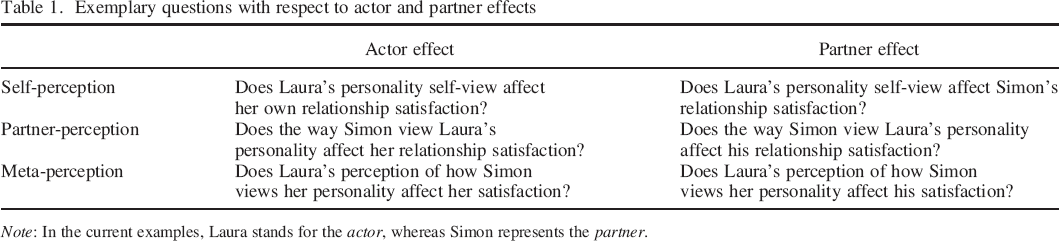
Note: In the current examples, Laura stands for the actor, whereas Simon represents the partner.
First, it is assumed that actor effects between the self–perception of personality and relationship satisfaction are primarily based on a general inside perception and are related to coping styles and regulation processes. Every couple has to deal with relationship conflicts. However, the two partners in a relationship can differ much with respect to their reactions to that stressful situation depending on their personality and their way of coping (Hampson, 2012). Let us go back to Laura and Simon, and let us speculate about their way of dealing with relationship conflicts. Whereas Laura's neuroticism could trigger a process of rumination and relationship problem focusing, and in turn, decrease her relationship satisfaction, Simon's extraversion could function as mood regulator, as extraverted individuals typically experience positive affect. It might be that Simon calls a friend to meet him for a beer in order to stop being annoyed and to get over the argument with Laura. In turn, the individuals’ coping and regulation skills affect not only the feelings within the person but also those of the partner (partner effects). One could assume that Laura's way of dealing with the conflict situation could also negatively affect Simon's relationship satisfaction. For instance, she might send him angry text messages.
Second, the partner–perception of personality is directly linked to the specific context of intimate relationships. Intimate couples share a wide array of situations in which individuals express characteristics of their personality. Thus, it can be hypothesized that the partner–perspective provides an additional picture of personality capturing particularly observable and social aspects of personality that become salient in relationship situations and that might reflect ‘blind spots’ (‘Johari window’; cf. Luft & Ingham, 1955) for the individual itself. From an actor effect perspective, a positive evaluation of one's personality by the partner might promote one's own relationship satisfaction (actor effect). From the related literature about partner enhancement, it is known that overrated positive evaluation promote relationship functioning (Murray, Holmes, & Griffin, 1996; Rusbult, Finkel, & Kumashiro, 2009). From a partner effect perspective, the representation of a joyful partner might be positively related to relationship satisfaction as it is linked to positive relationship behaviour and processes (partner effect).
Several studies reported both actor and partner effects between the self–perception of the Big Five traits and relationship satisfaction (Dyrenforth et al., 2010; Neyer & Voigt, 2004; Robins et al., 2000). In addition, a few studies found evidence for partner–reported personality traits and relationship satisfaction (Decuyper et al., 2012; Watson et al., 2000a). The finding that self– and partner–reported personality traits have actor as well as partner effects on relationship satisfaction is not only theoretically but also methodologically important. It demonstrates that the effects are substantial and not only an artefact of the common method variance issue (Kenny & Cook, 1999) that refers to the problem that actor effects based on self–perceived personality traits and partner effects based on partner–perceived personality traits are biased by shared variance between the predictor and outcome variable.
Third, to the best of our knowledge, this is the first study that investigates the meta–perception of personality traits in order to predict relationship satisfaction. However, from related studies, it is known that the evaluations of the partner's representation of the own person are important with respect to positive feelings in intimate relationships (Murray, Holmes, MacDonald, & Ellsworth, 1998). Meta–perceptions of personality traits are expected to be relevant with respect to intimate partners. On the one hand, one could assume that the relationship satisfaction of individuals is high when they appraise that their partners see them in a positive light such as being a smart, lovable, or dependable person (actor effect). On the other hand, an unfavourable meta–perception (e.g. being quarrelsome) might derive from partner criticism and, in turn, be related to the partner's dissatisfaction (partner effect). Positive or negative associations between meta–perceptions of personality traits and relationship satisfaction could be based on deviances between the self– and meta–perceptions. For example, Simon's appraisal that Laura sees him as funnier as he sees himself could be related to both Simon's relationship satisfaction (‘she thinks, I'm funny’) and Laura's relationship satisfaction (‘I really think, he's funny’). With respect to the latter example, it is assumed that social feedback processes between intimate partners play an important role in order to understand meta–perception personality effects on relationship satisfaction.
The present study
This study focuses on associations between three perspectives on personality and relationship satisfaction in order to obtain a deeper understanding of the dyadic interplay between personality and intimate relationships. Furthermore, the study sought to account for the widespread claim for multi–method assessments of personality. We had three specific hypotheses. First, we expected that the three perspectives be related, albeit distinct. Second, on the basis of previous findings, we expected that neuroticism, agreeableness, and conscientiousness are associated with relationship satisfaction across all three perspectives on personality on the basis of actor and partner effects. Third, in terms of the partner– and meta–perceptions, we expected additional substantial associations with extraversion and openness. With respect to the partner–perception, we expected positive associations between both extraversion and openness and relationship satisfaction, especially for partner effects. The two traits are expected to be more salient from an outside perspective and represent personality traits that are assumed to appear as appealing in the eyes of the intimate partner. Extraversion is related to cheerfulness that might contribute to positive interactions between the intimate partners (cf. John & Srivastava, 1999; Lucas & Diener, 2001). Furthermore, openness is associated with intellect that is known to be a desirable characteristic in an intimate partner (Botwin, Buss, & Shackelford, 1997). With respect to the meta–perception, we expected that high scores of meta–perceived extraversion and openness be related to an overall feeling of being valued as a likable, smart, and interesting person by the intimate partner. It is suggested that these appraisals are based on positive inter–personal processes between intimate partners that are related to relationship satisfaction of both partners.
A major strength of this study is the inclusion of three different perspectives on personality and two different assessment methods (self– and partner–reports). The particular novel contribution is to include the meta–perception of personality, as this is a relatively rarely examined perspective in the context of intimate couples. Furthermore, in contrast to the majority of previous studies, the current study estimated the relationships between the Big Five personality traits and relationship satisfaction at the latent level, which is uncontaminated by measurement error.
Method
Participants and procedure
Couples were drawn from the first measurement occasion (2010/2011) of the ongoing Swiss longitudinal study ‘Co–Development in Personality: Longitudinal Approaches to Personality Development in Dyads across the Life Span’ (CoDiP), which aims to investigate personality development in close kin and intimate relationships across three family generations. The overall sample consisted of 1050 adults (57.2% women) ranging in age from 12 to 92 years (M = 41.14, SD = 22.36). All participants completed a questionnaire including a variety of measures such as measures of personality, goals, or well–being. For this study, we selected all heterosexual couples from the three generations. We only included couples with relationship duration longer than 6 months in order to assure that partners know each other for a certain amount of time and are competent to report about the partner's personality. Seventeen couples were excluded because the relationship duration was less than 6 months or they had disproportionate missings on personality measures. This lead to the current sample of 216 heterosexual dating, cohabiting, or married couples. The 432 individuals ranged in age from 16 to 92 years (M = 48.38, SD = 19.65, Median = 50.00). There was a broad range in educational attainment. Of the participants, 9.0% reported having a basic education without an official training qualification, 28.8% had an education with training qualification, 39.7% completed a high school education or equivalent, and 21.8% had a university degree. Regarding marital status, 69.0% of the couples were married. The average relationship duration of the couples was 22.50 years (SD = 17.30, Median = 21.79). Of the participants, 70.3% had children.
We used multi–level models in order to assess the variance in the study variables that is explained by the levels of the individual (Level 1), the couple (Level 2), and the family (Level 3). The results indicated that the individual level always accounted for more variance in the personality variables (averaged percentages across the self–, partner–, and meta–perceptions of the Big Five traits: neuroticism = 99.58%; extraversion = 98.81%; openness = 80.07%; agreeableness = 87.14%; conscientiousness = 91.17%) than the couple or the family level. This was not the case with respect to relationship satisfaction, where the couple level explained more variance (55.76%) than the individual level (34.03%). As the amount of explained variance was always small with respect to the family level, we omitted that level in all analyses, which appears feasible to reduce the complexity of the models.
Measures
Big Five personality traits
The 45–item Big Five Inventory (BFI; John & Srivastava, 1999) was used to measure the self–perception of personality. The 21–item short version (BFI–K; Rammstedt & John, 2005) was used to assess the partner– and meta–perceptions of personality. The questionnaires consist of descriptive phrases that are prototypical markers of the Big Five factors of personality. Five–point Likert–type scales with responses ranging from 1 (disagree strongly) to 5 (agree strongly) were used to indicate how well these descriptive phrases described (i) their own personality (self–perception), (ii) the personality of their intimate partner (partner–perception), and (iii) the evaluation of how the intimate partner would rate their own personality (meta–perception). Alpha reliability estimates were as follows: .75–.85 (neuroticism); .78–.84 (extraversion); .74–.76 (openness to experience); .65–.70 (agreeableness); and .76–.80 (conscientiousness).
Relationship satisfaction
Relationship satisfaction was assessed with the Relationship Assessment Scale (RAS; Hendrick, 1988; Sander & Böcker, 1993). The RAS is a 7–item self–report instrument that measures global satisfaction with the relationship. The respondents indicated the degree of agreement with each of the items (e.g. ‘In general how satisfied are you with your relationship?’) on a 5–point Likert scale ranging from 1 (not at all) to 5 (very much). The alpha reliability estimate of the RAS was .91.
Statistical analyses
Our statistical analyses were performed in four steps. First, we analysed zero–order correlations for women and men. Additionally, to demonstrate convergent validity, we examined mono–trait/hetero–method, hetero–trait/mono–method, and hetero–trait/hetero–method correlations.
Second, we tested whether the self–, partner–, and meta–perceptions of personality represent three distinct personality constructs. To do so, we compared three–factor models as well as two–factor models with single–factor models by means of confirmatory factor analyses to demonstrate that it is worthwhile to examine the three perspectives separately. The measurement model based on either two (partner– and meta–perceptions) or three parcels (self–perception) as factor indicators, which were built according to the item–to–construct balance technique (cf. Little, Cunningham, Shahar, & Widaman, 2002).
Third, we examined the incremental validity of the three perspectives with respect to the prediction of relationship satisfaction by means of two approaches. We conducted a series of hierarchical regressions on the basis of the total sample (i.e. without partner effects). Furthermore, in order to account for the dyadic structure of our data, we adapted the procedure suggested by Cundiff et al. (2012). Using an actor–partner interdependence model (APIM; Kenny et al., 2006) approach, we conducted three different models for each Big Five trait. The first model only included the self–perception of the couples’ personalities as predictors (actor and partner effects) for relationship satisfaction. The second models added the actor and partner effects of the partner–perception, whereas the third models combined all three perspectives (including the actor and partner effects of the meta–perception). Similar to Cundiff et al. (2012), we used two indicators of incremental validity. First, we examined differences in model fits by means of the nested χ2–difference tests (∆χ2). Second, we analysed the increments in the outcome variance R2. As in our main analyses, we set the actor and partner effects equal across women and men (see subsequent discussions).
Fourth, for our main analyses, we examined the associations between the three personality perspectives and relationship satisfaction by means of latent APIMs, in which we simultaneously tested actor and partner effects for the two members of the dyad, respectively, women and men within the intimate couple. Figure 1 shows the conceptual model. The measurement models of the Big Five traits were equal to those described earlier. In order to establish the latent relationship satisfaction, we used three parcels as factor indicators, which were also built according to the item–to–construct balance technique (cf. Little et al., 2002). With respect to the current analyses, actor effects (a_w = actor effects women, a_m = actor effects men) represent the associations between an individual's personality and her or his relationship satisfaction, whereas partner effects (p_mw = partner effects of men on women, p_wm = partner effects of women on men) capture the associations between the individual's personality and the partner's relationship satisfaction. We established separate APIMs for the three perspectives of personality perceptions and across all Big Five traits. Factor loadings were set to be equal across gender, and we allowed for correlated uniqueness for the matching parcels between women and men.
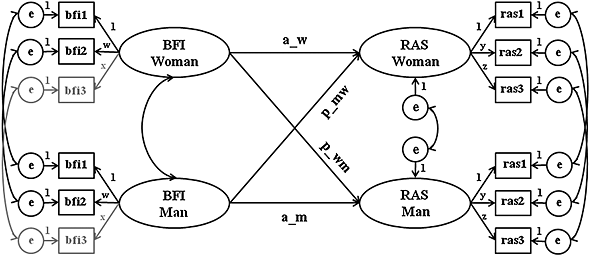
The conceptual actor–partner interdependence model utilized for the present analyses of dyadic associations between the Big Five traits and relationship satisfaction in intimate couples. Each latent construct (BFI Woman, BFI Man, RAS Woman, and RAS Man) was assessed with two or three manifest indicators (parcels); a_w and a_m represent the actor paths, and p_mw and p_wm the partner paths; a_w and a_m, respectively, p_mw and p_wm were set to be equal for all analyses; the part of the model marked in grey shows the additional third parcel used for the models based on the BFI self–perception perspective.
We included age and relationship duration as control variables in all APIMs, because previous research demonstrated age differences in personality traits (e.g. Allemand, Zimprich, & Hendriks, 2008; Roberts, Walton & Viechbauer, 2006), as well as effects of relationship duration on relationship satisfaction (Karney & Bradbury, 1995). Because age of women, age of men, and relationship duration were highly correlated in this study (between .91 and .99), we built a composite measure. The variables were z–standardized before they were averaged. For each model, we tested whether the actor and partner effects were equal across gender (a_w = a_m and p_mw = p_wm). For that purpose, we compared two models by means of nested χ2–difference tests (∆χ2). In the first model, we freely estimated the actor and partner effects for both women and men. In the second model, we set the actor and partner effects for women and men to be equal. The two models did not differ in model fit. For reasons of parsimony, we then constrained actor and partner paths to be equal for women and men in all subsequent APIMs.
The analyses were conducted using
Results
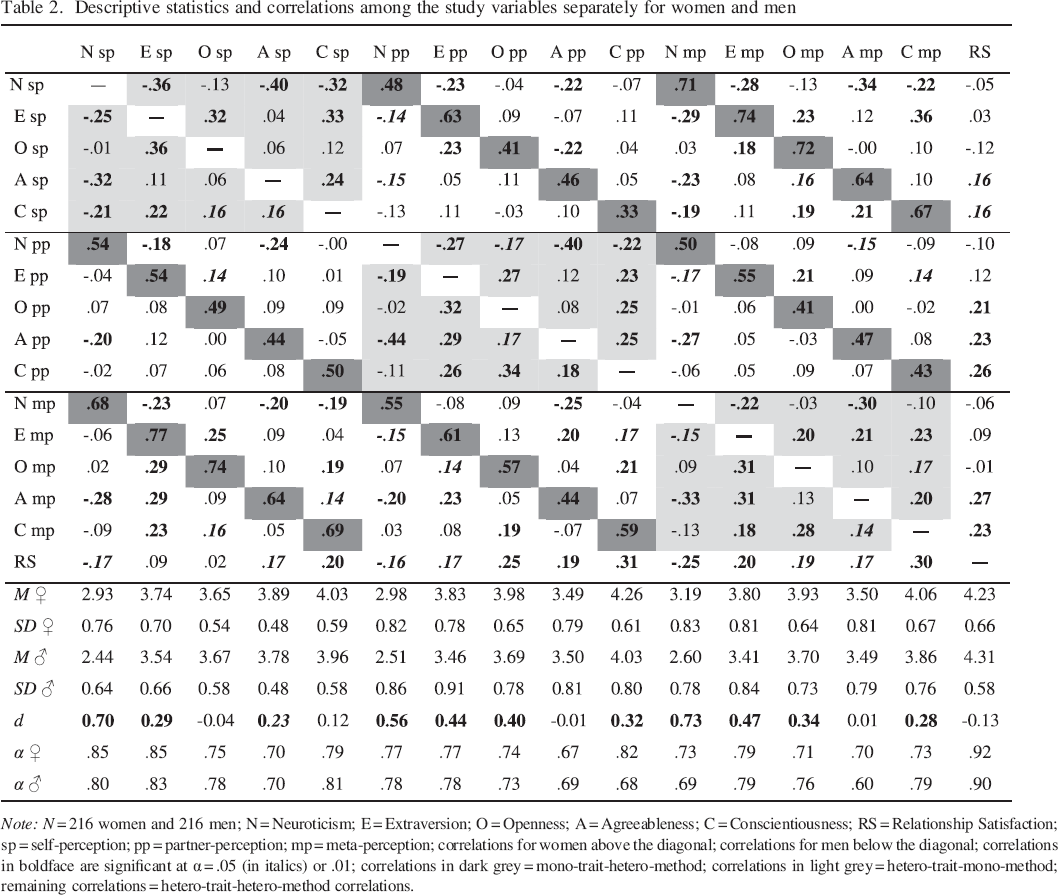
Table 2 shows the descriptive statistics and zero–order correlations among the study variables separately for women and men. Gender differences were found with respect to neuroticism and extraversion across all three perspectives. In general, women were more neurotic (d range: .56–.73) and extraverted (d range: .29–.47) than men. With respect to the other traits, there were mixed results for gender differences depending on the perspective one consider (Table 2). Women showed higher scores with regard to openness and conscientiousness but only for the partner– and meta–perceptions (openness: d range: .34–.40; conscientiousness: d range: .28–.32). Finally, on the basis of the self–perception, women had higher agreeableness scores than men (d = .23). No gender differences were found for relationship satisfaction.
Descriptive statistics and correlations among the study variables separately for women and men
Interrelations between the three perspectives
The self–, partner–, and meta–perceptions of the respective Big Five traits were substantially interrelated (Table 2). Using the Fisher's r–to–z transformation approach, we calculated the average agreement between the self– and partner–perceptions (women: r = .47, men: r = .50, ps < .01), between the partner– and meta–perceptions (women: r = .48, men: r = .56, ps < .01), and between the self– and meta–perceptions (women: r = .70, men: r = .71, ps < .01). In order to provide evidence for convergent validity, we tested whether the average mono–trait/hetero–method correlation (women: r = .56, men: r = .60, ps < .01) was statistically different from the average hetero–trait/mono–method correlation (women: r = .22, men: r = .21, ps < .05) and the hetero–trait/hetero–method correlation (women: r = .13, men: r = .12, ps > .05). This was the case with respect to the average hetero–trait/mono–method correlation (women: z = 4.22, men: z = 4.33; ps < .001) and with respect to the hetero–trait/hetero–method correlation (women: z = 5.18, men: z = 5.29; ps < .001).
Distinction of the three perspectives
The results of the χ2–tests (see Supporting information A1–A5) clearly indicated that the three–factor models described the data better than the two–factor models (range Δχ2 = 12.617–161.032, Δdf = 2, ps < .01) and the single–factor models (range Δχ2 = 117.886–177.010, Δdf = 3, ps < .001). In addition, the model fits of the two–factor models were significantly better than the single–factor models on the basis of the self– and partner–perception (range Δχ2 = 99.321–157.532, Δdf = 1, p < .001), the self–meta–perception (range Δχ2 = 13.233–31.387, Δdf = 1, ps < .001), and the partner– and meta–perception (range Δχ2 = 67.200–116.844, Δdf = 1, p < .001). Thus, with respect to the three perspectives on personality, the results suggest that three–factor models are more suitable than the two– or one–factor models.
With respect to the hierarchical regression analyses, we controlled for gender, age, and relationship duration in the first step of each analysis [R2 = .04, F(3, 426) = 6.05, p < .001]. The inclusion of the self–perception in the second step did add significant variance in the prediction of relationship satisfaction for the traits neuroticism, agreeableness, and conscientiousness (range ΔR2 = .01–.04; ps < .05–.001). In contrast to neuroticism, the addition of the partner– (third step) and meta–perceptions (fourth step) resulted in a significant increase of variance for the traits extraversion, openness, agreeableness, and conscientiousness (partner–perception: range ΔR2 = .02–.08; ps < .05–.001; meta–perception: range ΔR2 = .01–02; ps < .05–.01). We also tested whether the addition of the meta–perception next to the self–perception explained significantly more variance in the prediction of relationship satisfaction. This was the case for the traits extraversion, openness, agreeableness, and conscientiousness (ΔR2 = .02–.04; ps < .01–.001).
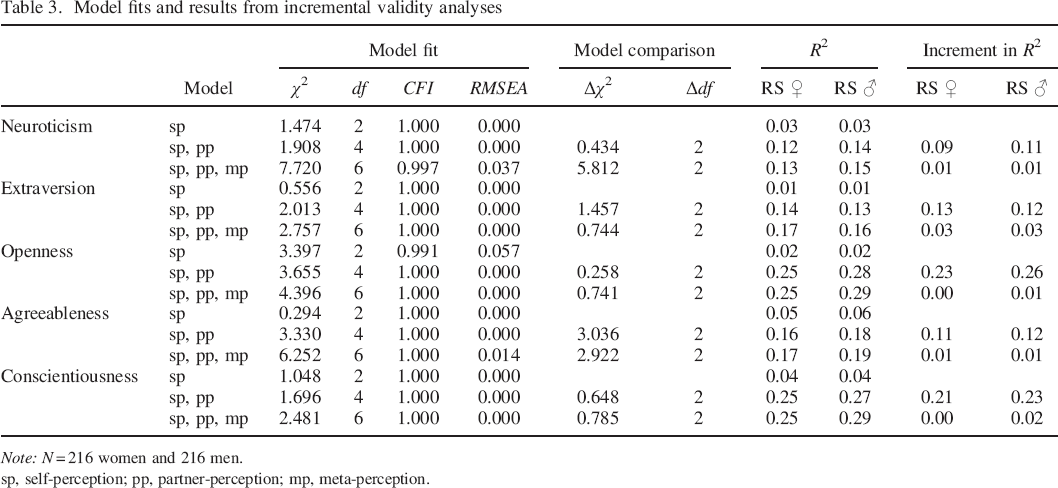
The results for the incremental validity by means of the APIM approach are depicted in Table 3. All model fits were acceptable across the different models. Although the different models fit the data equally well, it occurred that the inclusion of the partner–perception (range of increments in R2 = .09–.26) over the self–perception as well as the meta–perception (range of increments in R2 = .00–.03) over the other two perspectives generally resulted in an increase of explained variance with respect to relationship satisfaction.
Model fits and results from incremental validity analyses
Note: N = 216 women and 216 men.
sp, self–perception; pp, partner–perception; mp, meta–perception.
We also tested the increments in R2 on the basis of models without the addition of the partner–perception in order to find evidence that the meta–perception explains variance in relationship satisfaction above and beyond the self–perception. The models of extraversion, openness, agreeableness, and conscientiousness that combined the self– and meta–perceptions did equally fit the data in comparison with the models that only included the self–perception. The neuroticism model simultaneously analysing the self– and partner–perception model had a worse model fit than the self–perception model (Δdf = 2, Δχ2 = 6.510, p < .05), which replicates the results of the hierarchical regression. In general, the inclusion of the meta–perception was related to an increase in R2 (range of increments in R2 = .03–.07). In summary, the results of both approaches of the incremental validity analyses indicate that all three perspectives explain unique variance with respect to relationship satisfaction.
Associations between personality and relationship satisfaction
The zero–order correlations between personality traits and relationship satisfaction are depicted in Table 2. Although the separate results were somewhat mixed for women and men, the general picture shows consistently with previous research that neuroticism is negatively related to relationship satisfaction, and agreeableness and conscientiousness are positively related to relationship satisfaction. In contrast to the correlations for the self–perception, there are significant positive correlations between the partner– and meta–perceptions of extraversion and openness, and relationship satisfaction primarily in men.
To examine these associations more precisely and to account for the non–independence in dyadic data, we estimated APIMs and we modelled the associations on the latent level (Figure 1). The model fits of the APIMs were acceptable across all three perspectives (self–perception models: range χ2 = 74.502–122.444, df = 56, ps < .06, range CFI = 0.954–0.988; range RMSEA = 0.043–0.074; partner–perception models: range χ2 = 51.322–78.083, range df = 35–36, ps < .05, range CFI = 0.969–0.988, range RMSEA = 0.047–0.076; meta–perception models: range χ2 = 48.573–87.912, range df = 35–36, ps < .07, range CFI = 0.962–0.990, range RMSEA = 0.042–0.082). The results of the APIM analyses are shown in Table 4.
Standardized coefficients predicting relationship satisfaction based on personality self–, partner–, and meta–perceptions
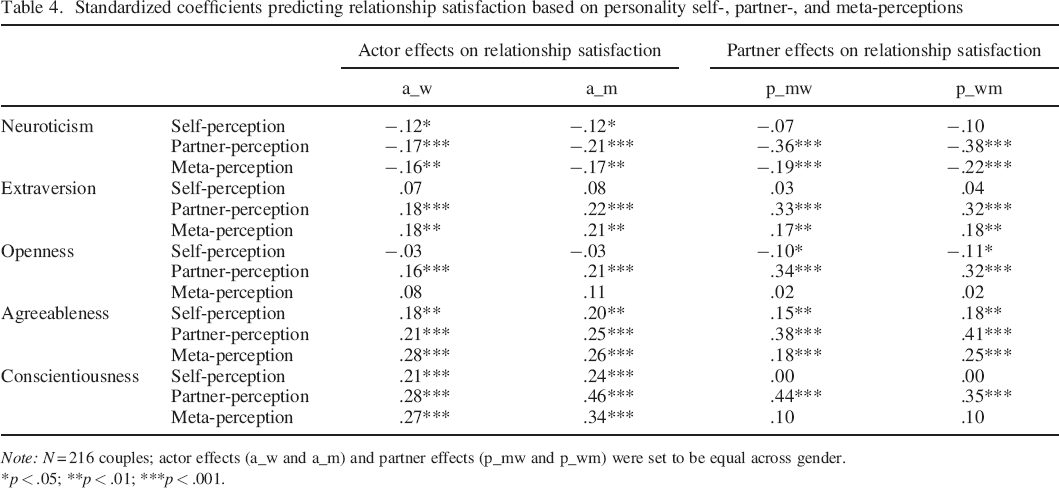
Note: N = 216 couples; actor effects (a_w and a_m) and partner effects (p_mw and p_wm) were set to be equal across gender.
p < .05;
p < .01;
p < .001.
With respect to the self–perceived personality traits, we found significant negative actor effects for neuroticism, and positive actor effects for agreeableness, and conscientiousness on relationship satisfaction. Positive partner effects were only found with respect to agreeableness, and negative partner effects were shown for openness. In contrast, the associations between the partner–perception of personality traits and relationship satisfaction were found across all Big Five traits and consistently both regarding actor and partner effects. The results for the associations between the personality traits from the meta–perception and relationship satisfaction showed significant actor and partner associations for the traits neuroticism, extraversion, and agreeableness. In addition, there was a significant actor effect for the trait conscientiousness. No effects were found for the meta–perception of openness on relationship satisfaction. The results suggest similar, but also different associations, between the three personality perspectives and relationship satisfaction. For instance, extraversion had positive actor and partner effects on relationship satisfaction on the basis of the partner– and meta–perceptions. This pattern was not found for the self–perception.
Discussion
In the field of personality research, there is a widespread consensus that the assessment of personality should be approached by the implementation of multiple methods. This seems particularly relevant for studies focusing on personality effects on indicators of intimate relationships. This current cross–sectional study therefore examined associations between the Big Five personality traits and relationship satisfaction of intimate couples by using three different personality perspectives: the self–, partner–, and meta–perception. To the best of our knowledge, this is the first study that integrated the perspective of the meta–perception of personality traits in the context of intimate relationships.
Our analyses provided three main findings. First, the results based on different methodological approaches (i.e. convergent and incremental validity analyses, and confirmatory factor analyses) indicated that the self–, partner–, and meta–perceptions represent three related, albeit distinct, personality perspectives. Second, the analyses based on all three perspectives revealed significant associations between neuroticism, agreeableness, and conscientiousness, and relationship satisfaction. Third, in addition, the partner– and meta–perceived extraversion was positively related to relationship satisfaction, whereas openness had positive associations with relationship satisfaction based on the partner–perception. We discuss each of these main findings in greater detail subsequently.
Consistent with previous research, self–reported neuroticism, agreeableness, and conscientiousness were significantly associated with relationship satisfaction within the individuals (actor effects; Dyrenforth et al., 2010; Heller et al., 2004). Partner effects were only evident in terms of agreeableness and openness. Interestingly, with respect to the analyses based on the partner–perception, all Big Five traits were meaningfully associated with relationship satisfaction via both actor and partner effects. Likewise, the results demonstrated that except for openness, all remaining meta–perceived traits contribute to relationship satisfaction, and conscientiousness was only related to relationship satisfaction via actor effects, though. These results imply that in addition to the three consistent correlates of relationship satisfaction (i.e. neuroticism, agreeableness, and conscientiousness), extraversion and openness play relevant roles for relationship satisfaction when accounting for the partner– and meta–perception, as two personality perspectives that involve the specific context of intimate relationships.
It is assumed and supported by the incremental validity analyses that every perspective sheds light on some specific aspects of personality, which seems to impact differences in intra– and inter–personal outcomes such as relationship satisfaction. For example, the self–perception perspective may represent enduring aspects of the self that is composed by mental representations and generalizations about oneself including personal memories and aggregated experiences (cf. Hart & Matsuba, 2012). Thus, self–perception ratings may be less based on recent interactions in social contexts. As an example, the self–perceived neuroticism might be rather related to the neurotic part of one's identity than to the neuroticism that is expressed in specific interactions within the intimate relationship. This would, in turn, explain why the partner effect based on the self–perception of neuroticism did not turn out to be significant in contrast to the partner– and meta–perceptions of neuroticism that probably directly affect the intimate partner.
On the contrary, the self–perceptions of the Big Five traits might be more influenced by a crystallized self–bias that describes the blindness of individuals towards changes in their basic personality traits (McCrae & Weiss, 2007). Thus, back to our example, it might be that Simon used to be a person that is generally not interested in arts. So, Simon thinks that he is not very open in this domain (self–perception). However, Laura's fascination for painting and design made a big impression on him. It happened that Simon started to overtake Laura's habit to go and see the latest exhibitions in town. Hence, from Laura's perspective (partner–perception), Simon is open towards arts and aesthetics, and that is something she really likes about him. To cut to the chase, this example might explain why the self–perception and partner–perception of the same trait could result in different associations with relationship satisfaction, as it is the case for openness in our study.
Besides, the partner–perception might be more influenced by aspects of personality that are salient and observable in social interactions of the intimate couple. For example, Vazire (2010) suggested that extraversion should be adequately reported from an outside perspective because of its high observability. In the context of intimate couples, it is possible that partner ratings might be affected by relationship quality. It has been shown that individuals tend to make positive and idealistic attributions about their partner's personality under the condition of high relationship satisfaction (Fletcher & Kerr, 2010; Murray et al., 1996). The overestimation of positive traits with respect to individuals who are liked by the rater is known as the halo effect (cf. Berman & Kenny, 1976). However, as the associations between the partner–rated personality traits and the partner's relationship satisfaction were not extremely high, the existence of a strong halo effect does not seem likely.
We suggest that the meta–perception might function as a bridge between the self– and partner–perceptions and, in turn, might include reflections of oneself in the context of the intimate relationship and particularly in the eyes of the intimate partner, which are not activated within the process of generating self–perceptions. It is therefore assumed that the use of the meta–perception leads to a more complex understanding of the interactions between personality and intimate relationships, as it incorporates the feelings of how one's person is valued by the intimate partner. The latter points to the looking glass phenomenon that is closely related to the concept of self–esteem (Leary & Baumeister, 2000), which, in turn, has been shown to be relevant for attachment and felt security in intimate relationships (Murray et al., 1998; Murray, Holmes, & Griffin, 2000).
The consistent associations between neuroticism, agreeableness, conscientiousness, and relationship satisfaction can be interpreted with respect to the maturity concept. Hogan and Roberts (2004) proposed that these three traits are characteristic of a mature personality. There is also evidence that maturity is related to inter–personal sensitivity, self–control, and the fulfilment of socially important roles (Wood & Roberts, 2006), which, in turn, might positively influence intimate relationships. Hogan and Roberts (2004) assumed that maturity includes both an inside aspect (related to self–perception) and an outside aspect (related to partner–perception). Accordingly, the first aspect is reflected in individuals’ adjustment (emotional stability) and role–taking ability (agreeableness and conscientiousness), and the second aspect is represented in the reputation of being emotionally stable, agreeable, and conscientious. Hogan and Roberts (2004) suggested that the inside and outside aspects of maturity predominantly overlap but also can differ from each other, as it was shown in our results. The present results also might reflect the fact that highly emotionally stable, agreeable, and conscientious individuals are more willing to invest in and to commit to their intimate relationships and thus maintain a good relationship with their partners (Lodi–Smith & Roberts, 2007; Roberts & Wood, 2006).
Previous work based on self–reports demonstrated that the associations between extraversion and openness and relationship satisfaction are unclear. The current results clearly contribute to a better understanding of the role of these traits for relationship satisfaction particularly regarding extraversion. In terms of extraversion, we found that the partner– and meta–perceptions were substantially and positively related to relationship satisfaction with respect to both actor and partner effects. Extraversion comprises several underlying facets that are particularly expressed in social interactions and are therefore well observable from an outside view. Extraverts are known to be talkative and energetic (John & Srivastava, 1999) and have the ability to maintain a positive affect balance (Lischetzke & Eid, 2006). Thus, extraverts feature characteristics that are assumed to be relevant and positive for social interactions. Therefore, it is suggested that the perception of those characteristics, via both partner– and meta–perceptions, has meaningful effects on relationship satisfaction of both partners. Thus, Simon's humorous and cheerful personality is probably easier to identify from another person's perspective (e.g. Laura's perspective) than for Simon's self, because particularly social interactions (e.g. during leisure time with Laura) evoke those facets of personality. Furthermore, it is the explicit view of Laura that has something to do with her relationship satisfaction and that of Simon, because Laura's pleasure might function as feedback for Simon, which in turn will be represented in Simon's meta–perceptions about him to be humorous and cheerful.
Limitations, implications, and future research
Despite the strengths of this study, it also exhibits some limitations. First, one could speculate that the individual's partner–perception (How do I see my partner?) and meta–perception (How do I think my partner sees me?) are confounded with relationship satisfaction. That is, positive evaluations of these questions go systematically along with high relationship satisfaction. However, the two perceptions are only modestly interrelated. Therefore, it is not likely that the partner effects of the partner–perception and the actor effect of the meta–perceptions on relationship satisfaction are driven by unspecific–shared variance. Second, although personality was assessed by multiple perspectives, only self–reports of relationship satisfaction were available in this study. For future studies, it would be relevant to use different methods and forms of report to assess a broader picture of relationship satisfaction. Third, it is not possible to draw conclusions about the direction of effects given the cross–sectional nature of the study. Thus, longitudinal studies are needed.
The findings of the current study have several implications. First, on the one hand, our results have shown that the self–, partner–, and meta–perceptions of the Big Five personality traits are substantially related. This finding needs to be emphasized with respect to the overlap between the self– and partner–perceptions as these two perspectives are based on different sources of report (self– and other–reports). On the other hand, we provided evidence that three perspectives are distinct and show different association patterns with relationship satisfaction. The latter finding is especially relevant with respect to the self– and meta–perceptions in reference to the ongoing debate about whether the meta–perception really constitutes something distinct from the self–perception or whether it is a result of a self–verification process (Carlson et al., 2011; Kenny & DePaulo, 1993; Swann, 2012). Our findings support the assumption that individuals have the ability to acquire self–knowledge about their reputation in the social environment that deviates from their self–perception. The result that the three perspectives are distinct might provoke the question about the most accurate personality perspective. However, we suggest that there is no one ideal approach to capture personality. Rather, we think that every perspective has its power, and the most precise personality assessment can be reached by the implementation of various perspectives. Second, our analyses provided novel findings with respect to the association between extraversion and relationship satisfaction that, to date, is unclear in the literature. Our results imply that extraversion contributes to relationship satisfaction when perceiving it from the outside perspective, directly via the partner–perception or indirectly via the meta–perception. Thus, studies of personality effects on relationship satisfaction that are only based on the self–perception of individuals are limited. Third, we have to point to the differences with respect to the occurrence of actor and partner effects based on the three perspectives. Although personality traits based on self–perceptions were primarily linked to relationship satisfaction via actor effects, we found both actor and partner effects of personality on relationship satisfaction based on partner– and meta–perceptions of personality. With respect to the partner–perception, the many substantial actor effects need to be accented, whereas the significant partner effects based on the meta–perception have to be underlined, as those effects are not inflated by common method variance (Kenny & Cook, 1999).
Our current study provides implications for future research. First, from a developmental perspective, it would be of great interest to investigate longitudinal trajectories of the three perspectives to explain stability and change of personality in the specific context of intimate relationships. Moreover, it would be interesting to study whether the relation between the different perspectives changes as a function of age or whether the three perspectives have the same associations with relationship satisfaction in various age groups. Second, the three perspectives in the context of intimate couples raise additional interesting research questions with respect to similarity and congruence. Previous research on personality similarity (e.g. Are partners with similar personality profiles happier in their relationship?) was mostly based on personality self–perceptions. Similarity analyses on the partner– and meta–perceptions might help to better understand the role of personality similarity in intimate relationships. The three perceptions provided by both partners of an intimate relationship allow for analysing congruence phenomena from a dyadic perspective (e.g. is a high meta–accuracy representing a high overlap between partner– and meta–perceptions positively related to the relationship satisfaction of intimate partners?). For instance, one could assume that when Laura sees Simon as more neurotic and less agreeable and conscientious (partner–perception) than Simon sees himself (self–perception), her relationship satisfaction is rather low. Third, future studies should investigate moderators and mediators with respect to the associations between the three different perspectives and relationship satisfaction in order to understand the underlying mechanisms and contextual factors that drive these associations. With reference to the looking glass theory (cf. Leary & Baumeister, 2000), one could speculate that meta–perceptions and self–esteem are two interrelated constructs that are both uniquely and jointly relevant for relationship satisfaction.
Finally, the results also have practical implications. As the findings of our analyses provided evidence for incremental validity of the self–, partner–, and meta–perceptions of personality, the three perspectives could be useful for diagnostic purposes in the context of intimate relationships. Furthermore, with respect to couple counselling, it might be insightful for intimate partners to share their inside and outside personality perspectives and their meta–perceptions with respect to each other. In this vein, individuals can find out more about themselves, about how they are perceived in their relationship, and about their accurate or inaccurate assumptions about how they are seen by their partner. This reflection could lead to a fruitful identity building process with respect to both the individual and the couple, which, in turn, could result in increased self–esteem and self–satisfaction of the individual as well as enhanced feelings of intimacy and attachment of the partners.
Conclusions
The findings of the current study lead to several conclusions. We demonstrated that the self–, partner–, and meta–perceptions of the Big Five traits represent three related, albeit distinct, personality perspectives. Furthermore, our results imply that the three perspectives might differ with respect to associations with important outcomes of social relationships such as relationship satisfaction. Therein, it needs to be emphasized that a dyadic perspective on that interplay is indicated. From our findings, it is suggested that individuals have accurate knowledge about how they are seen by others such as the intimate partner as in our study. Thus, we conclude that the meta–perception is more than a copy of the self–perception.
Supporting info item
Supporting info item, per1948_sup-0001_Appendices A1-A6 - Personality Traits and Relationship Satisfaction in Intimate Couples: Three Perspectives on Personality
Supporting info item, per1948_sup-0001_Appendices A1-A6 for Personality Traits and Relationship Satisfaction in Intimate Couples: Three Perspectives on Personality by Schaffhuser Kathrin, Allemand Mathias and Martin Mike in European Journal of Personality
Footnotes
Acknowledgements
This publication is based on data from the study ‘Co–Development in Personality: Longitudinal Approaches to Personality Development in Dyads across the Life Span’ (CoDiP), funded by the SINERGIA PROGRAM of the Swiss National Science Foundation (SNSF; CRSI11_130432/1). The CoDiP study was conducted by Alexander Grob, Mike Martin, Franciska Krings, and Bettina S. Wiese. We thank the CoDiP team for the collaboration. Kathrin Schaffhuser is a fellow of the International Max Planck Research School ‘The Life Course: Evolutionary and Ontogenetic Dynamics’ (LIFE). We express our appreciation to Jenny Wagner for her advice regarding earlier drafts of the manuscript.
References
Supplementary Material
Please find the following supplemental material available below.
For Open Access articles published under a Creative Commons License, all supplemental material carries the same license as the article it is associated with.
For non-Open Access articles published, all supplemental material carries a non-exclusive license, and permission requests for re-use of supplemental material or any part of supplemental material shall be sent directly to the copyright owner as specified in the copyright notice associated with the article.
