






Abstract

Using Longitudinal Studies to Understand Post–Traumatic Growth
IVANA ANUSIC AND STEVIE C. Y. YAP
Michigan State University, East Lansing, MI, USA
Abstract: Jayawickreme and Blackie suggested that the study of post–traumatic growth requires longitudinal data. We echo this point and note further issues that need to be considered when using longitudinal data. Baseline periods and follow–up intervals should be carefully selected in order to observe true change. Comparison groups should be used to separate normative change from post–traumatic growth. Longitudinal data from national panel studies can provide useful resources to study this topic. Copyright © 2014 European Association of Personality Psychology
Understanding the factors that predict personality change across the lifespan is an important goal of personality psychology. In their review of the current state of research on post–traumatic growth, Jayawickreme and Blackie (J&B) provided an excellent outline of limitations of existing research in this field and offered some insightful recommendations that can move the field forward. We agree with their suggestion that longitudinal studies are crucial for understanding real change following the experience of trauma. However, observation of true change may require even longer time spans than were suggested by the authors. In addition, we emphasize the importance of comparison groups for the study of post–traumatic growth. Finally, because it is often challenging to collect prospective longitudinal data, we point the readers to existing longitudinal datasets that may be used to study post–traumatic growth.
As J&B noted, in order to observe change in personality that follows trauma, it is essential to know the baseline levels of relevant personality characteristics prior to the event. However, we advise caution when selecting the appropriate baseline period. At least in the existing well–being literature, change from baseline levels can begin up to several years before the experience of major life events such as widowhood or disability (Lucas, 2007). Thus, a study that is designed to look at post–traumatic growth should ideally start well before the traumatic experience. Similarly, personality growth that occurs in the initial years following trauma may be temporary or enduring. To observe the latter, several years of follow–up may be necessary.
Another point to emphasize is the importance of using comparison groups in studies of post–traumatic growth. Changes in any personality characteristic are likely to occur throughout the lifetime (e.g. Srivastava, John, Gosling, & Potter, 2003). Thus, any change observed in those who experience trauma may be attributed either to normative changes that would have occurred regardless of the traumatic event or to the actual experience of trauma. To be able to draw more informative inferences about the impact of trauma when controlled experiments are not available, statistical techniques can be used to create groups that are similar on important characteristics prior to the experience of the event (e.g. propensity score matching; Gelman & Hill, 2009). If the two groups are equal at the beginning and the trauma group shows more change over time, then it is unlikely that this change can be attributed to normative change alone. In some of our work with change in life satisfaction following experience of major life events, accounting for normative changes had important implications for interpretation of the results (Yap, Anusic, & Lucas, 2012). For example, we studied whether life satisfaction showed long–lasting changes after marriage and found that married people's life satisfaction levels were no different after marriage than before marriage. However, people in a matched comparison group who did not marry experienced a decline in life satisfaction during the same period, suggesting that marriage actually may have a protective effect. This protective effect would have been lost if a comparison group was not considered.
Of course, it is costly and challenging to find large samples of individuals who are likely to experience a particular trauma, and the difficulty of this type of research increases substantially when one is interested in following people over long periods. Fortunately, an accessible solution to these challenges lies in the use of existing panel studies. Several nationally representative longitudinal studies have been ongoing in Germany (German Socio–Economic Panel), UK (British Household Panel Study), Australia (Household, Income, and Labour Dynamics in Australia), and Switzerland (Swiss Household Panel). These longitudinal studies have followed tens of thousands of people on an annual basis for many years (e.g. the German panel started in 1984 and includes over 40 000 respondents). The datasets include a wide range of variables, including many demographic and socioeconomic variables, as well as psychological characteristics such as subjective well–being and personality traits.
In addition to providing data over very long periods, an important feature of these panel studies is that they do not recruit people because they have experienced or are going to experience a traumatic event. Rather, because so many people are followed over many years, a substantial number of people actually do experience even relatively rare events. This type of design minimizes demand characteristics that may affect participants’ responses. Indeed, at the start of the study, people are likely not aware that they will experience a particular traumatic event years down the road. Even after the event, because the study does not specifically focus on the traumatic event and because of the breadth of questions included in the survey, this design is unlikely to push people into responding in a biased manner (Smith, Schwarz, Roberts, & Ubel, 2006).
A major limitation of conducting research with panel data is that researchers have no control over the variables that are available for study. However, these datasets provide an excellent starting point for the field of post–traumatic growth. For instance, they allow for study of diverse life events that vary in their severity of trauma (e.g. unemployment, loss of a spouse or a child, onset of disease, disability), and thus they can provide a preliminary test of the types of events that may lead to most growth following trauma. More in–depth studies can then be designed to specifically target mechanisms behind such change.
In the end, to study change longitudinal data are necessary. However, longitudinal study designs come with their own challenges. Selecting appropriate baseline periods and allowing adequate time for any adaptation to occur are crucial for properly detecting lasting post–traumatic growth, and it is important to use techniques that can distinguish between different sources of personality change. Panel studies offer a useful resource for future research in this area of personality psychology.
Acknowledgement
Preparation of this manuscript was supported in part by a Social Sciences and Humanities Research Council of Canada doctoral fellowship awarded to Stevie Yap.
Understanding Post–Traumatic Growth by Attending to Contextual Influences and Developing Wise Interventions to Promote It
DAN V. BLALOCK, JENNA M. CALTON AND TODD B. KASHDAN
George Mason University, Fairfax, VA, USA
Abstract: Jayawickreme and Blackie offered recommendations on how the conceptual framework of post–traumatic growth can benefit from greater attention to measurement and methodology. We offer two additional considerations. Emerging research suggests that brief and specific psychological interventions produce lasting changes in how people view themselves and their environment. In the early post–trauma phase, these interventions are worthy of exploration. Additionally, a focus on who is experiencing what type of trauma offers a contextual lens missing from the hunt for universal, silver–bullet approaches to mental health promotion. Copyright © 2014 European Association of Personality Psychology
Jayawickreme and Blackie (J&B) provided a thorough review of literature on post–traumatic growth with a detailed critique of the measurement, methodological, and conceptual limitations. We agree that while research conducted on post–traumatic growth has been useful and admirable, the nature of this construct demands special scrutiny. The primary concern with the current understanding of post–traumatic growth is that researchers might be studying something different, whether it is perceived post–traumatic growth, social desirability and cultural expectations regarding response to trauma, or even cognitive attempts at dissonance reduction. Both longitudinal and daily diary research methodologies can address some of these concerns. Nevertheless, two large and interrelated issues warrant greater consideration—the lack of attention on innovative post–traumatic interventions and the heterogeneity of traumas and survivors.
The point of studying post–traumatic growth is to prescribe conditions to promote it. Greater attention to post–trauma interventions, particularly those that are both effective and efficient, is necessary to make research practically useful. Similarly, as research is moving towards finding conditions/moderators for effects long–studied, we must examine heterogeneity of the trauma–individual interaction. This heterogeneity exists because traumas and individuals differ. Every trauma–individual combination yields a specific phenomenon. When we assume everyone needs to grow, and grow similarly, following a host of different experiences we classify as a ‘trauma’, we risk conducting surface–level research that masks more condition–specific effects.
Any effective intervention must be informed by this trauma–individual interaction, yet most current interventions offer a relatively uniform approach on the basis of a few core principles. If we target an individual's specific problem immediately, we will reduce the large amount of time, energy, and money that current intervention models demand. Recent research on ‘wise’ interventions that are by definition brief, precise, simple attempts to target specific psychological problems can have long–term effects on health and well–being (Walton, 2014). These interventions are based on in–depth understandings of psychological experiences and the ways in which people think about themselves, others, and the world. However, the experience of post–traumatic growth varies across traumas and survivors. Tailoring interventions to the type of trauma a survivor experiences (i.e. trauma–specific) and taking into account an individual's worldview and values (i.e. idiographic) is important for effectiveness and efficiency.
Instead of stressing variability and specificity in interventions, J&B proposed a behavioral intervention geared towards homogenizing individuals to act (and therefore become; Fleeson, 2001) more extraverted, agreeable, and open to experience. The proposed intervention aligns with Linley and Joseph's (2004) finding that these personality traits correlated with higher self–reported and retrospective post–traumatic growth. This creative intervention follows a ‘wise’ format because it stresses behaviourally oriented change, can be implemented early in the post–trauma period before PTSD or other maladaptive processes occur, and can target recurring processes (e.g. frequent trait–related behaviors). However, this intervention diverges from a ‘wise’ format because it ignores the heterogeneous post–trauma psychological experience across traumas and individuals. A successful intervention necessitates consideration of both inter–trauma and inter–individual variability.
First, interventions should be flexible to the type of trauma a survivor experiences. Some of the variability found in post–traumatic reactions of distress or growth (Frazier, Conlon, & Glaser, 2001) could be due to factors associated with the type of trauma experienced, such as stigma. Interventions developed for highly stigmatized traumas, such as rape, should target maladaptive thoughts and behaviors, such as concealment of the experience or avoidance of any romantic activity because of shame, self–blame, and thoughts that one has become ‘damaged goods’. A wise intervention could ask rape survivors to describe the trauma without blaming themselves (Bugental et al., 2002) and to engage in behaviours that accurately blame perpetrators (e.g. blog about criminal charges). However, survivors of other traumas, such as the Boston Marathon bombings, who received tremendous explicit support from the American public, would benefit from interventions targeting survivors’ thoughts about the world being a dangerous place.
Second, interventions should be flexible to who is experiencing the trauma. Research supports the idea that a growth mindset is beneficial across various ethnic cultures (Splevins, Cohen, Bowley, & Joseph, 2010; Taku, Tedeschi, Cann, & Calhoun, 2009). While interventions may increase post–traumatic growth across cultures, expansive sub–cultures and individual differences account for variable trauma reactions. To promote post–traumatic growth, we must account for these sub–cultural values, as opposed to only assessing values in a vague manner, by asking questions such as ‘I'm able to do better things with my life’ (Post–Traumatic Growth Inventory; Tedeschi & Calhoun, 1996). For example, interventions for child rape survivors who are homeschooled might prioritize family dynamics over peer social relationships and target thoughts/behaviors related to safety in the outside world. However, rather than make a ‘Post–Rape Growth for Homeschooled Children’ intervention, eliciting culture–specific values and needs within the intervention would be more practical and personal.
A self–affirmation intervention, for example, provides a suitable middle ground by allowing individuals to dictate what values they focus on. This intervention promotes culture–specific post–traumatic growth without necessitating that everyone experiences this growth. By focusing on core personal values, this intervention directs individuals to what is important within themselves and in their life, weakening the trauma's ability to threaten personal integrity (Cohen & Sherman, 2014). Self–affirmation would encourage an individual to pursue personality traits they choose (such as a homeschooler intentionally spending more quality time with his family because he values family support) in order to grow, rather than having certain personality traits and behaviors (such as socializing with many same–aged peers) dictated as the ‘path to growth’.
A better understanding of post–traumatic growth through measurement and methodology, combined with attention to the trauma–individual interaction, will help refine the effectiveness and efficiency of traditional and wise interventions. Wise interventions, in turn, can facilitate immediate and tangible improvements on the basis of trauma–level and individual–level differences. Personality psychology offers a wealth of strategies to improve post–traumatic growth interventions and trauma survivors’ lives.
Integrating Post–Traumatic Growth into a Broader Model of Life Experiences and Personality Change
RODICA IOANA DAMIAN AND BRENT W. ROBERTS
University of Illinois at Urbana–Champaign, Champaign, IL, USA
Abstract: Post–traumatic growth research may be integrated into a broader model of life experiences and personality change by the following five guidelines: (i) expand the definition of ‘growth’ to include personality change and allow for both positive and negative outcomes; (ii) use longitudinal designs and measure event experience in addition to event occurrence; (iii) identify moderating factors of the experience–growth link; (iv) consider both positive and negative events as movers of personality change; and (v) broaden the outcomes of interest, from intra–psychic growth outcomes, to other adaptive functioning, such as achievement. Copyright © 2014 European Association of Personality Psychology
Jayawickreme and Blackie provided an excellent review of research on post–traumatic growth, its various definitions, proposed mechanisms, pervasive methodologies, and limitations. Then, they suggested several ways in which personality psychology and post–traumatic growth research may benefit from each other through integration.
One suggestion was that the definition of post–traumatic growth should be broadened to personality change and that researchers should examine the effects of traumatic life events on personality change, employing longitudinal designs. We agree that this is an important step, and indeed, this question has already been addressed by several longitudinal studies on stressful life events and personality change. For example, Roberts, Helson, and Klohnen (2002) showed in a 30–year longitudinal study of women that negative life experiences, such as divorce, were associated with decreases in dominance, which is a valued personality trait. Another longitudinal study, conducted on 2000 German students over four years, showed that experiencing negative life events was related to increased neuroticism and decreased extraversion, whereas experiencing positive life events was related to decreased neuroticism and increased extraversion, agreeableness, and conscientiousness, thus suggesting that the experience of positive, not negative, life events is associated with positive growth. Additionally, this study found that people who started out higher in neuroticism tended to experience more negative life events in the future, thus triggering a vicious cycle of negative personality change (Lüdtke, Roberts, Trautwein, & Nagy, 2011). Building on this idea, a recent study (Chow & Roberts, 2014) found that increases in neuroticism were related to increases in depression over time, and this link was explained, in part, by chronic stressors. Finally, a longitudinal study on bereavement, showed that anxiety, depression, grief, and PTSD (some of the common symptoms of bereavement) increased over time for some people but decreased for others depending on their attachment styles, thus showing that positive growth following trauma is subject to moderators (Fraley & Bonanno, 2004).
In sum, previous longitudinal research on negative life events and personality change suggests negative, rather than positive, changes. However, these findings do not dismiss the possibility of post–traumatic growth. Instead, they emphasize the importance of expanding the definition of ‘growth’ to personality change, allowing for both positive and negative personality changes and identifying moderating factors. This point is not trivial, because, as the authors point out, most previous research on post–traumatic growth has used measurements that are positively biased, such as the Post–Traumatic Growth Inventory (Tedeschi & Calhoun, 1996), in the sense that they only ask participants about retrospective positive changes, thus leaving no room for negative changes. Thus, it is essential for research in this area to employ measurements that leave room for both positive and negative outcomes and to focus less on whether positive growth occurred or not and more on who shows positive versus negative personality change in the wake of trauma. Relevant moderating factors may include attachment style, cognitive ability, socio–economic status (education level and income), support networks, and pre–trauma personality traits (Damian & Simonton, 2014a, 2014b; Fraley & Bonanno, 2004; Lüdtke et al., 2011).
Another important problem that longitudinal designs will be able to address is that of subjective experience of the event versus mere event occurrence. So far, post–traumatic growth research has focused on the occurrence of pre–defined traumatic events, but because they employed retrospective designs, they were unable to measure how the respective event was perceived at the time. We believe that the way people experience events is an important moderating factor, above and beyond event occurrence. We would expect, for example, less negative personality change for people who were not as affected initially by the negative event (see Fraley & Bonanno, 2004).
Finally, two additional ways in which research on post–traumatic growth may broaden its operating model come from a research tradition in creative achievement. According to this research, diversifying experiences are highly unusual and unexpected events or situations that push individuals outside the realm of ‘normality’ (Damian & Simonton, 2014a, 2014b, in press). Any unusual and unexpected events, positive or negative, may fulfil this role through the ‘strain’ they place on the individual, by providing the experience necessary to break boundaries and see the world in multiple ways, which presumably equips them with the cognitive flexibility necessary for coming up with creative ideas. In other words, unconventional and unpredictable developmental experiences might foster unconventional and unpredictable ideas. Past research found that positive experiences, such as multiculturalism and travelling, as well as negative experiences, such as parental death and chronic illness, are related to higher levels of creative achievement. The proposed underlying mechanism (i.e. breaking boundaries and seeing new perspectives) is similar to some of the proposed mechanisms underlying post–traumatic growth. Indeed, if the underlying mechanism consists of challenging the status quo, then it should not make a difference if the experience has a positive or negative emotional valence. This is a hypothesis that future research on post–traumatic growth may test. Additionally, other outcomes indicative of adaptive functioning, such as (creative) achievement, may be considered.
In conclusion, we believe that the future for post–traumatic growth research lies in broadening its working models as follows: (i) expand the definition of ‘growth’ to personality change and allow for both positive and negative personality change outcomes; (ii) measure actual growth by using longitudinal designs, rather than perceived growth, and consider not just the event occurrence but also people's subjective experience of life events as they occur; (iii) identify moderating factors of the link between life events and personality change; (iv) consider both positive and negative events as movers of personality change; and (v) broaden the outcomes of interest, from intra–psychic growth outcomes to other outcomes signalling adaptive functioning, such as achievement. These changes would have significant theoretical and practical implications. Theoretically, they would merge the two literatures, broaden the working model, and provide a balanced framework for studying personality change and growth as a consequence of life events and moderating factors. Practically, this research might teach us which moderating factors are essential in helping people cope with trauma and emerge from it with positive growth.
Four Ways of (Not) Being Real and Whether They are Essential for Post–Traumatic Growth
WILLIAM FLEESON
Wake Forest University, Winston–Salem, NC, USA
Declaration: The author is a co–investigator on the post–traumatic growth project with Eranda Jayawickreme and Laura Blackie.
Abstract: Is post–traumatic growth (PTG) ‘real’? The concept of ‘real’ is abstract, so I draw out four specific meanings of ‘real’ from the Jayawickreme and Blackie article. I propose three reasons being ‘real’ might matter: whether there are benefits to trauma, the possibility of interventions, and the accuracy of personal beliefs about growth. Using these reasons for mattering, I evaluated whether being ‘real’ matters for PTG in each of the specific meanings of ‘real’. Only the pre–change to post–change meaning and the daily instantiation meaning appeared to matter for these reasons. Copyright © 2014 European Association of Personality Psychology
Jayawickreme and Blackie (J&B) presented an outstanding review of the theories, findings, and controversies of post–traumatic growth (PTG). Their target article covers the important issues, describes the theories in clear, accurate, and concise summaries, makes several subtle but important distinctions, and is fair to the multiple parties to the disagreements.
A main point of their article appears to be the question whether PTG is ‘real’ or ‘actual’ (variants of the words ‘real’ and ‘actual’ appear over 50 times.) ‘We argue that … we need to conceptualize posttraumatic growth as actual positive personality change…’, p. 6.
However, ‘real’ and ‘actual’ are difficult concepts, because they are abstract. Not only are they abstract but they are highly valued. Thus, it is critical to be specific about what ‘real’ means and to question whether the more specific meaning is as valuable as the abstract meaning. It is particularly important in this case because in some ways it may not matter whether PTG is real—it may almost seem harsh to tell trauma sufferers that even their silver linings are not real.
In this commentary, I translate ‘real’ into four specific meanings. I then propose three reasons being ‘real’ might matter and evaluate whether it matters whether PTG is ‘real’ in each of these specific meanings.
There are at least three reasons it might matter that PTG be ‘real’. The first reason is that
The second reason is that
The third reason is that
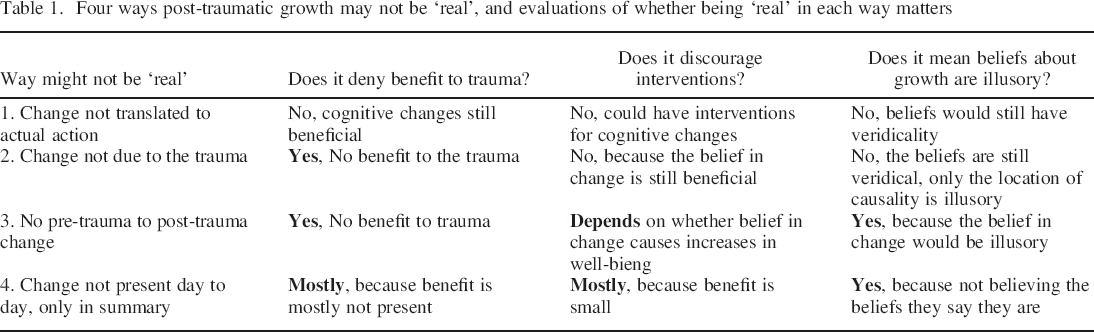
Table 1 crosses these three reasons why the reality of PTG may be important with the four ways that PTG may not be ‘real’. These four ways of being ‘real’ elaborate ideas articulated by J&B.
The first specific way in which PTG may not be real is that cognitive PTG may not be translated into physical action. People may increase in maturity, wisdom, self–transcendence, and others, but these changes may not be evident in physical behaviors. Such PTG might be not real because it is not physical. However, maturity, wisdom, and others are valuable, regardless of whether any physical behaviors follow, and PTG would still be a benefit attendant upon trauma. Furthermore, interventions could be appropriately designed to foster these cognitive changes following PTG. Thus, PTG not being translated into physical behaviour would not undermine its importance, and this way of being ‘real’ is not essential to PTG.
The second specific way that PTG may not be real is that change may not be due to the trauma. In this case, PTG may be evident but is caused by other factors, such as traits, for example, optimism, coping strategies, or maturation. Some people may often grow, and trauma is only one topic of growth. This possibility denies any benefits to trauma and assigns them to the trait, coping, or maturation. However, this possibility does not discourage interventions. The growth happened in these cases, and interventions could be developed to encourage such growth. Thus, PTG not being due to the trauma only somewhat undermines its importance, and this way of being real is not essential to PTG.
The third specific way PTG may not be ‘real’ is that there may have been no change from pre–trauma to post–trauma. People may believe they changed on some relevant dimension, but their post–trauma standing may actually be the same as their pre–trauma standing. This way of not being ‘real’ would deny benefits to trauma. However, such a way of not being real might not discourage interventions—if the beliefs about change cause well–being, regardless of actual pre–change and post–change, then interventions to increase those beliefs could be warranted. Thus, PTG not being present in actual pre–change to post–change would greatly undermine its importance, but not completely, and this way of being real is almost essential to PTG.
The fourth specific way that PTG may not be real is that the change may not be instantiated in daily beliefs and emotions. Rather, when describing themselves abstractly in summary, people may claim to have changed in their relationships, in their attitudes, and in their emotions, but those claims may not describe the relationships, attitudes, or emotions people actually engage in day to day. For example, someone may claim they enjoy being with family more, but there may be few moments with family that they are actually enjoying. If this is true, then the trauma has produced almost no benefits. Furthermore, there would be little benefit to interventions that changed only abstract summaries. Thus, PTG not being present in day to day beliefs and emotions would greatly undermine its importance, and this way of being real is almost essential to PTG.
Thus, it really does matter whether PTG is ‘real’. It matters because not being ‘real’ denies benefits to trauma, discourages growth interventions, and implies that beliefs about growth are illusory
Four ways post–traumatic growth may not be ‘real’, and evaluations of whether being ‘real’ in each way matters
Post–Traumatic Growth: A Call for Less, but Better, Research
PATRICIA FRAZIER1, JAMES COYNE2 AND HOWARD TENNEN3
1University of Minnesota, Minneapolis, MN, USA
2University Medical Center Groningen, Groningen, The Netherlands
3University of Connecticut School of Medicine, Farmington, CT, USA
Abstract: We describe a multitrait–multimethod (MTMM) approach to studying the construct validity of self–report measures of post–traumatic growth (PTG). The proposed MTMM reveals three important points. First, most cells representing anything other than retrospective self–reports are empty. Behavioural studies are particularly lacking. Second, retrospective and prospective reports of PTG do not converge. Third, retrospective reports of PTG are more related to coping than to prospectively assessed PTG. We call for less research that measures PTG retrospectively and more research that takes seriously this lack of evidence of construct validity. Copyright © 2014 European Association of Personality Psychology
Despite the expansion of research on post–traumatic growth (PTG) over the past two decades, Jayawickreme and Blackie's (J&B) review suggested minimal progress in resolving persistent controversies, elucidating mechanisms, or even demonstrating that PTG is a robust phenomenon rather than an illusion or methodological artefact. In our brief commentary, we break convention and call for less—but higher quality—research.
J&B took seriously concerns related to the construct validity of self–report measures of PTG. Nonetheless, they focused rather narrowly on validating retrospective reports of growth with prospective measures of change on growth–relevant measures. We here suggest a more systematic multitrait–multimethod (MTMM; Campbell & Fiske, 1959) approach to studying the construct validity of self–report PTG measures.
To validate a measure of a construct, more than one ‘trait’ or construct (e.g. PTG and coping) should be measured with more than one method (e.g. retrospective and prospective reports). Correlations between measures of the same construct assessed using different methods should be high, providing evidence of convergent validity. These correlations should be higher than the correlations between measures of different constructs assessed using the same methods and higher than the correlations between measures of different constructs assessed using different methods. These last two conditions provide evidence of discriminant validity. Both types of evidence are necessary to have confidence in the measure of a construct.
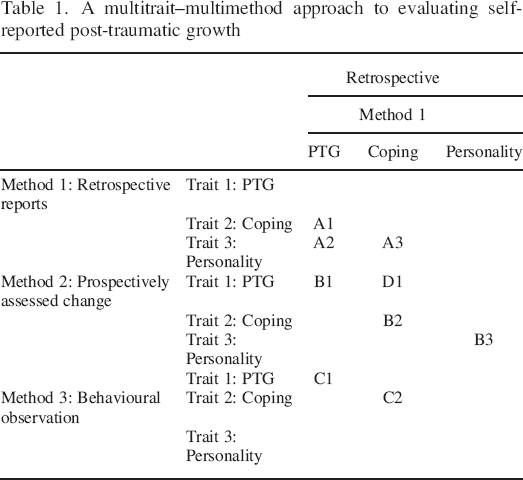
Table 1 highlights a portion of an MTMM approach to assessing the validity of self–report PTG measures. It includes three constructs (PTG, coping, and personality) assessed via three methods (retrospective self–reports, prospective self–reports, and behavioural observations). We chose coping because an important question in the literature concerns the extent to which self–reported PTG reflects coping strategies (represented by correlations between self–reported PTG and coping; cell A1) versus measured growth from pre–trauma to post–trauma (correlations between retrospective and prospective reports of change; cell B1). We included personality as a third construct on the basis of J&B's argument that PTG is reflected in personality change. Retrospective self–report needs to be included as a method because it is by far the most commonly used method to assess PTG. Prospective report of change is the most straightforward method of assessing the extent to which an individual has ‘grown’ from a traumatic event. However, retrospective and prospective self–report share method variance; ideally, different methods are independent. In addition, it is difficult, although not impossible, to gather prospective data before trauma occurs. Behavioural observation is an important additional method: If individuals have grown from traumatic events, they should behave differently than individuals who have not grown. 1
We highlight a few cells in the MTMM to illustrate the information provided. Cells B1 and C1 represent correlations between different methods of assessing PTG. Of the hundreds of studies assessing retrospective reports of PTG, we know of only two (Frazier et al., 2009; Yanez, Stanton, Hoyt, Tennen, & Lechner, 2011) that have correlated them with prospective data on change from pre–trauma to post–trauma (cell B1). Both found small correlations (r of .22 and .10, respectively) between these two methods of assessing PTG. 2 Studies correlating retrospective and prospective reports of personality change (cell B3) also reveal low concordance (e.g. Costa & McCrae, 1989). We know of no studies that have compared retrospective reports to behavioural observations of PTG–related domains (cell C1).
When two methods of measuring the same construct do not converge, either method may not adequately measure the construct but may measure another. Data from an MTMM provide evidence regarding these alternative hypotheses, allowing comparisons of correlations between different methods of assessing the same construct to (a) different constructs assessed using the same method and (b) different constructs assessed using different methods. Take PTG and coping. Retrospective reports of PTG are more related to measures of positive reappraisal coping (cell A1; same method, different construct; average r = .38; Helgeson, Reynolds, & Tomich, 2006) than to prospectively assessed PTG (cell B1; same construct, different method, average r = .16; Frazier et al., 2009; Yanez et al., 2011). Retrospective (A1) and prospective (D1) reports of PTG also have different relations with retrospective measures of coping. In the Frazier et al. study, retrospectively assessed PTG was strongly correlated with positive reappraisal coping (r = .52), whereas prospectively assessed PTG was modestly correlated with coping (r = .12). J&B interpreted the positive relation between retrospectively assessed PTG and positive reappraisal coping as suggesting that retrospectively assessed PTG has ‘functional value’ (p. 29). However, retrospective reports of PTG were positively associated with distress, a not uncommon finding. Until we have a better sense of what self–reports of PTG actually measure, claims regarding their functional value seem premature.
Examination of the proposed MTMM reveals three important points. First, most cells representing anything other than retrospective self–reports are empty. Behavioural studies are particularly lacking. Second, on the basis of the available data, retrospective and prospective reports of PTG do not converge. Third, retrospective reports of PTG are more related to coping than to prospectively assessed PTG (and more related to coping than are prospective reports). Maybe the problems are with prospective studies that relied on undergraduate samples with brief time frames rather than with retrospective reports. Regardless, the construct validity of self–reported PTG measures must be demonstrated, not assumed. We need less research that measures PTG retrospectively. We need more research that takes the lack of evidence of construct validity seriously and gathers that evidence, or we need to change the way we measure PTG.
A multitrait–multimethod approach to evaluating self–reported post–traumatic growth
Traumatic Experiences Yield Changes in the Situation Experience
ASHLEY BELL JONES, NICOLAS A. BROWN, DAVID G. SERFASS AND RYNE A. SHERMAN
Florida Atlantic University, Boca Raton, FL, USA
Abstract: Much of the research on post–traumatic growth posits that traumatic events may result in positive personality changes in a number of domains. We propose that this growth may occur, at least in part, because of changes in situations that one experiences following a traumatic event. Exposure to these new situations may be directly responsible for changes in individual behaviour and personality. We explore how new situations may be relevant to the study of post–traumatic growth and recommend that future research consider differences in experienced situations. Copyright © 2014 European Association of Personality Psychology
What are the consequences of experiencing a traumatic event? According to Jayawickreme and Blackie (J&B), there is some evidence to suggest that traumatic life events are related to subsequent changes in personality, including traits and behaviour. However, post–traumatic growth may also result in changes in a different part of the ‘personality triad’ (Funder, 2006)—situations. Although we agree with J&B that more research is needed, such as prominent theories on this topic, we suspect that traumatic events lead to changes via internal personality processes (e.g. reappraisal, rumination, meaning–making). However, we also suspect that traumatic life events lead to subsequent changes in situation experiences, and situations matter (Funder & Colvin, 1991; Furr & Funder, 2004; Richard, Bond, & Stokes–Zoota, 2003; Ross & Nisbett, 1991; Sherman, Nave, & Funder, 2010, 2012; Sommers, 2011). That is, the situations we experience day–in and day–out, day after day, affect who we are. For example, an abundance of evidence suggests that personality changes with age, and such age–related changes are suspected to be, in part, due to changes in daily situation experiences (e.g. retirement; Lucas & Donnellan, 2011; Soto, John, Gosling, & Potter, 2011; Srivastava et al., 2003). Thus, it seems hardly a far stretch to think that experience of a traumatic event could lead to a plethora of changes in daily situation experiences, ultimately yielding changes in behaviour and personality.
The target article hints at this possible process: ‘…consider the individual who has lost his or her child to leukemia, and since has committed himself or herself to raising awareness and funds for this worthy cause’ (p. 9). While such a traumatic event probably leads to changes in the way the parent processes information in the social world, it also affects the kinds of situations this person is likely to encounter.
For instance, when the parent wakes up in the morning, the child is no longer there to be greeted for breakfast. They can no longer play together outside on sunny weekends. In other words, there is now a discrepancy between the daily events (i.e. situations) that would (or could) have happened, and those that are now possible. Moreover, the situations the parent would (or could) have experienced are now replaced by new situations, and, as implied in J&B's example, the parent is now likely to spend that time organizing and attending fundraisers, speaking about the experience to others and perhaps even in hospital cancer wards.
It is wholly possible that these experiences themselves lead to changes in the five domains in which post–traumatic growth is likely to occur (J&B; Tedeschi & Calhoun, 2004). After the death of a child, for example, a parent may experience new situations that are a continuous reminder of the loss. Such situations can be challenging, and overcoming those challenges should yield increased personal strength. Because others recognize the challenges resulting from a traumatic event, the parent is also more likely to experience situations in which he or she is receiving social support. Such experiences of social support likely strengthen interpersonal relationships with close others (e.g. family, friends, support groups, other survivors). Alternatively, the parent may seek out situations that reduce reminders of the loss. Indeed, after experiencing a traumatic event, one may wish to ‘move on with his or her life’, by literally moving to a new location or exploring new opportunities, which both provide different possibilities for one's life.
Further, it is apparent that experiencing situations where death and sickness are salient can affect one's spirituality (or lack thereof). Situations that remind individuals of their mortality (e.g. hospitals, funeral homes) may result in strengthened or new religious beliefs or spirituality. Lastly, traumatic events can introduce situations to foster a newfound appreciation for life. A leukaemia patient finally being released from the hospital, for example, must no longer deal with painful chemotherapy or tedious visits from doctors and nurses. Thus, in this sense, the removal of certain (unpleasant) situations may be related to an individual's greater appreciation for life. These ongoing changes in one's daily situations may contribute to the overall process of post–traumatic growth.
How could such processes be studied? First, one would need a tool to measure situations. Second, one would need a method for assessing situations experienced both prior to and after a traumatic event. The Riverside Situational Q–Sort (Wagerman & Funder, 2009; Sherman et al., 2010) and its recently identified eight major dimensions (Rauthmann et al., in press) provide such a tool. In addition, experience sampling methods seem ideal for assessing real–life situations experience before and after a traumatic event. Thus, by employing a brief measurement instrument for assessing situations (e.g. Rauthmann & Sherman, under review) with a methodology to measure situations in real–time, perhaps we can begin to investigate the kinds of situations experienced both before and after traumatic events.
Experience of a traumatic event has a cascade of consequences, which include the situations a person subsequently experiences (e.g. a loved one dies so you attend a funeral), and it may be that the experience of these new situations themselves more proximately leads to post–traumatic growth in a variety of domains. We hope that future research considers the role of situational change on post–traumatic growth.
Assessment of Post–Traumatic Growth
STEPHEN JOSEPH
University of Nottingham, Nottingham, UK
Abstract: In this comment, I clarify how post–traumatic growth is a form of eudaimonic well–being and discuss future trends in measurement. Copyright © 2014 European Association of Personality Psychology
It is generally the case that fields of scholarship become more methodologically sophisticated as they develop. Exploratory studies first map out the territory. As the field becomes established, funding and resources become more readily available, and new scholars are attracted. Cross–sectional studies give way to longitudinal studies. New measurement tools are developed and refined. This describes the field of post–traumatic growth, which has in the last few years become part of mainstream psychology.
The pioneers of this field of research have swum against the tide of research in establishing conceptual frameworks, measurement tools, and a set of initial findings. The topic of post–traumatic growth was controversial and rightly so as it challenged the pathological focus of mainstream psychology. It questioned how we conceptualize human suffering and how to meet it as practitioners. It looked towards humanistic psychology rather than the illness ideology of contemporary psychology.
With the surge of interest in positive psychology over the past decade, the tide has changed, and scholars in post–traumatic growth are now swimming with it. Two issues stand out for its future development. The first is the conceptualization of growth. The second is the use of retrospective measures.
A question raised is how to conceptualize post–traumatic growth. Previously, I have said that it would be useful to conceptualize post–traumatic growth in terms of already well–defined constructs in order to integrate literatures across seemingly disparate fields.
In terms of the positive psychology literature, post–traumatic growth appears to be a description of an increase in eudaimonic as opposed to hedonic well–being. As such, I have conceptualized post–traumatic growth within the most commonly used framework for eudaimonic well–being—Ryff's description of psychological well–being as consisting of six domains of self–acceptance, autonomy, purpose, relationships, mastery, and openness. My colleagues and I developed a new questionnaire on the basis of the traditional retrospective style of questionnaire to assess perceptions of change in psychological well–being following adversity.
Respondents in one of our studies completed Ryff's measure of psychological well–being twice over a period of six months and also at the six–month point the new retrospective measure of psychological well–being asked for in relation to changes as a result of an event. We found the correlation to be r = .41, p < .001, between retrospective ratings and changes in actual psychological well–being.
Our conclusion was that this association was not so weak that we ought to dismiss perceptions of growth as completely illusory but clearly not strong enough that we should take reports of growth at face value. We explicitly made the point that researchers should clearly distinguish between perceptions of growth and actual growth and whenever possible to measure state scores at several points in time to allow change scores to be calculated (Joseph et al., 2012).
The point however was not that I was suggesting that psychological well–being is the only way to conceptualize growth but that it would be useful to understand posttraumatic growth from the perspective of existing frameworks. Doing so would enable research findings to be more firmly integrated within mainstream psychology. Eudaimonic well–being is one framework currently attracting attention in positive psychology, but one could equally well conceptualize growth from a cognitive restructuring of one's life story perspective or in terms of constructs drawn from mainstream personality psychology. These are all different ways of conceptualizing growth following adversity from different traditions of research.
Several years ago, the use of retrospective measures was controversial as it was recognized that perceptions of growth do not provide evidence of actual growth. Before and after studies have now shown that post–traumatic growth occurs, so the issue is not whether post–traumatic growth occurs but simply how to best assess it. There is agreement that retrospective measures are less than ideal to assess actual growth, and where possible researchers should assess state scores at several points in time to measures change. Many authors have now made this point, and research is already developing in these directions.
As the literature develops, we will need to recognize that findings from the two forms of assessment need to be regarded separately. As the amount of research builds, we will need to consider what we know about perceptions of growth and what we know about actual growth as two separate questions. What we need is an integrative understanding of how actual growth and perceptions of growth contribute to overcoming adversity, under what circumstances they are more closely aligned, and how they are differently related to other variables.
It may be that we will find that actual growth is not as common as perceptions of growth have suggested it to be, but it may be that actual growth is more robust and long lasting and leads to other positive psychological outcomes. However, it would be unwise to dismiss perceptions of growth as unworthy of study as these are likely to play an important role in the recovery process and may even be a springboard to actual growth.
Unravelling the Post–Traumatic Growth Paradox: Can Negative Experiences Drive Positive Personality Maturation?
CHRISTIAN KANDLER1 AND JULE SPECHT2
1Universität Bielefeld, Bielefeld, Germany
2Freie Universität Berlin, Berlin, Germany
Abstract: The controversial construct post–traumatic growth as positive personality change comes along with numerous conceptual and methodological problems, which have vividly been outlined in the target article by Jayawickreme and Blackie. As we point out here, existing empirical results also contradict the paradoxical hypothesis of an interrelation between negative life events and positive personality change. Given the oppressive evidence against this paradox, we propose some adjustments of the concept and suggest three areas of personality research in which traumatic experiences might show great promise for positive personality changes. Copyright © 2014 European Association of Personality Psychology
Jayawickreme and Blackie provided a comprehensive and sophisticated overview of the concept post–traumatic growth as positive personality change and illustrated a number of alternative explanations and problems with respect to adequate designs and accurate measures that have to be resolved before we can tag validity to the construct. Until then, we can try to unravel the paradox of positive personality maturation in response to non–normative traumatic events to adequately base the concept on existing empirical grounds.
On one hand, the conceptualization of post–traumatic growth as positive personality change appears to be plausible, because its description as positive change in five life domains (Tedeschi & Calhoun, 2004) can be associated conceptually and empirically with positively valued personality characteristics. Greater appreciation of life comes along with higher life satisfaction, emotional stability, positive emotionality (i.e. extraversion), conscientiousness, and agreeableness (e.g. Steel, Schmidt, & Shultz, 2008). Positive change in strength and intimacy in social relationships typically accompany increases in extraversion and agreeableness (e.g. Asendorpf & van Aken, 2003). Heightened personal strength can be described in terms of larger self–esteem and perceived control, which in turn are positively interrelated with emotional stability, extraversion, and conscientiousness (Judge, Erez, Bono, & Thoresen, 2002; Robins, Tracy, Trzesniewski, Potter, & Gosling, 2001). Greater spirituality comes along with more openness to experiences and agreeableness (Saroglou, 2010). Finally, recognition of new possibilities for lives typically reflects openness to experiences. Thus, correlations between measures of post–traumatic growth and specific personality characteristics rest upon a substantiated state of knowledge (Linley & Joseph, 2004).
On the other hand, positive personality change in the aftermath of traumatic events is not consistent with results from most empirical studies. Generally, correlations between negative events and personality change are rather small and show in the opposite direction. The probably most robust finding is the small negative effect from experiences of extremely adverse events on emotional stability (e.g. Löckenhoff, Terracciano, Patriciu, Eaton, & Costa, 2009; Middeldorp, Cath, Beem, Willemsen, & Boomsma, 2008). Similarly, the occurrence of negative events appears to be prospectively linked to decreases in agreeableness (Kandler, Bleidorn, Riemann, Angleitner, & Spinath, 2012). In addition, only positive events are typically associated with increases in extraversion (e.g. Vaidya, Gray, Haig, & Watson, 2002). Openness to experiences appears to be the only personality trait that shows positive associations with the experience of life events irrespective of valence. However, the direction of influences primarily goes from openness to experiences, because more open people typically seek for more events (Headey & Wearing, 1989). Support for the reverse direction is rather low (Kandler et al., 2012). These findings strongly challenge the idea of positive personality change following adverse life experiences.
To explain the lack of positive personality changes in reaction to negative events, the authors suggest that people may reinterpret negative as positive life events on the long run (McAdams & Bowman, 2001). They may try to derive positive sense from the experience of a traumatic event—contemplating why it happened and what can be learned from the experience (Tedeschi & Calhoun, 2004)—and thus may show personality growth on the long run. However, no study until now provided direct support for this hypothesis. To the contrary, Riese et al. (2014) reported stronger negative effects for recent compared with distant negative events on emotional stability indicating a slight return to baseline on the long run but no positive change. Research on subjective well–being has shown that individuals either adapt back to baseline or maintain lower levels of well–being after negative life events but do not benefit from such events in the long run (Lucas, 2007).
Given the oppressive empirical evidence against the concept of post–traumatic growth as positive personality change, how can we retain the construct for personality research? We provide three suggestions. First, traumatic experiences may lead to growth in specific individuals on the long run, but definitively not to normative growth. Maybe, positive change will arise only in those people whose pre–traumatic personality dispositions provide enough resilience to cope traumatic experiences in a positive way that in turn may reinforce their personality traits (Tennen & Affleck, 1998). The other way round, low pre–traumatic personality resources may drive post–traumatic disorders. This hypothesis may account for observable individual differences in personality change in response to traumatic events and the typical findings of weak average effects from negative events on personality.
Second, the three–layer approach to personality (McAdams, 2013) allows an integration of several apparently contradicting findings and concepts. For example, post–traumatic growth may be observable in some layers of personality, such as life narratives and in some characteristic adaptations (e.g. increasing quality of social relations) but maybe not in dispositional traits (e.g. emotional stability).
Our final suggestion addresses the problem with the terms ‘trauma’ and ‘post–traumatic’. The authors suggest that ‘moderate amounts of trauma’ experienced across the lifespan may be associated with subsequent maturation in personality. That is, medium levels of stress are best to promote growth (Seery, Holman, & Silver, 2010). Most studies derived trauma from checklists of clinically relevant events leaving out the possibility that events may be traumatic or not. An accumulation of moderate stressful events is conceptually distinct from the construct ‘trauma’, which is defined as consequence of extremely adverse events. Imagine two persons who experienced car accidents. Henceforward, person A avoids the road where it happened (i.e. he/she developed a ‘trauma’), whereas person B drives more carefully (i.e. he/she has learned from the event). Thus, the term ‘moderate traumas’ to retain the concept ‘post–traumatic growth’ is neither helpful nor correct in terms of the clinical definition of ‘trauma’. Maybe the misleading term ‘post–traumatic’ can be replaced by ‘potentially traumatic’ reflecting learning lessons in the aftermath of extremely stressful but not necessarily traumatic circumstances (Park, 2010).
We want to close with the notion that potentially traumatic events are bad and undesirable. Fortunately, the empirical basis supports this. Otherwise, we would have to assume that trauma is desirable to drive positive growth. However, we do not need a trauma for growth.
Where is the Growth and Where is Personality in the Post–Traumatic Growth Construct?
SHULAMITH KREITLER1,2
1School of Psychological Sciences, Tel–Aviv University, Tel–Aviv, Israel
Psychooncology Research Center, Sheba Medical Center, Tel Hashomer, Israel
Abstract: This comment focuses on two issues. The first is appropriateness of relating post–traumatic growth to personality change. Doubts are raised in regard to whether the responses in a traumatic situation, focused on survival and minimization of suffering, are relevant in regard to personality change. The second issue is relations of cognition and behaviour in defining manifestations and adequate predictors of post–traumatic growth. Because the interrelations of cognition and behaviour are dealt at present mainly in the domains of health psychology and social psychology, it is advisable to proceed with exploring the motivations and manifestations of post–traumatic growth in the framework of personality, using as bridges health and social psychology. Copyright © 2014 European Association of Personality Psychology
The paper about post–traumatic growth (PTG) is to my mind an extraordinary achievement in its coverage of the evidence, the insightful theoretical discussions accompanying the narrative, and its thoughtful integration of the material in the broadly conceived domain. It could serve as a paradigm for target papers concerning other nebulous constructs.
The major issue that may have inspired the paper and has turned into its pivotal point is the relations of PTG with personality. There are very few potentially relevant constructs in personality and affiliated domains that the authors have overlooked. The review dealt with adjustment, coping, personality traits, meaning, rumination, and others all in an attempt to bind PTG to personality change. Maybe the difficulty attending their attempts is due to the posed question. Possibly, personality change is not the right context for exploring the motivations, processes, and outcomes of PTG. For a person involved in a trauma, the major issue is to get out of the trauma with as little damage and suffering as possible, rather than growth or personality change. Not surprisingly, the major domains in which PTG has been recorded—well–being and social relations—are characteristically those that play a role in the struggle for overcoming the hardships of trauma. A person who suffers for whatever reason strives for improving one's well–being, and social support is a major factor contributing to the attainment of this goal (Ozbay, Fitterling, Charney, & Southwick, 2008). If personality change occurs under these circumstances, then it is likely that it is a side effect of the efforts of coping with the negative life event. Coping with disease is a domain in itself, attended by processes that have little to do with the normal or normative processes of personality change (Holland, Breitbart, Jacobsen, et al., 2010).
This claim is particularly well illustrated and supported by the ‘dream experiment’ suggested by the authors for testing specific predictors of actual change following trauma (see pp. 46–47). The suggestion is to follow for a year a sample of women who have undergone mammography and obtained an abnormal result, and ask them to record their thoughts and feelings on a daily basis. On the basis of my personal experience as a psycho–oncologist for over 30 years and in view of the rich literature about these women, it needs to be emphasized that in the course of one year, the women who undergo treatments are too busy with the attempt to survive the physical difficulties and keep up their daily routine so that there is barely an opportunity for personal growth. These comments are designed to emphasize the importance of considering the kind of trauma, its duration, and the patient's whole situation in any attempt to follow the patient's behaviour and actions. Incidentally, the daily recording of thoughts and feelings is a kind of therapy that may affect the eventually observed results (e.g. Pennebaker, 1997; Smyth, True, & Souto, 2001).
Another basic issue that ran through the paper was the relation between cognition and behaviour. The authors have carried out an exceptionally careful recording of the various references to this troublesome issue in regard to PTG. In the course of the paper, it became increasingly clear that PTG is largely limited to reported thoughts and feelings rather than to actual behaviors. This would not be troublesome if it were made clear by the proponents of PTG that it is a purely cognitive construct. However, the authors do not take the easy way out. Indeed, they mention definitions of PTG focused on the cognitive level (McAdams & de St. Aubin, 1992; Park, 2010), but it is highly commendable that they are not satisfied with limiting PTG to this level, while excluding the behavioural one (pp. 37–38). This approach renders it impossible to evade the issue of how cognition and behaviour may be related.
Indeed, it is possible to leave the cognitive and behavioural manifestations unrelated, while adopting a kind of additive approach according to which PTG would consist of one or both kinds of manifestations, maybe in line with one's preferences or pre–traumatic salient personality traits, as proposed by the authors earlier (p. 13). However, at this point, the authors note valiantly but modestly that ‘It seems likely that significant changes in worldview (which encompasses life goals as well as attitudes about the self and the world) would lead to significant changes in behavior’, mentioning the example of ‘the construct of altruism born of suffering, which is associated with increased prosocial behavior’ Staub & Vollhardt, 2008) (p. 38). This is indeed a surprising statement in view of the fact that there exists a very large empirical and theoretical literature dealing with the relations between cognition and behaviour.
The best known theoretical frameworks that deal with the manner in which cognition affects behaviour are the theory of planned behaviour (Ajzen, 1991), the health belief model (Janz & Becker, 1984), and the cognitive orientation theory (Kreitler, 2004; Kreitler & Kreitler, 1982, 1991). These theoretical approaches have contributed to bridging the old gap between attitudes and behaviour and shown how beliefs about goals, about the self, about the world, and about rules and norms referring to relevant contents and meanings orient towards specific behaviours and thus enable their prediction.
There are dozens of studies demonstrating the prediction of behaviours on the basis of cognitive variables, so that there is barely a need to take recourse to the example of prosocial behaviour associated with suffering. Notably, the cognitive orientation theory has been applied successfully also for predicting PTG following secondary traumatization (Shiri, Wexler, & Kreitler, 2010). However, these approaches do not belong formally to personality but rather to the domains of motivation, health psychology, and social psychology. Thus, the answer to the pivotal question about the relation of PTG to personality may be that PTG does not yet belong to the domain of personality. It is however only a question of time before it will be adopted by personality researchers together with the insights from the affiliated domains of health, social psychology, and motivation.
Is Studying Traumatic Events Worth the Effort?
MAIKE LUHMANN
University of Cologne, Köln, Germany
Abstract: Jayawickreme and Blackie argued that personality researchers should consider traumatic events as a source of personality change. Given the methodological and practical challenges associated with designing and running prospective longitudinal studies of traumatic events, researchers need to determine whether traumatic events are really that different from the events typically studied by personality researchers. I argue that personality researchers benefit most from studying these events if they are qualitatively and not just quantitatively different from other adverse, non–traumatic events. Copyright © 2014 European Association of Personality Psychology
In their target paper, Jayawickreme and Blackie (J&B) offered a comprehensive, critical, and inspiring review of the current state of research on post–traumatic growth (PTG). One of their central contributions was to point out the conceptual and methodological limitations that have taunted this field to date, particularly the (over)reliance on cross–sectional data to explain processes of stability and change. Their main message, however, was that PTG researchers and personality researchers can learn from each other by considering the other side's theories and empirical findings. For example, they proposed that PTG researchers could benefit from studying a broader range of adverse events, as it is already carried out by personality researchers, and conversely, personality researchers could benefit from the findings on personality change after traumatic events in order to identify the mechanisms that drive personality development. In this commentary, I argue that the extent to which the two fields can learn from each other depends on whether traumatic and non–traumatic events are qualitatively or quantitatively different.
Personality researchers already study a broad range of adverse events (e.g. Löckenhoff et al., 2009; Lüdtke et al., 2011; Mroczek & Spiro, 2003; Specht, Egloff, & Schmukle, 2011), and they typically do so using much more appropriate methods (e.g. longitudinal, prospective designs; for a critical review, see Luhmann, Orth, Specht, Kandler, & Lucas, 2014) than is typical in PTG research. As pointed out by J&B, collecting prospective data on traumatic events is highly challenging because traumatic events are typically uncontrollable and unpredictable. So why should personality researchers engage in this endeavour? Put differently: What is so special about traumatic events (as opposed to more common non–normative events) that merits this kind of extraordinary effort? Can they really provide us with some insight that we could not have gained from studying other non–traumatic events? The answer depends on whether traumatic and non–traumatic adverse events are qualitatively or quantitatively different.
Traumatic and non–traumatic events are quantitatively different if they trigger the same processes that ultimately lead to changes in personality but differ in terms of degree of severity and thus in the amount of personality change they initiate. As discussed by Jayawickreme and Blackie, the relation between degree of severity and degree of personality change might be non–linear such that events with moderate levels of severity might promote the strongest growth in personality (e.g. Seery, Holman, & Silver, 2010; Seery, Leo, et al., 2010).
Traumatic and non–traumatic events are qualitatively different if personality changes are initiated by specific event characteristics not shared by other events. For example, in the clinical literature, traumatic events are defined as exposure to actual or threatened death, serious injury, or sexual violence (American Psychiatric Association, 2013). It may be this unique characteristic of traumatic events that triggers the mechanism thought to be responsible for PTG: the shattering of one's schemas about the world (Tedeschi & Calhoun, 2004, but note that Tedeschi and Calhoun themselves employ a broader definition of trauma). In contrast, most life events studied by personality researchers do not meet the definition of traumatic events. Hence, it is possible that one important mechanism of personality change is largely ignored by personality researchers to date.
So how can we figure out whether the event characteristics that are relevant for personality change are qualitatively or quantitatively different? One approach is to identify and classify the event characteristics that trigger personality change. To this end, we need a large sample of life events that vary on quantitative dimensions, such as desirability or valence, controllability, predictability, novelty, and degree of normativity (e.g. Taylor, 1991; Wilson & Gilbert, 2008), and on qualitative dimensions, such as life domain or exposure to death, serious injury, or sexual violence, and for which we can measure the short– and long–term impact on personality. With such a database, one could then determine statistically which event characteristics are particularly predictive of personality change. These empirical results could be used to determine whether it is the quantitative differences, the qualitative differences, or both, that distinguish the effects of traumatic and non–traumatic events on personality change.
For personality researchers, studying traumatic events as causes of personality change will be particularly fruitful if they differ qualitatively and, thus, in terms of the specific mechanisms, from non–traumatic events. If, however, traumatic events differ from non–traumatic events only in terms of quantitative characteristics and thus principally operate through the same mechanism(s), personality researchers would probably focus on those events that can, with reasonable effort, be studied in intensive longitudinal designs, that is, events that are sufficiently common and predictable.
Conversely, for PTG researchers, studying non–traumatic events as causes of PTG will be particularly fruitful if traumatic events and non–traumatic events differ primarily in quantitative ways because this would allow them to study the relevant mechanisms with more appropriate designs. In this case, however, one could wonder whether it is still appropriate to distinguish PTG from more general personality change.
In conclusion, both personality and PTG researchers would benefit from a comprehensive classification of life events as a framework that could help focus future research efforts on those events that are particularly suitable to identify those mechanisms of personality change that are currently poorly understood or even unknown.
A Satisfactory Definition of ‘Post–Traumatic Growth’ Still Remains Elusive
CHRISTIAN B. MILLER
Wake Forest University, Winston–Salem, NC, USA
Abstract: Jayawickreme and Blackie provided an excellent discussion of recent work on post–traumatic growth and offered many good recommendations for future research in this area. Here I suggest that, despite their efforts, important questions remain about just what the phenomenon of post–traumatic growth is supposed to be in the first place. Copyright © 2014 European Association of Personality Psychology
Jayawickreme and Blackie (J&B) provided an excellent discussion of recent work on post–traumatic growth (PTG) and offered many good recommendations for future research in this area. As a philosopher who works on issues about personality and character (Miller, 2013, 2014), my main focus here is on the question of how even to define ‘post–traumatic growth’ in the first place. My contention is that J&B used two different definitions in their article, and each definition invites some important questions.
Early on, J&B defined PTG as any change due to one or more traumatic events, where the change is both positive and psychological. For instance, they wrote (citing Tedeschi & Calhoun, 2004) that PTG is ‘positive psychological change experienced as a result of the struggle with highly challenging life circumstances.’ I have four concerns about this definition:
What counts as a ‘positive’ change? On the one hand, this could be determined by the individual in question and so could be entirely subjective, but that approach has some odd consequences, such as cases where a person values sadistic pleasure, and so an increase in the amount of sadistic pleasure following a trauma would be considered a form of growth. On the other hand, ‘positive’ could be defined by the psychological researchers, but then there will be cases in which what the psychologists would consider to be a ‘positive’ change will not be viewed that way at all by the person emerging from the trauma. In my opinion, researchers on PTG like J&B need to be more explicit about where the evaluative criteria for ‘positive’ change are coming from. J&B's definition implies that PTG can obtain so long as there is just one positive psychological change in the person's life as a result of the trauma. For instance, consider the case of an individual who lost a child to leukaemia and who ‘may not say that he or she is happier than before, but may feel a stronger sense of purpose and meaning as a result of the event.’ Would J&B count this as a case of PTG? It might seem counterintuitive to hold that a person has experienced post–traumatic growth even though in many respects—say his relationships with friends, his subjective well–being, his spiritual life, his emotional stability, and so forth—he is much worse off psychologically than he was before the event happened. Alternatively, J&B could maintain that there must be positive change along all the central psychological dimensions for there to be PTG, but which dimensions exactly would these be (perhaps the five domains outlined by Tedeschi & Calhoun, 2004?), and would it not be too stringent to require positive change on all of them as opposed to just some of them? Or perhaps it would be better to say that PTG obtains when, on balance, there have been more positive changes than negative changes to a person's psychology as a result of the trauma. These are tricky issues to sort out, I suspect. Using J&B's definition of PTG, it is not clear how to distinguish between PTG itself and the various important psychological outcomes of PTG, a distinction which J&B used in various parts of the paper. For instance, they discussed lower levels of depression, decreased anxiety, increased wisdom and faith, a feeling of strength, and a discovery of what is important in life, all as outcomes of PTG. However, on their definition, all these changes would have to be included as actual elements of PTG itself, not outcomes of PTG. The only outcomes possible would have to be non–psychological ones such as physical health, and that may seem counterintuitive. Finally, J&B's definition does not put any restrictions on how robust and stable a positive change has to be. So, for instance, a fleeting feeling of increased appreciation for life or a momentary strengthening of one's faith could count as instances of PTG, even if they are gone in a day or even an hour and the person ends up at an even lower level in these areas than she was prior to the highly challenging circumstances. That does not seem to me to count as a case of growth.
But perhaps I am not being fair to J&B. After all, one of the main tasks of their target article was to provide a better definition of PTG than what is currently on offer in the psychology literature. Here then is their own proposal: ‘We believe that posttraumatic growth should be conceptualized and assessed in terms of actual personality change.’ This, though, invites us to wonder what ‘personality change’ means. Fortunately, they do give us an account at the very beginning of the article in terms of ‘the extent to which enduring patterns of thought, emotion and behavior can be altered’. Let me end by making two brief points about their approach.
First, how is this really different from the first definition of PTG offered above? It does add behaviour, whereas the first definition may not have included behaviour if ‘psychological change’ is not meant to extend to bodily movements, but by itself that would not serve as a major improvement to the first definition. Rather, my guess is that a lot hinges on the ‘enduring patterns’. It is not just that PTG leads to one or more momentary psychological improvements but that they need to be enduring in order to count as real growth.
If this is the correct interpretation of their proposal, then does it help to address the concerns I have raised above? It definitely takes care of the last concern about merely fleeting positive psychological changes; those are blocked from counting as instances of PTG. But the other three concerns would still remain. And until they are addressed in some detail, it is not clear to me how much progress can continue to be made in studying a phenomenon that has not yet been clearly defined.
Acknowledgement
Work on this commentary was supported by a grant from the Templeton World Charity Foundation. The opinions expressed here are those of the author and do not necessarily reflect the views of the Character Project, Wake Forest University, or the Templeton World Charity Foundation.
What Counts as Positive Growth Following Trauma? The Conceptual Difficulties of Spiritual/Religious Change
OLIVER C. ROBINSON
University of Greenwich, London, UK
Abstract: Jayawickreme and Blackie refer frequently to ‘positive’ personality change following trauma, but avoid discussing ambiguities regarding what the word positive means in different domains, for example the area of spiritual/religious belief. Three of the most widely used post–traumatic growth measures specify that increased belief in God following trauma is indicative of positive change, and decreased theistic belief reflects negative change. Here, I question this value judgement, propose conceptual clarification on what kinds of changes reflect growth, and suggest various criteria for evaluating post–traumatic change (or indeed any personality change) as positive. Copyright © 2014 European Association of Personality Psychology
The methodological and conceptual challenges of researching post–traumatic growth (PTG) are complex, as expertly outlined in Jayawickreme and Blackie's (J&B) review. There are, however, deeper conceptual difficulties that they omitted to mention, particularly in relation to the domain of spirituality and religiosity. I focus on that issue and uncover problematic assumptions within existing measures and models.
Post–traumatic growth emerged as a domain of empirical research in the 1990s, initially on the basis of interview–led studies designed to ascertain what kinds of transformative changes occur following disaster events. To decide which changes were negative and which were positive, the studies relied on participants’ subjective appraisals of the matter. The Perceived Benefits Scale (PBS) was developed in this way, on the basis of interviews with American survivors of a tornado and a mass killing (McMillen, Smith, & Fisher, 1997), while the Post–Traumatic Growth Inventory (PTGI) was developed based on interviews with American individuals who had experienced spousal loss, physical disability and other life crises (Tedeschi & Calhoun, 1996, 2004). The Stress–Related Growth Scale (SRGS) was also developed at the same time (Park, Cohen, & Murch, 1996).
These instruments contain subscales and items pertaining to religious change, all of which state that following trauma an increase in religious belief is indicative of growth, and that a lowering in belief is indicative of decline. For example, an item in the PTGI is ‘I have a stronger religious faith’—this must be agreed with to be scored as growth (Tedeschi & Calhoun, 1996). In the PBS (McMillen & Fisher, 1998), items that are indicative of growth include ‘Because of this event, I am more religious’, ‘Because of this event, I am more spiritual’, and ‘Because of this event, I have a greater faith in God’. In the Stress–Related Growth Scale (Park, Cohen, & Murch, 1996), items include ‘I developed/increased my faith in God’, ‘I developed/increased my trust in God’, and the rather theologically ambiguous ‘I understand better how God allows things to happen’. If one is to gain high marks for growth on this item, one must endorse all these statements.
This means that when assessed by the PTGI, the SRGS, or the PBS, only people who become more religious following trauma qualify as showing growth on these items. Conversely, a person who following trauma becomes less religious will be scored as experiencing post–traumatic decline, even if they personally see their move away from religion as positive.
Origins of these items stem back to the original interview studies from which the models and measures emerged. The studies were carried out in the USA, a country that is more religious than any other Western country, 3 and it may well be that all participants, or the vast majority, experienced an increase in faith following the trauma and subjectively reported this was a positive change. That would have been a rationale for inclusion of these items in the resulting measures, which are likely to have been validated on other US samples. However, applying this instruments to Europe or more secular samples is problematic. It is telling that the one PTG questionnaire developed with a UK sample does not include a religion or spirituality subscale. The Changes in Outlook questionnaire was based on open–ended questions given to British survivors of a shipping disaster (Joseph, Williams, & Yule, 1993; Yule, Hodgkinson, Joseph, Parkes, & Williams, 1990). This questionnaire does not mention spirituality or religion, either because the British participants in their interview study were less religious or because the authors made the decision to word items in a way which enabled a greater variety of shifts in belief to be indicative of growth.
In addition to the bias against changes away from spirituality/religion contained within the aforementioned PTG measures and models, another problem in these measures is that there is no discernment about what kind of increases in religious belief and activity should count as growth. The problem is illustrated by the fact that research on individuals who convert to fundamentalist sects has found that trauma is often involved in the conversion process (Hood & Hill, 2009). According to the items in the PTGI, SRGS, or PBS, this counts as an increase in religious belief, so we should accept post–traumatic conversion to fundamentalism as positive growth.
The fallibility of this position is self–evident, and it is clear that more discrimination is necessary about what counts as positive development following trauma. There are developmental models that are more discriminatory about what counts as religious or spiritual growth (see Robinson, 2012); for example, Fowler's (1981) model of religious change talks of growth being manifest in a change away from literal dogmatic faith towards a reflective, tolerant, and experiential faith. Measuring pre–post changes using this model would be a step forward, but it still is only valid for those who hold a religious worldview, not for those who opt out of religion and faith more generally, and find personal growth in non–belief.
This problem will be partly solved by moving away from those existing retrospective assessment measures that contained religiously loaded items, but challenges will still remain in deciding what change is positive growth, in matters of belief and elsewhere. Thus, in addition to the methodological improvements suggested by J&B, researchers should be more explicit about how they are judging positive growth and what criterion they are basing this judgement on. Such criteria can include increased wellbeing, higher cognitive complexity/ability, greater evolutionary adaptedness, or moral/ethical enhancement (Robinson, 2012). By making underlying assumptions and growth criteria explicit, then there is less change of hidden bias within measures or in theoretical interpretation of change data.
Providing Context for Behaviour: Cognitive Change Matters for Post–Traumatic Growth
ANN MARIE ROEPKE, MARIE J. C. FORGEARD AND JEANETTE G. ELSTEIN
University of Pennsylvania, Philadelphia, PA, USA
Abstract: Jayawickreme and Blackie's review made a number of extremely valuable suggestions to advance the scientific understanding of post–traumatic growth. These include using theories and methods from personality psychology in order to address existing controversies in the field and assessing behavioural changes emerging as a result of exposure to adversity. We further examine the authors’ emphasis on the importance of behaviour, propose that behavioural changes need to be understood in the context of cognitive changes, and suggest future directions for researchers interested in investigating the interplay between cognition and behaviour in post–traumatic growth. Copyright © 2014 European Association of Personality Psychology
Jayawickreme and Blackie's (J&B) comprehensive review made several important contributions to the post–traumatic growth (PTG) literature. Of particular interest is their central and provocative question about the relationship between cognitive and behavioural change in PTG: are changes in cognition ‘enough’ to qualify as growth, or do concurrent and observable changes in behaviour also need to occur? The review subsequently explained how theories and methods used by personality psychologists can help answer this question.
In this commentary, we take a closer look at the question J&B raised on page 38: ‘Is personality change following trauma cognitive or 4 behavioral?’ J&B highlighted the value of assessing behavioural changes; according to them, ‘it seems implausible that any meaningful personality change occurring following trauma would occur in the absence of measurable behavioral change’ (p. 38–39). We agree that research on PTG has mostly focused on assessing subjective cognitive changes and in comparison has neglected behavioural changes. However, we assert that there is no need for an either/or dichotomy between cognitive change and behavioural change. Such a dichotomy inaccurately depicts the nature of change and conflates descriptive (what happens after adversity?) and prescriptive issues (what qualifies as growth?). For the purpose of this commentary, we do not address questions of methodology and measurement. Retrospective self–report methods should indeed be complemented by longitudinal investigations in order to better understand the trajectory of change (e.g. Frazier et al., 2009). This is beside our main point, which is to encourage researchers to adopt a more nuanced understanding of the relationship between cognitive and behavioural change in PTG.
We propose that behavioural change can only be understood in the context of cognitive change. Cognition and behaviour are not two separate domains of functioning (thinking vs. doing); rather, they reflect two levels of understanding of the same phenomenon. If researchers seek to measure behavioural changes that reflect growth, they also need to understand the cognitions accompanying them. Growth–related behaviours are likely imbued with meaning, and meaning is cognitive (Park, 2010). Using a concrete example 5 can help clarify the interplay between cognition and behaviour in PTG. Imagine two women who have experienced trauma. In a rigorous longitudinal study, we observe that one woman has stopped cooking for her family, whereas the other has begun cooking every night. The first woman stopped cooking because her trauma helped her prioritize time with her family over chores, whereas the other woman started cooking because her trauma caused her to value her health more. In this case, two completely opposite behaviours—cooking and not cooking—can be thought to reflect growth. Only through exploring the cognitive changes that accompanied these behaviours were we able to determine whether the behaviours reflected growth.
If cognition is necessary to interpret behaviour, is the reverse true? Do we need behaviour to assess the ‘veracity’ of cognition? Tedeschi and Calhoun's (2004) PTG model proposes that deliberate cognitive changes give rise to growth. If cognition precedes behavioural change, short–term assessment strategies may not capture the latter. We therefore agree with J&B that long–term longitudinal assessments are needed to assess whether, when, and how behavioural changes follow cognitive changes.
It is possible, however, that some cognitive changes may never be followed by behavioural changes and still constitute valuable outcomes. For example, cognitive therapy for depression aims to relieve depression by helping individuals change their negative thoughts about themselves, others, and the world (Beck, 1991; Garratt, Ingram, Rand, & Sawalani, 2007). In addition, perceived social support may actually be more predictive of mental health than actual received social support (Haber, Cohen, Lucas, & Baltes, 2007). Although cognitive therapy and social support may also predict behavioural change, the cognitions they foster appear to be inherently beneficial by themselves.
The literature therefore suggests that cognitive change can be important and meaningful on its own. We must, however, conduct another thought experiment: what if positive cognitive change is accompanied by negative behavioural change? Imagine a study participant who reports that, after trauma, he has become more caring towards his loved ones. Yet, a longitudinal assessment shows that he behaves more aggressively towards others. Has he grown or deteriorated? The answer, again, lies in cognition—and both types of change may be real and important. This participant may have tried to enhance his self–image by inaccurately reporting that his relationships improved. On the other hand, however, this participant may truly care for others more but also experience post–traumatic stress symptoms and struggle to manage anger. Thus, he may be experiencing growth and deterioration on different outcomes. Appropriate methods are needed to assess cognitive change at a deeper level and to assess the factors determining whether, when, and how cognition translates into behaviour.
In addition to assessing what people think (content) after experiences of adversity, researchers should also examine how they think about it (process). PTG could manifest as greater integrative complexity, appreciation of paradox, flexibility, creativity (Bonanno, Pat–Horenczyk, & Noll, 2011; Forgeard, 2013; Suedfeld, Fell, & Krell, 1998), and/or broadened attention to new opportunities for personal growth (Robitschek, 1998; Roepke & Seligman, in press). We encourage research testing these hypotheses.
J&B's suggestion to study behavioural changes after adversity is important and timely. Such research will advance the scientific understanding of PTG and help determine whether PTG should and can be enhanced through interventions (Roepke, in press). In spite of the benefits of studying behaviour, we do not think that behavioural change should be considered a more ‘valid’ or ‘real’ form of change compared with cognitive change. Given that behaviour can only be understood in the context of cognition, researchers should aim to specify which aspect of growth they focus on and to measure and explore the complex interplay between cognitive and behavioural change. We agree that the perspective and methods of personality psychologists can advance PTG research, and we encourage collaboration with clinical psychologists in order to draw on the strengths and complementarity of both disciplines.
Acknowledgement
This publication was made possible through the support of a grant from the John Templeton Foundation. The opinions expressed in this publication are those of the authors and do not necessarily reflect the views of the John Templeton Foundation.
Does Trauma Lead to ‘Special’ Growth?
MARK D. SEERY AND CHERYL L. KONDRAK
University at Buffalo, State University of New York, Buffalo, NY, USA
Abstract: Jayawickreme and Blackie identified serious problems in the current post–traumatic growth (PTG) literature and offered promising conceptual and rigorous methodological approaches to advancing the study of PTG. Assuming actual rather than merely perceived PTG exists, we question the argument that trauma results in a special type of growth. Instead, theory and findings suggest that growth can result from experiencing a range of different stressors, which is consistent with a common mechanism for stressor–related personality change that is not specific to trauma. Copyright © 2014 European Association of Personality Psychology
Jayawickreme and Blackie (J&B) presented a compelling indictment of the current state of research on post–traumatic growth (PTG). As they argued, a fundamental problem is that the overwhelming majority of studies on PTG rely on participants’ retrospective perceptions of growth measured at a single point in time. It is striking that a majority of trauma survivors report experiencing some form of growth when prompted to think about it, but of course, this alone does not speak to whether such perceptions of growth are accurate. It reminds us of one effect of cognitive dissonance: that people justify negative experiences by reporting benefits after the fact (Aronson & Mills, 1959). This is not to suggest that trauma survivors freely choose their traumas but instead to highlight that there are a variety of reasons to suspect that retrospective perceptions of benefits following a negative event may easily diverge from actual benefits. Our own conclusion is that ‘true’ PTG—meaning actual rather than perceived change following a traumatic event—has yet to be demonstrated conclusively. Given the substantial body of research that already exists, this suggests to us that it is high time for a shift in methodological gears. We agree with Jayawickreme and Blackie that the most commonly used measure of PTG, the Post–Traumatic Growth Inventory, cannot provide the necessary evidence for actual change because it depends on retrospective reports.
J&B's conceptualization of PTG in terms of personality change is appealing and offers promise for clarifying PTG as a construct. Their proposed methodological approach of using a prospective longitudinal design to assess personality change among people—for example—about to be screened for cancer seems to be a sensible strategy. This approach would be resource–intensive but would generate the quality of data that is required to advance the study of PTG. It also seems sensible to attempt to establish first that real growth occurs at all, rather than just the perceived growth that has been most clearly demonstrated in the vast majority of the work reviewed by J&B, before attempting to answer additional questions. Although empirical evidence from studies of the sort J&B proposed is required before accepting the assumption that PTG exists in the form of actual personality change, we wonder about the potential mechanisms underlying PTG. This is the point at which the specifics of the various theories of PTG become particularly relevant.
A key question for understanding PTG is the following: does trauma result in ‘special’ growth? In other words, is there something about trauma in particular that fosters growth in a way that other experiences do not? Tedeschi and Calhoun (2004) and others argue that trauma is indeed special in this fashion, in that ‘schema–shattering’ events are required. Empirical support for this idea would in turn support PTG itself as a construct distinct from other pathways to growth. However, without explicit support for a minimum threshold for schema shattering, below which PTG cannot occur, it seems implausible to us that there exists a special growth mechanism for PTG that is not shared with growth following non–traumatic life adversity or even mundane difficulties, challenges, or stressors in life. Traumas may be especially severe examples of stressors, but the same basic processes of coping (and growth) should be at work when facing stressors in general; the differences between more and less severe events should be a matter of degree, not kind.
Outside the PTG literature, there are theoretical and empirical reasons to believe that stressors that fall short of ‘trauma’ affect the development of subsequent individual differences potentially consistent with growth. Dienstbier's (1989) theory of toughness holds that exposure to intermittent stressors—with adequate opportunity for recovery—‘toughens’ individuals, relative to both excessive stressor exposure and sheltering from stressors. Toughness is an individual difference that is expressed in psychological and physiological changes associated with effective coping. Dienstbier argued that a wide variety of stressors should contribute to toughening, including decidedly non–traumatic experiences such as physical exercise and exposure to cold temperatures. Research with non–human primates has provided experimental support for the idea that intermittent exposure to stressors increases capacity to manage subsequent novel stressors (Parker & Maestripieri, 2011). Relatedly, DiCorcia and Tronick (2011) suggested that the successful regulation of everyday stressors in infancy develops the capacity for subsequent coping with more intense stressors.
Our own findings (Seery, Holman, & Silver, 2010; Seery, Leo, Holman, & Silver, 2010; Seery, Leo, Lupien, Kondrak, & Almonte, 2013) suggest that experiencing a moderate number of adverse life events is associated with a greater propensity for subsequent resilience to stressors, relative to exposure to no adversities or a high number. We treat resilience as a response that is demonstrated rather than as a trait (see Rutter, 2006), but our predictions rest on individual differences in propensity for it. The hypothesized individual differences have emerged even when facing controlled laboratory stressors, when adversity–specific coping skills are unlikely to be relevant and resources such as social support networks are unavailable (Seery et al., 2013). This suggests that the observed propensity for resilience is intrapersonal in nature—not dependent on contemporaneous interpersonal or environmental factors—consistent with being derived from personality as defined in the target article. Importantly, in this research, we assessed experience with 37 adversities, all of which are negative life events but not all of which are necessarily schema–shattering traumas (e.g. death of a grandparent).
This theory and research indicates the possibility of positive personality change from experiencing a variety of stressors, without the shattered schemas proposed in prominent PTG perspectives (e.g. Tedeschi & Calhoun, 2004). It would certainly be striking to demonstrate that traumas can foster actual positive personality change because traumas are particularly severe stressors, but when considering the potential mechanisms underlying PTG, focusing solely on possibilities that are specific to trauma risks ignoring the mechanisms that are common to coping with and growing from stressors in general. An accurate understanding of these mechanisms will be critical for developing successful interventions that promote lasting growth.
Post–Traumatic Growth: Some Needed Corrections and Reminders
RICHARD G. TEDESCHI, ELIZABETH ADDINGTON, ARNIE CANN AND LAWRENCE G. CALHOUN
University of North Carolina, Charlotte, NC, USA
Abstract: Jayawickreme and Blackie provided an interesting look at post–traumatic growth and personality characteristics. Unfortunately, their paper perpetuated some misunderstandings about work in the area and relied heavily on one methodologically problematic study in their critique. The target article failed to reflect the current evidence concerning self–report measures of growth, such as the Post–Traumatic Growth Inventory, accurately. Self–report measures must be used with caution, but the empirical evidence in support of both the reliability and validity of self–report measures of growth is much stronger than the evidence questioning the measures. Copyright © 2014 European Association of Personality Psychology
We introduced the term post–traumatic growth (PTG) as a way to describe the positive changes that sometimes are reported by people as they cope with the aftermath of major life crises (Tedeschi & Calhoun, 1995, 1996). Since then, many researchers have begun to more closely examine the process of PTG. Jayawickreme and Blackie (J&B) have reviewed some of this research, especially in relation to personality change that may occur through PTG, or that may itself represent PTG. Although we agree with much of what they have written, in this brief response, we correct some of the misconceptions that appeared in the paper. We have previously discussed some of these unfortunate misconceptions, especially in relation to the work of Hobfoll that was cited frequently by J&B, and we refer the reader to Tedeschi, Calhoun, and Cann (2007) for a more detailed analysis of those misconceptions.
Perhaps one of the most serious issues raised was that reports of PTG may somehow be suspect. The authors relied on work carried out by Tennen and colleagues (e.g. Frazier et al., 2009) where they attempted to show that self–report measures such as the Post–Traumatic Growth Inventory (PTGI; e.g. Tedeschi & Calhoun, 1996) do not produce accurate assessments of change over time. Frazier et al. is not the ‘hallmark’ study that J&B claimed; unfortunately, they failed to evaluate the methodology of that study carefully. It contains several significant flaws and serious limitations (see Aspinwall and Tedeschi, 2010, for a critique). There are other studies that lead us to conclude that people are quite able to describe their experiences of PTG accurately, just as we rely on self–report for information about virtually any personality tendency or personal experience. Several other studies provide evidence that people spontaneously report PTG (e.g. Duran, 2013), that they are not merely prompted into such reports, and that they report both the positive and negative outcomes of their experiences, indicating that PTG is not merely a self–enhancing bias (Baker, Kelly, Calhoun, Cann, & Tedeschi, 2008; Barrington & Shakespeare–Finch, 2013). Several studies indicated that significant others reliably corroborate reports of PTG (Moore et al., 2011; Shakespeare–Finch & Barrington, 2012; Taubman–Ben–Ari, Findler, & Sharon, 2011) and reports of PTG are not related to social desirability biases (Tedeschi & Calhoun, 1996; Wild & Paivio, 2003).
The PTGI has served many researchers well for several years. Just maybe this is because the items themselves were originally developed as quotations from trauma survivors who were interviewed after suffering physical disabilities (Tedeschi & Calhoun, 1988) and bereavement (Calhoun & Tedeschi, 1989-1990), not out of any preconceptions we had about PTG. Furthermore, the domains of PTG have been derived by factor analysis and have been confirmed in a number of studies (see Taku, Cann, Calhoun, & Tedeschi, 2008).
The model of PTG that we have proposed and continuously refined (Tedeschi & Calhoun, 1995; Calhoun & Tedeschi, 2006; Calhoun, Cann, & Tedeschi, 2010) has led to the development of measures that allow us to test the process of PTG that we have postulated. We are able now to measure the degree to which core belief systems are challenged, and the degree to which trauma survivors engage in intrusive or deliberate rumination processes, and the predictions of our model hold when tested (e.g. Triplett, Tedeschi, Cann, Calhoun, and Reeve (2012). We have also been able to see how PTG develops over time, and there is evidence that after a few months in initial development, PTG may remain quite stable (Danhauer et al., 2013). This temporal process is also important in considering the relationship between resilience and PTG, something that has often been misunderstood, a misunderstanding also reflected in the target article. When we first described PTG (Tedeschi & Calhoun, 1995), we hypothesized that psychological fitness would likely be related to PTG in a complicated fashion. Early on after the experience of trauma, people with moderate degrees of fitness would show the greatest tendency towards growth, having enough coping resources to move past initial emotional distress and intrusive rumination so that they can begin to reflect on their situation deliberately and to move towards a kind of change that leads to better psychological adjustment, resilience, and even wisdom. The relationship between resilience and PTG is stronger later on in the process than it is earlier, as PTG leads to resilience. Depending on how fixed or malleable one considers personality to be, this may be seen as personality change.
It is beyond the scope of this brief rejoinder to cover all the issues raised by J&B, but our reminders and clarifications are clearly needed so that those who are interested in PTG as a process of significant and enduring change can understand better what we already know about this process. The evidence for use of the PTGI and for PTG in general is much stronger than was implied by J&B. For a recent description of the fine details of the PTG process and how to facilitate it, we refer the reader to Calhoun and Tedeschi (2013).
Authors’ Response
Promoting Change in Post–Traumatic Growth Research: Response to Commentaries
LAURA E. R. BLACKIE AND ERANDA JAYAWICKREME
Wake Forest University, Winston–Salem, NC, USA
Abstract: We are confident that researchers who take note of the suggestions raised by the commentaries will greatly advance the study of post–traumatic growth. Our response focuses on four broad issues—the exact nature of post–traumatic growth, the role of ‘traumatic’ experiences, methodological improvements for future research, and why it really does matter whether retrospective perceptions of post–traumatic growth reflects genuine change. We hope that our target article and the discussion it has generated will inspire rigorous research into the positive outcomes that may follow from experiencing trauma and adversity. Copyright © 2014 European Association of Personality Psychology
We begin by thanking all the authors who contributed commentaries to our target article on post–traumatic growth. Each author offered a unique perspective on the construct and a novel solution to the conceptual and methodological challenges currently faced by researchers in this field. We are confident that researchers who take note of these suggestions will greatly advance the study of post–traumatic growth. In reading through and absorbing all the rich and informative commentaries, we identified some recurring themes. We therefore organize our response around four broad issues—clarification of the definition of post–traumatic growth, the role of traumatic experiences in post–traumatic growth, methodological improvements for future research, and why it really does matter whether retrospective perceptions of post–traumatic growth reflect genuine change. Readers interested in a summary of the commentators’ views and our response may refer to Table 1. It is our hope that our target article and the discussion it has generated will inspire continued and rigorous research into the positive outcomes that may follow from experiencing trauma and adversity.
Just What is Post–Traumatic Growth? Towards Greater Theoretical Clarification
Several authors focused (either directly or indirectly) on issues surrounding the definition of post–traumatic growth. In our article (Jayawickreme & Blackie, this issue), we discussed the many conceptualizations that have been put forward, which include the manifestation of five specific changes (Tedeschi & Calhoun, 2004), an increase in eudaimonic well–being (Joseph & Linley, 2005), and the “restructuring of an individual's life narrative” (McAdams, 2006). However, as pointed out by
These are challenging issues to tackle and deserve very careful consideration. While we are hesitant to provide a definite answer at this stage, it does seem clear to us that the existing definition of post–traumatic growth is limited in that it conflates the process of identifying positive change such as a shift in life priorities with the associated outcomes that may result from identifying changes (Tennen & Affleck, 2002). Thus, it may be fruitful to separate out process variables from outcome variables and use distinct terms. The term ‘benefit finding’ (Tomich & Helgeson, 2004) may be most appropriate to describe the process that an individual undergoes when identifying how she has changed, whereas the term ‘post–traumatic growth’ may be best reserved for determining the extent to which these benefits have translated into higher cognitive functioning and behaviour. Of course, a critical reviewer could argue that we have side–stepped and simply relabeled the definitional issue altogether. Indeed, she would be correct, if we fail to identify what we mean by higher cognitive functioning and associated behaviours. At this point, we refer to suggestions made by both
With post–traumatic growth outcomes more clearly defined, we now return to a central question we posted in our target article—is personality change following trauma cognitive or behavioural?
The study of post–traumatic growth also calls for an examination of the broader context behind reports of positive change (or benefits). To determine if a survivor has truly grown, there must be meaningful improvements in mental health, cognitive functioning, or behaviour. So far, and in the broader literature, post–traumatic growth has been viewed as a psychological construct. However, there are underlying biological processes that will support (or in some cases undermine) psychosocial adjustment. Biological processes may react negatively to poor psychosocial adjustment. For example, trajectories of psychosocial adjustment in resilient adolescents under conditions of high SES risk have been associated with poorer physiological health (Brody et al., 2013). Thus, if we view post–traumatic growth simply as a psychological phenomenon, we may not take into account these physiological processes and the long–term impact of physiological depreciation on the trajectory of psychosocial adjustment. 6
We end this section by returning to our definition of post–traumatic growth as positive personality change. Several authors challenged our definition and called for further clarity on how it diverged from past conceptualizations.
Our central argument is that post–traumatic growth has been conceptualized in terms of positive personality change by past research (e.g. Park, 2010; Joseph & Linley, 2005; Tedeschi & Calhoun, 2004), but it has not been measured accordingly. If post–traumatic growth captures an enduring shift in how someone thinks, feels, and behaves, then we should also be measuring it as a change in personality over time by operatizing appropriate current–standing scales. We additionally agree with
Is Trauma the Essential Ingredient for Post–Traumatic Growth?
The role of trauma or more precisely the necessity of a traumatic experience to attain post–traumatic growth was another issue debated in several comments (
Weathers and Keane (2007) provided a comprehensive overview of the challenges faced by clinicians when trying to distinguish ordinary stressors from more traumatic stressors. For a start, the term ‘stressor’ encompasses several dimensions, including severity, frequency, duration, predictability, and controllability. As a result, there are no clear–cut boundaries that can easily distinguish ordinary stressors from traumatic ones, and the definitions proposed by clinicians and the Diagnostic and Statistical Manual of Mental Disorders represent attempts to categorize and objectify uniquely subjective experiences. According to the definition specified in the latest edition of the Diagnostic and Statistical Manual of Mental Disorders (DSM–V; American Psychiatric Association, 2013), trauma refers to exposure—experienced, witnessed, learned that a close family member or friend experienced or exposed to in the line of work—to an event that involved actual (or threatened) death, serious injury, or sexual violation. Some examples of traumatic events in the DSM–V are exposure to war as a combatant or civilian, physical assault, abusive sexual contact, and natural or human–made disasters (p. 274). These examples function as guidelines with which to classify an event as traumatic, but the trauma classification also requires that a clinician makes a call on the extent to which the event was sudden, unexpected, and catastrophic. Thus, as nicely summarized by
Taking the challenges of defining trauma into account, can we still maintain that trauma is a necessary ingredient for growth? We are inclined to agree with
To borrow a terminology from
Methodological Improvements for Future Research
We argued that post–traumatic growth is defined as positive personality change in the literature (
Retrospective measures of post–traumatic growth were particularly valuable tools for establishing a new paradigm of research. Tedeschi and Calhoun (1996) made a significant contribution to shaping the field and attracting researchers to the fold. However, as
Continuing with the call for less, but higher quality research,
Finally, examination of intra–individual personality development would also enable the development of tailored and ‘wise’ intervention programmes that may facilitate post–traumatic growth (
Why we Should Care Whether Post–Traumatic Growth is Genuine
The crux of our argument was that post–traumatic growth should be conceptualized as enduring positive personality change and measured accordingly and with appropriate current–standing measures. We therefore dedicated considerable time to explaining the importance of investigating whether post–traumatic growth is an actual change in personality from pre–to–post trauma and made several recommendations for rigorous research methodologies that could answer this lingering question. We conclude by returning to this issue and reiterate why we believe it is so important that the future of research in this field extend beyond retrospective measurement of belief in change to establish the extent to which genuine (or actual) post–traumatic growth exists.
To illustrate the importance of the distinction between belief in positive change and actual change from pre–trauma to post–trauma, we refer to
Since experiences of adversity are unfortunate parts and parcels of life, establishing the veracity of post–traumatic growth shows that it possible for people to learn and grow from even the darkest and most tragic circumstances in life. This is of course a bitter truth, as the benefits that result from such experiences will never justify or compensate for the individual's pain. The knowledge we gain from establishing the veracity of prospective post–traumatic growth, however, may be used most effectively and responsibly to design intervention programmes that may reduce an individual's pain and enhance psychosocial adjustment. We would, of course encourage the development of wise interventions (
Conclusion
We have presented a rationale for why post–traumatic growth should be conceptualized as positive personality change and measured accordingly. We have attempted to shed some light on the unresolved issues that were identified by our colleagues and clearly articulate the places that researchers can work together to tackle these challenges. We would once more like to thank all the authors who contributed commentaries on our target article. Each author challenged us to refine our own account, and we are grateful to have benefited from this opportunity. We believe that the breadth of issues along with the diversity of opinions voiced in this special issue demonstrate the importance of the topic and will undoubtedly pave the way for higher quality research.
Acknowledgements
We thank Nuwan Jayawickreme for comments on an earlier version of this article and Eric Thibodeau for helpful discussions of ideas included in this article. This publication was made possible through the support of a grant from the John Templeton Foundation. The opinions expressed in this publication are those of the authors and do not necessarily reflect the views of the John Templeton Foundation.
Summary of commentary and authors’ responses
