







Abstract
Previous research within a dual–process cognitive–motivational theory of ideology and prejudice has indicated that dimensions of generalized prejudice are structured around attitudes towards dangerous, derogated and dissident groups, and that these prejudice dimensions are differentially predicted by the ideological attitudes of Right–Wing Authoritarianism (RWA) and Social Dominance Orientation (SDO). However, to date, these findings have been restricted to New Zealand samples. We describe two studies examining whether the structure of prejudiced attitudes and the differential prediction by RWA and SDO replicate in the Brazilian context, incorporating context–relevant examples of each group—politicians, those from the northeast region of Brazil, and environmentalists. Results broadly supported the three–factor structure of dangerous, derogated, and dissident groups. Consistent with previous research, regression and structural equation analyses showed that RWA explained prejudice against dangerous groups, SDO explained prejudice against derogated groups, and both RWA and SDO explained prejudice against dissident groups. This research provides some evidence for the generalizability of the three–dimensional structure of generalized prejudice and differential prediction by RWA and SDO. Copyright © 2014 European Association of Personality Psychology
Keywords
Introduction
The extant literature has shown that individuals’ prejudices or negativity towards one outgroup tends to generalize across outgroups so that someone who is prejudiced against one particular outgroup will also tend to be prejudiced against other outgroups (e.g. Adorno, Frenkel–Brunswik, Levinson, & Sanford, 1950; Allport, 1954; Bierly, 1985). The historical roots of this finding that prejudices are generalized across outgroups can be traced back to the seminal work of Adorno and colleagues (1950), who used the term ethnocentrism popularized by Sumner (1906; see Bizumic, 2014) to define this disposition for individuals to generalize their prejudices. However, this definition is theoretically distinct from the original meaning of ethnocentrism as the tendency to view one's own ingroup as the centre of everything and to devalue outgroups because of an overvaluation of the ingroup (Sumner, 1906). For this reason, Allport (1954) used the term generalized attitude to refer to the disposition to hold many prejudices.
This generalized prejudice idea suggests that individuals’ negative attitudes towards distinct outgroups will all tend to be positively correlated and factor together as a single prejudice dimension. Empirical support for a single overall prejudice dimension underlying negativity to various social groups has been demonstrated (e.g. Bierly, 1985; Bratt, 2005; McFarland, 2010; Zick et al., 2008). It is also possible that negativity towards distinct social groups could form unique clusters based on similar and distinct characteristics of the outgroups. According to this idea, negativity towards different sets of social groups would form distinct and meaningful dimensions of generalized prejudice at the first–order level and would all correlate positively to load together on the single higher order generalized prejudice factor. Recent research provides some evidence showing that first–order dimensions of generalized prejudice group together to form a higher order generalized prejudice factor (Duckitt & Sibley, 2007; Zick et al., 2008).
Importantly, this hierarchical perspective of generalized prejudice suggests that particular social groups perceived to have similar characteristics should cluster along the same first–order dimension and share the same psychological foundations, while groups perceived to be relatively distinct should cluster in a separate first–order dimension and be predicted by different combinations of variables. Indeed, research following the Dual–Process Motivational model (DPM; Duckitt, 2001) has shown that prejudiced attitudes tend to cluster around three distinct social groups and that Right–Wing Authoritarianism (RWA; Altemeyer, 1981, 1998) and Social Dominance Orientation (SDO; Pratto, Sidanius, Stallworth, & Mallé, 1994) differentially predict prejudice towards these groups (Duckitt, 2006). These distinct social groups comprise dangerous, dissident, and derogated groups. The study of the dimensions of generalized prejudice under this framework has received some support, but only in studies conducted in New Zealand (Asbrock, Sibley, & Duckitt, 2010; Duckitt, 2006; Duckitt & Sibley, 2007).
The present manuscript advances past research by replicating the New Zealand findings in a different context. In particular, the present research examines whether the three–dimensional structure of generalized prejudice, and the differential prediction of its dimensions by RWA and SDO, will hold in Brazil. While the prediction of the dimensions of generalized prejudice by RWA and SDO has been studied, not much attention has been given to the prediction of generalized prejudice by competitive and dangerous worldviews (Asbrock et al., 2010; Duckitt & Sibley, 2007), which are important variables in the DPM (Duckitt, 2001, 2006). The present research also explores the extent to which prejudice towards different social groups is predicted by competitive and dangerous worldviews. We begin with a brief description of this theoretical model.
The dual–process model of individual differences in prejudice proneness
Research has shown that a large proportion of variance in generalized prejudice (about 50%) can be explained by the additive combination of RWA and SDO (McFarland & Adelson, 1996; Sibley, Robertson, & Wilson, 2006). The dual–process model proposed by Duckitt (2001; Duckitt, Wagner, du Plessis, & Birum, 2002) explicitly explains the complementary and distinct influences of RWA and SDO on prejudice, as well as two pathways for the development of these two ideological attitudes founded on specific socialization experiences, personality traits, and worldviews.
According to the DPM, and as depicted in Figure 1, RWA reflects punitive socialization experiences, a social conformist personality, and a perception of the world as a dangerous place. In contrast, SDO reflects unaffectionate socialization, tough–minded personality, and a perception of the world as highly competitive. The two pathways underpinning the development of RWA and SDO would then explain intergroup prejudice (Duckitt, 2001). The DPM thus proposes a dual mediational model with personality traits impacting attitudes towards outgroups through the development of RWA or SDO via particular worldviews.
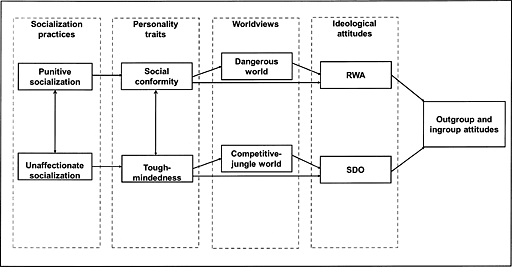
Dual–Process Motivational model (adapted from Duckitt, 2001). Note: RWA, Right–Wing Authoritarianism; SDO, Social Dominance Orientation.
Support for the whole model or particular portions has been shown in a number of studies (for reviews, see Perry, Sibley, & Duckitt, 2013; Sibley & Duckitt, 2008). The model has also been widely used to explain intergroup prejudice (e.g. Cohrs & Asbrock, 2009; Cohrs & Stelzl, 2010; Duckitt & Sibley, 2010).
Dimensions of generalized prejudice according to the Dual–Process Motivational model
According to the DPM, dimensions of generalized prejudice should be differentially predicted by RWA and SDO. Providing initial support for this reasoning, Duckitt (2006) showed that RWA impacted attitudes towards socially threatening groups, while SDO impacted attitudes towards socially subordinate groups, respectively, through the perception of threat and competitiveness. This study considered each of the groups separately, not computing scores for groups understood similarly as threatening or subordinate. As a result, the association between clusters of groups and the other variables was not examined.
Extending the initial work, Duckitt and Sibley (2007) examined the structure of generalized prejudice among university students, reporting that prejudice towards 24 typically stigmatized groups was structured into three different dimensions: Prejudice against groups perceived as dangerous (threatening but not subordinated), derogated (subordinated but not threatening), and dissident (both threatening and subordinated). Consistent with the DPM, RWA predicted prejudice against dangerous groups (e.g. ‘drug dealers’ and ‘violent criminals’), SDO predicted prejudice against derogated groups (e.g. ‘housewives’ and ‘mentally handicapped people’), and both RWA and SDO predicted prejudice against dissident groups (e.g. ‘protestors’ and ‘feminists’).
Support for the three–dimensional structure of generalized prejudice and differential prediction by RWA and SDO was further confirmed in a longitudinal student population study (Asbrock et al., 2010). The relationships between these dimensions of generalized prejudice, RWA, SDO, and personality were also supported in a subsequent study (Sibley, Harding, Perry, Asbrock, & Duckitt, 2010).
The present research
The New Zealand studies briefly reviewed earlier provide empirical support for a three–dimensional structure of generalized prejudice comprising prejudice towards groups perceived as dangerous, derogated, and dissident. These studies also provide empirical support for the proposition that prejudice towards these three clusters of groups results from different combinations of RWA–based and SDO–based motivational processes (Asbrock et al., 2010; Duckitt, 2006; Duckitt & Sibley, 2007; Sibley et al., 2010).
Studies using the DPM to investigate the role of RWA and SDO in explaining generalized prejudice towards distinct social groups have largely overlooked the influence of the other variables in the model (i.e. worldviews; Duckitt, 2001; Duckitt et al., 2002). The present studies extend previous research by examining the extent to which the particular worldviews underpinning RWA and SDO (dangerous worldview and competitive worldview, respectively) would also differentially contribute to predicting attitudes towards the three groups identified under generalized prejudice.
We are particularly interested in extending past research using the DPM to predict generalized prejudice. Specifically, we test whether the three–dimensional structure of generalized prejudice and differential prediction of RWA and SDO replicates in Brazil, a different cultural context compared with New Zealand. As well as being a fairly standard English–speaking country, New Zealand is conceived as an individualistic country, while Brazil is conceived as a collectivistic country (Gouveia & Ros, 2000; The Hofstede Centre, 2014). This means that individuals’ bonding to their ingroup, and the distinction between the ingroups and outgroups, might be stronger in Brazil than in New Zealand. Therefore, the replicability of the structure of generalized prejudice and the relationship between its dimensions and RWA and SDO should be highly accessible if generalizable (Duckitt & Sibley, 2007). As prejudice is understood fundamentally as an intergroup process, this assumption is entirely defensible (Hinton, 2000).
Although New Zealand and Brazil culturally differ in a number of aspects, we expect that the overall pattern of findings will be similar in both nations. We hypothesize that the only possible difference regarding the two countries will be the strength of the observed relationships. At the same time, the content of group stereotypes is culturally and historically bound, and it is not wise to assume that groups perceived as, say, dissident in a particular cultural context will automatically be seen as dissident in other contexts (Hilton & von Hippel, 1996). Culturally unique findings (if any) will also be explored and discussed.
As well as including target groups previously identified as dangerous, derogated, and dissident, we also incorporate additional groups stigmatized in Brazil. Consistent with the DPM, we also explore whether dangerous worldview beliefs would predict prejudice towards dangerous groups, competitive worldview beliefs would predict prejudice towards derogated groups, and both dangerous and competitive worldview beliefs would predict prejudice towards dissident groups.
Study 1 tests these issues with exploratory factor analysis and regression analysis. Although there is a theoretical model to be tested, we opted to run an exploratory factor analysis in Study 1 because the three–factor structure had not been previously tested in Brazil and we added new (Brazilian specific) items to the scale. In this sense, we wanted to first uncover the structure in the items and sample at hand, and then confirm the predetermined three–factor structure with selected items in a second sample (see, e.g., Child, 2006). Study 2 conceptually replicates the initial study with a larger Brazilian sample, employing structural equation modelling.
Study 1
Method
Participants
Participants were 171 Brazilians aged 18 years or older who completed an online survey in March 2013 (72.5% female; Mage = 33.4, SD = 10.84). The majority of the participants (52.1%) had a postgraduate degree and were living in the capital city of Brazil (53.6%) during data collection.
Measures
Besides answering socio–demographic questions and other measures not relevant to the study at hand, the participants completed the core measures described below. These core measures were presented in random order to participants. Mean scale scores for all measures were computed by averaging over items after reverse coding relevant items.
Dangerous and competitive worldviews
The measure proposed by Perry and Sibley (2010) was used to measure both worldviews by asking participants to indicate the percentage of people in the country they believe act in a specified way ‘just because they can’. The scale comprises nine items for each of the factors of dangerous worldviews (e.g. ‘Rob someone’; α = .93) and competitive worldviews (e.g. ‘Charm someone to manipulate them’; α = .90) that are answered in a scale varying from 0% to 100%. Because of a typing error, the scale only varied from 1% to 100% in this study (this error was fixed in Study 2).
Right–Wing Authoritarianism
A tri–factor structure for the RWA scale has been proposed (Duckitt & Bizumic, 2013; Duckitt, Bizumic, Krauss, & Heled, 2010). A short version of the proposed tri–factor scale (Duckitt et al., 2010) was used in the present study, including 18 items (six for each factor) rated on a 9–point scale varying from −4 (very strongly disagree) to +4 (very strongly agree). The tri–factor structure comprises RWA–Authoritarianism (e.g. ‘The facts on crime and the recent public disorders show we have to crack down harder on troublemakers, if we are going preserve law and order’; α = .83), RWA–Conservatism (e.g. ‘Our country will be great if we show respect for authority and obey our leaders’; α = .83), and RWA–Traditionalism (e.g. ‘The old–fashioned ways and old–fashioned values still show the best way to live’; α = .89). An overall RWA score was used in the present study (α = .91).
Social Dominance Orientation
A new version of the SDO scale (Ho et al., 2012) with an equal number of pro–trait and con–trait items for its two factors of SDO–Dominance (e.g. ‘Having some groups on top really benefits everybody’; α = .88) and SDO–Egalitarianism (e.g. ‘We should not push for group equality’; α = .90) was used. Each subscale has eight items rated on a 7–point scale varying from 1 (strongly disagree) to 7 (strongly agree). In Ho's et al. (2012) study these dimensions were strongly correlated (r = .76, p < .001). An overall SDO score was used in the present study.
Generalized prejudice
Prejudiced attitudes to dangerous, derogated, and dissident groups were assessed with the measure presented by Asbrock and colleagues (2010). Each dimension includes seven groups that are rated according to the participants’ sentiments from 1 (really negative) to 7 (really positive): dangerous (e.g. ‘violent criminals’; α = .77), derogated (e.g. ‘physically unattractive people’; α = .77), and dissident groups (e.g. ‘protestors’; α = .73). For ease of interpretation, participants’ scores on these items were reversed so that higher scores represented higher prejudice against the respective groups.
Three Brazilian–specific disliked groups were added to this generalized prejudice scale: ‘politicians’, ‘northeasteners’ (those from the northeast region of Brazil), and ‘environmentalists’. These disliked groups were first selected on the basis of saliency within the Brazilian society according to life experiences of the first two authors. The focus was to select unique group exemplars that would theoretically fit the originally proposed disliked groups. The selection was then independently confirmed by the third Brazilian co–author. We predicted that politicians should be perceived as a dangerous group (but not subordinated) in the Brazilian context because they are often involved or perceived to be involved in corruption schemes in the country (e.g. Fischer, Ferreira, Milfont, & Pilati, 2014). Northeasterners should be perceived as a derogated group because historically, they are identified as a subordinate group (but not dangerous) who migrate to other regions of Brazil looking for better living conditions (e.g. Gomes, 2011). Finally, environmentalists should be perceived as a dissident group (both subordinated and dangerous) as they tend to be identified as extremists seeking to change the status quo (e.g. Moreira, Araujo, & Pimentel, 2007).
Procedure
All scales were translated using the bilingual committee approach (van de Vijver & Leung, 1997). The scales were first translated from English into Brazilian–Portuguese by a bilingual referee and then validated by a second independent bilingual referee. The original and translated versions were then compared by both referees to reach a final version. Data were collected through Qualtrics online platform (www.qualtrics.com). Participants were invited to take part in the survey through online discussion groups, emails, and social media such as Facebook. Participants were also asked to send the survey link to their own contacts. The survey was completely anonymous.
Data analysis
Cases that had more than 5% of missing data were excluded from the dataset. Multiple imputation using the expectation maximization algorithm (Tabachnick & Fidell, 2013) was used to replace isolated missing data (applied in 15 cases).
Results
Three–dimensional structure of generalized prejudice
We submitted the generalized prejudice scale to exploratory factor analysis. The Kaiser–Meyer–Olkin measure (.85) was in a good range, and the Bartlett's test of sphericity was significant, χ2(276) = 2037.91, p < .001. These results support the suitability of the data for factor analysis (Field, 2009). Focusing on the main analysis, five eigenvalues greater than one emerged (6.93, 4.01, 1.85, 1.15, and 1.13), but scree plots indicated a substantial drop after the third eigenvalue. Parallel analysis on the principal components eigenvalues indicated that only the first three eigenvalues were higher than those that would be obtained from 100 replications of random data with the same number of items and sample size (1.76, 1.63, 1.54, 1.45, and 1.38). These results suggest that three factors should be extracted. Table 1 presents the factor structure forcing the extraction of three factors with principal axis factoring and oblique (direct oblimin) rotation. This factor structure explained 47.2% of the total variance. 1
Groups and factor loadings for the three dimensions of generalized prejudice in Study 1
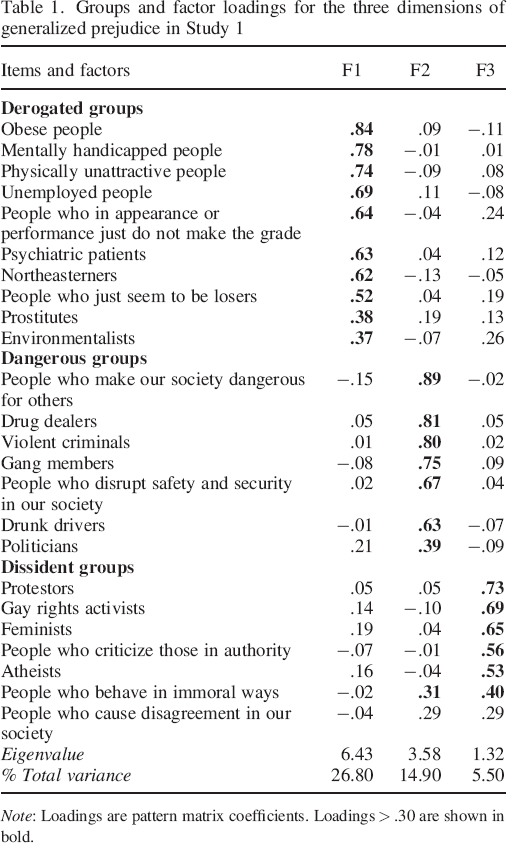
Note: Loadings are pattern matrix coefficients. Loadings > .30 are shown in bold.
As can be seen in Table 1, the overall factor structure for the generalized prejudice scale confirmed the structure obtained in New Zealand studies. Only three items did not load on the expected factors: ‘prostitutes’ and ‘environmentalists’ loaded higher on derogated groups instead of dissident groups, and ‘people who behave in immoral ways’ loaded higher on dissident groups instead of dangerous groups. Importantly, only this last item had cross–loading equal or above .30, and the cross–loading was in the predicted (dangerous groups) factor. These three items were kept on the factor they showed higher loading. Moreover, the item ‘people who cause disagreement in our society’ loaded equally and slightly under .30 in the dangerous and dissident group factors. Following the original structure of the generalized prejudice scale, this item was kept on the dissident group factor.
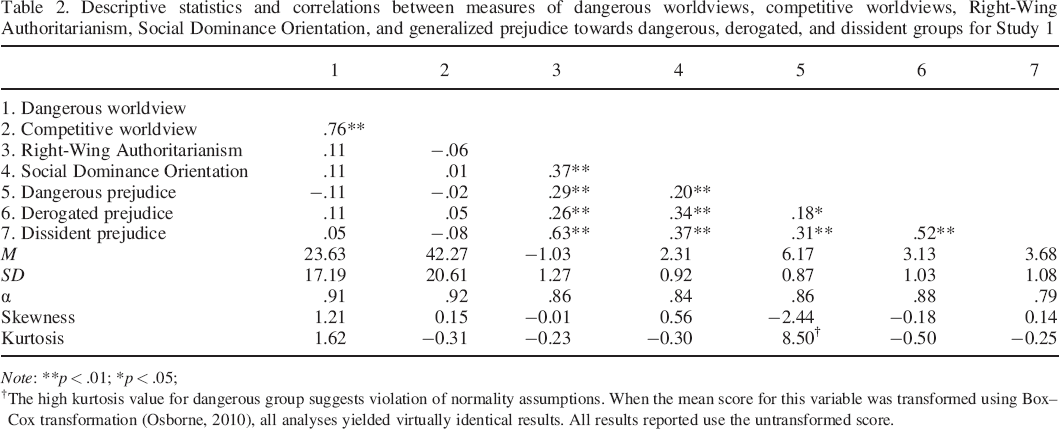
Table 2 presents descriptive statistics, reliability estimates, and correlations for the three prejudice generalized factors, dangerous and competitive worldviews, RWA, and SDO. 2 Unexpectedly, dangerous and competitive worldviews were very highly correlated (.76) and did not show statistically significant correlations to any of the other measures. These variables were thus excluded from further analyses, and this unexpected finding is discussed later.
Descriptive statistics and correlations between measures of dangerous worldviews, competitive worldviews, Right–Wing Authoritarianism, Social Dominance Orientation, and generalized prejudice towards dangerous, derogated, and dissident groups for Study 1
Note:
p < .01;
p < .05;
The high kurtosis value for dangerous group suggests violation of normality assumptions. When the mean score for this variable was transformed using Box–Cox transformation (Osborne, 2010), all analyses yielded virtually identical results. All results reported use the untransformed score.
Differential prediction of generalized prejudice dimensions by Right–Wing Authoritarianism and Social Dominance Orientation
With each of the generalized prejudice factors as the dependent measure, RWA and SDO were entered together in the regression equation using the enter method. RWA (β = .25; p = .002; R2 = .09) but not SDO (β = .11; p = .177) significantly predicted prejudice against dangerous groups, both RWA (β = .15; p = .048) and SDO (β = .28; p < .001) significantly predicted prejudice against derogated groups (R2 = .14), and both RWA (β = .57; p < .001) and SDO (β = .16; p = .013) significantly predicted dissident prejudice (R2 = .42). 3
Discussion
The present study yielded two important findings. First, and consistent with previous studies using New Zealand samples (Asbrock et al., 2010; Duckitt & Sibley, 2007), the present study supported the presence of three underlying factors on the generalized prejudice scale. All three factors were reliable as evidenced by Cronbach's α coefficient (Table 2). These findings replicate the three–factor structure of generalized prejudice in Brazil and after adding new culturally salient target groups. The second important finding of the present study refers to the differential prediction of RWA and SDO. Also, supporting previous findings (Asbrock et al., 2010; Duckitt, 2006; Duckitt & Sibley, 2007), RWA predicted prejudice against dangerous groups, SDO predicted prejudice against derogated groups, and both RWA and SDO predicted prejudice against dissident groups. Also, in line with previous findings (e.g. Altemeyer, 1998), the combination of RWA and SDO explains a large proportion of variance in dissident prejudice. Unexpectedly, RWA also predicted prejudice against derogated groups but with a smaller effect compared with SDO. Another unexpected finding was the non–significant correlations between competitive and dangerous worldviews and the other measures. In an effort to replicate and extend these findings, Study 2 used a larger Brazilian sample and structural equation modelling to test the structure of generalized prejudice and the differential prediction by RWA and SDO.
Study 2
Method
Participants
Participants were 367 Brazilians aged 18 years or older who completed an online survey in January 2014 (58.9% female; Mage = 29.7, SD = 10.80). More than two thirds of the participants had a postgraduate degree (35.5%) or a secondary degree (34.7%). The majority of the participants were living in the Brazilian states of Paraíba (47.7%) or Rio Grande do Sul (9%) during data collection.
Measures, procedure, and data analysis
The measures and procedure were the same as for Study 1, and mean scale scores for all measures were computed by averaging over items after reverse coding relevant items. Cases that had more than 5% of missing data were again excluded from the dataset, and multiple imputation using the expectation maximization algorithm replaced isolated missing data (applied in 37 cases).
Structural equation models with maximum likelihood estimation were computed in AMOS 20. Because fit indices consider different aspects of fit, we follow recommendation to report multiple fit indices (Thompson, 2000). Four indicators of model fit were considered when evaluating the models: the ratio χ2∕df (chi–square over degrees of freedom), the comparative fit index (CFI), the root mean square error of approximation (RMSEA), and the standardized root mean square residual (SRMR). Values of χ2∕df smaller than 2 indicate good fit, and values between 2 and 3 indicate acceptable fit (Bollen & Long, 1993). Models with CFI values close to .95 indicate an acceptable fit, while RMSEA and SRMR having values close to, respectively, .06 and .08 indicate an acceptable fit (Hu & Bentler, 1999). The consistent Akaike information criterion (CAIC) and the expected cross–validation index (ECVI) were used to calculate improvements over competing models, with lower values reflecting better fit (Byrne, 2010).
Results
Three–dimensional structure of generalized prejudice
To test and replicate the three–factor structure, we conducted confirmatory factor analysis. Three alternative models were tested: a one–factor model with all items loading on a single prejudice dimension (Model 1) and two three–factor models with items loading on either their predicted prejudice dimensions as in previous research (Asbrock et al., 2010) or based on findings from Study 1 (Models 2 and 3, respectively).
Preliminary analysis of the one–factor model indicated that one item (‘drunk drivers’) did not load significantly on the general prejudice factor. Even after exclusion of this non–significant item, the one–factor model showed poor fit to the data: χ2(230, N = 367) = 1717.81; χ2∕df = 7.47; CFI = .48; SRMR = .142; RMSEA = .133; 90% CI RMSEA = .127–.139; CAIC = 2035.46; ECVI = 4.94. For both three–factor models the correlation between the dangerous and derogated latent factors was non–significant. Deleting this non–significant path did not improve model fit for either model (i.e. chi–square tests yielded non–significant results). Moreover, for both three–factor models, the loading for ‘politicians’ on the dangerous groups factor was under .30 but statistically significant. This item was kept for further analyses because it is a new item created for the Brazilian reality.
An overall better model fit was observed for the three–factor model based on theory [χ2(249, N = 367) = 729.35; χ2∕df = 2.93; CFI = .84; SRMR = .088; RMSEA = .073; 90% CI RMSEA = .067–.079; CAIC = 1081.52; ECVI = 2.27] compared with the three–factor model based on the Study 1 results [χ2(249, N = 367) = 814.89; χ2∕df = 3.27; CFI = .81; SRMR = .096; RMSEA = .079; 90% CI RMSEA = .073–.085; CAIC = 1167.07; ECVI = 2.50]. Although the fit indices are below the recommended values, these results indicate that the original three–factor model provides the best overall fit to the data. 4 Based on these findings, we proceeded with the predicted three–factor structure and added new items. Figure 2 depicts the final model with standardized maximum likelihood path coefficients.
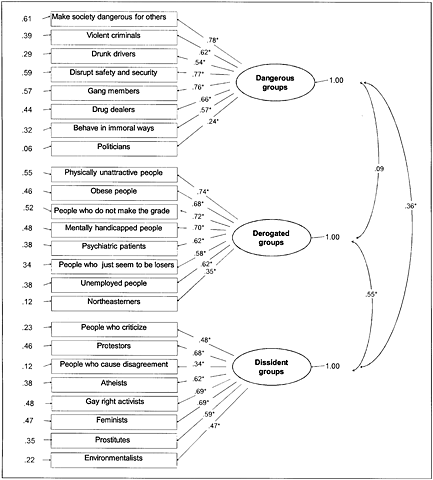
Generalized prejudice scale structure in Study 2. Note: Paths are standardized maximum likelihood coefficients from confirmatory factor analysis. Starred numbers (*) denote statistically significant paths (p < .05).
Differential prediction of generalized prejudice dimensions by Right–Wing Authoritarianism and Social Dominance Orientation
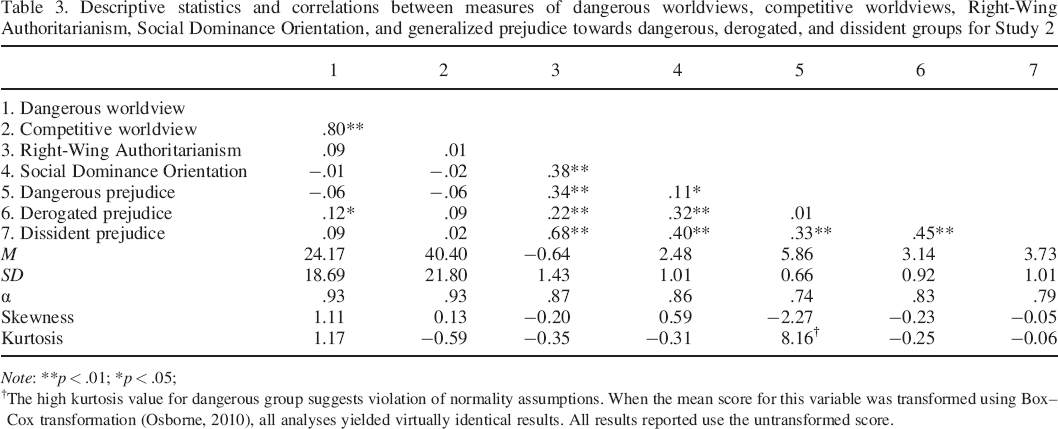
Before running structural equation models relating the dual–process model variables to the generalized prejudice dimensions, we evaluated the bivariate correlations between the variables. Table 3 presents these correlations as well as descriptive statistics and reliability of the measures. The pattern of correlations was the same as that observed in Study 1, except for a positive correlation between dangerous worldview and prejudice against derogated groups. As in Study 1, competitive and dangerous worldviews were very highly correlated (.80) and were excluded from further analyses.
Descriptive statistics and correlations between measures of dangerous worldviews, competitive worldviews, Right–Wing Authoritarianism, Social Dominance Orientation, and generalized prejudice towards dangerous, derogated, and dissident groups for Study 2
Note:
p < .01;
p < .05;
The high kurtosis value for dangerous group suggests violation of normality assumptions. When the mean score for this variable was transformed using Box–Cox transformation (Osborne, 2010), all analyses yielded virtually identical results. All results reported use the untransformed score.
Turning to the main analysis, a structural equation model was conducted to examine the differential predictions of the ideological attitudes using item parcels for both RWA and SDO with pro–trait and con–trait items within each parcel (Little, Cunningham, Shahar, & Widaman, 2002). The latent factors for RWA and SDO, respectively, had nine and eight item parcels, and each generalized prejudice latent factor included all items as observed variables. These latent variables were allowed to covary between themselves.
Replicating past research, only RWA significantly predicted prejudice towards dangerous groups, only SDO significantly predicted prejudice towards derogated groups, and both RWA and SDO significantly predicted prejudice towards dissident groups. The predictor variables explain 11% of the variance in prejudice against dangerous groups, 12% of the variance in prejudice against derogated groups, and 68% of the variance in prejudice against dissident groups. Hence, together, RWA and SDO explain a larger proportion of variance in dissident prejudice compared with the other disliked groups. The final model had moderate fit, χ2(771, N = 367) = 1820.87; χ2∕df = 2.36; CFI = .83; SRMR = .080; RMSEA = .061; 90% CI RMSEA = .057–.065. Figure 3 depicts the standardized maximum likelihood path coefficients for the impact of RWA and SDO on the different dimensions of generalized prejudice.
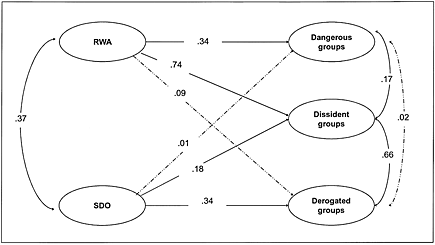
Model with ideological attitudes explaining differential prejudice against different social groups in Study 2. Note: Paths are standardized maximum likelihood coefficients from structural equation modelling. Solid arrows represent significant causal paths (p < .05). Dashed arrows represent non–significant paths (p > .05). For simplicity, manifest variables and the paths from latent to manifest variables are not shown. RWA, Right–Wing Authoritarianism; SDO, Social Dominance Orientation.
Discussion
Using confirmatory factor analysis and a larger Brazilian sample, Study 2 provided additional evidence for the presence of three factors underlying the generalized prejudice scale when considering the multiple fit indices. The present study also replicated Study 1 and previous New Zealand findings by showing that RWA and SDO differentially predict the three generalized prejudice factors. Finally, the unexpected findings observed in Study 1 for competitive and dangerous worldviews were also replicated. These predicted and unexpected findings are discussed in detail below.
General Discussion
Generalized prejudice towards outgroups appears to incorporate similar and distinct characteristics of stigmatized social groups. Drawing from their DPM, Duckitt and colleagues (Asbrock et al., 2010; Duckitt, 2006; Duckitt & Sibley, 2007; Duckitt et al., 2002; Sibley et al., 2010) have shown that typically disliked groups can be recognized as dangerous, derogated, or dissident, presenting a three–factor model for generalized prejudice. Importantly, they have shown that prejudice against these groups is differentially predicted by the ideological attitudes of RWA and SDO. RWA predicts prejudice against dangerous groups, SDO predicts prejudice against derogated groups, and both RWA and SDO predict prejudice against dissident groups. However, to date, these empirical findings have been confined to New Zealand samples. Additionally, only RWA, SDO, and personality traits have been used to predict prejudice against different types of groups under the DPM (Asbrock et al., 2010; Duckitt & Sibley, 2007; Sibley et al., 2010).
The primary goals of the present article were twofold. First, the paper was directed at uncovering whether the three–dimensional model of generalized prejudice, in which outgroups could be classified as falling into three specific categories, could be replicated in a context other than New Zealand. Second, the paper was designed to determine whether the dual–process model of prejudice, in terms of the differential prediction of these social groups by particular variables in the DPM, could be empirically confirmed.
The findings reported in this article show that the three–factor structure of disliked social groups found in New Zealand replicates in Brazil. In line with the DPM (Duckitt, 2001) and previous findings, RWA was found to predict prejudice against dangerous groups, SDO was found to predict prejudice against derogated groups in a higher extent than RWA, and both RWA and SDO predicted prejudice against dissident groups. Also, confirming Duckitt and Sibley's (2007) findings, RWA predicted prejudice against dissident groups more strongly than did SDO. Overall, our studies suggest that generalized prejudice has three dimensions explained differentially by RWA and SDO as predicted by the DPM. We discuss these findings as well as some unexpected findings in detail next.
The structure of generalized prejudice: Dangerous, dissident and derogated groups
Although three groups (‘people who behave in immoral ways’, ‘prostitutes’, and ‘environmentalists’) did not load on the predicted factors in Study 1, the overall three–factor structure of the generalized prejudice scale was supported in two different Brazilian samples. It is worth noting that the groups comprising the dissident dimension formed the last factor in our exploratory factor analysis, a finding also observed in past studies (Asbrock et al., 2010; Duckitt & Sibley, 2007). Perhaps, the dissident dimension and particular social groups included in this dimension are relatively weaker in terms of eliciting disliked judgements in comparison with dangerous and derogated groups. Future research could examine this possibility further.
The replicability of the three–factor group structure identified in the first Brazilian sample was supported overall by confirmatory factor analysis in Study 2. Alternative models were tested, and the original model proposed by Asbrock and colleagues (2010) with added Brazilian–specific items was shown to be the best fitting model. At the same time, it is important to note that model fit indices were below recommended levels. One possible explanation for the marginal fit is that the groups listed are not as salient in the Brazilian context as they are in New Zealand. We have attempted to use a combined emic–etic approach (Cheung, van de Vijver, & Leong, 2011) by adding three Brazilian–specific disliked groups in the original prejudice scale. However, future studies could advance our approach by conducting qualitative analysis to obtain a culturally specific list of outgroups that are indeed perceived as derogated, dangerous, and/or dissident in Brazil.
Results from the confirmatory factor analysis also suggest that the prejudice dimensions related to dangerous and derogated groups are not significantly correlated, and these dimensions were only weakly correlated in both studies. One might be tempted to attribute the weak correlation between dangerous and derogated groups to cross–cultural differences. However, this finding is consistent with results previously reported by Asbrock and colleagues (2010), who observed that the factors of dangerous and derogated groups were only slightly correlated in a New Zealand sample.
While the original work by Duckitt and Sibley (2007) empirically demonstrated significant and moderate–to–strong positive associations between all three dimensions of generalized prejudice, in both our findings and those of Asbrock and colleagues (2010), the dimensions of dangerous and derogated groups were only weakly or non–statistically correlated, and the dimensions of dangerous and dissident groups were only slightly to moderately correlated. In fact, only the dimensions of dissident and derogated groups were moderately–to–strongly correlated in the studies reported on the present article.
A hierarchical perspective of generalized prejudice suggests that prejudice against social groups perceived to have similar characteristics would cluster together and that first–order prejudice dimensions would all be correlated positively and load together on a single higher order generalized prejudice factor. What happens to the view of a hierarchical structure of generalized prejudice when one first–order prejudice dimension fails to be strongly related to the others? Considering that one should expect factors of an overarching construct to be related to one another and group into a general second–order factor, these more recent findings might cast doubt on the degree to which the three dimensions of prejudice considered actually represent a coherent and overarching construct that could be unquestionably labelled generalized prejudice. Further research on the structure of the generalized prejudice scale and the correlations between its hypothesized factors is needed in order to clarify whether there is a three–factor structure for generalized prejudice, whether the use of this term is warranted, and how prejudice against dangerous groups fits on this structure. In spite of Duckitt and Sibley's (2007) recognition of dangerous groups as a real intergroup threat, the relationship between this factor and the other two factors on the generalized prejudice scale should be studied more deeply (cf. Stephan & Stephan, 1999).
Distinct motivational roots of the dimensions of generalized prejudice
Perhaps more important than the correlations between the factors of generalized prejudice is whether distinct worldviews and ideological attitudes predict these factors. Supporting previous findings and predictions from the DPM (Asbrock et al., 2010; Duckitt, 2006; Duckitt & Sibley, 2007; Sibley et al., 2010), the present research confirmed that RWA predicts prejudice against dangerous groups, SDO predicts prejudice against derogated groups, and both RWA and SDO predict prejudice against dissident groups.
According to the DPM (Duckitt, 2001), RWA reflects a perception of the world as dangerous, while SDO reflects a perception of the world as competitive. This theoretical reasoning explains the pronounced prejudice of high–RWA individuals towards groups perceived as dangerous, of high–SDO individuals towards groups perceived as subordinated, and of high–RWA and high–SDO individuals towards groups perceived as both dangerous and subordinated. Together, RWA and SDO explained more of the variance in dissident prejudice compared with the other disliked groups in both studies. Similar to other findings (Duckitt & Sibley, 2007), it is RWA that exerts the stronger negative influence on dissident groups. Besides seeming to be a dimension relatively weaker in terms of eliciting disliked judgements, dissident groups might also be perceived as more dangerous than subordinated.
Besides providing cross–cultural replication of previous findings regarding the differential prediction of RWA and SDO, the present article also extended past studies by examining whether the worldviews underpinning RWA and SDO according to the DPM would also be found to be associated with the three disliked social groups. In line with the DPM, we predicted that dangerous and competitive worldviews would, respectively, mirror RWA and SDO in their correlations with outgroup attitudes. Surprisingly, correlational analysis in both studies showed that dangerous and competitive worldviews only correlated significantly and strongly with each other, and did not show any other significant associations with outgroups (but see exception in Study 2) or ideological attitudes. We believe the unexpected findings were due to the measure we used to assess these worldviews.
The correlations between dangerous and competitive worldviews in our studies were higher (.76 and .80 for Studies 1 and 2, respectively) than the ones previously observed in the literature (Perry & Sibley, 2010, r = .60; Perry et al., 2013, r = .64). One explanation for the high correlations between dangerous and competitive worldviews in our studies could be the unsuitability of the frequency estimation indices to the Brazilian context. The frequency estimation indices proposed by Perry and Sibley (2010) have also been more poorly correlated to RWA and SDO than the Duckitt et al. (2002) original measures of dangerous and competitive worldviews (see Perry et al., 2013). This result is expected as the frequency estimation measure encloses schemas about the world, while the original measures are similar to RWA and SDO in measuring beliefs about the world. Because the prediction of prejudice by variables included in the DPM has been highly documented (Duckitt et al., 2002; Sibley & Duckitt, 2008), the lack of associations between the measures of dangerous and competitive worldviews with other DPM variables in our studies needs to be assessed in further research.
Limitations and directions for future research
Before concluding, it is important to note some limitations of the studies. As mentioned before, the measure used to evaluate dangerous and competitive worldviews in the two studies is probably not the most adequate to examine the relationship between worldviews and other variables in the DPM (Perry et al., 2013). Another limitation is the size and composition of our samples. The sample used in Study 1 was small and not balanced for gender, educational level, and Brazilian state in which the participants lived, and the sample used in Study 2 was not balanced for Brazilian state in which the participants lived. As a result, we cannot generalize the results across the entire Brazilian population. At the same time, the present research expands previous New Zealand studies that have only considered university students. Considering the context–specific groups, a preliminary qualitative study would have been a preferred method for identifying potentially relevant targets for inclusion in the Brazilian context. Additionally, data were not collected in New Zealand in the same period. This would probably grant the results obtained in Brazil, and only studied until now in New Zealand, more reliability. Despite these limitations, the present study advances previous research by testing the three–factor structure of generalized prejudice in a context other than New Zealand and by testing the differential prediction of the generalized prejudice dimensions by RWA and SDO.
Future studies should further examine whether the distinct RWA and SDO dimensions also differentially predict other social groups, or aim to identify the core dimensions underlying the overall RWA and SDO predictions. Tests of the full dual–process model in other cultural contexts also seem needed. Such work would provide additional knowledge and validation of the mechanisms underlying the development of RWA and SDO, as well as help to elucidate the role of these two ideological attitudes in predicting dimensions of generalized prejudice. We also believe that future research should further explore the pervasiveness of the three–dimensional structure of generalized prejudice in order to evaluate whether the weak relationship between the prejudice dimensions related to dangerous and derogated groups is specific to the Brazilian context (but also see Asbrock et al., 2010). These studies should evaluate how prejudice against dangerous groups relates to prejudice against derogated and dissident groups.
Future studies should also focus on the prediction of prejudice towards groups not perceived as dangerous, derogated, or dissident by the DPM. Maybe prejudice against these groups is only a facet of generalized prejudice. Can all prejudiced groups in a given society be perceived in a minor or major extent as dangerous, derogated, or dissident? Does prejudice exist without threat to the ingroup and/or competitiveness with the ingroup? These are important theoretical questions to be addressed that would clarify the structure and content of generalized prejudice.
Finally, studies have been acknowledging the role of other variables besides RWA and SDO in explaining generalized prejudice. For instance, empathy and general propensity to believe in conspiracy theories have been found to explain additional variance in individuals’ prejudices or negativity to outgroups (Imhoff & Bruder, 2014; McFarland, 2010; Sidanius et al., 2013). More studies investigating the role of other variables not included in the DPM in the prediction of generalized prejudice are also desirable.
Conclusion
In conclusion, the present article provides empirical support for the replicability and generalizability of the three–dimensional structure of generalized prejudice and for the differential explanation of prejudice against different groups by RWA and SDO in a context other than New Zealand. Further studies addressing these primary research questions as well as the additional theoretical and empirical questions outlined are needed.
Footnotes
Acknowledgements
This research was partially supported by a Victoria Doctoral Scholarship awarded to Clara Cantal. Preparation of this manuscript was partially supported by a Marsden Fast Start grant from The Royal Society of New Zealand (Te Putea Rangahau a Marsden) awarded to Taciano L. Milfont. Clara Cantal and Taciano L. Milfont contributed equally to the writing of this article. We thank Samantha Watson for editing comments on a draft version of the manuscript.