







Abstract
In a sample of 7– to 8–year–old children (N = 760), we examined the associations between personality traits, oral fluency and sociometric popularity. Extending upon research conducted with older populations, we found parent ratings of extraversion at age 7 to predict popularity one year later. More importantly, we expected and found teacher–rated oral fluency to partially mediate the positive association between extraversion and popularity. This mediation effect was independent of psychometrically assessed working memory, academic skills and gender. Our results can be interpreted as suggesting that a Matthew effect, similar to the one proposed for early reading skills and cognitive ability, may be operating in the domain of social competence. Copyright © 2015 European Association of Personality Psychology
Keywords
Introduction
Why are some children popular and others unpopular? In recent years, the evidence has accumulated that a certain personality disposition, that is, extraversion, is associated with being popular. However, the explanation that certain kids are popular because they are extraverted begs the questions of why those who are extraverted are more popular. The focus of the present research is on the mechanisms through which children's personality may influence their popularity. In adulthood, behavioural manifestations of extraversion, such as strength of voice, have been associated with positive first impressions (Back, Schmukle, & Egloff, 2011), which could in part help explain the association between extraversion and popularity. However, other mechanisms may be at play in childhood, especially in contexts such as in the classroom, in which first impressions are likely to be less important than in many other contexts—whereas first impressions may in some context determine whom people approach, sit next to or engage in conversation with, thereby determining opportunities to learn to know people, children attending the same class will over time learn to know all of their classmates. We will investigate, in a sample of 7– to 8–year–olds, the following: (i) whether extraversion, already at the beginning of middle childhood, is associated with popularity; and (ii) whether the predicted association between extraversion and popularity can be explained by the greater oral fluency of extraverts.
Popularity
In general terms, popularity is characteristic of an individual that reflects whether the individual is generally liked, accepted and preferred as an interaction partner. It is a form of social status that is unilateral (as opposed to reciprocated social relation between two individuals); it reflects how others perceive the individual and how much they like the individual (Bukowski, Pizzamiglio, Newcomb, & Hoza, 1996). Although popularity is derived from the group, it is inevitably influenced by the behaviours and characteristics of the individual.
Popularity as a concept reflective of peer status is commonly studied in one of two somewhat distinct forms. The focus of the present study is on ‘sociometric popularity’ (later also referred to as ‘popularity’), which is distinguished from ‘perceived popularity’ (Parkhurst & Hopmeyer, 1998). Sociometric popularity is measured by items such as ‘this person is likeable’ or ‘I like to play/work with this person’, and perceived popularity by items such as ‘how popular is this person?’ (Cillessen & Mayeux, 2004). Sociometric popularity is weighted towards likeability and preference, whereas perceived popularity is more a reflection of visibility and social centrality (Parkhurst & Hopmeyer, 1998). Although the different types of popularity are interrelated, they also have distinct predictors, correlates and outcomes (Cillessen & Rose, 2005; Mayeux, Houser, & Dyches, 2011; Rodkin, Ryan, Jamison, & Wilson, 2012). It should be noted, however, that the younger the studied age group, the more the two forms of popularity overlap (Cillessen & Mayeux, 2004; Rodkin et al., 2012). Whereas 10– and 13–year–old children's descriptions of ‘popular children’ (perceived popularity) included mentions of physical appearance, self–presentation, studentship and peer affiliations, 7–year–old children described popular children as follows: (i) those who are liked by others; (ii) those who behave pro–socially; (iii) those who are less overtly aggressive; and (iv) those who are preferred playmates (Xie, Li, Boucher, Hutchins, & Cairns, 2006). The popularity measure that we derived from peer nominations by 7– to 8–year–olds, who were asked to report on whom they enjoyed spending time with, is thus likely to reflect both the extent to which the child is liked and preferred and the extent to which the child is central and visible.
Children 7–8 years old are entering middle childhood. At this age, in between weaning and sexual maturity, peer relations and peer respect are of paramount importance among social primates (Del Giudice, Angeleri, & Manera, 2009). The evolutionary purpose of this period can be derived from differences in its relative length in various primates. In essence, across various species of primates, the length of this period is associated with the complexity of social networks and the size of the brain area essential for social problem solving (the longer the period of juvenility, the larger the social networks and the non–visual neocortex: Joffe, 1997). For highly social primates, such as humans, who have to learn language, communication skills and social hierarchies, in order to be able to survive (and later reproduce) within a social context (Joffe, 1997; Locke & Bogin, 2006), a long middle childhood is necessary.
Several developmental processes occurring in middle childhood support the idea that peer relations are of particular importance in this age period. Whereas friendships before the age of 7 have focused on playmate activities and gaining pleasure from games, group acceptance has been argued to be the most important function of friendship in the following years (Parker & Gottman, 1989). Indeed, as cognitive advances allow for the construction of more complex self–representations (Harter, 1998), based, for instance, on newly acquired perspective–taking skills and social comparison processes (e.g. Eccles, 1999; Ruble, Boggiano, Feldman, & Loebl, 1980; Wigfield et al., 1997), peer relations become increasingly important determinants of self–worth (e.g. Cole, Jacquez, & Maschman, 2001; Hart & Damon, 1986). Also supporting the notion that one's relationships to others, particularly peers and friends, become more important at this age is that the trait labels applied to the self become increasingly interpersonal (Rosenberg, 1979). In sum, gaining the liking, preference and respect of one's peers is likely to constitute one of the primary developmental goals of middle childhood. Difficulties at this task could, as we will argue later, have enduring consequences throughout the life course.
Personality and popularity
The present research was conducted within the framework provided by the Big Five model of personality structure. There is, to our knowledge, no research on the associations between popularity and Big Five personality traits in a sample as young as ours. However, among adolescents and young adults, the associations between personality traits and popularity (any of the forms of popularity presented earlier) have been studied to substantial extent. Of the Big Five trait dimensions, extraversion is by far the trait most often associated with popularity among adolescents (Ciarrochi & Heaven, 2009; Jensen–Campbell et al., 2002; Jensen–Campbell & Malcolm, 2007; Lubbers, Van Der Werf, Kuyper, & Offringa, 2006; Scholte, Van Aken, & Van Lieshout, 1997; van der Linden, Scholte, Cillessen, Nijenhuis, & Segers, 2010) and young adults (Anderson, John, Keltner, & Kring, 2001; Asendorpf & Wilpers, 1998; Stopfer, Egloff, Nestler, & Back, 2013; Wortman & Wood, 2011). In fact, there seems to be only one study in which a non–significant association between extraversion and popularity has been reported (Selfhout et al., 2010). Agreeableness has also, although less frequently, been associated with popularity in adolescence (Jensen–Campbell et al., 2002; Scholte et al., 1997) and young adulthood (Selfhout et al., 2010). There are mixed results for conscientiousness among adolescents; one study reports a positive association (Jensen–Campbell & Malcolm, 2007), and another study a negative association (van der Linden et al., 2010). Some negative associations between openness to experience and popularity in adolescence have been reported, but mostly for reciprocal friendship measures, not for unilateral popularity (Jensen–Campbell et al., 2002; Jensen–Campbell & Malcolm, 2007; Scholte et al., 1997). In addition, one study has reported a negative association between neuroticism and popularity in early adulthood (Anderson et al., 2001).
Popularity could also be reflected in the size of one's social networks. Extraversion is the only personality trait associated with number of friends in online social networks (e.g. Facebook; Lönnqvist & Itkonen, 2014; Stopfer et al., 2014). Although online social network samples include the whole adult population, they tend to be skewed towards young adults. These results thus provide additional support for the extraversion–popularity link among young adults. Also, studies on the size of offline peer networks have indicated that extraversion is the most relevant trait in this domain (Kalish & Robins, 2006; Pollet, Roberts, & Dunbar, 2011; Roberts, Wilson, Fedurek, & Dunbar, 2008; Russell, Booth, Reed, & Laughlin, 1997). Regarding other traits, one study has reported a negative association between neuroticism and social network size (Kalish & Robins, 2006). In sum, the literature on adults and adolescents suggests that extraversion is by far the most relevant Big Five personality trait in determining popularity. The present study aims to extend this literature by studying these associations at an earlier stage of development, that is, middle childhood.
Although the social consequences of extraversion per se have not been studied in a sample as young as ours, extraversion, like the other Big Five factors, has enormous bandwidth, and there are several characteristics associated with extraversion that have been studied in the developmental psychology literature. For instance, positive mood, positive anticipation, approach motivation, desire for sensation seeking, unrestraint, impulsiveness, activity level, dominance, leadership, warmth and assertiveness, all of which have been argued to be constituents of extraversion, have been investigated in children. Given our interest in social behaviour, we focus our illustrative review of this literature on shyness. Shyness has been argued to be an important determinant of childhood peer relations (Rubin & Mills, 1988) and is considered one of the most prototypical characteristics of extraverts—for example, over 90% of expert judges suggested shyness captures the most central content of extraversion (John, 1990), or to take another example, across 12 data sets comprising both self–ratings and peer ratings, shyness, with a loading of −.79, was the item that most strongly defined the extraversion factor (Saucier, 1994).
Although intuitively many attributes associated with popularity, such as assertiveness, sociability and good communication skills, could seem incompatible with shyness, the empirical evidence on the associations between childhood shyness and popularity is at best mixed. Studies directly investigating the associations between shyness and popularity are very rare—only a handful of studies directly address this issue, and these studies have suffered from methodological limitations. For instance, Booth–LaForce and Oxford (2008), who documented a negative association between teacher ratings of shyness and teacher ratings of sociometric status, noted that although a measure of peer sociometric data would be ideal for research designs such as theirs, teacher ratings of children's social relationships were the current norm (e.g. Ladd, 2006; Ladd & Burgess, 1999; Gazelle & Ladd, 2003; Gazelle & Rudolph, 2004). Very recently, Eggum–Wilkens, Valiente, Swanson, and Lemery–Chalfant (2014), who reported on a negative association between parent ratings of shyness and teacher ratings of popularity, noted that ‘a worthwhile next step to document this relation involves utilizing peer–reported (e.g., sociometric nominations) impressions of children's real–time social tendencies and popularity’ (Eggum–Wilkens et al., 2014, p. 91). The literature on shyness and popularity thus suggests that they may be negatively associated in middle childhood, but empirical evidence employing peer ratings of sociometric status is lacking. Furthermore, the one study that we could find that did utilize peer ratings of popularity found that shyness was unrelated to popularity (Bowen, Vitaro, Kerr, & Pelletier, 1995). Despite this, from the impressive amount of research conducted with older participants, in which an association between extraversion and popularity has been documented, we expected extraversion to be associated with popularity.
Oral fluency as a mediator
In his Annual Review of Psychology article published at the turn of the century, Funder (2001) called for more research connecting personality with actual real–life social behaviours. Five years later, Ozer and Benet–Martinez (2006), in the same journal, reviewed the evidence that had by then accumulated on the predictive power of personality on real–life outcomes, most of which were social by their nature. Most recently, Hampson (2012), in her Annual Review of Psychology article on the same topic, argued that the next goal of personality research should be to focus on the processes underlying the observed associations between personality traits and real–life outcomes (for a similar emphasis on the need to understand the processes through which personality is expressed, see, for instance, the PERSOC framework, Back et al., 2011; or the CAPS model, Mischel & Shoda, 2008). Hampson (2012) argued that the discovery of such processes should not only help us improve our theoretical models of personality but also help identify opportunities for intervention. The study of processes typically invokes mediation; a mediator is a trait–related action that is thought to bring about a change in an outcome (Rusting, 1998). In the present context, establishing a mechanism through which extraversion influences popularity entails examining mediating behaviours that (i) are manifestations of extraversion; (ii) influence peer regard; and (iii) are observable or accessible to others. In the following, we argue that enhanced speech production, or oral fluency, could in middle childhood be such a mediator variable.
One manifestation of extraversion in social behaviour is talkativeness (Mehl, Gosling, & Pennebaker, 2006). But not only the quantity of speech that extraverts produce but also its quality differentiates extraverts from introverts—research conducted within the zero–acquaintance personality perception framework shows that merely listening to a stranger allows for accurate judgments of his or her level of extraversion (Borkenau & Liebler, 1992; Hunt & Lin, 1967; Scherer, 1978). More recently, the content of speech and strength of voice have, within the zero–acquaintance framework, been shown to differentiate extraverts from introverts—these features were associated with more positive ratings by strangers (Back et al., 2011). Corroborating these findings, further research has revealed that extraversion and three of its facets (sociability, activity and tendency to experience positive emotions) are associated with psychometrically assessed verbal fluency (Sutin et al., 2011). Extraverts have also been reported to have a more implicit speech style, have a higher speech rate and show less hesitation, especially under more stressful situations (Dewaele & Furnham, 1999, 2000). From the preceding discussion, we expected extraversion to be associated with oral fluency.
For oral fluency to mediate the association between extraversion and popularity, oral fluency needs to be associated with popularity. Although studies on adolescents have established that expressive language skills are associated with friendship quality (Botting & Conti–Ramsden, 2008; Durkin & Conti–Ramsden, 2007), there are rather few studies on individual differences in oral fluency and various social behaviours and outcomes in middle childhood. However, one study, conducted with a sample of 5–year–old boys, suggested that verbal abilities already predict peer popularity in this age group (Braza et al., 2009). Further supporting the idea that verbal abilities matter already at this age, observation of preschool children has revealed that disliked children are less able to contribute to coherent conversation (Black & Hazen, 1990). On a related note, disfluent children have been observed to be less able to communicate in social problem–solving situations and are therefore less able to maintain or reconcile peer relations (Horowitz, Jansson, Ljungberg, & Hedenbro, 2006). Experimental studies on children's perceptions of stuttering peers, adults and puppets have also supported the view that oral fluency is an important determinant of peer popularity. For instance, when rating videos of the same child either stuttering or not stuttering, the same child was rated as less likely to fit in and less likely to make friends when raters based their ratings on the video in which the child was stuttering (Evans, Healey, Kawai, & Rowland, 2008). Similar results have been found among children who rated videos of an adult: the more the adult stuttered, the more negatively the children rated the adult (Franck, Jackson, Pimentel, & Greenwood, 2003). Already preschool children rate disfluent puppets more negatively than they rate fluent puppets (Ezrati–Vinacour, Platzky, & Yairi, 2001).
Oral fluency is likely to be particularly strongly associated with popularity in middle childhood, an age period in which both peer relations (Del Giudice et al., 2009) and spoken language develop rapidly (e.g. Hoit, Hixon, Watson, & Morgan, 1990), suggesting that there will be ample individual differences in these characteristics. On the basis of the findings described earlier, we expected oral fluency to be associated with popularity. More importantly, we expected oral fluency to mediate the association between extraversion and popularity.
The role of working memory and gender
The fluent speech production of extraverts may, at least partially, be a product of better working memory functionality (Lieberman, 2000; Pearman, 2009). This line of thought builds on the idea that under more formal interpersonal conditions, introverts become over–aroused (Eysenck, 1974; Gray & Braver, 2002) and also on the notion that working memory is associated with verbal fluency (Rosen & Engle, 1997). Matthews, Deary, and Whiteman (2003) have proposed that the better working memory of extraverts may lead to better conversational skills, and consequently to more successful behaviour in social environments. By contrast, it could be that introverts are less able to maintain fluency of speech in formal or stressful situations that require parallel processing of multiple stimuli (Dewaele & Furnham, 2000). In more informal and less complex conditions, the association between extraversion and fluency is not as frequently reported, perhaps because there are less processes dividing attention and causing arousal (Dewaele & Furnham, 2000). In short, extraverts may have an advantage in speech production because of better working memory (Matthews et al., 2003).
On the basis of the preceding discussion, the association between extraversion and oral fluency could, to some degree, be caused by individual differences in working memory capacity. The association between extraversion and oral fluency would, if this were the case, be expected to be rendered insignificant when the influence of working memory is controlled for. An alternative possibility is that the enhanced oral fluency of extraverts is not only based on working memory processes but also on their approach–oriented and attention–attracting behavioural tendencies (Ashton, Lee, & Paunonen, 2002; Gomez, Holmberg, Bounds, Fullarton, & Gomez, 1999) that direct them towards more experiences in interpersonal communication. That is, because interpersonal engagement and social relations are more important for extraverts than for introverts, extraverts are likely to spend more time communicating with other people (see also Wilson, Harris, & Vazire, 2015), thereby becoming more orally fluent. This would give them advantages in forming relations with peers and gaining popularity. Working memory was included in the present analyses in order to investigate whether the expected association between extraversion and oral fluency is independent of working memory.
Research focusing on the peer processes of children has revealed the existence of gender differences in several domains (for a review, see Rose & Rudolph, 2006). More specifically, there are several studies suggesting that the associations between constructs associated with extraversion (e.g. shyness) and popularity are stronger for boys (e.g. Coplan, Prakash, O'Neil, & Armer, 2004). Also, the link between verbal abilities and popularity may be stronger among boys (Braza et al., 2009). We therefore examined the possible moderating role of gender.
Purpose of the present research
The present research aimed to contribute to the growing literature on personality and social relations in several ways. We first investigated whether 7– to 8–year–olds already showed an association between extraversion and popularity (we also investigated associations between other Big Five personality traits and popularity). Several of the currently most important frameworks within personality research, for instance, the PERSOC framework presented by Back et al. (2011) and the neo–socioanalytic model presented by B. Roberts and Wood (2006), suggest not only that social interaction processes are influenced by personality dispositions but also that these processes influence the development of dispositions. This is particularly likely to be true in childhood (there is general agreement that the stability of personality more or less linearly increases from childhood to adulthood; e.g. a meta–analysis by B. Roberts and DelVecchio, 2000, suggested that the rank–order stability of personality traits in middle childhood was .43, whereas in older age groups, it was as high as .74). Prior research on how extraversion is behaviourally manifested and the social consequences it may have has been conducted with adult and adolescent samples. Extending this research into middle childhood—an age period in which the acquisition of social skills and social competence is of paramount importance—could shed light on the life course development of extraversion. For more exploratory purposes, relations between other personality traits and popularity were also investigated.
Knowledge about mediating mechanisms, such as social behaviours, is essential if we are to understand the associations between personality and social outcomes (Back et al., 2011). Moreover, such knowledge will identify opportunities for intervention (Hampson, 2012). Such interventions may be directed at changing the level or rate of growth of traits, or they may be directed at the processes through which traits are manifested in behaviour. In the present research, we expected oral fluency to mediate the associations between extraversion and popularity. From an applied perspective, focusing on oral fluency from the age at which children enter the school system may be particularly important as oral fluency may be a cumulative advantage that produces inequality throughout the school years (Baumert, Nagy, & Lehmann, 2012; DiPrete & Eirich, 2006). Cumulative advantages are various phenomena wherein initial levels of an attribute influence change rates of that same attribute subsequently (DiPrete & Eirich, 2006). In the context of the current study, higher initial oral fluency could lead to faster gains in social skills later on—orally fluent children will engage in social conversations more often, which will contribute to their popularity, possibly even their levels of extraversion (Back et al., 2011; Hampson, 2012; B. Roberts & Wood, 2006), which in turn will open up more opportunities for improving oral fluency as well as learning other social skills (Baumert et al., 2012). In fact, Black and Hazen (1990, p. 386) have proposed a similar pattern of reciprocated causality between communication and social status: ‘…it seems very likely that although only certain types of communication patterns may contribute to the original establishment of social status, once a particular social reputation is established, the relation of communication skills and social status becomes cyclic (i.e., low peer status leads to inadequate peer communication, which leads to low peer status, and so on)’. Thus, the gap in social skills between orally fluent and less fluent children may widen throughout middle childhood. A similar phenomenon, known as the Matthew effect, has previously been proposed for early reading abilities (Stanovich, 1986), which have been suggested to bring a cumulative advantage in learning throughout the school years.
As argued earlier, working memory could be involved in the association between extraversion and oral fluency. We will investigate this possibility, as well as possible gender differences. As a final note, the ratings of oral fluency were obtained from the participants’ teachers. In order to rule out alternative interpretations of the links between extraversion, oral fluency and popularity, we also investigated teachers’ ratings of proficiency in other academic domains (skills in writing, reading and mathematics). This enabled us to control for potential general desirability effects in teacher ratings, thereby allowing us concentrate on the unique effects of oral fluency.
Methods
Participants and procedure
Our sample included 760 children from 38 school classes selected to be representative of the Helsinki (Finland) area (Lönnqvist, Verkasalo, & Vainikainen, 2011). These 760 children all took part in the sociometer procedure. Parent ratings of personality were available for 595 children, teacher ratings of academic skills were available for 550 children and a working memory score was available for 699 children. The personality of the children was assessed at age 7, around half a year after school had started. More or less simultaneously, teacher assessments of oral fluency and academic skills were collected. One year later, when the children were 8 years old, they completed a sociometer during class.
Measures
Personality
For the assessment of personality, parents rated the children on 27 personality descriptive items (Table 1 in Lönnqvist et al., 2011) on a scale from 1 to 7. 1 These items were used to assess extraversion, openness to experience, conscientiousness, emotional stability, pro–sociality and antagonism (the Big Five agreeableness split into two separate factors). In order to utilize as much of the variance as possible, we used factor scores rather than mean or sum scores. The two highest loading items on extraversion—the factor that we focus most on—were ‘She is good at asserting herself’ and ‘She states her opinions even when others disagree’. Descriptive statistics and inter–correlations for all our measures are presented in Table 1.
Descriptive statistics and inter–correlations (pairwise) between variables
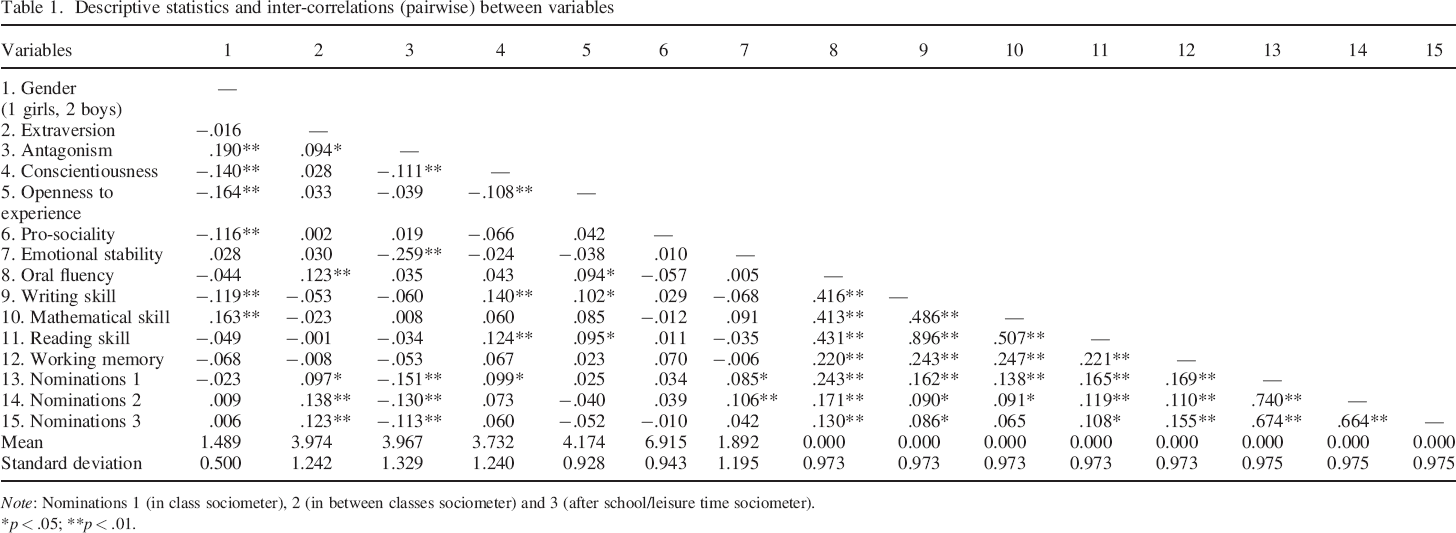
Note: Nominations 1 (in class sociometer), 2 (in between classes sociometer) and 3 (after school/leisure time sociometer).
p < .05;
p < .01.
Oral fluency, writing, reading and mathematical skills
Teachers assessed the children's oral fluency, as well as their writing, reading and mathematical skills. Teachers were instructed to ‘assess the pupil's current skill levels in the following domains’, which were then listed as ‘oral fluency’, ‘writing’, ‘reading’ and ‘mathematical skill’. Each domain was assessed on a scale from 1 (the pupil has obvious difficulties) to 7 (the pupil is clearly above the developmental norm). Writing, reading and mathematical skills defined the academic skills variable that we employed (as discussed later). 2
Popularity
Popularity was assessed using a sociometer—in each class, children indicated who they preferred to work and play with. The nomination sheet was administered during class. Children provided nominations by answering three questions: ‘With whom of your classmates do you prefer to… 1. Work in class? 2. Spend time with between classes? 3. Spend time with after school/spend leisure time with?’ Nominations were limited to five per question, and popularity was computed as the sum of the received nominations. Children were allowed to nominate the same peer across different questions. 3
Working memory
Working memory was assessed using a count task that focused on short–term auditory memory. 4 In this task (referred to as the count task by Lönnqvist et al., 2012), the teacher tapped his or her desk with a pencil, knuckle or palm, and the subjects had to write down how many knocks they heard. Counting and retrieving running totals involve working memory in the continuous registering of knocks and the retrieving of totals from the phonological store (Logie & Baddeley, 1987). Participants were presented with 30 series of one to five taps in total. Each series was coded on a pass–fail basis (0 or 1), so the scores ranged from 0 to 30. The distribution was strongly skewed to the left, so a rescaled version, with scores ranging from 0 to 6, was used (similar to Lönnqvist et al., 2012).
Statistical analyses
Associations between variables were investigated with path analyses in structural equation modelling. To deal with missing values on some of the measures, full information maximum likelihood estimation was used. This method, as compared with other methods such as listwise deletion, pairwise deletion or imputation, has less restrictive assumptions regarding the pattern of missing values and provides more efficient and unbiased parameter estimates (Enders & Bandalos, 2001). All analyses were run in R v. 3.0.2 (The R Foundation for Statistical Computing, Vienna, Austria, http://www.r–project.org) using the R package Lavaan (Rosseel, 2012). Popularity was constructed as a latent variable on which the three nomination variables loaded. Also, academic skills, on which writing, reading and mathematical skills were set to load, were constructed as a latent variable. 5 Personality traits, oral fluency and working memory were observed variables. All but parent ratings of personality were standardized within class to control for teachers’ rating bias and manner of test administration.
Results
We investigated whether parent ratings of personality traits, especially extraversion, were associated with the following: (i) popularity and (ii) oral fluency. To do this, a model was constructed in which paths from all six traits (extraversion, antagonism, openness to experience, conscientiousness, pro–sociality and emotional stability) to popularity and to oral fluency were simultaneously estimated (Figure 1). In a similar fashion, paths from personality traits to academic skills were simultaneously estimated. In addition, to examine whether, as we expected, oral fluency would predict popularity, this path was estimated in the same model, as well as a path from academic skills to popularity (the latter path was estimated in order to ensure that it was not the general desirability of the teacher ratings—reflected by academic skills—that was doing the explanatory work). Finally, working memory was included in the model as a control variable. Paths from working memory were estimated for oral fluency, popularity and academic skills. Associations between personality traits and working memory were left out of the model because of non–significant zero–order correlations (all zero–order correlations between variables are shown in Table 1). Also, the path from working memory to extraversion was non–significant, and as it also did not affect other paths, it was left out of the final model. The fit of the model was acceptable (χ2 = 96.972, df = 40, p < .05; comparative fit index (CFI) = 0.977, Tucker–Lewis index (TLI) = 0.960, root mean square error of approximation (RMSEA) = 0.043, standardized root mean square residual (SRMR) = 0.026). All of the indicator variables of popularity loaded statistically significantly on the latent factor (standardized loadings: .788–.872). In addition, the indicator variables of academic skills all had statistically significant loadings (.532 for mathematics, .941 for writing and .952 for reading). Path coefficients for the model are presented in Table 2 and in Figure 2. The paths from extraversion (β = .141, z = 3.273, p < .01) and antagonism (β = −.153, z = −3.436, p < .01) to popularity were significant, as were the paths from extraversion (β = .125, z = 3.125, p < .01), pro–sociality (β = −.085, z = 2.092, p < .05) and academic skills (β = .436, z = 10.566, p < .001) to oral fluency. Working memory was significantly associated with all dependent variables in the model.
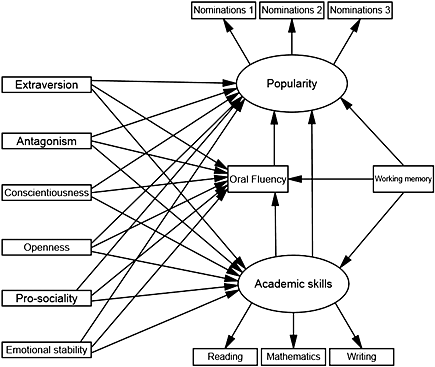
Structural path model used for examining the associations between parent ratings of personality traits, teacher ratings of oral fluency and popularity based on sociometric peer nominations. The model controls for general academic skills and working memory.
Standardized path coefficients and indirect effects from structural equation with parent ratings of personality
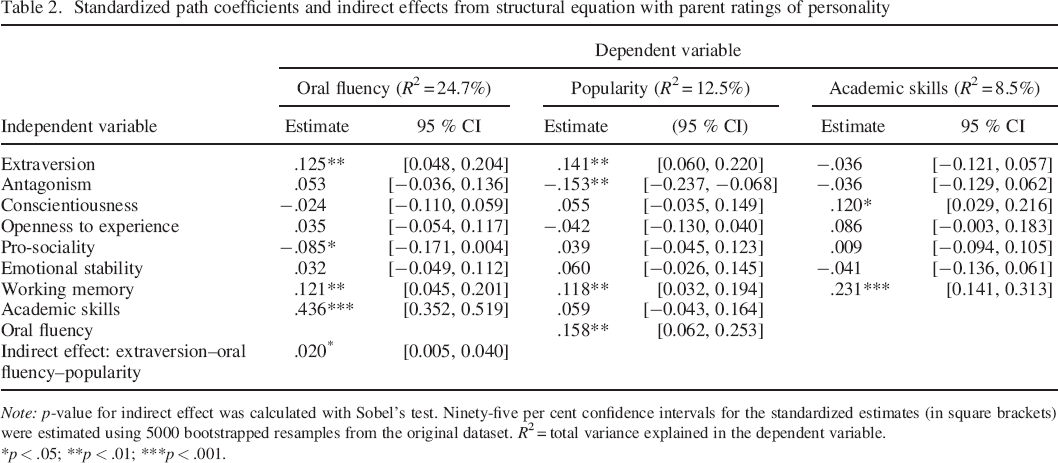
Note: p–value for indirect effect was calculated with Sobel's test. Ninety–five per cent confidence intervals for the standardized estimates (in square brackets) were estimated using 5000 bootstrapped resamples from the original dataset. R2 = total variance explained in the dependent variable.
p < .05;
p < .01;
p < .001.
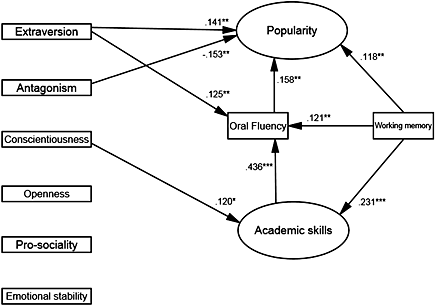
Standardized estimates for structural path model. Only statistically significant (based on both z–test and bootstrapped 95% confidence intervals) are depicted in the figure.
Extraversion was the only personality trait associated with both popularity and oral fluency. Besides the personality traits mentioned earlier, also fluency oral explained unique variance in popularity (β = .158, z = 3.106, p < .01). However, the path from academic skills to popularity was non–significant. Of the personality traits, conscientiousness was significantly associated with academic skill (β = .120, z = 2.532, p < .05). The previous results show that extraversion was associated with popularity and with oral fluency. Furthermore, extraversion was only associated with teacher ratings of oral fluency, not with teacher ratings of more general academic skills, ruling out the possibility that the association between extraversion and oral fluency would merely be an artefact of teachers evaluating extraverts more positively. Furthermore, the results show that the other teacher–rated skills were not associated with popularity. Therefore, only oral fluency could serve as a mediator between personality and popularity. The results also show that the association between extraversion and oral fluency was not affected by working memory.
The results described earlier allowed us, in our examination of possible mediator variables, to focus exclusively on oral fluency as a potential mediator variable between extraversion and popularity. Using the same structural path model, the indirect effect combining the paths (i) from extraversion to oral fluency and (ii) from oral fluency to popularity was tested with a Sobel z–test. Sobel's test indicated that the indirect effect of extraversion on popularity through oral fluency was significant (standardized estimate: .020, z = 2.265, p < .05). Furthermore, because the sampling distribution of Sobel's z is skewed, we further tested the mediation effect by constructing a population distribution for the indirect effect by drawing 5000 resamples from the original data (Preacher & Hayes, 2008). This allowed us to calculate a bootstrapped confidence interval (CI) for the mediation estimate as well as for the other paths estimated earlier (MacKinnon & Fairchild, 2009). The bootstrapped CIs are presented in Table 2. These generally supported the preceding analyses (for the extraversion–oral fluency–popularity mediation, the 95% CI was [0.005, 0.040]). The only path coefficient that was statistically significant in the preceding analyses, but which according to the bootstrapping method included zero in its CI, was the path from pro–sociality to oral fluency (95% CI [−0.171, 0.004]). From these results, we conclude that the influence of extraversion on popularity is partially mediated through oral fluency. 6
We finally conducted moderated mediation tests to examine if gender moderated the indirect effect of extraversion on popularity through oral fluency. The indirect effects were, in the same structural equation, estimated separately for girls (N = 384) and boys (N = 368), and the difference between these estimates was statistically tested in order to investigate whether it deviated from zero. Additionally, a sample distribution for gender difference was drawn by resampling the data 5000 times using the bootstrapping method, and from this distribution, a 95% CI for the difference was calculated. Both the test for differences in the estimates (difference = −0.008, z = 0.450, p = .653) and the CI (95% CI [−0.045, 0.029]) indicated that gender did not moderate the indirect association between extraversion and popularity through oral fluency.
Discussion
On the basis of previously reported links between (i) extraversion and popularity, (ii) extraversion and verbal abilities and (iii) verbal abilities and popularity, we expected, in a sample of 7– to 8–year–olds, teacher–rated oral fluency to mediate the association between parent–rated extraversion and sociometrically assessed popularity. The results conformed to our expectations. Furthermore, we concluded that the mediation was independent of working memory capacity, academic skills and gender.
Personality and popularity
Previous research on personality and popularity has established an association between extraversion and popularity among adolescents (Ciarrochi & Heaven, 2009; Jensen–Campbell et al., 2002; Lubbers et al., 2006; Scholte et al., 1997; van der Linden et al., 2010) and young adults (Anderson et al., 2001; Asendorpf & Wilpers, 1998; Stopfer et al., 2013; Wortman & Wood, 2011). However, the effects of extraversion on popularity had not been investigated in an age group as young as ours. Furthermore, prior research conducted in this age group and employing concepts similar to extraversion, such as shyness, has suffered from not employing actual peer ratings but has instead approximated sociometric popularity by means of adult ratings (Eggum–Wilkens et al., 2014). The current research thereby provides a novel contribution to the developmental psychology literature on individual differences associated with popularity in middle childhood. This is particularly important, because, as argued later, not only may individual differences in personality affect social interactions, but these interactions may, in the long run, also affect personality development, and this is especially likely to be true at a young age. Furthermore, what happens at this age may have consequences throughout the life course.
For more exploratory purposes, we also reported on associations between other personality traits and popularity. Parent ratings of antagonism—the antisocial component of the Big Five trait agreeableness, as opposed to pro–sociality, the pro–social component—were negatively associated with popularity. Similar results connecting agreeableness with popularity have previously been reported on in studies conducted with older participants—in fact, the associations between agreeableness–related traits and popularity are the second most frequently reported associations in studies investigating associations between personality and popularity (Jensen–Campbell et al., 2002; Scholte et al., 1997; Selfhout et al., 2010).
The mediating role of oral fluency
The development of speech and the development of peer relations have been argued to be intrinsically associated, in terms of both phylogenetic and ontogenetic processes. The evolution of the human species into a social being for which belongingness is one of the most fundamental motivations (Baumeister & Leary, 1995) is likely to have proceeded in tandem with the evolution of speech: among non–human primates, increases in vocal repertoire have co–evolved with increases in group size and social bonding (McComb & Semple, 2005). Children entering middle childhood are likely to experience a dramatic increase in their social contacts. They are subject to a multitude of new situations in which fluent communication is likely to be rewarded and that also provide them with opportunities to learn to communicate (Del Giudice et al., 2009; Joffe, 1997; Locke & Bogin, 2006). In this age group, the development of spoken language is characterized by increased verbal fluency, gossip, argumentation and verbal duels (Del Giudice et al., 2009; Hoit et al., 1990). Our results are consistent with the idea of an intrinsic association between the development of speech production and the development of peer relations—at an age at which both speech and social networks are rapidly developing, those children whose acquisition of speech was more advanced also held an advantage in the social domain.
Our primary research question was whether the association between extraversion and popularity was mediated through oral fluency. The results indicated that one reason that 7– to 8–year–old extraverts are more popular is, indeed, that they are more orally fluent. Importantly, the path between parent ratings of extraversion and teacher ratings of oral fluency was not confounded by teacher ratings of other academic skills; that is, extraversion explained unique variance in oral fluency. Our results therefore suggest that it was actually oral fluency that was relevant, not the general desirability of the teacher ratings. To our knowledge, no other variables have directly been proposed as mediators of the association between extraversion and sociometric popularity.
Although our results provide an answer to the question of why extraverts are more popular, they can be accused of begging the question of why extraverts are more orally fluent. To investigate this, we considered the role of working memory. However, in contrast to previous research (Lieberman, 2000; Pearman, 2009), extraversion was not associated with working memory, and controlling for working memory did not affect the associations between extraversion, oral fluency and popularity. That is, although working memory was independently associated with oral fluency, academic skills and popularity, the link between extraversion and oral fluency was independent of working memory. The more fluent speech production of 7– to 8–year–old extraverts may thus primarily be a result of extraverts being more experienced in social interactions; that is, extraverts may be more motivated to communicate with others, and this may over the long run enhance their oral fluency.
Our results raise the possibility of a Matthew effect in the social domain. Extraverts are likely to show fast development in oral communication as they are likely to more eagerly seek opportunities for conversation—extraverts are by definition motivated to seek social attention (Ashton et al., 2002). The more socially active extraverts are, the more their oral fluency will develop, providing them with yet further opportunities to be socially active; for instance, both the general ability to contribute to conversations (Black & Hazen, 1990) and more specific social skills, such as patching up peer relations (Horowitz et al., 2006), are facilitated by good verbal abilities. Furthermore, such social interaction processes may, especially at a young age, influence the development of extraversion. In terms of the PERSOC framework (Back et al., 2011), those who are popular will have very different histories of social interaction processes than those who are less popular—children who are liked are likely to find social interactions more rewarding and may therefore be more inclined to seek out and enter novel social situations. This may over time influence not only their levels of oral fluency (which will constantly be honed) but also their levels of extraversion; that is, as popular children's oral fluency improves, they will be more and more rewarded in social interactions, which could in turn lead them to enjoy social attention—arguably the core feature of extraversion (Ashton et al., 2002)—even more. The interplay between extraversion, oral fluency and popularity could thus be reciprocal, meaning that all three characteristics enhance each other (Black & Hazen, 1990). Although the advantages of oral fluency may be more pronounced in the school years, early popularity, especially if it influences the development of extraversion, known to be associated with many positive life outcomes (Ozer & Benet–Martínez, 2006), may continue to be a cumulative advantage throughout the life course (Nelson & Dishion, 2004). Moreover, as the sources of self–worth shift in middle childhood (Harter, 1998) to become increasingly dependent on the appraisals derived from peers (Cole et al., 2001), the cumulative processes described earlier are also likely to have consequences for self–esteem, which in turn has been argued to play an important role in determining general quality of life (Swann, Chang–Schneider, & McClarty, 2007).
It is important to note that full mediation did not occur. That is, the ability to produce fluent speech is not the only mechanism through which extraversion affects popularity. Additional mediators should be sought to fully account for the association between extraversion and popularity. For instance, behaviours that are automatically expressed across interpersonal situations by extraverts—such as expressions of positive mood and affect—could also be expected to mediate this association (Leikas, Lönnqvist, & Verkasalo, 2012). It would also be highly interesting to investigate whether any of the extraverted behaviours associated with interpersonal attraction at zero acquaintance, such as active and assured movement, affects long–term popularity (Back et al., 2011). More generally, future research should include more potential mediator variables between traits and popularity—in order to disentangle the shared and unique effects of various processes through which traits influence social outcomes, and vice versa, several possible mediator variables need to be investigated simultaneously.
Not only should the additional mediators of the association between extraversion and popularity be sought, but the potential mechanisms that could link low agreeableness with low popularity should also be investigated. The literature on narcissism could provide some clues on where to look when investigating pathways from extraversion and agreeableness to social popularity. These two Big Five traits uniquely correspond to the two processes involved in grandiose narcissism—admiration and rivalry, respectively (Back et al., 2013). Admiration, characterized by striving for uniqueness, grandiose fantasies and charmingness, increases social potency through dominant and expressive behaviours, whereas rivalry, characterized by devaluation of others, aggressiveness and striving for supremacy, increases social conflict through aggressive and combative behaviours (Back et al., 2013; Back, Schmukle, & Egloff, 2010; Küfner, Nestler, & Back, 2013). Although we do not wish to draw too strong parallels between the Big Five personality traits of 7–year–old children and narcissistic tendencies in adults, it is striking how it is particularly the low end of agreeableness (i.e. antagonism) that we found to be associated with (low) popularity. This implies that the mechanisms through which agreeableness affects popularity are, also among children, likely to involve antagonistic and aggressive behaviours that increase social conflict, and not pro–social and cooperative behaviours that could be expected to facilitate more positive social outcomes (see also Ackerman & Corretti, 2015, who proposed that the lower value ascribed to interpersonal warmth could function as a mediator between antagonism and interpersonal disclosure).
Limitations and conclusions
The design of the study does not allow for strong claims regarding causality. We acknowledge that more definite conclusions regarding causal processes will have to wait until the participants of the present research are followed up over time and we gain access to repeated measurements. Establishing whether a Matthew effect in the social domain actually exists and operates as a source of growing inequality throughout the school years is one of the main tasks of future research employing data collected on this sample of children.
Another methodological limitation was that oral fluency was measured with only one item. However, this item was positively associated with both working memory and popularity. These associations, which replicate those previously reported on (e.g. Braza et al., 2009; Lieberman, 2000; Pearman, 2009), bolster our confidence in our measure of oral fluency. Nevertheless, more psychometrically sound measures of speech production should be utilized in future studies (e.g. Speeded Naming and Word Generation subtests of NEPSY II; Brooks, Sherman, & Strauss, 2010).
The non–significant association between extraversion and working memory differed from previous results (Lieberman, 2000; Pearman, 2009). The count test used for assessing working memory may not have been stressful and complex enough to induce arousal differences between extroverts and introverts. Future research should address this issue in more detail, for instance by including various attention–dividing social stimuli that would be expected to have stronger influence on working memory processes.
Despite several limitations, we do believe that the current result warrants the conclusion that in middle childhood—an age period in which peer relationships become of increasing importance—extraverted children are more popular in part because they are more orally fluent. Amplifying the importance of this finding, several of the currently most important frameworks within personality research (e.g. the PERSOC framework presented by Back et al., 2011; the neo–socioanalytic model presented by B. Roberts and Wood, 2006) suggest not only that social interaction processes are influenced by personality dispositions but also that these processes influence the development of dispositions (for the specific role that peers might play, see Reitz et al., 2014). Early discovery of those processes by which traits have their effects should help identify the best possible opportunities for intervention. Such discoveries could be used not only to bring about specific outcomes but also to bring about a generally beneficial personality change.
Footnotes
Acknowledgements
The work of the first author on this paper was supported by the Jenny and Antti Wihuri Foundation.