






Abstract
Previous research on the role of self–esteem in partner relationships indicates that it is both predictive of and predicted by variables such as relationship satisfaction. However, most of these studies were constrained to only relationship satisfaction, cross–sectional or individual data. In the present study, we examine the dynamic interplay between self–esteem and both broad (i.e. relationship satisfaction) and specific aspects of relationship quality (independence and connectedness) reflecting the fulfilment of agentic and communal needs in stable partner relationships from both an intrapersonal perspective and an interpersonal perspective. Study 1 assessed 186 individuals at three measurement occasions over 15 years and suggests a common developmental dynamic between self–esteem and relationship satisfaction, as indicated by initial correlations and correlated changes. In Study 2, actor and partner effects in stable couples (N = 2124 dyads) were examined over a period of three years. It was found that self–esteem and all three aspects of relationship quality are dynamically intertwined in such a way that both previous levels and changes in one domain predict later changes in the other domain. Together, the findings indicate that self–esteem is consequential for the development of a variety of relationship aspects but likewise influenced by these very aspects. Copyright © 2015 European Association of Personality Psychology
Keywords
Global self–esteem refers to an individual's evaluation of himself or herself as a person of worth (Donnellan, Trzesniewski, & Robins, 2011; Leising et al., 2013). Over the lifespan, self–esteem follows a specific developmental trajectory with increases during young adulthood and decreases from around age 50 years onwards (Orth, Robins, & Widaman, 2012; Robins, Trzesniewski, Tracy, Gosling, & Potter, 2002). As a dispositional characteristic with a longitudinal stability comparable with that of the Big Five traits (Kuster & Orth, 2013; Trzesniewski, Donnellan, & Robins, 2003), self–esteem influences an individual's style of interacting with the environment and shapes experiences in interpersonal relationships. At the same time, its development might be influenced by those very experiences in relationships, as individual development throughout the lifespan primarily occurs in social contexts, either as a permanent process of adaptation to an important stable relationship or as adaptations to relationship transitions (Lang, Reschke, & Neyer, 2006; Reis, Collins, & Berscheid, 2000; Reitz, Zimmermann, Hutteman, Specht, & Neyer, 2014). In Western societies, the relationship with a romantic partner is one of the closest and most intimate relationships an individual has (Berscheid, Snyder, & Omoto, 1989; Neyer, Wrzus, Wagner, & Lang, 2011) and is thus an ideal context to study the dynamic interplay between personality and the social environment.
According to the paradigm of dynamic transactionism (Magnusson, 1990), the interplay between persons and their environments should manifest in three different ways. First, as individuals are agents and create environments according to their own needs, there should be personality effects that predict changes in various aspects of relationship quality and can be thought of as reflecting social consequences of personality. Second, as a consequence of the process of adaptation towards a relationship, aspects of the relationship should also influence the development of personality (relationship effects). Third, the common developmental dynamic of personality and aspects of relationship quality can be examined based on the cross–sectional correlations between changes in both domains (correlated changes).
In accordance with a dynamic transactionistic point of view, a large body of literature indicates that personality characteristics such as the Big Five are longitudinally predictive of the quality and stability of partner relationships, at both the intrapersonal (Karney & Bradbury, 1995; Lehnart & Neyer, 2006; Malouff, Thorsteinsson, Schutte, Bhullar, & Rooke, 2010; Neyer & Asendorpf, 2001) and the interpersonal perspectives (Robins, Caspi, & Moffitt, 2000). With reference to self–esteem, findings of prior research closely resemble those of the Big Five traits (Erol & Orth, in press, 2013; Orth et al., 2012). In addition to these personality effects, the occurrence of relationship effects is also well documented. The formation of a romantic relationship, for instance, was shown to set in motion a multitude of changes in personality characteristics (Neyer & Asendorpf, 2001; Robins, Caspi, & Moffitt, 2002), cognitive processes (Finn, Mitte, & Neyer, in press) and self–esteem (Lehnart, Neyer, & Eccles, 2010; Neyer & Asendorpf, 2001; Wagner, Lüdtke, Jonkmann, & Trautwein, 2013).
Most of the studies conducted so far have focused on the prediction of changes in one domain (i.e. personality or relationship) by previous levels of the other domain (level–change effects; e.g. self–esteem predicts later changes in relationship satisfaction). Such level–change effects, however, examine only one aspect of the dynamic interplay between individuals and their environments. Concretely, they capture the effects of what individuals bring into the relationship and how this influences the relationship further on (and vice versa). To capture the full dynamic interplay, it is necessary to additionally examine what happens within the relationship and how it influences what happens further on (change–change effects; see Finn et al., in press; Mund & Neyer, 2014).
While the notion that individual development takes place through continuous, reciprocal and dynamic transactions with the environment (Magnusson, 1990) has found support in many empirical studies, not much is known about the processes underlying these effects. With regard to self–esteem, the broad frameworks of self–broadcasting (Srivastava & Beer, 2005) and sociometer effects (Leary, 1999) offer some guidance in understanding the underpinnings of personality and relationship effects.
Self–Broadcasting and Sociometer Perspectives
Self–broadcasting can be thought to provide one explanation for personality effects as it describes the effects of an individual's self–esteem on his or her social environment (Srivastava & Beer, 2005). That is, based on their self–esteem, individuals approach the world in a certain manner, thereby evoking reactions that primarily verify their self–views (Swann, 2012). In partner relationships, for instance, individuals high in self–esteem were shown to more readily engage in behaviours that deepen the connectedness within the relationship, although this might set them at risk for being rejected. Individuals low in self–esteem, in contrast, were found to more strongly pursue goals of self–protection (Murray, Derrick, Leder, & Holmes, 2008). As behaving rather reserved and cautious within a relationship makes it harder for the partner to respond to the other, individuals low in self–esteem are continuously confirmed in their view that they are not particularly worthy (Murray et al., 2008; Swann, 2012). Further support of the self–broadcasting perspective was found with reference to relationship satisfaction (Erol & Orth, in press, 2013; Orth et al., 2012) and perceived social support in other close relationships (Marshall, Parker, Ciarrochi, & Heaven, 2014).
Apart from exerting influence on several aspects of an individual's environment, self–esteem was also conceptualised as a sociometer detecting cues and the status of social inclusion and being liked (Leary, 1999). As these cues are derived from the relationship, for instance, from the behaviour of the partner, sociometer effects can be conceived of as one process underlying relationship effects. Concretely, if one partner smiles and makes compliments, the other partner most likely perceives these signals and infers from them being appreciated and liked (e.g. Back et al., 2011). This perception of being liked and socially included should subsequently increase self–esteem, at least on a state–level (Denissen, Penke, Schmitt, & van Aken, 2008). If a relationship is generally characterised by warmth and affection, it might in the long run lead to increases in trait self–esteem as well (Hutteman, Nestler, Wagner, Egloff, & Back, in press). With reference to partner relationships, the sociometer perspective found broad support. It was shown, for instance, that spending quality time with one's partner and feeling appreciated by him or her predicts increased self–esteem even on the next days (Denissen et al., 2008; Murray, Griffin, Rose, & Bellavia, 2003).
As yet, most studies examining the development of self–esteem in partner relationships have solely focused on relationship satisfaction. Although relationship satisfaction is an important indicator of overall relationship quality (Fletcher, Simpson, & Thomas, 2000), it is too broad to allow conclusions about the processes and the dynamics of self–esteem and the relationship. Thus, in addition to relationship satisfaction, more specific aspects should be taken into account.
Aspects of Relationship Quality
The quality of a partner relationship is not a unitary construct but rather entails several different aspects (Fletcher et al., 2000). In the current studies, we focus on the rather broad aspect of relationship satisfaction and the two rather specific aspects of independence and connectedness.
The overall satisfaction with one's current relationship is one of the most widely studied aspects of partner relationships and one of the strongest predictors of relationship stability (Karney & Bradbury, 1995). It is considered a broad aspect of relationship quality as it assesses an individual's satisfaction with the relationship in general. Because of its conceptual broadness, it is beneficial to additionally study more specific aspects of relationship quality that reflect the outcomes of specified relationship processes such as the partners’ strivings for need fulfilment (Le & Agnew, 2001; Patrick, Knee, Canevello, & Lonsbary, 2007; Prager & Buhrmester, 1998).
Besides being overall satisfactory, well–functioning relationships are also characterised by the balance between being able to preserve a certain degree of independence while at the same time feeling connected towards one's partner (Baxter, 1990; Patrick et al., 2007; Prager & Buhrmester, 1998). In motivational terms, this balance reflects the fulfilment of two fundamental human needs: agency or self–centred needs and communion or other–centred needs (Bakan, 1966; Hagemeyer & Neyer, 2012). Independence refers to following one's own interests and feeling able to make decisions on one's own, thus, primarily reflecting the fulfilment of agentic needs (Schneewind & Kruse, 2002). Connectedness, in contrast, refers, on the one hand, to the frequency with which self–disclosing, intimacy–creating behaviours occur and, on the other hand, to the extent to which an individual feels appreciated by his or her partner. As such, it reflects the fulfilment of communal needs within the relationship (Prager & Buhrmester, 1998).
It is important to note that, although not mutually exclusive, independence (or agency) and connectedness (or communion) are conceptualised to reflect two distinct dimensions rather than two poles of one unitary construct. This distinction was corroborated in numerous studies (e.g. Abele & Wojciszke, 2007; Hagemeyer, Neyer, Neberich, & Asendorpf, 2013; Horowitz et al., 2006; Prager & Buhrmester, 1998).
Throughout the present study, we refer to aspects of relationship quality as individual variables rather than dyadic or relationship variables (see also Fincham, Beach, & Kemp–Fincham, 1997). Although they might be shared between the partners to some extent, they primarily reflect each partner's subjective evaluation of the relationship aspect in question (Fincham et al., 1997; Fletcher et al., 2000).
Previous research indicates a connection between self–esteem and each aspect of relationship quality described earlier. First, relationship satisfaction was consistently shown to be predicted by self–esteem in longitudinal studies (Erol & Orth, 2013, in press; Orth et al., 2012). Second, as individuals with higher self–esteem depend less on continuous reassurance by their partners (Murray et al., 2003), they are more likely to follow their own interests and decide on their own, which should likewise retroact on their self–esteem as they experience to be capable of being autonomous (i.e. fulfilling one's agentic needs; Patrick et al., 2007; Prager & Buhrmester, 1998). Third, individuals higher in self–esteem more readily engage in behaviours promoting connectedness (Murray et al., 2008). As a consequence, the relationship is more likely to be characterised by warmth and appreciation. From a sociometer perspective, self–esteem should be particularly responsive to the fulfilment of communal needs in such a way (Baumeister & Leary, 1995; Leary, 1999; Prager & Buhrmester, 1998). It should be noted that although the observed effects might be similar (i.e. occurrence of personality effects, relationship effects and correlated changes), their underlying processes might differ.
However, most previous studies were constrained to cross–sectional examinations between self–esteem and aspects of relationship quality. As a consequence, not much is known about dynamic transactions between both domains. Furthermore, self–esteem is a dynamic characteristic (Orth et al., 2012; Robins, Trzesniewski, et al., 2002), but the role of its development for the development of aspects of relationship quality is yet unclear. Similarly, with the exception of relationship satisfaction (e.g. Karney & Bradbury, 1995; Rusbult, 1983), the long–term trajectories of aspects of relationship quality themselves are understudied in relationship research. Finally, as yet, most studies have adopted an individual perspective, that is, focused on dynamic transactions between personality and relationship aspects within individuals. As a partner relationship necessarily consists of two partners, a dyadic perspective might provide more detailed insights into the codevelopment of partners and dynamic transactions over time.
Dyadic Perspective
In contrast to the individual perspective that focuses on the development of only one of the relationship partners, a dyadic perspective takes into account the interplay between both partners (Kenny, Kashy, & Cook, 2006). The dyadic perspective, thus, allows to examine how partners influence each other over time. That is, personality and relationship effects that can be examined as level–change or change–change effects are additionally decomposed into actor and partner effects. Actor effects refer to the individual perspective in that they examine, for instance, how one's own self–esteem predicts changes in one's own relationship satisfaction over time (level–change personality effect) or how the development of one's own connectedness predicts subsequent changes in one's own self–esteem (change–change relationship effect). In addition, partner effects examine the effect of one's own self–esteem on changes in one's partner's relationship satisfaction (level–change personality effect) or of changes in one's partner's connectedness to subsequent changes in one's own self–esteem (change–change relationship effect; Finn et al., in press; Kenny et al., 2006).
The Present Studies
The overall goal of the present investigation is to unravel the dynamic transactions between self–esteem and several aspects of the quality of enduring partner relationships from young adulthood to midlife. To achieve this goal, we were not only interested in the effects of initial personality and relationship characteristics on subsequent changes in the respective other domain (i.e. level–change effects) but also aspired to investigate the change dynamics occurring over the course of the relationship (i.e. change–change effects). To this end, we applied extended bivariate latent change models (Grimm, An, McArdle, Zonderman, & Resnick, 2012) to examine developmental processes within partner relationships by estimating the impact of recent changes in one domain on subsequent changes in the other domain (see also Finn et al., in press; Mund & Neyer, 2014). We make use of two longitudinal German samples: one sample of individuals who were studied three times across 15 years and one sample of couples who were assessed three times across three years.
Based on the assumptions of dynamic transactionism (Magnusson, 1990), we expected self–esteem and the three aspects of relationship quality to be intertwined in three respects. First, we expected personality effects indicating the influence of an individual's self–esteem at a given point in time on subsequent changes in the aspects of relationship quality. Second, aspects of relationship quality should also exert influences on the subsequent development of self–esteem (relationship effects). Third, personality and relationship effects were expected to occur both as level–change and change–change effects. That is, in addition to levels of one domain influencing changes in the other domain (level–change effects), changes in one domain should also exert influences on subsequent changes in the other domain (change–change effects; Mund & Neyer, 2014). Finally, changes in both domains should also be cross–sectionally correlated, thereby reflecting the common developmental dynamic of self–esteem and aspects of relationship quality (correlated changes). Whereas accumulated changes are supposed to become apparent in correlated changes over longer periods of time (Study 1), shorter time intervals should be better suited to detect cross–lagged personality and relationship effects (Study 2).
Overall Analytic Procedure
The building blocks of the analyses were latent change models (McArdle, 2009), which we set up for each variable under investigation. The latent change models comprised two variables capturing change from occasion to occasion (i.e. changes from the first to the second and changes from the second to the third measurement occasion). A negative value in these variables indicates decline, and a positive value indicates increase in a construct over time.
In the next step, the univariate latent change models were combined into an extended bivariate latent change model allowing for the prediction of changes in one domain by previous levels of the other domain (level–change effects). These models contained personality effects, relationship effects and correlated changes. Furthermore, as changes between adjacent measurement occasions were modelled explicitly, they could themselves be used as predictors further on (change–change effects). Concretely, changes in one domain could be predicted by previous changes in the other domain (Grimm et al., 2012). As was demonstrated recently (Mund & Neyer, 2014), such an approach is crucial in order to model assumptions of dynamic transactionism (Magnusson, 1990) pertaining to mutual transactions between individuals and their environment (as reflected by the level–change effects) and to the notion that changes in either domain retroact and set in motion subsequent changes in the other (as reflected by the change–change effects).
The model contained additional features that were not deployed in the current paper and are thus not discussed further (for more details on the model, see Grimm et al., 2012).
Study 1: Individuals
Method
Participants and design
This longitudinal dataset contains information of individuals assessed at four measurement occasions across 15 years covering the life period from young adulthood to the midlife transition (Mund & Neyer, 2014; Neyer & Asendorpf, 2001; Neyer & Lehnart, 2007). At the first measurement occasion in 1995, 2002 young adults aged between 18 and 30 years, who participated in a larger interview study, were contacted by mail and asked to fill out a paper–and–pencil survey on personality and social relationships. Six hundred sixty–one individuals agreed (for details, see Neyer & Asendorpf, 2001; Neyer & Lehnart, 2007). In 1999 and 2003, the participants who completed the respective previous survey were asked to participate again in follow–up assessments (N1999 = 489; N2003 = 339). Unlike these two measurement occasions, in 2010, all participants from the very first measurement wave in 1995 were sought out again (N = 271). For the current analyses, we only used data from the approximately equidistant waves conducted in 1995, 2003 and 2010 (henceforth referred to as T1, T2 and T3, respectively) to ensure the interpretability and comparability of model coefficients over time.
Participants were included if they provided data on at least two measurement occasions and could be identified as being in one single enduring relationship based on self–reported partner status (single versus currently in a relationship) and self–reported relationship duration (see also Lehnart & Neyer, 2006). This rather liberal criterion allowed us to include participants who dropped out at any point in time but remained in an enduring relationship until then. For example, if a participant lived in a stable relationship at T1 and T2 but left the study at T3, his or her data were still used. The same pertains to participants who provided data at T1 and T3 but left out T2. Given these criteria, 186 participants (65.59% women) were eligible. Mean relationship duration at T1 was 6.31 years (SD = 3.61; range from 1 to 15). The mean age was 26.82 years (SD = 3.01) at T1, 34.80 years (SD = 3.54) at T2 and 42.13 years (SD = 3.37) at T3.
To examine whether the sample of individuals with one and the same partner relationship over time was sufficiently large to detect personality and relationship effects of the size reported in the literature, we conducted a Monte Carlo simulation study (Beaujean, 2014; Muthén & Muthén, 2002). As a benchmark for the expected effect size, we used the average β–weight of actor personality effects across five studies reported by Erol and Orth (2013), that is, β = |.26|. Furthermore, based on results by Mund and Neyer (2014), we assumed the relationship and the change–change effects not to be smaller than the personality effects. For the present dataset, the statistical power to detect effects of this size was above .81 for every level–change and change–change effect.
Measures
As relationship satisfaction is known to be negatively associated with relationship duration (Karney & Bradbury, 1995; Rusbult, 1983) and self–esteem to be positively related with age (Orth et al., 2012; Robins, Trzesniewski et al., 2002), we included both relationship duration and age as covariates in the models. 1
Self–esteem
At all three measurement occasions, global self–esteem was assessed with six items from the Self–Description Questionnaire III (e.g. ‘Overall, I have a lot of respect for myself’; Marsh & O'Neill, 1984) that were answered on a five–point Likert scale ranging from 1 (not at all agree) to 5 (completely agree). To examine the reliability of the scale, we used coefficient ω and provide 95% confidence intervals (CI) to account for the variability of the point estimate itself (Kelley & Cheng, 2012). Coefficient ω amounted to .75 (CI: .68–.81) at T1, .75 (CI: .65–.82) at T2 and .84 (CI: .77–.89) at T3.
Relationship satisfaction
The German version of the relationship assessment scale (RAS; Sander & Böcker, 1993) was used to examine overall relationship satisfaction. The RAS consists of seven items examining several aspects of one's relationship (e.g. ‘In general, how satisfied are you with your relationship?’; ‘How many problems are there in your relationship’) answered on a five–point Likert scale ranging from 1 (not at all/very few, etc.) to 5 (absolutely/a great many, etc.). Coefficient ω amounted to .86 (CI: .80–.89) at T1, .90 (CI: .87–.92) at T2 and .90 (CI: .86–.93) at T3.
Analysis model
We applied the extended bivariate latent change model (Grimm et al., 2012) as described earlier. Given the complexity of the model, we considered the sample of individuals with a stable partnership (N = 186) too small to set up latent variables and decided to include self–esteem and relationship satisfaction as manifest variables. As a consequence, the univariate and bivariate latent change models were saturated.
All models were run with a maximum likelihood estimator with robust standard errors and controlled for age and relationship duration. Missing data on any of the variables were treated by means of full information maximum likelihood (FIML; Enders, 2010). To ensure that data are missing at random, which is a precondition for FIML to provide unbiased parameter estimates, we conducted Little's missing completely at random (MCAR) test (Enders, 2010). The MCAR test with all study variables was not statistically significant (χ2(34) = 29.47, p = .69; χ2/df = 0.87), indicating that missingness was indeed due to a random process.
Results
Univariate change models
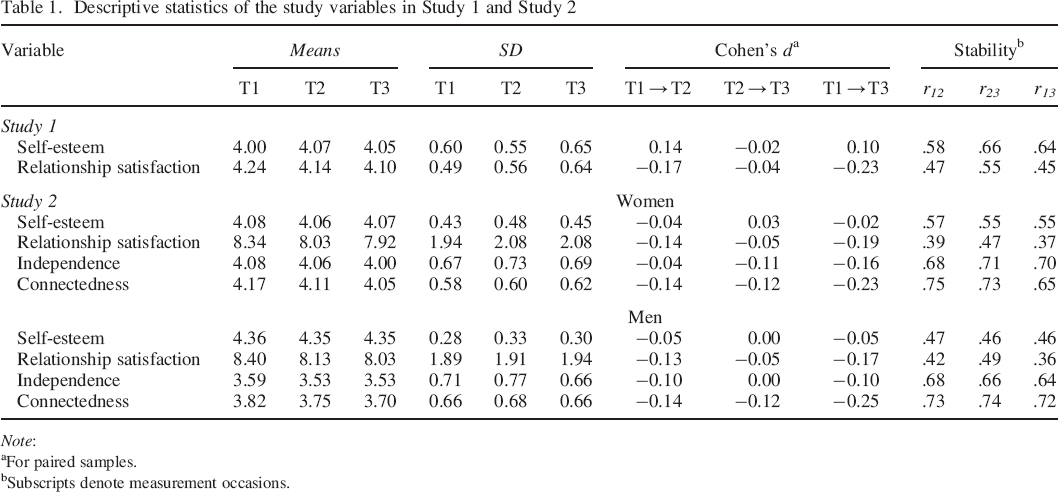
As displayed in the upper part of Table 1, self–esteem slightly increased over time with regard to its mean–level. Its rank–order stability was comparable with that of other personality characteristics across the same period (Mund & Neyer, 2014). In contrast, relationship satisfaction decreased across the 15 years at small to moderate amounts.
Descriptive statistics of the study variables in Study 1 and Study 2
Note:
For paired samples.
Subscripts denote measurement occasions.
Self–esteem and relationship satisfaction
Level–change effects of self–esteem on subsequent change in relationship satisfaction were not statistically significant (βT1→T2 = .06; βT2→T3 = .08; ps > .30), neither were effects of relationship satisfaction on subsequent change in self–esteem (βT1→T2 = .08; βT2→T3 = .02; ps > .30). Neither did change–change effects reach statistical significance (βSE→R = −.07; βR→SE = −.01; ps > .50). However, the initial correlation (r = .34, p < .001) as well as the correlated changes at T2 (r = .26, p = .019) and T3 (r = .33, p = .002) indicated an intertwining between self–esteem and relationship satisfaction with regard to their levels and concerning change. That is, higher (lower) initial levels and relative increases (decreases) in self–esteem were associated with higher (lower) initial relationship satisfaction and relatively less (more) decline in relationship satisfaction over time, respectively.
Discussion
The results of the individual data study demonstrated that self–esteem and relationship satisfaction share a common developmental dynamic from young adulthood to the midlife transition, as indicated by the correlated changes (Little, Bovaird, & Siegers, 2006; Mund & Neyer, 2014; Neyer & Lehnart, 2007). However, no mutual influences between both domains were detected.
Although Study 1 had enough statistical power to detect a typical effect size found in research on personality–relationship transactions, the actually observed effects were much smaller than expected. Such small effects, however, might accumulate over time and eventually manifest as correlated changes in the model. That is, although neither level–change nor change–change effects reached statistical significance, the correlated changes found in this study indicate a common developmental dynamic between self–esteem and overall relationship satisfaction that is worthwhile to further disentangle. If the small cross–lagged effects accumulate over time, a study with narrower measurement occasions should find less correlated change and more longitudinal effects between both domains.
Furthermore, as romantic relationships necessarily consist of two partners, individual data might not capture all information necessary to examine the assumed codevelopment. These issues are addressed in Study 2, in which a large dyadic dataset with more than 2000 couples was utilised. With measurement occasions one year apart, Study 2 additionally allows for a closer look at the interplay between self–esteem and relationship aspects on a finer–grained level.
Study 2: Couples
Method
Participants and design
For Study 2, we used data from the first three waves of the German Panel Analysis of Intimate Relationships and Family Dynamics (pairfam) that started in 2008 (for a detailed description, see Huinink et al., 2011). Pairfam is a representative longitudinal study incorporating a multi–actor design. Apart from anchor participants, who are queried yearly at their homes by trained interviewers, their partners, parents and children are assessed via paper–and–pencil questionnaires (PAPI) upon consent. At the first measurement occasion, 12 402 anchors from three birth cohorts (1971–1973, 1981–1983 and 1991–1993) participated. The yearly interviews are conducted in two modes, the computer–assisted personal interview (CAPI) and the computer–assisted self–administered interview (CASI). Most of the questions are asked during CAPI, whereas CASI is only used for more sensitive questions, for instance, on sexuality, contraceptive behaviour and personality. In addition to the 12 402 anchors, 3743 partners took part at the first measurement via PAPI. In the present study, we only include data of the two oldest birth cohorts. This was carried out (i) because a growing body of research indicates that partner relationships in adolescence are qualitatively different from partner relationships in young adulthood and thus hardly comparable (Collins, Welsh, & Furman, 2009; Furman, 2002) and (ii) because we intended to parallel Study 1 with respect to the age of the participants. Additionally, as in Study 1, we only included stable couples (i.e. couples who stayed together throughout the study period). The final dataset comprised data of 2124 stable, heterosexual couples at the first measurement occasion with a mean age of women of 31.35 years (SD = 5.55, range from 18 to 58) and 34.16 years (SD = 6.10, range from 20 to 68) of men; the average relationship duration was 9.38 years (SD = 5.74; range from 0.08 to 32.42).
Measures
As in Study 1, we included relationship duration and age as covariates in order to control for their covariance with the study variables. 2
Self–esteem
Self–esteem was assessed with three items from the Rosenberg Self–Esteem Scale (e.g. ‘I like myself just the way I am’; Rosenberg, 1965). The items were answered on a five–point Likert scale ranging from 1 (not at all) to 5 (absolutely). At T1, self–esteem of the anchor participants was assessed in the CAPI mode, whereas the CASI mode was used from T2 onwards. Because of these differences in assessment modes for anchor participants between measurement occasions, the mean of self–esteem declined in the anchors between T1 and T2 (d = −0.28) but was stable between T2 and T3 (d = 0.02). This drop did not occur for the partners, who were assessed via PAPI across all waves. Further inspection of the data revealed that anchor and partner participants differed noticeably at T1 (d = 0.27) but not at T2 (d = 0.03) or T3 (d = 0.02).
To avoid mean differences between measurement occasions being due to interviewer–effects rather than to true changes in self–esteem, we normalised the mean of the T1 anchor data with respect to the mean of the T1 partner data. In particular, we first centred the individual T1 anchor data (mean of zero) and added the mean of the partners at T1 to each individual value. Using this procedure, mean differences based on interview modes were eliminated while preserving all inter–individual differences. As will be discussed in the following, Study 2 applied a latent variable modelling approach. In order for changes over time to be meaningfully interpretable, the construct under scrutiny has to be invariant over time with regard to factor loadings and intercepts (strong invariance). It is important to note that strong invariance was achieved with the normalised self–esteem measure. Coefficient ω for the self–esteem scale amounted to .74 (CI: .71–.76) at T1, .79 (CI: .77–.81) at T2 and .77 (CI: .74–.79) at T3 for women, and to .68 (CI: .65–.71) at T1, .76 (CI: .74–.78) at T2 and .74 (CI: .71–.76) at T3 for men.
Relationship satisfaction
Relationship satisfaction was measured with one item from the German version of the RAS (Sander & Böcker, 1993). The item (‘In general, how satisfied are you with your relationship?’) was answered on an 11–point Likert scale ranging from 0 (very dissatisfied) to 10 (very satisfied).
Independence
Independence was assessed with the partnership climate scales (Schneewind & Kruse, 2002), examining the extent to which a person can pursue own interests in a partner relationship. The four items (e.g. ‘In our partnership I can follow my own interests without my partner getting upset’) were answered on a five–point Likert scale ranging from 1 (not at all) to 5 (absolutely). Coefficient ω amounted to .70 (CI: .68–.73) at T1, .82 (CI: .80–.83) at T2 and .75 (CI: .72–.77) at T3 for women, and to .69 (CI: .66–.71) at T1, .79 (CI: .77–.81) at T2 and .71 (CI: .68–.73) at T3 for men.
Connectedness
Connectedness was assessed with four items from the German version of the Network of Relationship Inventory (Wittmann, Helm, Buhl, & Noack, 2000). The overall scale of connectedness consisted of the two subscales intimacy and appreciation, which were measured with two items each. Intimacy assesses the frequency of self–disclosure to the partner (e.g. ‘How often do you share your secrets and private feelings with your partner?’), whereas appreciation assesses the frequency of self–perceived appreciation by the partner (e.g. ‘How often does your partner show that he or she appreciates you?’). Both subscales were measured on a five–point Likert scale ranging from 1 (never) to 5 (always). Based on exploratory and confirmatory factor analyses and the latent intercorrelation between the subscales of .61 in the pairfam sample, Walper, Fiedrich, Gschwendtner and Wendt (in preparation) proposed the aggregation of the subscales into a composite score reflecting the overall factor connectedness. Coefficient ω amounted to .75 (CI: .73–.77) at T1, .79 (CI: .76–.80) at T2, and .77 (CI: .75–.79) at T3 for women, and to .64 (CI: .60–.66) at T1, .69 (CI: .66–.71) at T2 and .67 (CI: .64–.70) at T3 for men, respectively.
Relationship satisfaction, independence and connectedness represent theoretically distinct relationship processes (Prager & Buhrmester, 1998). This view was also supported by weak to moderate correlations within individuals (rs ranging from .21 to .45) and couples (rs ranging from .20 to .33).
Analysis model
For the dyadic analyses, we extended the individual model used in Study 1 by the partner perspective with an adapted actor–partner interdependence model (Kenny et al., 2006). The extended dyadic bivariate latent change model (see Figure 1 for the conceptual model) accommodated both women's and men's levels of self–esteem (see columns A and D of Figure 1) and the relationship aspects (see columns B and C of Figure 1) at each measurement occasion as well as the changes in each variable. For each construct, the individual items were used to model the latent variable. Because we assumed similar developmental trajectories for women and men with regard to self–esteem and the relationship aspects, all paths were set equal across the sexes. A comparison between models constrained in such a way and unconstrained models, in which the paths were allowed to differ between the sexes (Kenny et al., 2006) further supported this line of action as the constrained models did not fit the data worse (Δχ2 = 34.282, 25.082, 24.49, Δdf = 24, ps = .07, .40, .43 for relationship satisfaction, independence and connectedness, respectively). Constraining the paths in such a way still allows for mean–level differences across the sexes as it only assumes the associations between the variables to be equal for women and men. As a consequence, we will not refer to sex–specific influences but rather address the general influence between partners.
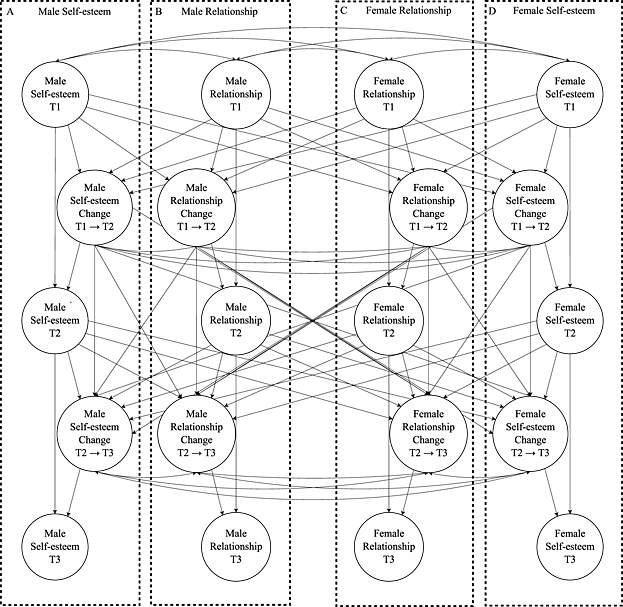
Dyadic extended bivariate latent change model. T1 to T3 indicate measurement occasions. Letters A to D indicate latent change models for women's and men's self–esteem and aspects of relationship quality. Measurement models were omitted for reasons of clarity. Paths for women and men were set equal.
According to recommendations for evaluating model fit (Hu & Bentler, 1999), a comparative fit index (CFI) close to or greater than 0.95, a root mean square error of approximation (RMSEA) close to or smaller than 0.06 and a standardised root mean square residual (SRMR) close to or smaller than 0.08 were assumed to reflect a good fit of the model to the data. Missing data on any of the variables were handled by FIML. Little's MCAR test including all manifest study variables was statistically significant (χ2(1217) = 1454.434, p < .01) but probably because of the large sample size. The χ2–to–df ratio of 1.20 did not indicate large differences between couples who participated at all three measurement occasions and those who left out one wave.
Results
Univariate latent change models
Whereas no substantial mean–level change in self–esteem was found for women nor men, the moderate rank–order stabilities indicated variability in individual trajectories (see Table 1 for details). The three aspects of relationship quality showed similar patterns of change with slight decreases across the three years in both women and men. Rank–order stabilities were somewhat higher for independence and connectedness as compared with relationship satisfaction.
Bivariate dyadic effects
These effects refer to initial correlations, correlated changes (Table 2) and cross–lagged effects between self–esteem and the relationship variables (Table 3). All effects were studied within a dyadic perspective, that is, with regard to actor and partner effects. In the following, we will first refer to initial correlations and correlated changes between both domains. Second, we will present effects of self–esteem on the respective aspect of relationship quality. These effects indicate whether the level of self–esteem (at T1 and T2) affected relationship change (level–change effects; T1 → T2 and T2 → T3). By contrast, change–change effects indicate whether changes in self–esteem (T1 → T2) affected subsequent change in relationship quality (T2 → T3). Third, the effects of relationship quality on self–esteem will be presented analogously. We report standardised estimates for all effects.
Initial correlations and correlated changes between self–esteem and aspects of relationship quality
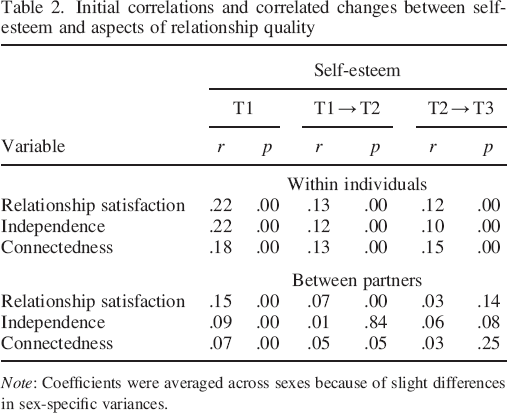
Note: Coefficients were averaged across sexes because of slight differences in sex–specific variances.
Bivariate dyadic latent level–change and change–change effects
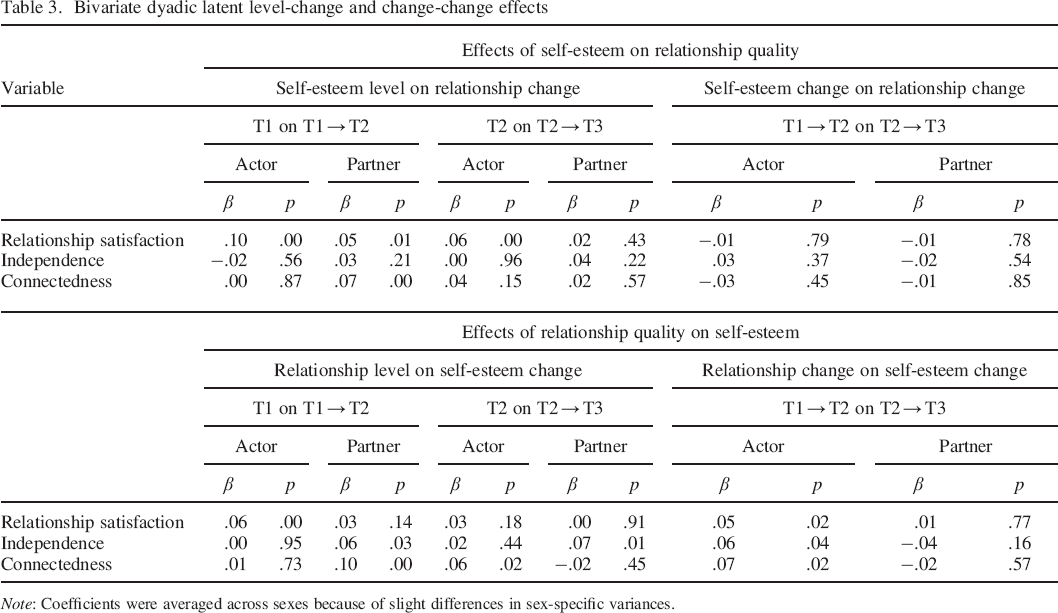
Note: Coefficients were averaged across sexes because of slight differences in sex–specific variances.
Self–esteem and relationship satisfaction
The model had a good fit to the data (χ2(284) = 1004.722, p < .001, CFI = 0.951, RMSEA = 0.035, SRMR = 0.049).
Correlations
Self–esteem and relationship satisfaction were positively correlated within individuals at T1, and their change correlated positively during the first and the second time intervals. Between partners, there was a significant correlation at T1 and weak correlated change during the first time interval. That is, one's own higher (lower) initial self–esteem was associated with one's own and one's partner's higher (lower) initial relationship satisfaction. In addition, relative increases (decreases) in one's own self–esteem were related to less steep (steeper) decreases in one's partner's satisfaction (Table 2).
Level–change effects
With regard to actor effects of self–esteem on relationship satisfaction (personality effects), higher (lower) self–esteem at T1 predicted slower (faster) declines in satisfaction during the first and the second time intervals. With regard to partner effects, one's own higher (lower) self–esteem at T1 predicted slower (faster) declines in one's partner's satisfaction during the first time interval (Table 3).
There was one level–change actor effect of relationship satisfaction on self–esteem (relationship effect) indicating that one's own higher (lower) initial satisfaction predicted subsequent increases (decreases) in one's own self–esteem during the first time interval.
Change–change effects
Increases (decreases) in relationship satisfaction during the first time interval were found to be predictive of subsequent increases (decreases) in the actor's self–esteem (relationship effect). No change–change effects were found with regard to the partner perspective (Table 3).
Self–esteem and independence of the partner
The model had a good fit to the data (χ2(917) = 2054.584, p < .001, CFI = 0.956, RMSEA = 0.024, SRMR = 0.041).
Correlations
Within individuals, self–esteem and independence were positively correlated at T1 and evinced correlated change during the first and second time intervals. That is, higher (lower) self–esteem at the onset of the study was associated with more (less) independence. Additionally, relative increases (decreases) in one's own self–esteem were associated with less steep (steeper) declines in one's own independence. Between partners, the initial correlation was small, indicating that one's own higher (lower) self–esteem was associated with one's partner's higher (lower) independence. Correlated changes were not substantial neither within individuals nor between partners (Table 2).
Level–change effects
With regard to the actors, there were no personality effects. In contrast, level–change effects of independence on self–esteem were found with regard to the partners. That is, one's own higher (lower) independence predicted increases (decreases) in one's partner's self–esteem during the first and the second time interval.
Change–change effects
At the actor level, change–change relationship effects occurred, indicating that increases (decreases) in one's own independence between T1 and T2 predicted subsequent increases (decreases) in one's own self–esteem (Table 3).
Self–esteem and connectedness with the partner
The model fitted the data well again (χ2(917) = 3189.269, p < .001, CFI = 0.931, RMSEA = 0.034, SRMR = 0.074).
Correlations
Self–esteem and connectedness as well as their changes were positively correlated both within individuals and between partners (Table 2). That is, higher (lower) initial self–esteem was associated with one's own and one's partner's higher (lower) connectedness. Furthermore, relative increases (decreases) in one's own self–esteem over time were associated with less steep (steeper) declines in one's own and one's partner's connectedness.
Level–change effects
With regard to personality effects, one level–change partner effect of self–esteem on connectedness emerged indicating that one's own higher (lower) self–esteem at T1 predicted slower (faster) decreases in one's partner's connectedness during the first time interval (Table 3).
Concerning relationship effects of connectedness on later self–esteem, one actor and one partner effect emerged. That is, one's own higher (lower) self–esteem at T2 predicted subsequent increases (decreases) in one's own connectedness. Similarly, one's own higher (lower) self–esteem at T1 predicted increases (decreases) in one's partner's connectedness.
Change–change effects
No change–change personality effects occurred, with regard neither to the actor nor to the partner level. There was, however, a relationship effect indicating that increases (decreases) in one's own connectedness were predictive of subsequent increases (decreases) in one's own self–esteem (Table 3).
Discussion
The dyadic analyses of Study 2 highlight the fact that self–esteem and partnership development go hand in hand and influence each other in a reciprocal manner. More concretely, we found substantial level–change effects for both actors and partners indicating that changes in aspects of relationship quality were predicted by previous levels of self–esteem, and changes in self–esteem were themselves predicted by previous levels of the examined aspects of relationship quality. These findings support both the self–broadcasting and the sociometer perspectives. Change–change effects, however, occurred as relationship effects only. That is, increases in relationship satisfaction, independence and connectedness consistently predicted subsequent increases in self–esteem. Even though these change–change effects were limited to the actor perspective, they provide support for the sociometer perspective. In short, in Study 2, we uncovered processes of self–esteem and relationship development that would have remained undetected by using cross–sectional designs, considering individuals only or examining long time intervals.
General Discussion
The aim of the present investigation was to unravel the dynamics of self–esteem development in stable partner relationships from an individual and a dyadic perspective. With data from two longitudinal studies, we found evidence for the notion that the association between aspects of relationship quality and self–esteem is bidirectional. First, findings of Study 1 illustrated the long–term codevelopment of self–esteem and relationship satisfaction over 15 years from young adulthood to the midlife transition. The results show that self–esteem and relationship satisfaction share a common developmental dynamic over time. Second, by following stable couples over a period of three years, Study 2 provided deeper insights into the middle–term processes that underlie personality and relationship effects in partner relationships. While the pattern of level–change effects (i.e. previous levels in one domain predict change in the other domain) found in Study 2 supports both the self–broadcasting and the sociometer perspectives, the pattern of change–change effects (i.e. previous change in one domain predicts subsequent change in the other domain) supports the sociometer perspective.
It should be noted that the effects in both studies were generally small. However, small effects are powerful if they accumulate over time (e.g. Ozer & Benet–Martínez, 2006; Roberts, Kuncel, Shiner, Caspi, & Goldberg, 2007). In analytical models such as those used in the present studies, the accumulation of small effects manifests in the correlated changes. In Study 2, a certain amount of the changes were explained by the observed dynamic transactions, leading to relatively small correlated changes. In Study 1, however, correlated changes were higher, indicating that the common developmental dynamic between self–esteem and relationship satisfaction was not captured by the cross–lagged effects. With the findings of Study 2 in mind, it seems likely that the correlated changes in Study 1 were at least partly driven by small effects similar to those observed in Study 2 accumulating over time.
Self–broadcasting and sociometer perspectives
Self–broadcasting (Srivastava & Beer, 2005) might reflect one process underlying personality effects of an individual's self–esteem on his or her environment. Evidence for such effects were found both from an individual perspective (Orth et al., 2012) and a dyadic perspective (Erol & Orth, 2013; Murray et al., 2003). In the present study, we extended earlier findings by also incorporating more specific aspects of relationship quality in addition to overall relationship satisfaction. It was found that higher self–esteem predicted later increases in aspects of relationship quality, which was due to both intrapersonal (actor effects) and interpersonal processes (partner effects). More concretely, one's own self–esteem predicted later changes in one's own and one's partner's relationship satisfaction as well as in one's partner's feelings of connectedness. This pattern of results might be due to processes of self–verification (Swann, 2012) and risk–regulation (Murray, Holmes, & Collins, 2006). That is, individuals higher in self–esteem might more readily engage in closeness–promoting behaviour in partner relationships (Murray et al., 2008). This might help the partner to disclose himself or herself and thus likewise deepen the connection between the partners, verifying the self–views of high self–esteem individuals as being a person of worth.
Sociometer effects (Leary, 1999) are one possible driving mechanism of relationship effects on the development of self–esteem. Their occurrence is most likely due to an individual perceiving being loved by his or her partner, which is communicated via, for instance, smiling, appreciating the other or disclosing oneself. In the present study, higher relationship quality was found to predict increases in self–esteem at both the actor and partner levels. Comparable effects on self–esteem were previously reported for high–quality partner interactions (Denissen et al., 2008; Murray et al., 2003) and likeability within social groups (Srivastava & Beer, 2005). However, to the best of our knowledge, no other study has yet assessed partner effects.
The analyses in Study 2 further revealed that, for actors, actual increases in relationship quality predicted subsequent increases in self–esteem. On the one hand, this finding provides further support for the importance of a stable partner relationship for personality development (Finn et al., in press; Lehnart & Neyer, 2006; Lehnart et al., 2010; Neyer & Asendorpf, 2001; Robins, Caspi, et al., 2002). Perceiving the relationship as increasing in quality might be accompanied or preceded by the reduction of cognitive biases (Finn et al., in press) or by the development of more constructive and appreciating communication strategies over time (Sadikaj, Moskowitz, & Zuroff, 2015). Furthermore, partners might be more and more able to shape the partner relationship according to their need for independence and connectedness. This might facilitate becoming more and more focused on the positive aspects of the relationship and the partner's behaviour, eventually making self–protection and being reserved and withdrawn unnecessary (Murray et al., 2006, 2008). On the other hand, such change–change effects represent a strict test of the ideas of dynamic transactionism, as they take into account the assumption of changes in one domain being predictive of subsequent changes in the other (Magnusson, 1990; Mund & Neyer, 2014). The effects of partner relationships are thus not limited to rather static associations but are amplified by full dynamic transactions.
Overall, the pattern of results found in the present studies suggests that personality and relationship effects go hand in hand and at least partially depend on each other. That is, self–esteem is associated with a particular way of interacting with the environment and within social relationships (i.e. personality effect). This behaviour has consequences and evokes reactions from the environment, for instance, by signalling appreciation and social inclusion or by responding to the actor's needs, which in turn is perceived by the individual and incorporated in his or her self–evaluation (relationship effect).
Aspects of relationship quality
Personality and relationship effects occurred with regard to all three aspects of relationship quality examined in the present study. This finding highlights the importance of considering specific aspects of relationship quality such as independence and connectedness in addition to overall relationship satisfaction in order to obtain an idea of the processes underlying personality and relationship development (Fincham et al., 1997; Fletcher et al., 2000).
Relationship satisfaction reflects the subjective evaluation of the relationship as being overall satisfactory and pleasant (Fincham et al., 1997). Perceiving one's relationship as satisfactory is, at least partly, a consequence of one's self–esteem (Orth et al., 2012), as individuals tend to seek environments and look out for cues supporting their self–view (Swann, 2012). That is, individuals high in self–esteem might be more aware of the positive and satisfactory aspects of their relationship, whereas individuals low in self–esteem might feel chronically threatened and less appreciated (Murray et al., 2008). However, increases in relationship satisfaction also retroact on self–esteem, which might be due to overall improved need fulfilment or the development of appropriate patterns of relationship regulation (Murray et al., 2006; Vater & Schröder–Abé, 2015).
The interplay between independence and self–esteem might be due to the fulfilment of agentic needs allowing an individual to follow his or own interests in the relationship. (Hagemeyer et al., 2013; Patrick et al., 2007; Prager & Buhrmester, 1998). Being able to follow one's own interests might be important to maintain a self–evaluation as oneself as competent and agentic and to get things carried out without the supervision or distrust of the partner. Furthermore, allowing the partner to pursue his or her own interests might be easier for individuals higher in self–esteem, as they are less sensitive to rejection and less dependent on continuous confirmation (Murray et al., 2003).
In addition to their agentic needs, individuals have a deeply rooted need to belong (Baumeister & Leary, 1995), that is, a communal need. To fulfil this need, individuals have to feel connected with their partners (Murray et al., 2006). Individuals high in self–esteem might be more ready to leave self–protection aside and instead strive to foster the connectedness towards their partners by a wide range of behaviours signalling liking and trust (Murray et al., 2006). Increasing connectedness in this way, in turn, might eventually foster not only one's own self–esteem but also one's partner's self–esteem as the relationship contains more cues of social inclusion.
Unravelling dynamic transactions
Although the overall mean–level trend of global relationship quality is to decrease (Karney & Bradbury, 1995), romantic partners with higher self–esteem still experienced differential increases in relationship quality in the present studies. These increases in aspects of relationship quality in turn contributed to later increases in self–esteem. That is, despite the overall negative trend of relationship quality, higher self–esteem might protect from overly declines by either decelerating or even reversing this downward development. However, it has to be kept in mind that the effects can also be interpreted in the reverse direction. Thus, it seems that individuals who had already been better off in the first place benefitted the most, while those who suffered from lower relationship quality and lower levels of self–esteem may be confronted with a vicious circle of negative transactions. Nevertheless, our findings indicate that romantic partners might exert a positive influence on personality development and one's appreciation of the relationship. Although the dynamics of self–esteem were examined in a naturalistic setting, it seems reasonable to assume that active attempts to increase relationship quality such as couple therapy or counselling may have similar positive consequences for the development of self–esteem of both partners. That is, improving relationship quality might strengthen a key component of social inclusion, which might eventually strengthen self–esteem.
As the present studies are particularly suited for detecting dynamic longitudinal associations between self–esteem and aspects of relationship quality, it will be an important task for future research to identify mediators underlying the individual and dyadic processes of personality and relationship effects. The PERSOC model (Back et al., 2011), for instance, provides a useful framework for further investigations of the cognitive, emotional and behavioural underpinnings of transactional processes. For example, detailed analyses of couples’ distance regulation behaviours (Hagemeyer, Schönbrodt, Neyer, Neberich, & Asendorpf, 2014), patterns of communication (Marshall, Simpson, & Rholes, 2015; Vater & Schröder–Abé, 2015) or their daily interactions (Sadikaj et al., 2015) are important to understand how the fulfilment of agentic and communal needs proceeds. By focusing on even shorter time intervals, such mediators could be examined in more detail in dyadic interactions, daily diary or ambulatory assessment studies (Back et al., 2011).
Limitations and future directions
The present investigation has limitations. First, our samples were limited to participants in stable partner relationships, which may constrain the generalizability of findings. However, as we have discussed earlier, our results also point to a possible vicious circle of declining self–esteem and relationship quality, which in the end may lead to separation and divorce. Moreover, dynamic transactions are more likely to occur in stable environments, and it has proven useful to focus on enduring relationships in order to examine these processes (Lehnart & Neyer, 2006; Robins, Caspi, et al., 2002).
Second, both self–esteem and relationship quality may fluctuate in response to other external factors that we were not able to control for. Because young adulthood is a period with many transitions and intense experiences, it is possible that certain life experiences and other unknown factors have affected self–esteem and relationship quality also in the present study.
Third, the samples used in this investigation covered the time of young adulthood and early midlife. More heterogeneous samples and longer investigation periods with narrower assessment intervals could help clarify whether a satisfying and reliable relationship protects individuals from experiencing declines in self–esteem. For example, decreases in self–esteem seem to be normative in old age (Orth et al., 2012; Robins, Trzesniewski, et al., 2002), and it would be worth identifying relationship processes that work against this normative trend.
Finally, in both studies, only self–report measures were used, which may be susceptible to effects of response sets and social desirability. Extending the present findings by investigating mediational processes such as cognitive processes (Finn, Mitte, & Neyer, 2013), self–regulation (Vater & Schröder–Abé, 2015) or daily interactions (Sadikaj et al., 2015) and by integrating ambulatory assessments and behavioural observations would be a desirable venue for future research. Similarly, as a consequence of shared method variance between self–report measures, partner effects may have been underestimated in the present investigation (Orth, 2013). Future research might thus benefit from incorporating multiple perspectives of personality and relationship characteristics. In addition to the self–perception used in the present studies, other and meta–perceptions could be considered (Schaffhuser, Allemand, & Martin, 2014).
Conclusion
By analysing two longitudinal datasets covering time spans of 15 and three years, we unravelled the dynamics of self–esteem development in stable partner relationships. Overall, it was found that self–esteem and relationship satisfaction, a broad aspect of overall relationship quality, share a common developmental dynamic over time (Study 1). This dynamic might at least partly be driven by small but accumulating effects over shorter time periods and additionally involving more specific aspects of relationship quality that reflect the fulfilment of agentic and communal needs (Study 2). Importantly, full dynamic transactions were found indicating that the development of self–esteem and aspects of relationship are interdependent. Together, the findings highlight that research on the development of self–esteem and its social consequences should not just be about who you are (Robins, Caspi, et al., 2002) but also who you are with and what experiences you make in that relationship.
Footnotes
Acknowledgements
This research was supported by grant NE 633/8–1 from the German Research Foundation awarded to Franz J. Neyer (Study 1). Additionally, this paper uses data from the German Family Panel pairfam, coordinated by Josef Brüderl, Karsten Hank, Johannes Huinink, Bernhard Nauck, Franz J. Neyer and Sabine Walper. Pairfam is funded as long–term project by the German Research Foundation (DFG; Study 2).