







Abstract
There is currently no consensus on how to study psychological situations, and situation research is still riddled with problems of conceptualization (what is a situation and what is it not?) and measurement (how can situational information be assessed?). This target article formulates three core principles (with corollaries) to provide a foundation for psychological situation research: the Processing, Reality and Circularity Principles. These principles build upon each other, ranging from basic to more complex issues (e.g. how to study situations in both objective and subjective terms). They are intended to guide and spur more coherent research programs that produce cumulative knowledge on psychological situations. We conclude with a plea for real–life, multi–method, multi–situation, multi–time, multi–group designs that can illuminate the interwoven dynamics between persons (with their personalities and behaviour) and situations. Copyright © 2015 European Association of Personality Psychology
The person and the situation at any given moment are inextricably interwoven. Almost all psychological theories have acknowledged this truism. Yet, psychologists have not made much progress in describing, explaining and predicting person–situation transactions: how people construe, maintain, select, evoke, change and create situations in their daily lives. Why is this the case? Although most psychological theories incorporate situational influences, these influences are rarely couched within a set of guiding principles of what situations are and how they can operate. In contrast, psychology has had fair success in providing principles for describing and understanding persons, most notably summarized in our cumulative knowledge of personality (e.g. Funder, 2001) and behaviour (e.g. Furr, 2009). A complete study of the human condition, however, requires a better understanding of situations.
As one step towards understanding situations and person–situation transactions better, we organized an expert meeting, supported by the European Association of Personality Psychology, held in Berlin on 23–25 August 2013. Discussions among the 16 participants made apparent that in situation research (i) there are many insular findings; (ii) cumulative, coherent and integrative–synthetic research efforts have not been achieved so far; and (iii) researchers are unclear how to study situations because there is no consensual framework (e.g. Argyle, Bond, 2013; Furnham, & Graham, 1981; Edwards & Templeton, 2005; Endler, 1993; Frederiksen, 1972; Funder, 2006, 2008, 2009; Furr & Funder, 2004; Hogan, 2009; Kenny, Mohr, & Levesque, 2001; Magnusson, 1981a, 1981b; Rauthmann, 2012; Rauthmann et al., 2014; Reis, 2008; Ross & Nisbett, 1991; Rozin, 2001; Saucier, Bel–Bahar, & Fernandez, 2007; Sherman, Nave, & Funder, 2010, 2012, 2013; Swann & Seyle, 2005; ten Berge & de Raad, 1999, 2001, 2002; Wagerman & Funder, 2009; Yang, Read, & Miller, 2006, 2009).
This target article is an outgrowth of that meeting. Based on its wide–ranging and stimulating discussions, we set out our views on how to move the field of psychological situation research forward. After clarifying terminological issues, we formulate our ideas of core principles concerning what situations are (and what they are not), how they operate and how they may be studied, pursuing three broad aims. First, we hope to raise awareness and alert those interested in conducting research to thorny issues that have bedevilled situation research (and continue to do so). Second, we offer some principles for organizing, guiding and unifying future research on situations. Third, an important purpose of this target article is to elicit comments and constructive discourse from the meeting participants as well as other researchers working on situational assessment.
Terminological Issues
The term ‘situation’ is often used haphazardly, ambiguously, or inconsistently throughout the literature. To provide clear terminology, we suggest defining, taxonomizing and measuring three different basic kinds of situational information: cues (composition information), characteristics (psychological meaning information) and classes (category information). After proposing our core principles, we will revisit the strengths and weaknesses of each and recommend particular focus on situation characteristics.
Cues: The composition of situations
Cues (synonyms: Elements, Units, Parts, Building blocks, Constituents, Components, Ingredients) represent physically present, scalable and (relatively) objectively quantifiable stimuli (Block & Block, 1981). They can be categorized into the following: (i) persons, relationships and social interactions; (ii) objects; (iii) events/activities; (iv) locations; and (v) time (e.g. Mehl & Robbins, 2012; Pervin, 1978; Saucier et al., 2007). Thus, cues address five easily answerable ‘W–questions’: Who is with you? Which objects are around you? What is happening? Where are you? When is this happening? For example, the situation ‘party (Where?) with friends (Who?) who are dancing (What?)’ contains several cues. Notably, though, these cues do not possess intrinsic psychological meaning (cf. Miller, 2007)—they are ‘raw’ distal stimuli and need to be processed by a perceptual system to be interpreted and acted upon. Cues thus only describe the environmental structures into which psychological situations (i.e. cognitive representations of the cues) are couched (Block & Block, 1981; Rotter, 1981).
Characteristics: The psychological meanings of situations
Characteristics (synonyms: Qualities, Features, Properties, Descriptors, Attributes, Meanings) capture the psychologically important meanings of perceived cues, thus summarizing a situation's psychological ‘power’ (Edwards & Templeton, 2005; Rauthmann et al., 2014). Characteristics (e.g. dutiful, intellectual, conflictual, sexual, pleasant, negative, distrustful, social) reflect the way in which the human perceptual system processes situational information and can hence be used to describe situations (de Raad, 2004, pp. 186/187; Edwards & Templeton, 2005, p. 706; Rauthmann et al., 2014). To date, there is only one standardized and validated instrument to measure a broad range of characteristics, the Riverside Situational Q–sort (RSQ: Wagerman & Funder, 2009; see Guillaume–Hanes & International Situations Project Group, in press; Morse, Neel, Todd, & Funder, in press; Morse, Sauerberger, Todd, & Funder, in press; Sherman et al., 2010, 2012, 2013), which enables comparing situations on many characteristics.
In a study involving samples from multiple countries, Rauthmann and colleagues (2014) identified the ‘Situational Eight’ DIAMONDS in the RSQ: Duty (does something need to be done?), Intellect (is deep information processing required?), Adversity (is someone being overtly threatened?), Mating (is the situation sexually and/or romantically charged?), pOsitivity (is the situation pleasant?), Negativity (do negative things taint the situation?), Deception (is someone deceptive?) and Sociality (is social interaction and relationship formation possible, desired, or necessary?). The Situational Eight emerged as dimensions (i) on which different raters substantially agreed; (ii) that were tied to situation cues; and (iii) that could predict a wide range of behaviours. Additionally, Sherman, Rauthmann, Brown, Serfass, and Jones (in press) showed in an experience sampling study that the DIAMONDS predicted behaviour independent of personality, and Rauthmann, Sherman, Nave, and Funder (2015) found them useful in studying personality–situation transactions (such as situation selection and construal). While the DIAMONDS do not exhaustively cover the entire universe of situation characteristics, they integrate the most often identified dimensions and thus provide a common language (see the Big Five in personality psychology) (Rauthmann et al., 2014, Table 15). Additionally, they reduce the relatively unwieldy 89–item RSQ to a manageable set of major dimensions that have analogous content to major dimensions of personality—a property that is highly desirable (Johnson, 1999) because personality–because conceptual associations between personality and situational variables can be (e.g. in personality–situation transaction studies: Rauthmann et al., 2015).
Classes: The categorization of situations
Classes (synonyms: Categories, Types, Domains, Groups, Clusters) represent abstract groups, or types, of situations. Classification can be based on the following: (i) similar cues (e.g. all situations within the workplace) and/or (ii) similar levels or profiles of characteristics (e.g. all situations high on Duty or all situations with a specific DIAMONDS profile). They thus condense otherwise disparate information that can then be easily communicated (e.g. ‘work situations’). Indeed, most ‘situation taxonomies’ organize entire situations into classes (Rauthmann, in press; e.g. Endler, Hunt, & Rosenstein, 1962; Pervin, 1976; ten Berge & de Raad, 2001, 2002). To date, van Heck's (1984) taxonomy remains the most inclusive and prominent among them, with 10 dimensions: conflict, joint working, intimacy/relationships, recreation, travelling, rituals, sport, excesses, serving and trading. More recently, Morse, Neel, et al. (in press) classified situations in terms of seven motives identified as essential in evolutionary theory: self–protection, disease avoidance, affiliation, kin care, mate seeking, mate retention, and status.
The Objectivism–Subjectivism Debate
A pivotal question for any kind of situation research is: Should situations be conceptualized as objective or subjective phenomena? Some researchers see situations as subjective phenomena that exist largely if not exclusively ‘in the head’ of each perceiver (e.g. Allport, 1937; Battistich & Thompson, 1980; Eckes, 1995; Forgas & van Heck, 1992; Jessor, 1981; Jessor & Jessor, 1973; Pervin, 1978; Rotter, 1981); others view situations, or at least the appropriate level at which to study them, more objectively as existing ‘out there’(e.g. Barker & Wright, 1951, 1955; Reis, 2008; van Heck, 1984, 1989).
But what do ‘objective’ and ‘subjective’ mean? Table 1 gives an overview of objectivist and subjectivist perspectives in situation research. As can be seen, three perspectives align with objectivism (i.e. assumption, physical and consensus perspectives) and two with subjectivism (i.e. phenomenological and idiosyncrasy perspectives). Notably, the objectivism–subjectivism debate is not monolithic, and our principles address each perspective in different ways.
Objectivist and subjectivist positions
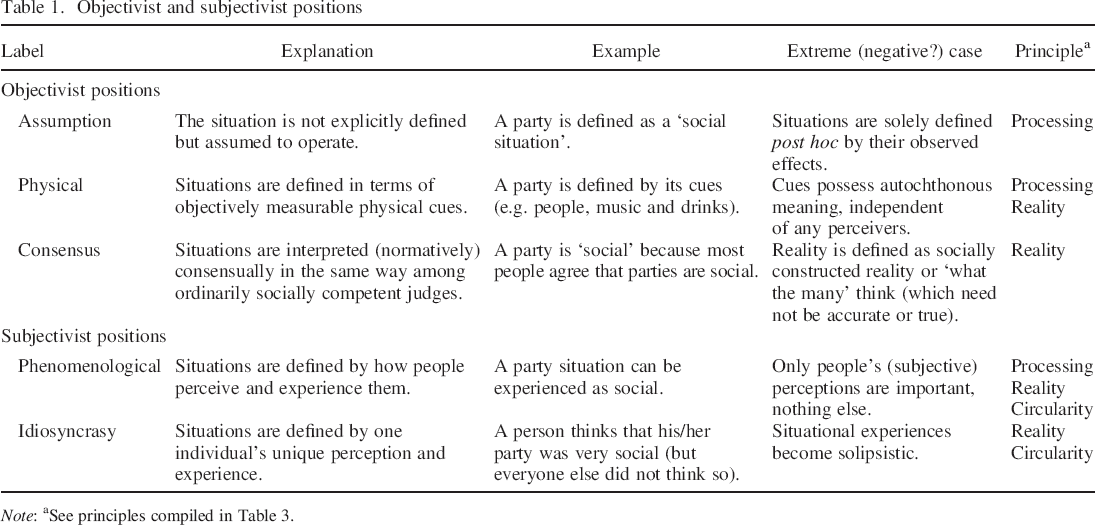
Note:
See principles compiled in Table 3.
The objectivist perspectives
The assumption perspective regards situations as ‘existing’ per se and does not require assessment of situational information. The presumption is that the operation of pre–specified situational forces can be post hoc observed in group differences of responses. For example, researchers may define a ‘social exclusion situation’ by manipulating ball receipt in a Cyberball game (Williams & Jarvis, 2006) and tracking people's affective and behavioural responses. Then, the game is assumed to define the situation (fully). Often in such instances, no attempt is made to verify whether participants processed the cues as intended (e.g. to what extent they perceived social exclusion) nor to what extent such observations generalize to real–life situations.
The physical perspective emphasizes attention to circumscribed cues. In contrast to the assumption perspective, however, cues are objectively scaled or measured and assumed to be meaningful per se. They are thus believed to possess ‘affordances’ that are ‘objective properties of situations inasmuch as they exist even without being perceived by any particular observer’ (Krahé, 1995/2010, p. 76; for detailed discussions, see Chemero, 2001, 2003; Gibson, 1977, 1979; Stoffregen, 2000a, 2000b, 2003, 2004). Thus, situations—defined solely by their physico–biological cues (Block & Block, 1981)—‘exist’ independent of any perceivers and constitute objective reality. To return to the Cyberball example, certain game elements (e.g. size and colour of the ball and receiving rate of ball) may constitute key objective situation cues, and these cues are tabulated (while a design subscribing to the assumption perspective would not even identify such details). Research emphasizing environmental affordances or conceptualizing situations in terms of cues is common in ecological psychology (e.g. Barker, 1968; Stokols & Altman, 1987) and experimental social psychology (e.g. Reis, 2008).
The consensus perspective employs a pragmatic interpretation of objective reality: what is objective depends on the extent to which people agree. Thus, if many people agree that the situation ‘being excluded in the Cyberball game’ is ‘unsocial’, then it is objectively unsocial. Block and Block (1981) referred to this as the canonico–consensual aspect of situations that describes a quasi–objective ‘social reality’ relying on normative and consensual knowledge shared by a socio–cultural group (Argyle et al., 1981).
The subjectivist perspectives
The phenomenological perspective holds that situations are constructed by perceivers. Its main notion is perhaps best exemplified by the so–called ‘Thomas Theorem’ that ‘if men define situations as real, they are real in their consequences’ (Thomas & Thomas, 1928, p. 572). Because the meaning of cues is supposedly generated only in people's heads, situations are to be measured by asking participants about them and eliciting situation ratings.
The idiosyncrasy perspective represents a more radical form of the phenomenological perspective. While the phenomenological position emphasizes experiential aspects that tend to be shared with others, the notion of the idiosyncrasy perspective is that each person holds a distinct view of the world and specific situations (which deviates from the consensual view). These individual construals are considered the only important factors for the person's thoughts, feelings, desires and actions. Block and Block (1981) referred to such perceptions as the subjective–functional aspect of situations.
Objectivist and subjectivist perspectives in literature
Six major theoretical approaches can be distinguished in situation research (Rauthmann, in press; ten Berge & de Raad, 1999). First, environmental–ecological approaches (e.g. Barker, 1968; Craik, 1981; Krause, 1970), as found in ecological, organizational and some of social psychology, emphasize objective physical ‘settings’. Second, behavioural approaches (e.g. Frederiksen, Jensen, & Beaton, 1972; Price, 1974; Price & Blashfield, 1975), as found in (earlier) experimental, social and cognitive psychology, emphasize stimulus–response configurations. Third, trait–psychological approaches (e.g. Fleeson, 2007; Saucier et al., 2007; ten Berge & de Raad, 1999, 2001, 2002), as found in personality psychology, emphasize situations‘ affordance of trait expression. Fourth, cognitive–attributional approaches (e.g. Edwards & Templeton, 2005; Krahé, 1995/2010; Magnusson, 1971), as found in cognitive and social psychology, emphasize mental constructs and declarative representations of situations. Fifth, social–interactional approaches (e.g. Forgas, 1976; Fournier, Moskowitz, & Zuroff, 2008, 2009; Kelley et al., 2003), as found in social psychology, emphasize interpersonal/social interaction sequences, settings, behaviours and roles. Sixth, transactional–dynamic approaches (e.g. Endler et al., 1962; Haken & Schiepek, 2006), as found in developmental, clinical and systemic–synergetic psychology, emphasize complex and dynamic transactions of person–situation processes.
These six major approaches require explicit or implicit assumptions about the objective or subjective nature of situations and thus differentially reflect the objectivist and subjectivist perspectives. Table 2 summarizes the perspective(s) with which each approach mostly aligns and the relevance of individual differences to those approaches. As can be seen there, environmental–ecological and behavioural approaches focus more on objective aspects of situations; trait–psychological and cognitive–attributional approaches more on subjective aspects of situations and social–interpersonal and transactional–dynamic approaches on both objective and subjective aspects.
Synopsis of six theoretical perspectives in situation research and their properties
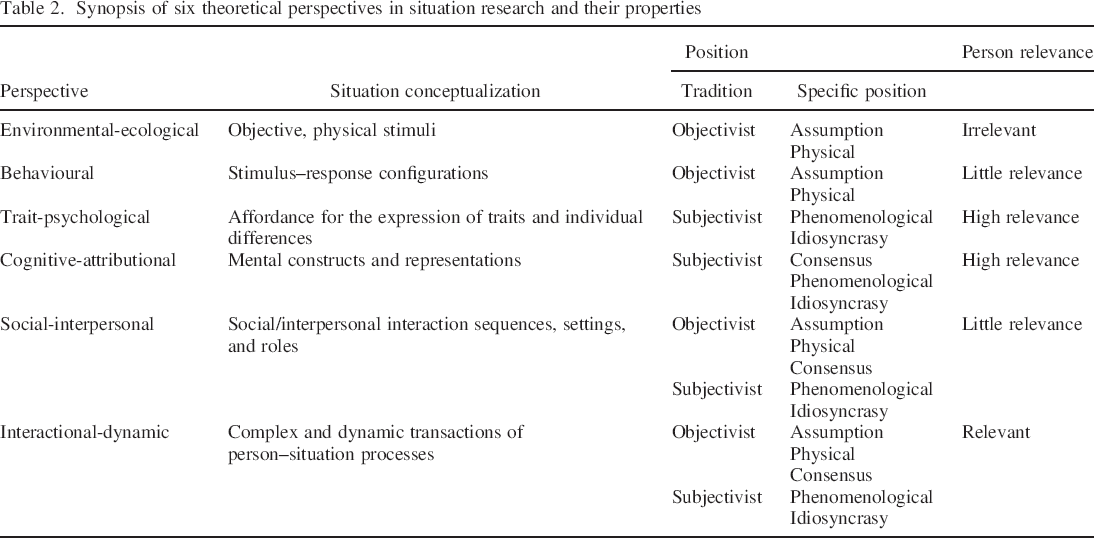
The six approaches also differ in potential to reveal influences of personality and individual differences in situations. While objectivist perspectives tend to underestimate or neglect influences of persons on situations and their perception, subjectivist perspectives tend to exaggerate them. Not surprisingly, research emphasizing situations as ‘objective forces’ has often tried to ascertain the superiority of situation factors over person(ality) factors in explaining behaviour (Fleeson & Noftle, 2008; Kenrick & Funder, 1988; Ross & Nisbett, 1991). However, to understand person–situation transactions in their entirety and complexity, it is important to test such assumptions. This requires integrating objectivist and subjectivist perspectives that we attempt to do in the three principles described next.
Three Principles of Situation Research
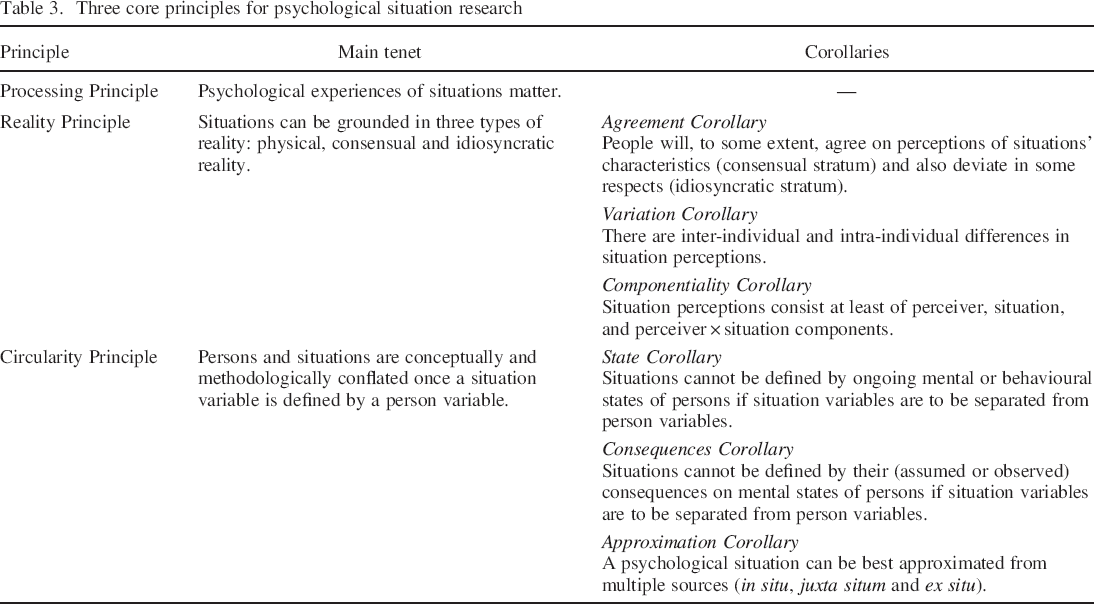
We have compiled three core principles, with some corollaries, that we believe can synthesize situation research, provide a consensual structure and generate fresh ideas: The Processing, Reality and Circularity Principles. These principles and their corollaries are summarized in Table 3. We consider them axiomatic in that they cannot be directly tested and thus represent pragmatic assumptions with at least intuitive validity. However, some of the principles entail corollaries and implications, most of which can be subjected to empirical testing. As such, the principles and their corollaries may also serve as guides for the conduct of future cumulative and systematic theoretical, empirical and applied research on situations, particularly within personality and social psychology and in other areas (e.g. developmental, organizational or clinical psychology). Further, the principles were designed to reconcile the long–standing feud between objective and subjective situation perspectives. Specifically, the Processing Principle addresses the assumption, physical and phenomenological perspectives; the Reality Principle the physical, consensus, phenomenological and idiosyncrasy perspectives; and the Circularity Principle the phenomenological and idiosyncrasy perspectives.
Three core principles for psychological situation research
The processing principle
Psychological situations
The Processing Principle states that situations only acquire ‘psychological importance’ by being processed and psychologically experienced by at least one individual (who then may act based upon his or her situational experiences). This line of thought is illustrated in the basic process model depicted in Figure 1. Hogan (2009, p. 249) asserted that ‘everyone … agrees that “situations” only matter if they are perceived by the individuals in them’. This statement has two important ramifications. First, a situation only ‘exists’ if at least one person processes it.1 For example, a ‘situation’ exists right now on the surface of Venus, but it is not a psychological situation because nobody 1 is there to experience it. Second, how people consciously or unconsciously process situations (Bowers, 1981) affects their affective, cognitive, motivational and behavioural patterns and long–term outcomes such as mental and physical health (Endler, 1981; Lewin, 1936; Murray, 1938; Rauthmann, 2013).
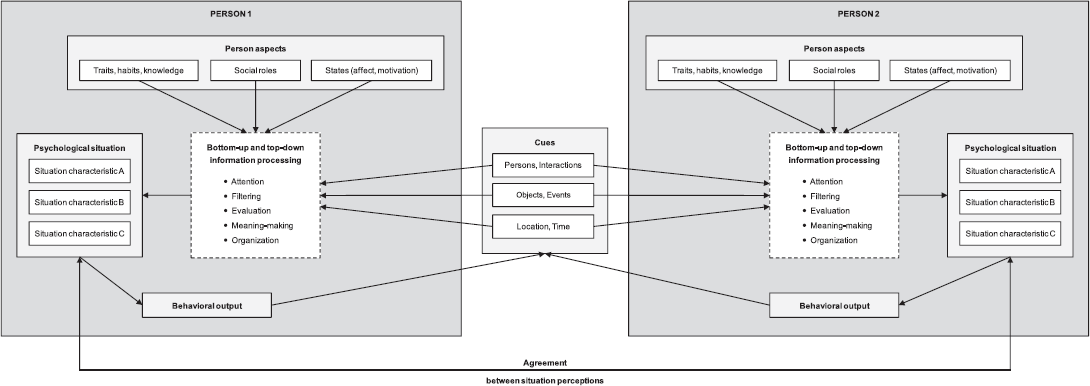
A simple process model of situation perception and agreement.Note: This schematic model illustrates in simplified terms what happens when two persons (Persons 1 and 2) encounter a certain setting with environmental cues (depicted in the middle). Both persons process these cues, and that processing depends on both stable and variable person–bound variables (such as traits, roles and mental states). This processing results in a psychological situation—the experience of the situation. The person's experiences will match to the extent that they (a) attend to the same cues in the environment and (b) process these cues in similar ways (because both share similar personalities, roles, and/or mental states). Thus, both persons will show agreement in their situation perceptions. Both persons‘ experiences will eventually result in actions taken, and with their behaviours they may influence the cues in their environment. To the extent that both persons communicate, they may increase their agreement and/or coordinate their behaviours accordingly. This model is relevant for the Processing and Reality Principles.
Zavalloni and Louis–Guerin (1979, p. 310) integrated objectivist and subjectivist perspectives by stating that ‘on the one hand, the environment is something out there, on the other, as internalized content, it constitutes a property of the “processor” through which he responds to a particular external task environment.’ This notion is reflected in the process model of Figure 1 that seeks common ground between conceptualizations that have been previously proposed (e.g. Magnusson, 1981; Rauthmann et al., 2014; Reis, 2008; Yang et al., 2009). The model incorporates “objective” physical stimuli (in the middle) and people's “subjective” processing of these stimuli (the grey–shaded boxes), while the two people in the figure may or may not reach consensus in their experience of the situation (see the agreement line).
Both chronically and/or momentarily activated person factors (traits and states) and situation cues ‘feed into’ a person's psychological representation of a situation (Block & Block, 1981; Fleeson, 2007; Forgas, 1976; Krahé, 1995/2010; Magnusson, 1981a; Mischel & Shoda, 1995; Murray, 1938; Nystedt, 1981; Pervin, 1976; Rauthmann, 2012; Reis, 2008; Reis & Holmes, 2012; Saucier et al., 2007; Stebbins, 1967, 1969; Wicker, 1992). Our ‘psychological situation’ thus fits James and Sells‘ (1981, p. 275) definition of situations as ‘individuals‘ cognitive representations of proximal environments, expressed in terms that represent the personal or acquired meaning[s] of environments to individuals’. Situation cues are selected, filtered, evaluated, interpreted and assigned meaning via automatic bottom–up and top–down ‘hot’ (impulsive–affective and more implicit) and ‘cold’ (reflective–cognitive and more explicit) information processing (e.g. Strack & Deutsch, 2004). Stable and fluctuating person factors (e.g. traits, knowledge, habits, social roles, mood, goals, etc.) guide chronic and concurrent selection and interpretation of these cues (Magnusson, 1981; Mischel & Shoda, 1995, 1999; Nystedt, 1981; Rauthmann, 2012; Reis, 2008). As a function of these, situation characteristics are then perceived and ascribed to the situation (de Raad, 2004; Edwards & Templeton, 2005; Harré & Madden, 1975; White, 1989). How the situation is experienced will determine what a person thinks, feels, wants and acts upon within it. These situation experiences may, down the road, also impact social relationships and life stories either because they involve special or drastic life events or life transitions (e.g. Bleidorn, 2012) or because they contribute cumulative effects that accrue over time to sizeable proportions (e.g. Kandler et al., 2010; Serfass & Sherman, 2013; Sherman et al., 2013). The person's reactions generate further information processing, but also impact situation cues via person–situation transactions: Based on situation experience, a person may maintain, select (i.e. approach or avoid), change and/or create certain aspects of the situation (e.g. Buss, 1987; Rauthmann et al., 2015).
Addressing the objectivism–subjectivism debate
The model in Figure 1 touches upon the objectivism–subjectivism debate in that it acknowledges that there is an objective reality ‘out there’ (i.e. the physical cues) but that people only form mentally represented impressions of it. This is consistent with the often articulated idea that situations can be understood as mentally constructed entities (Battistich & Thompson, 1980; Cantor, Mischel, & Schwartz, 1982; Champagne & Pervin, 1987; Dworkin & Goldfinger, 1985; Eckes, 1995; Edwards & Templeton, 2005; Forgas, 1976; Krahé, 1995/2010; Rauthmann, 2012; Schutte, Kenrick, & Sadalla, 1985). Indeed, situation processing as ‘the point of engagement between organism and environment’ (Pervin, 1978, p. 83) constitutes a fundamental property of organism fitness (Miller, 2007): Situational information may stand directly or indirectly in the service of interpreting others‘ behaviours (‘what has led that person to act like that?’) and planning one's actions (‘what should I do under these circumstances?’), thus fulfilling fundamental functions of social cognition and self–regulation (Cantor, 1981).
The Processing Principle addresses the assumption, physical and phenomenological perspectives. First, accepting the Processing Principle rejects the assumption perspective completely because situations have to be processed by someone. Dismissal of the assumption perspective, in turn, implies embracing the phenomenological position: that situations are defined in terms of people's experiences (because these experiences give situations their ‘power’, make them matter, and propel people to [re–]act accordingly). Nonetheless, the Processing Principle, encapsulated in the model in Figure 1, acknowledges parts of the physical position: people's experiences are based upon tangible and objectively measurable physical cues in the environment (Block & Block, 1981; Magnusson, 1981a, 1981b; Rauthmann, 2012; Reis, 2008), but it is through being explicitly and/or implicitly processed that they become consequential.
The Reality Principle
The Reality Principle states that any explicit experience of situations (i.e. a situation perception that a person might articulate) is grounded in three types of ‘reality’ (Block & Block, 1981): physico–biological cues (‘objective’ physical reality), canonico–consensual aspects (normative, quasi–objective social reality) and subjective–functional aspects (distinctive, idiosyncratic personal reality). We refer to these ‘realities’ as the physical, consensual and idiosyncratic strata. At the physical stratum, cues in the environment may be perceived or not. At the consensual stratum, some perceptions of situation cues may be consensually agreed upon and their meaning shared with others. Shared representations rely on common group knowledge (consensus) via shared lexica, concepts, meanings and scripts within a given socio–culture (e.g. Argyle, 1981; Argyle et al., 1981, p. 4). Normative interpretations constitute ‘social reality’ (Rommetveit, 1981). At the idiosyncratic stratum, individuals may perceive and interpret cues that others miss and/or may interpret particular cues in ways other than the consensual interpretations. Non–shared representations can be considered individuals‘ idiosyncratic construals based on individual differences in preferences, weltanschauung, evaluations, appraisals and so on. Non–shared representations constitute our ‘private worlds’ (Rommetveit, 1981).
The Reality Principle echoes earlier approaches emphasizing shared versus non–shared representations of situations. For example, Murray (1938) distinguished ‘alpha press’ as more distal, observable, quasi–objectively quantifiable and consensually agreed–upon situational pressures, affordances or constraints from ‘beta press’ as proximal, private and subjectively perceived interpretations of situational presses, affordances or constraints (see also Kantor, 1924, 1926; Koffka, 1935; Rotter, 1981; Wagerman & Funder, 2009; Yang et al., 2009). In a similar vein, Moos (1973) summarized six non–exclusive, overlapping and mutually interrelated aspects of human environments: (i) ecological dimensions; (ii) behaviour settings; (iii) dimensions of organizational structure; (iv) dimensions of collective, personal and/or behavioural characteristics of inhabitants; (v) dimensions of psycho–social characteristics and organizational climates; and (vi) variables concerning functional or reinforcement analyses. Murray's alpha press captures Moos‘ aspects (i)–(ii) as well as Block and Block's physico–biological and canonico–consensual concepts that we used to express the Reality Principle, while his beta press captures Moos‘ aspects (v) and (vi) as well as Block and Block's subjective–functional concept.
To illustrate the different reality strata, consider the specific work situation ‘Tasks are piling up.’ This situation can be said to have an objective reality that is directly tied to its physical circumstances (e.g. number of people or emails requesting something, number of To–Do list items, cluttered desk, etc.). Such objective reality may never be fully specifiable as that would require quantifying literally every physical aspect of the situation. There is also a social reality tied to the normative interpretation of the physical cues. Such a reality may be quantified via consensual agreement from ordinarily socially competent people (e.g. on how high the situation scores on Duty from the DIAMONDS). Finally, there are as many personal realities tied to the characteristics of the situation as there are participants and observers. For instance, Susan may perceive the situation to require urgent action (perhaps because she is very conscientious), while Dana does not (perhaps because she tends to procrastinate too long). Susan's perception may be more consistent with the social reality of the situation (e.g. it is generally perceived as inspiring Duty) than Dana's, but it may still be idiosyncratic to some degree (e.g. she may experience the particular tasks as inspiring duty much more than most people). Thus, idiosyncratic reality captures how people differ from each other and from the consensus regarding their situation experiences.
The agreement corollary
The Reality Principle spawns a corollary that addresses the consensual and idiosyncratic realities of situations. To the extent that people (i) perceive identical cues and (ii) process these cues in similar ways as other people (because of similar information processing systems, momentary mental states and/or personality traits), situation experiences become shared (i.e. consensual stratum). To the extent that people (i) perceive different cues or (ii) process identical cues in different ways as other people (because of dissimilar information processing systems, momentary mental states and/or personality traits), situation experiences become not shared (i.e. idiosyncratic stratum). Figure 1 graphically illustrates how two people (Persons 1 and 2) achieve agreement on perceptions of a situation.
Because almost any situation experience is based on external cues, 3 we can expect that people will largely agree on their psychological assessments of situations to the extent that they are exposed and attend to the same cues (even if these people differ in information processing systems, levels of personality traits and/or mental states). This expectation is embodied in the literature of experimental social psychology, much of which implicitly relies on the assumption that the manipulated situational independent variables are perceived by participants in largely the same ways (Wagerman & Funder, 2009). The notion that human perceptual and cognitive systems evolved to respond efficiently and effectively to physical reality to avoid dangers, seek rewards and survive offers justification for this (Tooby & Cosmides, 1990).
The variation corollary
The assumption of shared interpretation of situational information is basic to any experimental psychological field. Variations in situation experiences, to the extent they exist in experimental studies, are relegated to ‘error variance’ as researchers seek to identify manipulable situational variables that, in general, can be shown to affect behaviour (Wagerman & Funder, 2009). Still, people do not always experience the same situation in an identical fashion (even if they are exposed to the same cues for the same amount of time), and different people often have different views of the same situation. 4 Thus, the Reality Principle spawns a corollary that addresses only the idiosyncratic stratum of situations: Variations in situation experience can be intra–individual (i.e. the same person sees the same kinds of situations differently in each instance) or inter–individual (i.e. different people see the same situation differently). These sources of variation limit total agreement (see Section on The Agreement Corollary) and provide ‘wiggle room’ for personal experiences that are not shared with others.
The argument we seek to formulate is that intra–individual and inter–individual variations of situation experiences should not be considered error variance. Rather, such variation should be embraced and seen as meaningful parts of situational experiences. For example, it has been shown that within–person variation in experience of different situations is meaningful and related to personality (Sherman et al., in press). Moreover, individual differences in construal of the same situation are related to personality (see Morse, Sauerberger, et al., in press; Rauthmann, 2012; Rauthmann et al., 2015; Serfass & Sherman, 2013; Sherman et al., 2012; Todd, 2014).
The componentiality corollary
The Agreement and Variation Corollaries state that people agree on some (aspects of) situation perceptions but not all. Accordingly, Yang and colleagues (2009, p. 1020) stated that ‘situations can be generally defined as a combination of the individually interpreted, implicit and unique understandings, and the culturally shared, explicit and common understandings of the surroundings that produce and constrain human behaviour.’ But how can these ‘realities’ be disentangled? Figure 2 suggests an integration of the Reality Principle with its corollaries.
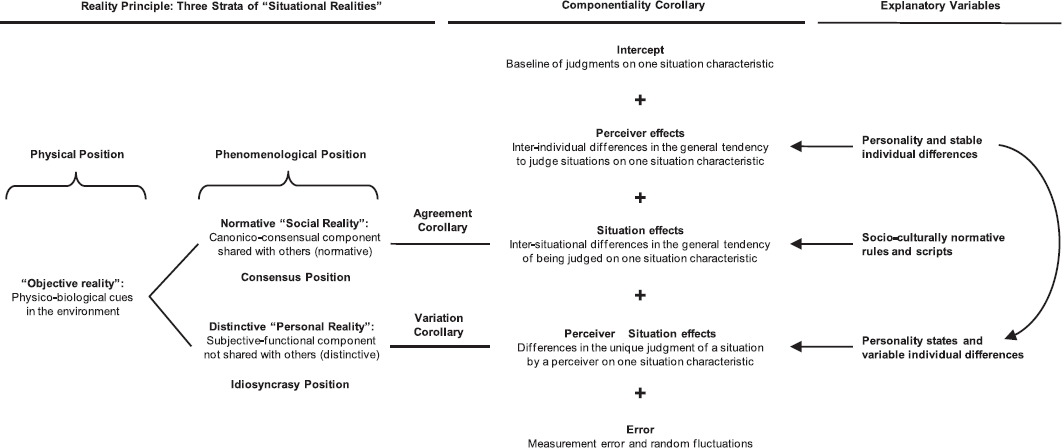
The Reality Principle and its corollaries.Note: This model corresponds to a fixed–situations design where multiple perceivers judge the same set of multiple situations on one situation characteristic. In such instances, variance decomposition of the resulting data can be used to disentangle, among other things, situation components (= consensual reality stratum) from perceiver × situation components (= idiosyncratic reality stratum). If a random–situations design were used (where there are multiple perceivers, but each judge a different situation on the same situation characteristic), then a consensual reality stratum can only be approximated by an aggregate score of additionally gathered ex situ ratings (or a factor–analytically derived score capturing the commonly shared variance between in situ and ex situ ratings) and the idiosyncratic reality stratum by the in situ ratings controlled for the ex situ ratings (i.e. residual scores).
On a conceptual level (left side of Figure 2), the physical (focusing on objective cues) and the phenomenological (focusing on situation experiences) perspectives can be distinguished. The latter subsumes the consensus and idiosyncrasy perspectives. Thus, the consensus perspective has been incorporated into the phenomenological perspective. It may thus seem as if it has transitioned from the objectivist into the subjectivist perspective, but it is more accurate to consider it the link between them: The consensus perspective stands between the objectivist and subjectivist perspective in that it relies on situation perceptions (phenomenological perspective), but only those on which there is sufficient agreement that they (or their content) may be considered ‘facts’. Thus, the Reality Principle conceptually covers the physical, phenomenological, consensus and idiosyncrasy perspectives.
Integration of the objectivist and subjectivist perspectives implies the Componentiality Corollary: Any situation experience simultaneously requires (at least) a perceiver, a situation and a ‘relationship’ between the perceiver and the situation. As such, any explicit perception of a situation (e.g. how ‘intellectual’ a situation is) may contain—conceptually (and statistically)—different components, such as (i) intercept (i.e. some ‘typical’ perception as the baseline level, e.g. of Intellect from the DIAMONDS); (ii) perceiver (i.e. perceptual consistency; e.g. the perceiver's general tendency to consider situations intellectual); (iii) situation (i.e. social reality; e.g. the situation's general tendency to be considered intellectual); (iv) perceiver × situation interaction (i.e. personal reality; e.g. how uniquely intellectual the particular perceiver sees the particular situation); and (v) measurement error. 5 The personality judgement literature has successfully demonstrated that valuable insights may be gleaned from distinguishing such components in judgement data (see, e.g. Back & Kenny, 2010; Back et al., 2011; Jussim, 2005; Kenny, 1994; Kenny, West, Malloy, & Albright, 2006), and this may be also true for situation perceptions (for first evidence, see Rauthmann, 2012). Variance decomposition of personality judgments has been used to examine consensus (inter–rater agreement) by attending to target variance in judges‘ trait ratings of targets (Kenny, 1994). Such consensus investigations are also possible for situation perceptions. For example, situation variance (relative to total variance) seems to be relatively large in situation perceptions (and much larger than target variance in person perceptions), indicating a strong consensual stratum (Rauthmann & Sherman, in preparation). Not only the quantification of variance components but also the derivation of effect scores may be interesting. For example, Rauthmann (2012) showed that both perceiver and perceiver × situation effects (idiosyncratic stratum) were associated with major personality traits (Big Five).
The Circularity Principle
Both the Processing and the Reality Principles stress the importance of situation perceptions. Further, many research designs (have to) employ participants‘ situation perceptions to measure situational information. Thus, we need to address to what extent a measured situation variable (i.e. someone's perception) is not actually just a person variable. The Circularity Principle states that situation variables, when defined only by person variables (e.g. participant's perceptions or behaviours), blur the distinctions among persons, situations and behaviours (Funder, 2006, 2008, 2009), leaving attempts to examine person–situation transactions circular and tautological (see also Reis & Holmes, 2012). There are three instances where clean separation of persons and situations is jeopardized, and each instance represents a corollary of the Circularity Principle: when situations are defined and measured (i) by participants‘ ongoing mental or behavioural states; (ii) by hypothesized or post hoc observed consequences on participants‘ mental or behavioural states; and (iii) when only one person's situation perceptions are considered.
The state corollary
The State Corollary states that if people's mental and behavioural states are seen as constituents of situations (i.e. as cues), then the person and the situation have become indistinguishable. Thus, to prevent circularity in theory and data gathering, people's mental and behavioural states should not be considered parts of situations or the situation per se. For example, a person's excitement in a situation should not be (part of) the situation, but an accompanying aspect or response for this person (e.g. mood). Similarly, a person's socializing with other people reflects the person's behaviour within the situation but not the situation itself. 6 The State Corollary is often violated in literature that has defined, described or even assessed situations using person states (Rauthmann, in press; cognitions: Craik, 1981; Rotter, 1981; emotions: Russell, Ward, & Pratt, 1981; Saucier et al., 2007; motivations: Murray, 1938; Yang et al., 2006; behaviour/actions: Hacker, 1981; Pervin, 1978). In accordance with the State Corollary, the process model in Figure 1 distinguishes between concomitant person variables in situations (such as a person's current mood, motivation or ongoing behaviour), outcomes of situations for persons (such as future behaviour in response to what happens in the situation) and physical constituents of situations (i.e. cues).
The consequences corollary
The Consequences Corollary states that circularity is introduced by post hoc explaining or defining situations in terms of their (actual or potential) consequences on mental and behavioural states (rather than as the states themselves). 7 No understanding is conferred, for example, by stating that ‘the situation was exciting to the participant because he/she got excited.’
Researchers conducting studies designed from the assumption perspective assume that their situations will have ‘caused’ mental or behavioural states if they observe the hypothesized states after experimental manipulation. Here, mental states and behaviour are observed (e.g. feeling lonely, enjoying a self–esteem boost, feeling excited, etc.), but their presence does not grant information about how or whether the situation triggered them. Attention to the Consequences Corollary keeps our assumptions in check and reminds us that we should try to (i) explain effects (not just observe them and jump to post hoc inferences) and (ii) track underlying mechanisms and processes (e.g. how people perceived the situation's characteristics that then triggered their behaviour; Figure 1).
The approximation corollary
If we should not, or cannot, assume the operation of a situation, then we actually need to measure situational information. However, in contrast to persons, situations cannot provide information about themselves. As such, to assess characteristics of situations, we need to rely on people to rate situations. However, defining any situation solely by one person's experience (e.g. ‘I was in a very social party situation’) completely confounds contact with situations (which kind of situation was the person actually in?) with construal of situations (how did the person interpret the situation?) and makes it impossible to identify its reality strata (see The Reality Principle). The Approximation Corollary thus states that a psychological situation is best assessed using at least two rating sources. The relative approximation this inevitably entails is offset by the avoided circularity.
But who can rate a situation? Raters can be in situ (‘within the situation’), juxta situm (‘around the situation’) and ex situ (‘outside of the situation’). These rater types can be contrasted on the dimensions of (i) whether they are physically present in the unfolding situation; (ii) whether their ratings depend on their personal experience of (being in) the situation; and (iii) to what extent they are personally involved in and/or affected by the situation. Raters in situ (typically focal participants) are present in the situation, base their ratings on personal experience and are personally involved and/or affected. Raters juxta situm (typically observers, bystanders or confederates) are also present in the situation and personally witness it, but they are usually not involved and may be affected by it much differently from (and generally less than) raters in situ. Raters ex situ (typically lab raters) are even more detached from the situation than raters juxta situm: They are not physically present in the situation, their ratings do not depend on personal experience (they rate the situation based on written descriptions, photos or video clips) and they are not personally involved and/or affected by the situation.
Summary
Psychologists in almost every area are interested in defining, systematizing, understanding, explaining and/or modifying person–situation transactions (e.g. Allport, 1961; Asendorpf & Wilpers, 1998; Baltes, 1997; Bandura, 1978; Buss, 1987; Caspi & Roberts, 2001; Caspi, Roberts, & Shiner, 2005; Chorpita & Barlow, 1998; Cramer et al., 2012; Fleeson, 2007, 2012; Funder, 2006, 2008, 2009; Gosling, Gaddis, & Vazire, 2008; Gross, 1998; Haase, Heckhausen, & Wrosch, 2013; Holland, 1973; Ickes, Snyder, & Garcia, 1997; Johnson, 2007; Kandler, Bleidorn, Riemann, Angleitner, & Spinath, 2012; Kandler, Riemann, & Angleitner, 2013; Lewin, 1936, 1946, 1951; Luhmann, Orth, Specht, Kandler, & Lucas, 2014; Mischel, 1977; Mischel & Shoda, 1995, 1999, 2008; Mund & Neyer, 2014; Pettigrew, 1997; Plomin, DeFries, & Loehlin, 1977; Rauthmann, 2010, 2013; Read et al., 2010; Roberts & Caspi, 2003; Ryff, 1987; Scarr & McCartney, 1983; Schmitt et al., 2013; Shiner, 2009; Snyder & Ickes, 1985; Walsh, Price, & Craik, 2000): how people experience, construe, maintain, select, evoke, change and create situations in their everyday lives and across their life spans. To study such transactions, however, a firm psychology of situations is essential. Towards this end, we have set forth three core principles (with corollaries) to provide a foundation for psychological situation research (Table 3): the Processing, Reality and Circularity Principles.
The Processing Principle specifies that information processing of situational information is important and that, as such, psychologically experienced situations matter to individuals. This means that situations only have consequences for people's thinking, feeling, desiring and acting through the psychological processing they receive (Figure 1). The Reality Principle then clarifies how different realities—physical reality (cues), consensual reality (normative social reality) and idiosyncratic reality (distinctive personal reality)—are contained within situation experiences to reconcile objectivist and subjectivist perspectives (Figure 2). Encapsulated into its three corollaries, the Reality Principle holds that (i) people substantially agree in their perceptions of situations (Agreement Corollary); (ii) there are intra–individual and inter–individual differences in situation perceptions nonetheless (Variations Corollary); and (iii) situation perceptions are not monolithic but contain different components, such as perceiver, situation (social reality) and perceiver × situation (personal reality) components (Componentiality Corollary). The Circularity Principle notes that persons‘ perceptions and situations‘ characteristics are confounded when situations are defined or measured in terms of (i) people's mental states or behaviour (State Corollary); (ii) observed or assumed consequences on people's mental states or behaviour (Consequences Corollary); and/or (iii) only one person's perception (Approximation Corollary). To approximate the psychological situation from different perspectives, more than one rating source of the situation should be employed.
Building upon each other, these three interlocked principles are intended to guide and foster more coherent research programs that can produce cumulative knowledge on psychological situations and person–situation transactions. Next, we outline implications and considerations of the principles and then delineate some future directions.
Considerations and Implications
Different types of situational information co–exist in extant research
Previous literature has often used terms haphazardly and inconsistently, creating a ‘jingle–jangle jungle’ of terms that obfuscates the literature and impedes research progress (e.g. the jingle problem that ‘features’ and ‘properties’ may both refer to characteristics and the jangle problem that features may refer to either cues or characteristics). To cut through this jingle–jangle jungle, we propose standardizing and limiting terminology for describing situations to ‘cues’, ‘characteristics’ and ‘classes’ to facilitate accurate and precise communication. Each of these concepts plays a specific role in taxonomization and measurement.
On one hand, assessment of situational information is difficult if we have no guiding taxonomies of what to assess. As such, lack of ‘a taxonomy of situations’ (Rauthmann, in press; Reis, 2008; ten Berge & de Raad, 1999; Yang et al., 2009) has been repeatedly bemoaned. On the other hand, taxonomizing situational information is difficult if we have no criteria or methods to assess it reliably. Presuming agreement on our three basic types of situational information, each could serve as the basis of a taxonomy 8 , with differences in ability to facilitate different aspects of research. Thus, we should not impose a ‘taxonomy of situations’ inflexibly; instead, we should tailor different situational taxonomies to our research needs. This point has not been appreciated sufficiently so far, although several taxonomies of situation cues (e.g. Saucier et al., 2007), characteristics (e.g. Rauthmann et al., 2014), and classes (van Heck, 1989) have been proposed (though not clearly distinguished from each other; Rauthmann, in press). Part of the confusion about which taxonomy to use (for details, see Rauthmann et al., 2014) stems from failure to distinguish clearly among cues, characteristics and classes.
Psychological (experiences of) situations matter
The Processing Principle alerts us that we should attend to people's experiences, impressions or perceptions of situations, particularly in instances where we are interested in how (and why) people behave the ways they do in certain situations. We believe that situation research will be best off focusing on perceptions of situation characteristics; thus, the Processing Principle has implications for how to treat cues and classes and which kinds of situation research will be most productive.
Contra cues: The limited utility of stimulus research
Cues are frequently assumed to be uniformly powerful in social, cognitive and experimental paradigms where ‘stimuli’ or ‘settings’ are manipulated within or between groups and differences in affective, cognitive, motivational and behavioural responses tracked as functions of those manipulations. While such research is convenient, it—by default—reduces situations to only the experimentally controlled cues, ignoring individual differences influencing real–world situation participation as well as how people process both the manipulated and non–manipulated cues. Such approaches are important in understanding typical reactions to cues, but less so in understanding how daily person–situation transactions (e.g. situation selection and construal) unfold. Nonetheless, cues provide important information about the ‘objective’ environment within which a psychological situation takes place. As such, it can be helpful to tie cues to (consensually or idiosyncratically perceived) characteristics and vice versa (see Rauthmann et al., 2014, Study 3).
Contra classes: The limited utility of categorical research
Early theories of personality often used typological/categorical approaches, while modern personality psychology has embraced a dimensional approach in trait theories (John & Srivastava, 1999; McCrae, Terracciano, Costa, & Ozer, 2006). In a similar vein, we believe that sole reliance on a categorical approach to situations would be limiting for several reasons, particularly when comparing categorical approaches to what dimensional approaches can offer.
First, a categorical approach robs us of information because it forces situations into nominal categories they may not neatly fit. One solution is to create more nuanced (or hierarchically nested) situation classes. However, this limits statistical power by increasing the number of dummy codes needed. Moreover, classes can be made up of combinations of characteristics. Thus, one can obtain classes from characteristics (e.g. by latent class analyses of DIAMONDS profiles; template matching: Morse, Neel, et al., in press), but going the other direction from classes to characteristics is problematic because characteristics can then only be inferred and not empirically derived. Finally, categorical approaches leave us wanting more. If someone says that they were in a ‘work situation’, we probably have some idea that there are likely obligations and tasks (i.e. high Duty). But, for example, does the work require deep thinking (Intellect), are there job insecurities (Adversity), is there opportunity to flirt with an attractive coworker (Mating), is the work engaging (pOsitivity), is the task load taxing (Negativity), is it important to figure out who can be trusted (Deception), are there opportunities to get to know co–workers better (Sociality)? The dimensional approach offers answers to these questions, while the typological approach would either have to lump together many heterogeneous work situations or create too many sub–classes of work situations. Thus, we believe that assessing situational information as classes (e.g. with ‘Yes/No’ checklists) is too limiting, although deriving classes from profiles of situation characteristics may be useful in examining theoretically relevant situation classes (e.g. from an evolutionary perspective: Morse, Neel, et al., in press).
Pro characteristics: Advantages of dimensional approaches
Defining situations using characteristics offers several advantages. First, characteristics describe situations similarly to how people are described with traits (de Raad, 2004, pp. 186/187; Edwards & Templeton, 2005, p. 706; Pervin, 1981; Rauthmann et al., 2014). They denote attributions of underlying causal powers or qualities (Edwards & Templeton, 2005; Harré & Madden, 1975; White, 1989) and capture psychologically salient and important meaning (Magnusson & Endler, 1977, p. 4). Consequentially, they likely represent the most fruitful unit of analysis when it comes to establishing psychological effects of situations.
Second, theoretically, characteristics guide behaviour. According to Endler (1981, p. 364, italics in original), ‘actual behaviour occurs in a situation, or the aspect of the ecology that a person perceives and reacts to immediately’ (Lewin, 1936, p. 217; Murray, 1938, p. 40). Supporting this, Rauthmann and colleagues (2014) observed that the Situational Eight DIAMONDS dimensions were related to a host of behaviours, and Sherman and colleagues (in press) found that they were also related to momentary expressions of personality states.
Third, quickly forming impressions of situations serves the adaptive purpose of better navigating through the world (Buss, 2009; Edwards & Templeton, 2005): a perceiver is able to understand—in a succinct manner (e.g. Duty: Work needs to be done)—what is happening, surmise what might have led to the observed state of affairs, extrapolate what might happen and coordinate own behaviour accordingly (Endsley, 1995a, 1995b). Because it would be inefficient, costly and time–consuming to process every single cue in the environment separately, the human perceptual system has evolved to attend to, filter, integrate and interpret information quickly (Buss, 2009; Miller, 2007; Tooby & Cosmides, 1990)—resulting in the formation of condensed psychological situation characteristics with tangible consequences for regulation and behaviour. 9
Thus, we propose that psychological situation research may particularly benefit from focus on a variable–oriented approach where situations are described with characteristics instead of their cues or the classes in which they fall (Fleeson, 2007; Rauthmann et al., 2014). Cues and classes convey only nominal information and usually tell us little if anything about what situations mean psychologically. For example, what does a ‘work situation’, a ‘rejection situation’ or a ‘family situation’ mean? That is where (agreed–upon) dimensions of situation characteristics (e.g. the DIAMONDS) come into play: They can be used to describe and summarize any situation and thus enable comparing situations (similarly to how people are compared on levels of agreed–upon traits) in a ‘differential’ psychology of situations.
Research on situation perception
The Processing Principle—emphasizing the importance of the experiential aspects of situations—necessitates that we devise and hone theories about situation perception. According to Magnusson (1981b, p. 24), situation perception is one of the most important fields in situation research (Cantor, 1981; Jessor, 1981; Nystedt, 1981; Rauthmann, 2012; Rotter, 1981). There are several strands of research that will benefit from a better understanding of situation perceptions because (i) situation perceptions can function as mediating variables between cues and behavioural (re–)actions (Figure 1); (ii) systematic individual differences in situation perceptions may be associated with personality traits; (iii) personality manifestations always occur in situ and are thus likely to rely on people's situation perceptions (Block & Block, 1981; Fleeson, 2012; Fleeson & Jayawickreme, in press; Sherman et al., in press); and (iv) situation perceptions aid in understanding perspective taking of others‘ situations (‘if I were in your situation …’).
Situational information can be assessed with different methods
There is an abundance of research on how personality (e.g. Weiner & Greene, 2008) or behaviour may be assessed (e.g. Furr, 2009), but for situations, we are mostly still groping in the dark. Thus, it is useful to acknowledge the Circularity Principle in developing methods of situation assessment. In doing so, we can cross four dimensions among themselves: (i) the rating source; (ii) the situation that is being rated; (iii) temporality of the ratings; and (iv) basis of the ratings. A full crossing among these dimensions yields 3 × 3 × 3 × 3 = 81 different cells, but only 19 define practical (and sensible) assessment methods for situation research. Table 4 summarizes those 19 methods. Some of them have been used, while others await their debut.
Methods of assessing situational information
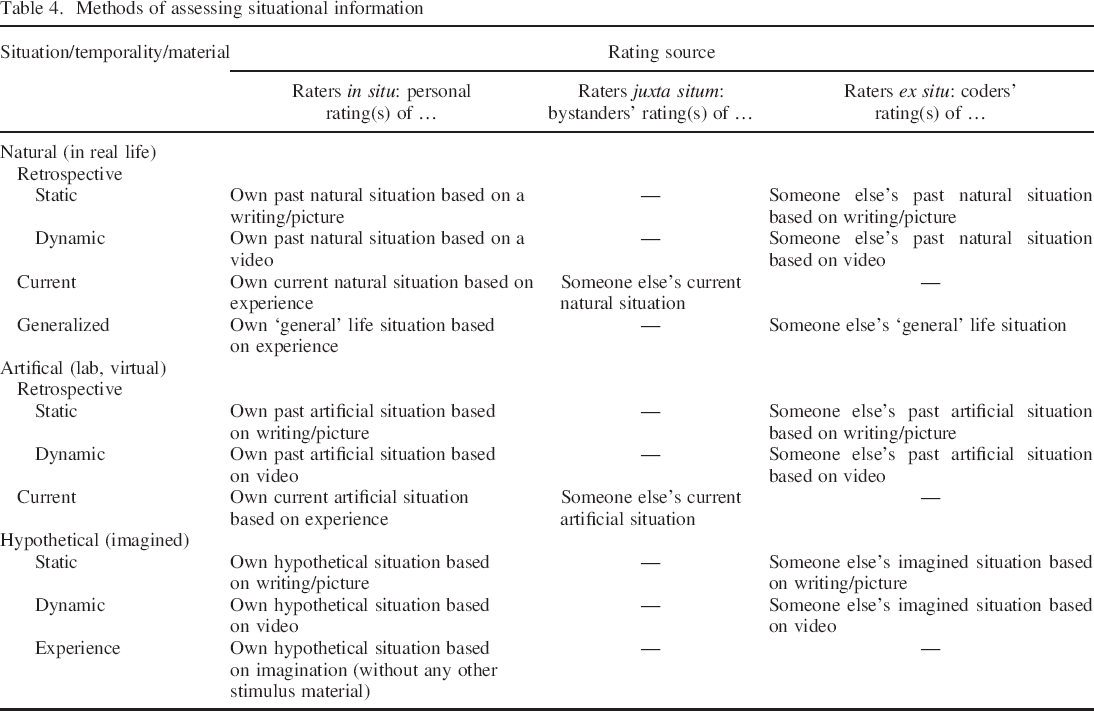
Rating source refers to the three types of raters we outlined in the Approximation Corollary: (i) raters in situ (within the situation and affected by it); (ii) raters juxta situm (within the situation but not necessarily affected by it); and (iii) raters ex situ (not in the situation and not affected by it). The focal situations that are being judged can be (i) natural situations that take place in real life; (ii) artificial situations that take place in laboratory settings or virtual environments; or (iii) hypothetical situations that are only imagined and thus may not actually take place. 10 Rating temporality refers to whether ratings are made (i) retrospectively (i.e. relying upon recall); (ii) while in process; or (iii) in a generalized fashion (i.e. for one's current life or habitual environment). 11 Ratings can be based on different kinds of material, and the most common ones are (i) static (e.g. pictures and written text vignettes); (ii) dynamic (e.g. audio and video); and (iii) one's experience (e.g. what one sees, hears, feels, smells and tastes).
Table 4 is intended to serve as a guiding chart for researchers interested in measuring situational information. As can be seen there, raters in situ can be used more often than raters ex situ, and raters ex situ more often than raters juxta situm. Indeed, using raters juxta situm only makes sense in two cases: if someone else's current natural or artificial situation needs to be judged as it occurs. In contrast, raters ex situ may be used with greater flexibility, especially if information on raters‘ in situ situations is available via static or dynamic material. Knowledgeable raters ex situ (i.e. close friends or family) may also rate someone else's general life situation. As can be gleaned from Table 4, all designs but one would potentially meet the Approximation Corollary by allowing at least two types of raters: rating a hypothetical situation based on one's imagination. But if actual person–situation transactions are of interest, the hypothetical situation methods should probably be avoided altogether. While the natural situation methods are of course ideal, artificial situations can also be employed provided that participants do act naturally there (i.e. voluntarily select into and respond within those situations realistically). Further, in–process ratings of situations may be preferred to retrospective situation ratings because memory errors and willful distortions can occur with recall. It would also be useful to sample several current situations from raters in situ and have them protocol those situations in relatively objective terms (e.g. by taking photos, making video clips or itemizing situation cues). These protocols—as static and/or dynamic material—may then be shown later to raters ex situ. This example demonstrates that two (or more) methods from Table 4 may be combined in one research design. Thus, the 19 methods are not mutually exclusive but can complement each other. Regardless, we recommend that (i) research on person–situation transactions focus on natural situations and (ii) the methods used require situation assessments from more than one source.
Situational information can be assessed in fixed–situation and random–situation designs
Two basic designs can be employed in situation research: Each person experiences or rates (i) a fixed set of circumscribed situations to which all participants are exposed equally (fixed–situations design) or (ii) situations that occur in participants‘ daily lives (random–situations design). 12 Standardized and experimentally controlled research settings rely on the fixed–situations design. However, such designs may limit examinations of genuine person–situation transactions because in experimental settings (including hypothetical situations) participants usually cannot select their surroundings as they do in real life and may respond differently because they know the situations are artificial. Thus, random–situations designs may be more effective where situation perceptions and participation vary. Such designs, however, are prone to violating the Circularity Principle, which is why multiple raters (ex situ) should be used (see the Approximation Corollary).
Assessing the physical, consensual and idiosyncratic reality strata
The definitions of the reality strata (Figure 2) from the Reality Principle can be translated into measurement requirements. For the physical stratum, cues (e.g. number of people present, amount of light in lux, volume of ambient sound in decibels, etc.) can be relatively objectively quantified. The consensual and idiosyncratic strata need to be handled differently depending on whether a fixed–situations or random–situations design is used.
Strata in fixed–situations designs
Because situations are ‘fixed’ by definition, there is no natural variation of cues among participants. Examining effects of the physical stratum is thus impossible; rather, attention to ecological validity should have gone into selection of cues during study design (and cues should be reported in detail in the study report to foster assessments of replicability and generalizability). Examining the consensual and idiosyncratic reality strata can be handled with variance decomposition within ANOVA or random–effects modelling frameworks (Generalizability Theory: e.g. Brennan, 2001; Cronbach, Gleser, Nanda, & Rajaratnam, 1972; Shavelson & Webb, 1991) where the same set of perceivers judges the same set of situations on specified characteristics (i.e. a fully crossed half–block design). Variance in situation ratings can then be decomposed into a (i) perceiver component (inter–individual differences in how people generally judge situations); (ii) situation component (inter–situational differences in how situations are generally judged); and (iii) perceiver × situation component (inter–individual differences in how specific situations are uniquely perceived by specific perceivers). Thus, such decomposition can disentangle the consensual stratum (situation component) from the idiosyncratic stratum (perceiver × situation component).
Variance decomposition offers not only quantification of variance sources (percentage of total variance due to perceiver, situation and perceiver × situation) but also perceiver and perceiver × situation effect scores for and situation effect scores for each situation. Such scores may predict outcomes such as future behaviour, mental and physical health, or can be explained by antecedent variables (right side of Figure 2). For example, perceiver effects may be predicted by stable individual differences variables (e.g. needs, values, etc.) and situation effects by normative rules, scripts and codes. Perceiver × situation effects may be predicted by momentary personality states (which tend to be also associated with stable individual differences variables).
Strata in random–situations designs
Variance decomposition is not possible in naturalistic designs where situations are not experimentally controlled and vary among persons. This means that each person rates his or her own situation, which can cause the problems articulated by the Circularity Principle. Specifically, given the Approximation Corollary, random–situations designs should always include at least one other juxta situm or ex situ source rater besides raters in situ. 13 In such a multi–rater approach, (aggregated) juxta situm or ex situ ratings can be used as proxies for each situation's consensual reality, and they can also be partialled out from the in situ ratings so that the resulting residuals represent indices of idiosyncratic reality (e.g. Serfass & Sherman, 2013; Sherman et al., 2013). Further, with multiple ratings, the total (psychological) situation can be approximated by extracting the common variance from in situ, juxta situm and ex situ ratings in a factor or principal components analysis (see Rauthmann et al., 2015 for an empirical demonstration). Indeed, we envision that modelling latent characteristics within structural equation modelling frameworks may be the best way to assess situation characteristics from multiple raters.
Measuring the triad of persons, situations and behaviour
The corollaries of the Circularity Principle have direct implications for how situations should be defined. Because preceding, concomitant and outcome state variables (i.e. affect, cognition, motivation and behaviour) reside with(in) persons, they should not constitute situations but be used to describe persons. Once this is appreciated, person and situation variables can be studied in conjunction (as in Figure 1). For example, in a situation people can be(come) excited (an emotional state), do something exciting (a behavioural description) and describe their situation as ‘exciting’ (a perceived situation characteristic). Thus, situation studies should sample people's mental processes, behaviours and perceptions of situations separately (and have multiple situation raters to avoid circularity in situation perceptions).
We suggest that person and situation measures should ‘speak a common language’, such as the measures for personality (CAQ: California Adult Q–Sort), behaviours (RBQ: Riverside Behavioural Q–Sort) and situation characteristics (RSQ) spawned from Jack Block's Q–sort tradition. Such commensurability of person, behaviour and situation variables in content and measurement creates desirable properties for research (e.g. Johnson, 1999; Kristof–Brown & Guay, 2011). For example, Sherman and colleagues (2010) and Furr and Funder (2004) examined how objective versus subjective similarity of situations regarding their characteristics (ex situ and in situ RSQ ratings) contributed to behavioural consistency on a variety of behaviours (RBQ–ratings). People tended to experience similar situations over time (as measured by associations among RSQ profiles of situations) and were more consistent in behaviour in situations that were similar to each other but also exhibited behavioural consistency above what could be explained by the similarity of the situations they experienced. Moreover, Sherman and colleagues (2012) showed that congruence between personality and behaviour (as measured by a profile association between the CAQ and the RBQ) was higher in psychologically ‘weak’ situations (as defined by an RSQ template) and situations that afforded autonomy, competence and relatedness to others (also defined by RSQ templates).
Future Directions
Further principles (and/or further corollaries)
To keep the messages of this target article simple, we have proposed only three principles (and some corollaries for two of them) that we deem essential cores to achieve advances in psychological situation research. Nonetheless, it is possible to expand these principles by adding new ones and/or devising further corollaries. Thus, proposing principles for psychological situation research can be seen as work in progress. Indeed, the comments to this article as well as future conceptual and empirical research may address potential amendments or spawn additions to the set of initial principles proposed here.
Real–life multi–method multi–situation multi–time multi–group designs
How would an ‘ideal’ design examining psychological situations and person–situation transactions (how people experience and shape situations) look? We believe that situational information—preferably characteristics—should be sampled (i) from multiple people in their everyday lives (Sherman et al., 2010); (ii) with different assessment methods as outlined in Table 4 (including at least one rating source in addition to in situ ratings; Rauthmann et al., 2014); (iii) from multiple situations (e.g. within experience sampling designs; Sherman et al., in press); (iv) more than once to analyse (inter–individual differences in) intra–individual stability, variability and short–term (moment–to–moment, day–to–day) changes in people's kinds and perceptions of situations (e.g. in longitudinal burst designs; Ram et al., 2014); and (v) across relevant groups (e.g. cultures, nations) to examine group–level differences in and moderators of situation experiences and their effects on behaviour (Guillaume–Hanes & International Situations Project Group, in press). Taken together, designs fulfilling at least two of the aforementioned attributes—real–life, multi–method, multi–situation, multi–time, multi–group—are likely to yield valuable new insights into how persons form situations and situations form persons.
Future lines of substantive situation research
The principles we proposed point towards interesting lines of future substantive situation research. These may include, but are not limited to, (i) stronger integration of ideas from philosophy and psychology (e.g. Kristjánsson, 2012); (ii) evolutionary perspectives on situations (e.g. Buss, 1997, 2009; Funder, 2007; Morse, Neel, et al., in press); (iii) cross–cultural comparisons of situations (e.g. Funder, Guillaume, Kumagai, Kawamoto, & Sato, 2012; Guillaume–Hanes & International Situations Project Group, in press); (iv) the ‘strength’ of a situation and its consequences for (variation in) behaviour (e.g. Cooper & Withey, 2009; Judge & Zapata, in press; Meyer & Dalal, 2009; Meyer et al., 2010); (v) inter–individual and intra–individual differences in situation perceptions (e.g. Sherman et al., 2013); (vi) agreement on situation judgments (e.g. Rauthmann & Sherman, in preparation); (vii) stability and change in kinds as well as perceptions of situations across the life span (e.g. for life events, see Kandler et al., 2012, 2013; Luhmann et al., 2014); (viii) personality–situation fit (e.g. Rauthmann, 2013; Roberts & Robins, 2004); and (ix) sophisticated modelling of person, situation and person × situation effects in latent state–trait models (Geiser et al., in press). All these strands of research promise new and intriguing insights into situations, how they operate and how they transact with persons. We hope that the principles we have set forth may guide and enrich these research endeavours.
Conclusion
Many fascinating questions surrounding situations, their workings, their effects and their transactions with persons await conceptual, methodological and empirical investigation. We thus end our target article with a plea: help situation research (re–)flourish and live up to its true potential. By understanding situations better, we are bound to gain better understandings of persons and behaviours. This can be achieved by innovative and intensive multi–method, multi–time designs that gather longitudinal data from people's everyday lives, even across different cultures and across different age cohorts. Thus, let us—together across disciplinary boundaries—study situations and person–situation transactions.
Footnotes
Acknowledgements
We thank for their valuable input and stimulating discussions all participants of the European Association of Personality Psychology expert meeting on ‘Situations and Person × Situation Interactions’ (Jens Asendorpf, Gabriela Blum, Buades Rotger, Giulio Costantini, William Fleeson, Eranda Jayawickreme, Wendy Johnson, René Mõttus, Marco Perugini, David Gallardo–Pujol, Manfred Schmitt, Yu Yang and Matthias Ziegler), held on 23–25 August 2013 in Berlin (Germany). We also wish to thank two anonymous reviewers for their valuable suggestions as well as the editor, Wendy Johnson, for her outstanding support, comments on and patience with our manuscript. Any opinions and remaining errors are solely our own.
Researchers interested in situations and person × situation transactions may become associated members of the Situation Research Network (SRN) to be found at  . The website is intended to (i) compile information on all kinds of situation research; (ii) grant access to practical resources (e.g. R codes, scales, etc.); and (iii) provide interested researchers a platform for communication and collaboration.
1
Here, ‘processing’ pertains to explicit and conscious as well as implicit and non–conscious information processing of cues. If a person responds to a situation, the response is prima facie evidence that it has been processed.
2
As far as we know …
3
Psychopathological aberrations such as hallucinations may constitute exceptions. However, these underscore our point: Because hallucinations are not based on anything ‘real’ (sensu physical and observable), people cannot agree on the psychological characteristics of hallucinated situations. A hallucination is only in the head of the one hallucinating person (=solipsism) and thus cannot become (properly communicable) shared social reality.
4
See any website that contains a comments section.
5
There are many more components that could be distinguished (Jussim, 2005), and different variance decomposition methods are possible depending on the data structure (Biesanz, 2010; Cronbach, 1955; Judd & Park, 1993; Kenny et al., 2006). In the interest clarity in tying together the different aspects of the Reality Principle, we only present the ‘Kenny technique’ here.
6
This person's behaviours, however, may serve as cues for other persons (e.g. Fournier et al., 2008, 2009).
7
Interestingly, this inappropriate ‘circularity–through–consequences’ reasoning occurs quite often and even with prominent concepts. For example, it is a classic—but underappreciated—criticism of Skinner's behaviourism: There, ‘reinforcement’ is defined solely in terms of its consequences (i.e. it increases the frequency of the behaviour that preceded it). Thus, reinforcement is actually a circular concept.
8
We deliberately refer to ‘situational taxonomies’ instead of ‘situation taxonomies’ here. Situation taxonomies would only refer to taxonomies of situation classes.
9
Perception of these characteristics does not mean that the situation is ‘accurately’ perceived. Indeed, there is plenty of room for misinterpretation (see the Agreement and Variation Corrollaries for idiosyncratic perceptions).
10
Recalled situations can refer to natural or artificial situations, depending on in which setting (real–life vs. standardized) they occurred.
11
We do not list ‘future situations’ because those have to be extrapolated and imagined; thus, they fall into the hypothetical category.
12
The terms ‘fixed’ and ‘random’ are not used in the tradtional ANOVA sense here.
13
Some researchers may interpret this as a drawback, however. One may argue that raters in situ are the ‘experts’ of their situation, and thus, their input into ‘what a situation is’ is essential. Nonetheless, a situation should not be defined solely by one person's perception of it (Approximation Corollary) but validated against or made relative to (knowledgeable) others‘ views.