






Abstract

Personality differences influence social relationships. Although this statement sounds like a truism today, one needs to be reminded that social relationship research has long been performed without strong consideration of individual differences, and personality research on social relationships has long been a rare endeavour. Fortunately, this situation has changed, and researchers from both personality and social psychology acknowledge that individual differences and social experiences are interwoven phenomena (Back, Baumert, et al., 2011; Baumeister, 1999; Reitz, Zimmermann, Hutteman, Specht, & Neyer, 2014; Specht et al., 2014; Vohs & Finkel, 2006; Vollrath, Krahé, & Hampson, 2004; Wood, Tesser, & Holmes, 2008). Moreover, empirical research in the domains of zero acquaintance perceptions and interactions (Asendorpf, Penke, & Back, 2011; Back, Schmukle, & Egloff, 2011; Cuperman & Ickes, 2009), peer relationships and friendship (Anderson, John, Keltner, & Kring, 2001; Asendorpf & Wilpers, 1998; Selfhout et al., 2010), romantic relationships (Dyrenforth, Kashy, Donnellan, & Lucas, 2010; Malouff, Thorsteinsson, Schutte, Bhullar, & Rooke, 2010; Schaffhuser, Allemand, & Martin, 2014), family relationships (Belsky, Jaffee, Caspi, Moffitt, & Silva, 2003; Branje, van Lieshout, & van Aken, 2005; Wagner, Lüdtke, Roberts, & Trautwein, 2014) and work relationships (Connelly & Ones, 2010; Judge, Heller, & Mount, 2002; Poropat, 2009) has convincingly shown that the personality characteristics of actors and partners have a sustainable influence on the emergence, maintenance and quality of social relationships as well as on the success in social contexts (also see Ozer & Benet–Martinez, 2006; Roberts, Kuncel, Shiner, Caspi, & Goldberg, 2007).
However, much less is known about the mechanisms that can account for these effects. The need for more personality research on mediating processes has recently been highlighted by a number of scholars (e.g. Back, Baumert et al., 2011; Hampson, 2012; Snyder & Stukas, 1999; Swann & Bosson, 2008). Four years ago, in another special issue of the European Journal of Personality, we proposed a general process framework for understanding the interplay of personality and social relationships, the PERSOC model (Back, Baumert et al., 2011). Since then, researchers have initiated many creative research programmes that aim to explain the processes by which personality influences our social environment. This special issue is dedicated to this quest. I was very happy about the number and high quality of empirical responses to my call for papers, explicitly focusing on mediating processes. Ten empirical papers provide novel process insights that cover a wide variety of trait, relationship and process domains. In addition, two comprehensive overviews of the methodological tools that are available for gathering (Wrzus & Mehl, 2015, this issue) and analysing (Nestler et al., 2015, this issue) process data are included. Finally, Back and Vazire (2015, this issue) discuss the next steps that future research might take to further unravel the mechanisms underlying the social consequences of personality.
Replicated and Novel Personality Effects
The issues covered in this special issue are reflective of the breadth of our field. As illustrated in Figure 1, social outcomes of personality were examined across a variety of personality domains (Big Five, interpersonal circumplex, temperament, attachment, self–esteem and pathological traits) and relationship outcome domains (zero acquaintances, peers and friends, romantic partners and family relations). Moreover, the analyses involved multiple social perspectives, including personality effects on people's own outcomes (actor effects), on their partners’ outcomes (partner effects) and combination of the social partners’ personalities on their outcomes (actor–partner interactions).
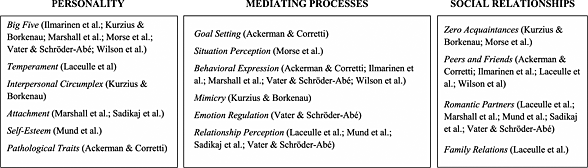
Overview of the aspects of personality, social relationships and processes addressed by the papers in this special issue.
Two research teams investigated intensive triadic (Morse, Sauerberger, Todd, & Funder, 2015, this issue) and dyadic (Kurzius & Borkenau, 2015, this issue) social interactions among strangers. Consistent with the literature, Morse et al. found that extraverted targets made more positive impressions on outside perceivers. In Kurzius and Borkenau's (2015) study, extraversion was unrelated to being liked by one's interaction partner. Interestingly, however, agreeableness (Morse et al., 2015) and trait affiliation (Kurzius & Borkenau, 2015) were positively related to early social outcomes. These findings are consistent with the idea that affiliative traits become more important as the intimacy of social interactions increases (Küfner, Nestler, & Back, 2013) and call for further research on the contextual features that moderate the influence of interpersonal traits on early interaction outcomes.
Laceulle, Jeronimus, van Aken and Ormel (2015, this issue) investigated the prospective effects of temperament on the occurrence of stressful events with peers, romantic partners and parents. In line with the well–established protective effects of emotional stability and conscientiousness, low levels of effortful control and high levels of frustration predicted the occurrence of stressful social events for the parental and peer domains. In the romantic partner domain, by contrast, the occurrence of stressful events was predicted by high levels of intensity pleasure, and affiliation as well as low levels of shyness. These findings point to both generic and domain–specific effects of personality on the frequency with which people experience stressful social events.
Three investigations focused on non–romantic peer relations (Ackerman & Corretti, 2015; Ilmarinen, Vainikainen, Verkasalo, & Lönnqvist, 2015; Wilson, Harris & Vazire, 2015, all this issue). Their results particularly underlined the predictive validity of extraversion in this domain. Extending research with older populations, Ilmarinen et al. (2015) showed that parent–rated extraversion–predicted sociometric popularity among 7– to 8–year–olds in school. Although research on the predictors of general satisfaction with life and romantic relationship satisfaction is widespread, little is known about the individual differences that predict friendship satisfaction. In the study of Wilson et al. (2015), extraversion, agreeableness and emotional stability were uniquely associated with self–reported friendship satisfaction. Also looking at the development of close non–romantic peer–relationships, Ackerman and Corretti (2015) present one of the first investigations of the roles of pathological traits. Detachment negatively predicted self– and partner–reported relationship intimacy in roommate relationships.
The romantic relationship domain was addressed by four teams of authors (Marshall, Simpson, & Rholes, 2015; Mund, Finn, Hagemeyer, Zimmermann, & Neyer, 2015; Sadikaj, Moskowitz, & Zuroff, 2015; Vater & Schröder–Abé, 2015, all this issue). In line with meta–analytical evidence, low neuroticism, attachment security, self–esteem, agreeableness and conscientiousness were related to higher relationship quality, including actor and partner effects on the future level (Vater & Schröder–Abé, 2015), short–term change (Sadikaj et al., 2015) and long–term change (Mund et al., 2015) of relationship satisfaction as well as the number of depressive symptoms in the transition to parenthood (Marshall et al., 2015). Effects of the Big Five and attachment were largely independent of each other (Marshall et al., 2015; Sadikaj et al., 2015). Marshall et al. (2015) also showed that specific combinations of actor's and partner's personalities (high neuroticism and low agreeableness) were particularly predictive of depressive symptoms. In addition, Mund et al. (2015) provided evidence for transactional processes, by showing that (a) self–esteem predicted changes in relationship and (b) increases in relationship satisfaction predicted increases in self–esteem.
These studies provide real–life evidence of the social power of personality: Across various relationship types and several intrapersonal as well as interpersonal outcomes, individual differences in personality were predictive of social outcomes. The pattern of results across studies provides evidence for both, generic personality effects (e.g. positive effects of agreeableness and negative effects of neuroticism particularly on self–reported outcomes) and relationship–specific personality effects (e.g. stronger impact of extraversion for peer relations as compared with romantic relations). A number of more specific novel personality effects were also revealed that will stimulate future research on the social consequences of personality. More importantly, however, all of the aforementioned investigations even went a crucial step further by trying to unravel the processes that drive these effects.
New Insights into Mediating Processes
As can be seen in Figure 1, the papers in this special issue cover a rich variety of motivational, cognitive, affective and behavioural processes that are potential mediators of the social consequences of personality (see Back & Vazire, 2015, this issue, for more detailed considerations). Morse et al. (2015) focused on an understudied domain of potential mediators: situation perceptions. They showed that the ways individuals perceive interactive situation are both affected by personality (particularly the positivity of perceptions) and predictive of interactional outcomes (particularly how normative, that is, similar to other individuals, people construe situations). Although individual differences in these global aspects of situation perception did not mediate the effects of personality on social outcomes, these results are novel in their own rights. They underscore the idea that people construe the social situations they encounter in systematically different ways and that these individual differences have social consequences. Future research focusing on additional contexts and more specific aspects of situational construal is highly welcome.
Kurzius and Borkenau (2015) provided a strong, naturalistic test of the antecedents and consequences of mimicry. Overall, the personality predictors of mimicry were more specific than previously reported in the literature. Dominance of interaction partners, for example, predicted mimicry of actor's negative behaviours such as shaking one's head or shrugging, whereas a partner's agreeableness and trait affiliation predicted mimicry of actor's positive behaviours such as nodding and smiling. The social consequences of mimicry were also nuanced—and not always positive. Mimicry of leaning forward, for instance, predicted being liked, whereas mimicry of shaking one's head was a negative predictor of being liked. Whereas these interesting specific findings await further replication, the results of this study underlined the importance of real–life investigations of social processes and called for cautious interpretation of prior findings that were based on less ecological valid designs.
A number of projects concentrated on the way people interact with their social partners (behavioural expression processes). Ilmarinen et al. (2015) showed that oral fluency is one specific behavioural mediator that can partially account for the link between extraversion and popularity among peers in middle childhood. Extraverted children (as judged by their parents) had more fluent ways of speaking (as judged by their teachers), and this contributed to their greater popularity among their peers (as assessed by sociometric nominations). Wilson et al. (2015) investigated the characteristic ways of behaving in everyday interactions with friends as mediators of the relation between personality and friendship satisfaction. Although effect sizes were small and only a few of the investigated behavioural indicators qualified as mediators (e.g. the quantity of social interactions mediated the effect of extraversion on friendship satisfaction), several interesting empirical relations were found. Individual differences in the Big Five were associated with corresponding extraverted, agreeable, conscientious and neurotic behaviours towards friends. Depth of conversation was associated with extraversion, agreeableness and openness. Extraversion additionally predicted the quantity of interactions, amounts of disclosure and less suppression of emotions. Quantity of social interactions and depth of conversation, in turn, contributed to friendship satisfaction. These findings build a solid basis for further exploring the understudied domain of friendship processes.
Ackerman and Corretti (2015) tested a series of theoretically derived chains of processes that had the potential to account for the effects of pathological traits on intimacy between roommates. These processes involved both the stage of goal setting (as assessed by the interpersonal values participants held) and behavioural expressions (roommate–reported expression of warmth and dominance). The strongest effects were found for detachment. Participants with greater detachment expressed less warmth, which was related to their roommates’ perceptions of them as less responsive and their roommates’ reports of feeling less close to them. Also consistent with the authors’ expectations, antagonism was related to weaker communal values, which predicted lower levels of disclosure. A number of interesting exploratory results were also revealed; many of which can provide valuable starting points for future investigations.
Focusing on the role of conflict discussion in the development of satisfying romantic relationships, Vater and Schröder–Abé (2015) engaged in a similarly complex investigation of mediating process chains. The Big Five were systematically related to spontaneous emotion regulation during conflict discussions (e.g. extraversion and less suppression, neuroticism and aggressive externalization); emotion regulation then predicted actually observed interpersonal behavioural expressions (e.g. less functional behaviour based on suppressive or aggressive coping), which predicted immediate relationship perceptions of both partners (more state satisfaction based on functional behaviour); finally, such perceptions were related to general relationship satisfaction 6 months later. These findings nicely illustrate how detailed micro–level investigations of affective, cognitive and behavioural processes within critical interaction units can help explain the macro–level associations between personality traits and romantic relationship satisfaction. The critical role of conflict behaviour in romantic relationships was also underlined by the study of Marshall et al. (2015). Here, the adverse interactive effect of actor's neuroticism and partner's disagreeableness was particularly pronounced in couples who were characterized by a dysfunctional pattern of problem–solving communication and aggressive behaviour.
Three projects investigated relationship perceptions as mediators of the consequences of personality on relationships. Laceulle et al. (2015) showed that perceived affection, that is, meta–perceptions of being liked and accepted by one's social partners (adolescent–reported at age 11 years), was not only systematically related to temperament dispositions (parent–reported at age 11 years) but also had real–life consequences as it longitudinally predicted stressful social events (between the ages of 11 and 16 years) with parents, peers and romantic partners. Sadikaj, Moskowitz and Zuroff (2015) investigated felt security in real–life interactions with romantic partners and found that this subjective everyday relationship experience partially mediated the effect of attachment avoidance on both partners’ relationship satisfaction. Finally, also focusing on the domain of romantic relationships, Mund et al. (2015) showed that feelings of connectedness and independence regarding the romantic relationship, both of which were relevant predictors of overall relationship satisfaction, were related to the level and development of individual's self–esteem.
Each of the empirical papers included in this special issue presents important results on mediating mechanisms that move the field forward, from the detection of personality effects on social outcomes to explaining these associations. As discussed by Back and Vazire (2015, this issue), these novel process insights are a wonderful starting point for informing existing theories as well as for stimulating further empirical studies on the mechanisms that explain the social consequences of personality.
In addition, given the pattern of process results across the studies of this special issue, five more speculative general observations seem potentially relevant to me. First, personality influences on the expression of typical interpersonal behaviours is one key domain of mediating processes. Behaving in an expressive, cheerful, dominant and generally visible manner likely explains the effects of extraversion on popularity and status. Behaving considerately, friendly, and modestly provides an atmosphere that is generally perceived as supportive and harmless, thereby explaining the effects of agreeableness on intimate interaction and relationship quality. Behaving in a calm, structured, consistent, and normative manner likely contributes to less stressful and more predictable interactions, thereby partially explaining the effects of neuroticism and conscientiousness on social relationship quality. Second, personality affects the way interactive situations, social partners and social relationships in general are regularly perceived and interpreted. Perceiving one's interactions as threatening, critical and generally negative likely contributes to and perpetuates low interaction and relationship satisfaction, whereas perceiving one's interactions as inviting, accepting and generally positive will foster satisfying social relationships. These processes presumably also contribute to the widespread influence of neuroticism and agreeableness on relationship qualities.
Third, these two domains of processes are systematically connected and together build up more complex process chains that explain actor–effects and partner–effects as well as actor–partner interactions. Behavioural expression processes dependent on the actor's personality evoke certain interpersonal perception processes, which are themselves shaped by the personality of the social partner (Back, Baumert et al., 2011). Particularly, fruitful or toxic personality combinations within social interactions and relationships (e.g. particularly negative effects when a disagreeable actor is paired with a neurotic partner; e.g. Marshall, Simpson and Rholes, 2015, this issue) arise if the personality of the actor expresses in behaviours (e.g. being overly critical) that are perceived as particularly positive/negative dependent on the particular personality of the partner (e.g. easily perceiving social situations as threatening), or, put differently, when the behaviour of an actor amplifies the positive or negative perceptual tendencies of a social partner.
Fourth, the type and phase of relationship can moderate these mediating processes, thereby moderating personality effects on social outcomes. Cheerful and dominant behaviours seem to be more important at short–term acquaintance and regarding peer relations, explaining why traits like extraversion are more relevant in these contexts. In contrast, the extent of nervous, tensed, disorganized behaviours and negatively biased relationship perceptions seem to be more relevant at long–term acquaintance, particularly in romantic relationships, thereby explaining the adverse effects of neuroticism and low conscientiousness in this context. The expression of friendly and warm behaviour rather seems to be a generic process with positive consequences across relationship types and acquaintance levels, at least when a minimum amount of intimacy is involved. This might explain the broad positive influence of agreeableness on social relationships.
Finally, understanding the processes underlying the social consequences of personality might also help better understand the nature and covariation of personality traits themselves (cf. Wood, Gardner, & Harms, in press, for a related approach). Effects of traits on social outcomes are the result of the psychologically active mechanisms in a given context. Unravelling these mechanisms will, thereby, also help to unpack the more specific process–based units they are made of (e.g. agreeableness: motivation to establish close social bonds, selection of situations in which the option to help others is salient, tendency to act friendly and considerate, tendency to view others’ behaviours as unharmful, metaperceive others’ perceptions of oneself as fair…). This might explain the joint and unique social effects of personality traits (with similar process units leading to similar outcomes) and their covariation (depending on the extent that traits encompass similar process units).
Of course, more research applying fine–grained process analyses is needed to establish a solid empirical database, from which more robust general conclusions can be drawn. Future research might build on the work presented in this special issue and try to further unravel general, relationship–specific and trait–specific process chains that underlie the joint development of personality and social relationships.
Rich Data, Advanced Analyses and Transparent Reporting
Investigating the real–life processes that mediate the effects of personality on social outcomes requires the assessment of multiple rich sources of data, optimally of a longitudinal nature (Wrzus & Mehl, 2015, this issue). The authors of this special issue spared no effort in gathering such data. This included fine–grained recording of specific behavioural acts every 10 s (Kurzius & Borkenau, 2015, this issue); observation of actual interactive behaviour in the laboratory (Morse et al., 2015; Vater & Schröder–Abé, 2015, both this issue) as well as in field settings (Ilmarinen et al., 2015, this issue), event–based relationship perceptions and behaviours during social interactions in real–life (Sadikaj et al.; Wilson et al.); repeated time–based assessments of partner behaviours and relationship quality (Ackerman & Corretti, 2015); and longitudinal investigations of actor–reported or partner–reported personality and relationship characteristics spanning multiple years (Laceulle et al., 2015, Marshall et al., 2015; Mund et al., 2015, all this issue). In addition to these excellent empirical showcases, Wrzus and Mehl (2015) provide a comprehensive overview of the available and forthcoming methods that can be applied to assess the process data in the field as well as in the laboratory, including assessment of experiences, physiology and behaviour.
These kinds of data are not only extremely difficult to assess, but they are also far from easy to analyse statistically (Nestler et al., 2015, this issue). Luckily, all authors carefully applied the complex, up–to–date statistical techniques needed to account for the multi–methodological, longitudinal, dyadic or multi–level structures of their data. In their comprehensive methodological overview, Nestler et al. (2015) accessibly described established as well as novel statistical solutions for the analysis of individual, dyadic and group (round–robin and network) data. They also included demonstration data sets and scripts that show how to implement the described approaches in R. The methodological articles of Wrzus and Mehl (2015) and Nestler et al. (2015) provide researchers who are interested in the social consequences of personality and, more generally, in the dynamic interplay of personality and social relationships with an up–to–date toolkit that can be applied to open the process black box. I hope that the empirical and methodological articles in this special issue encourage other researchers to engage in similar ambitious projects, to try unravel further the multitude of processes that drive the social consequences of personality.
I want to conclude with another feature of the present set of articles that I regard as particularly commendable and worthy of imitation: scientific transparency. In my call for papers, I asked for submissions that would be able to provide the following: (a) straightforward conceptual ideas about the processes that underlie the social consequences of personality and (b) high–quality data that are well suited for investigating these processes—irrespective of the resulting empirical findings. In fact, in a number of articles in this special issue, main hypotheses were not confirmed, and I applaud the authors for adopting such transparent approaches to presenting their results. A related aspect is transparency with respect to the assessed variables and potential alternative analyses. I encouraged all authors to provide full–scale descriptions of the procedures and methods they applied in their rich, multi–methodological projects and also asked for several supplementary analyses. As a result, appendices, online supplements and links to further resources such as Open Science Framework projects will help the interested reader to understand the applied methods and selection of variables fully and to verify the robustness of the presented findings.
These additional details might also be catalysts for readers to get in touch with the authors to discuss the novel ideas for data analysis or the combination of research projects that have assessed similar types of variables. In this spirit, Back and Vazire (2015, this issue) discussed the potential benefits of stronger collaboration across laboratories. The search for mediating processes in the social context is a complex and oftentimes slow scientific endeavour. It involves laborious data collection and preparation across long periods of time and complex statistical analyses. Joint efforts to gather and analyse such data and more open access to such data for various research groups might enable us to understand personality processes in a more sustainable way.
Research on the social consequences of personality has come a long way, but the excellent contributions of this special issue lead me to conclude that the most exciting times are still to come.