







Abstract
Previous research has conceptualized dispositional envy as a general construct that does not vary across comparison domains. In five studies (N = 1393), we examine dispositional envy as a domain–specific construct. In Study 1, we present the development of a domain–specific measure of dispositional envy. Across samples from different populations and two countries (Studies 2 and 3), the measure is shown to have good reliability, construct validity and stability over three months, highlighting the trait–like character of the construct. State levels of envy were also examined in the academic domain (Study 4) and in dyadic interactions between unacquainted participants (Study 5). Results show a Person × Situation Interaction effect (i.e. Dispositional Envy × Situation) on experiences of envy. By placing domain–specific dispositional envy into a network of similar and dissimilar constructs, the current findings serve as a foundation for drawing conclusions about the nature of dispositional envy. Copyright © 2015 European Association of Personality Psychology
Keywords
‘My Queen, you are the fairest here so true. But Snow White is a thousand times more beautiful than you.’ Then the Queen was shocked, and turned yellow and green with envy. From that hour, whenever she looked at Snow White, her heart heaved in her breast, she hated the girl so much. And envy and pride grew higher and higher in her heart like a weed, so that she had no peace day or night. (Grimm & Grimm, 1857/1991, p. 173)
Envy is an intense, unpleasant feeling that arises when a person realizes that someone else has something that the person longs for, strives for or desires (Parrott & Smith, 1993; Smith et al., 1996). Envy is a social emotion, as it arises from a negative upward comparison with another person (Salovey & Rodin, 1984; Smith, 2000). Prior work on state envy has revealed substantial individual differences (e.g. Cohen–Charash, 2009; Smith, Parrott, Diener, Hoyle, & Kim, 1999). More specifically, there is now compelling empirical evidence that people differ reliably in their stable tendencies to experience envy (Gold, 1996; Lange & Crusius, 2015; Smith et al., 1999). These habitual tendencies have been conceptualized as a stable personality trait (dispositional envy; Ben–Ze'ev, 2000; Gold, 1996).
Prior approaches have treated dispositional envy as a general tendency to envy others that does not vary across different comparison domains (Belk, 1985; Gold, 1996; Lange & Crusius, 2015; Smith et al., 1999). Research on temporary experiences, however, has shown that state envy substantially varies across comparison domains (DelPriore, Hill, & Buss, 2012; Salovey & Rodin, 1991). In the current research, we present a conceptual approach to dispositional envy as a domain–specific construct and present the development of a domain–specific instrument measuring dispositional envy.
Prior perspectives on dispositional envy
Belk (1985) conceptualizes dispositional envy as a subtrait of materialism. In this approach, dispositional envy is described as a unidimensional tendency to focus on another person's possessions. A person high in dispositional envy should tend to desire many different possessions of other people, such as objects, experiences or persons. In accordance with this approach, the Materialism Scale (Belk, 1985) assesses dispositional envy as a component of materialism in addition to the components of possessiveness and nongenerosity. Item formulations are based on personal statements referring to comparison situations such as ‘I am bothered when I see people who buy anything they want’, ‘I don't know anyone whose spouse or steady date I would like’ (reverse coded) and ‘When Hollywood stars or prominent politicians have things stolen from them I really feel sorry for them’ (reverse coded).
Another conceptualization of significant individual differences in the degree of enviousness has been provided by Gold (1996). Gold conceptualizes dispositional envy as a unidimensional general tendency to desire what another person has, to resent this person and to show ill–will towards the envied person. Based on this conception, the York Enviousness Scale (Gold, 1996) includes items of short personal statements, such as ‘When my friends succeed I feel hurt’ and ‘I'm content with what I've got’ (reverse coded).
In a similar approach, Smith et al. (1999) describe dispositional envy as a unidimensional, comparison–based emotional trait that includes the tendency to experience envy, general feelings of inferiority and resentment of successful persons. Smith et al. argue that a person with a tendency to envy others also tends to interpret unfavourable social comparisons as indicators of one's own inferiority. Frustrations that arise out of such unfavourable social comparisons, in turn, result in a general tendency to resent other persons of the comparison (Smith et al., 1999). Based on this approach, Smith et al. (1999) developed the Dispositional Envy Scale (DES). The DES consists of eight items with some being formulated in terms of enviousness (e.g. ‘I feel envy every day’) and some measuring aspects of inferiority (‘The bitter truth is that I generally feel inferior to others’) and resentment (‘Frankly, the success of my neighbors makes me resent them’).
In order to disentangle various envious reactions, Lange and Crusius (2015) focus on two different tendencies as forms of envious responding at the trait level. Dispositional benign envy describes a tendency to be motivated to increase one's own standing to match that of the other person, whereas dispositional malicious envy describes a tendency to decrease the other's standing to match one's own. Both forms belong to a comparison–based emotional trait that is associated with frustration that arises from a negative social comparison, but they differ in the motivations and actions associated with that feeling. To assess motivational aspects and behavioural consequences of envy, the Benign and Malicious Envy Scale was developed (Lange & Crusius, 2015). It measures the tendency to strive to acquire the desired object when feeling envious (e.g. ‘When I envy others, I focus on how I can become equally successful in the future’) and the tendency to hostile reactions when being envious (e.g. ‘Envious feelings cause me to dislike the other person’).
Expanding the conception of dispositional envy
Although these conceptual perspectives and measures differ in important ways, they all treat envy as a broader syndrome containing different tendencies that come late in the emotion–generative process of envy, such as hostile reactions against the comparison person. In contrast, we conceptualize dispositional envy as a stable tendency to emotional experiences that come earlier in the emotion–generative process of envy (Ekman, 1972; Gross, 2001; Lazarus, 1991; Levenson, 1994; Plutchik, 1980; Rosenberg, 1998; Scherer, 1984). We argue that it is important to disentangle individual differences in envy–specific experiences from related outcomes or associated constructs. Thus, we conceptualize dispositional envy as the stable tendency to experience intense unpleasant feelings when being confronted with negative social comparison outcomes.
A second feature of previous approaches to trait envy is the assumption that envy is a general construct that does not vary across comparison domains. Although researchers have referred to different comparison domains of envy, such as possessions of wealth and romantic attraction in the Materialism Scale (Belk, 1985), the disposition to envy still has been defined as domain general. In contrast, we argue that it is useful to specify the domains of social comparison relevant to dispositional envy. Considering specific goods that are important for our social standing in society, Bourdieu (1986) postulated three forms of capital: economic capital such as money or property, social capital such as the social network or people close to oneself and cultural capital such as education or knowledge. Indeed, comparison domains that are particularly likely to elicit envy have been identified, including romantic attraction, physical attractiveness, financial wealth, possessions, academic success, popularity, status and intelligence (DelPriore et al., 2012). People differ in which comparison domain is particularly important to them (Salovey & Rodin, 1991). For example, participants for whom attractiveness was very important also reported more intense feelings of envy in that domain than in the domain of wealth (Salovey & Rodin, 1991). Because dispositional envy is a social comparison–based trait, we argue that the domains of social comparison matter when it comes to dispositional envy.
Previous research has focused on the domains of wealth or competence in dispositional envy (e.g. Belk, 1985; Smith et al., 1999). Based on findings that highlight the importance of the domain of attraction (e.g. DelPriore et al., 2012), we also consider aspects of attraction (i.e. physical, romantic and social) as another important domain of dispositional envy.
The present research
Our goal in the present research was to build on prior efforts by developing and validating a new measure of dispositional envy in order to empirically test the conceptualization of dispositional envy as a domain–specific construct.
In Study 1, we present the development of a new multidimensional instrument measuring dispositional envy—the Domain–Specific Envy Scale (DSES). In addition, we identify correlations between our measure and important intrapersonal and interpersonal constructs in order to place dispositional envy within a nomological network of similar and dissimilar constructs. Across studies from an English–speaking sample (Study 2) and from a German–speaking community sample (Study 3), we provide evidence that dispositional envy is a domain–specific, temporally stable construct. In studies on social comparisons in the academic domain (Study 4) and on dyadic interactions (Study 5), we demonstrate that state levels of envy can be explained by trait differences in this construct.
Study 1
Development of the Domain–Specific Envy Scale
Based on the common definition of envy as an intense, unpleasant feeling when a person realizes that someone else has something that the person longs for, strives for or desires, we formulated items to meet specific criteria for assessing dispositional envy:
Each item was introduced with the description of an intense, unpleasant feeling, such as ‘It bothers me’ or ‘It disturbs me’. Each item was intended to describe concrete circumstances that elicit envy. Thus, every item included a social comparison situation with other persons. Every item was intended to be formulated in a way that it measures only the tendency to subjectively experience envy, and not behavioural outcomes or related constructs. We intentionally did not include action tendencies that might follow the emotional experience, such as downgrading the comparison person. Items were not allowed to contain words that directly refer to envy, such as envy or envious, in order to limit socially desirable responding (e.g. Belk, 1985; see also Smith et al., 1999). Furthermore, not including the words of envy in the trait measure was intended to limit method variance, based on, for example, socially desirable responding, when investigating the relation between trait and state levels of envy. Every item was intended to refer to a specific domain of social comparison.
In Study 1a, we wanted to show broad domains that are relevant in state levels of envy. More specifically, based on previous research indicating that people's tendency to experience envy varies by domain of social comparison, we wanted to reduce the number of domains to the broad categories of attraction, competence and wealth, in order to formulate items that assess domain–specific dispositional envy in Study 1b.
Study 1A
In Study 1a, participants described past experiences of envy. The descriptions were coded in order to establish broad domains of experiences of envy.
Method
Participants
Seventy–four undergraduate students studying psychology as a major or a minor at a German university participated in an online study. Participants were recruited via email or blackboard messages and received partial course credit for participation. The sample consisted of 64 female students and 10 male students with an average age of 22.0 years (SD = 4.8).
Procedure and measures
Participants were instructed to remember and mentally relive a recent situation in which they experienced envy towards another person. To facilitate responding, participants were asked to use the following common definition of envy: ‘Envy is an intense, unpleasant feeling that arises when a person realizes that someone else has something that the person longs for, strives for, or desires’. After participants had a situation in mind, they were given 30 seconds to imagine reliving the emotional situation (see Ekman, Levenson, & Friesen, 1983, for a relived emotion task). After 30 seconds, they were asked to write down their description of the situation in at least five sentences. Narratives were later coded by five coders with respect to the domains in which participants experienced envy towards another person (see supporting information S1 and S2 for details as well as the participants‘ narratives). Coders had not participated in the online study and received partial course credit for their assistance. Inter–coder reliability computed via Cohen's kappa coefficient was 0.67, which indicated acceptable inter–coder agreement. Seven narratives that were provided by participants had to be excluded from the analyses as participants did not follow the instructions.
Results
Analyses revealed that the domains of attraction, competence and wealth were commonly reported by participants. Coding revealed that 40.5% of the descriptions referred to envious experiences in the domain of attraction (such as physical attraction and social attraction). For example, one participant reported: ‘I met a fellow from university at the bus stop. He was better–built than I was. It bothered me, because I used to work a lot on my body. I was envious of his body’. Furthermore, 28.9% of the descriptions were about comparisons in the domain of competence (such as intelligence and exam scores). For example, one participant wrote: ‘We received the results of the exams online. Although I was optimistic, I just received a C. Then I heard that some of my friends received an A. I was very envious of them’. Another 21.1% of the descriptions were about envy with respect to wealth (such as property, money and lifestyle). For example, one participant reported: ‘I went to a school where many students came from a very rich family. I was not struggling financially, but some of my friends travelled much more than I did. I was envious because I also wanted to travel to South America for several weeks’. The remaining 9.5% of descriptions were not categorized. They referred to luck (2.7% of all descriptions), grades, family, togetherness, life situation (1.1% respectively), course enrolment, occupation, non–specified (0.7% respectively) and pregnancy (0.3%). In total, over 90% of envy episodes fell into one of three categories: attraction, competence and wealth.
Study 1B
In the first step of scale development, previously existing items designed to measure dispositional envy were evaluated as to whether they meet our criteria. Four items provided by Smith et al. (1999) and Belk (1985) that at least partially met the criteria were translated to German, modified and included in the first draft of the inventory. Most of the items referred to envy in the domains of competence or wealth.
Based on previous research (e.g. DelPriore et al., 2012) and on our findings in Study 1a, we also formulated items assessing different facets of attraction. In order to maximize representativeness of the item pool, we also formulated further items assessing different facets of competence and wealth. Facets of the domain of attraction ranged from physical attractiveness and romantic attraction to social popularity; competence included for example intelligence and knowledge; wealth referred to financial status or lifestyle.
The first version of the inventory included 35 items (see supporting information S3), such as ‘It makes me feel uncomfortable when others are more attractive than I am’ (attraction), ‘It is hard to bear when other people are more intelligent than I am’ (competence) or ‘It bothers me when others own things that I cannot have’ (wealth).
In order to allow participants to respond at varying levels of dispositional envy, we utilized a 7–point Likert scale ranging from 1 (not at all) to 7 (very much). To facilitate responding and to avoid method variance due to negative item wording (e.g. Harvey, Billings, & Nilan, 1985; Peterson & Peterson, 1976), none of the items were reverse coded.
We expected that the instrument would have a hierarchical structure consisting of three first–order factors that refer to the different domains of envy and a second–order factor that measures general dispositional envy. The final version of the scale was evaluated to determine whether it meets established criteria for reliability as well as convergent and discriminant validity (see supporting information S5 for a summary of measures).
As we conceptualized dispositional envy as a comparison–based emotional trait, we argued that dispositional envy should be related to the tendency to compare oneself with other people (Gibbons & Buunk, 1999). A person who scores high on comparison orientation tends to seek out social comparison opportunities and to directly compare himself with others.
In accordance with dispositional envy as a comparison–based trait, we argued that dispositional envy is also related to negative self–perceptions such as low self–esteem, neuroticism or low subjective well–being. On the one hand, frequent upward comparisons also entail the risk of negative self–evaluations (Wayment & Taylor, 1995). Thus, a person high in dispositional envy should be at risk of negative self–evaluations because of the tendency to compare oneself with others. On the other hand, people low in self–esteem tend to make more upward than downward comparisons (Wayment & Taylor, 1995), which apparently also entail the risk of the stabilization of dispositional envy. As the evaluation of comparison outcomes should be particularly important for people high in dispositional envy, we expected that those people draw their self–esteem from such comparison outcomes. Thus, the self–esteem of people high in dispositional envy should not just be low but also contingent on comparison outcomes (Kernis, 2003). Because contingencies vary across domains of comparison (Crocker, Luhtanen, Cooper, & Bouvrette, 2003), we further expected that domain–specific dispositional envy would be related to the corresponding contingencies of self–worth.
Because envy is very painful (Takahashi et al., 2009), people who experience that emotion are motivated to overcome this unpleasant feeling and activate reactions that might help to improve their inferior status, for example, by denigrating the superior person (e.g. Salovey & Rodin, 1984). This particularly strategy refers to the malicious tendencies of dispositional envy (Lange & Crusius, 2015). On the other hand, envy has also been treated as a beneficial trait that motivates striving to acquire the desired object (Foster, 1972; van de Ven, Zeelenberg, & Pieters, 2009), which refers to a benign strategy (Lange & Crusius, 2015). As we in our approach did not conceptualize related outcomes of dispositional envy that come late in the emotion–generative process, we expected relations to both hostile tendencies and tendencies to acquire the desired object.
Sayings such as ‘Our envy of others devours us most of all’ suggest that dispositional envy is related to maladaptive intrapersonal outcomes (see also Gold, 1996). It has been argued that envy can lead to depression and anxiety as a consequence of the frequent negative social comparisons (Salovey & Rodin, 1984). The proposed system of domain–specific dispositional envy, in which much focus is on the self and the painful comparison with other people, should thus be associated with psychopathological symptoms, such as anxiety or depression.
To establish discriminant validity, the scale was also administered along with a number of other scales that, theoretically, should not correlate with dispositional envy such as openness and conscientiousness as non–affective measures of personality. Based on our approach of dispositional envy as a social comparison–based emotional trait, it would seem plausible to argue that dispositional envy should also be related with the ability to social understanding. However, dispositional envy does not need the understanding of the emotion of the other person (as in the case of sympathy with others, for example), but the cognitive ability to realize that oneself did poorly as compared with another person. Therefore, we argued that dispositional envy should not be related to empathy. As dispositional envy is an undesirable trait (Smith et al., 1999), we expected a positive but small correlation with the tendency to exhibit sociably desirable responding.
Method
Participants
Participants were recruited by psychology students from a German university who received partial course credit for recruiting other students, friends and family as participants. Our sample consisted of 198 participants who responded to the initial item pool, 135 of whom were female, with an average age of 22.9 years (SD = 5.7). Participants were then re–contacted two months later. One hundred forty participants (70%) completed the final version of the dispositional envy measure at Time 2, in order to examine the psychometric properties and construct validity. The average age of these participants was 23.2 years (SD = 6.5), 106 of whom were female.
Measures of convergent validity
Global trait envy was measured with the DES (Smith et al., 1999), an instrument that has been widely used for measuring general dispositional envy. Comparison orientation was assessed using the Iowa–Netherlands Comparison Orientation Measure (Gibbons & Buunk, 1999; German adaptation by Schneider & Schupp, 2011). Contingent self–esteem was assessed with the Contingent Self–esteem Scale (Kernis, 2003; Paradise & Kernis, 1999). Specific contingencies were assessed with the Contingencies of Self–worth Scale (Crocker et al., 2003). Subscales assess seven different sources of self–esteem: others‘ approval, appearances, competition, academic competence, family support, virtue and God's love. Self–esteem was assessed with the Rosenberg Self–esteem Scale (Rosenberg, 1965; German adaptation by von Collani & Herzberg, 2003). Life satisfaction was measured with the World Health Organization Quality of Life instrument (Angermeyer, Kilian, & Matschinger, 2000). Neuroticism was assessed with the Big Five Inventory (John, Donahue, & Kentle, 1991; German adaptation by Lang, Lüdtke, & Asendorpf, 2001). Hostile tendencies were measured with the Hostility Scale of the Aggression Questionnaire (Buss & Perry, 1992; German version by Herzberg, 2003). Individual differences in the tendency to experience anger were measured with the Trait Anger Scale of the State–Trait Anger Expression Inventory (Spielberger, 1988; German adaptation by Schwenkmezger, Hodapp, & Spielberger, 1992). Participants also responded to three subscales of the Multidimensional Perfectionism Scale (Frost, Marten, Lahart, & Rosenblate, 1990; German adaptation by Altstötter–Gleich & Bergemann, 2006): personal standards, concern over mistakes and doubts about action. Concern over mistakes and doubts about action have been conceptualized as dysfunctional aspects of perfectionism whereas to set high standards is a functional aspect of perfectionism: people who tend to personal standards focus on their efforts on attaining a goal. Psychopathological symptoms were assessed with the short version of the Symptom Checklist (Hardt, Egle, Kappis, Hessel, & Brähler, 2004), which has six symptom subscales: depressive, dysthymic, vegetative, agoraphobic, sociophobic and mistrust. Additionally, a global severity index was computed. Trait anxiety and trait depression were assessed with the 10–item Trait Anxiety scale and the 10–item Trait Depression scale of the State–Trait Anxiety Depression Inventory (Laux et al., 2013; German adaptation of the State–Trait Anxiety Inventory; Spielberger, 1983).
Measures of discriminant validity
Social desirability was measured with the other–deception scale of the Balanced Inventory of Desirable Responding (BIDR; Paulhus, 1994; German version by Musch, Brockhaus, & Bröder, 2002). Openness and conscientiousness were assessed with the Big Five Inventory (John et al., 1991; German adaptation by Lang et al., 2001). Empathy was assessed with the Interpersonal Reactivity Index (Davis, 1983; German version by Paulus, 2009).
Results and Discussion
Scale development
The initial set of 35 items had an internal consistency measured with Cronbach's α of .97. In order to explore the factorial structure and to check potential cross–loadings of the items, we ran an exploratory factor analysis using an Oblimin rotation, as we expected correlated factors. Results revealed three dependent factors based on the conventional scree–plot criterion. However, because the scree–plot criterion is a very subjective criterion, we ran a parallel analysis (Horn, 1965), which provides objective and reliable indices for factor extraction. Using syntax developed by O'Connor (2000), the parallel analysis revealed three factors. The three–factor solution explained 57.15% of total item variance.
Results revealed items with cross–loadings. Items that were observed to have high intercorrelations (i.e. 8 items with cross–loadings larger than 0.30 and 12 items that were redundant with others owing to intercorrelations larger than 0.76) were excluded from the final version of the scale (see supporting information S3). One item that revealed inconsistency with its corresponding scale was eliminated, and two items using first person (such as ‘I cannot bear…’) were modified for the final version so that all items were formulated using third person (such as ‘It is hard to bear…’). Additionally, based on considerations about including important aspects of daily life, one item was newly formulated, ‘It bothers me when others live in a better neighborhood than I do’, and another item was reformulated, ‘It troubles me when others have higher tech equipment than I have’.
The final set of items for the DSES contained 15 items (see the formulations in Table 1; see supporting information S4 for the German version of the scale). We tested this version with respect to its psychometric properties and construct validity at Time 2 (n = 140). Corrected item–total correlations with respect to the total scale varied from r = .45 to r = .73, indicating good fit of items to the scale. Internal consistencies and descriptive statistics for the subscales can be found in Table 2. The total scale revealed good psychometric properties as well. Reliability of the scale was very good (Cronbach's α = .93).
Item formulations of the DSES and factor loadings, Study 1b
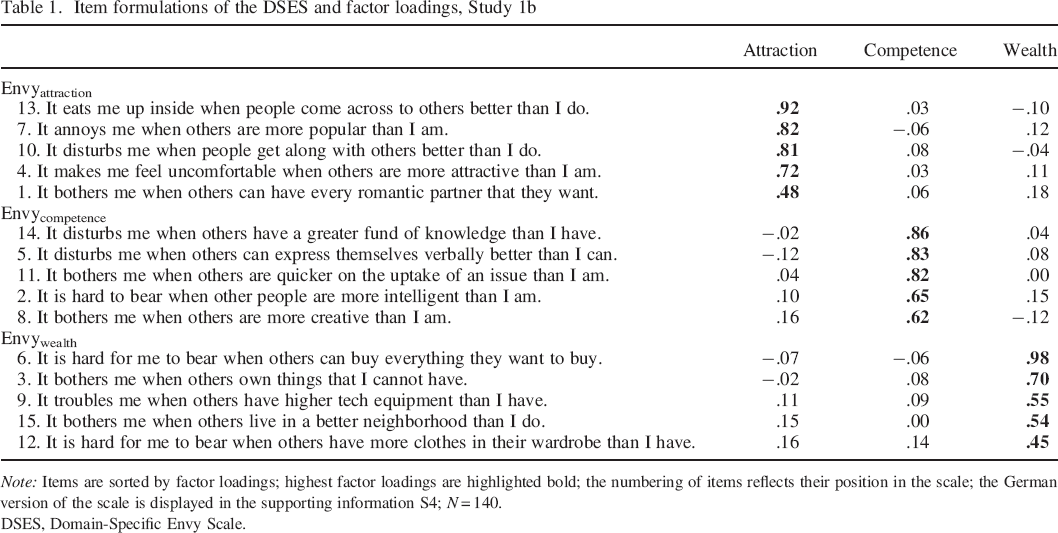
Note: Items are sorted by factor loadings; highest factor loadings are highlighted bold; the numbering of items reflects their position in the scale; the German version of the scale is displayed in the supporting information S4; N = 140.
DSES, Domain–Specific Envy Scale.
Summary of descriptive statistics and relations of the global and domain–specific factors of dispositional envy to external variables, Study 1b
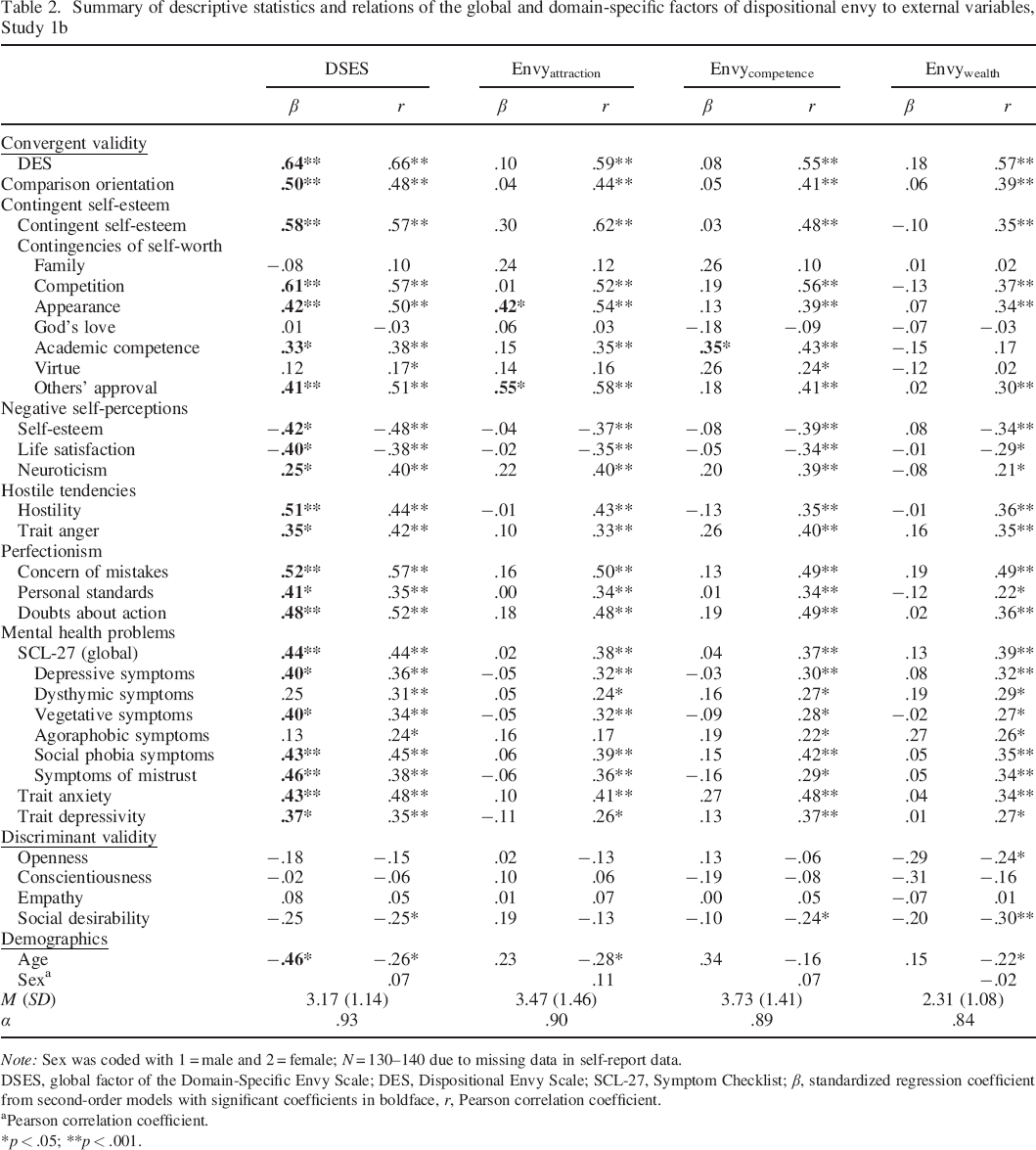
Note:Sex was coded with 1 = male and 2 = female; N = 130–140 due to missing data in self–report data.
DSES, global factor of the Domain–Specific Envy Scale; DES, Dispositional Envy Scale; SCL–27, Symptom Checklist; β, standardized regression coefficient from second–order models with significant coefficients in boldface, r, Pearson correlation coefficient.
Pearson correlation coefficient.
p < .05;
p < .001.
Factor analyses
An exploratory factor analysis revealed three correlated factors based on the Kaiser–Guttman criterion. The three factors explained 61.22% of item variance. The factor loadings based on an Oblimin rotation are displayed in Table 1. As can be seen, each domain–specific item loaded particularly strongly on its corresponding factor. None of the items revealed cross–loadings. The scree test as well as a parallel analysis also indicated three factors.
To further probe the factor structure of the items, we used confirmatory factor analyses with the
Construct validity
We used the aforementioned second–order model to test the convergent and discriminant validity of the DSES. The disturbances of the lower–order factors ‘attraction’, ‘competence’ and ‘wealth’, which correspond to the domain–specific facets of the DSES, and the second–order factor, which corresponds to the global measure of dispositional envy, were used to simultaneously predict each of the other variables displayed in Table 2. The second–order model is a nonstandard model (Bentler, 1990) in which disturbances are used to predict external variables (Chen, West, & Sousa, 2006). The effects of the domain–specific facets are unique, because the model allows disentangling of shared and unique variance in the global and domain–specific factors.
As can be seen from Table 2, the estimates from the second–order model support convergent validity: the global factor of the DSES was significantly positively related with the DES (Smith et al., 1999), a previous instrument for measuring general dispositional envy (see supporting information S6 for relations of the DSES and the DES to external variables). Additionally, the global factor was significantly related to comparison orientation and contingent self–esteem. The factor of dispositional envy also predicted negative self–perceptions such as low self–esteem and neuroticism, but also mental health problems such as trait anxiety and trait depressivity. Furthermore, dispositional envy was significantly related to hostile tendencies as well as to perfectionism. For all of the relationships, global dispositional envy predicted these variables, whereas the domain–specific sub–factors did not reveal specific effects.
We also tested whether the domain–specific factors would predict domain–related variables over and above the second–order factor of global dispositional envy. As can be seen in Table 2, analyses revealed that attraction predicted the self–esteem contingencies of appearance and of other's approval beyond global dispositional envy, whereas the other domain–specific factors did not have an effect. The factor of dispositional envy with respect to competence and the contingency of academic competence were particularly related, over and above the global factor of dispositional envy. The other domain–specific factors did not reveal an effect.
In order to test discriminant validity, we investigated the relation between the DSES and openness, conscientiousness, empathy and social desirability. As expected, dispositional envy was not significantly related to any of these measures. The contingencies of self–worth with respect to the domains of family, God's love and virtue were also not significantly related with dispositional envy.
With respect to demographics, dispositional envy was significantly negatively related to age. However, we did not find an effect of gender.
The current analyses supported reliability of the newly developed DSES in terms of internal consistency. Factorial analyses indicated a superordinate factor of general dispositional envy plus three domains of dispositional envy (i.e. attraction, competence and wealth). Furthermore, the DSES showed convergent and discriminant validity. Placing dispositional envy into a nomological network, our analyses revealed relations with comparison orientation, contingent self–esteem, negative self–perception, hostile tendencies, perfectionism and psychopathological symptoms. Although the relations were mostly due to global dispositional envy, the association between dispositional envy and contingent self–esteem was domain specific: the domains of attraction and competence in dispositional envy were uniquely related to the corresponding contingencies of self–worth. Furthermore, results revealed a link between dispositional envy and age, but not to gender. However, interpretations are limited, as the data are based on a homogeneous student sample.
Study 2
Cross–validation in an English–speaking sample
As the DSES was constructed based on a German–speaking sample in Study 1, the instrument was cross–validated with an English–speaking sample in Study 2. We tested factorial invariance of the DSES across languages.
Method
Participants
Two hundred and nineteen undergraduate students from an American university in the western part of the United States were recruited via email and received partial course credit for participation in an online survey. Eight participants did not complete the survey and therefore were excluded from further analyses. Participants who omitted full parts of the questionnaire (18 participants) and participants who repeatedly used the same scale response across measures (6 participants) were excluded from the analyses. The final sample consisted of 187 participants (68 men and 117 women) 1 with an average age of 19 years (SD = 1.2). Twenty–three per cent of participants self–identified as Asian American, 12.3% as African American/Black, 13.9% as Latin American/Hispanic, 1.6% as Native American, 59.4% European American/White and 11.2% as other. The demographic background of the final sample did not differ from the total sample.
Measures
Dispositional envy was assessed using the English translation of the DSES (Table 1; see supporting information S7 for summary of measures). Participants responded using 7–point Likert scales ranging from 1 (not at all) to 7 (very much). For the purpose of construct validation, we once again used the DES (Smith et al., 1999). Self–esteem was assessed with the Rosenberg Self–esteem Scale (Rosenberg, 1965) Scores were inverted prior to analyses to facilitate interpretation.
Results and Discussion
Item analysis revealed that corrected item–total correlations with respect to the subscales varied from r = .58 to r = .72, indicating good fit of items to subscales. As displayed in Table 3, the DSES had good psychometric properties. Corrected item–total correlations between items and the total scale varied from r = .51 to r = .73. Internal consistency reliability was very good (Cronbach's α = .92) and resembled that from the German sample in Study 1.
Summary of descriptive statistics and relations of the global and domain–specific factors of dispositional envy to external variables, Study 2
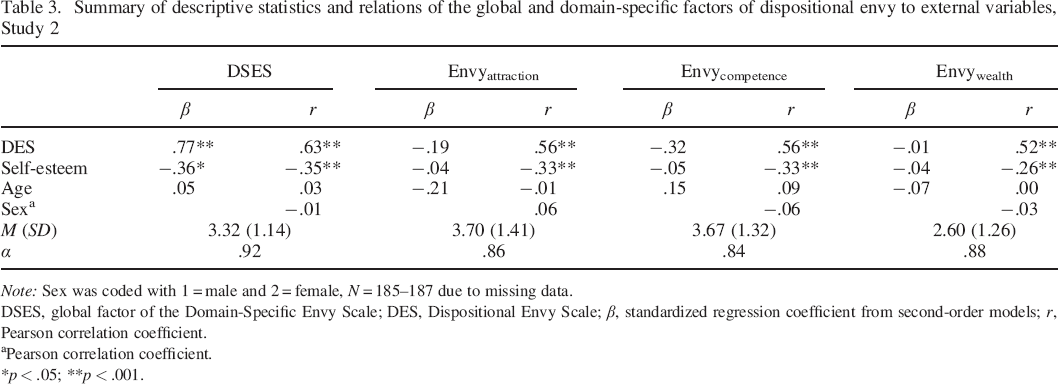
Note: Sex was coded with 1 = male and 2 = female, N = 185–187 due to missing data.
DSES, global factor of the Domain–Specific Envy Scale; DES, Dispositional Envy Scale; β, standardized regression coefficient from second–order models; r, Pearson correlation coefficient.
Pearson correlation coefficient.
p < .05;
p < .001.
In order to test the structure of the DSES in a North American sample, we ran confirmatory factor analyses with the
To test for factorial invariance across the German sample from Study 1b and the English sample from Study 2, a hierarchically arranged set of analytical steps was carried out: first, we determined a configural model that corresponded with the proposed second–order model of the DSES for both groups. In a configural model, no equality constraints are imposed on any parameter in the model (Model A). Then, a series of increasingly restrictive models were compared against each other to examine factorial invariance. Parameters that had been found to be equal across groups were constrained, whereas increasingly restrictive constraints were imposed on the other parameters (Byrne, 2008). Parameters were considered invariant when there was no substantive drop in model fit (ΔCFI < 0.01) between two steps (Cheung & Rensvold, 2002). Results are displayed in Table 4. Invariance in the factor loadings would imply that the unit of measurement for latent factors was equal across groups (Models B and C). In addition, we tested for structural invariance by imposing equality constraints on the factor variances and covariances (Model D). Structural invariance is demonstrated when the underlying factor structure of the construct is equal across groups (Byrne, 2008). Finally, we tested for invariant structural residuals (Model E) and invariant measurement residuals (Model F). Analyses supported the factorial invariance of the DSES across groups: factor loadings, factor covariances and variances as well as structural residuals and measurement residuals were invariant across languages.
Model fit indices from the invariance testing procedure for the two language groups, Study 2
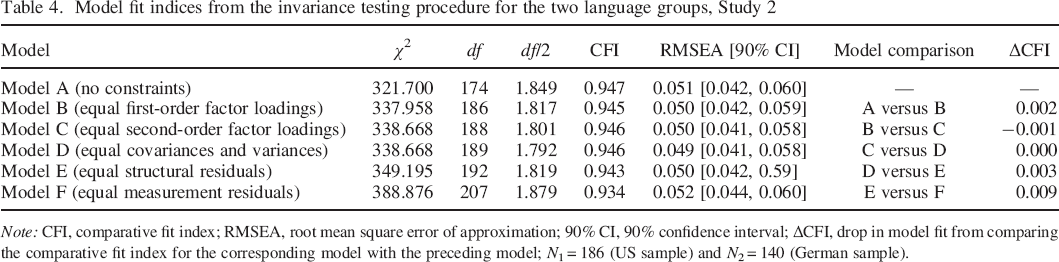
Note: CFI, comparative fit index; RMSEA, root mean square error of approximation; 90% CI, 90% confidence interval; ΔCFI, drop in model fit from comparing the comparative fit index for the corresponding model with the preceding model; N1 = 186 (US sample) and N2 = 140 (German sample).
We used the second–order model in order to investigate the relations between dispositional envy measured with the DSES and the other variables (Table 3). The global factor of dispositional envy was significantly related with the DES, thereby supporting the convergent validity of the DSES (see supporting information S8 for relations of the DSES and the DES to external variables). As in Study 1b, dispositional envy was significantly negatively related to self–esteem. Similar to Study 1b, dispositional envy was not related to gender of participants. The domain–specific factors of dispositional envy did not reveal unique effects on these domain–unspecific variables.
Results from Study 2 provide support for the applicability of the DSES in the English language context. Indicating equivalence, the DSES revealed factorial invariance across the German sample from Study 1b and the English sample from Study 2. Consistent with Study 1, the DSES was positively related to the DES and negatively to self–esteem. However, as domain–specific effects of the domains of dispositional envy were not investigated in Study 2, it is not clear whether the DSES is related to specific outcomes in a domain–specific way. Additionally, the development of the DSES was based on student samples in Studies 1 and 2. Therefore, it is not clear whether the domain–specific structure can also be found in more representative samples.
Study 3
Temporal stability and validity in a community sample
In Study 3, the instrument was cross–validated with a sample drawn from the general population in order to confirm the applicability of the instrument to the general population. Furthermore, in order to provide evidence of the trait–like nature of the measured construct, we investigated temporal stability of dispositional envy across a three–month interval.
Method
Participants
Participants were recruited from the general German population using a participant pool that consists of potential volunteers for participation in lab research. The link for signing up to be in the participant pool was announced in various regional and national media outlets in order to recruit potential participants. As an incentive, participants received personal feedback on their self–esteem profile for participating. In total, 644 participants completed the DSES. The average age of participants was 46.7 (SD = 12.8, min = 15, max = 88), which closely resembled the average age of the German population (44.2 years of age; DESTATIS, 2014). Of the participants, 67.7% were female. Three months after participation, participants were contacted again to respond to another online survey for the purpose of examining retest reliability. Four hundred seventy–two participants responded to the invitation (74%). Participants who did not complete the questionnaire (10 participants) or participants who did not remember their participation code (42 participants) were excluded from retest analyses. The final retest sample consisted of 420 participants with an average age of 47.8 years (SD = 12.3, min = 15, max = 88); 290 participants were female.
Measures
Dispositional envy was assessed with the DSES. In order to investigate domain–specific relations between the DSES and multidimensional self–esteem, self–esteem was measured with the Multidimensional Self–esteem Scale (Fleming & Courtney, 1984; German adaptation by Schütz & Sellin, 2006). The scale measures six facets of self–esteem: self–regard, self–esteem concerning contact, self–esteem concerning criticism, academic self–esteem, self–esteem with respect to appearance and self–esteem with respect to ability. As in Study 1, social desirability was measured with the other–deception scale of the BIDR (Paulhus, 1994; German version by Musch et al., 2002).
Three months later, participants responded to the DSES a second time and to the short version of the Physical Aggression Scale of the Aggression Questionnaire (Buss & Perry, 1992; German version by Herzberg, 2003; Bryant & Smith, 2001). Participants also responded to three subscales of the Multidimensional Perfectionism Scale (Frost et al., 1990; German adaptation by Altstötter–Gleich & Bergemann, 2006), personal standards, concern over mistakes and doubts about action (see supporting information S9 for summary of measures).
Results and Discussion
Reliability
Corrected item–total correlations with respect to the subscales of the DSES varied from r = .52 to r = .79, indicating good fit of items to subscales. Internal consistencies of the subscales resembled those from the German and English student samples in Studies 1 and 2. As displayed in Table 5, the total score of the DSES revealed good psychometric properties. Corrected item–total correlations between items and the total scale varied from r = .50 to r = .78. Internal consistency reliability was, again, very good (Cronbach's α = .93).
Summary of descriptive statistics and relations of the global and domain–specific factors of dispositional envy to external variables, Study 3
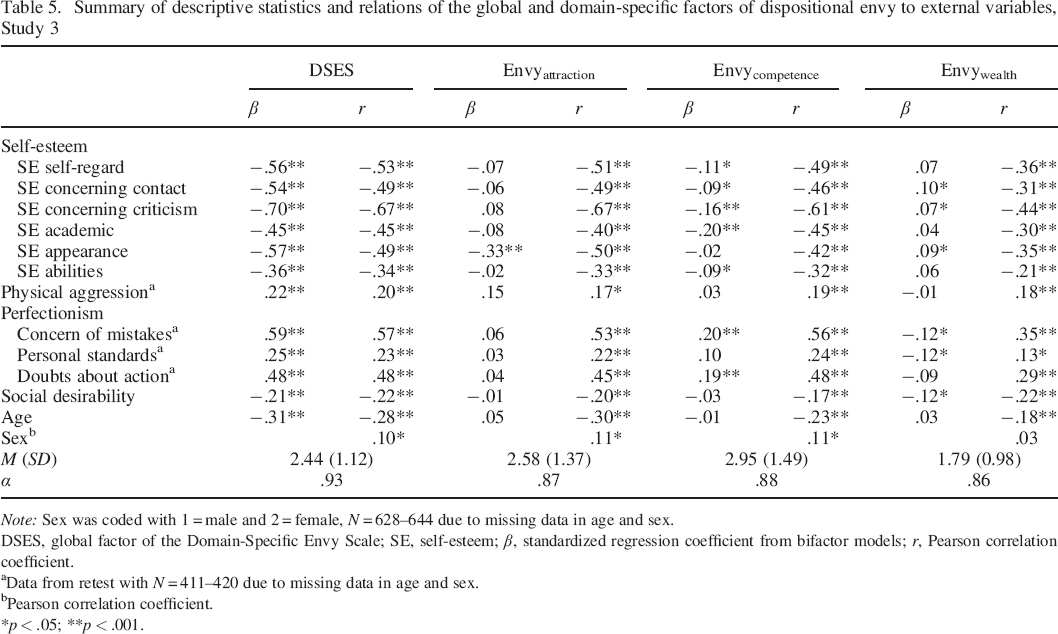
Note: Sex was coded with 1 = male and 2 = female, N = 628–644 due to missing data in age and sex.
DSES, global factor of the Domain–Specific Envy Scale; SE, self–esteem; β, standardized regression coefficient from bifactor models; r, Pearson correlation coefficient.
Data from retest with N = 411–420 due to missing data in age and sex.
Pearson correlation coefficient.
p < .05;
p < .001.
Factor structure
In order to cross–validate the structure of the DSES in a sample from the general population, we ran confirmatory factor analyses with the
Because of the large sample size, we additionally conducted bifactor model analyses (Chen, Hayes, Carver, Laurenceau, & Zhang, 2012) on the structure of the DSES. A bifactor model assumes that there is a global factor that accounts for the commonality shared by the domain–specific facets, and there are multiple specific factors, each of which accounts for the unique influence of the specific component over and above the global factor. Analyses revealed acceptable model fit (CFI = 0.955, RMSEA = 0.075) that was slightly better than that in the second–order model.
Construct validity
We used the bifactor model in order to investigate the relations between domain–specific dispositional envy and the other variables. The bifactor model is more applicable than the second–order model when testing whether a subset of the specific factors predicts external variables over and above the global factor, as the specific factors are directly represented as independent factors rather than disturbances, as in second–order models (Chen et al., 2012).
Supporting the domain specificity of dispositional envy, results showed that specific subscales of the DSES revealed particularly strong relations with the analogous dimensions of self–esteem, over and beyond the global factor of dispositional envy (Table 5). For example, dispositional envy with respect to attraction was particularly strongly related to appearance self–esteem, and the domain of competence to academic self–esteem. Dispositional envy was also related to physical aggression and to perfectionism. Although we did not find a domain–specific effect on perfectionism in Study 1, in the current study, results revealed that concern of mistakes and doubts about action with respect to performance were also uniquely related to dispositional envy with respect to competence. Furthermore, dispositional envy was negatively related to socially desirable responding. Dispositional envy was also negatively related to age, indicating a decline of envy with age. The correlation between dispositional envy and gender was significant, but very small.
Temporal stability
In order to investigate temporal stability, we computed retest reliability coefficients for each of the domains and the total scale assessed at Time 1 and three months later. Results revealed that dispositional envy remained stable over three months (r = .77, p < .001). Retest correlations were stable across domains (i.e. r = .78, p < .001 for attraction; r = .72, p < .001 for competence; and r = .73, p < .001 for wealth). Coefficients indicated good three–month retest reliability of the scale.
Our findings highlight dispositional envy as a temporally stable construct. Furthermore, factorial analyses support the domain specificity of dispositional envy in a sample from the general population. Results indicated that the domains of dispositional envy with respect to attraction and competence were particularly strongly related to the corresponding facets of self–esteem. Additionally, the factor of competence was uniquely related to general self–regard and self–esteem with respect to criticism. Thus, the domain of competence seems to be particularly important in these self–esteem facets beyond global dispositional envy. The effect size on socially desirable responding was similar to the previous studies. However, the factor of wealth showed additional contributions to social desirability. Dispositional envy was related to physical aggression, indicating the malevolent outcomes related with the construct. However, dispositional envy was also related to setting personal standards, emphasizing the motivation to strive to acquire desired objects.
Study 4
Predicting state envy in the academic domain
Studies 1 through 3 provide evidence that the DSES is a reliable and valid instrument that can be applied with English–speaking as well as German–speaking persons and to participants from the general population. In order to investigate the criterion validity of the instrument, we wanted to provide evidence that dispositional envy has an impact on state levels of envy. Models that differentiate emotional states from traits have been developed, for example, with respect to the emotions of anxiety and anger (e.g. Spielberger, 1972, 1988). Such models differentiate between the temporary condition of states (e.g. anxiety in a test situation) and the more general and temporally stable quality of a trait (e.g. individual differences in tendencies to experience anxiety). State–trait models emphasize that a trait, depending on the situation, influences a state by affecting the intensity of the emotional experience (Spielberger, 1972).
Using an experimental design, we expected that, especially in upward social comparison situations, persons high in dispositional envy would display higher intensities of state envy than persons low in dispositional envy. As our results from Studies 1 to 3 revealed that dispositional envy can be assessed as a domain–specific construct, we chose a design in which the domain of academic competences was salient. We expected that dispositional envy with respect to competences would predict state envy, above and beyond the other domain–specific facets of dispositional envy and the global measure of dispositional envy.
Method
Participants
Participants were recruited via email or blackboard messages at two German universities and received personal feedback on their self–esteem profile for participation. Two hundred twenty students completed the questionnaire. Two participants were excluded from the analyses because of language problems. The final sample consisted of 218 students (39.4% men) from various schools such as humanities and social sciences, natural sciences and computer sciences. The average age of the participants was 23.0 years (SD = 4.1).
Procedure and measures
Participants first completed an online questionnaire to provide data on dispositional envy and other trait measures. Dispositional envy was assessed with the DSES (α = .91, αattraction = .80, αcompetence = .88 and αwealth = .88). Responses on the DSES were rated on 7–point Likert scales ranging from 1 (not at all) to 7 (very much). Participants were then randomly assigned to read one of two university news articles (adapted from van de Ven, Zeelenberg, & Pieters, 2011; see supporting information S10 for summary of measures).
The articles were comparable with respect to length and content but varied with regard to whether they were about a high–ability student (upward–comparison condition, 108 participants) or about an average student (neutral–comparison condition, 110 participants). As research has shown that similarity is an important condition for feelings of envy (Salovey & Rodin, 1984), the target person and the participant were matched with respect to their gender and their school of studies. In the upward–comparison condition, a university news article described Paula [Paul] Schneider as a brilliant student from the same school who had just won a prize in the national student competition, StudCompete. Paula [Paul] Schneider was selected for the competition because of her [his] excellent achievements in high school, at university and in her [his] extracurricular activities. The prize was given to her [him] because of remarkable abilities shown during the completion of a variety of tasks. In the neutral–comparison condition, the university news article was about Paula [Paul] Schneider as an average student who had participated in the student competition because of her [his] solid prior achievements. Although she [he] had performed reasonably well, her [his] performance had been within the average range.
While reading, participants were instructed to think about how they evaluate themselves relative to the described person in order to foster an intensive mental processing of the description of the student. Then, participants were asked to indicate the intensity of their actual feelings. Feelings of envy were measured with eight items on 7–point Likert scales ranging from 1 (not at all) to 7 (very much): ‘I feel envious towards the person’, ‘I am sure many people envy this person’, ‘I feel malevolence against this person’, ‘I envy this person’, ‘I would like to be in the position of this person’, ‘I would like to be in the shoes of this person’ and ‘I feel less good when I compare my own results with those of this person’ (α = .89; with the latter three items adapted from van Dijk, Ouwerkerk, Goslinga, Nieweg, & Gallucci, 2006). In order to rule out the explanation that mere negative affect was manipulated and could have driven the results, we assessed negative affect via the short form of the Positive and Negative Affect Schedule (Mackinnon et al., 1999; German adaptation by Krohne, Egloff, Kohlmann, & Tausch, 1996). Responses on the five items (afraid, upset, nervous, scared and distressed) were rated on 5–point Likert scales ranging from not at all to very much (α = .80).
As a manipulation check, we additionally asked participants how much they would agree with the following statements: The target person is characterized by intelligence, creativity, laziness, ambition and diligence. Responses were rated on 5–point Likert scales ranging from 1 (not at all) to 5 (very much).
Results and Discussion
The manipulation check revealed that the target in the upward–comparison condition was perceived as significantly more intelligent (M = 4.46, SD = 0.73), less lazy (M = 1.20, SD = 0.51), more ambitious (M = 4.59, SD = 0.66) and more diligent (M = 4.61, SD = 0.53) than the target in the neutral–comparison condition [M = 4.15, SD = 0.67, t(216) = 3.26, p = .001 for ratings on intelligence; M = 1.48, SD = 0.73, t(216) = −3.27, p = .001 for ratings on laziness; M = 4.27, SD = 0.68, t(216) = 3.54, p < .001 for ratings on ambition; and M = 4.38, SD = 0.78, t(216) = 2.69, p = .01 for ratings on diligence]. With respect to creativity, there was no effect, t(216) = −0.34, p = .73. Consistent with our hypothesis, targets in the upward–comparison condition were perceived as displaying higher academic competences than targets in the neutral–comparison condition. Furthermore, conditions did not significantly vary in terms of feelings of general negative affect in participants, t(216) = 0.10, p = .92. These results indicate that mere negative affect was not manipulated.
In order to investigate the (main) effect of the situation, we tested whether the condition affected state envy. The analysis revealed that state envy varied significantly by condition, t(216) = 5.53, p < .001. Participants in the upward–comparison condition reported more intense feelings of envy (M = 3.26, SD = 1.26) than participants in the neutral–comparison condition (M = 2.36, SD = 1.15). Testing the main effect of dispositional envy, regression analyses revealed that all domains of dispositional envy significantly predicted state envy: β = .42, p < .001 for attraction; β = .40, p < .001 for competence; and β = .35, p < .001 for wealth. Participants with higher dispositional envy reported stronger state envy than participants with lower dispositional envy.
In the current study, however, we argued that state envy is determined by a person–by–situation interaction. In order to analyse the impact of dispositional envy on the intensity of state levels of envy depending on the situation, we ran a moderated multiple regression analysis with a dichotomous contrast–coded moderator (−1 for the neutral condition and 1 for the upward condition). Dispositional envy was z–standardized prior to running the analysis. More specifically, we hypothesized that especially dispositional envy with respect to competence would predict state envy in an upward–comparison situation on academic competences, but not the other facets of domain–specific envy.
Regression analyses revealed an outlier with a standardized residual larger than 3, which was omitted from further analyses. Results showed that the interaction term between dispositional envy and condition was only significant for dispositional envy with respect to competence (β = .16, t = 2.16, SE = 0.07, p = .03, 95% confidence interval (CI) [0.01, 0.30]), but not for the domain of attraction (β = .11, t = 1.48, SE = 0.07, p = .14, 95% CI [−0.04, 0.25]) or wealth (β = .01, t = 0.16, SE = 0.08, p = .88, 95% CI [−0.14, 0.16]). The interaction effect for competence remained the same even when controlling for the other domains of dispositional envy and when additionally controlling for global dispositional envy (p = .02). Results remained stable when controlling for general negative affect (p = .04).
To facilitate interpretations of the effects, we analysed the simple slopes for each of the conditions. The interaction effect revealed that domain–specific dispositional envy (competence) predicted state levels of envy in situations involving an upward comparison with respect to academic competences (β = .67, t = 6.51, SE = 0.10, p < .001, 95% CI [0.47, 0.88]) significantly more strongly than situations involving neutral comparisons (β = .36, t = 3.53, SE = 0.10, p < .001, 95% CI [0.16, 0.56]). Participants with high levels of dispositional envy regarding competence reported stronger experiences of envy than participants with low levels of dispositional envy after having been assigned to an upward–comparison condition than after having been assigned to a neutral–comparison condition.
Results from Study 4 support the hypothesis that people differ in their experiences of envy and that this variation can be predicted by individual differences in dispositional envy. Moreover, results highlight that when a specific domain is particularly salient, such as the domain of competence, domain–specific dispositional envy with respect to competence was particularly relevant when experiencing envy, above and beyond the other domains of dispositional envy. The results of the current study also support the criterion validity of the DSES as it predicted experiences of envy. However, because Study 4 was based on comparisons with a hypothetical target, it is not clear yet whether dispositional envy predicts experiences of envy using a realistic design. Furthermore, findings from Study 4 are limited, as we did not control for related feelings of envy such as anger or sadness.
Study 5
Predicting state envy elicited by dyadic interaction
In Study 5, we investigated the role of dispositional envy in observed experiences of envy in dyadic interactions. Given that envy is a social emotion that arises from a negative comparison with another person (Salovey & Rodin, 1984; Smith, 2000), we examined whether dispositional envy influences levels of state envy in social interactions, controlling for the influence of other relevant negative emotions (anger and sadness).
A previous study has shown that the emotion of envy arises when the outcome of a social comparison situation is perceived as somewhat uncontrollable (van de Ven, Zeelenberg, & Pieters, 2012). In order to ensure low controllability of the outcome of such a situation, we chose a task in which the outcome was not predictable. Participants played the game ‘Rock, Paper, Scissors’ against each other. This allowed for the possibility that each player would experience a positive or negative outcome by chance alone. Furthermore, the task was expected to be highly credible relative to tasks that include manipulations utilizing false feedback, for instance.
Method
Participants
Participants were invited to participate in a study on ‘Personality and Social Relationships’ via announcements in education lectures at a German university. We focused on education and teaching students as they had not participated in psychological research before. Ninety students completed the first part of the study, which was an online survey. Of those who completed, 72 participants with an average age of 22.2 years (SD = 4.2) took part in the second part of the study. Sixty–six participants were female. Participants received personal feedback on their self–esteem profile as well as monetary reimbursement for participation.
Procedure and measures
The study consisted of two parts (see supporting information S11 for details). In the first part, participants filled out an online questionnaire at home. In the second part, participants met in dyads in the interaction laboratory at the university. Two weeks before meeting in the interaction lab, participants filled out questionnaires measuring traits such as dispositional envy and individual differences in socially desirable responding. Dispositional envy was assessed with the DSES (α = 91) using 7–point Likert scales ranging from 1 (not at all) to 7 (very much). Social desirability was assessed as a control measure with the other–deceptions scale of the BIDR (Paulhus, 1994; German version by Musch et al., 2002, α = .62) on 7–point Likert scales ranging from 1 (strongly disagree) to 7 (strongly agree).
Before arriving in the interaction lab, participants were matched by sex to dyads at zero acquaintance, as research has shown that similarity is an important condition for feelings of envy (Salovey & Rodin, 1984). Participants sat face to face at a table (seating position was randomized; the distance between participants was held constant across settings, i.e. 140 cm). Then, participants played a game called ‘Rock, Paper, Scissors’. The rules of the game were provided on a handout. Participants had three trials to test the game. Afterwards, the game started: participants were informed that the game was over when one of the two participants won a trial and that the winner would receive a small reward for purposes of motivation. The reward was a highly valued chocolate bar (Milka Nussini) that was placed in an opaque box next to both participants (the position of the box was held constant across settings). The winner was instructed to take the reward and leave it on the table next to him or herself.
Participants completed a questionnaire assessing their perceptions of the situation and their feelings towards the other person. For state measures, participants were asked to rate the intensity of their feelings on a 7–point Likert scale ranging from 1 (not at all) to 7 (very much). The intensity of feelings of envy was measured with two items (i.e. ‘I am envious of the other person’ and ‘I envy the other person’, α = .76). As control measures, participants rated the intensity of their experience of sadness (‘I am sad’) and anger (‘I am angry’) on the same rating scale. Furthermore, participants indicated their previous experience with the Rock, Paper, Scissors game and their attributions of the outcome of the game to luck, task difficulty, ability or effort. Additionally, on a 7–point Likert scale from 1 (not at all) to 7 (very much), participants indicated how much they thought that they could have won the game. At the end, participants were thanked and fully debriefed. They received monetary reimbursement of €5 each. The personal self–esteem profile was sent via email. Seven participants reported that they did not like chocolate, suffered from a nut allergy or suffered from lactose intolerance. Those participants and their interaction partners were excluded from the following analyses.
Results and Discussion
Analysing the main effect of the situation revealed that participants who did not receive the reward reported stronger feelings of envy (M = 2.00, SD = 1.08) than participants who received the reward (M = 1.31, SD = 0.89), t(57) = 2.67, p = .01. Furthermore, as expected, the manipulation had no effect on sadness, t(58) = 1.20, p = .24, and anger, t(58) = 0.00, p = .99. We further checked participants‘ perceptions of the task. Participants reported that they could have won the game (M = 6.33, SD = 1.67) and attributed the result of the task primarily to coincidence (93.3% vs 5% to ability and 1.7% to effort). Results indicated that the outcome of the task was perceived as uncontrollable. Furthermore, 66.7% of participants rated themselves as intermediate, 30% as beginners and 3.3% as experts. These data ruled out the possibility that ability could have driven the effects of the task.
Because of the dyadic design, analyses on the influence of dispositional envy on current feelings of envy in specific situations were conducted using actor–partner interdependence model (APIM) analyses (Kenny, Kashy, & Cook, 2006) with the
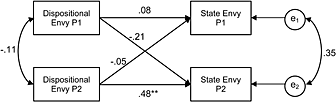
Standardized regression coefficients from an actor–partner interdependence model for analysing the relation between dispositional envy and actual experiences of envy; P2 is the person who did not receive a reward; P1 is the person who received a reward; e1 and e2 are error terms, Study 5.
The current results provide evidence that dispositional envy has an impact on state envy also in real dyadic interactions. Study 5 confirms criterion validity of our measure of dispositional envy, as the DSES predicted reports of envy two weeks after the assessment of dispositional envy.
General Discussion
In the current research, we conceptualized dispositional envy as a domain–specific construct and developed a new instrument to measure dispositional envy, the DSES. Psychometric properties indicate that the DSES is a reliable and valid instrument for measuring dispositional envy in the English and German language contexts. Previous approaches did not conceptualize dispositional envy as a domain–specific construct. The current results, however, provide support for the domain specificity of dispositional envy. We further demonstrated relations with important intrapersonal and interpersonal constructs in order to locate domain–specific dispositional envy within a nomological network of similar and dissimilar constructs. Our findings have practical importance as dispositional envy predicted the intensity of envy experience in both hypothetical and actual envy–relevant situations.
Domain specificity in dispositional envy
Our findings support the conceptualization of dispositional envy as a domain–specific personality trait. Factor analyses in three different samples provide evidence for the multidimensional structure of dispositional envy. In accordance with previous research revealing different comparison domains at the state level (e.g. DelPriore et al., 2012; Salovey & Rodin, 1991), our analyses established three broad domains of dispositional envy: attraction, competence and wealth. The differentiation was further supported by unique relations between the domains of attraction and competence and other domain–related constructs. For example, participants who scored higher on dispositional envy with respect to competence exhibited lower academic self–esteem than participants scoring lower on dispositional envy with respect to competence. According to findings with respect to state envy (Salovey & Rodin, 1991), it is likely that domain–specific dispositional envy is dependent on the importance an individual attaches to a specific comparison domain for her or his self–evaluation. Consistent with this argument, we found that self–esteem of participants who were high in dispositional envy with respect to competence was especially contingent on the domain of academic competence but not on other domains. Thus, it is plausible that people high in domain–specific dispositional envy attach importance to specific comparison domains on which they also draw their self–esteem.
Based our conceptualization of dispositional envy as a domain–specific construct, we further argued that the relation between trait and state envy should be domain specific as well. Results based on social comparisons in the academic domain revealed that participants scoring high in dispositional envy with respect to competence reported higher levels of state envy than participants scoring low in dispositional envy with respect to competence. The effect was particularly relevant in upward–comparison situations. We also found that dispositional envy predicted state envy in observed dyadic interactions between zero–acquaintance participants. Our findings reveal a Person × Situation interaction (Mischel, 1977) such that dispositional envy is particularly important in predicting actual experiences of envy in upward–comparison situations. Our findings are largely consistent with state–trait models of affect (e.g. Spielberger, 1972), which propose that a trait influences the state in specific situations by having an impact on the intensity of the state experience.
Irrespective of the comparison domains, the general tendency to experience envy—which can be assessed either as the aggregated mean of all items of the DSES or as a global factor that exhibits the shared variance of all items—revealed relations to domain–general constructs. Across studies, we found that dispositional envy was negatively related to general self–esteem. Some researchers have argued that low self–esteem stems from feelings of inferiority that follow negative upward social comparisons with other persons (e.g. Parrott & Smith, 1993; Smith et al., 1999). Probably, the negative relation between dispositional envy and self–esteem is due to social comparison processes, as studies have suggested that self–esteem affects the tendency to draw on social comparisons for one's self–evaluation. For example, research revealed that low self–esteem is linked to individual differences in comparison orientation (Gibbons & Buunk, 1999). More specifically, it has been shown that people low in self–esteem rather tend to compare themselves upwards than downwards, which apparently also entails the risk of negative self–evaluations (Wayment & Taylor, 1995). Thus, low self–esteem seems to be rather a risk factor for painful social comparison outcomes, which therefore may be associated with the tendency to envy others.
Consistent with this view, we found that dispositional envy was associated with comparison orientation. Our results are in line with research showing that comparing oneself with other persons frequently is associated with negative affect (Nolen–Hoeksema, Larson, & Grayson, 1999; Pyszczynski & Greenberg, 1987) and frequent feelings of envy (White, Langer, Yariv, & Welch, 2006). Moreover, this connection might be due to an increase in self–focused attention (Silvia & Duval, 2001), as this form of self–awareness has been shown to be linked to social comparison orientation and negative affect (Nolen–Hoeksema et al., 1999; White et al., 2006). Thus, it is likely that frequent negative evaluations of social comparison outcomes promote self–focused attention, low self–esteem and a stable tendency to experience envy.
The proposed interrelations are also confirmed by our finding that dispositional envy and psychopathological symptoms of depression and anxiety are correlated. These findings are consistent with theories of early philosophers, such as Aristotle, who equated envy with psychological pain. Furthermore, given that negative social comparisons can be very painful (Takahashi et al., 2009), the individual should be motivated to maintain or improve his or her current status. One way to overcome this feeling is to distance oneself from the comparison person, for example, by degrading the superior other (e.g. Salovey & Rodin, 1984) or by levelling up (e.g. Lange & Crusius, 2015). Our results showing that measures of hostility and aggression are related to dispositional envy support this notion. Dispositional envy was also related to setting personal standards, an aspect of perfectionism that has been shown to be associated with constructive problem solving (Altstötter–Gleich & Bergemann, 2006). The latter is consistent with a strategy that has been discussed as another reaction of envy, namely to strive to acquire the desired object (Foster, 1972; Lange & Crusius, 2015).
Limitations and future directions
The current studies revealed strengths but also limitations that deserve mention. More research is needed in disentangling the specific contributions of the DESs. For example, it would be important to investigate whether the DSES predicts state envy in domain–specific contexts better than previous instruments measuring dispositional envy as a unidimensional construct. Furthermore, it seems to be of crucial importance to further validate the Wealth Scale of the DSES. For example, dispositional envy with respect to wealth should be uniquely related to materialism as proposed by Belk (1985). In this regard, it is also important to further investigate the predictions of domain–specific outcomes by the corresponding domain–specific facets of dispositional envy, also in order to establish criterion validity of these subdomains. Such an approach would be clearly important in intervention or prevention programmes in the clinical context. For example, attraction envy might be particularly relevant in the context of eating disorders. As it has been shown that eating disorders are related to social comparisons with respect to physical attractiveness (e.g. Ferreira, Pinto–Gouveia, & Duarte, 2013), then this might be related to attraction envy as well. Another important risk factor that has been identified for psychopathology is neuroticism (Barlow, Sauer–Zavala, Carl, Bullis, & Ellard, 2014). In our study, we found a moderate correlation between dispositional envy and neuroticism. It is possible that one mechanism linking neuroticism to psychopathology is a tendency to experience heightened levels of dispositional envy. However, the current findings on psychopathological symptoms are limited as they are based on mentally healthy populations. Thus, it is necessary to replicate the current findings in patient samples with clinically defined mental health outcomes.
It is also important to note that the domains investigated in the current studies are based on student samples (e.g. DelPriore et al., 2012). It is, however, possible that coming to late age, different domains are relevant, for example, health. In the current research, we referred to broader domains of dispositional envy in order to minimize the possibility of age effects. Results from a community sample also support the three–factorial structure of dispositional envy. However, it is of crucial importance to investigate whether domain specificity changes across age. It would be also worth to investigate whether the mean levels of the domains of dispositional envy remain equally stable over a long period or whether they change differently with age. Our studies indicated that older participants exhibited less dispositional envy with respect to the domains of attraction, competence and wealth. However, those results are based on cross–sectional data, therefore not allowing the opportunity to investigate change across the life span. For example, researchers could investigate whether the change of specific contingencies of self–worth across age are accompanied by a change in the corresponding domains of dispositional envy. Similarly, it has been shown that different facets of multidimensional self–esteem change with age (e.g. Rentzsch, Wenzler, & Schütz, 2015), which, again, could be accompanied by a change in domain–specific dispositional envy.
Moreover, all of the studies presented referred to self–reports. However, self–reports in studies on envy can be problematic, as participants could be inclined to respond in a socially desirable way. For example, the means of state envy in Study 5 were particularly low, indicating little acquiescence. It seems to be therefore important for future studies to use different methods for assessing envy beyond relying on self–report, such as indirect assessment (e.g. Habimana & Massé, 2000) or behavioural observation. Behavioural outcomes could be, for example, better performance in performance tasks for people high in dispositional envy with respect to competence or negative reactions towards the comparison person. Based on our results from Studies 4 and 5, it is plausible to argue that state envy could serve as an important mediator. However, it is also important to note that the sample size in Study 5 was rather small. Although power for detecting the effect between dispositional envy and state envy was appropriate (0.77), power for detecting a significant difference between the effects of the conditions was insufficient. Therefore, it is necessary to show the relation between dispositional envy, state envy and related behavioural outcomes in a representative large sample.
Another research direction is to investigate whether dispositional envy is adaptive or maladaptive in the long run. On the one hand, we identified several problematic factors that are associated with dispositional envy, such as mental health problems or aggression. However, we also identified adaptive correlates such as the tendency to set personal standards, as a subtrait of perfectionism (Frost et al., 1990). From an evolutionary psychological perspective on social emotions such as envy, these emotions are thought to serve as a means of informing the individual about the advantages of others, which is important because individuals who are oblivious to these aspects of interpersonal relations face the risk of losing access to resources and mating partners (Hill & Buss, 2008). Thus, a person who tends to exhibit such a signal system could also benefit from the trait, at least when it comes to gaining resources and mating partners.
Concluding comment
The goal of the present research was to develop and validate a new measure of dispositional envy, the DSES, in order to provide evidence of the conceptualization of dispositional envy as a domain–specific construct. One important aspect of the DSES is that we constructed the scale based on the common definition of envy, by disentangling the experience of the emotion from emotional reactions that come later in the emotion–generative process of envy and from related constructs. The DSES thus provides a tool for investigating the underlying mechanisms of the phenomenon of dispositional envy. A second important aspect of the DSES is that it distinguishes different domains of social comparison in dispositional envy. The present studies established three broad domains of dispositional envy: attraction, competence and wealth. Results supported the notion of dispositional envy as a domain–specific, temporally stable trait that contributes to the temporary experience of state envy.
Supporting info item
Supporting info item, per2012-sup-0001-Supplementary - Who Turns Green with Envy? Conceptual and Empirical Perspectives on Dispositional Envy
Supporting info item, per2012-sup-0001-Supplementary for Who Turns Green with Envy? Conceptual and Empirical Perspectives on Dispositional Envy by Rentzsch Katrin and Gross James J. in European Journal of Personality
Footnotes
Notes
Acknowledgements
The research project was funded by the German Research Foundation DFG (RE 3718/1–1). We are grateful to Astrid Schütz for helpful suggestions to an earlier version of the manuscript. We thank Martina Haas, Eva Pfister and Michela Schröder–Abé for their support in collecting data.
References
Supplementary Material
Please find the following supplemental material available below.
For Open Access articles published under a Creative Commons License, all supplemental material carries the same license as the article it is associated with.
For non-Open Access articles published, all supplemental material carries a non-exclusive license, and permission requests for re-use of supplemental material or any part of supplemental material shall be sent directly to the copyright owner as specified in the copyright notice associated with the article.
