







Abstract
The cognitive functioning of individuals with stronger endorsement of right–wing and prejudiced attitudes has elicited much scholarly interest. Whereas many studies investigated cognitive styles, less attention has been directed towards cognitive ability. Studies investigating the latter topic generally reveal lower cognitive ability to be associated with stronger endorsement of right–wing ideological attitudes and greater prejudice. However, this relationship has remained widely unrecognized in literature. The present meta–analyses revealed an average effect size of r = −.20 [95% confidence interval (95% CI) [−0.23, −0.17]; based on 67 studies, N = 84 017] for the relationship between cognitive ability and right–wing ideological attitudes and an average effect size of r = −.19 (95% CI [−0.23, −0.16]; based on 23 studies, N = 27 011) for the relationship between cognitive ability and prejudice. Effect sizes did not vary significantly across different cognitive abilities and sample characteristics. The effect strongly depended on the measure used for ideological attitudes and prejudice, with the strongest effect sizes for authoritarianism and ethnocentrism. We conclude that cognitive ability is an important factor in the genesis of ideological attitudes and prejudice and thus should become more central in theorizing and model building. Copyright © 2015 European Association of Personality Psychology
Cognitive ability pertains to an individual's capacity to perform higher cognitive processes, such as problem solving, reasoning, remembering and understanding. Although at first glance cognitive ability may only seem relevant to performance on cognitive and intellectual tasks, it has many social implications as well. Indeed, a higher cognitive ability is related to a host of social behaviours and interactions, such as increased interpersonal sensitivity (Murphy & Hall, 2011), higher altruism (Millet & Dewitte, 2006) and greater (political) trust (Sturgis, Read & Allum, 2010). Furthermore, research has shown that cognitive ability has substantial effects on attitude formation as well, demonstrating correlations with lower levels of religiosity (Zuckerman, Silberman & Hall, 2013) and a greater preference for evolutionary, novel ideas (Kanazawa, 2010, 2012). The role of cognitive ability may also be important for our understanding of both prejudice and ideological attitudes, a topic on the agenda of scholars more than 60 years ago (e.g. Adorno, Frenkel–Brunswik, Levinson & Sanford, 1950; Allport, 1954; for a review, see Dhont & Hodson, 2014). As concluded by Adorno and colleagues, ‘the most ethnocentric are, on the average, less intelligent than the least ethnocentric’ (p. 284). In line with this observation, several recent investigations confirm that greater cognitive ability is negatively related with right–wing ideological attitudes and prejudice (e.g. Deary, Batty & Gale, 2008; Hodson & Busseri, 2012; Van Hiel, Onraet & De Pauw, 2010).
Yet, the vast majority of contemporary theories explaining intergroup attitudes and behaviour specify little or no theoretical role for cognitive abilities, instead focusing on factors such as intergroup contact (Hodson & Hewstone, 2013; Pettigrew & Tropp, 2006), anxiety and threat (Onraet, Van Hiel, Dhont & Pattyn, 2013; Riek, Mania & Gaertner, 2006; Stephan, 2014), social identity concerns (Tajfel & Turner, 1979), competition for dominance or resources (Bobo, 1999; Sidanius & Pratto, 1999), empathy (Batson et al., 1997), essentialist thinking (Hodson & Skorska, 2015; Roets & Van Hiel, 2011a), out–group dehumanization (Leyens et al., 2000; Hodson, MacInnis & Costello, 2014) or disgust sensitivity (Hodson et al., 2013), to name a few. Mental or cognitive abilities, as related to ideological attitudes and prejudice, are strikingly absent from the comprehensive Handbook of Social Psychology (Fiske, Gilbert, & Lindzey, 2010), and from popular and widely used texts and textbooks that deal specifically with stereotyping, prejudice and discrimination (e.g. Brown, 2010; Dovidio, Hewstone, Glick & Esses, 2010; Nelson, 2009; Schneider, 2004; Whitley & Kite, 2010). To the extent that cognitive factors are implicated, the field largely emphasizes cognitive styles, that is, preferences for modes of information processing, such as need for closure (NFC) or structure (e.g. Jost, Glaser, Kruglanski, & Sulloway, 2003; Roets & Van Hiel, 2011b; Van Hiel et al., 2010). In other words, motivation for simple and ordered thinking drives people towards right–leaning ideologies and prejudice.
All of these factors are arguably important correlates of ideological attitudes and prejudice, but what about cognitive abilities? It is possible that contemplating these relations is considered unsavoury, contentious or overly controversial, encouraging researchers to underplay links between, for instance, ability and ideology (e.g. Block & Block, 2006; Fraley, Griffin, Belsky & Roisman, 2012), with such topics possibly considered ‘impolite’ for academic discussion (Hodson, 2014). Moreover, there exist strong doubts in the field about whether mental abilities are actually relevant contributors to the outcomes we seek to explain. For instance, Duarte et al. (in press) opine that, based on their reading of the literature, the data do ‘…not yield a consistent liberal advantage [in abilities], even a small one’. This raises the question of whether relations exist between ability, on the one hand, and ideology and prejudice, on the other, and whether such relations represent very small effects (and are thus inconsequential) or sizeable (and thus relevant to explaining ideology and intergroup relations).
In keeping with the Association for Psychological Science best practices and an emphasis on the ‘new statistics’ (Cumming, 2014), we bring a cumulative science approach to this research question, conducting a meta–analysis of the empirical studies of the association of cognitive ability with right–wing ideology and prejudice. We argue that meta–analyses are particularly needed and valuable when relations between variables are relatively unknown or under–represented and when variable inter–relations are controversial and contentious, as with the relation between cognitive ability and ideology. 1 In such circumstances, meta–analyses not only provide a quantitative review of the existing literature but also offer generative insights for new research and theorizing. In our analysis, we were especially interested in whether the strength of the relations under study depends on the type of cognitive ability. Based on the Cattell–Horn–Carroll (CHC) model of cognitive ability (McGrew, 2005; Schneider & McGrew, 2012), we distinguished between different types of cognitive abilities. We also investigated the potential moderating effects of several other variables such as type of outcome and sample characteristics.
Right–wing ideological attitudes and prejudice: The role of cognition
Prejudice largely involves negative evaluations of and beliefs about out–groups, such as other ethnic groups, women, homosexuals and the elderly. Two broad research traditions have historically sought to unveil the psychological basis of prejudice. Whereas some focused on the impact of situational and contextual factors, such as (intergroup) threat (e.g. Riek et al., 2006), others investigated the role of individual differences and personality predispositions (Adorno et al., 1950; Allport, 1954). In their well–known book The Authoritarian Personality, Adorno et al. (1950) argued that authoritarian personality characteristics lead people to adhere to extreme right–wing parties and prejudice. Since then, other relevant attitudinal individual differences have been related to right–wing ideology and prejudice, including tough–mindedness (Eysenck, 1954), dogmatism (Rokeach, 1960) and conservatism (Wilson, 1973). These attitudes can all be divided under the category of ‘right–wing socio–cultural attitudes’, broadly referring to adherence to traditional values and norms and resistance to change (Altemeyer, 1998; Duckitt & Sibley, 2009; Jost et al., 2003). Right–wing authoritarianism (RWA; Altemeyer 1981, 1998) is a typical indicator of this pattern of broad social beliefs (Duckitt & Sibley, 2009). The three RWA facets—uncritically submitting to authorities, adhering to societal norms and traditions and showing aggressiveness towards individuals who deviate from these conventional norms and values—all tap into the social–cultural domain. Most conservatism scales and dogmatism also refer to the social–cultural domain.
We focus on one prominent research question that has elicited interest among scholars for a long time. Specifically, do individuals with stronger endorsement of right–wing and prejudiced attitudes score higher or lower on specific cognitive characteristics, differentiating them from individuals with rather left–wing and less prejudiced attitudes? In the social psychological literature, there is a long and widely accepted tradition linking limited cognitive resources with intergroup biases and ideological attitudes. For instance, the well–known study by Gilbert and Hixon (1991), a staple in most prejudice textbooks, demonstrated that when cognitively busy (e.g. rehearsing a digit sequence or performing a visual search task while performing the central task), participants are less likely to activate stereotypes but are significantly more likely to apply (i.e. ‘use’) stereotypes that are activated (or salient). Others have observed that people under high (versus low) cognitive load are more likely to recall stereotypic traits (e.g. Macrae, Hewstone & Griffiths, 1993; Pratto & Bargh, 1991). With regard to ideological attitudes, Eidelman, Crandall, Goodman and Blanchar (2012) have demonstrated that inducing low–effort thinking (e.g. alcohol consumption, cognitive load and time pressure) results in stronger endorsement of politically conservative ideologies, such that ‘conservatism may be a process consequence of low–effort thought’ (Eidelman et al., 2012, p. 808). Underlying each of these experimental methodologies is the assumption that lower availability of cognitive resources elicits more social conservatism and prejudice–relevant thinking. This basic premise, when framed experimentally within a social psychology context, courts little controversy. Yet, when exported to the realm of individual differences, such that those lower in cognitive abilities are purportedly higher in social conservatism and prejudicial attitudes, this idea has less traction. However, the underlying principles are very closely related if not analogous—to the extent that lesser mental ability is related to these outcomes; this should be true whether the ability limitation is based on an individual difference or is experimentally induced (see E. T. Higgins, 2000, for a discussion of ‘general principles’ across person and situation effects).
Indeed, some scholars have argued that individuals with lower cognitive skills are relatively ill–equipped to process complex and new social information and to understand constantly changing societal contexts. Therefore, they are more likely to stick to what is presently known and considered acceptable, rather than being open–minded and appreciating multidimensional perspectives (Deary et al., 2008; Heaven, Ciarrochi & Leeson, 2011; McCourt, Bouchard, Lykken, Tellegen & Keyes, 1999; Stankov, 2009). By emphasizing societal traditions, the preservation of the status quo and strict group boundaries, ideologies endorsing resistance to social change, that is, right–wing ideologies (Jost et al., 2003), should be particularly appealing to those with lower cognitive abilities (e.g. Heaven et al., 2011; Keiller, 2010; Stankov, 2009). According to this theoretical perspective, therefore, right–wing ideologies provide well–structured and ordered views about society and intergroup relations, thereby psychologically minimizing the complexity of the social world. Theoretically, therefore, those with fewer cognitive resources drift towards right–wing conservative ideologies in an attempt to increase psychological control over their context. Furthermore, studies have shown that being cognitively restricted when engaging in complex mental processing and high–effort thinking (Eidelman et al., 2012) facilitates reliance on simple heuristics in social judgments, which in turn lead to quick and biased views about other groups (Heaven et al., 2011; Hodson & Busseri, 2012; Keiller, 2010). Although initially under–investigated, cognitive ability has gradually gained importance in the field of ideological attitudes and prejudice (e.g., Deary et al., 2008; Dhont & Hodson, 2014; Hodson, 2014; Van Hiel et al., 2010). In the next sections, we provide an overview of the empirical studies investigating associations of cognitive ability with both right–wing ideological attitudes and prejudice.
Cognitive ability and right–wing ideological attitudes
Adorno et al. (1950) already investigated the relationship between cognitive ability and authoritarianism, and many studies followed this first inquiry, reporting negative relations between cognitive ability and authoritarianism (e.g. Adorno et al., 1950; Christie, 1954; Davids & Eriksen, 1957; Jacobson & Rettig, 1959; Siegel, 1956). Similar results were obtained with the Dogmatism Scale (Long & Ziller, 1965; Thompson & Michel, 1972; Uhes & Shaver, 1970) and, more recently, for a range of measures tapping right–wing ideological attitudes (e.g. Bouchard, Segal, Tellegen, McGue, Keyes & Krueger, 2003; Kanazawa, 2010; Keiller, 2010; McCourt et al., 1999). Further evidence for this association was obtained on the cross–national level by Stankov (2009), who found that inhabitants of conservative countries typically show lower average performance across different ability tests. A meta–analysis (Van Hiel et al., 2010), including data from 50 studies, reported an average correlation of r = −.26 between cognitive ability and right–wing ideological attitudes, including conservatism, authoritarianism and dogmatism. Moreover, several longitudinal studies, some using large representative samples, provided evidence for the direction of the relation, demonstrating that lower general cognitive ability in childhood relates to stronger endorsement of conservative and authoritarian attitudes later in life (Block & Block, 2006; Deary et al., 2008; Fraley, et al., 2012; Heaven et al., 2011; Schoon, Cheng, Gale, Batty & Deary, 2010).
Remarkably, despite the use of various cognitive ability measures across studies, scholars paid little attention to the potential differential impact of the various types of cognitive ability. However, a few studies simultaneously contrasted various types of cognitive abilities. For instance, Heaven et al. (2011) reported that among 12– to 13–year–olds, lower verbal abilities predict RWA five years later in time, whereas numerical abilities did not show such longitudinal effect. Kemmelmeier (2008) observed weak significant negative associations of verbal ability with two of three indicators for conservative attitudes and a positive association with a third indicator (i.e. anti–regulation attitudes), yet numerical ability did not yield any significant association. Choma, Hodson, Hoffarth, Charlesford and Hafer (2014) similarly found numerical reasoning to be unrelated to RWA. Deary et al. (2008) reported negative relationships of comparable strength between conservatism (i.e. items tapping into political distrust, social conservatism and anti–working women) on the one hand and two verbal ability tasks (mean r across sexes = −.18 and −.17), a reasoning task (mean r = −.15) and a short–time memory task (mean r = −.10) on the other hand. In sum, the results of these few studies yielded rather mixed findings with respect to potential differences between cognitive ability types.
Cognitive ability and prejudice
In the early studies, ethnocentrism, a form of prejudice towards ethnic out–groups in general, was particularly studied. Adorno et al. (1950) devoted an entire chapter on the relationship between cognitive ability and ethnocentrism, which was found to be negative. This initial finding was replicated in other studies across diverse samples and with diverse indicators of cognitive ability, such as reasoning tests (e.g. Eysenck, 1954; Kutner & Gordon, 1964; O'Connor, 1952), verbal ability tests (e.g. Egan, 1989) and general cognitive ability tests (Rokeach, 1951). More recently, Meeusen, de Vroome and Hooghe (2013) also revealed negative correlations between measures of verbal and mathematical abilities and ethnocentrism.
Other studies recently focused on prejudice expressed towards specific out–groups. Keiller (2010) reported that abstract reasoning is negatively related to prejudice against homosexuals. Costello and Hodson (2014) found that White children who are more able to comprehend hierarchical relations among objects (e.g. that cars and trucks belong to the superordinate category vehicles) express less racial bias towards Black children. Furthermore, longitudinal studies provided evidence for the effect of cognitive ability early in life on subsequent levels of prejudice. Analysing large, representative datasets, Deary et al. (2008), Schoon et al. (2010) and Hodson and Busseri (2012) demonstrated that cognitive ability in childhood leads not only to increased right–wing ideological attitudes but also to increased racism later in adulthood. A recent literature review on this topic by Dhont and Hodson (2014) concluded that ‘the field will benefit from a recognition of, and open discussion about, differences in cognitive abilities between those lower versus higher in prejudice’ (p. 454).
Similar to the literature on cognitive ability and right–wing ideological attitudes, little attention has been devoted to the possible differential impact of distinct types of cognitive ability. Only one study (Deary et al., 2008), using a large and representative dataset, reported associations of various strengths between racism and two verbal ability tasks (mean rs across sexes = −.23 and −.19), a reasoning task (mean r = −.15) and a short–time memory task (mean r = −.12).
The present study
The present study is a meta–analytic integration of empirical research on the relationship of cognitive ability with both right–wing social–cultural ideological attitudes and intergroup prejudice. The present meta–analyses extend the meta–analysis on cognitive ability by Van Hiel et al. (2010) in three important ways. First, since Van Hiel et al. collected samples for their meta–analysis in early 2009, several important studies, some with large samples or longitudinal data, have been published (e.g. Heaven et al., 2011; Hodson & Busseri, 2012; Kanazawa, 2010; Keiller, 2010; Schoon et al., 2010; Stankov, 2009; Xu, Mar & Peterson, 2013), which we included in the present analysis. Based on this literature and the meta–analysis of Van Hiel et al. (2010), we expected that lower cognitive abilities predict more right–wing ideological attitudes and greater prejudice. Second, whereas Van Hiel et al. only examined relationships with ethnocentrism as an indicator of prejudice, we also included studies that administered other indicators of prejudice (e.g. Costello & Hodson, 2014; Keiller, 2010).
Third, the present meta–analysis aimed to investigate the potential differential effects of specific types of cognitive ability, which was not examined by Van Hiel and colleagues. Research to date has typically used very diverse types and measures of cognitive ability, but little attention has been directed towards the question of whether particular types of cognitive ability might be especially relevant in ideology and prejudice. In other words, is the association between cognitive ability and right–wing ideological attitudes and prejudice consistent across all types of cognitive ability, or are these relationships largely driven by particular types of cognitive abilities? To investigate this, we divided all samples included in our meta–analysis into categories according to the measure of cognitive ability employed. The cognitive ability measures were classified according to the CHC theory of cognitive abilities (McGrew, 2005; Schneider & McGrew, 2012), considered one of the most empirically well–supported and widely accepted comprehensive theoretical frameworks of the structure of cognitive abilities (e.g. Flanagan, Genshaft & Harrison, 2012). Specifically, the CHC model proposed three levels: g is the highest level, representing general cognitive ability. Underlying g are nine primary broad domains who each contribute to the higher–order g–factor. These nine primary domains are: fluid reasoning (Gf), the broad ability to reason and solve novel problems; comprehension–knowledge ability (Gc), static abilities based on one's previously acquired knowledge; short–term memory (Gsm), the ability to encode, maintain and manipulate information in the immediate situation; long–term storage and retrieval (Glr), the ability to store and retrieve information in long–term memory; visual–spatial processing (Gv), the ability to perceive, generate, store and retrieve visual and spatial information; auditory processing (Ga), abilities involved in detecting and interpreting sounds; cognitive processing speed (Gs), the ability to quickly and fluently perform relatively simple cognitive tasks; reading and writing (Grw), individual's depth and breadth of reading and writing knowledge and skills; and finally, quantitative knowledge (Gq), the individual's depth and breadth of quantitative or mathematical knowledge and skills.
In sum, the present meta–analysis extends the meta–analysis of Van Hiel et al. (2010) by the following actions: (i) including new and recent studies for the relationship between cognitive ability and right–wing ideological attitudes; (ii) including various measures of prejudice and (iii) investigating whether the specific type of cognitive ability influences the strength of the relationship. Because it is widely acknowledged that right–wing ideological attitudes and prejudice are conceptually distinct (e.g. Altemeyer, 1981; Duckitt, 2001), we perform two separate meta–analyses, one for the relationship between cognitive ability and right–wing ideological attitudes and one for the relationship between cognitive ability and prejudice (including both measures of generalized prejudice and prejudice towards specific groups).
Method
Selection of studies: Search strategies and inclusion criteria
Studies for this meta–analysis were selected by using a variety of search strategies. First, we identified the relevant studies included in Van Hiel et al.'s (2010) meta–analysis, excluding the studies focusing on education rather than pure cognitive abilities. Second, we searched the databases ISI Web of Knowledge and Google Scholar for studies published until November 2014. We used a variety of keywords in various combinations. Keywords for right–wing ideological attitudes were authoritarianism, conservatism and dogmatism. Keywords for intergroup prejudice were racism, sexism, ethnocentrism, prejudice, ethnic prejudice, racial prejudice and intolerance. Keywords for cognitive ability were cognitive ability, mental ability, reasoning, intelligence and IQ. Third, we checked the references list of each relevant article for additional studies of interest. Finally, we contacted researchers in the field to share relevant unpublished data. We distributed our call for unpublished data via the websites or mailing lists of the International Society of Political Psychology, Society for Personality and Social Psychology, European Association of Social Psychology and the Social Psychology Network. Three researchers contacted us and shared their unpublished data.
Studies had to meet several criteria to be included in the meta–analysis. First, studies had to administer at least one measure of right–wing ideological attitudes or intergroup prejudice and at least one measure of cognitive ability. Furthermore, no sample overlap was allowed because samples included in a meta–analysis have to be statistically independent (Card, 2012; Mullen, 1989). When studies included multiple types of ideological or out–group attitudes or multiple types of cognitive ability in the same sample, we selected the type least prevalent across the other samples (see also Onraet et al., 2013; Van Hiel et al., 2010). When multiple indicators of a single type of right–wing ideological or out–group attitudes (e.g. multiple subscales of a conservatism scale) or multiple indicators of a single primary domain of cognitive ability (e.g. different indicators of fluid ability) were administered, the mean correlation was calculated and used for the analyses.
Study characteristics and coding
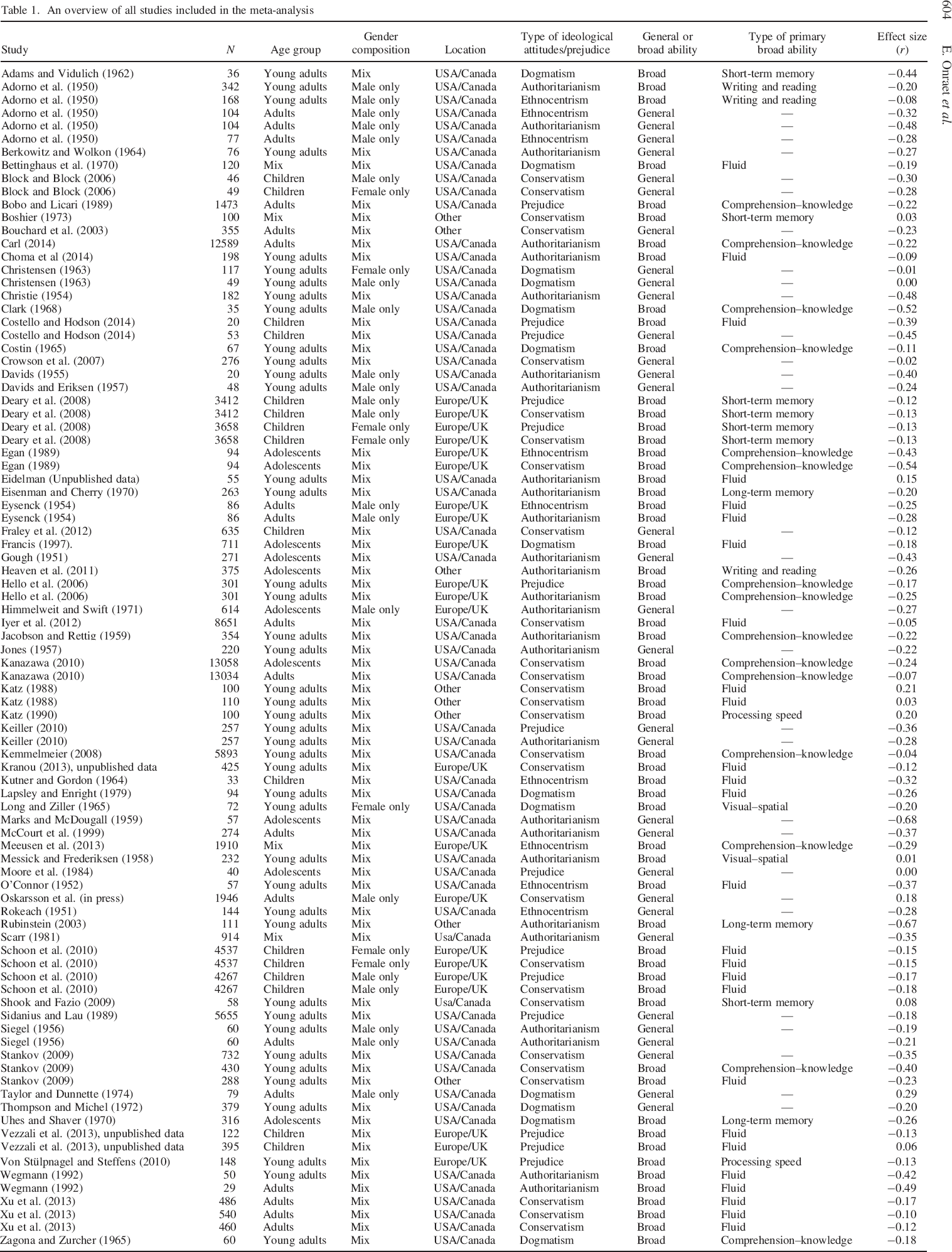
For the relationship between cognitive ability and right–wing ideological attitudes, we found 67 samples, with a total of 84 017 unique participants, meeting the inclusion criteria for the meta–analysis. For the relationship between cognitive ability and prejudice, we found 23 samples, with a total of 27 011 unique participants, meeting the inclusion criteria for the meta–analysis. All studies are displayed in Table 1, and forest plots with each study's effect size and 95% confidence intervals (CIs) are displayed in Figure 1 (for right–wing ideological attitudes) and Figure 2 (for prejudice). In total, over both meta–analyses combined, we now have 82 unique samples, with 94 398 unique participants. We retrieved 32 additional studies, which comprised 78 840 extra participants compared with the meta–analysis of Van Hiel et al. (2010).
An overview of all studies included in the meta–analysis
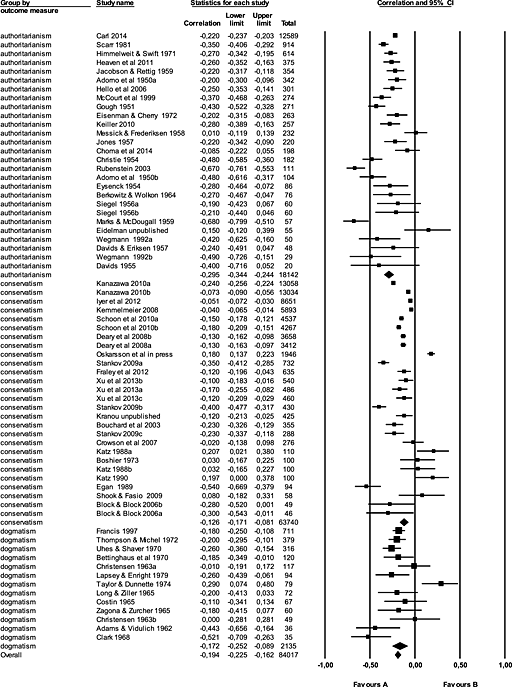
Forest plot for the meta–analysis for ideological right–wing attitudes, grouped by type of ideological attitude (authoritarianism, conservatism and dogmatism).
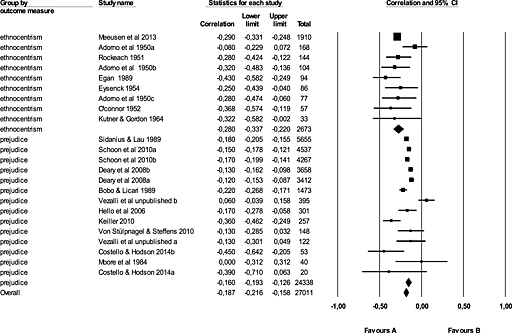
Forest plot for the meta–analysis for prejudice, grouped by type of prejudice.
We coded each sample for design, sample and publication characteristics. First, we coded each study according to the specific type of right–wing ideological attitudes or prejudice used: authoritarianism, conservatism 2 or dogmatism for right–wing ideological attitudes and ethnocentrism or prejudice towards specific groups as types of prejudice. Next, we also coded the type of cognitive ability according to the CHC model. We decided to create two moderator variables for the distinction between different types of cognitive. First, we distinguished between different levels of cognitive ability. More specifically, we coded whether the measure tapped the following: (i) a higher–order factor of general ability (studies using scores of entire intelligence tests or studies combining several types of broad abilities into one factor) or (ii) one specific type of broad primary ability (without specifying which type of broad primary ability). For the second moderator variable, we coded the latter studies according to the specific type of primary broad domains of the CHC model. For this second moderator analysis on type of cognitive ability, the studies using general ability measures were not included.
Sample characteristics were according to age group in which cognitive ability was administered [children (0–11 years old), adolescents (12–17 years old), young adolescents (18–27 years old) and adults (27+ years old)], sex composition (mixed sex, males only and females only) and geographic location of the sample (United States/Canada, Europe and other). As an indicator of publication characteristic, the year of data acquisition was coded into three categories, 1950–1969, 1970–1989 and 1990–present.
Statistical analyses
Pearson product–moment correlation coefficients (rs) between cognitive ability and right–wing ideological attitudes/prejudice were used as effect size estimates. For studies reporting mean differences in scores on right–wing ideological attitudes or prejudice across groups with low or high cognitive ability, the reported test statistics (F–value, t–value or p–values) were used for calculating the effect sizes (Borenstein, Hedges, Higgins & Rothstein, 2005). Three samples only reported a p–value. In these cases, we used the lower limit effect size estimates from the reported significance level. This meta–analytic decision is commonly used but a conservative strategy that tends to underestimate the true magnitude of effect sizes (Durlak & Lipsey, 1991).
For the statistical meta–analyses, we used the software
Homogeneity analyses were conducted to test whether the sets of effect sizes were homogeneous at the population level and allowed us to examine the role of potential moderator variables. We conducted these moderation analyses using categorical testing procedures (Lipsey & Wilson, 2001). A significant within–groups Q (Qw) indicates that the effect sizes within each moderator category are heterogeneous, whereas a significant between–groups Q (Qb) estimate indicates that the effect sizes of the moderator subgroups are significantly different. I2 indices (J. P. T. Higgins & Thompson, 2002) indicate the percentage of variability in point estimates due to between–study heterogeneity, rather than sampling error (I2 = 0 indicates that all variability in effect estimates is caused by sampling error; I2 values on the order of 25, 50 and 75 represent low, moderate and high between–study heterogeneity).
Finally, we addressed the robustness of the meta–analytical estimates by performing sensitivity analyses. These evaluate (and adjust for) the impact of publication bias as well as the impact of outliers and influential studies. The accuracy of a meta–analysis strongly depends upon the representativeness of the sample of studies analysed. Publication bias is one source that potentially jeopardizes the representativeness of a meta–analytical sample set because the likelihood that a study becomes published hinges upon the presence of significant results (Kepes, Banks, McDaniel & Whetzel, 2012; Kepes, McDaniel, Brannick & Banks, 2013; Rothstein, Sutton & Borenstein, 2005). Hence, publication bias might overestimate the meta–analytical effect sizes. Another important source that potentially questions meta–analytic conclusions is the presence of outliers and influential cases (Kepes et al., 2013; Viechtbauer & Cheung, 2010). Even though it is not uncommon to observe extreme effect size values when conducting a meta–analysis, it is mandatory to illuminate to which extent these outliers/influential cases weigh upon the meta–analytic conclusions.
These sensitivity analyses involved the combination of four recommended techniques (Kepes et al., 2012, 2013; Stanley & Doucouliagos; 2014; Viechtbauer & Cheung, 2010). First, we addressed the presence of publication bias and outliers by visually inspecting contour–enhanced funnel plots (Peters, Sutton, Jones, Abrams & Rushton, 2008; Kepes et al., 2013; Sterne et al., 2011). Contour–enhanced funnel plots display the magnitude of each study's effect size as a function of the sample's standard error (Sterne et al., 2011), allowing visual inspection of the symmetry of the meta–analytical study distribution. In the funnel plots, the grey–shaded areas indicate different levels of statistical significance, whereas the white (unshaded) area indicates the non–significance of the study effect sizes. In the presence of publication bias, it is expected that the bottom of a plot (where the smaller studies are located) will show a higher concentration of studies on one side of the mean than the other. The missing studies in the underrepresented area would primarily be located in the white (non–significant) regions of the plot. If these two visual features are present, this would reflect publication bias, resulting from the phenomenon that smaller studies only become published if they have larger–than–average effects, because this makes them more likely to attain statistical significance criteria (Peters et al., 2008; Sterne et al., 2011).
Second, we applied the trim–and–fill method (Duval & Tweedie, 2000) to identify and adjust for publication bias. This method is an iterative, statistical procedure based upon the notion that—in the absence of publication bias—the funnel plot would be symmetrically dispersed around the summary effect. The trim–and–fill procedure estimates the number of missing studies in a dataset by ‘trimming’ the funnel plot until it is symmetrical and then ‘filling’ in both sides of the funnel in a way that maintains symmetry. Based upon the imputation (‘filling’) of missing effect sizes, the procedure then re–estimates an adjusted pooled effect size as sensitivity analysis. We added the trim–and–fill imputations to the contour–enhanced funnel plots because they help to inform the likely location of missing studies (Peters et al., 2008).
Third, because the trim–and–fill method has recently been criticized in the literature (e.g. lower ability to detect publication bias and tendency for under–correction of publication bias; Carter & McCullough, 2014; Peters et al., 2008), we also applied Egger's linear regression procedure (Egger, Smith, Schneider & Minder, 1997; Sterne & Egger, 2001). This test is also based upon the funnel plot but does not implicitly assume that publication bias is the only cause of funnel plot asymmetry. Egger's test can be described as a weighted least squares regression model in which the effect size is predicted by the standard error. The (non–)significance of the coefficient associated with the standard error (i.e. the slope, b1) is interpreted as a test of funnel plot asymmetry and leads to a conclusion on the absence/presence of publication bias (Sterne & Egger, 2001). Interestingly, the use of this model is recently expanded by the recognition that in Egger's regression equation, the model's intercept (b0) can be interpreted as an estimate of the underlying effect size, which is theoretically uninfluenced by publication bias (see, for extensive discussions, Carter & McCullough, 2014; Stanley & Doucouliagos, 2014). This expansion of the use of Egger's test is referred to as the ‘precision–effect test’ (PET; Stanley & Doucouliagos, 2014). Simulation studies have now shown that PET estimations are highly accurate when the true meta–analytic effect is zero but tend to overcorrect when the true effect is non–zero. In these cases, the intercept of a regression model in which the effect size is predicted by the variance (i.e. standard error squared) provides more optimal estimates of the adjusted pooled effect size. This is referred to as a ‘precision–effect with standard error’ (or PEESE; Carter & McCullough, 2014; Stanley & Doucouliagos, 2014). We adopted this conditional PET–PEESE procedure (i.e. if b0 using PET is significant, PEESE–adjusted estimates should be interpreted as unbiased effects) to calculate more accurate pooled effects adjusted for publication bias.
In the final step of the sensitivity analyses, we addressed the impact of potential outliers and influential cases in the two core meta–analyses. In addition to the contour–enhanced funnel plot providing a first visual sense of potential outliers (Kepes et al., 2013), we applied the set of outlier and influence diagnostics for the meta–analyses proposed by Viechtbauer and Cheung (2010). This allows identification of particularly influential studies in both meta–analyses. Subsequently, we re–ran the meta–analyses without these outliers to evaluate to what extent these influential cases distort the conclusions of the meta–analyses. This type of sensitivity analyses may either strengthen the conclusions of the meta–analyses or leave some doubts regarding their robustness (Viechtbauer & Cheung, 2010). All sensitivity analyses were conducted using the metafor package in R (Viechtbauer, 2010).
Results
We performed two separate meta–analyses, one for the relationship between cognitive ability and right–wing ideological attitudes and one for the relationship between cognitive ability and prejudice.
Cognitive ability and right–wing ideological attitudes
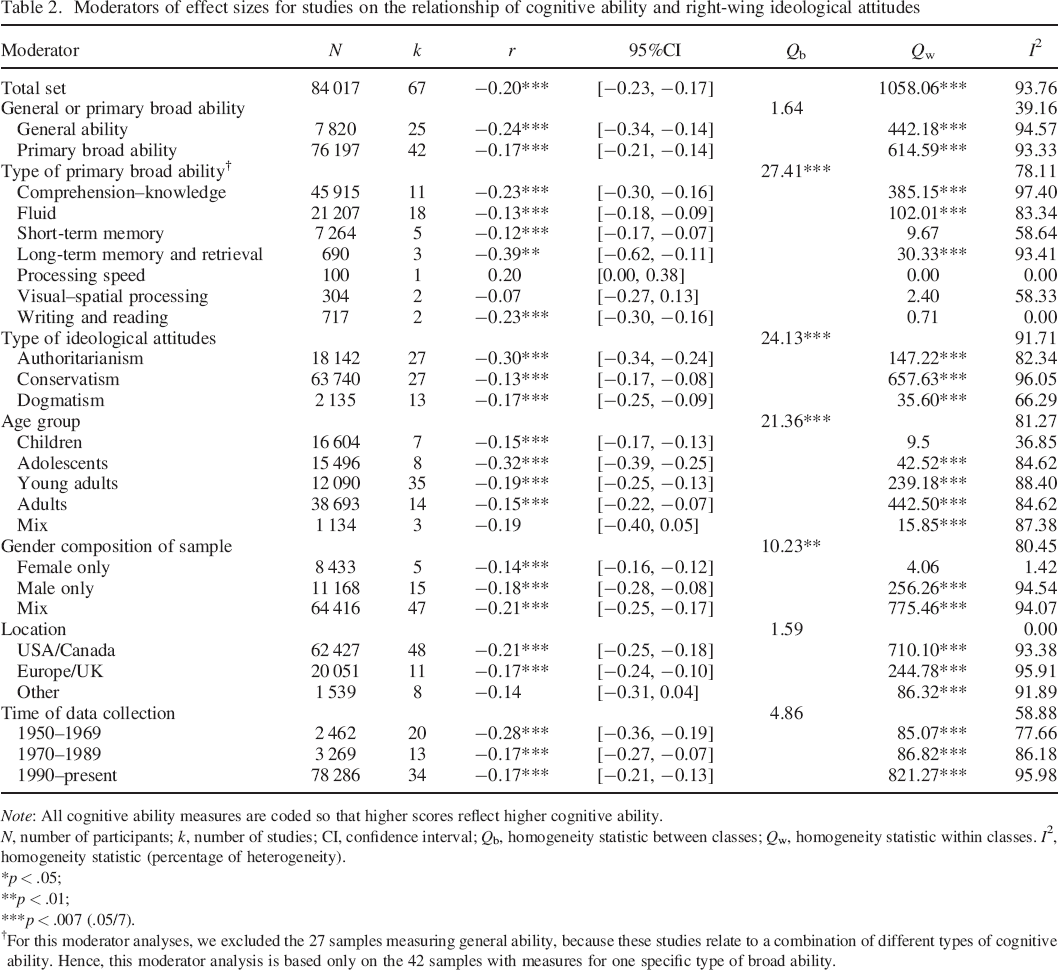
Fifty–seven studies showed negative relations, nine showed positive relations and one showed a correlation of approximately 0. The meta–analysis (for all results, see Table 2) revealed an overall moderate negative relation, r = −.20, p < .001. In other words, lower cognitive ability was associated with the stronger endorsement of right–wing ideological attitudes.
Moderators of effect sizes for studies on the relationship of cognitive ability and right–wing ideological attitudes
Note: All cognitive ability measures are coded so that higher scores reflect higher cognitive ability.
N, number of participants; k, number of studies; CI, confidence interval; Qb, homogeneity statistic between classes; Qw, homogeneity statistic within classes. I2, homogeneity statistic (percentage of heterogeneity).
p < .05;
p < .01;
p < .007 (.05/7).
For this moderator analyses, we excluded the 27 samples measuring general ability, because these studies relate to a combination of different types of cognitive ability. Hence, this moderator analysis is based only on the 42 samples with measures for one specific type of broad ability.
Moderator analyses
Further analyses revealed that the effect size was heterogeneous, indicating that moderator variables might explain the differences in effect size among the samples. We tested seven potential moderators (i.e. general or broad primary ability, type of broad ability, measure of right–wing ideological attitudes, age group, sex composition, location and time period). Because we investigated more than one moderator variable, we corrected for multiple comparisons using a significance level of .007 (=.05/7). Three moderator variables reached this significance level. First, the type of right–wing ideological attitudes was a significant moderator. More specifically, the strongest effect sizes were found for authoritarianism (r = −.30), whereas weaker but still significant effect sizes were found for dogmatism (r = −.17) and conservatism (r = −.13). Second, the moderator type of primary broad ability was also significant. More specifically, the strongest effect sizes were obtained for long–term memory (r = −.39), comprehension–knowledge (r = −.23) and writing and reading (r = −.23). Weaker, but still significant, effect sizes were found for fluid abilities (r = −.13) and short–term memory (r = −.12). Third, effect sizes significantly differed across age groups. More specifically, the effect size was strongest when cognitive ability was measured among adolescents (r = −.32), compared with children (r = −.15), young adults (r = −.19) or adults (r = −.15).
Cognitive ability and prejudice
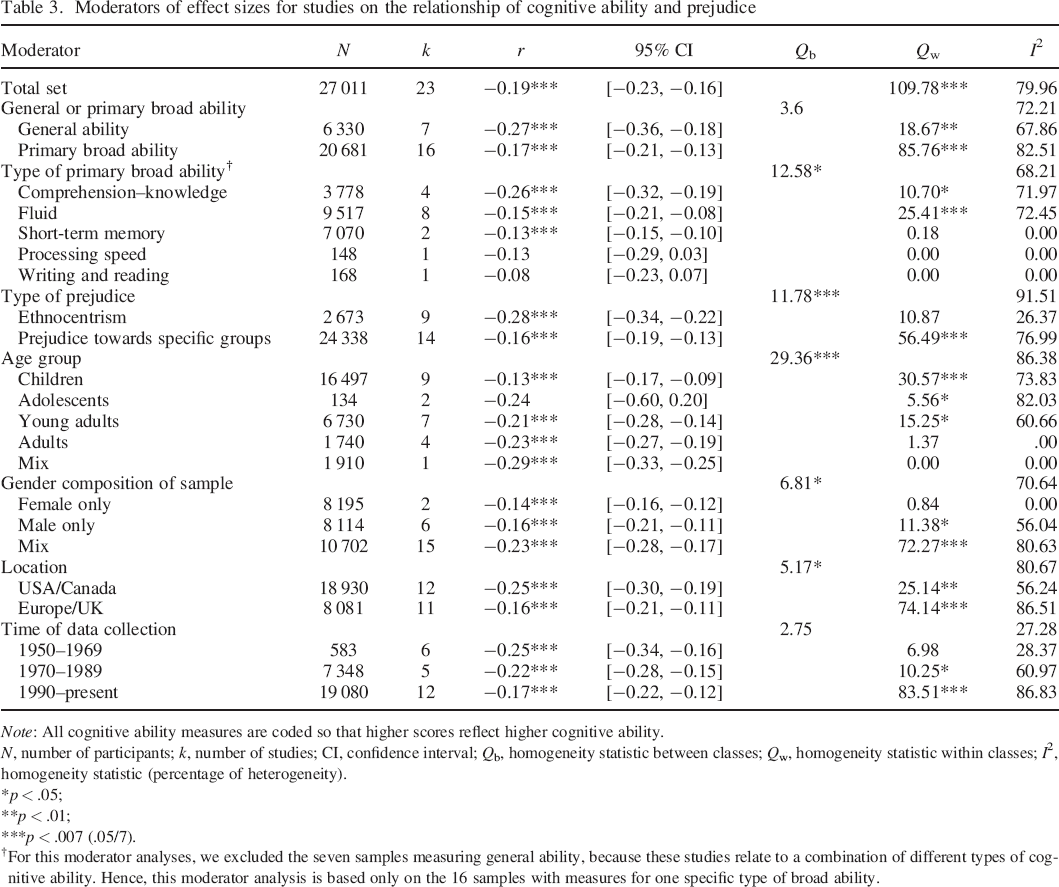
We found 23 studies reporting correlations between cognitive ability and prejudice, with 21 studies showing negative relations, 1 showing a positive relation and 1 showing a correlation of approximately 0. The overall effect size for this relationship (Table 3) was comparable with the effect size for right–wing ideological attitudes, r = −.19, p < .001, indicating that lower cognitive ability was associated with stronger endorsement of prejudice.
Moderators of effect sizes for studies on the relationship of cognitive ability and prejudice
Note: All cognitive ability measures are coded so that higher scores reflect higher cognitive ability.
N, number of participants; k, number of studies; CI, confidence interval; Qb, homogeneity statistic between classes; Qw, homogeneity statistic within classes; I2, homogeneity statistic (percentage of heterogeneity).
p < .05;
p < .01;
p < .007 (.05/7).
For this moderator analyses, we excluded the seven samples measuring general ability, because these studies relate to a combination of different types of cognitive ability. Hence, this moderator analysis is based only on the 16 samples with measures for one specific type of broad ability.
Moderator analyses
We performed moderator analysis, revealing that the effect size was heterogeneous. As a result, we investigated moderator variables that might explain the differences in effect size among the samples. We looked at the same moderator variables as in the previous meta–analysis, with the exception of types of prejudice instead of types of right–wing ideological attitudes. Again, we corrected for multiple comparisons using a significance level of .007 (=.05/7). We found evidence for two significant moderators. First, the type of prejudice was a significant moderator. More specifically, the effect size was strongest for ethnocentrism (r = −.28) compared with prejudice towards specific groups (r = −.16). Second, age group was a significant moderator, with stronger effect sizes in groups of adolescents (r = −.24), adults (r = −.23) and young adults (r = −.21) compared with children (r = −.13). However, we acknowledge that only few samples were included for each of these age groups, making this moderator effect difficult to meaningfully interpret.
Sensitivity analyses
The validity of these two meta–analyses was addressed with sensitivity analyses evaluating the impact of publication bias and potential outliers/influential studies. These results are organized as an answer to three questions: (1) ‘Is there evidence of publication bias?’; (2) ‘How do the pooled effect sizes change if we adjust for potential publication bias?’; and (3) ‘Which studies are outliers and how do they affect the meta–analytic estimates?’. Publication bias and outlier analyses were run on the full set of studies for the two meta–analyses, with the publication bias analyses also run on smaller sub–distributions (Kepes et al., 2012). We chose to analyse publication bias for each type of right–wing ideological attitudes and prejudice, as analyses identified these as the strongest moderator variables (explaining 93% and 42% of between–study variance, respectively).
Is there evidence of publication bias?
This question is addressed by the joint interpretation of three procedures: contour–enhanced funnel plots, the trim–and–fill procedure and significance of Egger's regression tests (Kepes et al., 2012; Peters et al., 2008). Figure 3 presents the contour–enhanced funnel plot with trim–and–fill imputations for the (sub–)meta–analyses on cognitive ability and right–wing ideological attitudes. The trim–and–fill method on the overall meta–analysis (Figure 3A) suggests that 11 studies are missing at the right of the mean effect size. As the contour–enhanced funnel plot allows evaluation of the missing studies in the context of statistical significance, it can be noted that 10 of 11 studies are located in the grey–shaded areas of the plot. This suggests that funnel plot asymmetry primarily results from factors other than publication bias. Indeed, the separate publication bias analyses for each type of right–wing ideological attitudes (Figure 3B–D) strengthen this hypothesis as there is strong moderator–induced between–study heterogeneity. More specifically, within the sub–distributions for both authoritarianism (Figure 3B) and conservatism (Figure 3C), trim–and–fill method no longer imputes studies at any side of the mean. Only for dogmatism (Figure 3D) are two studies imputed in the grey area. However, as this sub–distribution only includes 13 studies, these imputations can also be caused by the small set of studies in this meta–analysis. For all (sub–)meta–analyses, Egger's regression tests for funnel plot asymmetry were performed. However, in none of these regression models were significant slope coefficients found. This also strengthens the conclusion that publication bias is unlikely to distort the pooled estimate between cognitive ability and right–wing ideological attitudes.
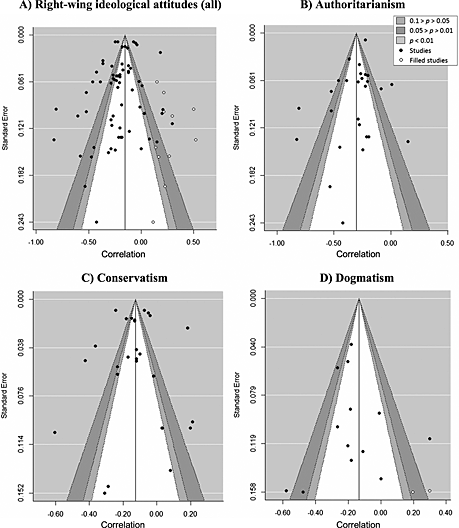
Contour–enhanced funnel plots with trim–and–fill imputations for cognitive ability and right–wing ideological attitudes. The black points represent the real studies; the white points represent the imputed studies. If missing studies are imputed in areas where non–significant studies would be plotted (no shading), the observed asymmetry may be due to publication bias. If missing studies are imputed in areas of statistical significance (darker shading), publication bias is less likely.
Similar results are found for the (sub–)meta–analyses on the association between cognitive ability and prejudice. Figure 4 presents the contour–enhanced funnel plot with trim–and–fill imputations for the overall meta–analysis on prejudice (Figure 4A) and the specific types of prejudices: ethnocentrism (Figure 4B) and prejudice towards specific groups (Figure 4C). The trim–and–fill method on the overall meta–analysis imputes four studies at the right of the mean, with only two of them located in the white (non–significant) area of the plot. The trim–and–fill method imputed three missing studies in the meta–analysis of ethnocentrism and one in the meta–analysis prejudice towards specific groups. However, funnel plot asymmetry in these subsets might be primarily related to the limited number of included studies. Also, for all (sub–)meta–analyses, Egger's regression tests yield no significant slope coefficients. This strengthens the conclusion that publication bias is unlikely to distort the relation between cognitive ability and prejudice.
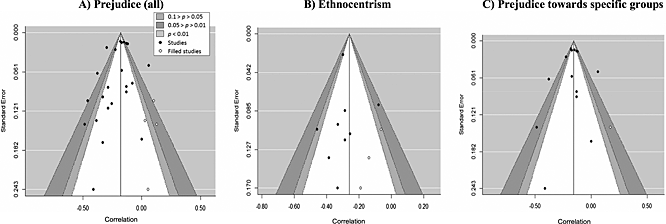
Contour–enhanced funnel plots with trim–and–fill imputations for cognitive ability and prejudice. The black points represent the real studies; the white points represent the imputed studies. If missing studies are imputed in areas where non–significant studies would be plotted (no shading), the observed asymmetry may be due to publication bias. If missing studies are imputed in areas of statistical significance (darker shading), publication bias is less likely.
How do the pooled effect sizes change if we adjust for potential publication bias?
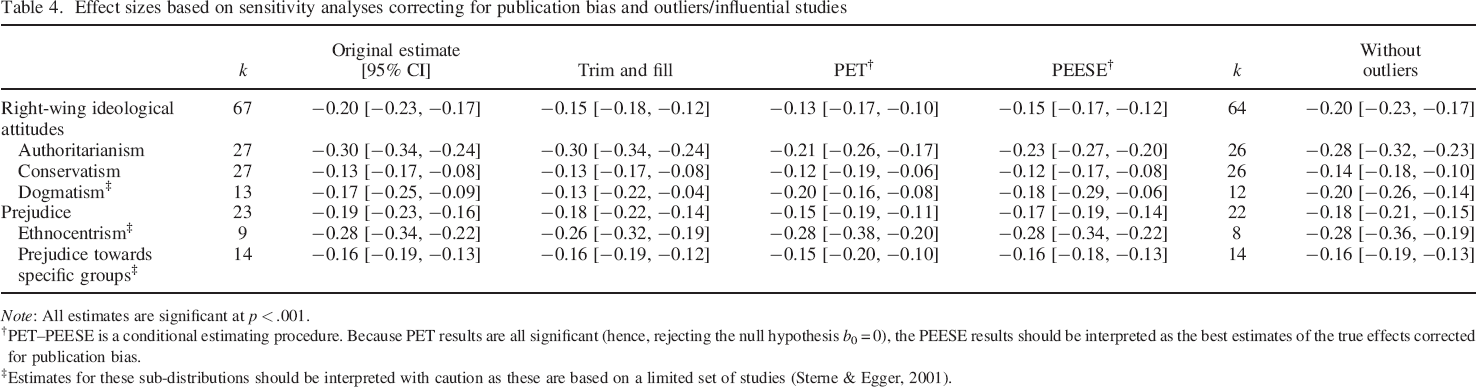
Table 4 presents the original and adjusted effect sizes provided by the trim–and–fill procedure and extended Egger's regression procedure (i.e. PET–PEESE estimators). In line with the previous analyses, adjusted effect sizes are strongly similar to the original meta–analytic estimates. All estimates remain significant (p < .001), and hence, the PEESE results can be regarded as the best estimates of the effect sizes corrected for publication bias (Carter & McCullough, 2014; Stanley & Doucouliagos, 2014). Notably, these PEESE estimates provide a somewhat less negative effect between cognitive ability and right–wing ideological attitudes (r = −.15) and between cognitive ability and authoritarianism (r = −.23). All other PEESE estimates resemble the original estimates.
Effect sizes based on sensitivity analyses correcting for publication bias and outliers/influential studies
Note: All estimates are significant at p < .001.
PET–PEESE is a conditional estimating procedure. Because PET results are all significant (hence, rejecting the null hypothesis b0 = 0), the PEESE results should be interpreted as the best estimates of the true effects corrected for publication bias.
Estimates for these sub–distributions should be interpreted with caution as these are based on a limited set of studies (Sterne & Egger, 2001).
Which studies are outliers and how do they affect the pooled effect sizes?
In the funnel plots of the overall meta–analyses (Figures 3A and 4A), no marked outliers were noted. Additionally, we performed a set of influence diagnostics for meta–analyses (Viechtbauer & Cheung, 2010) to identify particularly influential cases. The last column of Table 4 presents the meta–analytic results without these outliers. In the right–wing ideological attitudes meta–analysis, three outliers/influential cases were identified. Interestingly, each of these studies represents each of the three types of right–wing ideological attitudes. For authoritarianism, the study of Rubinstein (2003) was identified as an outlier. This study provided a substantially stronger effect size (r = −.67; N = 111) than the other studies on authoritarianism. For conservatism, the study of Oskarsson et al. (in press) was identified as an outlier. This study is the only one to report a positive correlation (r = .18). Moreover, the study used a large sample (N = 1946), adding substantial weight to the analysis. For dogmatism, the study of Taylor and Dunnette (1974) was identified as an outlier. This study is also the only one to report a positive correlation between cognitive ability and dogmatism (r = .29, N = 79). In the prejudice meta–analysis, influence diagnostics only identify Meeusen et al. (2013; r = −.29) as an outlier. This study addressed ethnocentrism in a much larger sample (N = 1910) than the other ethnocentrism studies, and hence, its estimate adds substantial weight to the meta–analysis.
Nevertheless, removing these four influential studies from the meta–analyses appears to have only very limited effect on the meta–analytic effect sizes (Table 4). Hence, this type of sensitivity analyses also validates the robustness of the current meta–analytic conclusions.
General Discussion
The present meta–analyses of the relationship of cognitive ability with ideological right–wing ideological attitudes and intergroup prejudice yielded four important results. First, we obtained convincing evidence for the presence of moderate negative associations between cognitive ability and both ideological right–wing attitudes and prejudice, which were relatively stable across different sample characteristics. Second, the negative relationship varied significantly across different subtypes of broad cognitive ability for ideological attitudes, but not for prejudice. Third, our analyses revealed that cognitive ability was not related to all types of right–wing ideological attitudes or prejudices equivalently. Fourth, sensitivity analyses show that the results are not strongly influenced by publication bias or influential cases. In the next sections, we discuss each of these findings in greater depth.
Finding 1: General relationship of cognitive ability with ideology and prejudice
The first main finding of our study was that people with greater cognitive resources are more likely to adhere to left–wing beliefs and tend to be less prejudiced, whereas those having lower cognitive abilities are more likely to endorse right–wing beliefs and be more prejudiced (average effect sizes of r = −.20, 95% CI [−0.23, −0.17]; and r = −.19, 95% CI [−0.23, −0.16], respectively). The confidence interval reported provides considerable support for the notion that these findings are both meaningful and replicable. We further assessed the validity of our meta–analytical estimates, with sensitivity analyses addressing the impact of both publication bias and outliers/influential studies. In general, these analyses underscore robustness in our meta–analytical study because the implications of the meta–analytic results and conclusions remain largely unaltered when adjusting for potential publication bias or when omitting outliers and overly influential studies.
A straightforward comparison between the results of the present meta–analysis and the meta–analysis conducted by Van Hiel et al. (2010), who also investigated the relationship between cognitive ability and ideological attitudes, is not possible. First, Van Hiel et al. (2010) included ideological attitudes and ethnocentrism in the same analysis, whereas we performed two separate analyses. Second, and most importantly, Van Hiel et al. (2010) also included years of education as a proxy of cognitive ability, whereas we chose not to include this variable as an indicator of cognitive ability and instead focused only on objective tasks measuring cognitive ability. As can be seen from their results, years of education yields the strongest effect size compared with other indicators of cognitive ability, making their overall effect sizes for the different types of ideology higher than the present effect sizes.
Moderator analyses revealed that the effect size in the present meta–analysis was relatively stable across different sample characteristics, such as gender, location and time frame, attesting to the robustness of the relationship. Only one moderator related to sample characteristics yielded a significant effect. Specifically, the strength of the effect size differed across age groups, with the strongest effect size for the relationship between cognitive ability and right–wing ideological attitudes in the group of adolescents. Although we do not have a clear explanation for this effect, it should be noted that adolescence constitutes the formative years of political ideology (e.g. Altemeyer, 1998; Alwin, Cohen, & Newcomb, 1991) and that cognitive ability might then yield its biggest impact. Future research can further examine this potential.
Our effect sizes varied around r = −.20 and were largest in magnitude for authoritarianism (r = −.30, 95% CI [−0.34, −0.24]) and ethnocentrism (r = −.28, 95% CI [−0.34, −.22]). Clearly, these effects are not inconsequential but rather are of a similar magnitude of other meta–analytic relations such as between contact and prejudice (Pettigrew & Tropp, 2006), stereotypes and prejudice (Dovidio, Brigham, Johnson & Gaertner, 1996), discrimination and prejudice (Talaska, Fiske & Chaiken, 2008; Schütz & Six, 1996), personality factors and prejudice (Sibley & Duckitt, 2008) and even stronger than relations between religiosity and prejudice (Hall, Matz & Wood, 2010). In fact, these effect sizes approximate those of the vast majority of personality and social psychology findings more generally (Richard, Bond & Stokes–Zoota, 2003). With meta–analytic relations of this magnitude reliably observed, a strong case can be made that cognitive abilities are as important, and often more important, in explaining ideology and prejudice than many of the constructs commonly discussed in personality and social psychology textbooks. Hence, we strongly advise future models and theories aiming to uncover the psychological basis of ideology and prejudice to provide a key role for cognitive ability (Dhont & Hodson, 2014; Hodson, 2014; Hodson & Busseri, 2012).
An important reason for this long–standing interest in the cognitive basis of ideology lies in an attempt to uncover the scientific inaccuracy or invalidity of certain ideologies, and the superiority of other ideologies (Durrheim, 1997). Specifically, ideologies might seem inferior when they attract less intelligent people, whereas ideologies that attract intelligent people may appear to be more ‘correct’. To be clear, any attempt to show whether right–wing or left–wing ideologies are accurate or valid on the basis of the level of cognitive ability of their adherents is based on false premises and certainly not the goal of our present synthesis.
Moreover, we appreciate that this issue is a very delicate and controversial one (Dhont & Hodson, 2014; Hodson, 2014) that, for this reason, speaks to the need for a cumulative–science approach (i.e. meta–analysis). Moreover, we would like to stress that, although right–wing ideological attitudes relate to conservative and right–wing political party affiliation (e.g. Altemeyer, 1996; Jost et al., 2003), our findings cannot be generalized to party identification. In other words, the current findings not necessarily imply that adherents of right–wing parties have lower cognitive abilities than adherents of left–wing parties.
Finding 2: Different effect sizes for different types of broad cognitive ability
The second important question of the present study pertained to the potential differences in effect sizes for different types of cognitive abilities. Previous studies (Deary et al., 2008; Heaven et al., 2011; Kemmelmeier, 2008) yielded somewhat conflicting outcomes. In our meta–analysis, we investigated two moderators in order to answer this question. First, we found that the strength of the relationship did not differ between studies focusing on one specific type of cognitive ability and those focusing on general cognitive ability. Second, we compared the effect sizes between different types of broad cognitive abilities as defined by the CHC theory (McGrew, 2005; Schneider & McGrew, 2012). Our analysis for right–wing attitude effect sizes varied significantly across ability types. To interpret this effect, we focus on comprehension–knowledge, fluid abilities and short–term memory, because we have a smaller number of participants (<1000) for the other types of broad abilities. The strongest effect size was obtained for comprehension–knowledge (r = −.23), which refers to abilities based on previously acquired knowledge and skills valued by one's culture. It includes general verbal information, language development, lexical knowledge, listening and communication abilities and grammar sensitivity (Schneider & McGrew, 2012). The effect size was considerably smaller for fluid abilities (r = −.13), referring to abilities to solve unfamiliar problems and abstract reasoning, and for short–term memory (r = −.12), referring to abilities to encode, maintain and manipulate information in the immediate situation. Although the moderator for type of primary broad ability was not significant in our analysis for prejudice, the same pattern of results emerged, with the strongest effect size for comprehension–knowledge (r = −.26) and weaker effect sizes for fluid abilities (r = −.15) and short–term memory (r = −.13).
These findings corroborate the studies of Heaven et al. (2011) and Kemmelmeier (2008) who found that verbal abilities are more strongly related to ideological attitudes compared with numerical and mathematical reasoning. As noted by Heaven et al. (2011), ideologies are relevant to verbal narratives, arguments and point of views, but not directly to numerical abilities. Similarly, other researchers argue that ideology can be considered as a schema or a learned knowledge structure, including norms and values, beliefs and opinions (e.g. Fiske, Lau & Smith, 1990; Hamill, Lodge & Blake, 1985). Hence, this might explain why comprehension–knowledge abilities may be especially relevant in relationship with ideology.
Also of relevance to the present findings is the recognition that cognitive ability is associated with particular personality traits, which also lie at the basis of right–wing ideological attitudes and prejudice. More specifically, high openness (Costa & McCrae, 1992; Digman, 1990), which refers to a preference for novelty, variety and intense experience, lies at the basis of lower authoritarianism and conservatism and lower prejudice (Block & Block, 2006; Sibley & Duckitt, 2008). At the same time, several researchers have shown that openness is also related to cognitive ability, with the strongest associations for comprehension–knowledge abilities, compared with other types of cognitive ability, such as fluid ability (Ackerman & Heggestad, 1997; Ashton, Lee, Vernon & Jang, 2000). This common personality association may also provide insights into the stronger relationships of comprehension–knowledge abilities with right–wing ideological attitudes and prejudice.
Whereas the effect of comprehension–knowledge ability is strongest, it is important to note that the other types of broad abilities (for which we obtained enough studies) also yielded negative and significant effects. This finding further attests to the robustness of this general relationship. However, on the basis of the present state of the literature, we cannot make conclusive statements about all types of cognitive abilities. First, studies on cognitive ability and ideology and prejudice did not include every type of ability (e.g. to our knowledge, no study investigated auditory processing or quantitative knowledge). Second, for other types of cognitive ability, most notably long–term memory, processing speed and visual–spatial processing, we found only a few studies, which elicited potential statistical power issues in our analysis. Hence, we should be cautious not to over–interpret the results for these specific abilities. Future research administering a wide range of cognitive ability measures at the same time can provide a more decisive answer to this intriguing question.
Finding 3: Different effect sizes for different types of ideological attitudes and prejudice
Our analyses revealed that cognitive ability is not related to all types of right–wing ideological attitudes or prejudices to the same extent. First, in our analysis of right–wing ideological attitudes, we found the strongest effect size for authoritarianism as compared with conservatism and dogmatism. One possible explanation lies in particular rigid cognitive styles linked with cognitive ability, and most notably NFC. Research indicated that lower cognitive ability is associated with a higher NFC (Webster & Kruglanski, 1994), which relates to an individual's desire to come to a relatively quick closure in decisions and judgments (Kruglanski, 1989; Kruglanski & Webster, 1996). Individuals with a high NFC have a strong preference for structure, certainty and predictability and are repelled by ambiguity. Because of these needs, individuals with a high NFC are more attracted to right–wing ideological attitudes, because these attitudes stress the importance of traditional values and the resistance towards change (Roets & Van Hiel, 2006). Of interest, NFC is more strongly related to authoritarianism than other types of ideological attitudes, like conservatism (Chirumbolo, 2002; Crowson, Thoma & Hestevold, 2005; Van Hiel, Pandelaere & Duriez, 2004). Authoritarianism may be especially functional in reducing ambiguity and providing a sense of certainty, because ‘RWA attitudes… would provide for individuals the strongest level of closure on social and political issues’ (Crowson et al., 2005, p. 574). In the present context, individuals with lower cognitive abilities may similarly benefit from more certainty and closure, which, in the context on ideas about society, are best met through authoritarian beliefs relative to other right–wing attitudes. Whereas cognitive styles may provide an explanation for the strongest effects found between cognitive ability and authoritarianism, we should note that the sensitivity bias analyses (Table 4) revealed that the actual effect size of authoritarianism might be somewhat lower, bringing them closer to the effect sizes of conservatism and dogmatism. Hence, we should interpret these findings with caution.
A second interesting finding concerned two types of prejudices. More specifically, ethnocentrism, which can be considered an indicator of generalized prejudice, yielded a stronger effect size than prejudices directed towards specific out–groups. In other words, cognitive ability related more strongly to negative attitudes and a dislike of other groups in general, rather than specific groups such as ethnic minorities or the lesbian, gay, bisexual and transgendered community. A similar effect can be found in research on the personality basis of prejudice. More specifically, Sibley and Duckitt (2008) found that (low) agreeableness or openness to experience is more strongly related to measures of generalized than specific prejudices. These authors argued that, because specific types of prejudice are partly rooted in knowledge about and (personal) experiences with these particular groups, these situational and group–specific factors might attenuate the generalized effect of personality (see also Akrami, Ekehammar & Bergh, 2011). Generalized prejudice, on the other hand, is more abstract and less influenced by group–specific attitudes and cognitions, yielding a stronger effect of personality. Similar processes can explain the present findings for cognitive ability as well. Cognitive ability might yield its strongest effects on generalized prejudice because of the reliance on general cognitive heuristics during judgment formation that is similar across all out–groups; in contrast, specific prejudice types are additionally influenced by factors uniquely related to the particular social group in question (including the social context).
Finding 4: Little evidence for publication bias or distortion by outliers
Given the controversial nature of studying the relationship of cognitive ability with right–wing ideological attitudes and prejudice, a crucial question is to what extent the studies included in the current meta–analyses represent the entire sample collection. It might be that studies retrieving null findings or positive findings are more likely to be put away in file drawers. A definite strength of this meta–analysis is that we addressed this issue by comprehensively addressing the impact of publication bias. These analyses, based upon visual inspection, regression and trim–and–fill methods, do not yield evidence that publication bias is likely in the present meta–analytic study collection. Nevertheless, it remains important for future updates of this meta–analysis to further search for additional unpublished studies. Despite our widespread call for unpublished data, only three researchers shared their unpublished data, and more unpublished datasets might be out somewhere.
Taken together, our sensitivity analyses accounting for publication bias and removing outliers/influential studies underscore and validate the robustness of our meta–analytical conclusions. Some other potential biases, however, could not be completely ruled out. First, it remains possible that the current meta–analytical conclusions do not reflect the true effects, owing to measurement error. Even though adjusting for measurement error is recommended by some meta–analysts (particularly in the psychometric meta–analytical tradition of Hunter & Schmidt, 2004; Kepes et al., 2013), we found insufficient information in the original studies to conduct such artefact adjustments. Also, we acknowledge that it is possible that the results of our meta–analysis are somewhat influenced by indirect range restriction (Hunter & Schmidt, 2004; Kepes et al., 2013). Many studies consist of volunteers, and volunteers may tend to have a higher–than–average cognitive ability. However, as information of the population variances on the outcome measures is essentially lacking in the original studies, it was not possible to correct for this artefact as part of the current sensitivity analyses.
Alternative accounts
Some scholars have criticized a pure ‘cognitive’ explanation of the negative relationship of cognitive ability with ideology and prejudice and suggest alternative accounts explaining these relationships. More specifically, social desirability, education and socio–economic status (SES) have often been proposed as explaining these effects. We elaborate on these alternative accounts in the next sections.
Social desirability
Studies included in our meta–analysis exclusively employed self–report measures of ideology and prejudice. Although self–report questionnaires are omnipresent in research and generally considered as a valid and reliable method to measure attitudes, it may provoke some interpretation problems as well, particularly with regard to social desirability. People may try to suppress or mask what they think to be socially unacceptable, such as prejudiced or ethnocentric attitudes and (extreme) right–wing ideological opinions. Indeed, intelligent and educated individuals are quite capable of suppressing their prejudices (e.g. Gaertner & Dovidio, 1986). Hence, an alternative account might be that individuals with lower cognitive abilities are less able to suppress their socially unacceptable attitudes, whereas individuals with greater cognitive abilities are more likely to present themselves as open–minded, liberal and unprejudiced.
However, whereas social desirability poses an important limitation to questionnaire studies, the self–report nature of the attitudinal measures cannot adequately explain the obtained meta–analytic relationships for various reasons. More specifically, utterances that support extreme right–wing ideological ideas and prejudice expressions are widely rejected in the general population, and it does not require especially strong cognitive abilities to comply with these norms. Moreover, relatively simple and straightforward questions are used to measure prejudice, tapping into (dis)liking of and avoiding contact with different out–groups, making it unlikely that only highly intelligent individuals are able to manipulate their answers on these questions (Hodson & Busseri, 2012). Furthermore, the relations observed in the present results are similar to those in samples of young children (e.g. Costello & Hodson, 2014; Kutner & Gordon, 1964), who often feel freer to express their own minds. Moreover, our effects are strongest (not weakest) in adolescence, a life phase where individuals are most conscious of social approval and norms. Given these arguments, we feel that increased social desirability among individuals with higher cognitive ability cannot explain completely the obtained relationships. However, future research might try to replicate the present finding by employing other implicit or more subtle measures for these attitudes that are less prone to social desirability concerns.
Education and socio–economic status
Scholars have often suggested that SES and educational experiences may pose potential confounds in the relationship of cognitive ability with right–wing ideological attitudes and intergroup prejudice (Adorno et al., 1950; Allport, 1954; Christie, 1954). More specifically, because education and cultural sophistication are known to influence the values and attitudes of individuals and because higher education typically provides a ‘liberal climate’, high SES and participation in higher education may make individuals more liberal and left–wing and less prejudiced (e.g. Hello, Scheepers, Vermulst & Gerris, 2004). Indeed, empirical studies showed that educational level is negatively correlated with right–wing ideology (e.g. an effect size of r = −.33 in the meta–analysis of Van Hiel et al., 2010), prejudice and ethnocentrism (e.g. Hello, Scheepers, & Sleegers, 2006; Meeusen et al., 2013). Hence, because individuals with higher cognitive ability are more likely to pursue higher and longer education, the effects of cognitive ability on ideological attitudes and prejudice might be explained by this ‘liberalizing effect’ of education rather than by pure ‘cognitive effects’.
However, empirical research suggests that a potential confounding effect of education and SES does not account for these relations. Most importantly, a range of studies reported that the relationships of cognitive ability with right–wing ideology and prejudice remain significant after statistically controlling for educational level and SES (Deary et al., 2008; Hodson & Busseri, 2012; Kanazawa, 2010; McCourt et al., 1999; Schoon et al., 2010; Sidanius & Lau, 1989). Moreover, significant associations of cognitive ability with right–wing ideological attitudes and prejudice have also been obtained in samples of children and young adolescents who have not yet experienced higher education (e.g. Costello & Hodson, 2014) and among university student samples (e.g. Choma et al., 2014; Keiller, 2010) where education levels are largely equivalent across participants. In sum, whereas education and SES might, to some extent, explain the relationship between cognitive ability and right–wing ideological attitudes and prejudice, it cannot serve as a single and exhaustive explanation.
Towards new theories on the cognitive basis of right–wing ideology and prejudice
We introduce two new perspectives in the field of cognition and ideology, which hold promise for future research. First, we discuss the need to focus more research attention towards the interplay between cognitive ability and cognitive style in explaining ideology and prejudice. Second, we argue to study affective processes as well and discuss the interplay between cognition and affect in the context of ideology and prejudice.
An integrated theory of cognition: The interplay between ability and style
Recent theorizing has stressed that both cognitive resources and motivation are important variables in decision–making and information processing (Kruglanski, 2004; Kruglanski, Pierro, Mannetti, Erb & Chun 2007; Kruglanski et al., 2012; Roets, Van Hiel, Cornelis & Soetens, 2008; Wright & Kirby, 2001). For example, Kruglanski et al. (2007) have argued that cognitive resources (i.e. cognitive ability) and motivation (i.e. motivated cognition or cognitive style) are the two key ‘decision maker’ parameters in human judgment (see also Kruglanski, 2004). Although both of these variables might exert direct effects on judgment, they may show important multiplicative effects as well (Roets et al., 2008).
Potential joint influences (simultaneous or interaction effects) of cognitive ability and style are especially interesting in the context of the present research questions. Instead of probing into the effects of cognitive ability and cognitive style separately, it may be more interesting to considerer both concepts simultaneously (Dhont & Hodson, 2014; Hodson, 2014; Hodson & Busseri, 2012; Pennycook, Cheyne, Seli, Koehler & Fugelsang, 2012). Adorno et al. (1950) already hinted to such a possibility, and they coined this ‘promising field of future research … the dynamics of intelligence’ (p. 278). Cognitive ability in itself does not provide a complete answer to the question of why people hold certain beliefs and attitudes; rather, the dynamic interplay between ability and style should be considered.
Building on the current models of decision–making, one important finding deserves special attention here. When cognitive ability is lower or task demands grossly exceed the individual's resources, people may cease further efforts to solve the problem (Roets et al., 2008; Wright & Kirby, 2001). It is possible that such a breakdown in one's willingness to invest in information gathering has also great relevance for the development of right–wing ideology and prejudice. People lower in cognitive ability may perceive the world as particularly difficult to understand and, irrespective of their cognitive style preferences, gravitate towards simpler heuristics and traditional worldviews instead of being open for new and challenging information (e.g. Heaven et al., 2011; Keiller, 2010; Stankov, 2009). It is unfortunate that, at least to our knowledge, no single study has investigated the interplay between cognitive ability and style measures in the context of right–wing ideological attitudes or prejudice. In order to develop comprehensive cognitive theories about right–wing ideological attitudes and prejudice, future studies should certainly include both cognition components.
An integrated theory of cognition and affect
We acknowledge that a one–sided focus on cognition is rather limited and that, in order to understand right–wing ideological attitudes and prejudice, affective factors should also be considered. Thus, a more complete model of right–wing ideological attitudes and prejudice arguably incorporates affect as well. In classic theories on right–wing ideological attitudes, this affective component was thought to be dominant (e.g. Adorno et al., 1950; Wilson, 1973). For example, Meloen (1997) argued, ‘Adorno et al. furthermore hardly used the concept of cognition, as they were convinced that also more emotional factors were involved, while cognitions often would merely serve as rationalizations’ (p. 650). Although both cognitive and affective variables have been studied separately, theoretical models and empirical studies have rarely examined these variables simultaneously. Recently, Dhont and Hodson (2014; see also Hodson, 2014) introduced the Cognitive Ability and Style to Evaluation (CASE) model, a conceptual model of ideology and prejudice, which holds that right–wing ideology and prejudice result from the interplay between cognitive, affective and motivational factors. Specifically, the CASE model proposes that individuals with lower cognitive abilities and preferences for simple structure, order and predictability are more inclined to perceive the surrounding societal context as threatening. In turn, threat stimulates a focus on the status quo, which ultimately develops into right–wing and conservative ideologies and prejudice. However, this model is in need of future research to test its assumptions.
Limitations of the current state of the literature
As a final note, we would like to address two limitations of the current state of the literature concerning cognitive ability, ideology and prejudice, which we think are important issues to tackle in future research. First, whereas a large focus is placed on social–cultural right–wing attitudes in relationship with cognitive ability, few studies have investigated economic–hierarchical attitudes in this context. We will further reflect on the possible relationship. Second, we discuss the need for cross–cultural validation of the obtained relationships.
Cognitive ability and economic–hierarchical right–wing attitudes
In the literature on cognitive ability and right–wing ideological attitudes, almost all attention is directed towards social–cultural ideological right–wing attitudes. However, Duckitt and colleagues (e.g., Duckitt, 2001; Duckitt & Sibley, 2009) distinguished between social–cultural attitudes and economic–hierarchical right–wing attitudes, and this distinction proved to be very important for our understanding of the attitudinal basis of prejudice. Social dominance orientation (SDO; Pratto, Sidanius, Stallworth & Malle, 1994) is the most frequently studied variable situated in the economic–hierarchical domain of right–wing ideological attitudes. SDO is defined as a preference for hierarchically structured group relations and inequality among social groups. A relevant question, then, is whether cognitive ability is related to economic–hierarchical attitudes to the same extent as to social–cultural attitudes. Only a few studies have directly compared social–cultural attitudes and economic–hierarchical ideological attitudes in relationship with cognitive ability. Heaven et al. (2011) reported that cognitive ability yields stronger associations with RWA than with SDO. Likewise, Choma et al. (2014) observed that RWA, but not SDO, is significantly related to a lower cognitive ability. A recent study by Oskarsson et al. (2014) reported that general cognitive ability is positively related to right–wing economic attitudes. Similarly, Carl (2014, 2015) showed that cognitive ability was positively associated with fiscally and economically conservative beliefs.
These studies thus seem to suggest that the relationship between cognitive ability and economic–hierarchical attitudes is distinct from the relationship between cognitive ability and social–cultural attitudes. However, based on the few available empirical studies on the relationship between cognitive ability and economic–hierarchical attitudes, we cannot make strong claims about the strength and direction of this relationship. Therefore, we encourage more systematic research employing a wide range of measures in the economic–hierarchical domain in order to understand the role of cognitive abilities in the development of economic–hierarchical attitudes.
The impact of culture: Universal or culture–specific relationship?
An important limitation of the current state of the literature on cognitive ability and ideology and prejudice resides in the fact that the literature is overrepresented by studies conducted in Western societies. As a result, our meta–analytic finding can only be applied with certainty in these societies; whether or not these findings can be generalized to non–Western societies largely remains an unanswered question.
According to the cultural mediation hypothesis (Woodley, 2010, 2011), we could find different patterns of results in other societies. More specifically, Woodley asserts that individuals with higher cognitive ability are more likely to be aware of the advantages of adhering to norms and beliefs dominant in one's society and hence will shift their own attitudes and beliefs towards this normative centre. As a result, and in line with the present findings, in societies with rather liberal norms (such as most Western societies), individuals with greater cognitive skills are predicted to be generally more left–wing. However, in societies characterized by more conservative and rightist norms and belief systems, one could expect those individuals to shift to the right side of the spectrum. We know of one study that supports this interesting possibility. Katz (1990) reported that among White South African students, a group characterized by conservative views at that time, greater cognitive ability was associated with more conservative and traditionalistic views. However, given that this is the only study of its kind and that its findings did not apply to all ability tasks used, we recommend caution in interpreting these results. In sum, in order to provide a conclusive answer to the question of whether the present findings are context specific and typical for Western societies or whether the obtained relationships can be considered universal, we need more elaborate research on the relationship of cognitive ability with ideology and prejudice in culturally diverse societal contexts.
Conclusion
The present meta–analysis reveals relationships of small–to–moderate strength between (lower) cognitive ability and right–wing ideology and prejudice. These findings further enforce the call of Hodson and Busseri (2012) that ‘…cognitive abilities, particular in relationship to ideology, need to become increasingly focal to and integrated into existing literatures’ (p. 193). Future research should not refrain from further investigating this interesting, albeit controversial, relationship (Hodson, 2014). Rather, the inclusion of cognitive ability as an important variable in a comprehensive model of ideology and prejudice, together with other individual differences and situational factors, will provide a fuller account of why some individuals are less tolerant and more prejudiced than others.