







Abstract
We examined the components and situational correlates of state authenticity to clarify the construct's meaning and improve understanding of authenticity's attainment. In Study 1, we used the day reconstruction method (participants assessed real–life episodes from ‘yesterday’) and in Study 2 a smartphone app (participants assessed real–life moments taking place ‘just now’) to obtain situation–level ratings of participants’ sense of living authentically, self–alienation, acceptance of external influence, mood, anxiety, energy, ideal–self overlap, self–consciousness, self–esteem, flow, needs satisfaction, and motivation to be ‘real’. Both studies demonstrated that state authentic living does not require rejecting external influence and, further, accepting external influence is not necessarily associated with state self–alienation. In fact, situational acceptance of external influence was more often related to an increased, rather than decreased, sense of authenticity. Both studies also found state authentic living to be associated with greater, and state self–alienation with lesser: positive mood, energy, relaxation, ideal–self overlap, self–esteem, flow, and motivation for realness. Study 2 further revealed that situations prioritizing satisfaction of meaning/purpose in life were associated with increased authentic living and situations prioritizing pleasure/interest satisfaction were associated with decreased self–alienation. State authenticity is best characterized by two related yet independent components: authentic living and (absence of) self–alienation. Copyright © 2015 European Association of Personality Psychology
Keywords
[On your birthday] you are you, that is truer than true. There is no one alive who is youer than you. —Dr. Seuss (1959)
This verse implies that on days other than your birthday, you may not be wholly you. The idea is a conundrum, for who else would you be if not yourself? And why would that sense of self change from day to day? Despite the apparent contradiction, not feeling like yourself is common. Nine out of 10 people report that they have experienced alignment with a false self, and most are strongly motivated to attain authenticity and avoid inauthenticity (Lenton, Bruder, Slabu, & Sedikides, 2013). The two studies that we report herein contribute to the emerging literature that views authenticity as a state rather than a trait (cf. Lenton, Bruder, et al., 2013; Slabu, Lenton, Bruder, & Sedikides, 2014) by examining the content and correlates of authenticity as it occurs in everyday situations. Specifically, we investigated whether state authenticity is composed of the same components previously identified in trait authenticity and, further, how mood, the ideal self, self–esteem, self–consciousness, needs satisfaction, the motivation to be ‘real’, and—for the first time—flow relate to the situational sense of authenticity. In this way, we sought to contribute to the nascent understanding of how experiences of authenticity may be increased and inauthenticity decreased.
What is authenticity?
Concern with authenticity's meaning and attainment extends back to the Greek philosophers (for reviews, see Harter, 2002; Kernis & Goldman, 2006) and, in the discipline of psychology, to its earliest days (Vannini & Franzese, 2008). Nevertheless, the construct persists in being nebulous. What does it mean to be authentic? In lay terms, it refers to feeling like one's true or real self (Schlegel, Hicks, Arndt, & King, 2009). Researchers have traditionally viewed authenticity through a dispositional lens, establishing that some individuals generally feel truer to themselves than do others across a variety of situations (Kernis & Goldman, 2006; Wood Linley, Maltby, Baliousis, & Joseph, 2008). A burgeoning literature, however, approaches authenticity from a situational view, echoing more closely early psychological theorizing. The humanistic tradition, for example, posits that felt authenticity signals that the self is integrated and organized (Sheldon, Ryan, Rawsthorne, & Ilardi, 1997); inauthenticity signals otherwise. Another early humanistic idea is that authenticity is an idealized state that anyone can experience (Maslow, 1971; Rogers, 1961). In this vein, recent investigations of state authenticity have prompted participants to rate the extent to which they currently feel alienated from myself (Gino, Norton, & Ariely, 2010, p. 7), are in touch with my ‘true self’ (Heppner et al., 2008, p. 1141), or feel close to their real self right now (Lenton, Slabu, Sedikides, & Power, 2013).
Congruent with Fridhandler's (1986) proposal that ‘if a person is in a state he or she must be able to feel it’ (p. 170), these operationalizations emphasize the phenomenological experience of state authenticity. That is, states are amenable to conscious introspection: They possess a referent, a concomitant ‘feeling’. We concur with this view of states, particularly as applied to authenticity. Again, a conscious, subjective sense of (in)authenticity is important because it is thought to facilitate the maintenance of self–coherence (Sheldon et al., 1997), without which one's well–being is jeopardized (Sedikides, Wildschut, Gaertner, Routledge, & Arndt, 2008; Sedikides, Wildschut, Routledge, & Arndt, 2015). The feeling of inauthenticity has been described by researchers as ‘psychological tension’ (Harter, 2002; p. 383) or ‘emotive dissonance’ (Hochschild, 1983; p. 90). Authenticity, in contrast, is associated with a distinct sense of ease and comfort: Emotion clusters such as contentment/satisfaction/enjoyment, calmness/ relaxation/relief, and a lack of anxiety/unease/tension strongly discriminate the sense of authenticity from inauthenticity (Lenton, Bruder, et al., 2013). If (in)authenticity is indeed a signal, a feeling of inauthenticity could instigate some means by which to rectify the lack of self–coherence, whereas a feeling of authenticity might inhibit the undertaking of such actions and, instead, help sustain one's present course of action. Beyond the proposal that state (in)authenticity is best conceived of as a conscious experience (Harter, 2002; Schlegel, Hicks, King, & Arndt, 2011), it remains unclear how to conceptualize it further. In this regard, theorizing about trait authenticity is a step ahead.
Multicomponent conceptualizations of authenticity
Two models of trait authenticity advocate a multicomponent conceptualization. Inspired by Rogerian theory, Wood and colleagues (2008) postulated three components: (i) lack of self–alienation ensues when a person's primary experience or ‘true self’ (i.e. physiological states, emotions, and beliefs) aligns with their conscious awareness of such (‘I don't know how I really feel inside’ ➔ inauthenticity); (ii) authentic living occurs when one's behaviour and interpersonal communications are a valid reflection of the individual's conscious awareness of their ‘true self’ (‘I live in accordance with my values and beliefs’ ➔ authenticity); and (iii) accepting external influence (‘I always feel I need to do what others expect me to do’ ➔ inauthenticity). Accepting external influence is presumed to moderate the other components, such that increased acceptance of external influence contributes to inauthenticity. Further, lack of self–alienation is critical to authenticity, as authentic living depends on it. A multigroup confirmatory factor analysis supported the three–factor structure and showed it to be invariant across samples, gender, and ethnic groups (Wood et al.). Further, the authors demonstrated the hypothesized direction of the relations among the components, as well as the direction of the relations between each component and several indicators of well–being. Other studies have bolstered the scale's validity (Vess, Schlegel, Hicks, & Arndt, 2014; White & Tracey, 2011), cross–cultural reliability and validity (Robinson, Lopez, Ramos, & Nartova–Bochaver, 2013), and factor structure (Grégoire, Baron, Menard, & Lachance, 2013; White, 2011).
Kernis and Goldman (2006) also have advanced a multicomponent model of authenticity. Their authenticity inventory (AI) assesses four components: awareness (i.e. knowing one's goals, feelings, and self–beliefs, even if contradictory), unbiased processing (i.e. accurately assessing one's characteristics, emotions, experiences, and knowledge), relational orientation (i.e. being honest and open with others), and behaviour (acting in accord with one's personal desires, needs, and values). Although the AI predicts well–being–related phenomena (Davis, Hicks, Schlegel, Smith, & Vess, 2015; Kernis & Goldman, 2005), its psychometric properties have not been as thoroughly examined as those of Wood et al.'s (2008) tripartite scale. Further, one investigation casts doubt on the utility of this model: White (2011) was unable to replicate its factor structure or obtain demonstrably reliable subscales.
Still, there is conceptual overlap between the two models. ‘Authentic living’ (Wood et al., 2008) is an amalgam of Kernis and Goldman's (2006) ‘behavioral’ and ‘relational’ authenticity, as authentic living represents the degree to which one's actions (behavioural expressions) are consistent with who one knows themselves to be, regardless of the audience (or lack thereof). ‘Self–alienation’ (Wood et al.) is a combination of ‘unbiased processing’ and ‘awareness’ (Kernis & Goldman), for an unalienated self possesses conscious awareness of their own mental states, no matter whether these are socially undesirable or conflicting. Both multicomponent models argue that self–awareness (or lack of self–alienation) is authenticity's lynchpin. In all, Kernis and Goldman's four–component model can be distilled into Wood et al.'s authentic living and self–alienation. In accord with this contention, new research supports the idea that these two dimensions are key constituents of trait authenticity (Knoll, Meyer, Kroemer, & Schroeder–Abe, 2015). 1 Wood and colleagues (2008) argued that authentic living and self–alienation manifest consciously; thus, we propose—per our contention that momentary authenticity must be accessible to introspection in order for its theorized benefits to be accrued (and inauthenticity consciously experienced in order for its theorized downsides to be mitigated)—that they are likely to be applicable to state authenticity as well.
As to the relations among the components at the situational level, Wood et al.'s (2008) accepting external influence may not have the hypothesized relationship with the other two components as has been identified in the trait level. In particular, although the results of the few relevant studies appear to support the idea that the real or imagined influence of others has negative implications for state authenticity (Bargh, McKenna, & Fitzsimons, 2002; Lenton, Bruder, et al., 2013; Slabu et al., 2014; Turner & Billings, 1991), accepting external influence in a particular situation need not be inauthentic. According to the self–concordance model (Sheldon & Elliot, 1998), people are self–concordant if there is a fit between the goals they are currently pursuing and their phenomenal self's values or interests. This idea illustrates the theorized relationship between awareness and authentic living (Wood et al. 2008) and, further, implies that an individual who accepts another's influence for autonomous reasons (i.e. those self–perceived to emanate from within) is authentic. Conversely, an individual who accepts another's influence for controlled reasons (i.e. those self–perceived to emanate from outside) is inauthentic (see also Baumann & Kuhl, 2003). Stated otherwise, accepting external influence may sometimes represent an authentic and other times an inauthentic action; it depends on whether the goals and values of the individuals overlap. In support of this contention, authentic living and accepting external influence are both positively correlated with work dedication, the latter being an indicator of ‘enthusiasm, inspiration, pride, and challenge’ (Van den Bosch & Taris, 2014, p. 663). At least at work, people may accept influence to achieve a mutually sought outcome.
Our two studies assessed whether the multicomponent model advanced by Wood and colleagues (2008) may also be a valid conceptualization of state authenticity. That is, we examined whether authentic living, self–alienation, and accepting external influence relate to one another similarly at the state level as at the trait level. Again, there is reason to believe that state authenticity is better characterized by only two dimensions: authentic living and (an absence of) self–alienation, but as yet, this proposal has not been investigated at the state level. If state authenticity is, indeed, better characterized by two than the three components advanced by Wood and colleagues, it further underscores the utility of making a distinction between trait and state authenticity, both theoretically (for conceptual development of the authenticity construct) and practically (for well–being–related applications).
State authenticity
In brief, a trait is an individual's base–rate propensity for a given set of emotions, cognitions, or behaviours, whereas a state is the set of emotions, cognitions, or behaviours experienced or enacted by the individual in a particular situation. Accordingly, the experience of state authenticity can overlay a person's base–rate authenticity (like trait and state anxiety; Endler, Parker, Bagby, & Cox, 1991). The literature points to a variety of psychological correlates of state authenticity, but the vast majority of these studies have relied on retrospective reports or have been conducted in the laboratory. To address limitations associated with this type of research, we employed survey methodology that focuses on participants’ evaluations of recent, concrete, real–life situations: the Day Reconstruction Method or DRM (Study 1; see Kahneman, Krueger, Schkade, Schwarz, & Stone, 2004) and experience sampling (Study 2). The benefits of this type of approach are well established (cf. Bolger, Davis, & Rafaeli, 2003). We emphasize here that both the DRM and experience sampling facilitate the assessment of how processes unfold over time and in real–life (vs in contrived and controlled) situations and reduce the impact of memory biases in self–reports, thus enhancing the validity of the results. Recalled emotions from long ago may be distortions of the original experience due to the individual's reliance upon heuristics, situational theories or schemas, extensive post–event cognitive processing, or goals (McAdams, 1993; McLean, Pasupathi & Pals, 2007; Miron–Shatz, Stone, & Kahneman, 2009). The methods we employed herein are less subject to such intrusions (Kahneman et al., 2004).
We sought to examine constructs believed to be key psychological correlates of state authenticity—mood, energy, anxiety, needs satisfaction, ideal–self overlap, state self–esteem, situational self–consciousness, the motivation to be real, and flow (cf. Lenton, Bruder, et al., 2013; Slabu, et al., 2014)—using methods that capture naturalistic situations and subjective evaluations in real time. We are aware of only two relevant publications that have assessed state authenticity in realistic situations (Fleeson & Wilt, 2010; Heppner et al., 2008), and only one of these specifically focused on state authenticity as a key variable (Fleeson & Wilt, 2010). Furthermore, neither publication conceptualized state authenticity from a multicomponent perspective. In addition to undertaking a comprehensive examination of state authenticity via novel methods, our studies are also the first to examine directly the relationship between state authenticity and flow.
What do we know about state authenticity's correlates?
Again, most of what we know about these relations comes from studies that rely on retrospective reports, have less naturalistic settings (e.g. the laboratory), or comes from those lacking a multicomponent perspective of authenticity.
Mood and arousal
Felt authenticity is correlated with more positive affect and less negative affect (Heppner et al., 2008; Lenton, Bruder, et al., 2013; Turner & Billings, 1991). In one of the few experiments investigating the directionality of this relation, the results revealed that participants put in a positive mood (e.g. by upbeat music) felt more authentic than participants put in a negative mood (e.g. by lugubrious music; Lenton, Slabu, et al., 2013). And as mentioned earlier, prior research in which participants were asked to recall a time when they felt either authentic or inauthentic indicated that experiences of authenticity are more closely associated with a sense of calm and approach–related emotion clusters (e.g. enthusiasm and enjoyment), whereas experiences of inauthenticity are more closely associated with anxiety and other withdrawal–related emotion clusters (e.g. disappointment and sadness; Lenton, Bruder, et al., 2013).
Needs
Self–determination theory (SDT; Deci & Ryan, 2000) hypothesizes that autonomy, competence, and relatedness are essential to authenticity because satisfaction thereof contributes to goal internalization (Ryan & Deci, 2000; Sheldon & Elliot, 1998). Supporting this hypothesis, one diary study demonstrated that daily variability in perceived autonomy, relatedness, competence, and self–esteem correlated positively with felt authenticity (Heppner et al., 2008). Examining a larger set of needs (Lenton, Bruder, et al., 2013), we found that retrospectively reported experiences of authenticity and inauthenticity were distinguished by satisfaction of the three SDT needs as well as by the needs for pleasure/interest, meaning/purpose, physical thriving, security/comfort, self–esteem, and popularity/influence—but not money/materials.
Ideal self
Feeling ideal and feeling real are positively correlated, at least in retrospect (Lenton, Bruder, et al., 2013; Slabu et al., 2014). A study of personality–behaviour congruence (i.e. not subjectively experienced authenticity) also points to overlap between the ideal and real selves (Sherman, Nave, & Funder, 2012), perhaps because these selves share content (Pelham & Swann, 1989) or because people hold positive self–illusions (Sedikides & Gregg, 2008).
State self–esteem
Authenticity and state self–esteem are correlated (Heppner et al., 2008; Lenton, Bruder, et al., 2013; Slabu et al., 2014): Higher self–esteem coincides with higher authenticity.
Situational self–consciousness
Public self–consciousness appears detrimental to authenticity (Bargh et al., 2002). In line with this proposal, inauthenticity (vs authenticity) experiences are associated with increased retrospectively reported public self–consciousness (Lenton, Bruder, et al., 2013). Existing theorizing, however, suggests opposing hypotheses regarding the situational private self–consciousness–state authenticity relation: (i) private self–consciousness increases authenticity (Goldman & Kernis, 2002; Koole & Kuhl, 2003), and (ii) private self–consciousness decreases authenticity (Leary, Adams, & Tate, 2006; Turner & Billings, 1991). Research relying on retrospective methods found that inauthenticity (vs authenticity) was associated with more private self–consciousness (Lenton, Bruder, et al., 2013), but this effect was small.
Motivation to be real
If inauthenticity indeed is a ‘signal’ that one's well–being is at risk (Sheldon, et al., 1997), then the ensuing motivation to be real should be related to (subsequent) achievement thereof. Research shows that people are motivated to attain authenticity and avoid inauthenticity, with these two motivations being independent of trait authenticity (Lenton, Bruder, et al., 2013). However, it remains unclear if and how those motivations manifest. For example, does greater motivation to be real actually correlate with an increased sense of authentic living?
Flow
Task involvement and immersion are inputs to the experience of flow. Flow reflects intrinsic motivation and is characterized by a merging of action and awareness, a sense of control, high concentration, reduced self–consciousness, and time transformation (Csikszentmihalyi, 1975). Furthermore, flow states are experienced as highly self–congruent and, like authenticity, are believed to constitute a positive outcome of self–determined behaviour (Deci & Ryan, 2000). Studies indicate that task involvement and immersion also may be conducive to state authenticity (Lenton, Bruder, et al., 2013; Turner & Billings, 1991). We elaborate on these findings by assessing whether there is direct evidence for the flow–state authenticity relation.
Overview
We aimed to advance understanding of what it means to be momentarily authentic or inauthentic by investigating whether state authenticity comprises the same components as identified previously in trait authenticity and by examining state authenticity's situational relations with mood, anxiety, energy, needs, the ideal self, state self–esteem, situational public and private self–consciousness, the motivation to be ‘real’, and flow. Given the importance of achieving authenticity and avoiding inauthenticity (Lenton, Bruder, et al., 2013) as well as authenticity's relevance to clinical settings (Rogers, 1961; Wood et al., 2008), our findings have both theoretical and practical implications.
We anticipated that whereas state authentic living would be negatively correlated with state self–alienation, neither of these constructs would correlate strongly (if at all) with state accepting external influence when examined across a wide variety of real–life situations. Additionally, if the results of previous lab–based, retrospective studies of state authenticity are generalizable to more realistic, everyday–type experiences, we expected that authentic living would correlate positively and self–alienation negatively with positive mood, greater relaxation, more energy, state needs satisfaction (generally), state ideal–self overlap, state self–esteem, lesser situational public self–consciousness and, possibly, lesser situational private self–consciousness, a greater motivation to be real, and stronger situational flow. Our studies would also allow us to compare the extent of within–person versus between–person variation in felt authenticity across a variety of real–life situations. Per the findings of Fleeson and Wilt (2010), which assessed participants’ state authenticity across several naturalistic–but–contrived situations, we anticipated that authenticity would vary more within people than between people.
Study 1
In Study 1, we used a modified version of the day reconstruction method (Kahneman, et al., 2004) to examine the situational correlates of state authenticity. The DRM asks respondents for intensive reports on the previous day's activities. It has many of the advantages of ‘true’ experience–sampling methodology but is less time intensive. Kahneman and colleagues validated the DRM by replicating the results of previous traditional experience–sampling studies. And in a direct comparison with experience–sampling, the pattern of affect actually experienced across a day in their life was reliably reconstructed by participants using the DRM (Dockray et al., 2010). As Kahneman et al. put it, the DRM ‘approximat(es) the results of continuous, real–time experience measurement’ (p. 1779). Accordingly, we implemented the DRM to obtain a first approximation of continuous, real–time assessment of state authenticity.
Method
Participants
We advertised this study to the University of Edinburgh community and on websites listing opportunities for research participation (e.g. onlinepsychresearch.co.uk). In return for completing both parts of the study, we offered participants entry into a draw to win an Amazon.co.uk voucher (three chances at £50). The sample consisted of 155 participants (119 women and 36 men) aged from 18 to 79 years (M = 33.93, SD = 19.18). The majority had a white ethnic background (87.2%) and UK residency (81.2%). This sample size is more than adequate to yield accurate estimates of the statistics that we report in Table 1 (Maas & Hox, 2005).
Studies 1 and 2: Multilevel models of predictors of authentic living, accepting external influence, and self–alienation
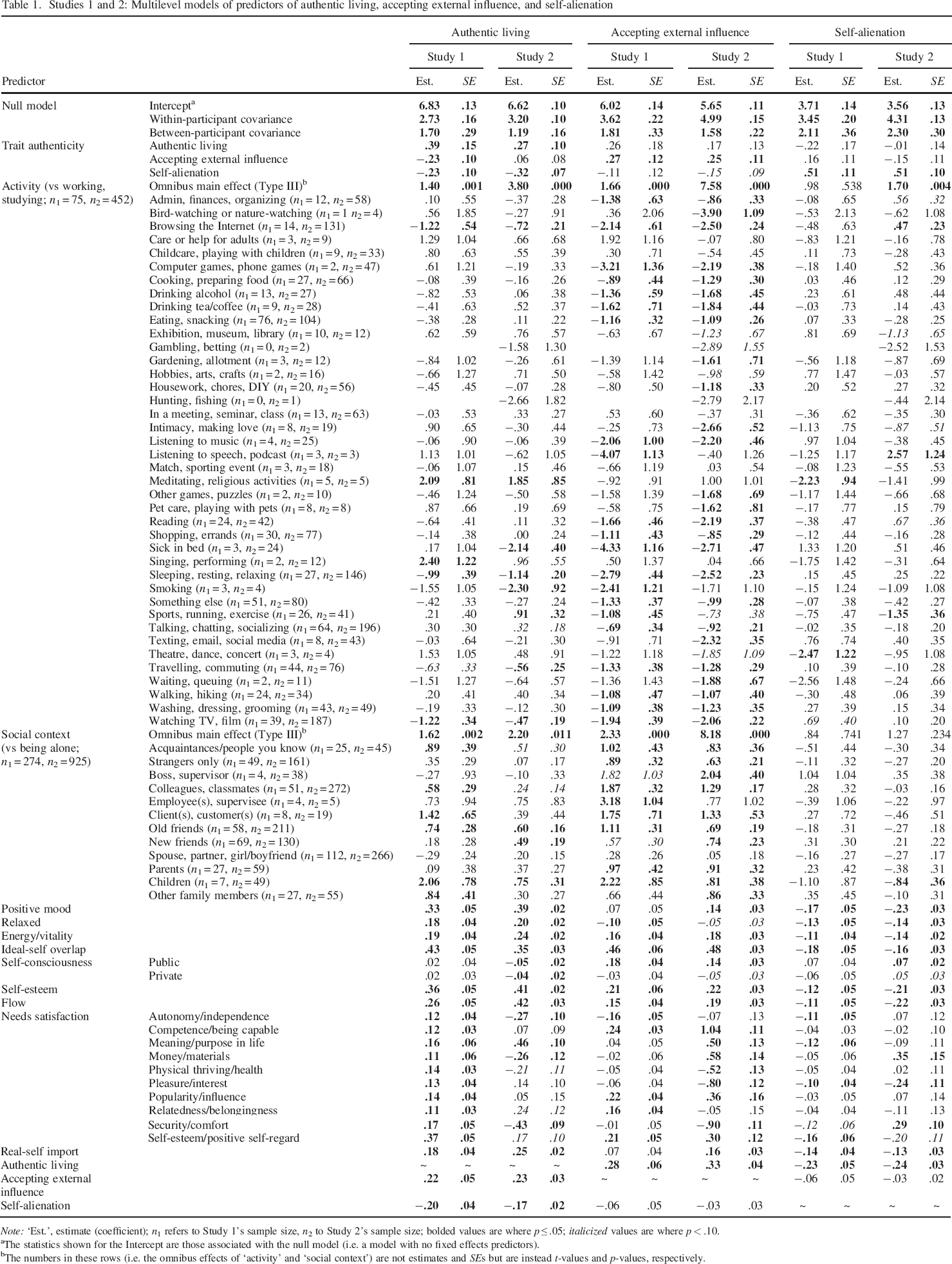
Note: ‘Est.’, estimate (coefficient); n1 refers to Study 1's sample size, n2 to Study 2's sample size; bolded values are where p ≤ .05; italicized values are where p < .10.
The statistics shown for the Intercept are those associated with the null model (i.e. a model with no fixed effects predictors).
The numbers in these rows (i.e. the omnibus effects of ‘activity’ and ‘social context’) are not estimates and SEs but are instead t–values and p–values, respectively.
Materials and procedure
The study comprised two online surveys. In part I, participants completed a survey assessing individual differences in authenticity (12 items rated on a scale where 1 = strongly disagree and 7 = strongly agree; Wood et al., 2008), whereas in part II, they completed the modified day reconstruction task (DRT). We included the trait authenticity measure in this and the next study to validate the single–item state–level measures of each authenticity facet. Each trait authenticity subscale demonstrated good internal consistency: authentic living (α = .75; M = 5.54, SD = 0.87), accepting external influence (α = .86; M = 3.83, SD = 1.33), and self–alienation (α = .86; M = 2.84, SD = 1.32). At part I's conclusion, participants responded to the demographic items.
Approximately 14 days following completion of part I (‘approximately’ because correspondence depended somewhat on day of week), we emailed participants a link to part II, the modified DRT. This task asked them to use a sheet of paper (or online software) to divide up ‘yesterday’ into discrete episodes. The resulting diary was not collected but intended as an aide–mémoire for what followed. Unlike the original DRM (Kahneman et al., 2004), our DRT was administered online, an approach taken by others (Ashton–James, Kushlev, & Dunn, 2013; Daly, Delaney, Doran, Harmon, & MacLachlin, 2010; Oerlemans, Bakker, & Veenhoven, 2011) and known to replicate the results of offline administration (Ashton–James et al.). Additionally, because of both software limitations and concerns about over–burdening online volunteers, participants could not assess more than 10 episodes. We instructed them that if they identified more, they should select the 10 that ‘best reflect the range of activities across the day’.
Next, participants were prompted to answer 26 questions about the episodes. For each, they identified their activity of 41 options and social context of 13 options (options drawn from Kahneman et al., 2004, and Krueger & Schkade, 2008; see Table 1). We included these items because they are integral to the administration of the DRM (Kahneman et al.) and to facilitate the interpretation of other findings. Table 2 lists the other 24 items and their response scales. We selected the three key dependent variable items on the basis of both face validity and the extent to which we could logically transform the item from the trait to the state level (i.e. that the items could reasonably apply to a wide range of situations).
Studies 1 and 2: Situational psychological survey items
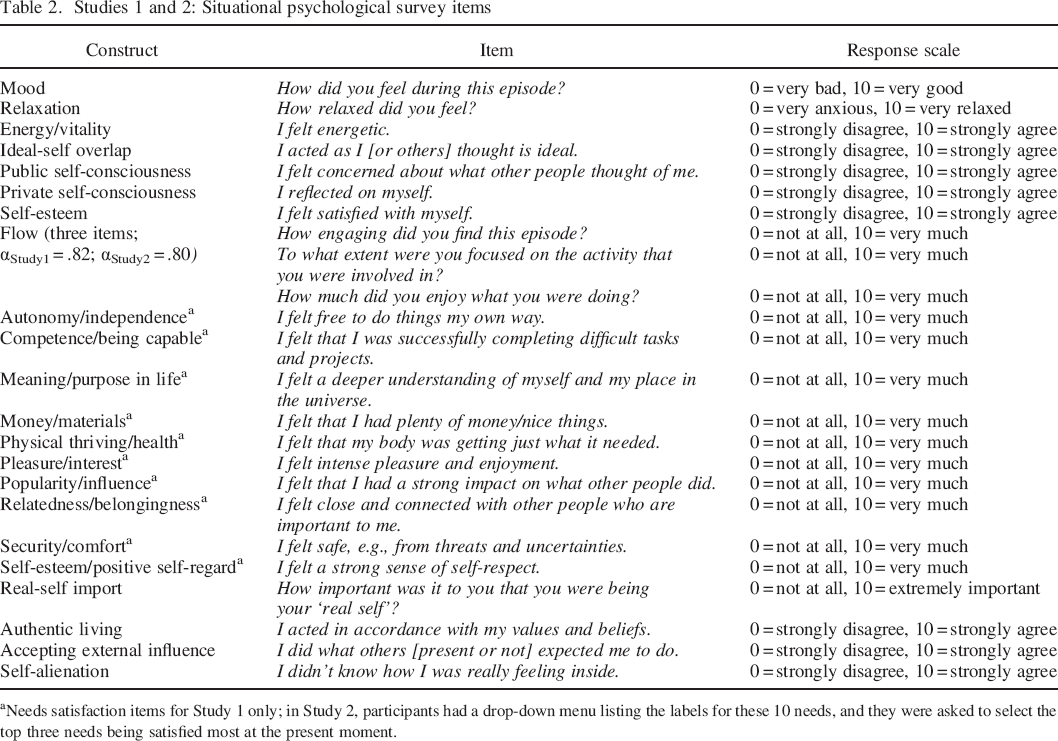
Needs satisfaction items for Study 1 only; in Study 2, participants had a drop–down menu listing the labels for these 10 needs, and they were asked to select the top three needs being satisfied most at the present moment.
Results
Data preparation and analysis notes
In our analyses of both studies, we used IBM© SPSS© Statistics 22 to conduct multilevel modelling with the restricted maximum likelihood estimation method. All of the continuous and dichotomous within–participant predictors were participant–mean centred first, which has interpretational implications. Specifically, this practice focuses purely on the state (situational) level, because it eliminates between–participant effects from the within–participant estimates. That is, the within–participant estimates are unbiased (Heck, Thomas, & Tabata, 2010; Kreft, De Leeuw, & Aiken, 1995). Thus, when interpreting the slopes (estimates) reported in our table, the variability was always relative to the within–person average for that predictor. For example, a slope of .25 would mean that for every unit increase above participants’ average score on the predictor, the dependent variable increased by .25. It may help to think of these estimates as deviations from participants’ typical level of ‘X’ (e.g. what happened to their state authenticity when participants were more relaxed or happier than usual). 2 Categorical variables with more than two levels cannot be centred (Heck et al., 2010; Kreft et al., 1995); thus, ‘activity’ and ‘social context’ remained in raw–score form. The trait authenticity items, being between–participant rather than within–participant predictors, were grand–mean centred prior to analysis. Thus, these estimates’ variability was always relative to the sample average (e.g. for every one–unit increase above the sample mean for that variable, the dependent variable increased by .25).The intercepts we report (Table 1, row 1) represent the (raw score) dependent variables’ average.
We set the covariance structure to variance components, which is equivalent to a diagonal covariance matrix when at least two random effects have been specified; otherwise, it is a scaled identity matrix. Covariance structures have little impact on fixed effects, which is where our interests lay. Still, we chose this covariance structure rather than an unstructured matrix in the interest of parsimony and power (Dedrick et al., 2009; Heck et al., 2010). In all of our multilevel models, we entered the intercept and the within–subjects predictor(s) as both fixed and random effects, whereas between–subjects predictors (e.g. trait authenticity components) were fixed only. We report the fixed effects in Table 1.
We examined the relation between each predictor and the three potential state authenticity components across several multilevel models, as it is recommended that models be built up (forward inclusion) rather than broken down (backward elimination) when using this analytic technique (Nezlek, 2008). Further, there was conceptual and statistical overlap among many measures, rendering a simultaneous model of the predictors difficult to interpret. Thus, we entered the constructs one measure at a time, except for the trait authenticity subscales, which we entered simultaneously. There were 716 episodes available for analysis.
Trait and state authenticity
The pattern of relations among the three state authenticity items was not in complete accordance with Wood et al.'s (2008) trait model of authenticity (see final three rows of Table 1). The analyses revealed that increasing state authentic living was associated with more, rather than less, state acceptance of external influence. Moreover, the correlation between state accepting external influence and state self–alienation was not significant. These results suggest that the state authenticity facets should be examined separately from one another.
In contrast, the relations among the trait authenticity components were as theorized by Wood et al. (2008): authentic living–accepting external influence, r(155) = −.32, p = .001; authentic living–self–alienation, r(155) = −.41, p = .001; and accepting external influence–self–alienation, r(155) = .45, p = .001. Trait authentic living was associated with lesser trait acceptance of external influence and decreased trait self–alienation. Furthermore, the more participants reported trait accepting external influence, the more trait self–alienation they felt.
With respect to the trait–state authenticity relationship (Table 1), all three of the trait authenticity subscales (controlling for each other) significantly predicted state authentic living, such that higher trait authentic living, lesser trait acceptance of external influence, and lower trait self–alienation were associated with higher self–reported authentic living across the day. Of the three subscales, trait authentic living demonstrated the strongest relationship with state authentic living. The only trait authenticity component that (controlling for the others) significantly predicted between–subjects variability in state acceptance of external influence was trait acceptance of external influence: Participants higher in trait acceptance of external influence reported being more likely to accept external influence across the day, thus supporting the validity of this single–item measure. Also supporting the validity of the single–item dependent variables, participants’ average self–alienation across the day was positively predicted by trait self–alienation but not by the other trait components (when each trait component controlled for the others).
Situational correlates of state authenticity
Authentic living
Table 1 reports the results of the null (no predictors) model, which indicates that within–subjects variability in self–reported authentic living (2.73) was over 1.5 times than that of between–subjects variability in authentic living (1.70). That is, the sense of authentic living was more changeable across episodes than between people.
With respect to the state (within–subjects) predictors, Table 1 shows that authentic living depended upon the participant's activity and social context. For example, participants were less likely to feel they were living authentically when they were browsing the Internet, sleeping/resting, or watching TV, and more likely to feel they were living authentically when engaging in spiritual activities or singing/performing (vs when working, which—being the most frequently reported activity—we selected as the point of comparison). They also were more likely to feel they were living authentically when they were among old friends, acquaintances, colleagues, clients/customers, or with their children or other family members (vs when alone, which—being the most frequently reported social context—we selected as the point of comparison). More important for our purposes, positive mood, feeling relaxed, energetic, ideal, high in self–esteem, flow, satisfaction of each of the 10 needs, and strong motivation for being ‘real’ were all associated with a greater sense of living authentically.
Accepting external influence
The null model (Table 1) indicated that within–subjects variability in self–reported acceptance of external influence (3.62) was twice that of between–subjects variability in acceptance of external influence (1.81).
Within–subjects variability in accepting external influence was significantly predicted by numerous constructs. With respect to activity, browsing the Internet, doing administrative work, sleeping/resting, reading, hiking, and grooming oneself were all associated with lesser episodic acceptance of external influence than working (the most frequent activity again serving as our ‘activity’ reference point). Also, being with nearly any other person(s) versus being alone (the ‘social context’ reference point) was associated with an increase in the acceptance of external influence, except for being with one's spouse or certain other family members, social contexts that were statistically similar to being alone. Energy/vitality, ideal–self overlap, public self–consciousness, state self–esteem, flow, and satisfaction of the needs for competence, popularity/influence, relatedness, and self–esteem were each associated with an increase in episodic acceptance of external influence. Feeling relaxed or that the need for autonomy was satisfied, in contrast, was associated with lesser acceptance of external influence (the latter relation providing further validation for this single–item measure).
Self–alienation
The null model (Table 1) indicated that within–subjects variability in self–reported self–alienation (3.45) was over 1.5 times than that of between–subjects variability (2.11).
Neither activity nor social context predicted this dependent variable, but participants were significantly less self–alienated when in a positive mood, relaxed, energetic/ vital, feeling ideal, high in self–esteem, in flow, and when their needs for autonomy, meaning/purpose in life, pleasure/ interest, or self–esteem had been satisfied. Finally, when feeling ‘real’ was more important to the individual, he or she self–reported experiencing significantly less self–alienation.
Summary
This first study demonstrates that trait and state authenticity models are not isometric. Whereas trait authentic living was negatively related to both acceptance of external influence and self–alienation and, further, acceptance of external influence and self–alienation were positively correlated with each other, state authentic living was positively related to accepting external influence, which was unrelated to self–alienation. At the same time, however, each state component was predicted by its trait counterpart. Thus, trait authenticity does manifest in daily experiences. Nevertheless, the daily experience of authenticity is not as described by the trait model: Situational acceptance of external influence is not necessarily associated with increasing self–alienation or a lesser sense of living authentically.
With respect to authenticity–related motivations, the more motivated a participant was to be their ‘real self’ in the episode, the more authentic living, the less self–alienation, and the greater acceptance of external influence he or she reported. Thus, in their lay conception of what it means to be ‘real’, participants did not perceive a conflict between accepting others’ influence and living authentically. These findings suggest that state acceptance of external influence does not necessarily have the negative effects on self–alienation and authentic living advanced by the trait model of authenticity (Wood et al., 2008) and, more generally, that acceptance of external influence has a more nuanced relation to state authenticity than to trait authenticity.
There is more variation in the sense of authenticity within than between participants, further attesting to the importance of viewing authenticity from a distinctly state perspective. State authentic living was reliably and positively associated with nearly all of the within–subjects psychological correlates we assessed and in the expected direction as well. The exceptions were situational public and private self–consciousness: Neither related to state authentic living.
Self–alienation was correlated with many of the same psychological constructs as authentic living and in the expected (negative) direction. Notably, however, state self–alienation was predicted by fewer needs satisfaction items: Greater meaning/ purpose in life, pleasure/interest, and self–esteem/positive self–regard were associated with decreasing self–alienation.
Most of the within–subjects psychological correlates also predicted accepting external influence. However, the direction of many of these effects was opposite to that predicted by Wood et al.'s (2008) trait model of authenticity (e.g. higher acceptance of external influence was associated with more—not less—state self–esteem). Further, in the instances in which needs satisfaction related to accepting external influence, it was more common that needs satisfaction was associated with increasing—rather than decreasing—acceptance of external influence (e.g. greater satisfaction of competence/capability and popularity influence were each associated with more acceptance of external influence). Finally, and consistent with the construct's meaning more generally, greater acceptance of external influence was associated with lesser satisfaction of the need for autonomy/ independence.
In addition, the results revealed that activity explained variability in authentic living and accepting external influence, but not self–alienation. Passive activities such as watching television, sleeping/relaxing, and browsing the Internet were associated with less authentic living (vs working). Likewise, many activities were significantly related to the degree to which one accepts external influence, and all had a negative relation to this outcome. That is, most activities (vs working) were associated with less acceptance of external influence.
Social context predicted authentic living and accepting external influence, but not self–alienation. Thus, self–alienation was equally likely to be experienced when alone as compared to when with friends, family, or colleagues. In contrast, being among others—no matter if they were mere acquaintances, certain members of one's family, or work colleagues—was associated with both greater authentic living and acceptance of external influence. These results contribute further evidence for the proposition that situational acceptance of others’ influence need not be inauthentic and, instead, may sometimes represent the expression of shared values.
Study 2
Study 2 is a replication and extension of Study 1, except that in Study 2, we used a true experience–sampling method so that we would have more power in our examination of the intra–individual correlates of state authenticity. We capitalized on advances in smartphone technology to collect live data from participants across several days. In doing so, we sought to obtain the clearest picture yet of what it means to feel authentic at a given moment in time.
Additionally, Study 2 assessed needs satisfaction differently to examine a potential alternative explanation for the results observed in Study 1 and previously (Lenton, Bruder, et al., 2013; Slabu et al., 2014): Perhaps participants considering positive–toned events evinced a response set whereby they reported that (nearly) all needs have been satisfied, and conversely, those considering negative–toned events were inclined to report that (nearly) no needs have been satisfied. As we saw in Study 1, all 10 of the assessed needs were significantly and positively associated with authentic living, even satisfaction of the need for money/materials. To address the ambiguity in the needs–authenticity relation, participants considered the needs satisfaction domains relative to one another. In this way, we could clarify which needs were more (vs less) important with respect to the momentary experience of authenticity.
Method
Participants
We advertised this study to Android smartphone users in the University of Edinburgh and wider UK community via email, posts on online noticeboards, Facebook ads, and coverage in local and national media outlets. In return for completing both parts of this study, we offered participants entry into a draw to win an Amazon.co.uk voucher (25 chances at £25). Although 156 participants completed both parts, we excluded seven because they responded to fewer than 25% of the possible pings (prompts for a response). We chose to have a minimum response criterion in order to bolster the power of the within–subjects or idiographic analyses (Conner, Tennen, Fleeson, & Barrett, 2009). The final sample of 149 participants consisted of 105 women and 42 men (plus two gender unreported), from 18 to 65 years of age (M = 25.87, SD = 8.97). The majority of participants had a white ethnic background (85.3%) and UK residency (93.9%).
Materials and procedure
The materials and procedures were similar to Study 1. Part I—the individual differences survey—was exactly the same. The trait authenticity subscales again demonstrated good internal consistency: authentic living (α = .79; M = 5.44, SD = 0.98), accepting external influence (α = .79; M = 4.00, SD = 1.12), and self–alienation (α = .86; M = 3.02, SD = 1.42).
The primary difference between Studies 1 and 2 was the method used to prompt participants’ evaluation of everyday situations. Approximately 5 minutes after completing the individual differences survey, Study 2's participants were sent a text message containing a link to the ‘Daily Self app’. They were instructed to download the app to their phone and set up their preferred ping constraints (the times before and after which they must not be pinged each day). The app was programmed to ping participants 16 times across (usually) a period of 8 days. Each day was divided in half between a participant's not–before time (e.g. 7:30
Results
Data preparation and analysis notes
The total number of episodes available for analyses was 2235. We conducted Study 2's analyses as in the previous study (i.e. multilevel modelling with the restricted maximum likelihood estimation method and participant–mean–centring all of the continuous and dichotomous within–participant predictors first). The revised needs satisfaction questions were initially coded into 10 binary dummy variables: In this episode, did the participant identify the need as being among the top three satisfied (1) or not (0)?
Trait and state authenticity
The pattern of correlations among the state authenticity dependent variables (Table 1) was not as theorized by Wood et al.'s (2008) trait model. Authentic living at a given moment in time was associated with increasing (rather than decreasing) state acceptance of external influence, and there was no relation between state acceptance of external influence and state self–alienation.
The correlations among the trait authenticity components were consistent with Wood et al.'s (2008) model: authentic living–accepting external influence, r(149) = −.33, p = .001; authentic living–self–alienation, r(149) = −.39, p = .001; and accepting external influence–self–alienation, r(149) = .32, p = .001. The higher the trait authentic living, the less trait acceptance of external influence and lower trait self–alienation they reported too. Higher trait acceptance of external influence was related to increased trait self–alienation.
With respect to the relationship between the trait and state authenticity variables, individual differences in each authentic living (positively) and self–alienation (negatively) predicted state authentic living. The only trait authenticity component to predict state acceptance of external influence was trait acceptance of external influence. Likewise, participants’ average state self–alienation was predicted by trait self–alienation alone.
Situational correlates of state authenticity
Authentic living
The null (no predictors) model (Table 1) indicates that within–subjects variability in self–reported authentic living (3.20) was over 2.5 times than that of between–subjects variability in authentic living (1.19). Again, participants’ sense of authentic living was more changeable across situations than between persons.
With respect to the situational correlates (Table 1), authentic living depended upon the activity in which the participant was engaged and with whom they shared the situation (if anyone). For example, participants were less likely to feel they were living authentically when they were ill, browsing the Internet, sleeping/resting, watching TV, or commuting (vs when working, again the most frequently reported activity). They were more likely to report living authentically when they were among friends (old or new) or with their children (vs when alone, again the most frequently reported social context). Further, positive mood, feeling relaxed, energetic, ideal, high self–esteem, flow, satisfaction of the need for meaning in life, and strong motivation for being ‘real’ were all associated with a greater sense of authentic living. In contrast, the more privately and publicly self–conscious the individual, or the more he or she perceived himself or herself as being in a situation that fulfilled the need for autonomy, money/materials, or security/comfort more than other needs, the less he or she felt that he or she was living per his or her beliefs.
Accepting external influence
The null model (Table 1) indicated that within–subjects variability (4.99) in accepting external influence was three times that of between–subjects (1.58).
Significant within–subjects predictors of state acceptance of external influence were generally positive psychological constructs (e.g. positive mood, energy/vitality, ideal–self overlap, high state self–esteem, flow, satisfaction of competence/ capability, and meaning/purpose in life): Increased acceptance of external influence was associated with higher well–being. The only constructs for which this pattern did not hold were satisfaction of the needs for physical thriving, pleasure/ interest, and security/comfort: When these needs were listed among the top three satisfied, reported acceptance of external influence was lower. High state public self–consciousness predicted greater accepting external influence. Activity and social context again explained accepting external influence: Most activities were associated with less accepting external influence when compared to work, and being with nearly anyone else (other than an employee/supervisee or one's partner/ spouse) was associated with accepting more external influence (vs being alone). Lastly, the more important it was to be ‘real’ in the situation, the greater the reported acceptance of external influence.
Self–alienation
The null model (Table 1) showed that within–subjects variability in self–alienation (4.31) was nearly two times that found between–subjects (2.30).
Social context did not explain this aspect of state authenticity. Activity, however, reliably predicted self–alienation: Browsing the Internet and listening to a speech/podcast increased self–alienation, whereas engaging in exercise decreased it (compared to working). In addition, participants were significantly less self–alienated when in a positive mood, feeling relaxed, energetic, ideal, high in self–esteem, in flow, and when their need for pleasure/interest was among the top needs being satisfied. Greater public self–consciousness was associated with higher self–alienation, as were satisfaction of the needs for money/materials and security/comfort. Finally, when feeling ‘real’ was more important, participants reported less self–alienation.
Summary
We summarize Study 2's results generally and as compared with Study 1. As in Study 1, Wood et al.'s (2008) trait authenticity model was validated, but the state authenticity facets did not correlate with one another in the same way. In both studies, state authentic living was positively correlated with state accepting external influence and negatively correlated with state self–alienation; state accepting external influence and state self–alienation were not correlated with one another. Also, each trait component correlated positively with its corresponding state component, attesting to the predictive validity of the trait measure, as well as to the construct validity of the single–item state measures of authenticity. The results of Study 2 showed again that there is more variation in sense of authenticity within–subjects than between–subjects. Thus, at the same time trait authenticity contributes to the daily experience of state authenticity, state authenticity is a unique construct determined more by the situation than by base–rate tendencies.
Both studies showed that when ‘being real’ was important to the participant, he or she also reported greater authentic living and less self–alienation. In Study 2, motivation to be ‘real’ was additionally positively associated with accepting external influence (this relation was nonsignificant in Study 1). Motivation to be ‘real’ may help people live in accord with their values or reduce the likelihood of experiencing self–alienation. Conversely, and given the correlational nature of the data, perhaps participants downplay authenticity's import in situations that do not afford it.
As in Study 1, Study 2 showed that nearly all of the psychological correlates predicted authentic living, and they did so in the expected (positive) direction. Study 2 also revealed, however, that situations predominantly satisfying the need for autonomy, money/materials, or security/comfort (vs other needs) related to decreased authentic living, the opposite of Study 1.
Study 2 replicated Study 1's pattern of results concerning state accepting external influence. That is, the direction of most effects largely opposed the predictions made by Wood et al.'s (2008) trait authenticity model. For example, Study 2 showed that having more energy, greater overlap with the ideal self, stronger flow, and higher state self–esteem were associated with more (not less) accepting external influence. Increased public self–consciousness was also associated with greater acceptance of external influence. With respect to needs, satisfaction of the needs for physical thriving/health, pleasure/interest, or security/comfort was correlated with less acceptance of external influence, at least when these needs were prioritized over others; these same relations were either nonsignificant or in the opposing direction in Study 1. The strongest need–related associate of accepting external influence was competence: Situations satisfying the need for competence above most other needs were associated with higher acceptance of external influence. Additionally, situations that predominantly satisfied the needs for money/materials, meaning/purpose, self–esteem, or popularity/influence were associated with increased accepting external influence. We discuss the implications of the needs satisfaction results for theories of authenticity in the General Discussion.
State self–alienation was correlated with many of the same psychological constructs as in Study 1 and, again, in the expected direction (e.g. greater self–alienation was related to lower mood, less energy, lower self–esteem, and less overlap with the ideal self). Also, and as observed with authentic living, prioritizing satisfaction of the need for money/ materials or security/comfort over most other needs was associated with greater self–alienation.
Whereas activity explained variability in authentic living and accepting external influence but not self–alienation in Study 1, activity was significantly correlated with all three dependent variables in Study 2. As before, passive activities such as watching television, sleeping/relaxing, and browsing the Internet were associated with less authentic living (vs working). Also like Study 1, a wide variety of activities (when compared to working) was associated with lower acceptance of external influence. The effects of activity on self–alienation, although significant, were comparatively few: Browsing the Internet or listening to a speech/podcast was associated with increasing self–alienation, whereas engaging in exercise was associated with lesser self–alienation (in Study 1, activity was not significantly associated with self–alienation). Social context again failed to predict self–alienation, whereas it significantly related to both authentic living and accepting external influence. As observed in Study 1, being among others—whether friends, children or (as with accepting external influence) strangers, acquaintances, work colleagues, or other family members—was associated with both greater authentic living and higher acceptance of external influence (vs being alone). Again, we found that situations associated with authentic living—that is, living in accord with one's beliefs and values—were often the same as those related to acceptance of external influence.
General Discussion
Dr Seuss was right: You may feel ‘youer’ in some situations than in others. In fact, these two studies demonstrated that authenticity varies more—from 1.5 to 3 times more—within than between individuals (Figure 1), showcasing the need for a situational approach to understanding authenticity. Our aim was to assess the components and identify key situational correlates of state authenticity to clarify this construct. As a starting point, we sought to assess whether authentic living, self–alienation, and accepting external influence relate to one another at the state level as has been found at the trait level. Wood and colleagues (2008) theorized that trait authenticity is a function of living authentically, being in tune with your beliefs and emotions (i.e. lacking self–alienation), and rejecting others’ influence. We hypothesized, however, that the third criterion would not apply equally well to state as to trait authenticity because situational acceptance of another's influence need not be indicative of conformity or obedience (which follows from a controlled motivation; Sheldon & Elliot, 1998). For example, someone may choose to accept another's influence in a situation because they share a goal or because, by doing so, they can achieve a broader or more deeply held goal (e.g. financial independence and meaning in life).
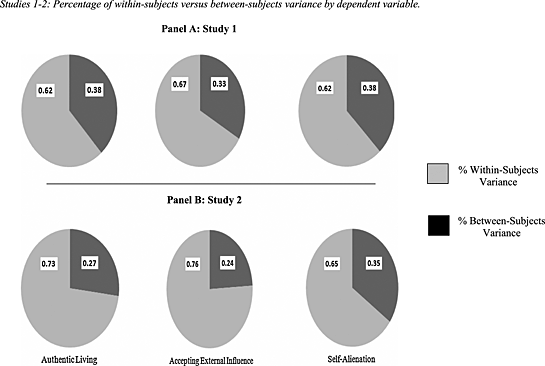
Studies 1 and 2: Percentage of within–subjects versus between–subjects variance by dependent variable.
Although both studies upheld the hypothesized relations among the trait authenticity components, the relations among the components at the state level evinced a different pattern: Greater acceptance of external influence was associated with an increase (rather than decrease) in authentic living, and further, accepting external influence bore no relation to self–alienation. This pattern contrasts with the trait model's (Wood et al., 2008) contention that accepting external influence is indicative of inauthenticity. Accepting external influence at a given moment in time is not necessarily detrimental to living in accord with one's values and with being in tune with one's physiology, emotions, and beliefs. Of course, it is not unusual for traits and states to comprise different components (Endler et al., 1991). So, if Wood et al.'s model does not extend perfectly to state authenticity, how ought this construct be conceptualized?
State authentic living
Having a situational sense of living authentically is associated with positive mood, feeling relaxed, having energy, feeling ideal, possessing increased self–esteem, and experiencing flow. Clearly, the state of authentic living is generally a positive experience. Study 2 further showed that situations prioritizing satisfaction of the needs for autonomy/independence, money/materials, or security/comfort were associated with lower authentic living, whereas situations prioritizing satisfaction of the need for meaning/purpose in life related to increased authentic living.
Considering further what it means to live authentically, one might wonder if participants’ reports of behaving in accordance with their values and beliefs were accurate. That is, people may subjectively feel aligned with their beliefs and values even when a more objective assessment suggests otherwise (Fleeson & Wilt, 2010). It is likely, however, that self–reports of authentic living possess at least some validity. For example, deeply held and/or well–practiced personal beliefs are more likely to be evinced in positively valenced contexts (Ashton–James, Maddux, Galinsky, & Chartrand, 2009). Additionally, there is growing evidence that attending to one's current experience in a non–evaluative way increases access to the true self by breaking down barriers to self–knowledge (Carlson, 2013). As we saw, flow—operationalized as task absorption—was significantly associated with increased authentic living. Improved access to self–knowledge may have mediated that relation.
Regardless of whether these beliefs possess validity, it is the subjective sense of authenticity that is important for well–being (Harter, 2002; Schlegel et al., 2011). Activities that facilitate this sense may include those that satisfy the need for meaning in life (above other needs) or spending time with old friends or one's children. On the other hand, browsing the Internet, watching TV, or being in situations that prioritize satisfaction of the need for money/materials or security/comfort (over most other needs) may contribute to a reduced sense of authentic living.
Interestingly, participants’ motivation to achieve authenticity (‘realness’) was somewhat more strongly associated with state authentic living than with self–alienation, suggesting that the lay conception of ‘being real’ is more aligned with the former conceptualization. For that reason, it is arguably more useful to emphasize authentic living—rather than lack of self–alienation (Kernis & Goldman, 2006; Wood et al., 2008)—as the cornerstone of state authenticity. Further to this argument, the results of both studies showed that authentic living is more strongly correlated with indicators of well–being (e.g. positive mood, state self–esteem, ideal–self overlap, and flow) than is self–attunement (self–alienation's converse). Thus, if we want to facilitate well–being via authenticity, it may be more effective to facilitate state authentic living in particular.
State accepting external influence
Situational acceptance of external influence was positively correlated with state authentic living, uncorrelated with self–alienation, and, more generally, linked to a host of well–being indicators. Together, these results confirm our contention that accepting external influence is not necessarily inauthentic and, indeed, may reflect autonomous choice. Thus, rejecting external influence is not an integral component of state authenticity. This is because people may share the goals of the persons whose influence they accept, or they may accept that influence in the short term to achieve a more expansive, long–term goal. Or still further, when one lives in accordance with one's standards, values, and ideals, one may simply become open to the influence of others. In contrast, reactance (i.e. actively resisting control attempts; Brehm & Brehm, 1981) may be the province of those living inauthentically.
Overall, we believe the findings concerning situational acceptance of external influence support the useful distinction between reflective and reactive autonomy (Koestner & Losier, 1996). Derived from SDT (Deci & Ryan, 2000; Ryan & Deci, 2000), the reflectively autonomous person is someone who, when faced with potential external influence, takes a measured decision as to whether to accept it. Based on Murray's (1938) theorizing, reactive autonomy is the notion that to be autonomous, one must defy authority and actively strive for independence from others. That state accepting external influence generally followed from reflective (vs reactive) autonomy is evidenced by the results showing its relation to several indicators of well–being as well as by the needs satisfaction results in Study 2: Acceptance of external influence was more likely to occur in situations prioritizing satisfaction of the need for competence/capability, meaning/ purpose, money/materials, popularity/influence, or self–esteem (over most other needs). In contrast, situations conducive to satisfying the needs for physical thriving or pleasure/interest were associated with lesser acceptance of external influence. The former set of needs generally requires the participation or input of other people; thus, individuals may choose to accept influence to satisfy these needs or other shared goals. Overall, the results show that, more often than not, situational acceptance of external influence is a positive and authentic course of action.
State self–alienation
The person–centred model (Kernis & Goldman, 2006; Wood et al., 2008) assumes that authenticity ultimately requires accurate awareness of or access to one's physiological, emotional, and cognitive states. In our studies, the evidence for this assertion at the state level is relatively weak. Firstly, self–alienation (or rather, lack thereof), although significant, was not a sizable predictor of authentic living (Table 1). Furthermore, authentic living and self–alienation possessed unique correlates. For example, social context explained authentic living but not self–alienation, and Study 2 showed that situations affording satisfaction of meaning and purpose in life (more than other needs) contributed to a sense of authentic living but not to lesser self–alienation. Additionally, the evidence indicates that while it is possible to experience authentic living without feeling momentarily self–attuned (self–alienation's converse; more below), it seems unlikely that one would experience authentic living while being distinctly self–alienated.
Focusing more closely on self–alienation, the results indicated that very few—if any—of the activities we assessed consistently contributed to self–alienation. Similarly, in neither study did social context explain feelings of self–alienation, suggesting that the objective features of situations contributing to self–alienation are possibly more idiosyncratic. Psychological features of the situation, on the other hand, did explain participants’ self–alienation. When they felt self–alienated, they were also likely to be in a more negative mood, feel more anxious, experience less energy, feel less like their ideal selves, possess lower self–esteem, and be less likely to experience flow. Study 2—which better isolated the needs that were important—also showed that situations satisfying the needs for money/materials or security/comfort (above most other needs) were also associated with heightened self–alienation, whereas situations satisfying the need for pleasure/interest (above most other needs) were associated with less self–alienation.
This pattern of findings is reminiscent of the distinction between egoic versus hypo–egoic states (Leary et al., 2006; Leary & Guadagno, 2011). In particular, state self–alienation has some of the hallmarks of an egoic (vs hypo–egoic) self–regulatory state (Leary et al., 2006): a concern with how one is being evaluated (i.e. higher public self–consciousness, at least in Study2), situational ego–involvement and, perhaps, dissatisfied goals (i.e. lesser self–esteem and reduced ideal–self overlap), and less energy. Perhaps ironically, not actively focusing on (nor actively avoiding) the self may facilitate feeling in touch with one's self. This is why we label the opposite of self–alienation ‘self–attunement’ rather than ‘self–awareness’: Awareness implies a conscious process (Blair, 2002). Hypo–egoic states, on the other hand, are more spontaneous/automatic/natural (Leary et al., 2006), and they can be attained by, for example, repetitive practice until the behaviour becomes automatic, entering a state of flow, experiencing transcendence, or practicing humility (Leary et al., 2006; Leary & Guadagno, 2011). In accord with this theorizing, the results of both studies indicated that greater flow was associated with lesser self–alienation. With respect to other practical means by which to reduce self–alienation, the results suggest that those seeking self–attunement ought to avoid prioritizing the achievement of money/materials or security/comfort and, instead, participate in activities that predominantly satisfy their need for pleasure/interest. Of course, these data are correlational, so the direction of causality (if any) has yet to be determined, but the results offer a concrete starting point for testing hypotheses concerning directionality.
Additional implications
Most investigations of state authenticity have taken place in the lab or relied on participants’ retrospective reports, thus rendering it possible that the findings were not generalizable to real–life situations (Kahneman et al., 2004). Notably, the present results largely confirmed those observed previously: State authenticity is correlated with positive mood (Lenton, Slabu et al., 2013; Turner & Billings, 1991), greater self–esteem (Slabu et al., 2014), lower anxiety, and feeling ideal (Lenton, Bruder, et al., 2013).
Study 1 also replicated previous findings concerning the needs–authenticity relation. Study 2, however, did not, and thus, we elaborate here. SDT (Deci & Ryan, 2000) hypothesizes that satisfaction of the needs for autonomy, competence, and relatedness is important for the achievement of authenticity because their satisfaction—especially autonomy and competence—contributes to goal internalization (Ryan & Deci, 2000; Sheldon & Elliot, 1998). Research supports this hypothesis (Heppner et al., 2008). But in an earlier study examining the relevance of additional psychological needs, we found that nine out of the 10 needs assessed were related to authenticity (Lenton, Bruder, et al.), undermining the idea that there is something special about autonomy, competence, and relatedness. Study 1 largely replicated these results, showing that satisfaction of all 10 needs was related to increased authentic living. Self–alienation was associated with the dissatisfaction of five needs, competence and relatedness not included.
To address the possibility of a yes–saying bias for the needs satisfaction items, Study 2 compelled participants to trade off needs against one another. In this way, we could determine which needs matter more. With respect to the SDT needs, Study 2 showed that situations conducive to the satisfaction of autonomy (more than most other needs) were associated with a decreased—not increased—sense of authentic living. There was no relation between autonomy satisfaction and self–alienation. Furthermore, neither prioritization of competence satisfaction nor of relatedness satisfaction explained within–subjects variability in felt authentic living or in self–alienation. Instead, prioritizing satisfaction of the need for meaning/purpose in life was correlated with greater authentic living, and prioritizing satisfaction of the needs for money/materials or security/comfort was correlated with lesser authentic living and greater self–alienation. These results align with those of Carter and Gilovich (2012), who found that material purchases are not integrated into the true self. The results also expand upon research by Schlegel and colleagues (2011) showing that the phenomenological experience of being in touch with one's true self facilitates meaning and purpose in life. The findings concerning security/ comfort correspond to Maslow's (1971) proposal that focusing on lower–order needs may interfere with authenticity attainment (a higher–order need). More generally, these results suggest that researchers ought to examine a wider array of psychological needs when assessing the needs–authenticity relation and, further, that they should employ methods that reduce response sets.
Flow is a state of deep absorption by and enjoyment of an activity, and it is characterized by alertness, effortless self–regulation, contented ignorance of the passage of time, a feeling of competence, and a lack of self–awareness (Csikszentmihalyi, 1990). Our research is the first to demonstrate that absorption in one's present activity is a reliable correlate of state authenticity. In particular, flow was related to a decreased sense of self–alienation and, even more so, an increased sense of living authentically. Future research should examine which of the theorized components of flow (e.g. concentration, control, merging, and autotelic; Moneta, 2012) contribute more to state authenticity. For example, our measure of flow did not assess the individual's sense of time passing, the extent to which the situation's goals were clear, and the balance between the individual's skills and the situation's challenge. The needs satisfaction results of Study 2 suggest, however, that meeting a challenge (feeling capable) or experiencing deep pleasure/interest each by itself may be insufficient to provoke a sense of authentic living. Alternatively, because of the correlational nature of our data, it may be that situational authenticity affords a state of flow (rather than—or in addition to—the converse).
Limitations and additional future directions
This research has limitations. We assessed most of the within–subject variables with one–item measures to mitigate the demands placed on participants but at the potential cost of measurement reliability and validity. There are conditions, however, that favour the use of single–item versus multi–item measures (Burisch, 1984; Stebbins, 2001). Single–item measures are recommended when the relevant construct is concrete and when it can be reasonably assumed that there is good agreement among respondents about the characteristic being assessed (Rossiter, 2002). More practically speaking, single–item measures are advantageous in large–scale surveys, longitudinal studies, and other research contexts in which time constraints limit the number of items to be administered (Drolet & Morrison, 2001). Thus, single–item measures are acceptable in situations where psychometric concerns are less pressing and practical constraints are unyielding. Indeed, researchers studying such diverse phenomena as life satisfaction (Campbell, Converse, & Rodgers, 1976), subjective well–being (Sandvik, Diener, & Seidlitz, 1993), religiosity (Gebauer, Nehrlich, Sedikides, & Neberich, 2013), affect (Russell, Weiss, & Mendelsohn, 1989), relationships (Aron, Aron, & Danny, 1992), attachment style (Hazan & Shaver, 1987), and self–esteem (Robins, Hendin, & Trzesniewski, 2001) have relied extensively upon such measures. We are also confident in the results yielded by the single–item measures and our interpretations thereof because the constructs correlated with one another in expected ways and most results replicated from Study 1 to Study 2 (which employed distinct methods of sampling real–life situations).
Reflecting more deeply still on our use of single items for our dependent variable measures, we further point out that each of the three dependent variables was predicted by its corresponding trait authenticity facet (over and above the other trait facets), thereby supporting their construct validity. In addition, results showed that (i) state authentic living was associated with greater ideal–self overlap, flow, and satisfaction of the need for meaning/purpose in life, and was less likely to be experienced when sleeping/resting, watching TV, or browsing the Internet, but more likely to be experienced when spending time with old friends or one's offspring; (ii) state accepting external influence was associated with increased public self–consciousness, greater satisfaction of the needs for popularity/influence and self–esteem, and more likely to be experienced when in the presence of nearly any other person (vs being alone) and less likely to be observed when participants were engaging in solitary activities (e.g. browsing the Internet, playing computer games, and reading); and (iii) state self–alienation was associated with greater anxiety, lower self–esteem, and decreased satisfaction of the need for pleasure/interest. The pattern of these relations further attests to the validity of the single–item dependent variable measures. Nevertheless, future studies of state authenticity should conduct elaborated investigations of each of these constructs.
Although the situations we sampled included many instances of certain activities (e.g. browsing the Internet, eating, and chatting) and categories of other people (e.g. strangers, partner, and classmates/colleagues), other activities and social contexts were represented infrequently (e.g. bird–watching, meditating, and being with employees/ supervisees). Figures 2 and 3 depict the average authentic living, acceptance of external influence, and self–alienation for each activity and social context (respectively) across Studies 1 and 2 combined. They suggest that, on average, meditating, exercising, or spending time with one's children facilitates authenticity. The estimates associated with under–represented activities and social activities (see Table 1 for the ns), however, should be taken with a large grain of salt. Future research might make concerted efforts to increase the sample size of certain classes of activities or social contexts to better determine which ones are generally associated with an increased (or decreased) sense of authenticity.
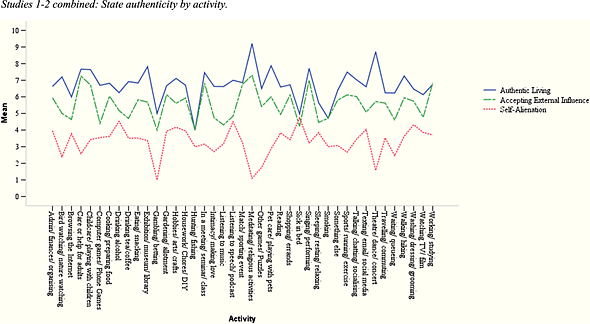
Studies 1 and 2 combined: State authenticity by activity.
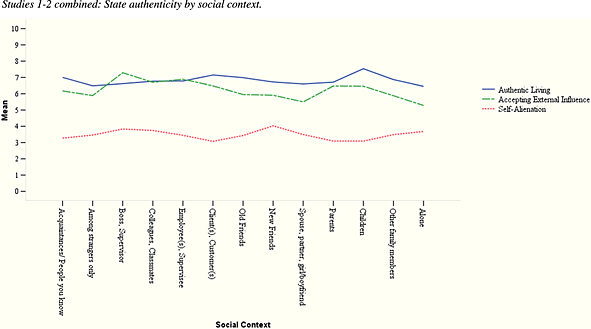
Studies 1 and 2 combined: State authenticity by social context.
A further limitation is that we sampled only two episodes per day in Study 2. Given the average time lag between episodes, we could not detect ordered relations. Future experience–sampling research might ‘ping’ participants more frequently.
Despite these limitations (or perhaps in part because of these limitations), the present studies offer a tremendous springboard for future research on the role of state authenticity in everyday life. In addition to all of the possibilities mentioned already, an additional research avenue could be to assess whether and how trait authenticity moderates the relation between state authenticity and various indicators of well–being (questions beyond the scope of the present research). For example, perhaps high (vs low) trait authentics are more susceptible to negative moods when in situations that preclude an authentic mode of operating, whereas low (vs high) trait authentics may be more prone to reaping the positive mood benefits that coincide with situations facilitating the true self.
Coda
Dispositional authenticity manifests in situations, but trait and state authenticity are not isometric constructs. Situational acceptance of external influence is not necessarily indicative of inauthenticity. Instead, accepting the influence of another person in a given moment is more likely to reflect an authentic course of action. Overall, state authenticity is best characterized as a phenomenological experience comprising two related but independent constructs: self–attunement (i.e. absence of self–alienation) and authentic living.
Footnotes
Acknowledgements
We thank Roy Welensky and Cedric Macmartin for their technical assistance with the online survey software, and we extend our deep gratitude to Dr Mateo Obregón for working tirelessly and cheerfully to develop the smartphone app described in Study 2.The studies were conducted while the first and second authors were at the Department of Psychology, University of Edinburgh, UK. This research was supported by Economic and Social Research Council grant #RES–062–23–2595 to Alison Lenton and Constantine Sedikides.