







Abstract
This study investigated grandiose narcissism from a categorical perspective. We tested whether subgroups of narcissists can be distinguished that differ in their expressions of more agentic (narcissistic admiration, ADM) and more antagonistic (narcissistic rivalry, RIV) pathways of narcissism. We analysed three German samples (total N = 2211; Mage = 26; 70% female) and one US sample (N = 971; Mage = 35; 74% female) using latent class analysis. Four subgroups of narcissists were consistently identified across samples from Germany and the United States: low narcissists, moderate narcissists primarily characterized by agentic aspects (ADM), moderate narcissists characterized by both agentic and antagonistic aspects (ADM + RIV), and high narcissists. The subgroups were systematically related to a number of personality traits (e.g. Machiavellianism, impulsivity) and adjustment indicators (e.g. self–esteem, empathy). Members in the moderate narcissists—ADM subgroup showed the most adaptive characteristics while members in the moderate narcissists—ADM + RIV subgroup showed the most maladaptive characteristics. Investigating grandiose narcissism—a primarily quantitative trait—from a categorical perspective can yield valuable insights that would otherwise be overlooked. In addition, our results underline the utility of a self–regulatory process approach to grandiose narcissism that distinguishes between agentic and antagonistic dynamics. Copyright © 2016 European Association of Personality Psychology
Narcissism is a complex, multi–faceted trait that is related to diverse (adaptive and maladaptive) outcomes in the intrapersonal and interpersonal domain. While everyday discourse and theorizing about narcissism often use categorical language (e.g. speaking about how ‘narcissists’ behave and feel), most research on narcissism is trait–centred: It investigates narcissism as a continuous construct that people possess to varying degrees. Therefore, it is unclear whether different subgroups of narcissists exist that are meaningfully related to different levels of psychological functioning. In this paper we apply a person–centred approach based on latent class analysis. This allows us to investigate whether subgroups of narcissists can be differentiated and how they are related to other personality traits as well as intrapersonal and interpersonal adjustment indicators.
A self–regulatory process approach to understanding narcissism
The personality trait narcissism is characterized by feelings of superiority, a sense of grandiosity, exhibitionism, charming but also exploitative behaviours in the interpersonal domain, feelings of entitlement, fantasies of unlimited power, success, or beauty, and a lack of empathy (Cain, Pincus, & Ansell, 2008). Some of these features appear to be rather adaptive, particularly the more agentic ones (e.g. charmingness and a sense of grandiosity), because they have been linked to positive outcomes such as indicators of psychological health (high self–esteem and emotional stability, low depression and loneliness; Rhodewalt & Morf, 1995; Sedikides, Rudich, Gregg, Kumashiro, & Rusbult, 2004; Trzesniewski, Donnellan, & Robins, 2008) and social potency (positive peer evaluations; e.g. Lange, Crusius, & Hagemeyer, 2016; Leckelt, Küfner, Nestler, & Back, 2015). In contrast, other more antagonistic components of grandiose narcissism (e.g. exploitativeness and feelings of entitlement) have been linked to negative outcomes such as dysfunctional interpersonal relationships, trait anger, aggression, lack of forgiveness, fragile self–esteem, and counterproductive work behaviours and therefore appear to be rather maladaptive (Bushman & Baumeister, 1998; Campbell & Campbell, 2009; Campbell, Foster, & Finkel, 2002; Fatfouta, Gerlach, Schröder–Abé, & Merkl, 2015; Geukes et al., in press; Miller et al., 2009).
A recently developed conceptual framework that incorporates the agentic and antagonistic aspects of grandiose narcissism and explains their divergent correlates and consequences is the Narcissistic Admiration and Rivalry Concept (NARC; Back et al., 2013). The NARC postulates that the overarching goal of persons with high levels of narcissism (for brevity called ‘narcissists’ in the following) is to maintain a grandiose self (see also Morf & Rhodewalt, 2001). Back et al. distinguish two strategies narcissists employ to maintain their grandiose self: assertive self–enhancement (self–promotion) and antagonistic self–protection (self–defence). The two strategies activate distinct pathways that manifest themselves in the affective–motivational, the cognitive, and the behavioural domain. The first agentic pathway, admiration, is triggered by the strategy to self–promote and manifests itself, for example, in charming and self–assured behaviours and engaging in fantasies of grandiosity. The second antagonistic pathway, rivalry, is triggered by the strategy to protect the grandiose self and manifests itself, for example, in aggressive and hostile behaviours and the devaluation of others.
Among the two pathways, self–promotion can be seen as the dominant default narcissistic strategy leading to agentic expressions of narcissism (i.e. admiration) that are ubiquitous among narcissists. Only when there is a real or imagined threat to the grandiose self, a self–defending narcissistic strategy additionally comes into play that leads to antagonistic expressions of narcissism (i.e. rivalry). Consequently, while the two pathways overlap substantially (latent r = .61; Back et al., 2013), they also show distinct relationships with other variables. For example, admiration correlates positively with self–esteem, extraversion, and openness whereas rivalry correlates negatively with these traits (Back et al., 2013). Both pathways are positively associated with pathological narcissism, Machiavellianism, and psychopathy, although the correlations are stronger for rivalry compared to admiration (e.g. r = .64 vs. .17 for Machiavellianism).
Narcissism is commonly understood as a continuous trait that people possess to varying degrees. Nevertheless, based on the ideas postulated in the NARC, we can also expect subgroups of narcissists that differ in their expressions of this trait, in particular with respect to the two pathways admiration and rivalry. For people who are high on narcissism, both pathways should play an important role, with admiration (the default mode) as the more dominant one. For people who are low on narcissism, both pathways should be equally unimportant, as these persons do not pursue the goal of maintaining a grandiose self. However, for people with moderate narcissism levels, we should be able to distinguish persons who take only the admiration pathway from persons who take both the admiration and rivalry pathways. The first group should consist of persons who achieve their goal of maintaining a grandiose self purely by engaging in self–promotion. These people rarely perceive threats to their grandiose self and therefore do not need to show behaviours to defend it. On the other hand, the second group of persons should—as people high on narcissism—engage in antagonistic self–defending behaviours when confronted with a perceived threat to the grandiose self. Thus, following the idea of self–promotion as the narcissistic default and self–defence as a supplemental strategy in the face of failure or critique, we should be able to identify a subgroup with high values on admiration and low values on rivalry but not vice versa. Finding this particular constellation of subgroups would be an important validation of the two pathways postulated by the NARC. In sum, while quantitative differences on narcissism (high, moderate, low levels) should prevail, qualitative differences with respect to a differential expression of the admiration and rivalry pathways should also exist.
Latent class analysis and latent class regression
Several methods have been developed for examining whether a sample can be divided into subgroups that share certain characteristics. These include inverse factor analysis for Q–sort ratings and cluster analysis and latent class analysis (LCA) for data from questionnaires with polytomous rating scales. The method applied in this paper is LCA (Lazarsfeld, 1950; Lazarsfeld & Henry, 1968). LCA explains interindividual differences in item response patterns using a fixed number of subgroups (latent classes) that are represented by the values of a categorical latent variable. The latent classes can be characterized by both quantitative differences (e.g. persons high vs. low on a trait) and qualitative differences (e.g. persons who prefer vs. avoid endorsing extreme categories when responding to questionnaire items). The LCA algorithm at the same time maximizes heterogeneity between latent classes and homogeneity within latent classes. For each person, a probability of membership to each of the latent classes is estimated. Persons can then be manifestly allocated to the latent class for which they have the highest membership probability (maximum class membership probability). Ideally, a person's membership probability to one latent class is very high and the membership probabilities to the other classes are very low, allowing the person to be classified with high certainty. These manifest class memberships can then be utilized in further analyses, for example as predictors of outcome variables.
The number of latent classes appropriate to capture the characteristics of a sample will be determined using four criteria: (i) The values of the Bayesian Information Criterion (BIC; Schwarz, 1978) for the LCA model. LCAs with one to six classes will be estimated and compared regarding their fit with the BIC. The lowest BIC value indicates the best–fitting number of classes. While other information criteria are available, simulation studies have shown that the BIC performs best in identifying the correct number of classes (Li, Cohen, Kim, & Cho, 2009; Nylund, Asparouhov, & Muthén, 2007). (ii) The interpretability of the latent classes. The latent classes will be interpreted using the profiles of their expected values on the NARQ items. Put simply, the expected value indicates the mean score on a NARQ item for the persons allocated to the respective latent class. For a latent class model to be chosen, the defining characteristics of the classes should be clearly identifiable using these profiles. (iii) The size of each of the latent classes. The final latent class model should consist of latent classes that all contain a sizable portion of the participants. (iv) The overall certainty of manifest allocation to the classes. The average of the maximum class membership probabilities (i.e. the class membership probabilities for persons who are manifestly allocated to a certain class) represents the overall certainty of classification. That is, high average maximum class membership probabilities indicate that persons in distinct latent classes could be reliably distinguished based on their item response patterns. The chosen latent class model should have high average maximum class membership probabilities (above .85; Rost, Carstensen, & von Davier, 1999).
The advantages of applying LCA to traits that are considered primarily quantitative include that LCA is very parsimonious and does not require assumptions about the distribution of the data. Thus, LCA can also be applied when common assumptions of quantitative methods such as unidimensionality or normally distributed response data are violated (McCutcheon, 1987; Wetzel, Xu, & von Davier, 2015).
An extension of LCA, latent class regression, combines LCA with regression techniques. Latent class regression allows incorporating external variables directly into the latent class model as predictors of participants‘ latent class membership. Thus, it can be investigated whether participants with varying levels on the external variable differ in their probability of belonging to a certain latent class. This approach will be applied to investigate the relationships between the latent classes and other personality traits (e.g. Big Five, Machiavellianism, psychopathy) because it is plausible that latent class membership differs as a function of a person's standing on other personality traits. Last, manifest class memberships can be used in latent regressions to predict outcome variables. This approach will be applied to examine the relationships between the latent classes and intrapersonal (e.g. self–esteem) and interpersonal (e.g. interpersonal distrust) adjustment indicators.
The present research
The aim of this study was to investigate whether subgroups of narcissists can be distinguished that differ in their expressions of the two pathways admiration and rivalry. Based on the NARC we hypothesize that we will be able to differentiate a subgroup of persons who (i) only pursue strategies from the admiration pathway from a subgroup of persons who (ii) pursue strategies from both pathways. If different subgroups can be shown to exist as hypothesized, the second aim of this study was to investigate the relationships of the subgroups to other personality traits as well as intrapersonal and interpersonal adjustment indicators.
This article is divided into three studies that analysed four samples in total. Study 1 tested whether subgroups exist and, provided that they exist, how they could be interpreted in terms of the expressions of narcissistic admiration and rivalry. Study 2 aimed at replicating the findings from Study 1 regarding the subgroup structure in two samples. In addition, relationships to personality traits and intrapersonal and interpersonal adjustment indicators were investigated. Because the samples in Study 1 and Study 2 consisted of predominantly German participants, the goal of Study 3 was to replicate the subgroup structure in an online sample from multiple (mainly English–speaking) countries.
Study 1
The goal of Study 1 was to investigate whether subgroups of narcissists could be distinguished and—if this was the case—how the subgroups could be described in terms of their expressions of admiration and rivalry.
Method
Table 1 summarizes the demographic characteristics of all samples analysed in this article. In addition, it shows mean scores on admiration and rivalry as well as omega reliability coefficients (McDonald, 1999) for the mean scores.
Descriptive statistics for the four samples

Note: ADM = admiration; RIV = rivalry.
Sample
Sample 1 consisted of 828 German–speaking participants who filled out a large online survey on personality and participation in online studies (see Table 1 for sample characteristics). They were recruited via a university–wide email list and either received feedback on their personality or took part in a lottery of 30 Amazon coupons with a value of 10 Euros each.
Measures
Narcissism was assessed with the Narcissistic Admiration and Rivalry Questionnaire (NARQ; Back et al. 2013). The NARQ consists of 18 items in total. Nine of the items assess cognitions, behaviours, and emotions related to the admiration pathway (e.g. ‘I am great.’ or ‘I show others how special I am.’). The other nine items assess cognitions, behaviours, and emotions related to the rivalry pathway (e.g. ‘I want my rivals to fail.’ or ‘Most people won't achieve anything.’). Participants rated how well the items described them on a six–point rating scale ranging from not agree at all to agree completely.
Analyses
LCAs with one to six classes were estimated in the R (R Core Team, 2013) package poLCA (Linzer & Lewis, 2011). The statistically best–fitting latent class model was determined with the BIC (Schwarz, 1978). Class sizes, manifest class memberships, and average maximum class membership probabilities (see above) were derived from the estimation in poLCA. Subsequently, profiles of the expected values were constructed to interpret the latent classes.
Results
According to the BIC, the latent class model with four latent classes showed the best fit to the data (see Table 2). Figure 1 shows the expected values on the NARQ items for each latent class. For example, class 3 had an expected value of approximately 4 on the first item (narq05). Thus, on average, participants allocated to class 3 endorsed response category 4 on the scale from 1 to 6 to this item (‘I enjoy my successes very much.’). Note that the NARQ items are not ordered as they appear in the questionnaire, but rather according to subscales with the first nine items forming the admiration subscale and the second nine items forming the rivalry subscale. Within each subscale the items are ordered from the highest average expected value across classes to the lowest average expected value across classes. Hence, the discontinuity of the lines between item 2 and item 6 indicates where admiration ends and rivalry starts. Non–crossing, separate expected value profile lines indicate quantitative differences whereas crossing profile lines indicate qualitative differences (Kempf, 2012).
Results of latent class models for samples 1 to 4
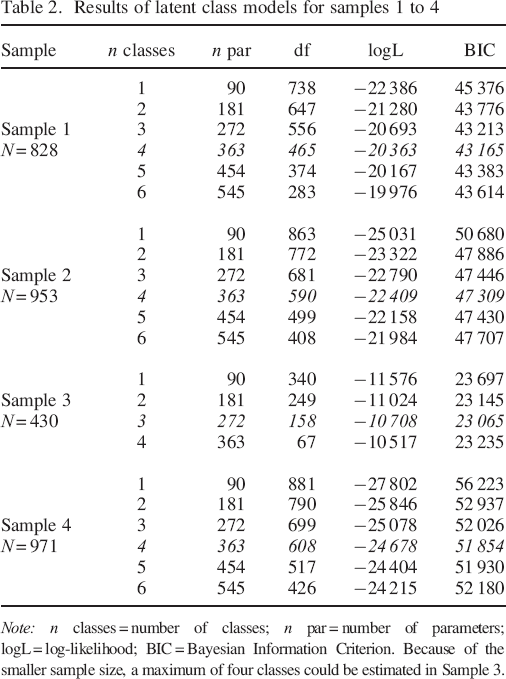
Note: n classes = number of classes; n par = number of parameters; logL = log–likelihood; BIC = Bayesian Information Criterion. Because of the smaller sample size, a maximum of four classes could be estimated in Sample 3.
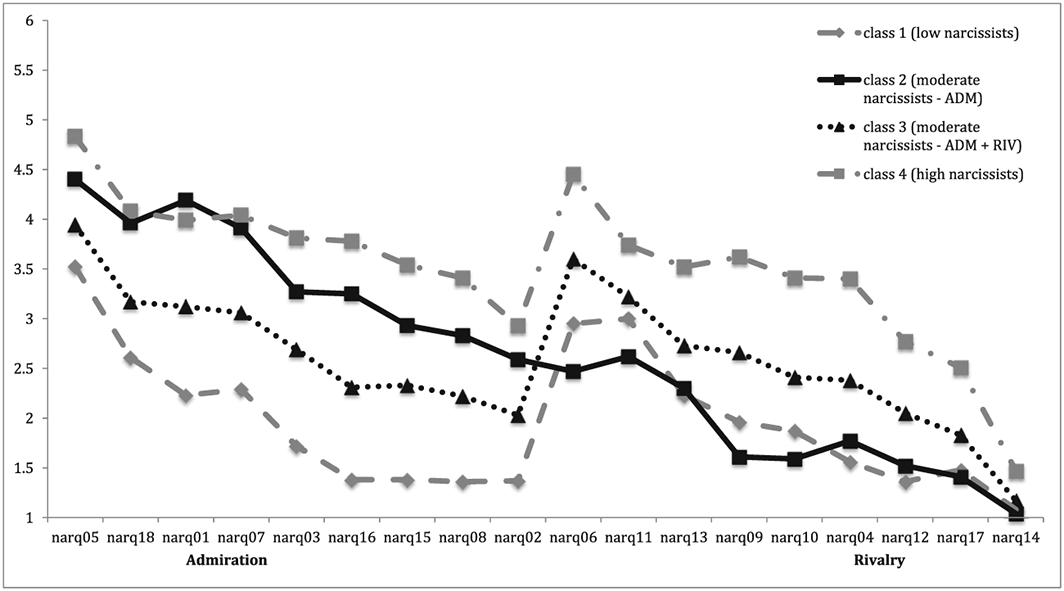
Profile of expected values for four latent classes in Sample 1. Items narq05 to narq02 belong to admiration and items narq06 to narq14 belong to rivalry.
Class 1 and class 4 were purely characterized by quantitative differences because their expected value profile lines never crossed. Class 1 showed low expected values (ranging from 1.08 to 3.52 with M = 1.96, SD = 0.67) on all items, indicating that participants allocated to this class were generally low on narcissism and endorsed not agree at all or the second response category on most items. Class 1 members will therefore be referred to as low narcissists in the following. In contrast, class 4 appeared to contain respondents moderate to high on narcissism (for simplicity high narcissists in the following) because expected values in particular on the admiration items were mostly in the upper half of the response scale (MADM = 3.82, SDADM = 0.50; MRIV = 3.21, SDRIV = 0.81). Class 2 and 3 had expected value profile lines located between those for class 1 and 4, indicating that both classes were overall moderate on narcissism. However, they differed strongly in their expected values on the admiration and rivalry items. Class 2 consistently showed higher expected values than class 3 on the admiration items (Mclass2 = 3.48, SDclass2 = 0.61; Mclass3 = 2.76, SDclass3 = 0.58). In contrast, class 2 had low expected values on the rivalry items (Mclass2 = 1.81, SDclass2 = 0.50) that were comparable to those of the low narcissists whereas class 3 had moderate expected values (Mclass3 = 2.45, SDclass3 = 0.69) on the rivalry items. This indicates that class 2 and class 3 contained participants who differed in their expressions of the admiration and rivalry pathways, albeit having an overall comparable moderate level of narcissism. These classes will be referred to as moderate narcissists—ADM (class 2) and moderate narcissists—ADM + RIV (class 3) in the following.
This interpretation of the four latent classes is substantiated by examining histograms of the distribution of the NARQ mean score over all items in the classes (see Figure 2). Low narcissists and high narcissists had the corresponding approximately normal distribution of scores around a low mean score of about 2 and a moderate to high mean score of about 3.5, respectively. Both moderate narcissists classes had very similar distributions around a mean score of 2.6. Hence, these subgroups appear equivalent from a quantitative perspective, but the LCAs revealed an important qualitative distinction related to the admiration and rivalry pathways.
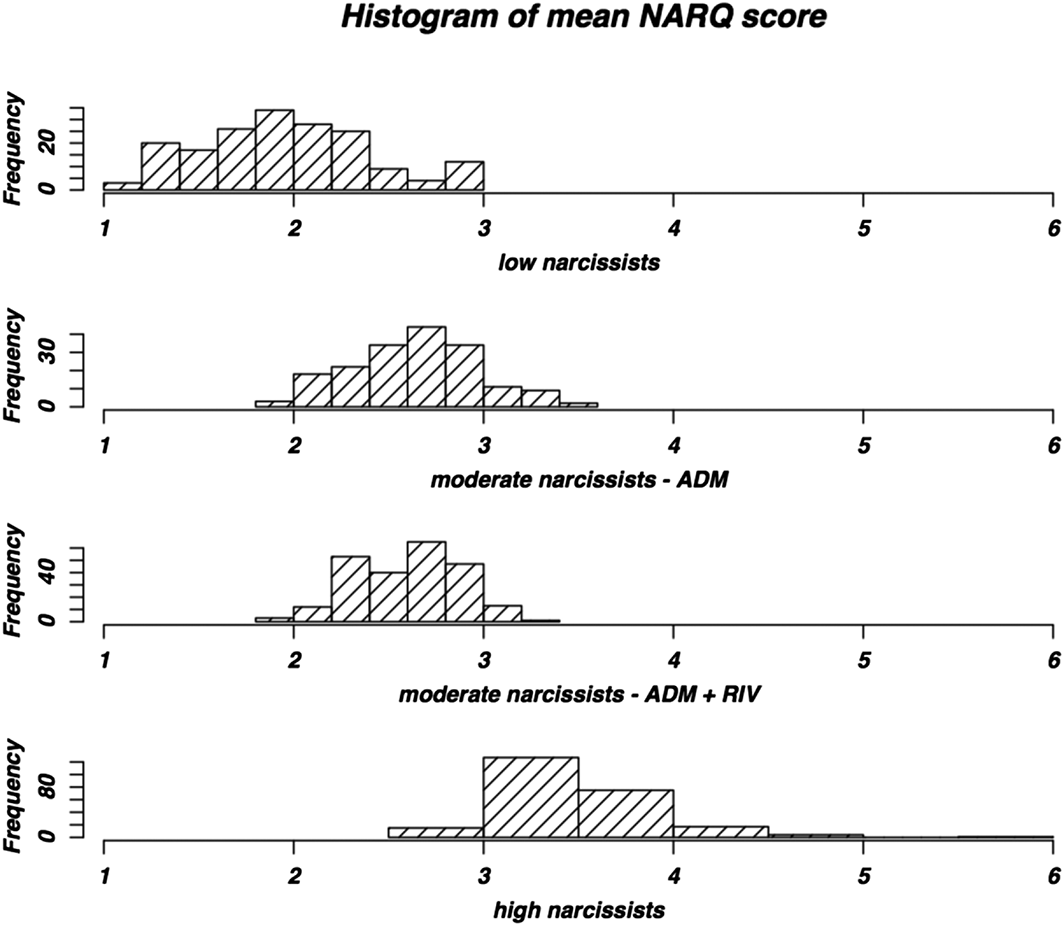
Histograms of the mean score on the Narcissistic Admiration and Rivalry Questionnaire (NARQ) separately for the four narcissism latent classes.
Class sizes were 21% for low narcissists, 21% for moderate narcissists—ADM, 29% for moderate narcissists ADM + RIV, and 29% for high narcissists, respectively. Thus, none of the classes were particularly small or particularly large, indicating that they were all important with respect to the number of respondents they represented. Participants could be classified with a high degree of certainty: average maximum class membership probabilities ranged from .90 (moderate narcissists—ADM) to .95 (low narcissists) and the overall relative entropy for the model was .87. A χ2–test of class membership and gender was significant (χ2(3) = 17.81, p <.001). Inspecting the proportions of men and women in each of the classes revealed that more women were allocated to the low narcissists class (24%) compared to men (15%) and more men were allocated to the high narcissists class (38%) compared to women (25%). Proportions of men and women in the two moderate classes did not differ substantially with 20% of men and 22% of women in the moderate narcissists—ADM class and 27% of men and 29% of women in the moderate narcissists—ADM + RIV class. To ensure that the latent class structure was nevertheless the same, we conducted separate LCAs for men and women with the combined Sample 1 and Sample 2 data (with only one sample the sample size for men would have been too small). The profiles of expected values indicated that the classes were equivalent with the only notable difference being that the expected values for the rivalry items in the moderate narcissists—ADM + RIV subgroup and the high narcissists subgroup were more similar for women than men (see Supporting Information Figures S1 and S2).
Discussion
The findings of Study 1 confirmed our hypothesis that subgroups of narcissists exist. The four subgroups we found were mainly characterized by quantitative differences in their narcissism levels (low, moderate, high). Importantly, however, there were two subgroups with moderate narcissism levels that differed with respect to their expressions of the admiration and rivalry pathways. Respondents in the first subgroup were mainly characterized by agentic aspects and, thus, appeared to only use strategies from the admiration pathway (i.e. self–promotion) in order to maintain their (moderately) grandiose self. In contrast, respondents in the second subgroup were characterized by both agentic and antagonistic aspects and, thus, appeared to use strategies from both the admiration and rivalry (i.e. self–defence) pathways in order to maintain their (moderately) grandiose self. Considering the differential relationships of admiration and rivalry with other traits and outcomes (Back et al., 2013), being a member of the moderate narcissists—ADM subgroup might potentially be more adaptive than being a member of the moderate narcissists—ADM + RIV subgroup. This will be investigated in Study 2.
Study 2
The aim of Study 2 was to investigate whether the subgroup structure found in Study 1 could be replicated in two other German samples. In addition, if the latent classes described above could be confirmed, their relationships to other personality traits (e.g. the Big Five, Machiavellianism, psychopathy) as well as intrapersonal (e.g. self–esteem) and interpersonal (e.g. interpersonal distrust) adjustment indicators will be investigated.
Method
Samples
Sample 2 consisted of 953 German–speaking participants who filled out an online survey. Participants did not receive an individual remuneration, but took part in a lottery for 6 × €50. This sample was also analysed in Back et al. (2013; Study 1).
Sample 3 consisted of 430 German–speaking participants who took part in an online experiment on transgressions in friendships unrelated to the present research. A number of personality constructs including narcissism were assessed. Participants received feedback on their personality scores after completing the experiment. The two samples‘ demographic characteristics and score distributions on admiration and rivalry are depicted in Table 1.
Measures
Narcissism was assessed with the NARQ (see Study 1). In addition, pathological narcissism was assessed with the Pathological Narcissism Inventory (PNI; Pincus et al., 2009). The PNI consists of two subscales, grandiosity and vulnerability. Grandiosity reflects the degree to which persons repress negative self–representations and external information and fantasize about being extremely powerful or superior. Grandiosity is measured with 18 items such as ‘I can usually talk my way out of anything.’ and ‘I often fantasize about performing heroic deeds’. Vulnerability reflects the degree to which persons feel helpless, empty, worthless, and ashamed. Vulnerability is measured with 34 items including ‘It's hard to feel good about myself unless I know other people admire me.’ and ‘When others get a glimpse of my needs, I feel anxious and ashamed’. The PNI's rating scale consists of six response categories ranging from not at all like me to very much like me.
Machiavellianism was assessed with the inventory for the measurement of Machiavellianism (Mach–IV; Christie & Geis, 1970). Machiavellianism captures the degree to which people are cold and emotionally detached and tend to manipulate others in order to achieve their goals. Sample items from the Mach–IV include ‘Never tell anyone the real reason you did something unless it is useful to do so’ and ‘It is hard to get ahead without cutting corners here and there’. Participants responded on a response scale from −3 (disagree strongly) to +3 (agree strongly).
Psychopathy was assessed using the Self–Report Psychopathy Scale–III (SRP–III; Paulhus, Neumann, & Hare, in press). Psychopathy captures the degree to which people can be characterized by low anxiety and antisocial and disinhibited behaviours. Sample items from the SRP–III include ‘I think I could “beat” a lie detector.’ and ‘I never feel guilty over hurting others’. Participants responded on a five–point rating scale from disagree strongly to agree strongly.
The Big Five personality traits neuroticism, extraversion, openness, agreeableness, and conscientiousness were assessed with a 15–item short version of the Big Five Inventory (BFI–S; Lang, John, Lüdtke, Schupp, & Wagner, 2011). In the BFI–S, three items are applied to measure each of the Big Five personality traits. Responses were given on a seven–point rating scale from strongly disagree to strongly agree. The Barratt Impulsiveness Scale (BIS–III; Patton, Stanford, & Barratt, 1995) was administered to assess impulsivity. It contains 30 items (e.g. ‘I do things without thinking.’) that are responded to on a four–point rating scale from rarely/never to almost always/always.
Self–esteem was assessed with the Rosenberg Self–esteem Scale (RSE). The RSE (Rosenberg, 1965, 1979) consists of 10 items assessing global self–esteem such as ‘On the whole, I am satisfied with myself’. Participants rated how well the items described them on a scale ranging from strongly disagree (1) to strongly agree (4). Better–than–average self–evaluations were assessed with the Self–Attributes Questionnaire for the measurement of general better–than–average self–evaluations (SAQ; Pelham & Swann, 1989). In the SAQ participants rate their abilities (e.g. intellectual/academic ability) and traits (e.g. emotional stability) relative to those of other people their age on a 10–point scale from bottom 5% to top 5%.
Empathy was assessed with 14 items from the Interpersonal Reactivity Index (IRI; Davis, 1983) that in particular addressed content related to empathic concern (e.g. ‘I often have tender, concerned feelings for people less fortunate than me.’) and perspective–taking (e.g. ‘I sometimes try to understand my friends better by imagining how things look from their perspective.’) as well as seven additional items assessing a lack of motivation to empathize with others. The Tendency to Forgive Scale (TTF; Brown, 2003) was applied to assess forgiveness. The TTF consists of four items including ‘I tend to get over it quickly when someone hurts my feelings’. Gratitude was assessed with the six–item Gratitude Questionnaire (GQ; McCullough, Emmons, & Tsang, 2002). A sample item is ‘I have so much in life to be thankful for’. The rating scale for empathy, forgiveness, and gratitude was a six–point rating scale from strongly disagree to strongly agree. Last, interpersonal distrust was assessed with four items from the International Personality Item Pool (Goldberg et al., 2006) including ‘I suspect hidden motives in others’. Participants rated how well the items described them on a five–point scale from strongly disagree to strongly agree.
Data on the Big Five, grandiosity, vulnerability, Machiavellianism, psychopathy, impulsivity, self–esteem, and better–than–average self–evaluations were available for Sample 2. Data on empathy, forgiveness, gratitude, and interpersonal distrust were available for Sample 3.
Analyses
The same analyses as in Study 1 were conducted to investigate the latent class structure in Sample 2 and Sample 3. Then, further analyses were conducted to gain a better understanding of how the latent classes were related to other personality traits as well as adjustment indicators on the intrapersonal and interpersonal level. For other personality traits (i.e. Big Five, grandiosity, vulnerability, impulsivity, Machiavellianism, psychopathy), we applied latent class regressions to examine whether each of these traits could predict latent class membership. 1 This approach was chosen for personality traits because—considering known interrelations between personality traits—a person's standing on one trait should influence his or her latent class membership for narcissism. Thus, one trait at a time was introduced as a predictor in the estimation of the latent class models in the poLCA package in R. The respondents‘ class membership was therefore estimated conditional on their score on the respective trait. Over the whole sample, this shows us how the probability of membership to the latent classes varies as a function of the trait level on, for example, Machiavellianism. For intrapersonal (i.e. self–esteem, better–than average self–evaluations) and interpersonal adjustment indicators (i.e. empathy, forgiveness, gratitude, and interpersonal distrust) we took the opposite approach and used class membership as the predictor. If the narcissism subgroups we found are meaningful, they should be able to predict these important outcomes. To this purpose, we modelled a confirmatory factor analysis (CFA) model in the R package lavaan (Rosseel, 2012) for the adjustment indicator of interest and added class membership as dummy–coded variables. The adjustment indicator was modelled as a latent variable with between two and three parcels consisting of a mean score as indicators. The items were randomly assigned to the parcels. These analyses allowed us to investigate whether participants who belong to different classes (e.g. moderate narcissists—ADM vs. moderate narcissists—ADM + RIV) differed in their trait levels on the adjustment indicators.
Provided that the latent class structure from Study 1 can be replicated, we expect class membership to the low narcissists and moderate narcissists—ADM classes to be related to more adaptive characteristics (e.g. lower Machiavellianism, higher self–esteem, higher empathy) and class membership to the moderate narcissists—ADM + RIV and high narcissists classes to be related to rather maladaptive characteristics (e.g. higher Machiavellianism, lower self–esteem, lower empathy).
Results
Replication of latent class structure
For Sample 2 the latent class model with four classes again fit the data best according to the BIC (see Table 2). Profiles of the expected values showed that these four classes could be interpreted in the same way as those in Study 1. Average maximum class membership probabilities were high with an average of .93 across all classes (range .90 to .96) and relative entropy was .86, indicating high reliability of class membership assignment.
The LCA of Sample 3 resulted in three classes. The profiles of expected values plotted in Supporting Information Figure S7 show that the three classes were very similar to those found in Sample 1 and 2. In particular, there was one class of low narcissists with low scores on all items (M = 2.19, SD = 0.68), one class of moderate narcissists with moderate to high scores on admiration (M = 3.76, SD = 0.70) and low scores on rivalry (M = 1.99, SD = 0.46), and one class of narcissists with moderate to high scores on both admiration (M = 3.64, SD = 0.52) and rivalry (M = 2.85, SD = 0.74). In contrast to Samples 1 and 2, however, this class of respondents characterized by admiration and rivalry appeared to contain respondents with moderate and high levels on these subscales because the average scores were in between those reported for the moderate narcissists—ADM + RIV and high narcissists classes above. Thus, the third class in Sample 3 was a combination of the moderate narcissists—ADM + RIV and high narcissists classes from Samples 1 and 2. Note that the sample size for Sample 3 was substantially smaller (N = 430) than the ones for Sample 1 (N = 828) and Sample 2 (N = 953). The sample size influences the BIC value directly, because its logarithm is part of the equation for the BIC, and indirectly through the log–likelihood of the model, which is also part of the equation (Schwarz, 1978). Thus, determining the number of classes in LCA with the BIC is dependent on sample size and it can be expected that this combined class would have differentiated into two separate classes with a larger sample.
With an average maximum class membership probability of .96 and a relative entropy of .92, participants could be classified into subgroups with high certainty. Consistent with the results for sample 1, χ2–tests of class membership and gender were significant in Sample 2 (χ2(3) = 23.06, p <.001) and 3 (χ2(2) = 17.71, p <.001). As in Sample 1, more men were assigned to the high narcissists class than women (e.g. 33% vs. 19% for Sample 2) and more women were assigned to the low narcissists class than men (e.g. 31% vs. 22% for Sample 2).
In sum, the general latent class structure from Study 1 could be confirmed in two additional samples. Importantly, the two classes distinguished by their differential expression of only the admiration pathway vs. both the admiration and rivalry pathways occurred consistently across samples with different sizes and characteristics.
Prediction of latent class membership with other personality traits
Next, it was investigated whether other personality traits could predict membership to the latent classes. For all latent class regressions with different traits as predictors, we first checked that the latent classes were equivalent to the classes found in the LCAs without predictors by comparing the profiles of expected values and class sizes to those in the LCAs without predictors. The profiles of expected values from models with predictors showed the same pattern for the latent classes as those found in the original model without predictors. In addition, the sizes of the latent classes were practically identical with those from the original model. Thus, the same latent classes emerged for all predictors. To check the degree of agreement in assigning respondents to narcissism subgroups across models with different predictors, we calculated Fleiss‘ Kappa (Fleiss, 1971), an extension of Cohen's Kappa to multiple raters (in this case models). Respondents were overall consistently allocated to the same narcissism subgroup as indicated by a high Fleiss‘ Kappa of .91. The coefficients (intercept, b) of all latent class regressions are depicted in Table 3. The moderate narcissists—ADM class was chosen as the reference group in the latent class regressions because they represent the prototypical combination of moderate admiration and low rivalry. Thus, the coefficients indicate the log–odds of belonging in one of the other classes (low narcissists, moderate narcissists—ADM + RIV, high narcissists) vs. the moderate narcissists—ADM class conditional on the mean score on the trait of interest. Because data on the traits of interest was available for Sample 2, all four classes could be taken into account in these analyses.
Coefficients from latent class regressions
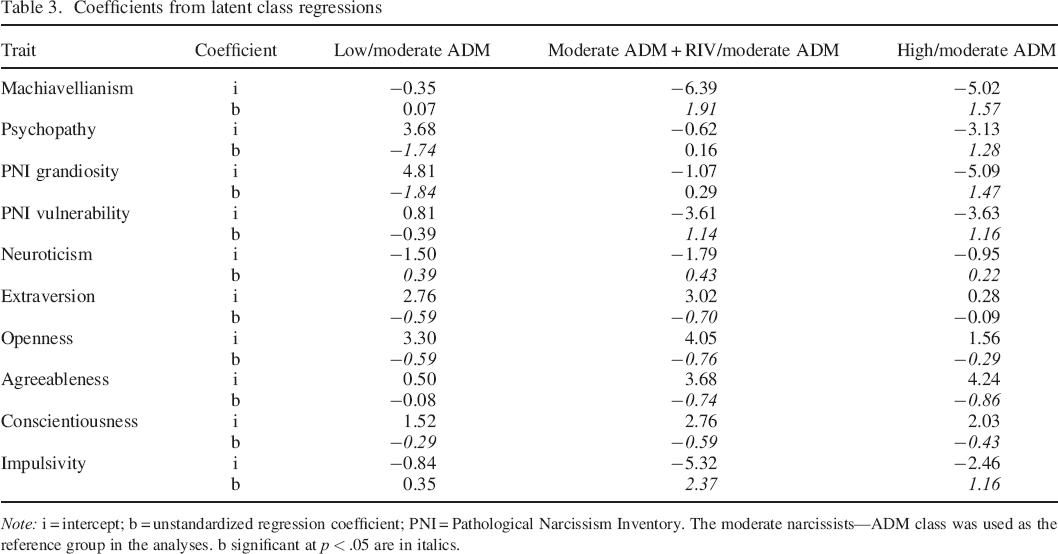
Note: i = intercept; b = unstandardized regression coefficient; PNI = Pathological Narcissism Inventory. The moderate narcissists—ADM class was used as the reference group in the analyses. b significant at p < .05 are in italics.
Machiavellianism was a significant predictor of membership in the moderate narcissists—ADM + RIV class vs. moderate narcissists—ADM class as well as the high narcissists class vs. moderate narcissists—ADM class (see Table 3). For example, for a mean score of 4 on Machiavellianism, the log–odds that a person would be in the moderate narcissists—ADM + RIV class vs. the moderate narcissists—ADM class was −6.39 + 1.91 × 4 = 1.25, indicating that membership to the moderate narcissists—ADM + RIV class was more likely than membership to the moderate narcissists—ADM class. Transformed into probabilities, this corresponds to a probability of .38 for membership in the moderate narcissists—ADM + RIV class and a probability of .11 for membership in the moderate narcissists—ADM class. Membership to the low narcissists class vs. the moderate narcissists—ADM class could not be predicted based on respondents‘ Machiavellianism scores. The relationship between Machiavellianism and the narcissism subgroups is illustrated in Figure 3 (panel a) in which the mean Machiavellianism score is plotted on the x–axis and the probability of latent class membership is plotted on the y–axis. The plot shows that with lower Machiavellianism scores, both the low narcissists and the moderate narcissists—ADM classes had moderate to high probabilities, although they were higher for the moderate narcissists—ADM class. In contrast, the moderate narcissists—ADM + RIV class and high narcissists class had probabilities close to 0. The corresponding exact numeric probabilities for a range of mean Machiavellianism scores are depicted in Supporting Information Table S2. Thus, people low on Machiavellianism tended to also be low on narcissism or to be moderate on narcissism, but only characterized by using self–promoting and not self–defending strategies. However, with increasing Machiavellianism scores, the probabilities shifted to being higher for the moderate narcissists—ADM + RIV and high narcissists classes while the probabilities for the other two classes steadily decreased. Thus, with moderate to high Machiavellianism scores, it was more probable that participants possessed moderate to high narcissism characterized by utilizing both self–promoting and self–defending strategies. For ease of interpretation, we also computed the mean scores on all personality traits by class membership from the LCA without predictors. As can be seen in Table 4, the low narcissists and moderate narcissists—ADM classes had practically identical mean scores on Machiavellianism (2.95 and 2.96, respectively). The mean scores for the moderate narcissists—ADM + RIV and high narcissists classes were higher and very similar (3.27 and 3.29, respectively), which is in line with the results from the latent class regressions.
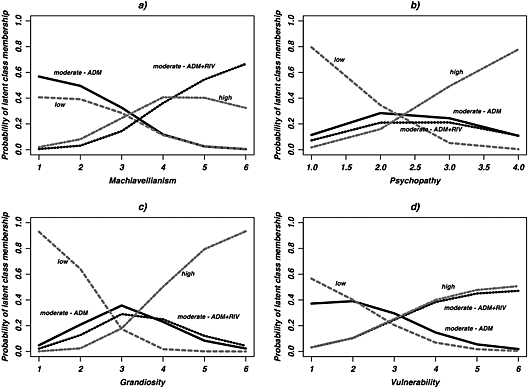
Plot of probability of latent class membership as a function of the mean score on Machiavellianism (a), psychopathy (b), grandiosity (c), and vulnerability (d).
Means and standard deviations of mean scores on personality traits by class membership
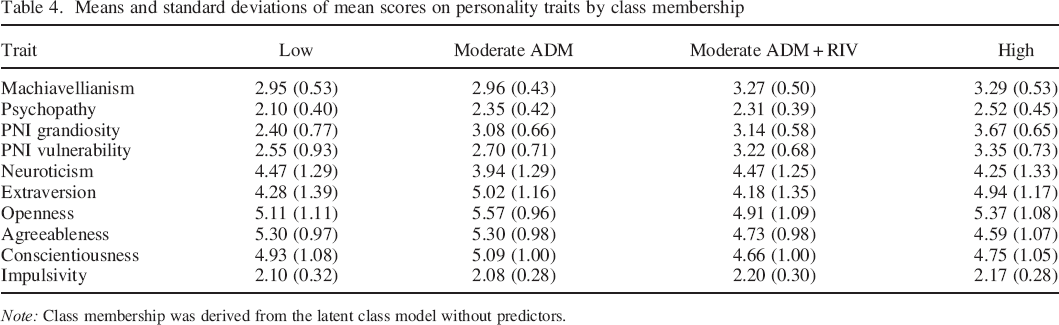
Note: Class membership was derived from the latent class model without predictors.
Psychopathy was a significant predictor of class membership in low narcissists vs. moderate narcissists—ADM and high narcissists vs. moderate narcissists—ADM. As Figure 3 (panel b) shows, the two moderate narcissists classes had similar levels of probability across the range of mean psychopathy scores. For psychopathy the probabilities indicated an almost dichotomous separation of participants into two classes: With psychopathy scores up to slightly below the theoretical midpoint of the scale, allocation to the low narcissists class was most likely whereas for psychopathy scores above the midpoint of the scale, the high narcissists class was most likely. Thus, people with low psychopathy scores tended to be low on narcissism and people with high psychopathy scores tended to be high on narcissism with the two moderate subgroups playing a minor role (see also mean scores in Table 4).
Of the two pathological narcissism subscales, grandiosity predicted membership in low narcissists vs. moderate narcissists—ADM as well as high narcissists vs. moderate narcissists—ADM (see Table 3). Grandiosity showed a similar almost dichotomous separation of the probabilities into low narcissists and high narcissists as psychopathy (see panel c in Figure 3). In contrast, the vulnerability subscale showed decreasing probabilities for low narcissists and moderate narcissists—ADM and increasing probabilities for high narcissists and moderate narcissists—ADM + RIV with increasing vulnerability scores (see panel d in Figure 3). Thus, the higher a person's vulnerability score, the higher the probability that they were a member of the high narcissists or moderate narcissists—ADM + RIV class.
The Big Five traits were also significant predictors of latent class membership (see Table 3). For example, for low agreeableness levels belonging to the moderate narcissists—ADM + RIV and the high narcissists class was most probable. With increasing agreeableness scores, probabilities for these two classes declined and probabilities for the low narcissists and moderate narcissists—ADM class increased (see panel a in Figure 4). Probability plots for neuroticism and extraversion are depicted in panel b and c of Figure 4. Probability plots for openness and conscientiousness are included in Supporting Information Figure S8 and S9.
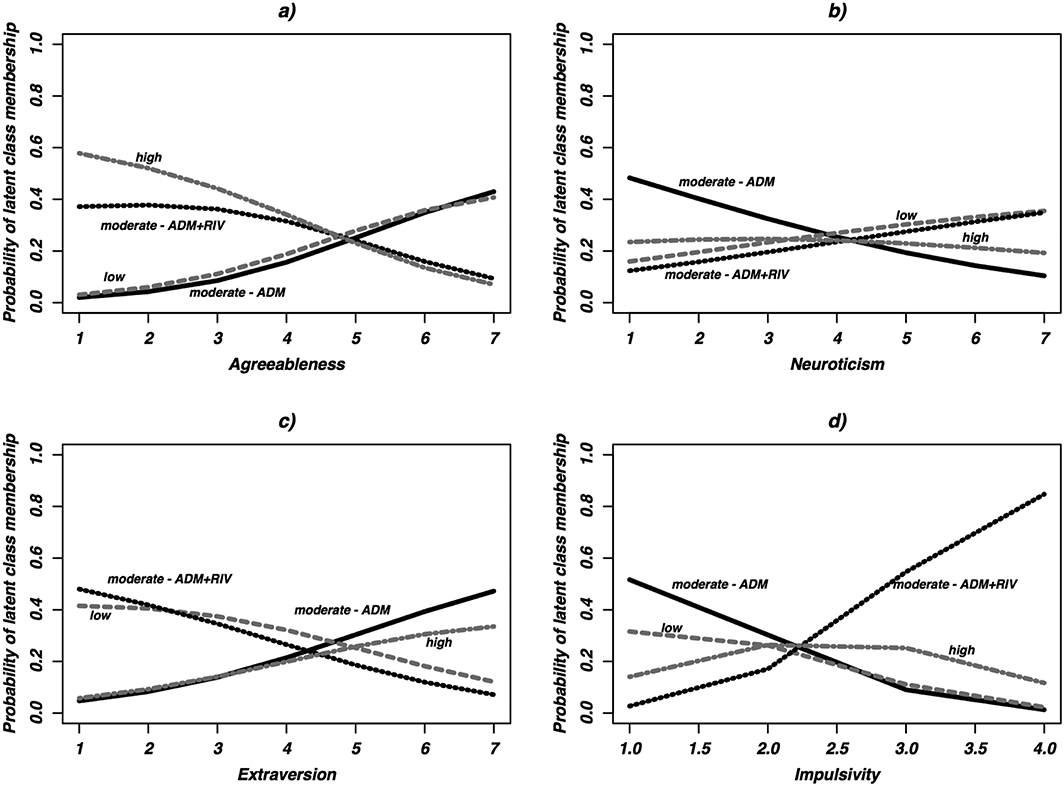
Plot of probability of latent class membership as a function of the mean score on agreeableness (a), neuroticism (b), extraversion (c), and impulsivity (d).
Impulsivity was a significant predictor of membership in the moderate narcissists—ADM + RIV vs. moderate narcissists—ADM class and the high narcissists vs. moderate narcissists—ADM class. The plot of the probability of latent class membership (panel d in Figure 4) shows that the low and high narcissists classes were never the most likely along the range of impulsivity scores. Instead, for respondents with low impulsivity scores up to slightly below the midpoint of the scale, the moderate narcissists—ADM class was the most likely class whereas above the midpoint the moderate narcissists—ADM + RIV class was the most likely class.
In sum, all traits investigated here were significant predictors of latent class membership. Plots of the probabilities of latent class membership showed that membership in the four narcissism classes varied as a function of scores on other traits. Lower levels on traits such as Machiavellianism and impulsivity were related to higher probabilities for the low narcissists and the moderate narcissists—ADM class. Higher levels on these traits were related to higher probabilities for the moderate narcissists—ADM + RIV and high narcissists class.
Prediction of intrapersonal and interpersonal adjustment variables with latent class memberships
The previous section showed that personality traits predict membership to the four narcissism subgroups identified in the LCAs. The goal of the following analyses was to investigate whether the narcissism subgroups themselves function as predictors of adjustment indicators with strong relevance in the intrapersonal domain such as self–esteem as well as the interpersonal domain such as empathy and interpersonal distrust. To this purpose, dummy–coded variables for class membership were added to a CFA model of the trait of interest. Supporting Information Table S3 contains the model fit indices for all CFAs. According to the comparative fit index (CFI; Bentler, 1990) model fit was good for all models (CFI > .95) except the model including better–than–average self–evaluations which showed an acceptable fit (CFI > .90; Hu & Bentler, 1999). The Tucker–Lewis index (TLI; Tucker & Lewis, 1973) indicated acceptable to good fit for all models (TLI > .90; Hu & Bentler, 1999). According to the root mean square error of approximation (RMSEA; Steiger, 1990), model fit was good for gratitude (RMSEA < .05) and acceptable for empathy and forgiveness (RMSEA < .08; Browne & Cudeck, 1993). Model fit was slightly below acceptable for self–esteem, better–than–average self–evaluations, and interpersonal distrust. Integrating the information provided by the three model fit indices, CFAs for all traits showed at least acceptable fit.
Regression coefficients from the regression of the trait of interest on the dummy–coded variables for class membership are depicted in Table 5. All regression coefficients were significant at p < .05. As in the latent class regressions, the moderate narcissists—ADM class was the reference group. Thus, the intercept indicates the mean of this group. For example, participants allocated to the moderate narcissists—ADM class had a self–esteem trait level of on average 3.44. The unstandardized regression coefficient b for each of the other groups indicates the difference between the mean of the moderate narcissists—ADM class to the respective other class. For instance, for the low narcissists class b = −0.37. Thus, participants allocated to the low narcissists class on average had a self–esteem trait level of 0.37 below that of the moderate narcissists—ADM class (i.e. 3.44 − 0.37 = 3.07). For the moderate narcissists—ADM + RIV class the difference to the moderate narcissists—ADM class was larger with b = −0.44 while for the high narcissists class it was smaller with b = −0.17. This indicates that having a moderate level of narcissism characterized by using only strategies from the admiration pathway is related to the highest self–esteem level. In contrast, having a moderate narcissism level characterized by strategies from both the admiration and rivalry pathways is related to the lowest self–esteem level. For the better–than–average self–evaluations the pattern was similar with the highest trait level occurring in the moderate narcissists—ADM class and the lowest trait level occurring in the moderate narcissists—ADM + RIV class (see Table 5).
Regression coefficients from confirmatory factor analysis models with narcissism subgroups as predictors
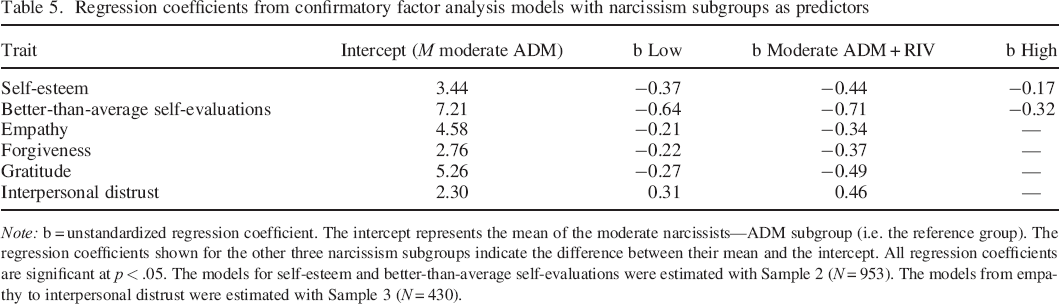
Note: b = unstandardized regression coefficient. The intercept represents the mean of the moderate narcissists—ADM subgroup (i.e. the reference group). The regression coefficients shown for the other three narcissism subgroups indicate the difference between their mean and the intercept. All regression coefficients are significant at p < .05. The models for self–esteem and better–than–average self–evaluations were estimated with Sample 2 (N = 953). The models from empathy to interpersonal distrust were estimated with Sample 3 (N = 430).
The remaining relationships with interpersonal adjustment indicators were investigated with Sample 3 in which three classes (low narcissists, moderate narcissists—ADM, combination of moderate narcissists—ADM + RIV and high narcissists) were differentiated. Nevertheless, very similar patterns emerged for empathy, forgiveness, and gratitude. That is, participants in the moderate narcissists—ADM class reported the highest levels of these interpersonal variables (e.g. 5.26 on gratitude). The other two classes reported significantly lower interpersonal adjustment levels with the combined moderate narcissists—ADM + RIV and high narcissists class reporting the lowest levels (e.g. 4.77 on gratitude). Accordingly, for interpersonal distrust, the relationship was reversed. Here the moderate narcissists—ADM class showed the lowest level on interpersonal distrust (2.30) while the low narcissists class was slightly higher (2.61) and the combined moderate narcissists—ADM + RIV and high narcissists class showed the highest level on interpersonal distrust (2.76).
In sum, the narcissism subgroups were significant predictors of intrapersonal and interpersonal adjustment. The largest differences occurred between the two moderate narcissist classes.
Discussion
LCAs of Sample 2 and 3 in Study 2 confirmed the general subgroup structure from Study 1. Importantly, the two subgroups distinguished by their use of the admiration vs. the admiration and rivalry pathways were found consistently across samples with different sample sizes. Further analyses showed that these two subgroups were also differentially related to other traits as well as adjustment indicators at the intrapersonal and interpersonal level. For most traits, the progression of class membership probabilities as a function of the trait scores was more similar between low narcissists and moderate narcissists—ADM as well as between moderate narcissists—ADM + RIV and high narcissists. This indicates that the differentiation of respondents into subgroups that differ in their expressions of the admiration and rivalry pathways is meaningfully related to their scores on other important traits. With respect to the adjustment indicators we found that the subgroup of moderate narcissists utilizing only strategies from the admiration pathway consistently showed the most adaptive adjustment levels (e.g. highest levels on self–esteem, empathy, lowest levels on interpersonal distrust). In contrast, the subgroup of moderate narcissists utilizing strategies from both the admiration and rivalry pathways consistently showed the most maladaptive adjustment levels (e.g. lowest levels on self–esteem, empathy, highest levels on interpersonal distrust). The results confirmed our hypothesis that the low narcissists and moderate narcissists—ADM classes are related to more adaptive characteristics such as higher empathy and lower Machiavellianism whereas the moderate narcissists—ADM + RIV and high narcissists classes are related to more maladaptive trait levels such as lower empathy and higher Machiavellianism.
Study 3
The goal of Study 3 was to investigate whether the same latent class structure found for the predominantly German samples in Study 1 and 2 also existed in a diverse sample from mainly English–speaking countries.
Method
Sample
Sample 4 consisted of 971 respondents who filled out an online survey. They received feedback on their narcissism scores upon completion of the survey. Most of the participants were from Western, English–speaking countries (60% United States, 13% United Kingdom, 6% Canada). The average age of this sample (M = 35.15, SD = 13.63) was substantially higher than that of the other three samples (see Table 1).
Measures
Participants in Sample 4 filled out the English version of the NARQ together with two other narcissism inventories and several demographic items.
Analyses
Latent class models with one to six classes were estimated in the R package poLCA. The analyses followed the procedure depicted above for Study 1.
Results
The latent class model with four classes showed the best fit to the data (see Table 2). Supporting Information Figure S10 shows the profile of expected values for these four classes. The classes were remarkably similar to those found for the German samples. There was one class of low narcissists with consistently low values on both admiration (M = 2.21, SD = 0.80) and rivalry (M = 1.73, SD = 0.58) items. Class 2 contained participants characterized by moderate admiration (M = 3.84, SD = 0.63) and low rivalry (M = 2.19, SD = 0.65). This subgroup therefore corresponds to the moderate narcissists—ADM subgroup found for the samples in Study 1 and 2. Class 3 consisted of moderate narcissists—ADM + RIV persons because they had moderate expected values on both admiration and rivalry (MADM = 3.26, SDADM = 0.54; MRIV = 3.32, SDRIV = 0.76). Class 4 showed a profile of high expected values on all items (with the exception of item 14). Their average expected value on the admiration items (M = 4.93, SD = 0.37) and rivalry items (M = 4.54, SD = 0.66) was higher than the average expected values for the German samples.
The low narcissists subgroup was by far the largest (39%). The moderate narcissists—ADM subgroup (28%) and moderate narcissists—ADM + RIV subgroup (24%) were similar in size while the high narcissists subgroup was the smallest (10%). The significant χ2–test of class membership and gender (χ2(3) = 76.27, p <.001) again indicated that men and women were unevenly distributed across the high and low narcissists classes with more women being assigned to the low narcissists class (44% vs. 25%) and more men being assigned to the high narcissists class (21% vs. 5%). The average maximum class membership probability across all classes was .95 and the relative entropy was .89, indicating that participants could be classified into the subgroups with a high degree of certainty. This was especially the case for the high narcissists subgroup where classification certainty was almost perfect (.99).
Discussion
The subgroup structure found for the German samples could be confirmed in a sample of English–speaking respondents from diverse countries. Thus, consistently across cultures we identified subgroups of narcissists that differ in their expression especially of admiration and rivalry: low narcissists, moderate narcissists with only admiration, moderate narcissists with admiration and rivalry, and high narcissists. The high narcissists subgroup here was higher on narcissism than the respective subgroups in the other samples. This may be due to the nature of the samples we analysed because the German samples consisted mainly of German students whereas the English sample was a very heterogeneous sample with respect to age, education level, and country of origin. In addition, cross–cultural differences on narcissism may exist (Miller et al., 2015).
General Discussion
The present study investigated whether subgroups of narcissists could be differentiated and how they were related to other personality traits as well as indicators of intrapersonal and interpersonal adjustment. Subgroups characterized by low, moderate, and high narcissism levels were found across four samples. Importantly, we consistently found two distinct types of moderately narcissistic subgroups: one whose expression of narcissism was characterized mainly by agentic aspects (i.e. self–promotional strategies from the admiration pathway) and one whose expression of narcissism was characterized by agentic and antagonistic aspects (i.e. additionally self–defending strategies from the rivalry pathway). In the following, we will discuss the implications of our findings, how our findings relate to the NARC, and the incremental value of investigating primarily quantitative traits with a categorical approach.
Implications of Subgroups of Narcissism
Analyses of the relationships with other personality traits and adjustment indicators at the intrapersonal and interpersonal level consistently revealed that the low narcissists and moderate narcissists—ADM subgroups were the most adaptive while the moderate narcissists—ADM + RIV and high narcissists subgroups were the most maladaptive. For instance, members of the latter two subgroups tended to have higher Machiavellianism, psychopathy, and impulsivity scores and lower empathy, forgiveness, and gratitude scores than members of the former two subgroups. In this section we discuss the pattern of results for relationships with (i) personality traits; (ii) intrapersonal adjustment indicators; and (iii) interpersonal adjustment indicators.
Personality traits
All personality traits were significant predictors of subgroup membership, but the specific prediction patterns differed across personality traits. For most traits, the membership probabilities were similar for the low narcissists and moderate narcissists—ADM class as well as the moderate narcissists—ADM + RIV and high narcissists class along the range of scores on the trait of interest. There were two exceptions to this general pattern. The first exception involved psychopathy and grandiosity for which membership probabilities showed an almost dichotomous divide into two subgroups: Low mean scores were related to high probabilities of being in the low narcissists class whereas high mean scores were related to high probabilities of being in the high narcissists class. The two moderate narcissists classes had similarly low probabilities along the range of psychopathy (grandiosity) scores. It is conceivable that moderate levels of narcissism are not well represented by pathological grandiosity and psychopathy, which is considered the most maladaptive of the dark triad traits (Paulhus & Williams, 2002), and these two traits therefore only differentiate people low on narcissism from people high on narcissism, though this should be tested in future research. The second exception occurred regarding impulsivity. For impulsivity, membership probabilities were also dichotomously divided, however in this case high probabilities for the moderate narcissists—ADM subgroup were related to low impulsivity scores and high probabilities for the moderate narcissists—ADM + RIV subgroup were related to high impulsivity scores. This fits with the idea of two separate narcissistic pathways because members of the moderate narcissists—ADM + RIV class employ self–defending behaviours in addition to self–promoting behaviours. These behaviours involve high irritability and tendencies toward rash, aggressive behaviours, which are related to the construct of impulsivity.
Intrapersonal adjustment indicators
The narcissism subgroups and in particular the two moderate narcissists subgroups significantly predicted self–esteem and better–than–average self–evaluation levels. Participants allocated to the moderate narcissists—ADM subgroup showed the highest self–esteem levels, even higher than participants in the low and those in the high narcissists subgroup. In contrast, participants allocated to the moderate narcissists—ADM + RIV subgroup showed the lowest self–esteem levels, even lower than participants in the low and high narcissists subgroup. Thus, despite having overall similar narcissism levels, the two moderate narcissists subgroups differ fundamentally in self–esteem, a particularly consequential adjustment indicator. This underscores the value of distinguishing subgroups on narcissism that differ in their expressions of the two narcissistic pathways admiration and rivalry.
Interpersonal adjustment indicators
The pattern of results for the latent classes as predictors of interpersonal adjustment indicators was very consistent across different traits: Being a member of the moderate narcissists—ADM subgroup was associated with the most adaptive trait levels (e.g. highest empathy levels). Several previous studies have shown that narcissism is linked to problematic behaviours in particular in the interpersonal domain. For example, narcissism is related to dysfunctional interpersonal relationships (Campbell & Campbell, 2009; Campbell et al., 2002), risk–taking in work contexts (Campbell, Goodie, & Foster, 2004; Chatterjee & Hambrick, 2007), and being perceived as arrogant, aggressive, and untrustworthy (Leckelt et al., 2015). Our results imply that these problematic behaviours in interpersonal contexts may in particular be exhibited by members of moderate narcissists—ADM + RIV and high narcissists subgroups because they tend to show lower agreeableness, lower empathy, lower forgiveness, and higher interpersonal distrust. The subgroup structure shown here could provide valuable information for designing interventions aimed at reducing problematic narcissistic behaviours. For example, interventions for persons classified as characterized by utilizing the rivalry pathway could specifically address self–defence strategies such as devaluing others and being unforgiving and aggressive in the face of conflicts.
Relating our Findings to the NARC
Our findings support the differentiated process–view of narcissism as proposed by the NARC (Back et al., 2013) because two subgroups that clearly differ in their expressions of the admiration and rivalry pathways were consistently found and showed differential relations to other traits and adjustment indicators. Thus, the central idea of two separate pathways that trigger different cognitive, emotional, and behavioural strategies was supported. Furthermore, the existence of the two separate moderate narcissists subgroups indicate that admiration can be understood as the default component in pursuing the goal of a grandiose self, whereas the rivalry component may only come into play when this goal cannot be achieved via the admiration pathway. Members of the moderate narcissists—ADM subgroup appear to be successful at maintaining their (moderately) grandiose self via the admiration pathway. These individuals could represent the group of narcissists that past research has termed successful narcissists (Maccoby, 2007; Robins, Tracy, & Shaver, 2001). On the other hand, members of the moderate narcissists—ADM + RIV subgroup appear to fail at maintaining their (moderately) grandiose self solely via the admiration pathway and instead may have to activate the rivalry pathway in addition in order to achieve their goal. These individuals may represent the group of failed narcissists described in previous research (Campbell, 2001; Maccoby, 2007; Robins et al., 2001). Future research could further investigate the characteristics of these two subgroups as well as their antecedents and consequences. Our analyses suggest that members of the moderate narcissists—ADM + RIV subgroup have a configuration of traits that is unfavourable for maintaining a grandiose self through self–promotion. For example, they tend to be lower on empathy and higher on interpersonal distrust. Thus, it is possible that this group of narcissists lacks the intrapersonal resources and abilities to adequately implement self–promoting strategies and therefore has to employ strategies of self–defence instead. Future research—in particular research employing longitudinal designs—should therefore investigate how the different types of grandiose narcissism (i) predict social outcomes over time and (ii) evolve based on past social experiences.
Incremental Value of Investigating Narcissism with a Categorical Approach
In this article we took a categorical approach to investigating narcissism, a trait that is generally considered to be of a dimensional nature. Our finding of subgroups differing in their general narcissism levels (low, moderate, high) substantiates that narcissism is best understood as a trait that people possess to varying degrees on a continuum from low to high. Despite the overall continuous nature of narcissism, the studies we conducted also show that taking a categorical approach can yield valuable insights into narcissism that we would not have gained by only applying methods that treat narcissism as a continuous variable. In particular, we discovered two subgroups that are equivalent from a quantitative perspective, but differ in their expressions of the two components of narcissism: Moderate narcissists—ADM were characterized by employing only strategies from the admiration pathway to maintain their grandiose self, whereas moderate narcissists—ADM + RIV were characterized by employing strategies from both the admiration and rivalry pathways. These qualitative differences between the subgroups would have been overlooked if we had only applied methods addressing quantitative aspects of the construct. Thus, by taking a categorical approach we were able to validate the theoretical distinction between admiration and rivalry proposed in the NARC. LCA allows an efficient and parsimonious classification of persons into subgroups that share certain characteristics while making much fewer assumptions about the data than quantitative methods (McCutcheon, 1987). One often–voiced criticism of the categorical approach is that subgroups explain less variance in outcomes than continuous variables (Costa, Herbst, McCrae, Samuels, & Ozer, 2002). Indeed, this is also the case for the adjustment indicators investigated here. For example, dummy–coded variables for class membership explained 5% of the variance in empathy whereas latent variables for admiration and rivalry explained 26% of the variance in empathy. Adding an interaction term between admiration and rivalry did not explain any incremental variance. However, as Asendorpf (2003) explained, this result is expected when comparing categorical predictors to continuous predictors in the prediction of concurrently assessed continuous criteria. In contrast, subgroups as predictors fare much better when looking at long–term outcomes (Asendorpf, 2003; Asendorpf & Denissen, 2006). Future research could therefore investigate the predictive validity of the narcissism subgroups for important long–term outcomes such as relationship satisfaction and break–up (e.g. Cramer, 2011; Wurst et al., in press) or counterproductive work behaviours and even white collar crime (e.g. Blickle, Schlegel, Fassbender, & Klein, 2006). Thus, we argue that analyses in the latent class framework are valuable for the investigation of primarily quantitative traits and that both approaches (dimensional and categorical) should complement each other.
The categorical approach we took is very similar to the typological approach where subgroups characterized by the configuration of several traits are differentiated. In personality psychology, this led to the definition of the resilient, overcontrolled, and undercontrolled personality types (Robins, John, Caspi, Moffitt, & Stouthamer–Loeber, 1996), which have been confirmed in numerous studies (e.g. Asendorpf, Borkenau, Ostendorf, & Van Aken, 2001; Dubas, Gerris, Janssens, & Vermulst, 2002; Specht, Luhmann, & Geiser, 2014). As Donnellan and Robins (2010; p.1078) aptly put it, ‘the three personality types might prove to be practically useful even if they do not fully capture reality’. This is also the case with the two moderate narcissism subgroups we found. We showed that the two subgroups are differentially related to other relevant traits as well as intra– and interpersonal adjustment indicators. Future research could further test the practical usefulness of distinguishing these two subgroups by investigating how they are related to other criteria and outcomes. For example, it could be tested whether the relationship between narcissism and leadership effectiveness, which appears to be curvilinear for narcissism as a continuous trait (Grijalva, Harms, Newman, Gaddis, & Fraley, 2015), differs for moderate narcissists with and without self–defending behaviours. Or, it could be tested whether changes in marital functioning over time (Lavner, Lamkin, Miller, Campbell, & Karney, 2015) are related to the two moderate narcissistic subgroups.
Limitations and Future Prospects
A limitation of this study is that the German samples consisted mainly of university students. Nevertheless, the general subgroup structure could also be confirmed for a heterogeneous English–speaking sample. An additional limitation is that we only investigated relationships between the narcissism subgroups and other self–reported variables. Further research could investigate whether the subgroups are also present in other–report or observational data and investigate the relationships between subgroups with further criteria such as job performance. Future research might also aim at more direct investigations of the distinct process pathways related to narcissistic subgroups. While the results of the present paper are well in line with the agentic and antagonistic pathways as described in the NARC, we did not directly test them. Research for example employing longitudinal designs including experienced–sampled behavioural and mental states might be particularly fruitful additions to further zoom in into the processes underlying different narcissistic subtypes. Future research might also explore how different narcissistic subgroups longitudinally relate to pathological forms of narcissism. Given the pattern of distinct correlates and outcomes found in the present work, it might be interesting to analyse whether individuals in the moderate narcissists—ADM + RIV subgroup have a higher probability of developing more vulnerable or even pathological forms of narcissism.
Conclusion
In sum, by applying a categorical approach to narcissism we showed that people do not only differ quantitatively in narcissism, but that there are also two distinct subgroups that differ with respect to the narcissistic strategies they pursue. One subgroup was characterized by using only self–promoting strategies while the other subgroup was characterized by using both self–promoting and self–defending strategies. This differentiation carried important implications at the intrapersonal and interpersonal level. Thus, we hope that research on narcissism will benefit from complementing the dominant dimensional approach with a categorical approach.
Supporting info item
Supporting info item, per2062-sup-0001-Supplemental_material - Distinguishing Subgroups of Narcissists with Latent Class Analysis
Supporting info item, per2062-sup-0001-Supplemental_material for Distinguishing Subgroups of Narcissists with Latent Class Analysis by Wetzel Eunike, Leckelt Marius, Gerlach Tanja M. and Back Mitja D. in European Journal of Personality
Footnotes
Notes
Acknowledgements
The authors thank Brent W. Roberts and R. Chris Fraley for providing the Sample 4 data and Angelina Bohlender for the help with collecting the Sample 3 data.
Funding
This research was supported by grant BA 3731/6–1 of the German Research Foundation (DFG) to Mitja D. Back.
References
Supplementary Material
Please find the following supplemental material available below.
For Open Access articles published under a Creative Commons License, all supplemental material carries the same license as the article it is associated with.
For non-Open Access articles published, all supplemental material carries a non-exclusive license, and permission requests for re-use of supplemental material or any part of supplemental material shall be sent directly to the copyright owner as specified in the copyright notice associated with the article.
