







Abstract
The social surrogate hypothesis proposes that people with higher social anxiety (HSA) recruit others to accompany them into social situations. We tested this hypothesis with college roommates using both hypothetical (Study 1) and retrospective (Study 2) measures, while assessing roommate's perceptions of recruitment and how social surrogacy might influence liking between roommates. Across two studies, we found that HSA participants were less likely to enter social situations alone (i.e. higher conditional entry); however, HSA was related to recruitment only when participants considered hypothetical scenarios, not when recruitment was assessed globally or retrospectively. There was little evidence that HSA participants’ roommates were aware of these behaviours, although there was preliminary evidence that less social anxiety might increase liking when roommates perceived more conditional entry. We also found preliminary evidence that social anxiety may be negatively related to liking when participants were less likely to recruit an alternate surrogate if their roommate was unavailable. Taken together, these preliminary findings emphasize the importance of studying the surrogacy process from an interpersonal/dyadic perspective and using methods that will differentiate between anticipated (which may be assessed by hypothetical scenarios) and enacted recruitment behaviours. Copyright © 2017 European Association of Personality Psychology
Social anxiety (SA) consists of feelings of distress that can arise during real or imagined social situations (Leary & Kowalski, 1997; Rapee & Heimberg, 1997; Schlenker & Leary, 1982), often when individuals are concerned with being evaluated by others and question their ability to make the desired impression in this situation (Schlenker & Leary, 1982; also see Leary, 2010). In Western samples, 12–month prevalence rates for SA Disorder (SAD), which is characterized by intense fears of social situations that elicit embarrassment and anxiety (American Psychiatric Association, 2000), range from 2.0% (with a German sample; Fehm, Beesdo, Jacobi, & Fiedler, 2008) to 2.8% (with an American sample; Grant et al., 2005), whereas rates of subthreshold (i.e. individuals who meet all but one of the DSM criteria for SAD) and symptomatic (i.e. exhibit strong social fears, but do not meet two or more DSM criteria) SAD are higher, approximately 3% and 7.5%, respectively (Fehm et al., 2008). Less severe forms of SA likely are even more common; in one study of German adolescents, nearly 47% of respondents indicated having experienced fear during social situations (Essau, Conradt, & Petermann, 1999).
Importantly, individuals with higher levels of SA appear overly critical of their performance in social situations (see Rapee & Heimberg, 1997, for a discussion) and respond more negatively to perceived social mishaps, including greater feelings of shame and embarrassment, and more concern with the potential interpersonal costs associated with their mistake(s) (Moscovitch, Rodebaugh, & Hesch, 2012). Consequently, people with higher levels of SA often engage in a variety of behaviours to help them reduce their anxiety and avoid rejection during social interactions, including planning their social exchanges in advance (Arkin & Grove, 1990), engaging in safety behaviours during actual interactions (e.g. Wells et al., 1995) or interacting with others via computer–mediated communication rather than face–to–face (e.g. Pierce, 2009).
The Social Surrogate Hypothesis
In 1998, Bradshaw proposed the social surrogate hypothesis as a means of understanding how shy individuals would actively cope with their SA. He suggested that people with higher levels of SA would recruit social surrogates to accompany them into anxiety–provoking situations (i.e. people with higher levels of SA would ‘try to get’ others to go with them). These surrogates then would offer the recruiter assistance in these situations, which could vary from providing support simply by accompanying them into the situation, by facilitating interactions between the recruiter and other individuals, or by engaging in social interactions for them. In turn, the recruiter would experience less anxiety and concern with negative evaluations.
Consistent with this hypothesis, research suggests that adults with higher levels of SA are more likely to recruit social surrogates, less likely to enter social situations without a surrogate present and more likely to utilize a surrogate in social situations by asking them to perform specific behaviours (Boucher & Cummings, 2014; Bradshaw, 1998). 1 This hypothesis also has been supported in research with children between the ages of eight and 12 years (Arbeau, Coplan, & Matheson, 2012), although research with adolescents did not find a relationship using a single–item measure of recruitment (Markovic & Bowker, 2015).
Although Bradshaw's (1998) hypothesis focused on how shy individuals cope with their SA, recruiting social surrogates is not unique to SA. For instance, higher levels of sociability (Bradshaw, 1998) and lower levels of depressive symptoms (Boucher & Cummings, 2014) also predict recruitment. There also is evidence that self–esteem may be negatively related to recruitment (Bradshaw, 1998), although other research suggests it does not predict recruitment per se, only the extent to which individuals enter social situations alone (i.e. conditional entry; Boucher & Cummings, 2014). However, previous research suggests the effect of SA on surrogate use remains significant even when controlling for these other variables (Boucher & Cummings, 2014; Bradshaw, 1998). Moreover, individuals who recruit surrogates to cope with their SA likely have different motivations than those who recruit for other reasons. Adults generally report recruiting social surrogates primarily for companionship and anxiety–reduction purposes (Bradshaw, Williams, Linton, Park, & Rosemond, 1999, as cited in Bradshaw, 2006), whereas adolescents appear to recruit surrogates to make situations more fun (Markovic & Bowker, 2015). However, people with higher levels of SA are more likely to report recruiting a surrogate because they would make situations less stressful, and because the surrogate would be better at performing necessary behaviours in these situations (Bradshaw, 1998; Markovic & Bowker, 2015).
There is also preliminary evidence that high–SA individuals may benefit from having these surrogates present. Self–report data suggest that high–SA individuals report feeling more comfortable and more outgoing when a friend is present (Bradshaw, 1998) and having others present during social exchanges helps to reduce state–level anxiety (Carron, Estabrooks, Horton, Prapavessis, & Hausenblas, 1999). Observational research also suggests that having a friend present while preparing for a recorded introduction to a stranger may reduce some of the negative interpersonal consequences associated with SA (Pontari, 2009; Pontari & Glenn, 2012). More specifically, high–SA participants engaged in fewer self–protective behaviours (Pontari & Glenn, 2012) and were coded as more socially competent (Pontari, 2009) when they made these introductions with a friend present than when they were alone.
Although there is evidence to support Bradshaw's (1998) social surrogate hypothesis, the research remains limited. In particular, most social surrogacy research has examined recruitment of nonspecific surrogates, and often, using hypothetical, anxiety–provoking scenarios. To our knowledge, only one study assessed recruitment behaviours for a specific target. In that study, Souma, Ura, Isobe, Hasegawa, and Morita (2008) assessed students’ recruitment of a specific friend during their first seven months of college and the extent to which that friend acted as a surrogate. Consistent with the social surrogate hypothesis, higher levels of SA were associated with greater reported participation as a surrogate by the friend (note, however, that Souma et al. do not report the relationship between SA and recruitment, although they did assess recruitment). High–SA participants who used their friend as a surrogate were more likely to expand their social network over the course of the seven months compared with those who reported lower levels of recruitment, primarily because of an increase in participants’ joint network with their friend/surrogate. In other words, most of the new social ties formed during this time were shared with the surrogate. However, Souma et al. never examined how recruitment or participation as surrogate influenced perceptions of the friendship, nor did they examine characteristics of the friend/surrogate. Consequently, little is known about who socially anxious people recruit as their surrogates, or how this process affects high–SA individuals’ interpersonal relationships.
Social Anxiety and Interpersonal Relationships
Although Penke (2011) argued that ‘personality and situations are intimately intertwined in the generation of behaviours’ (p. 87), historically, researchers have typically studied these constructs in isolation (see Penke, 2011, for a discussion). More recently, however, researchers have begun studying the interpersonal consequences of personality within the context of actual relationships and social situations. For example, research suggests that higher levels of extraversion are associated with nominating more friends, whereas individuals who are more agreeable are more likely to be nominated as friends by others (Selfhout et al., 2010), and those with higher levels of SA are less likely to be nominated as friends by others (Van Zalk & Van Zalk, 2015). Furthermore, individuals with higher levels of extraversion, agreeableness and conscientiousness, as well as those scoring low in neuroticism, tend to have more satisfying friendships (Wilson, Harris, & Vazire, 2015).
Recently, Back et al. (2011) introduced the PERSOC framework to understand the dynamics between personality and social relationships. In this model, they suggest that individual dispositions, such as a person's level of SA, are related to mental representations of a social relationship. These individual dispositions and mental representations then influence each other over time, as acquaintanceship level progresses, via behaviours and interpersonal perceptions during social exchanges. Importantly, however, the extent to which these factors influence each other at an individual or dyadic level depends on the extent to which individual dispositions are expressed and/or the extent to which conversational partners are aware of them. For example, some individual dispositions may be relatively invisible to others because they are expressed more internally. So, from this perspective, SA may have little impact on conversational partners’ interpersonal perceptions unless it is accompanied by observable behaviours.
Research on the interpersonal consequences of SA have largely overlooked the effects of SA within adult friendships. However, recent research suggests SA prospectively predicts increased loneliness (Lim, Rodebaugh, Zyphur, & Gleeson, 2016), suggesting individuals with higher levels of SA experience interpersonal difficulties. Indeed, SA is associated lower levels of peer acceptance in children (Greco & Morris, 2005), more uncertainty during interactions between friends (Gudykunst & Nishida, 2001) and difficulty making new friendships as well as lower satisfaction with those friendships while transitioning to college (Parade, Leerkes, & Blankson, 2010).
However, other studies suggest SA may not be directly related to friendship quality. For example, while individuals with generalized SAD report poorer friendship quality relative to community control participants (Rodebaugh et al., 2014), continuous measures of SA often are unrelated to liking (e.g. Pontari, 2009; Pontari & Glenn, 2012; Rodebaugh et al., 2014). Rodebaugh, Lim, Shumaker, Levinson, and Thompson (2015) also found that while higher levels of friendship quality predicted lower levels of SA six months later, SA did not predict friendship quality concurrently or prospectively. SA effects on the friendship may be even weaker when assessed from the friend's perspective. While participants with friends diagnosed with generalized SAD appear to view these friends as less dominant and well–adjusted relative to friends without SAD (Rodebaugh et al., 2014), a participant's SA does not predict the extent to which their friend likes them (Pontari, 2009; Pontari & Glenn, 2012), even at clinical levels of SA (Rodebaugh et al., 2014).
One potential explanation for these mixed findings is that SA may only have negative interpersonal consequences when expressed externally. As Back et al. (2011) propose, individual dispositions must be expressed behaviourally in order to influence others. So to the extent that SA is expressed internally, the heightened levels of SA may remain invisible to others and, in turn, have little impact on friendship quality. This may also help to explain why effects are even weaker when assessed from the conversational/relationship partner's perspective. Consequently, identifying what discernable behaviours associated with SA lead to these negative interpersonal consequences is important in terms of understanding the dynamics of SA in close relationships.
Impact of the Surrogacy Process on Interpersonal Relationships
One behaviour associated with SA that might influence interpersonal perceptions and, in turn, mental representations of the relationship is the recruitment of social surrogates. Bradshaw (2006) proposed that social surrogacy could either negatively or positively influence relationships between recruiters and surrogates. Surrogates may come to resent the socially anxious person, particularly in cases where they feel pressured to attend, although acting as a surrogate also may permit friends to satisfy a need to provide nurturance and support.
Unfortunately, because of the paradigm employed by most social surrogacy research (i.e. recruitment of non–specific targets), the effects of recruitment on the quality of the relationship between the recruiter and the surrogate remain unclear. Some preliminary evidence suggests that social surrogacy may have a beneficial, rather than detrimental, effect. For instance, Pontari (2009) found that friends asked to play a supportive role while participants recorded an introduction for a future conversational partner generally responded positively to this role. Furthermore, in their analysis of surrogate use among adolescents, Markovic and Bowker (2015) found that participants who reported higher levels of surrogate use overall also reported better quality relationships with best friends, although they also reported more overprotection from those friends. Similarly, Souma et al. (2008) reported a positive correlation between participation as a surrogate and closeness between friends. However, Markovic and Bowker also found that participants reported more social problems when they engaged in either low or high levels of recruitment as compared with moderate levels of recruitment, suggesting that moderate levels of recruitment may be beneficial, but higher levels of surrogate use may be maladaptive. Conceivably, moderate levels of recruitment may allow surrogates to satisfy nurturance and affiliative needs, but too much recruitment may begin to make surrogates feel overwhelmed and pressured, which may lead to the perception that the recruiter is overly dependent on them.
Although there is some preliminary evidence to suggest that recruitment of surrogates may have positive interpersonal effects, at least at moderate levels of recruitment, we believe there are several limitations to this previous research. First, these studies failed to examine the effects of recruitment on friendship quality while considering the recruiter's level of SA. Consequently, we do not understand the extent to which surrogate use may contribute to socially anxious people's interpersonal difficulties specifically. Second, these studies did not assess the surrogate's perceptions of the recruitment behaviours. If individual dispositions must produce observable behaviours to influence others’ perceptions (Back et al., 2011), then assessing the recruiter's perceptions of their own surrogate use may be less relevant than the surrogate's perceptions. Although Souma et al. (2008) did assess a friend's participation as a surrogate, they did not assess that friend's perceptions of the participant's recruitment behaviours. Conceivably, friends may have accompanied the participant in instances where they were not explicitly recruited, or declined other requests to act as a surrogate. Recruitment behaviours (particularly when a surrogate is unwilling or unable to participate) may have a different effect on the relationship. Thus, in order to understand the interpersonal consequences of the surrogacy process, we should assess the extent to which surrogates are aware of recruitment behaviours and how these perceptions influence their mental representation of their relationship with the recruiter.
Characteristics of Surrogates: Similarity versus Complementarity in Social Anxiety
Bradshaw (1998) argued that anyone from one's social network could be recruited as a surrogate, although research suggests that people most commonly recruit a best friend, or a friend in general (Bradshaw, 1998; Markovic & Bowker, 2015). However, because most previous surrogacy research has focused on the recruitment of nonspecific targets, little is known about what high–SA individuals seek in potential surrogates.
Byrne, Clore, and Worchel's (1966) similarity–attraction hypothesis suggests that greater similarity among individuals increases attraction. Based on this theory, individuals who have more similar personality traits should be more attracted to one another and, in turn, more likely to become friends. Indeed, college students tend to befriend others with similar levels of openness to experience, agreeableness and extraversion during their first year (Selfhout et al., 2010), and people tend to have Facebook friends who are similar in terms of personality traits, particularly extraversion and openness to experience (Lönnqvist & Itkonen, 2016). However, other research suggests that actual similarity may not be a good predictor of relationship quality within established relationships (e.g. Dyrenforth, Kashy, Donnellan, & Lucas, 2010), and may be more important during the early stages of relationship development (Bahns, Crandall, Gillath, & Preacher, 2016), whereas perceived similarity may be more important within established relationships (Selfhout, Denissen, Branje, & Meeus, 2009).
In terms of SA, the evidence for similarity is mixed. While research suggests that opposite–sex strangers report more closeness following an intimacy–building exercise when they have similar, rather than dissimilar, levels of SA (Kashdan & Wenzel, 2005) and having similar levels of SA predicts more positive relational outcomes (i.e. increased closeness, more uncertainty reduction) during the early stages of friendship development (Boucher, Jacobson, & Cummings, 2015), there is contradictory evidence within established friendships. For example, one study found that adolescents were more likely to nominate a friend who had similar levels of SA (Van Zalk, Van Zalk, Kerr, & Stattin, 2011), whereas another found that adolescents do not necessarily befriend others with similar levels of SA (Van Zalk & Van Zalk, 2015).
One potential explanation for these mixed findings is that there may be instances where high–SA individuals would not seek similarity. In fact, there is some evidence that friendships between socially withdrawn individuals are characterized by both similarity and complementarity. Specifically, Gűroğlu, van Lieshout, Haselager, and Scholte (2007) not only found that adolescent friend pairs were similar in terms of social withdrawal but also found evidence of complementarity in the type of social withdrawal. Specifically, socially withdrawn pairs typically consisted of a victimized withdrawn individual (i.e. high withdrawal, peer victimization) with a prosocial withdrawn friend (i.e. engagement in prosocial interactions, low peer rejection).
Therefore, there may be circumstances where people benefit from dissimilarity. Indeed, Aron and Aron's (1996) self–expansion theory proposes that people may seek out dissimilar others as a means of enhancing or expanding the self. For example, victimized withdrawn individuals may benefit from their prosocial withdrawn friend's superior social skills and more successful peer relationships, which may provide protection from further victimization. Similarly, Bradshaw (1998) argued social surrogates provide support in social situations because of their relative lack of shyness, increased self–confidence and social skills. From this perspective, high–SA individuals should seek complementarity (i.e. individuals with lower SA) rather than similarity (i.e. individuals with higher levels of SA) in surrogates. However, another motive for recruiting social surrogates is companionship (Bradshaw et al., 1999, as cited in Bradshaw, 2006), suggesting high–SA individuals may recruit others based on liking as well. From this perspective, they may seek similarity given the higher levels of closeness reported among dyads with similar levels of SA (e.g. Boucher et al., 2015; Kashdan & Wenzel, 2005).
Thus, understanding the extent to which high–SA individuals seek out similar or complementary surrogates may be helpful in understanding the role of SA similarity in interpersonal relationships. Unfortunately, virtually no research has examined the characteristics of the surrogates themselves. Some preliminary research suggests that when given the option of recruiting a hypothetical surrogate depicted as high or low in SA, individuals prefer the low–SA surrogate, regardless of their own level of SA (MacNeil, Boucher, & Cummings, 2014). Conceivably, then, in selecting surrogates, low–SA individuals may prefer similarity whereas high–SA individuals prefer complementarity.
Current Research
The purpose of the current research was to further test the social surrogate hypothesis using a more interpersonal framework by exploring whether SA predicts recruitment behaviours with a specific individual – a college roommate. As part of a socially anxious individual's social network, roommates would be viable social surrogates (Bradshaw, 1998). However, whereas friend pairs in the study of Souma et al. (2008) reported particularly high levels of closeness, roommates represent unique peer relationships in which individuals are not necessarily friends, or even acquainted prior to living together, providing opportunities to study relationship dynamics when liking is not necessarily high, as it tends to be in other close relationships (Kurtz & Sherker, 2003). Given that college roommates live in close proximity, they also may be likely recruit each other even when liking is low because they are readily available when a surrogate is required. Thus, exploring the effects of the surrogacy process within the context of roommate relationships, rather than established friendships, allows us to better examine the extent to which recruitment may have positive or negative relational outcomes.
Study 1
In Study 1, we explored whether SA predicted the extent to which participants would recruit and utilize their same–sex college roommate as a social surrogate. Using Bradshaw's (1998) paradigm, participants reported on their global recruitment behaviours (i.e. not specific to their roommate), and then rated the extent to which they would recruit and utilize their roommate specifically across a series of hypothetical, anxiety–provoking situations. Consistent with the social surrogate hypothesis, we predicted that higher levels of SA would be associated with greater surrogate use.
Hypothesis 1: Participants with higher levels of SA will report more global recruitment and conditional entry than will participants with lower levels of SA.
Hypothesis 2: Participants with higher levels of SA will report more recruitment, conditional entry, and utilization across the hypothetical scenarios than will participants with lower levels of SA.
Although we were primarily interested in the extent to which high–SA participants would recruit their roommate, we were also interested in whether these participants would seek out alternative social surrogates if their roommate was unwilling or unable to be a surrogate. Therefore, participants also reported the extent to which they would recruit another person if their roommate did not accompany them into each of the hypothetical scenarios. Consistent with the social surrogate hypothesis, we also predicted that SA would be positively related to greater recruitment of alternative surrogates.
Hypothesis 3: Participants with higher levels of SA will report being more likely to recruit an alternative surrogate across the hypothetical scenarios than will participants with lower levels of SA.
Roommate's Perceptions of Recruitment Behaviours
In addition to studying the relationship between a participant's own SA and their recruitment behaviours, we also wanted to explore whether the roommate (i.e. the potential surrogate) was aware they were being recruited. To do so, we asked participants to report first on their roommate's general recruitment behaviours, and then we asked them to rate the extent to which their roommate would recruit and utilize them in each of the hypothetical scenarios. Thus, in contrast to Souma et al. (2008), who assessed participation, we assessed the extent to which potential surrogates felt they would be recruited and utilized as a surrogate, and the extent to which they felt their roommate would attend social events on their own (i.e. if they declined the request to act as a surrogate). Given the lack of research on surrogates’ perceptions of recruitment behaviours, this aspect of the study was exploratory, and we made no specific predictions. In order to mark this difference between our hypotheses and exploratory questions, we have labeled these as research questions (RQ).
RQ1: Will participants with high–SA roommates report more recruitment and conditional entry from their roommates overall? RQ2: Will participants with high–SA roommates report higher levels of anticipated recruitment, conditional entry and utilization from their roommate across a series of hypothetical scenarios than will those with low–SA roommates? We also examined the extent to which participants would agree to act as a surrogate by asking them if they would accompany their roommate into the various hypothetical scenarios if they were asked. Although Souma et al. (2008) found a positive correlation between a participant's SA and their friend's participation as a surrogate, this relationship may be confounded by the fact that high–SA participants also recruited their friend more frequently as a surrogate. Consequently, it is unclear whether a participant's level of SA would influence the extent to which their roommate would accept or decline a request to act as a surrogate, so this aspect of the study also was exploratory. RQ3: Will a participant's level of SA influence the extent to which their roommate would agree to act as a surrogate across a series of hypothetical scenarios?
Matching Effects
Another advantage of assessing recruitment for a specific target using a dyadic paradigm is that we can explore whether recruitment, or perceived recruitment, is affected by the extent to which participants and their roommates have similar or dissimilar levels of SA. As discussed earlier, Bradshaw (1998) suggested that socially anxious individuals should be motivated by complementarity in recruiting surrogates as surrogates with lower levels of SA, greater self–confidence and better social skills would be more effective in helping them navigate social situations. However, if socially anxious individuals are motivated by companionship (Bradshaw et al., 1999, as cited in Bradshaw, 2006), they should look for similarity rather than complementarity given the higher levels of closeness reported among pairs with similar levels of SA (e.g. Boucher et al., 2015; Kashdan & Wenzel, 2005).
Thus, another goal of the current study was to explore whether high–SA participants would be more likely to recruit a roommate who had similar or dissimilar levels of SA. Although this aspect of the study was exploratory, given preliminary research suggesting both high–SA and low–SA individuals prefer surrogates with lower levels of SA (MacNeil et al., 2014), we tentatively predicted that complementarity would be more important to high–SA participants when recruiting a surrogate.
Hypothesis 4: Roommate SA will moderate the effects of participant SA on recruitment such that high–SA participants will report higher levels of recruitment and utilization across the hypothetical scenarios when their roommate is low, rather than high, in SA themselves.
Recruitment Effects on Liking
A final goal of Study 1 was to examine how these recruitment behaviours affect the relationship between recruiter and surrogate. Although Souma et al. (2008) assessed closeness between participants’ and their surrogate, they did not examine the effect of recruitment or perceptions of recruitment on closeness. Rather, they found a positive correlation between changes in closeness over the course of seven months and the friend's participation as a surrogate (i.e. how frequently they accompanied the participant in social situations), suggesting that when friends accompanied the participant more frequently, closeness increased. While this finding is interesting, it may simply reflect that when friendships were closer, friends were more likely to agree to act as a surrogate, so whether persistent recruitment behaviours negatively impact the relationship between the socially anxious individual and their potential surrogates remains unclear. Furthermore, Bradshaw (2006) proposed that social surrogacy may lead surrogates to resent socially anxious individuals, particularly in cases where they feel pressured, or that it may have positive outcomes if it helps surrogates satisfy a need to provide nurturance and support.
Therefore, we also asked roommate pairs to report how much they liked each other to determine how participants’ recruitment behaviours, as well as perceived recruitment behaviours, might influence liking. Specifically, given that Souma et al. (2008) and Markovic and Bowker (2015) treated surrogate use as a moderating variable, we tested whether recruitment, conditional entry and utilization as well as the roommate's perceptions of these behaviours would moderate the effects of SA on liking. Based on previous research (e.g. Boucher et al., 2015; Pontari, 2009; Pontari & Glenn, 2012; Rodebaugh et al., 2014), we did not predict that participant SA would be directly related to liking; however, we were interested in whether participants with high–SA roommates would report more or less liking at different levels of actual and perceived recruitment. Perceived recruitment may be particularly relevant in predicting liking here because it assesses the extent to which participants are aware of their roommate's recruitment behaviours, which would be important to influencing interpersonal perceptions (Back et al., 2011).
As noted earlier, Bradshaw (2006) suggested that surrogates may respond positively to their role if it allows them to meet their nurturance needs. So, from this perspective, participants with high–SA roommates would report liking their roommate more when that roommate reports higher levels of recruitment and/or when the participant reports greater perceived recruitment. However, Bradshaw also suggested that surrogates may come to resent the recruiter if they feel pressured to act in this capacity. Conceivably, then, participants with high–SA roommates may report less liking when their roommate reports greater perceived recruitment and/or when the participants reports greater recruitment. In particular, these roommates may feel more pressure when conditional entry is higher (i.e. when they recruiter refuses to enter the social situation without a surrogate present). Given the lack of research to clarify whether recruitment and conditional entry would have positive or negative effects on liking, this aspect of the study also was largely exploratory.
RQ4: Will higher levels of recruitment, conditional entry and utilization moderate the effects of roommate SA on liking? RQ5: Will higher levels of perceived recruitment, conditional entry and utilization moderate the effects of roommate SA on liking?
Method
Participants
Participants were 113 same–sex roommate pairs recruited from a small liberal arts college in the Northeastern United States; 15 pairs were dropped because one roommate did not begin the study, and an additional three pairs were dropped because one or both of the roommates did not finish the survey. The remaining 190 participants (40 men, 150 women), or 95 roommate pairs, had a mean age of 19.63 (SD = 1.19), ranging from 18 to 22 years, and were primarily European–American (n = 160). Sixty–three participants identified as freshman students, 62 as sophomores, 25 as juniors and 40 as seniors. All participants were compensated with partial course credit or 10 USD.
Characteristics of Roommate Relationships
Most of the roommate pairs knew each other prior to living together (n = 102) and had chosen to live together (n = 64) rather than being paired together. On average, roommates had known each other for approximately 23.08 months (SD = 20.08), ranging from five months to 13 years, and had lived together for approximately 12.20 months (SD = 9.34), ranging from one month to four years. The majority of the sample lived either in a traditional college dormitory, where they shared a single room with their roommate (n = 126), or in an apartment–style dormitory, where they had separate bedrooms (n = 50). Only 44 of the roommate pairs reported that the roommate participating in the study with them was their only roommate.
Measures and Procedure
Roommate pairs who expressed interest in participating in the study were sent an e–mail including instructions to complete the measures described below online via Qualtrics. Participants explicitly were instructed to complete the surveys independently and that their responses would not be shared with their roommate. Descriptive statistics for all predictor and outcome measures are presented in Table 1. 2
Descriptive statistics for predictor and outcome measures in Study 1
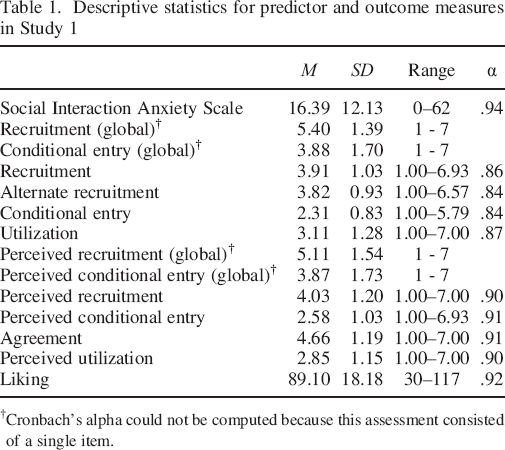
Cronbach's alpha could not be computed because this assessment consisted of a single item.
Assessment of Recruitment Behaviours
To assess participants’ reported recruitment behaviours, they completed a modified version of Bradshaw's (1998) social surrogacy questionnaire. This questionnaire consists of three separate sections. In the first section, we asked participants four questions to assess global recruitment behaviours. Specifically, participants indicated how often they person try to get another person to attend a social event with them to assess global recruitment, and how often they would still attend a social event when they were unable to get someone to accompany them to assess global conditional entry. Both questions were rated on a seven–point scale from 1 (Almost Never) to 7 (Almost Always).
In the second section, participants were presented with 14 different scenarios a typical undergraduate student might encounter (e.g. ‘Going to a party where you know and like everyone there’; see supplementary materials for a list of all scenarios). While Bradshaw's (1998) original questionnaire asked participants about their general recruitment behaviours, we modified these items to ask about participants’ recruitment specifically with their roommate. To assess recruitment, participants first indicated their level of agreement, on a scale from 1 (strongly disagree) to 7 (strongly agree), with the statement ‘I would try to get my roommate to go with me’ for each of the 14 scenarios. To assess conditional entry, participants then indicated their level of agreement, using the same 7–point scale, with the statement ‘I would not go unless my roommate went with me’ for each of the scenarios. Then, in the second question, participants were presented with 10 different behaviours a typical college student might perform in social situations (e.g. ‘Walk up to a person you don't know at a party and say hello’; see supplementary materials for a list of all behaviours). To measure utilization, participants were asked to indicate their level of agreement, using the same 7–point scale as in the first section, with the statement ‘If my roommate was with me, I would try to get him/her to do this for me’ for each of the 10 behaviours. Given that Bradshaw (1998) and Boucher and Cummings (2014) found few differences across the different scenarios/behaviours, we averaged participants’ responses for each of the three subscales to compute overall recruitment, conditional entry and utilization scores.
Assessment of Perceived Recruitment Behaviours
As with our assessment of recruitment behaviour, our assessment of participants’ perceptions of their roommate's recruitment behaviours consisted of three parts. First, participants indicated how often their roommate tries to get other people to attend social events with them to assess perceived global recruitment, and how often their roommate would still attend the event if they were unable to get someone to accompany them to assess perceived global conditional entry. Both questions were rated on a 7–point scale from 1 (Almost Never) to 7 (Almost Always).
Next, using the same scenarios from Bradshaw's (1998) original social surrogacy questionnaires, participants were asked to rate how their roommate would behave in each scenario/behaviour. To assess perceived recruitment, participants indicated their level of agreement, on a scale from 1 (strongly disagree) to 7 (strongly agree) with the statement ‘My roommate would try to get me to go with them’ for each of the 14 scenarios. To assess perceived conditional entry, participants then indicated their level of agreement, using the same 7–point scale, with the statement ‘My roommate would not go without me’ for each of the 14 scenarios. Then, to assess agreement, participants indicated their level of agreement, using the same 7–point scale, with the statement ‘If my roommate asked me to go with them, I would go’ for each of the 14 scenarios.
Finally, to assess perceived utilization, participants indicated their level of agreement, using the same 7–point scale, with the statement ‘If my roommate was with me, s/he would try to get me to do this for him/her’ for each of the 10 behaviours from Bradshaw's (1998) social surrogacy questionnaires. Again, we averaged participants’ responses for each of the three subscales to obtain overall scores for perceived recruitment.
Liking
To assess the degree to which participants liked their roommate, they completed Rubin's (1970) Liking Scale in regards to their roommate. This scale consists of 13 items (e.g. ‘My roommate is one of the most likeable people I know’) rated on a scale from 1 (not true) to 9 (definitely true). Ratings are summed so that higher scores indicate more liking.
Social Interaction Anxiety Scale (Mattick & Clarke, 1998)
The Social Interaction Anxiety Scale (SIAS) consists of 19 items (e.g. ‘I am tense mixing in a group’) rated on a scale from 0 (not at all) to 4 (extremely). Following Rodebaugh, Woods, and Heimberg's (2007) recommendations, we dropped the two negatively keyed items when computing a total score; consequently, scores could range from 0 to 66, where higher scores indicate greater SA. Approximately 16% of the sample met the suggested criteria of Rodebaugh et al. (2011) for clinical levels of SA (i.e. cutoff score of 28).
Results
Overview of Analyses
To account for the interdependence in roommates’ responses, we analyzed the data using Kashy and Kenny's (2000) Actor–Partner Interdependence Model (APIM). This model estimates an actor effect, which estimated the degree to which a participants’ own SA predicted his or her ratings on the surrogacy questionnaires, and a partner effect, which estimated the degree to which the roommate's SA predicted a participant's ratings on these questionnaires. Consider, for example, an analysis of SA effects on recruitment. Using the APIM, the actor effect would estimate the extent to which a participant's SA predicted his or her own recruitment behaviours, whereas the partner effect would estimate the extent to which their roommate's SA predicted these recruitment behaviours.
We conducted these analyses using the mixed model approach in SPSS such that the dyad was treated as the unit of analysis, and each roommate was treated as a repeated–measure within the dyad. Because the two participants within a given roommate pair were indistinguishable, both participants’ levels of SA were used to predict the actor/partner effects (for more details on this analysis and how it control for interdependence, see Kenny, Kashy, & Cook, 2006). Specifically, we estimated the actor effect using all participants’ centred SIAS scores as a predictor in the model, while estimating the partner effect using each participant's roommate's centred SIAS scores as an additional predictor in the model.
Given previous research demonstrating similarity effects with SA (e.g. Boucher et al., 2015; Kashdan & Wenzel, 2005), we also included the two–way participant SA × roommate SA interaction in the model. Similarity has more traditionally been assessed using a difference score calculated from the two dyad members’ scores on the predictor, or with a profile correlation of dyad members’ ratings on the predictor; however, these methods may inflate similarity effects (see Dyrenforth et al., 2010, for a discussion). By examining similarity using the interaction between actor and partner levels of SA, we can determine if the effect of a participant's SA if moderated by his or her roommate's level of SA. Note that although we did not formally adopt a more conservative alpha level, given the number of analyses we report in the succeeding texts, we encourage interpreting results that fall just below the .050 threshold with caution. Correlations between all predictor and outcome variables, as well as correlations between participants’ and roommates’ scores on these measures are presented in Table 2.
Intercorrelations between measures in Study 1
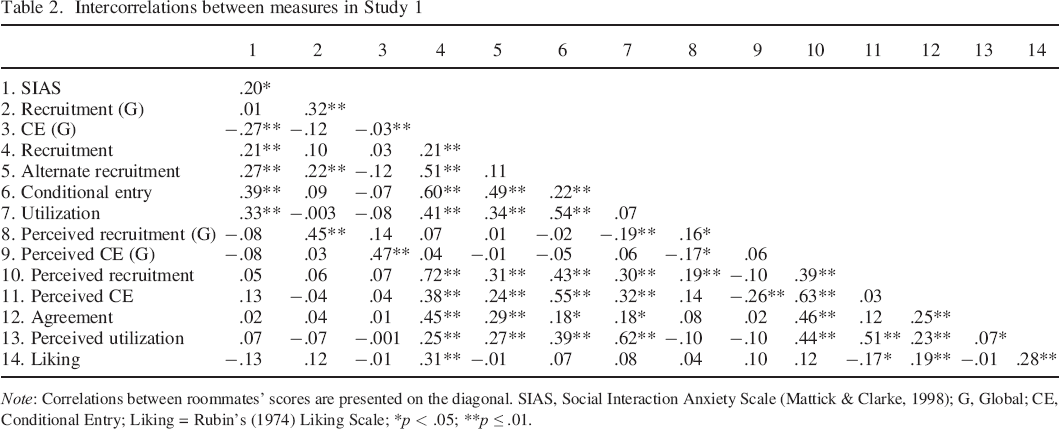
Note: Correlations between roommates’ scores are presented on the diagonal. SIAS, Social Interaction Anxiety Scale (Mattick & Clarke, 1998); G, Global; CE, Conditional Entry; Liking = Rubin's (1974) Liking Scale;
p < .05;
p ≤ .01.
Hypotheses 1–3: Recruitment Behaviours
For this hypothesis, we were interested in whether a participant's own level of SA would predict his or her own recruitment behaviours. Thus, we were primarily interested in the actor effects when examining participants’ reported recruitment behaviours (none of the corresponding partner effects were significant; ps ≥ .127). In Hypothesis 1, we predicted that participants with higher levels of SA would report more recruitment and conditional entry using a general assessment of these behaviours. This hypothesis was partially supported. Contrary to Bradshaw's (1998) findings, we did not find a significant relationship between participant SA and general recruitment, B = 0.002, t(183.17) = 0.20, p = .842; however, we did find that participants with higher levels of SA reported more conditional entry, B = −0.04, t(177.24) = −3.70, p < .001.
In Hypothesis 2, we then predicted that participants with higher levels of SA would report greater recruitment, conditional entry and utilization specifically in regard to their roommate across the hypothetical scenarios than would participants with lower levels of SA. As predicted, we found significant actor effects for recruitment, B = 0.02, t(181.58) = 3.34, p = .001, conditional entry, B = 0.03, t(185.82) = 5.80, p < .001, and utilization, B = 0.03, t(185.25) = 4.93, p < .001, such that participants with higher levels of SA reported being more likely to recruit their roommate across the various scenarios, less likely to attend these events without their roommate and more likely to ask their roommate to perform specific behaviours for them in the hypothetical social situations.
In Hypothesis 3, we predicted that participants with higher levels of SA would also report being more likely to recruit another potential surrogate if their roommate was unavailable. As predicted, we found a significant actor effect, B = 0.02, t(185.97) = 4.17, p < .001, such that participants with higher levels of SA were more likely to report attempting to recruit an alternate surrogate than were participants with less SA.
Research Questions 1–2: Perceived Recruitment Behaviours
Although exploratory given the lack of research on surrogates’ perceptions of recruitment behaviours, we were also interested in whether a roommate's level of SA would predict participants’ perceptions of such recruitment behaviours. Thus, for these analyses, we were primarily interested in the partner effects (none of the corresponding actor effects were significant; ps ≥ .150).
First, we examined the effect of roommate SA on the global measures of perceived recruitment and conditional entry. Neither of these effects were significant (ps ≥ .344). Next, we examined these effects for perceived recruitment, conditional entry and utilization across the hypothetical scenarios. We found a significant partner effect for perceived conditional entry, B = 0.01, t(180.39) = 2.28, p = .023, suggesting participants with high–SA roommates felt their roommate would be less likely to enter the various situations alone compared with participants with low–SA roommates. However, the partner effects for perceived recruitment, B = 0.01, t(180.39) = 1.45, p = .150, and perceived utilization, B = 0.01, t(183.96) = 1.10, p = .272, were not significant.
Research Question 3: Agreement
Again, although exploratory, we also were interested in whether participants with high–SA roommates would be more likely to agree to act as a surrogate than would those with low–SA roommates. Consequently, we were interested in the partner effect here (i.e. the extent to which the roommate's level of SA predicted the participant's reported agreement; the corresponding partner effect was not significant; p = .557). Contrary to the findings of Souma et al. (2008), roommate SA was not significantly related to the extent to which participants agreed to act as a surrogate, B = −0.01, t(184.00) = −1.71, p = .090.
Hypothesis 4: Matching Effects
While exploratory given the lack of research on whether high–SA individuals recruit similar or dissimilar surrogates in terms of SA, we tentatively predicted that roommate SA would moderate the effects of participant SA such that high–SA participants would be more likely to recruit and utilize a high–SA versus a low–SA roommate. As noted earlier, this effect was tested using the two–way participant SA × roommate SA interaction. We found no significant participant SA × roommate SA interactions for any of our outcome variables (ps ≥ .100).
Research Questions 4–5: Liking
Finally, we were interested in exploring whether recruitment behaviours moderated the relationship between SA and liking. Consistent with previous research (e.g. Boucher et al., 2015; Kashdan & Wenzel, 2005; Pontari, 2009; Pontari & Glenn, 2012), we found no significant effects of participant or partner SA on liking (ps ≥ .113). We then conducted separate APIM analyses including each of the participants’ centred recruitment behaviours scores, agreement scores or perceived recruitment scores as an additional predictor in the model along with the corresponding interactions. Given the lack of significant participant SA × roommate SA interactions in the earlier analyses, we did not include this interaction.
With the exception of a significant participant SA × alternate recruitment interaction (p = .019), no other moderating effects were significant (ps ≥ .057). We first explored this interaction by examining the simple main effect of participant SA at higher (i.e. 1 SD above the original alternate recruitment mean) and lower (i.e. 1 SD below the original mean) levels of alternate recruitment (see Cohen, Cohen, West, & Aiken, 2003, for a discussion). These analyses revealed that participant SA was negatively related to liking at lower levels, B = −0.43, t(178.76) = 2.70, p = .008, but not higher levels of alternate recruitment, B = 0.01, t(183.15) = 0.10, p = .916, suggesting that participants with higher SA liked their roommate less than did participants with lower SA, but only when they were less likely to recruit another social surrogate when their roommate was unavailable (Figure 1). 3
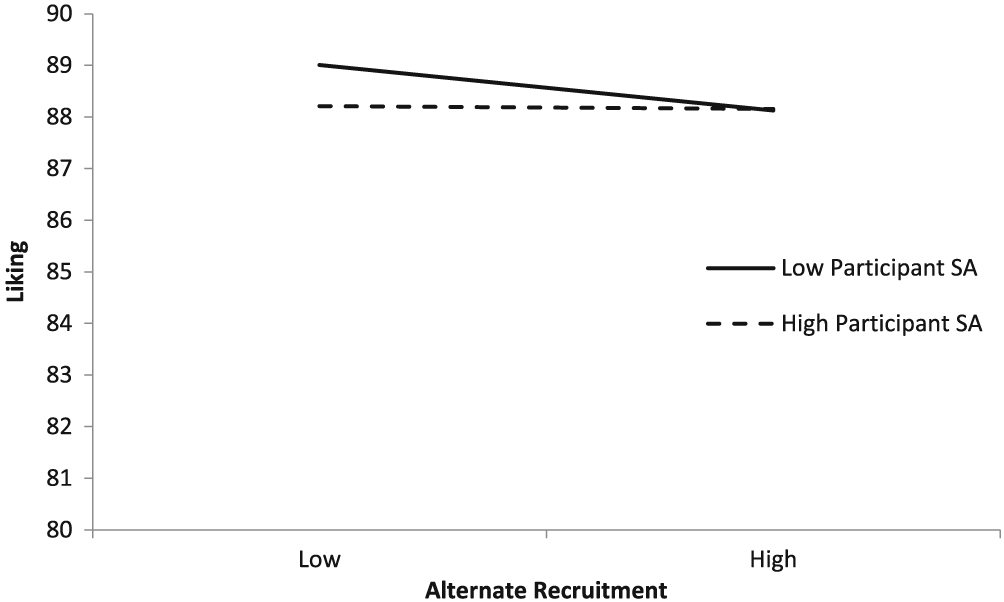
Effect of a participant's social anxiety (SA) on liking as a function of their reported alternate recruitment in Study 1.
Ancillary Analyses: Gender
To determine if gender may have moderated any of our SA effects, we replicated all of the analyses described above including an effects–coded gender variable (+1 = male; −1 = female) in the model along with all corresponding two–way and three–way interactions. With the exception of a significant roommate SA × gender interaction for perceived conditional entry (p = .029), suggesting that higher levels of roommate SA were associated with greater perceived conditional entry among female pairs (B = 0.02, p = .005) but not among male pairs (B = −0.02, p = .252), no other effects were significant (ps ≥ .089). 4
Discussion
The purpose of this study was to further examine the effects of SA on recruitment of social surrogates by assessing recruitment for a specific individual – a college roommate. Our findings were partially consistent with Bradshaw's (1998) social surrogate hypothesis. When we assessed recruitment behaviours globally, we found that SA was positively related to conditional entry, but not recruitment. However, when we assessed recruitment behaviours specifically in regard to the participant's roommate across a series of hypothetical, anxiety–provoking scenarios, participants with higher levels of SA reported being more likely to recruit their roommate as a surrogate across these situations, less likely to enter the situations without their roommate present and more likely to ask their roommate to perform specific behaviours in the hypothetical scenarios. Participants with higher levels of SA reported being more likely to recruit another (i.e. alternate) potential surrogate if their roommate was unavailable.
We also explored whether these recruitment behaviours would be affected by the extent to which roommates had similar or dissimilar levels of SA. On the one hand, high–SA individuals might be more likely to recruit roommates with similar levels of SA because closeness tends to be higher among dyads with similar, rather than dissimilar, levels of SA (e.g. Boucher et al., 2015; Kashdan & Wenzel, 2005). But, on the other hand, high–SA participants might seek dissimilar others because low–SA surrogates might be more effective given their relative lack of shyness and superior social skills (Bradshaw, 1998). Our findings do not support either of these arguments. We found no evidence that recruitment behaviours (or perceived recruitment behaviour) differed as a function of SA similarity. Conceivably, the roommate's level of SA may become more important depending on the individual's specific goals within the situation. Alternatively, however, high–SA individuals may be primarily motivated to have a surrogate present, which may override the desire for specific characteristics in a surrogate. Consequently, preferences for specific characteristics may become evident only when high–SA participants have the choice of multiple potential surrogates. Thus, future research should further examine how the surrogate's characteristics influence recruitment decisions, and how the importance of these characteristics might vary based on the type of situation and the availability of other suitable surrogates.
Another goal of this study was to explore whether participants with high–SA roommates would be aware of their roommate's heightened recruitment behaviours. To our knowledge, this was the first attempt to examine perceptions of recruitment, conditional entry and utilization from the surrogate's perspective. Although high–SA participants reported being more likely to recruit and utilize their roommates compared with low–SA participants, participants with high–SA roommates did not report higher levels of perceived recruitment or utilization compared with those with low–SA roommates. However, roommates did appear to accurately discern conditional entry behaviours; participants with higher levels of SA reported significantly higher levels of conditional entry compared with participants with lower levels of SA, and participants with high–SA roommates reported higher levels of perceived conditional entry than did those with low–SA roommates.
One potential explanation for these results is that individuals with higher levels of SA do engage in these behaviours, but that people with high–SA roommates do not perceive they are being recruited and utilized as a surrogate more frequently, even if they understand their roommate would be less likely to attend a social event alone. Alternatively, given that we largely assessed recruitment using self–reported anticipated behaviour in hypothetical scenarios, it is possible that high–SA participants believe they would engage in these recruitment behaviours, but that the lack of corresponding partner effects suggests they do not actually engage in these behaviours. In other words, it is possible that the roommates’ appraisal of the recruitment behaviours is more accurate than the high–SA individual's appraisal.
A final aim of the current study was to explore whether the recruitment process would affect the relationship between the recruiter and his or her surrogate. We did this by testing whether recruitment or perceived recruitment behaviours moderated the relationship between SA and liking among roommates. We found little evidence of moderating effects. However, we did find that high–SA participants liked their roommates less than did low–SA participants, but only when they were less likely to recruit an alternate surrogate when their roommate was unable/unwilling to be a surrogate. While this effect requires replication, particularly given our small sample size and large number of analyses, one potential explanation for this effect is that the interpersonal consequences of the surrogacy process may depend on perceptions of the recruiter's dependence on the surrogate. For example, given that high–SA individuals are less likely to be nominated by others as a friend (Van Zalk & Van Zalk, 2015), it seems plausible that they may have fewer potential surrogates than low–SA individuals. Conceivably, then, when a high–SA individual reported lower levels of alternate recruitment, it may have been because they have few options for surrogates, and given the higher levels of conditional entry associated with SA, they may be more likely to avoid social situations when their roommate is not available to act as a surrogate. Conversely, given that low–SA individuals are more likely to have other potential surrogates and more likely to attend events alone, when they reported lower levels of alternate recruitment, it may have been because they genuinely wanted their roommate, and their roommate alone, to accompany them. Thus, exploring the extent to which the effects of the recruitment process differ based on the availability of other suitable surrogates may be an important direction for future research.
One major limitation of the current study, as well as most other social surrogacy studies, was that participants reported their likelihood of engaging in recruitment behaviours, or their roommate's likelihood of engaging in recruitment behaviours, across various hypothetical scenarios. Consequently, it is unclear whether participants with higher levels of SA would actually engage in these behaviours in their day–to–day lives, or if they simply believe they would engage in these behaviours. As noted earlier, it is possible that our lack of significant effects for perceived recruitment suggests that the roommates’ appraisal of the recruitment behaviours is more accurate than the high–SA individual's appraisal. Indeed, the fact that we did not find an effect of participant SA on global report of recruitment, nor did Markovic and Bowker (2015) in their sample of adolescents, suggests that high–SA individuals may not actually engage in these recruitment behaviours although they report being more likely to recruit someone when considering a hypothetical scenario. To our knowledge, beyond the single–item global reports we used in the current study, only Souma et al. (2008) have asked participants about their actual recruitment behaviours in a variety of social situations. However, their study included only eight situations (e.g. ‘you asked your partner to accompany you when you needed to talk with a person (teacher, senior student, etc.) to whom you had never spoken easily’; p. 69), which provides a very limited sampling of participants’ behaviours. While Souma et al. did assess recruitment, they used the surrogate's participation as the primary measure of surrogate use and did not report the direct relationship between participant SA and reported recruitment. Thus, an important test of Bradshaw's (1998) social surrogate hypothesis would be to examine the relationship between SA and social surrogate use by asking participants to report on their actual recruitment behaviours across a broader array of real–world social situations; we addressed this issue in Study 2.
Study 2
The purpose of Study 2 was to re–examine the effect of SA on recruitment behaviours within roommate relationships. However, rather than asking participants to reflect on their anticipated behaviours across a variety of hypothetical scenarios, we asked participants to consider a series of situations undergraduate students typically encounter and report on their actual recruitment behaviours over the past two weeks, along with the global assessment of recruitment and conditional entry we used in Study 1. Based on our findings in Study 1, as well as Markovic and Bowker's (2015) findings with adolescents, we did not predict that SA would be significantly related to global reports of recruitment, although we did predict that SA would be significantly related to global reports of conditional entry.
Hypothesis 1: Participants with higher levels of SA will report more conditional entry overall than will participants with lower levels of SA.
However, we predicted that when participants were asked to reflect on recruitment across a variety of specific scenarios, SA would be significantly related to both recruitment and conditional entry.
Hypothesis 2: Participants with higher levels of SA will report recruiting their roommate more frequently over the past two weeks, and their decision to enter these situations will be more dependent on their roommate's attendance, relative to participants with lower levels of SA.
As in Study 1, we also wanted to assess whether roommates would be aware of these heightened recruitment behaviours. Although we found few effects of a roommate's SA on participants’ perceptions of their roommate's recruitment behaviours, it is plausible that these effects may be stronger when participants are asked about actual recruitment behaviours rather than considering hypothetical scenarios. Nevertheless, given the lack of research in this area and the largely non–significant findings from Study 1, we made no specific predictions for the effects of roommate SA on participants’ perceptions of recruitment behaviours.
RQ1: Will participants with high–SA roommates report more perceived recruitment and conditional entry from their roommates overall? RQ2: Will participants with high–SA roommates report more perceived recruitment and conditional entry over the previous two weeks?
We also assessed the extent to which roommate's agreed to act as a surrogate to further explore whether participant SA would influence the degree to which roommates actually participated as the surrogate. Given the lack of previous research in this area, we made no specific predictions, although given the null findings in regards to agreement in Study 1, one might expect that a participant's SA would not be significantly related to the roommate's agreement to act as a surrogate.
RQ3: Will participants with high–SA roommates be more or less likely to agree to act as a surrogate over the previous two weeks relative to those with low–SA roommates?
Finally, we also wanted to re–examine the extent to which recruitment and perceived recruitment behaviours would moderate the relationship between SA and liking among roommates. Although we found only one moderating effect of recruitment in Study 1, it is plausible that assessing recruitment behaviours using hypothetical scenarios would have weaker effects as these are intended rather than enacted behaviours. Consequently, asking participants (and their roommates) to reflect on their perceptions of recruitment and conditional entry over the previous two weeks may be a more effective way to determine whether the surrogacy process has positive or negative effects on the relationship between high–SA recruiters and their roommates. However, given the largely non–significant findings in Study 1 and the lack of previous research in this area, this aspect of the study remained largely exploratory.
RQ4: Will higher levels of recruitment and conditional entry moderate the effects of roommate SA on liking? RQ5: Will higher levels of perceived recruitment and conditional entry moderate the effects of roommate SA on liking?
Method
Participants
Participants were 82 same–sex roommates recruited from a small liberal arts college in the Northeastern United States 5 ; 11 pairs were dropped because one roommate never accessed the online survey, and another pair was dropped because one roommate did not finish the survey. The remaining 140 participants (34 men, 106 women), or 70 roommate pairs, had a mean age of 19.18 (SD = 1.07), ranging from 18 to 22 years, and were primarily European–American (n = 116). Fifty–four participants identified as freshman students, 45 as sophomores, 31 as juniors and 10 as seniors. All participants were compensated with partial course credit or 5 USD.
Characteristics of Roommate Relationships
Thirty–eight of the roommate pairs reported knowing each other prior to living together and choosing to live together, whereas 32 roommate pairs were unacquainted and were paired to live together. On average, roommates had known each other for approximately 20.39 months (SD = 23.78), ranging from two months to 13 years, and have lived together for approximately 7.83 months (SD = 8.19), ranging from two months to three years. The majority of roommates lived either in a traditional college dormitory (n = 90) or in an apartment–style dormitory (n = 42). Only 16 of the roommate pairs reported that the roommate participating in the study with them was their only roommate.
Measures and Procedure
As in Study 1, roommate pairs who expressed interest in participating in the study were instructed to complete the measures below online via Qualtrics. 6 Each roommate was sent an individual email instructing them to complete the survey independently and that their responses would never be shared with their roommate. Descriptive statistics for all predictor and outcome measures are presented in Table 3.
Descriptive statistics for measures in Study 2
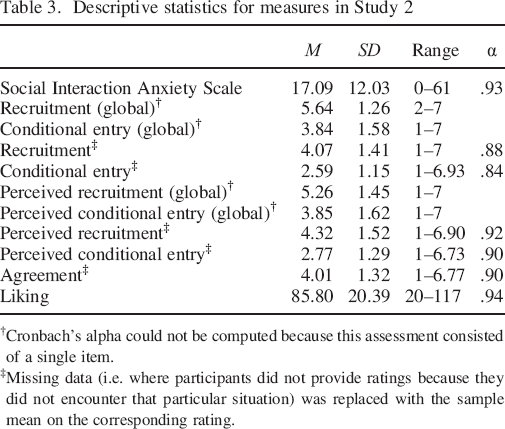
Cronbach's alpha could not be computed because this assessment consisted of a single item.
Missing data (i.e. where participants did not provide ratings because they did not encounter that particular situation) was replaced with the sample mean on the corresponding rating.
Global Assessment of Recruitment and Perceived Recruitment
To assess global levels of reported and perceived recruitment in addition to recruiting a roommate specifically, participants answered the same four questions we modified from Bradshaw's (1998) original study for Study 1 to assess global recruitment, global conditional entry, global perceived recruitment and global perceived conditional entry.
Assessment of Recruitment Behaviours
To assess participants’ recruitment behaviours in Study 2, we presented participants with 21 scenarios college students typically encounter in their daily lives (e.g. going to the dining hall, going to a store off–campus or going to the fitness centre; see supplementary materials for a list of all scenarios). These items were drawn from another study conducted with a sample drawn from the same colleges in which participants reported on their daily activities over the course of 10 days (Boucher & Cummings, 2013), so we were confident these represented situations participants would have considered attending over the past two weeks. For each scenario, participants first were asked if they had considered entering this situation over the past two weeks. If a participant responded ‘no’, they proceeded to the next scenario; however, if a participant responded ‘yes’, they were asked two additional questions. To assess recruitment, we asked participants to indicate how often they asked their roommate to go with them on a scale from 1 (never) to 7 (always). Then, to assess conditional entry, we asked them to indicate the extent to which their decision to enter this situation was influenced by whether or not their roommate was going with them on scale from 1 (not at all) to 7 (extremely).
Because participants only completed these items if they had considered entering these situations in the past two weeks, we computed a mean recruitment score as a well as a mean conditional entry score. Participants reported on an average of 8.63 scenarios (SD = 2.27), ranging from 1 to 14 scenarios. Despite the use of a different measure of social surrogacy, mean recruitment and conditional entry scores were consistent with Study 1 as well as previous research (e.g. Boucher & Cummings, 2014; see Table 3 for descriptive statistics).
Assessment of Perceived Recruitment
To assess participants’ perceptions of their roommate's recruitment behaviours over the previous two weeks, participants then were asked to consider the same 21 scenarios but to report instead on their roommate's behaviours. To assess perceived recruitment, participants were asked to report how often their roommate asked them to accompany them for each of the scenarios on a scale from 1 (never) to 7 (always); participants also were given a not applicable option if they felt their roommate had never considered entering this situation, and those who selected this option were directed to the next scenario. To assess perceived conditional entry, participants also were asked to report the extent to which they felt their roommate's decision to enter the situation was influenced by their attendance on a scale from 1 (not at all) to 7 (extremely). Finally, to assess the extent to which roommates actually acted as social surrogates over the previous two weeks, we also asked participants how often they agreed to accompany their roommate in each of the scenarios on a scale from 1 (never) to 7 (always). Again, we averaged participants’ responses to compute mean perceived recruitment, perceived conditional entry and agreement scores. Participants reported on an average of 12.88 scenarios (SD = 4.73), and perceived recruitment and perceived conditional entry scores were largely consistent with those in Study 1.
Other Measures
As in Study 1, participants completed Rubin's (1970) Liking Scale in regard to their roommate, and the SIAS to measure SA. In Study 2, approximately 21% of the sample met the cutoff of Rodebaugh et al.(2011) for clinical levels of SA using the SIAS.
Results
To examine the effects of participant and roommate SA on recruitment, perceived recruitment and liking, we replicated the APIM analyses described in Study 1. However, given the lack of significant participant SA × roommate SA interactions in Study 1, we did not include this interaction in our analyses for Study 2. 7 Again, given the number of analyses we report in the succeeding texts, we encourage interpreting results that fall just below the .050 threshold with caution. Correlations between all predictor and outcome variables, as well as correlations between participants’ and roommates’ scores on these measures are presented in Table 4.
Intercorrelations between measures in Study 2
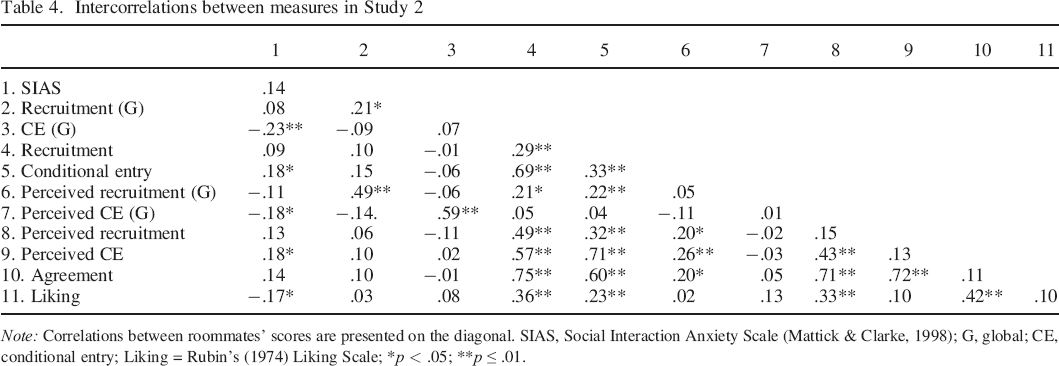
Note: Correlations between roommates’ scores are presented on the diagonal. SIAS, Social Interaction Anxiety Scale (Mattick & Clarke, 1998); G, global; CE, conditional entry; Liking = Rubin's (1974) Liking Scale;
p < .05;
p ≤ .01.
Hypotheses 1–2: Recruitment Behaviours
As in Study 1, for recruitment behaviours, we were primarily interested in the actor effects as we were examining how a participant's own SA predicted his or her own recruitment behaviours (none of the partner effects were significant, ps ≥ .252). In Hypothesis 1, we predicted that higher levels of SA would not necessarily be associated with greater recruitment when assessed globally, but would be associated with significantly greater conditional entry. As predicted, participants with higher levels of SA reported significantly more conditional entry, B = −0.03, t(136.84) = −2.71, p = .008. As in Study 1, participant SA was not significantly related to global reports of recruitment, B = 0.01, t(120.77) = 0.82, p = .416.
In Hypothesis 2, we predicted that participants with higher levels of SA would report significantly higher levels of recruitment and conditional entry specifically in regards to their roommate over the previous two weeks. However, we did not find a significant effect of participant SA on recruitment, B = 0.01, t(115.28) = 1.07, p = .287, although we did find the predicted effect of participant SA for conditional entry, B = 0.02, t(123.25) = 2.27, p = .025. Consistent with previous research and our Study 1, relative to low–SA participants, high–SA participants reported that their decision to enter social situations over the past two weeks depended more on whether their roommate would accompany them.
Research Questions 1–2: Perceived Recruitment Behaviours
As in Study 1, for perceived recruitment behaviours, we were primarily interested in the partner effects as we were exploring whether participants with high–SA roommates would report more recruitment and conditional entry from their roommates than would those with low–SA roommates. Consistent with Study 1, we found no significant partner effects for global reports of perceived recruitment, B = −0.01, t(136.88) = −1.41, p = .160, or perceived conditional entry, B = −0.01, t(135.18) = −0.50, p = .616. We also found no significant partner effects for perceived recruitment, B = 0.01, t(122.98) = 1.34, p = .182, or perceived conditional entry, B = 0.01, t(134.21) = 1.29, p = .198.
We did find a significant actor effect for global reports of perceived conditional entry as well, suggesting that participants with higher levels of SA were more likely to believe their roommate would be less likely to enter social situations alone, B = −0.02, t(135.18) = −2.03, p = .045 (all other ps ≥ .068). However, we would be reluctant to place too much emphasis on this effect given that we found no other actor effects for perceived recruitment in either Study 1 or 2, and this effect just meets the alpha of .050.
Research Question 3: Agreement
Again, we also examined whether participants with high–SA roommates would be more likely to agree to act as a surrogate than would those with low–SA roommates. Consistent with Study 1, roommate SA did not predict the extent to which participants agreed to act as a surrogate, B = 0.01, t(126.77) = 0.94, p = .347.
Research Questions 4–5: Liking
As in Study 1, we found no significant effects of participant or partner SA on liking (ps ≥ .060). Contrary to Study 1, we found a significant participant SA × global recruitment interaction (p = .046) as well as a significant roommate SA × perceived conditional entry interaction (p = .011); we found no other moderating effects of recruitment or perceived recruitment behaviours (ps ≥ .111). As described in Study 1, we examined these significant interactions further by testing the simple slopes for participant or roommate SA at different levels of the particular moderating variable (i.e. 1 SD above the mean and 1 SD below the mean). We then re–ran the APIM analyses replacing the original centred moderating variable with one of these new variables.
When we broke down the participant SA × global recruitment interaction, we found that participants with higher SA reported liking their roommates less than participants with lower SA at higher levels of global recruitment, B = −0.51, t(133.99) = −2.74, p = .007, but not at lower levels of global recruitment, B = 0.10, t(133.63) = 0.43, p = .666 (Figure 2). 8 However, we interpret this effect with caution given that we did not find this effect in Study 1 and the interaction just met the alpha of .050.
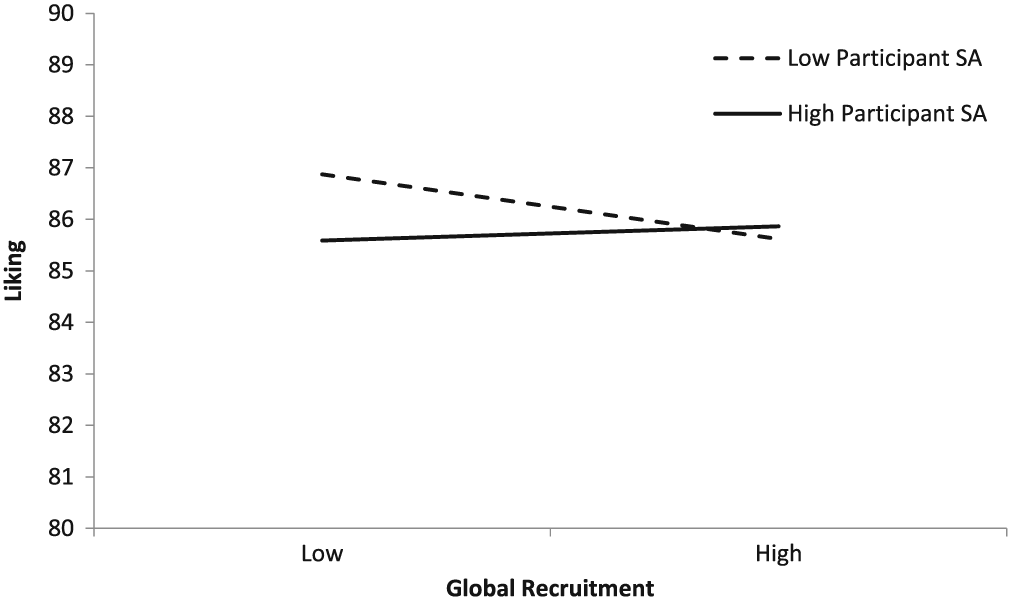
Effect of a participant's level of social anxiety (SA) on liking as a function of their reported global recruitment in Study 2.
In terms of roommate SA and perceived conditional entry, we found that participants with higher SA reported liking their roommate less than participants with lower SA at higher levels of perceived conditional entry, B = −0.33, t(133.89) = −2.00, p = .047, but not at lower levels of perceived conditional entry, B = 0.25, t(133.86) = 1.29, p = .200. These effects might suggest that participants were more likely to reject their high–SA roommate when they felt their roommate's decision to enter a social situation was high dependent on their decision to accompany them. However, when we tested the simple main effect of perceived conditional entry at higher and lower levels of roommate SA, we found that perceived conditional entry was not significantly related to liking at higher levels of roommate SA, B = 0.70, t(127.13) = −0.42, p = .673, but was positively related to liking at lower levels of roommate SA, B = 4.75, t(132.90) = 2.74, p = .007. Therefore, as depicted in Figure 3, it appears that the extent to which a participant felt their roommate's decision to enter social situations depended on whether or not the participant would accompany them had less of an impact when roommates were more socially anxious, but participants were likely to respond positively (i.e. report more liking) to higher levels of perceived conditional entry when their roommates were low in SA.
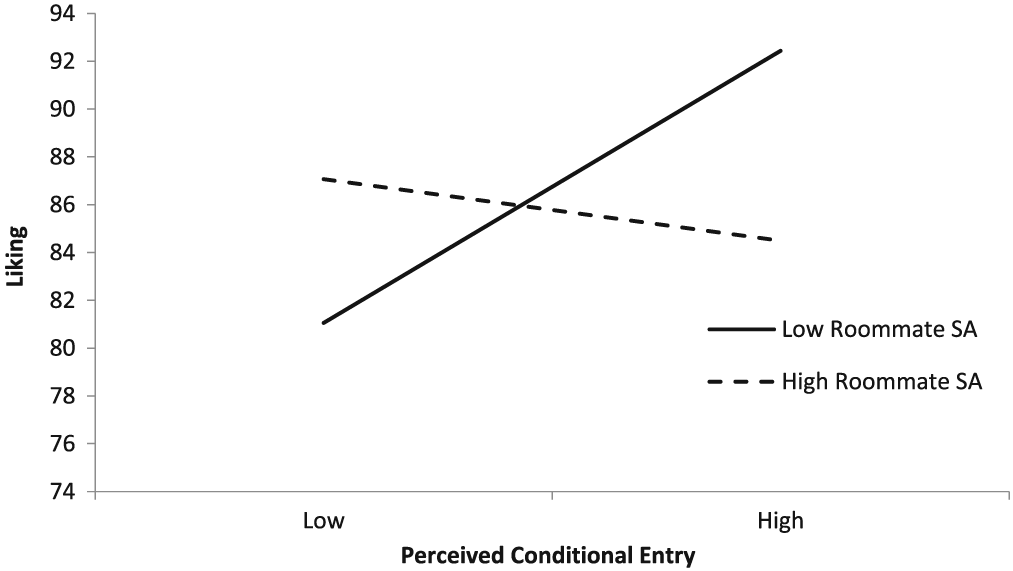
Effect of a roommate's level of social anxiety (SA) on liking as a function of perceived conditional entry in Study 2.
Ancillary Analyses: Gender
As in Study 1, to determine if gender moderated any of our SA effects, we replicated our the APIM analyses including an effects–coded gender variable and all corresponding interactions.6 We found a significant participant SA × gender interaction for conditional entry (p = .047), suggesting that higher levels of participant SA were associated with more conditional entry among male (B = 0.05, p = .004), but not female (B = 0.01, p = .261) participants. We also found a significant participant SA × gender × perceived recruitment (p = .008) as well as a significant participant SA × gender × perceived conditional entry (p = .046) interaction for liking; however, the two–way participant SA x perceived conditional entry interactions for the latter were not significant for either male (p = .115) or female (p = .113) participants, so we did not explore this effect any further. When we explored the other interaction further, we found that higher levels of perceived recruitment predicted less liking among female pairs (B = −0.56, p = .008), but not among male pairs (B = 0.01, p = .969), whereas lower levels of perceived recruitment were associated with less liking among male pairs (B = −1.14, p = .002), but not among female pairs (B = 0.14, p = .581). No other effects were significant (ps ≥ .051). 9
Discussion
The purpose of Study 2 was to provide a more naturalistic test of Bradshaw's (1998) social surrogate hypothesis by assessing the relationship between SA and surrogate use by assessing reported recruitment behaviours retrospectively rather than assessing intended recruitment behaviours across a variety of hypothetical scenarios. Contrary to previous research, including our Study 1, we found no evidence that participants with higher levels of SA were more likely to recruit their roommate as a social surrogate over the previous two weeks. We did, however, find the predicted relationship between participant SA and conditional entry, both when assessed globally and with the specific situations. Consistent with previous research, then, participants with higher levels of SA were more likely to report that their decision to enter social situations, generally and over the previous two weeks, depended more on whether or not a surrogate was available to accompany them into these situations.
Although our recruitment effects are not consistent with the social surrogate hypothesis and with previous research, including our Study 1, they are interesting given that this was one of only two studies to assess reported, rather than intended, recruitment behaviours. Furthermore, while Souma et al. (2008) assessed recruitment, they did so using a small number of behaviours, which may not have given an accurate portrayal of recruitment behaviours in participants’ daily lives. In particular, the single item reported by Souma et al. suggests that the scenarios used in their study might have included more anxiety–provoking events (i.e. ‘You asked your partner to accompany you when you need to talk with a person (teacher, senior student, etc.) to whom you had never spoken easily’). Given that Bradshaw (1998) found that recruitment, particularly for individuals with higher SA, was tied to the level of anxiety associated with the situation, Souma et al.'s use of anxiety–provoking situations may have produced higher levels of recruitment than we might observe with more mundane scenarios like going to the dining hall or to the library. In addition, Souma et al. did not appear to give participants the option to indicate they did not experience these events, so a lower rating may have represented low recruitment, or that participants never faced this particular situation. Participants in the current study reported recruitment and perceived recruitment behaviours only for the scenarios they encountered over the previous two weeks, thereby disentangling the recruitment behaviours from attendance, which were confounded in the research Souma et al.
Furthermore, our null findings with the retrospective accounts of recruitment corroborate other research assessing the relationship between SA and global reports of recruitment using a single item. Specifically, Markovic and Bowker (2015) failed to find a significant relationship with a sample of adolescents, whereas we did not find a significant effect of participant SA on global reports of recruitment in either Study 1 or Study 2. In other words, while high–SA individuals may believe they would engage in greater recruitment when considering the hypothetical scenarios, their actual recruitment behaviours may differ from their intended behaviours, highlighting the importance of using assessment methods that do not rely on hypothetical scenarios in future research.
We also wanted to re–examine whether participants with high–SA roommates would be aware of the heightened recruitment behaviours. Perhaps not surprisingly given the non–significant relationship between participant SA and recruitment, we found little evidence that participants with high–SA roommates felt their roommates had engaged in more recruitment behaviours over the previous two weeks than those with low–SA roommates. However, while we found that higher levels of roommate SA were associated with greater perceived conditional entry in Study 1, and we did find a significant relationship between participant SA and conditional entry in the current study, participants with high–SA roommates did not report higher levels of perceived conditional entry than did those with low–SA roommates. In other words, participants with higher levels of SA reported that their decision to enter social situations depended more on their roommate's attendance than did participants with lower levels of SA, but their roommates did not appear to detect this.
Again, it is unclear whether the lack of significant partner effects in the current study suggests that participants with high–SA roommates do not detect their roommate's recruitment behaviours, perhaps because these recruitment behaviours are subtle, or if the relationship between participant SA and recruitment behaviours is more indicative of a desire to recruit a surrogate rather than actual enacted behaviours. However, it is noteworthy that most of the previous studies that found a direct relationship between participant SA and recruitment used hypothetical vignettes to assess recruitment behaviours (e.g. Arbeau et al., 2012; Boucher & Cummings, 2014; Bradshaw, 1998). Conversely, in the current study where we measured recruitment behaviours using retrospective accounts of actual behaviour, we found no significant relationship between participant SA and recruitment, only with conditional entry. Similarly, we found no significant effects of participant SA on global reports of recruitment in either Study 1 or Study 2, whereas Markovic and Bowker (2015) failed to find a significant effect using a single–item measure of global recruitment with adolescents. As noted earlier, one could argue that this provides support for the position that the relationship between participant SA and recruitment represents more of the socially anxious person's desire to recruit a surrogate rather than their enacted behaviours. Still, these results are preliminary and unfortunately the only other study to measure recruitment in this way (i.e. Souma et al., 2008) assessed recruitment, but never reports the direct relationship between participant SA and recruitment, using the surrogate's participation as their primary measure of social surrogacy. Thus, it is unclear whether Souma et al. (2008) similarly found a non–significant relationship using these methods.
While it remains unclear whether individuals with higher levels of SA actually engage in more recruitment behaviours, it does appear that they are less likely to attend events alone. Perhaps more importantly, such conditional entry appeared to have different effects for low versus high–SA individuals. Specifically, while perceived conditional entry did not have a significant effect on the extent to which participants liked their high–SA roommates, higher levels of perceived conditional entry were associated with more liking for low–SA roommates. While the reasons for this effect are unclear, and the effect should be replicated given that we did not find a corresponding moderating effect of conditional entry in Study 1, it is possible that participants with low–SA roommates interpret the conditional entry differently than those with high–SA roommates. For example, if these participants believe their low–SA roommates are capable of attending the event alone, they may interpret their roommate's failure to attend the event without them positively – that they genuinely wanted their company. However, participants with high–SA roommates may (perhaps accurately so) interpret that their roommate needed, rather than wanted, their company. Thus, as noted in Study 1, the effects of social surrogacy may depend on perceptions of dependence on a particular surrogate, which may subsequently influence how surrogates interpret the recruitment behaviours.
General Discussion
In 1998, Bradshaw's social surrogate hypothesis proposed that people with higher levels of shyness would ask other people to accompany them into social situations more frequently than would people who were less shy as a means of coping with their SA. Since his original paper, few studies have tested this hypothesis, and even fewer have examined the relationship between SA and recruitment of social surrogates within a specific relationship. College roommate relationships present a unique opportunity to examine social surrogacy processes: Individuals are not necessarily friends, but live in very close proximity and, consequently, might often be available when one of the roommates is seeking a surrogate. Our current research focused on providing an additional empirical test of Bradshaw's hypothesis, using both hypothetical (Study 1) and real (Study 2) social situations to assess surrogate use, and examined surrogate perceptions of recruitment as well as the potential impact on the roommate relationship (i.e. roommate liking).
Recruitment Behaviours
Our findings partially supported the social surrogate hypothesis. In Study 1, we found that higher levels of SA predicted only global reports of conditional entry, not recruitment. However, when we used the same hypothetical scenarios as in Bradshaw's (1998) original research, we found that participants with higher levels of SA did report higher levels of recruitment, conditional entry and utilization. That is, participants who were more socially anxious reported that they would be more likely to ask their roommate to accompany them into the hypothetical situations, less likely to enter these situations without their roommate present and more likely to ask their roommate to perform specific behaviours in these situations. In addition, participants with higher levels of SA reported that they would be more likely to attempt to recruit an alternate surrogate if their roommate was not available. However, in Study 2, when we assessed recruitment behaviours by having participants reflect on their actual recruitment behaviours over the previous two weeks, we found that higher levels of SA were associated with greater conditional entry only. Similarly, as in Study 1, SA was positively related to global reports of conditional entry, but not recruitment.
In other words, reports of recruitment are inconsistent when compared across our studies; participants’ reports of intended recruitment (i.e. regarding hypothetical situations) and actual recruitment (i.e. regarding behaviour over the previous two weeks or when assessed globally using a single item) are not the same. This difference has a number of important implications. First, it indicates consistency in socially anxious participants’ desire for the assistance of social surrogates. Across both of our studies, as well as previous studies (Boucher & Cummings, 2014), participants high in SA report not wanting to enter social situations without a surrogate (i.e. conditional entry). However, when it comes to actually asking those surrogates to accompany them to social situations or to perform necessary interpersonal behaviours, high–SA participants report the intention of doing so, but may not follow through on that intention. It is possible that recruitment and utilization of surrogates might be too anxiety–provoking or introduce increased opportunities for rejection (e.g. social surrogates declining socially anxious individuals’ requests). That is, given that SA is positively related to rejection sensitivity (e.g. Fang et al., 2011; London, Downey, Bonica, & Paltin, 2007), concerns with rejection might interfere with their desire to recruit a surrogate in real social situations. They might prefer, instead, to avoid social situations altogether rather than risking rejection by asking a close other to accompany them.
Second, these discrepant findings point to an important impact of measurement on results in social surrogacy research. Whereas the use of hypothetical scenarios can measure intended recruitment, our results indicate that these intentions might not match actual recruitment. Researchers, including ourselves, relying upon only one source of information will, it seems, end up with an incomplete picture of social surrogacy processes. It is important for researchers to be aware of this discrepancy and to choose measures accordingly. In addition, previous social surrogacy research that relied upon hypothetical situations should be interpreted in light of this potential difference between intention and action.
Surrogate's Perceptions of Recruitment Behaviours
The current studies also were the first to examine the surrogates’ perceptions of these recruitment behaviours. In Study 1, we found that participants with high–SA roommates did believe that their roommates would be less likely to enter the hypothetical social scenarios alone (i.e. without a surrogate); however, there was no evidence that they believed their roommates would be more likely to recruit or utilize them as a surrogate compared with participants with less socially anxious roommates. In Study 2, where we assessed actual recruitment behaviours, we found no evidence that participants with high–SA roommates perceived differential levels of recruitment or conditional entry over the previous two weeks compared to those with low–SA roommates.
As previously mentioned, one potential reason for the discrepancy between the results for Study 1 and Study 2 is the different methods of assessment of recruitment behaviours. Conceivably, in real–world settings, it may be more difficult to determine the extent to which you influenced your roommate's decision to enter social situations. For example, when presented with hypothetical scenarios, participants merely had to consider whether their roommate would enter this situation alone. Conversely, in real–world scenarios, conditional entry behaviours may have to be more overt to be detected. In instances where a participant would comply with a request to act as a surrogate, the participant would have little insight into how their roommate would have responded if they had declined; that is, whether their roommate would have decided to enter the situation without them or not.
In addition, in some situations surrogates might be unaware that they influenced the recruiter's conditional entry at all, which would account for the discrepancy between participants’ own reports and their roommate's perceptions. For example, consider the following scenario: A college freshman has been invited to a meeting for a new club on campus. He would like to ask his roommate to attend this meeting with him, but his roommate preemptively shares with him that he will be spending the entire evening in the library working on an assignment before the student has the opportunity to make the recruitment request. In this scenario, conditional entry might occur in that the student may choose not to attend the meeting because his roommate is unavailable to accompany him, even though he did not explicitly ask his roommate to attend. Consequently, his roommate would be unaware of the meeting and how he influenced the student's decision to attend.
Similarly, it is also possible that recruitment behaviours are quite subtle and, again, roommates are unaware they are being recruited. For example, in the aforementioned situation, the college freshman interested in a new club on campus might suggest that his roommate would also enjoy and should consider joining the club. If the roommate expresses his lack of interest and the freshman decides not to attend the meeting alone, it is again unlikely the roommate would be aware of this ‘failed’ recruitment. Furthermore, the use of such subtle recruitment strategies might allow socially anxious individuals to decrease the possibility of rejection and pursue social surrogacy while decreasing ‘risk’ as much as possible.
Related, in this scenario whereas the participant would be aware that his roommates’ inability to attend influenced his own decision to attend (i.e. conditional entry), the roommate would not be aware of this. Thus, participants might be more accurate reporters of their own recruitment behaviours, with roommates only being able to report clear and explicit recruitment attempts (e.g. ‘Will you go to this meeting with me? I don't want to go alone’). This also might help to explain why participants with higher levels of SA reported greater conditional entry than did those with less SA in Study 2, but their roommates appeared unaware of the heightened conditional entry behaviours.
We believe that additional research exploring how people, particularly those with higher levels of SA, specifically enact recruitment behaviours is necessary to better understand the surrogacy process. Behavioural–based measures, including lab observations or experiencing sampling methods (e.g. Wrzus & Mehl, 2015), will be an important next step in social surrogacy research to examine actually performed recruitment behaviours. Bradshaw's (1998) current definition of recruitment (i.e. ‘I would try to get someone to go with me’) is too vague and not specific enough to measure the full range of actual recruitment behaviours. Given that it is important that individual dispositions, like SA, produce discernable behaviours in order to influence others’ interpersonal perceptions and mental representations (Back et al., 2011), it is likely that the outcomes associated with the surrogacy process differ depending on how overtly surrogates are recruited. For instance, Bradshaw suggested that surrogates may come to resent recruiters when they feel pressured to act as a surrogate; however, this resentment can occur only if surrogates are aware of the recruiter's conditional entry into the situation(s). Conceivably, then, in cases where recruitment requests are clear to the surrogate and it is understood that the recruiter will not enter the situation if the surrogate were to decline this request, the surrogacy process may have more negative implications for the recruiter–surrogate relationship. Whereas in cases of more subtle recruitment and conditional entry, surrogates may be able to fulfill nurturance needs without feeling pressure and, consequently, have more beneficial effects on the recruiter–surrogate relationship. Thus, it is imperative that future research develop more fine–tuned assessments of exactly how socially anxious individuals recruit surrogates.
Liking
In addition to understanding surrogates’ perceptions of being recruited and utilized, it is important to understand how social surrogacy might impact the relationship between socially anxious individuals and their potential surrogates. While exploratory, the current research provides the first direct attempt to understand how surrogacy processes might moderate the relationship between SA and liking between the recruiter and his or her surrogate. We interpret these effects with caution given the exploratory nature of the moderation analyses as well as the large number of moderation analyses we conducted with few significant effects. Consequently, these effects are quite preliminary and require replication, particularly with a larger and more heterogeneous sample.
In Study 1, we found that although participant SA was not directly related to liking, participants with higher levels of SA reported liking their roommates less than low–SA participants when they reported lower levels of alternate recruitment across the hypothetical scenarios, whereas participant SA did not significantly predict liking at higher levels of alternate recruitment. While this effect requires replication, it could suggest that at lower levels of alternate recruitment, socially anxious recruiters are more dependent on their roommate as a surrogate. Consequently, when their roommate is unwilling or unable to act as the surrogate, they might resent their roommate because it reduces their likelihood of entering these social situations given the higher levels of conditional entry associated with SA. Alternatively, when low–SA participants engage in less alternate recruitment, it may be because they like their roommate and genuinely want them to accompany them into the situation, rather than simply wanting a surrogate present.
In addition, although we did not find that participants with roommates higher in SA reported greater perceived conditional entry overall, our analyses suggest that higher levels of perceived conditional entry may be interpreted differently when the recruiter is low versus high SA. Specifically, it appears that when participants reported higher levels of perceived conditional entry from their low–SA roommates, liking was actually higher than at lower levels of perceived recruitment; conversely, perceived conditional entry did not significantly influence liking for high–SA roommates. Again, we believe this effect may point to the fact that a recruiter's perceived dependence on a specific surrogate may influence how the surrogacy process is interpreted. That is, when a recruiter is perceived to have several potential surrogates available to him or her, the heightened conditional entry may be perceived as flattering, suggesting that the recruiter genuinely wanted that surrogate's company. However, when a recruiter is perceived to have few potential surrogates available, recruitment may be viewed as more instrumental (i.e. needing a surrogate present) rather than an indicator of fondness for that particular surrogate.
Importantly, we did not find a corresponding effect for perceived conditional entry in Study 1, although the discrepant findings for the effects of perceived conditional entry on the relationship between roommate SA and liking may be due to the fact that perceived conditional entry was measures using hypothetical scenarios in Study 1, and retrospective reports in Study 2. In other words, in terms of assessing the impact on liking, reflecting on one's perceptions of actual events may be more powerful than estimating the likelihood of intended behaviours in hypothetical scenarios. Thus, while we believe this effect should be interpreted with caution, we believe this is an important avenue for future research in terms of understanding the ways in which the effects of the surrogacy process may depend on perceptions of dependence on specific surrogates.
Limitations and Future Directions
One important limitation of the current research was our small sample size in both studies and the resulting low statistical power. This research was primarily exploratory in nature, so replication with a larger sample size is warranted. As noted in the preceding texts, this is particularly problematic in our analyses of moderating effects, where statistical power is even lower. Additionally, while we conducted ancillary analyses to examine the effects of gender, our low statistical power combined with our particularly small sample of male roommate pairs means these effects should be interpreted with caution and gender differences should be explored more specifically in future research. Bradshaw (1998) found some evidence that women may recruit surrogates more than men in some of the hypothetical scenarios he used, whereas Markovic and Bowker (2015) found that female adolescents reported more surrogate use overall than did male adolescents. Consequently, while we found few moderating effects of gender, there is some evidence to suggest that social surrogate use might differ as a function of the recruiter's gender and warrants further examination, particularly as it relates to SA and the potential implications for the relationship between the recruiter and the surrogate.
Additional replications with regard to gender differences are also important.
An additional limitation of the current study is that the sample was limited to undergraduate students. Bradshaw's (1998) original social surrogacy measure was developed specifically for undergraduate students by using hypothetical scenarios a typical undergraduate student had likely encountered. With the exception of research exploring this relationship among young children (Arbeau et al., 2012) and adolescents (Markovic & Bowker, 2015), all other studies exploring the relationship between SA and recruitment of social surrogates has focused exclusively on college students. Consequently, it is unclear whether these findings would generalize to other individuals.
Indeed, previous research suggests that the relationship between SA and recruitment might be related to age. In their replication of Bradshaw's (1998) research, Boucher and Cummings (2014) examined the relationship between SA and recruitment in two different student samples, one of which represented an older, non–traditional student population. They found that the effects of SA on recruitment and conditional entry were stronger in the younger, more traditional student sample than in the older, non–traditional sample. Although it is possible that the difference between samples was an artifact of using a questionnaire designed specifically for a typical undergraduate student, it also might suggest that people with higher levels of SA recruit and utilize social surrogates differently as they get older. Therefore, research exploring the relationship between SA and recruitment behaviours in a community sample is key to understanding the extent to which people with higher levels of SA employ social surrogates outside a college environment.
Similarly, to date, most previous research has focused on a sample consisting primarily of individuals with sub–clinical levels of SA. In the current research, only 16% of the sample in Study 1 and 21% of the sample in Study 2 met the cutoff socre of Rodebaugh et al. (2011) for possible clinical levels of SA. We believe it is important to examine these relationships with individuals with clinical levels of SA, who might have less access to potential surrogates, or might be more apprehensive about entering social situations altogether. For example, epidemiological research indicates that individuals with clinical levels of SA engage in fewer social interactions and experience reduced social support as compared to individuals without SAD (Davidson, Hughes, George, & Blazer, 1993). Individuals with diagnosable levels of SA might thus simply lack the opportunity to recruit surrogates, because of low need (i.e. lack of social interactions) or a small network to recruit from (i.e. low social support).
Another important limitation of the current research is that we examined the effects of recruitment behaviours concurrently, not prospectively. Thus, we cannot draw conclusions about the impact of social surrogacy over time. However, because individual dispositions and mental representations arguably influence other over time by means of behaviours and interpersonal perceptions during social exchanges (Back et al., 2011), understanding the longitudinal effects of social surrogacy is important to understanding how it may contribute to (or mitigate) socially anxious individuals’ interpersonal difficulties. For example, one potential effect of social surrogacy over time is by influencing how SA influence the recruiter's and the surrogate's mental representation of their relationship. Conceivably, continued recruitment efforts may place a greater burden on the surrogate, which may make them more aware of the recruitment behaviours over time and, in turn, increase the risk of rejection. Alternatively, recruiters may find that recruiting the same surrogate over time provides diminishing returns. For example, Souma et al. (2008) found that people with higher levels of SA who used a social surrogate during their first seven months of college experienced a greater increase in their social network, primarily because of an increase in their shared network with the surrogate. Thus, once the socially anxious person has accessed a particular surrogate's social network, it may be more beneficial to recruit other surrogates so as to gain access to a new social network.
Another way in which social surrogacy may influence these processes over time is by affecting the individual disposition itself (Back et al., 2011). Currently, the extent to which surrogate use is a positive or maladaptive coping strategy for high–SA individuals remains unclear. Research suggests that the mere presence of a friend in social scenarios can reduce state levels of anxiety (Carron et al., 1999), whereas being nominated by others as a friend (but not nominating friends yourself) reduces SA over time (Van Zalk & Van Zalk, 2015). However, it is unclear whether people ultimately use social surrogates to learn how to navigate social situations on their own (thereby reducing their SA), or come to rely on these surrogates as a crutch (see Pontari, 2009, for a discussion). Therefore, longitudinal research is needed to better understand the prospective effects of social surrogacy behaviours on the relationship between the socially anxious person and his or her surrogates, and on the socially anxious person themselves.
The current research only provides insight about the impact of social surrogacy among college roommates. We examined these roommates specifically because they present a unique relationship in which liking is not as high as in other close relationships (see Kurtz & Sherker, 2003), but people live in close proximity to each other, making them likely candidates for social surrogates. However, the experience and impact of social surrogacy behaviours might be different in different types of relationships. For example, socially anxious individuals in more intimate relationships, where their socially anxious feelings have perhaps been disclosed, might be more explicit with their recruitment attempts than in relationships with those where such feelings have not been disclosed. Furthermore, changes in fear of rejection might play a role in this relation between SA and recruitment. That is, perhaps socially anxious individuals might have greater fear of rejection with potentially important strangers (i.e. potential new roommates) than in established relationships (e.g. with a romantic partner).
Relatedly, recruitment behaviours might vary in explicitness based on type of relationship. For example, in established relationships, recruitment might be clearer and obvious (e.g. a romantic partner is asked to attend a social event because of the other partner's anxiety), whereas in less established relationships recruitment might be more subtle, as in our previously discussed example of a college freshman wanting to attend a new club. In addition, as intimacy of a relationship increases, roommates and others might become more aware of a socially anxious individual's subtle recruitment behaviours. It will also be important for future research to study characteristics of surrogates, including who is likely to be recruited, which potential surrogates people with high SA consider most effective or desirable, and how such recruitment decisions are made.
Moreover, relations between social surrogacy and outcome variables might be more complex than early research indicated. For example, recent research by Markovic and Bowker (2015) reported a curvilinear relationship between surrogate use and social problems. That is, the predicted linear relationship between higher SA and recruitment, and/or recruitment and interpersonal difficulties might be an oversimplification of the connections between these constructs. Furthermore, the specific purposes and internal reasons for surrogacy remain unclear. For example, researchers have speculated multiple possible reasons for surrogacy use including companionship and anxiety reduction (Bradshaw et al., 1999, as cited in Bradshaw, 2006), fun (Markovic & Bowker, 2015), opportunities to observe social skills (Bradshaw, 1998) and decreased stress (Bradshaw, 1998). Delineating these internal motivations is also an important direction for future research. In summary, the potential relations between type of relationship, level of intimacy, rejection sensitivit, and overt/covertness of recruitment behaviours is an area with rich possibility for future research. In addition, the development of larger conceptual models, including mediating and temporal influences, will be important to develop in this research area.
Summary
The purpose of the current research was to further test Bradshaw's (1998) social surrogate hypothesis by exploring the impact of recruitment behaviours on the relationship between the recruiter and his or her surrogate. Taken together, our findings suggest that while it is unclear whether people with higher levels of SA actually recruit social surrogates more frequently, particularly in real–world scenarios, their decision to enter social situations depends more on whether their roommate/surrogate can accompany them into these situations. Furthermore, our findings suggest that roommates/surrogates are unaware of such recruitment behaviours, or the extent to which they influence the socially anxious person's decision to enter social situations. While it is unclear whether this discrepancy in the recruiter's and surrogate's perceptions of recruitment behaviours suggests that socially anxious individuals engage in more subtle or indirect forms of recruitment, or if their self–reported recruitment behaviours indicate their intentions rather than enacted recruitment behaviours, we did find some preliminary evidence suggesting that when surrogates become aware of that their roommate's decision to enter social situations depends on their presence, they respond more negatively than they would if the recruiter was less socially anxious. Given the relative lack of research in this area, we believe these findings highlight the importance of continued research exploring the effects of SA and recruitment behaviours on the relationship between the recruiter and his or her surrogates, particularly over time, in other types of close relationships, and using more naturalistic assessments of recruitment.
Supporting info item
Supporting info item, per2090-sup-0001-Supplementary_Materials - Social Anxiety and Social Surrogacy in College Roommate Relationships
Supporting info item, per2090-sup-0001-Supplementary_Materials for Social Anxiety and Social Surrogacy in College Roommate Relationships by Boucher Eliane M. and Cummings Jorden A. in European Journal of Personality
Supplementary Materials I. Scenarios Used to Assess Recruitment, Conditional Entry, Perceived Recruitment, and Perceived Condition Entry in Study 1 (from Bradshaw, 1998)
Supplementary Materials II. Behaviours Used Utilization and Perceived Utilization (from Bradshaw, 1998)
Supplementary Materials III. Scenarios Used to Assess Recruitment, Conditional Entry, Perceived Recruitment, and Perceived Conditional Entry in Study 2.
Supplementary Materials IV. Additional Ancillary Analyses
Footnotes
Notes
References
Supplementary Material
Please find the following supplemental material available below.
For Open Access articles published under a Creative Commons License, all supplemental material carries the same license as the article it is associated with.
For non-Open Access articles published, all supplemental material carries a non-exclusive license, and permission requests for re-use of supplemental material or any part of supplemental material shall be sent directly to the copyright owner as specified in the copyright notice associated with the article.
