







Abstract
It is widely appreciated that extraversion is associated with greater subjective well–being. What is not yet clear is what mechanisms relate the two. In two longitudinal studies, we explored whether extraversion is prospectively associated with higher levels of satisfaction during college through influencing college social experiences using longitudinal cross–lagged mediation models. In both studies, students’ extraversion at the beginning of college predicted their subjective well–being 4 years later. In both studies, extraversion at the beginning of college predicted a variety of self–reported and peer–reported social experiences (e.g. feelings of belonging and size of social network). We tested whether qualitative or quantitative aspects of social experiences explained the association between extraversion and subjective well–being. In the first study, neither type of social experience explained the effect of extraversion on satisfaction. Only qualitative social experiences in the second study were instrumental in explaining this effect. The results suggest that extraversion's ability to create better social experiences can play a role in extraverts’ greater subjective well–being, but these experiences are not the only reason extraverts are happier and more satisfied. Copyright © 2017 European Association of Personality Psychology
How does one become more satisfied or happier? The answer depends on both one's situation and more stable factors, like one's disposition (Diener, Scollon, & Lucas, 2003b). These situational and dispositional factors are often interrelated. Through person–environment transactions, personality traits influence the selection into and interpretation of particular experiences (Caspi & Roberts, 2001). The present study investigates the association between situational and dispositional factors on satisfaction and happiness during college, a time period defined by new situations and novel social groups. Specifically, across two longitudinal studies, we investigate whether the association between extraversion and subjective well–being is partly the result of college social experiences.
Extraversion and subjective well–being
Extraversion is often associated with subjective well–being, as measured by its cognitive aspect, life satisfaction, and its affective aspect, happiness 1 (Demir & Weitekamp, 2007; Heller, Watson, & Ilies, 2004; Lucas, Le, & Dyrenforth, 2008; Pavot, Diener, & Fujita, 1990; Schimmack, Oishi, Furr, & Funder, 2004; Srivastava, Angelo, & Vallereux, 2008; Steel, Schmidt, & Shultz, 2008). There have been a number of reasons suggested for why this association exists. One perspective on extraversion's consistent association with subjective well–being is that it is directly associated with subjective well–being. That is, individuals high in extraversion are happier because extraversion and happiness share an underlying cause (Hampson, 2012; Heller et al., 2004; Steel et al., 2008; Wilson & Gullone, 1999), such as the same neurological underpinnings that impact extraversion also impact emotional reactivity to stimuli (Heller et al., 2004) or a common genetic influence (Weiss, Bates, & Luciano, 2008). According to this ‘temperamental view’, an extraverted person and an introverted person could be in the same situation, and the extraverted person will always be the happier of the two. Alternatively, this direct association could be due to measurement overlap (Schimmack et al., 2004). Positive emotion, or cheerfulness, is argued to be a facet of extraversion (Costa & McCrae, 1980) and is also a component of subjective well–being (Heller et al., 2004; Schimmack et al., 2004).
Another perspective on the association between extraversion and subjective well–being is based on reward sensitivity (Hampson, 2012; Smillie, Wilt, Kabbani, Garratt, & Revelle, 2015). Individuals high in extraversion are thought to be highly reward sensitive and are thus more attune to things in their environment that might make them happy. Individuals high in extraversion would thus be more motivated to approach rewards and do so by being more active, more sociable, and more outgoing (Coor, DeYoung, McNaughton, 2013; Lucas, Diener, Grob, Suh, & Shao, 2000).
A third perspective is the instrumental view, which states that extraversion has an indirect effect on subjective well–being by influencing the way people engage with and experience the world around them (Hampson, 2012; Heller et al., 2004; Lucas et al., 2008; Srivastava et al., 2008). According to this view, extraverts become happier because of what they do. The activities and behaviours that individuals high in extraversion engage in make them happier than individuals low in extraversion. Few studies have tested this view longitudinally.
Social experiences as extraversion's path to well–being
Social experiences may be one pathway by which extraversion is related to subjective well–being. Extraversion is associated with having more and better social experiences. For example, people high in extraversion have larger social networks, and they are more popular and well liked by others (Ciarrochi & Heaven, 2009; Jensen–Campbell & Malcolm, 2007; Hills & Argyle, 2001; Jensen–Campbell et al., 2002; Wortman & Wood, 2011). Individuals high in extraversion tend to be more satisfied with their friendships (Wilson, Harris, & Vazire, 2015). Moreover, people high in extraversion perceive more social support from close others (Swickert, Rosentreter, Hittner, & Mushrush, 2002). Not only do highly extraverted people perceive more social support, they tend to put themselves in situations where there are a lot of people around and participate in more social activities like dancing, team sports, and parties (Argyle & Lu, 1990).
In addition to being associated with extraversion, social experiences such as these have been shown to be particularly important for well–being. People have a basic need for social contact (Cacioppo, Hawkley et al., 2006a; Van Vugt, Hogan, & Kaiser, 2008), and there is consistent evidence suggesting that people are happier when interacting with others than when they are alone (Demir & Weitekamp, 2007; Lucas et al., 2008; Pavot et al., 1990; Srivastava et al., 2008). For example, when people act sociable and engaging, as opposed to quiet and withdrawn (i.e. more extraverted), they enjoy interactions more (Fleeson, Malanos, & Achille, 2002; Smillie et al., 2015). Thus, extraversion's positive influence on social experiences, combined with the importance of social experiences for subjective well–being, makes these social experiences the perfect candidate for examining the instrumental view.
There are a few mechanisms by which extraversion might affect subjective well–being via social experiences. To date, these mechanisms have only been tested with happiness as the outcome. First, extraversion may play a moderating role on the effect of social experiences on happiness. This idea, deemed the social reactivity hypothesis, suggests that highly extraverted people get more pleasure from social interactions than introverts, which then leads to the differences in subjective well–being (Lucas & Diener, 2001; Oerlemans & Bakker, 2014; Smillie et al., 2015). The quality of the social experience is different for individuals high in extraversion compared with those low in extraversion. Social reactivity has received mixed support in previous research (Lucas & Diener, 2001; Lucas et al., 2008; Oerlemans & Bakker, 2014; Smillie et al., 2015). However, recent research has tried to account for these mixed results by using reward sensitivity to make more refined predictions of when social reactivity should occur (Oerlemans & Bakker, 2014; Smillie, Cooper, Wilt, & Revelle, 2012). Instead of extraverts getting more happiness from any and all social interactions, they may only get a boost when the social experience activates their approach motivation system. For example, support for the social reactivity hypothesis was found only in pleasurable and rewarding social interactions (Oerlemans & Bakker, 2014). Similarly, another study found that extraverts got more happiness from social experiences that were appetitive and higher arousal compared with those that were not (Smillie et al., 2012).
Second, potentially simpler mechanism is social participation. According to the social participation hypothesis, people high in extraversion participate in more social interactions than people low in extraversion (Lucas et al., 2008; Smillie et al., 2015; Srivastava et al., 2008) and thereby accumulate more positive affect. Social participation is driven by the quantity of social experiences; thus, the more social experiences one has, the happier one will be. Similar to social reactivity, social participation has received some support in the literature, but it has not been definitive (Lucas et al., 2008; Smillie et al., 2015; Srivastava et al., 2008).
Life satisfaction
Previous research has tested social reactivity and social participation using daily diary methods, in which participants described their daily activities and how happy they felt during those activities. Despite these preliminary findings for extraversion and positive affect, neither the social participation hypothesis nor the social reactivity hypotheses have been examined in relation to more stable assessments such as life satisfaction. Life satisfaction makes up the cognitive component of subjective well–being; it is not a feeling but rather a judgement based on the state of one's life (Diener, Oishi, & Lucas, 2003a). There is some evidence that life events can have differing impacts on life satisfaction and happiness (Luhmann, Hofmann, Eid, & Lucas, 2012). Even though some longitudinal studies test the instrumental view with regard to positive affect, the theory needs to be tested with life satisfaction as well to understand how life experience impacts more stable assessments of subjective well–being. Life satisfaction is a judgement that requires some reflection to make, and so the impact of social experiences on life satisfaction might lack the immediacy of positive affect. Instead of asking participants how many times they interacted with friends today and then assessing their positive affect that same day, one might assess how often social interactions occur across a year and then see if this prolonged interaction is associated with long–term life satisfaction. This is the approach that we took for the present study.
Present study
In two studies, we will explore several types of social experiences that might be important to satisfaction and happiness for college students. The goal of these studies is to examine the long–term longitudinal relationship between extraversion, social experiences, and subjective well–being. We focus exclusively on the instrumental view of extraversion's association with subjective well–being in two longitudinal studies, where we examine whether extraversion leads people to partake in social experiences that make them more satisfied or happier over the course of college. The time scale of the studies requires less fine–grained measurements than what was used in the daily diary studies. Instead of looking at social experiences at the level of interactions as the daily diary studies did (e.g. Lucas et al., 2008; Smillie et al., 2015; Srivastava et al., 2008), we test more general questions about the effects of two categories of social experiences. First, does the quantity of social experiences impact subjective well–being? Similar to the way the number of social interactions are emphasized in the social participation hypothesis, quantitative social experiences are experiences that can be measured by the frequency or number of their occurrences. For example, how often students engage in activities with friends or how many friends they have. Second, does the quality of social experiences impact subjective well–being? Qualitative social experiences are focused on how students feel about their social lives. For example, whether they belong or whether they have substantive friendships.
A college sample is an ideal group to investigate the relationship between extraversion, social experiences, and subjective well–being because college is a social environment as much as it is an educational one. When students arrive on campus, their position in the university social structure is not yet established, and they have to find their social niche and develop new social ties. For many students, college is a time for exploration, and many opportunities arise for novel social interactions in different group contexts. College freshmen's dispositions have been shown to influence the development of relationships across the transition to college (Ackerman & Corretti, 2015). Indeed, in previous research, extraversion has proven to be relevant to social experiences during the transition to college. Students high in extraversion attain larger social networks (Selfhout et al., 2010) and higher social status (Anderson, John, Keltner, & Kring, 2001). Highly extraverted students also engage in more interactions with peers (Asendorpf & Wilpers, 1998). Further, peers are important to development in young adulthood (Reitz, Zimmermann, Hutteman, Specht, & Neyer, 2014). We expect that because social experiences are such an important part of college and because extraversion has been shown to predict social experiences that college social experiences will be a means through which extraversion has a positive impact on subjective well–being.
Study 1: Harvard Student Study
In Study 1, we test whether the instrumental view explains how extraversion is linked to college satisfaction by measuring a variety of self–reported social experiences. First, we ask whether extraversion measured at the beginning of college predicts future (i.e. senior levels of) college satisfaction. We then test whether extraversion predicted social experiences throughout college. We focus on two social experiences that could be categorized as quantitative or qualitative: social engagement and belonging. Social engagement is a quantitative measure that assesses whether students do more things alone or with close others. Social engagement has been associated with greater subjective well–being (Thomas, 2011). Belonging is a second qualitative measure. Adolescents who have a stronger belonging to a particular group have fewer behaviour problems and are better adjusted (Newman, Lohman, & Newman, 2007). Finally, we examine whether college social experiences mediated the influence of extraversion on later college satisfaction.
Methods
Sample
This study uses an archival data set from the Harvard Student Study (King, 1973). The participants were 492 men who entered Harvard in 1960 and 1961 and graduated in 1964 and 1965. Participants were on average 18.1 years old when the study began, and 96% were White. The men completed four batteries of questionnaires, one for each year they were in school that included measures of personality and experiences at Harvard. The data and scripts for this study are available on the Open Science Framework (osf.io/6pu3w).
Measures
Extraversion
Extraversion was assessed during the participants’ first year at Harvard using a combination of measures. Prior research utilizing this data set (Harms, Roberts, & Winter, 2006) created and validated a measure of extraversion by combining items from the 166–item Myers–Briggs Type Indicator (Myers, 1962) and the 15–item Brownfain Self–Rating Inventory (Brownfain, 1952). We used structural equation modelling to create a latent variable for extraversion using the Extraversion–Introversion Scale from the Myers–Briggs Type Indicator along with the items cheerfulness, social poise, sociability, and popularity from the Brownfain Self–Rating Inventory, as indicated in Harms et al. (2006). The measurement model had a good fit, χ2(5) = 12.40, p < .001; CFI = .99; and RMSEA = .05 (90% CI [.02, .09]).
Satisfaction with college
At all four time points, students were asked three questions about their satisfaction with college: ‘What kind of time are you having at Harvard?’ (1 = very poor, 5 = very good); ‘How satisfied are you with your year?’ (1 = very unsatisfied, 4 = very satisfied); and ‘How sure are you that you made the right choice in schools?’ (1 = not sure, 4 = very sure). These items were previously grouped in a measure of college satisfaction in Harms et al. (2006). We use these items as indicators in a latent variable for college satisfaction. The measurement model had a good fit, χ2(33) = 61.54, p < .001; CFI = .98; and RMSEA = .04 (90% CI [.03, .06]).
Social experiences
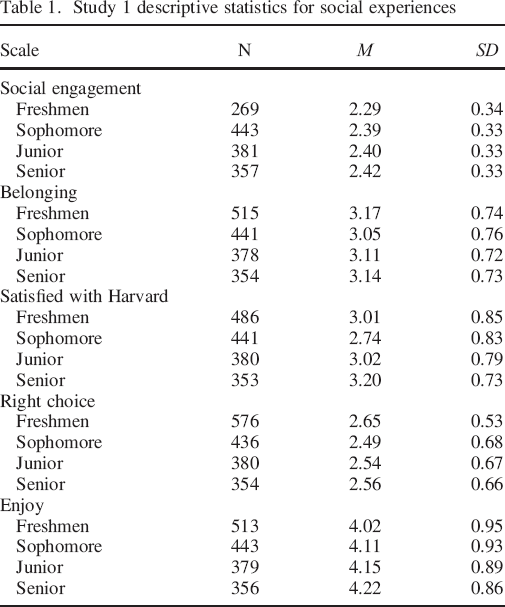
To measure social experiences, we selected the questions and scales that related to peer and social experiences and were assessed at least three times. This left us with two experiences: social engagement and belonging. Descriptive statistics for the social experiences at each time point are found in Table 1. The correlations among the social experiences at each time point are found in Table 2.
Study 1 descriptive statistics for social experiences
Correlations among Study 1 social experiences and college satisfaction
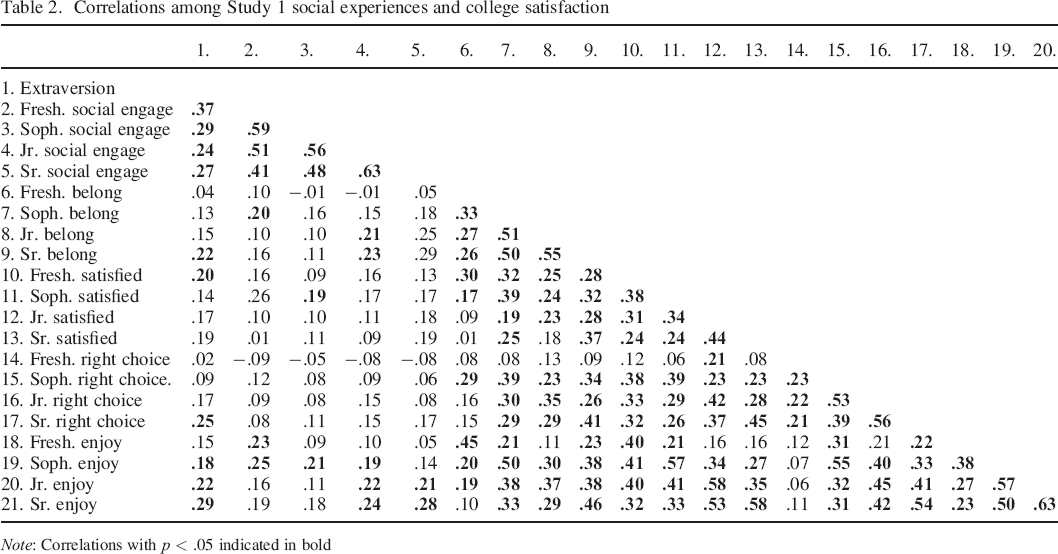
Note: Correlations with p < .05 indicated in bold
Social engagement
Social engagement was a quantitative measure assessed at each time point. Using a list of 16 activities including playing sports, attending plays, and eating out, students were asked to say with whom they engaged in these activities. A rating 1 meant students did the activity alone or with strangers, 2 meant they were accompanied by casual acquaintances, and 3 meant they were accompanied by close friends. A composite measure of social engagement was created by averaging the scores for these activities. A lower score would indicate being less engaged in activities with close others; a higher score would indicate being more engaged in activities with close others. The composite measures showed fair reliability with Cronbach's α between .68 and .74 across all four time points.
Belonging
Sense of belonging was assessed at each time point and served as a qualitative measure. This was measured using the question, ‘Have you ever felt out of place at Harvard?’ Participants responded on a scale from 1 to 4, where 1 is ‘never’ and 4 is ‘most of the time’. This variable was recoded prior to further analyses so that a higher score meant that participants experienced a greater sense of belonging.
Data analysis
We used the lavaan package (Rosseel, 2012) in R to created latent variables for extraversion and college satisfaction. Path models were used to predict senior satisfaction with freshman extraversion. Next, we tested whether extraversion predicted peer experiences throughout college. Finally, we performed longitudinal indirect effects analyses that tested whether social experiences mediated the relationship between extraversion and college satisfaction. The social experiences were tested separately as mediators. In terms of measures, we used all available measures that were related to social experiences and satisfaction. The variables included in the manuscript were the only variables examined, besides the rest of the Big Five, which we also examined for thoroughness. The results for other Big Five personality traits are available on the Open Science Framework (osf.io/6pu3w).
Analyses were conducted using maximum likelihood estimation method to handle the missing data. We used a cross–lagged longitudinal mediation model as depicted in Figure 1 (Maxwell & Cole, 2007). This model is a particularly stringent test of mediation, as it controls both for the stability of the peer experiences and college satisfaction, as well as accounts for the reciprocal effect college satisfaction has on peer experiences. Therefore, the effects estimated in this model are much less biased than the effects estimated in cross–sectional mediation (Maxwell & Cole, 2007). While the cross–lagged longitudinal mediation model we used was the most strenuous test of our hypothesis, it should be noted that there are more parsimonious ways to test the hypotheses. These alternative methods may result in better fit indices. Results for simple mediations are available on the Open Science Framework (osf.io/6pu3w).
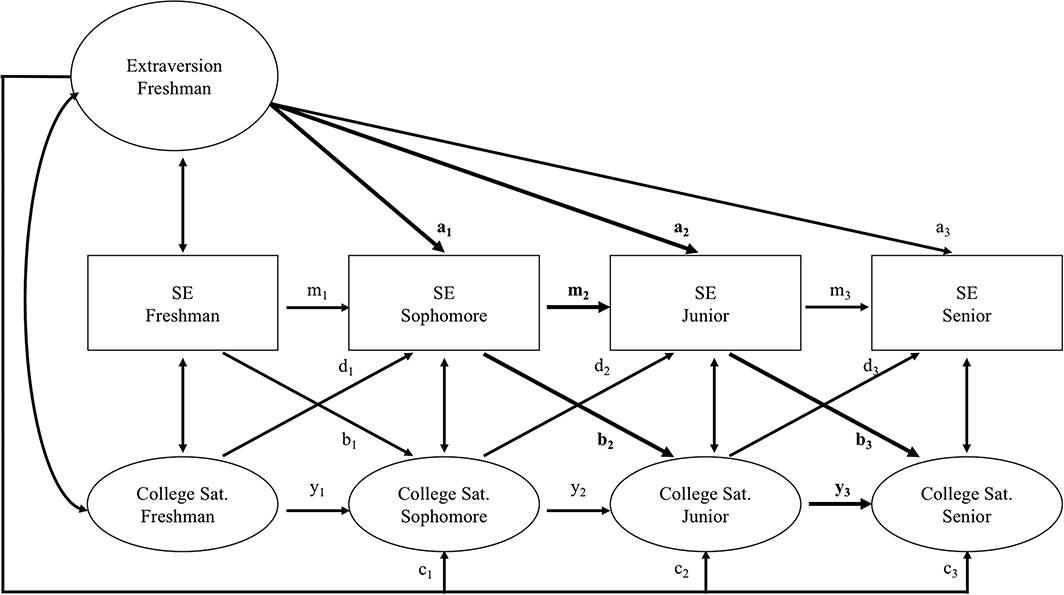
The cross–lagged longitudinal mediation model used to test whether social experiences (SE) mediated the effects of extraversion on college satisfaction, while accounting for the stability of extraversion, social experiences, and college satisfaction. The bold pathways were used to calculate the indirect effects.
The indirect effect was calculated using the regression pathways that form routes from freshman extraversion to senior satisfaction, represented by bold lines in Figure 1. This includes regressing social experiences onto extraversion (i.e. a1 and a2 in Figure 1) and satisfaction onto social experiences (i.e. b2 and b3 in Figure 1), as well as the stability pathways between social experiences (i.e. m2 in Figure 1) and satisfaction (i.e. y3 in Figure 1) as sophomores and juniors. The overall indirect effect was the sum of each individual indirect effect: a1*b2*y3 + a1*m2*b3 + a2*b3. We tested the mediation by estimating the overall indirect effect and using 1000 bootstrapping iterations to provide confidence intervals for the indirect effects (Preacher & Hayes, 2008). The mediation is significant if the confidence intervals do not include zero. Table 3 contains the standardized regression coefficients for each path of the mediation model.
Standardized regression coefficients for the longitudinal mediation models in which social experiences mediate the effects of extraversion on college satisfaction in Study 1
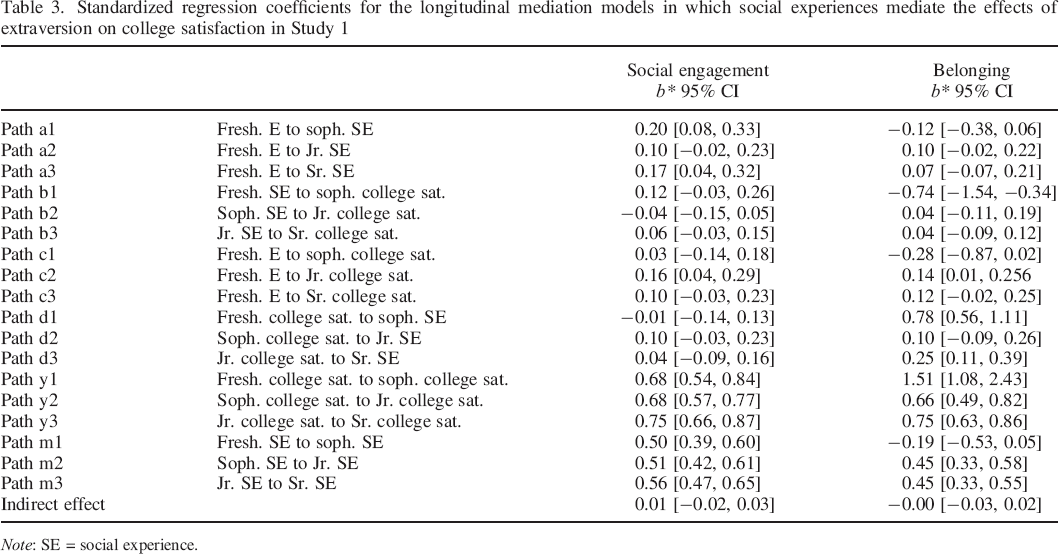
Note: SE = social experience.
Results
Does extraversion predict future satisfaction?
We regressed senior satisfaction onto freshman extraversion. Consistent with past findings, freshman extraversion predicted higher levels of senior satisfaction 4 years later, b* = .41, 95% CIs [0.27, 0.46]. This effect was stronger than the zero–order correlations between extraversion and the individual satisfaction items presented in Table 2; however, this is to be expected when looking at latent associations instead of observed variables.
Does extraversion predict college peer experiences?
Next, we tested whether college peer experiences during sophomore, junior, and senior year were predicted by freshman levels of extraversion, while accounting for the stability of those experiences. Extraversion predicted participating in more social engagement sophomore, b* = 0.19, 95% CIs [0.08, 0.27], and senior year, b* = 0.18, 95% CIs [0.07, 0.30]. The association was marginal junior year, b* = 0.12, 95% CIs [0.00, 0.23]. Extraversion predicted more belonging, as a sophomore, b* = 0.17, 95% CIs [0.05, 0.28], and a senior, b* = 0.14, 95% CIs [0.02, 0.27]. The association was not significant junior year, b* = 0.10, 95% CIs [−0.01, 0.21]. Overall, students higher in extraversion reported better social experiences throughout college.
Do social experiences mediate the effect of extraversion on college satisfaction?
We next tested whether social engagement and belonging mediated the effect of extraversion on later satisfaction. Figure 1 shows the pathways that were used to calculate the overall indirect effect of extraversion on senior satisfaction. The model fit for social engagement was good: χ2(153) = 231.02, p < .001; CFI = .97; and RMSEA = .03 (90% CI [.02, .04]). The indirect effect, b* = 0.01, 95% CI [−0.02, 0.03], was not significant. Social engagement did not mediate the effect of extraversion on satisfaction. The model fit for belonging was fair: χ2(162) = 365.77, p < .001; CFI = .93; and RMSEA = .05 (90% CI [.04, .05]). The indirect effect, b* = 0.00, 95% CI [−0.03, 0.02], was not significant. Belonging did not mediate the effect of extraversion on satisfaction.
Discussion
In Study 1, we examined the relationship between extraversion, social experiences, and satisfaction using a 4–year study of college men. The results indicate that while extraversion predicts future college satisfaction and social experiences throughout college, social experiences do not help explain the association between extraversion and college satisfaction. More extraverted students were more satisfied with college and had more positive social experiences, but they were not more satisfied with college because they had more positive peer experiences.
Study 1 did have some limitations. First, all of the measures of social experiences were self–reported. These self–reports of social experiences are completely subjective and susceptible to method overlap with extraversion and satisfaction, although this would likely increase the association between study variables. Instead of self–reports, this study could have been strengthened by peer–reports of social experiences. Additionally, there is not a measure of happiness or positive affect that would allow for a test of whether these results are unique to college satisfaction or are shared by the affective component of subjective well–being. Finally, Study 1 was an extremely homogenous sample. It is unclear how well these results will generalize to a more modern sample with more diverse participants. Several of these issues are addressed in Study 2.
Study 2: Transition to Stanford Study
Study 2 builds upon Study 1 in several ways. In addition to Study 2 offering a more diverse sample than Study 1, it also offers some methodological improvements. In Study 1, we utilized a variety of self–reported social experience measures to examine why extraversion is associated with college satisfaction 4 years later. Self–reports of social experiences can be biased by affective states, such that people who are in better moods are more likely to cast their experiences and social interactions in a positive light (Forgas, Bower, & Krantz, 1984), and positive self–views, such that people with high self–esteem rate themselves as more popular (Reitz, Motti–Stefanidi, & Asendorpf, 2016). Furthermore, self–reports of social experiences and extraversion could suffer from common method variance, such that people high in extraversion think their social experiences are more fulfilling and occur more frequently. Informants are often privy to information about us that we might not know ourselves, so having informant reports of participants’ social lives could provide unique information (Jackson et al., 2015; Vazire, 2010). Thus, in Study 2, we included both self–report and informant–report of social experiences throughout college and tested whether the findings from Study 1 would replicate.
Additionally, Study 2 assesses extraversion before participants entered college, which allows us to account for the potential reverse causation of social experiences influencing extraversion ratings. This design thus provides a better test of whether extraversion is associated with the formation of new social experiences. Some social experiences were also assessed before college, allowing us to isolate college–specific experiences.
As in Study 1, we utilize two categories of social experiences in Study 2. In addition to belonging, which is assessed in both studies, Study 2 assesses social network size and social connection in order to determine whether the effects from Study 1 generalize to other social experiences. Social network size is a quantitative social experience that has been associated with subjective well–being. People with more friends tend to have better subjective well–being (Van der Horst & Coffé, 2012). Social connection, or feeling close and intimate with others, is a qualitative social experience associated with better subjective well–being in adolescents through adults (Busch & Hofer, 2012; Lee, Dean, & Jung, 2008; Olsson, McGee, Nada–Raja, & Williams, 2013). Conversely, being lonely, or less social connected, is linked to depression (Cacioppo, Hughes, Waite, Hawkley, & Thisted, 2006b; Hawkley & Cacioppo, 2010). The peer reports of social experiences also fell into the two categories. Peer–reports of time spent socializing was a quantitative measure of social experiences, and peer–reported social connection and belonging were qualitative measures.
In Study 1, we used college satisfaction as our measure of subjective well–being, but in Study 2, we attempt to replicate the findings in Study 1 using measures of life satisfaction and happiness. College satisfaction and life satisfaction are highly correlated (Loundsbury, Saudargas, Gibson & Leong, 2005), so we expected the results to be similar across studies. The addition of a happiness measure allows us to compare any differences between it and life satisfaction and determine whether social experiences have differing effects on the affective and cognitive components of well–being, respectively. We expect life satisfaction and happiness to show a similar pattern of results.
Once again, we raised three questions about the relationship among extraversion, subjective well–being, and college social experiences. First, we examine whether extraversion measured before college predicts future well–being. Then, we asked whether extraversion predicted self–reported and peer–reported college experiences. Finally, we asked whether college social experiences mediated the positive effect of extraversion on life satisfaction and happiness.
Methods
Participants
Study 2 uses longitudinal data from a larger study of college adjustment conducted at Stanford between the years 2000 and 2004. 2 Students completed their first assessment during the summer prior to their first semester of college. Follow–up assessments occurred during the spring quarters of their freshmen, sophomore, junior, and senior years. Data were available for 393 students (60% female) who completed personality assessments the summer before college and assessments of social experiences and subjective well–being measures senior year. The sample was ethnically diverse: 58% Caucasian, 34% Asian/Asian–American, 10% Latino/a, 6% African–America, 4% Native America, and 5% other. These percentages sum to over 100% because students were allowed to select more than one ethnic identity. The data for Study 2 are not openly accessible; however, a codebook is available on the Open Science Framework (osf.io/6pu3w).
Measures
Extraversion
Extraversion was measured at the first time point (i.e. summer prior to college) using the eight extraversion items from the 44–item Big Five Inventory (John & Srivastava, 1999). After using modification indices to improve the fit of our measurement model, we allowed some items of the scale to correlate with each other. Please see the scripts on the Open Science Framework (osf.io/6pu3w) for more details. The measurement model had a good fit, χ2(15) = 27.78, p < .001; CFI = .99; and RMSEA = .05 (90% CI [.02, .07]).
Life satisfaction
Life satisfaction was measured during all five assessments using the Satisfaction with Life Scale (Diener, Emmons, Larsen, & Griffin, 1985). There were five questions that participants responded to on a scale from 1 to 7, ‘strongly disagree’ to ‘strongly agree’. Participants’ responses were averaged together to create a composite variable of life satisfaction, α = .85.
Happiness
Happiness was measured during all five assessments using a single item. Students were asked to indicate how often during the last quarter the phrase ‘I am happy’ described them during the last quarter. They responded on a scale from 1 to 4, with 1 being ‘rarely or none of the time’ and 4 being ‘most or all of the time’.
Social experiences
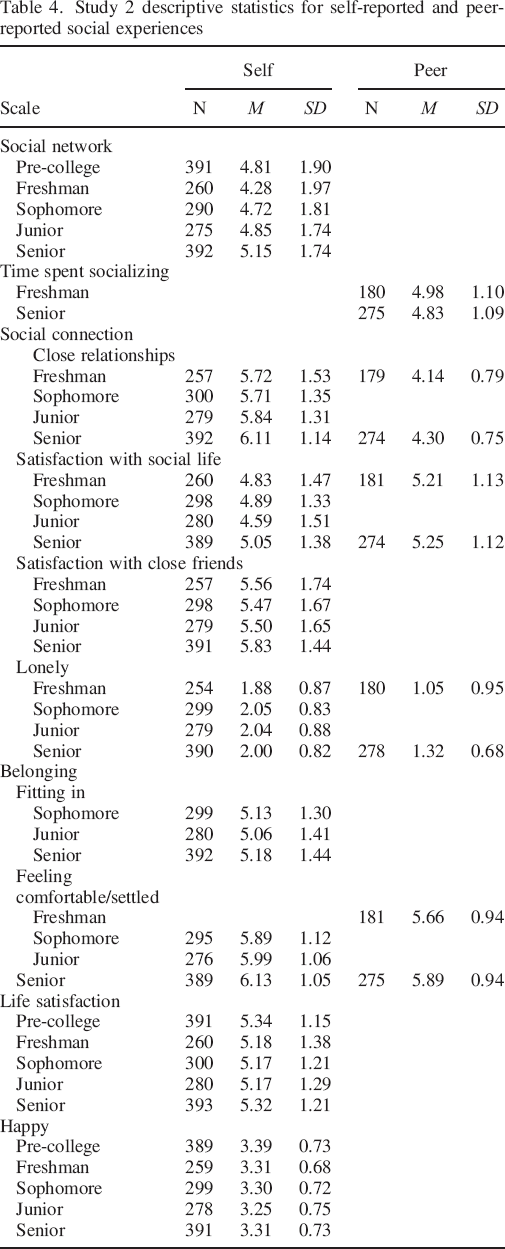
From the data set, we selected all of the self–reported questions that related to peer and social experiences that were assessed at least three times. Additionally, we selected peer–reported social experiences that we assessed in the spring of students’ freshman and senior years. The descriptive statistics of self–reported and peer–reported social experiences are included in Table 4. The correlations among extraversion, self–reported social experiences, and subjective well–being are found in Table 5. The correlations of extraversion, peer–reported social experiences, and subjective well–being are included in Table 6.
Study 2 descriptive statistics for self–reported and peer–reported social experiences
The correlations among self–reported social experiences and subjective well–being in Study 2
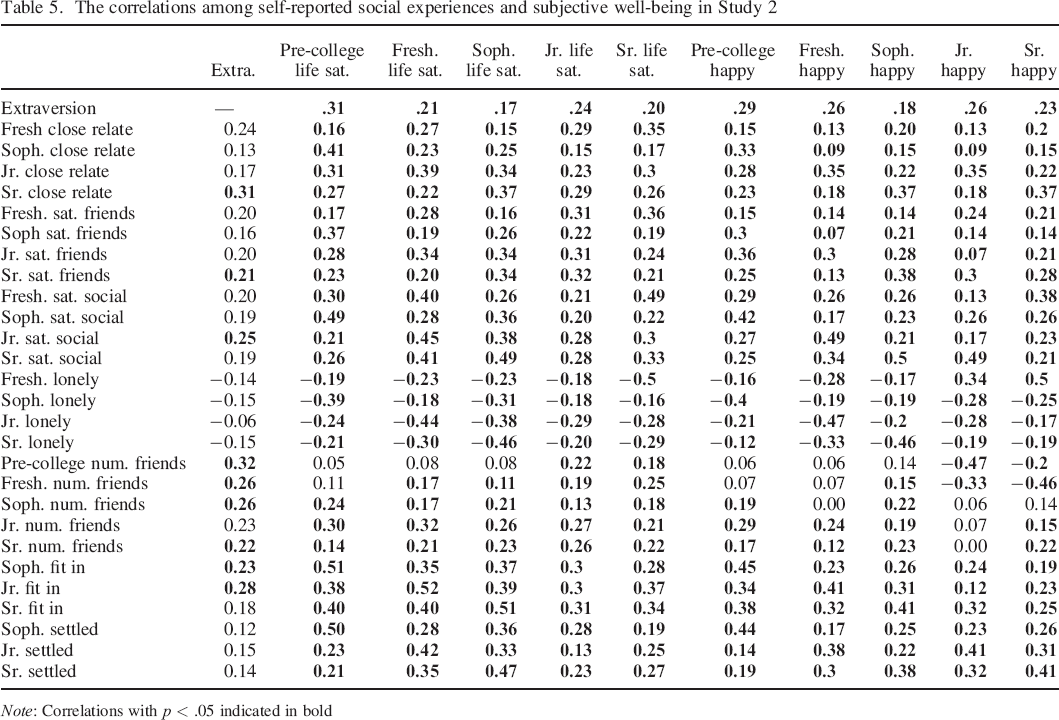
Note: Correlations with p < .05 indicated in bold
The correlations among peer–reported social experiences and self–reported well–being in Study 2
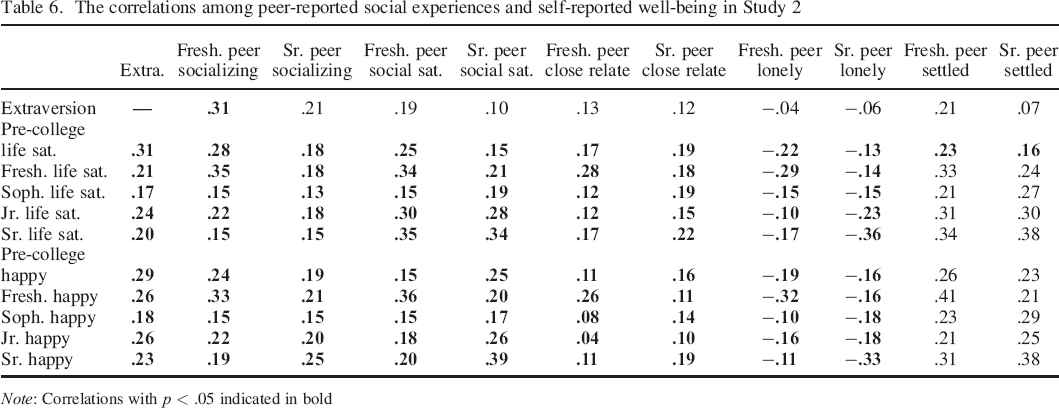
Note: Correlations with p < .05 indicated in bold
Self–reported social experiences
Social network size
At each assessment, participants were asked, ‘How many close friends do you have? (meaning people that you feel at ease with, can talk to about private matters, and can call on for help)’. In the pre–college assessment and the spring of freshman year assessment, participants could respond from 0 to 7+. For the sophomore, junior, and senior year spring assessments, students could free respond with their number of friends, but these responses were recoded to match the initial 0 to 7+ scale.
Social connection
Social connection was assessed by combining four items into a latent variable. At all four spring assessments, students were asked to consider the last quarter or year and how much they agreed with the statement ‘I had close relationships with others’. They responded on a seven–point scale, with 1 being ‘disagree’ and 7 being ‘agree’. At all four spring assessments, students were asked ‘How satisfied are you with your social life at Stanford?’ to which they responded on a seven–point scale, with 1 being ‘very dissatisfied’ and 7 being ‘very satisfied’. At the pre–college assessment and at all four spring assessments, students were asked ‘How satisfied are you with the number and quality of your close friendships?’ They could respond on a seven–point scale from ‘very dissatisfied’ to ‘very satisfied’. The final item in social connection was loneliness. Students were asked to indicate how often during the past quarter the statement ‘I am lonely’ described them. They responded on a scale from 1 to 4, with 1 being ‘rarely or none of the time’ and 4 being ‘most or all of the time’. These variables were highly correlated at each time point (r = .57 to .86). The measurement model had a good fit, χ2(74) = 129.58, p < .001; CFI = .96; and RMSEA = .04 (90% CI [.03, .06]).
Belonging
Belonging was measured using two items: ‘I fit in really well at Stanford’ and ‘How settled in (comfortable, at home) do you feel at Stanford right now?’ The former item was assessed at all four college time points. Students responded on a scale from 1 to 7, ‘disagree’ to ‘agree’. The latter item was asked in the sophomore, junior, and senior year assessments. Students responded on a scale from 1 to 7, ‘not at all’ to ‘very’. These variables were highly correlated at each time point (r = .75 to .86). The measurement model had a fair fit, χ2(6) = 59.53, p < .001; CFI = .92; and RMSEA = .15 (90% CI [.12, .19]).
Peer–reported social experiences
Students nominated three to four peers as informants at the end of the spring quarters of their freshman and senior years. The peers completed assessments regarding the participants’ experience in the previous quarter. Peer questionnaires were similar to the questionnaires the students received, but shorter. Peer reports from the same point were averaged together in these analyses.
Time spent socializing
Peers were asked to indicate on as scale from 1 to 7—‘not at all’ to ‘a great deal’—to what extent the participant spends time socializing.
Social connection
Peer–reported social connection was assessed by two questions also used in the self–reported social connection. Informants indicated whether they felt the participant had close relationships on a scale from 1 to 5, ‘strongly disagree’ to ‘strongly agree’. Informants also indicated the extent to which the participant felt ‘lonely, isolated’ during the previous quarter on a scale from 0 to 4, ‘not at all’ to ‘extremely’. These items were placed in a latent variable. The measurement model had good fit, χ2(7) = 16.84, p < .001; CFI = .97; and RMSEA = .07 (90% CI [.03, .11]).
Belonging
Peer–reported belonging was assessed by one the same question we used for self–report: ‘How settled in (comfortable, at home) does the participant seem to be at Stanford?’ Informants responded on a scale from 1 to 7, ‘not at all’ to ‘very’.
Data analysis
Similar to Study 1, we used the lavaan package (Rosseel, 2012) in R to created latent variables for pre–college extraversion and the following social experiences: self–reported social connection, self–reported belonging, and peer–reported social connection. Once again, we used all available measures that were related to social experiences and satisfaction. The variables included in the manuscript were the only variables examined, besides the rest of the Big Five, which we also examined for thoroughness. The results for other Big Five personality traits are available on the Open Science Framework (osf.io/6pu3w). We used path models to predict senior satisfaction with pre–college extraversion. We then used path models to predict self–reported and peer–reported social experiences throughout college with pre–college extraversion. Finally, as in Study 1, we performed cross–lagged longitudinal mediation analyses that tested whether social experiences mediated the relationship between extraversion and life satisfaction and happiness (Maxwell & Cole, 2007). The paths from pre–college extraversion to senior life satisfaction and happiness, represented by the bold paths in Figures 2 and 3, are used to calculate the overall indirect effects in the same manner as in Study 1.
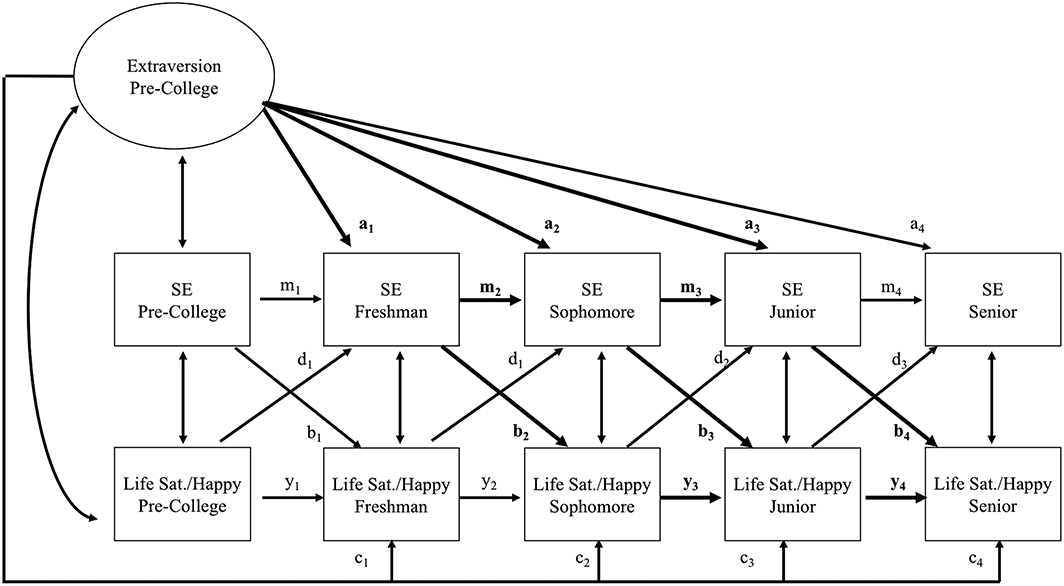
Cross–lagged longitudinal mediation model used to test whether social experiences (SE) mediated the effects of extraversion on life satisfaction/happiness, while accounting for the stability of social experiences and life satisfaction/happiness. The model for number of close friends uses observed variables for social experiences, whereas the models for social connection and belonging use latent variables. The model for number of connections contains all of the variables and pathways shown. The model for social connection does not include an assessment of pre–college social experience. The model for belonging does not include assessments of pre–college or freshman social experiences. The bold pathways were used to calculate the indirect effects.
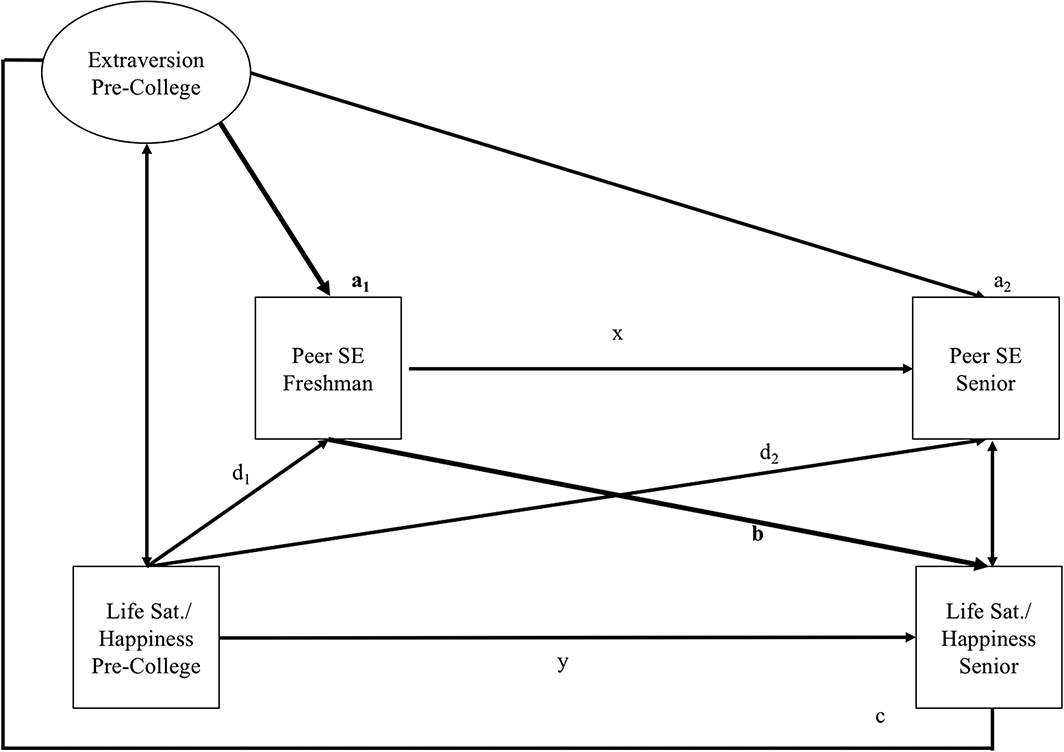
Longitudinal mediation model of pre–college extraversion, peer–reported social experiences (SE), and life satisfaction, while controlling for the stability of social experiences and life satisfaction. The bold pathways were used to calculate the indirect effects.
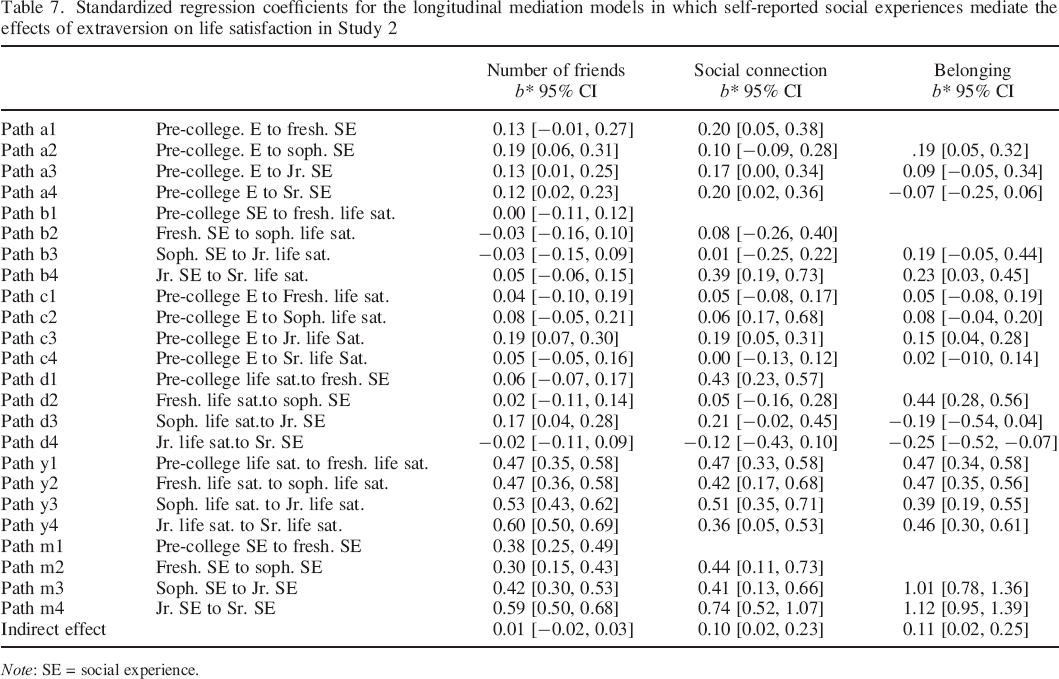
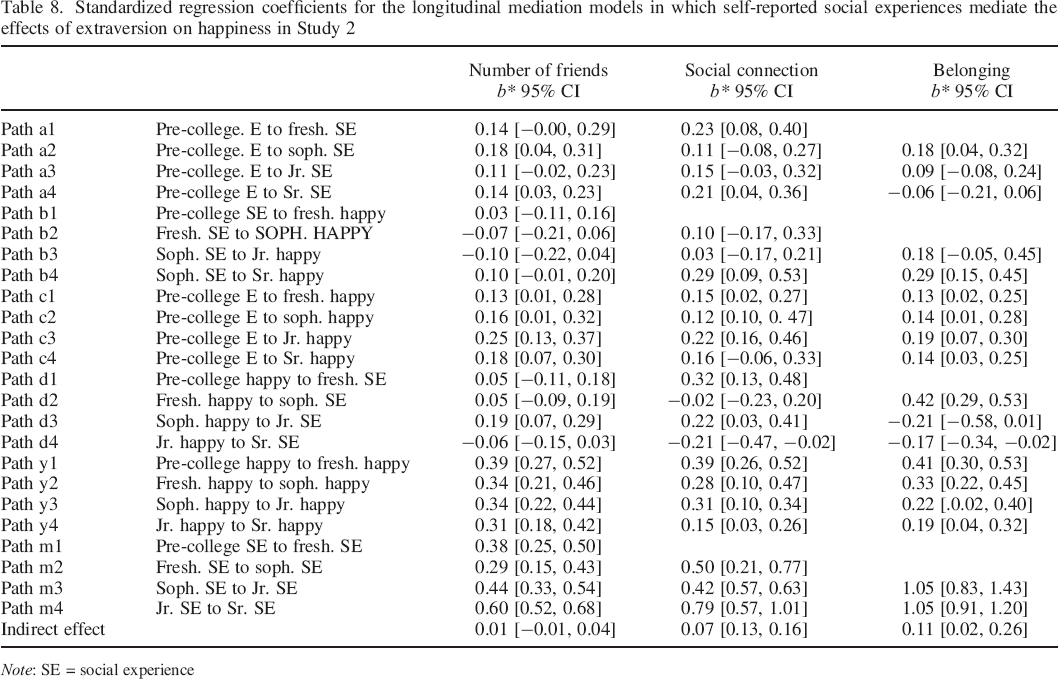
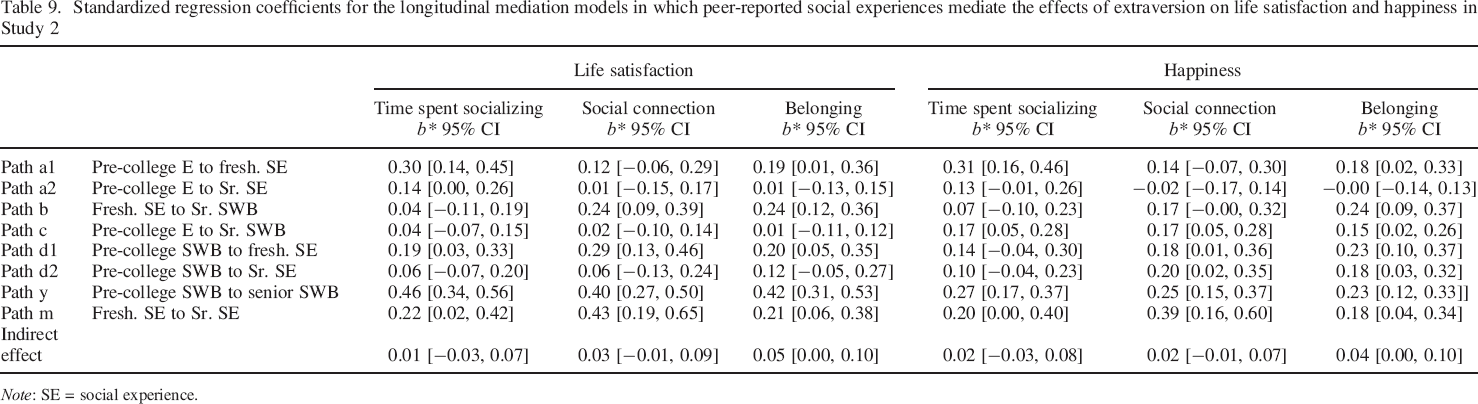
The model we used for self–reported peer experiences is represented in Figure 2. The model we used for peer–reported peer experiences is represented in Figure 3. Tables 7 and 8 contain the standardized regression coefficients for each path of the model in which self–reported social experiences mediate the effect of extraversion on life satisfaction and happiness, respectively. The standardized regression coefficients for the models using peer–reported social experiences are located in Table 9, with life satisfaction and happiness as the dependent variables, respectively. Correlations among the self–rated and peer–rated social experience items, along with the results of the mediation for social experiences as individual items rather than latent variables, are available in the Supporting Information as well as on the Open Science Framework (osf.io/6pu3w).
Standardized regression coefficients for the longitudinal mediation models in which self–reported social experiences mediate the effects of extraversion on life satisfaction in Study 2
Note: SE = social experience.
Standardized regression coefficients for the longitudinal mediation models in which self–reported social experiences mediate the effects of extraversion on happiness in Study 2
Note: SE = social experience
Standardized regression coefficients for the longitudinal mediation models in which peer–reported social experiences mediate the effects of extraversion on life satisfaction and happiness in Study 2
Note: SE = social experience.
Results
Does extraversion predict future life satisfaction and happiness?
We first examined the relationship between pre–college extraversion and senior year satisfaction. As expected, high extraversion before college predicted higher satisfaction as a college senior, b* = 0.20, 95% CI [0.10, 0.31]. High extraversion before college also predicted happiness, b* = 0.25, 95% CI [0.13, 0.36].
Does extraversion predict college social experiences?
Next, we tested whether college self–reported social experiences during freshman, sophomore, junior, and senior year were predicted by extraversion measured prior to students starting college, while also accounting for the stability of the social experience. Extraversion predicted self–reports of having more close friends as a freshman, b* = 0.415, 95% CI [0.13, 0.34]; sophomore, b* = 0.19, 95% CI [0.16, 0.40]; junior, b* = 0.14, 95% CI [0.16, 0.40]; and senior, b* = 0.12, 95% CI [0.16, 0.40]. Extraversion predicted being more social connected being more socially connected as a freshman, b* = 0.36, 95% CI [0.12, 0.38]; junior, b* = 0.16, 95% CI [0.23, 0.48]; and senior, b* = 0.19, 95% CI [0.23, 0.48], but not as a sophomore, b* = 0.10, 95% CI [0.23, 0.48]. Finally, extraversion predicted belonging as a sophomore, b* = 0.19, 95% CI [0.05, 0.32], but not as a junior, b* = 0.12, 95% CI [0.12, 0.42], or senior, b* = −0.09, 95% CI [0.12, 0.42].
We also tested whether peer–reported social experiences during freshman and senior year were predicted by extraversion measured prior to students starting college, while accounting for stability in the peer–reported peer experiences. Extraversion predicted peer–reports of more time spent socializing as a freshman and senior, b* = 0.36, 95% CI [0.21, 0.49] and b* = 0.22, 95% CI [0.15, 0.30], and more social connection, b* = 0.21, 95% CI [0.05, 0.37], and more belonging, b* = 0.23, 95% CI [0.09, 0.41], as freshmen. Extraversion did not predict peer–reported social connection, b* = 0.04, 95% CI [−0.11, 0.20], or belonging, b* = 0.05, 95% CI [−0.08, 0.19], as a senior.
Do self–reported social experiences mediate the effect of extraversion on life satisfaction and happiness?
We next tested whether the number of close friends, social connection, and belonging mediated the effect of extraversion on life satisfaction. The model fit for number of close friends was fair: χ2(109) = 347.59, p < .001; CFI = .91; and RMSEA = .08 (90% CI [.07, .08]), with the indirect effect, b* = 0.01, 95% CI [−0.02, 0.03], indicating that number of close friends in college did not explain the effect of extraversion on life satisfaction. The model fit for social connection was fair: χ2(326) = 600.05, p < .001; CFI = .93; and RMSEA = .05 (90% CI [.04, .05]). The indirect effect, b* = 0.10, 95% CI [0.02, 0.23], was significant, indicating that students higher in extraversion were more socially connected than less extraverted students, which led them to be more satisfied with life. Similarly, the model fit for belonging was fair: χ2(130) = 373.69, p < .001; CFI = .92; and RMSEA = .07 (90% CI [.06, .08]), with a significant indirect effect, b* = .11, 95% CI [0.02, 0.25]. Students high in extraversion felt more like they belonged at university, and this sense of belonging led them to be more satisfied with life.
After testing whether self–reported social experiences mediated the effect of extraversion on life satisfaction, we tested whether these experiences mediated the effect of extraversion on happiness. The model fit for number of close friends was fair: χ2(109) = 284.90, p < .001; CFI = .92; and RMSEA = .06 (90% CI [.06, .07]), with a non–significant indirect effect, b* = 0.01, 95% CI [−0.01, 0.04], indicating that number of close friends in college did not explain the effect of extraversion on happiness. The model fit for social connection was fair: χ2(326) = 576.27, p < .001; CFI = .94; and RMSEA = .04 (90% CI [.04, .05]). The indirect effect, b* = 0.07, 95% CI [0.02, 0.25], was significant. Students higher in extraversion were more socially connected than less extraverted students, which lead them to be happier as seniors. The model fit belonging was fair: χ2(130) = 316.23, p < .001; CFI = .93; and RMSEA = .06 (90% CI [.05, .07]), with a significant indirect effect, b* = .11, 95% CI [0.02, 0.26]. Students who started college higher in extraversion had a greater sense of belonging throughout college, which lead them to be happier as seniors.
Do peer–reported social experiences mediate the effect of extraversion on life satisfaction and happiness?
We next tested whether peer–reported time spent socializing, social connection, and belonging mediated the effect of extraversion on satisfaction. The model fit for time spent socializing was good: χ2(43) = 88.59, p < .001; CFI = .97; and RMSEA = .05 (95% CI [.04, .07]). The indirect effect, b* = 0.01, 95% CI [−0.03, 0.07], was not significant. The model fit for social connection was good: χ2(90) = 160.79, p < .001; CFI = .97; and RMSEA = .05 (90% CI [−.01, .09]). The indirect effect, b* = .03, 95% CI [−0.01, 0.09], was not significant. The model fit belonging was good: χ2(43) = 84.99, p < .001; CFI = .98; and RMSEA = .05 (90% CI [.03, .07]). The indirect effect, b* = 0.05, 95% CI [0.00, 0.10], was not significant. Peer–reported social experiences did not mediate the effect of extraversion on life–satisfaction.
We finally tested whether peer–reported time spent socializing, social connection, and belonging mediated the effect on happiness. The model fit for time spent socializing was fair: χ2(46) = 96.58, p < .001; CFI = .97; and RMSEA = .06 (90% CI [.04, .07]). The indirect effect, b* = 0.02, 95% CI [−0.03, 0.08], was not significant. The model fit for social connection was fair: χ2(90) = 156.65, p < .001; CFI = .97; and RMSEA = .04 (90% CI [.03, .06]). The indirect effect, b* = .02, 95% CI [−0.01, 0.07], was not significant. The model fit belonging was fair: χ2(43) = 86.13, p < .001; CFI = .97; and RMSEA = .05 (90% CI [.04, .07]). The indirect effect, b* = 0.04, 95% CI [0.00, 0.10], was not significant. Peer–reported social experiences did not mediate the effect of extraversion on happiness.
Discussion
Study 2 has some methodological advantages to Study 1. We were able to control for pre–college social experiences in our analysis of social network size, thus allowing a stronger inference about extraversion's ability to predict novel social experiences in college. Study 2 also offered more comprehensive measures of social experiences by including social network size and social connection. The results of Study 2 were similar to the results of Study 1 with regard to the effects extraversion had on subjective well–being and on social experiences. Extraversion assessed before college predicted being more satisfied with life and happier 4 years later. Further, extraversion predicted both self–reported and peer–reported social experiences throughout college, suggesting that the association between extraversion and social experiences is not due to method bias. Unlike Study 1, there was some evidence that the self–reported quality of social experiences led to better well–being, although the findings also suggest that quantitative social experiences did not explain the extraversion subjective well–being association.
General Discussion
In two longitudinal samples, we examined whether social experiences could explain why college students high in extraversion experienced greater subjective well–being compared with students low in extraversion. In both studies, extraversion before or during the first year of college had long–lasting effects, predicting satisfaction and happiness 4 years later. Moreover, in both studies, extraversion predicted spending more time with peers and having better quality social experiences. We used cross–lagged longitudinal mediation models to test our central question of whether social experiences mediate the effect of extraversion on satisfaction. These models were a stringent way to test for the mediation and have not been used to address this question before. 3 We found mostly null results. In Study 1, we did not find that social experiences mediate the relationship between extraversion and college satisfaction, whereas in Study 2, we found that the effects of extraversion on life satisfaction and happiness were due in part to self–reported social experiences. Specifically, only the self–reported qualitative aspects of social experiences influenced life satisfaction and happiness, suggesting that the quality of social experiences (and not quantity) might be more important for subjective well–being. However, because the effects were small, were not present in both studies, and were not reflected in peer–reports, the results are by no means definitive. Because we were examining that the participant's felt quality of social experiences, there might also have been temperamental effects that explained the associations. In this way, we replicate previous research that has also been inconsistent in identifying instrumental effects of extraversion on satisfaction through social experiences (e.g. Lucas et al., 2008; Smillie et al., 2015; Srivastava et al., 2008).
Unique to this paper is the use of two longitudinal data sets that track students over the 4 years they are in college. Previous studies examining social experiences as a pathway from extraversion to well–being have either taken place in a lab or had a shorter timeframe, such as a couple of weeks (Fleeson et al., 2002; Lucas et al., 2008; Srivastava et al., 2008). Several features of the design make our study a particularly strong test of the instrumental view. First, the ability to control for the stability of social experiences and subjective well–being in both studies, as well as the stability of extraversion in Study 1, is an asset of the longitudinal designs of these studies. Our cross–lagged mediation model constitutes the strongest test available for our hypotheses. These analyses have not been used to examine the associations between personality, social experiences, and subjective well–being. Accounting for stability in the models created a more robust test of the mediation by reducing measurement biases that could occur from examining the associations cross–sectionally (Maxwell & Cole, 2007). As a result, although the support we find for the instrumental view, which argues that extraversion shapes satisfaction through experiences (Hampson, 2012; Heller et al., 2004; Lucas et al., 2008; Srivastava et al., 2008), in Study 2 is small, it is robust. These results provide some evidence that more extraverted students are also more satisfied with life and happier because of the social experiences into which they select themselves. Relatedly, life satisfaction and happiness, along with one social experience variable in Study 2, social network size, were measured before college. Accounting for life satisfaction, happiness, and social network size before students even entered college allows us to infer that the assessments during college would reflect unique experiences within college and were not byproducts of previous life satisfaction or social structures.
Another design strength was the inclusion of peer–reports of social experiences, as peer–reports offer a bit more objectivity by providing an outside perspective from the self. Peers are particularly well suited to assessing traits and behaviours with high observability, such as going to parties or club meetings (Vazire & Mehl, 2008). It is notable then, that the self–report and peer–report of qualitative peer experiences showed different results, as those experiences are more internal and therefore less easily observed. Indeed, extraversion only predicted peer–reports of quantitative social experiences; it was unrelated to peer–reports of qualitative social experiences. Had the divergence between self–report and peer–report occurred for the results of the quantitative peer experiences, we would be more inclined to defer to the peer reports. However, for these qualitative social experiences, perhaps the relative objectivity peer reports offer should not hold as much weight, because qualitative social experiences are by nature subjective and experiential. Extraverts claim that they have better quality social experiences might well be all in their heads, rather than based on some objective reality. But if these claims lead them to being more satisfied or happier, maybe in this case, objectivity is overrated.
Extraversion predicted all of the self–reported social experiences in both studies. However, neither quantitative measure in either study had an effect on satisfaction or happiness. That is, the number of activities students did with friends and students’ social network size did not make them more satisfied or happier. As for qualitative peer experiences, the results of Study 1 suggested that there was no effect, whereas the results of Study 2 suggested that there was an effect. Perhaps, like the tests of social reactivity (Oerlemans & Bakker, 2014), more nuance is needed to properly determine what kind of social experiences matter to which kind of subjective well–being. For example, measuring an experience that taps into status or popularity might provide the social rewards that extraverts are more likely to approach. Asking about how often students participate in higher arousal social experiences, like parties, compared with lower arousal social experiences, like going to the movies with friends, might also address the differences in how introverted and extraverted students’ subjective well–being are affected by social experiences.
Previous research examining the relationship among extraversion, social experiences, and subjective well–being has focused on happiness (e.g. Oerlemans & Bakker, 2014; Smillie et al., 2015; Srivastava et al., 2008). This paper expands upon that research by examining life satisfaction in addition to happiness. While there is some evidence that life satisfaction and happiness are not always affected by life events in the same way (Luhmann et al., 2012), in our study, the pattern of results was largely the same for both.
Our findings replicate previous research and suggest that extraversion guides the selection of new social environments, such that students high in extraversion may have an easier time making new friends, hanging out with them, and enjoying their new college social environment (Asendorpf & Wilpers, 1998; Selfhout et al., 2010). While social experiences with peers, in particular, are important for satisfaction in college, it is possible that these types of social experiences are less important during other ages. For many people, college is a social setting as well as an academic one, where socializing and peer interactions are as important as academics and doing well in their classes. The emphasis on peers and the exploration of new peer groups wane with age, however. People begin to prioritize other domains, like family or work, and they report having fewer friends in their social networks (Wrzus, Hänel, Wagner, & Neyer, 2013). Social experiences with peers may have less impact on life satisfaction with age as other domains become more prominent in one's life. However, people high in extraversion tend to have larger social networks across the lifespan (Lang, Staudinger, & Carstensen, 1998), so it is possible that even as social networks are pruned, highly extraverted people will retain more friends who aide with keeping them satisfied with life.
Limitations
Both samples were from elite universities, which might limit how generalizable the results will be to college students more broadly. The sample also affects the understanding of the belonging measures. It is possible that belonging is not a purely social measure but could also be tapping into issues of class and academic self–efficacy (Freeman, Anderman, & Jensen, 2007; Reay, Crozier, & Clayton, 2010). Students from more modest socio–economic backgrounds might feel out of place because they care surrounded by people with wealthier backgrounds (Reay et al., 2010). Students who are struggling academically might feel as though they do not belong because everyone else appears to be smarter than them (Freeman et al., 2007). Even though extraversion predicted belonging in both studies and belonging mediated the relationship between extraversion and life satisfaction and happiness in Study 2, there might be more to this measure than just being a social experience. Future research would be well to tease apart what it means to ‘belong’ in college, how personality affects these different types of belonging, and how a more specified measure of belonging might influence students’ well–being.
Neither study included an objective behavioural measure. It is important to note that peer reports are subjective measures, just as self–reports, and therefore are subject to biases. So while we might ask participants a question that seems like it should be fairly objective, for example ‘How many friends do you have?’ the participant's response could be influenced by things like their current self–esteem (Reitz et al., 2016). While we attempted to account for the effect satisfaction and happiness might have on social experience self–ratings by incorporating prior satisfaction and happiness in the model, a behavioural measure would be a stronger test.
Conclusion
The two studies presented here show that extraversion has long–lasting influence on social experiences and satisfaction during early adulthood. The results lend tentative support to the instrumental view, in which extraversion influences subjective well–being via behaviours and experiences, and suggest that only in some cases does engaging in social relationships help people experience greater subjective well–being. However, only the subjective quality, not quantity, of social experiences partially explained the relationship, suggesting there is a lingering possibility relationship may be due to temperamental factors as well as instrumental ones.
Supporting info item
Supporting info item, per2101-sup-0001-supplementary - Why Are Extraverts More Satisfied? Personality, Social Experiences, and Subjective Well–Being in College
Supporting info item, per2101-sup-0001-supplementary for Why Are Extraverts More Satisfied? Personality, Social Experiences, and Subjective Well–Being in College by Harris Kelci, English Tammy, Harms Peter D., Gross James J., Jackson Joshua J. and Back MitjaProf. in European Journal of Personality
Data S1. Supporting info item
Table S1. The correlations among self-reported and peer-reported social experiences in Study 2.
Table S2. The correlations among self-reported social experiences in Study 2.
Table S3. The correlations among peer-reported social experiences g in Study 2.
Table S4. Standardized regression coefficients for the longitudinal mediation models in which self-reported social experiences mediate the effects of extraversion on life satisfaction in Study 2.
Table S5. Standardized regression coefficients for the longitudinal mediation models in which self-reported social experiences mediate the effects of extraversion happiness in Study 2.
Open Practices Disclosure
Open Practices Disclosure, per2101-sup-0002-supplementary - Why Are Extraverts More Satisfied? Personality, Social Experiences, and Subjective Well–Being in College
Open Practices Disclosure, per2101-sup-0002-supplementary for Why Are Extraverts More Satisfied? Personality, Social Experiences, and Subjective Well–Being in College by Harris Kelci, English Tammy, Harms Peter D., Gross James J., Jackson Joshua J. and Back MitjaProf. in European Journal of Personality
Footnotes
Acknowledgement
This research was supported by a grant from the National Institutes of Health (R01 MH58147) awarded to James J. Gross.
Notes
References
Supplementary Material
Please find the following supplemental material available below.
For Open Access articles published under a Creative Commons License, all supplemental material carries the same license as the article it is associated with.
For non-Open Access articles published, all supplemental material carries a non-exclusive license, and permission requests for re-use of supplemental material or any part of supplemental material shall be sent directly to the copyright owner as specified in the copyright notice associated with the article.
