







Abstract
The objectives of the present study were twofold. First, we tested a new approach to affect regulation dynamics, conceptualized as a network made up of the reciprocal influences that affect and affect regulation strategies constantly exert on each other. Second, we attempted to gain a better understanding of these dynamics by examining how they vary according to broad personality traits. To this end, we adopted an experience sampling method, involving five daily assessments over a 2–week period. In each assessment, participants indicated their current affective experience and the way they had implemented five well–known affect regulation strategies (i.e. appreciation, positive reappraisal, distraction, expressive suppression, and rumination) since the previous assessment. At the sample level, the network of affect regulation dynamics was characterized by positive feedback loops between positive affect and so–called broad–minded strategies, and between negative affect and narrow–minded strategies. The form of this network varied according to levels of extraversion and neuroticism. Our findings are discussed in light of current knowledge about personality and affect regulation. Copyright © 2017 European Association of Personality Psychology
Introduction
Affect regulation is involved in many important areas of individuals’ lives, including health, wellbeing, and career success (Mikolajczak & Desseilles, 2012). There have therefore been frequent attempts to understand it. These attempts have often emphasized the dynamic nature of its processes. Specifically, for many decades, the prevailing models of affect regulation have highlighted the way regulatory processes, especially affect regulation strategies (i.e. the strategies individuals can use to modify their affect), influence both current and subsequent affective experiences (Gross, 1998; Lazarus & Folkman, 1984). By contrast, these same models have long overlooked the regulatory role played by affective experiences, thus neglecting the reciprocal influences that experiencing affect and implementing affect regulation strategies can exert on each other. Yet, an integrative perspective considering the possible interplay between affect and affect regulation strategies might more fully explain the dynamics of affect regulation than an approach focusing solely on the dependence of affect on affect regulation strategies (Philippot, 2011). Furthermore, the new network approaches (Schmittmann, Cramer, Waldorp, Epskamp, Kievit, & Borsboom, 2013) that are starting to emerge in the psychology literature provide the methodological tools needed to test the hypothesis that the dynamics of broad psychological phenomena (e.g. affect regulation) rely on reciprocal influences between more specific variables (e.g. affect and affect regulation strategies).
Affect regulation dynamics may also be understood more deeply by examining how they differ from one person to another. The stable disposition to feel certain affects or use certain affect regulation strategies is known to vary according to interindividual differences in personality traits (Carver & Connor–Smith, 2010). However, the impact of these interindividual differences on affect regulation dynamics has rarely been examined, even though their contribution to dynamic psychological processes has been recognized for at least two decades (Mischel & Shoda, 1995).
The present study was designed to improve current knowledge of affect regulation dynamics. To this end, we attempted to address the neglected issues of interindividual differences in these dynamics and the influence of affective experiences on the use of affect regulation strategies. Specifically, we adopted a network approach to test a conceptualization of affect regulation dynamics whereby affective experience and affect regulation strategy use constantly influence each other. An experience sampling method enabled us to capture these relationships as they occur in everyday life. We not only revealed the structure of the network made up of these relationships at the sample level but also determined whether it varies according to interindividual differences in two basic personality traits (extraversion and neuroticism).
A network approach to affect regulation dynamics
For at least three decades, the main models of affect regulation adopted in psychology research have emphasized the effect of certain regulatory mechanisms on affective feelings 1 (e.g. Gross, 1998; Lazarus & Folkman, 1984). For instance, the model of affect regulation proposed by Gross (1998) highlights the different influences exerted on affective experience by five categories of cognitive or behavioural strategies used by individuals to modify their affect (i.e. situation selection, situation modification, attentional deployment, cognitive change, and response modulation). A number of affect regulation strategies have been identified on the basis of these models, and their effects on concurrent and subsequent affective feelings have been widely studied (Mikolajczak, 2009; Quoidbach, 2009).
The most popular models of affect regulation in psychology research today place more emphasis on the influence that affective experiences exert in turn on the implementation of affect regulation strategies (Gross, 2015; Kuppens, Oravecz, & Tuerlinckx, 2010b). In this context, affective feelings are no longer simply phenomena that need to be regulated. Their regulatory role is also considered. One example is the extended process model of emotion regulation (Gross, 2015). This theory states that changes in affective experiences, just like changes in all other components of the external or internal environment, are evaluated by individuals as ‘indifferent, good for me, or bad for me’ (Gross, 2015, p. 10). This evaluation is thought to consist of a comparison individuals make between the affect they are actually feeling and the one they would like to feel. When a difference emerges between these actual and desired affective experiences, individuals are assumed to be motivated to implement affect regulation strategies to reduce this gap. When the gap is sufficiently closed, they are thought to stop using affect regulation strategies. The resulting conceptualization of affect regulation dynamics consists mainly of negative feedback loops between affect and affect regulation strategies (i.e. an increased experience of negative affect triggers the use of various affect regulation strategies which, in turn, reduces the initial negative affect).
The idea that affective feelings can influence the implementation of affect regulation strategies is also supported by some theories pertaining to the broad impact of affective experience on cognition and behaviour (Bowers, 1991; Fredrickson, 1998, 2001) and has been confirmed by empirical studies (Burns et al., 2008; Fredrickson & Joiner, 2002; Moberly & Watkins, 2008; Pavani, Le Vigouroux, Kop, Congard, & Dauvier, 2015). Contrary to what recent models of affect regulation state (Gross, 2015; Kuppens, Oravecz, et al., 2010b), these theories and findings suggest that there are at least as many positive feedback loops between affect and affect regulation strategies as there are negative ones. Despite this disagreement, which we discuss later, recent theories of affect regulation (i.e. Gross, 2015; Kuppens, Oravecz, et al., 2010b), theories on the broad impact of affective experiences on cognition and behaviour (i.e. Bowers, 1991; Fredrickson, 1998, 2001), and several initial studies (Burns et al., 2008; Fredrickson & Joiner, 2002; Moberly & Watkins, 2008; Pavani et al., 2015), all agree that reciprocal influences can exist between affect and affect regulation strategies. Given that these influences operate over time (affective experiences determine the subsequent implementation of affect regulation strategies which, in turn, determines fresh affective feelings), they presumably constitute the dynamics of affect regulation.
This emerging perspective on affect regulation dynamics is in line with recent network approaches (Schmittmann et al., 2013). When applied to dynamic processes, including affective dynamics (Bringmann, Lemmens, Huibers, Borsboom, & Tuerlinckx, 2015; Bringmann et al., 2013; Bringmann et al., 2016; Pe et al., 2015), network approaches conceptualize broad psychological phenomena (e.g. depression) as networks made up of more specific components that are temporally related to one another (e.g. tiredness and sadness). The relationships between these variables over time are thought to constitute the dynamics of the psychological network to which they belong. For example, many depressive symptoms reinforce each other over time, thus constituting the dynamics of depression (Bringmann et al., 2015). Similarly, as mentioned previously, affect regulation dynamics can be conceptualized as a network composed of affect and affect regulation strategies that exert reciprocal influences on each other over time. Below, we identify the components of affect regulation we chose to focus on, as they represent the types of affect and affect regulation strategies that are most likely to influence each other.
Affective components: Positive and negative affect
Few studies have focused on the possible influence of affective experiences on the subsequent implementation of affect regulation strategies (Brans, Koval, Verduyn, Lim, & Kuppens, 2013; Burns et al., 2008; Fredrickson & Joiner, 2002; Moberly & Watkins, 2008; Pavani et al., 2015). Nevertheless, their findings all stress the importance of considering affective valence (i.e. positive or negative affect). The broaden–and–build theory (Fredrickson, 1998, 2001) and the affect priming theory (Bowers, 1991) outline different mechanisms explaining how affective valence can influence the use of affect regulation strategies.
The broaden–and–build theory (Fredrickson, 1998, 2001) states that the experience of a positive affect momentarily triggers a cognitive and behavioural broadening mechanism. Such a broadening process is manifested by a temporary widening of the attentional scope and thought–action repertoire of the person who has felt this affect. This mechanism is supposed to encourage individuals to explore their environment when they encounter a healthy situation. Several studies confirm this hypothesis, notably revealing that a positive affect experience is followed by an increase in creativity and cognitive flexibility (Davis, 2009; Tsai, Lin, Chen, & Lin, 2014). Interestingly, creativity and flexibility are particularly important in the implementation of so–called broad–minded affect regulation strategies (Fredrickson & Joiner, 2002). These strategies are characterized by a broad perspective on the causes of one's affective feelings (e.g. discovering new ways of interpreting an unpleasant situation, identifying ways of altering it through concrete actions, directing attention away from it). If the experience of positive affect enhances creativity and cognitive flexibility, and if enhanced creativity and cognitive flexibility facilitate the implementation of broad–minded affect regulation strategies, then it is not surprising to observe that positive affect feelings primarily influence the use of this type of strategy (Burns et al., 2008; Fredrickson & Joiner, 2002; Pavani et al., 2015; but for an exception, see Brans et al., 2013).
The broaden–and–build theory (Fredrickson, 1998, 2001) also acknowledges that the experience of a negative affect momentarily engenders a cognitive and behavioural narrowing mechanism. Such a process is associated with an attentional fixation on the threats present in the environment, and a reduction in the repertoire of available thoughts and actions, in favour of ones that promote fight, flight, or freeze. This cognitive and behavioural narrowing following a momentary experience of negative affect has been demonstrated in numerous studies (e.g. Gasper & Clore, 2002; Hamilton, 1989; Matthews & Wells, 2000). Once again, the implementation of certain affect regulation strategies may be particularly sensitive to this process. These strategies can be labelled ‘narrow–minded’ strategies, because they are characterized by the fixation of thoughts and attention on certain stimuli, or by the inhibition of some behaviours. For instance, within a few hours of experiencing more negative affect, individuals are more inclined to ruminate (Brans et al., 2013; Moberly & Watkins, 2008; Pavani et al., 2015).
The mechanisms outlined in the affect priming theory (Bowers, 1991) are based on the specific organization of information in memory. According to this framework, each affect is represented in memory by a concept, and each affective concept in memory is related to the words, propositions and images that accompanied the previous feelings of this affect. Thus, the experience of an affect activates the corresponding affective concept in memory, as well as all the information to which it is related. In other words, feeling a positive affect activates positive information, whereas feeling a negative affect activates negative information. In turn, this information is thought to momentarily shape information processing. For example, several studies have shown that eliciting a particular affect results in the retrieval of memories, biases in attention deployment, and the interpretation of ambiguous situations that are all congruent with the valence of the initial induced affect (Bowers, 1991; Forgas, 1995). These affective priming effects may explain the influence exerted by affective experiences on subsequent engagement in particular affect regulation strategies, most of which involve the display of positive or negative thoughts and interpretations, or the direction of attention toward pleasant or unpleasant stimuli (Gross, 1998).
Affect regulation strategy components: Broad–minded and narrow–minded strategies
Not only is engagement in broad– or narrow–minded affect regulation strategies likely to depend on prior experiences of positive or negative affect, but it is also thought to influence subsequent feelings of positive or negative affect. For instance, the ability to flexibly change one's point of view, behaviour or focus of attention forms the basis of the main psychological interventions designed to promote affect regulation (Beck, 2011; Seligman, Rashid, & Parks, 2006). We chose to focus on three broad–minded strategies (i.e. appreciation, positive reappraisal, and distraction) and two narrow–minded strategies (i.e. expressive suppression and rumination). There were three reasons for this choice. First, each of these five strategies can be described as either broad– or narrow–minded. Second, their implementation, be it habitual or momentary, has been shown to exert a significant influence on affective valence. Third, these five strategies have been widely studied and are thus familiar to people interested in affect regulation research.
Appreciation refers to the initiative to notice and enjoy those aspects of life that individuals usually rush through (Seligman et al., 2006). This strategy can be seen as a broad–minded strategy, as its implementation rests on a change in one's cognitive habits. First, implementing appreciation involves directing attention to the present moment. Second, using this strategy entails a modification in the initial appraisal of a seemingly neutral situation that becomes pleasant once all its small positive aspects have been recognized. Appreciation has been shown to promote mainly positive affect experiences (Erisman & Roemer, 2010; Fagley, 2012).
Positive reappraisal consists in perceiving negative events as beneficial (Folkman, 1997). This strategy involves changing one's initial interpretation of a negative event by considering the positive features of this event. The contributions of creativity and cognitive flexibility to this process have already been acknowledged (e.g. Weber, de Assunção, Martin, Westmeyer, & Geisler, 2014). Positive reappraisal has been shown to influence affective experiences mostly by increasing positive affect feelings (Rood, Roelofs, Bögels, & Arntz, 2012; Shiota & Levenson, 2012). By contrast, the effect of this strategy on affective inertia (i.e. resistance of an affective experience to change from one moment to another; Kuppens, Allen, & Sheeber, 2010a), an important aspect of affective dynamics possibly captured by network approaches, was found to be negligible in one recent study (Koval, Butler, Hollenstein, Lanteigne, & Kuppens, 2015).
Distraction is a strategy whereby an individual's attention is diverted from a negative situation or the unpleasant feelings it elicits (Van Dillen & Koole, 2007). This strategy can be used by directing attention to the most neutral or positive aspects of a critical situation, or even by changing the situation (e.g. engagement in an alternative activity). In the short term, distraction can enhance feelings of positive affect (Brans et al., 2013) and reduce feelings of negative affect (Nolen–Hoeksema & Morrow, 1993), but its chronic use can have the opposite effect.
Expressive suppression consists in inhibiting the behavioural tendencies associated with the elicitation of an affect (John & Gross, 2004). This strategy entails suppressing one's facial expressions or gestures, to hide one's feelings from others. Expressive suppression can be regarded as a narrow–minded strategy, because it constitutes a form of behavioural inhibition, which is supposed to be encouraged by a narrowing mechanism triggered by experiences of negative affect. This strategy influences affective valence mainly by increasing experiences of negative affect (Brans et al., 2013; John & Gross, 2004). Furthermore, like positive reappraisal, it appears to have little effect on the inertia of affective feelings. Nevertheless, expressive suppression seems to be associated with higher inertia of affectively expressive behaviour (Koval et al., 2015).
Rumination refers to the passive and repetitive generation of thoughts about negative events or affects (Nolen–Hoeksema, 2000). This strategy can be viewed as a prototypical narrow–minded strategy, as it is defined by the fixation of thoughts and attention on a single stimulus. Rumination mainly influences affective experience through its impact on feelings of negative affect, either in the short term or the longer term (Nolen–Hoeksema, 2000). Furthermore, its habitual use has been shown to increase the inertia of negative affect feelings (Koval, Kuppens, Allen, & Sheeber, 2012).
Reciprocal influences between affect and affect regulation strategies
To summarize the numerous findings described previously, positive feedback loops could be observed between positive affect and broad–minded affect regulation strategies such as appreciation, positive reappraisal and distraction. Individuals who feel positive affect at a particular time appear to temporarily display increased creativity, cognitive flexibility, and easier access to positive information. This state may facilitate their inclination to see negative or neutral situations in a favourable light and direct their attention to more positive stimuli, thus encouraging fresh feelings of positive affect. The experience of negative affect and engagement in narrow–minded affect regulation strategies, including rumination and expressive suppression, could also reinforce each other. Individuals who feel negative affect at a particular time appear to momentarily tend to focus their attention on negative stimuli, and restrict their behaviours to those required to cope with them. In such a state, there would be a notable increase in the inclination to brood on previous or future problems, as well as to overestimate, then avoid, the risk associated with expressing affect to others. These mechanisms may foster fresh experiences of negative affect.
Importantly, these hypotheses on the interplay between affect and affect regulation strategies, which are based on theories pertaining to the broad impact of affective experiences on cognition and behaviour (Bowers, 1991; Fredrickson, 1998, 2001), differ from hypotheses based entirely on recent models of affect regulation (Gross, 2015; Kuppens, Oravecz, et al., 2010b). For instance, as set out above, the extended process model of emotion regulation (Gross, 2015) claims that affect only influences affect regulation strategies when affective experiences are negatively evaluated, triggering the urge to use strategies to produce experiential changes. As the most negatively evaluated affective experiences appear to be high in negative affect and/or low in positive affect (Riediger, Schmiedek, Wagner, & Lindenberger, 2009), Gross (2015)'s model mainly predicts that a momentary increase in a negative affect experience promotes the use of various affect regulation strategies which, in turn, decreases the initial feeling of negative affect. Conversely, an increase in a positive affect experience reduces the use of affect regulation strategies, resulting in a subsequent decrease in the initial feeling of positive affect. Thus, the extended process model of emotion regulation (Gross, 2015) mainly predicts negative rather than positive feedback loops between affect and affect regulation strategies.
We acknowledge that these negative feedback loops form part of affect regulation dynamics. For instance, although their implementation is likely to depend on prior positive affect experiences as mentioned previously, the use of distraction and positive reappraisal is primarily thought to arise in a context where a negative affect is felt (Folkman, 1997; Van Dillen & Koole, 2007). Moreover, implementing these strategies can sometimes reduce this initial negative feeling (e.g. Nolen–Hoeksema & Morrow, 1993). Nevertheless, our main hypotheses suggest that greater attention should be paid to possible positive feedback loops between affect and affect regulation strategies.
Note that the positive feedback loops between positive affect and broad–minded strategies are sometimes referred to hereafter as virtuous cycles, and those between negative affect and narrow–minded strategies as vicious cycles. Despite their tempting simplicity, these terms must be used with caution, because individuals are not always motivated by feeling more positive affect and less negative affect (Riediger et al., 2009). Moreover, under some circumstances (e.g. the occurrence of frequent unpleasant events), an increased vigilance and negative affectivity can be adaptive.
Personality and affect regulation dynamics
The contribution of stable inter–individual differences in personality to the dispositions to feel particular types of affect, or use particular affect regulation strategies, is well documented (see Carver & Connor–Smith, 2010, for a review). By contrast, few researches have examined how differences in personality impact dynamic temporal relationships between affective experience and affect regulation strategy implementation. Yet, Mischel and Shoda (1995)'s cognitive–affective personality system highlights the possible close relationship between stable traits and dynamic processes. According to this theoretical framework combining dispositional and dynamic approaches to psychological functioning, all the levels at which interindividual variations occur should be considered. In the succeeding section, we provide information suggesting that variations in affect regulation dynamics as we conceptualize them arise partly from differences in individuals’ levels of extraversion and neuroticism. We chose to focus on these two traits because they are the two basic personality traits that are most strongly related to affect and affect regulation strategies (Carver & Connor–Smith, 2010; Watson & Clark, 1992).
Extraversion and affect regulation dynamics
To the best of our knowledge, there are no available findings on the impact of extraversion on reciprocal relationships between affect and affect regulation strategies. Nevertheless, some information leads us to hypothesize that a higher level of extraversion is associated with more intensely positive feedback loops between positive affect and broad–minded strategies. First, a pleasant stimulation of the same magnitude triggers a more intense experience of positive affect among extraverted individuals than among introverted ones (Larsen & Ketelaar, 1991). As the use of a broad–minded affect regulation strategy can be perceived of as a pleasant internal stimulation, the enhanced positive affect reactivity displayed by extraverted individuals may lead them to feel more intense positive affect than their introverted counterparts, for the same intensity of strategy use. Second, a higher level of extraversion is associated with greater motivation to seek pleasure and rewards (Smits & Boeck, 2006). Thus, the cognitive and behavioural broadening mechanisms that follow the experience of an initial positive affect may particularly increase the implementation of affect regulation strategies that promote feelings of positive affect among the most extraverted individuals. Initial findings support this hypothesis, suggesting that a higher level of extraversion is accompanied by a greater inclination to continue to seek pleasure after positive affect induction (Hirsh, Guindon, Morisano, & Peterson, 2010).
Neuroticism and affect regulation dynamics
Although the relationship between neuroticism and the dynamics of affective feelings starts to be understood (Bringmann et al., 2016; Suls, Green, & Hillis, 1998), the impact of this trait on the interplay between affect and affect regulation strategies has rarely been analysed. We can nevertheless hypothesize that the positive feedback loops between the experience of negative affect and the use of narrow–minded affect regulation strategies are most intensely displayed by the most neurotic individuals, compared to the less neurotic ones. As the use of a narrow–minded strategy can be perceived of as an unpleasant internal stimulation, and as neurotic individuals react more intensely to negative stimuli than their less neurotic counterparts (Larsen & Ketelaar, 1991), the former may feel more intense negative affect than the latter for the same intensity of strategy use. Furthermore, the stronger inclination to focus on negative stimuli exhibited by neurotic individuals compared with less neurotic ones (Smits & Boeck, 2006) may mean that a higher level of neuroticism is accompanied by a more intense use of narrow–minded strategies in reaction to an initial experience of negative affect. Finally, given the deterioration in affect regulation skills associated with increased neuroticism (Yoon, Maltby, & Joormann, 2013), we can also predict that components of the virtuous cycles studied here have less of an inhibitory effect on vicious cycle components among neurotic individuals than among less neurotic ones.
The present study
In this study, we tested a new conceptualization of affect regulation dynamics, based on the reciprocal influences over time between affect and affect regulation strategies. We did so in light of the network approach (Schmittmann et al., 2013), which recommends the use of experience sampling methods (Hektner, Schmidt, & Csikszentmihalyi, 2006) to capture dynamic mechanisms (Bringmann et al., 2013). We therefore used this method to collect data on affective experience and affect regulation strategy implementation via five daily assessments over a 2–week period. These short time intervals between two assessments enabled us to analyse short–term dynamics.
Moreover, working on the assumption that a deeper understanding of dynamic processes can be acquired by considering how they vary between individuals, we looked at whether interindividual differences in extraversion and neuroticism were associated with variations in affect regulation dynamics. Extraversion and neuroticism were assessed with questionnaires.
The hypotheses formulated in the present study concerned the structure of the network of affect regulation dynamics. We assumed that, at the sample level, this network is characterized by positive feedback loops between the experience of positive affect and the implementation of broad–minded affect regulation strategies (virtuous cycles), and between the experience of negative affect and engagement in narrow–minded affect regulation strategies (vicious cycles). We also hypothesized that this network varies according to the degree of extraversion and neuroticism. Interindividual differences in extraversion would mainly be reflected in the virtuous cycles, which would intensify as the level of extraversion increased. Similarly, the vicious cycles would intensify as the level of neuroticism increased. Furthermore, a higher level of neuroticism would be accompanied by reduced inhibitory influences of positive affect experiences and broad–minded strategy implementation on feelings of negative affect and narrow–minded strategy use.
Method
Participants
The sample consisted of 78 non–clinical individuals (62% female) aged 13–80 years (M = 44.55, SD = 18.01). The main determinant of such a sample size choice was that it was sufficient for the examination of the significance of the effects hypothesized in the present study, which included cross level interaction effects. Specifically, power analyses performed on the models reported later with simr (Green & MacLeod, 2016), a package for the statistical programming language R (R Core Team, 2016), showed that, even for the effects whose size was small (e.g. β = .05), the observed statistical power was satisfactory (i.e. ranging from 80 to 98%). Participants were recruited from the experimenters’ social network and came from different regions of France. Participants were excluded if they exhibited alexithymia, as measured by the French version of the Toronto Alexithymia Scale (TAS; Bagby, Parker, & Taylor, 1994), validated in French by Loas, Otmani, Verrier, Fremaux, and Marchand (1996), because this characteristic reflects an inability to identify and label affective experiences.
Procedure
Each participant was initially interviewed by the experimenter, either face to face or over the telephone, depending on the participant's preference. During this interview, after obtaining the participant's informed consent (or the consent of a parent for adolescents), the experimenter worked with the latter to fix the times at which the daily assessments would take place throughout the experience sampling period. The experimenter initially proposed five daily assessments 3 hours apart (i.e. 9 am, noon, 3 pm, 6 pm, and 9 pm). However, depending on the participant's preference, these scheduled times could be changed by up to 15 minutes (e.g. between 8.45 am and 9.15 am for the first assessment of the day). Finally, during this interview, the wording of the affect and affect regulation strategies on which the participant would be assessed was determined. To ‘filter’ the interindividual differences that exist in labelling affective experience, the experimenter implemented a strategy based on the work of Nesselroade, Gerstorf, Hardy, and Ram (2007). More precisely, for each affect we studied, the experimenter read out a set of statements describing this affect to the participant, then asked him or her to provide the adjective that best seemed to summarize them (e.g. happy, anxious, sad). A similar technique was implemented for the affect regulation strategies of interest, except that the participant was asked to provide a whole sentence, as one adjective is not sufficient to describe the use of such strategies. 2 The last step consisted in asking the participant to express the meaning he or she assigned to each of the items (i.e. adjectives and sentences) that had been provided, to avoid any misunderstanding. Each participant's items were written on a card that he or she kept throughout the experience sampling phase, in order to respond to the assessments.
Tailoring a construct to each individual, all the while leading all the individuals to assign the same core meaning to this construct, as described previously, represents an innovative strategy. We used it because of its usefulness in analysing interindividual differences. As Nesselroade et al. (2007) and Nesselroade and Molenaar (2016) argue, this strategy serves to filter nonrelevant interindividual differences, allowing for a more precise examination of relevant interindividual differences. In our study, we focused on how individuals differ in their affect regulation dynamics, not how they differ in the way they label their affective experiences or their use of affect regulation strategies. To give but one example, as explained later, one of the types of affective experience we sought to assess was highly deactivated negative affect. Some individuals habitually use the word tired to describe this type of experience, whereas others use the word apathetic. Most importantly, for the latter, tired may refer to a deactivated affect that is not negatively valenced. Thus, despite the rarity of this strategy in the literature, we chose to use it because we assumed that its ability to filter out idiosyncratic meanings would enhance the validity of our measures. Using this strategy was particularly useful for defining our affect–related items, as the model on which we based our affective measures distinguishes between several types of affect that have subtle differences from one another (e.g. highly activated positive affect and activated positive affect).
The week before the beginning of the experience sampling period, participants were invited to fill in several questionnaires on the Internet, including one that measured their levels of extraversion and neuroticism. The experience sampling phase lasted for 2 consecutive weeks. During this phase, five times a day, at the times agreed on with the experimenter, participants received a text message on their mobile phones. These text messages were sent by a web server. They were all identical, prompting the participant to respond. More specifically, participants were asked to respond within 30 minutes, so that the assessments were neither too close together nor too far apart. On each occasion, participants were assessed on their current affective experience (through the set of adjectives printed on their card), and the way they had regulated their affect since the last assessment (through the set of sentences printed on their card). Specifically, participants responded by texting a list of numbers in response to the alert messages. Each number corresponded to the participant's rating of the intensity with which he or she currently felt (for affective items), or had used (for affect regulation strategy items), each item printed on the card (for a more precise description of the Likert scales used and the number of items, see below). The numbers texted by each participant had to follow the order in which the items were printed on the card. Each participant was trained to respond in this manner at the very end of the initial interview, to avoid any possible mistakes. Importantly, for the first assessment of each day, and for assessments that followed ones to which they had not responded, participants were asked to indicate the way they had regulated their affect for the previous three hours only. On average, participants responded to 87% of the 70 text messages that were sent during the experience sampling phase.
Material
Affect
We assessed participants’ affective experience with the 12 kinds of affect described by the 12–point affect circumplex model (Yik, Russell, & Steiger, 2011). This model identifies five kinds of positive affect and five kinds of negative affect according to their arousal level (highly activated, activated, neither activated nor deactivated, deactivated and highly deactivated positive and negative affect). This model also contains two neutrally valenced affects: one that is activated, and one that is deactivated. Examples of the statements that participants had to summarize for each type of affect are set out in an openly accessible file available from https://osf.io/project/s3chz/files/osfstorage/58920befb83f6901f40f7ec4/. At each assessment occasion, participants were asked to indicate the intensity with which they currently experienced these 12 kinds of affect, on a Likert scale ranging from 1 (not at all) to 5 (a lot). As explained earlier, several findings had suggested that affective valence is important to consider in affect regulation dynamics. We therefore ignored the two neutrally valenced affects. We then conducted a multilevel confirmatory factor analysis on the 10 remaining items (i.e. the five positively valenced and five negatively valenced affects) to test the extent to which a two within–participants and two between–participants factor structure explained the covariations among these items. Results indicated that the fit of this model was satisfactory (CFI = .97, TLI = .95, RMSEA = .04). Consequently, we calculated an indicator of positive affect and an indicator of negative affect by averaging the scores for the five degrees of positive affect and the scores for the five kinds of negative affect. To estimate the reliability of these indicators, we computed the two coefficients devised for multilevel data by Bolger and Laurenceau (2013): omega (ω) and reliability of change (RC). Results were ω = .732 and RC = .730 for our indicator of positive affect, and ω = .760 and RC = .756 for our indicator of negative affect. The reliability of both indicators was thus satisfactory.
Affect regulation strategies
We assessed participants’ implementation of affect regulation strategies with five strategies: appreciation, positive reappraisal, distraction, expressive suppression, and rumination. Our protocol also contained the assessment of two other strategies (i.e. social sharing of affect and problem–focused coping). However, these two strategies were not examined in the present study, as previous research (e.g. Zech & Rimé, 2005), as well as initial analyses on comparable data, had led us to hypothesize that their short–term influence on affective valence, over and above the effect of the five other strategies, would be negligible. Examples of the statements that participants had to summarize for each affect regulation strategy are set out in an openly accessible file available from https://osf.io/project/s3chz/files/osfstorage/58920befb83f6901f40f7ec4/. At each assessment, participants were asked to report the intensity with which they had implemented each strategy since the last assessment, on a Likert scale ranging from 1 (not at all) to 5 (a lot). As with previous experience sampling studies attempting to examine a variety of strategies (e.g. Brans et al., 2013), the only drawback of measuring strategies with solely one item is that it makes it impossible to assess the factorial validity of such measures. Nevertheless, initial findings based on these items suggest that they have good construct validity (Pavani et al., 2015).
Extraversion and neuroticism
Extraversion and neuroticism were assessed with two 60–item subscales of a French translation of the International Personality Item Pool (IPIP: Goldberg, 1999). Participants were asked to rate the degree to which they agreed with each of the statements in these subscales, on a Likert scale ranging from 1 (not at all) to 5 (a lot). In the IPIP, extraversion is evaluated through items organized around six facets (i.e. activity, assertiveness, warmth, gregariousness, positive emotions, and excitement seeking), while neuroticism is measured through items organized around six other facets (i.e. anxiety, depression, anger, vulnerability to stress, social shyness, and impulsivity). Although this questionnaire has not yet been validated, the reliability of the indicators of both extraversion (α = .90) and neuroticism (α = .92) was satisfactory.
Data analysis strategy
We inferred the structure of the network of affect regulation dynamics by analysing the reciprocal influences between affect and affect regulation strategy over time. These effects were estimated with multilevel vector autoregressive models (Bringmann et al., 2013). A vector autoregressive model represents a model in which multiple variables measured at t for a given individual are predicted by the lagged version of the same variables measured at t − 1. For example, this tool can be used to determine whether the positive and negative affect experienced by a person at t depend on his or her feelings of positive and/or negative affect at t − 1. This model can be used to analyse the interplay between several variables for individual participants. However, as our aim was to combine the examinations of intraindividual variability and interindividual differences, we adopted a multilevel vector autoregressive method.
More specifically, each of the seven variables of interest in this study (i.e. positive affect, negative affect, appreciation, positive reappraisal, distraction, expressive suppression, rumination) measured at t was regressed on the lagged version of all the variables of interest measured at t − 1 in a linear mixed–effects model, in which random intercepts were included. By contrast, no random slopes were included. Including the maximum number of possible random slopes would have incurred convergence problems, apart from which the utility of this kind of procedure is now in some doubt (Bates, Kliegl, Vasishth, & Baayen, 2015). However, as omitting random slopes sometimes biases the estimation of the fixed effects, we ensured that not including them did not substantially change our estimated fixed effects. 3 While the fixed effects we estimated yielded the connections within the network of affect regulation dynamics, the variables included in each model represented the network's nodes. These variables were all standardized, to allow for a direct comparison of the strength of the network connections (Bulteel, Tuerlinckx, Brose, & Ceulemans, 2016). Moreover, these variables were all grand–mean centred rather than person–mean centred in the analyses reported here. 4 Each time we provide the results of a multilevel vector autoregressive model later, we begin by presenting the estimated fixed effects within a matrix, before representing them graphically using qgraph (Epskamp, Cramer, Waldorp, Schmittmann, & Borsboom, 2012), a package for the statistical programming language R (R Core Team, 2016). The matrix related to the network at the sample level contained 95% confidence intervals. The matrices related to the networks moderated by personality did not contain them, because, as set out later, the connections of these networks were determined by using predictions, knowing that these predictions were based, for each predictor variable, on its partial effect and its interaction effect with the personality trait examined, each effect having its own confidence interval.
To estimate the network of affect regulation dynamics at the sample level, we applied the seven models mentioned earlier to the data collected during the experience sampling phase. To examine variations according to extraversion, we applied them again, adding the multiplicative effect of extraversion to their predictor variables. We could thus determine which connections in the network were significantly moderated by this trait. Furthermore, by using predictions, the fixed effects of these models enabled us to compute the distinctive networks displayed by introverted and extraverted individuals. We used the same strategy to examine how the dynamic network of affect regulation varied according to neuroticism. By proceeding thus, we avoided having to transform our continuous personality variables into categorical ones as Bringmann et al. (2013) did.
When calculating multilevel vector autoregressive models, the variables included in the equations must not change over time (Bringmann et al., 2013; Bringmann et al., 2015). To check that they did not, we constructed a time variable ranging from 1 (first assessment) to 70 (last assessment). We then determined whether our seven variables of interest depended on this time variable, by successively computing seven linear mixed–effects models, where the fixed and random effects of time were included as predictor variables. Results showed that our variables of interest did not change over time. Besides, when examining data collected from a sample with large age differences, it is important to include age in every model, to neutralize its potential effects. However, as including age did not significantly improve our models’ accuracy, the results set out in the succeeding section were obtained with models that did not contain the age variable.
Finally, to perform the multilevel vector autoregressive models, we lagged the data collected during the experience sampling period, resulting in two times (t − 1 and t) that corresponded to two consecutive assessments to which participants responded. This resulted in the deletion of data for 12% of the 4724 assessments to which participants responded, as these were not directly preceded or followed by a completed assessment. Consequently, the analyses reported later were performed on data collected from 4150 assessments to which participants responded, representing 76% of the total number of assessments they could have completed. Another consequence was the deletion of all missing data. As participants were asked to indicate the affect they currently experienced and the strategies they had implemented since the previous assessment, considering two consecutive assessments provided information about the affect felt at t and t − 1, and the implementation of strategies between t − 1 and t, and t − 2 and t − 1. Data can be found in an openly accessible file available from https://osf.io/traf4/. 5 Furthermore, the R script we used to compute and represent graphically the networks are set out in another openly accessible file available from https://osf.io/pdy6b/.
Results
Initial analyses
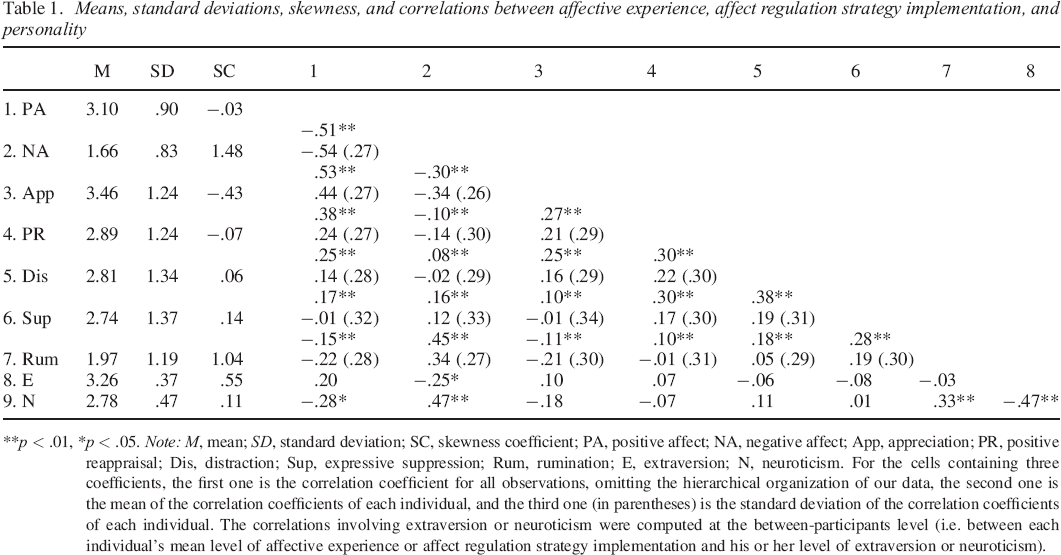
Before testing our hypotheses, we performed descriptive analyses of the variables of interest in our research (see Table 1). This first step served mainly to ensure that the relationships we observed between our indicators of affective experience and affect regulation strategy implementation were consistent with what is generally outlined in literature. As the analyses did not require the data lagging described previously, they were performed on all 4724 assessments to which participants responded.
Means, standard deviations, skewness, and correlations between affective experience, affect regulation strategy implementation, and personality
p < .01,
p < .05.
Note: M, mean; SD, standard deviation; SC, skewness coefficient; PA, positive affect; NA, negative affect; App, appreciation; PR, positive reappraisal; Dis, distraction; Sup, expressive suppression; Rum, rumination; E, extraversion; N, neuroticism. For the cells containing three coefficients, the first one is the correlation coefficient for all observations, omitting the hierarchical organization of our data, the second one is the mean of the correlation coefficients of each individual, and the third one (in parentheses) is the standard deviation of the correlation coefficients of each individual. The correlations involving extraversion or neuroticism were computed at the between–participants level (i.e. between each individual's mean level of affective experience or affect regulation strategy implementation and his or her level of extraversion or neuroticism).
First, at a descriptive level, participants’ affective feelings throughout the experience sampling period were characterized by moderate positive affect (M = 3.10) and low negative affect (M = 1.66). The distribution of their experience of negative affect was positively skewed. However, we did not transform this variable, because the residuals of all the models described later were normal. Participants’ implementation of strategies was marked by quite intensive use of appreciation (M = 3.46), moderate use of positive reappraisal (M = 2.89), distraction (M = 2.81) and expressive suppression (M = 2.74), and nonintensive use of rumination (M = 1.97).
Second, correlations in Table 1 suggest that the relationships between the engagement in affect regulation strategies in the space of a few hours and the affect experienced at the end of this time interval were consistent with what is generally reported in the literature. In particular, we found positive correlations between the use of the three broad–minded strategies and the experience of positive affect, and between the implementation of the two narrow–minded strategies and the experience of negative affect.
Third, the relationships between extraversion, neuroticism, and mean experience of each type of affect and implementation of each affect regulation strategy for each individual were also generally coherent with prior findings. A higher level of neuroticism was associated with more negative affect (r = .47, p < .001) and less positive affect (r = −.28, p < .05) experiences. Conversely, a higher level of extraversion was accompanied by fewer feelings of negative affect (r = −.25, p < .05) and, marginally, more feelings of positive affect (r = .20, p = .08). Moreover, even though most of them were not significant, owing to the small number of participants (i.e. 78), the strength and the direction of the correlations between extraversion, neuroticism, and affect regulation strategy implementation were consistent with our predictions. The clearest example is the moderate correlation between neuroticism and rumination (r = .33, p < .01).
Finally, the correlation between extraversion and neuroticism (r = −.47, p < .001) may seem surprising, in view of the hypothesis that these two traits are independent (McCrae & Costa, 2005). Even though several studies using common measures of extraversion and neuroticism (e.g. NEO Five Factor Inventory) have obtained similar correlation coefficients (e.g. Olesen, Thomsen, & O'Toole, 2015; Sarubin et al., 2015), the correlation we obtained between these two traits suggests that some of our findings should be considered with caution.
Hypothesis testing
The network of affect regulation dynamics at the sample level
Our first hypothesis was that the network of affect regulation dynamics would be characterized at the sample level by positive feedback loops between positive affect and appreciation, positive affect and positive reappraisal, positive affect and distraction, negative affect and expressive suppression, and negative affect and rumination.
We used multilevel vector autoregressive models to test this hypothesis. More precisely, we computed seven models. Models 1 and 2 contained experience of positive affect and experience of negative affect at t − 1 as predictor variables, as well as implementation of the five strategies of interest between t − 1 and t. The outcome variable was experience of positive affect at t for Model 1 and experience of negative affect at t for Model 2. Models 3, 4, 5, 6 and 7 all contained the same predictor variables (experience of positive and negative affect at t − 1, and implementation of the five strategies between t − 2 and t − 1), but the outcome variable was the implementation, between t − 1 and t, of appreciation, positive reappraisal, distraction, expressive suppression, or rumination.
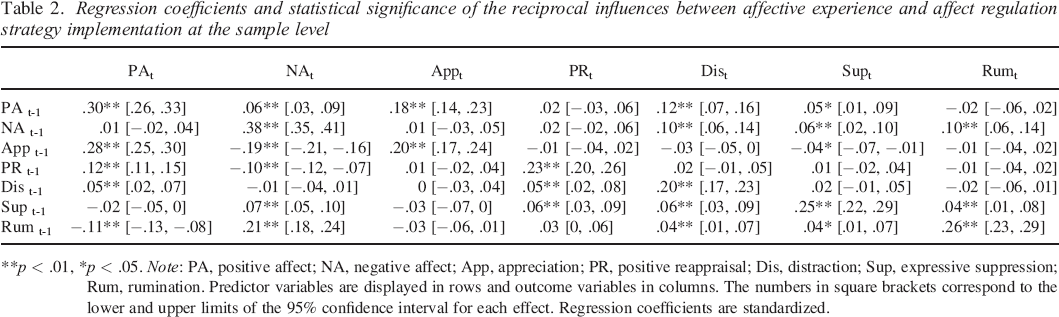
Results are set out in Table 2 and Figure 1. To make this figure easier to understand and interpret, we concealed effects that were not significant, or whose size did not exceed the absolute value of β = .10. 6 These effects were concealed but not removed, even though their removal is recommended in certain network approaches (e.g. Costantini et al., 2015). The main point of removing the spurious edges of a network is to refine the estimation of certain characteristics of that network (e.g. betweenness centrality, clustering coefficients). However, we did not need to estimate these characteristics to test our specific hypotheses.
Regression coefficients and statistical significance of the reciprocal influences between affective experience and affect regulation strategy implementation at the sample level
p < .01,
p < .05.
Note: PA, positive affect; NA, negative affect; App, appreciation; PR, positive reappraisal; Dis, distraction; Sup, expressive suppression; Rum, rumination. Predictor variables are displayed in rows and outcome variables in columns. The numbers in square brackets correspond to the lower and upper limits of the 95% confidence interval for each effect. Regression coefficients are standardized.

The network made up of the reciprocal influences between affect and affect regulation strategies at the sample level. Note. PA = positive affect; NA = negative affect; App = appreciation; PR = positive reappraisal; Dis = distraction; Sup = expressive suppression; Rum = rumination. Arrows correspond to the effects that exceeded the significance threshold (p < .05) and whose size exceeded the absolute value of β = .10. Solid lines correspond to positive effects, dashed lines to negative effects.
Results confirmed most of our predictions. First, we clearly observed a virtuous cycle between positive affect and appreciation, and a vicious cycle between negative affect and rumination. More specifically, positive affect felt at a particular time significantly promoted engagement in appreciation (β = .18, p < .001) within the space of a few hours. By the same token, appreciating the present more within this time interval significantly increased the positive affect experienced afterwards (β = .28, p < .001). Likewise, within a few hours of experiencing more negative affect, individuals ruminated more (β = .10, p < .001), and engaging more in rumination within this time interval increased their subsequent experience of negative affect (β = .21, p < .001).
Second, when we focused on the significance of the effects we had examined, we observed another virtuous cycle, between positive affect and distraction, as well as another vicious cycle between negative affect and expressive suppression. Although these effects were significant, the size of some of them was too small for us to interpret them as contributing to the occurrence of such positive feedback loops. More specifically, small effect sizes were found for the effect of implementing distraction on the experience of positive affect (β = .05, p < .001), the influence of engaging in expressive suppression on the experience of negative affect (β = .07, p < .001), and the influence of negative affect feelings on the subsequent use of this strategy (β = .06, p < .01).
Finally, contrary to what we predicted, whereas implementing more positive reappraisal increased feelings of positive affect within a few hours as expected (β = .12, p < .001), feelings of positive affect did not influence subsequent implementation of this strategy (β = .02, p > .05).
A more precise examination of Table 2 and Figure 1 reveals three more interesting results. First, each component of the network displayed self–loops. These autoregressive effects systematically had the largest sizes, reflecting so–called affective inertia (Kuppens, Allen, et al., 2010a) as regards our indicators of positive and negative affect experience. Affective inertia provides information about the rapidity of change in the relevant affect during a given interval. High inertia (i.e. regression coefficient very close to 1) reflects slow change (a form of rigidity) and resistance to change, whereas low inertia (i.e. regression coefficient very close to 0) reflects rapid change (a form of flexibility, susceptibility to change). In the present research, modest inertia was observed not only in affective experience, but also in affect regulation strategy implementation, which has received less attention from researchers.
Second, within a few hours of experiencing more negative affect, individuals tended to implement coping strategies (i.e. strategies designed to regulate negative affect experiences) more intensively. Feeling this type of affect not only enhanced subsequent use of rumination and expressive suppression, but also promoted the implementation of distraction (β = .10, p < .001). This suggests that affect regulation dynamics are partly driven by the motivation to change unwanted feelings after their elicitation, as posited by the most prominent models of affect regulation (e.g. Gross, 2015).
Third, strategies whose implementation is known to exert the strongest influence on affective life impacted feelings of both positive and negative affect. More intensive engagement in appreciation and positive reappraisal was associated not only with enhanced subsequent experience of positive affect, but also with reduced experiences of negative affect (βs = −.19 and −.10, p < .001). Likewise, ruminating more was followed not only by a heightened experience of negative affect, but also by a decreased feeling of positive affect (β = −.11, p < .001).
In summary, regarding our hypothesis, the dynamics of affect regulation at the sample level appeared to be characterized by two systems. Negative affect and narrow–minded strategies reinforced each other, even though only the vicious cycle involving rumination had a large effect size. Likewise, virtuous cycles emerged between positive affect and some broad–minded strategies, but only the cycle featuring appreciation had a large size, the one involving distraction having a smaller one. As regards the positive feedback loop between positive affect and positive reappraisal that we expected to observe at the sample level, the following analyses enabled us to determine whether it could be identified among some individuals, or did not appear at all.
Variations in the network of affect regulation dynamics related to extraversion
Our second hypothesis was that the network of affect regulation dynamics varies according to extraversion. More specifically, we predicted that these variations would mainly be manifested in the positive feedback loops between experience of positive affect and use of broad–minded strategies. These loops would become more intense as the level of extraversion increased.
To test this hypothesis, we calculated the same seven models as for the first hypothesis, adding the multiplicative effect of extraversion to their predictor variables. As neuroticism and extraversion were correlated in our study, we also included the additive effect of neuroticism, to neutralize its potential confounding effect. First, these models enabled us to determine which connection in the network was significantly moderated by extraversion. Second, the coefficients estimated by these models were used to predict the distinctive networks that fictitious individuals with either low extraversion (1.5 standard deviations below the mean) or high extraversion (1.5 standard deviations above the mean) would display. Results for these two networks are set out in Table 3 and on the top of Figure 2. The effects that were significantly moderated by extraversion are shown in bold in Table 3, and in black in the two networks on the top of Figure 2. In these networks, we chose to represent some effects whose size was below the absolute value of β = .10 but above the absolute value of β = .05, as they were significantly moderated by extraversion, and thus relevant to our analyses. Table 3 also provides the AICs of the seven models we calculated, with and without the inclusion of the multiplicative effect of extraversion.
Regression coefficients of the reciprocal influences between affective experience and affect regulation strategy implementation among individuals with low versus high extraversion scores
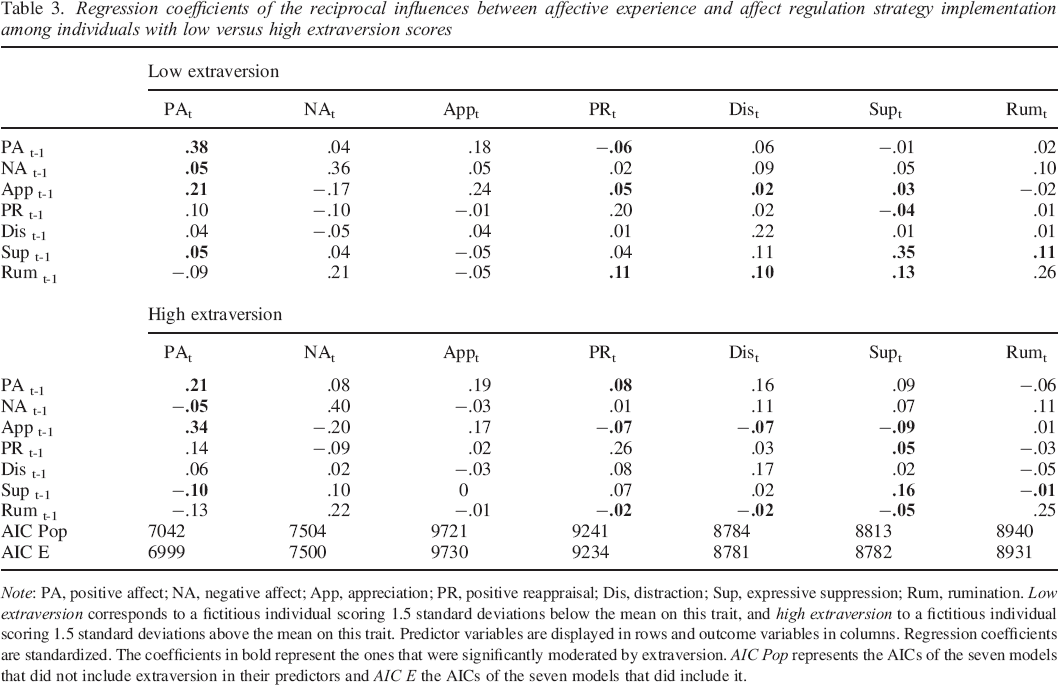
Note: PA, positive affect; NA, negative affect; App, appreciation; PR, positive reappraisal; Dis, distraction; Sup, expressive suppression; Rum, rumination. Low extraversion corresponds to a fictitious individual scoring 1.5 standard deviations below the mean on this trait, and high extraversion to a fictitious individual scoring 1.5 standard deviations above the mean on this trait. Predictor variables are displayed in rows and outcome variables in columns. Regression coefficients are standardized. The coefficients in bold represent the ones that were significantly moderated by extraversion. AIC Pop represents the AICs of the seven models that did not include extraversion in their predictors and AIC E the AICs of the seven models that did include it.
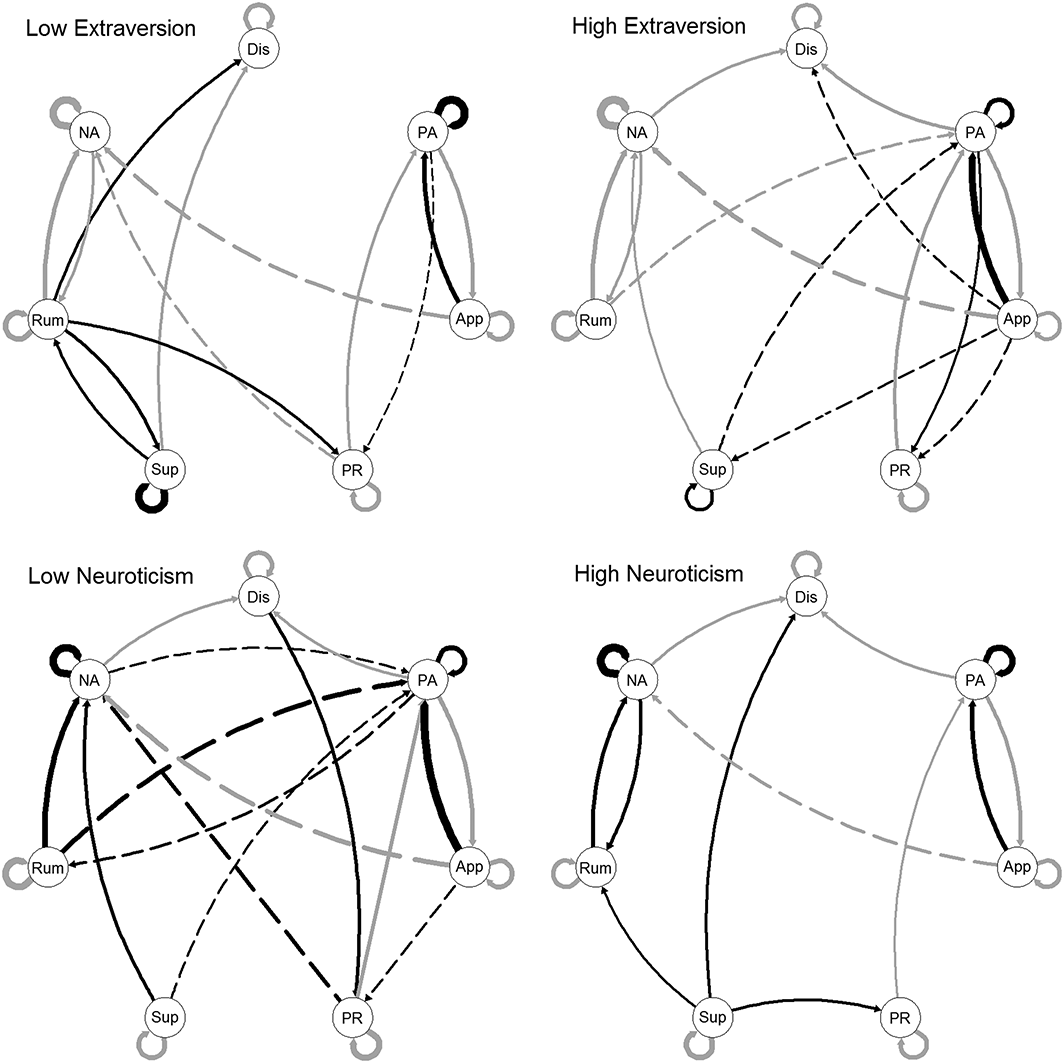
The network made up of the reciprocal influences between affect and affect regulation strategies among individuals scoring low or high on extraversion (on the top) and neuroticism (at the bottom). Note. PA = positive affect; NA = negative affect; App = appreciation; PR = positive reappraisal; Dis = distraction; Sup = expressive suppression; Rum = rumination. Arrows are effect sizes above the absolute value of β = .10, or between the absolute values of β = .06 and β = .10, if they were significantly moderated by extraversion for the two networks on the top of this figure, and by neuroticism for the two networks at the bottom of it. Solid lines correspond to positive effects, dashed lines to negative effects. Black arrows refer to the effects that were significantly moderated by extraversion for the two networks on the top of this figure or by neuroticism for the two networks at the bottom of it, grey arrows to the effects that were not.
Results were generally consistent with our hypothesis. Extraverted and introverted individuals differed in the form of their affect regulation dynamics. The AICs in Table 3 notably reveal that six of the seven models we calculated had a better fit when they contained the multiplicative effect of extraversion. Extraverted individuals were characterized by low positive affective inertia (β = .21), indicating rapid change in this affect. This type of low inertia reflects the tendency of the most extraverted individuals to display greater flexibility in their positive affective lives, possibly manifested in the rapid emergence of the virtuous cycles we explored in this study.
Two observations are consistent with this idea. First, extraverted individuals were the only ones to exhibit a positive feedback loop between positive affect and positive reappraisal, in addition to the virtuous cycle between positive affect and appreciation we had already identified at the sample level. Specifically, extraverted individuals were the only participants whose use of positive reappraisal was prompted by a more intense previous experience of positive affect (β = .08), even though the size of this effect was small. Second, the virtuous cycle we had already identified at the sample level tended to be more intense among these participants. In particular, appreciating the present had a greater influence on the feelings of positive affect of the most extraverted individuals (β = .34) than on the feelings of positive affect of their most introverted counterparts (β = .21).
In contrast to their extraverted peers, the most introverted individuals displayed high positive affective inertia within the time interval we chose (β = .38). Their positive affective lives therefore appeared to be more rigid—a rigidity that may have been expressed in their tendency to go through the virtuous cycles of interest more slowly. In particular, introverted individuals failed to display a positive feedback loop between positive affect and positive reappraisal, as they tended to implement less positive reappraisal within a few hours of experiencing more positive affect (β = −.06). Furthermore, as set out earlier, the use of appreciation had a smaller impact on their feelings of positive affect than on the feelings of positive affect of their extraverted counterparts.
Albeit less closely related to our hypotheses, a final interesting observation regarding the positive affect feelings of introverted individuals concerns the particular relationship between this type of feeling and their engagement in expressive suppression. More specifically, suppressing affective expression for a few hours did not reduce their subsequent feelings of positive affect (β = .05), contrary to what we observed among their more extraverted peers (β = −.10). If using expressive suppression does not noticeably impact affective experiences in the short term among introverted individuals, and if the main function of affect regulation strategies is to modify affective experiences, then introverted individuals may be less motivated to modulate expressive suppression (i.e. change the intensity with which this strategy is used) than extraverted individuals. This reduced inclination to control this strategy may explain the high expressive suppression inertia observed among introverted individuals (β = .35), compared with their extraverted peers (β = .16).
Taken together, our results suggest that considering extraversion is important for understanding affect regulation dynamics more fully. As expected, the variations in the network of affect regulation dynamics brought about by this trait mainly concerned the positive feedback loops between the experience of positive affect and the use of broad–minded strategies. Extraverted individuals displayed more–and more intense–virtuous cycles than their more introverted peers.
Variations in the dynamic network of affect regulation related to neuroticism
Our third hypothesis was that the network of affect regulation dynamics varies according to neuroticism. These variations would mostly be identified in the positive feedback loops between experience of negative affect and implementation of narrow–minded strategies. These loops would become stronger as neuroticism increased, and their components (i.e. negative affect, expressive suppression, rumination) would become less inhibited by the components of the virtuous cycles.
We tested this hypothesis by performing the same seven models as before, adding the multiplicative effect of neuroticism and the additive effect of extraversion to their predictor variables, and using the coefficients estimated by these models to predict the distinctive networks that fictitious individuals with low (1.5 standard deviations below the mean) and high (1.5 standard deviations above the mean) neuroticism would exhibit. The results are set out in Table 4 and in the two networks at the bottom of Figure 2. The effects that were significantly moderated by neuroticism are shown in bold in Table 4, and in black in the two networks at the bottom of Figure 2. Table 4 also contained the AICs of the seven models constituting the network with and without the inclusion of the multiplicative effect of neuroticism.
Regression coefficients of the reciprocal influences between affective experience and affect regulation strategy implementation among individuals with low versus high neuroticism scores
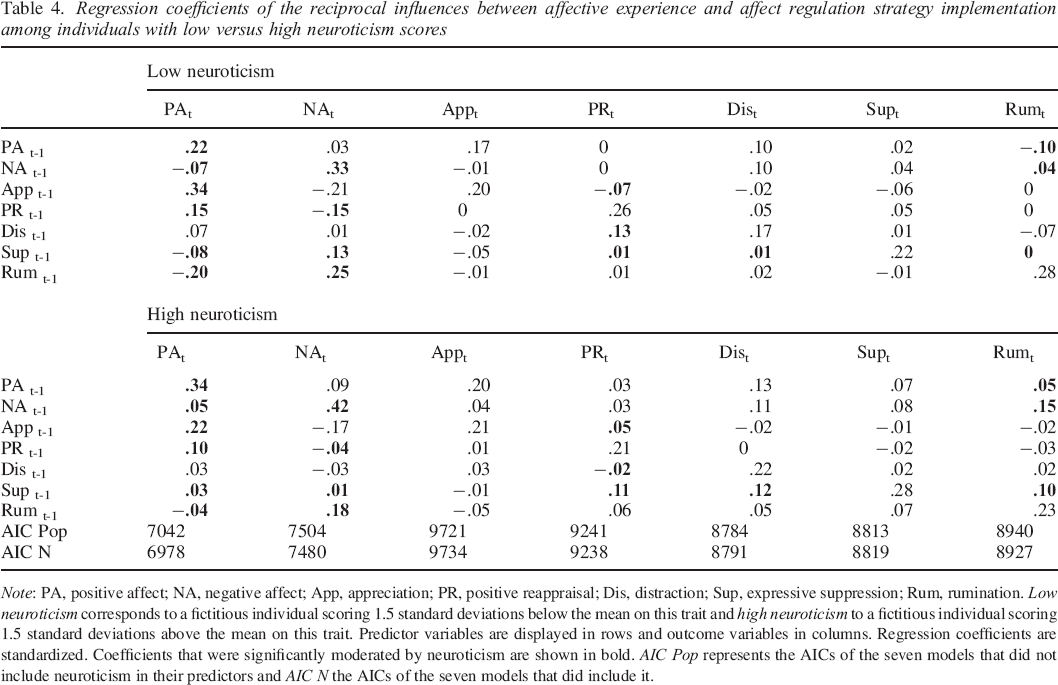
Note: PA, positive affect; NA, negative affect; App, appreciation; PR, positive reappraisal; Dis, distraction; Sup, expressive suppression; Rum, rumination. Low neuroticism corresponds to a fictitious individual scoring 1.5 standard deviations below the mean on this trait and high neuroticism to a fictitious individual scoring 1.5 standard deviations above the mean on this trait. Predictor variables are displayed in rows and outcome variables in columns. Regression coefficients are standardized. Coefficients that were significantly moderated by neuroticism are shown in bold. AIC Pop represents the AICs of the seven models that did not include neuroticism in their predictors and AIC N the AICs of the seven models that did include it.
Results did not entirely support our hypothesis. Differences emerged in the affect regulation dynamics of the most and the least neurotic individuals. In particular, the AICs in Table 4 reveal that four of the seven models constituting the network had a better fit when they contained the multiplicative effect of neuroticism. However, the neuroticism–related differences we observed did not exactly follow the predicted pattern.
One of the main characteristics of the affect regulation dynamics of the most neurotic individuals was the rigidity of their affective feelings, that is, the resistance of these feelings to change during the time interval we examined. First, this rigidity manifested itself in a high level of negative affective inertia (β = .42). This resistance to change may explain why, as compared with what occurs among their less neurotic peers, the engagement in rumination by the most neurotic individuals had a reduced influence on their negative affect experiences (β = .18), contrary to what we had predicted. Therefore, even though the most neurotic individuals were particularly inclined to ruminate after feeling negative affect (β = .15), the reduced effect of rumination on this negative affect meant that there was no intensification in the vicious cycle between negative affect and rumination among the most neurotic individuals. Similarly, the most neurotic individuals showed no intensification of the vicious cycle between negative affect and expressive suppression, owing to the resistance of their negative affect feelings to change brought about by previous use of this strategy (β = .01). Interestingly, their negative affect experiences were also resistant to the intensity with which they used positive reappraisal (β = −.04), confirming our hypothesis that, as neuroticism increases, some vicious cycle components are less inhibited by virtuous cycle components.
Rigidity was also observed in the positive affect feelings of the most neurotic individuals, as suggested by their high positive affective inertia (β = .34). Once again, their positive affect feelings were characterized by low dependence on the strategies they had previously used. More specifically, compared with what we observed among their less neurotic peers, these feelings were quite resistant to the intensity with which they engaged in appreciation (β = .22), expressive suppression (β = .03), and rumination (β = −.04).
Contrary to their more neurotic counterparts, the least neurotic participants displayed low positive (βs = .22) and low negative (βs = .33) affective inertia. This may have reflected their tendency to experience intense virtuous and vicious cycles within the short time interval we chose, mainly owing to the dependence of their affective experiences on the strategies they implemented.
Finally, the specific tendency of positive affect experiences to inhibit subsequent engagement in rumination among the least neurotic individuals (β = −.10) was an interesting finding in relation to our hypothesis. In addition to the enhanced influence of positive reappraisal on feelings of negative affect (β = −.15), it suggests that some of the vicious cycles were particularly inhibited by components of the virtuous cycles among these individuals.
In summary, interindividual differences in neuroticism were associated with several variations in the network of affect regulation dynamics. Contrary to what we had predicted, the positive feedback loops between experience of negative affect and implementation of expressive suppression and rumination did not intensify as the level of neuroticism increased. This may have been due to the increased rigidity (i.e. resistance to change) that the most neurotic individuals displayed in their feelings of negative affect, compared with their less neurotic peers. Nevertheless, the components of these vicious cycles tended to be less inhibited by virtuous cycle components as the level of neuroticism increased, in line with our prediction, even though neuroticism had few significant moderating effects on these inhibitory influences.
Discussion
The present study was designed to test a model of affect regulation dynamics based on the reciprocal influences that affect and affect regulation strategies exert on each other over time. To this end, we applied a network approach resting on multilevel vector autoregressive models (Bringmann et al., 2013), to data collected using an experience sampling method comprising five daily assessments over a 2–week period. This procedure enabled us to reveal a network of short–term relationships between the experience of positive and negative affect, and engagement in broad–minded strategies (i.e. appreciation, positive reappraisal and distraction) and narrow–minded strategies (i.e. expressive suppression and rumination) that occur in daily life. To understand these dynamics more fully, we also analysed how they vary according to extraversion and neuroticism.
Theoretical discussion of results
The results obtained at the sample level suggested that affect regulation dynamics can be characterized by two systems, as hypothesized. The first one mainly consists of a virtuous cycle between experience of positive affect and implementation of the broad–minded strategy of appreciation. A virtuous cycle also appeared between experience of positive affect and engagement in another broad–minded strategy, namely distraction, but its size was weak. The second system was mainly composed of a vicious cycle between experience of negative affect and engagement in the narrow–minded strategy of rumination (the vicious cycle we identified between this type of affect and the implementation of expressive suppression was considerably weaker).
Our results regarding the impact of affect regulation strategy implementation on affective experience are consistent with prior findings that appreciating the present and distracting oneself promote feelings of positive affect, whereas suppressing one's affective expressions and ruminating encourage negative affect experiences (e.g. Erisman & Roemer, 2010; John & Gross, 2004; Nolen–Hoeksema & Morrow, 1993). As regards the impact of affective experience on the implementation of affect regulation strategies, our findings are in line with theory–based hypotheses focusing on the broad influence of affective feelings on cognition and behaviour.
Specifically, consistent with the broaden–and–build theory (Fredrickson, 1998, 2001), positive affect feelings appeared to trigger a broadening mechanism for cognition and behaviour, as these feelings facilitated the subsequent use of two broad–minded strategies (i.e. appreciation and distraction). Likewise, the strategies we perceived of as narrow–minded (i.e. expressive suppression and rumination) were more intensively used within a few hours of experiencing more negative affect, supporting the notion that this type of affect triggers a narrowing process. In addition, affective priming theory (Bowers, 1991) may explain why we found that experiencing positive affect encouraged the implementation of appreciation more than that of distraction, and why feeling negative affect facilitated engagement in rumination more than that in expressive suppression. This theory states that, owing to the particular organization of information in memory, the experience of a positive affect activates a number of pleasant information items stored in memory, whereas the experience of a negative affect activates a variety of unpleasant information items. Consequently, an experience of positive affect temporarily leads individuals to be more inclined to display positive thoughts, positive interpretations of the environment, or positive biases in attention deployment. In this state, individuals may be more likely to use appreciation (i.e. a strategy based on the display of all these positive characteristics) than distraction (i.e. a strategy that can merely consist of a departure from negative stimuli). As with positive affect experiences, according to affect priming theory (Bowers, 1991), an experience of negative affect temporarily leads individuals to be more inclined to display negative thoughts, negative interpretations of the environment, or negative biases in attention deployment. In this state, individuals are more likely to ruminate (i.e. a strategy based on the display of negative thoughts and the fixation of attention on negative stimuli) than to use expressive suppression (i.e. a strategy that consists mainly of mere behavioural inhibition). Finally, contrary to what these two theories led us to hypothesize, we did not observe any influence of the experience of positive affect on subsequent engagement in positive reappraisal at the sample level. One possible reason is that we did not examine the interaction between positive and negative affect experiences, even though positive reappraisal may be used in a context in which both affects are intensely felt (Folkman, 1997).
Examining the way that affect regulation dynamics varied according to extraversion and neuroticism yielded other interesting findings. As predicted, variations due to extraversion were mainly expressed in the virtuous cycles of interest in this research. The most extraverted individuals displayed more intense and more numerous virtuous cycles than their most introverted counterparts. Specifically, extraverted individuals were the only ones to display a virtuous cycle between positive affect and positive reappraisal, in addition to the virtuous cycle between positive affect and appreciation we had already identified at the sample level. Furthermore, this virtuous cycle observed at the sample level was stronger among extraverted individuals than among their most introverted peers. Importantly, both cycles appeared to be driven by an aspect of affect regulation dynamics that was present in the most extraverted individuals and mainly lacking in their most introverted peers, namely a form of flexibility (i.e. easily changing their feelings of positive affect). Taken together, these findings confirm the observation that an enhanced level of extraversion is associated not only with greater susceptibility to feelings of positive affect (Larsen & Ketelaar, 1991), but also with a stronger dependency of psychological functioning on current experience of positive affect (Hirsh et al., 2010).
Neuroticism–related variations in affect regulation dynamics were first identified in the expected inhibition of vicious cycle components by virtuous cycle ones. We found that this inhibition tended to disappear as the level of neuroticism increased. By contrast, contrary to what we predicted, the vicious cycle between negative affect and rumination, as well as the fainter one between negative affect and expressive suppression, tended to be weaker among neurotic individuals than among their less neurotic peers. One possible cause of this reduced intensity of the vicious cycles between negative affect and narrow–minded strategies among neurotic individuals is the overall resistance of their affective feelings to the intensity with which they implemented one strategy or another. The weak impact that affect regulation strategy use had on affective feelings among neurotic individuals may reflect the deterioration in affect regulation skills that accompanies an enhanced level of neuroticism (Yoon et al., 2013). Importantly, it may also reflect the increased inertia (i.e. resistance to change) we observed in the negative and positive affect feelings of neurotic individuals compared with their less neurotic counterparts. Interestingly, the stronger affective inertia that accompanies an increased level of neuroticism, especially in negative affect experiences, has already been identified or suggested by a number of studies (e.g. Bringmann et al., 2016; Kuppens, Allen, et al., 2010a; Suls et al., 1998).
Theoretical implications
Taken together, our findings may have theoretical implications. In particular, they suggest that a considerable proportion of the affect regulation dynamics that take place within the space of a few hours consists of positive feedback loops between the experience of certain affects and the use of certain affect regulation strategies. This idea contrasts with the main models of affect regulation currently endorsed in the literature (e.g. Gross, 2015; Kuppens, Oravecz, et al., 2010b), as these models mainly predict the occurrence of negative feedback loops between affect and affect regulation strategies. This contrast is intriguing, as several affect regulation strategies have been thought to give rise to negative feedback processes with the experience of certain affects. One simple example is positive reappraisal or, more generally, cognitive reappraisal. This strategy is assumed to arise in a context in which individuals feel a negative affect owing to their negative interpretation of a situation. Furthermore, this strategy is assumed to decrease this initial negative affect by generating more favourable interpretations of the situation (e.g. Beck, 2011; Lazarus & Folkman, 1984), thus contributing to a negative feedback process. However, in the short term, owing to their impact on behaviour and cognition (Bowers, 1991; Fredrickson, 1998, 2001), affective experiences appear mainly to promote the use of affect regulation strategies that are likely to maintain or reinforce them, thus creating positive rather than negative feedback loops. Importantly, Gross (2015) acknowledges in one sentence that an affective feeling can influence the use of affect regulation strategies not only by heightening, when this feeling is negatively evaluated, the motivation to change it (i.e. process that generally gives rise to negative feedback loops), but also through the impulse this feeling triggers (Gross, 2015, p. 14). This impulse seems to refer to the broad impact that affective experience has on cognition and behaviour (Bowers, 1991; Fredrickson, 1998, 2001), which may deserve greater attention in affect regulation theories, as our findings suggest that it makes a considerable contribution to the short–term dynamics of affect regulation.
Limitations and suggestions for future research
Nevertheless, further research is needed to extend our exploration of this area, while addressing some of the present study's limitations. To begin with, even though this initial study yielded some interesting findings, it might be worthwhile exploring a wider range of affect regulation strategies than that covered in this research. This might help us gain a better understanding of the number and proportion of positive and negative feedback loops between affect and affect regulation strategies that constitute affect regulation dynamics. However, proceeding thus would be complex for two reasons. First, experience sampling studies require short assessments to which quick responses can be made, knowing that these assessments need to contain both affect– and affect regulation strategy–related items. This therefore constrains the number of the latter items. For instance, our decision to use 12 affect–related items in the present study on the basis of Yik et al. (2011)'s model considerably constricted the number of affect regulation strategies we could examine. Second, examining a larger number of affect regulation strategies could prove complex, as the multilevel vector autoregressive approach adopted in the literature only considers the unique effects that the variables have on each other. In other words, examining too many affect regulation strategies is likely to considerably reduce, or even suppress, the influence exerted by each of these strategies on affective experience. Tools enabling both unique and shared effects to be considered, such as relative importance matrices, are available in the literature, but are hardly applicable to multilevel vector autoregressive approaches (Bulteel et al., 2016).
A second limitation of this study is its generalizability. Our results were obtained from a single sample of 78 individuals, all living in the same country. Thus, future research will need to be conducted with different samples, to determine the extent to which our initial results can be generalized. Importantly, the sample from which we collected our data was sufficient to identify statistically significant effects, including cross–level interaction effects. However, some of the data analysis strategies we used in this study (i.e. not including random slopes, not using correction for multiple comparisons) may have led to the significance of the effects we examined being overstated. Although it is conceivable that not including random slopes can yield just as many Type–II errors as Type–I errors, and although applying corrections for multiple comparisons to multilevel vector autoregressive models is, for the time being, virtually unfeasible (Epskamp, Borsboom, & Fried, 2016), further research is needed to address the robustness of our findings.
A third limitation of the present study is that it did not contain any assessment of the occurrence of affectively salient events. However, an individual's current affective feeling depends on a myriad of influences interacting with one another, including previous affective feelings, thoughts, behaviours, motivational states, and events. The interplay between these main determinants will need to be the subject of future comprehensive network approach–based studies.
Conclusion
To conclude, the present study yielded two main findings. First, affect regulation dynamics, when conceptualized as a network made up of units (i.e. affect and affect regulation strategies) that influence each other over time, is mainly characterized by positive feedback loops between positive affect and some broad–minded affect regulation strategies, and between negative affect and some narrow–minded strategies. Second, stable interindividual differences in extraversion and neuroticism are not only manifested in the tendency to display one affect or another, or one affect regulation strategy or another, but are also expressed in the pattern of temporal relationships between these units.
Supporting info item
Supporting info item, per2109-sup-0001-Open_Practices_Disclosure_Form - A Network Approach to Affect Regulation Dynamics and Personality Trait–Induced Variations: Extraversion and Neuroticism Moderate Reciprocal Influences between Affect and Affect Regulation Strategies
Supporting info item, per2109-sup-0001-Open_Practices_Disclosure_Form for A Network Approach to Affect Regulation Dynamics and Personality Trait–Induced Variations: Extraversion and Neuroticism Moderate Reciprocal Influences between Affect and Affect Regulation Strategies by Pavani Jean–Baptiste, Le Vigouroux Sarah, Kop Jean–Luc, Congard Anne, Dauvier Bruno and Denissen Jaap in European Journal of Personality
Open_Practices_Disclosure_Form
Footnotes
Notes
References
Supplementary Material
Please find the following supplemental material available below.
For Open Access articles published under a Creative Commons License, all supplemental material carries the same license as the article it is associated with.
For non-Open Access articles published, all supplemental material carries a non-exclusive license, and permission requests for re-use of supplemental material or any part of supplemental material shall be sent directly to the copyright owner as specified in the copyright notice associated with the article.
